← Back to Archive

Digest for 2026-10-14

🐦 Share on X 💼 Share on LinkedIn 📘 Share on Facebook

Average-Reward Policy Identification from a Single Continuing Trajectory
By Tongxi Wang • arXiv • Importance: 92/100
Hero Image for 2610.20486

Decoding Optimal AI: Learning from Just One Path! 🚀

Ever wondered how self-driving cars or sophisticated robots learn? Most folks think they need millions of miles of driving data. But what if the theory says you don’t?

This groundbreaking research tackles a fundamental bottleneck in Reinforcement Learning (RL): Data Efficiency. Traditionally, learning an optimal policy means having free access to every possible state-action pair—a perfect dataset. However, in real-world scenarios, especially complex environments like industrial robots or autonomous vehicles, your ‘experience’ is constrained to the single path you actually take. This limits how much information your agent can gather.

This paper, “Average-Reward Policy Identification from a Single Continuing Trajectory” https://arxiv.org/abs/2610.20486, flips that script. It mathematically proves that for average-reward settings, the extra time and complexity cost of navigating (i.e., collecting information slowly along a single path) is often unnecessary.

💡 What’s the Big Idea? The Information Advantage

The researchers introduce an elegant algorithm designed to be highly efficient in how it collects necessary data. Instead of just running random actions, their approach learns strategically where and when to gather information, ensuring that even a single continuous trajectory yields enough ‘experience’ to identify a near-optimal policy.

Crucially, the paper provides two powerful proofs:

  1. Upper Bound: They establish a tight upper bound on the necessary interactions, giving us concrete guarantees on training complexity.
  2. Lower Bound (The Game Changer): This is the most impactful part. By matching information-theoretic lower bounds, they show that learning from one single trajectory in the worst case is no harder—in fact, it’s comparable—to learning with unlimited, unrestricted access to samples.

🌐 Why Does This Matter for AI Development?

For ML researchers and engineers working on deployment (especially robotics, factory automation, or resource-constrained edge devices), this changes the game:

  • Real-World Feasibility: It solves a core theoretical mismatch between controlled simulation environments and messy real-world deployments.
  • Reduced Data Needs: If theory proves less data is needed, it dramatically cuts down the cost (time, compute, physical equipment) of training expensive AI agents.
  • Robustness: The ability to learn effectively from limited or constrained observational data improves system robustness in unpredictable environments.

The Takeaway: Don’t assume more samples always mean better learning. By intelligently adapting how we gather information based on the environment’s inherent information structure, we can achieve optimal policy identification using significantly less interaction time than previously thought possible.


Developed for ML practitioners in North America and Europe to stay ahead of state-of-the-art research.
The COUNT: Counting N-grams Unlocks Scaling on Host Memory and Training-Free Adaptation

By Ian Magnusson, Noah A. Smith, Pang Wei Koh • arXiv • Importance: 92/100
Hero Image for 2610.20456

✨ Breaking the LLM Memory Wall: Introducing COUNT for Ultra-Efficient NLP

The biggest bottleneck in scaling large language models (LLMs) isn’t always pure compute—it’s often memory. As we push toward trillions of parameters, how do we integrate critical knowledge like n-grams without overwhelming expensive GPU VRAM?

Traditional methods are forcing us to train massive embedding tables from scratch directly on the GPU, which eats up precious memory and requires immense computational resources. But what if we could leverage the cheap, abundant memory sitting right next to our GPUs: Host Memory?

Introducing COUNT (Counting Offline Unlocks N-gram Transformers)—a groundbreaking approach that changes how LLMs incorporate domain knowledge.

🧠 How COUNT Works (The Game Changer)

Instead of adding learned n-gram embeddings that balloon the GPU memory footprint, COUNT smartly moves the core intelligence to the host system. It bypasses the need for expensive training and colossal embedding tables by doing the following:

  1. Offline Counting: The model precomputes n-gram counts using a corpus’s inherent frequencies.
  2. Knowledge Integration: It weights together the LLM’s existing unembeddings (the probability distribution of next tokens) based on these external, domain-specific counts.
  3. Zero GPU Bloat: Crucially, this process requires no additional learned parameters or massive embedding lookups in the GPU memory, dramatically reducing VRAM usage.

🚀 Why This Matters for LLMs and Deployment

This isn’t just an academic tweak; it changes the practical limits of deployment:

  • Memory Efficiency: At a fixed compute budget, COUNT allows us to improve validation loss significantly—performing as well as an LM trained with over 57% more compute!
  • GPU Memory Constraint Relief: When GPU VRAM is limited, using COUNT means we can dedicate the maximum possible parameters (the backbone model) while still gaining massive knowledge boosts, outperforming splitting the memory between learned embeddings and the core model.
  • Training-Free Adaptation (The Killer Feature): This is perhaps the most exciting part. At inference time, you can simply swap out the n-gram count table from a completely different, domain-specific corpus without retraining or fine-tuning. Just loading a new table instantly adapts the LLM to a new task or domain.

COUNT unlocks a path toward truly scalable and resource-efficient LLMs that are ready for diverse real-world environments, especially those constrained by memory budgets. For researchers looking to scale language modeling while respecting VRAM limits, this paper presents a powerful, novel solution.

🔗 Read the full details of COUNT here: The COUNT: Counting N-grams Unlocks Scaling on Host Memory and Training-Free Adaptation

Cortex: Consolidating Context into Parametric Memory

By Jintian Zhang, Feng He, Xinnian Liang, Ziwen Xu, Haoming Xu, Haojing Huang, Shuangzhi Wu, Ningyu Zhang • arXiv • Importance: 92/100

Cortex: Giving LLMs Long-Term Memory for Seamless Context Retention

You know how sometimes using a sophisticated AI model feels like it forgets everything you told it minutes ago? That ‘context window’ effect is frustrating, especially when deep application context matters. In the world of large language models (LLMs), improving performance with massive context windows has been the standard goal. But what if those gains evaporate once the conversation moves on?

This groundbreaking work introduces Cortex, a novel framework designed to solve this exact problem: memory consolidation. Drawing inspiration from how human brains stabilize memories—the process of consolidating temporary learning into long-term, robust knowledge—the researchers provide LLMs with a sophisticated mechanism for permanent, context-aware skill acquisition.

🧠 How Does Cortex Work? (The Core Idea)

Think of Cortex as the brain’s ‘save button’ for LLM knowledge. Instead of just processing temporary input tokens, it actively identifies valuable dependencies and patterns learned during a specific task or conversation segment. The system then distills this context-specific performance into permanent architectural updates (low-rank or structural feed-forward network updates).

Instead of requiring the entire conversation history to be re-fed repeatedly, Cortex merges that context knowledge directly into the model’s weights. This achieves several critical outcomes:

  1. True Consolidation: The gains derived from specific context edits (like teaching a niche skill or remembering user preferences) are internalized and persist over time.
  2. High Retention: Crucially, it does this without forgetting the skills or knowledge the model already possessed before the new training—a major challenge in continual learning.
  3. Generative Memory: It anticipates future uses of context by generating prospective queries, making the memory recall process much more efficient and targeted.

🔬 The Breakthrough Results

The team tested Cortex across a massive landscape of models (from 4B to 120B dense and Mixture-of-Experts backbones) and through challenging tasks like sequential factual edits. The results are highly impressive:

  • Sustained Learning: After simulating 50 sequential factual edits on a 14B model, Cortex-Structural maintained an impressive 88.9% recovery of the initial context-induced gain.
  • Minimal Forgetting: Critically, it preserved nearly all original capabilities, maintaining 99.8% of the model’s baseline performance.

The authors summarize that Cortex sits on the empirical consolidation–retention Pareto frontier, meaning it achieves state-of-the-art memory retention with minimal capability decay.

✨ Why Is This a Big Deal for AI?

Cortex moves LLMs beyond merely ‘reading’ context and allows them to truly learn from temporary interaction. This is a monumental step towards building genuinely personalized, reliable, and expert AI assistants that can maintain complex state over long periods, making applications in fields like medicine, legal consultation, and advanced education vastly more robust.

[Learn more about Cortex: Cortex: Consolidating Context into Parametric Memory]

Fractional is Better: Learnable Derivative Orders in Neural Operator Learning

By Fares B. Mehouachi, Saif Eddin Jabari • arXiv • Importance: 92/100
Hero Image for 2610.20363

Fractional is Better: Boosting Neural Operators with Learnable Derivatives

Are Neural Networks failing to fully capture the complexity of physics? Our new research suggests how to give them an essential structural upgrade.

As AI researchers increasingly tackle real-world scientific problems, we rely heavily on Neural Operators. These powerful models are designed not just to predict single points, but entire functions—making them invaluable for fast surrogate solutions to Partial Differential Equations (PDEs), which govern everything from climate modeling to quantum dynamics.

But even the best operators often face a fundamental bottleneck: they typically take raw coordinate-value pairs $(x, u(x))$ as input. This forces the network to learn complex derivatives implicitly, placing an unnecessary burden on its capacity.

📈 The Core Problem: Implicit vs. Explicit Physics

Our paper, Fractional is Better: Learnable Derivative Orders in Neural Operator Learning, asks a critical question: What if we gave the network the derivatives it needs, explicitly?

Following PDE theory (specifically, using Picard iteration on mild solutions), we found that the solution operator inherently depends on the input’s derivatives. By providing these derivative features directly to the model, we not only reduce the network’s implicit differentiation burden but significantly improve its theoretical approximation bounds. We improved the bound from $O(W^{-(s-m)/d})$ to a cleaner $O(W^{-s/d})$, where $W$ is parameters and $s$ is input regularity.

🔬 The Game-Changing Discovery: Optimal Order Gap

The most surprising, yet highly insightful, finding concerns the optimal derivative order ($eta^$). We prove that $eta^$ can be strictly less than the PDE’s native order ($m$). This gap isn’t a flaw—it reveals a complex bias-variance tradeoff in the spectral space. By characterizing this tradeoff in closed form, we give unprecedented theoretical depth to physical machine learning.

To harness this, we developed $oldsymbol{ u}$-NO ($ ext{del-NO}$): an architecture-agnostic augmentation that injects learnable fractional derivative features into any existing Neural Operator backbone. This enhancement doesn’t force the network to predict derivatives; it learns the optimal level of spectral regularization needed by the physics.

🚀 Why This Matters for Science and Industry

$ ext{del-NO}$ consistently boosts prediction accuracy across diverse benchmark problems and novel architectures. Crucially, the learned optimal orders ($eta^$) don’t just appear randomly; they reflect a delicate balance between known physical constraints (the PDE) and* the empirical limitations of finite data and noise.

This moves Neural Operators from being mere pattern matchers to sophisticated tools that respect underlying physics structure. If you work in computational fluid dynamics, climate modeling, or materials science, this paper introduces a vital structural refinement for your PDEs-solving pipelines.

Read the full technical details and understand how learnable spectral regularization can improve scientific AI today: https://arxiv.org/abs/2610.20363


#ScientificML #NeuralOperators #PDEs #DeepLearning #PhysicsInAI

Lifted State Policy Optimization: Internalizing Self-Correction through Transition Geometry

By Ren Zhuang, Ben Wang, Shuifa Sun • arXiv • Importance: 92/100
Hero Image for 2610.20350

✨ Training AI to Self-Correct: The Future of Reasoning with LSPO

Ever notice when a brilliant student or expert revises their work? They don’t just jump from the initial idea to the final polished answer. They refine it—they correct the wrong turn, they adjust the faulty premise. Cutting-edge AI needs this ability.

Traditional Reinforcement Learning (RL) methods often treat an entire generation sequence as a single black box. While they optimize the final result or the aggregate reward, they fail to credit the crucial local steps: the moment the model recognizes its own mistake and corrects it.

Our latest work introduces Lifted State Policy Optimization (LSPO), a breakthrough methodology that fundamentally changes how we train complex AI reasoning. Instead of viewing an answer as one continuous trajectory, LSPO treats the correction step—the localized transition from a flawed state to an improved one—as the primary unit of learning.

💡 How Does LSPO Work?

The genius of LSPO lies in creating a ‘lifted state.’ For every text generation, we augment it with a continuous, learned coordinate. This coordinate isn’t just metadata; it’s an energy signature that guides the model’s internal self-evaluation.

  1. Energy Function: We introduce an energy function that evaluates and orders candidate answers based on cost-adjusted transitions (energy descent). The process is driven by a shaped reward that minimizes ‘edit costs’ and maximizes logical flow.
  2. Internalization Loss: Critically, LSPO includes an internalization loss. This mechanism forces the model to absorb highly selected, low-energy corrections directly into its main generator weights. This means the ability to self-correct isn’t just a fancy post-processing step; it becomes baked into the core knowledge base.

🚀 Performance & Impact

The results are transformative. On Qwen3.5-27B, LSPO enables a single-pass policy that achieves 71.8% aggregate accuracy across demanding benchmarks (math, science, code, logic). Crucially, this matches the performance of state-of-the-art test-time reflection methods—which typically require extra computation and slower inference—but with:

  • ⏱️ 28% Lower Latency: Near instant self-correction.
  • 📄 25.8% Fewer Tokens: Highly efficient generation.
  • ✨ Simplified Architecture: The complex logic is now internalized into the model itself.

This research proves that optimizing local state transitions, rather than just final outputs, is key to building truly robust and reliable generative AI for real-world applications like deep reasoning and problem-solving.

🔗 Read the full technical details on LSPO here: Lifted State Policy Optimization: Internalizing Self-Correction through Transition Geometry

#AIResearch #MachineLearning #NLP #DeepLearning #SelfCorrection #GenerativeAI

Co-Evolving Acting and Forecasting for Language Agents

By Haofei Yu, Yixing Chen, Yining Zhao, Xuyan Ye, Yuxiang Liu, Zhigang Hua, Yan Xie, Shuang Yang, Jiaxuan You • arXiv • Importance: 90/100
Hero Image for 2610.20597

🤖 CoPE: Teaching Language Agents to Predict the Future and Act Like a Pro

Are you building large language agents that need to perform complex tasks in simulated or real-world environments? You’ve probably hit a major bottleneck: long-horizon reasoning is incredibly expensive. Standard reinforcement learning (RL) methods struggle with this because they typically learn only from the final, terminal reward—they ignore all the valuable steps and observations leading up to that success.

This massive gap in intermediate supervision has severely limited agent performance on real-world benchmarks like ALFWorld or WebShop.

We’ve been deep-diving into this problem, which is why we wrote our latest paper: CoPE: Co-Evolving Acting and Forecasting for Language Agents.

💡 The Core Problem with Current AI Agents

Imagine teaching an agent to bake a cake. Traditional RL just tells it ‘Success! (Reward: +100)’ or ‘Failure! (Reward: -1)’. It doesn’t tell the agent why it succeeded at mixing ingredients, or what crucial observation it missed when gathering supplies.

Current methods try to fill this gap by adding auxiliary targets—like predicting per-step value or fitting observed logs. But these approaches are often brittle and limited: prediction targets come from a single scalar signal, while observed text logs (like web pages) are too long, noisy, and only predict one step ahead.

✨ The CoPE Solution: Multi-Step Self-Supervision

We introduce CoPE, which revolutionizes agent training by adding a third kind of multi-step action target. Instead of just learning to react (acting) or just learning to guess the future (forecasting), CoPE forces the policy backbone to learn both simultaneously, making them co-evolve.

How it works: 1. Supervision from History: During on-policy rollout (successful attempts), CoPE doesn’t just use the final reward. It trains the language model/agent to predict the entire sequence of actions that successfully followed a given history. This creates a powerful, temporal ensemble. 2. Shared Backbone Magic: Critically, this action prediction training (forecasting) and the actual action selection during inference are handled by a single policy backbone. There’s no need for separate models, complex pretraining stages, or runtime overhead—it keeps things elegant and efficient.

🚀 Results: Smashes Existing Baselines

On five challenging real-world benchmarks (ALFWorld, ScienceWorld, WebShop, $ au^2$-bench, and AppWorld), CoPE demonstrates superior performance:

  • Stronger Performance: We beat state-of-the-art baselines like GRPO on aggregate performance across simulated environments.
  • Sample Efficiency Boost: On complex benchmarks like ScienceWorld, we achieved up to $1.9 imes$ higher sample efficiency compared to leading methods like ECHO and GRPO. This means learning faster with less data!
  • Efficiency Maintained: All these gains are achieved using just a single policy backbone, maintaining clean inference performance.

Takeaway: CoPE provides a powerful mechanism for language agents to absorb rich intermediate supervision, leading to dramatic improvements in sample efficiency and overall task completion without compromising computational simplicity.

🔗 Read the full paper and check out the codebase: CoPE: Co-Evolving Acting and Forecasting for Language Agents

#LLMs #AIAgents #ReinforcementLearning #GenerativeAI #DeepLearning

PrismaCoder: Pushing the Boundaries of Open Multimodal Code Intelligence through Decomposed Rubric Synthesis

By Qiushi Sun, Jingyang Gong, Yang Liu, Qiaosheng Chen, Zhangyue Yin, Zixian Huang, Hanxu Hu, Jing Xiong, Fangzhi Xu, Haochen Tan, Haoli Bai, Lifeng Shang, Xiaoguang Li, Ben Kao, Qipeng Guo, Lingpeng Kong, Jiahui Gao • arXiv • Importance: 90/100
Hero Image for 2610.20538

Unlocking Multimodal Code Intelligence: Introducing PrismaCoder

In the rapidly evolving landscape of AI, code generation is no longer just about spitting out syntactically correct functions. Today’s models need to see, render, and understand complex visual outputs—think generating interactive charts, perfectly styled web pages from a text prompt, or even replicating detailed diagrams. This field, known as Multimodal Code Intelligence, is pushing the boundaries of what AI can achieve.

However, this frontier has been dominated by closed-source proprietary models. To keep open research moving forward, we need massive amounts of high-quality, specialized data and robust methodologies to train on it.

The Core Problem: Quality Control in Visual Code

The biggest bottleneck isn’t just the quantity of code; it’s the quality. A piece of generated code must satisfy three strict criteria simultaneously:

  1. Program Correctness: It must run without bugs.
  2. Structural Integrity: It must be well-formed and architecturally sound.
  3. Visual Fidelity (The Hardest Part): When rendered, it must look exactly like the intended visual artifact (e.g., matching the layout of a screenshot or chart).

Existing data pipelines fail here. Standard execution only gives ‘Pass/Fail’; they don’t grade how wrong the code is visually.

💡 The Breakthrough: PrismaForge and Decomposed Rubric Synthesis

To solve this, our research introduces PrismaForge, a revolutionary hierarchical data pipeline. Instead of relying on simple binary pass/fail checks, we use a novel synthesized rubric that decomposes the complex requirements into numerous checkable criteria. This single, powerful rubric serves a dual function:

  • Data Curator: It meticulously filters and curates high-quality samples for our supervised training corpus.
  • Reward Driver: It powers Reinforcement Learning (RL) tasks, guiding models to not only pass tests but also achieving optimal visual appearance.

The result is PrismaCoder-2M, the largest and most diverse open dataset created specifically for multimodal code intelligence.

🚀 PrismaCoder: Leading Open State-of-the-Art

We trained highly capable models, PrismaCoder-9B and PrismaCoder-35B, on this massive, curated data set. The performance results are outstanding. Our models significantly raise the bar for open research, achieving state-of-the-art performance that directly rivals leading closed proprietary systems.

The significance of our work is twofold: we provide a dramatically improved pipeline (PrismaForge) and an equally large model and dataset (PrismaCoder) to accelerate the entire field. If you’re building tools for AI agents, developers, or visual content generation, this repository is a must-check.

👉 Get started: You can access our code and datasets here: qiushisun.github.io/PrismaCoder-Home/

For the technical details, check out the paper on arXiv.

ActiveEvidence: Decision-Focused Evidence Graphs with Verifiable Acquisition Gaps

By Miaobo Hu, Shuhao Hu, Xiaobo Guo, Xin Wang, Bokun Wang, Peng Zhang, Daren Zha, Jun Xiao • arXiv • Importance: 90/100
Hero Image for 2610.20532

Stop Guessing: How ActiveEvidence Senses When Enough Data is Enough

In the world of advanced AI agents, collecting data is expensive. Every single image, every chunk of text, and every API call costs time, money, and computational resources. Simply dumping everything into a model’s context window isn’t just inefficient—it can mislead the agent.

This new research from Hu et al. tackles one of the hardest problems in multimodal AI: knowing when to stop gathering evidence. They introduce ‘ActiveEvidence,’ a system that doesn’t just process data; it actively manages the acquisition of data, ensuring every piece gathered is necessary and maximally impactful.

🔬 The Problem: Computational Overload & Informational Blind Spots

The challenge is complex. Imagine an autonomous agent trying to solve a real-world mystery (e.g., analyzing surveillance footage or medical scans). It must decide not only what evidence is useful, but also whether querying that evidence is computationally worthwhile at all. The core decisions are:

  1. Is this visual evidence worth the cost? (Free vs. Paid observation boundary)
  2. Which candidate or resolution should I query next? (Optimization/Efficiency)
  3. Have I reached the point of diminishing returns, where more interaction won’t change my decision? (Stopping Criteria)

Traditional agents often operate on simple thresholds; ActiveEvidence uses deep structural certifiers to make these decisions under strict constraints.

🧠 How ActiveEvidence Works: Decision-Certifiable Evidence Graphs

The breakthrough lies in treating evidence acquisition as a quantifiable, graph-based decision process. Instead of just feeding raw data, the system builds and modifies a specialized structure called the Counterfactual Evidence Interaction Graph (CEIG).

This CEIG is powerful because it tracks: * Unary evidence value: The inherent worth of single pieces of evidence. * Signed second-order interaction: How two pieces of evidence influence each other (e.g., A validates B, or A contradicts B). * Directed conditional harm: Tracking when acquiring one piece might negatively impact the interpretation of another.

Crucially, ActiveEvidence calculates explicit ‘score enclosures’ for unresolved interactions. This allows it to mathematically prove that even if more data were acquired, the selected action would not change beyond a defined tolerance ($\epsilon$-decision certificate).

This means the agent doesn’t guess; it certifies its optimal stopping point.

⚡️ Key Technical Innovations You Need to Know

  • $oldsymbol{\epsilon}$-Decision Certificates: This is the core differentiator. The system verifies policy-consistent optimality by calculating the bounds on learned scores. It stops when these bounds prove that further evidence acquisition cannot change the final action.
  • Gap-Directed Refinement: Rather than evaluating all possible interactions, it only focuses its computational power on those ‘gaps’ of knowledge that could potentially displace the current best action.
  • Cost Separation: By separating the online operational cost filter from the core policy certification, the model gains robustness and transparency. It knows exactly what its decision costs before executing it.

🚀 The Results: Efficiency Meets Accuracy

The performance metrics speak to a massive leap in efficiency. While achieving high accuracy (Task score of 0.842; grounding F1 of 0.816), the system drastically cuts down on redundant querying.

Crucially, it evaluates only 19.6 expensive interaction terms per decision, compared to a potential 191.4 if it were brute-forcing all possibilities. This represents an immense saving in both computation and time—a game-changer for real-time, resource-constrained AI deployments.

ActiveEvidence isn’t just about better performance; it’s about resource-aware reasoning. It teaches agents to be judicious, intelligent data gatherers rather than simply enthusiastic vacuum cleaners of information. This pushes the frontier toward truly autonomous and practical multimodal intelligence.

The Physics Is the Network: Fast, Training-Free Neural Emulation

By Luka Todorovic, Kaushal Gianchandani, Sai Ravela • arXiv • Importance: 90/100
Hero Image for 2610.20525

The Physics Is the Network: Training-Free Neural Emulation

If you’ve ever wondered how AI could solve complex physical simulations—from fluid dynamics to quantum mechanics—you might think it needs massive amounts of data and months of training. Think again.

Researchers at arXiv have proposed a paradigm shift in scientific computing: PolyNets. This approach ditches the need to train the neural network on simulated data entirely, instead embedding known physics directly into the network’s structure.

🤯 What Problem Does PolyNet Solve?

Traditional machine learning emulators (like state-map or physics-informed predictors) require training, which is resource-intensive. Furthermore, when they fail outside their training domain, their reliability plummets.

PolyNets tackle this head-on. By coupling a continuous-time neural representation of polynomial dynamics with standard recurrent integration, the resulting model requires zero training and maintains structural fidelity to the underlying physics equations (the governing coefficients).

🔬 How Does It Work? (The Deep Dive)

Instead of letting the network learn the rules of physics, PolyNet forces the network to adhere to them. This is accomplished through a novel tensor graph structure that preserves the prescribed numerical scheme—a major win for both computational efficiency and scientific rigor.

Using the classic Korteweg-de Vries (KdV) equation, they rigorously benchmarked PolyNet against industry standards: high-end CPU/GPU finite-difference Runge-Kutta solvers and three state-of-the-art trained neural emulators.

The results were compelling: * Accuracy: PolyNet achieved accuracy comparable to gold-standard numerical solvers, even at amplitudes far outside the training regime of the competing models. * Efficiency: It maintains high GPU throughput that remains relatively constant across different resolution levels. * Scalability: Crucially, it demonstrates favorable ensemble scaling for running large batches of simulations.

🌍 Why Should You Care? (Impact & Applications)

The ability to run highly accurate, scalable physical simulations without the burden of training sets revolutionizes fields like:

  1. Climate Modeling: Running massive ensembles of atmospheric or oceanic models in real-time.
  2. Astrophysics: Simulating galaxy dynamics or stellar collapse efficiently.
    3. Quantum Chemistry: Rapidly solving differential equations that govern molecular interactions.

    The takeaway? PolyNets offer the best of both worlds: the fidelity and robustness of established computational physics alongside the speed and hardware efficiency of modern deep learning frameworks.

Read the full technical details on arXiv.

Bayesian Learning to Select Fair Classifiers

By Saatvik Kher, Hyungrok Do, Judy Zhong, Padhraic Smyth • arXiv • Importance: 90/100
Hero Image for 2610.20514

🤔 The Future of AI Labeling: Balancing Accuracy and Fairness in Real-Time

AI models are only as good as the data they train on. But standard labeling practices—where every model or person labels every example—are wildly expensive, slow, and often impractical in real-world applications (think live healthcare diagnostics or rapidly evolving conversational agents).

This paper introduces a breakthrough approach: instead of labeling everything, we figure out who to ask next. We treat data labeling as an online selection problem, where incoming examples arrive one by one, and we adaptively choose the most informative source—be it another AI model, a human expert, or even a different agent.

🧠 The Core Problem: Beyond Simple Accuracy

Traditional machine learning usually optimizes for a single metric: predictive accuracy. However, in sensitive domains (like finance or hiring), maximizing pure accuracy can lead to unfair outcomes if some subgroups are underrepresented or consistently mislabeled by the available sources.

This research addresses this critical gap. We aren’t just asking ‘Which agent is most accurate?’ Instead, we’re solving a much harder problem: How do we select the source that optimally balances high predictive performance AND robust subgroup fairness?

🚀 How It Works: Bayesian Bandit Theory

The authors formulate this challenge as a specialized Bayesian multi-armed bandit (MAB) problem.

  1. The Arms: The ‘arms’ are the various labeling sources (the agents, LLMs, or human labelers). Each source is an option we can choose from.
  2. The Objective: Our policy must select the best arm at each step. ‘Best’ means minimizing prediction error while actively ensuring fairness across protected attributes.
  3. The Method: They employ Thompson Sampling, a powerful Bayesian technique that allows the system to learn continuously and adaptively. As results come in (even if delayed), the system updates its belief about which source is improving both accuracy and equity simultaneously.

By explicitly incorporating fairness metrics into the bandit framework, they ensure that label selection doesn’t just aim for a high average score but also systematically gathers sufficient, unbiased data across all necessary groups.

📊 Key Takeaways & Impact (Why this matters)

  • Efficiency: By reducing unnecessary queries, the system achieves substantial reductions in ‘regret’ (the difference between what it could have done and what it actually did), saving massive time and money.
  • Theoretical Guarantees: The work provides formal theoretical guarantees on performance, explicitly confirming that balancing accuracy and fairness is computationally achievable within an online learning setting.
  • Versatility: Their empirical tests span complex real-world domains, including tabular data, modern Large Language Models (LLMs), and human labeling tasks, proving the technique’s broad applicability.

This methodology represents a significant step towards developing truly responsible AI systems that are efficient and equitable. It moves us from static training datasets to dynamic, self-optimizing data collection pipelines.

VascuSR: Iterative Anatomy-Aware Diffusion for CT Super-Resolution

By Hairong Ni, Jiahe Huang, Minghao Guo, Wojciech Matusik, Rose Yu • arXiv • Importance: 90/100
Hero Image for 2610.20509

Unlocking Crystal-Clear Medical Imaging: Introducing VascuSR

Medical imaging, particularly Computed Tomography (CT) scans, is foundational to modern healthcare. But when we talk about ‘super-resolution’ in medicine, it’s not just about making pictures look better—it’s about restoring critically missing anatomical detail, especially the delicate and vital vascular structures.

The challenge is immense: Simply guessing the lost high-frequency information from a blurry, low-resolution scan can lead to anatomically impossible details. You might get ‘spurious vessels’ that don’t exist or completely miss real ones—a clinical nightmare. Traditional generative super-resolution models often fail here because they lack structural context.

🔬 What is VascuSR and Why Does It Matter?

The team behind VascuSR: Iterative Anatomy-Aware Diffusion for CT Super-Resolution introduces a major leap forward with VascuSR. This model isn’t just an upscaler; it’s a highly intelligent, structurally constrained reconstruction framework that treats the anatomy—especially blood vessels—as its primary guide.

Unlike standard SR methods that only focus on pixel-by-pixel fidelity, VascuSR integrates explicit 3D vascular guidance at every step. It works in two revolutionary ways:

  1. 3D Structural Context: By generating a unified 3D map of the vasculature first, it ensures consistency across all slices. This stops the model from making disconnected or spatially illogical vessel guesses.
  2. Iterative Refinement (The Feedback Loop): The system uses an iterative feedback mechanism. After the initial super-resolution pass on one slice, that reconstructed volume is re-annotated to refine the 3D structural guidance for the next slice. This constant self-correction dramatically improves accuracy.

✨ Key Takeaways for ML Engineers & Researchers

The results presented are highly compelling. By adopting this anatomy-aware approach, VascuSR achieves:

  • Superior Structural Accuracy: It significantly outperforms existing methods in tasks like segmentation (Dice score) and measuring 3D connectivity/mean centerline distance.
  • Fewer Hallucinations: Critically, the model reduces class-averaged connected-component counts by over 20% compared to baselines. This means fewer fake, spurious vessel connections—a huge safety win in a diagnostic setting.

The Bottom Line: For machine learning researchers focusing on medical imaging (MedAI), VascuSR sets a new gold standard. It proves that integrating domain-specific prior knowledge (like explicit 3D vascular structures) into general generative models is essential for reliable clinical application. This moves us closer to robust, trustworthy AI diagnostics.


🚀 Tech Deep Dive: Diffusion Models | Medical Imaging (MedAI) | Super-Resolution (SR) | Anatomical Constraint | 3D Generative Modeling

FOLD: Position-Free Far Memory with Local Order for Long-Context Speculative Decoding

By Shuxuan Li, Jialiang Kang, Yanghao Zhou, Ziye Zhu, Xiao Yang • arXiv • Importance: 90/100
Hero Image for 2610.20392

🚀 Doubling LLM Speed: Introducing FOLD for Massive Context Decoding

As Large Language Models (LLMs) continue to get bigger and smarter, one of the biggest bottlenecks remains speed, especially when dealing with massive context windows. Generating tokens—the process of letting an LLM ‘write’ text token by token—is inherently slow. But how do we make it lightning-fast without sacrificing accuracy?

Our latest research introduces FOLD (Position-Free Far Memory with Local Order), a groundbreaking, training-free method designed to supercharge speculative decoding for ultra-long context tasks.

🧠 The Problem: Context Length vs. Speed

Speculative Decoding is already revolutionary. It works by having the LLM predict several tokens quickly (drafting) and then using the full power of the main model to verify them in parallel, rather than processing them one by one. This gives enormous speed boosts.

However, current speculative methods face two major scaling problems:

  1. Long-Context Degradation: Most existing drafters are trained on short data and fail miserably when faced with massive context inputs (tens of thousands or even hundreds of thousands of tokens).
  2. Memory Management: Handling ultra-long context makes the self-attention mechanism computationally expensive, leading to resource constraints.

Traditional fixes—like restricting windows or simple position rescaling—don’t capture the full richness of distant context while maintaining local order.

🛠️ What is FOLD? The Solution for Extreme Memory

FOLD solves these issues by reimagining how LLMs access memory. Instead of treating all parts of the prompt equally, FOLD adopts a clever architectural approach:

  • Local Priority: It preserves the exact local positional order for recent tokens, ensuring grammatical and sequential integrity.
  • Far Memory Treatment: All distant, historical context is treated as ‘far memory’ at a shared, general position. This dramatically reduces positional overhead and computational complexity over massive inputs.
  • Attention Sharpening: Critically, FOLD doesn’t just dump all the memory in; it actively sharpens the attention mechanism within that far memory space. This emphasizes only the most relevant historical entries while precisely controlling its total weight relative to the immediate local context window.

This combination allows the model to ‘remember’ everything without getting bogged down by irrelevant noise.

💡 The Results Speak for Themselves

We rigorously tested FOLD across diverse benchmarks and multiple target-drafter pairs, even simulating inputs up to 256K tokens. The results are phenomenal:

FOLD predominantly delivers the highest speedup, with cases more than doubling the efficiency of standard autoregressive decoding.

Our best case observed a massive speed increase from $2.08 imes$ all the way up to an incredible $4.22 imes$. This means LLMs can generate long content nearly twice as fast—a game-changer for enterprise applications, scientific reasoning, and real-time user experience.

In short: FOLD provides a scalable, high-performance framework that keeps local coherence perfect while efficiently harnessing massive historical context. It’s the next critical piece of infrastructure for truly industrial-strength LLMs.


Read the full details and mathematical proofs of this groundbreaking work here: FOLD: Position-Free Far Memory with Local Order for Long-Context Speculative Decoding

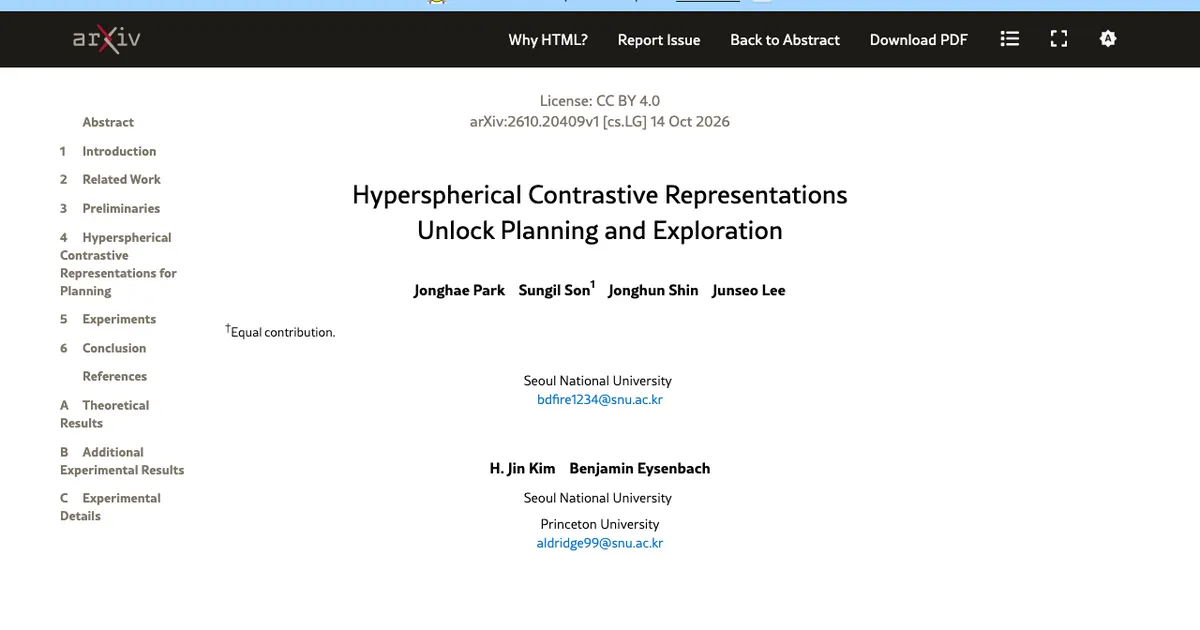
Hyperspherical Contrastive Representations Unlock Planning and Exploration

By Jonghae Park, Sungil Son, Jonghun Shin, Junseo Lee, H. Jin Kim, Benjamin Eysenbach • arXiv • Importance: 88/100
Hero Image for 2610.20409

💡 Building AI from Scratch: How Hyperspherical Spaces Unlock Complex Planning

Artificial Intelligence is constantly pushing the boundaries of what machines can achieve. But robust planning—the ability to navigate complex environments and execute multi-step tasks without explicit training data or human guidance—remains one of the hardest problems in machine learning.

New research from Jonghae Park et al. tackles this challenge head-on, introducing a breakthrough method that unlocks sophisticated sequential decision-making using abstract geometrical concepts: hyperspheres.

🚀 The Core Idea: Planning with Contrastive Geometry

The researchers developed an algorithm called Contrastive Planning via Spherical Linear Interpolation (C-Slerp). At its heart, C-Slerp reframes the complex task of ‘how to get from A to Z’ into a geometric problem. Instead of training a massive, high-level policy network (which is often fragile), they use contrastive representations as reusable building blocks.

Think of these representations like fundamental vectors or coordinates within an abstract space. By learning meaningful differences between points—what ‘contrastive’ means—the model captures the essence of movement and structure itself. These self-supervised learned representations are then repeatedly composed to infer a sequence of intermediate waypoints.

✨ The Hyperspherical Edge: A Novel Approach to Interpolation

The real innovation lies in the hyperspherical parameterization. When data is constrained to a hypersphere, geometric relationships become predictable and clean. This specific mathematical framework allows the critical step—inferring intermediate waypoints—to be done in closed form using Spherical Linear Interpolation (Slerp).

Why does this matter? It means the system doesn’t need to train a separate, complex policy or perform computationally expensive graph searches. The geometry itself dictates the optimal path!

Furthermore, the representation geometry provides a unique meta-insight: it tells the model how many waypoints it needs based on how difficult the goal is. This adaptability (and making sure you don’t stick to a fixed number of steps!) significantly boosts performance.

🤖 Real-World Impact and Applications

The experimental results are genuinely impressive, demonstrating success on challenging long-horizon tasks like complex navigation and robotic manipulation—tasks where state-of-the-art baselines often fail even a single trial.

This work suggests a paradigm shift in how we approach reinforcement learning planning: moving from massive policy models toward geometrically grounded representations that are robust, interpretable, and intrinsically adaptive.

Want to read the full details on this revolutionary technique? Check out the paper here!


Is your AI system built on brittle policy networks, or does it understand the fundamental geometry of movement and structure? This research pushes the frontier toward the latter.

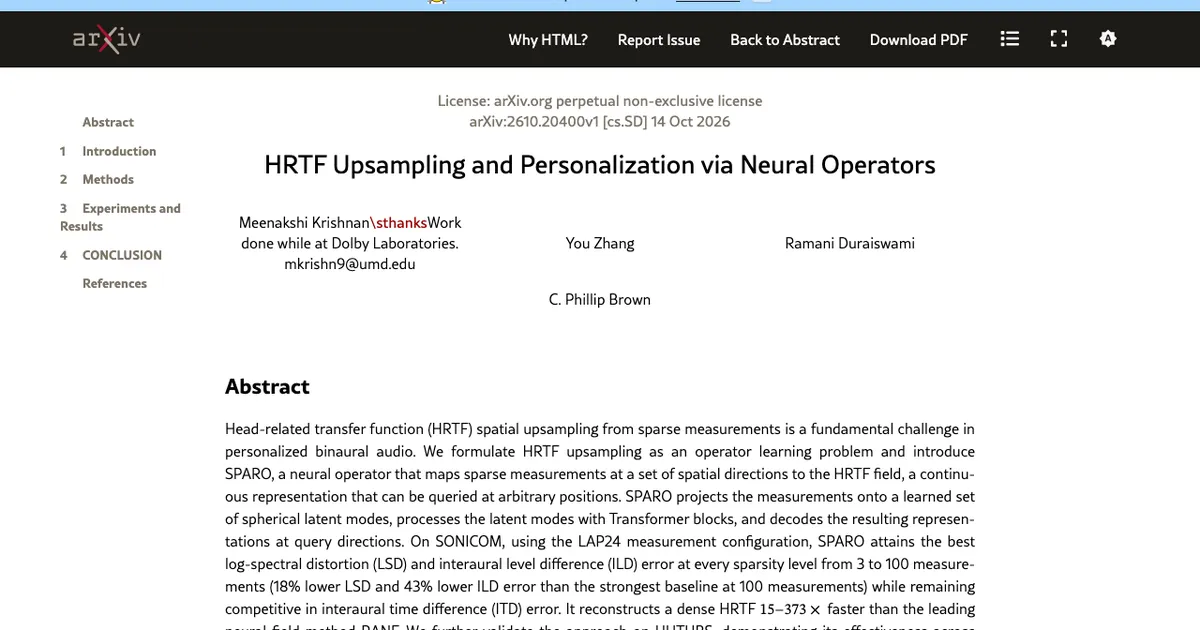
HRTF Upsampling and Personalization via Neural Operators

By Meenakshi Krishnan, You Zhang, Ramani Duraiswami, C. Phillip Brown • arXiv • Importance: 88/100
Hero Image for 2610.20400

🎧 Making Sound Feel Real: Neural Operators for Personalized Binaural Audio

As immersive audio and virtual reality (VR) become mainstream, the quality of spatial sound is everything. But generating perfect binaural audio—the kind that makes you feel like sound comes from exactly where it should—is surprisingly difficult. This is because we rarely measure a person’s head-related transfer function (HRTF) perfectly or densely enough.

Our latest research tackles this fundamental limitation by treating HRTF upsampling as an operator learning problem. We introduce SPARO, a novel neural operator designed to bridge the gap between sparse measurements and continuous, high-fidelity sound fields.

🚀 How Does SPARO Work?

Traditionally, building a full HRTF map requires thousands of dedicated measurements. SPARO changes this paradigm. It takes limited directional data (sparse measurements) and intelligently constructs a complete, dense HRTF field that can be sampled at any arbitrary position in space.

Its architecture is robust: 🧠 1. Latent Projection: It projects the sparse input measurements onto a learned set of spherical latent modes. 2. Processing Core: These modes are processed using powerful Transformer blocks, which excels at sequential and contextual data processing. 3. Decoding: Finally, it decodes these representations into the full HRTF field, providing continuous spatial accuracy.

✨ Performance Breakthroughs on SONICOM

We rigorously tested SPARO on the widely recognized SONICOM dataset (using LAP24 measurements). The results are highly impactful:

  • Superior Accuracy: At sparsity levels ranging from 3 to 100 measurements, SPARO achieves the best metrics in log-spectral distortion (LSD) and interaural level difference (ILD) error. Notably, we achieved an 18% lower LSD and a 43% lower ILD error compared to the strongest baseline at 100 measurements.
  • Efficiency Edge: Furthermore, SPARO reconstructs the dense HRTF field dramatically faster—15 to 373 times faster than existing leading neural-field methods like RANF. This speed boost is critical for real-time applications in VR and gaming.

These results prove that SPARO not only achieves state-of-the-art acoustic quality but does so with an unparalleled computational efficiency, making personalized binaural audio practical for consumer use.

Learn more about our approach to sparse HRTF upsampling.

#SpatialAudio #BinauralAudio #NeuralNetworks #MLResearch #ImmersiveTech #Acoustics

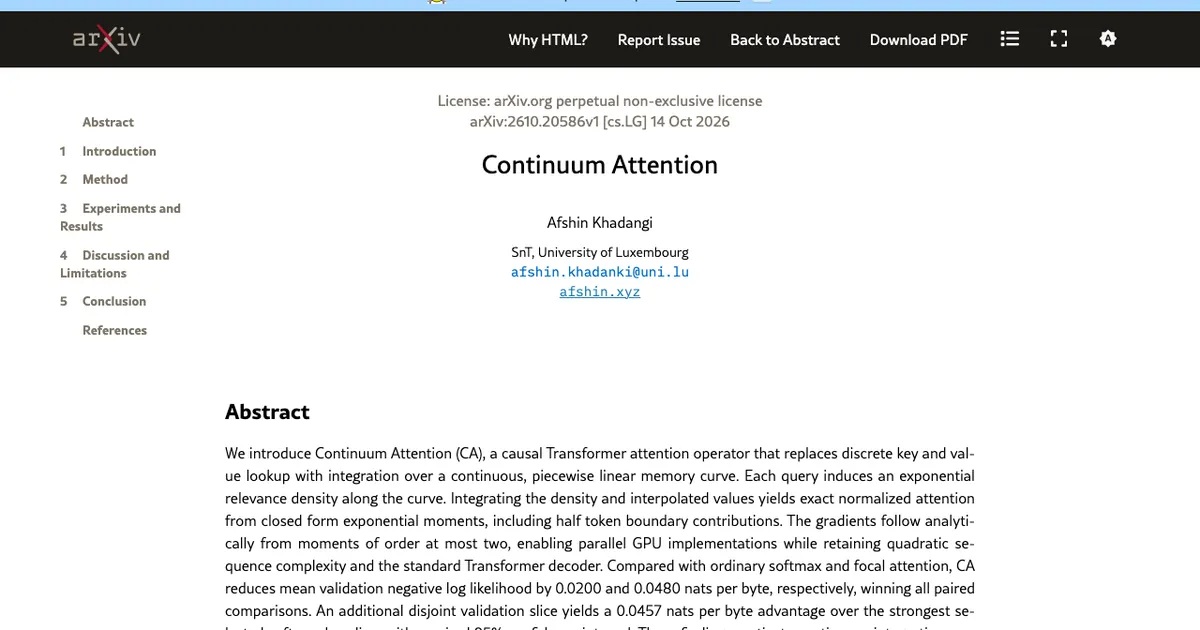
Continuum Attention

By Afshin Khadangi • arXiv • Importance: 87/100
Hero Image for 2610.20586

🚀 Continuous Attention: A Revolution in Transformer Architecture

As ML researchers continually push the boundaries of sequence modeling, attention mechanisms remain at the core. Standard self-attention, while powerful, relies on discrete lookups (softmax) which can sometimes limit model capacity or introduce computational overheads, especially when dealing with continuous data streams.

Introducing Continuum Attention (CA), a groundbreaking alternative that reimagines how Transformers process memory. Instead of using standard discrete key/value lookups, CA proposes treating the sequence memory as a smooth, continuous, piecewise linear curve Continua Attention Paper.

💡 How Does Continuum Attention Work?

The core innovation lies in replacing the step-function of standard attention with calculus. When a query arrives, it doesn’t just look up discrete tokens; it induces an exponential relevance density along this continuous memory curve. The resulting normalized attention is calculated by integrating this density and the interpolated values from closed-form exponential moments.

This mathematical elegance solves several critical problems:

  1. Smoothness: By using integration, CA naturally incorporates exact half-token boundary contributions, leading to a more holistic model understanding.
  2. Efficiency: It maintains the standard quadratic sequence complexity and can be implemented efficiently on parallel GPUs.
  3. Optimality: The analytical derivation of gradients from low-order moments ensures reliable backpropagation while keeping the standard Transformer decoder structure intact.

📈 Performance Benchmarks Speak Volumes

In rigorous comparisons, CA demonstrates superior performance across the board. It significantly reduces the mean validation negative log likelihood (NLL) compared to traditional softmax and even specialized variants like focal attention. Crucially, it also outperforms the strongest selected softmax baselines on additional disjoint validation slices.

The results suggest that continuous integration is a highly promising direction for future Transformer designs, potentially leading to more robust and generalizable language models.

Is this the next big thing? While Continuum Attention offers substantial gains and presents an elegant theoretical framework, the authors caution that larger-scale generalization remains an open area for further research. Nonetheless, it provides a powerful new paradigm shift for tackling sequential data processing.


Interested in diving deep into the math and implementation details? Check out the full paper! Read the Continuum Attention Paper here

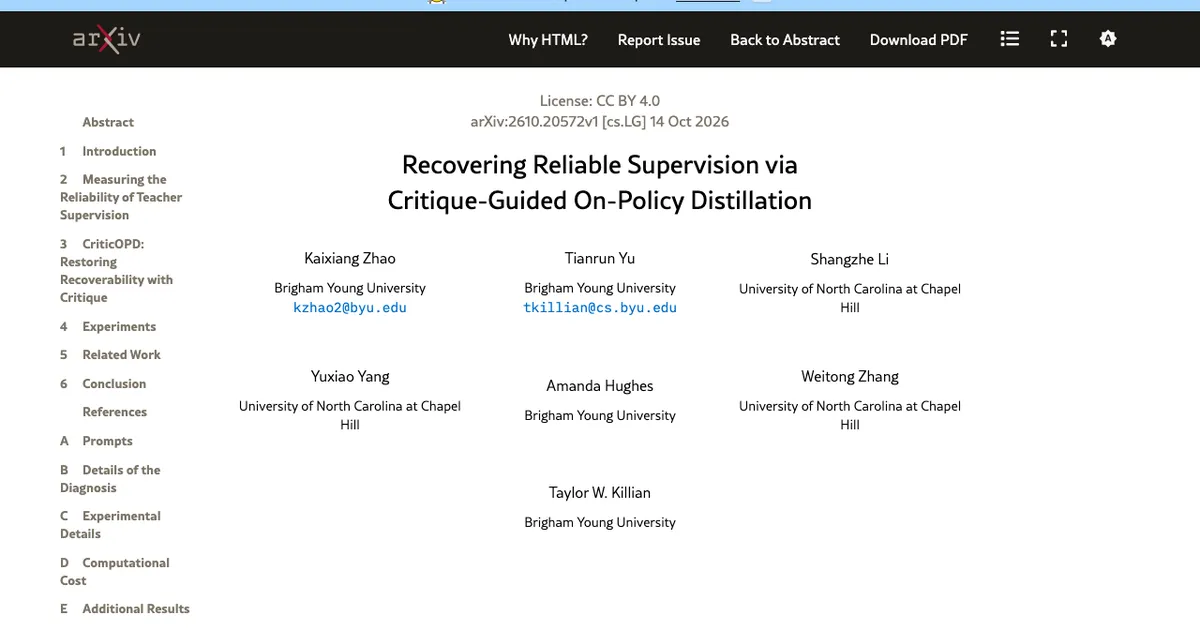
Recovering Reliable Supervision via Critique-Guided On-Policy Distillation

By Kaixiang Zhao, Tianrun Yu, Shangzhe Li, Yuxiao Yang, Amanda Hughes, Weitong Zhang, Taylor W. Killian • arXiv • Importance: 85/100
Hero Image for 2610.20572

The Secret Flaw in Teaching AI: Why Student Errors Trip Up Teachers

As LLMs get more sophisticated, training them on ‘expert’ knowledge is crucial. One popular technique is On-Policy Distillation (OPD): essentially, the model teaches itself by having a powerful ‘teacher’ guide its own outputs on specific tasks like complex math reasoning.

The core assumption of OPD is that the teacher can always rescue the student from an error—that no matter what mistake the student makes in a prefix, the teacher can still steer it to the correct answer. We call this ‘recoverability.’ Sounds perfect, right?

Problem: Our research shows that this recoverability assumption breaks down when students make significant mistakes. The teacher does recognize the error, but instead of guiding the student past it, its output becomes contaminated by the student’s initial mistake, effectively following along on the wrong path.

💡 Introducing CriticOPD: Fixing Teacher Blind Spots

The authors propose Critic-Guided On-Policy Distillation (CriticOPD). Instead of just having the teacher generate a clean response, CriticOPD introduces a critical step: the teacher explicitly critiques the student’s incorrect rollout. This critique acts as privileged feedback.

This refined process allows the student to not only correct its answer but also explicitly model its revision based on the critique. The key insight is that this structured error handling significantly improves performance, especially in complex domains like mathematical reasoning and competitive problems where small errors can cascade into failure.

🔬 Why This Matters for AI Training

The paper demonstrates these gains using Qwen3 students across six diverse math reasoning benchmarks. By integrating a formal critique mechanism, CriticOPD provides a robust way to train models on complex, high-stakes tasks and overcomes the limitations of standard OPD. It represents a significant step towards creating more reliable and error-resistant generative AI systems.

Check out the full details in our paper: Recovering Reliable Supervision via Critique-Guided On-Policy Distillation


Keywords: LLMs, AI Training, On-Policy Distillation, Model Robustness, Machine Learning, Deep Learning, Reinforcement Learning

To our readers in the tech and ML communities: If your research involves fine-tuning or distillation techniques for high-stakes reasoning, give this paper a look. Understanding how supervision fails when errors occur is critical to building truly reliable AI.

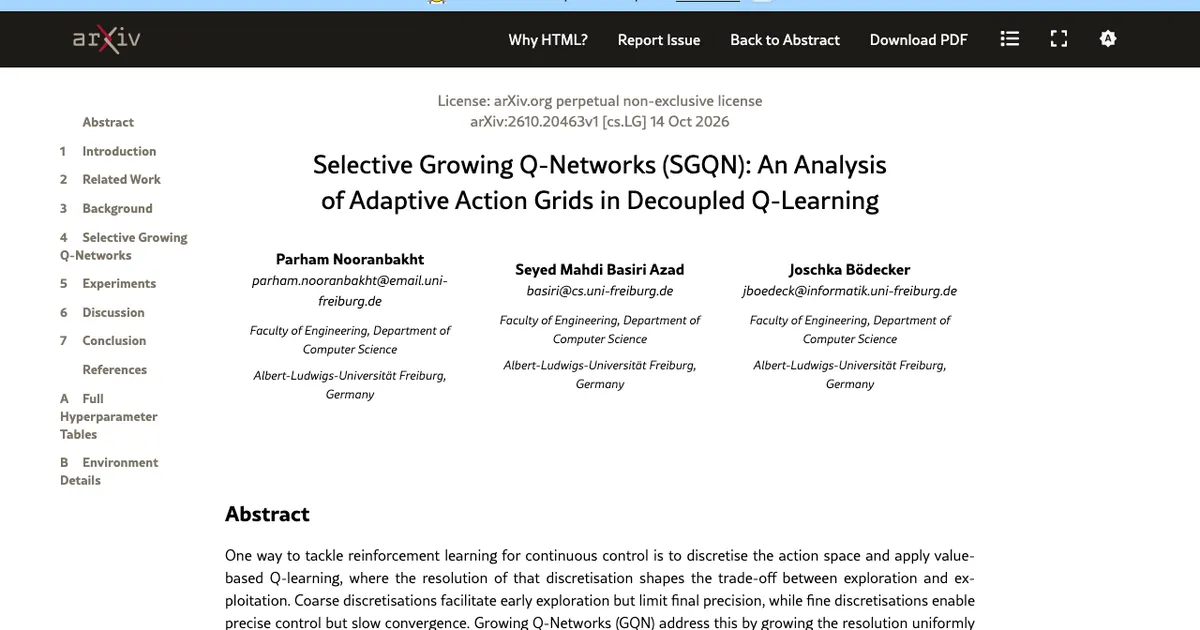
Selective Growing Q-Networks (SGQN): An Analysis of Adaptive Action Grids in Decoupled Q-Learning

By Parham Nooranbakht, Seyed Mahdi Basiri Azad, Joschka Bödecker • arXiv • Importance: 85/100
Hero Image for 2610.20463

📈 Beyond Grid World: Smarter Continuous Control with Selective Growing Q-Networks

Are you trying to teach an AI agent complex physical tasks—like walking, running, or manipulating objects? One of the biggest hurdles is action space. If you discretize continuous actions (e.g., setting a force output between -1 and 1), you have to decide how many steps (bins) to use. Too few, and your agent lacks precision; too many, and training becomes computationally infeasible.

The academic paper Selective Growing Q-Networks (SGQN) introduces a novel solution: Selective Growing Q-Networks. Instead of increasing the resolution uniformly across all possible actions, SGQN is selective. It focuses its computational power and precision only where it matters most—the promising areas of the action space.

🔍 How Does SGQN Work?

Traditional approaches like Growing Q-Networks (GQN) grow their action grids by adding bins evenly across all dimensions. SGQN revolutionizes this with an adaptive, intelligent strategy:

  1. Adaptive Growth: It identifies which areas of the action space need more detail. Instead of uniform growth, it adds new ‘bins’ adjacent to existing bins that showed high estimated Q-values (meaning those actions were highly rewarded). This is like focusing your resources where performance gains are likely.
  2. Selective Pruning: Crucially, SGQN doesn’t just grow; it prunes. It eliminates bins in areas of the action space that have been consistently shown to be poor or unpromising, keeping the representation clean and efficient.

This approach allows the agent to maintain high resolution only where optimal behavior occurs, significantly reducing both computational load and the risk of overfitting low-value actions.

🚀 The Performance Edge

Testing SGQN on eight challenging DeepMind Control Suite (DMControl) tasks with complex action spaces (2 to 12 dimensions), the results are impressive:

  • State-of-the-Art Results: On four tasks, SGQN achieved the highest mean final return among all compared methods.
  • Highly Competitive: For three other tasks, its performance was within a remarkable 1.1% of the best method.
  • Efficiency: It achieves these results using significantly fewer computational bins (averaging only 7.5 out of 9 available per dimension).

🤔 What Did the Researchers Discover?

A Deep dive into SGQN’s mechanism reveals deeper insights—a kind of ‘meta-learning’ insight for continuous control.

The authors tested if it was the selection or the growth that provided the advantage. The surprising finding was that when they activated every candidate bin (removing selection) and pruned nothing, the performance gain vanished. This suggests that while the components are valuable, their synergistic interaction—the intelligent combination of focused growth and pruning—is what drives the superior results.

The paper further analyzes that SGQN is robust to its own hyperparameter choices, confirming the stability and generalizability of the proposed method.


Takeaway for Researchers & ML Engineers: This work doesn’t just offer a better technique; it provides a critical analysis. It proves that understanding why certain parts of the action space matter is as important as learning optimal policies. For next-generation robotic control and high-dimensional decision-making, selective representation methods like SGQN are essential.

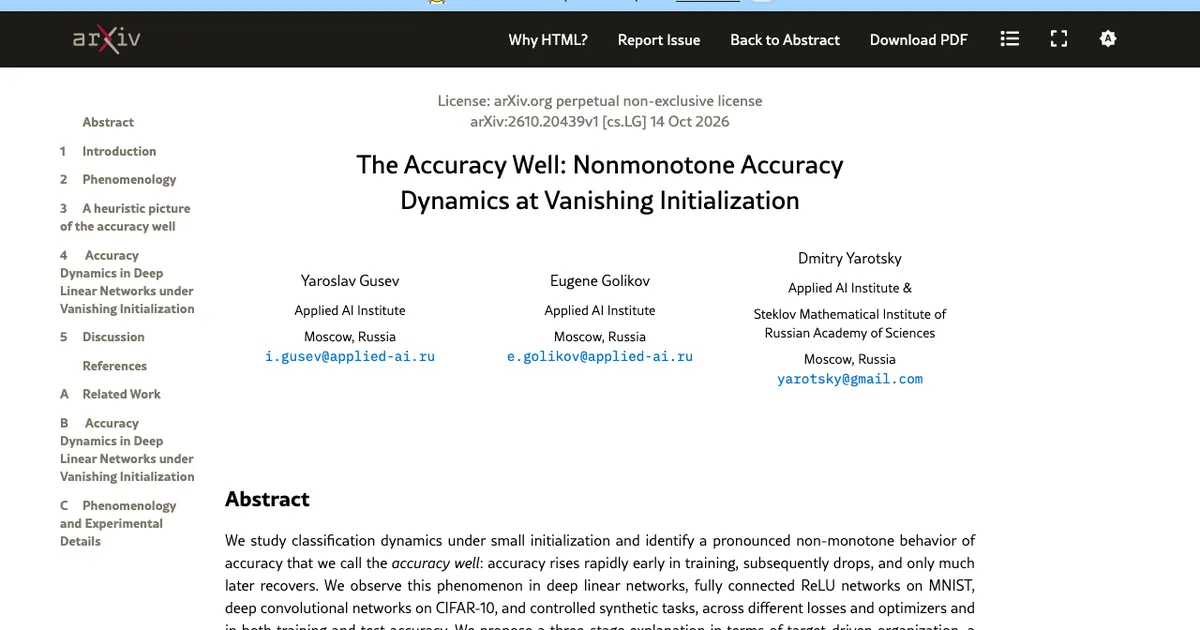
The Accuracy Well: Nonmonotone Accuracy Dynamics at Vanishing Initialization

By Yaroslav Gusev, Eugene Golikov, Dmitry Yarotsky • arXiv • Importance: 85/100
Hero Image for 2610.20439

📉 The ‘Accuracy Well’: Understanding the Hidden Dynamics of Deep Learning Training

Ever noticed that your model’s training accuracy doesn’t just go up steadily? If you’ve tuned models or worked on optimization, you know that learning curves can be bizarre. A new study by Gusev et al. introduces a fascinating phenomenon they call the Accuracy Well.

A recent paper analyzing classification dynamics The Accuracy Well: Nonmonotone Accuracy Dynamics at Vanishing Initialization challenges the conventional assumption that accuracy always improves monotonically as training progresses, especially when initialized close to zero.

🧠 What is the Accuracy Well?

In simple terms, the paper details a three-phase learning pattern:

  1. Rapid Ascent: The model quickly learns foundational features and performance surges.
  2. The Dip (The ‘Well’): Crucially, after the initial surge, accuracy unexpectedly drops. This dip suggests that the model temporarily loses or reorganizes its learned representations before recovering.
  3. Delayed Recovery: Finally, much later in training, the model recovers and achieves robust performance again.

This non-monotonic behavior is observed across diverse deep network architectures—from simple ReLU networks on MNIST to complex Convolutional Networks on CIFAR-10—and even holds true when analyzing test accuracy, not just training loss!

💡 Why Does This Matter for ML Engineers?

Traditionally, metrics like the training loss are heavily relied upon to judge model health. However, the findings of this research suggest that classification accuracy can reveal critical aspects of learning dynamics that are invisible when only observing the loss function.

The study proposes a detailed three-stage explanation involving: * Target-driven organization: How features initially organize around specific tasks. * A degeneracy bottleneck: The period where initial optimization methods struggle or constrain representation space, causing the dip. * Recruitment and recovery: The mechanism by which stable, high performance is finally achieved.

For researchers working on initialization strategies, advanced optimizers, or general theories of deep learning dynamics (especially in fields like medical imaging or autonomous vehicle control where robust, reliable performance is non-negotiable), this work provides a necessary theoretical framework for understanding the ‘deep’ mechanics beneath standard optimization curves. It signals that simply minimizing loss isn’t the full story.

📚 Key Takeaways & Future Work

The authors develop rigorous mathematical theories—even proving extreme instances for synthetic tasks where accuracy reaches 100%, collapses to zero, and recovers permanently to 100%—providing powerful theoretical grounding.

Bottom Line: When evaluating model performance, especially in highly optimized or complex tasks, don’t just trust the smooth descent of your loss function. Pay attention to sudden dips or plateauing periods; they might be signals of a critical reorganization moment rather than failure.

Deep learning optimization is more nuanced than we thought! Read the full paper for the rigorous mathematical proofs: The Accuracy Well Paper on ArXiv

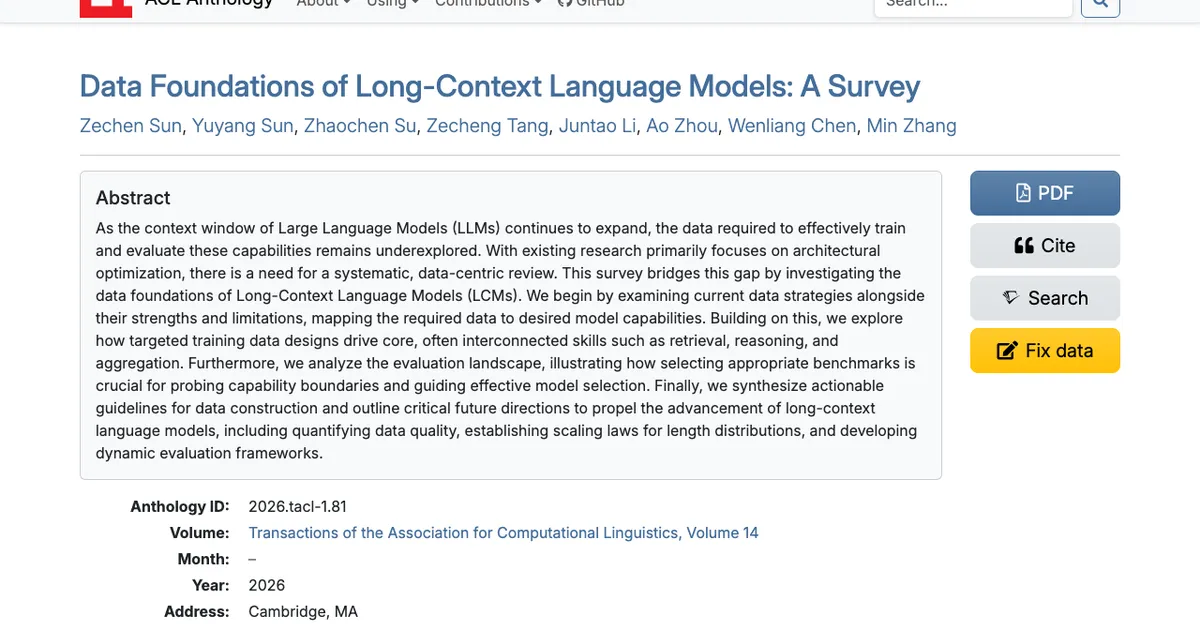
Data Foundations of Long-Context Language Models: A Survey

By Zechen Sun, Yuyang Sun, Zhaochen Su, Zecheng Tang, Juntao Li, Ao Zhou, Wenliang Chen and Min Zhang in Transactions of the Association for Computational Linguistics, Volume 14 • ACL Anthology • Importance: 85/100
Hero Image for acl_2026.tacl-1.81

💡 Beyond Transformers: The Crucial Role of Data in Long-Context LLMs

The race for ‘longer context’ in Large Language Models (LLMs) is captivating the AI world. Models that can maintain coherence over tens or hundreds of thousands of tokens seem like a holy grail, capable of handling entire books, codebases, or comprehensive documents. But as researchers and companies pour massive resources into expanding context windows, there’s a critical question often overlooked: Is the bottleneck architectural optimization, or is it the data?

This deep dive explores that very question. We break down the findings from the survey paper, Data Foundations of Long-Context Language Models: A Survey, which systematically shifts the focus from model architecture to the underlying data necessary to truly unlock long-context capabilities.

🧐 The Context Gap: Why Data Matters More Now Than Ever

The current research trend has heavily emphasized technical fixes—new attention mechanisms, specialized Transformers, and architectural tweaks. However, this survey highlights that simply increasing context size isn’t enough. To successfully train Long-Context Language Models (LCMs), you need highly specific, data-centric strategies.

What does this mean for builders? It means the next breakthrough won’t just come from optimizing the matrix multiplication; it will come from curating and engineering bespoke training datasets that teach the model specialized skills.

🧠 Data-Driven Skills: Going Beyond Simple Recall

The paper maps out how targeted data design drives complex, interconnected abilities crucial for high-performing LLMs. These aren’t just simple memory tasks; they are complex cognitive functions:

  • Retrieval: The ability to find and pull specific facts from a vast context (like looking up a footnote in a massive document).
  • Reasoning: Following logical chains of thought across long passages, maintaining causality.
  • Aggregation: Summarizing or synthesizing information gleaned from disparate parts of the same massive input—the ‘big picture’ view.

By understanding which data types drive these skills, researchers can move from generic large datasets to highly specialized foundations.

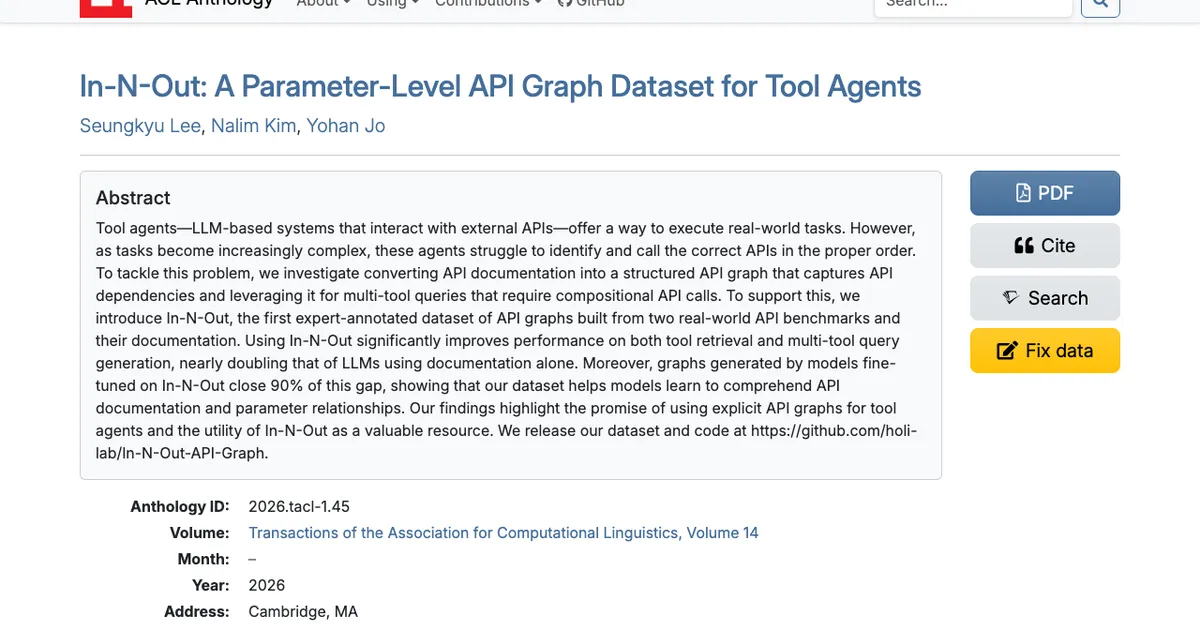
In-N-Out: A Parameter-Level API Graph Dataset for Tool Agents

By Seungkyu Lee, Nalim Kim and Yohan Jo in Transactions of the Association for Computational Linguistics, Volume 14 • ACL Anthology • Importance: 85/100
Hero Image for acl_2026.tacl-1.45

The Next Generation of AI Agents: Building a Graph-Based API Blueprint

Are Large Language Models (LLMs) ready for the real world? While modern LLMs can write compelling code and pass challenging exams, performing complex, multi-step actions in real-world applications is their next major hurdle. This paper introduces a revolutionary dataset and framework to solve this: In-N-Out, a parameter-level API graph blueprint.

💡 What Problem Does This Solve?

The biggest limitation of current AI agents (called ‘tool agents’) is complexity. If you need an agent to book a multi-stage travel itinerary—say, search for flights, then find an airport shuttle, and finally check hotel availability—the model struggles to figure out the exact sequence and dependencies of API calls using only raw documentation.

This work tackles this by turning tedious textual API documentation into structured graph data. By explicitly mapping which parameters depend on the outputs of other APIs, researchers can build a robust understanding of multi-tool workflows. This is like moving from reading a complex instruction manual to looking at a clean flowchart.

🚀 Introducing In-N-Out: The Definitive Resource

To train models on this concept, we needed an expert resource. That’s where In-N-Out comes in. This is the first specialized, expert-annotated dataset designed specifically for API graphs. Built from two real-world, complex APIs, it captures parameter dependencies and call order at a granular level that standard benchmarks lack.

The Impact: The results are compelling. Models trained using In-N-Out dramatically outperform those relying solely on generic documentation, nearly doubling performance in both tool retrieval and multi-tool query generation for complex tasks. This isn’t just an incremental improvement; it demonstrates a fundamental shift in how we teach AI to reason about structured workflows.

🔬 Why Is This Important? (The ML Perspective)

The findings prove that explicit, structured representation of system logic—the API graph—is crucial for reliable multi-step reasoning. Instead of treating an LLM’s job as pure text prediction, this method treats it as a structured planning problem.

For developers building sophisticated AI systems (think booking agents, financial bots, or supply chain managers), In-N-Out provides the essential training backbone to move models from ‘knowing theory’ to ‘doing complex tasks.’


🔗 Read More and Get Hands-On:

AI #LLMs #MachineLearning #AgentFrameworks #NLP #APIs #ArtificialIntelligence

Inferring Scientific Cross-Document Coreference and Hierarchy with Definition-Augmented Relational Reasoning

By Lior Forer and Tom Hope in Transactions of the Association for Computational Linguistics, Volume 14 • ACL Anthology • Importance: 85/100
Hero Image for acl_2026.tacl-1.36

🧬 Unlocking Scientific Knowledge: New Methods for Cross-Document Concept Linking

As researchers increasingly rely on Large Language Models (LLMs) to manage the vast ocean of scientific literature, a critical challenge emerges: how do we connect related concepts that span dozens of documents, sometimes using vastly different terminology? This problem is fundamental to building robust knowledge graphs and improving semantic search.

Traditional LLMs often falter when faced with long-tail technical concepts—those niche ideas with many nuanced variations. They struggle to reliably determine if ‘the XYZ field effect’ mentioned in one paper refers precisely to the same physical phenomenon described differently months later in another publication.

Our new research tackles this by introducing a sophisticated, definition-augmented reasoning framework designed specifically for scientific NLP.

💡 What is Cross-Document Coreference and Hierarchy?

The core task here is determining two things:

  1. Coreference: Identifying that multiple mentions of the same concept (e.g., ‘deep learning architecture X,’ ‘the XYZ field effect’) across different documents refer to one single, unified entity.
  2. Hierarchy/Relation: Understanding how these concepts relate—are they synonyms? Are they causal inputs and outputs? Are they simply different facets of the same overarching theory?

This is crucial for accurate knowledge graph construction and advanced scientific discovery tools.

🔬 How Does Our Method Work? The Power of Definitions

Instead of relying solely on contextual patterns, which can be ambiguous, our method grounds its analysis in meaning itself. We introduce two key innovations:

  • Definition Augmentation: For every concept mention, we retrieve context-dependent definitions by pulling relevant passages from the literature. This acts as a high-fidelity anchor for what the concept means.
  • Relational Definitions: Crucially, we don’t just find coreferences; we generate formal definitions that describe the precise relationship between two concepts—how they are related or how they differ. This allows models to perform deep relational reasoning.

By integrating these explicit definition layers and designing an efficient re-ranking mechanism (to handle the massive number of potential links), our system significantly boosts performance, even in challenging subsets characterized by surface form ambiguity.

🚀 Why Does This Matter for AI Researchers?

The findings are significant because they provide tangible evidence that enhancing an LLM’s capacity for explicit relational reasoning using external knowledge sources dramatically improves its ability to handle fine-grained scientific nuance.

This work showcases a powerful blend of advanced NLP techniques and structured retrieval, pushing the boundaries from simply understanding text to actually building verifiable knowledge.

🔗 Read the full paper here: Inferring Scientific Cross-Document Coreference…


Keywords: Knowledge Graphs, LLMs, Coreference Resolution, Semantic Search, Scientific NLP, Computational Linguistics

Tracking a Small Set of Experts in Online Convex Optimization

By Angelos Assos, Anand Brahmbhatt, Elad Hazan • arXiv • Importance: 80/100
Hero Image for 2610.20416

Beyond Discretization: Setting the Information-Theoretic Limits of Online Prediction

When you’re making critical decisions in real time—from optimizing trading strategies to managing network resources—you often have to rely on ‘expert advice.’ But what happens when that advice comes from continuous, non-discrete sources?

This new research dives into the fundamental mathematical limits of online convex optimization. It tackles a long-standing question: how close can we get to perfect prediction when our action space isn’t limited to simple choices, but is continuously variable?

The Core Problem: In traditional settings (discrete experts), algorithms have successfully achieved near-optimal performance. However, when the underlying problem space becomes continuous, performance suffers dramatically. The authors demonstrate that merely discretizing the continuous action space—a seemingly simple fix—leads to a suboptimal, and computationally expensive, result.

The Breakthrough Insight: Angelos Assos, Anand Brahmbhatt, and Elad Hazan establish a significant separation boundary. They prove that for online convex optimization, there is an inherent gap between the best theoretically possible regret (the information-theoretic limit) and what can be practically achieved in polynomial time.

Specifically, they show that even if you use the most powerful techniques available, any practical algorithm will face instances where its accumulated error (regret) grows significantly higher than the optimal theoretical bound. This isn’t a bug in our algorithms; it’s a fundamental limitation of computation itself.

Why Does This Matter for ML/AI? * Theoretical Depth: It pushes the boundaries of optimization theory, giving us deeper insight into why certain types of prediction problems are inherently harder than others. * System Design: For real-world applications (e.g., dynamic resource allocation in cloud computing or continuous control systems), knowing these theoretical limits is crucial. It tells engineers where the bottleneck lies—whether it’s the model, the data, or the fundamental nature of computation itself. * Future Research: This work guides future research by defining a ‘hard limit,’ preventing wasted effort on developing algorithms that can never outperform the natural computational barrier.

This study provides a rigorous proof establishing this separation, linking advanced optimization theory (like the hypergraphic planted-clique conjecture) to practical performance constraints.

Dive into the full details of the technical breakthrough here: Online Convex Optimization Regret Limits

Human-like Fleeting Memory Improves Language Learning but Impairs Reading Time Prediction in Transformer Language Models

By Abishek Thamma and Micha Heilbron in Transactions of the Association for Computational Linguistics, Volume 14 • ACL Anthology • Importance: 80/100
Hero Image for acl_2026.tacl-1.39

🧠 Human Memory & AI: Why ‘Forgetting’ Might Be Our Best Teacher

Ever wonder how we learn language? It’s a process that involves building connections, but also a constant act of forgetting the exact word you just heard. Cognitive science has long theorized that this natural limitation of working memory is actually beneficial for acquiring complex language.

The recent dominance of Transformer models—the backbone of LLMs like GPT and BERT—has challenged this idea. These sophisticated AI systems, by design, don’t suffer from ‘memory fade.’ Could this architectural difference be fundamentally changing how AI learns language?

🔍 The Research: Building Memory Limitations into Transformers

The authors investigated the core hypothesis: does mimicking human working memory limitations (i.e., making the model forget word details as it processes a sentence) actually boost language learning? Using a highly controlled setup, they trained Transformer models with and without these artificial ‘fleeting memory’ constraints.

What they found: * 📚 Better Language Learning: Introducing fleeting memory significantly improved overall language modeling performance. The models were better at predicting syntax and constructing fluent, natural-sounding sentences—a major win for general NLP capabilities. * ⏱️ Worse Reading Prediction: Surprisingly, this boost in language understanding did not translate to better prediction of human reading times (surprisal). When the model was great at generating text, it was actually worse at predicting how long a person would take to read that text.

✨ Key Takeaways for ML Research

These results offer critical insights into how we conceptualize intelligence in AI:

  1. The Value of Limitation: The study supports the idea that having natural cognitive limitations—like fleeting memory—is an asset during language acquisition, potentially leading to deeper, more structured understanding.
  2. Bridging Models and Behavior: Crucially, they separated general language modeling from predictive human behavior. While constrained models learn language better generally, this doesn’t guarantee superior alignment with real-world cognitive processes (like predicting reading speed).
  3. The Next Frontier: This work pushes us to move beyond simply optimizing log-likelihood and consider how well AI systems model human cognitive constraints themselves.

This research in Human-like Fleeting Memory Improves Language Learning but Impairs Reading Time Prediction in Transformer Language Models is a thought-provoking reminder that perfect models aren’t always the most human-accurate ones! #NLP #LLMs #ComputationalLinguistics

Revisiting Simple Baselines for Relational Deep Learning

By Viet The Nguyen, Vijay Prakash Dwivedi, Gunther Gust • arXiv • Importance: 75/100
Hero Image for 2610.20534

The Simple Power of Baselines: Unlocking Relational Deep Learning

Are advanced Graph Neural Networks (GNNs) and massive Transformer models the only way to achieve state-of-the-art results in relational deep learning? Maybe not.

New research dives deep into a seemingly overlooked area: revisiting simple, classic baselines for modeling complex relationships within databases. The study Revisiting Simple Baselines for Relational Deep Learning suggests that before jumping to the newest, most complex architecture, we need to understand how much of the performance gain is actually due to architectural complexity versus simply clever signal processing.

🧠 The Core Problem: Too Much Complexity?

The field of Relational Deep Learning (RDL) has exploded. We use powerful tools like GNNs and Transformers to model databases as temporal heterogeneous graphs—predicting things from complex web of interconnected data points. While these models perform wonderfully, their sheer complexity makes it hard to isolate why they work so well.

This paper argues that we need a better baseline understanding. Instead of assuming the best outcome requires a mega-model, the researchers focused on simple propagation methods—revisiting foundational techniques to see how much predictive power they retain.

✨ The Key Takeaways (Why This Matters)

  1. Simple Beats Complex… Sometimes: By adapting fixed low-pass feature propagation and training simple MLPs, the authors found that these basic models significantly outperformed using only target-entity features on most tasks. Crucially, they recovered a substantial portion of the performance seen with sophisticated heterogeneous GNNs.
  2. The Power of Context (Correct-and-Smooth): They introduced ‘Correct-and-Smooth,’ an advanced label propagation algorithm that uses historical labels across task-specific meta-graphs. This technique provides further gains by contextualizing predictions with past data, although it requires building a separate connection graph (meta-graph).
  3. The Blueprint for Improvement: The research doesn’t just provide better scores; it identifies ‘canonical meta-graph construction’ as the key architectural challenge. It shows that structuring how we connect target entities across tasks is more critical than merely adding layers to the core GNN.

💡 Takeaway for ML Engineers & Data Scientists

If you’re building RDL models, this paper serves as a powerful reminder: Simplicity can be sophisticated. Don’t immediately default to the largest, most complex Transformer architecture available. Start with robust baselines that effectively model signal propagation and label context first. This approach not only saves computation but also provides deeper insights into the true source of predictive power.


A deep dive into optimizing your feature engineering and graph structure can yield performance gains comparable to, or exceeding, massive model updates!

From Benchmarks to Skills: Low-Rank Factors for LLM Evaluation

By Aviya Maimon, Amir David Nisan Cohen, Gal Vishne, Shauli Ravfogel and Reut Tsarfaty in Transactions of the Association for Computational Linguistics, Volume 14 • ACL Anthology • Importance: 75/100
Hero Image for acl_2026.tacl-1.75

Beyond the Scoreboard: Unlocking LLM Capabilities with Latent Skill Factors

The era of Large Language Models (LLMs) is defined by a relentless pursuit of higher benchmark scores. But as models get bigger, an uncomfortable question arises: what exactly do these aggregate scores measure? Are they truly measuring generalized intelligence, or are we just hitting highly correlated academic silos?

Our latest research tackles this fundamental problem head-on. Instead of accepting benchmarks at face value, we propose a revolutionary shift in LLM evaluation—moving from mere score aggregation to intrinsic skill profiling.

🧠 The Problem with Benchmarks

The traditional approach involves constructing large matrices: Model $A$ scores $X$ on Benchmark $ ext{Task}1$, $Y$ on $ ext{Benchmark}$, and so on. We treat the output as a set of independent measurements. }

However, our analysis—applying Factor Analysis (FA) to a massive performance matrix ($60 imes 44$)—revealed something striking: the structure is intrinsically low-rank.

What does ‘low-rank’ mean in plain English? It means that seemingly distinct tasks (like natural language inference, sentiment analysis, and reading comprehension) are not measuring independent abilities. Instead, they share a core set of underlying, highly correlated dimensions—the model isn’t exhibiting 44 unique skills; it’s using maybe 5 or 6 overarching ‘meta-skills’.

✨ Introducing the Skill-Space Framework

We found that this latent geometry doesn’t just suggest redundancy; it offers a powerful new framework. These latent factors correspond to coherent, skill-like dimensions of LLM behavior—the true capabilities underpinning performance.

Our work provides practical tools for anyone building or evaluating modern AI:

  1. Redundancy Detection: Quickly identifying which benchmarks are measuring overlapping abilities, saving effort and preventing metric inflation.
  2. Efficient Profiling: Evaluating a brand-new model using only a small, optimized subset of tasks while retaining comprehensive insight into its core capabilities.
  3. Targeted Model Selection: Allowing researchers or product managers to select models that align precisely with a desired skill profile (e.g., ‘high logical reasoning’ but ‘low creative hallucination’).

This approach provides a solid, interpretable alternative to the de-facto standard of reporting a single aggregate score.

Takeaway for ML Engineers: Stop optimizing blindly for arbitrary leaderboard positions. Start profiling your model against its underlying core skill dimensions. Understanding how an LLM performs is far more valuable than knowing only what its average score is.

🔗 Read the full paper: From Benchmarks to Skills: Low-Rank Factors for LLM Evaluation

LLMs #MachineLearning #AIResearch #EvaluationMetrics #NLP

Explore Recent Digests