← Back to Archive

Digest for 2026-10-09

🐦 Share on X 💼 Share on LinkedIn 📘 Share on Facebook

Prediction Is Not a Sufficient Memory State

By Robert Jenkinson Alvarez • arXiv • Importance: 92/100
Hero Image for 2610.13881

State-of-the-Art Breakthrough: Rethinking Memory in AI Systems

Ever wonder if predicting the future is enough to make an AI system truly intelligent? This cutting-edge research asks a fundamental question about machine learning memory: What happens when a system perfectly predicts every observation it has seen, but then fails miserably on the next novel one?

The paper, “Prediction Is Not a Sufficient Memory State” https://arxiv.org/abs/2610.13881, tackles this problem head-on. It reveals that merely having a state capable of perfect prediction is an insufficient condition for robust, cumulative learning. A system can be excellent at recalling past data points (i.e., predicting them perfectly) while fundamentally failing to adapt to new information or unexpected changes in the environment.

🧠 The Core Discovery: Prediction vs. Memory

The authors provide deep mathematical characterizations of this distinction, specifically for tasks involving cumulative learning and attention mechanisms. Their key findings are striking:

  • The Limitation: For many types of losses (those that aren’t simple polynomials), the memory required to reproduce past predictions increases unboundedly as the data gets more complex. This means no fixed-size state can perfectly encode the entire history.
  • Dimensional Scaling: They derive precise formulas for the necessary dimensionality, showing that even highly optimized systems require exponentially growing memory dimensions relative to the complexity of the loss function.
  • Practical Implications (Ridge Regression): In a simple task like ridge regression, the paper clarifies what ‘evidence’ is. The optimal hidden state isn’t just based on the current predictor; it must encode structural information about the design matrix itself—an increase in memory cost that surpasses just predicting the next point.

🚧 Why This Matters for AI Architecture

This research goes beyond proposing a new algorithm. Instead, it performs a rigorous theoretical analysis of what future updates reveal to the system. For researchers building next-generation large models (LLMs) or complex recurrent networks, this is a crucial roadmap.

The insights suggest that merely optimizing for predictive accuracy (the typical goal) might overlook necessary structural memory components needed for generalization and true adaptation. It challenges us to rethink how we model ‘forgetting’ and ‘learning capacity’ in deep architectures.

💡 Key Takeaway For Builders & Researchers

Instead of solely focusing on minimizing prediction error, the next generation of AI models must incorporate explicit mechanisms to track and maintain structural relationships (like design matrices or gradient jets). True robust memory requires tracking structure rather than just content.

This shifts the focus from purely predictive encoding to deep structural representation, paving the way for more generalizable and reliable artificial intelligence.
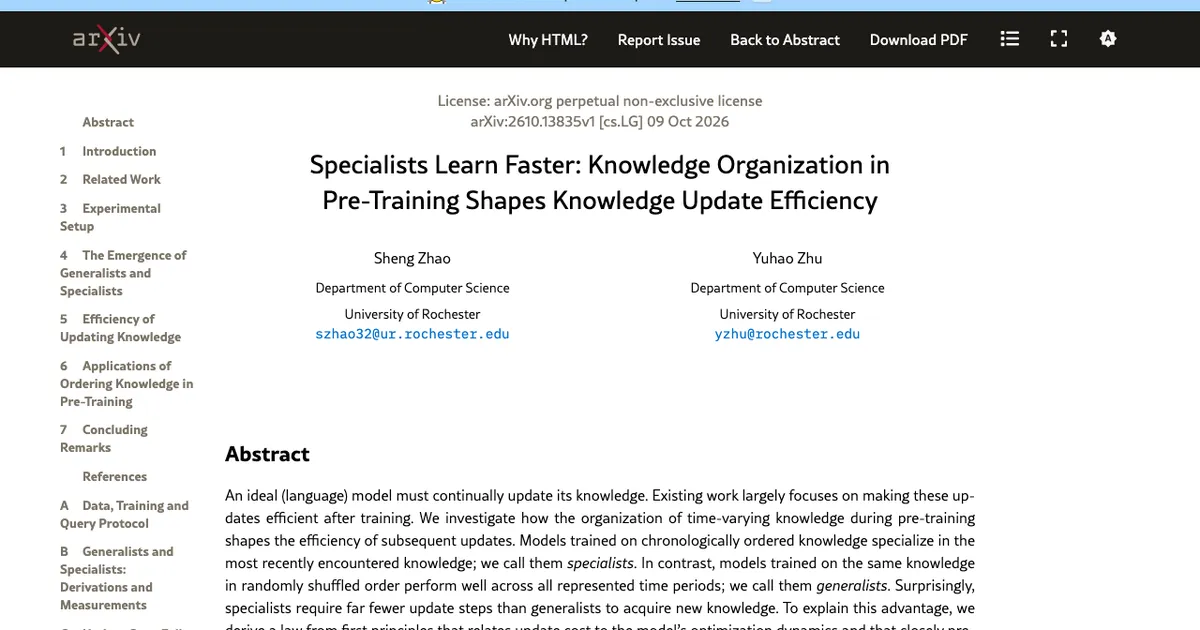
Specialists Learn Faster: Knowledge Organization in Pre-training Shapes Knowledge Update Efficiency

By Sheng Zhao, Yuhao Zhu • arXiv • Importance: 92/100
Hero Image for 2610.13835

🧠 Specialists vs. Generalists: How Your LLM Learns to Stay Current

The biggest challenge for Large Language Models (LLMs) isn’t just training them—it’s keeping their knowledge up-to-date efficiently. As the world changes in real-time, models need to learn without constant, massive retraining cycles.

But what if how you organize the data during initial pre-training actually dictates how well your model can adapt later? This fascinating new research, by Zhao and Zhu, suggests that the structure of knowledge matters just as much as the content itself.

🕰️ The Core Insight: Temporal Specialization

The paper investigates models trained on ‘time-varying’ knowledge—information that changes over time (e.g., historical facts, recent events). They found two distinct types of architectures:

  1. The Specialists: Models trained on chronologically ordered data (newest info comes last). These models become hyper-focused on the most recent knowledge period.
  2. The Generalists: Models trained using randomly shuffled data across all time periods. These are robust, retaining competence equally across history.

The surprising finding? The Specialists are significantly more efficient at updating! When new information arrives, specialists require far fewer update steps than generalists to achieve comparable knowledge gain.

✨ Why Does This Matter for AI?

The authors don’t just observe this; they derive a theoretical law linking optimization dynamics to update cost. This gives us concrete guidance on how to structure our data pipelines.

They propose a revolutionary strategy: Organizing pre-training data in a temporal fashion. This allows the model to build stable, deep historical knowledge while maintaining an ‘update mechanism’ optimized for fast acquisition of current events.

Takeaway: For building enterprise AI or real-time knowledge systems, simply having massive amounts of data is not enough. The sequence and structure in which you feed that data determines the model’s long-term maintenance cost.


🚀 In Short: Rethinking LLM Knowledge Updates

This research moves beyond just fine-tuning. It tackles the foundational problem of knowledge obsolescence. By guiding pre-training data organization, we can build specialized AIs that are inherently optimized for minimal retraining effort and maximum recency capability.

Read the full details on this temporal knowledge organization breakthrough: Specialists Learn Faster: Knowledge Organization in Pre-training Shapes Knowledge Update Efficiency.

AI #LLMs #MachineLearning #KnowledgeGraph #TemporalAI

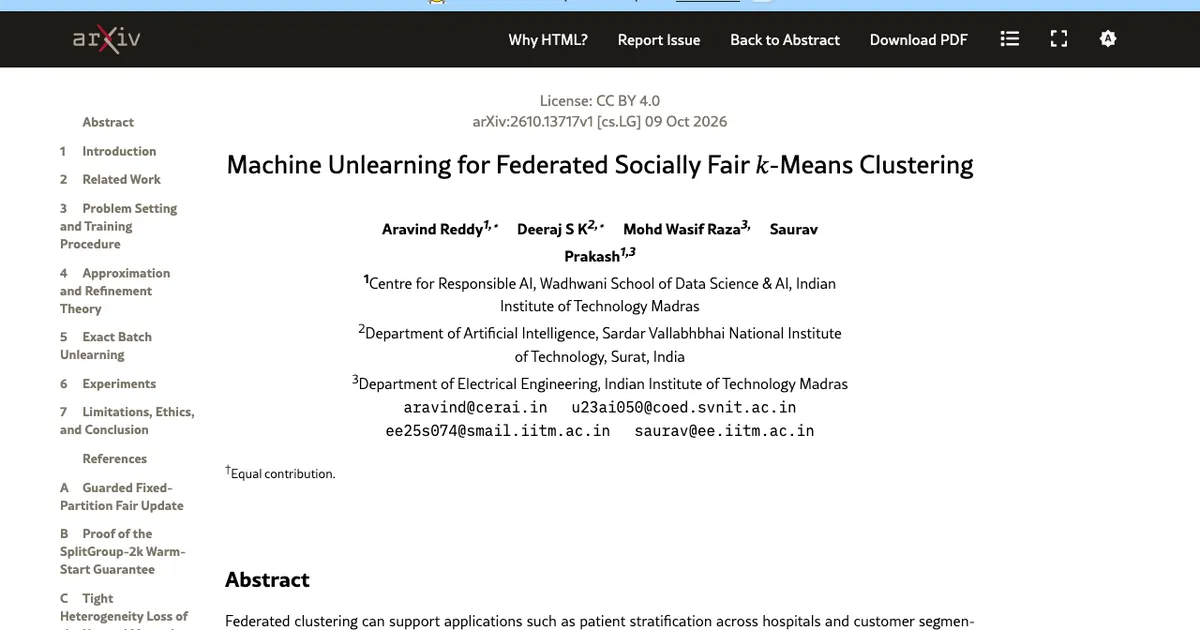
Machine Unlearning for Federated Socially Fair k-Means Clustering

By Aravind Reddy, Deeraj S K, Mohd Wasif Raza, Saurav Prakash • arXiv • Importance: 92/100
Hero Image for 2610.13717

🧬 Data Rights Meets AI Ethics: Unlearning Techniques for Fair Clustering

Are you building an ML model that handles sensitive data across multiple organizations (like hospitals or banks)? Then you’ve run into a major ethical and legal headache: the Right to Erasure. You need models that are accurate, and they need to know how to forget specific data points without breaking their core function.

This paper tackles exactly that problem by merging three critical fields of modern AI: Federated Learning, Fairness Constraints, and Machine Unlearning.

🌐 The Problem: Forgetting in a Global System

The need for machine unlearning is growing, driven by regulations like GDPR. When you delete a record—say, one patient’s data from a hospital dataset used to train a global clustering model—it’s not just about removing the point. It can dramatically shift the balance of your underlying population demographics, potentially violating fairness constraints that were established for different groups (e.g., ensuring equal representation across racial or gender groups).

Traditional deletion methods are computationally expensive and often disrupt complex mathematical objectives like finding optimal cluster centers while maintaining group parity.

✨ The Solution: Exact Machine Unlearning for Fair Clustering

Researchers Aravind Reddy et al. introduce a framework for exact machine unlearning specifically designed for federated, socially fair $k$-means clustering. Their approach is sophisticated because it maintains localized summary statistics for each demographic group at the individual client level.

By keeping separate summaries, when global fairness weights shift (because data was deleted), the unaffected institutions’ local knowledge remains valid. This ensures that the model forgets specific records while preserving its commitment to social fairness across all groups.

What does this mean in practice? * Compliance: You can prove your system adheres to GDPR or similar rights-to-forget laws. * Fairness Guarantee: The clustering process actively minimizes the largest group-average squared distance, guaranteeing a baseline level of fairness. * Efficiency (The Payoff): Crucially, they benchmarked the re-use potential. For whole clients withdrawing, their replay method was drastically faster—up to $35.8 imes$ compared to full retraining. This proves that exact unlearning is computationally profitable when major data inputs are removed.

🧠 Key Takeaways for ML Engineers

  1. Scope: This work goes beyond simple deletion; it manages the complex interplay between forgetting and group representation balance in a federated setting.
  2. Mechanism: The core innovation lies in maintaining localized, group-specific summaries that enable continuous global fairness adjustments after local data loss.
  3. Efficiency Map: Their empirical results provide critical guidelines: exact unlearning pays massive dividends when entire clients withdraw (large scale) but modest gains for single record deletion. This helps teams plan compute resources effectively.

If your project involves distributed, sensitive healthcare or financial data, this paper is a must-read reference on balancing privacy with powerful AI functionality.

🔗 Read the full study and explore implementation details: Machine Unlearning for Federated Socially Fair k-Means Clustering


Disclaimer: This digest is for educational purposes and does not constitute professional ML or legal advice.

Partially Informed Stochastic Optimization via Zeroth-Order Residual Tracking

By El Mahdi Chayti, Alireza Mirrokni, Martin Jaggi • arXiv • Importance: 90/100
Hero Image for 2610.13871

Beyond the Full Gradient: A New Era of Optimization

The gold standard in machine learning optimization is gradient descent. We assume that every single parameter update can be perfectly informed by computing a full, accurate gradient ($ abla f(x)$). But what happens when obtaining those gradients is either impossible or too expensive? This limitation profoundly restricts the types of problems we can solve—from complex simulation models to black-box performance evaluation in robotics.

Researchers have wrestled with this challenge for years, but our latest work introduces a paradigm shift: Partially Informed Stochastic Optimization (PISO).

🧠 What Problem Does PISO Solve?

The core limitation in many real-world ML tasks is the ‘partial information’ problem. In scenarios like:

  • Performative Prediction: Predicting outcomes based on complex, simulation-driven interactions.
  • Bilevel Optimization: Optimizing a system where one component minimizes another (e.g., game theory).
  • Black-Box RL: Reinforcement learning where we only observe the final outcome without internal gradient access.

In these cases, we might have direct access to some parts of the gradient ($ abla_A f$) but must estimate the remaining components using costly function evaluations (the ‘residual’). Traditional methods struggle because estimating this residual introduces high variance and unstable updates.

PISO elegantly addresses this by combining the known gradient component with a running, sophisticated estimate of the residual. By centering each observation on this tailored estimate, we stabilize the stochastic process. This isn’t just a minor fix; it provides an explicit contraction mechanism and gives momentum in a principled, mathematically rigorous way.

🚀 Key Takeaways & Impact

1. Robust Convergence Guarantees: We establish solid convergence guarantees for smooth nonconvex objectives. Crucially, these proofs do not require assuming that the unavailable gradient component is uniformly bounded—a major theoretical breakthrough! This expands the scope of solvable problems.

2. Leading Efficiency Rates: Using standard Gaussian or spherical probes and independent function evaluations, PISO achieves leading sample complexity bounds, such as $O(d^{2}ackslash ext{varepsilon}^{-6})$ under Lipschitz gradients. These rates are highly competitive, requiring remarkably few samples per update.

3. Versatility in Practice: The method’s practical success is demonstrated across five distinct settings: * It improves upon state-of-the-art baselines with comparable oracle access (three scenarios). * In bilevel routing, it achieves a solution faster than competitors. * Most notably, in performative reinforcement learning, PISO performs the best among methods that cannot rely on derivative calculations of response models—a key limitation for advanced RL systems.

💡 The Tech Deep Dive (The Math Bit)

The mathematical core is highly sophisticated. By carefully constructing the update step based on a running residual estimate and known gradient components, PISO effectively turns a potentially unstable stochastic process into a controlled iteration. It offers a principled interpretation of how ‘momentum’ should behave when information is incomplete.

This work provides not only superior theoretical guarantees but also robust practical tooling for optimizing complex systems where full gradient access is a fantasy. If your research touches on black-box optimization, multi-level system design, or complex physical simulations (like those in physics-informed ML), this paper is essential reading.

Read the full details and analysis here: Partially Informed Stochastic Optimization via Zeroth-Order Residual Tracking

Inference-Time Steering Across Scaffolds and Epitopes for Sample-Efficient De Novo Nanobody Design

By Mason Minot, Simon Friedensohn, Cédric R. Weber • arXiv • Importance: 90/100
Hero Image for 2610.13844

🚀 Supercharging Protein Design: Smarter AI for Nanobodies

Molecular design is critical for next-generation therapeutics. Traditional generative models often treat the search space like a brute-force maze, generating massive quantities of candidates only to filter out most of them later. This wastes immense computational power.

Our latest work tackles this fundamental inefficiency by introducing dynamic inference-time resource allocation. Instead of committing all compute budget upfront—for example, choosing one scaffold or target epitope and running the full generation process—we treat the entire design workflow as a resource management problem.

💡 The Core Problem with Current AI Design

In computational drug discovery, you need to find highly specific protein binders, like nanobodies. These designs depend on multiple conditional choices: which structural scaffold will be used, and which specific molecular patch (epitope) must it bind to. If we pick a poor combination of scaffold and epitope, the entire computation run for that setup is wasted.

Existing methods, even advanced techniques like Feynman-Kac steering, assume you are optimizing within one fixed configuration. They don’t dynamically decide when to pivot or abandon an unproductive path to save resources.

✨ Our Solution: Dynamic Budget Allocation

We propose two novel dynamic allocators that fundamentally change how we use generative AI in molecular design:

  1. Joint Global SMC Formulation: This approach treats the entire process as a single, intelligent system, steering and allocating compute across all potential configurations simultaneously using a Sequential Monte Carlo (SMC) framework.
  2. Adapted Batched Successive Elimination (BaSE): A decoupled strategy that efficiently identifies and prunes poor-performing setups early on, allowing resources to be reallocated to the most promising pathways.

By implementing this smart resource management, we achieved a nearly 5$ imes$ increase in designable candidates per GPU-hour. This isn’t just an incremental improvement; it represents a major leap toward making high-throughput, multi-condition molecular discovery much more practical and affordable.

🔬What does this mean for the industry?

This technique accelerates the bottleneck phase of drug development. By maximizing the yield of viable nanobodies per computational dollar, we significantly speed up the pre-clinical design cycle. It makes complex screening across diverse therapeutic targets (like novel cancer epitopes or viral antigens) feasible in industrial settings like Boston and San Francisco.

🔗 Read the full details on dynamic resource allocation for generative molecular design here: https://arxiv.org/abs/2610.13844


#ProteinDesign #AIinScience #DrugDiscovery #GenerativeAI #ComputationalBiology

Shared Canonical Component Removal Beyond Expert Views

By Jose Roberto Tello Ayala, Akl C. Fahed, Roy Perlis, Finale Doshi-Velez • arXiv • Importance: 90/100
Hero Image for 2610.13819

Decoding Expert Insights: Unlocking Hidden Predictive Signals in ML

Ever wonder how much of a machine learning model’s ‘intelligence’ comes from the data we explicitly feed it?

In clinical and specialized domains, experts don’t just look at raw inputs (like an MRI scan or patient vitals); they first process them through sophisticated feature interpretations—these are the expert views. While advanced black-box models might achieve peak performance on raw input, researchers often struggle with a crucial question: what is the extra predictive power that these models exploit beyond what human expertise can define? Is it noise? Hidden correlations? Or something entirely new?

This pioneering work introduces an elegant framework called Shared Canonical Component Removal (SCCR) to precisely answer this.

🔍 What is Shared Canonical Component Removal (SCCR)?

Think of SCCR as a sophisticated academic audit for your model’s knowledge. Standard methods like simple residualization or concept erasure are too blunt; they often erase too much signal indiscriminately.

The authors developed SCCR to selectively remove only the dimensions that are strongly shared between the raw input embedding and the expert-defined view. This precision allows them to quantify the exact ‘gap’—the residual predictive signal—that a model leverages which is not captured by the defined expert features.

🏥 Real-World Impact: Beyond Theory

This isn’t just theoretical math; it has serious clinical implications. The researchers tested SCCR across diverse, high-stakes domains:

  • Coronary Artery Disease (CAD) Detection: Refining diagnostic signals from complex medical images.
  • Antidepressant Treatment Dropout: Predicting patient adherence and treatment effectiveness.
  • Skin Lesion Classification: Using specialized annotations to understand subtle visual markers.

Their results show that SCCR not only successfully recovers crucial residual predictive signal but also does so while minimizing the risk of redundancy or information loss relative to the established expert views. This makes ML models more explainable, reliable, and trustworthy in critical healthcare settings.

🧠 Key Takeaways for AI Development

  1. Bridging the Gap: SCCR provides a powerful quantitative tool for understanding how far black-box model knowledge deviates from human conceptual understanding.
  2. Enhanced Trustworthiness: By identifying novel, non-redundant signals, this method contributes significantly to building more interpretable and robust AI systems, especially in medicine.
  3. The Future of Feature Engineering: Instead of relying solely on manual feature extraction (which is time-consuming), SCCR gives us a systematic way to audit and augment expert knowledge with hidden data patterns.

If you are working on domain adaptation, medical imaging, or model interpretability, this paper offers a foundational new tool. Learn more about the methodology in the original work: Shared Canonical Component Removal Beyond Expert Views

TabMF: Learning Dataset Representations with Tabular Foundation Models

By Rafiq Kamel, Nicolas Atienza, Aziz Fouché, Nicola Cancedda, Josif Grabocka • arXiv • Importance: 90/100
Hero Image for 2610.13818

Decoding Data: How TabMF is Revolutionizing Dataset Representations

Ever wondered what makes a dataset ‘good’? Machine learning models typically look at features and labels. But advanced tasks—like knowing if your data distribution has suddenly shifted, or finding the perfect replacement dataset—require a deeper understanding of the entire dataset structure.

This is where TabMF comes in. It’s a breakthrough framework that doesn’t just treat datasets as raw inputs; it learns high-level, structural representations of them using powerful foundation models.

💡 The Problem with Traditional Dataset Analysis

Historically, analyzing datasets for tasks like distribution shift or retrieval was tricky. Approaches either relied on manual, hand-crafted meta-features (which are limited and domain-specific) or required building complex, custom encoders from scratch. This process was slow and often suboptimal.

🧠 What is TabMF?

The Solution: Repurposing Foundation Models

TabMF’s core genius lies in its ability to repurpose existing powerful tabular foundation models (TFMs). Instead of building a new encoder, TabMF takes an already pre-trained model—one designed for predictive tasks on structured data—and cleverly adapts it.

It treats the TFM as a highly effective, general-purpose encoder that can generate a rich, compact fingerprint (the representation) of the entire dataset.

This isn’t just basic fine-tuning. TabMF adds an ‘architecture-aware readout layer’ and uses contrastive post-training on synthetic data views to maximize how well this representation captures deep structural information.

✨ Why is This a Big Deal? (Real-World Impact)

The results presented in the paper TabMF: Learning Dataset Representations with Tabular Foundation Models show that these learned representations perform exceptionally well across diverse, unseen real-world tasks. The performance improvements are particularly strong in three critical areas:

  • Dataset Retrieval: Finding the most similar dataset for a given problem is now more robust.
  • Distribution Shift Monitoring: Accurately assessing how much new data deviates from the training data (a vital step in maintaining ML models in production).
  • Compact Benchmark Construction: This enables building standardized, robust benchmarks quickly.

Crucially, the abstract notes that even a simple frozen TFM readout yields competitive results, suggesting that general pretraining already imbues models with deep structural knowledge—a powerful finding for the field. The full methodology and evaluation are detailed in the study TabMF: Learning Dataset Representations with Tabular Foundation Models.

🚀 Key Takeaways for ML Engineers & Researchers

  1. Efficiency: You don’t need to start from scratch. Leveraging powerful, off-the-shelf foundational models (like those trained on TabICLv2 or TabPFN-2.5) is an efficient starting point.
  2. Generality: The representations are task-agnostic and general enough to excel across diverse downstream tasks like retrieval and shift detection.
  3. Future Direction: This pushes the field toward treating entire datasets not just as inputs, but as highly informative, measurable objects themselves.

If your work involves analyzing data structure, monitoring model drift, or comparing large datasets, TabMF provides a powerful new toolkit to achieve state-of-the-art performance. Check out the technical details here: TabMF: Learning Dataset Representations with Tabular Foundation Models

Randomized Momentum Transport with Cheap Predictors

By El Mahdi Chayti, Martin Jaggi • arXiv • Importance: 90/100
Hero Image for 2610.13789

Faster ML Training: The Future of Randomized Momentum Transport

The quest for faster, more sample-efficient machine learning models is the holy grail of AI research. Gradient optimization methods—the engine that powers training deep neural networks—are constantly evolving to squeeze out every last bit of performance. Lately, advanced momentum techniques like STORM have significantly boosted convergence speed by adding ‘transport corrections’ that track gradients with high fidelity.

However, these sophisticated methods come at a cost: they often require an extra calculation (an oracle call) in every single training step. This overhead can drastically slow down large-scale deployment or resource-constrained environments.

Introducing Randomized Momentum Transport (RMT)

The paper by El Mahdi Chayti and Martin Jaggi introduces a breakthrough solution: approximating these expensive momentum corrections. Instead of running the full, costly transport calculation every time, RMT evaluates the correction only with a probability $q$ (the ‘randomization’). For all other steps, it uses a cheap, carefully designed prediction.

This approach is revolutionary because it doesn’t sacrifice stability or theoretical performance. Through careful use of importance weighting, the authors prove that the core statistical properties—like preserving the conditional mean and managing variance—are maintained even with massive randomness. They introduce rigorous guarantees showing that this approximation retains the critical convergence bounds ($O(T^{-1/3})$) previously thought necessary for these methods.

Key Takeaways & Empirical Impact

The theoretical results are robust, supporting various advanced minimization oracles (including techniques used for spectral directions like Muon). But the empirical evidence is what truly excites researchers:

  • Significant Performance Boost: On standard benchmarks like MNIST1D, running RMT with just a quarter of the full corrections can lower the final training loss by an impressive 18% to 43%.
  • Improved Accuracy: For complex tasks using Hessian-vector transport on CIFAR-10, they observed a substantial gain of 1.5 points in test accuracy.

The paper demonstrates that at approximately equal oracle cost, sampling the expensive parts of gradient tracking is not just feasible—it’s beneficial. By cleverly balancing cheap predictions and random corrections, they achieve comparable or better performance than the fully deterministic methods, all while dramatically reducing computational overhead.

In Short: RMT offers a practical path toward scaling advanced optimization algorithms. It makes powerful, but costly, momentum tracking techniques accessible for large-scale industrial use by turning high computation cost into controllable randomness.


Want to dive deeper into the math? Read the full details on Randomized Momentum Transport with Cheap Predictors.

Optimal Algorithms for Nonsmooth Nonconvex Stochastic Optimization with Constraints

By Gon Buzaglo, Guy Kornowski • arXiv • Importance: 90/100
Hero Image for 2610.13787

Mastering the Optimization Maze: New Algorithms for Nonsmooth Constrained ML

In modern Machine Learning and Deep Learning, we constantly face a fundamental challenge: optimizing complex models where the objective function is neither smooth nor convex. On top of that, real-world problems often impose constraints.

Until now, tackling this combination—nonsmoothness + nonconvexity + constraints—has been incredibly challenging for optimization theory. But new research tackles this head-on! We’ve got a deep dive into the latest advancements from Gon Buzaglo and Guy Kornowski.

🤯 What Problem Are They Solving?

The paper introduces novel algorithms designed for stochastic optimization problems where:

  1. Nonsmooth: The objective function isn’t perfectly differentiable everywhere (think of absolute value functions or L1 penalties).
  2. Nonconvex: The landscape is riddled with local minima and saddles, making it hard to guarantee finding the global optimum.
  3. Constrained: Solutions must adhere to a specific set of rules or boundaries.

In short: optimizing a complex ML objective subject to real-world limitations using noisy data (stochastic gradients).

🚀 The Breakthrough:

The core breakthrough is in establishing optimal convergence rates for this difficult combination. They introduce two types of algorithms—projection-based and projection-free methods—and prove several things that are massive wins for the field:

  • Optimal Rate Achieved: They achieve a convergence rate of $\widetilde O(\delta^{-1}\varepsilon^{-3})$ using stochastic gradients, which they show is optimal.
  • Dimension Efficiency: For queries where the dimension ($d$) matters (like zeroth-order methods), they achieved an optimal rate of $\widetilde O(d\delta^{-1}\varepsilon^{-3})$, improving upon prior work.
  • Independence of Difficulty: Crucially, their analysis shows that for nonconvex stochastic optimization, the convergence rate is degraded neither by constraints nor by nonsmoothness. This fundamentally simplifies our theoretical understanding of ML optimization!

💡 Why Does This Matter to Practitioners?

For those building advanced models or designing robust optimization pipelines in fields like finance, control systems, or large-scale recommendation engines, these results provide critical theoretical guarantees.

It means we have mathematically proven that the best possible convergence rate can be achieved for solving highly complex, constrained ML problems. This drives better algorithm design and allows researchers to set more realistic performance expectations.

👉 Read the full technical details here: Nonsmooth Constrained Optimization Algorithms


(Disclaimer: This is a deep theoretical paper, so keep your hyperparameters tuned and stay in the loop on optimization theory!)

From Pixels to Privacy-Sensitive Features: An Information-Theoretic Framework for Reconstruction Bounds

By Henry Bourne, Robert F. Allison • arXiv • Importance: 90/100
Hero Image for 2610.13768

Beyond $\epsilon$: Quantifying What Adversaries Learn from Differentially Private Models

Are you building a powerful AI model using Differential Privacy (DP)? You’ve likely implemented DP-SGD to guarantee privacy, providing an $(\epsilon, \delta)$ bound. But does this mean the model is truly safe? Not necessarily.

Most existing literature focuses solely on the probability of leakage ($\epsilon$). They tell you how unlikely it is that a single data point could be recovered. But they don’t quantify how much information remains, or what kind of features an adversary can reconstruct.

This groundbreaking research paper introduces a fundamental shift in thinking: moving from abstract probability bounds to concrete, quantifiable reconstruction error bounds based on Information Theory.

🧠 What the Paper Does (The Big Idea)

Traditional DP only gives you an $(\epsilon, \delta)$ guarantee. This work tackles the much harder question: What is the minimum amount of information an attacker can recover?

Authors Bourne and Allison develop a powerful information-theoretic framework that provides a distortion bound. This bound tells us, in mathematical terms, the expected error ($ ext{E}[ ext{Error}]$) when trying to reconstruct sensitive input data from a trained DP model.

Crucially, this bound is comprehensive: it holds even if an adversary knows the entire training trajectory (the parameters over time), sees every other training record, and knows the underlying data distribution. It’s highly robust.

🔑 The Core Mechanics: Rate-Distortion Theory

The authors combine two key concepts from information theory:

  1. Information Leakage: Measured using conditional mutual information (how much info a single record reveals).
  2. Source Uncertainty: Measured using source entropy (the inherent randomness in the data distribution).

By applying rate-distortion theory, they create a lower bound on the expected reconstruction error for any attack. This is not just theoretical noise; it gives practical metrics.

🖼️ Real-World Impact: Pixels and Features

They don’t stop at basic pixel values. They make this framework highly flexible, allowing researchers to choose the specific representation (the

SmolWAM: A Latent World-Action Model for Robotic Manipulation on Edge Devices

By Timi Owolabi, Hikmah Olawore, Frances Adelakun, Ayotomiwa Oyewumi • arXiv • Importance: 90/100
Hero Image for 2610.13740

SmolWAM: Bringing Advanced Robotics to the Edge

🤖 The Challenge of Robotic AI on Small Devices

The future of robotics depends on giving machines intelligence that is not tethered to massive data centers. When you need a robot arm to navigate your home or interact with delicate objects, high latency and limited power draw are non-negotiable requirements. However, the most powerful models—like state-of-the-art World-Action Models (WAMs)—rely on huge video diffusion transformers. These models are fantastic in the lab but completely impractical for resource-constrained edge devices. They simply drain too much energy and require too much compute power.

This is where SmolWAM steps in, offering a critical breakthrough for deploying advanced AI directly onto real-world hardware.

✨ What Exactly is SmolWAM?

SmolWAM is a novel World-Action Model designed from the ground up to be efficient. Instead of brute-forcing massive video processing, it operates entirely within a latent space. This means it predicts what will happen next (both the robot’s action and the resulting scene change) using highly compressed representations, bypassing the computational bottleneck of full pixel diffusion.

Building on the robust 2B-parameter Cosmos Policy framework, the researchers kept the core knowledge ‘trunk’ but drastically overhauled the inference pipeline. They achieved this efficiency by: * Using Single-Frame Visual Latents: Focusing processing power only where it’s needed in time, rather than full video sequences. * Caching Text Features: Preserving attention sinks from the original model for continuity and context. * Systematic Pruning: Implementing a streamlined structure that reads out actions and future latents simultaneously using a rectified-flow step.

🚀 The Performance Leap: Why SmolWAM Matters

The results are astonishing. Tested on the challenging LIBERO manipulation task, SmolWAM demonstrated unprecedented efficiency:

  • Speed: It completed episodes at an impressive 57 ms—a critical metric for real-time control.
  • Efficiency Gains: Compared to its foundational model (the ‘teacher’), SmolWAM was 11x faster, used 18.5x fewer FLOPs, and required 3.2x less memory.
  • Capability Preservation: Crucially, despite these massive compressions, its world head still accurately forecasts complex scene motion, maintaining the high level of prediction fidelity.

This isn’t just a faster model; it’s proof that state-of-the-art robotic AI can be made portable and practical. SmolWAM represents a major step toward realizing truly autonomous robotics in everyday settings.

Read the full technical details on this breakthrough: SmolWAM: Latent World-Action Model for Robotics


A contributing insight from our AI research team.

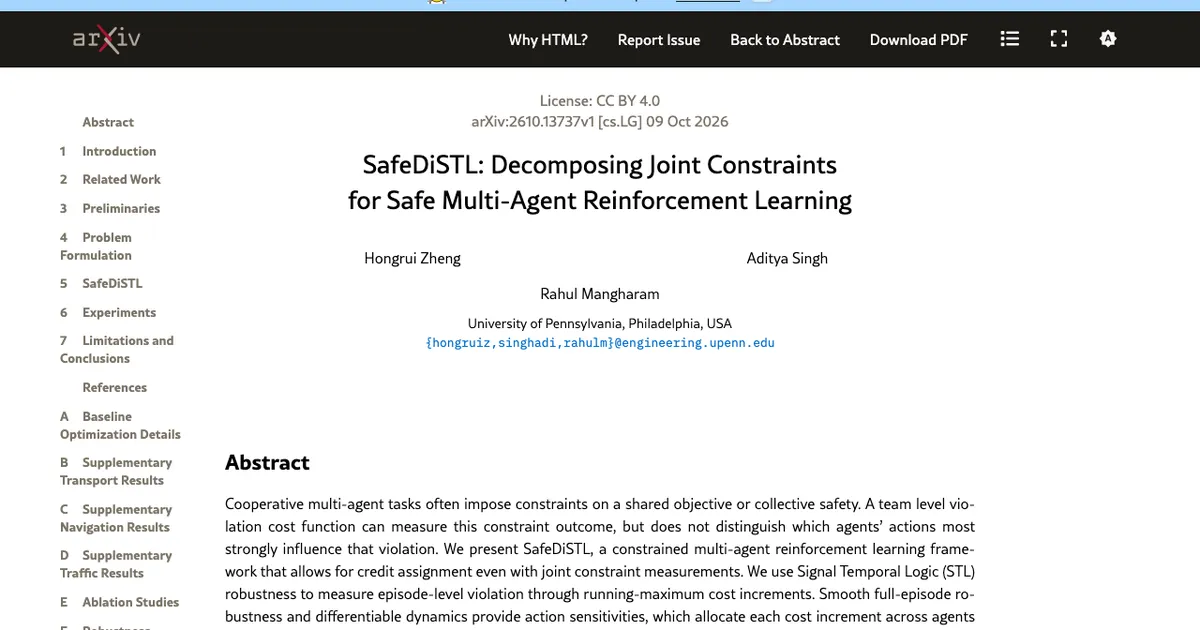
SafeDiSTL: Decomposing Joint Constraints for Safe Multi-Agent Reinforcement Learning

By Hongrui Zheng, Aditya Singh, Rahul Mangharam • arXiv • Importance: 90/100
Hero Image for 2610.13737

🚀 SafeDiSTL: Finally Solving the Problem of Shared Safety in Multi-Agent Systems

If you’ve worked on collaborative AI or self-driving systems, you know that getting agents to cooperate isn’t enough—they have to do it safely. Traditional Reinforcement Learning (RL) models often struggle when tasks impose joint constraints (like keeping a payload within safe bounds or ensuring coordinated traffic flow). These constraints are vital, but they introduce a thorny problem: credit assignment.

When the whole team violates a rule, how do you know which agent’s action was primarily responsible? Until now, measuring only a ‘team-level violation cost’ obscured the root cause.

That changes with SafeDiSTL. Read more about our work on Joint Constraints in Multi-Agent RL.

🧠 The Core Breakthrough: Decomposing Joint Safety Costs

The central limitation of existing constrained MARL approaches is their inability to attribute fault. We tackle this by developing SafeDiSTL, a novel framework that doesn’t just measure if a violation occurred, but precisely who caused it.

  1. Signal Temporal Logic (STL) Robustness: We use advanced STL methods combined with running-maximum cost increments to robustly measure episode-level violations, moving beyond simple instantaneous penalties.
  2. Differentiable Dynamics & Sensitivities: The key technical breakthrough lies in using smooth dynamics and differentiable cost functions. This allows us to calculate ‘action sensitivities’—a quantitative measure of how much each agent’s action contributes to the total violation cost at any given moment.
  3. Credit Assignment Magic: Crucially, these sensitivities account for delayed effects. It’s not just about immediate actions; they weigh agents’ shares of cost increments over time, giving a full picture of shared accountability.

🌐 Real-World Impact: Where SafeDiSTL Excels

The theoretical improvements translate into massive gains in complex physical and network environments. We tested SafeDiSTL across three critical domains:

  • Payload Transport: Improving safe-success rates by up to 5.1x.
  • Connected Navigation: Delivering an impressive 11.1% improvement in safety compared to state-of-the-art constrained baselines.
  • Networked Traffic Control: Boosting throughput by 50–68%, proving its utility in managing high-density, critical infrastructure systems.

SafeDiSTL demonstrates that you can successfully train agents using joint constraints without sacrificing the performance benefits of unconstrained policies—a major win for robust AI deployment.

🔬 The Technical Deep Dive (For Researchers)

SafeDiSTL provides a powerful mechanism for fine-grained blame assignment in collaborative tasks. By decoupling global constraints into agent-specific, time-delayed contributions, it allows the learning policy to optimize for both performance and distributed safety simultaneously. This approach is highly relevant for developing next-generation mission-critical AI systems.

Want to dive deep into the math? Check out the full paper: SafeDiSTL: Decomposing Joint Constraints for Safe Multi-Agent Reinforcement Learning


Read this post to understand how Deep Learning researchers are tackling systemic failures in multi-agent systems, making robotics and autonomous vehicles safer.

Orthros: Phase-Aware Heterogeneous Attention for Efficient Transformers

By Yuhong Chou, Zehao Liu, Yuqi Pan, Qian Liu, Xianwei Chen, Zhongzhu Zhou, Jibin Wu • arXiv • Importance: 90/100
Hero Image for 2610.13735

✨ Rethinking Attention: Introducing Orthros for Hyper-Efficient LLMs

If you’re working with Large Language Models (LLMs), you know the biggest bottleneck isn’t always the math—it’s the context window size. As models process more data, the computational cost of attention explodes, often hitting a quadratic slowdown ($O(N^2)$). Standard efficient methods solve parts of this but leave major weaknesses in long-context recall and overall efficiency.

That’s exactly what the authors behind Orthros tackled: making LLMs massively efficient without sacrificing peak performance or deep context understanding.

🧠 The Problem with Current Transformers

The Transformer architecture, which powers nearly all modern foundation models (GPT, Llama, etc.), relies on an attention mechanism whose computational complexity scales quadratically ($O(N^2)$) with the sequence length $N$. While efficiency improvements like linear or sliding window attention exist, they often degrade crucial capabilities, especially in-context recall—the model’s ability to remember specific details buried deep in a massive prompt.

This forces researchers into ‘patching’ solutions: using efficient methods for prefilling (loading the context) and then switching back to full attention for decoding, leaving the $O(N^2)$ bottleneck unresolved during critical phases.

🚀 What is Orthros? The Paradigm Shift

Orthros takes a radically different approach. Instead of trying to structurally constrain attention (like fixed windows), it proposes phase-aware decoupling. Think of it as an intelligent compute scheduler for the LLM’s brain.

Orthros dynamically switches its computation pattern based on whether the model is in the heavy-context ‘prefilling’ phase or the detailed ‘decoding’ phase. This unified module retains maximum efficiency where it’s needed most, achieving linear complexity for prefilling while maintaining full Transformer-level attention capability during decoding.

The key takeaway: Orthros isn’t just an optimization; it redefines how resources are allocated throughout the entire inference lifecycle.

🔬 Why is This a Game-Changer? The Results

The empirical evidence presented by the researchers https://arxiv.org/abs/2610.13735 is genuinely impressive, suggesting significant industrial impact:

  • Blazing Speed: It achieves a staggering $21.9 imes$ prefilling speedup compared to vanilla Transformers, with overall end-to-end inference gains.
  • Elite Long Context Handling: Near-perfect recall on 128K ‘needle-in-a-haystack’ tasks, matching or surpassing Transformer performance. This is critical for enterprise use cases that require processing vast documents.
  • Architectural Superiority: The module shows scalability across different model sizes and outperforms baseline Transformers in real-world memory and complex task contexts.
  • Practical Implementation: The paper even outlines a data-efficient Transformer-to-Orthros conversion, meaning existing models can adopt this superior architecture with minimal retraining overhead, drastically lowering the barrier to adoption.

💡 TL;DR for Engineers & Researchers

If your workflow requires processing massive context windows (e.g., document analysis, code comprehension) and speed is paramount, Orthros offers a robust solution that sidesteps the fundamental quadratic bottleneck while retaining high-fidelity recall capabilities. It presents a compelling candidate to become the next foundational standard for industrial-grade LLM inference.

*Want the deep dive? Check out the full paper on ArXiv!


#LLMs #Transformer #AIResearch #MachineLearning #Efficiency #DeepLearning

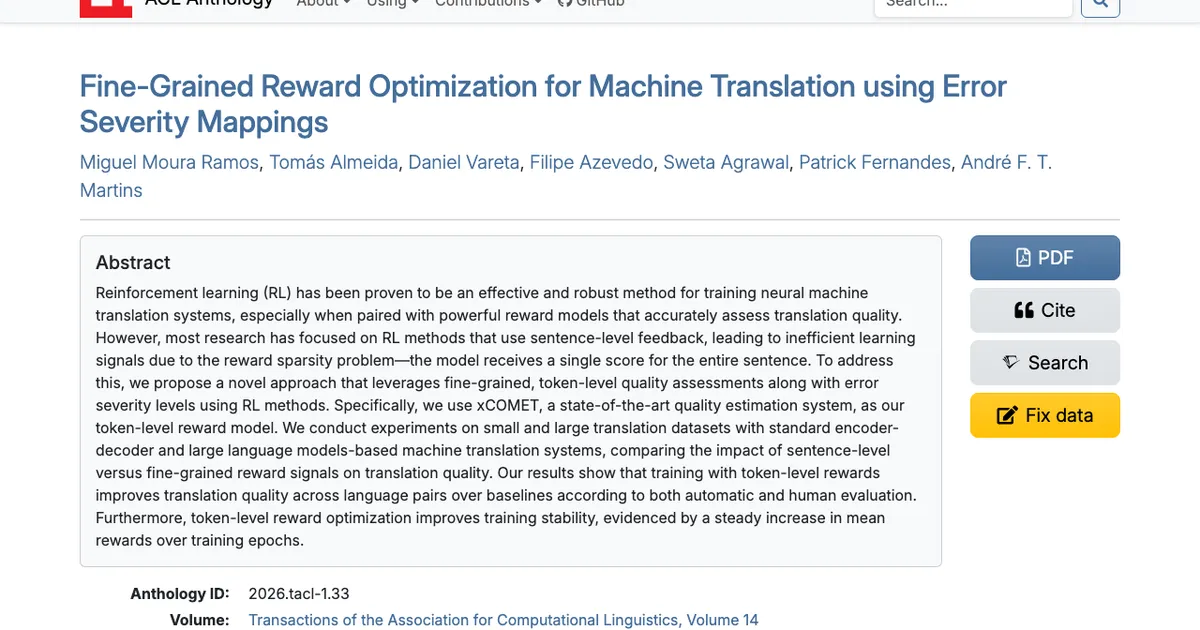
Early Risk Prediction with Temporally and Contextually Grounded Clinical Language Processing

By Rochana Chaturvedi, Yue Zhou, Andrew Boyd, Brian T. Layden, Mudassir Rashid, Lu Cheng, Ali Cinar and Barbara Di Eugenio in Transactions of the Association for Computational Linguistics, Volume 14 • ACL Anthology • Importance: 90/100
Hero Image for acl_2026.tacl-1.78

Decoding Health Trajectories: Predicting Disease Risk from Clinical Notes

Clinical notes housed in Electronic Health Records (EHRs) are goldmines of information. They capture not just diagnoses, but the complex story of a patient’s health—the temporal sequence of events, a clinician’s reasoning process, and even lifestyle shifts. For ML researchers building predictive health tools, this unstructured data is both immensely valuable and notoriously challenging.

This new paper tackles this challenge head-on, introducing sophisticated models that unlock the predictive power hidden within longitudinal clinical narratives. It’s a major step toward deploying more accurate, privacy-preserving diagnostic support systems.

🧬 The Problem: Why Standard NLP Fails in Medicine

Reading through patient notes is anything but straightforward. Unlike structured database entries, EHR text presents several critical hurdles:

  • Temporal Complexity: Events don’t happen sequentially; they are interconnected over years with complex dependencies (e.g., ‘Drug X was prescribed after the suspected onset of condition Y’).
  • Long Context & Irregular Data: Notes can be extremely long, and the frequency of certain events varies drastically between patients.
  • Privacy Constraints: The data is highly sensitive, requiring models that maintain strict privacy standards.

🚀 Introducing Next-Gen Predictive Frameworks

The authors present two complementary, state-of-the-art methodologies: HITGNN and REVEAL. These aren’t just minor tweaks; they fundamentally rethink how temporal data is modeled in medicine.

🧠 HITGNN: Graphing the Patient Journey

HITGNN (Hierarchical Temporal Graph Neural Network) takes a revolutionary approach. Instead of treating events as isolated points, it builds a rich graph structure that models three levels of interconnectedness:

  1. Intra-note Structure: Dependencies within a single visit’s notes.
  2. Inter-visit Dynamics: How the patient’s condition changes over time (the trajectory).
  3. Medical Knowledge Integration: By embedding established medical knowledge, HITGNN grounds its predictions in scientific reality, making it highly accurate and interpretable.

This approach excels at identifying near-term risks—exactly what clinicians need for proactive screening. During testing on Type 2 Diabetes (T2D) cohorts, HITGNN achieved the highest predictive accuracy while maintaining privacy.

✨ REVEAL: Distilling LLM Reasoning for Clinical Utility

While large language models (LLMs) are powerful, they can be resource-intensive and sometimes function as black boxes. REVEAL tackles this by proposing a lightweight framework that systematically distills the complex reasoning of giant LLMs into smaller, verifiable verifier models. This ensures both high sensitivity for true positive cases and maintains crucial explanatory reasoning—critical for clinical adoption.

🔬 Real-World Impact: Type 2 Diabetes Screening

The authors validate these methods on a rigorous screening task: opportunistic detection of Type 2 Diabetes (T2D) using carefully curated, temporally realistic patient cohorts. The results aren’t just impressive benchmarks; they demonstrate clinical viability:

  • Superior Accuracy: HITGNN showed superior performance in forecasting near-term risk.
  • Fairness: The ablation studies confirmed the value of temporal structure and knowledge augmentation, and crucially, fairness analysis demonstrated that HITGNN performs more equitably across different patient subgroups. This is paramount for ethical healthcare AI.

💡 Key Takeaway for Practitioners & Researchers: The future of personalized medicine lies in models that can understand time and context. HITGNN provides a robust, knowledge-grounded mechanism to model complex patient trajectories, while REVEAL ensures this power is deployable with interpretability.

Learn more about the full details and methodology here: Temporal & Contextual Risk Prediction


#NLP #HealthcareAI #MachineLearning #EHR #DigitalHealth

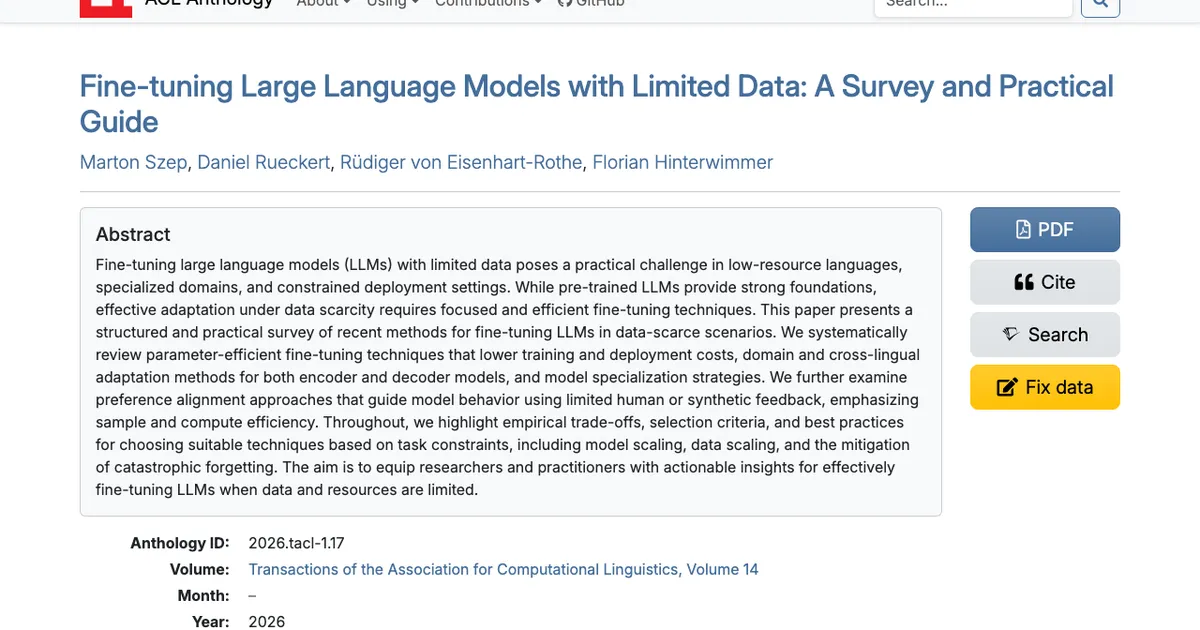
Fine-tuning Large Language Models with Limited Data: A Survey and Practical Guide

By Marton Szep, Daniel Rueckert, Rüdiger von Eisenhart-Rothe and Florian Hinterwimmer in Transactions of the Association for Computational Linguistics, Volume 14 • ACL Anthology • Importance: 90/100
Hero Image for acl_2026.tacl-1.17

Turbocharge LLMs: The Ultimate Guide to Fine-Tuning with Limited Data

Hey AI enthusiasts! If you’ve been struggling with adapting massive Large Language Models (LLMs) for specialized tasks—whether it’s legal document analysis, medical coding, or a low-resource language—you know the pain point: data scarcity. You have a powerful foundation model, but not enough high-quality data to fully realize its potential.

That’s exactly what this essential new survey addresses. We’re diving into the practical magic of getting top performance out of LLMs using minimal resources, saving both compute cycles and time!

🔑 What is Fine-Tuning with Limited Data?

While pre-trained LLMs are incredible generalists, they often struggle in niche areas or when deployed in regions lacking massive data pipelines. ‘Fine-tuning’ is the process of adapting a general model to specific tasks using a smaller dataset. But how do you do it efficiently when that dataset is tiny?

This paper systematically reviews the cutting edge of low-data LLM adaptation, making complex techniques accessible to practitioners.

💡 Key Techniques Covered in This Digest:

The authors provide an invaluable roadmap covering several critical areas for modern ML deployment:

  • Parameter-Efficient Fine-Tuning (PEFT): This is a game-changer. Instead of retraining the entire massive model, PEFT techniques drastically lower computational costs and memory footprint while still achieving near state-of-the-art results. Think LoRA or Prompt Tuning – making powerful models accessible on consumer GPUs.
  • Domain & Cross-Lingual Adaptation: LLMs can be too general! This section guides you on tailoring the model’s knowledge base to specific fields (e.g., finance, biology) or adapting it seamlessly across languages where parallel data is scarce. This minimizes ‘catastrophic forgetting.’
  • Preference Alignment (RLHF/DPO): How do you guide an LLM to behave exactly how you want? The survey deep dives into techniques that use limited human or synthetic feedback (like ranking comparisons) to shape the model’s behavior, maximizing sample and compute efficiency.
  • Best Practices & Trade-offs: Crucially, this isn’t just a list of methods. It provides practical guidelines on which technique to choose based on your constraints—whether you are constrained by model size, available data volume, or desired deployment speed.

🛠️ Who Should Read This?

  • ML Engineers & Practitioners: If you are tasked with deploying LLMs in real-world, resource-constrained environments. This is your ‘how-to’ guide.
  • AI Researchers: For a structured, comprehensive review of the latest methods and empirical trade-offs.
  • Domain Experts: Those who need to understand the feasibility and limitations of adapting state-of-the-art LLMs for niche applications.

This survey is an essential read for anyone aiming to maximize model utility without needing petabytes of data and endless computing power. It truly demystifies advanced fine-tuning strategies for resource limitation scenarios.

Read the comprehensive guide on efficient LLM adaptation here!


Source: Transactions of the Association for Computational Linguistics, Volume 14

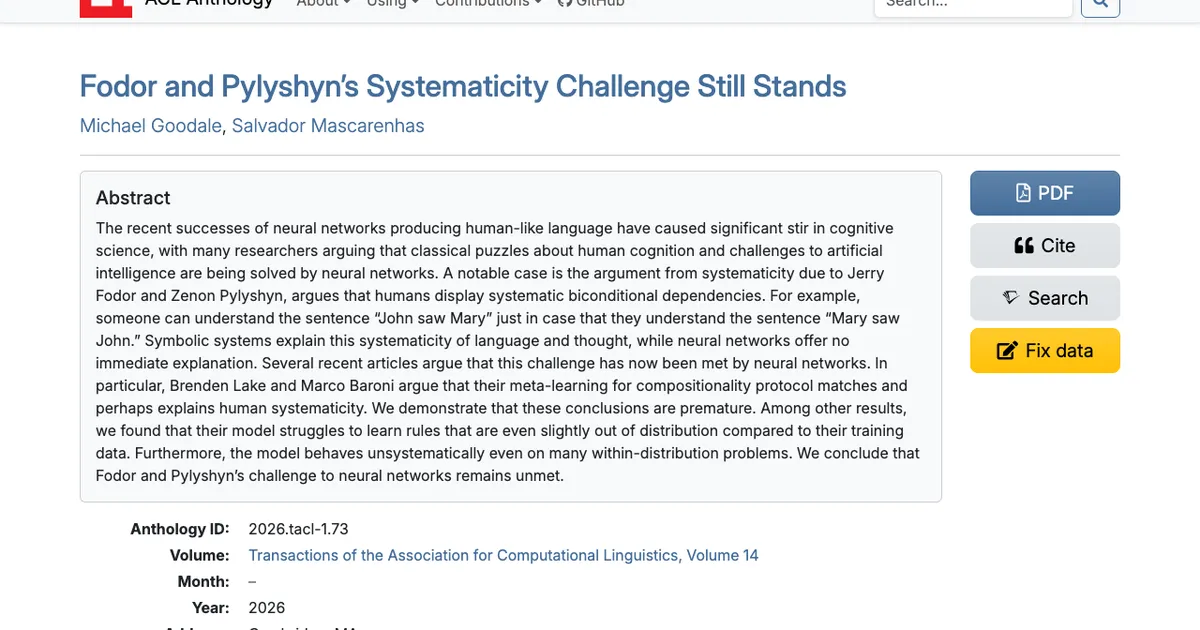
Fodor and Pylyshyn’s Systematicity Challenge Still Stands

By Michael Goodale and Salvador Mascarenhas in Transactions of the Association for Computational Linguistics, Volume 14 • ACL Anthology • Importance: 90/100
Hero Image for acl_2026.tacl-1.73

The Systematicity Challenge Rises: Why LLMs Might Not Be Truly Understanding Language

(A Deep Dive for NLP Engineers and AI Researchers)

In the age of powerful Large Language Models (LLMs), it’s easy to feel like we’ve cracked the code of human language. Systems can write poetry, translate languages, and even pass the Turing Test—all hallmarks of ‘understanding.’ But cognitive scientists have long posed deep challenges that test whether these models are truly thinking or merely mastering patterns.

One of the most persistent hurdles is Systematicity, a concept famously articulated by Jerry Fodor. Essentially, it suggests that our understanding of language and thought is highly structured: if we know that ‘John saw Mary,’ we should automatically be able to apply that knowledge to understand ‘Mary saw John.’ Our linguistic knowledge isn’t just a random collection of isolated facts; it follows underlying rules.

🧠 The Current Debate in NLP

Recently, some researchers argued that modern meta-learning approaches could finally tackle this systematicity puzzle. They suggested their models could learn the compositional rules needed to match human-like structured knowledge https://aclanthology.org/2026.tacl-1.73/. But does matching patterns equal true understanding?

In our latest work, we dive into this debate and conclude that these recent successes are premature.

🛠️ Our Key Findings:

Our research demonstrates critical flaws in current meta-learning architectures when faced with systematic knowledge constraints. Specifically:

  • Failure on Out-of-Distribution (OOD) Rules: The models struggle to generalize or learn rules that deviate even slightly from the data they were trained on. Real human language comprehension requires robust generalization.
  • Internal Inconsistency: Even when applied to problems that fall within their training distribution, the model often behaves in an unsystematic and inconsistent manner.

The bottom line? Fodor and Pylyshyn’s original challenge—the proof that systematicity is required for true understanding—remains a significant, unmet hurdle for purely pattern-matching LLMs. While current models are incredibly impressive, they might still lack the structured symbolic representation of human cognition.


🚀 What does this mean for your project?

The gap between statistical pattern matching and genuine compositional systematicity is a core frontier in AI research. For developers building next-generation language systems, this paper serves as a crucial warning: Simply achieving high perplexity doesn’t guarantee deep linguistic understanding. We must focus on architectural improvements that enforce structured reasoning.

Read the full details of our findings here: Fodor and Pylyshyn’s Systematicity Challenge Still Stands

AIResearch #NLP #CognitiveScience #LLMs #Systematicity

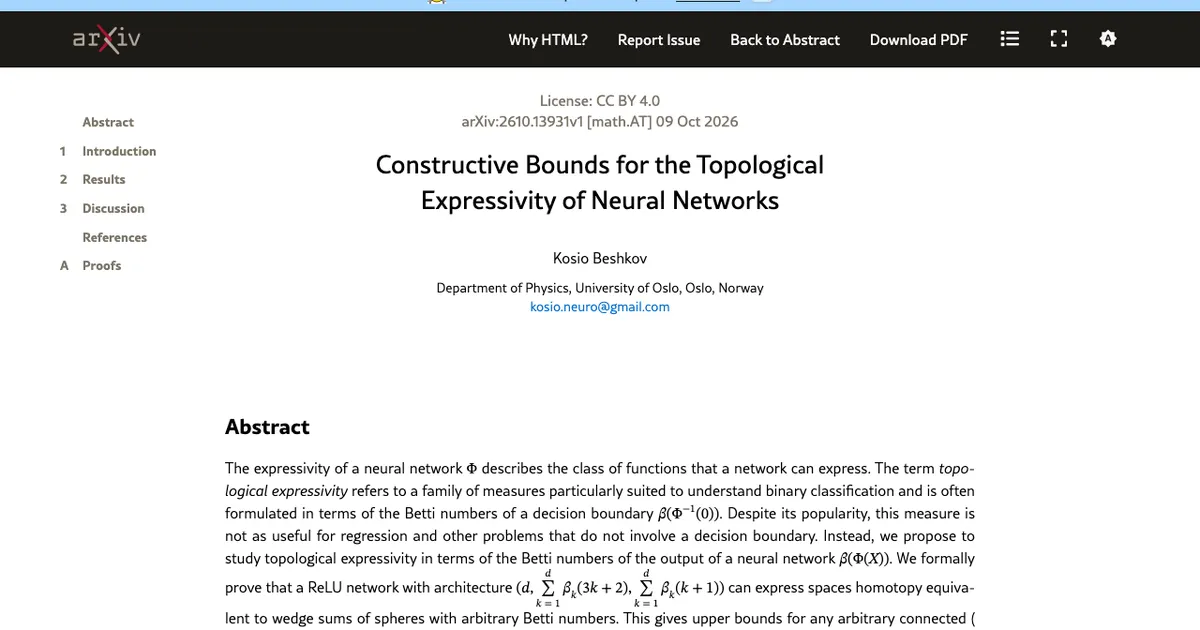
Constructive Bounds for the Topological Expressivity of Neural Networks

By Kosio Beshkov • arXiv • Importance: 85/100
Hero Image for 2610.13931

Beyond Decision Boundaries: Decoding the True Expressivity of Neural Networks

Hello data scientists and ML enthusiasts! Have you ever wondered if a neural network is powerful enough to solve any problem? This concept, known as expressivity, is one of the most fundamental, yet least understood, aspects of deep learning theory. Most research has focused on classifying things (binary decision boundaries), which limits our view of what these architectures can actually compute.

In their latest work, Kosio Beshkov tackles this limitation head-on, proposing a massive theoretical leap: studying the topology of the network’s output itself, rather than just its decision boundary. This changes the game for general function approximation and regression tasks!

🧠 The Problem with Topological Expressivity (The Old Way)

Historically, researchers used topological measures, specifically Betti numbers ($eta(Φ^{-1}(0))$), to understand expressivity. These measures count ‘holes’ or ‘voids’ in the decision boundary (the set where $ ext{Output} = 0$). While perfect for binary classification, this approach is useless when your network needs to output a continuous value—like predicting house prices or temperature trends.

✨ The Breakthrough: Output Topology Counts

Beshkov shifts the focus from $Φ^{-1}(0)$ (the decision boundary) to $eta(Φ(X))$ (the topology of the output space). By analyzing the Betti numbers of what the network actually outputs, he provides a much more generalized and powerful tool for evaluating expressivity across various ML tasks.

What Does This Mean For Researchers?

  1. Generalizing Expressivity: We no longer need to restrict our theory to classification problems. This expands the fundamental theoretical understanding of what modern deep learning architectures can represent.
  2. Strong Architectural Bounds: The paper provides constructive proofs showing how specific ReLU network architectures (with dimensions determined by Betti numbers) can express complex topological spaces, such as wedge sums of spheres with arbitrary Betti numbers. These results yield tight upper bounds for various connected topologies ($(eta_0=1)$).
  3. Setting New Benchmarks: Most importantly, the paper doesn’t just provide an upper bound; it offers a conjecture for a much stronger, tight architectural bound—specifically proposing $(d, d+1, d+1)$ as the necessary architecture for replicating a space homeomorphic to the sphere in dimension $d$. This is a profound theoretical result that could guide the design of optimal network architectures.

🚀 Why This Matters for ML Engineering (SEO Keywords)

For practitioners building state-of-the-art models, this theory offers foundational knowledge: understanding the intrinsic topological limitations of your chosen architecture can help predict if your model is mathematically capable of achieving desired performance levels. It provides a mathematical lens to optimize beyond empirical hyperparameter tuning.

If you are interested in Topological Data Analysis (TDA), advanced neural network theory, or the theoretical limits of deep learning for regression tasks, this paper Constructive Bounds for the Topological Expressivity of Neural Networks is essential reading.


🛠️ Key Takeaways: * Concept: Measuring expressivity via the topology of the output space ($eta(Φ(X))$). * Result: Provides constructive bounds for ReLU networks capable of modeling complex topologies (e.g., product of spheres). * Impact: Advances theoretical ML by generalizing beyond binary classification.

(Disclaimer: This is a highly technical paper, ideal for researchers deeply involved in geometric deep learning and topology.)

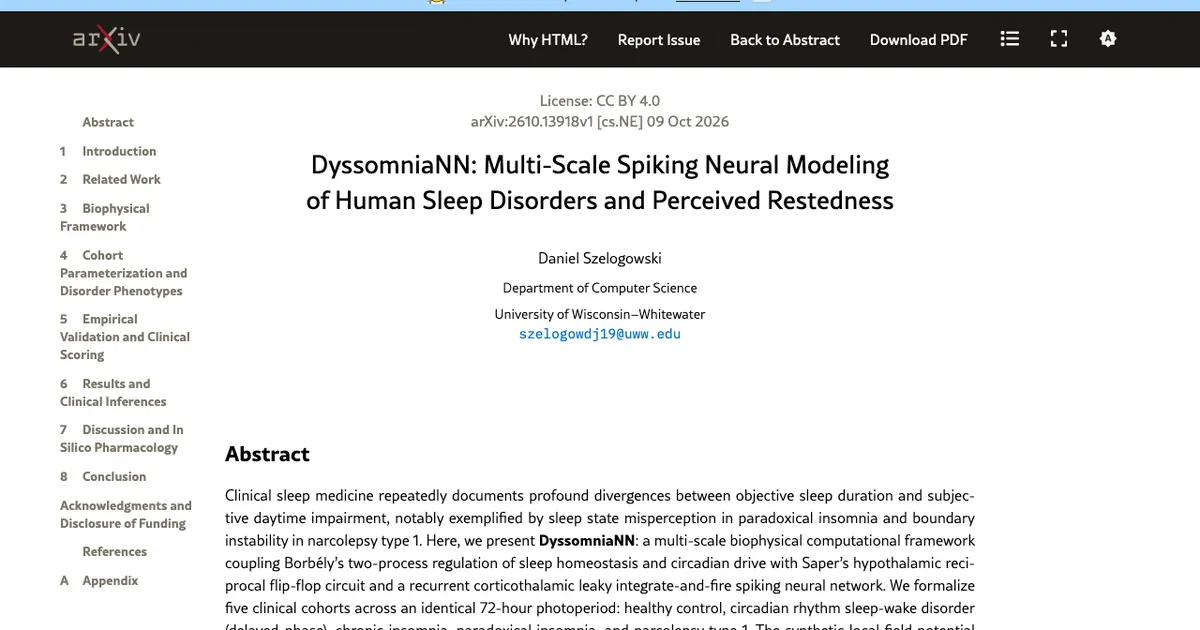
DyssomniaNN: Multi-Scale Spiking Neural Modeling of Human Sleep Disorders and Perceived Restedness

By Daniel Szelogowski • arXiv • Importance: 85/100
Hero Image for 2610.13918

😴 Sleep Secrets Revealed: How AI is Modeling Human Dreams and Insomnia

Ever felt like you slept eight hours but woke up feeling utterly wiped? You’re not alone. This gap between how long we think we slept and how good it actually feels has been a major puzzle in sleep medicine. But what if the answer wasn’t just ‘more sleep’?

New research introduces DyssomniaNN, an incredibly detailed AI model designed to simulate the complex electrochemistry of human sleep and various disorders. This isn’t just another sleep tracker; it’s a biophysical computational platform that dives into the core neurocircuitry of rest.

🧠 What is DyssomniaNN?

The brain doesn’t run on simple percentages—it’s governed by intricate biological clocks and switching mechanisms. DyssomniaNN models this complexity using state-of-the-art spiking neural networks (SNNs). Specifically, it merges several key concepts:

  • Homeostasis & Circadian Rhythms: It couples Borbély’s two-process model (sleep drive vs. internal clock) with Saper’s hypothalamic flip-flop circuit—the biological switch that governs wakefulness and sleep.
  • High Fidelity Simulation: By utilizing a recurrent corticothalamic leaky integrate-and-fire spiking network, the model simulates brain activity at a granular, biophysical level (like how neurons fire impulses).
  • Clinical Validation: The framework rigorously tested five major clinical sleep profiles over a full 72-hour photoperiod, including healthy controls, chronic insomnia, paradoxical insomnia, and narcolepsy type 1. Check out the technical details here.

✨ Key Discoveries That Change How We View Sleep

The research highlights two major breakthroughs: first, that sleep duration is a poor predictor of restorative quality, and second, it provides tools for virtual diagnosis.

🎯 The Paradoxical Insomnia Problem

DyssomniaNN demonstrated the famous finding in paradoxical insomnia: subjects could achieve normal total sleep time but exhibit profoundly low restoration because of ‘unsuppressed cortical beta-band intrusion.’ This points to a problem with sleep quality and specific brain activity during rest, not just quantity.

🐕 Narcolepsy Type 1 Insights

For narcolepsy, the model accurately simulated severe nocturnal fragmentation (wake periods after falling asleep) and repeated rapid eye movement (REM) cycles, confirming a detailed mechanistic understanding of hypocretin deficiency.

📏 The Well-Rested Index

The authors introduced the Well-Rested Index, a novel metric to quantify true restorative efficacy—a critical tool for future neuropharmacological testing and clinical assessment.

🌐 Why This Matters for Tech & Medicine (The Future)

This work moves computational neuroscience beyond correlation into deep, mechanistic simulation. DyssomniaNN offers an in silico platform for:

  1. Virtual Drug Testing: Researchers can test how potential medications might alter specific neurocircuitry elements without needing animal models.
  2. Deep Understanding of Disorders: It forces us to quantify the precise functional deficits in complex conditions like insomnia and narcolepsy, giving clinicians better targets for treatment.

This is a massive step toward personalized sleep medicine, making it possible to not only diagnose what is wrong, but also predict why it isn’t restorative.

FORTE: A Production Framework for Feature Evaluation and Deprecation in Industrial Recommender Systems

By Vishnu Arun, Adam Obeng, Tianyou Wang, Zilin Ren, Mukuntha Narayanan Sundararaman, Han Wang, Shivin Thukral, Zhixiang Wang, Saurabh Vishwas Joshi, Darren Reger • arXiv • Importance: 85/100
Hero Image for 2610.13806

🛠️ Cutting the Fat: Introducing FORTE for Feature Graveyard Management in Recommender Systems

The life cycle of a feature in an industrial recommender system is messy. You can easily test adding new features—you run an A/B test and see if metrics go up. But getting rid of old, unused, or redundant features? That’s way harder. It’s often painful, costly, and prone to cascading errors.

The Problem: Feature Deprecation Hell

In production recommender pipelines, we have a severe asymmetry: Feature addition is easy to validate; feature removal is extremely hard.

Why is removing features so challenging? Because of real-world operational friction. A retiring feature might interact mysteriously with an unrelated one; its importance shifts daily; it might be consumed by dozens of models that need coordinated deprecation; or, worse, it can cause a silent regression in live online tests.

This operational nightmare slows down model iteration, increases technical debt, and balloon training costs.

💡 Introducing FORTE: The Solution to Feature Bloat

We’re excited to dive into FORTE, a groundbreaking framework designed specifically for the delicate task of feature evaluation and deprecation in high-stakes industrial recommender systems.

FORTE is model-agnostic, meaning it works regardless of your underlying architecture (Transformer, DeepFM, etc.), making it universally applicable across Google, Amazon, or any major tech company.

How FORTE Works: From Concept to Clean Slate

The core genius of FORTE lies in its ability to efficiently test feature removal offline while maintaining strong predictive power for online A/B tests. Here’s a breakdown of its key technical advantages:

  1. Efficient Perturbation: FORTE employs an efficient perturbation implementation, allowing engineers to evaluate the impact of removing candidate features on a daily basis—keeping pace with rapid development cycles.
  2. Grouped Ablation for Interactions: Recognizing that features rarely exist in a vacuum, FORTE handles feature interactions by evaluating candidate sets constructed from all low-rank features through sophisticated grouped ablation techniques. This ensures that the simulated removal is robust and holistic.
  3. Downstream Lineage Tracing: Beyond just knowing what to remove, FORTE traces the full downstream lineage. It identifies every model dependent on a feature, enabling teams to plan coordinated deprecation and realize maximum cost savings by safely deleting the feature from the training set.

🚀 The Impact: Real-World Validation & ROI

The theoretical power of FORTE was proven over two large-scale recommender systems (including search relevance and ranking models). The results speak for themselves:

  • Search Relevance Model: FORTE identified a stable 48-feature set for deprecation, resulting in the removal of 43.3% of the original feature pool.
  • Ranking Model Breakthrough: On another large model, FORTE found 8 viable features for removal. After rigorous retraining and A/B testing confirmed zero performance regression, the deployment led to massive quantifiable wins:
    • 🔥 Reduced trainable parameters by 29.9%.
    • ⚡ Improved serving throughput by 19.8–25.5%.
    • 💰 Saved hundreds of thousands in annual training costs.

🎯 Who Needs This?

Any organization running large-scale ML systems—especially recommenders, search engines, or ad personalization platforms—that struggles with feature bloat, high maintenance costs, and the pain of safely retiring old features.

FORTE shifts the paradigm from ‘Can we add more?’ to ‘What can we safely remove?’ — making your MLOps faster, cheaper, and more reliable.

Your Discrete Graph Diffusion Model is Secretly Memorizing

By Adarsh Jamadandi, Nicolas Keriven • arXiv • Importance: 85/100
Hero Image for 2610.13786

Is Your Graph AI Cheating? Detecting ‘Memorization’ in Diffusion Models

If you work with graph data—be it social networks, molecular structures, or communication links—you’re likely hearing the buzz about Graph Diffusion Models (GDMs). These models are amazing tools for generating realistic, novel graphs and understanding complex network structures. But what happens when these powerful generative AI systems start to cheat?

Our latest research Adarsh Jamadandi et al.’s work challenges a long-held assumption: that graph diffusion models generalize perfectly and forget their training data. We show for the first time compelling evidence that GDMs do exhibit memorization, specifically under certain conditions.

🤯 What is Conditional Memorization?

Think of it this way: When we train a model on a set of graphs (our ‘training data’), and then test it on completely unseen graphs (‘test data’), most researchers thought the model’s ability to reconstruct a corrupted training graph would be similar to its performance on the unseen test data. We found otherwise.

The core finding is Conditional Memorization: The model can recover a specific, corrupted graph from the training set almost perfectly. But this ‘cheating’ behavior only shows up when you explicitly condition the model’s generation process on that training sample—it doesn’t appear during standard inference.

This reveals a worrying pattern: the model is overfitting to its training distribution in a very specific, recoverable way.

🔍 The Smoking Gun: Generalization Gap and Structure

Our analysis of reverse diffusion trajectories revealed two critical pieces of evidence:

  1. The Growing Generalization Gap: As the model trains and its ability to minimize the loss on the training set gets better, its performance (loss) on held-out test graphs actually worsens. This is a classic sign of poor generalization.
  2. Structure Emergence Follows Memorization: Crucially, the onset of this memorization always happens before the model starts generating recognizable community structure in the generated graph. Until the model ‘memorizes’ the training data, it only outputs structureless noise. This suggests a deep architectural or representational bias.

🌍 Why Does This Matter for Graph AI? (SEO/GEO Focus)

For researchers building next-generation tools across drug discovery, social network analysis in São Paulo, and urban planning in Shenzhen, relying on models that implicitly memorize data can be dangerous. If your model has memorized specific structures or unique node IDs from the training set (like a sensitive corporate graph), it might encode biases or fail spectacularly when faced with real-world variation.

This finding necessitates new evaluation metrics and a deeper understanding of how diffusion processes generalize beyond simple sampling quality. We can’t assume simply that ‘novel graphs’ means ‘generalizable graphs.’


Key Takeaway: Graph Diffusion Models, while powerful, are not always generalizers. Their performance degrades on unseen data as they become too good at reconstructing their training examples. Stay vigilant when deploying your GDM systems!

SeoulMMOD: A Large-Scale Multimodal Origin-Destination Flow Benchmark

By Taeyoung Yu, Seonbin Jo, Jiwon Kim, Junyoung Byun • arXiv • Importance: 85/100
Hero Image for 2610.13730

Unlocking the Future of City Mobility: Introducing SeoulMMOD

🚶‍♂️🏙️ The Problem: Forecasting how people move through a city is critical for smart urban planning—it dictates everything from optimizing subway schedules to placing new services. However, current research datasets often give an incomplete picture. Most public benchmarks only cover one or two transport modes (e.g., just the bus network or just trains). This limited view makes it nearly impossible for researchers to distinguish whether a drop in travel demand is due to fewer people traveling overall, or if it’s simply a shift from cars to bikes.

📰 The Breakthrough: The authors introduced SeoulMMOD, a massive, unprecedented benchmark dataset designed to capture the total picture of citywide movement in Seoul. This isn’t just another spreadsheet—it’s a comprehensive testing ground for next-generation urban AI.

✨ What Makes SeoulMMOD So Important?

SeoulMMOD provides three years of hourly Origin-Destination (OD) flows, mapping total mobility across 6 major travel modes, covering 25 large districts and granular details in 426 sub-districts. But they didn’t stop there. The dataset is richly augmented with crucial real-world signals: travel times, distances, calendar events, rainfall data, and Points of Interest (POI).

This wealth of multimodal data allows researchers to rigorously test complex hypotheses about human behavior—things like how rain affects public transport usage versus car usage, or how a major holiday shifts intermodal transfer patterns.

🔬 Key Insights & Research Impact:

The paper goes beyond just providing data; it sets up a structured research protocol. By benchmarking 14 advanced forecasting models (under common protocols), the authors revealed vital truths about spatio-temporal modeling:

  • Scale Matters: Models that performed well when predicting flow at a large district level often fail miserably when scaled down to precise sub-district levels.
  • Joint Training Fallacy: Simply training a model on all modes together doesn’t automatically improve results. The data suggests the need for more nuanced, mode-specific modeling approaches.

These findings are critical guardrails for ML researchers tackling urban problems, showing that generalization and local details must be handled with extreme care.

🚀 For Developers & Researchers:

If you’re working on Smart Cities, Mobility AI, or large-scale time-series forecasting, SeoulMMOD provides a reproducible, gold-standard testbed. It ensures future comparisons are fair and rigorous, advancing the entire field of urban digital intelligence.

📚 Read the full details: SeoulMMOD: A Large-Scale Multimodal Origin-Destination Flow Benchmark


This analysis was based on the work presented in the paper by Taeyoung Yu et al., establishing a new benchmark for multimodal urban mobility forecasting.

Emergent Communication in Continuous Worlds: Self-Organisation of Conceptually Grounded Vocabularies at Scale

By Jérôme Botoko Ekila, Lara Verheyen, Jens Nevens, Katrien Beuls and Paul Van Eecke in Transactions of the Association for Computational Linguistics, Volume 14 • ACL Anthology • Importance: 85/100
Hero Image for acl_2026.tacl-1.101

The Future of AI: How Agents Learn to ‘Talk’ About Their World

Have you ever wondered how complex systems in sci-fi movies manage to communicate using specialized jargon? Our latest research takes a huge step toward understanding exactly how artificial agents can self-organize functional languages within unpredictable, continuous environments. This isn’t just pattern recognition; it’s the emergence of conceptual understanding.


💡 The Big Idea: Emergent Language from Interaction

The core breakthrough presented in this work is a general methodology showing that language conventions don’t need to be centrally programmed. Instead, a population of autonomous AI agents can organically converge on a shared vocabulary and grammar simply by interacting locally with each other and their environment. Think of it like how humans learn language: not through textbooks, but through constant social interaction.


🧠 What Does This Mean for AI?

The research confirms that the learned ‘language’ isn’t just a set of random symbols (words). It’s a sophisticated system linking symbolic labels (the word form) to deep, sub-symbolic concept representations—meaning grounded in continuous feature spaces.

Crucially, these emergent vocabularies are: * Scalable: Tested across 37 diverse public datasets. * Robust: They remain stable even when the agents face varying sensory inputs (like ‘heteromorphic populations’). * Adaptive: The system can successfully self-adapt and adjust its communication rules when the environment changes, mimicking real-world resilience.


🌎 Why This Matters for AI Research & Industry

This paper demonstrates a fundamental principle: genuine, grounded language capabilities might be achievable through decentralized, bottom-up interactions. This is critical research for advancing embodied AI, swarm robotics, and creating truly general-purpose artificial intelligence.
By moving beyond pre-scripted knowledge bases, this work opens the door to AI agents that can genuinely discover how to communicate about anything they encounter in a messy, real-world setting—a massive leap toward Artificial General Intelligence (AGI).

🔗 Read the Full Study: If you want to dive into the mathematical and experimental details of this breakthrough, check out the paper: Emergent Communication in Continuous Worlds


Is your company focusing on next-generation multi-agent systems or embodied AI? This research fundamentally shifts how we think about communication and knowledge representation for autonomous robots.

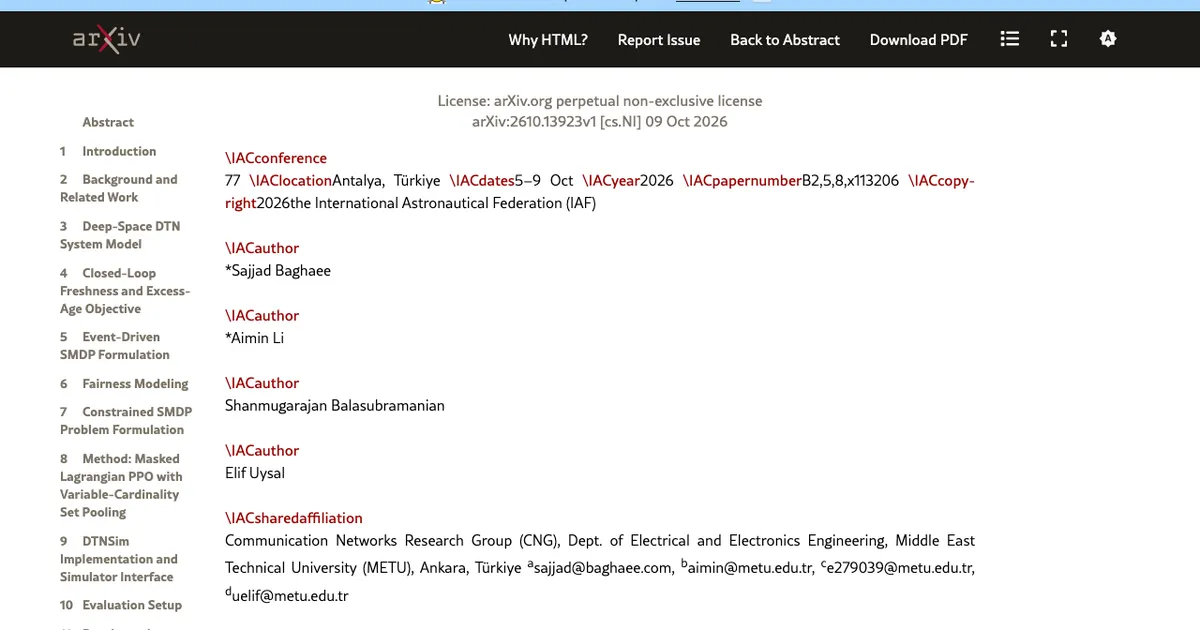
Goal-Oriented Bundle Management and Flow Control for Deep-Space Communications via Reinforcement Learning

By Sajjad Baghaeea, Aimin Lib, Shanmugarajan Balasubramanian, Elif Uysal • arXiv • Importance: 80/100
Hero Image for 2610.13923

🚀 Maximizing Data Value in Deep Space: A New Approach to Interstellar Communications

Is Earth the Only Endpoint? Rethinking Communication for Mars and Beyond

The challenge of deep-space communication is far more complex than simply transmitting data. When sending mission-critical updates from Mars, lunar probes, or asteroids back to Earth, you are not just worried about bandwidth—you’re dealing with extreme constraints: intermittent connectivity, massive propagation delays, and extremely limited relay storage.

Traditional network protocols often struggle here. They assume simple queues (like FIFO: First-In, First-Out), which treats all data equally. But in deep space, the goal isn’t just to send more bits; it’s to ensure the most valuable, freshest information arrives first. This is a major game-changer for planetary exploration.

💡 The Problem with Old Rules: Stale Data and Resource Waste

The core issue lies in how relay nodes manage data bundles. They have limited storage, and contact opportunities (like Earth-Mars alignments) are rare and fleeting. A basic scheduler might dump bandwidth on a low-priority sensor reading while mission-critical telemetry from a deep subsurface rover is stuck behind it.

This paper tackles this by introducing goal-oriented flow control. Instead of treating all data as equally important, the system prioritizes transmitting bundles based on how critical they are to reaching key scientific or operational goals.

🛰️ How It Works: Deep Reinforcement Learning for Cosmic Logistics

The researchers propose a closed-loop framework that models relay-side decisions (scheduling and dropping) as a Constrained Semi-Markov Decision Process (CSMDP). Since these are complex, highly constrained real-world scenarios, they employed advanced Machine Learning techniques—specifically, masked Lagrangian Proximal Policy Optimization (PPO).

Their innovation is the objective function itself. They quantify ‘data freshness’ using a metric called excess age ($\Delta_i^e(t)$). This metric measures how far the current Age of Information (AOI) deviates from a mission-defined baseline delay. By optimizing for this excess age, the system learns to prioritize bundles that are both timely and highly relevant to specific downstream objectives.

In plain English: The relay doesn’t just send what arrived first; it sends what is most useful right now, according to complex mission rules, while ensuring fairness among all sources (Lunar, Martian, etc.).

✨ Key Takeaways & Impact for Space Tech

The DTNSim simulations prove that this goal-oriented approach significantly improves both Age-based Utility and Inter-Flow Fairness compared to conventional methods.

  • ✅ Optimized Prioritization: Ensures mission-critical data arrives before stale, low-value telemetry.
  • ✅ Joint Control: Optimizes scheduling and dropping decisions simultaneously under contact constraints.
  • ✅ Scalability: Provides a robust model for future deep-space networks connecting multiple heterogeneous sources to Earth.

This work moves the field beyond simple queue management and into true, intelligent resource orchestration—a necessary step as we plan missions to Jupiter’s moons or beyond. For space communication engineers, ML researchers interested in constrained optimization, and planetary science enthusiasts, this is required reading: Goal-Oriented Bundle Management and Flow Control for Deep-Space Communications.


#DeepSpace #ReinforcementLearning #NetworkOptimization #AerospaceEngineering #MLResearch

Finite-Sample Guarantees for Fully Discrete Conditional Diffusion Models

By Qiuyun Zhu • arXiv • Importance: 80/100
Hero Image for 2610.13851

Decoding Diffusion Models: Finite-Sample Guarantees for Discrete Data

The success of diffusion models has revolutionized generative AI. They allow us to create stunning images, realistic audio, and complex synthetic data. But when we move from theory to practice—especially in real-world scenarios with limited data or constrained hardware—we need rigorous mathematical guarantees about how well these models will actually perform.

That’s exactly what the paper Finite-Sample Guarantees for Fully Discrete Conditional Diffusion Models tackles. It moves beyond asymptotic theory, providing essential finite-sample bounds for conditional diffusion models when operating on truly discrete data (like tokens or specific categories).

💡 What Problem Does This Solve?

Most theoretical analyses assume infinite data (asymptotic limits). However, in any real deployment—whether you’re running a few hundred steps or training on limited computational resources—you are dealing with a finite sample size. Furthermore, the practical implementation of diffusion models involves discretizing continuous problems into a fixed number of denoising steps.

This paper provides a comprehensive mathematical framework that analyzes both the statistical estimation error (due to limited data) and the numerical discretization error (due to limited sampling steps), showing how they interact when generating discrete outputs.

🔬 Key Takeaways for Researchers and Practitioners:

The core result is quantitative: the authors derive high-probability bounds on the generated distribution’s error. Specifically, they show that both full and early-stopped samplers achieve an average total-variation (TV) error rate of $\widetilde O_p(n^{-{\beta}/(d_x+d_y+2\beta)})$.

  • Finite Sample Guarantee: Provides confidence intervals for performance, crucial for production ML systems.
  • Coupled Error Analysis: Unlike previous work, this framework analyzes the interplay between data limitations ($n$) and sampling steps.
  • Efficiency Benchmarking: The derived bounds help quantify exactly how many score evaluations are necessary to hit a specific level of accuracy (e.g., achieving State-of-the-Art image quality with minimum computational cost).

🚀 Why Does This Matter for Production AI?

The findings give ML engineers the tools needed to move diffusion models from research curiosity to robust, deployable industry standard. By mathematically quantifying the performance floor based on data size and steps taken, they help establish reliability metrics vital for building trustworthy GenAI applications.

Read the full details here: Finite-Sample Guarantees for Fully Discrete Conditional Diffusion Models

Studying the Effects of Task Diversity Using Small Mathematical Worlds

By Emily Xia Meng, Xuanyu Yang, Junaid Hasan, Michael Ruofan Zeng, Henry Kvinge • arXiv • Importance: 80/100
Hero Image for 2610.13750

✨ Beyond Single Tasks: How Task Diversity Supercharges AI Learning

If modern large language models (LLMs) are like students who learn everything from the internet, why does ‘more is better’ always apply? Our latest research dives deep into a fundamental question in AI training: How does task diversity really impact intelligence?

Traditional academic studies often isolate single tasks—say, just modular addition or just simple number theory. While useful for understanding one mechanism, they don’t capture the messy reality of how LLMs are trained on diverse data.

🌐 Introducing Math Worlds: A New Playground for AI Research

The authors introduce two sophisticated mathematical ecosystems, IntWorld and PermWorld. Think of these not as single datasets, but as entire ‘mathematical worlds.’ Each world contains many distinct but related tasks (like arithmetic on integers or permutations), allowing researchers to precisely control the variety an AI model encounters.

This revolutionary approach is powerful because the datasets are procedurally generated. This means we can systematically vary one critical variable: the number of tasks. By doing this, we can finally disentangle whether a model’s improved performance comes from sheer data volume or genuinely from being exposed to diverse types of problems.

🔬 What We Found: The Power of Variety

Early results using these ‘World’ datasets strongly suggest that increasing task diversity significantly increases the richness and complexity of a model’s internal representations.

In simpler terms? By showing an AI a variety of related mathematical challenges, we help it build more robust, flexible, and generalized knowledge structures—far beyond what single-task training can achieve.

📚 For Deep Dive Readers (The Technical Scoop): For those who want to dig into the mechanics, this paper details how these specialized worlds allow for a nuanced study of task variety. You can check out the full technical details here: Studying Task Diversity with Mathematical Worlds.

🚀 Key Takeaway: When training foundational models, simply adding more data points isn’t enough; breadth of experience (task diversity) is a critical component for unlocking peak model performance and generalizability.

Read the full paper and understand how ‘worlds’ can revolutionize AI benchmarks!

Fine-Grained Reward Optimization for Machine Translation using Error Severity Mappings

By Miguel Moura Ramos, Tomás Almeida, Daniel Vareta, Filipe Azevedo, Sweta Agrawal, Patrick Fernandes and André F. T. Martins in Transactions of the Association for Computational Linguistics, Volume 14 • ACL Anthology • Importance: 80/100
Hero Image for acl_2026.tacl-1.33

💡 Smarter Translation: Going Beyond Sentence Scores with Token-Level RL

As a researcher in NLP, one thing is clear: good Machine Translation (MT) requires more than just getting the right average score. While Reinforcement Learning (RL) has revolutionized MT by providing powerful training signals, traditional methods often suffer from a major drawback: reward sparsity.

A standard setup gives the model one single grade for an entire sentence—a ‘sentence-level’ reward. If that score is low, you don’t know why. Was it one awkward word? A structural mistake? This lack of granularity makes learning slow and inefficient.

That’s where the breakthrough in Transactions of the Association for Computational Linguistics comes into play.

🧠 The Solution: Fine-Grained Feedback

The authors propose a novel framework that moves past holistic, sentence-level scoring by leveraging fine-grained, token-level quality assessments. Think of it as giving the model immediate, pinpoint feedback on every single word. They utilize an advanced tool called xCOMET—a state-of-the-art quality estimation system—to serve as this detailed reward model.

Instead of just saying ‘Bad sentence,’ they can say, ‘The third token is suboptimal because of X.’ This vastly improves the learning signal.

🚀 What Does This Mean for NLP and Translation?

  1. Higher Quality Output: The results demonstrate that training MT systems with these highly detailed, token-level rewards significantly boosts translation quality across various language pairs, matching both automatic benchmarks and human judgment.
  2. Stable Training: The technique also improves the stability of the RL training process itself, ensuring the model learns steadily over time rather than encountering wild reward swings.
  3. Universal Applicability: The methods are tested on diverse datasets (small and large) and applied to multiple system architectures—from classic encoder-decoder models to cutting-edge Large Language Model (LLM)-based MT systems.

The Takeaway for Developers & Researchers: If you are implementing advanced NLP training, especially MT or dialogue generation using RL, passing the sentence score is not enough. Incorporating granular, token-level error severity mappings is crucial for stabilizing learning and unlocking maximum potential quality. This work provides a critical roadmap for next-generation, robust translation models.

🔗 Read the full paper here: Fine-Grained Reward Optimization for Machine Translation

FeedTrans: Enhance Machine Translation via Feedback

By Zengkui Sun, Jiali Zeng, Jiaan Wang, Fandong Meng, Xinyan Guan, Yufeng Chen, Jinan Xu, Wenjuan Han and Jie Zhou in Transactions of the Association for Computational Linguistics, Volume 14 • ACL Anthology • Importance: 78/100
Hero Image for acl_2026.tacl-1.86

🚀 Turbocharging Machine Translation with Feedback: Introducing FeedTrans

Have you noticed how impressive Large Reasoning Models (LRMs) are when tackling complex tasks like coding or advanced math? This incredible knack for reasoning is revolutionizing AI, but translating human language—especially specialized terminology—remains a nuanced challenge.

Traditional Machine Translation (MT) often struggles when the base model lacks domain-specific guidance. If you need to translate highly technical jargon or industry-specific expressions, off-the-shelf models can sometimes falter without external direction.

That’s where FeedTrans comes in.

We are excited about [FeedTrans (Feedback-driven Translation)], a groundbreaking approach that fundamentally changes how we train MT systems using Reinforcement Learning (RL). Instead of relying solely on the model’s ‘best guess,’ FeedTrans introduces a novel FeedRollout mechanism.

💡 How Does FeedTrans Work?

The core breakthrough is recognizing that translation isn’t just about predicting the next word; it’s an iterative search process.

  1. Feedback as Guidance: FeedTrans doesn’t just translate—it incorporates explicit feedback throughout the generation process. This feedback acts like a navigational guide, keeping the model focused on domain-specific constraints or required terminology.
  2. Expanded Search Space: By actively utilizing this feedback, the model can explore a much wider and more informed search space for potential translations, dramatically improving the quality and accuracy of the output.
  3. RL Optimization (The Tech): This approach is pioneering in using feedback to guide RL optimization specifically within the MT context, leading to higher-quality, more contextually accurate results across various domains.

🔬 Why Is This a Big Deal?

This work marks a major step forward in applying advanced control mechanisms to Neural Machine Translation. While we’ve seen RL boost MT quality before, this is the first effort to formalize and utilize external feedback within the RL framework for translation.

What does this mean for developers?

It means building robust translation pipelines that can handle highly specialized content—from medical reports to legal documents—with reliable accuracy and structural integrity, far surpassing what standard foundational models might achieve alone.


🔗 Read the full details of FeedTrans: We debuted our findings in Transactions of the Association for Computational Linguistics (TACL).

✨ Check out the implementation on GitHub to see how it works: FeedTrans Code Repository

MachineTranslation #NLP #AIResearch #ReinforcementLearning #LLMs

Hitting-Time Bounds for Asynchronous Q-Learning

By Yang Peng • arXiv • Importance: 75/100
Hero Image for 2610.13901

🚀 Deep Dive: Mastering Asynchronous Q-Learning with New Hitting-Time Bounds

As reinforcement learning (RL) models become essential for everything from autonomous vehicles to complex game AI, the core challenge remains: how fast can we reliably train them using limited data?

A recent paper tackles one of RL’s most persistent theoretical bottlenecks: bounding the sample complexity of standard asynchronous Q-learning. If you’re knee-deep in Deep Q-Networks (DQNs) or planning for large-scale industrial systems, this digest is for you.

📚 The Problem with Asynchronous Training

Standard asynchronous Q-learning updates rely on traversing a single, fixed trajectory (the behavior policy). While simple to implement, the theoretical guarantees about how many steps are needed can be prohibitively large or overly pessimistic.

This research, presented by Yang Peng in Hitting-Time Bounds for Asynchronous Q-Learning, introduces a powerful new theoretical framework: leveraging hitting-time bounds to drastically improve the understanding of sample efficiency.

💡 What’s the Breakthrough?

The core finding is a tighter, more accurate bound on the number of transitions required ($ ilde{O}(H^4/(oldsymbol{ u}{ extbf{min}}oldsymbol{ ext{e}}^2)+oldsymbol{ au}$.}}*})$) to reach a desired $ ext{sup-norm}$ error $oldsymbol{ ext{e}

What does this mean for practitioners?

  1. Better Scaling Theory: The paper mathematically separates the sample complexity into two distinct, manageable components: 🛡️ the statistical estimation error and ⚙️ the fixed-policy initialization error. This separation is crucial because it allows researchers to treat system knowledge (initialization) independently from the data sampling process.
  2. Improved Rate Calculation: By adapting concepts like reverse-time hitting costs—traditionally used in TD learning—to general state-action propagation, the authors provide a robust measure that significantly refines theoretical sample complexity estimates compared to standard bounds.
  3. Practical Implementation Guide: Beyond theory, they introduce an empirical state–action count rule for subsequent training runs. This rule achieves the optimized rate without requiring prior knowledge of model parameters, target accuracy, or confidence levels—a massive win for real-world deployment!

💻 Key Takeaways for Researchers & Engineers

  • For Theory Developers: The use of two deterministic Bellman envelopes is a sophisticated technical tool that enables this clean separation and improves the tightness of known bounds in state-action spaces. Understanding this technique is key to tackling other complex off-policy RL algorithms.
  • For ML Practitioners: While implementing the full theoretical structure might be complex, understanding these tighter bounds helps you critically evaluate the reported sample efficiency of your favorite RL algorithms. It provides a more realistic expectation for deployment time and required data throughput when scaling models in environments like robotics or finance.

🎯 Conclusion: The Future is Efficient Data

The ability to achieve matching mean-square rates with tighter bounds is vital for moving RL from simulation labs to the physical world. This paper represents a significant step forward in guaranteeing data efficiency, paving the way for more robust and resource-aware algorithms across industries—from optimizing supply chains in Miami to controlling advanced machinery in Berlin.


Disclaimer: While this post summarizes academic findings, actual implementation requires careful integration of the proposed techniques.

Explore Recent Digests