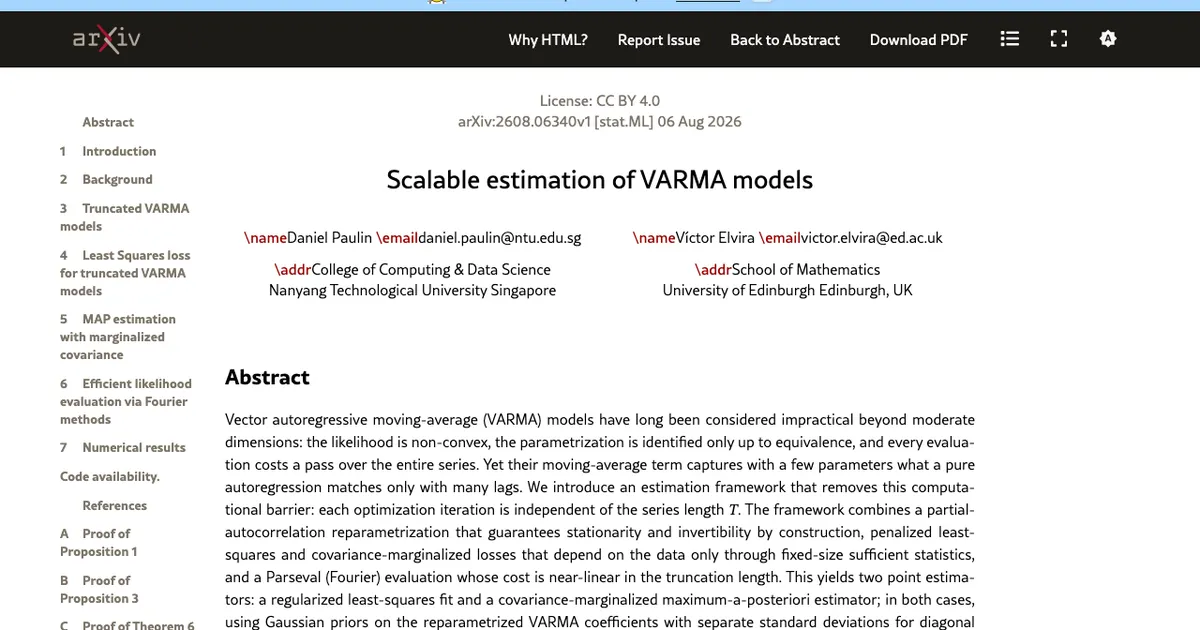
Scalable estimation of VARMA models
📈 Modernizing Time Series Forecasting: Scalable VARMA Estimation
As an ML researcher and tech writer, I’ve spent countless hours wrestling with complex time series models. Historically, the Vector Autoregressive Moving-Average (VARMA) framework was brilliant—it captures powerful underlying dynamics with far fewer parameters than traditional methods like standard VAR. However, its Achilles’ heel was computational scale. Evaluating these models often required passes over the entire dataset ($T$), making them impractical for massive modern datasets common in areas like retail demand or air quality.
Enter a game-changer: Paulin and Elvira have introduced an estimation framework that finally removes this computational barrier. They make VARMA scalable, allowing practitioners to use these powerful models on truly large time series data.
🚀 What’s the Big Breakthrough? (The Technical Digest)
The core problem is efficiency. Traditional likelihood calculation requires $O(T)$ computation per iteration. The new approach achieves a near-linear cost in the truncation length, independent of the total series length ($T$).
How do they pull this off?
- Partial-Autocorrelation Reparametrization: This is key for stability. By constructing coefficients that guarantee stationarity and invertibility by design, they overcome major theoretical hurdles.
- Sufficient Statistics & Parseval Identity: Instead of processing the whole series repeatedly, the loss functions depend only on fixed-size sufficient statistics. They utilize a clever application of the Parseval (Fourier) identity to calculate these losses efficiently in the frequency domain.
- Versatility: The framework isn’t just for simple VARMA. It naturally extends to seasonal dynamics (SARIMA), exogenous regressors (VARMAX), and even rolling-window refits, all at the same computational efficiency.
📊 Why Should Practitioners Care? (The Impact)
The empirical results are stunning. The estimators maintain accuracy even when moving into dimensions ($d=10$ to $d=40$) where classic Conditional Maximum Likelihood Estimation (MLE) fails due to non-invertibility or numerical instability.
They matched, and in some cases beat, established baselines like VAR, Bayesian-VAR, and component-wise ARMA on diverse real-world datasets, including: * Retail Demand Forecasting: Predicting spikes and trends. * Meteorological Data: Analyzing complex weather systems. * Air Quality Monitoring: Assessing environmental pollutants.
This advancement effectively brings the full power of likelihood-based VARMA estimation to problem sizes previously limited to simpler, less expressive VAR models. It’s a massive step toward advanced multivariate time series analysis in industry and academia.
Read the Paper Here: Scalable estimation of VARMA models
#TimeSeries #MLResearch #Econometrics #VARMA #DeepLearning #MachineLearning