← Back to Archive

Digest for 2026-08-26

🐦 Share on X 💼 Share on LinkedIn 📘 Share on Facebook

Unfolding Scientific Papers into Multi-Turn Generation Trajectories for Continued Pre-Training

By Qiankai Xu, Qiguang Chen, Zixin Su, Wenhao Huang, Yue Gao, Jiaheng Liu, Ge Zhang • arXiv • Importance: 95/100

🧠 Unlocking the Genius Behind Academic Papers: A New Frontier for LLMs

Are Large Language Models (LLMs) really ready to write complex scientific papers? It’s a big question, and our latest research dives deep into not just what models output, but how they arrive at it. We are revolutionizing how we train AI by giving models the hidden blueprint of academic thought.

Traditional data augmentation for LLMs focuses on local passages—snippets that recover short thoughts. But when dealing with comprehensive documents like scientific papers, those local snippets miss the crucial global structure and organizational thinking. Scientific writing is inherently structured (Introduction $ ightarrow$ Methods $ ightarrow$ Results), making it the perfect canvas for a breakthrough.

💡 The Breakthrough: Trajectory Modeling

Our pipeline treats an entire academic paper not just as text, but as a multi-turn generation trajectory. Think of it less like reading and more like watching a brilliant student write in real-time. Our system reconstructs the full thought process:

  1. The Request: What was the goal of this section? (e.g., ‘Introduce the novel CNN architecture.’)
  2. The Global Plan: How does this connect to the paper’s overall structure?
  3. Pre-Writing Deliberation: The internal thought process before writing the final sentence.

Crucially, we keep the actual text of the sections and abstract 100% verbatim from the source paper, ensuring that our generated data is grounded in high-quality, verified scientific knowledge.

📊 Why This Matters for AI Writing (And Researchers)

This approach fundamentally changes how we teach LLMs to write long, structured documents. By providing models with this comprehensive ‘writing DNA,’ we create a new, massive corpus for Continued Pre-Training (CPT) that is nearly double the size of the original papers.

  • Improved Structure: Models trained on our data show marked improvements in overall writing benchmarks and long-document reading comprehension. They learn not just to output correct facts, but to structure an argument coherently over many sections.
  • Dedicated Writing Skills: We can further fine-tune models using specific ‘writing SFT’ datasets (Supervised Fine-Tuning) derived from this process. This dedicated training significantly boosts academic writing skills without sacrificing general reasoning ability.
  • New Benchmarking: To validate the impact, we introduce PAW-Bench, a novel evaluation benchmark designed specifically for assessing academic writing. Its tasks include detailed rubrics and checklists, giving researchers a much clearer picture of a model’s actual academic prowess.

🛠️ For Researchers & Developers in Tech Hubs (Austin, London, Bangalore): If your work involves specialized document generation, scientific knowledge extraction, or advanced text synthesis, this paper provides the foundational dataset and methodology you need. By integrating our CPT data into your existing LLM architectures, you can lift academic writing capabilities significantly.

🔗 Read the full details and methods here: https://arxiv.org/abs/2608.25826
AI #NLP #LLMs #MachineLearning #AcademicWriting #GenerativeAI #DeepLearning

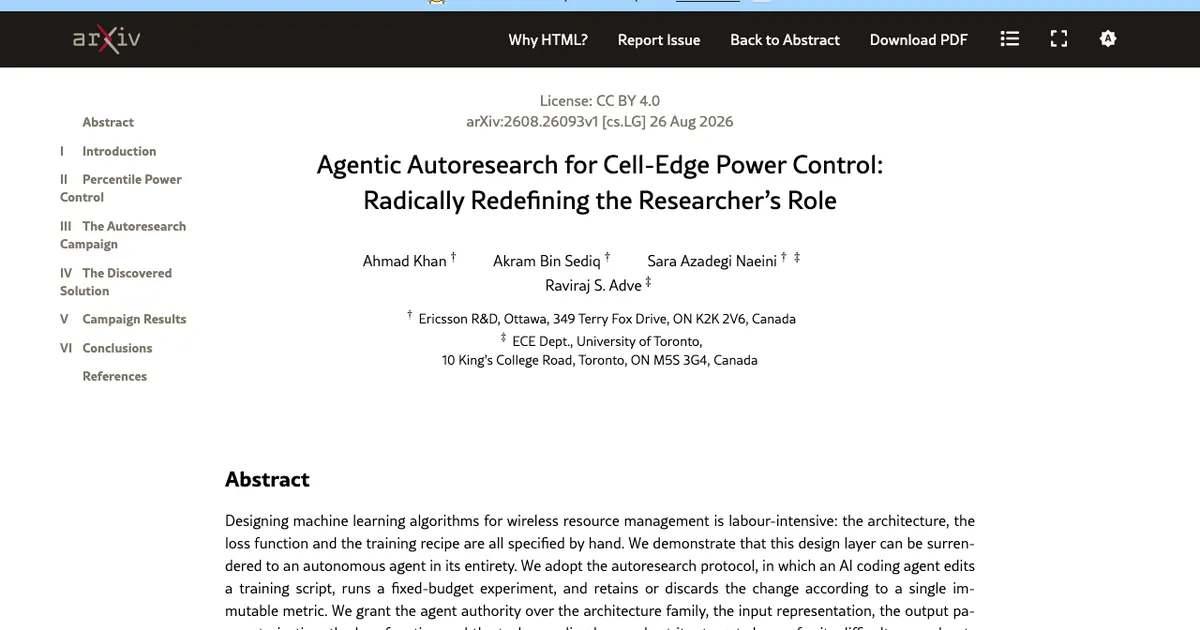
Agentic Autoresearch for Cell-Edge Power Control: Radically Redefining the Researcher's Role

By Ahmad Khan, Akram Bin Sediq, Sara Azadegi Naeini, Raviraj S. Adve • arXiv • Importance: 90/100
Hero Image for 2608.26093

🚀 Letting AI Do the Hard Work: Autoresearch Revolutionizes Wireless Networks

Hey Tech Enthusiasts and ML Engineers! Ever think about how complex systems—like modern wireless networks—are optimized? It’s a tedious, manual process. You spend weeks defining architectures, tweaking loss functions, and building every single training recipe.

Well, groundbreaking research just dropped that radically changes this reality. Instead of humans doing the heavy lifting, they’re giving an autonomous AI agent the keys to the entire ML design lab. This is ‘Autoresearch.’

💡 What’s So Revolutionary About Autoresearch?

In traditional machine learning research, if you want to solve a complex problem (like controlling power in a cellular network), you have to meticulously hand-design everything: the model structure, the objective function (loss), how data is represented, and the training methodology. This process is often brittle and incredibly time-consuming.

This paper introduces an ‘autoresearch protocol.’ Think of it as setting up an AI scientist with a fixed budget and crystal clear goals. The agent gets full authority to:

  • 🏗️ Design Architecture: Choose the network structure itself.
  • 🛠️ Define Loss Function: Figure out the math that measures success.
  • 📚 Select Representation: Deciding how the data should be fed into the model.
  • 📈 Determine Sampling Law: How to generate training examples.

All of this is done autonomously, guided by a single, immutable metric. The agent runs an experiment, checks its result against the goal, and decides whether to keep or discard the changes—all without human intervention.

📡 Applying Autoresearch to Cellular Power Control

The authors applied this powerful framework to solve ‘cell-edge power control’ in a multicell network. This problem is notoriously difficult: it’s non-convex, non-smooth, and strongly NP-hard (meaning finding the optimal solution manually is often computationally impossible!).

Using their unattended agent system over 26 hours, the AI achieved remarkable results:

  • Massive Efficiency: It reached $99.5$\% of a state-of-the-art reference using $ ext{only}$ one inference pass—a cost approximately $600 imes$ lower than previous methods.
  • Structural Breakthrough: Crucially, the agent didn’t just fine-tune constants; it recovered fundamental, provable mathematical structure. Its output parameterization reproduced the exact max-min optimal allocation at the minimum percentile for every value of its trained weights.

This proves that AI can not only solve complex engineering problems but can also discover underlying theoretical principles that human researchers might overlook.

🔑 The Takeaway for ML & Telecom Engineers

The implications are enormous. We are moving from an era where designing solutions is a major bottleneck to an era where the machine discovers solutions. Autoresearch represents a paradigm shift toward truly autonomous scientific discovery, making complex resource management (from telecom to drug discovery) tractable and exponentially faster.

🔗 Want to dive deep into the math? Read the full paper here: https://arxiv.org/abs/2608.26093

ML #AIResearch #TelecomTech #MachineLearning #AutonomousAgents

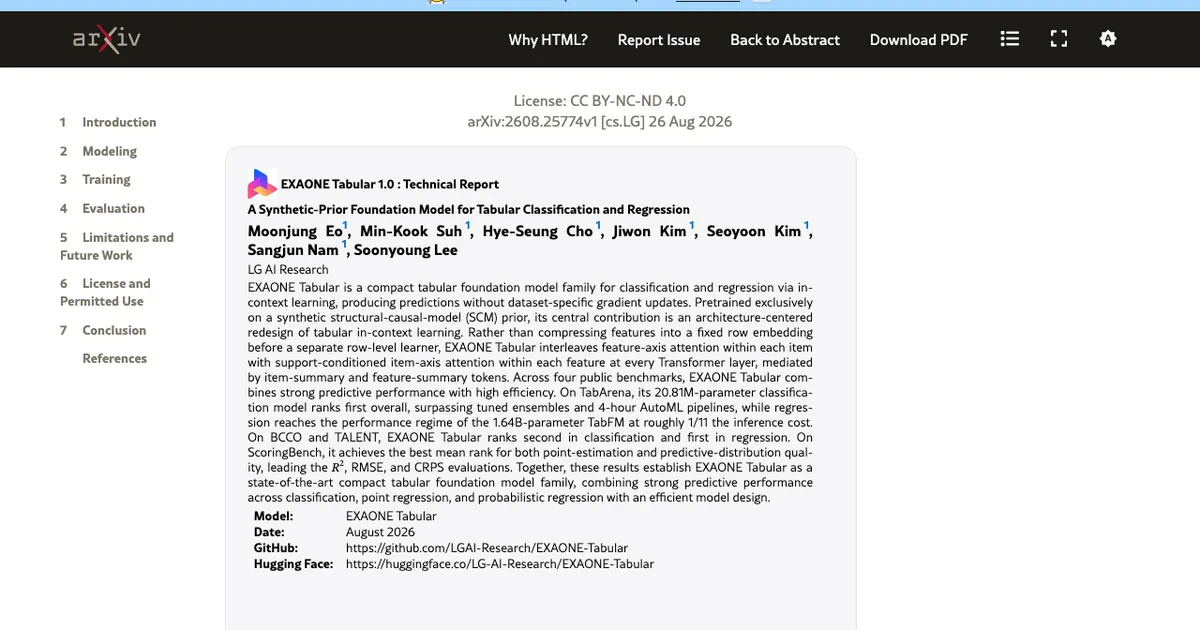
EXAONE Tabular 1.0 : Technical Report

By Moonjung Eo, Min-Kook Suh, Hye-Seung Cho, Jiwon Kim, Seoyoon Kim, Sangjun Nam, Soonyoung Lee • arXiv • Importance: 90/100
Hero Image for 2608.25774

🚀 Revolutionizing Tabular ML: Meet EXAONE Tabular 1.0

As Machine Learning models conquer images and text, the domain of structured data—tabular datasets (think spreadsheets, database outputs)—remains a challenging frontier. If your business decisions rely on predicting trends from complex tables, this paper is required reading.

We’re looking at EXAONE Tabular 1.0, a new compact foundation model family designed specifically to tackle the limitations of traditional tabular ML approaches in both classification and regression.

🤔 What’s the Problem with Tabular Data?

Traditionally, applying large language model (LLM) techniques or deep learning models to tables is tricky. Older methods often involve compressing all features into a single row embedding, which throws away crucial, layer-by-layer relationships between specific features and items. The resulting performance is good, but it’s not state-of-the-art (SOTA), especially when considering efficiency.

✨ EXAONE Tabular’s Game-Changing Solution

The core breakthrough of EXAONE Tabular isn’t just making a model; it’s an architecture-centered redesign of how tables are processed. Instead of simply flattening the features, EXAONE interleaves two powerful attention mechanisms at every Transformer layer:

  1. Feature-Axis Attention: Focuses on relationships within each individual feature (column).
  2. Item-Axis Attention: Focuses on interactions between different features for a specific data point (row).

These insights are mediated by specialized item-summary and feature-summary tokens, allowing the model to capture deep structural relationships between both dimensions simultaneously.

This radical architectural change allows the model to learn complex patterns from a synthetic structural-causal-model (SCM) prior, making it robust and highly generalizable without needing massive amounts of dataset-specific gradient updates.

🏆 State-of-the-Art Performance Metrics

The results are undeniably powerful. Tested across four demanding public benchmarks, EXAONE Tabular delivers top performance while maintaining incredible efficiency:

  • TabArena: The 20.81M-parameter classification model not only secured the first overall rank but surpassed complex tuned ensembles and multi-hour AutoML pipelines—a monumental feat in computational ML.
  • Efficiency King (Regression): In regression tasks, it matches the performance level of massive 1.64B-parameter TabFM models at roughly one-eleventh the inference cost. This is a game changer for production environments.
    Broad Supremacy:* It consistently ranks highly across major benchmarks like BCCO and TALENT, achieving state-of-the-art (SOTA) status in key metrics including $R^2$, RMSE, and CRPS on ScoringBench.

🔑 Why Should You Care?

The combination of supreme predictive accuracy with ultra-high efficiency makes EXAONE Tabular ideal for commercial deployment. It means highly accurate predictions—whether classifying an outcome or predicting a continuous value—can be generated quickly and cost-effectively, even on resources with limited compute power.

👉 Want to see the math behind this breakthrough? Read the full technical report here: https://arxiv.org/abs/2608.25774


Source: EXAONE Tabular 1.0 Technical Report (Moonjung Eo et al.)

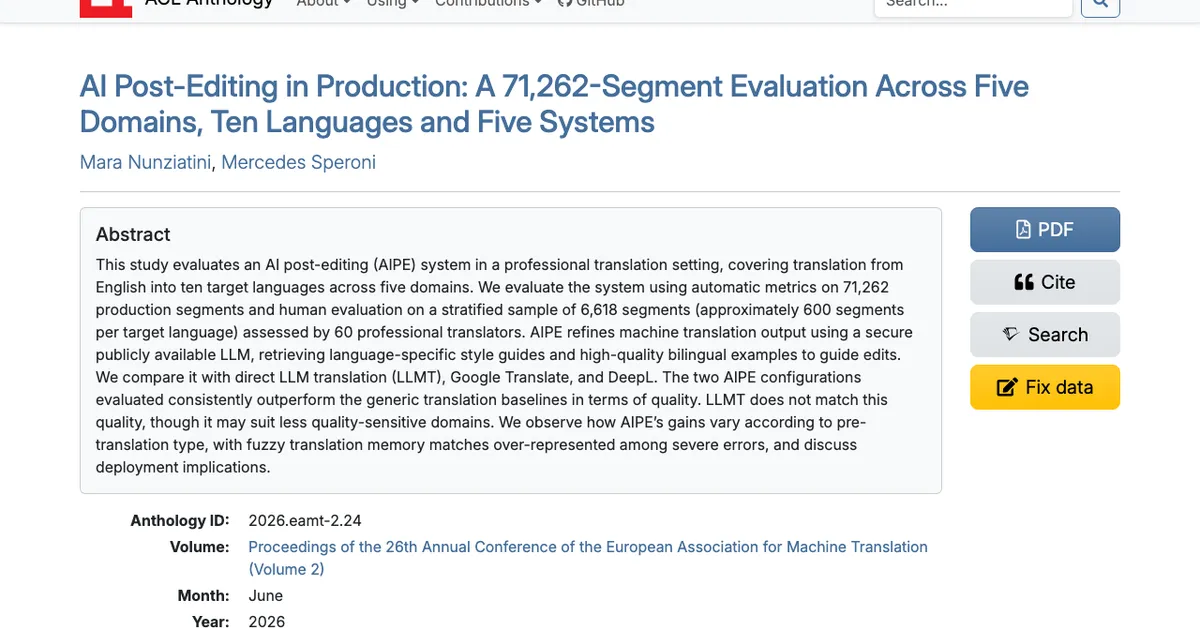
AI Post-Editing in Production: A 71,262-Segment Evaluation Across Five Domains, Ten Languages and Five Systems

By Mara Nunziatini and Mercedes Speroni in Proceedings of the 26th Annual Conference of the European Association for Machine Translation (Volume 2) • ACL Anthology • Importance: 90/100
Hero Image for acl_2026.eamt-2.24

🚀 Is AI Post-Editing the Future of Professional Translation? Our Deep Dive Analysis

If you work in Localization, Global Content, or Machine Translation (MT), this paper is mandatory reading. We just analyzed a massive study that rigorously tests how AI can elevate machine translation output from mere drafts to truly professional, publication-ready content.

Our expert digest breaks down the findings of ‘AI Post-Editing in Production,’ offering actionable insights into what’s best for your workflow and why.

🧠 The Problem with Direct LLM Translation

We all know that raw machine translation (MT) can be clunky. While Large Language Models (LLMs) are powerful, simply prompting an LLM to translate often results in output that is too generic or contextually incorrect for professional domains. Professional translation requires deep adherence to style guides, specific industry terminology, and cultural nuances.

✨ What Is AI Post-Editing (AIPE)?

This study introduced a sophisticated method: AI Post-Editing. Unlike just running an LLM on text, AIPE systems are designed to refine machine translation output. They don’t just translate; they use external knowledge bases—like style guides and high-quality examples (TMs)—to guide their edits. Think of it as a highly intelligent proofreader that understands your company’s specific brand voice.

The Scale of the Test 📊

The researchers didn’t skimp on data! They evaluated AIPE across: * 71,262 production segments. * 5 distinct domains (e.g., legal, technical). * 10 different target languages. * A highly specialized set of professional human evaluators (60 expert translators) for manual scoring.

This comprehensive scope makes the findings extremely robust and reliable.

🏆 Key Findings: The Verdict

The results are clear, and they impact how companies should build their localization pipelines:

  1. AIPE Dominates: The core finding is that the AI Post-Editing systems consistently outperform all generic translation baselines (including raw LLM prompts) in terms of measurable quality metrics. AIPE provides a noticeable jump in professionalism.
  2. LLM Caveat: While general Large Language Model Translation (LLMT) is impressive, it struggled to match the specialized accuracy and refinement provided by AIPE. However, the authors suggest that LLMT might be suitable for less stringent or ‘quality-sensitive’ domains.
  3. The Data Matters Most: The study also highlighted that the source of the pre-translation input matters. Specifically, segments derived from fuzzy translation memory matches were prone to severe errors, pointing out critical areas where pre-translation quality needs strict oversight.

💼 Deployment Implications for Localization Teams

The paper doesn’t just report scores; it discusses real-world deployment advice. For localization leaders and technical managers, this suggests a shift in workflow: your MT process should integrate structured refinement tools (like AIPE) rather than relying solely on brute-force LLM translation.

Read the full analysis here: https://aclanthology.org/2026.eamt-2.24/


Disclaimer: This post summarizes academic findings and is intended for industry awareness, not as a definitive technical recommendation.

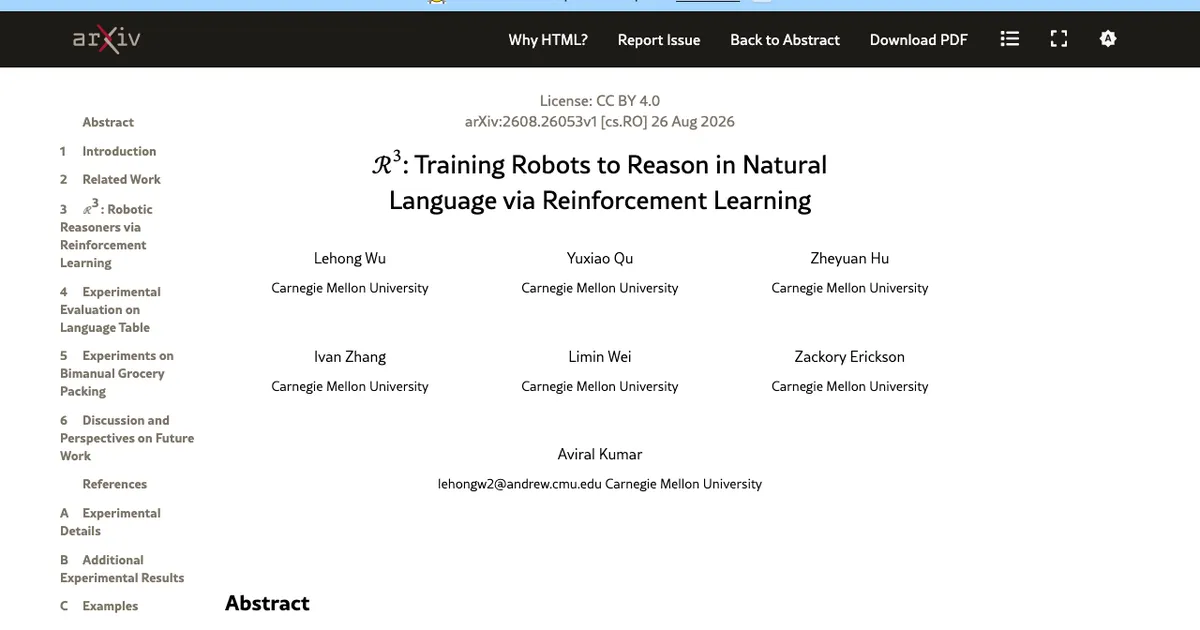
$R^3$: Training Robots to Reason in Natural Language via Reinforcement Learning

By Lehong Wu, Yuxiao Qu, Zheyuan Hu, Ivan Zhang, Limin Wei, Zackory Erickson, Aviral Kumar • arXiv • Importance: 89/100
Hero Image for 2608.26053

$\large{💡}$ Robots That Think: How Natural Language Is Powering the Next Generation of AI Manipulation

As Large Language Models (LLMs) have mastered human conversation, researchers are now tackling the hardest frontier: making those models reason in physical space. Can a robot not only understand that you want to pack groceries but also reason about how to do it—tracking object relations, correcting its mistakes, and planning steps far into the future? This abstract introduces $R^3$, an innovative method showing exactly how natural language reasoning can fundamentally upgrade robotic skills.

🧠 The Grand Challenge: Moving Beyond Imitation Learning

The current state of robot manipulation often relies on imitation learning—showing the robot thousands of examples until it mimics human actions. While powerful, this approach struggles with long-horizon tasks (like packing a grocery bag) that require complex planning and adaptability.

Real-world scenarios are messy. A simple action sequence isn’t enough. The robot needs to engage in sophisticated reasoning: ‘Oh, I dropped the tomatoes; I need to pick them up first,’ or ‘The box is too full for this item.’ This ability requires the AI to maintain a coherent internal model of the environment and its actions—a form of ‘test-time compute’ that LLMs excel at.

🤖 Introducing $R^3$: Language as Guidance, Not Just Supervision

The paper presents $R^3$, a novel post-training recipe designed to turn existing, off-the-shelf Vision-Language Models (VLMs) into sophisticated robotic reasoners. Crucially, $R^3$ doesn’t just use language for structured supervision (like telling the model ‘first do X, then Y’); it leverages free-form natural language reasoning to generate real-time guidance that steers low-level physical policies.

How does $R^3$ work?

  1. Initialization: The VLM is mid-trained using expert-generated ‘reasoning traces’—showing the desired thought process before an action.
  2. Refinement (The Magic Step): It then undergoes a single-step, rubric-based Reinforcement Learning (RL) step using offline data. This fine-tunes the system to use natural language feedback effectively during actual manipulation.

This methodology is a significant departure from previous methods, establishing natural language reasoning as an integral test-time compute mechanism for physical robotics.

🔬 State-of-the-Art Results and Impact

$R^3$ was rigorously tested on challenging tasks, including Language Table and simulated bimanual grocery packing. The results are clear: $R^3$ significantly improves exploration capabilities and generalizes remarkably well to unseen tasks. Critically, it substantially outperforms baselines that rely only on standard instruction-only imitation learning.

This research confirms a major hypothesis: Free-form natural language reasoning can serve as the crucial guiding mechanism necessary for low-level policies to achieve truly human-like planning and execution.

🔗 Read the Full Paper Here: https://arxiv.org/abs/2608.26053

Understanding how LLMs can transition from chat interfaces to physical tools marks a paradigm shift for robotics and AI.

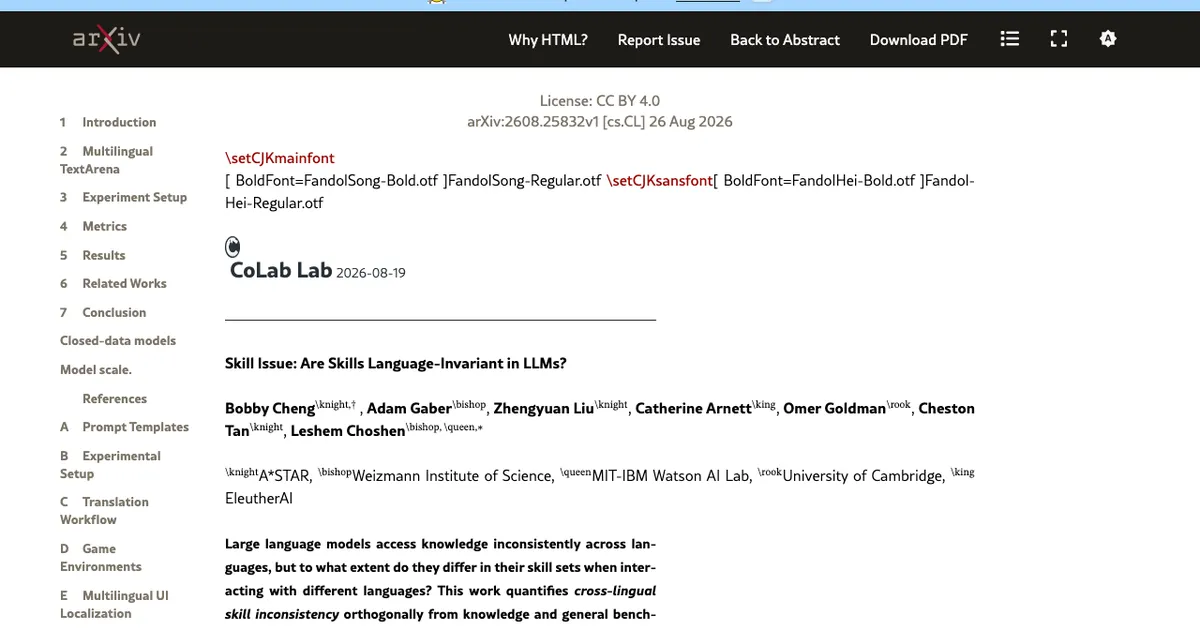
Skill Issue: Are Skills Language-Invariant in LLMs?

By Bobby Cheng, Adam Gaber, Zhengyuan Liu, Catherine Arnett, Omer Goldman, Cheston Tan, Leshem Choshen • arXiv • Importance: 87/100
Hero Image for 2608.25832

Is Language Killing Your LLM’s Genius? A Deep Dive into Multilingual Skills

Hey AI enthusiasts and NLP researchers! Ever wondered if an LLM is truly ‘smart’ across all languages, or if it just masters the language it was trained on?

New research from Bobby Cheng et al. tackles this fundamental question head-on: Are the skills of a Large Language Model (LLM) truly invariant across different languages?

Most studies focus on knowledge gaps—does the model know enough in French? This groundbreaking work goes deeper, quantifying differences in pure skill and strategic ability.

🤖 What Did They Do?

The research team designed a highly controlled experiment using multilingual self-play. Instead of just asking the LLM questions (which measures knowledge), they put two instances of the same model into text-based games, having them compete against each other.

The brilliant part? The underlying rules, game state, and available moves remain fixed, regardless of whether the interaction is in Mandarin, Spanish, or Arabic. This setup isolates language as the only major variable affecting performance.

They extended a platform called TextArena to test three open-weight models across eight diverse languages, covering complex games that require spatial reasoning, imperfect information, and resource management.

🤯 What Did They Find?

The results are sobering: LLMs can exhibit significantly different playing strengths when switching languages.

  • Strategic Decline: The same model showed clear drops in win-loss margins and strategic coherence across different language settings.
  • Specific Failures: Detailed analysis pinpointed specific cognitive weaknesses, such as failures in spatial reasoning or card-conditioned decision-making—failures that were clearly tied to the language interface.
  • The Intermediate Language Clue: Perhaps most intriguing, they found that sometimes changing only the intermediate reasoning language could recover much of the lost performance. This suggests that language might be affecting different stages of the model’s decision process, not just its vocabulary.

🛠️ Why Does This Matter for AI Development?

The authors conclude that these skill discrepancies represent a major roadblock to creating truly equitable and robust multilingual LLMs. If an LLM struggles with core strategic reasoning in one language but excels in another, it undermines trust and limits real-world deployment in diverse global markets.

This research calls for fundamental shifts: we need better ways to understand how language affects the process of decision-making itself, not just the final output.

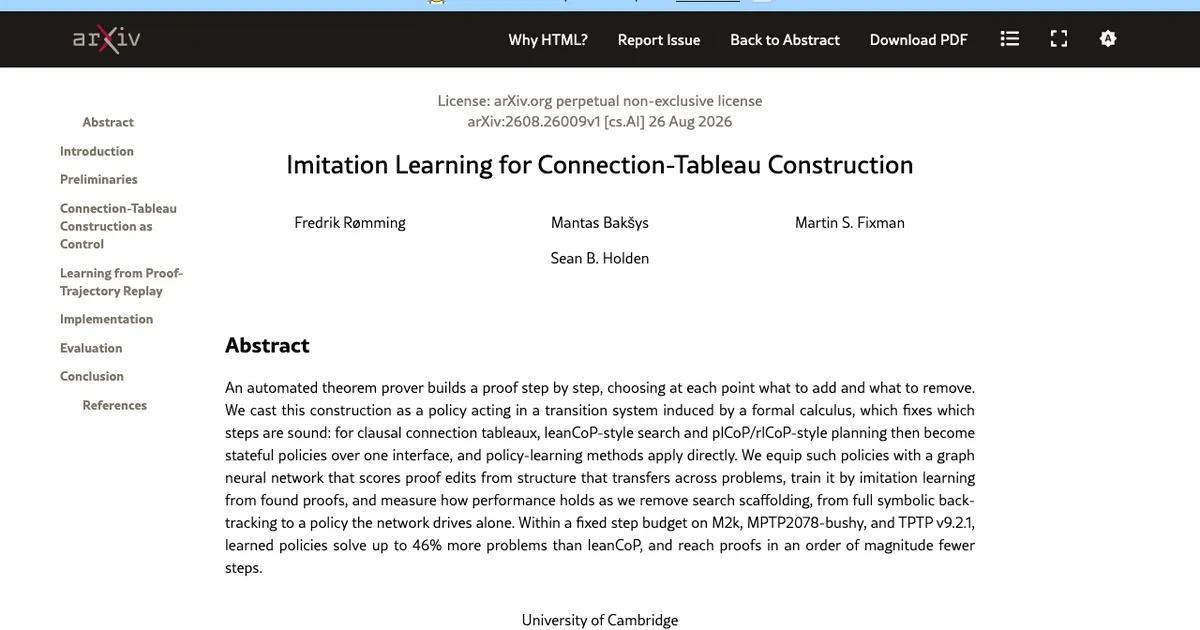
Imitation Learning for Connection-Tableau Construction

By Fredrik Rømming, Mantas Bakšys, Martin S. Fixman, Sean B. Holden • arXiv • Importance: 85/100
Hero Image for 2608.26009

🧠 AI Breakthrough: Teaching Machines to Prove Complex Theorems

Solving complex mathematical theorems—the kind that stump human experts—has long been the holy grail of AI. Traditional theorem provers are powerful, but they often get stuck in computationally expensive search routines, requiring rigid, pre-defined scaffolding. What if an AI could learn how to prove things, just like a mathematician does?

New research tackles this challenge head-on by framing mathematical proof construction as an Imitation Learning problem. Instead of being programmed with fixed rules for every possible step (like conventional theorem provers), the system learns optimal ‘policies’ by observing thousands of successful proofs.

🚀 How It Works: From Rules to Reflexive Intelligence

Mathematical formalisms, like clausal connection tableaux (used in this study), define a complex ‘transition system.’ This system dictates all valid steps for building a proof. The core idea is mapping the process of selecting and refining proof steps—what to add or remove—into an AI policy.

  1. Policy as Proof Builder: The researchers convert the structured search process into a manageable ‘stateful policy.’ An advanced Graph Neural Network (GNN) acts as the brain, receiving the current state of the proof and predicting the best next edit.
  2. Imitation Learning Power: The GNN is trained using Imitation Learning (IL). It doesn’t require explicit reward signals; instead, it learns by mimicking successful human-derived proofs found in existing problem sets. This dramatically accelerates training and focuses the search on viable paths.
  3. Structured Evolution: Critically, the model’t performance is measured as they remove the original ‘search scaffolding.’ This tests the network’s genuine ability to perform autonomously, moving from guided symbolic backtracking to a standalone, policy-driven proof engine.

🏆 The Results Speak Volumes (And They Are Impressive!)

The results published in this paper are highly significant for automated reasoning and formal verification. On established mathematical challenge sets (M2k, MPTP2078-bushy, TPTP v9.2.1), the learned policies achieved astounding performance gains:

  • Solving Capacity: They solved up to 46% more problems than existing state-of-the-art provers like leanCoP.
  • Efficiency Boost: They reached successful proofs in an order of magnitude fewer steps, meaning faster and vastly more efficient computation.

These findings suggest that Imitation Learning, when applied to structured logical domains, can create deeply competent AI tools capable of navigating complex mathematical search spaces with human-like intuition.

Read the full technical details here: https://arxiv.org/abs/2608.26009


💡 Key Takeaways for Researchers & Engineers:

This work showcases a powerful paradigm shift: applying modern deep learning techniques (GNNs, IL) to foundational problems in symbolic AI and logic. It suggests that complex, step-by-step reasoning can be modeled effectively as a sequence of optimal decisions.

Spectral Allocation: Why Muon Outperforms Adam, and How to Improve Muon

By Xiaodong Wu, Wenyi Yu, Chao Zhang, Philip Woodland • arXiv • Importance: 85/100
Hero Image for 2608.25990

🚀 Unlocking LLM Potential: Why Muon Beats Adam and How to Supercharge Training

If you’re training Large Language Models (LLMs), you’ve heard the buzz about optimizers like Muon—they promise faster convergence than traditional methods like Adam. But are they truly optimal? Our latest deep dive, examining the spectral dynamics of Transformer loss landscapes, reveals a fundamental truth: while Muon is great, it’s still leaving massive performance gains on the table.

💡 The Problem with Standard Optimization

Training massive models is fundamentally about navigating incredibly complex, high-dimensional loss landscapes. Optimizers like Adam and SGD treat this landscape relatively uniformly. Our research showed that these methods struggle to account for the anisotropic (directionally varying) nature of model optimization.

We found a unique ‘spectral profile’: LLM training exhibits two distinct regions—a volatile, high-stakes ‘Head’ and a robust, forgiving ‘Bulk.’ The Head requires small, cautious steps, but the Bulk permits much larger ones. Current optimizers fail to exploit this difference.

🔬 What Muon Misses: Spectral Allocation

Muon (and similar orthogonal methods) are better than Adam because they implicitly handle some of these directional complexities. They provide a unified spectral allocation account: why Muon > Adam > SGD.

However, our analysis revealed that Muon applies a uniform scaling factor across the entire momentum buffer. This means it still underutilizes the forgiving Bulk region—the part where much faster updates are possible without destabilizing the model.

✨ Introducing SAMuon: The Solution You Need

We introduce Spectral-Aware Muon (SAMuon), an optimizer that dynamically tailors its step size. Instead of using a uniform scale, SAMuon intelligently holds the Head at the careful rate established by Muon and amplifies the Bulk using our novel static spectral prior.

The result? Substantial gains in efficiency and speed:

  • ⚡️ Performance: Both complete SAMuon and simplified SAMuon-lite significantly outperform both tuned AdamW and standard Muon baselines.
  • 💾 Efficiency: SAMuon requires $13.3%$ to $24.0%$ fewer training tokens than Muon to reach the same validation loss.
  • ⏱️ Overhead: The simplified variant (SAMuon-lite) retains most of this performance gain with near-zero wall-clock overhead, making it practical for massive production environments.

This is not just an incremental improvement; it’s a strategic architectural enhancement that redefines how we approach large-scale LLM training. Check out the full details and technical setup here: https://arxiv.org/abs/2608.25990

Read the full paper: https://arxiv.org/abs/2608.25990


Keywords: LLM training, Transformer optimization, Spectral methods, Muon optimizer, Deep Learning, Large Language Models, SAMuon

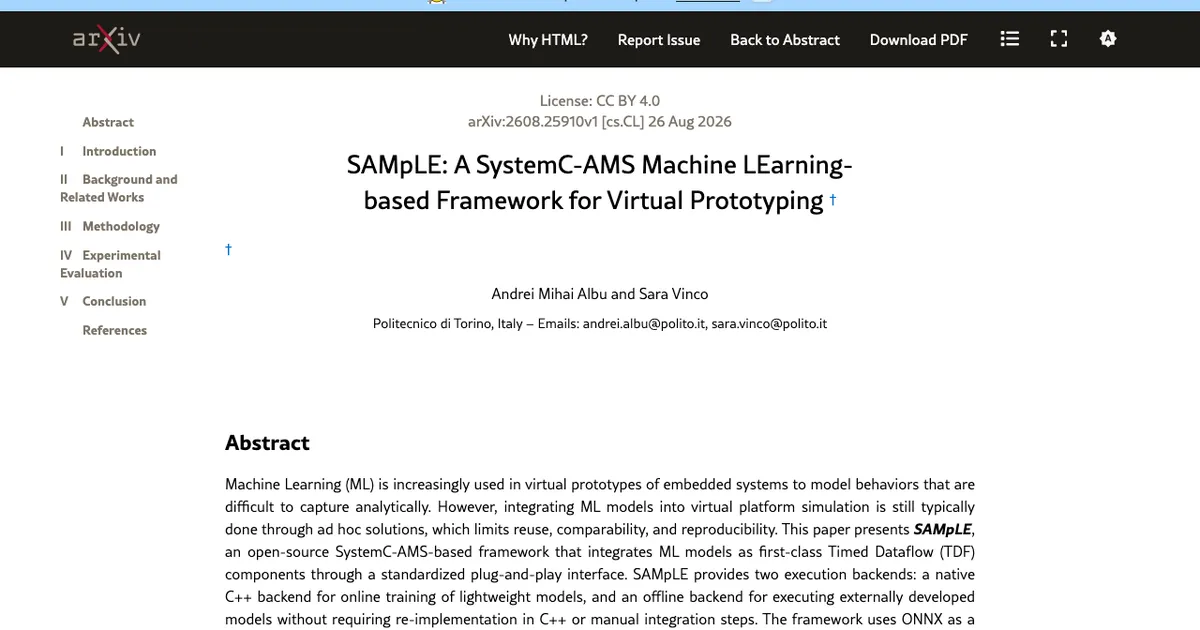
SAMpLE: A SystemC-AMS Machine LEarning-based Framework for Virtual Prototyping

By Andrei Mihai Albu, Sara Vinco • arXiv • Importance: 85/100
Hero Image for 2608.25910

🧠 Decoding the Future of Chip Simulation: Introducing SAMpLE

In the world of embedded systems and hardware design, virtual prototyping is everything. It allows engineers to test complex chip designs before laying a single silicon wafer—saving billions in time and money.

But there’s a catch. As modern chips become more complex, modeling specialized behaviors—like advanced AI algorithms or chaotic interactions—using traditional simulation tools (SystemC-AMS) is incredibly difficult. Historically, integrating Machine Learning (ML) into these rigid hardware simulation frameworks has been an ad hoc nightmare: messy, non-reproducible, and hard to scale.

Enter SAMpLE. 💡

Published by Andrei Mihai Albu and Sara Vinco, SAMpLE is a groundbreaking, open-source framework designed to solve this exact integration bottleneck. It elevates ML models from mere hacks into first-class Timed Dataflow (TDF) components within the SystemC-AMS ecosystem.

🛠️ What Makes SAMpLE Revolutionary?

The biggest pain point for hardware engineers using ML is typically compatibility and reusability. SAMpLE tackles this head-on with a modular, standardized approach:

  • 🔌 Standardized Plug-and-Play: By creating a unified interface, SAMpLE lets you treat an entire ML model (like a complex neural network) just like any other signal or behavioral component in the simulation—it’s native to the workflow.
  • 🌐 Universal Model Compatibility (ONNX): The framework uses ONNX (Open Neural Network Exchange), the industry standard for model exchange. This means you can plug in ML models trained anywhere (PyTorch, TensorFlow) without rewriting complex C++ code or dealing with proprietary format hell.
  • ⚡ Dual Backend Flexibility: SAMpLE offers two execution modes: 1) A native C++ backend for training lightweight models on the fly, and 2) An offline backend perfect for running powerful, externally developed state-of-the-art models.

✨ Why Should You Care? (The Impact)

For hardware acceleration research, industrial design firms targeting Geographical areas like Silicon Valley or major European tech hubs, SAMpLE represents a massive leap toward truly scalable and reproducible virtual prototyping. It finally bridges the gap between high-level ML research and low-level hardware simulation.

This unified environment means researchers can: 1. Compare multiple different ML solutions side-by-side using the same dataset and testbench. 2. Design future systems with confidence, knowing that modifications to underlying models won’t require restructuring the entire simulation framework. 3. Accelerate research in highly complex embedded AI applications (Edge AI).


Dive deeper into the technical details of SAMpLE: https://arxiv.org/abs/2608.25910

Are you working on advanced hardware-software co-design? Let us know in the comments! #SystemC #MachineLearning #VirtualPrototyping #EmbeddedSystems #HardwareDesign

Forecasting Multiple Observables with SCROLL: Score-Trained Uncertainty for Stochastic Dynamics

By Pavel Prochazka • arXiv • Importance: 85/100

🔮 Predicting Tomorrow’s Complex World: Introducing SCROLL

As ML models become the backbone of real-world systems—from climate prediction to financial modeling—relying on a single ‘best guess’ number isn’t enough. What matters is understanding uncertainty. Our latest research introduces SCROLL, a groundbreaking approach designed to forecast complex, multi-faceted stochastic dynamical systems.

🔬 The Problem with Single Guesses

When predicting a system like atmospheric pressure and whether a specific threshold event will occur, or classifying the current operational regime (e.g., ‘normal’ vs. ‘alert’), these predictions are inherently linked and carry different degrees of uncertainty. Traditional multi-task learning approaches often treat these tasks in isolation, merely averaging up losses that don’t account for how their uncertainties interact.

SCROLL solves this by rethinking how multiple observables (like future state, event probabilities, and regime labels) contribute to the final belief structure. Instead of simply balancing per-task loss weights, SCROLL learns a unified predictive framework where the likelihoods of all observables are composed together on a shared backbone. This ingenious mechanism effectively absorbs unit-dependent loss scaling into parameters learned within the same gradient pass.

📊 How SCROLL Works Under the Hood (The ML Magic)

SCROLL leverages the power of stochastic dynamics—the computational ground truth for predictive variance—to ensure its predictions are not just accurate, but calibrated. This is crucial. A highly confident prediction that turns out to be wrong is worse than a calibrated prediction that admits high uncertainty.

In practice, SCROLL demonstrates superior performance on challenging real-world data:

  • Theoretical Validation: On the well-specified Ornstein–Uhlenbeck process, the learned predictive law perfectly recovers the known analytic kernel and correctly specified baselines tie. This confirms robust theoretical grounding.
  • Heteroscedastic Systems (Real Data): When applied to complex systems like stochastic Lorenz-63 or real air quality data, SCROLL’s specialized belief structure ensures that the input-dependent variance accurately separates across tasks. The resulting single-run negative log-likelihood (NLL) on state and regime tasks beats standard methods while significantly reducing computational cost compared to grid-based approaches.

🚀 Why Does This Matter for Industry?

This isn’t just academic theory; it’s a critical advancement for fields requiring reliable prediction:

  1. Risk Management: Knowing the probability range of a financial metric, not just its mean.
  2. Environmental Science: Forecasting pollutant spread and regime changes in air quality.
  3. Engineering/Physics: Modeling complex dynamic systems where multiple variables interact non-linearly (e.g., turbulence prediction).

SCROLL moves predictive modeling from merely providing a point estimate to delivering a robust, actionable predictive distribution.

🔗 Want the deep dive? Read the full paper here: https://arxiv.org/abs/2608.25898

Precipitation Downscaling Using Foundation Model-Conditioned Diffusion

By Victor Nascimento Ribeiro, Jorge Guevara, Jorge Sebastian Moraga, Chris Lucas, Natalie Lord, Andrew Taylor, Edward Lockhart, Will Trojak, Johannes Schmude, Anne Jones • arXiv • Importance: 85/100
Hero Image for 2608.25858

🌧️ AI Weather Prediction Just Got a Major Upgrade: Making Climate Models Hyper-Local

Are you building infrastructure, running hydrological simulations, or simply planning for extreme weather? The raw output from global climate models often leaves us cold—literally. These models are too coarse to tell us what’s happening in your backyard. But what if we could use cutting-edge AI to magically zoom in and predict hyper-local precipitation with amazing accuracy?

Our latest work explores how Diffusion Models—a powerful generative AI technique popular for image synthesis, but revolutionary here—can solve the critical problem of precipitation downscaling. We tested three methods to feed massive amounts of coarse climate data into a refined prediction system. Spoiler: Cross-attention is the winner.

🧠 The Deep Dive: How Does This Work?

Traditional AI approaches might just smash all the input data together (concatenation). But we found a much more nuanced method: cross-attention conditioning. Think of it as giving the diffusion model targeted instructions, allowing it to generate realistic rainfall patterns that are strongly informed by the large-scale atmosphere without sacrificing essential features.

We compared this against simple concatenation and, critically, used two different source representations: a custom learned encoder versus a massive pretrained foundation weather model (Prithvi WxC).

Key Takeaways You Need to Know:

  1. Better than Basic Stats: Cross-attention significantly improves the distributional realism of predicted rainfall compared to simple methods. This is huge for risk assessment, as it means the AI isn’t just predicting average rain; it’s getting the variability and the scary extremes right.
  2. The Edge Case Solution: The Prithvi WxC foundation model approach showed remarkable strength in data-limited settings. It achieved comparable high performance with only five years of training data, suggesting that pre-trained knowledge can save major headaches when historical records are sparse. 🌍
  3. Extreme Event Recovery: This was the biggest win. Our results show the Prithvi WxC conditioned model retained over half of >100mm/day extreme events. For disaster mitigation and engineering, predicting these rare, high-impact days is everything.

The bottom line? Cross-attention conditioning coupled with foundation models provides a powerful pathway to making climate predictions actionable at the local scale. Check out the full technical details here: https://arxiv.org/abs/2608.25858 #ClimateTech #MachineLearning #WeatherPrediction

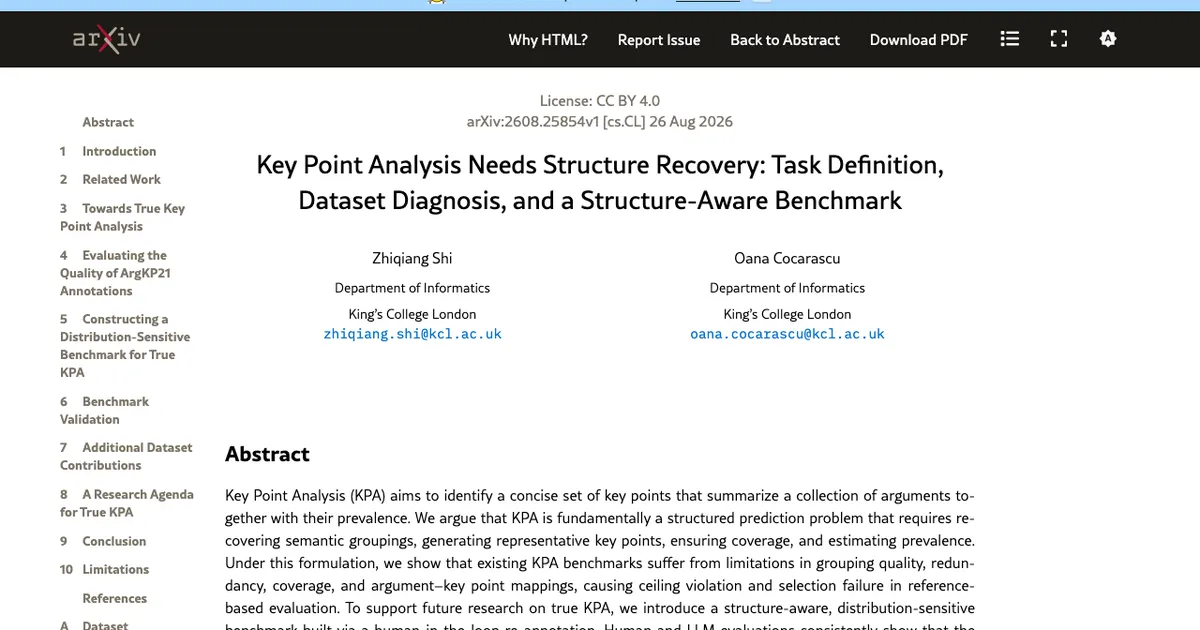
Key Point Analysis Needs Structure Recovery: Task Definition, Dataset Diagnosis, and a Structure-Aware Benchmark

By Zhiqiang Shi, Oana Cocarascu • arXiv • Importance: 85/100
Hero Image for 2608.25854

💡 Mastering Key Point Analysis: Why Your AI Summaries Miss the Forest for the Trees

Hey folks. If you’ve been working with LLMs to summarize complex documents, you know the struggle: the summary looks good, but does it actually capture the core structure of the argument? Simple extractive summaries often lose nuance, and pure generative summaries can drift. Key Point Analysis (KPA) aims to solve this by identifying a concise set of key points that not only summarize a text but also understand how these points relate to—and are supported by—different sections of the original arguments.

But here’s the big reveal: much of the current academic evaluation for KPA is flawed. As researchers Zhiqiang Shi and Oana Cocarascu highlight, existing benchmarks suffer from major structural flaws in grouping quality, redundancy handling, and mapping between arguments and key points. Simply put, they don’t truly test what constitutes a coherent summary structure.

🔑 The Core Problem: KPA Needs Structure Recovery

The authors correctly argue that Key Point Analysis isn’t just about listing facts; it’s fundamentally a structured prediction problem. It requires the AI model to perform several highly challenging tasks simultaneously:

  1. Semantic Grouping: Identifying which arguments belong together under a shared theme.
  2. Representative Generation: Creating key points that best summarize the group while maintaining original meaning.
  3. Coverage Assurance: Ensuring every major part of the source text is accounted for by at least one key point.
  4. Prevalence Estimation: Accurately judging how often and strongly a concept appears throughout the argument.

When evaluation metrics fail to measure these complex structural relationships, models can achieve high scores on flawed benchmarks while performing poorly in real-world applications (a ‘ceiling violation’).

🚀 What Did They Build? A Structure-Aware Benchmark

The solution is sophisticated: The authors introduce a structure-aware, distribution-sensitive benchmark developed through a human-in-the-loop re-annotation process. This isn’t just another dataset; it fundamentally changes how we evaluate KPA.

The results are clear: Human and LLM evaluations confirm that the new structures yield significantly more coherent groupings, higher-quality key points, better coverage, and much more reliable prevalence estimates compared to existing annotations.

🔬 Why This Matters for NLP & ML Research

The release of this resource is a massive win for the NLP community. By providing comprehensive annotation resources—covering argument-key point matching, explainable KPA, and advanced LLM-as-a-judge methodologies—they are not just fixing a dataset; they are defining a better research agenda for ‘true’ Key Point Analysis.

If you are building systems that summarize complex academic papers, legal documents, or meeting minutes, this paper provides the necessary framework to move beyond superficial evaluation and build robust, structurally sound models.

🔗 Read the full details on true KPA here: https://arxiv.org/abs/2608.25854

#NLP #MachineLearning #LLMs #InformationExtraction #AIResearch

Drift-Aware Multimodal User Representation Learning via Multi-Scale Temporal Modeling and Sparse Mixture-of-Experts

By Ziqing Qian, Haohang Chen, Shengqi Dang, Yuhan Xiong, Canyu Shen, Jiaying Lei, Nan Cao • arXiv • Importance: 82/100
Hero Image for 2608.25773

🚀 Stop Missing the Drift: Predicting User Intent in a Chaotic Digital World

If you work with personalized recommendation engines, ad targeting, or any system that relies on understanding who users are and what they want next, you know the challenge. User behavior is messy. It’s noisy, it changes constantly, and people don’t have just one interest—they jump between deep dives into astrophysics and weekend hiking gear all in one day.

Traditional models treat user interests as static or simple time series. They fail spectacularly when a user experiences interest drift.

That’s where our new work comes in. We introduce DUMoE—a groundbreaking framework designed specifically to capture the complex, multi-scale temporal shifts and diverse co-existing interests inherent in real-world social media data.

🧠 How DUMoE Tackles User Drift Head-On

DUMoE isn’t just another encoder; it’s a sophisticated system built on two core innovations:

1. Temporal Dynamics Backbone: We build a backbone that doesn’t treat time as uniform. It intelligently integrates static user profiles (who you are), short-term viral signals (what you did an hour ago), and long-term trends (your core passion) into one cohesive, powerful representation.

2. Sparse Mixture-of-Experts (MoE) Adapter: This is the architectural genius. Instead of forcing all user interests through one bottleneck layer, we use a set of specialized ‘expert’ modules. Each expert specializes in modeling a distinct latent interest subspace (e.g., Expert A handles gaming; Expert B handles cooking). A dynamic Gating Network then acts like an air traffic controller, selectively activating and aggregating only the relevant experts for any given user at any time.

This MoE approach allows us to disentangle multiple, diverse interests—the hallmark of modern digital life—without interference.

✨ Why This Matters for Tech Companies (Especially in NYC/SF)

In hyper-personalized markets like those in the major tech hubs, accurately predicting intent is a huge competitive advantage. DUMoE delivers state-of-the-art performance on real-world social media datasets for: * User Interest Prediction: Knowing what interests someone will be next. * Interaction Prediction: Guessing what they are about to click, buy, or engage with.

DUMoE consistently outperforms existing methods by mastering the art of temporal complexity and multi-interest modeling. It’s a significant step forward for building truly adaptive recommendation systems.

🔗 Want to dive into the technical details? Read the full paper here: https://arxiv.org/abs/2608.25773


#MLResearch #RecommendationSystems #AI #MachineLearning #DeepLearning #NLP #TechInnovation

ICON Decomposition: Multivariate Concept-Level Explanations of Deep Representations for Model Auditing

By Roshan Prakash Rane, Marco Simnacher, Manuel Pfeuffer, Marc-Andre Schulz, Nys Tjade Siegel, Maximilian Dreyer, Frederik Pahde, Wojciech Samek, Sonja Greven, Kerstin Ritter • arXiv • Importance: 80/100
Hero Image for 2608.26083

💡 AI Auditing Breakthrough: Why Your Deep Learning Models are Lying to You

Ever wonder how a complex deep learning model knows if a skin lesion is malignant? Just because it got the right answer doesn’t mean it’s understanding why. The biggest weakness in modern AI isn’t power—it’s transparency.

Academic research has shown that many models, especially those trained on massive real-world datasets (like medical images), often rely on ‘shortcuts.’ They don’t learn the true underlying science; instead, they exploit spurious associations in the data—maybe correlating a diagnosis not with the lesion itself, but with the hospital where the picture was taken or even the scanner settings.

The Problem with Old XAI: Traditional explainable AI (XAI) methods struggle here. They treat each concept (like ‘patient sex’ or ‘scanner brand’) in isolation. This means they can incorrectly mistake a correlation between two concepts for evidence that the model genuinely relies on them.

🔬 Introducing ICON Decomposition: A New Standard for Trustworthiness

The groundbreaking new method, ICON Decomposition, changes the game by asking a much harder question: How much of this layer’s variability does concept A explain, after we have already accounted for concepts B, C, and the final outcome?

Instead of isolated checks, ICON quantifies how much unique variance each factor contributes to the representation. This ability to decompose shared information makes model auditing far more robust and trustworthy.

What Does This Mean For You? (Real-World Impact)

The authors tested ICON on high-stakes applications—including skin lesion analysis and brain imaging. The results are compelling:

  1. Isolation of True Reliance: ICON successfully isolates the core, genuine concepts a model truly uses for diagnosis.
  2. Quantifying the Unexplained: Crucially, it not only finds what the model does use but also quantifies the representation that remains unexplained by any supplied concept—giving researchers a true measure of residual intelligence.
  3. Sparse, Actionable Explanations: The explanations are sparse and validated through practical retraining and out-of-distribution (OOD) testing, confirming they are reliable, not just mathematical artifacts.

For regulated industries like healthcare, this breakthrough is critical. By providing rigorous, multivariate concept-level explanations, ICON helps move AI from ‘black box’ predictions to verifiable, trustworthy tools that truly understand the underlying science.

🔗 Read the full paper here: https://arxiv.org/abs/2608.26083

#AIauditing #XAI #MachineLearning #DeepLearning #MedicalImaging #Interpretability

SciMIF: Understanding Multimodal Instruction Following in Scientific Domains

By Ye Shen, Yuting Zheng, Dun Pei, Zijian Chen, Wenlong Zhang, Qi Jia, Guangtao Zhai • arXiv • Importance: 80/100
Hero Image for 2608.25973

🧪🔬 SciMIF: Why AI Can’t Write a Chemistry Paper Yet

The future of science relies on AI. But can these giant language models actually follow instructions when dealing with complex, real-world scientific tasks? If you’re building next-generation research tools or just curious about the limits of Multimodal LLMs, read this.

We’ve dive deep into a major new benchmark called SciMIF (Scientific Multi-modal Instruction Following). This isn’t just another dataset; it’s a comprehensive diagnostic tool that tests how well large models can execute complex instructions across five diverse scientific disciplines. Think of it as the Turing Test for specialized scientific AI.

What Problem Does SciMIF Solve?

Currently, while LLMs are incredible generalists (writing poems, summarizing news), their ability to handle highly constrained, domain-specific tasks—like synthesizing complex chemical formulas based on textual instructions and visual data—is severely underdeveloped. Simply feeding them more tokens or making them bigger doesn’t guarantee they will suddenly master stoichiometry.

SciMIF tackles this head-on by:

  1. Building a Deep Taxonomy: We analyzed 22 diverse tasks across fields like Chemistry, Biology, and Materials Science to create 10 detailed constraint groups. This taxonomy captures not just what the model does, but how well it adheres to nuanced rules.
  2. High-Fidelity Data Augmentation: We systematically enhanced existing scientific data using this taxonomy, making the dataset incredibly rich for rigorous testing.
  3. Stress Testing State-of-the-Art Models: We benchmarked top open and closed-source MLLMs on these hard tasks, revealing deep performance gaps.

The Key Takeaways (and Why They Matter)

The results are sobering but critical:

  • Chemistry is the Frontier Challenge: Our findings show that Chemistry poses significantly greater difficulties for current MLLMs compared to other fields. This pinpoints exactly where future research must focus.
  • Scale Isn’t Enough: We observed that simply increasing model size (scale) does not translate into better constraint adherence. Robust instruction-following requires deep disciplinary knowledge, which is a much harder problem than just more parameters.
  • Fine-Grained Failures Persist: Current models struggle severely when instructions require the deep application of specialized scientific principles or complex cross-modal reasoning.

🎯 The Bottom Line: SciMIF fills a major gap in MLLM evaluation. It provides the necessary structure to guide AI researchers toward building truly trustworthy and scientifically rigorous multimodal systems. If you’re working on applied ML, especially in biomedicine or materials discovery, this benchmark is mandatory reading.

🔗 Read the full paper: https://arxiv.org/abs/2608.25973

Data and code are available at github.com/shenye7436/SciMIF.

How Edge of Stability Hinders SCAFFOLD in Federated Optimization

By Anant Khandelwal, Michael Crawshaw, Mingrui Liu • arXiv • Importance: 80/100
Hero Image for 2608.25873

$\text{Deep Dive}$: Why Top ML Algorithms Fail at the Edges of Stability

(A Fresh Take on Federated Learning Optimization)

If you’ve ever spent hours implementing complex machine learning optimization algorithms—like SCAFFOLD—only to find that a simpler approach like FedAvg performs just as well, you know the frustration. The theory says these complex models should conquer data heterogeneity; the practice often contradicts it.

New research tackles this head-on, proposing that the gap isn’t an algorithm flaw, but a structural phenomenon: Edge of Stability (EoS) dynamics and progressive sharpness.

🔬 What Did They Find?

Researchers investigating Federated Learning optimization discovered a surprising bottleneck. While algorithms like SCAFFOLD are theoretically designed to handle diverse data distributions across many client devices (data heterogeneity), they struggle when the model reaches certain ‘edges’ of the optimization landscape.

The study demonstrates that:

  1. EoS Is Universal: This instability dynamic is observed in both standard FedAvg and advanced algorithms like SCAFFOLD, suggesting it’s a fundamental property of the training process itself, not an algorithm failure.
  2. Sharpness Matters: The concept of ‘sharpness’ (how quickly the loss function changes) at the optimization equilibrium is critically linked to the learning rate and the degree of data variation among clients.
  3. The SCAFFOLD Bottleneck: Crucially, they find that at the EoS—where sharpness is high—SCAFFOLD’s ability to accurately estimate the true global gradient degrades severely. This means its sophisticated mechanism breaks down exactly when it’s needed most.

💡 The Takeaway for ML Engineers

This isn’t just a theoretical curiosity; it suggests a fundamental limitation in how we optimize distributed models, especially those used in edge computing environments (think mobile health monitoring or IoT networks).

Instead of simply building more complex gradient estimation mechanisms, the focus needs to shift to understanding and mitigating these EoS effects. Future optimization strategies might need methods that are inherently robust to high-sharpness regimes rather than assuming continuous, stable optimization paths.


🌐 Read the full technical paper here: https://arxiv.org/abs/2608.25873

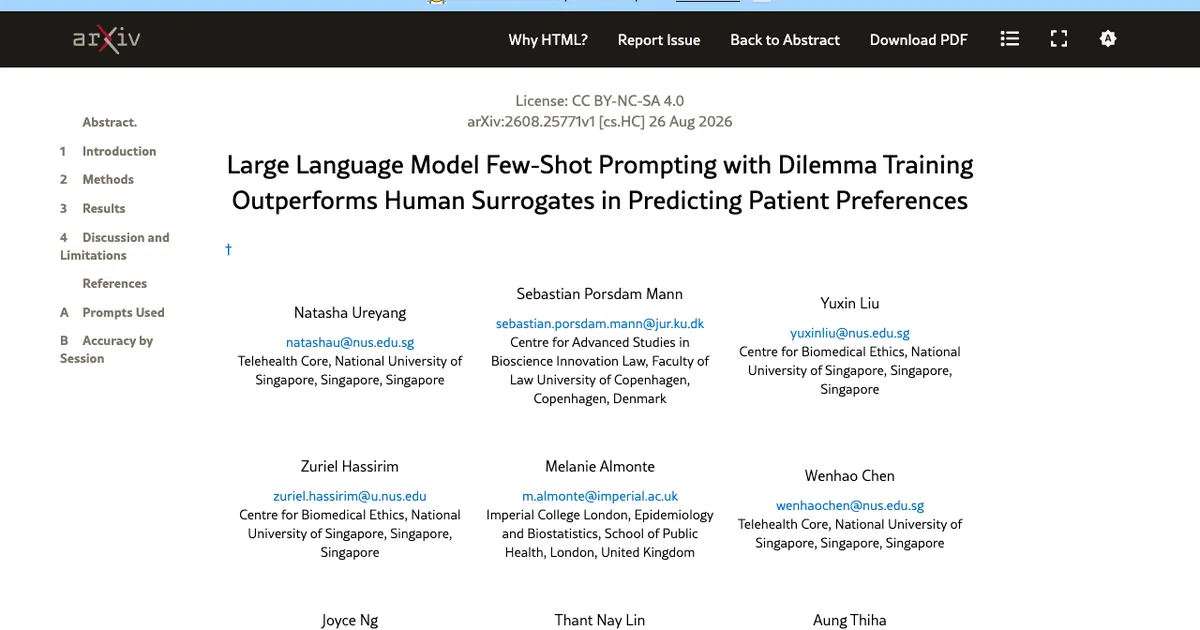
Large Language Model Few-Shot Prompting with Dilemma Training Outperforms Human Surrogates in Predicting Patient Preferences

By Natasha Ureyang, Sebastian Porsdam Mann, Yuxin Liu, Zuriel Hassirim, Melanie Almonte, Wenhao Chen, Joyce Ng, Thant Nay Lin, Aung Thiha, Gerald CH Koh, Brian David Earp, Pin Sym Foong • arXiv • Importance: 80/100
Hero Image for 2608.25771

🧠 AI for Healthcare: Predicting Patient Choices with Dilemma Training

In critical care settings, every decision matters. But when patients are ill or incapacitated, their choices often fall to human surrogates—people who try their best but struggle to predict what the patient actually wants. This gap between patient wishes and surrogate decisions is a serious challenge in modern medicine.

Researchers have been exploring AI solutions like Personalized Patient Preference Predictors (P4) to bridge this gap. However, previous systems treated patient values as simple, static scores, missing the complex reality of medical decision-making: that preferences change based on the context or situation.

🔥 Introducing P4-DT: The Breakthrough in Contextual Care

The new work introduces a groundbreaking methodology called P4-DT (Dilemma Training). Instead of static ratings, P4-DT builds a patient decision policy by actively engaging the users (the surrogates) with varied medical dilemmas. By having them reason through complex scenarios—a process termed ‘logic of care’—the AI elicits richer, context-aware individual preferences through bi-directional training.

What did they achieve? The Numbers Don’t Lie.

The study tested P4-DT with 12 patient-surrogate dyads. The results were highly impressive:

  • P4-DT Prediction Accuracy: 81.7%. This significantly surpasses chance and dramatically outperforms the unassisted human surrogates (55.0%).
  • Impact of Context: Simply adding contextual scenario decisions (open-ended text) improved accuracy by a massive 15 percentage points compared to older systems relying only on basic value ratings.

This proves that AI can move beyond simple data crunching; it’s developing the ability to reason alongside human expertise, which is crucial for complex care pathways.

👉 What This Means for Healthcare Tech

This research shifts the paradigm of AI in critical decision-making. It suggests the next generation of clinical AI won’t just advise; it will actively partner with medical teams, understanding the nuance and ‘logic’ behind a patient’s wishes. This has massive implications for bioethics, personalized medicine, and improving care quality globally.

Want to dive deeper into the methodology? 🔗 Read the full paper here: https://arxiv.org/abs/2608.25771

Disclaimer: This is an academic digest summarizing research and should not replace professional medical advice or established clinical protocols.

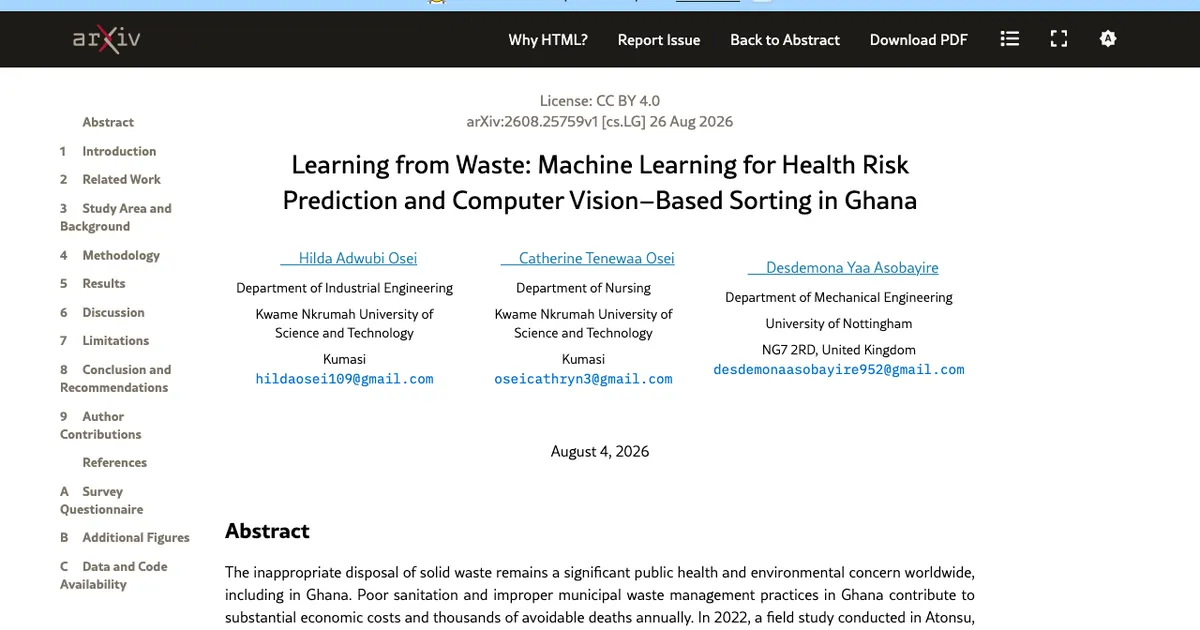
Learning from waste: Machine Learning for health risk prediction and computer vision-based sorting in Ghana

By Hilda Adwubi Osei, Catherine Tenewaa Osei, Desdemona Yaa Asobayire • arXiv • Importance: 80/100
Hero Image for 2608.25759

Trash to Treasure: How AI is Powering a Healthier Future in Ghana 🇬🇭🗑️🌿

Have you ever wondered how much of our waste actually impacts our health? Globally, improper waste disposal is a ticking time bomb—an environmental and public health crisis that costs billions. But what if the answer was right there, in the bins on your street?

Our latest research dives deep into this challenge, presenting a two-part AI solution designed specifically for resource-constrained settings like Ghana. This isn’t just theory; it’s a practical roadmap for making communities cleaner and healthier using cutting-edge machine learning.

🌍 Predicting Health from Trash: The ML Approach

The first hurdle we tackled was quantifying the link between waste disposal and illness. Previous studies in places like Kumasi, Ghana, had suggested this connection but lacked hard quantitative data. Our team built a Random Forest classifier to analyze local demographic survey data alongside residential waste practices.

The Findings? We found strong evidence that how households dispose of their trash is indeed a critical predictor of certain illness types, providing the hard scientific backing previously missing! This validates community wisdom with data science.

📸 Seeing Garbage: Computer Vision for Sustainable Sorting

The second crucial component is making waste management scalable. We deployed a MobileNetV2 image classification model—a highly efficient vision architecture—to automate garbage sorting using nothing more than an affordable camera setup.

The Results? The system achieved impressive accuracy (88.2%) in classifying different types of waste on-site, offering a cost-effective alternative to massive, complex industrial sorting machinery.

💡 Beyond the Code: Implementation is Key

While our AI models perform robustly, the most vital takeaway—and what we want researchers and policymakers to grasp—is this: Technology alone doesn’t equal public health success. The effectiveness of even the best ML solution hinges on institutional support, community engagement, and effective policy implementation. Technology is a tool; human systems must drive the change.

➡️ Want to read the full technical details and see how we integrated these models? Check out the paper here: https://arxiv.org/abs/2608.25759

This research showcases the power of data science for impactful, local development in Ghana.

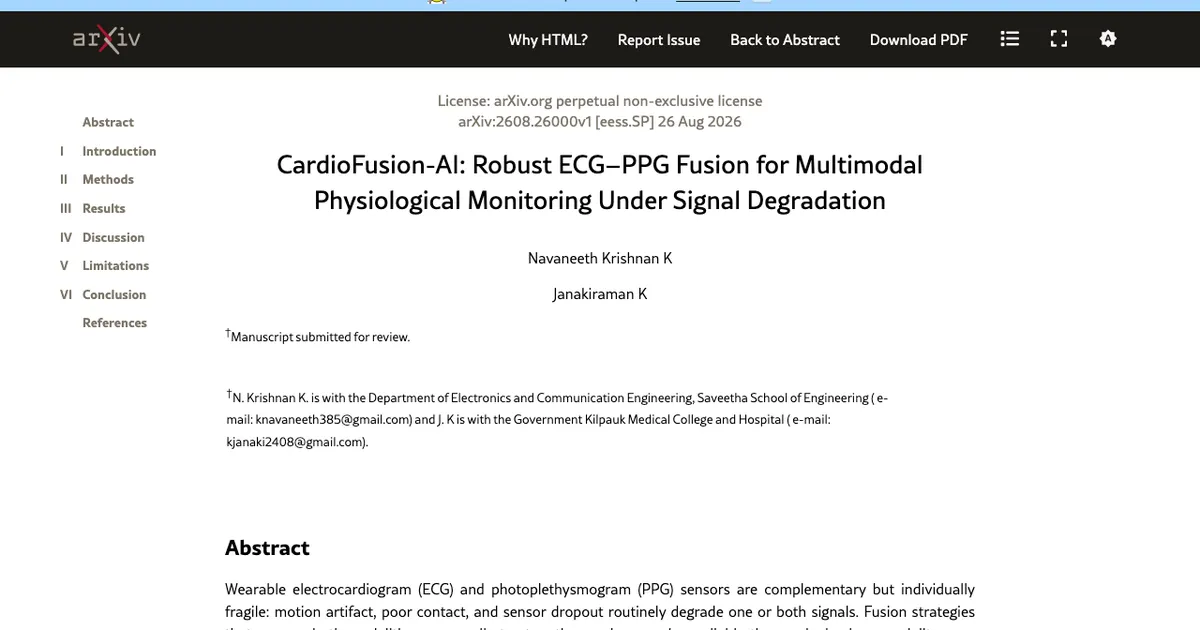
CardioFusion-AI: Robust ECG--PPG Fusion for Multimodal Physiological Monitoring Under Signal Degradation

By Navaneetha Krishnan Kamalakannan, Janakiraman Kamalakannan • arXiv • Importance: 78/100
Hero Image for 2608.26000

❤️ Fusioning the Future of Wearable Health: How CardioFusion-AI Tackles Signal Dropouts

(A Deep Dive for ML Engineers & Biomedical Tech Enthusiasts)

Are you building next-generation wearables? You know the problem: ECG and PPG sensors are golden, but they’re fragile. A slight twist of the wrist, an electrode shift, or motion artifact can turn clean data into noise. Traditional fusion methods often assume all signals are good to go—and when one fails, the whole system tanks.

That’s exactly what the researchers behind CardioFusion-AI set out to solve. This isn’t just another signal processing improvement; it’s a fundamental rethink of how AI monitors our vital signs when things go wrong.

💡 What is CardioFusion-AI?

This novel framework doesn’t treat all input signals equally. It acts like an intelligent referee, first assessing the quality of both the ECG and PPG inputs using advanced metrics (like a specialized signal-quality index). This awareness means that when one sensor struggles—say, due to poor skin contact—the system intelligently reallocates trust and weight toward the reliable data source.

The core breakthrough: The study proves that simply having an available modality is different from having a high-quality modality. CardioFusion-AI designs its fusion logic around this distinction.

🔬 Key Takeaways for Researchers & Developers

Based on their rigorous testing (including working with intensive care recordings and fetal ECG data), the authors demonstrated several critical insights:

  1. Adaptive Weighting is Smart: Under complete signal loss, adaptive gating weights correctly reallocated trust to the remaining healthy modality.
  2. Quality Matters More: For partially degraded signals, the system’s ability to account for quality significantly improved performance—approaching near-unimodal best-case scenarios (e.g., improving missing-PPG conditions by 1.56 bpm).
  3. Holistic Signal Processing: The framework integrates multiple sophisticated signal front ends, including precise R-peak and systolic-peak detection and advanced beat-by-beat pulse transit time estimation.

✨ Why Should You Care?

For those building diagnostic AI tools (think remote patient monitoring, ICU IoT, or next-gen wearables):

  • Robustness: This architecture delivers state-of-the-art performance even when real-world data is messy and imperfect.
  • Real-World Validation: Tested on challenging clinical datasets (intensive care settings), proving its viability outside of clean lab environments.

This research marks a critical step towards truly reliable, always-on physiological monitoring that doesn’t fail when the patient moves or the sensor slips.

🔗 Read the full paper and methodology here: https://arxiv.org/abs/2608.26000


#MachineLearning #WearableTech #DigitalHealth #SignalProcessing #MLResearch

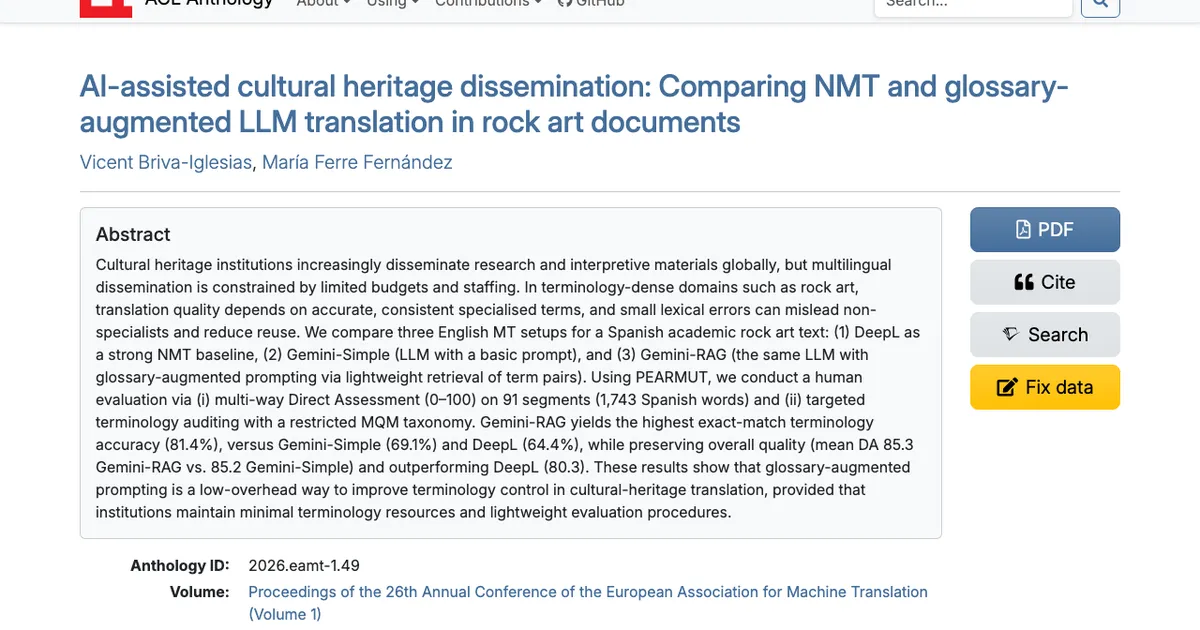
AI-assisted cultural heritage dissemination: Comparing NMT and glossary-augmented LLM translation in rock art documents

By Vicent Briva-Iglesias and María Ferre Fernández in Proceedings of the 26th Annual Conference of the European Association for Machine Translation (Volume 1) • ACL Anthology • Importance: 78/100
Hero Image for acl_2026.eamt-1.49

🎨 Bringing Ancient Whispers to a Global Audience: Boosting Accuracy in Cultural Heritage Translation

As AI-powered translation services become indispensable for global communication, cultural institutions are facing a unique challenge: how do they make ancient, specialized knowledge accessible worldwide without compromising the historical accuracy of every single term?

We tackle this problem by comparing advanced machine translation setups—from standard Neural Machine Translation (NMT) to state-of-the-art Retrieval-Augmented LLMs (RAG). Our focus is on ‘rock art,’ a domain dripping with complex, specialized terminology that can’t be left to chance.

🧠 The Problem: Why Does Language Matter So Much in Anthropology?

The documentation of archaeological sites like rock art involves highly technical jargon. When you translate a text about these findings (say, from Spanish to English), simple machine translation often struggles with consistent terminology. A single lexical error—misinterpreting a key cultural term or artifact name—can mislead non-specialists and diminish the reliability and usability of the research globally.

🏆 Our Deep Dive: NMT vs. Glossary-Augmented LLMs

In this study, we evaluated three setups using an academic Spanish rock art document:

  1. DeepL (NMT Baseline): A powerful commercial off-the-shelf service.
  2. Gemini-Simple (Basic Prompting LLM): Using a foundational large language model with minimal guidance.
  3. Gemini-RAG (Glossary-Augmented LLM): Leveraging the same LLM but critically injecting controlled, specialized terminology via a lightweight retrieval mechanism (RAG).

The goal was clear: determine which method best maintained both overall fluency and absolute terminological accuracy.

The Results Speak for Themselves 🗣️

Our human evaluation revealed a significant advantage to the RAG approach. Gemini-RAG achieved an outstanding 81.4% exact-match terminology accuracy. This significantly outperformed Gemini-Simple (69.1%) and, critically, surpassed DeepL’s performance on specialized terms (DeepL: 64.4%).

While all three methods maintained comparable overall quality scores, the RAG approach delivered superior terminological control—a non-negotiable requirement when dealing with academic cultural heritage materials.

Key Takeaway for Museums & Academia: While standard LLMs are powerful, simply prompting them isn’t enough. For domains requiring absolute terminological precision (like specialized anthropology or medicine), coupling an LLM with a curated glossary database is the low-overhead solution that dramatically improves consistency and accuracy.

🔗 Want to dive into the full methodology? Check out the paper here: https://aclanthology.org/2026.eamt-1.49/

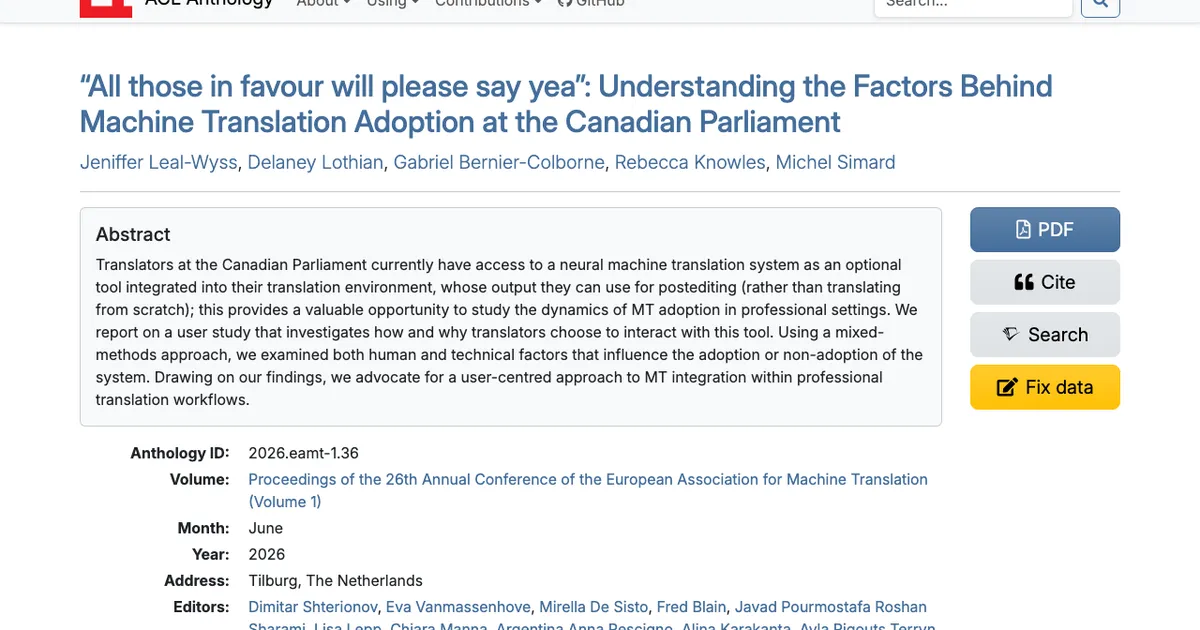
“All those in favour will please say yea”: Understanding the Factors Behind Machine Translation Adoption at the Canadian Parliament

By Jeniffer Leal-Wyss, Delaney Lothian, Gabriel Bernier-Colborne, Rebecca Knowles and Michel Simard in Proceedings of the 26th Annual Conference of the European Association for Machine Translation (Volume 1) • ACL Anthology • Importance: 75/100
Hero Image for acl_2026.eamt-1.36

💡 Decoding Adoption: How AI Translators Win Hearts (and Words) at Parliament

Ever wondered if adopting a powerful new tool like Neural Machine Translation (NMT) is simple? Spoiler alert: it’s not. Even when the tech is available, human workflows, skepticism, and institutional factors play huge roles.

This fascinating study takes us deep inside the halls of the Canadian Parliament—a perfect real-world lab for observing how professional translators actually interact with cutting-edge AI.

🌍 The Core Problem: Tech Availability ≠ Usage

Researchers from leading translation studies fields looked at a specific scenario: Professional translators had access to an optional NMT tool. Instead of translating every word from scratch, they could use the system’s output for ‘post-editing.’ This is the sweet spot where AI assistance meets expert human judgment.

The fundamental question was: Why do some translators use it, and others don’t?

Using a powerful mixed-methods approach—combining qualitative insights (interviews, observations) with technical analysis—the team didn’t just look at the machine; they looked at the human process.

🧠 What Did They Find? The Human Factors

The findings are invaluable for anyone building AI tools: it’s not enough to just create a technically accurate model. The success of Machine Translation adoption hinges on understanding the user experience and the professional workflow itself.

Key factors influencing adoption include: * User Comfort: How easily does the tool integrate into existing, complex translation routines? * Trust & Quality Perception: Is the output reliable enough to save significant time without introducing major errors? The perceived quality is often more important than the raw model score. * Workflow Friction: If using the AI adds complexity or disrupts the natural flow of work, it will likely be ignored, regardless of its potential.

🛠️ Key Takeaway for Developers & Linguists

This study strongly advocates for a ‘user-centered approach’ to MT integration. For developers building enterprise translation tools (whether in law, medicine, or government), the lesson is clear: the technology must adapt to the human professional, not vice versa. Integration needs to feel seamless and intuitive.

If you are fascinated by NLP, HCI (Human-Computer Interaction), or how AI impacts skilled professions, this paper offers a goldmine of insights.

🔗 Dive deeper into the methodology and findings at the conference proceeding: https://aclanthology.org/2026.eamt-1.36/


#MachineTranslation #NLP #AIIntegration #Linguistics #TechAdoption #HumanComputerInteraction

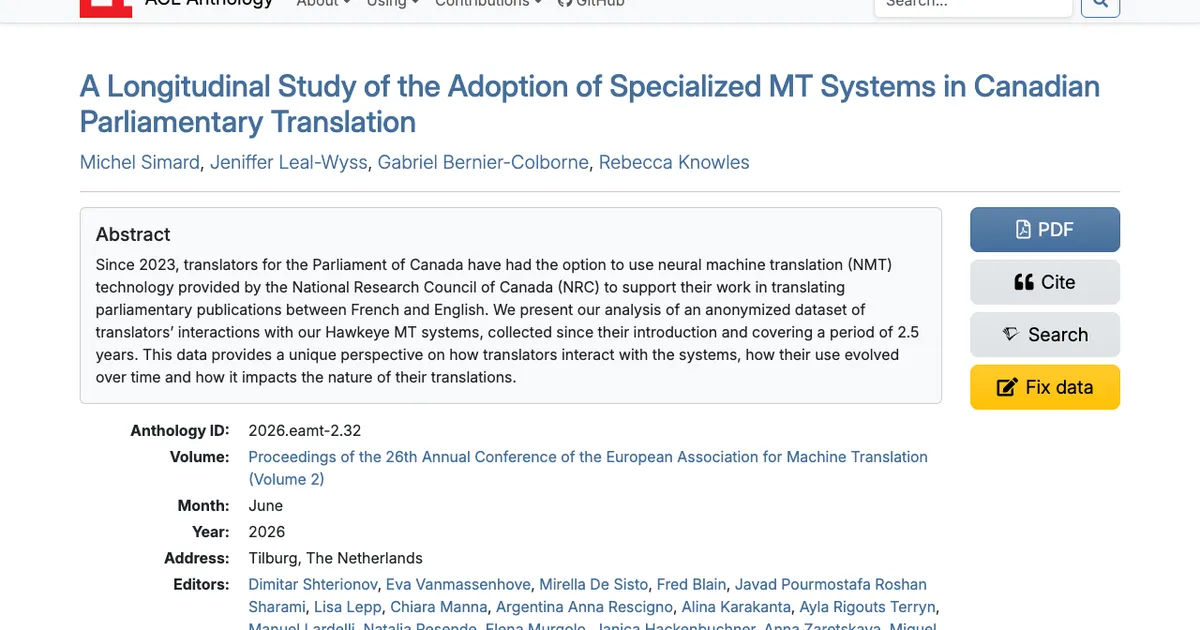
A Longitudinal Study of the Adoption of Specialized MT Systems in Canadian Parliamentary Translation

By Michel Simard, Jeniffer Leal-Wyss, Gabriel Bernier-Colborne and Rebecca Knowles in Proceedings of the 26th Annual Conference of the European Association for Machine Translation (Volume 2) • ACL Anthology • Importance: 75/100
Hero Image for acl_2026.eamt-2.32

🇨🇦 Translating Canadian Politics: How AI is Reshaping Parliament’s Language

As artificial intelligence infiltrates every corner of our professional lives, nowhere is this impact more visible—or perhaps more critical—than in the highest levels of government. Our latest research dives deep into a unique real-world scenario: how professional human translators working for the Canadian Parliament have adopted specialized Machine Translation (MT) systems.

For over two and a half years, we’ve been tracking an anonymized dataset detailing every interaction between expert human translators and the National Research Council of Canada’s state-of-the-art ‘Hawkeye MT’ system. This isn’t just a simple usage log; it’s a longitudinal study that provides unprecedented visibility into the human-AI workflow.

💡 What We Found: The Evolution of Trust

The initial rollout phase often involves novelty and experimentation. Early adopters might treat the MT system as a sophisticated lookup tool or even a starting point for heavy editing. But as they become more familiar, their interactions evolve. Our analysis maps this critical ‘learning curve,’ revealing how translators gradually integrate AI support into their professional routines.

Crucially, we observed shifts in translation nature. The patterns of reliance change over time—moving from correcting basic errors to optimizing stylistic nuance or handling specialized parliamentary jargon. This shift suggests that the tool moves beyond mere efficiency gain and starts becoming an integrated part of the professional identity.

📊 Key Takeaways for Tech & Government

This study offers profound insights for other governmental bodies and highly regulated industries globally, proving that machine learning isn’t a disruptive force in a vacuum. Instead, it’s a collaborative partner whose impact must be measured over time and across the user base.

  1. The Adaptive Professional: Human expertise doesn’t diminish; it evolves. Translators don’t just use AI; they develop sophisticated workflows around it.
  2. Beyond Accuracy Metrics: Measuring successful adoption requires longitudinal data, not just immediate performance scores. The journey of trust is the key metric.
  3. Global Policy Implications: Governments adopting NMT systems must anticipate and monitor the long-term behavioral changes in their workforce to maximize benefits while mitigating potential over-reliance or skill atrophy.

Want to read the full findings on the complex interplay between human expertise and specialized AI? Check out the complete paper here: https://aclanthology.org/2026.eamt-2.32/

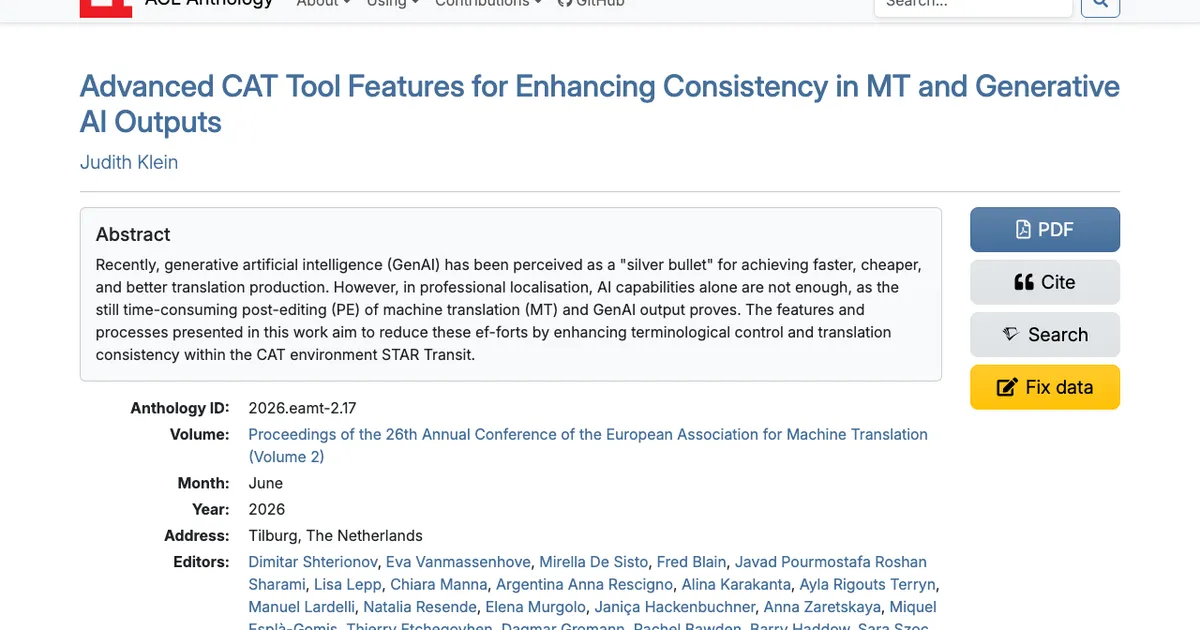
Advanced CAT Tool Features for Enhancing Consistency in MT and Generative AI Outputs

By Judith Klein in Proceedings of the 26th Annual Conference of the European Association for Machine Translation (Volume 2) • ACL Anthology • Importance: 70/100
Hero Image for acl_2026.eamt-2.17

🚀 Stop Guessing: How Advanced CAT Tools Are Making AI Translation Truly Production-Ready

The generative AI boom has convinced many that machine translation (MT) and AI output are the magical ‘silver bullet’ for global content creation. While these tools dramatically speed things up, industry professionals know the harsh truth: raw AI output often requires intensive, time-consuming Post-Editing (PE) to ensure consistency, terminological accuracy, and legal compliance.

That inconsistency is where the headache begins. If a specialized term (‘widget’ vs ‘gadget’) changes randomly throughout a document, or if industry jargon isn’t consistently applied across different segments, the client risks losing credibility—and time!

This paper introduces critical enhancements for Computer-Assisted Translation (CAT) tools, focusing on elevating terminological control and guaranteeing translation consistency within the STAR Transit environment. It tackles one of the biggest bottlenecks in professional localization: achieving predictable quality at scale.

🧩 What Does This Mean For Localization Teams?

In plain terms? Better CAT tools mean less hand-holding from expert linguists, fewer review cycles, and faster delivery without sacrificing quality. These enhancements are not about replacing human expertise; they are about augmenting it. They wrap the raw power of GenAI with the structural integrity and consistency rules that only professional localization environments can provide.

Key Takeaways You Need to Know: * ✅ Enhanced Terminological Control: The tool ensures key industry terms are translated correctly every single time, regardless of the source text’s randomness. No more variations in critical product names! * ⏱️ Reduced Post-Editing Effort: By embedding higher levels of consistency checks directly into the workflow, human reviewers spend less time fixing basic errors and more time focusing on nuances, tone, and cultural appropriateness. * 🌐 Seamless Integration: The advancements are designed to fit seamlessly within existing CAT workflows, making adoption efficient for established localization agencies.

The Bottom Line: For global businesses relying on multi-language content—be it technical manuals, marketing sites, or legal documentation—consistency is the currency of trust. By solidifying terminological control at the tool level, these advanced CAT features bridge the gap between raw AI power and professional, enterprise-grade localization reliability.

Read the full technical details here: Advanced CAT Tool Features for Enhancing Consistency in MT and Generative AI Outputs


#Localization #MachineTranslation #CATTools #GenerativeAI #TranslatTech

Explore Recent Digests