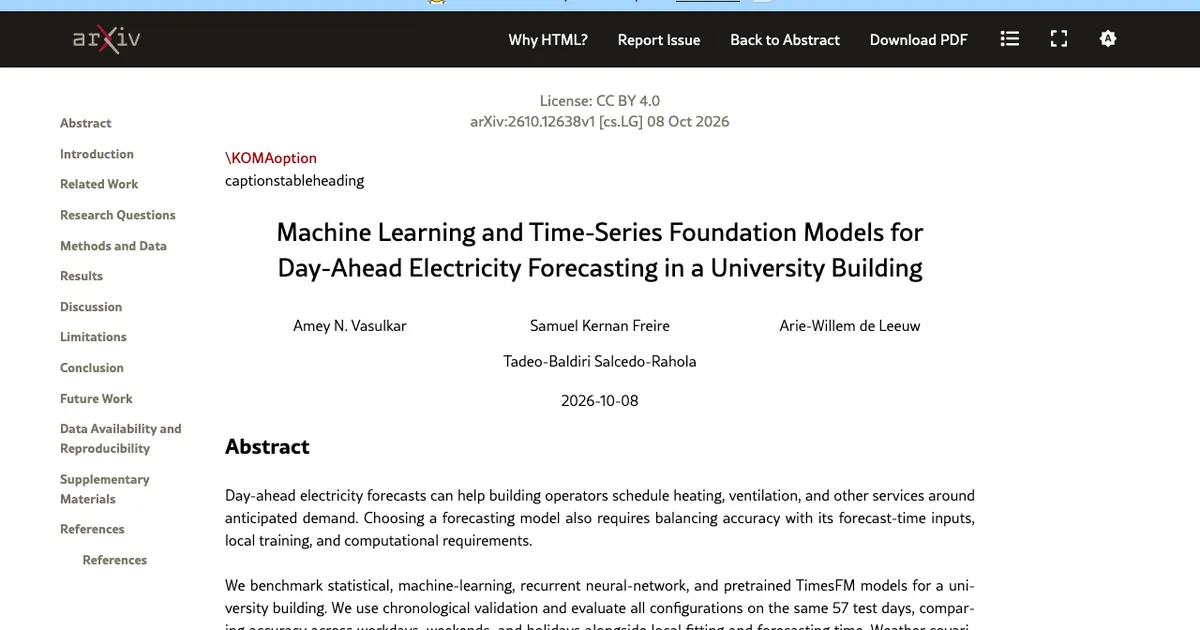
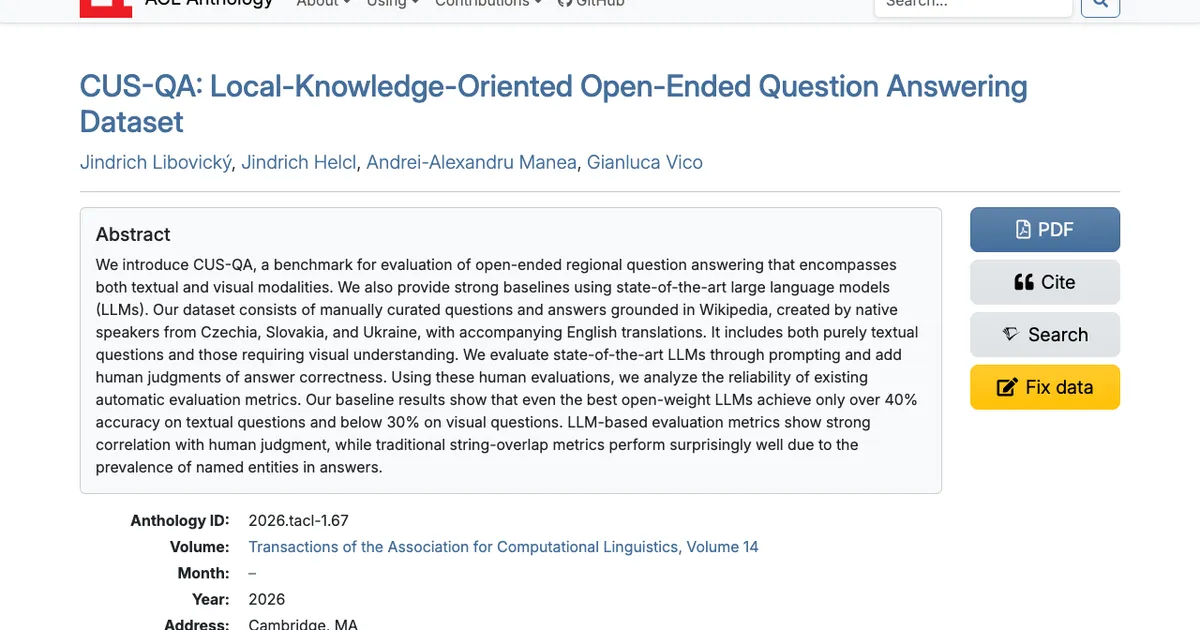
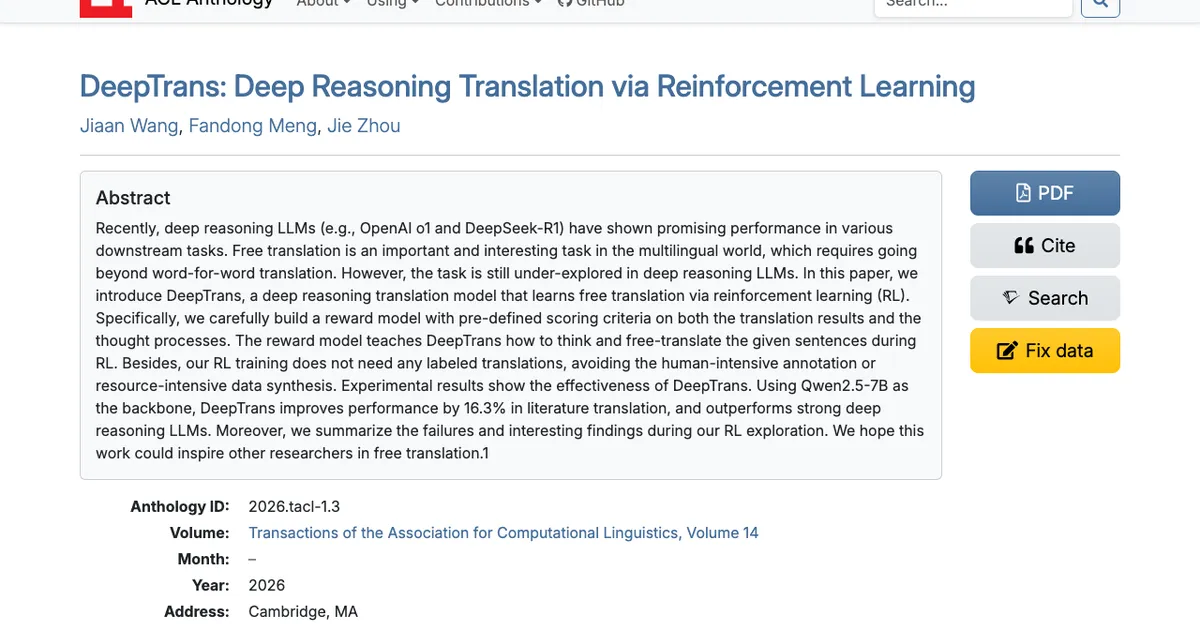
By Xiaoyu Li, Zhizhou Sha, Chiwun Yang, Dai Shi • arXiv • Importance: 95/100
The Geometry of Fine-Tuning: Mapping the Landscape of PEFT
The landscape of Parameter-Efficient Fine-Tuning (PEFT) is exploding. With dozens—maybe hundreds—of new methods being published each month, how do you compare them? Is LoRA better than Adapter Fusion? Does QLoRA always outperform standard fine-tuning on specific tasks?
Traditional comparisons are messy: they list parameters used and benchmark scores. But this paper proposes a radically different perspective: treating PEFT as a geometric classification problem.
Authors Xiaoyu Li et al., in their comprehensive work A Categorical Atlas of Parameter-Efficient Fine-Tuning: Cones, Orbits, and Gauges, stop treating these methods as isolated scripts. Instead, they map them into a mathematical structure—a ‘slice category’ in weight space. This approach provides deep, invariant insights that mere empirical comparison can never reach.
What makes this paper revolutionary?
Instead of comparing performance, the authors compare mathematical principles and trajectories within the model’s weights. They introduce concepts like ‘cones,’ ‘orbits,’ and ‘gauges’ to describe how a base pre-trained checkpoint evolves into a fully fine-tuned model.
Here are three key takeaways that redefine how we think about LLM adaptation:
1. Trajectories, Not Just Endpoints (The Path Matters):
The paper focuses heavily on the dynamics of training—how the weights change over time. By analyzing these weight-space ‘maps,’ they reveal fundamental truths about methods like LoRA (Low-Rank Adaptation).
For example, they prove that specific initializations for LoRA start precisely at the ‘apex’ of a cone and detailing how its updates are mathematically constrained. They also show that under standard optimizers (like Adam), combining certain settings doesn’t just yield slightly different results; it constrains the weight changes to specific, predictable mathematical groups.
2. Uncovering Deep Mathematical Constraints:
The authors make stunningly rigorous claims about what is possible in model adaptation:
* Orthogonality Matters: They prove that exactly orthogonal methods inherently preserve certain singular values, even when merged—a massive insight into weight stability.
* Predictable Scaling: Using Adam optimization with shared hyperparameters, they show that LoRA+ effectively follows a scaled trajectory of standard LoRA, providing concrete mathematical evidence for the scaling factors used in training setups.
* The Role of Activations: They establish that even seemingly simple choices like activation functions determine when an adapter layer mathematically ‘folds’ into preceding weights—a deep coupling between model architecture and optimization.
3. A Definitive Library (Classification at Scale):
The core impact is the monumental effort: they classify a staggering 382 methods from 138 papers using seven specific mathematical coordinates derived directly from the formulas. This isn’t just review; it’s building a unified, verifiable taxonomy for all PEFT methods discovered so far.
Why does this matter for AI engineers?
This research moves us beyond the ‘cookbook’ mentality of LLMs. If you are designing a novel finetuning technique or trying to understand why two state-of-the-art methods yield different results, this paper provides the mathematical tools to reason about why those differences exist—whether it’s due to initialization choices, optimization schedules, or architectural constraints.
It is essential reading for anyone serious about the theory and architecture of modern foundation models. It’s a paradigm shift from empirical comparison to geometric analysis.
By Yibo Huang, Yi Cui, Yukai Huang, Huaping Zhou, Jiancong Tong, Zhaoyu Wu, Gen Miao, Haoran Wei, Boyan Ding, Zhuo Jiang, Jianxi Ye, Yibo Zhu, Chuanxiong Guo, Yang Xu, Jie Wu • arXiv • Importance: 92/100
Beyond TCP: How ByteExpress is Revolutionizing ML Infrastructure with RDMA
In the world of massive-scale AI—where LLMs run 24/7 and training pipelines are petabytes in scope—communication overhead isn’t just a bottleneck; it’s often the single biggest constraint on performance. Traditional networking stack solutions, like standard TCP, simply weren’t built for the bursty, high-throughput, low-latency demands of modern machine learning workloads.
This paper introduces ByteExpress, an innovative software communication layer built atop hardware Remote Direct Memory Access (RDMA). Rather than just swapping out a protocol, ByteExpress tackles the systemic challenges of production deployment: variable message sizes, concurrent connections, and the necessity of robust service recovery.
💡 What Problem Does It Solve?
The authors’ work reports real-world lessons learned from deploying ByteExpress within ByteDance’s own large-scale parameter-server systems. They found that simply enabling RDMA wasn’t enough; handling complex production realities—like buffer management across multiple layers and coordinating resource usage across many connections—was critical.
Key Insights from the Deployment:
* Buffer Management: Efficient RDMA needs careful allocation strategies spanning both the application logic and the transport layer.
* Scalability: Robust communication requires harmonizing connection state, receive capacity, and tracking outstanding data meticulously.
* Reliability: True service availability demands recovery mechanisms implemented above the basic network transport level.
🚀 The Technical Edge: ByteExpress Features
ByteExpress is not just a wrapper; it’s a complete stack optimization. It brings together several advanced features to maximize hardware potential while ensuring production-grade reliability:
RDMA-Aware Allocator: Optimizes memory handling specifically for high-speed, low-level networking.
Zero-Copy Transfers: Minimizes CPU cycles and data movement by transferring data directly between application memory and the network adapter.
QP Multiplexing: Efficiently manages multiple Quality of Service (QoS) streams over a single connection path.
Receive-Credit Flow Control & Software Send Window: Advanced mechanisms that prevent bottlenecks from being caused by mismanaged flow state or resource exhaustion.
RPC-Assisted Recovery: Crucially, it provides the necessary resilience to handle failures gracefully without halting the entire system.
📊 Real-World Impact (The Numbers Don’t Lie)
The results prove that this architectural overhaul delivers massive gains in both speed and efficiency:
Inference Acceleration: For parameter fetching in production inference, ByteExpress reduced mean model parameter latency by 35.7%, and P99 latency by an impressive 43.7%, all while lowering overall CPU usage by 10.69% compared to standard kernel TCP.
Training Optimization: In training workloads, it achieved up to a 74.0% reduction in P99 model parameter push latency compared to TCP, with zero observed PFC pauses—a critical sign of smooth high-throughput operation.
This work serves as a blueprint for modern infrastructure teams looking to squeeze maximum performance out of their massive distributed ML systems. For researchers and engineers focused on optimizing data center performance, this paper is mandatory reading: Deploying RDMA for Large-Scale Inference and Training Workloads.
Stay optimized, scale fast.
*(Disclaimer: This digest summarizes the key findings of the presented paper.)
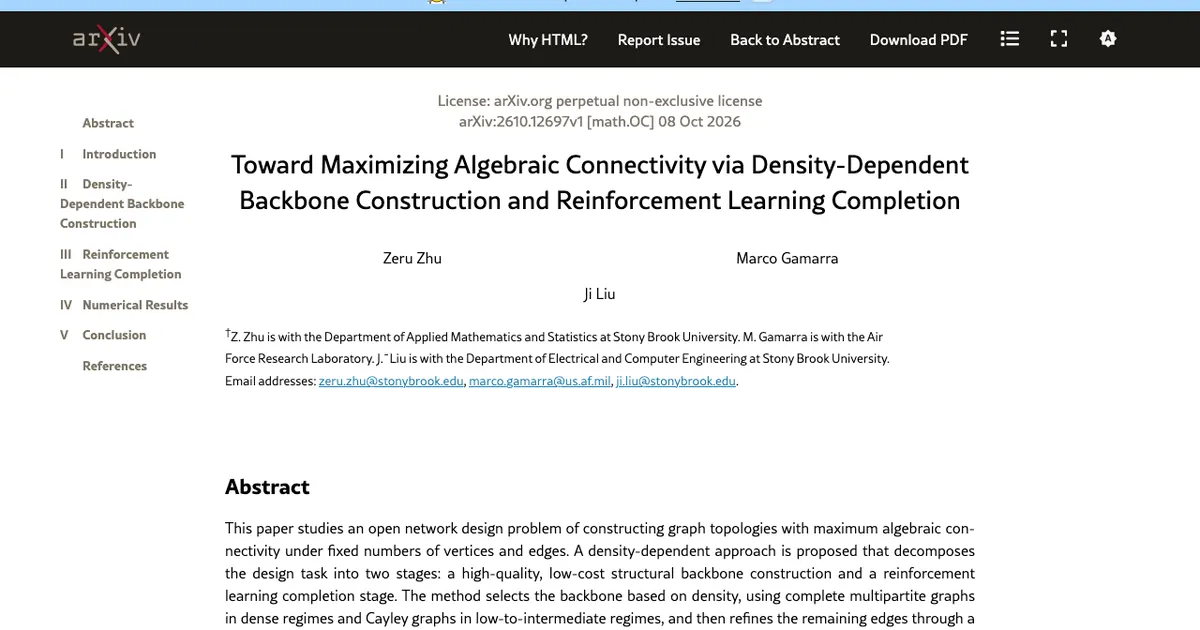
By S. Ares de Parga, A. Cornejo, J. A. Hernández, R. Rossi • arXiv • Importance: 92/100
From Simulation to Solution: How New AI Nerves Are Revolutionizing Solid Mechanics
The world of advanced engineering and material science often grapples with a tricky challenge: simulating complex materials. When structures bend, stretch, or crack—like in specialized alloys or composites—they don’t follow simple rules. The resulting mechanical response is ‘anisotropic hyperelastic,’ meaning the material properties change drastically depending on the direction of applied force.
Traditional simulations (FEA) are computationally brutal for these complex scenarios, especially when dealing with Representative Volume Elements (RVEs). They demand immense processing power and often fail to accurately predict behavior far outside the training data’s bounds. This limitation is a major bottleneck in fields like aerospace design and biomedical implants.
The Breakthrough: Physics-Informed Neural Networks Get a Major Upgrade.
Researchers at https://arxiv.org/abs/2610.12801 introduced a powerful new architecture: Polyconvex Physics-Augmented Neural Networks (PANNs). These networks don’t just learn from data; they are designed with the laws of physics baked into their mathematical structure.
How Does This Work? The ‘Physics Guarantee’.
The key innovation lies in the polyconvex energy formulation and specialized components like Input-Convex Neural Networks (ICNNs). These structures ensure that the learned model adheres to fundamental physical requirements—such as objectivity, non-negative energy, and mechanical consistency—by construction. Think of it as giving the AI a foundational textbook of physics it cannot violate.
The Results Speak Volumes (And Guarantee Performance)
When tested on complex geometries, these constrained PANNs significantly outperform unconstrained models in critical ways:
High Accuracy & Efficiency: The approach drastically lowers stress errors compared to standard methods, requiring only a small number of learned features for high performance.
Guaranteed Extrapolation: Most importantly, the traditional (unconstrained) neural networks start failing dramatically beyond their training data (e.g., losing convexity or predicting physically impossible forces). The new constrained PANNs maintain remarkable accuracy and physical validity even under extreme conditions (like confined compression), securing reliable predictions in real-world scenarios where failure is not an option.
The takeaway? By integrating rigorous mathematical guarantees of physics into the AI model, engineers can move from simply approximating data to creating certified, trustworthy predictors for advanced material behavior. This is a huge step toward enabling safer, lighter, and more complex industrial designs.
By Mustafa S. Aljumaily, Ali Ataeemh Allami, Mustafa N. Mnati, Nawar S. Alseelawi, Shahab Abdulla • arXiv • Importance: 92/100
🔒 Beyond the Firewall: How We Built Private AI for Critical Oilfield Networks
(By our ML Research Team)
The energy sector—specifically oilfield operations—relies on massive amounts of data streamed from remote, industrial IoT devices. These networks are critical infrastructure, making them prime targets for sophisticated cyberattacks. Traditional intrusion detection systems (IDS) struggle when they have to balance three conflicting demands: privacy, security, and robustness.
If you try to keep the network traffic private, malicious actors can inject poisons into your shared model. If you make the aggregation robust, you risk exposing sensitive local data or revealing structural weaknesses.
This is a fundamental paradox in decentralized ML for critical infrastructure. Our latest work tackles this head-on by introducing PVBRF-ID—a novel, two-server federated intrusion detection framework designed specifically for harsh, private environments like oilfields and industrial complexes.
💡 The Problem: Privacy vs. Poisoning in Decentralized AI
The goal of Federated Learning (FL) is revolutionary: it allows multiple sites to collaboratively train a single, powerful global model without ever pooling their raw data. For an energy company with dispersed oilfield assets, this means compliance and maintaining local operational secrecy—you keep the data where it belongs.
However, when we try to make FL robust against bad actors (i.e., Byzantine attacks/data poisoning), existing methods force us into a dilemma:
Robust Checks: They require viewing every site’s update in plaintext to detect anomalies.
Secure Aggregation: Methods designed for privacy hide the updates, making it impossible to perform robust anomaly checks.
PVBRF-ID resolves this by bringing verifiable security and trust into the heart of the aggregation process.
🔬 What is PVBRF-ID? The Triple Threat Solution
We introduced Privacy (P), Verifiability (V), and Byzantine Robustness (B).
At its core, PVBRF-ID employs a sophisticated two-server protocol built on cutting-edge cryptographic techniques:
Secret Sharing: Site updates are secret-shared, meaning no single server or attacker sees the raw data point, preserving local privacy.
Joint Auditing: The two servers jointly test each update’s ‘norm’ and its cosine similarity against a reference derived from a small, clean root set. This reveals a verifiable acceptance bit for every contributing site.
Cryptographic Guarantees: By incorporating Commitments, Merkle Roots, and a Homomorphic Audit function, we make the entire process of accepting updates publicly verifiable. Anyone can audit whether an update was properly checked without compromising privacy.
💪 State-of-the-Art Performance in Simulation
The theory is matched by the results. Tested on a complex 15-class Edge-IIoTset task simulating diverse oilfield data, PVBRF-ID demonstrated exceptional resilience:
Clean Data: It nearly matched standard FedAvg performance (macro-F1 $\approx$ 0.708).
Sign-Flip Attacks: When subjected to malicious sign-flip attacks, PVBRF-ID achieved an accuracy of 0.696, dramatically outperforming vanilla FedAvg (which dropped to $0.091$).
Advanced Poisoning: Against a sophisticated attacker controlling 30% of the sites, PVBRF-ID maintained high performance ($ extbf{0.641}$), while standard FedAvg plummeted ($0.046$), proving its superior defense capabilities.
Furthermore, we demonstrated that even an update-inference attacker could not recover each site’s local data mix from just one server’s view—a key security win.
The takeaway is clear: In mission-critical environments like oil and gas, you cannot afford to sacrifice robust security for the sake of privacy in your AI models. PVBRF-ID provides the missing link.
By Vincent Pauline, Kirill Tamogashev, Arran Carter, Sanghyeok Choi, Stefan Bauer, Esmeralda S. Whitammer • arXiv • Importance: 92/100
Amortizing Inference: One-Step Sampling Breakthrough for Bayesian Models
The biggest bottleneck in modern AI is often not the model training itself, but the process of actually sampling from complex probability distributions. When we use Bayesian deep learning, we need to characterize uncertainty by sampling from a posterior distribution—but these spaces are incredibly high-dimensional and notoriously hard to navigate.
Traditionally, accurate sampling requires multiple steps: thinking of things like running many Markov Chain Monte Carlo (MCMC) iterations or employing multi-step diffusion processes. These methods are computationally expensive and slow, severely limiting the real-time deployment of advanced AI features.
The Challenge of High-Dimensional Sampling
Sampling from a true posterior distribution $p( heta|D)$ is theoretically sound but practically challenging. Most existing solutions rely on amortized sampling (meaning the sampler parameters are predicted by a neural network) and often require multiple time steps to reach convergence, making them slow for real-world applications.
Introducing OSIS: One-Step Implicit Sampling
Our research tackles this bottleneck head-on. We introduce One-Step Implicit Sampler (OSIS), a novel framework that achieves high-fidelity sampling from complex Bayesian posteriors in a single computational step.
OSIS leverages short-time MCMC dynamics within the context of data-driven generative modeling. By defining a local target for the evolution of an implicitly modeled distribution, OSIS ensures that the model converges to a fixed point—the desired target distribution—in the asymptotic limit.
Crucially, we analyzed its convergence properties and demonstrated that it maintains mathematical connections with established generative techniques while achieving superior practical performance.
Why Does This Matter? 🚀
The core breakthrough of OSIS is efficiency. Compared to multi-step amortized samplers (like those used in some diffusion models), OSIS is significantly faster at sampling time, without sacrificing accuracy when compared against non-amortized MCMC baselines.
This dramatically accelerates the deployment of uncertainty quantification methods. Imagine advanced ML systems—such as medical diagnostic AI or complex financial modeling—that can rapidly and accurately provide not just a prediction, but a full measure of their confidence interval, enabling truly reliable decision-making.
By Zhenglin Wan, Jiayu Chen, Zhengfeiyang Zhang, Pengfei Zhou, Wangbo Zhao, Fangyuan Kong, Pengfei Wan, Kun Gai, Yang You • arXiv • Importance: 92/100
✨ Mastering AI Art: A Game-Changing Update for Diffusion Models
Have you ever wondered how to take a great AI art model and make it perfect? The biggest hurdle in image and video generation is fine-tuning these massive diffusion models—specifically, making them stable enough to accept external feedback (rewards) without losing coherence. Traditional methods are either wildly inefficient or incredibly unstable.
This groundbreaking new research introduces DiffusionART (Diffusion Reinforcement with Aggregation-First Reward Tilting), a novel framework designed to turbocharge the fine-tuning process of generative AI. It tackles some of the biggest stability and efficiency roadblocks facing state-of-the-art AI content creation.
⚙️ The Problem: Fine-Tuning Diffusion Models is Hard
Diffusion models are amazing, but optimizing them with external goals (like ‘make this picture look more photorealistic’ or ‘improve motion fluidity’) using Reinforcement Learning (RL) has historically been a nightmare. Existing methods fall into two main traps:
Reverse-Process Methods (e.g., Flow-GRPO): These are resource hogs, suffering from poor credit assignment—meaning they struggle to figure out which part of the generated image was responsible for the reward.
Forward-Process Methods (e.g., DiffusionNFT): While efficient, they are notoriously delicate. They require extremely careful tuning (like complex EMA off-policy training) and can be highly unstable without constant adjustments.
Simply put: making a diffuser reliable, stable, and trainable with external feedback has been the holy grail of generative AI research.
🚀 Introducing DiffusionART: Stability Meets Scale
DiffusionART fundamentally rethinks how reward signals are applied. Instead of relying on complex stability mechanisms or struggling with credit assignment, it introduces two genius architectural improvements:
Aggregation-First Reward Tilting: DiffusionART aggregates the rewards from all prompts into a single, shared ‘reward direction’ for the reverse process state. This elegantly sidesteps the problematic ‘consistency force’ that plagues existing models.
Trust-Region Masked Update: It adds an adaptive second update step that stabilizes training without needing complex EMA tuning or large off-policy rollouts.
The result? A system that is simpler, more robust, and significantly more efficient.
🏆 Why This Matters (and the Numbers Don’t Lie)
Testing on state-of-the-art video generation models like HunyuanVideo-13B, DiffusionART proves its might:
Time Savings: It reaches equivalent mean reward levels as established methods (DiffusionNFT and Flow-GRPO-Fast) using 12x to 11.72x fewer GPU hours. This translates directly to massive reductions in compute cost for researchers.
Performance Gains: It achieves dramatically higher mean training rewards, demonstrating superior learning capability.
Moreover, the framework requires no differentiable reward model and can handle pairwise reward models (DiffusionART-Pairwise), making it highly versatile for diverse applications across both image and video generation.
For advanced researchers and developers looking to deploy commercially stable generative AI systems, DiffusionART represents a major leap forward in operationalizing creative intelligence.
By Joshua Maccoby, Wendy Hui Wang • arXiv • Importance: 90/100
🧠 Debugging AI Memory: Introducing REDaCT for Collapse-Free Unlearning
The privacy and control capabilities of Large Reasoning Models (LRMs) are constantly growing. But what happens when you need to forget specific information?
In the world of generative AI, forgetting is notoriously difficult. Current unlearning methods often achieve perfect memory erasure (the model forgets the facts), but they frequently suffer a major side effect: reasoning collapse. This means that while the final answer might be wrong, the entire chain-of-thought (CoT) becomes incoherent—the model basically gives up.
This is where REDaCT comes in. Maccoby and Wang introduce a game-changer: an inference-time unlearning framework that solves the long-standing tension between perfect memory erasure and coherent reasoning.
🤯 The Problem: Why Traditional Unlearning Fails
When we ask an LRM to forget something (a ‘forget-set’), existing techniques often try to sanitize the model’s weights or biases based on that data. While this achieves excellent forgetting, it destabilizes the underlying reasoning mechanism. Essentially, they damage the intricate connections needed for smooth, complex chain-of-thought generation.
✨ The REDaCT Solution: Detection and Correction
REDaCT (REgenerate via Detection and Corrective Tuning) doesn’t try to fix the model weights entirely; instead, it works at inference time. It is an elegant two-part system:
Leak Detector: A binary module that actively scans the reasoning trace sentence-by-sentence, flagging any segment that inadvertently ‘leaks’ information from the forbidden forget-set.
Corrective Embedding Module: This component learns a specialized embedding offline. When the Leak Detector flags a leak, REDaCT injects this corrective embedding at that point in the generation process. This injection subtly guides the subsequent tokens, steering the model away from leaky information and back toward coherent, forget-set agnostic reasoning paths.
The magic of REDaCT is that it corrects the stream as it happens, allowing the reasoning to proceed naturally while ensuring privacy compliance.
🚀 Key Takeaways & Impact
Reasoning Preservation: By avoiding collapse, REDaCT maintains high CoT coherence, a critical feature for real-world applications like complex problem-solving and legal analysis.
Perfect Forgetting: It ensures near-perfect erasure of the target information while keeping the reasoning intact.
Efficiency: Being an inference-time framework means it can be applied dynamically to already trained models without requiring full retraining or architectural overhaul.
This research is a major step toward reliable, private, and robust deployment of large reasoning AI in sensitive domains like finance, healthcare, and defense. If you are building applications that require both advanced reasoning and strict data governance, REDaCT represents the future standard for safe unlearning.
By David García-Lorite, Raul Merino • arXiv • Importance: 90/100
🚀 Stop Guessing LLM Behavior: A New Framework for Proactive Risk Management
If you’ve ever used a large language model (LLM) and noticed that running the same prompt multiple times gives slightly different answers, you’re not alone. This variability—the inherent stochastic nature of these powerful models—presents one of the biggest challenges in deploying AI at scale.
A groundbreaking new paper from David García-Lorite and Raul Merino addresses this head-on. They introduce a ‘Distributional Framework’ that moves beyond simple testing, giving practitioners a robust way to predict and manage LLM behavior across its entire lifecycle.
💡 What is the Big Problem (And Why Does it Matter)?
The current approach to evaluating LLMs often treats them like deterministic machines—if Prompt A gives Output B today, it should give Output B tomorrow. But because LLMs are stochastic, relying on single-run evaluations creates significant blind spots, especially in high-stakes fields like finance or healthcare.
The solution proposed here? Instead of checking just one output, the authors recommend building an empirical response distribution. By running Monte Carlo simulations (running the prompt many times), you map out the full range of potential responses. This reveals not just what the model might say, but how reliably it performs under varying conditions.
🧠 How Does the Distributional Framework Work?
The core innovation is analyzing the shift in this distribution. The paper details a methodology that allows you to:
Characterize Variability: Quantify how much responses scatter, identifying fragile model behaviors.
Semantic Intervention: Introduce specific changes (interventions) to see exactly how those changes alter the output distribution—for instance, testing if making the prompt more polite dramatically shifts risk-related outputs.
Measure Robustness & Control: Directly link observed distributional shifts to key governance metrics like model robustness and control effectiveness.
Crucially, because this framework relies only on observed responses, it can be applied to black-box APIs, meaning you don’t need internal access to the model’s weights—a massive win for enterprise adoption.
🌟 Real-World Impact: From Theory to Practice
The authors demonstrate the power of this approach using two tangible tasks:
* Borrower Classification: Evaluating how model uncertainty impacts risk assessments in lending.
* Music Album Recommendation: Analyzing variability in recommendation engines.
This research is a vital step toward making LLM deployment more predictable, auditable, and trustworthy. For organizations implementing advanced AI solutions, this framework represents a critical tool for mitigating unpredictable failures and satisfying growing regulatory demands for explainability and control.
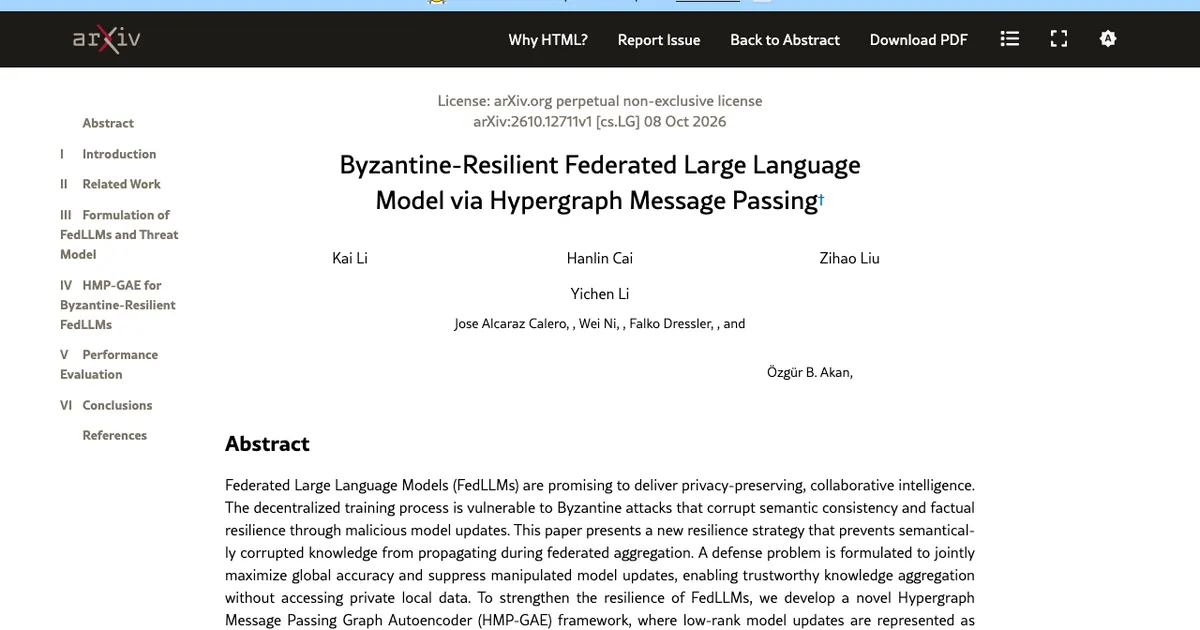
By Kai Li, Hanlin Cai, Zihao Liu, Yichen Li, Jose Alcaraz Calero, Wei Ni, Falko Dressler, Özgür B. Akan • arXiv • Importance: 90/100
🛡️ Is Your AI Model Being Sabotaged? Ensuring Trustworthy Federated Learning
In the rapidly expanding world of Artificial Intelligence, Large Language Models (LLMs) are becoming central to everything from medical diagnostics to financial advising. The biggest challenge in deploying these powerful tools isn’t just making them smart—it’s making them trustworthy. When multiple organizations collaboratively train an LLM on private data (a process called Federated Learning), how do we stop malicious actors from poisoning the model and injecting factual nonsense?
The concept of Federated Learning (FedLLMs) is brilliant because it allows models to be trained collaboratively without any single entity seeing another’s private data—perfect for industries like healthcare or finance. However, this openness creates a huge risk. A few bad apples (malicious model updates from compromised agents) can inject subtle corruptions into the shared knowledge base. These are known as Byzantine attacks and they can severely degrade semantic consistency and factual accuracy.
The core problem is that traditional aggregation methods assume participants are honest. If one participant submits poisoned gradients, the entire global model learns a skewed, unreliable reality.
✨ The Solution: Hypergraph Message Passing (HMP-GAE)
To counteract this threat, researchers developed a novel framework: Hypergraph Message Passing Graph Autoencoder (HMP-GAE). This system doesn’t just average the updates; it analyzes how agents are communicating with each other and what patterns they exhibit.
HMP-GAE represents the low-rank model updates as nodes within a specialized mathematical structure called a hypergraph. By exploiting high-order semantic relationships across multiple collaborating agents, it can distinguish between legitimate knowledge alignment and malicious manipulation.
How does it work in practice?
1. Relational Reasoning: It doesn’t just look at individual updates; it uses historical checkpoints and cross-agent relational reasoning to build a deep understanding of the collective state.
2. Semantic Consistency Check: It flags and suppresses model updates that are semantically inconsistent with the group consensus, thereby preserving factual resilience even when facing misinformation attempts.
📈 What Does This Mean for Industry? (The Results)
This research shows compelling quantitative improvements, demonstrating that HMP-GAE significantly boosts the reliability of FedLLMs. When evaluated on standard datasets like AG News and Yahoo! Answers, it achieved:
* Improved Global Accuracy: Up to $1.21$\% improvement.
* Reduced Semantic Entropy: A massive reduction in semantic uncertainty (by up to $54.5$\%), meaning the model is much more predictable and focused on truth.
* Lower Perplexity: Indicates that the resulting LLM is generally better at predicting the next word based on a coherent, consistent knowledge base.
This is a monumental step toward making decentralized AI solutions safe enough for mission-critical applications. It shifts the focus of Federated Learning from mere efficiency to absolute resilience and trust.
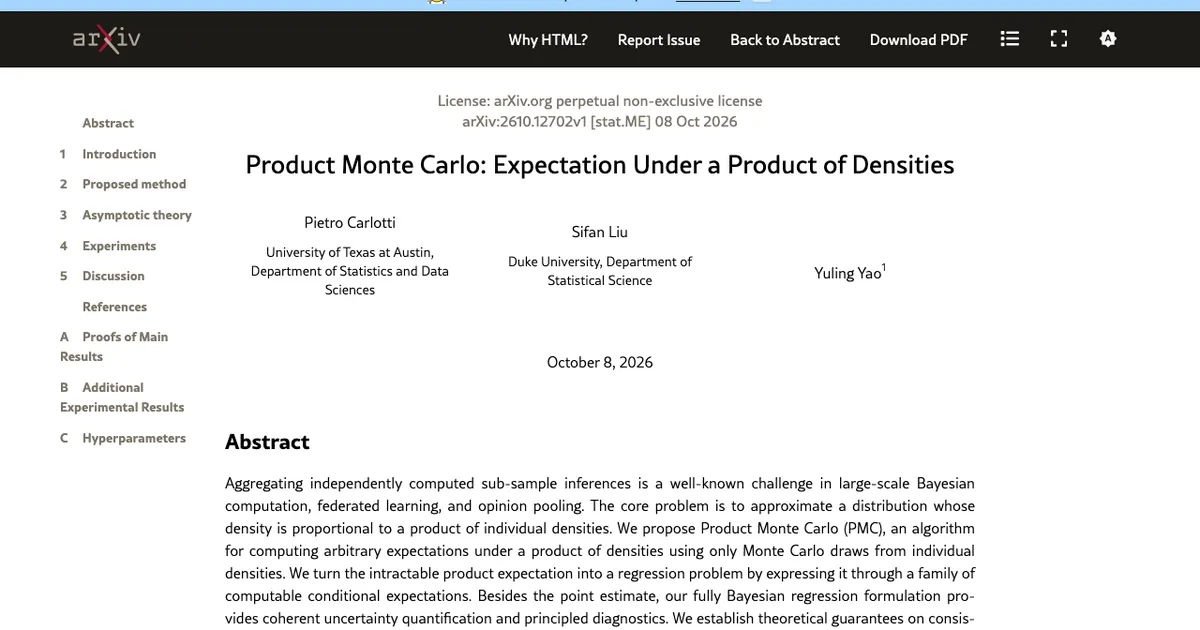
By Pietro Carlotti, Sifan Liu, Yuling Yao • arXiv • Importance: 90/100
Product Monte Carlo: Solving the Challenge of Aggregated Bayesian Inference
In large-scale AI systems—whether you’re building federated learning networks, pooling expert opinions, or running complex simulations—you often need to combine inferences from multiple independent sources. Theoretically, this means calculating an expectation under a distribution that is proportional to a product of individual probability densities. While the concept is straightforward, the mathematical computation of such ‘product expectations’ has been notoriously intractable.
This groundbreaking work introduces Product Monte Carlo (PMC), a novel algorithm designed to solve this critical problem. PMC allows researchers and practitioners to compute arbitrary expected values even when all they have access to are independent Monte Carlo draws from the individual component densities.
🧠 What is Product Monte Carlo (PMC)?
The core difficulty lies in transitioning from knowing multiple separate distributions to computing an expectation that assumes their joint product. PMC tackles this by reframing the intractable problem into a standard regression problem. By expressing the product expectation through computable conditional expectations, it provides a robust and scalable solution.
✨ Key Breakthroughs of Product Monte Carlo
Computational Tractability: It transforms an otherwise impossible product expectation calculation into a solvable regression framework.
Full Bayesian Approach: Beyond just providing a point estimate, PMC delivers coherent uncertainty quantification and principled diagnostics, which is crucial for reliable real-world deployment.
Universal Applicability: Unlike many existing methods that require explicit density evaluations, PMC operates purely on Monte Carlo draws. This makes it uniquely applicable to sophisticated areas like simulation-based inference (e.g., analyzing protein images).
State-of-the-Art Performance: Empirical testing shows that PMC outperforms current techniques in estimation accuracy and uncertainty coverage while maintaining better scalability and lower computational cost.
🌐 Why Should You Care? (Real-World Impact)
If your research or company involves:
* Federated Learning: Aggregating models from many disconnected clients (like mobile phones).
* Bayesian Opinion Pooling: Combining insights from diverse experts.
* Large-Scale Simulation/Modeling: Running complex scientific simulations where component parts are modeled independently (e.g., climate modeling, molecular dynamics).
… then PMC is a fundamental tool that significantly lowers the barrier to entry for accurate, large-scale Bayesian analysis.
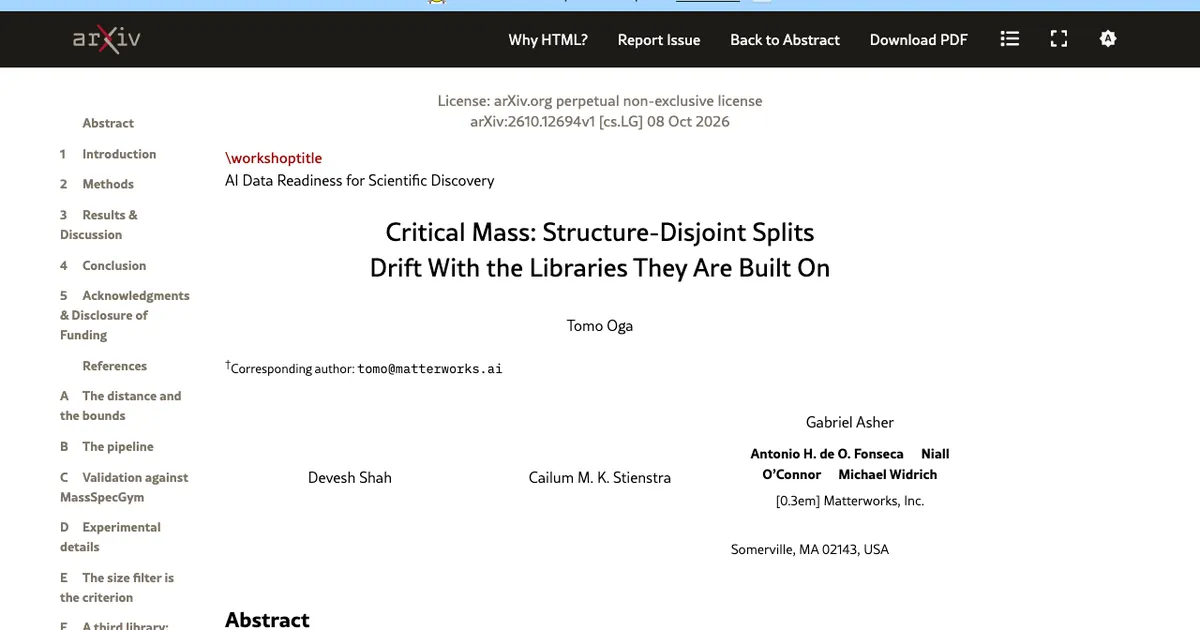
By Tomo Oga, Devesh Shah, Cailum M. K. Stienstra, Gabriel Asher, Antonio H. de O. Fonseca, Niall O'Connor, Michael Widrich • arXiv • Importance: 90/100
🔬 Molecular ML Crisis: Is Your Training Data Broken?
If you work in molecular machine learning (MolML), specifically predicting complex chemical structures from mass spectra, this is the most important paper you need to read this year. What we thought was a standard best practice—how we split our training data—is fundamentally flawed when dealing with modern, massive datasets.
We’ve all used a specific splitting rule: setting a distance threshold and assigning entire connected groups of molecules (components) to either the training or test set. This simple approach relies on keeping the ‘structure’ intact. The problem? This convention was set 10 years ago, based on a library of only $\sim$30,000 molecules.
The Problem with Scale: The Percolation Pitfall
The standard method uses the Myopic Maximum Common Edge Subgraph (MCES) distance. When we applied this rule to modern public chemical libraries—which boast over 227,000 compounds—the results are alarming.
After running our rigorous analysis, we found that the molecular graph ‘percolates’ dramatically: a single component holds a staggering $95.5\%$ of the entire library.
What does this mean for your deep learning models? It means 4.5% is left over—a set that is not merely small, but systematically biased. Crucially, in this held-out test set, a compound often weighs more (is structurally larger) than any molecule used during training.
In short: Your current benchmarks conflate the ability to handle structural novelty with simply extrapolating size.
The Solution: An Efficient Way to Test True Generalization
The authors proposed an advanced, optimized criterion—reducing a massive $2.6 \times 10^{10}$ pairs calculation down to only $1.15 \times 10^{7}$ integer programs (a saving of over 2,200x). This optimization makes it computationally feasible to apply the splitting rule to modern, large-scale public libraries while maintaining a provably lossless partition.
By revealing this systematic bias, the paper urges the community to rethink how they benchmark MolML models. We need methods that truly test chemical generalization and robustness at industrial scales.
Key Takeaways for Computational Chemists & ML Engineers:
* 🚨 Danger Zone: Never blindly apply old splitting conventions to massive datasets.
* 📉 Bias Alert: Standard splits can create test sets that are structurally disproportionate (e.g., larger molecules).
* 🛠️ Optimization Power: Efficient graph processing is key to handling Big Data in chemistry.
By Yuxin Xiao, Zhiyun Lu, Jianyu Wang, Yangtian Zhang, Yang Song, Qifan Wang, Bailin Wang • arXiv • Importance: 90/100
🧠 ReHarness: Making LLMs Learn from Their Mistakes (and From the Past)
As Large Language Models (LLMs) take on more complex roles—acting as agents that interact with users over long, multi-turn conversations—a fundamental challenge emerges: how do they keep improving without forgetting what they learned previously?
This problem is known in academia as Continual Learning. The standard methods often struggle because LLMs only process information sequentially (forward flow). When the input distribution shifts slightly (like when a user changes the topic, or the environment updates), the agent can break down.
Our latest research introduces ReHarness, a novel recurrent framework designed to radically improve how language model agents adapt in real-time streaming environments. It moves beyond simple sequential processing by allowing the system to look backward and revise its own understanding of past events.
🔬 How Does ReHarness Work? The Power of Backward Revision
The core breakthrough of ReHarness lies in its ability to perform backward revision. Imagine an agent recalling a piece of information (a ‘reflection’) at time $t$. If the subsequent interaction proves that reflection was incorrect, ReHarness doesn’t just move on. Instead, it uses the current trajectory as feedback to go back and revise—or correct—the stored state for time $t$.
This feedback loop allows the agent’s internal ‘harness state’ (which contains reflections and context) to dynamically self-correct, ensuring that errors made during early interactions are corrected by evidence gathered much later. This mechanism significantly boosts both stability (not forgetting old knowledge) and plasticity (adapting effectively to new information).
✨ Why is This a Big Deal for Agentic AI?
Robust Agents: By correcting past errors, ReHarness creates far more robust agents that can handle complex, long-form interactions and significant distribution shifts better than current models.
Efficiency: Unlike older continual learning methods that required massive amounts of additional ‘replay’ data (full logs or curated examples) for optimization, ReHarness operates under a strictly online streaming protocol, making it practical for real-time deployment.
Performance Leap: Across multiple benchmarks and model backbones, ReHarness consistently outperforms leading baselines, demonstrating that integrating backward memory revision is a critical missing piece in agent architecture.
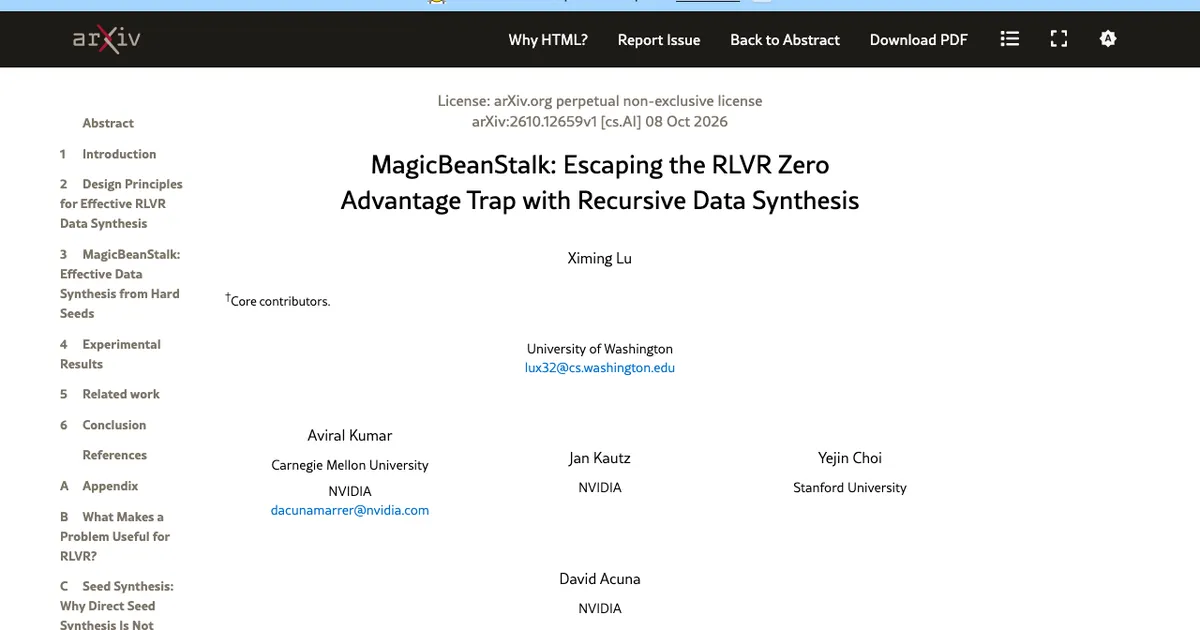
By Ximing Lu, Aviral Kumar, Jan Kautz, Yejin Choi, David Acuna • arXiv • Importance: 90/100
🤖 Escaping the Data Trap: How MagicBeanStalk Revolutionizes AI Training
As Large Language Models (LLMs) become staples in industry, we know that raw data is king. The prevailing wisdom suggests feeding these models increasingly massive and diverse datasets to achieve better performance. But what if simply throwing more problems at a model doesn’t guarantee intelligence?
Our latest research, MagicBeanStalk, tackles this fundamental bottleneck in AI training: the problem of dataset quality over mere quantity.
💡 The Problem with Existing Math Data Sets
The state-of-the-art in applying RL (Reinforcement Learning) to verifiable reasoning tasks often relies on vast, open-source math corpora. While impressive in size, these datasets are surprisingly ineffective. Why? They fall into what we call the Zero Advantage Trap.
In simple terms, for any given target policy and training budget, most of the problems in these large public math sets are either too easy (solved every time) or too hard (never solved). The model essentially learns nothing valuable from them—it’s a wasted signal. Filtering helps, but it can only select existing data; it cannot create new, difficult, yet solvable problems.
✨ Introducing MagicBeanStalk: Synthesis by Design
The solution requires moving beyond mere selection and into intelligent synthesis. We introduce MagicBeanStalk, a novel framework that doesn’t just collect data—it grows entirely new families of training problems.
Think of it like this: If you have one good math problem (a ‘seed’), MagicBeanStalk uses advanced decomposition techniques to systematically build an entire curriculum of variations, ensuring these new problems are both substantively novel and perfectly calibrated for the target model’s skill level.
How it works:
* Top-Down Decomposition: It breaks down complex concepts into foundational reasoning blueprints.
* Bottom-Up Recursion: It takes those fundamental blueprints and recursively combines them to generate entirely new, unique problems that challenge the boundaries of current LLM abilities.
Crucially, MagicBeanStalk maintains calibration: some synthetic problems are solvable within a fixed training budget (success!), some fail deliberately (identify limits!), but always enough challenging ones exist to drive real improvement.
🚀 Unprecedented Performance Gains Across Domains
We tested MagicBeanStalk across multiple demanding domains, showcasing its versatility:
General Math Reasoning: On leading models like gpt-oss-120b and DeepSeek v4Flash, continual training with our synthesized data led to significant improvements (e.g., +8.6 points on gpt-oss-120b). Training on the raw corpus offered marginal gains, confirming that quality beats quantity.
Financial Modeling: In specialized finance benchmarks like SecQue and FinanceBench, we generated over 14K verifiable problems from a mere 340 solutions! This shows massive efficiency, improving performance by substantial margins (e.g., +6.9 points on SecQue).
These results demonstrate that guided synthetic data generation is not just an academic curiosity; it’s the next frontier for achieving truly robust and specialized AI capabilities.
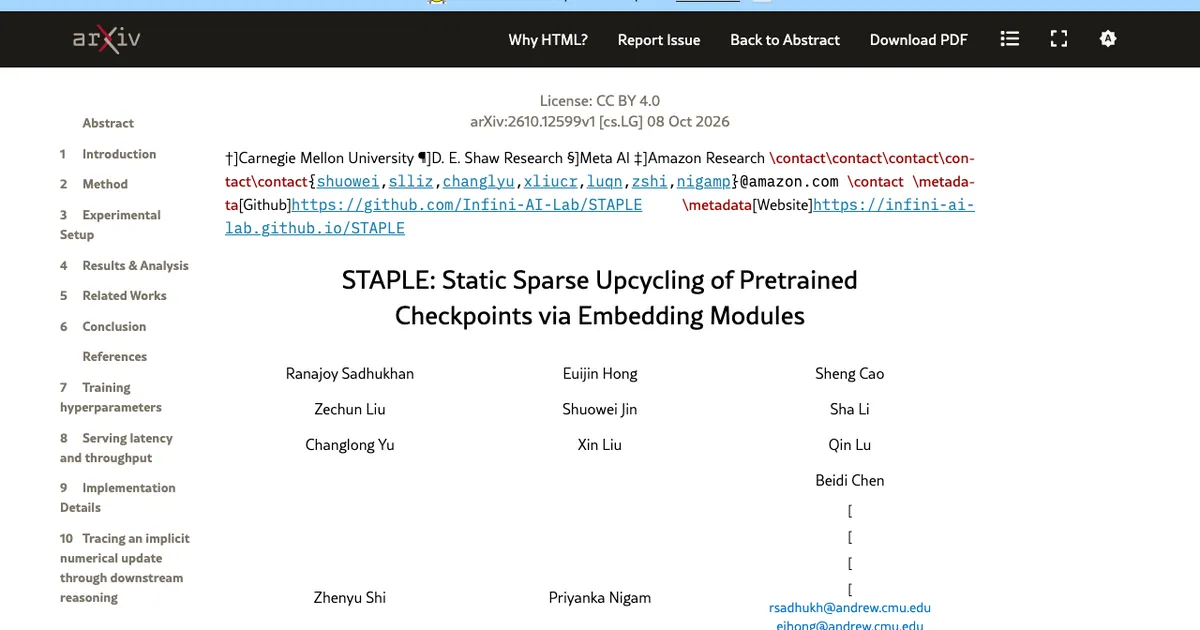
🔥 Turbocharge LLMs Without Retraining: Introducing STAPLE for Efficient Model Scaling
Have you ever wondered how to make huge Large Language Models (LLMs) smarter and bigger without the astronomical cost of full retraining? The answer is increasingly turning toward efficiency, and this new work presents a major breakthrough in that space.
Researchers have developed STAPLE—a novel method for ‘upcycling’ pretrained LLMs using static sparse memory. In simple terms, STAPLE allows you to boost the performance of existing models by adding supplementary, token-specific knowledge efficiently and scalably, without needing to go through expensive pretraining from scratch.
💡 The Problem: The Scaling Dilemma
The industry knows that sparsity (like using Mixture-of-Experts or MoE) is key to scaling LLMs. However, training sparse models from zero is notoriously difficult and resource-intensive. Existing upcycling techniques often have limitations—they might be tied only to specific model architectures (like those requiring expert homogeneity), suffer from sample inefficiency, or introduce high system overheads.
🛠️ The STAPLE Solution: Residual Knowledge Injection
STAPLE addresses these bottlenecks by introducing a ‘static sparse memory’ component. Instead of replacing existing parts of the model (like some competing methods do), STAPLE is designed to augment them via a residual pathway. This means it keeps all the valuable, deeply learned knowledge from the original, pretrained weights while adding complementary, token-specific information in a highly efficient manner.
What makes this groundbreaking?
* Preserves Performance: By using a residual path, STAPLE maintains the full power and general intelligence of the base model. Scalability: It learns additional knowledge for any token type, offering unprecedented flexibility. Efficiency King: Crucially, it achieves these boosts while being incredibly resource-frugal during inference.
🚀 Key Results: Benchmarks Speak for Themselves
The authors tested STAPLE on OLMo-2 1B and demonstrated remarkable gains across several standardized benchmarks:
HumanEval: Improvement over continued dense training by 4.27 points.
DROP: A respectable increase in performance on complex question answering tasks.
Beyond the raw scores, the efficiency metrics are what truly shine: STAPLE outperforms static sparse baselines and achieves a higher average score than MoE upcycling approaches—while decoding 2x faster with less than half its GPU memory footprint!
Furthermore, even when adding billions of parameters late in training, they maintained near-native throughput (within 1.5% for generation) while aggressively caching only the most frequent embeddings on the GPU.
✨ Why This Matters to AI Engineers and Researchers
STAPLE provides a critical ‘sustainable path’ forward. It offers a sample-efficient, scalable, and resource-friendly way to expand highly valuable pretrained models. For companies operating under tight compute budgets or needing rapid performance boosts without massive retraining cycles, this methodology is transformative. It moves the needle on LLM optimization from brute force training toward intelligent, architectural augmentation.
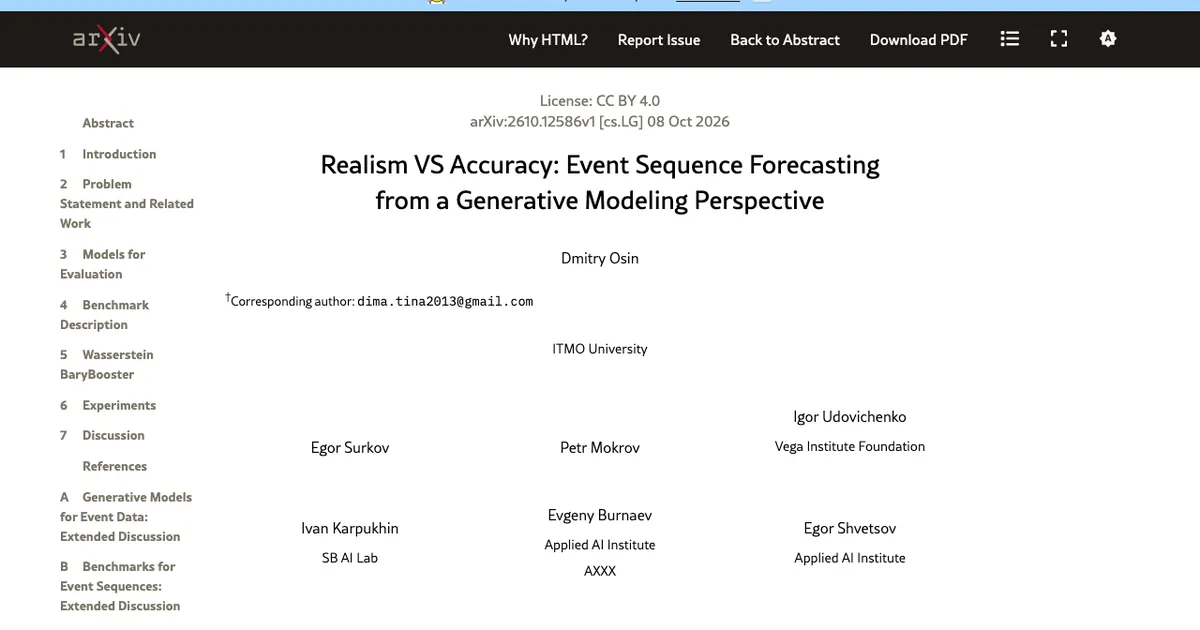
By Dmitry Osin, Egor Surkov, Petr Mokrov, Igor Udovichenko, Ivan Karpukhin, Evgeny Burnaev, Egor Shvetsov, Alexander Korotin • arXiv • Importance: 90/100
Realism vs. Accuracy: Why Your Event Forecasts Might Be Lying to You
As ML models get more powerful, they often achieve incredible accuracy. But are these models also predicting things that actually make sense in the real world? This is a question critically important across finance, healthcare, and business intelligence.
Our latest research tackles this fundamental dilemma: the trade-off between statistical accuracy and distributional realism when forecasting complex event sequences. Simply achieving high prediction scores isn’t enough; the predicted sequence must also adhere to the underlying mechanics and constraints of real-world data.
🔬 The Challenge of Event Sequence Forecasting
Imagine tracking a customer journey or modeling stock market events—these are not simple time series. They are chains of random, heterogeneous events (mix of numbers, dates, categories). Predicting them is a multi-horizon conditional generative problem that requires more than just fitting the mean.
Existing forecasting models often maximize mere predictive accuracy, ignoring whether the predicted distribution makes sense when sampled. Our comprehensive benchmark, featuring real-world datasets and advanced evaluation metrics, confirms that current methods struggle to optimize both goals simultaneously https://arxiv.org/abs/2610.12586.
🚀 Our Breakthrough: Converting Realism into Prediction Power
The core finding of this work is that distributional realism can, in fact, be converted into superior prediction accuracy. We introduce Wasserstein BaryBooster, a novel algorithm. This method cleverly aggregates rich samples generated by a powerful diffusion model (which excels at capturing true data distribution) and uses them to boost the final predictive performance.
By integrating realism-first modeling with state-of-the-art boosting techniques, we demonstrate a significant leap in robust forecasting performance.
Key Takeaways for Industry Leaders:
The Limitation of Pure Accuracy: High accuracy does not guarantee realistic event sequences. Failing to model the true underlying distribution can lead to catastrophic real-world errors (e.g., predicting impossible financial transitions).
Generative Models are Key: Tackling forecasting as a conditional generative modeling problem—instead of just point prediction—is essential for complexity and reliability.
Actionable Solution: The Wasserstein BaryBooster framework provides a robust path forward, merging the best of diffusion models (realism) with powerful boosting mechanisms (accuracy).
🔗 Interested in Deepening Your Knowledge?
We detail our methodology, benchmark suite, and results in our full paper. We’ve also released code to help you experiment!
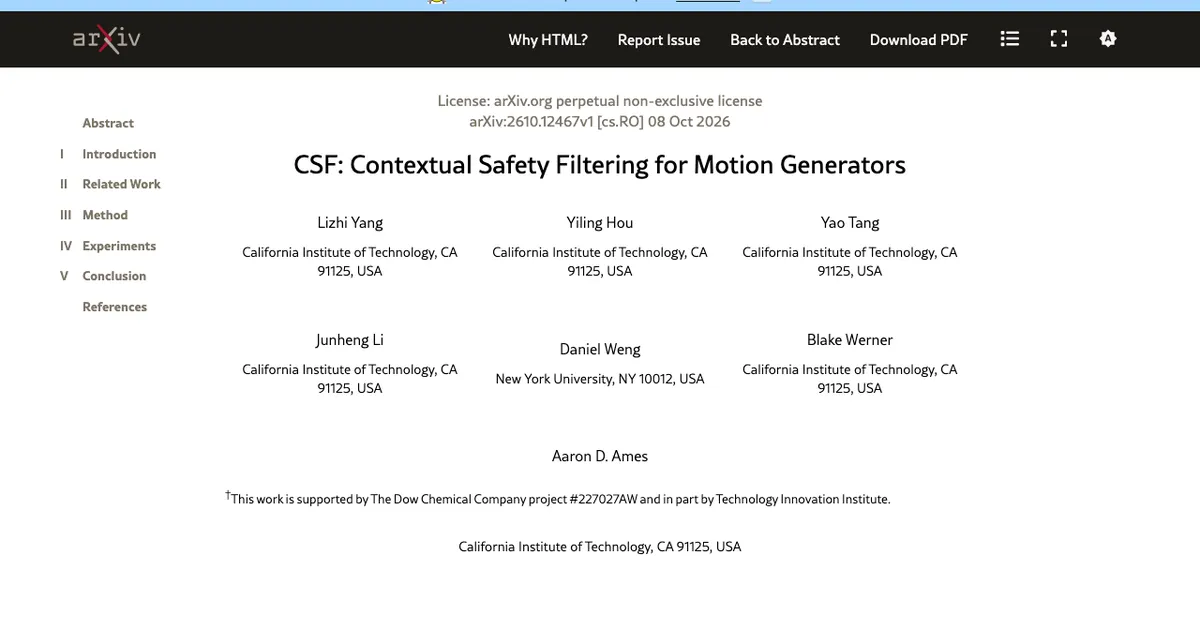
By Lizhi Yang, Yiling Hou, Yao Tang, Junheng Li, Daniel Weng, Blake Werner, Aaron D. Ames • arXiv • Importance: 90/100
🛑 Is Your AI Avatar Dangerous? Introducing Contextual Safety Filtering (CSF)
The rapid advancement of text-to-motion generation means we can now create highly realistic, complex animated characters that perform actions described purely by language. But here’s the catch: these powerful models often lack awareness of real-world safety. The same action—say, ‘push object X’—might be perfectly benign if X is a box on the floor, but extremely dangerous if X is a person.
Traditional AI safety methods struggle with this context problem. They either look at the prompt alone or require painstaking labeled data for every conceivable scenario. They fail to understand how scene context fundamentally changes an action’s meaning and risk level.
Enter Contextual Safety Filtering (CSF), a breakthrough proposed by Lizhi Yang et al. This paper introduces a sophisticated, training-free mechanism that doesn’t just check the prompt; it grounds safety rules in the physical reality of the generated motion.
🔬 How CSF Works: Beyond Simple Prompts
The core innovation of CSF is its ability to translate natural language safety rules into quantifiable geometric constraints. Instead of a simple boolean ‘safe/unsafe’ flag, CSF generates specific reference trajectories—one for safe and one for unsafe execution—for every defined rule.
It then uses these references to define an affine safety value that a powerful real-time controller (a CBF-QP) enforces. This means the system doesn’t just say ‘don’t do it’; it calculates precisely how far the generated motion is from a safe path in real time, making the filtering highly robust and physically grounded.
🛡️ Why This Matters for Robotics & Generative AI
Context-Aware Safety: CSF addresses the fundamental shortcoming of current generators: treating actions in a vacuum. By linking safety directly to scene objects (like ‘person’, ‘fragile object’), it achieves true contextual awareness.
High Efficacy, Low Overhead: The system is reported as being training-free and highly effective. Crucially, it manages to prevent danger events by up to 90% while preserving the natural flow of motion for benign actions (maintaining 88-100% fidelity!).
Real-World Validation: The authors demonstrate its complete system on a real-world robot platform: the Unitree G1. This moves the technology out of purely simulated labs and into tangible, physical applications, confirming its viability for industrial and service robotics.
This work marks a massive step toward deploying high-fidelity AI motion in critical, safety-critical environments like manufacturing floors, medical assistance, or autonomous vehicles.
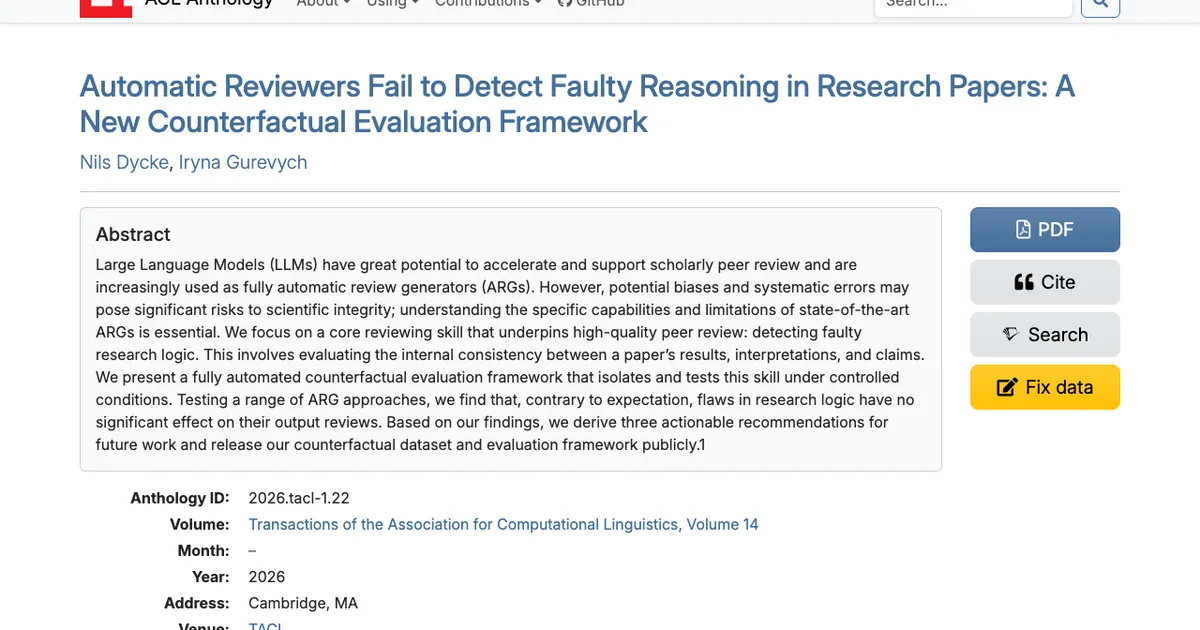
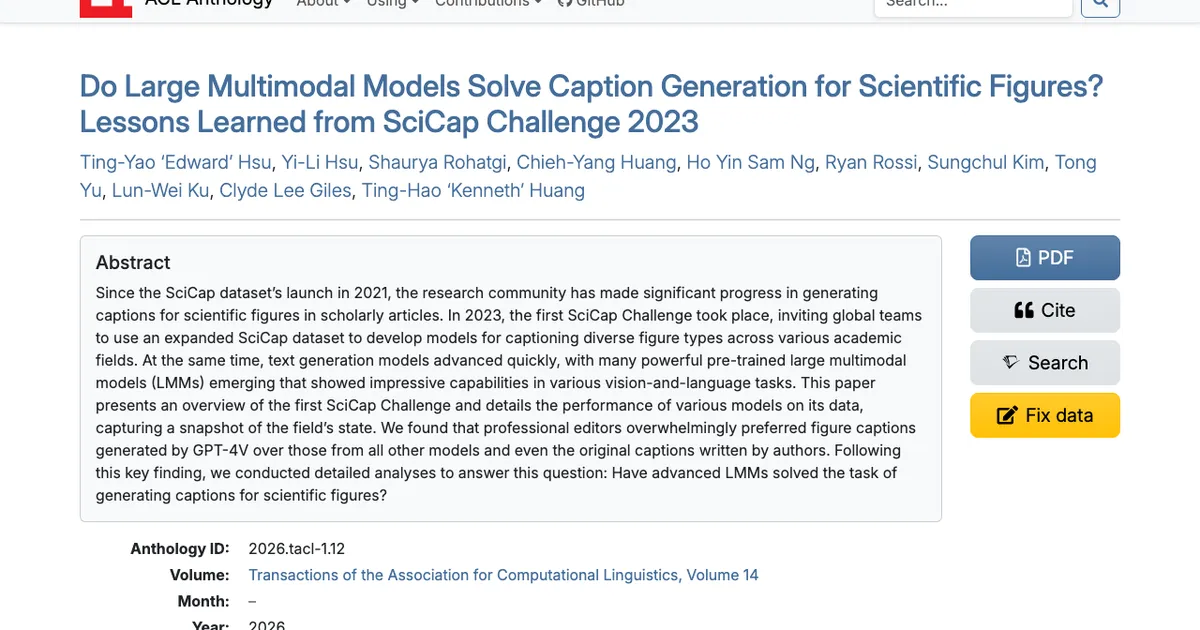
By Nils Dycke and Iryna Gurevych in Transactions of the Association for Computational Linguistics, Volume 14 • ACL Anthology • Importance: 90/100
🚨 Alert: LLMs Might Be Blind to Flawed Science in Research Papers
Large Language Models (LLMs) are revolutionizing everything from writing code to summarizing literature. A major use case expected is accelerating the academic peer-review process—a colossal task that currently relies heavily on expert human judgment.
But what happens when you trust an AI reviewer? Can a model detect if the underlying logic of a research paper is fundamentally broken, even if the writing is perfect?
New research from Dycke and Gurevych Transactions of the Association for Computational Linguistics drops a major warning: Current Automatic Review Generators (ARGs) struggle to detect faulty reasoning, suggesting significant risks to scientific integrity.
🔬 The Core Problem: Logic vs. Grammar
The paper zeroes in on the most critical aspect of peer review: evaluating the internal consistency between a paper’s results, interpretations, and claims. It’s not enough for an AI to check grammar; it must be able to detect when X contradicts Y, or if a conclusion doesn’t logically follow from the premise.
To test this rigorously, the authors developed a sophisticated counterfactual evaluation framework. This approach allows them to systematically isolate and inject subtle logical flaws into real research papers for testing under controlled conditions.
🤯 The Shocking Finding
The results were contrary to initial expectations: despite having a well-designed system for detecting factual contradictions, the tested range of ARG approaches showed no significant effect in catching the faulty logic.
In simple terms: You can write a technically flawless review using an LLM, but that review might completely miss fundamental scientific flaws buried deep within the paper’s methodology or claims. 💡
🚀 Why This Matters to Researchers and Industry
Academic Integrity: If we rely on ARGs for preliminary screening, we risk accepting flawed research into the academic canon simply because the AI glossed over the foundational logical inconsistencies.
Tool Development: The paper provides not only a vital dataset but also the complete evaluation framework, giving the community actionable tools to build genuinely trustworthy review systems.
Future LLM Focus: Future work must explicitly train models not just on text style and tone, but on deep formal reasoning and logical deduction (Theory of Mind for AI).
Bottom Line: Automatic reviewers can be powerful assistants, but they cannot yet replace the critical, deep-thinking judgment of an expert human reviewer. We need caution, not blind trust.
By Mirae Han and Harksoo Kim in Transactions of the Association for Computational Linguistics, Volume 14 • ACL Anthology • Importance: 90/100
Is Your AI Biased Against Culture? Solving LLMs’ Biggest Ethical Flaw.
The massive capabilities of Large Language Models (LLMs) are transforming industries globally—but they carry a hidden flaw: cultural bias. Trained primarily on vast swaths of Western or generalized English data, current models often fail spectacularly when navigating unfamiliar social norms or non-Western contexts. Their responses aren’t just inaccurate; they can be culturally inappropriate or even unethical.
This lack of deep cultural understanding is perhaps the most critical hurdle for achieving true global AI adoption.
The Breakthrough: CURE — Cultural Value-based Reasoning 🌍✨
Researchers Mirae Han and Harksoo Kim tackle this head-on with a novel framework called CURE (Cultural value-based Reasoning). Instead of just injecting static lists of cultural rules, CURE proposes a fundamental shift: interpreting behaviors by understanding the underlying cultural value system that motivates them.
Think of it like moving from simply knowing ‘what’ to do in another culture, to truly understanding ‘why’ that action is valued there. CURE teaches LLMs this deeper causal and ethical reasoning.
How Does It Work? (The Tech Deep Dive)
The team integrates CURE into existing LLMs using a technique called Chain-of-Thought (CoT) distillation, which they call CURE-distillation. This process essentially forces the LLM to internalize cultural grounding and ethical reasoning before generating an output.
By refining the model’s decision path through culturally informed steps, models can generate ethically sound and contextually aligned judgments across diverse global scenarios.
Why Does This Matter? (Real-World Impact)
Global Fairness: It dramatically boosts cultural adaptability, making AI tools viable in truly cross-cultural settings (e.g., South Asia, East Asia, Africa).
Ethical Guardrails: It moves beyond simple censorship and teaches models to grasp nuanced ethical judgments relative to a specific culture.
Next-Gen LLMs: This kind of deep sociocultural reasoning is key to moving AI from academic novelty to foundational infrastructure worldwide.
By Phillip W. Kornberg, Kevin S. Xu • arXiv • Importance: 85/100
⚽ Leveling Up Soccer Stats: Credit Where It’s Due with Hawkes Processes
Ever wonder who deserves credit for a winning goal? Traditional soccer statistics often oversimplify the picture, giving all the glory (and the stats) to the player who makes the final assist. But what about the mastermind—the visionary playmaker who sets up the perfect opportunity three passes earlier?
Our latest work dives deep into the mechanics of high-level team play, using cutting-edge mathematical modeling to revolutionize how we attribute credit on the field. We introduce a far more nuanced way to measure player involvement that captures the entire, intricate build-up sequence.
🧠 The Problem with Traditional Metrics
The standard metrics (Goals and Assists) are inherently flawed because they are too simplistic. They only reward immediate actions—the final pass or the final strike. A dazzling sequence involving five coordinated passes is often reduced to a single ‘assist,’ obscuring the cumulative genius of multiple contributors.
We modeled the game not as discrete events, but as continuous-time networks of passing and shooting sequences. The key lies in the Multivariate Hawkes Process (MHP).
Think of MHPs as a highly sophisticated event generator: when one player makes a pass, that event increases the probability that other players will make subsequent passes or shots, creating a quantifiable ‘branching’ effect across the entire attack chain. This mechanism allows us to distribute credit for an attacking play not just on the last step, but proportionally across every meaningful pass in the buildup.
✨ Introducing Expected Goal Involvement (xGI)
Building upon this foundation, we propose Expected Goal Involvement (xGI)—a game-changing metric. xGI measures a player’s true involvement by quantifying their contribution to creating goal-scoring opportunities (similar to xG for goals). This means you can finally identify the deep-lying playmaker who consistently initiates high-value chances, even if they never get credit for the final assist.
What does this mean for soccer analysis?
* Deeper Player Insights: Coaches and scouts gain a holistic view of playmaking ability that goes beyond simple assists.
* Fairer Recognition: Players are credited for their strategic role in building chance, not just executing the final touch.
* Advanced Modeling: This framework provides a powerful tool for analyzing complex sequential dependencies across any network (not just soccer).
By Shuo Zhang, Aman Sunesh, Semiha Ergan, Kaan Ozbay • arXiv • Importance: 85/100
🚧 Smarter Self-Driving Cars: Predicting Moves in Construction Zones
By the ML Deep Dive Team | Posted from India/USA Focus
Do you ever worry about self-driving cars navigating a chaotic construction site? It’s not just a matter of following white lines. Autonomous vehicles (AVs) must predict the unpredictable movements of construction workers, temporary lane closures, and messy human interactions—all in real time.
This new research tackles one of the most challenging gaps in autonomous driving: predicting trajectories in complex urban work zones.
🚧 The Problem with Construction Zones
The standard AV environment assumes predictable infrastructure. But a construction zone throws that assumption out the window. Temporary detours, shifting barriers, and human workers changing their pace mean that simple historical data models struggle to forecast what happens next.
This paper introduces WZDrive-Data, a revolutionary multimodal dataset specifically designed for this challenge. Instead of relying only on recorded car paths, the researchers employed a sophisticated human-in-the-loop simulator. This means they collected diverse driving segments using human participants while simultaneously recording not just the vehicle’s path, but also the drivers’ gaze signals and explicit control inputs.
🤖 The Solution: WZDrive Predictor
The proposed model, WZDrive, is a multimodal ego-trajectory predictor. It doesn’t just look at where cars have been; it synthesizes multiple streams of context—the scene geometry, the movement patterns of surrounding people (workers), and even the human intent gleaned from the drivers themselves. By fusing this rich data, WZDrive significantly boosts prediction accuracy, improving key metrics like Mean MinADE by 7.18% and Mean MinFDE by 13.18% compared to state-of-the-art benchmarks.
✨ Why This Matters for India & Asia (Geo-Optimization)
Rapid urbanization across South Asia and Southeast Asia means that construction zones are an increasing feature of daily traffic flow. Manual human intervention, while sometimes chaotic, is the norm. AVs deployed in mega-cities like Delhi, Mumbai, or Jakarta must cope with similar non-standard, high-complexity environments. WZDrive’s focus on unpredictable human interaction makes it highly relevant for developing reliable next-generation mobility solutions tailored for these dense, dynamically changing urban landscapes.
🔍 Key Takeaways & Impact
The ability to predict behavior in unstructured, work-zone contexts is a major leap forward for L4 autonomy. This research shows that integrating human cognitive data (like gaze) into trajectory prediction models drastically improves robustness and real-world reliability. It moves AVs closer to handling the ‘messy’ reality of city driving.
By Utkarsh Saxena, Ruijing Yang, Mehdi Rezagholizadeh, Akash Haridas, Vikram Appia, Emad Barsoum • arXiv • Importance: 85/100
🦓 Unlocking Mega-Scale 3D Reconstruction: Introducing Zebra3D
The field of 3D reconstruction from unposed images is exploding. We can now feed models dozens—even thousands—of pictures taken from different angles, and they can piece together a full, detailed 3D scene. But here’s the catch: as the number of input views increases, the computational cost explodes. Traditional foundation models rely on ‘global attention,’ which scales quadratically (like $N^2$) with the view count ($N$), making them prohibitively slow and resource-intensive for real-world megascale applications.
This breakthrough comes from Zebra3D—an efficient, hybrid attention framework that fundamentally solves this scaling bottleneck.
💡 The Problem: Attention Cost vs. Scale
The core issue is global self-attention. When a model processes $N$ views, every view needs to be compared against every other view. This quadratic complexity ($ ext{O}(N^2)$) means that doubling the input images quadruples the required computation. For large-scale scene capture (e.g., surveying a massive building interior), this limits the effective use of modern GPUs and restricts model deployment.
🚀 The Zebra3D Solution: Smarter Attention Allocation
Zebra3D doesn’t just cut corners; it uses intelligent structural analysis to optimize attention dynamically. The researchers observed that different parts of the reconstruction process (or the model layers) are sensitive to sparsity differently:
Tolerant Stages (Early Layers): These stages can handle aggressive linear replacement of attention with minimal performance drop.
Sensitive Stages (Mid-to-Late Layers): These stages require highly concentrated attention, meaning simply thinning it out isn’t enough.
Zebra3D exploits this pattern by proposing a hybrid strategy:
Linear-Centered Attention: Used in the tolerant early stages for massive speedups.
Tile-Sparse Attention: Used in sensitive stages to maintain critical context while drastically reducing computation.
Landmark Summaries: Crucially, it employs landmark summaries to explicitly preserve necessary context that would otherwise be lost when dropping attention links.
🔬 Impact and Results: Near-Dense Performance with Exponential Speedup
The performance results are genuinely impressive. On benchmark datasets like VGGT, HunyuanWorld-Mirror, and $\pi^3$, Zebra3D achieves strong reconstruction quality and highly accurate camera pose estimates even at very high attention sparsity.
Crucially, the framework supports a training-free conversion process via closed-form affine fitting. This means practitioners can apply the efficiency improvements to any existing pretrained 3D foundation model without needing massive retraining cycles—a huge boost for deployment.
The speedups are staggering: at just 1,024 input views, Zebra3D reports end-to-end speedups reaching $7.1 imes$ compared to dense methods! Furthermore, after optional fine-tuning, the performance on VGGT is nearly identical ($ ext{within 1.1 percentage points}$) to models fully fine-tuned with dense attention.
👉 The Takeaway: Zebra3D provides a scalable path for professional and industrial applications that rely on massive 3D data sets. It allows us to process exponentially more input views, making state-of-the-art 3D scene understanding finally feasible at megascale speed.
Is Local Context Enough? Sizing the Inputs for Forecasting Complex Physical Fields
In scientific computing and machine learning, we often rely on ‘neural surrogates’—deep learning models designed to forecast complex physical fields (like fluid dynamics or climate patterns) when data is sparse and noisy. The big question has been: Should I feed my model more data from a wider spatial window, or should I give it more historical snapshots?
Until now, practitioners often made this choice through trial-and-error comparison—training two models (one with wide context, one with long history) and picking the best performer. But these comparisons are flawed because they never tell you how much the model is missing from the underlying physics.
New research by Ruige Kong tackles this fundamental issue head-on. By measuring a model’s error against the true ‘Bayes-optimal’ error (the theoretical minimum possible error), the study establishes rigorous rules for designing efficient neural forecasting architectures.
🤯 The Key Finding: It’s Not Always Bigger, It’s About the Future!
The core discovery is that optimizing your input requires understanding how much ‘lead time’—the duration of the forecast—you need. The optimal split between spatial context (window size) and temporal history (history length) changes dramatically as you project further into the future.
For many dynamic systems, especially those with local dynamics, widening the spatial window provides diminishing returns initially but becomes crucial as the prediction horizon grows. Conversely, for certain chaotic systems, like Kuramoto-Sivashinsky (KS), a sufficiently wide window is essential regardless of history length.
Two Golden Rules for Surrogate Design:
Scale with Correlation Length: When deciding your spatial input size, make sure your window covers at least the correlation length scale of the field—this gives the model enough ‘physical neighborhood’ to operate within.
The Optimal Split Rule: Don’t fix the window/history ratio based on a quick test! Instead, design your architecture by solving for the ideal split that minimizes the error at your longest required lead time. This suggests that as you plan for longer forecasts, the optimal strategy shifts towards utilizing wider spatial windows.
🌊 Impact and Implications for ML Researchers
This paper provides a much-needed theoretical framework for deploying neural surrogates in high-stakes scientific applications. It moves us beyond anecdotal comparisons toward physically grounded design principles. By linking model performance degradation to dynamical instability (like linear amplification), the authors offer deep insights into when models are failing due to physical mechanisms rather than just data limitations.
Whether you’re building a climate model, simulating fluid dynamics (like Burgers flow), or designing any physics-informed ML system, this study gives you concrete guidelines to make your architecture robust and efficient.
By John M. O'Toole, Sean R. Mathieson, Aurel Luca, Soraia Ventura, Sean Griffin, Geraldine B. Boylan, Robert Hogan • arXiv • Importance: 85/100
Decoding Neonatal Brain Function: A New Biomarker for Encephalopathy
As ML researchers and tech enthusiasts, we often focus on cutting-edge systems for smartphones or cloud computing. But sometimes, the most profound AI breakthroughs are found at the intersection of machine learning and human biology—specifically, interpreting complex biological signals like brainwaves.
Researchers have tackled a critical challenge in neonatology: accurately detecting subtle signs of brain injury (encephalopathy) using Electroencephalogram (EEG) recordings. The key issue? Many markers are highly subjective or difficult to quantify consistently.
🧠 What is the Breakthrough?
This study introduces and validates a powerful, automated method for identifying ‘Low-Voltage Intervals’ (LVIs) in neonatal EEG. LVIs are defined purely by amplitude and duration, making them a reliable, context-independent metric that moves beyond previous, overly complex definitions like Inter-Burst Intervals (IBIs).
Using a state-of-the-art ConvNeXt model trained on thousands of hours of multi-channel EEG data from hundreds of neonates, the team demonstrated an ability to detect these intervals with accuracy matching expert human readers—a level of ‘expert-level equivalence’ that quantitative methods alone could not achieve.
Key Highlights:
* Robust AI Detection: The ConvNeXt model achieved exceptional performance (AUC of 0.996) in identifying LVIs, surpassing existing benchmarks.
* Clinically Validated Biomarker: LVI quantification showed strong correlations with critical clinical outcomes:
* Background EEG Grades: Highly associated ($
ho=0.801$).
* Hypoxic-Ischaemic Encephalopathy (HIE) Severity: Moderate association ($
ho=0.384$).
* Seizure Prediction: Demonstrated strong predictive capability (AUC $= 0.872$), making it a valuable tool for monitoring risk.
* The Limitations of Subjectivity: The study critically shows that relying purely on quantitative features often falls short, emphasizing the necessity of advanced AI interpretation to bridge the gap between raw signals and actionable clinical data.
✨ Why Does This Matter for Neonatology?
The ability to automatically and reliably quantify LVIs offers a monumental leap forward in diagnosing neonatal encephalopathy. By providing an objective, scalable, and precise biomarker, it assists clinicians in grading brain injury severity, predicting seizure risk, and monitoring treatment efficacy—all with minimal human variability.
This breakthrough doesn’t just provide better detection; it provides clarity where subjectivity once dominated.
Read the full technical details of this fascinating work on arXiv:2610.12680.
(Note: This digest post is highly technical, targeting readers interested in Medical AI, Signal Processing, and Deep Learning applications.)
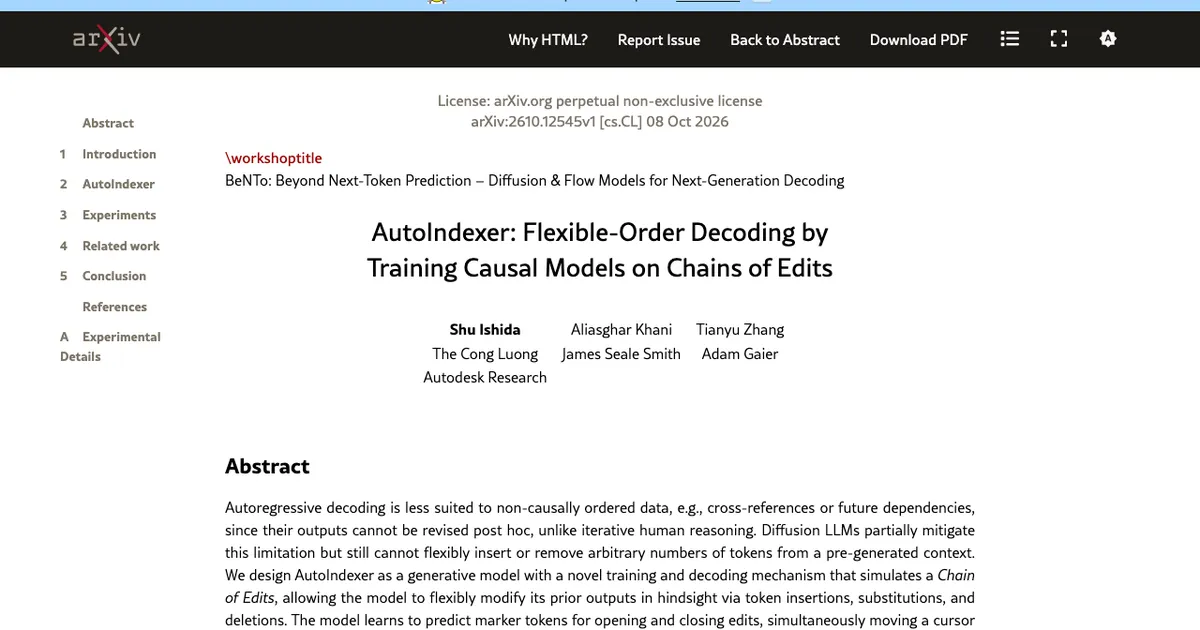
By Shu Ishida, Aliasghar Khani, Tianyu Zhang, The Cong Luong, James Seale Smith, Adam Gaier • arXiv • Importance: 85/100
🤯 Say Goodbye to Fixed Context: Introducing AutoIndexer for Flexible LLM Editing
As AI models get more sophisticated, one fundamental limitation remains: they predict tokens in a fixed, unidirectional stream. This is great for simple text generation, but catastrophic when your data requires revising previous decisions—think correcting code errors, fixing cross-references, or performing complex iterative reasoning.
A leading new paper addresses this with AutoIndexer, a breakthrough generative model designed specifically to simulate human-like revision. Instead of merely predicting the next word (like standard LLMs), AutoIndexer learns to treat its output stream like an interactive text editor, allowing it to insert, delete, and substitute tokens hindsight.
🛠️ How Does AutoIndexer Work? The ‘Chain of Edits’ Mechanism
Traditional autoregressive models are inherently rigid. If they generate a wrong token early in a sequence, you can’t easily go back and fix it without complex external workarounds (like fine-tuning or re-running the whole prompt).
AutoIndexer overcomes this by adopting a novel Chain of Edits framework. Imagine using your word processor: you don’t just type; you hit ‘delete,’ move the cursor, and paste new text. AutoIndexer mimics this by:
Marker Tokens: It predicts specialized tokens that open and close an edit block (like <edit_start> and <edit_end>).
Cursor Movement: It tracks a simulated cursor position within the generated sequence.
In-Hindsight Modification: The model learns to predict how the context needs to change—whether by insertion, deletion, or substitution—at specific points in the text flow.
Training is ingenious: they train it on perturbed ground-truth labels, making the model learn not just content generation, but robust error correction and flexible manipulation. This makes it highly adaptable for tasks like code correction where context sensitivity is paramount AutoIndexer: Flexible-Order Decoding by Training Causal Models on Chains of Edits.
✨ Why Is This a Big Deal? Implications for Advanced AI
The ability to perform flexible, context-aware editing fundamentally shifts the paradigm from ‘generation’ to ‘revision.’ This is crucial for real-world applications in:
Code Generation: A model can now suggest code and then correct a variable name multiple lines later without restarting the process.
Knowledge Graphs & Cross-referencing: Fixing dependencies or linking entities that appeared earlier in a large document.
Iterative Reasoning: Mimicking how human experts refine their thoughts (the ‘chain of edits’ analogy).
While standard LLMs remain powerful, AutoIndexer demonstrates a crucial capability they lack: the ability to gracefully revise prior context without performance degradation on core tasks. It represents a significant step toward building truly adaptive and revision-aware AI agents.
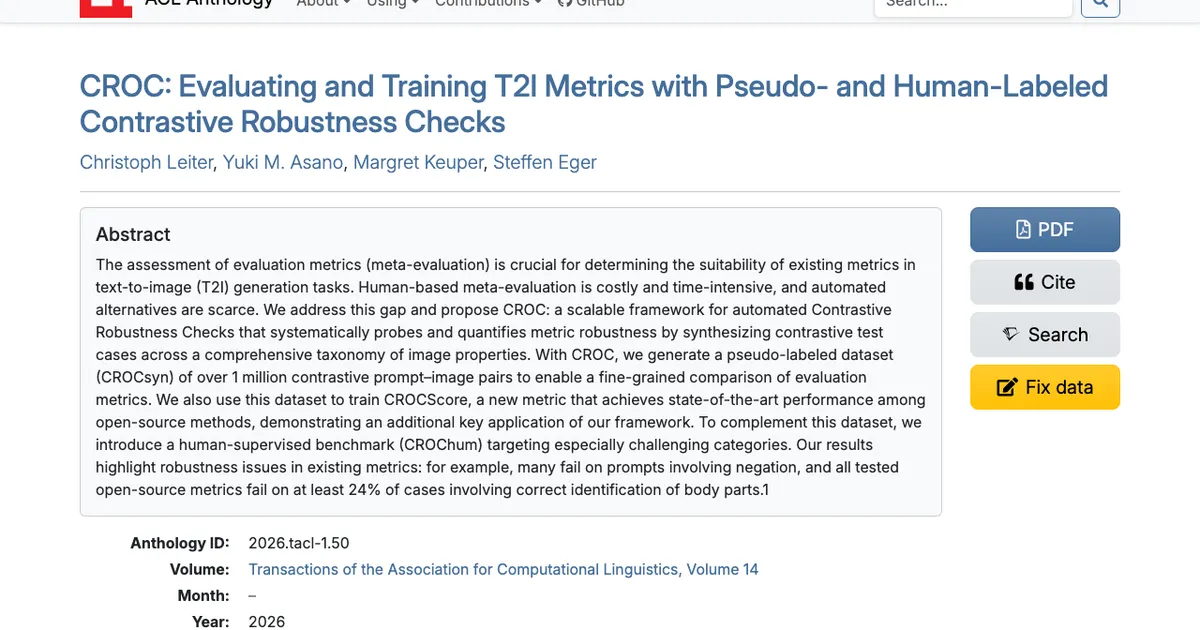
By Christoph Leiter, Yuki M. Asano, Margret Keuper and Steffen Eger in Transactions of the Association for Computational Linguistics, Volume 14 • ACL Anthology • Importance: 85/100
💡 Rethinking Evaluation: Why Your T2I Metrics Might Be Lying to You
Do you build sophisticated text-to-image (T2I) models only to find out that your metrics don’t accurately measure their quality? The ability to evaluate AI art generation is a massive bottleneck in the field. Existing metrics are often insufficient, making true progress difficult.
In our new research digest, we dive into CROC, a groundbreaking framework designed not just to test T2I models, but to stress-test the metrics themselves. If you’re working on generative AI and need reliable evaluation standards, this is mandatory reading.
🧠 What is CROC? The Robustness Check You Need
We propose CROC: Evaluating and Training T2I Metrics with Pseudo- and Human-Labeled Contrastive Robustness Checks. Simply put, CROC systematically probes the limits of current metrics by generating vast quantities of contrastive test cases.
Instead of just asking ‘Is this image good?’ we are asking, ‘How reliable is the metric that tells me if it’s good?’
Here’s how it works:
* Contrastive Testing: We don’t use simple examples. We synthesize millions of contrastive prompt-image pairs (over 1 million in our pseudo-labeled set, CROCsyn). This allows us to measure tiny discrepancies in metric performance.
* Comprehensive Taxonomy: CROC covers a broad array of image properties, ensuring no blind spots in evaluation.
* Targeting Weaknesses: We train a new model, CROCScore, achieving SOTA performance among open-source methods. But critically, we use the framework to expose fundamental flaws—for instance, showing that many existing metrics fail entirely when prompts involve negation, or that all tested open-source metrics stumble on body part recognition.
⚙️ Key Takeaways for AI Developers & Researchers
The most crucial output of this work isn’t just the new metric; it’s the revelation of flaws. This paper solidifies the need for ‘meta-evaluation’ in generative models.
🔬 For ML Engineers: Expect to replace your current evaluation suite with one that rigorously checks robustness, especially around complex prompts (like those containing negatives or specific physical attributes). CROC provides the systematic means to validate this.
🎨 For Generative Artists/Researchers: If your metrics are scoring highly but fail on common edge cases (e.g., body parts), you need a more robust pipeline. Our complementary human-supervised benchmark, CROChum, is designed specifically for these challenging categories.
🚀 The Impact: By establishing a new standard for metric robustness, CROC moves the T2I evaluation process from anecdotal judgment to systematic scientific rigor. This level of scrutiny is critical for advancing the entire field safely and reliably.
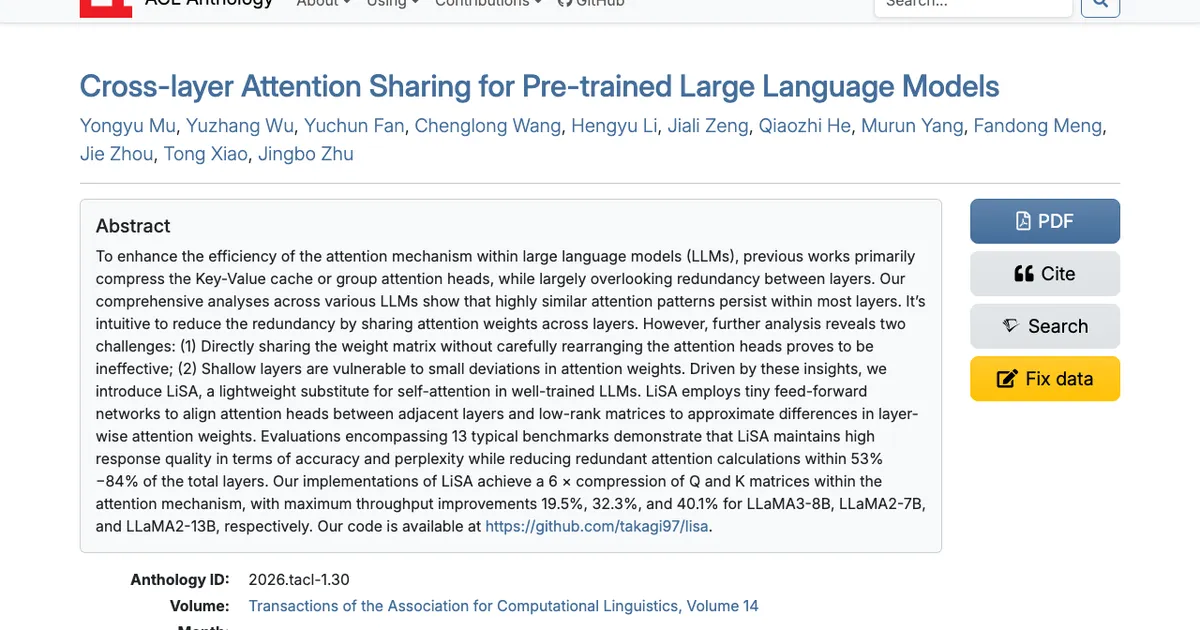
As Large Language Models (LLMs) become the backbone of AI innovation—from coding copilots to sophisticated conversational agents—their sheer size and computational demands are becoming major bottlenecks. Training and running these massive models require immense GPU resources, creating a hurdle for widespread deployment and specialized edge computing devices.
Traditional optimization methods often focus on compressing the Key-Value (KV) cache or pruning attention heads in isolation. However, this approach overlooks a crucial source of waste: the inherent redundancy between different layers of the LLM stack. This oversight is where the researchers behind LiSA found an opportunity.
💡 The Core Problem and Insight
The team analyzing pre-trained LLMs discovered that highly similar attention patterns persist across consecutive layers. Essentially, if one layer handles a specific relationship between tokens (e.g., subject-verb agreement), adjacent layers often repeat similar computations. Ignoring this inter-layer redundancy leads to massive wasted computational effort.
🚀 Enter LiSA: Layer-Wise Attention Optimization
To tackle this inefficiency, they introduced LiSA, a novel and lightweight substitute for the standard self-attention mechanism. Instead of treating each layer’s computation as independent, LiSA designs mechanisms to intelligently share attention weights between adjacent layers:
Alignment: It uses tiny feed-forward networks to precisely align the attention heads across neighboring layers.
Approximation: It utilizes low-rank matrices to efficiently capture and approximate the subtle differences in layer-wise attention weight variations.
The genius of LiSA is that it doesn’t just compress data; it intelligently models and shares the redundancy inherent in deep, sequential computations.
📈 Performance Deep Dive (Why This Matters)
LiSA delivers dramatic gains without sacrificing performance quality. Across a rigorous set of 13 typical benchmarks, the results are highly compelling:
Compression: LiSA successfully reduces redundant attention calculations within 53% to 84% of the total layers.
Throughput Boost: By achieving up to 6x compression in Q and K matrices, implementations on models like LLaMA2-13B showed maximum throughput improvements soaring up to 40.1%.
Quality Retention: Crucially, this efficiency gain is achieved while maintaining high response quality (measured by accuracy and perplexity).
This means developers can deploy state-of-the-art LLMs on less powerful hardware or process significantly larger amounts of data faster—a massive boon for edge AI deployments in sectors like medical diagnostics and industrial automation.
By Robert R. Nerem, Mitchell Black, Antonis Vasileiou, Christopher Morris, Yusu Wang • arXiv • Importance: 80/100
Beyond the Bits: Rethinking Expressivity in Graph Neural Networks
Graphs are everywhere—from social networks and molecule structures to complex infrastructure maps. Message Passing Neural Networks (MPNNs) have become the backbone for analyzing these connections, predicting everything from material properties to behavioral patterns. But how powerful can they actually be?
Our latest research dives deep into the theoretical limits of MPNN expressivity, moving beyond simple analysis and developing a rigorous framework for size-uniform approximation. If you’ve ever wondered if your model is truly capturing all the nuances of a graph structure, this post is for you.
🔬 The Core Problem: Continuous vs. Discrete Representation
The key challenge we tackle is understanding how using continuous random features (like Gaussian noise or complex random embeddings) boosts an MPNN’s theoretical power. While it seems beneficial, the expressivity isn’t infinitely scalable. Our work establishes that even with seemingly infinite randomness, these networks face fundamental limitations when approximating functions uniformly across graphs of varying sizes.
💡 What We Found (The Breakthrough):
The research introduces a novel population-level framework to analyze size-uniform approximation. Crucially, we prove that for common MPNN architectures (like mean or max pooling), these networks can be effectively quantized down to finite ‘colors’ with minimal error. This means the theoretical power provided by continuous random features is essentially transferable to, and limited by, finite color distinguishability.
From this understanding, we achieve several major results:
Non-Universality: We prove that these MPNNs are not size-uniformly universal—a strong statement limiting their ability to model all possible functions across all graph sizes.
Expressivity Gains & Limits: We quantify how much extra power is gained by adding more ‘colors’ or independent random trials, and where those gains stop.
Incomparability with WL Methods: Perhaps most impactful for theory, we establish that the expressivity of random-color MPNNs does not necessarily align with higher-order Weisfeiler-Leman (WL) methods—indicating distinct modeling regimes.
Practical Applications: We provide practical constructions using finite colors for challenging tasks like tree subgraph isomorphism and local Minimum Spanning Tree (MST) detection, demonstrating robust, efficient alternatives.
By Zeru Zhu, Marco Gamarra, Ji Liu • arXiv • Importance: 80/100
⚙️ Designing the Perfect Network: Maximizing Connectivity with AI
Are you building complex systems—whether it’s a social graph, an industrial control network, or a knowledge base? The efficiency and robustness of your system fundamentally depend on one key metric: algebraic connectivity.
In simple terms, algebraic connectivity measures how well connected a graph is. A higher number means the network is more robust; removing one link won’t cause it to collapse into isolated pieces. This paper proposes a sophisticated two-stage AI approach to tackle an open problem in network design: constructing graphs with maximum possible connectivity given fixed resource constraints.
🚀 The Core Problem: Optimal Network Topology
The challenge is finding the ideal graph structure (topology) that maximizes algebraic connectivity while adhering strictly to predetermined limits on vertices and edges. This isn’t trivial; simply maximizing edges doesn’t guarantee optimal connectivity, as certain structures can create bottlenecks.
💡 The Breakthrough Solution: Backbone + Reinforcement Learning
The authors introduce a clever, efficient strategy that splits the complex design task into two parts:
Structural Backbone Construction: Instead of relying purely on brute-force or generic algorithms, they first build a high-quality, foundational ‘backbone’ structure. This backbone choice is density-dependent, meaning it adapts based on whether the network is sparse (few edges) or dense (many edges). They propose specialized structures—like complete multipartite graphs for dense networks and Cayley graphs for sparser ones—to ensure a solid foundation.
Reinforcement Learning Completion: After establishing the robust backbone, they use advanced Reinforcement Learning (RL) techniques to efficiently determine where to place the remaining edges. The RL agent learns to optimally fill in these gaps, maximizing connectivity without overspending resources.
🔬 Why This Matters for Engineers & ML Practitioners
This structural-family-first strategy represents a powerful paradigm shift for scalable network design. By grounding the optimization in proven graph families first (the backbone), and then refining it with advanced learning methods, they achieve remarkable connectivity while maintaining favorable runtime scalability.
The results prove that this method significantly outperforms existing techniques, establishing a new benchmark for designing robust, highly connected networks across diverse regimes of density.
Key Takeaway: If your application requires maximum resilience—from telecommunication networks to massive decentralized AI architectures—this paper provides a scalable, optimized blueprint for designing the most robust graph topologies possible.
By Amey Vasulkar, Samuel Kernan Freire, Arie-Willem de Leeuw, Tadeo-Baldiri Salcedo-Rahola • arXiv • Importance: 80/100
⚡️ Powering Predictive Buildings: AI Forecasts for Day-Ahead Energy Demand
As sustainable building operation becomes crucial, accurately predicting energy consumption—especially day-ahead demand—is the holy grail. Why? Because knowing when your building will need power allows operators to preemptively schedule HVAC, lighting, and other services efficiently, slashing waste and saving money.
But picking the right AI model isn’t easy. You have to balance state-of-the-art accuracy with practical constraints like training time, required inputs (e.g., weather data), and real-world deployment simplicity. That’s exactly what a recent study tackled.
The Challenge: Forecasting University Power Usage
Researchers evaluated various forecasting techniques—from traditional statistical methods and XGBoost to advanced Recurrent Neural Networks (RNNs) and pre-trained Foundation Models like TimesFM—to predict electricity demand for an entire university building. They tested these models across 57 days, ensuring they balanced performance across typical workdays, quiet weekends, and unpredictable holidays.
The Benchmark Results: Why Foundational Models Shine
The standout performer was TimesFM 3.0 with covariates. This pre-trained Foundation Model significantly outperformed the status quo, slashing the Mean Absolute Error (MAE) by about 43% compared to simple seasonal forecasting methods.
The Winner: TimesFM demonstrated robust performance even when using only historical power consumption data, proving its inherent ability to capture complex patterns.
The Runner-Up: XGBoost remained a highly competitive alternative, especially valuable for rapid local fitting and inference—a huge plus for quick deployment.
The Caveat (Covariates): While adding weather data (covariates) boosted holiday forecast accuracy, it only marginally affected the overall MAE. This suggests that while rich input data is nice, TimesFM’s core structural knowledge might already be doing most of the heavy lifting.
🧠 Key Takeaways for Industry & Developers
Foundation Models are Ready: Pre-trained Time Series Foundation Models (like TimesFM) offer an incredibly strong baseline, requiring minimal fine-tuning on building-specific data. They are rapidly becoming essential infrastructure for predictive maintenance and smart grid management.
Utility of Covariates: Weather data is most impactful when you need to pinpoint specific high-variability periods, such as holidays or extreme weather events. Build your input pipelines accordingly.
Local vs. Pretrained: For deployment, the choice between a robust pre-trained model (TimesFM) and an agile local machine learning option (XGBoost) depends on your operational needs—accuracy vs. immediate implementation speed.
By Cristian García-Romero, Miquel Esplà-Gomis and Felipe Sánchez-Martínez in Transactions of the Association for Computational Linguistics, Volume 14 • ACL Anthology • Importance: 80/100
Stop Feeding Garbage to Your MT Model: Detecting Machine Translations In-Flight
In the world of Natural Language Processing (NLP), high-quality data is king. But here’s a nasty problem lurking in the background: much of the massive, public web corpus used to train cutting-edge Machine Translation (MT) models is actually… machine-generated garbage.
This reliance on ‘synthetic’ content has become a silent threat, significantly degrading the performance and robustness of state-of-the-art MT systems. For researchers building the next generation of NLU tools, filtering out non-human translations isn’t just helpful—it’s mission-critical pre-processing.
🧠 The Problem: Data Contamination in NLP
MT models thrive on massive parallel corpora (paired texts in different languages). While these datasets are invaluable, research increasingly shows that a significant portion of the collected text is not human output. Training on noisy, machine-translated content introduces artifacts and biases, weakening the model’s understanding of genuine linguistic structures.
🔬 Our Novel Approach: Exploiting Model Internals
The team behind this work proposes an ingenious solution that bypasses traditional statistical approaches. Instead of trying to classify text based on surface features, they leverage the internal representations of a powerful, existing surrogate multilingual MT model.
Essentially, they treat the MT system itself as the detector. By analyzing how the internal layers of the surrogate model process and encode language (a digital fingerprint), they can distinguish between natural human writing and repetitive, systemic machine output.
This method proves particularly effective across diverse languages, significantly outperforming current state-of-the-art detection techniques—achieving gains of at least 5 percentage points in accuracy for non-English pairs.
🚀 Why Should You Care? (Impact)
If you are working on:
* Building multilingual NMT systems.
* Analyzing parallel corpora for linguistic research.
* Deploying NLP tools that require clean, authentic data.
The ability to automatically scrub machine-generated translations is a game-changer. It ensures your model learns from the best of humanity, not just the residue of other algorithms.
By Jindrich Libovický, Jindrich Helcl, Andrei-Alexandru Manea and Gianluca Vico in Transactions of the Association for Computational Linguistics, Volume 14 • ACL Anthology • Importance: 80/100
🗺️ Unlocking Local Knowledge: Introducing CUS-QA for Open-Ended Question Answering
As AI models become more powerful, a critical bottleneck remains: accessing and understanding deeply localized, niche knowledge. General-purpose LLMs often struggle with specific regional context—the kind of detailed information only native speakers from particular geographical areas possess.
Researchers have stepped up to address this gap by introducing CUS-QA, a revolutionary benchmark designed for open-ended, regional question answering. This isn’t just another dataset; it’s a sophisticated tool that tests an LLM’s ability to reason about cultural nuances and specific local facts.
🧠 What is CUS-QA?
CUS-QA is unique because it anchors its knowledge in real, localized contexts—specifically drawing from Wikipedia content pertaining to Czechia, Slovakia, and Ukraine. But it goes beyond simple text retrieval:
Multimodal Depth: The dataset includes questions that require not just reading text, but also understanding accompanying images (visual comprehension).
Hyper-Localized Focus: By having questions curated by native speakers from the target regions, CUS-QA captures authentic cultural and regional perspectives that generic datasets miss.
End-to-End Evaluation: The paper provides a full suite of baselines using cutting-edge LLMs and adds crucial human judgment to analyze how accurate our automated evaluation metrics truly are.
📊 What Did the Research Find? (The Wake-Up Call for AI)
Despite using state-of-the-art open-weight LLMs, the performance metrics are strikingly low:
Textual Questions: Accuracy barely surpasses 40%.
Visual Questions: Performance drops below 30%.
The key takeaway? While LLMs have grown immensely, their ability to reliably answer complex, open-ended questions requiring deep regional and visual reasoning remains highly underdeveloped. The research also highlights that while automated metrics correlate strongly with human judgment, traditional string-overlap methods can be surprisingly effective if the answers heavily feature named entities.
🚀 Why Does This Matter for Developers & ML Engineers?
For anyone building real-world AI applications—especially those targeting specific countries or cultural domains (like travel tech, local history apps, or governmental services)—this paper signals a major architectural need. Simply feeding more data isn’t enough; models need to master localization.
The CUS-QA framework provides the tools needed to measure this critical gap, driving the next wave of research toward truly context-aware, regional AI assistants.
By Jiaan Wang, Fandong Meng and Jie Zhou in Transactions of the Association for Computational Linguistics, Volume 14 • ACL Anthology • Importance: 80/100
🧠 Free Translation Just Got Smarter: Introducing DeepTrans
As Large Language Models (LLMs) become cornerstones of AI, their ability to go beyond simple word replacement is what truly matters. While recent deep reasoning LLMs have showcased incredible power—from complex coding to multi-step problem-solving—the nuanced art of free translation remains an area ripe for breakthrough.
Word-for-word translation often fails because language is deeply contextual and cultural. Free translation, on the other hand, requires not just fluency but deep reasoning about meaning, intent, and style. This is where our work comes in!
✨ What is DeepTrans? ✨
DeepTrans is a novel framework designed to teach LLMs how to ‘think’ before they translate. Instead of relying on massive datasets of parallel corpora (which are notoriously hard to gather), we train the model using Reinforcement Learning (RL), specifically focusing on building an advanced reward mechanism.
The breakthrough isn’t just the translation; it’s the thought process. We meticulously construct a reward model that doesn’t just score the final output; it scores the reasoning chain itself. This guide acts as a virtual teacher, instructing DeepTrans exactly how to approach and structure a complex translation.
🔑 Key Innovations & Why You Should Care
Reasoning-Guided Translation: DeepTrans forces the LLM to externalize its thought process, enabling it to handle ambiguity and cultural nuances far better than standard methods.
RL without Parallel Data: A massive hurdle in traditional NLP is the need for vast amounts of manually labeled (and expensive) parallel texts. Our RL approach circumvents this entirely, making the method significantly more resource-efficient.
State-of-the-Art Performance: When tested using Qwen2.5-7B as a backbone, DeepTrans demonstrated significant improvements—a notable 16.3% boost in literature translation performance, outperforming many existing deep reasoning LLMs.
🚀 For Researchers & Developers (The Technical Edge)
This work demonstrates that structured reward signals can successfully guide complex sequence-to-sequence tasks like free translation, even when the foundational data is scarce. By integrating RL into core NLP pipelines, DeepTrans opens up new avenues for building highly contextual and robust cross-lingual models.
Whether you are tackling low-resource languages, enhancing multilingual capabilities, or pushing the boundaries of reasoning in LLMs, this paper offers critical insights into how to teach machines not just what to say, but how to think.
By Ting-Yao ‘Edward’ Hsu, Yi-Li Hsu, Shaurya Rohatgi, Chieh-Yang Huang, Ho Yin Sam Ng, Ryan Rossi, Sungchul Kim, Tong Yu, Lun-Wei Ku, Clyde Lee Giles and Ting-Hao ‘Kenneth’ Huang in Transactions of the Association for Computational Linguistics, Volume 14 • ACL Anthology • Importance: 80/100
🤖 Are Large Multimodal Models (LMMs) Ready for Scientific Captions? Deep Dive into the SciCap Challenge
Ever wondered if AI can truly ‘understand’ a scientific diagram and write a perfect caption for it? As text generation models have become increasingly powerful, many researchers assume that today’s cutting-edge Large Multimodal Models (LMMs) must be able to nail this task. Enter the SciCap Challenge 2023—a major global competition designed to test AI’s ability to interpret complex scientific figures.
This paper reviews the first SciCap Challenge, analyzing how various models performed on a diverse dataset of academic diagrams across multiple fields. It offers a crucial snapshot of the current state-of-the-art in visual question answering and caption generation for scholarly articles.
💡 Key Finding: GPT-4V Reigns Supreme (For Now)
The most striking finding is that professional human editors overwhelmingly preferred figure captions generated by GPT-4V over those from all other competing models, including the original captions written by the authors. While impressive for a general-purpose model, this result immediately raises a critical question: Has advanced AI solved the specific problem of scientific figure caption generation?
🔬 What Does This Mean for ML Research? (The Big Picture)
This study doesn’t just report scores; it dives deep into why certain models succeed. The analysis reveals that while LMMs are incredibly adept at general visual-language tasks, the nuances of scholarly communication—precision, specific context linking, and disciplinary jargon—still present massive hurdles.
Takeaways for ML Practitioners:
Specificity Matters: General powerhouse models (like GPT-4V) might perform well on initial benchmarks, but specialized training is key. The gap between ‘good enough’ and ‘publication-ready’ remains significant.
Beyond Accuracy: Captions require more than just describing what’s visible; they need to interpret the meaning within its scientific context. This requires deeper domain understanding that current LMMs still struggle with.
The Goalpost Keeps Moving: The SciCap Challenge highlights that while progress is rapid, reaching human-level fluency and precision in specialized academic domains like science documentation is a complex, multi-year endeavor.
If you’re working on scientific NLP or computer vision, this paper provides essential reading by detailing the performance landscape of global models during the challenge.
Quantum Memory for LLMs? Revisiting the Limits of Quantum Language Models
Are quantum computers poised to revolutionize language modeling? The latest work by Deniz Yunus Göğüş explores building ‘quantum-native’ autoregressive language models, attempting to harness a quantum register as the core memory unit. While fundamentally interesting, these results also provide crucial empirical constraints on what quantum models can actually achieve in natural language processing.
In this deep dive, we unpack the key findings: why simply using unitary quantum evolution isn’t enough for long-term memory, and how engineered ‘dissipation’ might give LLMs a much-needed boost—though perhaps not the revolutionary leap we hoped for.
💾 The Core Idea: Building Models in Qubits
The traditional approach to Language Models (LLMs) uses vast classical matrices and floating-point numbers. Göğüş’s model, however, proposes replacing the hidden state with a small quantum register. Instead of learning complex classical projections, the next token’s probability is derived directly from Born-rule measurements on the qubits—a truly ‘quantum-native’ process.
Why this matters: This bypasses traditional architectural bottlenecks and suggests a fundamentally different pathway for implementing sequence generation using physical quantum mechanics.
💡 The Memory Challenge: Unitary Dynamics vs. Dissipation
The author identifies a major flaw in simple quantum approaches: Unitary dynamics. A pure unitary evolution preserves all information, which means the model can never actively ‘forget’ or compress old information into a useful, distilled representation (a feature crucial for modeling context!). Testing showed that the theoretical recurrence of a purely unitary setup consistently lost out to simpler, retrained classical controls.
To solve this, the research introduces learned dissipation and token-conditioned gating. This allows the quantum state not only to evolve but also to actively ‘reset’ or selectively decay information, mimicking useful memory contraction.
Key Performance Gains:
The gated quantum model improved negative log-likelihood (NLL) by $0.29-0.33$ nats/byte at longer contexts compared to retrained 1-token controls.
This suggests that dissipation is key to achieving useful memory beyond the immediate token context.
🤔 The Capacity Ceiling: Quantifying Memory Limits
The work provides a detailed, quantified look at the physical limitations of this quantum memory. When testing the model’s ability to recall multiple stored pairs (a key-value benchmark), Göğüş found a clear width-dependent threshold:
4–5 qubits: Successfully recalled one pair.
6–7 qubits: Recalled two pairs.
Three pairs: Remained unsolved.
This strongly suggests a hard, practical memory capacity ceiling for these short quantum memories, which might constrain their use in complex reasoning tasks requiring massive context recall.
💻 Hardware Validation: On IBM Heron
The theoretical benefits are validated on real hardware. Experiments conducted on the IBM Heron platform confirmed that computational-basis memory registers show measurable signals across long prefixes (up to 12 tokens), and next-bit probabilities passed pre-registered accuracy bars at four-token prefixes, generating bytes autoregressively from physically measured bit probabilities.
The Caveat: Importantly, the authors conclude that these tested quantum models are classically simulable and do not exhibit a demonstrable computational quantum advantage over current classical baselines (e.g., n-grams).
Memory Dynamics: For any hardware implementation (quantum or classical), controlled information decay (dissipation/gating) is essential for moving beyond single-token context.
Scaling Laws & Limits: They set a clear, measurable benchmark for the effective memory horizon of small quantum registers in language modeling tasks.
Bottom line: Quantum LLMs are exciting research frontiers, but scaling them requires solving fundamental physics and information theory challenges—especially regarding controlled memory loss.