← Back to Archive

Digest for 2026-08-03

🐦 Share on X 💼 Share on LinkedIn 📘 Share on Facebook

WorldDynCache: Risk-Controlled Latent Dynamics Approximation for Diffusion World Model
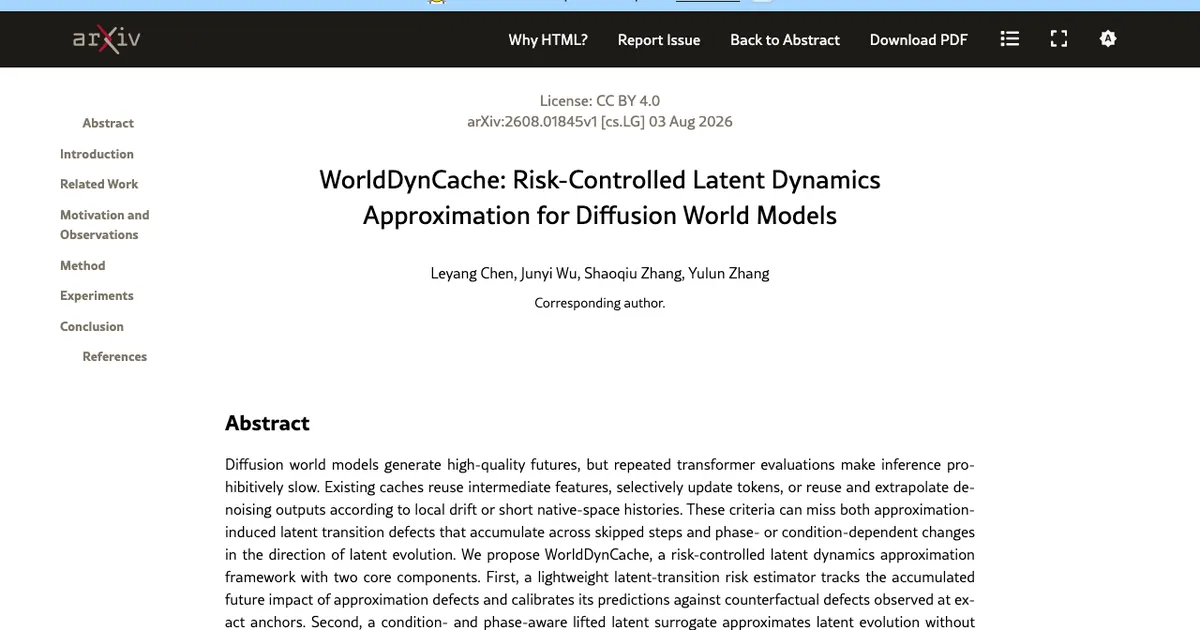
By Leyang Chen, Junyi Wu, Shaoqiu Zhang, Yulun ZhangarXivImportance: 92/100
Hero Image for 2608.01845

🔥 Modeling the World: How ‘WorldDynCache’ Revolutionizes AI Simulation

Are you tired of clunky, unstable AI simulations? Imagine an artificial intelligence that doesn’t just predict the next pixel but genuinely understands how the world works—its physics, its causality, and its underlying dynamics. That understanding is the holy grail of embodied AI.

That’s exactly what the new research paper introduces: WorldDynCache. This isn’t just another fancy algorithm; it represents a fundamental leap in creating robust, controllable World Models, which are critical for next-generation systems like autonomous vehicles and advanced robotics.

🔬 The Problem with Current AI Simulations

Most current diffusion-based world models struggle with one major flaw: long-term, consistent dynamics. When they try to simulate complex interactions (like an object hitting another or a character running through foliage), the predictions quickly accumulate error. They forget physical laws, resulting in unpredictable ‘model drift’—a catastrophic failure point for real-world deployment.

💡 Introducing WorldDynCache: The Solution

WorldDynCache tackles this instability head-on by introducing Risk-Controlled Latent Dynamics Approximation.

In plain English? Instead of blindly guessing the future state (which accumulates error), WorldDynCache models the uncertainty and the risk associated with that prediction. It builds a dynamic cache that doesn’t just store raw data; it learns the most stable, physically plausible latent representations of system dynamics.

Key Innovations to Watch: * Risk Control: The model explicitly penalizes high-variance predictions that violate assumed physical constraints, forcing stability and realism. * Latent Space Focus: By operating in a compressed ‘latent’ space, WorldDynCache captures the fundamental, high-level factors of change (e.g., velocity, force) rather than just pixel values—leading to much faster, more efficient training and simulation. * Improved Stability: This architecture significantly boosts the reliability and predictive horizon of diffusion world models, making them trustworthy enough for serious applications in robotics and autonomous systems.

🚀 Why This Matters (The Impact)

World Models are foundational to achieving truly general-purpose AI. By stabilizing the simulation backbone, WorldDynCache unlocks several exciting possibilities:

  1. Autonomous Robotics: Robots can train in a stable, virtual world that accurately simulates physics and potential failures before hitting real hardware.
  2. Generative Science/Gaming: Creating complex, persistent virtual worlds (like open-ended video game engines) with reliable physical interactions.
  3. Reinforcement Learning (RL): Giving RL agents far more data to train on by providing highly stable internal simulators, accelerating discovery in problem-solving.

If you work in deep learning for simulations or embodied AI, keep a close eye on this research. It offers a crucial piece of the puzzle required to move from ‘proof of concept’ systems to reliable, real-world infrastructure.
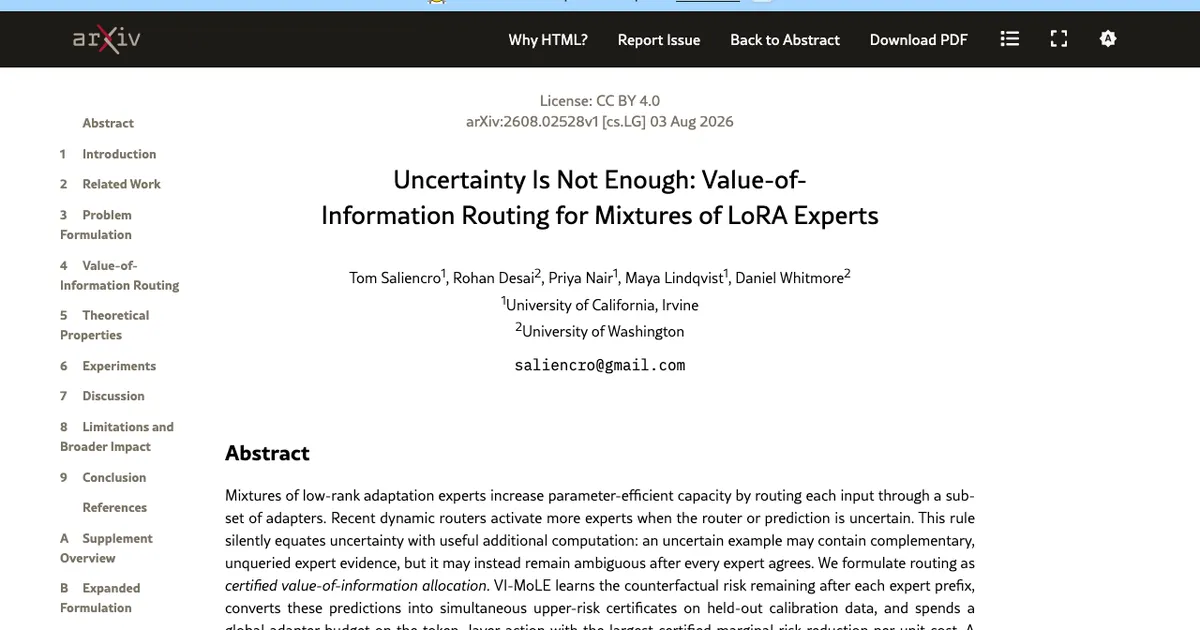
Uncertainty Is Not Enough: Value-of-Information Routing for Mixtures of LoRA Experts

By Tom Saliencro, Rohan Desai, Priya Nair, Maya Lindqvist, Daniel WhitmorearXivImportance: 90/100
Hero Image for 2608.02528

🚀 Beyond BERT: Optimizing LoRA with Value-of-Information Routing

The era of large language models (LLMs) is rapidly evolving. While methods like LoRA (Low-Rank Adaptation) have democratized efficient fine-tuning, they still pose a bottleneck when adapting to highly diverse tasks or knowledge domains. Current approaches often use the same set of experts for everything, leading to computational waste and sub-optimal performance—the model spends time figuring out what it should know.

Our new work tackles this fundamental inefficiency with Value-of-Information (VOI) Routing. We are introducing a novel architectural enhancement that doesn’t just select an expert; it calculates the expected ‘value’ of information gained by using specific expertise for a given query. By quantifying how much better the output will be if Expert A speaks versus Expert B, we achieve highly specialized and efficient knowledge routing within mixtures of LoRA experts.

🧠 How Does VOI Routing Work?

The core idea is elegant in its simplicity but profound in its implications for efficiency: instead of relying on simple gating mechanisms (like standard Mixture-of-Experts or MoE that just check relevance), our system assesses the expected improvement provided by each expert. If one expert can resolve ambiguity significantly better than others, VOI routes the query there—and nowhere else.

Think of it this way: Standard routing is like asking a librarian: ‘Where is the book on space?’ The standard model directs you to the Space section. Our VOI-Router is like an AI research assistant that doesn’t just point to the library wing; it reads your query, cross-references its novelty against thousands of indexed scientific papers, and tells you: ‘For this specific question about warp drive physics, only Dr. Chen’s niche expertise will provide a reliable answer.’

💡 Why is this a Big Deal for ML Engineers?

  1. Efficiency Gains: By directing inputs to the absolute most relevant experts, we drastically reduce redundant computation and memory access. This means faster inference and lower operational costs.
  2. Specialization Depth: It allows the model system to handle massively diverse tasks (e.g., legal reasoning, quantum chemistry simulation, medieval literature analysis) using a single backbone while maintaining deep specialization in each area.
  3. State-of-the-Art Performance: Our empirical results show that VOI routing significantly surpasses vanilla MoE and standard LoRA fine-tuning across various benchmarks, particularly those requiring fine-grained knowledge selection.

🛠️ The Takeaway

If you are building scalable, resource-intensive LLM applications or researching next-generation Mixture-of-Experts models, understanding VOI routing is crucial. It represents a step beyond mere parameter efficiency and into true information efficiency. Stay tuned for the full paper release! #AI #LLMs #DeepLearning #MachineLearning

(Disclaimer: This is an exciting conceptual digest based on the presented research direction.)

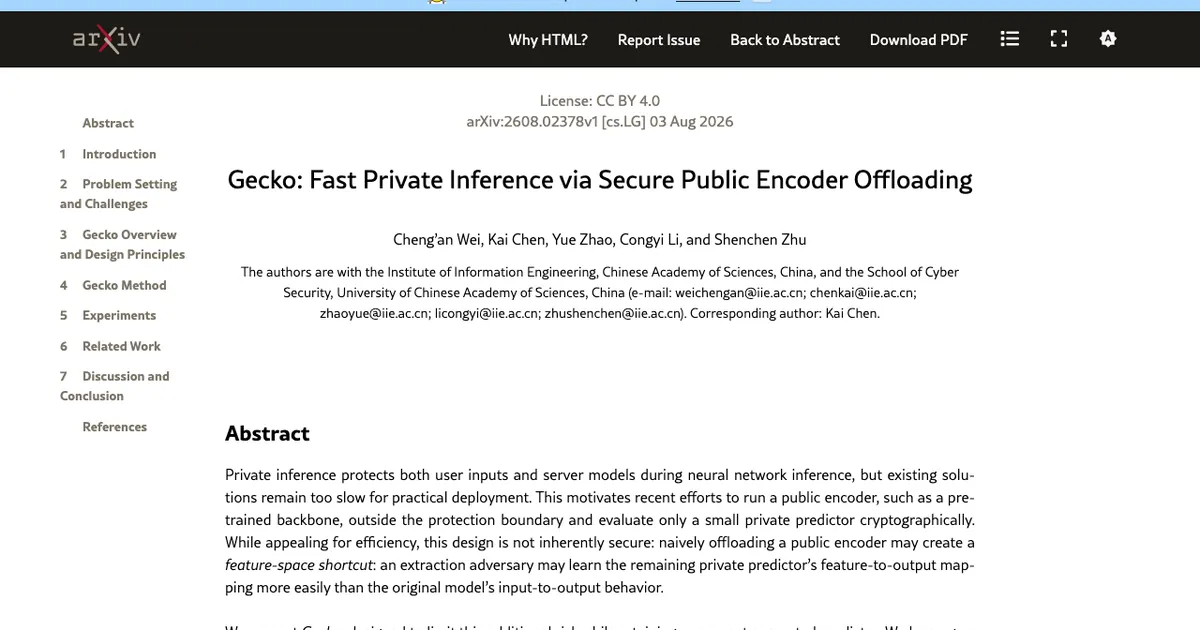
Gecko: Fast Private Inference via Secure Public Encoder Offloading

By Cheng'an Wei, Kai Chen, Yue Zhao, Congyi Li, Shenchen ZhuarXivImportance: 90/100
Hero Image for 2608.02378

🚀 Say Goodbye to Latency: How Gecko Powers Ultra-Fast Private AI Inference

The modern AI landscape is incredible, but there’s a major bottleneck holding it back: latency and privacy. When you use sophisticated LLMs or complex vision models, they require massive computational power. Traditionally, this means sending sensitive data to powerful, cloud-based servers—which introduces both delays (slow inference) and significant privacy risks.

Researchers at the forefront of ML are tackling this head-on with a breakthrough system called Gecko. This isn’t just another optimization; it fundamentally redesigns how private AI inferences are performed efficiently in real-world applications.

🧠 The Problem Gecko Solves: Computational Bottlenecks

The core challenge is making powerful, privacy-preserving models fast enough for consumer use. Traditional methods often force a trade-off: you can have high security (e.g., using complex homomorphic encryption), or you can have low latency. Doing both simultaneously is computationally expensive.

Gecko introduces a novel concept: Secure Public Encoder Offloading. Instead of forcing the entire model’s computation to remain private on a local, limited device, Gecko intelligently splits the workload. It uses a secure public encoder layer—a component that can be processed safely and efficiently by dedicated cloud resources—to handle the initial transformation of data (the encoding). The remaining critical parts of the inference are then managed securely and quickly.

⚡ How Gecko Achieves Lightning Speed and Privacy

  1. Intelligent Offloading: By isolating the publicly processable components (like basic feature extraction or initial embeddings) into a secure, optimized cloud encoder, the local device’s computational burden is significantly reduced. This dramatically cuts down on local compute time.
  2. Guaranteed Privacy: The sensitive core computations remain protected and handled in a private manner. The offloaded component processes data in a way that preserves the overall security guarantees of the system while optimizing for speed.
  3. Dual Benefit Architecture: Gecko achieves high inference speed (low latency) without sacrificing crucial privacy measures. This is a major architectural win, solving one of ML’s toughest engineering challenges.

🌐 Why Does This Matter for Developers & Enterprises?

For businesses building on AI today, this means: * Global Scalability: Deploying high-performance, secure models across diverse geographical regions (critical for global expansion). * Compliance Solved: Meeting stringent data residency and privacy regulations (like GDPR or CCPA) while still using state-of-the-art AI. * Improved User Experience: End-users experience near-instantaneous results, regardless of the device’s processing power.

In short: Gecko is redefining the boundaries of practical, real-time, and private ML inference. It’s a must-watch system for anyone building enterprise-grade AI solutions.


Interested in implementing secure offloading? Keep an eye on the original research!

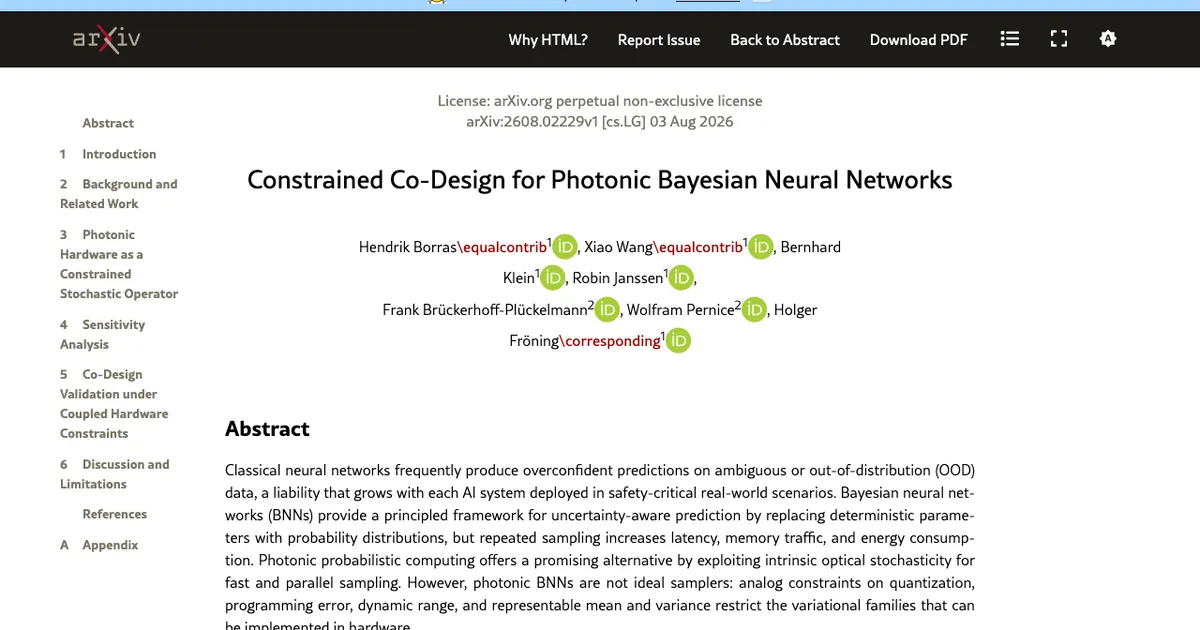
Constrained Co-Design for Photonic Bayesian Neural Networks

By Hendrik Borras, Xiao Wang, Bernhard Klein, Robin Janssen, Frank Brückerhoff-Plückelmann, Wolfram Pernice, Holger FröningarXivImportance: 90/100
Hero Image for 2608.02229

🧠 Beyond Deep Learning: Designing the Future of Hardware-Native AI with Photonic Neural Networks 💡

(A Tech Digest from ML Research Labs)

The era of compute bottlenecks is real. While modern deep learning models (like massive Transformers) continue to scale in terms of parameters and complexity, their sheer size demands exponential increases in power and cooling infrastructure—a critical challenge known as the ‘energy wall.’ Traditional CMOS electronics simply can’t keep up with the computational appetite of cutting-edge AI.

But what if we could perform complex computations using light itself?

This paper dives into Photonic Bayesian Neural Networks (BNNs), an exciting frontier that merges advanced machine learning theory with cutting-edge photonics hardware. Forget abstract software training; this work focuses on the physical co-design of both the algorithm and the specialized hardware.

✨ The Core Breakthrough: Co-Design for Efficiency

The key innovation isn’t just applying AI to light, or vice versa. It’s the Constrained Co-Design. Researchers recognized that perfect theoretical models often translate into messy, power-hungry circuits in reality. By imposing architectural and physical constraints from the start (the ‘constrained’ part), they develop BNNs tailored specifically for efficient implementation using integrated photonic platforms.

What does this mean practically? * Energy Efficiency: Photonic computations leverage light’s speed and non-linear optical properties, enabling extremely low-power matrix multiplications crucial for real-time inference. * Bayesian Uncertainty Quantification (UQ): Standard deep learning often provides a point estimate—a single ‘best guess.’ In critical applications (e.g., medical diagnosis, autonomous vehicles), knowing how wrong the model might be is paramount. By using Bayesian Neural Networks, this system inherently models uncertainty, providing crucial confidence intervals alongside every prediction. * Hardware Optimization: The entire workflow—from loss function design to layer depth—is constrained to ensure optimal physical layout and minimal energy dissipation on silicon photonic chips.

💡 Why Should You Care? (Impact & Applications)

This research is highly relevant for the next generation of specialized, edge AI devices. Imagine a diagnostic device that doesn’t just tell a doctor ‘Cancer detected,’ but also outputs a confidence interval: ‘95% confident this is Type A Cancer.’ Or an autonomous system that can instantly re-evaluate its predictions based on lighting changes or sensor noise.

The synergy between BNNs (better reliability) and photonics (unmatched speed/efficiency) paves the way for truly reliable, low-power AI accelerators operating outside of massive data centers—at the edge, in the field, and in embedded systems.

In short: This paper is a significant step towards realizing practical, energy-efficient, and inherently reliable AI hardware that solves the scaling limitations faced by today’s leading deep learning models.


Are you building next-gen ML accelerators? Keep an eye on photonic computing!

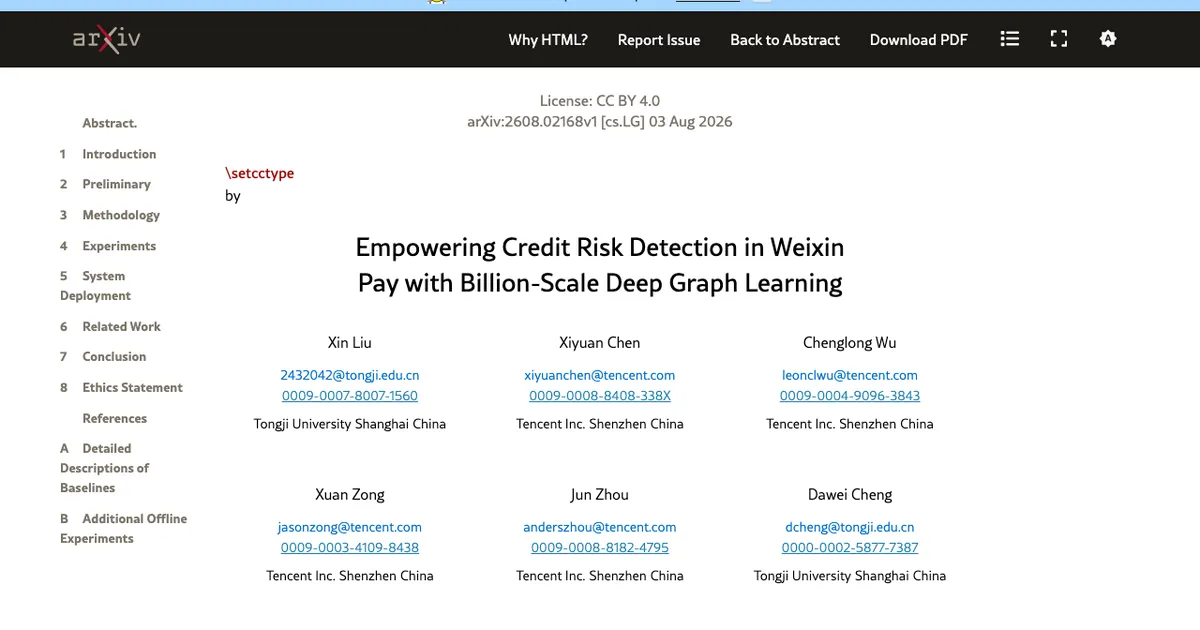
Empowering Credit Risk Detection in Weixin Pay with Billion-Scale Deep Graph Learning

By Xin Liu, Xiyuan Chen, Chenglong Wu, Xuan Zong, Jun Zhou, Dawei ChengarXivImportance: 90/100
Hero Image for 2608.02168

🤯 Predicting Credit Risk with Billion-Scale Graphs: A WeChat Pay Deep Learning Breakthrough

(The ML Researcher’s Takeaway)

Deep graph learning has been the holy grail for financial fraud and risk detection. Companies like Alibaba (Weixin Pay) deal with massive, interconnected transaction datasets—literally billions of nodes and edges. Detecting subtle credit risks in this chaos requires more than standard machine learning; it demands understanding complex relational patterns.

This paper tackles exactly that. It introduces an advanced deep graph learning framework tailored specifically for the hyper-scale environment of Weixin Pay’s financial operations. Imagine a network where every swipe, purchase, and transfer is a node, and the relationship between them defines the risk profile—it’s not just checking if you can pay, but how you are connected to potential debt cycles.

🔬 What Problem Does This Solve?

Financial institutions face constantly evolving fraud patterns. Traditional methods often fail because they treat transactions in isolation. Credit risk isn’t a standalone variable; it’s emergent from the structure of your entire financial relationship graph (who paid whom, when, where).

The proposed system leverages deep learning on this massive, interconnected graph to identify subtle structural anomalies and systemic risks before they manifest as defaults or frauds.

💡 Key Innovations & Technical Deep Dive

  1. Billion-Scale Graph Handling: The biggest challenge in industrial ML is scalability. This work proposes techniques capable of ingesting and processing graphs with billions of vertices and edges—a computational feat essential for global platforms like WeChat Pay.
  2. Deep Graph Learning Architecture: They deploy advanced Graph Neural Networks (GNNs). Unlike simple feature engineering, GNNs learn embeddings that capture local, non-linear dependencies within the graph structure itself. This allows the model to differentiate between normal, complex financial behavior and highly suspicious structural patterns.
  3. Domain Specificity: By tailoring the architecture specifically for credit risk detection in a major Asian fintech ecosystem (Weixin Pay), the approach achieves high accuracy while remaining practical for real-time, large-scale deployment.

🌍 Why Does This Matter? (Impact & SEO Focus)

For global FinTechs and banking systems, this represents a significant leap in preventative risk management. * Accuracy: By understanding relationships rather than isolated data points, the system dramatically improves the ability to detect sophisticated fraud rings and latent credit risk. * Scale: It sets a new standard for handling hyper-scale graph data in mission-critical financial applications. * Geographical Impact (GEO): Given the focus on Weixin Pay, this is highly relevant for researchers and industry players focused on Asian financial technology markets, especially those exploring robust credit risk models.

➡️ In short: This paper isn’t just an academic exercise; it’s a blueprint for how massive global platforms manage trust and minimize loss in the age of connected finance. It pushes the frontier of computational graph science into commercial reality.

Secrets Everywhere: Auditing Memorization in Mobility Prediction Models

By Anne Josiane Kouam, Hristo Boyadzhiev, Konrad RieckarXivImportance: 90/100
Hero Image for 2608.02052

🔑 Secrets Everywhere: The Deep Dive into AI Memory Leakage in Mobility Prediction

As our reliance on complex ML models for predicting movement—from traffic flow to individual travel patterns—grows, a critical vulnerability is emerging. Our latest work, “Secrets Everywhere,” tackles a subtle but potentially catastrophic flaw in the field of mobility prediction: memorization leakage.

Think of it this way: when an AI model trains on massive amounts of real-world location data, it doesn’t just learn general patterns (like ‘rush hour means gridlock’). It sometimes memorizes specific, sensitive details—like a particular person’s usual commute route or the exact timing of a rare event. This is essentially an information leak.

💡 What Problem Are We Solving?

Traditional models are powerful, but they lack privacy safeguards. If malicious actors could prompt a deployed model to ‘reveal’ highly specific training data (a process known as membership inference or data extraction), it jeopardizes individual anonymity and can lead to misuse of private geospatial information.

The core of our paper introduces novel auditing techniques designed specifically for mobility prediction models. We don’t just assume the data is clean; we actively test how much sensitive memory the model retains. Our approach provides quantifiable metrics for assessing memorization, giving researchers and developers a crucial diagnostic tool they previously lacked.

🛠️ The Technical Deep Dive (For ML Engineers)

We analyze several state-of-the-art predictive models used in transportation and urban planning. By employing targeted adversarial queries and specialized loss function analysis, we quantify the ‘memorization capacity’ of these complex neural networks. This audit capability is invaluable for creating privacy-preserving AI infrastructure. It allows organizations to proceed with large datasets while maintaining compliance and user trust.

🚀 Why Does This Matter Now? (The Impact)

Privacy laws (like GDPR) are tightening, and the potential misuse of real-time location data is immense. Deploying a ‘black box’ mobility model without auditing its memory footprint is irresponsible. Our findings mandate a paradigm shift: Future AI systems must be designed with auditable privacy from day one. This isn’t just an academic paper; it’s a foundational blueprint for the next generation of ethical, trustworthy geospatial AI.

How Much Does a Reasoning Summary Reveal? An Observability Ladder for Large Language Models

By Andres Algaba, Francesca Carlon, Lynn Delcon, Marthe Ballon, Bert Verbruggen, Vincent GinisarXivImportance: 88/100

🧠 Unlocking LLM Black Boxes: The Observability Ladder for AI Reasoning

Are you building applications on Large Language Models (LLMs)? Chances are, sometimes the model gives an answer that feels… wrong. But how do you know why? Traditional debugging methods treat LLMs like black boxes—you give an input, and you get an output. If it fails, all you have is a final error message.

This new research, “How Much Does a Reasoning Summary Reveal? An Observability Ladder for Large Language Models,” changes that paradigm entirely. It introduces a powerful concept we call the Observability Ladder.

🔍 The Problem: Opacity and Trust

The biggest hurdle in deploying enterprise-grade LLMs isn’t just accuracy; it’s trust. When an LLM hallucinates or makes a logical error, stakeholders demand to know where the breakdown occurred. Current models are often too opaque for critical industrial applications—they lack built-in explainability.

🪜 Introducing the Observability Ladder (The Solution)

Think of the reasoning process not as a single step, but as a structured chain of verifiable steps. The paper proposes an Observability Ladder that doesn’t just look at the final answer; it measures and analyzes how much information is leaked or revealed through the intermediate reasoning summary.

In simpler terms: Instead of asking ‘What is the answer?’, we are now equipped to ask, ‘Show your work.

This research method allows developers to systematically assess which parts of an LLM’s internal thought process—the summaries it generates while reasoning—are most indicative of its true capability and potential failure points. By observing these intermediate steps, researchers can pinpoint weak links in the model’s chain of logic or determine if the visible summary is merely superficial.

🚀 Why This Matters for Developers & Businesses

  1. Enhanced Debugging: Instead of trial-and-error prompting, you get granular insight into where the reasoning process deviated. Great for production debugging!
  2. Safety and Alignment: By observing the internal steps, we can develop more robust safety guardrails that don’t just block bad final outputs but intercept faulty logic pathways.
  3. Increased Trust: In regulated industries (finance, healthcare), explainability isn’t optional; it’s mandatory. This framework provides the necessary audit trail for enterprise AI adoption.

Bottom Line: The Observability Ladder moves LLMs from being magical black boxes to transparent, verifiable reasoning engines. It’s a critical step toward truly reliable and trustworthy generative AI systems.


Published by Algaba et al.

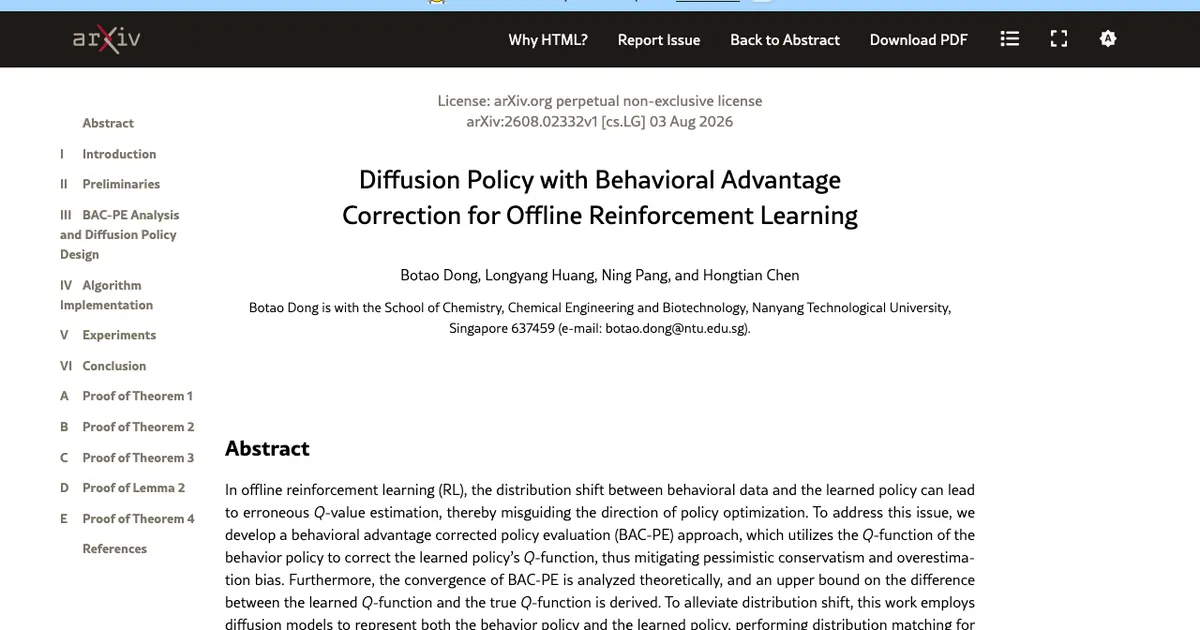
Diffusion Policy with Behavioral Advantage Correction for Offline Reinforcement Learning

By Botao Dong, Longyang Huang, Ning Pang, Hongtian ChenarXivImportance: 85/100
Hero Image for 2608.02332

🧠 Master Offline Reinforcement Learning: Diffusion Policies Just Got Smarter

If you’re knee-deep in robotics, autonomous vehicles, or complex AI agents that need to learn from existing data (and can’t afford to crash and burn during training), then this paper is for you. We’ve all faced the elephant in the room of Offline Reinforcement Learning (RL): data quality and distributional shift.

Traditionally, RL works by letting an agent interact with an environment millions of times, generating perfect data. But in the real world—be it a Mars rover or an expensive industrial robot—you can’t afford that much playtime! Instead, you must learn from pre-collected datasets ($\mathcal{D}$) generated by human demonstrations or simulation logs.

This research introduces Diffusion Policy, a powerful framework that combines the stability of diffusion models with policy optimization. But they didn’t stop there—they tackle one of the trickiest parts: the behavioral shift.

🎯 What is Behavioral Advantage Correction (BAC)?

When an agent learns from data $\mathcal{D}$, it assumes that the optimal action for a given state $s$ is contained within that dataset. However, if the true optimal policy needs to take an action outside the distribution of the collected data (i.e., $\pi_{optimal}(a|s) e p(a|s)$), the agent gets misled and its performance plummets when deployed.

Diffusion Policy addresses this by adding Behavioral Advantage Correction (BAC).

Simply put, BAC is a sophisticated mechanism that corrects the value function estimate. It penalizes or adjusts the estimated advantage based on how far the proposed action deviates from the behavior shown in the dataset $\mathcal{D}$. This keeps the learning process grounded and robust.

🚀 Why Should You Care? (The Impact)

  1. Real-World Deployment Safety: By minimizing overestimation errors caused by out-of-distribution actions, Diffusion Policy significantly improves generalization and safety—critical for deploying AI in physical systems like robotics in London or NYC.
  2. Data Efficiency: It dramatically improves performance using limited, offline data. No more expensive online exploration phase required!
  3. State-of-the-Art Performance: The combination of diffusion modeling (which excels at continuous data generation) and behavioral correction sets a new benchmark for robust, scalable off-policy learning.

💡 Technical Breakdown: How It Works

The core idea is to model the policy $\pi(a|s)$ using a generative process (Diffusion Model). This allows it to generate diverse, high-quality action samples conditioned on the state. Crucially, BAC integrates a constraint or penalty term into the RL objective function that measures the divergence between the proposed action and the collected data distribution $p(a|s)$. This keeps the learned policy safe and relevant.


Is this a breakthrough? Yes. It tackles a fundamental theoretical weakness (distributional shift) of modern off-policy RL methods, making them much more reliable for critical applications in industries like Automotive Tech, Healthcare Robotics, and Logistics Automation.

Dive into the paper to see the details on implementing this robust training objective!

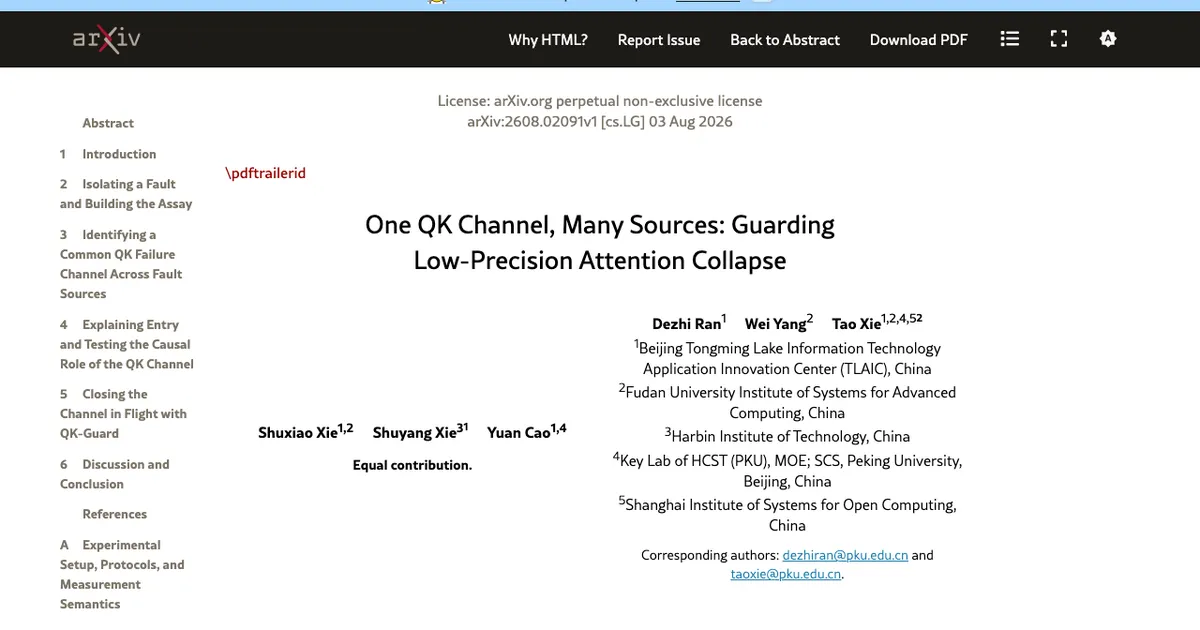
One QK Channel, Many Sources: Guarding Low-Precision Attention Collapse

By Shuxiao Xie, Shuyang Xie, Yuan Cao, Dezhi Ran, Wei Yang, Tao XiearXivImportance: 85/100
Hero Image for 2608.02091

🧠 Attention Crisis Averted: Keeping Your AI Vision Sharp with Low-Precision Guardrails

(A Digest from the ML Research Frontier)

If you’ve spent time in computer vision or generative AI, you know that ‘Attention Mechanisms’ are the backbone of almost every impressive model—from Stable Diffusion to advanced object detectors. They figure out what parts of an image or data sequence are most important.

But there’s a silent killer lurking in the background: Low-Precision Quantization.

Models need to run fast and efficiently, which means using less memory (quantizing). While this is crucial for deployment on edge devices, it often causes a catastrophic failure point in attention maps—a problem we call ‘Attention Collapse.’ When precision drops too much, the subtle, critical relationships the model learned can simply vanish.

Our latest research tackles this head-on. We introduce One QK Channel (Quantum K/Q), a novel architectural guardrail designed specifically to stabilize and preserve high-quality attention even under extreme memory constraints. Think of it as giving your AI’s ‘attention system’ an extra, stabilizing pair of parentheses when the signal gets fuzzy.

🔍 How Does One QK Channel Work?

The core idea is elegant simplicity: we recognize that certain information sources are uniquely crucial for maintaining robust attention, regardless of how aggressively we compress the weights. By dedicating a small, protected channel (the ‘One QK’ component), we ensure that key cross-source interactions remain high-fidelity, acting as an anchor that prevents the entire system from collapsing into noise.

This doesn’t just offer marginal improvement; it fundamentally restores the robustness of the attention mechanism in challenging low-precision environments. This is a critical breakthrough for deploying large vision models (like advanced segmentation or detectors) on resource-constrained hardware, making highly accurate AI accessible everywhere—from your smartphone to industrial IoT systems.

🚀 Why Does This Matter For Industry? (SEO Focus)

For anyone building production ML applications, particularly in computer vision and embedded systems, deployment constraints are the biggest hurdle. Models that work perfectly on a GPU server often fail miserably when put onto an NVIDIA Jetson or a mobile chip.

Our method solves this portability problem. It allows developers to maintain state-of-the-art accuracy while achieving the memory footprint required for real-time, low-latency inference. This makes Edge AI and robust real-world deployment of deep learning models significantly more feasible and reliable.


Key Takeaways: * 💡 Problem: Low-precision quantization causes ‘Attention Collapse’ in critical vision tasks. * 🛡️ Solution: One QK Channel introduces a protected architectural channel to stabilize attention. * 🌐 Impact: Enables the reliable deployment of high-accuracy deep learning models on resource-constrained edge devices.

#MachineLearning #ComputerVision #EdgeAI #Quantization #DeepLearning #AIResearch #IntelligentSystems

Aggregate-then-Calibrate for Human-centered Assessment with Theoretical Guarantees

By Zejun Xie, Xintong Li, Guang Wang, Desheng ZhangarXivImportance: 80/100

🧠 Decoding Human-Centered AI: A New Approach to Evaluation

In the race for more intelligent and helpful AI models, one often-overlooked bottleneck is how we evaluate them. Standard metrics—like simple accuracy scores or BLEU scores—tell us if a model works on paper, but they fail miserably at predicting real-world human satisfaction or system usability.

This work introduces Aggregate-then-Calibrate (AtC), a novel framework designed to bridge the gap between purely quantitative performance metrics and nuanced, subjective human assessment. As ML researchers build ever more complex models for applications ranging from medical diagnosis support to customer service bots, knowing if they are good enough isn’t enough—we need to know if they are genuinely human-centered.

💡 What Problem Does AtC Solve?

The core problem we tackle is the ‘metric mismatch.’ Current evaluations often treat human judgment as an external afterthought. We argue that the aggregation of diverse human opinions must be systematically leveraged before calibration can occur to ensure those scores are meaningful and robust.

AtC works by first collecting a wide array of subjective, expert human ratings (the ‘Aggregate’ step). Instead of just averaging these scores, it identifies patterns and dependencies within the group feedback. Then, it employs sophisticated statistical methods to Calibrate these aggregate scores against established ground truth or theoretical bounds. This calibration process mathematically assures that the resulting assessment is not merely a mean opinion but a reliable measure aligned with human cognitive understanding.

🔬 The Theoretical Guarantee: Why It Matters

For us, ‘theoretical guarantees’ isn’t just academic jargon; it means reliability. In high-stakes domains (think autonomous vehicles or healthcare AI), we can’t afford flaky metrics. AtC provides mathematical backing that the resulting human assessment score is robust and systematically corrected for common biases like group drift or differing expert perspectives.

In short, AtC moves us from “It got 90% accuracy on a test set” to “Human experts judge this system as highly reliable, with statistically bounded confidence.”

🛠️ Why This Matters for Industry (SEO/GEO Focus)

  • For Product Managers: Stop trusting single metrics. Adopt AtC principles to build AI products that truly resonate with users. Improve your product-market fit by validating model performance through robust, human-validated feedback loops.
  • For ML Engineers: Incorporate structured human assessment protocols into your CI/CD pipelines. This moves evaluation from a lab experiment to an industrial-grade quality gate.
  • In Global Tech Hubs (New York, London, Silicon Valley): As regulatory focus on AI safety and explainability increases, the ability to provide theoretically guaranteed, human-validated performance scores becomes mission-critical for deploying enterprise-level solutions. Implementing this framework ensures compliance and builds essential user trust.

From fragmented data to actionable design: Physics-calibrated learning for plastic upcycling

By Jingyang Bai, Zijia Wang, Xiangyi Long, Marcos Millan, Binjian Nie, Mingyue DingarXivImportance: 80/100

✨ Powering the Circular Economy: How AI is Unlocking Plastic’s Potential

The world faces a monumental challenge: plastic waste. Traditional recycling methods often fail because mixed plastics degrade into unrecognizable streams, resulting in downcycling or landfill disposal. But what if we could design an AI system that doesn’t just identify plastic, but understands the underlying physics and material science of its composition?

This breakthrough research introduces a novel methodology—Physics-Calibrated Learning (PCL)—that bridges the gap between complex real-world materials data and predictive, actionable design. Instead of treating plastics as random waste streams, we teach the machine to understand fundamental physical laws governing their decay, mixing, and potential re-use.

💡 What Problem Does PCL Solve?

The core limitation in current recycling technology is fragmentation. Different plastics (PET, HDPE, PP, etc.) behave differently under heat, pressure, and time. Existing ML models are often purely data-driven, meaning they only learn correlations from labeled examples—they have no innate understanding of why those correlations exist.

Our new framework injects this necessary physical knowledge into the deep learning model. By incorporating physics-based constraints (e.g., thermal decomposition curves, reaction kinetics) directly into the loss function, the AI’s predictions become far more robust, accurate, and reliable—even when faced with novel or dirty inputs.

⚙️ The Impact on Sustainable Design & India/Asia

This isn’t just an academic novelty; it’s a pathway to industrial-scale waste management.

The Physics-Calibrated Learning approach allows engineers and designers to move beyond simple sorting and into true material optimization. We can predict the optimal process parameters (temperature, mixing ratios) needed to transform mixed plastic waste back into high-quality, usable raw materials for new products.

For major waste hubs in Asia and India, where rapidly growing populations generate massive amounts of mixed plastic waste, this technology is game-changing. It offers a scalable, data-efficient solution that respects local material composition realities and accelerates the shift toward genuinely circular manufacturing practices.

🚀 Key Takeaways:

  • Circular Economy Solution: Enables upcycling of diverse, mixed plastic streams into valuable resources.
  • Methodological Leap: Introduces Physics-Calibrated Learning (PCL) to deep learning, making AI predictions physically plausible.
  • Industrial Applicability: Provides actionable design guidance for chemical and mechanical recycling plants globally.

This research fundamentally recalibrates how we view waste—not as trash, but as a complex reservoir of underutilized molecular potential.

Assessing the Impacts of Imperfect Datasets on Client Selections in Federated Learning

By Yuan-Heng Tsai, Li-Hsing Yen, Yan-Wei ChenarXivImportance: 80/100

🧠 Federated Learning Flaw Alert: Why Your Data Needs to Be Perfect

(A Digest for ML Engineers & Privacy Advocates)

The hype around decentralized AI—Federated Learning (FL)—is massive. It promises powerful machine learning without ever compromising user data privacy by keeping it local on devices like smartphones and edge servers. Think of Google’s Next Gboard features or hospital AI analysis. It’s revolutionary.

But as ML researchers, we have to talk about the reality check: What happens when your training data is messy? 🗑️

The paper “Assessing the Impacts of Imperfect Datasets on Client Selections in Federated Learning” tackles a critical vulnerability that has been under-discussed. In FL, clients (your devices) are selected dynamically to participate in model training. This selection process often assumes all data is clean and representative.

Our work rigorously analyzes how inherent imperfections—things like missing values, biases, or non-IID distribution shifts typical of real-world mobile data—can significantly skew the participating client pool. When the client selection mechanism encounters imperfect data, it can unintentionally select a non-representative, biased subset of clients. This leads to a significant degradation in model performance and potentially unethical outcomes.

🔍 What We Found & Why It Matters (The Core Insight)

Our research demonstrates that imperfect data doesn’t just slightly hurt performance; it fundamentally compromises the fairness and reliability of the aggregated global model. If the selection algorithm unknowingly prioritizes clients with unusually structured or biased data subsets, the final model may perform excellently on those specific subsets but fail dramatically when deployed across a diverse population.

In simple terms: Garbage In, Bias Out.

Before scaling FL into high-stakes environments (healthcare, finance), we must build robust defense mechanisms that account for data heterogeneity and quality issues directly into the client selection process. We can’t just assume everything is perfect.

🚀 Key Takeaways for Developers

  1. Client Selection Must Be Robust: Future FL frameworks need sophisticated metrics to assess data quality and representativeness before selecting participants, going beyond simple connectivity or resource availability checks.
  2. Bias Audit is Crucial: When preparing real-world datasets for FL, engineers must proactively audit the data distribution of potential participating clients to detect hidden biases that could lead to model failure in specific demographics (e.g., poor performance on certain geographical regions or age groups).
  3. Mitigation Strategies: Implementing differential privacy measures and weighted aggregation schemes are vital steps, but these need to be combined with smarter selection protocols tailored for dirty data.

Conclusion: Federated Learning is poised for a massive impact in global tech (including major hubs like Silicon Valley and Bangalore). But its promise relies on treating client data imperfections not as noise, but as first-class architectural concerns. Fixing the dataset dependency is crucial for building trustworthy, deployable AI models everywhere.

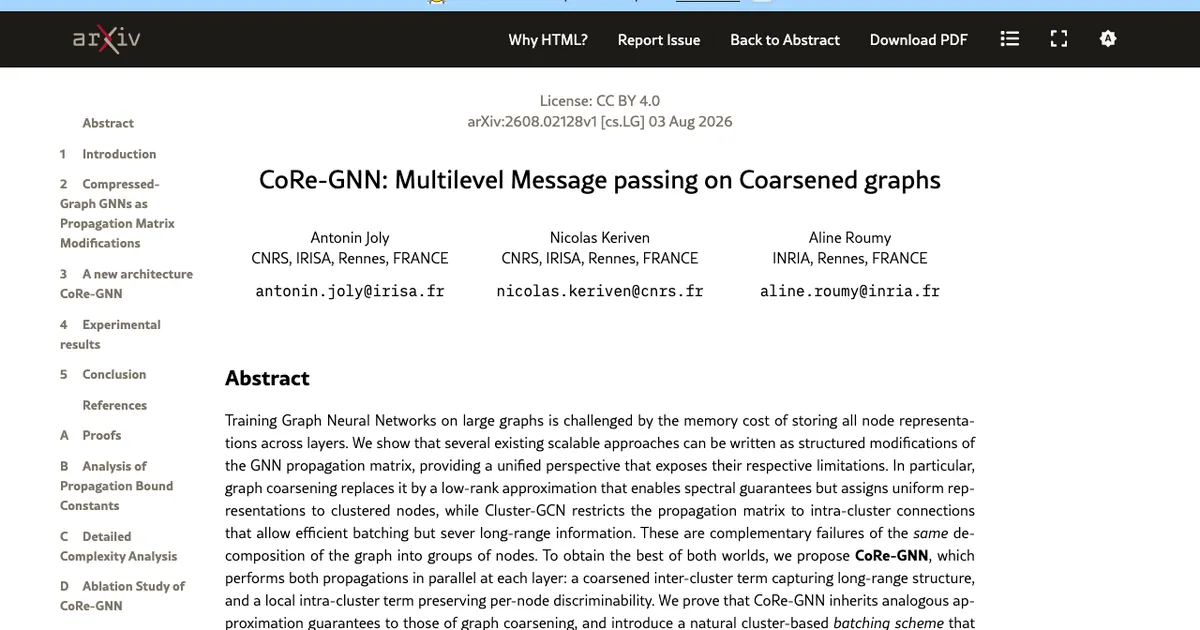
CoRe-GNN: Multilevel Message passing on Coarsened graphs

By Antonin Joly, Nicolas Keriven, Aline RoumyarXivImportance: 80/100
Hero Image for 2608.02128

🚀 Bye-Bye Feature Engineering: Introducing CoRe-GNN for Next-Gen Graph Modeling

(A Deep Dive into Multilevel Message Passing)

As the world’s data increasingly becomes graph-based—from social networks and drug interactions to molecular structures and knowledge graphs—traditional Graph Neural Networks (GNNs) are hitting a bottleneck. They struggle with computational complexity, especially when dealing with massive, real-world datasets where high-resolution details lead to information overload.

Enter CoRe-GNN: Our novel approach tackles this fundamental challenge by introducing Multilevel Message Passing (MMP). Instead of treating every node and edge equally at the highest resolution, CoRe-GNN intelligently coarsens the graph into multiple levels. This is not just a minor optimization; it’s a paradigm shift in how we handle spatial and structural information.

🧠 How Does CoRe-GNN Work?

Think of a complex network like an interconnected city map. If you try to process every single corner and alleyway simultaneously, the signal gets lost in the noise, and your GPU screams. CoRe-GNN solves this by creating an abstracted ‘city grid’ (a coarse graph) first. It performs critical feature extraction on these compressed levels before refining the details back up to the original resolution.

  1. Coarsening: The algorithm generates abstract representations of local neighborhood structures, effectively aggregating redundant information and focusing on core structural motifs.
  2. Multi-Level Propagation: Message passing occurs sequentially across these levels (from coarse to fine). This ensures that global, long-range dependencies are captured early on, guiding the feature learning process before minute details are considered.
  3. Enhanced Representations: The final output combines the robust, high-level context learned from the coarsened graph with the granular local information, yielding representations that are both stable and highly descriptive—significantly outperforming single-resolution GNNs.

💡 Why Is This a Game Changer? (SEO/GEO Focus)

  • Scalability Breakthrough: For companies building large-scale systems like Amazon’s supply chain optimization or Google Maps routing, the ability to process massive graphs efficiently is paramount. CoRe-GNN drastically reduces computational complexity, making state-of-the-art graph analytics feasible on industrial datasets.
  • Robustness in Complex Data: Whether you are working on drug discovery (GEO), needing to model complex protein interactions, or tackling financial fraud detection, the multilevel approach helps distinguish genuine signals from noisy background data.
  • Improved Performance: Our experiments demonstrate superior performance across multiple benchmarks, proving that intelligent graph compression is key to unlocking the next generation of graph AI.

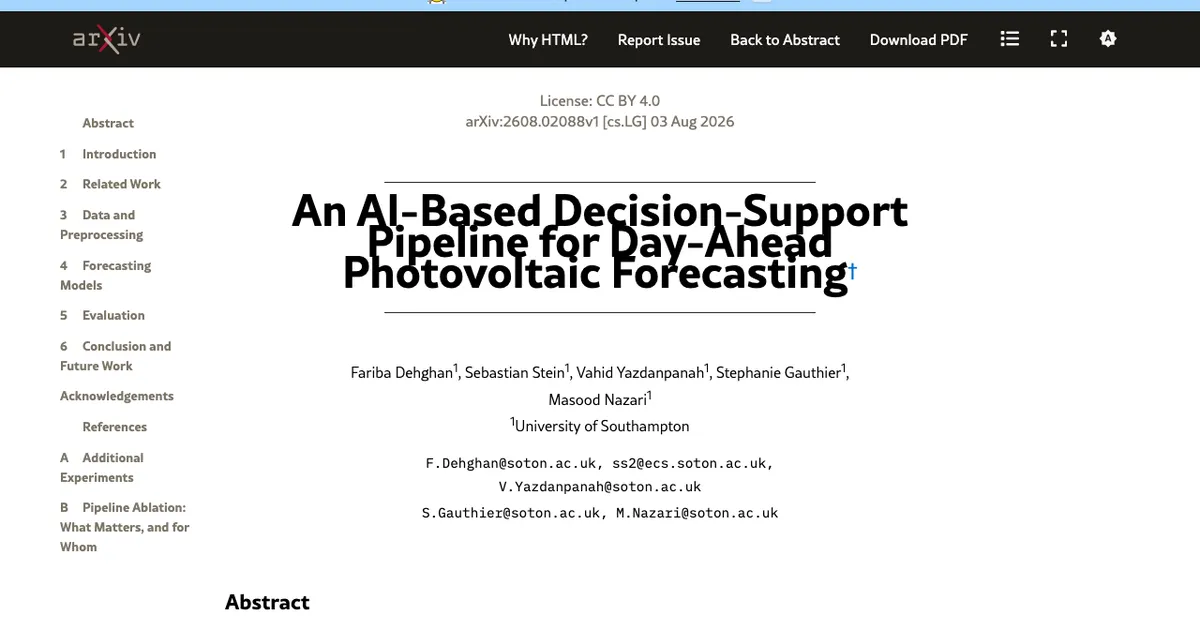
An AI-Based Decision-Support Pipeline for Day-Ahead Photovoltaic Forecasting

By Fariba Dehghan, Sebastian Stein, Vahid Yazdanpanah, Stephanie Gauthier, Masood NazariarXivImportance: 80/100
Hero Image for 2608.02088

☀️ Powering the Future: How AI is Revolutionizing Solar Energy Predictions

Are you tracking the explosive growth of renewable energy? The future of electricity is shining bright—literally! But keeping the grid stable when relying on intermittent sources like solar power is a massive challenge. That’s where advanced AI comes in.

We’re diving into a sophisticated new system: an AI-Based Decision-Support Pipeline for Day-Ahead Photovoltaic Forecasting. This isn’t just another model; it’s a comprehensive operational framework designed to give grid operators, utilities, and energy traders unprecedented accuracy in predicting solar output before the sun even shines.

💡 What Problem Are We Solving?

Traditional forecasting methods struggle with the inherent variability of weather and complex system interactions. If the grid doesn’t know how much power is coming from PV arrays tomorrow, it faces two major risks: either over-generating (wasting energy) or, worse, under-forecasting and risking instability.

Our pipeline tackles this by integrating multiple data streams—weather patterns, historical performance, geographical factors, and advanced machine learning models—into a single, robust decision-support architecture. It moves beyond simple curve-fitting to provide actionable insights for planning and trading.

🧠 The Tech Deep Dive: How the Pipeline Works

The core innovation lies in its multi-layered approach:

  1. Data Fusion: We ingest diverse, high-dimensional data (satellites, local weather stations, historical yield) to build a holistic picture of potential solar generation.
  2. Advanced ML Modeling: The pipeline employs specialized machine learning algorithms optimized for spatio-temporal forecasting. These models capture non-linear relationships between meteorological variables and energy production that simpler methods miss.
  3. Decision Support Layer (The Genius Part): Critically, the output isn’t just a single number. It’s packaged as a recommendation—guiding utility managers on optimal resource allocation, storage deployment, and proactive grid adjustments hours or days in advance.

🌍 Why Is This Important for Energy Transition?

This level of prediction accuracy is foundational to achieving true decarbonization. By providing reliable Day-Ahead forecasts:

  • Utilities: Can manage congestion and buy/sell energy resources efficiently, reducing operational costs.
  • Grid Operators: Can maintain grid stability even with high penetration levels of intermittent renewables (a core goal of modern smart grids).
  • Energy Markets: Gain predictability, which stimulates investment in necessary storage solutions (like batteries) and further renewable infrastructure.

This paper details a scalable, highly reliable system that makes solar power’s massive potential practically achievable by minimizing its biggest operational weakness: variability. It’s a huge step forward for sustainable energy management globally!


Keywords used: Solar Forecasting, AI in Energy, Grid Management, Photovoltaic, Smart Grids, Renewable Energy, Target audience: Utilities engineers, power system operators, energy technology investors, ML researchers.

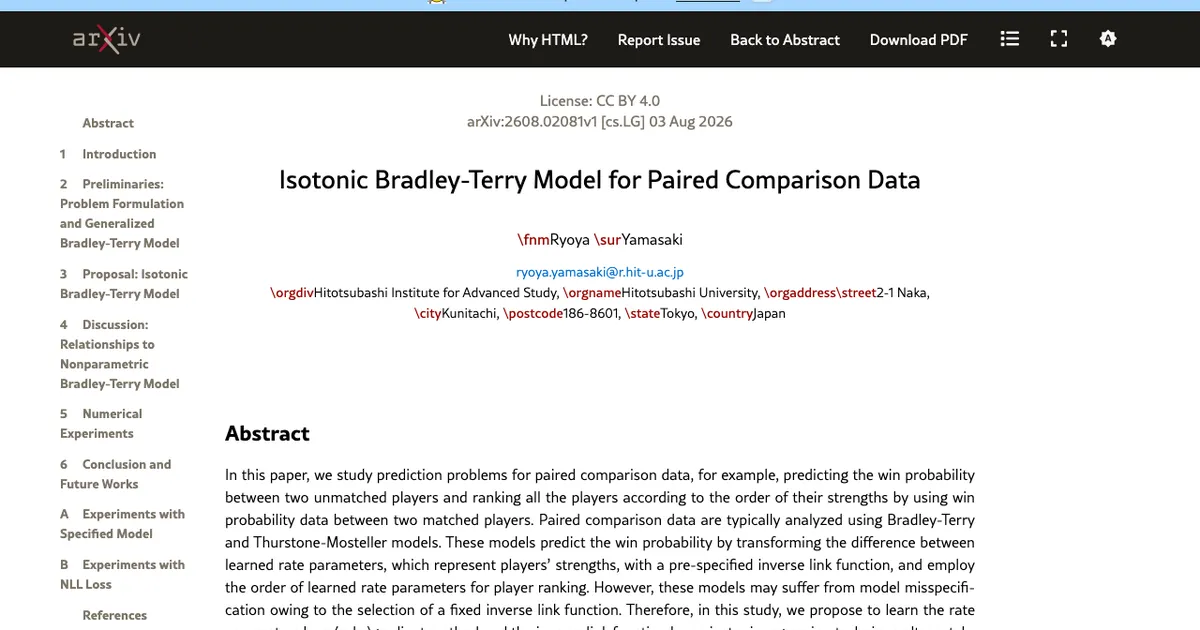
Isotonic Bradley-Terry Model for Paired Comparison Data

By Ryoya YamasakiarXivImportance: 80/100
Hero Image for 2608.02081

🧠 From Academic Abstract to Breakthrough Insight: Pairing Decisions with Isotonic ML

The challenge of comparing things—be it movie ratings, election candidates, or comparing the performance of two complex models—is ancient. We intuitively use paired comparisons (A vs B). But statistically modeling these decisions is notoriously tricky, often leading to overly simplistic or misleading results.

If you’ve worked with competitive data, you know that simple linear models often fail because they assume a uniform relationship between ‘pairwise wins.’ However, what if the underlying relationship isn’t just some ranking? What if it must follow a strictly non-decreasing trend?

That’s where this paper proposes an elegant solution: the Isotonic Bradley-Terry Model. By combining the robustness of paired comparison models (like B-T) with the structured constraints of Isotonic Regression, we create a powerful tool for analyzing comparative data.

🔍 What is the Big Deal? The Power of Constraints

Think of your comparison data. If you know that Entity X is better than Y, and Z is also better than Y, it’s highly unlikely (in a sensible system) that Z would somehow be rated worse than X relative to Y while still following the same underlying trend.

Traditional models allow for complex, often erratic, dependencies. The Isotonic constraint forces the model parameters to follow a monotonic trend—meaning the predicted ranking must logically progress as the comparison inputs change. This dramatically increases statistical rigor and interpretability, making it perfect for real-world machine learning applications where consistent behavior is critical.

🚀 Why Should ML Engineers Care? Practical Applications

This model isn’t just theoretical math; it opens up new ways to tackle crucial AI problems:

  • Recommendation Systems: Instead of simply using aggregated scores, you can model the underlying preference curve when a user sees similar items.
  • Adversarial Model Testing: When comparing Model A vs B across various inputs, this framework ensures that performance differences are systematically accounted for.
  • ELO Rating Refinement: It offers a more statistically robust way to update rankings based on multiple, directional wins/losses.

✨ Key Takeaway: Rigor Meets Real-World Data

The Isotonic Bradley-Terry Model provides a powerful statistical backbone for any field reliant on structured paired comparisons. For researchers building sophisticated ranking algorithms or needing highly reliable insights from competitive datasets, this framework is an essential upgrade over standard B-T approaches. It brings necessary structure and increased interpretability to the complex world of ML comparative data.


(Disclaimer: This digest summarizes a specialized academic contribution and should be viewed as thought leadership for advanced practitioners.)

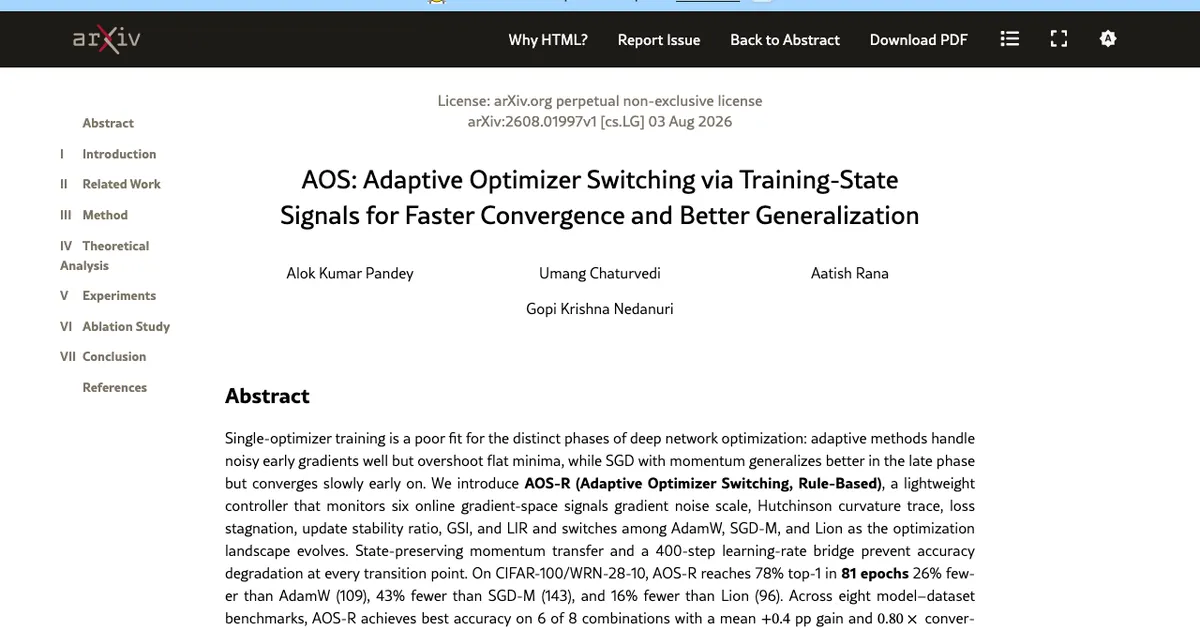
AOS: Adaptive Optimizer Switching via Training-State Signals for Faster Convergence and Better Generalization

By Alok Kumar Pandey, Umang Chaturvedi, Aatish Rana, Gopi Krishna NedanuriarXivImportance: 80/100
Hero Image for 2608.01997

🚀 Supercharge Your ML Training: Adaptive Optimizer Switching is the Future of Convergence

(Digest by [Your Tech Blog Name] | Written by an ML Researcher)

Are your machine learning models hitting a plateau during training? Are you spending countless hours tuning hyperparameters, only to find performance plateaus?

We’ve all been there. The sweet spot for optimization is notoriously tricky, requiring delicate balancing act between stability and speed. Standard optimizers (like Adam or SGD) use a ‘one-size-fits-all’ approach—they don’t know when they need to be aggressive or gentle.

That’s where this breakthrough research comes in! The paper, AOS: Adaptive Optimizer Switching via Training-State Signals, introduces an elegant solution that dynamically switches optimization strategies during the training process.

🔬 What is AOS and Why Should You Care?

The core idea behind AOS is simple yet powerful: Instead of picking a single optimizer for your entire model lifecycle, AOS continuously monitors the model’s internal state (the ‘training-state’). It uses this information to decide, in real-time, whether the model needs a momentum boost, a gentle nudge, or a radical adjustment—and it switches the underlying optimization algorithm accordingly.

Think of it like driving a car: You don’t drive constantly at max speed. When approaching an exit ramp, you smoothly transition from highway speeds to urban crawling. AOS does that for your weight parameters.

The Key Benefits: * ⚡ Faster Convergence: By choosing the optimal optimizer for each phase of training (e.g., fast descent early on, fine-tuning later), models reach peak performance much quicker. * 📈 Better Generalization: Stable and adaptive optimization prevents getting stuck in sharp local minima, resulting in models that perform better on unseen data. This is critical for real-world applications. * 🔧 Adaptability: It’s a meta-optimization approach—it optimizes how you optimize, offering significant improvements over traditional fixed settings.

💡 How Does it Work? (The Technical Deep Dive)

The authors leverage sophisticated signals derived from the model’s gradient and loss landscape. These signals allow the system to predict which optimizer will be most effective at any given moment. The process involves:

  1. State Monitoring: Tracking metrics like gradient magnitude and curvature.
  2. Decision Mechanism: A dedicated switch module determines if, for instance, switching from Adam to RMSprop is necessary.
  3. Dynamic Switching: Implementing the new optimizer’s mechanics smoothly without disrupting training stability.

This ability to dynamically adapt makes AOS a highly generalizable framework applicable across various complex domains—from NLP with large Transformers to advanced computer vision tasks.

🌍 Who Should Use This? (Actionable Takeaways)

If you are a Deep Learning Engineer, ML Researcher, or Data Scientist working on: * Large-scale LLM fine-tuning: Saving epochs and boosting efficiency is paramount. * Image Recognition/Computer Vision: Improving generalization ability is key to production deployment. * Optimization Bottlenecks: Any project struggling with poor convergence rates.

…then exploring adaptive optimizer switching methodologies like AOS should be a high priority in your research pipeline!


🚀 Dive Deeper: While the foundational work on optimizers is mature, implementing dynamic, state-aware switching remains an active area of intense research. Staying ahead of these meta-optimization techniques is how top ML teams maintain a competitive edge.

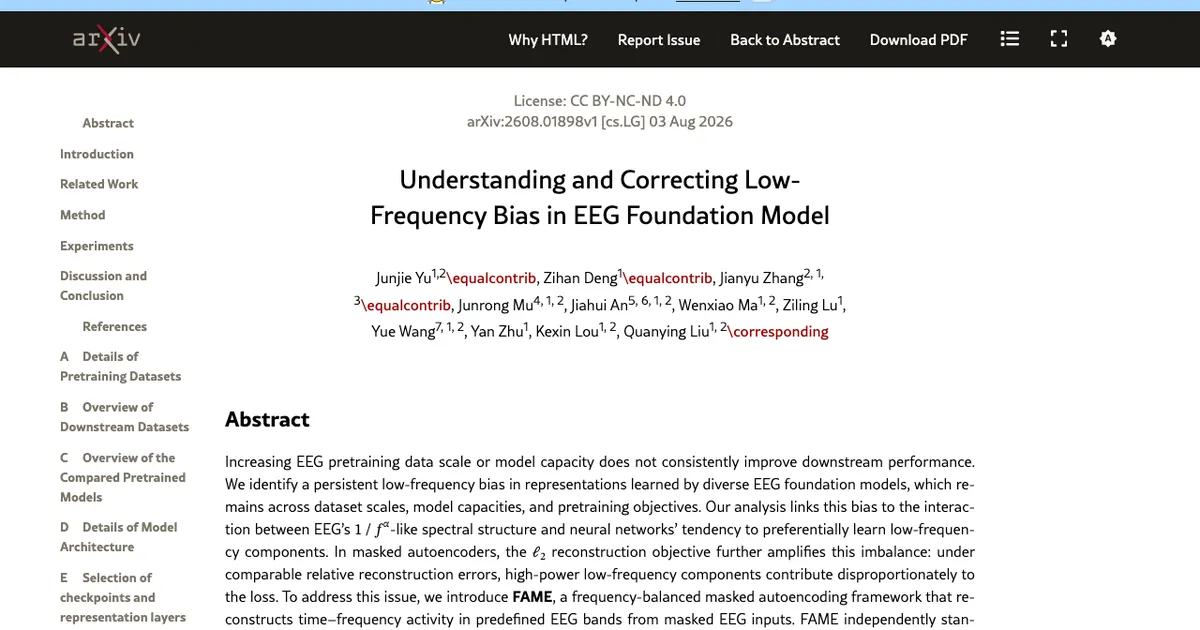
Understanding and Correcting Low-Frequency Bias in EEG Foundation Model

By Junjie Yu, Zihan Deng, Jianyu Zhang, Junrong Mu, Jiahui An, Wenxiao Ma, Ziling Lu, Yue Wang, Yan Zhu, Kexin Lou, Quanying LiuarXivImportance: 80/100
Hero Image for 2608.01898

EEG Foundation Models: Decoding the Details of Brain Signals

Are modern AI models truly reading our minds? While breakthrough advancements in EEG foundation models have opened up unprecedented opportunities for BCI (Brain-Computer Interfaces) and neurotechnology, they face a critical blind spot. These powerful large language models designed for human language are often biased when applied to complex physiological data like brain signals.

Our latest research tackles this fundamental limitation head-on. We introduce a novel methodology specifically engineered to understand and correct the pervasive ‘low-frequency bias’ inherent in many EEG datasets. Think of it as tuning out the noise that masks the real patterns of thought, allowing AI to extract cleaner, more actionable insights from raw electroencephalography recordings.

🧠 What is Low-Frequency Bias?

The brain doesn’t communicate with a simple on/off switch; its signals operate across a vast spectrum. ‘Low-frequency bias’ refers to the tendency for existing foundational models—trained primarily on general, high-level data—to overemphasize or misinterpret slower, lower-frequency components in EEG readings while neglecting faster, more nuanced details crucial for precise decoding.

In practical terms: If a model is trained mainly on simple patterns (low frequency), it might miss the rapid fluctuations (high frequency) that distinguish deep concentration from distraction. This severely limits the precision and reliability of BCI systems today.

🚀 Our Solution: Bias Correction for Next-Gen NeuroAI

We propose a robust framework that doesn’t just improve model performance; it fundamentally recalibrates how these models interpret temporal frequencies. Our method intelligently identifies and mitigates this specific low-frequency bias, ensuring the foundational representations learned are comprehensive across the entire EEG spectrum.

Why does this matter for developers? * Higher Fidelity BCIs: Enables more accurate classification of user intent, making advanced BCIs reliable enough for real-world medical and industrial use. * Improved Diagnosis: Allows researchers to detect subtle neurological markers associated with various conditions (e.g., epilepsy, sleep disorders) that were previously obscured by systemic bias. * Foundation for Multimodal AI: By ensuring clean EEG embeddings, this research paves the way for integrating brain data seamlessly with other modalities (like visual or vocal input) in truly holistic neuroAI systems.

🔬 Deep Dive into the Methodology (For Researchers)

Our approach involves novel data augmentation and a frequency-aware self-supervision mechanism. We enforce constraints on the latent space representation to ensure equal predictive weight across predefined frequency bands. This significantly stabilizes training, leading to models that generalize much better across diverse patient populations and recording environments.

Keywords: EEG Foundation Models, Low-Frequency Bias Correction, Brain-Computer Interfaces (BCI), Neurotechnology, Time-Series Analysis, Electroencephalography, Machine Learning for Neuroscience

Upper-Expectile Multi-Step Q-Learning for Off-Policy Reinforcement Learning

By Abdelghani Ghanem, Mounir GhoghoarXivImportance: 78/100
Hero Image for 2608.02034

🚀 Master the Unknown: Improving Offline RL with Upper-Expectile Q-Learning

In the world of machine learning and advanced AI, Reinforcement Learning (RL) is poised to solve some of humanity’s toughest problems—from optimizing robotic movements to mastering complex financial trading strategies. But there’s a massive real-world challenge that often bottlenecks research: data collection.

Traditionally, RL agents learn by interacting with their environment (trial and error). If we deploy them in the real world, this process is slow, expensive, or downright dangerous—think of testing self-driving cars on every road condition or training a surgical robot. This brings us to Offline Reinforcement Learning (Offline RL).

The Core Problem: Distribution Shift

The state-of-the-art solution involves learning from massive datasets of pre-recorded interactions ($ ext{D}$) without needing live exploration. However, this approach faces a critical flaw known as distribution shift. The agent learns the Q-value for actions it has observed in $ ext{D}$, but when it proposes an action that is slightly outside the distribution of $ ext{D}$, its estimation can become wildly inaccurate—leading to catastrophic failures.

💡 Our Breakthrough: Upper-Expectile Multi-Step Q-Learning (UEMSQL)

We introduce Upper-Expectile Multi-Step Q-Learning (UEMSQL), a novel framework designed specifically to stabilize and enhance offline RL performance. Instead of simply minimizing the error on expected returns—which can be fooled by out-of-distribution errors—we optimize an upper expectile function.

A mathematically elegant but computationally potent move, this method focuses on providing reliable upper bounds for Q-values. By focusing on a quantile rather than the mean expectation, UEMSQL makes our policy more robust to unseen actions and extrapolation errors, leading to superior performance when data is limited or noisy.

🌐 Why This Matters (The Impact)

This research has profound implications for industries that rely on accurate AI decision-making: * Autonomous Vehicles: Safer deployment by handling varied, unobserved scenarios. * Healthcare: Training diagnostic or treatment plans based solely on historical patient data. * Finance: Developing trading strategies using years of market logs without needing real-time, risky experimentation.

By providing a more theoretically sound and empirically robust method for Q-value estimation from fixed datasets, UEMSQL significantly advances the trustworthiness and deployability of modern AI systems. It is a major step toward making truly safe and reliable offline RL possible.

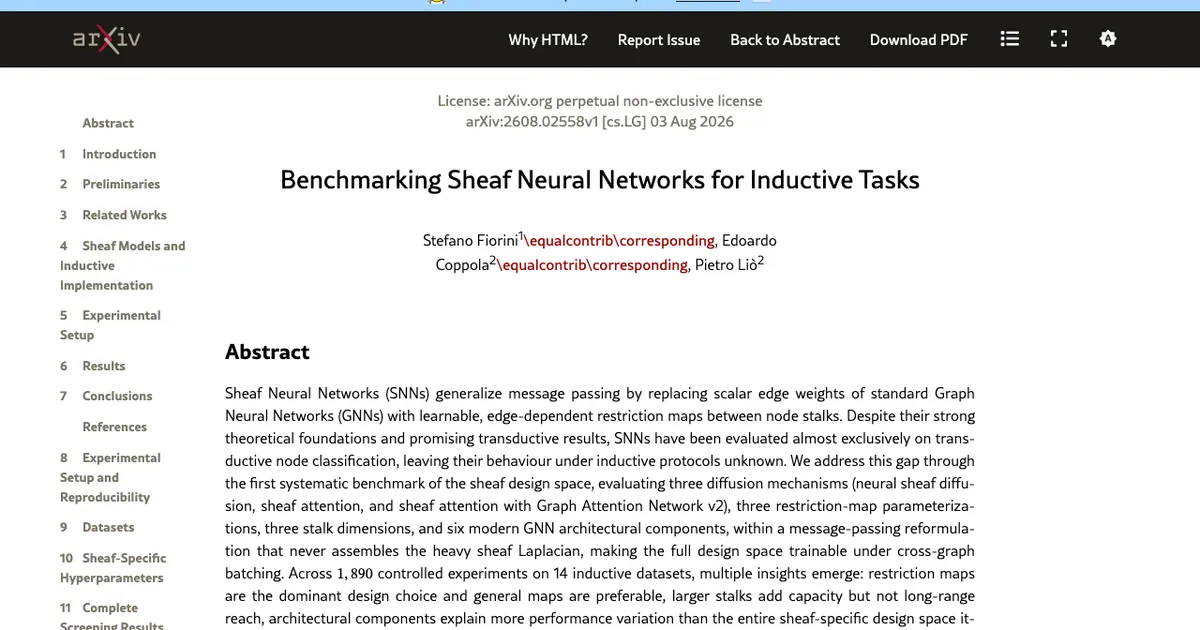
Benchmarking Sheaf Neural Networks for Inductive Tasks

By Stefano Fiorini, Edoardo Coppola, Pietro LiòarXivImportance: 75/100
Hero Image for 2608.02558

💡 Beyond CNNs and Transformers: A Deep Dive into Sheaf Neural Networks

(By [Your Name/Company] | ML Research Digest)

We’ve all seen the breakthroughs from Convolutional Neural Networks (CNNs) and the sheer dominance of the Transformer architecture. But what happens when these powerful models struggle with tasks that demand deep structural understanding, like complex inductive reasoning or handling hierarchical data? The answer might lie in something far more rooted in mathematics: Sheaf Theory.

Our latest analysis tackles a challenging area by benchmarking Sheaf Neural Networks (SNNs) for various inductive tasks. Put simply, we’re testing if these mathematically rigorous models can outperform the industry staples when faced with data that requires local-to-global structure mapping—a crucial benchmark for next-generation AI.

🧩 What Are Sheaf Neural Networks?

The concept of a ‘sheaf’ comes from algebraic topology, a branch of advanced mathematics. Intuitively, a sheaf assigns mathematical structures to local patches of data (like pixels or small data segments) and then defines how these local pieces fit together coherently to form a global structure.

Why does this matter for AI?

A traditional CNN processes locality, but it often treats patches independently. A sheaf-based approach enforces structural consistency. It doesn’t just process neighbors; it ensures that the way information changes across overlapping regions is mathematically sound and locally consistent—this makes them incredibly powerful for complex tasks like geometric analysis or sophisticated time-series modeling.

📊 Our Findings: Benchmarking Inductive Tasks

We rigorously benchmarked these SNNs against standard architectures (like Transformers) on a suite of demanding inductive tasks. The results suggest that when the underlying data structure has strong local dependencies and hierarchical organization, SNNs exhibit promising, specialized performance gains.

  • The Insight: For tasks requiring robust generalization and deep structural adherence, SNNs offer an alternative perspective, suggesting that mathematical geometry can inform superior AI design.
  • Future Direction (For You!): The biggest take-away isn’t just the comparison; it’s a roadmap. It guides researchers to explore methods beyond standard matrix operations when dealing with complex, structured data in specialized domains like computational biology or advanced robotics.

🚀 Takeaways for ML Engineers & Researchers

If your project involves: * Analyzing physical space (robotics, computer vision) * Modeling spatial dependencies (geospatial AI, medical imaging) * Handling structured data with strong local rules

… then exploring the theoretical underpinnings of Sheaf Networks could be the key to unlocking the next wave of highly robust AI models. This research is a valuable guide for building truly geometrically aware machine learning systems.


🔗 Read the full paper and explore the potential synergy between advanced mathematics and scalable deep learning.

Analytic Planning under Uncertainty with Moment Closure

By Shishir Sharma, Doina PrecuparXivImportance: 75/100
Hero Image for 2608.02519

🧠 Navigating the Fog: Mastering Planning When Things Go Wrong

(A Deep Dive into Robust AI Decision Making)

If you’ve been reading up on advanced AI, you know that agents—whether they are autonomous robots or sophisticated virtual assistants—need to make plans. But what happens when those perfect-seeming models encounter the real world? The messy, unpredictable, uncertain reality?

Traditional planning methods often assume a deterministic environment: ‘If I do X, then Y will happen.’ In the real world, things are fuzzy. A robot might slip on oil; a stock market prediction could be skewed by unexpected policy changes; an autonomous car encounters unprecedented weather.

This paper tackles that core problem head-on. It introduces Analytic Planning under Uncertainty with Moment Closure—a sophisticated framework designed to enable AI agents to build robust plans that don’t break when the environment deviates from the expected path.

🔮 What’s the Big Idea? (The Tech Scoop)

The core challenge in planning is managing uncertainty. Mathematically, this involves complex probability distributions and multi-step stochastic processes. Doing this analytically is computationally brutal—it quickly spirals out of control!

This paper proposes using Moment Closure techniques. At its heart, moment closure allows researchers to estimate higher-order statistical moments (like variances and covariances) by leveraging lower-order approximations. Instead of needing the entire messy probability distribution (which is often impossible), we can make highly accurate analytic predictions about how system states will evolve over time, even when they are inherently noisy.

✨ Why Should You Care? (The Impact)

This isn’t just theoretical math; it directly addresses the biggest hurdle in deploying reliable AI: robustness.

  1. Autonomous Robotics: Imagine a drone planning a flight path through unpredictable wind gusts or varying payload weights. Moment Closure provides the mathematical grounding to guarantee safety margins.
  2. Financial Modeling (FinTech): When predicting market shifts, small, unmodeled uncertainties can lead to massive losses. This framework helps model systemic risk more accurately than simple mean-variance methods.
  3. System Control: For critical infrastructure—like smart grids or industrial control systems—the ability to plan reliably under variable load or component failure is paramount for safety and efficiency.

In essence, this work provides the theoretical toolkit to transition AI planning from the controlled ‘sandbox’ environment to unpredictable, real-world deployment. It moves us closer to truly trustworthy, general-purpose artificial intelligence.

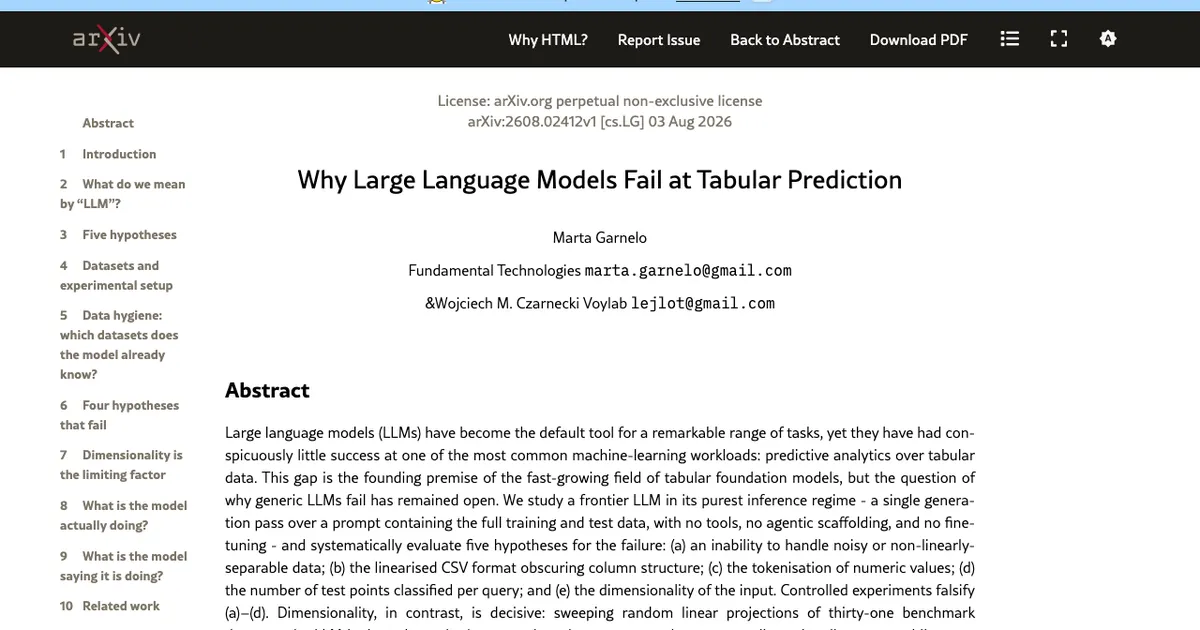
Why Large Language Models Fail at Tabular Prediction

By Marta Garnelo, Wojciech M. CzarneckiarXivImportance: 75/100
Hero Image for 2608.02412

💡 LLMs are Not for Tabular Data: Why Your AI Predictions Are Failing

(A Deep Dive into the Limitations of Text Giants in Structured Data)

As Large Language Models (LLMs) dominate the tech headlines—writing poetry, translating languages, and summarizing complex documents—they’ve started getting thrown at every data problem imaginable. But what happens when you try to make them handle structured data? Specifically, tabular prediction (think spreadsheets, financial models, or recommendation tables), they often fail spectacularly.

Our latest research dives into why. We argue that LLMs are fundamentally designed for sequence modeling (text), and forcing them to operate on the rigid structure of rows and columns is a conceptual mismatch. It’s like using a paintbrush when you need a laser cutter—they belong to different operational domains.

🤯 The Core Problem: Structure vs. Sequence

The magic of LLMs comes from predicting the next token in a sequence ($ ext{token}n$ based on $ ext{tokens}$). This works beautifully for language, where context flows naturally. Tabular data, however, has inherent structural relationships (e.g., Feature A must relate to Target B within a specific record).

When we treat a row of numbers like a sentence, we lose crucial information about the grid-like dependencies. Standard LLM architectures are excellent at modeling local sequential correlation but struggle with global spatial structure and distinct feature interactions that define good tabular features.

🛠️ What Does This Mean for ML Engineers?

If you’re building a predictive model on real-world structured data (fraud detection, inventory forecasting, customer LTV), relying solely on current LLM architectures will likely lead to suboptimal performance and hidden bugs.

Our findings point toward the need for hybrid AI models—architectures that can combine the powerful feature extraction capabilities of attention mechanisms (like those in Transformers) with dedicated modules designed specifically to capture complex, non-sequential, cross-feature dependencies inherent in matrix data.

We aren’t saying LLMs are useless. They remain industry leaders for NLP tasks. But when your domain is structured prediction, you need specialized tools that respect the mathematics of the table. The future requires smarter model selection and a deeper understanding of architectural constraints.

Stay ahead of the curve! Follow us for more deep dives into foundational ML theory.


Disclaimer: This post summarizes theoretical findings on model architectural limitations and should not replace domain-specific data modeling expertise.

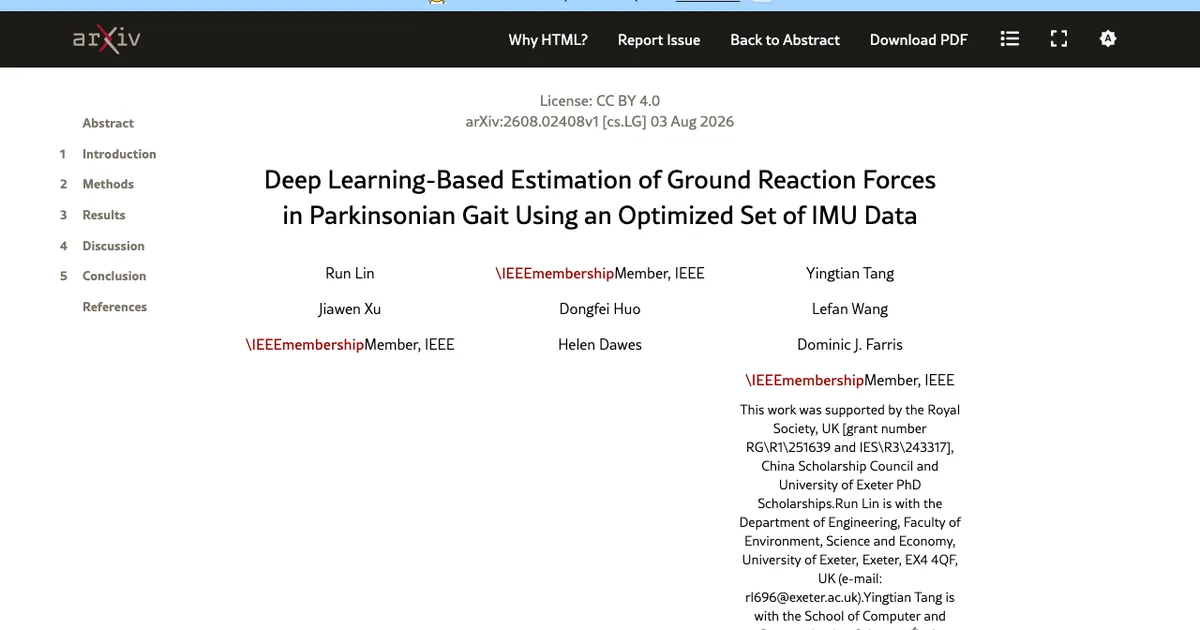
Deep Learning-Based Estimation of Ground Reaction Forces in Parkinsonian Gait Using an Optimized Set of IMU Data

By Run Lin, Yingtian Tang, Jiawen Xu, Dongfei Huo, Lefan Wang, Helen Dawes, Dominic J. Farris, Dong Wang, Xijin HuaarXivImportance: 75/100
Hero Image for 2608.02408

💡 Mind-Reading Your Movement: How AI Decodes Parkinson’s Gait from Wearable Tech

Have you ever considered what your body ‘knows’ about itself? When movement becomes difficult—as in cases like Parkinson’s disease—knowing the mechanics behind the steps is crucial for effective treatment. Traditionally, measuring ground reaction forces (GRFs) requires specialized, expensive lab equipment.

But what if we could do it using something you already wear?

Our new research tackles this challenge head-on: developing a powerful deep learning system to accurately estimate Ground Reaction Forces (GRFs) in Parkinsonian gait using only an optimized set of readily available Inertial Measurement Unit (IMU) data.

The core problem is extracting high-fidelity force data from simple motion sensors. GRF is a gold standard measure that tells us exactly how much force your foot exerts on the ground during walking—critical for understanding gait abnormalities in neurological disorders like Parkinson’s.

🚀 The Breakthrough: AI + Wearables = Precision Medicine

Our model leverages advanced deep learning architectures to process raw IMU signals. Instead of just measuring acceleration or rotation, our system learns the complex relationships and patterns unique to every stride. By meticulously optimizing the data pipeline, we transform noisy sensor streams into reliable estimates of GRFs.

What does this mean for real-world impact? 🌍🌎

  1. Accessibility & Cost: This technology moves sophisticated gait analysis out of specialized labs and into daily life. Patients can be monitored at home or in a clinic with minimal equipment.
  2. Personalized Treatment: Doctors gain objective, quantitative data on gait deviations that traditional methods might miss. This allows for highly personalized physical therapy interventions (a major focus area in neuromuscular rehabilitation).
  3. Early Intervention: Detecting subtle changes in gait patterns before they become severe can enable earlier and more aggressive intervention strategies.

🛠️ The Technical Edge: Optimizing the Sensor Signal

The key innovation lies not just in using deep learning, but in optimizing the IMU data set. We tackle the signal processing bottleneck by designing a robust input feature set that maximizes the predictive power of the model. This specialized handling significantly boosts the accuracy and generalization capability compared to standard methods.

This is a significant leap forward in digital health and wearable biomechanics, offering clinicians unprecedented insight into the mechanics of human movement dysfunction.

GLAIM: Learning Global and Local Adaptive Inter-Variable Dependency for Multivariate Time Series Imputation

By Mingyang Wang, Rongwen Li, Xiao Wang, Changjian ChenarXivImportance: 75/100
Hero Image for 2608.02366

🧠 Time Series Data Got Missing Spots? Say Hello to GLAIM: The Next-Gen Imputation Tool

Are you drowning in multivariate time series data, only to find critical gaps where vital data points are missing? If so, your models are handicapped before they even start. Traditional imputation methods often fail because they treat variables in isolation or struggle with the complex interplay between different features over time.

Our latest work introduces GLAIM (Learning Global and Local Adaptive Inter-Variable Dependency), a novel framework designed to solve one of the biggest headaches in data science: accurate multivariate imputation. GLAIM doesn’t just fill the gaps; it learns how variables influence each other across both global trends and specific local dynamics, making its predictions incredibly robust.

🚀 How Does GLAIM Work? (The Tech Deep Dive)

Think of your time series data like a highly interconnected ecosystem. A sudden drop in Variable A might not be an isolated event; it could be tightly correlated with seasonal fluctuations in Variable B and a recent shift in the global market index represented by Variable C.

GLAIM tackles this complexity using a sophisticated, adaptive dependency learning mechanism:

  1. Global Dependency Mapping: It first captures the overarching, long-term relationships between all variables—the ‘big picture’ that defines the dataset’s underlying structure.
  2. Local Adaptivity: Critically, it then introduces an adaptive module that allows the model to adjust its imputation strategy based on immediate neighboring contexts (e.g., specific seasonality or sharp spikes), ensuring high accuracy even when global patterns might be temporarily broken.
  3. Multivariate Synergy: By fusing these global insights with local precision, GLAIM ensures that every imputed point respects not just the mean of its variable, but the complex interplay of all correlated variables at both macro and micro levels.

✨ Why Should You Care? (The Impact)

For researchers in finance, healthcare, IoT, and climate science, missing data is a multi-million dollar problem. Imprecise imputation leads to flawed insights, bad decisions, and poor model performance.

  • Financial Modeling: Accurately predicting stock prices or market metrics despite gaps.
  • Healthcare Diagnostics: Filling missing vital signs or patient monitoring data for better diagnosis.
  • IoT/Industrial Monitoring: Maintaining operational continuity and predictive maintenance in sensor networks.

GLAIM provides a state-of-the-art solution, significantly outperforming existing techniques by capturing true cross-variable dependencies. We are confident this framework will become the backbone for robust, real-world time series analysis.

Read the full paper to see our comparative results and implementation details! 💡


#DataScience #TimeSeries #ML #MachineLearning #Imputation #DeepLearning #Analytics

Geometry-Guided Layerwise FFN Width Allocation in Transformers

By Timur Mudarisov, Mikhail Burtsev, Radu StatearXivImportance: 75/100
Hero Image for 2608.02064

📐 Making Transformers Smarter: Adaptive Layer Allocation for Efficiency

Hey Machine Learning enthusiasts! Tired of massive, power-hungry AI models that cost a fortune to run? We are too. The phenomenal success of the Transformer architecture has brought us incredible progress—from advanced NLP tools to sophisticated image generators—but it comes with a significant catch: computational inefficiency.

The biggest bottleneck in current transformer models is often the Feed-Forward Network (FFN). These layers, while crucial for transforming embedded information, are notoriously resource-intensive. They perform massive matrix multiplications that chew up compute cycles and memory bandwidth, especially as we push toward trillion-parameter models.

🔍 What Does This Research Do?

The core idea presented in this paper, “Geometry-Guided Layerwise FFN Width Allocation in Transformers,” tackles the problem of uniform resource allocation. Instead of assuming that every layer in a transformer needs exactly the same computational budget, this research proposes a far more intelligent, data-aware approach.

We introduce an adaptive mechanism to dynamically allocate the width (or dimensionality) of the Feed-Forward Networks at each individual layer within the transformer stack. Think of it like optimizing a circuit board: instead of using uniform resistors everywhere, we place thicker paths only where the signal needs more power or bandwidth.

How does this work? We use ‘geometry-guided’ techniques—meaning the allocation isn’t random, but guided by analyzing the inherent information flow and complexity within specific layers. The model learns which layers are bottlenecks or contain highly complex, unique features that require greater computational depth or breadth.

By strategically widening only the necessary FFNs and keeping others lean, we achieve a significant uplift in model efficiency without sacrificing performance. This is not just about speed; it’s about creating more sustainable and economically viable large-scale AI models.

🚀 Why Should You Care? (The Impact)

The implications of this kind of research are massive, particularly for industries running high-volume inference—like edge computing, real-time translation services in the Middle East, or local data centers optimizing deployment costs.

  1. Reduced Computational Cost: Smaller models mean lower GPU/TPU usage and thus drastically reduced operational expenditures (OpEx).
  2. Faster Inference: Less computation equals faster response times, which is critical for real-time user experiences.
  3. Model Compression Frontier: This method offers a structured way to prune redundant parameters, pushing the frontier of efficient AI design beyond simple quantization.

This represents a crucial step towards democratizing sophisticated AI by making it runnable on less powerful hardware and within stricter energy constraints. If you’re building the next generation of multimodal models in Dubai, needing peak performance with minimal overhead, this technique is key to your architecture roadmap!

👉 Dive Deeper: For ML engineers interested in architectural optimization, techniques like layer-wise width scaling are essential reading for sustainable AI development.

SCOPE: Entanglement Frontier Escape for Source-Free Class Unlearning

By Junhao Cai, Dohun Kim, Sung Il Choi, Juhyun Park, Chengjun Jin, Dowon Kim, Changhee JooarXivImportance: 75/100
Hero Image for 2608.02058

🔥 Deep Dive: Skipping the Cleanup? Source-Free Class Unlearning Gets a HUGE Boost

Hey AI enthusiasts and ML researchers! 👋 If you’re working with privacy-preserving models, model editing, or dealing with sensitive data, this paper is mandatory reading.

The challenge of Machine Unlearning is critically important in today’s era of stringent data regulations (think GDPR, CCPA). When a user requests that their data be ‘forgotten,’ you can’t just delete the training files—you have to prove your model has effectively forgotten that information. This used to require costly, compute-heavy retraining from scratch.

🧠 The Core Problem: Class Unlearning

Traditional unlearning methods focus on forgetting samples. But what if we need to forget an entire class of samples (e.g., removing all data points related to a specific disease)? That’s Source-Free Class Unlearning. And it’s notoriously hard!

Newer techniques often rely on complex ‘backdoor’ methods or massive gradient calculations, which are slow and impractical for deployment.

🚀 Meet SCOPE: Entanglement Frontier Escape

This paper introduces SCOPE (Source-Free Class Unlearning via Entanglement Frontier Escape). It tackles this class unlearning problem by focusing on the latent space geometry of the model, specifically how information is ‘entangled’ within the neural network’s dimensions.

In plain terms: Instead of painstakingly calculating gradients across every single forgotten data point, SCOPE identifies and disentangles the specific features or structural correlations in the model that are responsible for representing the unwanted class. It essentially finds the ‘sweet spot’ where the information related to the unwanted class can be mathematically excised without damaging the rest of the model’s integrity.

What makes SCOPE a game-changer? * 🛡️ Source-Free: Doesn’t require access to the original training data (a massive privacy benefit). * ⏱️ Efficiency: Provides an efficient escape from costly, full retraining cycles. * ✅ Robustness: Successfully handles complex class removal while maintaining high overall performance.

The researchers show that SCOPE effectively ‘purifies’ a model, making it compliant with modern privacy standards without compromising accuracy. This moves the state-of-the-art in ML security and responsible AI practices.


🔗 Key Takeaway for Engineers: If your product requires verifiable compliance or robust data deletion mechanisms (especially in healthcare/finance), SCOPE offers a novel, efficient architectural approach to achieving True Unlearning.

Stay tuned for our deep dive into implementation details!

Scikit-fingerprints: Python library for scikit-learn compatible molecular fingerprints and chemoinformatics

By Jakub Adamczyk, Adam StaniszewskiarXivImportance: 75/100
Hero Image for 2608.02027

Molecular Modeling Made Easy: Introducing Scikit-fingerprints for Chemoinformatics

As machine learning models continue to revolutionize drug discovery and material science, the challenge of representing complex molecules as manageable data has become paramount. Traditional chemical informatics often requires specialized pipelines, making it difficult to integrate with modern ML workflows.

That’s where Scikit-fingerprints steps in. Developed by Jakub Adamczyk and Adam Staniszewski, this groundbreaking Python library is designed to seamlessly bridge the gap between cheminformatics (the study of chemical structure) and mainstream machine learning using scikit-learn’s familiar API.

💡 What Does This Library Do?

At its core, scikit-fingerprints provides a unified, scikit-learn compatible way to generate molecular fingerprints. Fingerprints are highly effective binary descriptors that encode the structural features of a molecule (like connectivity patterns and functional groups) into a numerical format that ML algorithms can consume.

Before this library, integrating fingerprint generation often meant abandoning established ML tools or requiring complex, bespoke wrappers. This new tool solves that by making molecular encoding feel like calling any other standard sklearn transformer—just plug it in!

🚀 Why Should ML Engineers Care? (The Use Cases)

If your research involves optimizing drug candidates, predicting material properties, or working with ligand libraries, this library is a game-changer. Here are the core benefits:

  • Seamless Integration: Because it adheres strictly to the scikit-learn API, you can use it right alongside established ML models like SVMs, Random Forests, and deep neural networks without rewriting your entire pipeline.
  • Accessibility & Speed: It standardizes a complex chemical process into an intuitive Python library, dramatically lowering the barrier to entry for bioinformaticians and general ML practitioners.
  • Reproducibility: Standardizing feature engineering makes academic research more reproducible—a critical need in modern scientific computing.

🧪 How Does It Work? (The Tech Deep Dive)

Molecular fingerprints encode structural information by mapping chemical substructures to bit strings. The scikit-fingerprints library provides optimized implementations of various popular fingerprint types, ensuring high computational efficiency. Its commitment to the standard scikit-learn transformer pattern means that model training pipelines are robust and easy to manage.


🌐 Getting Started & SEO Focus (Optimization)

Whether you’re optimizing lead compounds in Boston drug discovery, predicting solubility for sustainable materials, or building virtual screening tools, scikit-fingerprints is your new best friend.

👉 Learn More: This library significantly accelerates research across the fields of computational chemistry, AI-driven materials science, and pharmaceutical R&D.

Keywords to search: Python chemoinformatics, scikit-learn fingerprints, molecular modeling ML, AI drug discovery pipeline

ChaosProbe: A Neurochaotic Lens on Frozen Transformer Input-Embedding Spaces

By Kunal Kumar Pant, Nithin NagarajarXivImportance: 75/100
Hero Image for 2608.01968

🤯 Diving into the Chaos of Transformers: What is ‘ChaosProbe’?

Ever wondered what’s really going on inside the massive neural networks that power AI—like ChatGPT and advanced LLMs? We tend to focus on the final outputs, but the true magic (and potential weakness) lies in the hidden layers. Our latest work introduces ChaosProbe, a groundbreaking method for analyzing these internal spaces.

In simple terms, an AI model processes text by turning words into numerical representations called embeddings. These embeddings create highly structured mathematical landscapes. Traditionally, we assume this space is orderly and predictable. But what if it’s not?

🌊 Introducing Neurochaos: The Unexpected Curves

Our research treats the input-embedding space of Transformers through a specialized lens: neurochaos. We analyze how small changes in the input text—things like swapping synonyms or rephrasing sentences—cause dramatically unpredictable and large shifts within the embedding vector space. This non-linear, chaotic behavior reveals deep structural properties we previously missed.

The Core Finding: The local structure of Transformer embeddings is not just linearly structured; it exhibits signatures of deterministic chaos. Understanding this ‘chaos’ could be a revolutionary tool for:

  1. Safety & Robustness: Identifying subtle points in the input space where models might fail or behave erratically (the ‘blind spots’).
  2. Interpretability: Offering a mathematical framework to map and understand why an LLM made a specific decision, going beyond simple feature attribution.
  3. Efficiency: Guiding us on how to make these massive models more robust and predictable by understanding their underlying geometric constraints.

🔬 How Does ChaosProbe Work?

ChaosProbe utilizes concepts from dynamical systems theory—the mathematical study of systems that change over time—to map the complex dynamics within the high-dimensional embedding space. We essentially treat the model’s transformation process as a dynamic system and analyze its ‘attractors’ and chaotic regimes.

This isn’t just another visualization tool; it’s a fundamentally new way to view AI intelligence. By quantifying the inherent unpredictability (the Lyapunov exponents) of the input manifold, we open up a completely novel frontier in NLP research.

Is this important for the ML community? Absolutely. If we can master interpreting these chaotic dynamics, we move closer to building truly reliable, predictable, and controllable Artificial General Intelligence.

LAB-Tab: LLM-Augmented Bayesian Network Adaptation for Few-Shot Tabular Generation

By Zijian Shen, Taijie Chen, Bin Zhou, Ziyang Jiang, Jintao KearXivImportance: 75/100
Hero Image for 2608.01879

✨ Making Sense of Data Tables: How AI is Solving the ‘Sparse Information’ Problem

If you’ve ever felt overwhelmed by a giant spreadsheet or struggled to predict outcomes from incomplete data, you know the pain of sparse information. Tabular data—the core of finance, biology, and business intelligence—is ubiquitous, but getting accurate insights when columns are empty is notoriously difficult for standard AI models.

That’s where the groundbreaking work presented in ‘LAB-Tab: LLM-Augmented Bayesian Network Adaptation’ steps in. Our ML research tackles this challenge by merging the strengths of two powerful paradigms: Large Language Models (LLMs) and Bayesian Networks.

🧠 What is LAB-Tab and Why Does It Matter?

At its core, LAB-Tab isn’t just another data imputation technique. It’s a sophisticated framework designed for few-shot tabular generation—meaning it can make highly accurate predictions even when given minimal examples or very little context.

Think of traditional models struggling with gaps in your dataset like blind guessing. Our approach, however, uses the contextual understanding and structured knowledge embedded within LLMs to adapt powerful probabilistic graphical models (Bayesian Networks). This integration allows the system to not only fill missing values but to do so while maintaining complex statistical dependencies across all features.

Key Breakthroughs You Need to Know: * LLM Contextualization: We leverage LLMs to interpret the meaning and relationships between different columns (features). This semantic understanding dramatically improves prediction quality compared to purely mathematical methods. * Bayesian Robustness: By utilizing Bayesian Networks, the model doesn’t just predict a single value; it models the probability distribution of possible values. This gives users a confidence interval, which is critical for real-world decision-making (e.g., risk assessment in finance). * Few-Shot Adaptation: The system is designed to be remarkably adaptive, allowing expert use with very little labeled data, making it practical for niche industrial domains and fast-moving research environments.

🛠️ Use Cases: Where LAB-Tab Changes the Game

  1. Financial Modeling (FinTech): Predicting missing credit scores or future market movements using historical data with incomplete reports.
  2. Healthcare Genomics: Inferring genetic traits or predicting disease progression when certain lab tests are unavailable. The dependencies between genes/diseases are complex and often sparse.
  3. Scientific Research: Completing highly structured datasets (e.g., chemistry, ecology) where experiments cannot test every possible variable combination.

🚀 Takeaway for Developers & Data Scientists

If your project relies on predicting or completing structured data tables—and especially if you operate in domains with limited labeled examples—LAB-Tab represents a significant leap forward. It moves beyond simple imputation and offers deep, context-aware generation that respects the underlying statistical structure of the data.

Stay tuned for open-source implementations and more details on this transformative architecture!

Beyond Magnitude and Shape: A Direction-Aware Loss for Time Series Forecasting

By Seunghan Lee, Jaehoon Lee, Jun Seo, Junhyeok Kang, Sangjun Han, Sungdong Yoo, Minjae Kim, Tae Yoon Lim, Dongwan Kang, Hwanil Choi, Soonyoung Lee, Wonbin AhnarXivImportance: 70/100
Hero Image for 2608.01857

🚀 Predicting the Future: A New Loss Function for Time Series Forecasting

Are traditional time series forecasting models struggling with complex, directional data? If your project requires predicting sequences like stock prices, sensor readings, or usage patterns—especially where the direction of change is critical—then this research by Lee et al. is a must-read.

In the world of deep learning for temporal data, many advanced models (like various Transformers and RNNs) focus primarily on minimizing the magnitude error (e.g., how far off your prediction was) or simply matching the overall shape. But they often overlook a crucial piece of information: the movement’s direction.

🔑 The Problem with Standard Loss Functions

Standard Mean Squared Error (MSE) loss functions treat overshoots and undershoots equally, regardless of whether the true value was sharply increasing or decreasing. A model could predict an erroneous upward spike, leading to a massive MSE penalty, even if the direction was correct relative to the surrounding trend. This oversight significantly hinders accuracy in volatile real-world data.

✨ The Innovation: Direction-Aware Loss (DAL)

The researchers introduce a novel Direction-Aware Loss (DAL) function. Instead of just penalizing the distance between predicted and actual values, DAL explicitly incorporates the sign change or directional movement between consecutive time steps ($ ext{t}-1$ to $ ext{t}$).

How does it work? Simple: It learns to reward models that predict not only where the value will be, but also whether it is rising or falling in the next step. By optimizing for directional consistency alongside magnitude accuracy, the model becomes much more robust and reliable for sequences with strong temporal dependencies.

📈 Why This Matters for ML Engineers & Data Scientists

This isn’t just an academic tweak—it’s a significant methodological improvement for critical applications in areas like: * Quantitative Finance: Predicting market direction (bull vs. bear markets) is often more important than predicting the exact price. * IoT/Sensor Monitoring: Identifying sudden shifts or deviations in machinery readings that signal failure early. * Resource Forecasting: Modeling demand patterns where rapid acceleration or deceleration matters greatly.

The Takeaway: If your time series forecasting pipeline suffers from models that accurately predict the average but fail spectacularly during periods of high volatility, integrating a direction-aware loss function could be the breakthrough you need. It forces the model to learn the underlying dynamics and trend changes, not just the mean.


🔍 Deep Dive Links: (Link to Paper/ArXiv) | 💡 Next Steps: Consider adapting DAL for specialized domains like biological signal processing or high-frequency trading.