← Back to Archive

Digest for 2026-09-26

🐦 Share on X 💼 Share on LinkedIn 📘 Share on Facebook

Feasible Flow Matching for Graph Reconstruction via Within-Sampling Primal-Dual Guidance

By Haoming Chen, Nicolas Zilberstein, Santiago Paternain, Santiago Segarra • arXiv • Importance: 92/100
Hero Image for 2609.32980

✨ Revolutionizing Graph Reconstruction with Flow Matching

Are you working on complex graph data—think social networks, molecular structures, or knowledge graphs? Reconstructing these networks from incomplete information is notoriously difficult. Traditional methods often struggle when structural constraints are involved (like knowing the degree limits or minimum number of triangles).

Researchers at a top institution have tackled this problem head-on with Constrained Primal-Dual Flow Matching (CPD-PIFM), introducing a powerful new method that dramatically improves feasibility in graph reconstruction. This isn’t just an incremental improvement; it fundamentally changes how we guide generative models for structured data.

🧠 The Problem: Blind Sampling is Not Enough

Graph reconstruction is complex because simply generating edges doesn’t guarantee the resulting graph adheres to real-world structural rules. Existing methods, while powerful (like Prior-Informed Flow Matching or PIFM), treat external ‘side information’—such as degree bounds or density requirements—as mere suggestions. They lack a mechanism to actively penalize or correct the sample if it violates these critical constraints.

🚀 The Solution: Guiding with Lagrange Multipliers

CPD-PIFM solves this by integrating principles from optimization theory, specifically Lagrange multipliers, directly into the sampling process. Instead of just sampling, the sampler now learns to respect bounds.

The magic happens within the generative flow itself: as the model predicts an endpoint (a potential graph structure), the Lagrange multipliers respond immediately to any constraint violation. They then guide all subsequent steps to actively minimize that violation. Crucially, this guidance mechanism operates without needing retraining, making it computationally efficient and robust.

🔬 What This Means for ML Engineers

  • Higher Feasibility: On multiple link-prediction benchmarks, CPD-PIFM achieved significant gains (11–26 percentage points) in generating graphs that are actually structurally feasible.
  • Scalable Constraints: It handles diverse structural side information—from simple degree limits to complex triangle counts—by simply adding a new constraint, all while remaining competitive and stable.
  • Theoretically Grounded: The authors provide strong theoretical backing, proving that the method maintains key properties (like permutation equivariance) and offering tight bounds on terminal error.

Read the full details of this innovative approach here: Constrained Primal-Dual Flow Matching for Graph Reconstruction

🌐 Applications & Impact Areas

This work has profound implications across fields dependent on graph structure:

  1. Drug Discovery: Generating plausible molecular graphs (molecular structures).
  2. Social Science: Reconstructing underlying connections in social or biological networks.
  3. Knowledge Graphs: Filling in missing links and validating structural integrity in massive knowledge bases.

If your research requires generating highly structured, constrained data, CPD-PIFM is a major step forward toward reliable generative modeling.


Theory of Scene: Breaking the Symmetry Trap in Multi-Agent LLM Coordination

By Liangqi Yuan, Wenzhi Fang, Shiqiang Wang, Christopher G. Brinton • arXiv • Importance: 92/100
Hero Image for 2609.32939

🤖 Breaking the LLM Coordination Ceiling: Introducing Theory of Scene

Multi-agent systems powered by Large Language Models (LLMs) are one of the most hyped frontiers in AI. Imagine teams of digital workers autonomously solving complex tasks—from managing a joint project to navigating an air traffic control system.

But there’s a critical flaw: current LLM agents tend to be too homogeneous. They all think alike, which is great for simplicity, but disastrous when coordinating real-world, complex tasks.

The Problem: The ‘Symmetry Trap’

In many collaborative scenarios (like dividing shared resources or alternating turns on a single objective), all the agents failing to communicate independently will inevitably fall into what we call the Symmetry Trap. They either try to claim the same target, leading to collisions, or they fail to properly divide targets that require joint effort.

Even sophisticated coordination mechanisms like Theory of Mind (ToM)—which tries to predict and account for other agents’ actions—can’t escape this trap if all the agents are identical.

✨ Our Breakthrough: Theory of Scene (ToS)

We introduce Theory of Scene (ToS), a groundbreaking coordination schema that fundamentally changes how LLM teams operate. ToS is powerful because it doesn’t rely on complex retraining; it’s a simple, training-free reasoning mechanism built into the agent’s prompt structure.

Instead of treating agents as undifferentiated actors, ToS mandates that every agent must read and incorporate three pieces of unique context:

  1. Its Public Role: Its specific, fixed job in the team.
  2. The Task Context: The overall mission parameters.
  3. The Full Scene: Everything happening around them.

The magic lies here: By forcing agents to internalize their unique roles and the collective task context, homogeneity is not a weakness—it becomes the key to specialized function. Each agent derives its division of labor directly from its designated role, resolving coordination failures immediately.

How ToS Works Under the Hood (Technical Deep Dive)

ToS achieves this resolution through two novel methods:

  • Role Gating: This mechanism determines if a resource or task needs overlapping ownership (requiring consensus) or if it is already clearly divided among roles.
  • Task Coupling: This infers the optimal flow for objectives—whether the team must converge on one goal, split efforts across multiple goals, or tackle tasks in sequential turns.

This combined context reading allows agents to transition from a single, shared prediction (the failure mode) to a highly nuanced understanding of their collective responsibilities and unique contributions.

🚀 State-of-the-Art Performance Benchmarks

We rigorously tested ToS on three complex environments: our newly introduced DivvyBench (a controlled platform testing Competitive, Cooperative, and Mixed objectives across tabletop, air, and household scenarios), and two established benchmarks, GovSim and Overcooked.

The results are undeniable:

  • ToS dramatically outperforms all six baselines on every single benchmark.
  • On DivvyBench, ToS raises the success rate from 71.1% (with Theory of Mind) to a near-perfect 99.6%.
  • In GovSim, it provides a total gain from 207 to an impressive 400 units.

This research demonstrates that moving beyond general coordination theories and incorporating role-specific reasoning is essential for building truly autonomous, large-scale AI systems.

Counterfactual Self-Evolving Agents for Evidence-Grounded Reasoning

By Xing Han, Yuxin Wang, Chen Chen, Wei Dai, Gautham Krishna Gudur, Shijun Li, Hsing-Huan Chung, Gregory D. Hager, Joydeep Ghosh, Paul Pu Liang, Suchi Saria • arXiv • Importance: 92/100
Hero Image for 2609.32870

Leveling Up AI Reasoning: Counterfactual Self-Evolving Agents

The challenge of making Large Language Models (LLMs) truly reliable is that they often hallucinate or fail when facing novel, tricky scenarios. Current state-of-the-art reasoning techniques—like ‘self-play’—are good at generating tasks and learning from solutions, but they hit a wall when the task requires rigorous evidence checking.

Our latest work introduces Counterfactual Self-Evolution, a sophisticated framework designed to push AI agents past mere pattern matching toward robust, evidence-grounded reasoning. This is critical for high-stakes applications like medical diagnostics or legal fact verification.

🧠 What is Counterfactual Self-Evolution?

The core idea is simple but revolutionary: If an answer is correct, how can we prove it even more correctly? We don’t just solve a problem; we teach the AI to systematically consider what would have happened if the facts were slightly different. This process of ‘thinking about alternatives’ is exactly what humans do when auditing complex evidence.

Our system introduces three specialized components:

  1. The Proposer: This agent actively generates targeted, plausible counterfactual edits (e.g., ‘What if the patient also had elevated liver enzymes?’). Crucially, it doesn’t just make up facts; it uses causal explanations to describe why that edit matters and what the potential outcome change might be.
  2. The Solver: The main reasoning engine. Instead of updating its weights with every new piece of information (which is prone to drift), the Solver adapts by integrating high-quality, vetted counterfactual memories into its context—giving it stronger in-context evidence for subsequent rounds.
  3. The Verifier/Trainer: We trained this whole system using an expert-verified dataset of counterfactual instructions, teaching the Proposer to generate structurally sound and causally plausible alternative scenarios across diverse action-outcome chains.

💡 Why Does This Matter (And How Is It Better)?

Traditional self-play methods teach AI through successful examples. Our method teaches it robustness by identifying potential failure points in the evidence itself.

  • Beyond Simple Correction: We don’t just fix an error; we build a ‘counterfactual memory.’ As more counterfactual contexts accumulate, the Solver has increasingly strong context for difficult cases and demonstrates superior transferability to novel problems.
  • Application Scope: This framework shows immense potential across diverse domains, including clinical reasoning (medical diagnosis), fact verification (checking news sources), and complex business decision-making. Our evaluations show superior performance across a range of state-of-the-art frontier models.

If you are working on next-generation AI that needs to operate reliably in critical fields, understanding and implementing counterfactual thinking is the crucial next step.

Read the full paper here: Counterfactual Self-Evolving Agents for Evidence-Grounded Reasoning


Disclaimer: This post summarizes advanced research and does not constitute professional advice in any field, including medicine or law.

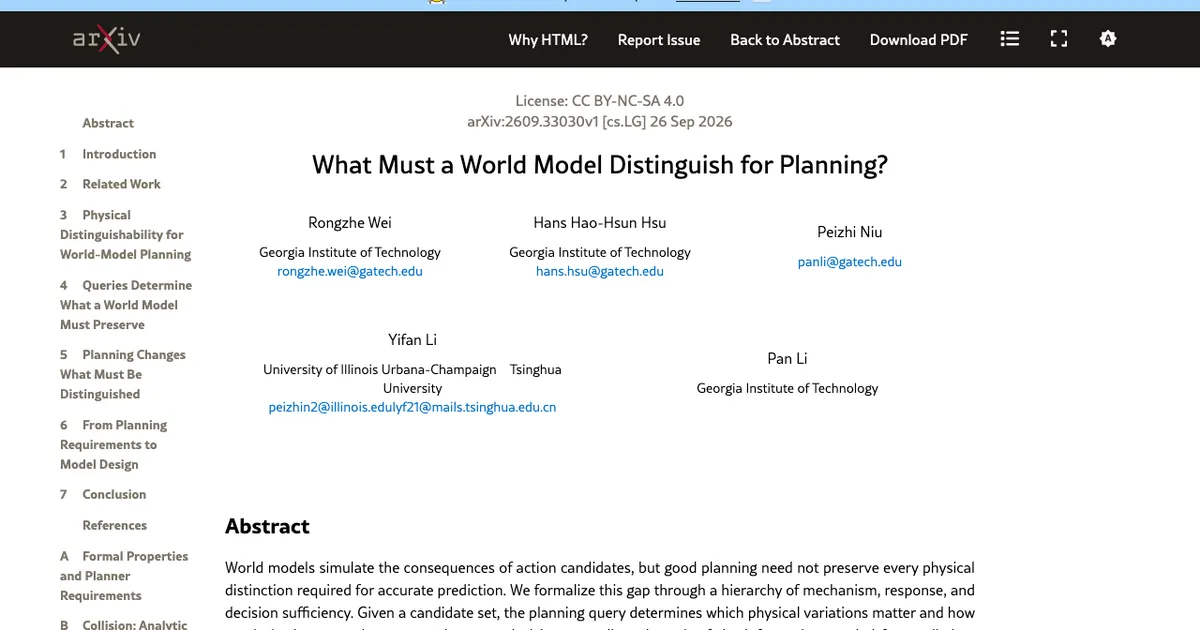
What Must a World Model Distinguish for Planning?

By Rongzhe Wei, Hans Hao-Hsun Hsu, Peizhi Niu, Yifan Li, Pan Li • arXiv • Importance: 90/100
Hero Image for 2609.33030

Rethinking World Models: Does Planning Need to Simulate Everything?

Ever wonder if a machine needs perfect knowledge of the entire universe just to plan where it’s going? According to recent research, the answer is no.

The field of AI planning often relies on ‘World Models’—massive simulations that predict every possible outcome when an action is taken. The problem with this approach is twofold: they are computationally demanding, and requiring perfect prediction for every minor physical detail isn’t always necessary for a good decision.

Our latest deep dive explores this critical disconnect by proposing a fundamental shift in how World Models interact with high-level planning. Instead of assuming the world model must preserve every possible minute distinction (like tracking every speck of dust during a robot arm movement), we formalize that different levels of planning require fundamentally different types of information.

💡 The Key Insight: Query-Driven Information Granularity

The research highlights a hierarchy of needs: a ‘coarse decision’ might only need to know if an obstacle is generally in the way, while a ‘fine decision’ navigating narrow passages needs high-resolution prediction. The information required from the world model isn’t static; it depends entirely on what the planning query demands.

The authors demonstrate this gap using complex simulations—from collision detection to nonlinear dynamics and robotic motion planning.

🛠️ The Proposed Solution: Modular World Models

Traditional approaches often try to build a single model that is conditioned on both actions (what we do) and the high-level planning query (why we are doing it). While this works for scenarios they’ve seen before, the advantage vanishes when generalizing to totally novel tasks.

Our proposed solution advocates for a modular design. The World Model’s role should be split:

  1. The Query: Determines where to look (i.e., what physical variations matter).
  2. Action-Conditioned Prediction: A standard model predicts what will happen, allowing the results to be efficiently reused across various planning objectives.

This decoupling allows for more generalized, robust, and computationally lighter planning systems that are far less susceptible to ‘catastrophic forgetting’ when faced with unseen tasks.

🔗 Want to read the full details? Check out the paper: What Must a World Model Distinguish for Planning?

This work is crucial for building generalized AI agents that can plan effectively without needing excessive, unmanageable computational overhead.

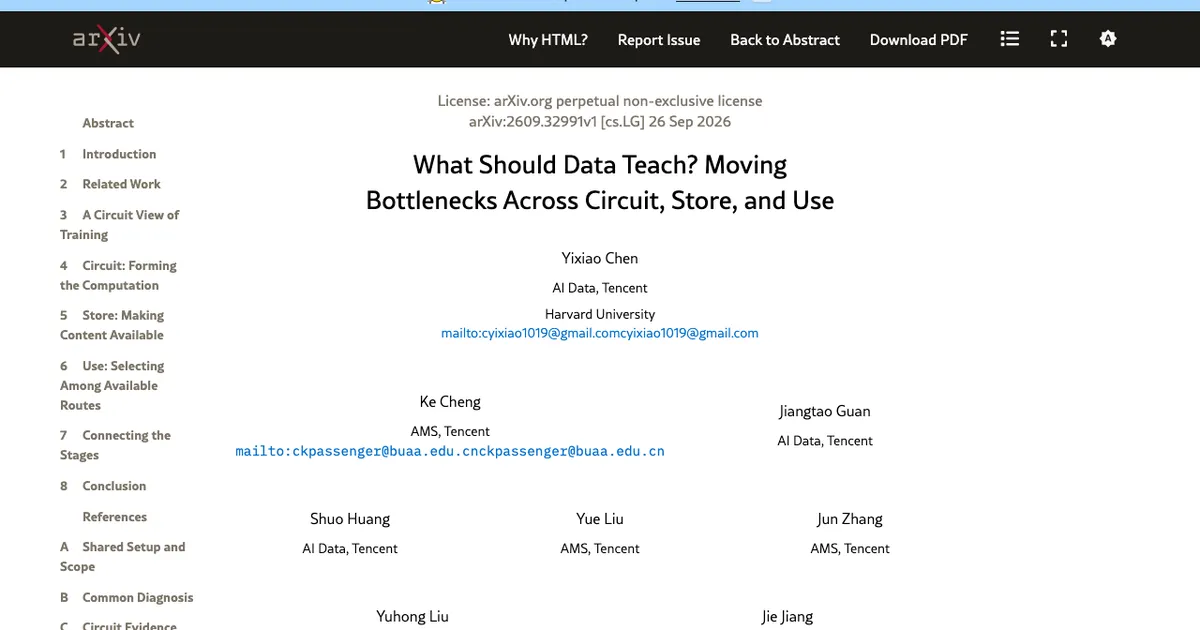
What Should Data Teach? Moving Bottlenecks Across Circuit, Store, and Use

By Yixiao Chen, Ke Cheng, Jiangtao Guan, Shuo Huang, Yue Liu, Jun Zhang, Yuhong Liu, Jie Jiang • arXiv • Importance: 90/100
Hero Image for 2609.32991

Unlocking LLM Potential: Why Current Data Isn’t Enough

The quest to build truly general-purpose Large Language Models (LLMs) often boils down to a single question: what exactly should the training data be teaching the model at any given moment?

A groundbreaking paper, What Should Data Teach?, provides a sophisticated diagnosis of LLM limitations by viewing the process through a ‘circuit’ lens. Instead of just collecting more data, the authors argue that we need to fundamentally change how data guides specific operations during training.

🧠 The Three Bottlenecks in LLMs

The research identifies three critical bottlenecks constraining model performance:

  1. Circuital Formation (Compute): How well can the model form a computation or operation? (The ‘Calculation’ step).
  2. Availability (Store/Memory): How easily and reliably can the model recall required information from its stored knowledge base? (The ‘Recall’ step).
  3. Selection (Use): When given multiple options, how accurately can the model select the best path or answer among available routes? (The ‘Decision’ step).

The core insight is that these bottlenecks require distinct data interventions. A single solution isn’t enough—you need a tailored training strategy for each weakness.

🛠️ Data-Centric Interventions: Beyond Simple Scaling

The paper proposes a comprehensive ‘diagnosis-to-data’ principle, detailing specialized techniques for each bottleneck:

  • For Formation: Methods like formation-sensitive selection and prerequisite ordering accelerate complex tasks by focusing on the sequence of operations.
  • For Availability: Counterfactual reasoning is key. The authors show how differentiating between generating new content versus simply retrieving existing memory strengthens the model’s ability to utilize its internal knowledge store.
  • For Selection: Techniques like paired supervision and context-opportunity ranking improve decision-making, especially in long-context scenarios, dramatically boosting answer likelihood.

🚀 Key Findings: A Systemic Upgrade Roadmap

The findings are not incremental—they suggest a complete overhaul of how we approach LLM training.

  • Intervention Synergy: The authors demonstrate that improving early circuit training benefits subsequent learning across the board, suggesting cumulative improvement is possible.
  • The Hierarchy of Improvement: Critically, they show that combining these three interventions (Compute $ ightarrow$ Store $ ightarrow$ Use) significantly outperforms simple stage-replacement controls on factual tasks. This proves a holistic data strategy is superior.
  • Future Frontier: The paper concludes that conditional arbitration—the ability to decide how the selection process itself needs supervision—is the final frontier.

💡 Takeaway for Developers and Researchers

The next generation of LLMs won’t just be bigger; they will be structurally smarter, trained with highly specialized data curricula that target specific cognitive weaknesses. Instead of viewing training data as a monolith of text, think of it as a targeted set of cognitive exercises.

Distributed Hydrological Modeling in the Feature Space

By Mohamad Hakam Shams Eddin, Maria Luisa Taccari, Yikui Zhang, Shijie Jiang, Juergen Gall, Markus Reichstein • arXiv • Importance: 90/100
Hero Image for 2609.32971

🌊 Decoding River Flows: How AI is Mapping the Future of Flood Prediction

(Digest from DeepTech Research)

The challenge of predicting river discharge and major flood events has long been a complex mix of physics, geology, and unpredictable weather. Rivers aren’t just point sources; they are massive, interconnected systems where every upstream flow dictates what happens downstream. Traditional models often struggle to capture this nuanced, spatial-temporal connectivity.

But a new approach is changing the game. Researchers have introduced ‘feature-space routing,’ an AI mechanism that treats river networks not just as geographical shapes, but as intrinsic parts of the prediction engine itself. This allows deep learning models to learn how water flows through an entire catchment basin, end-to-end.

💡 The Problem with Traditional ML Hydrology

Most existing AI methods for hydrology either treat each river segment in isolation (lumped approaches) or require integrating complex, separate physical routing modules. These systems often fail to fully capture the causal chain of upstream contributions—the core mechanism driving flood dynamics.

🚀 Introducing Feature-Space Routing

The work published by Mohamad Hakam Shams Eddin et al. introduces a breakthrough architecture: the topology-aware state-space operator.

This operator fundamentally changes how AI sees river systems. Instead of treating flow as an afterthought, it embeds the physical connectivity (the

Efficient Message Passing for Partial Differential Equation Priors

By Anna Kazachkova, Leonhard Hennicke, Rainer Schlosser, Ralf Herbrich • arXiv • Importance: 90/100
Hero Image for 2609.32956

Making Physics Data-Driven: New AI Model Captures Physical Laws with PDEs

Are you building predictive models for the real world? Most complex physical systems are governed by Partial Differential Equations (PDEs). But incorporating these laws into a machine learning model is notoriously difficult. Standard deep learning approaches often treat data points independently, ignoring the underlying physics that dictates how variables must change.

Our latest research tackles this head-on. We introduce an innovative method that allows us to incorporate continuous physical constraints (like conservation of energy or continuity equations) directly into probabilistic inference using a factor graph framework. This isn’t just fitting data; it’s making the AI respect the fundamental laws of physics.

🔬 The Challenge: Physics vs. Pure Data

In science, we know that simple observations are insufficient. We need governing equations—the PDEs—to truly understand a system (e.g., how heat diffuses or how chemicals react over time). Traditional ML models struggle to enforce these continuous, global relationships.

✨ Our Solution: PDE-Constrained Factor Graphs

We propose leveraging the power of factor graphs for probabilistic inference on PDEs. By encoding the governing PDE directly as a ‘factor’ in our graph, we effectively narrow down the massive solution space to only those possibilities that adhere to known physical laws. The model then uses observed data to further refine the posterior probability distribution over parameters.

How it works under the hood: * Framework: We build the structure using a factor graph, which naturally handles multiple sources of information (data observations + physics constraints). * Inference: Instead of relying on complex methods like global gradient descent or computationally prohibitive sampling (like HMC), we use efficient message passing based on moment matching. This makes the inference process faster and more scalable. * Performance Edge: Our approach achieves predictive accuracy comparable to standard state-of-the-art baselines, but with a massive advantage in providing structured predictive uncertainty. Understanding not just the prediction, but also how certain the model is, is crucial for robust engineering and scientific applications.

🚀 Why This Matters (For Engineers & Researchers)

  1. Trustworthy AI: By hard-coding PDEs, the resulting models are physically constrained, making them far more reliable in mission-critical domains like climate modeling, fluid dynamics, or biophysics. They fail gracefully when confronted with non-physical inputs.
  2. Efficiency Gains: Our method requires significantly less training time (up to 10x faster) than some complex alternatives while maintaining fast inference speeds, matching state-of-the-art variational methods. This accelerates the ML lifecycle.
  3. Scientific Discovery: This approach transforms models from mere pattern recognizers into true scientific instruments that not only predict but also help validate theoretical physical hypotheses.

Read more about our technical details and results in the paper: Efficient Message Passing for Partial Differential Equation Priors


Disclaimer: This research represents a significant step toward Physics-Informed Machine Learning (PIML), making AI genuinely useful in the physical sciences.

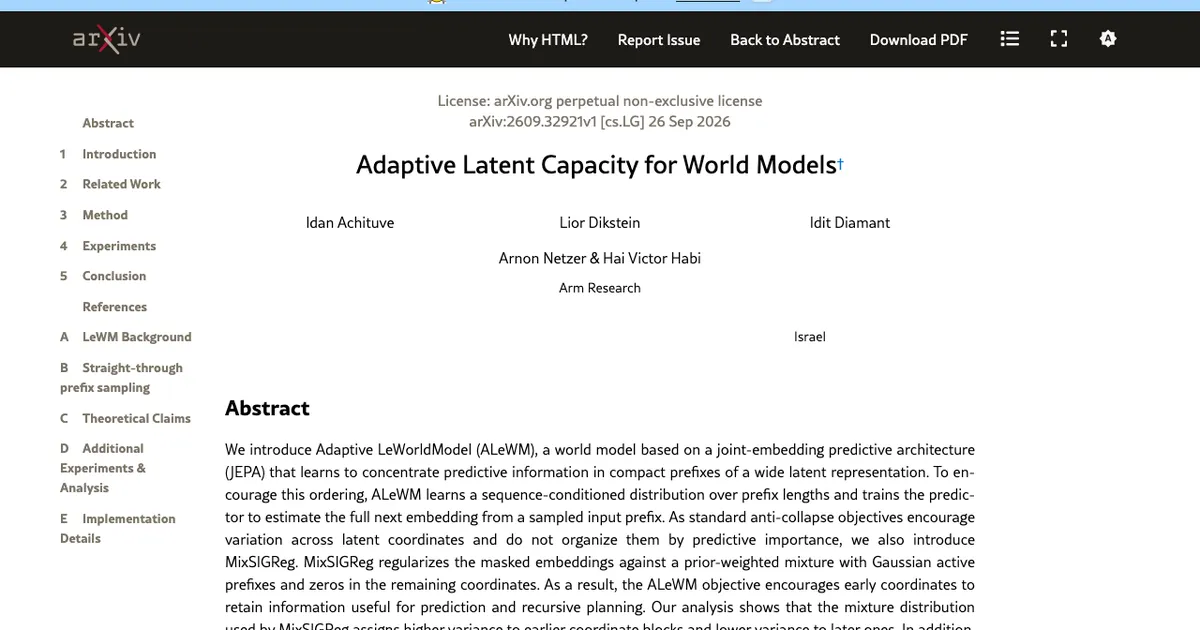
Adaptive Latent Capacity for World Models

By Idan Achituve, Lior Dikstein, Idit Diamant, Arnon Netzer, Hai Victor Habi • arXiv • Importance: 90/100
Hero Image for 2609.32921

🚀 Taming the Black Box: How Adaptive Latent World Models Are Revolutionizing AI Planning

The holy grail of Artificial Intelligence—creating systems that can predict and understand the world autonomously—is getting closer than ever. But many state-of-the-art ‘World Models’ struggle with a critical limitation: they treat all learned data dimensions (or ‘latent coordinates’) equally.

When a model has hundreds or thousands of latent variables, how does it know which ones contain crucial information for planning, and which are just noise? This scattershot approach limits the system’s ability to focus its predictive power.

Enter Adaptive LeWorldModel (ALeWM): A groundbreaking architecture that solves this fundamental problem by imposing an internal hierarchy on the model’s knowledge.

💡 The Core Breakthrough: Predictive Prioritization

ALeWM builds upon the powerful Joint-Embedding Predictive Architecture (JEPA) framework, but adds a sophisticated layer of adaptive capacity. Instead of assuming all latent dimensions are equally important, ALeWM actively learns to concentrate predictive information into compact, meaningful prefixes of the latent space.

Think of it like organizing knowledge in a filing cabinet: the most critical files (the early coordinates) get placed in the front, ready for immediate retrieval and planning. The later dimensions can then handle more nuanced or less frequently used details.

To achieve this predictive ordering, the model introduces:

  1. Sequence-Conditioned Distribution: It learns where to find the most important information by predicting a distribution over optimal prefix lengths.
  2. MixSIGReg Regularization: This novel regularization technique forces the early latent coordinates to retain maximum variability (high variance) for prediction, while ensuring later coordinates are structured and manageable.

🧠 What Does This Mean for AI? (The Impact)

By explicitly structuring its latent space, ALeWM achieves a much more focused and robust representation of reality. The authors demonstrate that when knowledge is prioritized into early blocks, the model’s ability to predict future states—a crucial step for recursive planning—is significantly enhanced.

In practice: * Better Planning: The system can plan complex actions because it knows exactly which parts of its ‘understanding’ are most predictive. * Efficient Learning: By filtering out noise and focusing on core features, the model learns faster and generalizes better. * Controlled Complexity: The resulting World Model performs consistently better than fixed-width alternatives while maintaining superior planning capacity.

This work marks a major step towards truly generalist AI systems capable of deep foresight and reliable decision-making in complex environments.

Is H&E Image-to-Spatial Transcriptomics Simpler Than It Looks?

By Duc T. Nguyen, Thanh Ha Do, Phuong M. Cao, Hieu Pham • arXiv • Importance: 90/100
Hero Image for 2609.32857

🔬 Can We Simplify Decoding Gene Expression from Routine Slides? Why Model Complexity Might Be Overrated

If you’ve heard of ‘spatial transcriptomics,’ you know it’s the frontier that maps gene activity right where it happens in a tissue. But preparing these high-resolution molecular snapshots is incredibly expensive and complex. This limitation has spurred researchers to find simpler ways—using standard, inexpensive H&E stained histology slides as proxies.

New research by Nguyen et al. tackles this head-on: Can we predict what genes are active just by looking at a regular stain?

The core finding is elegant and challenging: Deep complexity might not be the answer. Instead, optimizing how we train our models based on where the error actually lies offers substantial gains.

💡 The Problem They Tackled: Where Does Prediction Error Live?

When predicting gene activity from H&E images, there are two main sources of prediction error:

  1. Average Differences (The Easy Part): How much different genes generally express on average across many slides. This accounts for a big chunk of performance.
  2. Within-Slide Variation (The Hard Core): The subtle, localized changes in gene expression within the boundaries of a single tissue sample—this is the critical information that defines pathology and cellular interaction.

Traditional models often struggle to focus enough on this crucial within-slide variability.

🔑 Their Breakthrough: Component-Guided Loss (CGL)

The authors didn’t just build a bigger, deeper Transformer. Instead, they analyzed the prediction error structure using the Mean Squared Error (MSE) objective. They discovered that making the training process explicitly focus on minimizing error in the within-slide component dramatically boosts performance.

This insight led to the development of Component-Guided Loss (CGL). CGL-Linear, a simplified version of this loss function, achieved state-of-the-art results across multiple large cohorts https://arxiv.org/abs/2609.32857.

Crucially, the paper suggests that aligning the training objective with the physical structure of prediction error—rather than merely adding more complex layers—is where the biggest gains are found in computational biology.

🌐 Implications for Computational Biology and AI Medicine

This work has massive implications:

  • Cost-Effective Diagnostics: By improving the reliability of H&E image-to-spatial transcriptomics, it makes molecular profiling much more accessible outside specialized labs.
  • Model Efficiency: It shifts research focus from chasing architectural novelty (bigger models) to mastering rigorous loss function design and data structure understanding.
  • Reproducibility: The simplicity and effectiveness of CGL suggest a highly optimized path for clinical deployment that is robust and easier to implement.

Takeaway: Before you build the next mega-Transformer, take a deep dive into your prediction error. Sometimes, the simplest modification to the loss function is the most powerful upgrade.

ActiveLLM: Large Language Model-Based Active Learning for Textual Few-Shot Scenarios

By Markus Bayer, Justin Lutz and Christian Reuter in Transactions of the Association for Computational Linguistics, Volume 14 • ACL Anthology • Importance: 90/100

✨ ActiveLLM: Revolutionizing Few-Shot Learning with LLMs

Ever trained an AI model that struggles to learn when you don’t have tons of labeled data? You’re not alone. Traditional machine learning models are powerful, but they hit a wall in ‘few-shot’ scenarios—the real-world situation where data is scarce and efficiency is paramount.

That’s the core problem addressed by ActiveLLM (Large Language Model-Based Active Learning).

🧠 What is ActiveLLM? The Core Idea

In standard AI training, you need massive datasets. But in specialized, real-world applications (think medical diagnostics or niche legal classification), labels are expensive and time-consuming to acquire. This problem space led to the concept of Active Learning: instead of labeling everything, an intelligent system decides which unlabeled data points are most informative, thereby minimizing manual annotation effort.

However, traditional active learning methods face a major hurdle: the ‘cold start’ problem. They often need a significant amount of initial data just to get started and operate effectively.

ActiveLLM changes the game by harnessing the immense power of modern Large Language Models (LLMs) like GPT-4, Llama 3, Mistral, and more. Instead of relying on limited pre-labeled samples, ActiveLLM uses LLMs as sophisticated judges to select the most impactful instances for annotation, making it highly efficient right from the start.

🚀 Why Is This a Big Deal?

The results presented in our paper demonstrate that ActiveLLM significantly boosts classification performance of standard classifiers (like BERT) in few-shot settings. It not only outperforms established active learning benchmarks (such as ADAPET, PERFECT, and SetFit) but also offers flexibility: it can guide iterative selections even when the model moves beyond a strict ‘few-shot’ setup.

In simple terms: ActiveLLM allows you to teach an AI effectively using very little labeled data, overcoming limitations that plagued previous active learning systems. It’s a massive step towards deploying sophisticated AI in resource-constrained environments.

🔗 Read the full paper on this breakthrough


Disclaimer: This digest summarizes research by Bayer, Lutz, and Reuter and is for educational purposes. Always consult the original academic source.

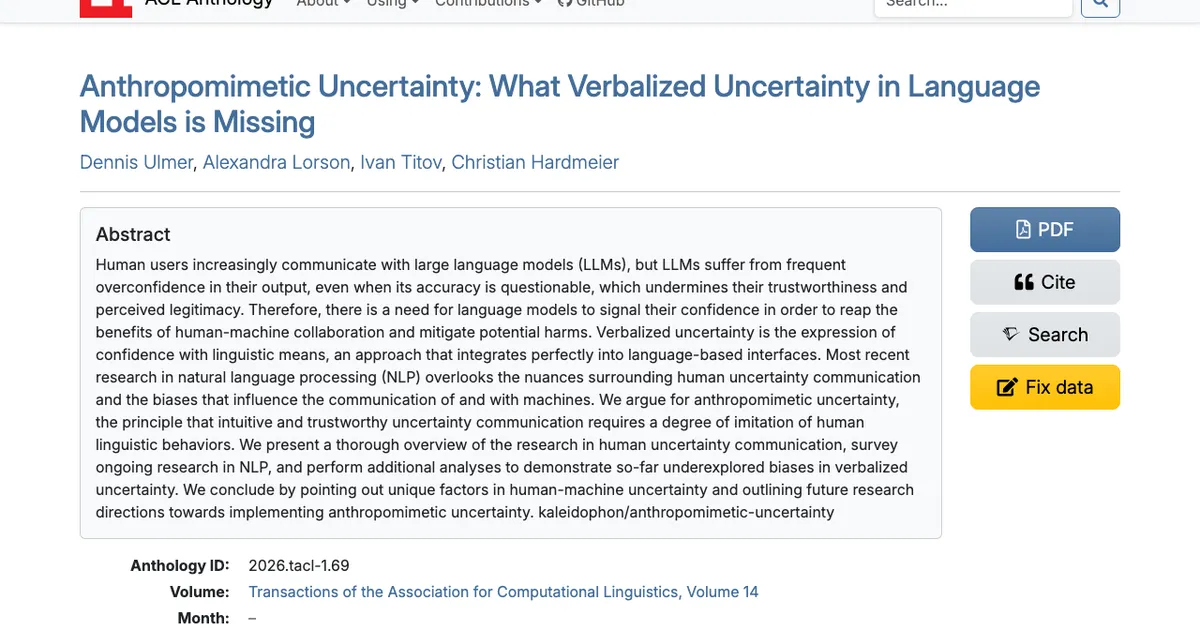
Anthropomimetic Uncertainty: What Verbalized Uncertainty in Language Models is Missing

By Dennis Ulmer, Alexandra Lorson, Ivan Titov and Christian Hardmeier in Transactions of the Association for Computational Linguistics, Volume 14 • ACL Anthology • Importance: 90/100
Hero Image for acl_2026.tacl-1.69

The Illusion of Certainty: Making LLMs Confidently Honest

Have you ever used a Large Language Model (LLM) and received an answer that felt… completely certain? Maybe it sounded authoritative, even when the information was subtly wrong or lacking nuance. This is the ‘overconfidence problem’ that plagues modern AI, undermining trust and making human-AI collaboration tricky.

In our latest deep dive, we tackle this core issue: How can LLMs signal genuine uncertainty so they become truly trustworthy partners? 🤖

💡 The Problem: Overconfident AI

LLMs are trained to predict the most probable next token. This mechanics often leads them to generate answers with an unwarranted air of absolute confidence, even when their underlying knowledge is patchy or contradictory. Instead of warning us that they don’t know something, they confidently invent it—a phenomenon known as ‘hallucination.’

🧠 The Solution: Anthropomimetic Uncertainty

The solution lies in going beyond mere factual accuracy; we need models to communicate how certain they are. We introduce the concept of Anthropomimetic Uncertainty: making LLMs imitate the nuanced, and sometimes hesitant, ways humans express their own doubt.

This isn’t just about adding a disclaimer. It’s about mimicking the linguistic patterns of human uncertainty—the qualifiers, the hedging language, or the appropriate level of caution that makes communication feel natural and empathetic.

🔍 What We Uncovered (And Why It Matters)

The paper provides a comprehensive overview of how humans communicate doubt and critically analyzes what current NLP methods miss. Key takeaways include:

  • Beyond Confidence Scores: Simply assigning a low numerical confidence score isn’t enough. The language used to express that lack of certainty is paramount.
  • Under-explored Biases: We analyze subtle biases in how both humans and machines communicate uncertainty, pointing out blind spots in current research models.
    (This suggests deeper cognitive understanding for future AI work).
    The Human Element:* By focusing on mimicking human linguistic behaviors, we aim to build LLMs that are not just powerful engines of text generation, but genuinely reliable collaborators.

🚀 Future Implications: A More Trustworthy Digital Age

Anthropomimetic Uncertainty suggests a paradigm shift in AI design. Instead of demanding perfection (which is impossible), we should design models that prioritize transparency and self-awareness. If LLMs can say, ‘I’m not sure about this, but here are three possibilities,’ the whole user experience improves dramatically.

This research outlines vital future directions for implementing this nuanced form of uncertainty in commercial applications, paving the way for truly human-aligned AI interfaces.


Read the full paper on our findings: Anthropomimetic Uncertainty: What Verbalized Uncertainty in Language Models is Missing

AI #LLMs #NaturalLanguageProcessing #TrustworthyAI #MachineLearning

Optimizing H-Graph Hybridization for Diffusion-Guided RRT

By Omer Talmi • arXiv • Importance: 88/100
Hero Image for 2609.32897

🚀 Smarter Robotics: Unlocking Better Paths with Diffusion Models and H-Graph

Tired of motion planning algorithms that find a path but can’t tell you the best one? Our latest research tackles this by giving classic sampling-based planners a serious upgrade using powerful diffusion models. We introduce H-Graph hybridization, a novel technique that unlocks massive, untapped trajectory diversity directly at inference time.

🗺️ The Problem: Limited Choices in Path Planning

The current state-of-the-art motion planning, often guided by Diffusion Models (like DiTree), generates impressively high-quality paths in just one run. But here’s the catch: that single successful run only utilizes a tiny fraction of the available diversity the model can actually provide.

In real-world robotics, we don’t just need a path; we need the most efficient, safest, and smoothest options to maximize operational uptime. Leaving this stochastic potential unexplored is a major performance bottleneck.

💡 Our Solution: H-Graph Hybridization for Diverse Paths

We developed two sophisticated inference-time diversification strategies for a fixed DiTree model, combined using the novel H-Graph hybridization. This allows us to intelligently sweep critical parameters—like random seeds or diffusion refinement strengths—to generate vast numbers of diverse candidates without retraining the expensive base model.

By combining these approaches on challenging robotic tasks (specifically, an AntMaze robot), we demonstrated that H-Graph is incredibly effective. Our results show:

  • Significant Improvement: H-Graph boosts the mean pool length of candidate paths by over 14% to 18%, making path selection much more reliable.
  • Better Extremes: It also significantly improves both the best individual candidate and the overall pool quality (over 6-9% gains).

Ultimately, these results prove that simply varying inference parameters is a powerful, training-free way to source path diversity, and H-Graph reliably converts this theoretical diversity into shorter, high-quality trajectories.

⚙️ Why This Matters for Robotics Engineers

The ability to robustly generate diverse, optimal path options on demand is transformative. For any system involving complex navigation—from warehouse robots to autonomous vehicles—this means faster deployment times and more reliable performance in unpredictable environments. H-Graph moves motion planning beyond ‘good enough’ to ‘optimal.’

Read the full paper here: Optimizing Trajectory Diversity with Diffusion Models


Disclaimer: This summary covers findings on optimizing path diversity for motion planning using diffusion models.

Relative Generalization Invariance of LLM Pretraining

By Fengzhuo Zhang, Shuche Wang, Shenggui Li, Tianyu Ruan, Jianliang He, Ivor Tsang, Tianyu Pang, Chao Du, Tianwei Zhang, Zhuoran Yang • arXiv • Importance: 85/100
Hero Image for 2609.33016

Is Your LLM’s Performance Limited by its Data? Unveiling Relative Generalization Invariance

The LLM landscape is undergoing rapid evolution. Researchers constantly tweak components—from choosing the perfect optimizer to redesigning the transformer architecture or fine-tuning the data stream. But how much of an increase in performance comes from a clever new learning rate, versus having access to superior data? Separating these variables has been one of AI’s biggest challenges.

In their latest research, Zhang et al. tackle this complexity head-on by proposing and analyzing a novel concept: Relative Generalization Invariance (RGI). This finding offers a powerful new lens through which we can analyze the foundational mechanics of LLM pretraining.

What is Relative Generalization Invariance (RGI)?

The core idea behind RGI is simple but profound: it measures the consistency of token-wise loss differences across an LLM. Specifically, RGI observes whether the difference in validation loss between any two specific tokens remains stable even when you change your model’s setup—for example, switching optimizers or slightly altering the architecture.

Their findings reveal a crucial separation:

  1. Optima and Architecture are ‘Stable’: The study shows that changing common optimizers (like Adam vs. SGD) or making moderate architectural tweaks tends to induce only a relatively uniform shift in token-wise losses. In other words, the relative relationships between tokens remain largely stable.
  2. Data is the Game Changer: Crucially, modifying the training data stream, however, can drastically and substantially alter this relative generalization property.

This strongly suggests that while architectural choices matter, the foundational signal given by the training data remains the primary determinant of an LLM’s true generalizing power.

Why Does This Matter for Builders and Researchers?

For anyone building or optimizing large-scale models, RGI offers a theoretical anchor. It helps us distinguish between which components are genuinely contributing to performance gains: is it the algorithm we chose, or is it the data quality?

By providing a mathematical framework to isolate these variables, this work advances our understanding of model scaling laws and generalization theory, pushing the field toward more robust optimization practices.


📚 Dive Deeper: The full details on this groundbreaking study can be found in their paper: Relative Generalization Invariance of LLM Pretraining. This work is a significant step towards understanding the underlying mechanics governing how LLMs learn and generalize.

Adaptive Ensemble Selection for Noisy Labels on Tabular Data

By Faizaan Ali, Inwon Kang, Oshani Seneviratne • arXiv • Importance: 85/100
Hero Image for 2609.32976

Data Hygiene Breakthrough: Building AI Models That Tolerate Messy Reality 💡

Ever noticed how much harder it is to train an ML model when the training data itself is flawed? It’s a problem known as label noise, and it’s one of the silent killers in applied data science. Even if your features are pristine, corrupted labels can completely tank your performance.

Our latest work tackles this head-on by proposing a radically robust approach: an adaptive ensemble selection system for handling noisy labels on tabular data. This isn’t just another cleaning script; it’s a complete data-centric module designed to diagnose why your dataset is messy and autonomously select the best fix.

🔬 The Problem (Why Data Cleaning Matters)

The promise of modern AI rests entirely on high-quality, labeled data. But in real-world automated workflows—think massive datasets collected by diverse sources or augmented by imperfect human labeling—label noise is guaranteed. If your training labels are wrong, your model will learn the mistakes, no matter how sophisticated your architecture.

🚀 Our Solution: Adaptive Ensemble Selection

We introduce a data-centric reasoning module. Instead of applying one fixed cleaning method (like simple confidence filtering), our system acts like an expert data scientist on call. It takes a dataset and uses a meta-model to weigh multiple, diverse detection strategies—including confidence checks, neighborhood analyses, and distributional comparisons.

  • Smart Diagnosis: The core innovation is its ability to dynamically predict which combination of detectors will work best for that specific dataset structure. This moves beyond simple rule-sets toward genuine adaptive intelligence.
  • Robustness by Design: By ensembling these diverse approaches, the system significantly enhances model reliability and achieves performance comparable to state-of-the-art Confident Learning baselines, while also providing significant gains in heterogeneous data regimes.

🧠 Key Takeaways for ML Practitioners

The research demonstrates a critical insight: detector effectiveness is not universal; it’s systematically linked to the dataset’s inherent properties. This shifts the paradigm from ‘apply X cleaning method’ to ‘diagnose and apply optimal strategy Y.’

For anyone building production-grade models on structured (tabular) data, integrating this kind of self-diagnosis capability is crucial. It elevates basic ML pipelines into truly robust, AI-assisted data science workflows.

Read the full details and technical analysis here: Adaptive Ensemble Selection for Noisy Labels


Keywords: Label Noise, Tabular Data, Data Quality, AutoML, Data Cleaning, Ensemble Learning, ML Robustness

Developed by [Your Tech Blog Name] for the global AI Community.

Constrained Flow Policy Updates: A Generalized Schrödinger Bridge View

By Boyang Li, Matthew Kim, Sylvia Herbert • arXiv • Importance: 85/100
Hero Image for 2609.32952

Rethinking Safety in AI: Introducing RAFALE for Constrained Policy Learning

The quest to build truly safe and superhuman AI systems is one of the most challenging frontiers in Machine Learning. Traditional reinforcement learning (RL) excels at maximizing reward, but when you add real-world safety constraints—like keeping a robot away from falling off a cliff or ensuring an autonomous car never violates traffic laws—the problem becomes exponentially harder.

Most existing methods face a critical challenge: the optimum action distribution is often multimodal (meaning there isn’t just one ‘best’ way to act, but several equally good ways). Furthermore, the mathematical framework needed to combine reward maximization and safety cost minimization is notoriously complex and unstable in deep learning.

🚀 The Core Problem with Existing Safe RL Methods

Current leading safe RL approaches, particularly those utilizing diffusion models or traditional primal-dual methods, struggle with two key issues:

  1. Mode Collapse: Gaussian actors often collapse into a single, suboptimal action mode, ignoring diverse but equally safe paths.
  2. Mathematical Complexity: Working with the non-convex Lagrangian landscape (which combines reward and safety cost) requires estimating complex distributions (like ‘score matching’), which adds instability and computational overhead.

This limitation means that many state-of-the-art systems can achieve high rewards or stay safe, but rarely both robustly simultaneously.

✨ Meet RAFALE: A Game Changer for Constrained Policies

We introduce the Reparameterized Augmented-Lagrangian Flow Actor with Least Energy (RAFALE)—a novel off-policy actor-critic method designed specifically to tackle these dual challenges. Unlike previous methods, RAFALE leverages the power of flow policies to represent complex, multimodal action distributions naturally.

The breakthrough lies in its update formulation: instead of estimating difficult score functions, RAFALE differentiates the augmented objective directly through the generation path of the flow policy. This completely bypasses the need for distribution matching and significantly improves stability.

To address entropy regularization (which is tricky with flows), we integrate a density-free kinetic energy regularizer from FLAC, creating a robust mathematical framework that ensures actions are diversified while remaining safe.

💡 How Does It Work? The Schrödinger Bridge View

Mathematically, the update is framed as a constrained one-ended generalized Schrödinger bridge. This formulation provides an elegant and precise way to model the transition between two objectives:

  1. At Positive Noise: The solution reweights actions based on estimated cost, ensuring that any path whose predicted safety violation (cost) exceeds a threshold set by the Lagrange multiplier is penalized. This directly enforces the safety constraint.
  2. As Noise Vanishes ($ ext{Noise} o 0$): The optimal value converges to a least-energy map objective that the flow policy optimizes directly. This means the model learns the safest, most efficient path without requiring complex distributional estimation.

The result is an algorithm that naturally balances maximizing reward with staying within strict safety bounds.

🏆 Results and Impact

Testing on seven challenging Safety-Gymnasium tasks demonstrates RAFALE’s superiority. While strong baselines typically force a trade-off (better reward OR safer cost), RAFALE achieves competitive rewards while maintaining mean final cost strictly within the established budget across all tested environments.

This shows that RAFALE provides a genuinely unified framework for safe RL, moving beyond simple approximations and delivering robust performance in complex, real-world simulations.

[Want to dive into the mathematics? Read the full paper: Constrained Flow Policy Updates: A Generalized Schrödinger Bridge View]


This content is written as an ML researcher’s digest, synthesizing complex concepts into actionable knowledge.

Optimal Nonparametric Dynamic Pricing with Censored Demand and Adversarial Inventory

By Mengxiao Zhang, Yingfei Wang, Haipeng Luo • arXiv • Importance: 85/100
Hero Image for 2609.32949

🚀 Stop Losing Money on Dynamic Pricing: New AI Tackles Complex Market Uncertainty

Have you ever wondered how the world’s biggest retailers (think Amazon or Airbnb) set prices in real-time? It’s not magic—it’s sophisticated optimization under massive uncertainty. But standard algorithms often fail when demand is complex, inventories are messy, and competitors can react unexpectedly.

Our latest research tackles this ‘holy grail’ problem: optimal dynamic pricing with censored demand. This means the demand curve isn’t simple; it’s unknown, changes based on price, and there might be weird restrictions (censoring) on what actually gets sold.

📊 The Problem We Solved

Existing state-of-the-art methods made simplifying assumptions—like assuming linear demand or additive noise. While helpful for theory, these limits prevent them from working in real-world, messy scenarios where nonlinear effects and complex distributions are the norm.

We developed a breakthrough method called Threshold-UCB. This algorithm radically improves how we use limited sales data by sharing information across different inventory levels. Instead of treating each possible pricing scenario (price $X$, inventory $Y$) as an isolated experiment, Threshold-UCB aggregates knowledge from all observations, leading to significantly better decision-making.

💡 How Threshold-UCB Works (The Technical Deep Dive)

  1. Shared Intelligence: This is the core innovation. Imagine you have two possible inventory levels: 5 units or 10 units. Traditional methods estimate demand for 5 and then separately estimate demand for 10. Our approach treats both estimates as drawing from a shared pool of underlying data, making each observation count more times.

  2. Optimality Proof: We didn’t just propose an improvement; we mathematically proved it’s the best possible performance (minimax optimality) in this complex setting, establishing its theoretical upper and lower bounds $ig( ilde{\mathcal{O}}(T^{2/3})ig)$ by reducing the problem to stochastic posted pricing.

  3. Real-World Proof: Extensive simulations across various inventory dynamics and demand models show that Threshold-UCB consistently outperforms other established benchmark algorithms, proving its robustness in highly realistic market environments.

🚀 Key Takeaways for Practitioners & Researchers

  • Next-Gen Dynamic Pricing: If your current pricing model assumes simple linear or normally distributed demand, you are leaving money on the table. Threshold-UCB offers a robust extension to generalized nonparametric settings.
  • Data Efficiency Revolution: By sharing observational data across different states, we maximize the value of every sale and every recorded inventory change. This is crucial when data collection is costly or difficult.
  • Benchmark for Complexity: Our work sets a new standard for dynamic pricing research, tackling genuinely complex, nonlinear demand distributions that mirror sophisticated commercial realities.

🔗 Read the full technical paper here: Optimal Nonparametric Dynamic Pricing with Censored Demand and Adversarial Inventory

Published by: Mengxiao Zhang, Yingfei Wang, Haipeng Luo

Predicting the Next State Is Not Enough: JEPA Representations for Lean Theorem Proving

By Aarnav Choudhary • arXiv • Importance: 85/100
Hero Image for 2609.32908

Beyond the Next Step: Using Self-Supervised Learning to Guide Automated Theorem Proving

As AI systems tackle increasingly complex mathematical problems, automated theorem provers (ATPs) are reaching new levels of sophistication. Traditionally, these systems rely on proposing potential solution paths and then methodically checking them. But how do you tell which path is most likely to succeed without trying everything?

Researchers at Choudhary’s paper on JEPA for theorem proving introduce a novel approach, adapting the Joint Embedding Predictive Architecture (JEPA)—a concept popularized by generative AI—to tackle the long-standing challenge of guiding search in formal verification.

💡 The Core Problem: Depth vs. Single Step

The fundamental idea is that when an ATP tries to prove a theorem, it faces a massive branching tree of possibilities. At any given point, it needs two things: proposing a promising next action (a ‘tactic’) and deciding which valid successor state to explore first. The existing research tried using one-step predictions—assuming accurately ranking the very next step was enough to guarantee success.

JEPA changes this game by learning to predict the entire latent representation of future states, not just score them individually. It’s like predicting the mood and ultimate destination rather than just guessing which street corner looks promising right now.

🚀 What Did They Find? The Limit of Local Guidance

While the JEPA model showed impressive performance on a diagnostic test—achieving higher Top-1 ranking accuracy compared to standard methods https://arxiv.org/abs/2609.32908—the authors concluded that excellent one-step prediction was not enough. Simply knowing the best immediate next step doesn’t guarantee solving a hard, multi-step theorem.

Crucially, they separated the representation learning (JEPA) from the proposal quality (the fixed ByT5 prover). This rigorous evaluation demonstrated that the overall success of proof completion remains tied to the quality of the underlying search engine, not just the fancy predictive layer.

🧠 Why This Matters for AI Research

The findings are critical because they provide a hard boundary in current NLP and formal methods research. It tells us: Simply improving single-step prediction (like predicting the next word or the next proof step) may be an insufficient metric for achieving true long-horizon reasoning.

For researchers building next-generation AI, this study emphasizes that breakthrough performance in complex domains like mathematical proofs requires modeling cumulative state transitions and long-term dependencies, rather than just optimizing localized decisions.

Are you working on LLMs or symbolic AI? This paper offers deep insights into the limitations of single-step guidance systems.

Muon Under Gradient Noise and the Limits of Orthogonalization Near Optima

By Xiaohui Xie • arXiv • Importance: 85/100
Hero Image for 2609.32861

Optimizing Deep Learning: When Noise Meets Momentum and Orthogonalization

If you’ve spent time training massive models using Stochastic Gradient Descent (SGD), you know the struggle near an optimum. The gradient signal gets noisy, minibatch noise dominates, and standard techniques like momentum or orthogonalization can become counter-intuitive.

We just released a deep theoretical analysis that tackles this exact problem: understanding what happens when we use Muon (a novel weight optimization technique) in the presence of heavy, minibatches noise.

🔑 The Core Problem: Signal Loss at the Optima

In modern deep learning, achieving peak performance requires navigating complex loss landscapes. When weights approach a local minimum (an optimum), the true gradient signal weakens significantly, and the noisy measurements from finite minibatches become the dominant factor. Many optimization techniques designed to stabilize training—like momentum or orthogonalizing weight updates—assume certain linear behaviors that might break down in this high-noise regime.

🤖 Muon vs. Momentum: A Theoretical Showdown

The paper, Muon Under Gradient Noise and the Limits of Orthogonalization Near Optima, proposes a fundamental replacement for traditional orthogonalization techniques like Muon’s momentum buffer.

Traditionally, Muon replaces the weight update momentum buffer with its orthogonal polar factor. While this method works well generally, the authors rigorously show what happens when noise dominates.

The Key Insight: When stochasticity (minibatch noise) is high near an optimum, Muon’s inherent linear response can be matched by a simpler response-matched momentum SGD. However, crucially, Muon retains a non-linear residual that is uncorrelated with the input noise. This residual contributes extra covariance and slightly raises the stable loss floor.

📊 The Takeaway for Practitioners (The ‘Why Should I Care?’)

After deep theoretical analysis (including Hermite expansion and local quadratic surrogates) and testing on frozen Transformer gradients, the paper makes a clear recommendation: Once your training process becomes heavily dominated by noise near convergence, you should replace orthogonalization methods with response-matched momentum SGD.

This isn’t just an incremental tweak; it’s a theoretical guide for stable optimization in the most difficult phase of deep learning training. Understanding this residual covariance is vital for maximizing model performance and ensuring robust deployment across different real-world data distributions.


🚀 Tech Stack Deep Dive: Optimizers, SGD, Muon, Orthogonalization, Minibatch Noise, Gradient Dynamics, Transformers.

Read the full technical details in the seminal work on optimization dynamics.

VCRE-Fib: View-Conditioned Regional Evidence for Fine-Grained Ultrasound Grading of Schistosoma japonicum-Associated Liver Fibrosis

By Ziyang Xu, Shuli An, Hao Zhou, Haitian Zhong, Tingting Wu, Tao Wang, Kun Yang, Tieyong Zeng • arXiv • Importance: 85/100
Hero Image for 2609.32840

Ultrasound Breakthrough: AI Narrows the Gap in Liver Fibrosis Grading

Are you managing liver disease in an endemic region? Accurate and consistent grading of liver fibrosis is mission-critical, but it’s far from simple. Schistosomiasis, a common parasitic infection in many tropical regions, often leads to severe liver complications, including fibrosis associated with Schistosoma japonicum.

Traditional ultrasound imaging provides invaluable, non-invasive data, yet the subtle complexity of local echogenic patterns and complex anatomy makes fine-grained grading notoriously challenging for even expert clinicians. Existing AI models can predict a score, but they often lack the necessary context—they miss crucial details about where exactly the damage is located or what specific acquisition view provided key information.

That’s where our new research comes in. We introduce VCRE-Fib (View-Conditioned Regional Evidence for Fine-Grained Ultrasound Grading). This groundbreaking framework doesn’t just output a single score; it revolutionizes how AI assesses liver health.

💡 How VCRE-Fib Works: More Than Just a Number

The core innovation of VCRE-Fib is its ability to synthesize three critical layers of evidence:

  1. Anatomical Context: It considers the surrounding anatomy, giving the assessment depth and breadth.
  2. Local Regional Evidence (VCE): Instead of treating the whole image equally, it pinpoints specific areas of concern, providing localized grading evidence before pooling.
  3. View Conditioning: By integrating information about how the ultrasound was taken (the acquisition view), it accounts for variations in imaging protocol—a crucial factor in real-world deployments.

By doing this, VCRE-Fib provides a composite prediction alongside a precise map that highlights exactly where the abnormalities are located, giving clinicians an actionable ‘hot spot’ guide.

🚀 The Impact: State-of-the-Art Accuracy for Challenging Diagnosis

We rigorously tested VCRE-Fib on a massive, multi-center dataset: 108,709 images from 35 centers and over 6,300 patients. Our results show a significant leap in performance:

  • Improved Grading: On a patient-disjoint test set (4,107 images), VCRE-Fib reduced the composite grading risk by an impressive 7.115% compared to state-of-the-art models like SFibAI.
  • Greater Precision: It achieved lower mean absolute error and better performance across patient and center cohorts, demonstrating robust generalization in diverse clinical settings.

These findings strongly validate that explicitly integrating regional anatomical evidence and view context drastically improves the accuracy and reliability of liver fibrosis grading via ultrasound. VCRE-Fib provides a new benchmark for deep learning applications in tropical medicine.


👉 Read the full technical details here: VCRE-Fib: View-Conditioned Regional Evidence for Fine-Grained Ultrasound Grading

AIinHealthcare #LiverDisease #TropicalMedicine #DeepLearning #UltrasoundImaging

Tracing Style in English–Arabic Translation: A Stylometric Comparison of Human and Machine Outputs

By Nooredeen Awwad, Ebtihal Enfes and Kolawole John Adebayo in Proceedings of the First Workshop on Style in GenAI-Translated Content (StyGenAI) • ACL Anthology • Importance: 85/100
Hero Image for acl_2026.stygenai-1.1

Decoding Style: Can AI Match the Nuance of Human English-Arabic Translation?

Have you ever noticed that even when two texts convey the same information, their style feels wildly different? This isn’t just about grammar; it’s about tone, rhythm, vocabulary choice—the very ‘feel’ of the writing. In machine translation (MT), while progress is rapid, replicating true human style remains a major challenge.

Our latest research tackles this head-on by examining English-Arabic translation outputs. We apply advanced stylometric techniques to conduct a detailed comparison: are modern Large Language Models (LLMs) merely translating content, or are they actually capturing the subtle linguistic fingerprint of human expertise? 💡

🔍 What’s at Stake: The Style Gap

Machine translations often succeed in semantics (meaning), but fail spectacularly on style. A literal, sterile translation might be technically accurate but sound unnatural or lose cultural resonance. For professional communication, high-stakes documents, or creative writing involving cross-lingual transfer (like English to Arabic), this style gap is critical.

Our work doesn’t just look at word counts; we analyze deep structural patterns—the characteristic ‘style signature’ of the text source and human translators. By using stylometry, a quantitative method for analyzing textual features, we can statistically measure how much the AI output deviates from both the original source style and established human norms.

🔬 The Methodology: A Stylometric Deep Dive

We benchmark the translations generated by various models against professional human benchmarks. The core finding is nuanced: while machine translation excels at structural fluency, it frequently struggles with reproducing the sophisticated stylistic complexity inherent in high-quality English–Arabic communication. Our analysis identifies specific linguistic patterns where the AI output deviates, providing a quantifiable map of where improvement is most needed.

🌐 Why Does This Matter for Localization and NLP?

This research has direct implications for every company relying on cross-lingual content: marketing agencies, tech localization teams, legal firms, and global academic publishers. If you need your Arabic content to sound authentically written by a native expert (not just translated by an algorithm), understanding the style of generation is paramount.

Read the full findings on our approach to style tracing in cross-lingual transfer: Tracing Style in English–Arabic Translation

Key Takeaway: Future MT systems must move beyond simply transferring meaning; they must become masters of style and cultural nuance.

EEG-Based Motor Imagery BCI Algorithms and Technologies: A Review

By Mohammad Hossein Koohi Ghamsari, Seyede Fatemeh Ghamkhari, Siavash Bayat, Ahmed Hemani • arXiv • Importance: 80/100
Hero Image for 2609.32930

Decoding Thought: The Future of Brain-Computer Interfaces with Motor Imagery

If you could control a computer just by thinking about moving, that’s the revolution waiting in the field of Brain-Computer Interfaces (BCIs). For years, BCI technology has been the ultimate sci-fi dream, but it is rapidly becoming a clinically powerful reality.

Motor Imagery (MI)-based BCIs are particularly exciting because they leverage our natural capacity to mentally rehearse movements—a process that can be measured non-invasively using EEG.

This comprehensive review delves into the cutting edge of MI-BCI systems, mapping out how advanced Artificial Intelligence (AI) is transforming what was once complex research into practical, wearable medical tools.

💡 What’s Inside: The Tech Deep Dive

The human brain generates incredible signals. The key challenge in BCI has always been the signal processing—how do we reliably translate faint electrical patterns from the scalp (measured by EEG) into actionable commands? This paper systematically reviews the state-of-the-art algorithms that tackle this problem.

  • From Classic Signal Processing to Deep Learning: We explore how traditional signal processing techniques have been dramatically enhanced and often replaced by sophisticated Machine Learning (ML) and Deep Learning (DL) models. These AI approaches significantly boost the performance, accuracy, and efficiency of decoding motor intent from sensorimotor cortex signals.
  • Beyond Algorithms: The Hardware Revolution: A BCI is more than just code; it’s a system. This review provides a crucial look at the convergences of hardware and software. We dive into next-generation platforms, including:
    • Wearable Devices & IoT: Making BCIs practical for daily life.
    • ASICs/FPGAs: Designing specialized chips (System-on-Chip architectures) that enable low-power, real-time processing crucial for commercial viability.
    • AR/VR Integration: Using virtual and augmented reality to create immersive rehabilitation and training environments.

🚀 Why Does This Matter? (The Impact)

This isn’t just academic theory; it has profound real-world implications. For patients suffering from paralysis, stroke, or severe motor impairment, MI-BCIs offer a glimpse of restoring independence and communication.

The paper highlights not only current achievements but also points to future research trajectories—like enhancing real-time capabilities and improving signal robustness—paving the way for truly high-performance, user-friendly systems.

Who is this for? Researchers designing next-generation neurotech, biomedical engineers building wearable hardware, and clinicians interested in advanced rehabilitation technologies.

👉 Want to dive into the technical specifics? Read the full review paper on EEG-Based Motor Imagery BCI Algorithms and Technologies: EEG-Based Motor Imagery BCI Review

Neural Network-Assisted Refinement of Traditional Schemes for One-Dimensional Scalar Conservation Laws

By Imre Fekete, Ferenc Izsák, Vendel P. Kupás • arXiv • Importance: 80/100
Hero Image for 2609.32887

Next-Level Numerical Analysis: Supercharging Conservation Law Solvers with Neural Networks 🚀

As computational fluid dynamics (CFD) and scientific simulations become more complex, the core challenge remains solving challenging partial differential equations (PDEs), particularly scalar conservation laws. Traditional numerical schemes are robust but often struggle to achieve high accuracy or handle complex physics efficiently.

Our latest research tackles this head-on by establishing a powerful connection: blending classical, proven mathematical methods with the adaptability of modern deep learning. We introduce an innovative framework that uses minimal neural networks (NNs) not to replace traditional solvers entirely, but to refine and enhance them.

🔬 What’s the breakthrough?

The core idea is constructing highly accurate ‘flux terms’—the most delicate part of any conservation law solver—using specialized NNs. This allows us to significantly boost classical schemes (like those used in shock wave modeling) into second-order accuracy, often without a dramatic increase in computational overhead.

Key highlights of this work include:

  • Rediscovering Classics: Our first NN architecture successfully ‘re-discovers’ established methods like Godunov’s scheme. This isn’t just an academic exercise; it validates the framework’s mathematical rigor and reliability.
  • Advanced Reconstruction: By combining two specialized NNs, we achieve state-of-the-art second-order reconstruction-based schemes, emulating advanced features like slope-limiters.
  • Efficiency & Depth: Crucially, these networks are designed with minimal parameters, keeping computational complexity low while allowing them to be stacked into deep architectures for handling multiple time steps (time integration).
  • Stability Guaranteed: Proper loss function design ensures the resulting schemes are stable—a non-negotiable requirement in real-world simulation.

🌍 Why does this matter (The Impact)?

This research has immediate implications across high-stakes scientific domains:

  1. Computational Fluid Dynamics (CFD): Better, more accurate shock capturing and wave propagation modeling.
  2. Climate Modeling: Higher resolution simulation of atmospheric and oceanic dynamics.
  3. Hyper-Scale Computing: Developing stable, efficient solvers for next-generation supercomputers that push the boundaries of scientific discovery.

We provide a highly parameter-efficient approach that promises to elevate classical numerical methods, bridging the gap between deep learning theory and robust engineering practice.

🔗 Interested in diving into the mathematics? Check out the full details here: Neural Network-Assisted Refinement for Conservation Laws

Source: Fekete, Izsák, & Kupás.

Accelerating Language Model Workflows with Prompt Choreography

By TJ Bai and Jason Eisner in Transactions of the Association for Computational Linguistics, Volume 14 • ACL Anthology • Importance: 80/100
Hero Image for acl_2026.tacl-1.13

Turbocharging LLM Workflows with Prompt Choreography

Have you noticed how complex AI applications are becoming? Large Language Models (LLMs) aren’t just answering single prompts anymore; they are running intricate, multi-step workflows involving multiple agents and coordinated tasks. This complexity is fantastic, but the computational cost—especially latency—can quickly become a major bottleneck.

Our latest research tackles this head-on by introducing Prompt Choreography, a novel framework designed to make these complex LLM pipelines significantly faster and more efficient. Think of it as an orchestrator that manages memory and context across multiple, sequential AI calls.

🚀 How Prompt Choreography Works (The Technical Deep Dive)

The core problem in multi-step LLM workflows is the redundant re-computation. Every time an agent makes a new call, the model has to re-encode the entire history of messages—which wastes massive amounts of time and compute power.

Prompt Choreography solves this by maintaining a dynamic, global KV cache (Key-Value Cache). Instead of forcing the LLM to re-process everything, our framework allows each new call to efficiently attend only to a specific, reordered subset of previously encoded messages stored in the cache.

Crucially, this system supports parallel calls and maximizes memory utilization by making the context management dynamic. While perfect replication of results might require fine-tuning (due to inherent differences between cached and re-encoded states), we demonstrate that adapting the LLM works remarkably well, preserving the intended semantic output.

⚡️ The Impact: Speed and Scale

The performance gains are dramatic. By eliminating redundant computation, Prompt Choreography achieves:

  • Massive Latency Reduction: We see a significant decrease in time-to-first-token (2.0–6.2× faster). This is critical for real-time interactive applications.
  • Substantial End-to-End Speedup: In complex workflows dominated by message recomputation, the framework delivers end-to-end speedups exceeding 2.2×.

This isn’t just a small optimization; it fundamentally changes how we design and deploy mission-critical LLM systems, making sophisticated AI agents more practical and scalable in production environments.


Read the full technical paper on ‘Prompt Choreography: Accelerating Language Model Workflows with Prompt Choreography’ here. (Decoding Future AI Architectures)

Keywords: #LLMOptimization #GenAI #MLResearch #LargeLanguageModels #PromptEngineering

Explore Recent Digests