By Zhongpan Tang • arXiv • Importance: 95/100
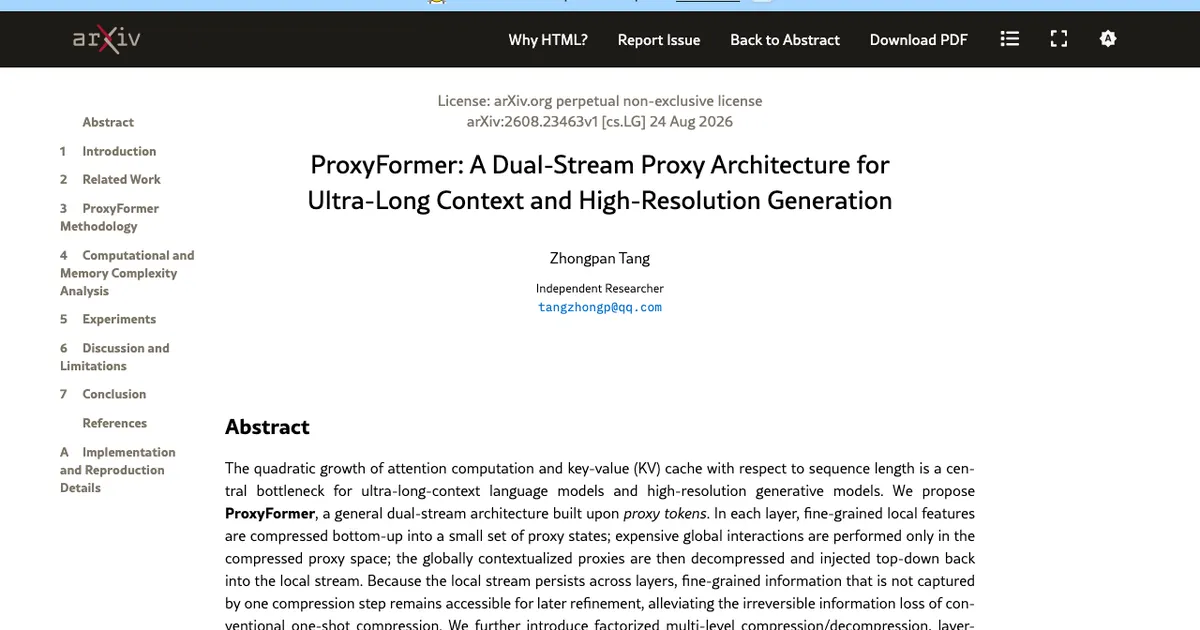
🚀 ProxyFormer: Cracking the Ultra-Long Context Code
Hey AI enthusiasts and researchers! If you’ve ever dealt with context window limits—the dreaded ‘context collapse’ or needing to analyze a massive book chapter—you know the bottleneck. Traditional transformer models hit a wall when sequence length gets large, primarily due to the quadratic complexity of attention ($O(N^2)$) and the memory burden of the KV cache.
But what if we could process megabytes of text without breaking the bank? Enter ProxyFormer, a revolutionary dual-stream architecture that rethinks how LLMs handle extreme context lengths.
💡 The Problem: Quadratic Blowup
Current large language models (LLMs) face a fundamental constraint: as the input sequence ($N$) grows, the computational requirements and memory usage scale quadratically ($ ext{Computation}
ightarrow N^2$, $ ext{Memory}
ightarrow N$). Processing millions of tokens is computationally prohibitive.
✨ The Solution: Dual Streams via Proxy Tokens
ProxyFormer tackles this head-on by introducing a novel mechanism using proxy tokens. Instead of forcing the entire massive context through one expensive attention layer, it smartly divides the process into two streams:
- Local Stream (Fine-Grained): This stream processes local details bottom-up, retaining high fidelity information about immediate neighbors.
- Global/Proxy Stream (Compressed): The core innovation here is compression. Fine-grained local features are compressed into a small set of highly contextualized proxy states. All the expensive, global interactions—the ‘big picture’ understanding—happen only within this dense, low-dimensional proxy space.
Crucially, these globally informed proxies are then decompressed and injected back top-down into the local stream. This gives the model massive global knowledge without sacrificing crucial local detail!
Why is this breakthrough? (The ‘No Loss’ Magic)
The key differentiator from older methods is that ProxyFormer retains a continuous, uncompressed connection in the Local Stream across layers. Traditional compression often suffers irreversible information loss after one step. By keeping the local path open for refinement, ProxyFormer ensures fine-grained details remain accessible throughout deep processing.
📈 Performance Deep Dive (The Numbers Don’t Lie)
These aren’t just theoretical gains; the benchmarks are staggering:
- Context Extension: While a standard decoder-only model might struggle beyond 20K tokens on a 16GB GPU, ProxyFormer extends the trainable sequence length to an incredible ~700K tokens with a compression ratio of 64.
- Retention Power: Even when trained with significantly smaller windows (e.g., 8K), the model retains exceptional recall accuracy—exceeding 94% on multi-needle retrieval tasks even when extrapolated to massive contexts like 256K tokens.
ProxyFormer is highly effective across modalities, demonstrating feasibility for both pixel-space and latent-space flow matching in preliminary image generation tests.
💻 Technical Highlights You Should Know
- Factorized Multi-Level Compression: Improved efficiency by compressing information at multiple stages.
- Dynamic Compression Ratios: The system can adapt the compression level based on the current task or data requirements.
- Proxy-Only KV Cache: Enables inference using only the compressed proxy space, drastically reducing memory footprint.
🌐 Dive Deeper: Read the full paper and explore the future of mega-context LLMs here: https://arxiv.org/abs/2608.23463
What does this mean for us? It means our AI can finally read entire books, process massive codebases, and handle multi-modal inputs without hitting a hard memory wall.
By Andrej Orsula, Miguel Olivares-Mendez, Carol Martinez • arXiv • Importance: 92/100
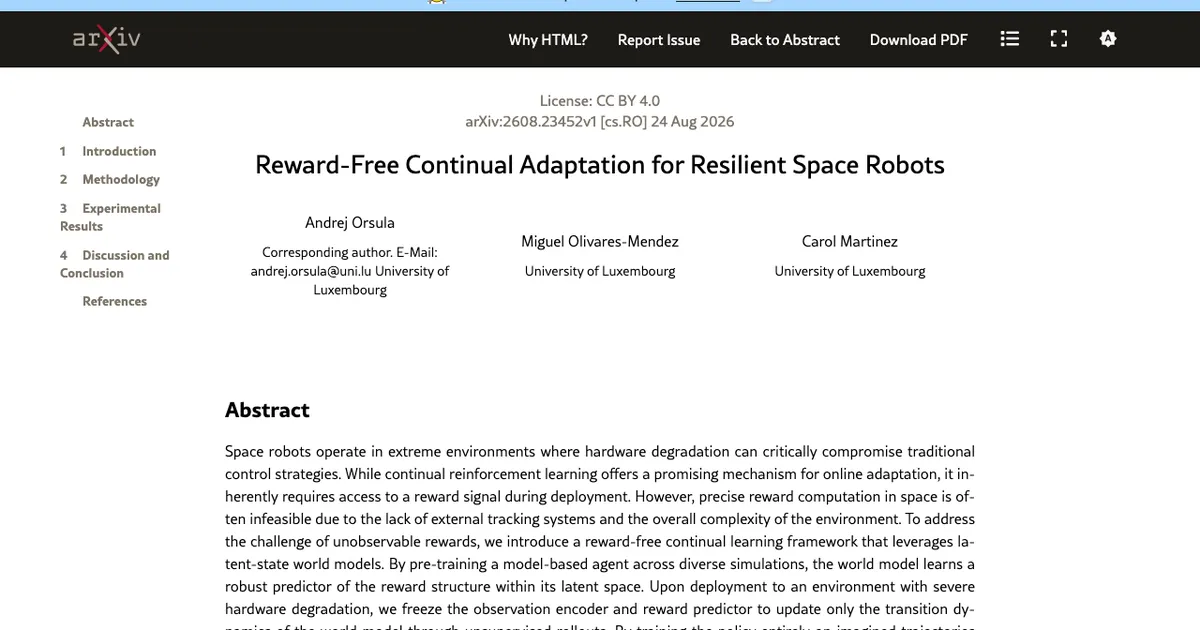
🚀 Keeping Space Robots Operational: Mastering Adaptation Without Rewards
The Challenge: When an astronaut deploys a robot to Mars or the Moon, they face extreme unknowns. Hardware breaks down—motors seize, sensors degrade, and systems shift. Traditional robotic control needs constant feedback (a ‘reward signal’) to know if it’s doing well. But in deep space, generating that perfect reward signal is often impossible due to missing external tracking or simple environmental complexity.
The Solution: Reward-Free Adaptation.
A new research framework tackles this critical hurdle head-on: how can a robot learn and adapt robustly when the guiding ‘success metric’ (the reward) is unknown or unobservable? The authors introduce a revolutionary reward-free continual learning approach that utilizes latent-state world models.
🧠 How It Works (The Tech Deep Dive):
The core idea revolves around imagination. Instead of needing external rewards, the robot learns to predict its environment’s changing dynamics using a sophisticated World Model. This model is pre-trained in diverse simulations, allowing it to build an internal understanding of how changes impact potential success.
- World Model Training: The agent learns a latent representation of the world and builds a predictor for the reward structure within this compressed space.
- Adaptation Phase (The Magic): When deployed with hardware failures, the system freezes the core observation encoder and the reward predictor. Instead, it performs unsupervised rollouts—essentially letting the World Model simulate what happens next using only its current knowledge.
- Policy Update: The policy (the robot’s decision-making algorithm) is trained exclusively on these imagined trajectories. By maximizing performance based purely on internal simulations of the altered physics, the agent adapts to severe mechanical degradation without needing a single new external reward signal.
🛰️ Real-World Impact & Applications:
This technology has massive implications for long-duration space exploration. The paper demonstrates its effectiveness across simulated planetary traversal (moving over rough terrain), complex orbital navigation, and delicate precision assembly tasks—all while simulating severe morphological failures (broken parts).
This marks a major leap toward truly autonomous deep-space robotics, allowing mission longevity far beyond current operational limits.
🔗 Read the full paper for technical details: https://arxiv.org/abs/2608.23452
💡 Why this matters to AI & Robotics: Continual learning is huge, but requiring constant reward input severely limits its use in real-world, unpredictable edge cases. By eliminating the reward requirement, this framework opens up new possibilities for self-healing and sustained operation in extreme environments, making it foundational research for Mars missions and asteroid mining.
#Robotics #DeepLearning #SpaceTech #ContinualLearning #AIResearch #WorldModels
By Shireen Kudukkil Manchingal, Sofiia Nikolenko, Fabio Cuzzolin • arXiv • Importance: 92/100
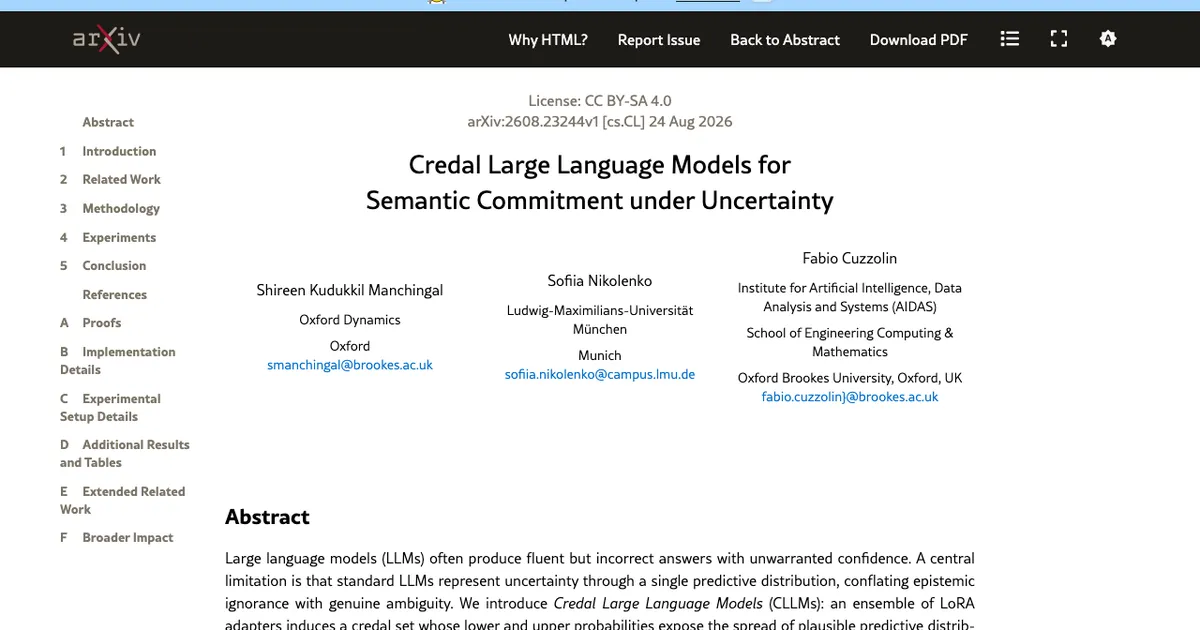
✨ Stop Guessing: LLMs Finally Admit They Don’t Know What They Don’t Know
(Digest Post)
The biggest flaw in modern AI isn’t just that it hallucinates—it’s how confident it sounds when it gets it wrong. When a Large Language Model (LLM) spits out a fluent, authoritative answer, you tend to take it as gospel truth. But researchers have found a way to quantify the true uncertainty of an LLM, giving us models that are more honest about their limitations.
🧵 The Problem: The Confidence Trap
The current generation of LLMs treats every answer like a single point prediction—a simple ‘softmax’ output. This forces them to collapse all possibilities into one number, regardless of how uncertain they actually are. As the paper Credal Large Language Models for Semantic Commitment under Uncertainty explains, this approach conflates two very different types of error: epistemic ignorance (when the model truly doesn’t know) and simple ambiguity.
📚 The Solution: Credal Modeling (CLLM)
The authors introduce Credal Large Language Models (CLLMs). Instead of outputting a single prediction, CLLMs generate an ensemble of potential outputs. This ensemble defines a ‘credal set’ that doesn’t just give a single answer; it exposes the full spread of plausible distributions—the genuine range of what might be true.
💡 Key Breakthroughs You Need To Know
- Credal Token Commitment (CTC): This novel, lightweight score measures uncertainty directly at the token level. It combines the lower-bound support and ‘credal width’ without needing additional computation or complex sampling, making it incredibly efficient for real-time use.
- Semantic Commitment Consistency (SCC): For deeper understanding, SCC extends commitment to meaning. By comparing prediction confidence both at the word level and the sentence/semantic level, CLLM can pinpoint mismatches—an effective way to catch advanced forms of hallucination.
- State-of-the-Art Performance: Evaluations on industry leaders like Gemma-2-9B, Llama-3.1-8B, and Qwen2.5-7B confirm the superiority of CLLM. The method achieves near-perfect accuracy (e.g., 99.0% OpenBookQA with selective prediction) while drastically improving calibration and hallucination detection compared to baseline models.
🧠 Why This Matters for AI Adoption
This research is a massive step toward making LLMs reliable, especially in high-stakes fields like medicine, finance, and law. By giving us quantifiable metrics of uncertainty, CLLM helps build next-generation applications that can intelligently decide when they should defer to a human expert, rather than confidently lying.
🔗 Want to dive deep? Read the full paper here: https://arxiv.org/abs/2608.23244
AI #LLMs #MachineLearning #UncertaintyQuantification #DeepLearning
By Manos Giannopoulos, Yi Shen, Michael M. Zavlanos • arXiv • Importance: 92/100
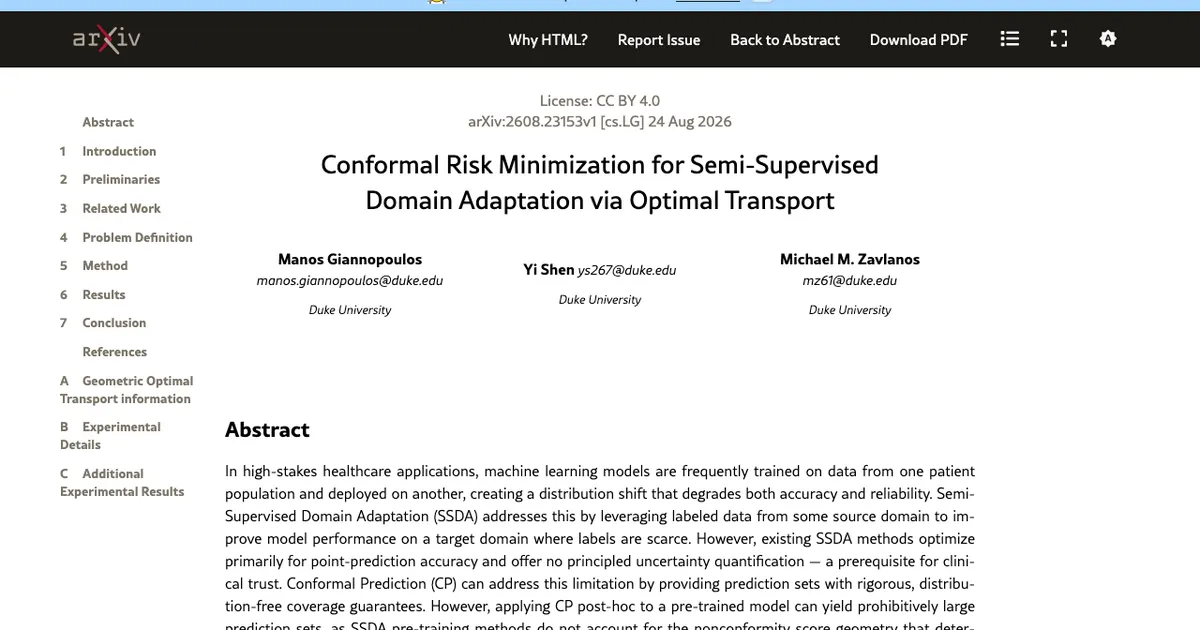
💡 New ML Breakthrough: Making AI Clinical Grade with Conformal Risk Minimization
If your deep learning model is moving from the lab to the operating room, you know that data shifts are a massive risk. This isn’t just about accuracy; it’s about trust—the clinical need for knowing how confident an AI really is.
Our latest work tackles one of ML’s biggest hurdles in high-stakes settings: reliably deploying models on new patient populations. We are introducing a novel framework that combines Semi-Supervised Domain Adaptation (SSDA) with Conformal Risk Minimization (CRM), powered by Optimal Transport (OT).
🏥 The Problem: Why Standard AI Isn’t Good Enough for Medicine
When training an ML model on patient data from Hospital A, but deploying it at Hospital B, the underlying data distributions drift. This is ‘domain shift,’ and it can tank performance overnight.
The existing fix, Semi-Supervised Domain Adaptation (SSDA), helps by leveraging limited labels in the new domain. But SSDA methods traditionally only focus on maximizing point-prediction accuracy—they don’t tell you if they don’t know something. For clinical use, this lack of explicit uncertainty quantification is a critical failure.
The gold standard for rigorous uncertainty is Conformal Prediction (CP), which provides prediction sets with mathematically guaranteed coverage. However, integrating CP post-hoc often leads to massive, unusable output boxes. Furthermore, applying the ideal training method, Conformal Risk Minimization (CRM), requires too much labeled data—precisely what we don’t have in a typical medical setting.
🚀 Our Solution: Bridging Adaptation and Trust
We bridge this gap with an end-to-end framework. The magic ingredient is Optimal Transport (OT), which allows us to generate intelligent ‘pseudo-labels’ for the abundance of unlabeled target data. These pseudo-labels provide the critical extra training signal that enables Conformal Risk Minimization (CRM) to function effectively even when only a small set of labels are available in the target domain.
The result is a model jointly optimized for two crucial goals:
- Domain Invariance: Ensuring the model performs robustly regardless of the specific patient population it encounters.
- Conformal Efficiency: Guaranteeing compact, mathematically valid prediction sets that meet clinical constraints (e.g., ensuring predicted diagnoses are mutually consistent).
This framework is a major step toward reliable, trustable AI in critical healthcare domains like skin lesion classification.
Read the full technical details and methodology here: https://arxiv.org/abs/2608.23153
By Na Li, Yuchen Jiao, Changxiao Cai, Gen Li • arXiv • Importance: 85/100
🔥 Goodbye Cross-Entropy: Introducing ConvergeFlow for Next-Gen Language Models
Are continuous and flow-based AI models the future of language generation? Maybe. But if they can’t reliably output real tokens, they are just theoretical art.
That was the bottleneck that Na Li et al. tackled with ConvergeFlow. This paper introduces a fundamental architectural breakthrough for training flow-based Language Models (LMs).
🤯 The Problem with Continuous AI Models
The current generation of advanced LMs is moving into continuous domains, utilizing diffusion and flow techniques. These methods are incredibly powerful because they model language as smooth, predictable trajectories rather than discrete jumps. They achieve performance rivaling traditional models.
However, there was a critical flaw: existing frameworks used standard cross-entropy (CE) decoders that supervised the continuous process. This meant the model’s flow paths were never guaranteed to land precisely on valid, usable token embeddings when it finished generating.
🚀 ConvergeFlow’s Game Changer
ConvergeFlow flips this script. It is an embedding-space flow-based LM that fundamentally redefines how these models are trained. Instead of relying on a post-hoc CE decoder, ConvergeFlow addresses the core mathematical problem:
- Constrained Training: It forces the data predictor to stay within the convex hull defined by all possible token embeddings.
- Pure Flow Matching: Crucially, it trains only using the Mean Squared Error (MSE) objective induced by flow matching.
What does this enable? Through rigorous mathematical proof, the authors guarantee that under suitable conditions, the continuous flow is mathematically proven to converge directly and reliably to valid token embeddings—all without needing a separate CE-supervised decoder.
In plain English: They solved the ‘landing strip’ problem. ConvergeFlow ensures that when the AI finishes generating text, it hits the precise digital location required for a real word (a token), making the model deployable and mathematically robust.
💡 Why This Matters for ML Researchers and Developers
The ability to train powerful LMs purely through flow-matching objectives represents a massive paradigm shift. It promises:
* Architectural Efficiency: Removing complex, failure-prone decoders simplifies the entire pipeline.
* Stability & Predictability: The provable convergence means predictable outputs, which is essential for robust real-world applications (like search or specialized enterprise AI).
* Potential for Scale: Streamlining the core training objective clears the way for larger, more powerful continuous models.
Experimental results on OpenWebText show that ConvergeFlow achieves performance competitive with established continuous and discrete diffusion LMs. This solidifies the flow-based paradigm as a major contender in NLP.
Want to dive deeper into the math? The full paper, ‘ConvergeFlow: Language Flow with Provable Convergence to Token Embeddings,’ is available here: https://arxiv.org/abs/2608.23551
(Code implementation provided by the authors at https://github.com/Na-Li66/ConvergeFlow.)
#NLP #MachineLearning #AIArchitecture #LanguageModeling #DiffusionModels #GenerativeAI
By Xiaoyang Xie, Clarence W. Rowley • arXiv • Importance: 85/100
🔬 Breakthrough in Scientific AI: Solving Complex Physics with Neural Operators
As ML models get closer to solving real-world scientific problems—from fluid dynamics to climate modeling—the challenge lies not just in fitting data, but in capturing the underlying physics. Our latest research introduces a powerful new architecture called the Inertial Manifold Neural Operator (IMNO) that tackles these tough, time-dependent partial differential equations (PDEs).
🤯 The Challenge: Why Traditional ML Fails for Physics
The real world is governed by complex physics. When we deal with dissipative PDEs—equations describing systems that lose energy over time (like heat dissipation or fluid slowing down)—the system’s long-term behavior often isn’t captured well by standard neural networks. Standard operators, while powerful, often treat the PDE purely as a data mapping without understanding its inherent structure.
✨ The IMNO Solution: Harnessing Physics for Better AI
Our new approach, IMNO, is a game-changer because it doesn’t just map inputs to outputs; it explicitly understands the system’s underlying physics.
The core insight comes from understanding that dissipative physical systems are constrained to live on a low-dimensional space called an ‘Inertial Manifold.’ By baking this critical structural information into our neural operator, IMNO achieves three massive improvements over existing methods like FNO:
- Physical Interpretability: The model is inherently more grounded in physics, making it easier to trust and debug.
- Accuracy & Stability: It significantly improves stability, especially during long-horizon predictions (like predicting system states far into the future).
- Performance on Complex PDEs: It maintains high accuracy across a wide range of nonlinear dissipative problems.
🔄 Even Better: IMNO-SE for Symmetry
We didn’t stop there! For equations that need spatial symmetry—meaning shifting the entire system in space doesn’t change the underlying physics (like wave propagation)—we introduced IMNO-SE. This shift-equivariant variant ensures perfect mathematical consistency, leading to substantial performance boosts in these sensitive applications.
🚀 Conclusion: A New Frontier for Scientific ML
IMNO represents a critical step toward deploying highly accurate and physically compliant AI models in domains like computational fluid dynamics (CFD), climate science, and chemical engineering. If you’re working on complex systems governed by PDEs, this is research you need to pay attention to.
Read the full details here: Inertial Manifold Neural Operator (IMNO) Paper
By Federico Stella, Fei Jiang, Zhongshi Jiang, Zohar Barzelay, Emanuel Garbin, Amin Jourabloo, Liuhao Ge • arXiv • Importance: 85/100
✨ Face Reality: Generating Ultra-Photorealistic Views of People
Tired of AI generating blurry, uncanny valley faces? You’re not alone. Creating truly photorealistic images of a person from angles they never saw—a process called Novel View Synthesis—is one of the hardest problems in computer vision.
But what if we could solve it with stunning clarity, perfect identity preservation, and consistency across every angle? Enter our new research.
🤯 What’s So Hard About AI Faces?
The core challenge is making these synthetic views look real and cohesive. If you synthesize a face from three different angles, the nose must look like it belongs on that specific person in all three photos (identity preservation), and the lighting/geometry has to match up perfectly (geometric coherence).
Previous methods often struggled with high resolutions or needed massive, perfect datasets.
🚀 The Breakthrough: Next-Scale Transformers
Our new approach tackles these issues head-on. We build upon the powerful Next-Scale Autoregressive paradigm and adapt it specifically for human faces. Think of this as a major architectural upgrade for view synthesis.
What makes this breakthrough? It allows us to handle three critical things in one pass:
- Higher Resolution: Generating huge, sharp images suitable for professional applications.
- Multi-View Outputs: Simultaneously synthesizing multiple novel viewpoints (e.g., 45°, 90°, 135°) at once.
- Strong Consistency: Ensuring that the core identity and visual appearance are perfectly preserved across every generated view.
Unlike some competitors, our method smartly leverages general-purpose pre-training from lower resolutions. This means we can use smaller, more realistic human datasets while still achieving world-class results—a major win for data efficiency.
📸 Beyond the Image: Creating Full 3D Models
The model doesn’t just stop at a nice 2D picture. We pair our pipeline with existing transformer technology to lift these multi-view inputs into highly accurate, photorealistic 3D Gaussian models. This means you get not just pretty pictures, but a measurable, geometrically accurate digital twin of the face.
🔬 Technical Deep Dive (For ML Engineers)
Our use of next-scale autoregression is key. It shifts the dependency from requiring massive, fully labeled two-dimensional pre-training steps (like some diffusion models do). Instead, by structuring the architecture optimally, we maximize fidelity while minimizing the reliance on huge, purpose-specific datasets in the final stages. This convergence capability with limited data makes it highly practical for real-world deployment.
This advancement sets a new bar for scalable, multi-output human view synthesis.
➡️ Read the full paper: https://arxiv.org/abs/2608.23410
What’s Next? Better character consistency, more adaptable 3D reconstruction for varied demographics (including full bodies), and faster inference times.
By Markus B. Pettersson, James Bailie, Mohammad Kakooei, Eagon Meng, Adel Daoud • arXiv • Importance: 85/100
🌍 Beyond Point Predictions: Revolutionizing Poverty Mapping with AI
The challenge of measuring poverty is monumental. For regions like Africa, high-resolution, ground-truth data simply doesn’t exist across the board—and this critical knowledge gap severely hampers effective public policy. Until now, ML models predicting poverty relied on simple ‘point predictions,’ offering a single number that suggested the outcome. But what if that number was wrong? Policy decisions based on a faulty single point prediction could waste billions or, worse, exclude genuinely needy populations.
We needed a better way to measure not just what the model predicts, but how confident it is in that prediction.
💡 Our Approach: Uncertainty-Aware Mapping
Our new work introduces an uncertainty-aware approach to Earth Observation (EO)-ML for poverty mapping. Instead of delivering a single estimate for international wealth indices across African neighborhoods, our method provides statistically guaranteed prediction intervals.
By combining advanced techniques—specifically simultaneous quantile regression and a novel form of conformal prediction—with a spatiotemporal transformer trained on sequences of satellite imagery (like Landsat and nighttime-light data), we build a much more robust intelligence layer.
- What makes it special? We don’t just give you a number; we give you a reliable range. This range quantifies the risk, allowing policymakers to assess not only the predicted poverty level but also the confidence level associated with that prediction.
- Handling Reality: While our raw predictions match state-of-the-art performance (high $R^2$), we recognize an inherent limitation: ML alone can’t be blindly trusted. To solve this, we developed a revolutionary procedure for efficient aid allocation. We combine model predictions with ground-truth survey data while mathematically proving that the risk of missing any eligible neighborhood remains below a set threshold.
🚀 The Policy Impact: Smarter Aid Deployment
This isn’t just academic rigor; it’s about lives. In simulations, our uncertainty-aware allocation strategy delivers substantially more aid to genuinely eligible recipients compared to traditional strategies or simple model predictions.
We successfully demonstrate that EO-ML can be a reliable supplement to traditional data sources—but only when we use methods that account for uncertainty.
Read the full paper and technical details: https://arxiv.org/abs/2608.23322
🔑 Key Takeaways:
- From Point to Range: We shift poverty mapping from single-point guesses to statistically guaranteed prediction intervals.
- Transformers Meet Poverty: Utilizing spatiotemporal transformers on multimodal satellite data for improved geospatial context understanding.
- Guaranteed Allocation: A novel framework that provably minimizes the risk of aid exclusion, making AI a true policy partner.
ML #EarthObservation #PovertyMapping #AIforGood #PolicyScience #SatelliteImaging
By Apodex Team, B. An, B. Li, B. Wang, B. Zhang, B. L. Wang, C. Feng, C. Wei, C. Xue, C. Zhang, D. Ng, D. Ye, E. Min, F. Chen, F. Liu, F. Yang, F. Ye, H. Xu, H. Yang, H. Ye, H. Zhang, H. Zhao, J. Li, J. Lin, J. Xia, K. Jin, K. Wang, K. Yang, L. Bing, L. Lei, L. Su, Le. Wang, Lu. Wang, N. Wang, Q. Ren, Q. Yang, R. Li, S. Bai, S. Du, S. Li, S. Lin, S. Nie, S. Wang, S. Zhang, S. Z. Wang, Ta. Q. Fang, Ti. Q. Fang, W. Fang, W. Li, W. Zhang, X. Chen, X. Li, X. Tang, X. Wang, X. Xu, X. Zhang, X. Q. Wang, X. Y. Wang, Y. Deng, Y. Gao, Y. Hu, Y. Li, Y. Sui, Y. Wang, Y. Xiao, Y. Zhang, Z. Chen, Z. Cheng, Z. Feng, Z. Liang, Z. Zhang • arXiv • Importance: 85/100
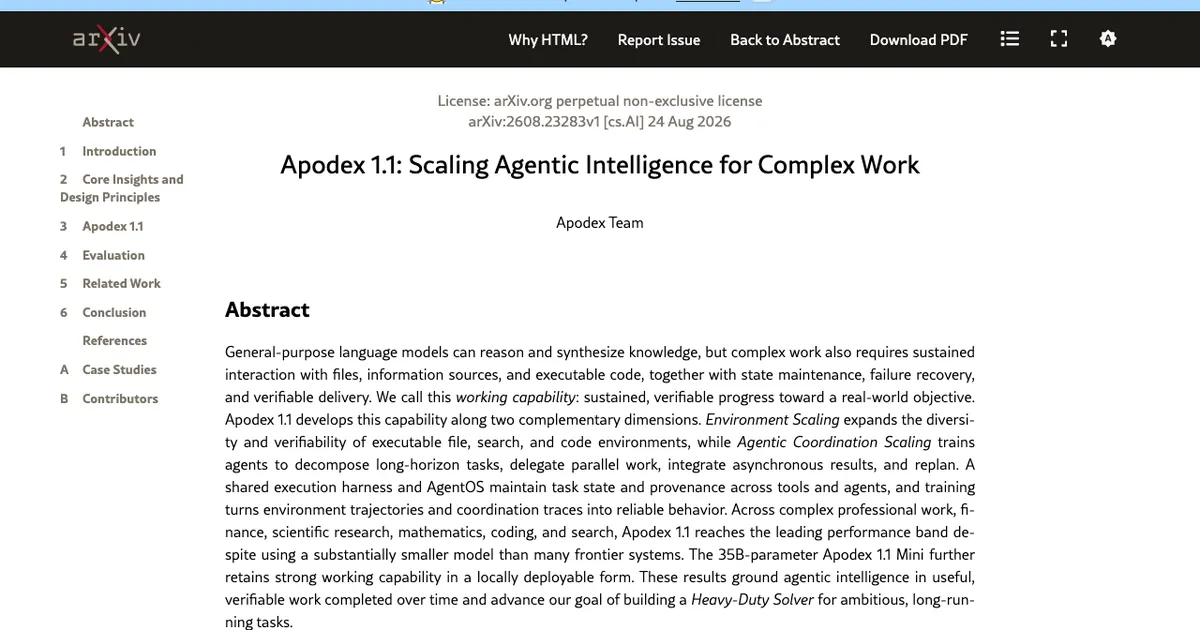
Unlocking the Future of AI: Introducing Apodex 1.1 for Complex ‘Working Capability’
The general consensus has been that large language models (LLMs) are revolutionary, but there’s a critical gap in their real-world applicability. While current LLMs can brilliantly reason and synthesize knowledge, complex professional work—like financial modeling, scientific research, or debugging massive codebases—doesn’t just happen in the abstract. It requires something far more robust than chat: sustained, verifiable progress toward a tangible objective.
That gap is what the new framework, Apodex 1.1, tackles head-on. As researchers know best, advanced AI needs to move beyond just generating text; it needs working capability.
🤖 What is ‘Working Capability’?
The Apodex team defines this as the ability for an AI system to manage complex tasks that involve continuous interaction with files, external information sources, and executable code. Think of it not as a single prompt-response cycle, but as a multi-day project where the machine has to remember its context, recover from failures, and prove that its final deliverable is correct.
🧠 The Core Innovations: How Apodex 1.1 Works
Apodex 1.1 tackles this ‘working capability’ challenge on two powerful fronts:
1. Environment Scaling: This vastly expands the scope and verifiability of the tools AI uses. It doesn’t just talk about code; it runs, executes, and verifies code in diverse environments (filesystems, search APIs, specialized interpreters). Verifiable execution is key to trust.
2. Agentic Coordination Scaling: This moves beyond single-agent workflows. Apodex 1.1 trains agents to operate like a specialized team: they decompose massive, long-horizon tasks into smaller pieces, delegate those tasks in parallel, integrate asynchronous results, and dynamically replan when things inevitably go wrong.
These two dimensions are managed by a shared execution harness (AgentOS) that meticulously tracks task state and provenance—meaning every step the AI takes is documented and auditable. This level of rigor makes it suitable for mission-critical applications.
🚀 Real-World Impact: A ‘Heavy-Duty Solver’
The results are seriously impressive. Across demanding, complex domains—including finance, advanced coding, scientific modeling, and mathematics—Apodex 1.1 reaches a leading performance band. Crucially, it achieves this performance while using models that are substantially smaller than many of the current frontier giants.
Bonus news for edge computing and enterprise deployment: The 35B-parameter Apodex 1.1 Mini retains much of this strong ‘working capability,’ making sophisticated AI accessible even in locally deployable, private environments.
Apodex 1.1 isn’t just another LLM update; it fundamentally changes the goalposts for agentic intelligence—advancing the blueprint for a true Heavy-Duty Solver capable of tackling humanity’s most ambitious, long-running challenges.
Want to dive deep into the technical details? Read the full paper here: https://arxiv.org/abs/2608.23283
By Yuexin Ma, Jingqi Hou, Yuxuan Kang, Zhaoying Liu • arXiv • Importance: 85/100
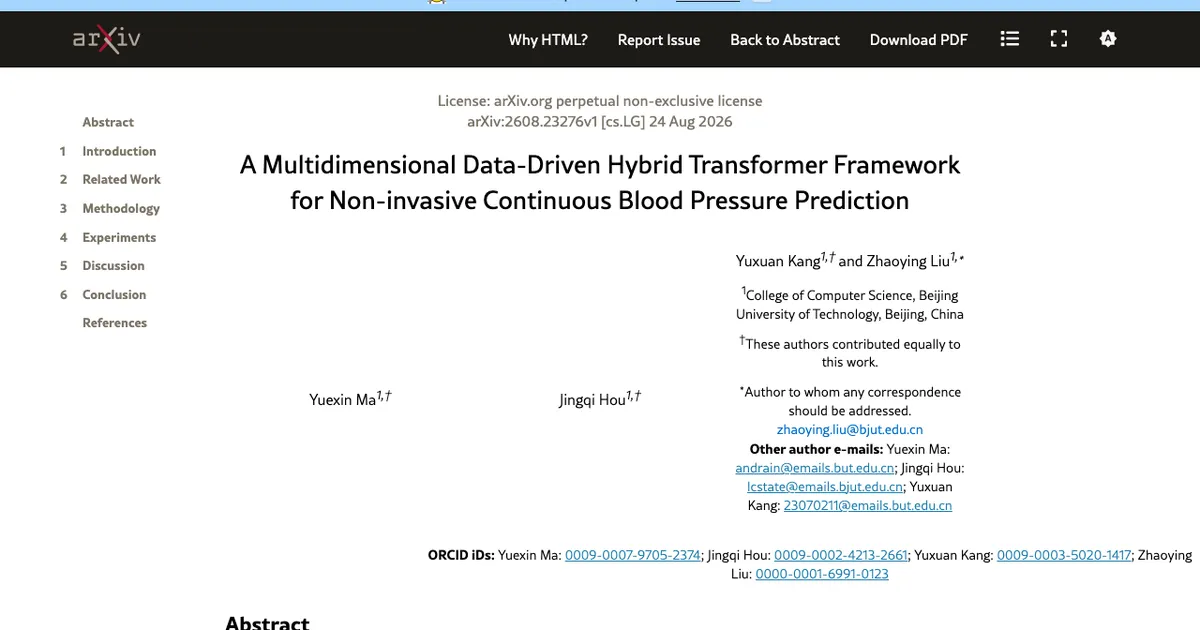
The Future of Healthcare: Predicting Blood Pressure Cufflessly with AI 🩸
Does measuring blood pressure require a cuff? Not anymore. This groundbreaking new research proposes an AI-driven solution to continuously estimate both systolic (SBP) and diastolic (DBP) blood pressure non-invasively, opening up massive possibilities for remote patient monitoring in Boston and beyond.
Scientists have developed a sophisticated hybrid Transformer framework designed to interpret subtle physiological signals from commonly available devices. Instead of analyzing raw, noisy waveforms, the system focuses on structured feature sequences derived from ECG (electrocardiogram) and PPG (photoplethysmography) data—the key biomarkers already collected in modern healthcare settings.
🤖 How Does This AI Magic Work?
Traditional BPs readings are snapshots. Continuous monitoring is gold, but it’s complex. The researchers built a specialized ‘Multi-Source Temporal Encoder Module’ that acts like an expert panel of different ML techniques:
- Transformer: Excellent at capturing long-range dependencies in sequential data.
- Kolmogorov-Arnold Network (KAN): Powerful for modeling highly nonlinear, complex biological relationships.
- XGBoost: Great for integrating static, tabular demographic information (like age or weight).
By combining these strengths, the framework captures complementary information—temporal trends, non-linear interactions, and fixed patient traits—all in one robust model. The final output is managed by a ‘Dynamic Conditional Fusion-Decoder’ that uses advanced attention mechanisms to refine the estimates.
🔬 Performance Highlights & Real-World Impact
Testing was conducted using large datasets from MIMIC-III Waveform and Clinical Databases, involving over 28,000 waveform segments. The results showed remarkable accuracy for both SBP and DBP, significantly outperforming existing baseline models. Crucially, the framework achieved alignment with established clinical standards (AAMI and BHS Grade A thresholds).
This isn’t just an incremental improvement; it’s a leap toward making high-quality BP monitoring as simple as wearing a watch.
💡 Why This Matters for Tech in Boston/US Healthcare:
The ability to continuously, accurately monitor blood pressure at home is revolutionary. It allows clinicians to spot dangerous trends (like hypertensive crises) much earlier, leading to preventative care and vastly improving patient outcomes—especially crucial for managing conditions like hypertension in urban centers.
Disclaimer: The authors stress that this is a retrospective analysis on specific datasets, and formal device validation or external evaluation is required before clinical deployment.
Read the full paper here
By Daniel Richards Arputharaj, Daniel Jönsson, Gabriel Eilertsen • arXiv • Importance: 85/100
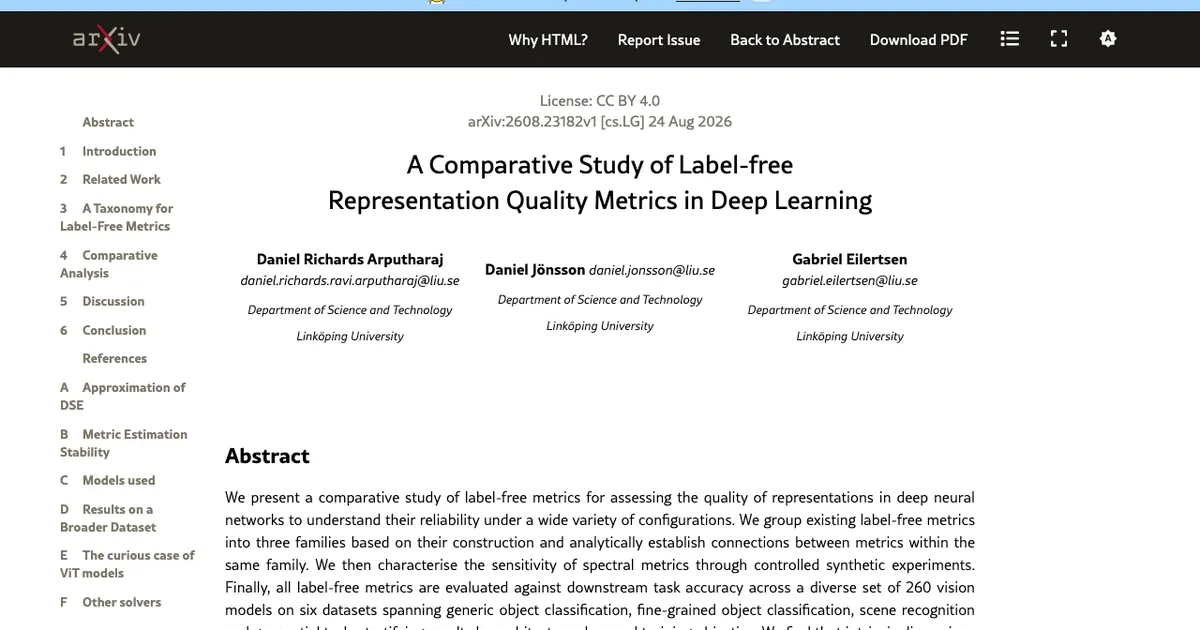
✨ Deep Learning Secrets: How Good Are Your Model Embeddings Really?
As ML researchers, we often talk about ‘representation quality’—the idea that the internal vectors (embeddings) deep neural networks generate contain rich, useful information. But how do we measure this quality without needing a labeled answer? Enter label-free metrics.
The new study from Arputharaj et al. provides a comprehensive, almost forensic, look at these crucial tools. They tackle a fundamental question in modern AI: When you build an amazing deep learning model, can you trust the features it learned before you check the accuracy?
🤯 The Core Problem (The ‘Black Box’ Challenge)
In ML research, we love to measure things that matter—like final classification accuracy. But sometimes, checking task accuracy is expensive or impossible. We need proxy measures. That’s where label-free metrics come in. They allow us to assess the internal quality of model representations (the feature space) purely by looking at the data structure itself.
The academic team meticulously analyzed multiple existing metrics—grouping them into families and analytically connecting their underlying mathematical principles. This isn’t just an overview; it’s a deep structural breakdown that clarifies what each metric actually measures.
🚀 What Did They Find?
- The Star Performer: The study highlights Intrinsic Dimensionality (ID) as the most robust and reliable predictor of representation quality among all metrics tested.
- But Wait, There’s More Complexity: Crucially, they caution that even ID’s reliability is not universal. Its effectiveness changes significantly based on the model’s architecture class (e.g., ResNet vs. Vision Transformer) and how it was trained.
- Real-World Testing: To prove their points, the authors tested all metrics against downstream task accuracy across a massive benchmark: 260 different vision models tested on six diverse datasets spanning general object classification, detailed fine-grained tasks, scene recognition, and even complex geospatial analysis.
🛠️ Why Does This Matter for Practitioners? (SEO Focus)
If you’re building advanced computer vision systems or working with large foundational models, this paper provides a critical roadmap. It moves the conversation beyond simply listing metrics to offering a true understanding of their operational reliability.
It helps us answer three key questions in practice: What exactly does a metric measure? When is it reliable? And how should we properly interpret its score?
This research elevates representation learning from a concept into a scientifically validated engineering tool, improving the trustworthiness and robustness of deep learning systems deployed globally.
👉 Want to dive into the technical details? Check out the full paper here: https://arxiv.org/abs/2608.23182
MachineLearning #ComputerVision #DeepLearning #RepresentationLearning #AIResearch
By Santosh Ray, Pratik K. Mishra, Ali Abedi, Charlene H. Chu, Amir Ahmad, Shehroz S. Khan • arXiv • Importance: 80/100
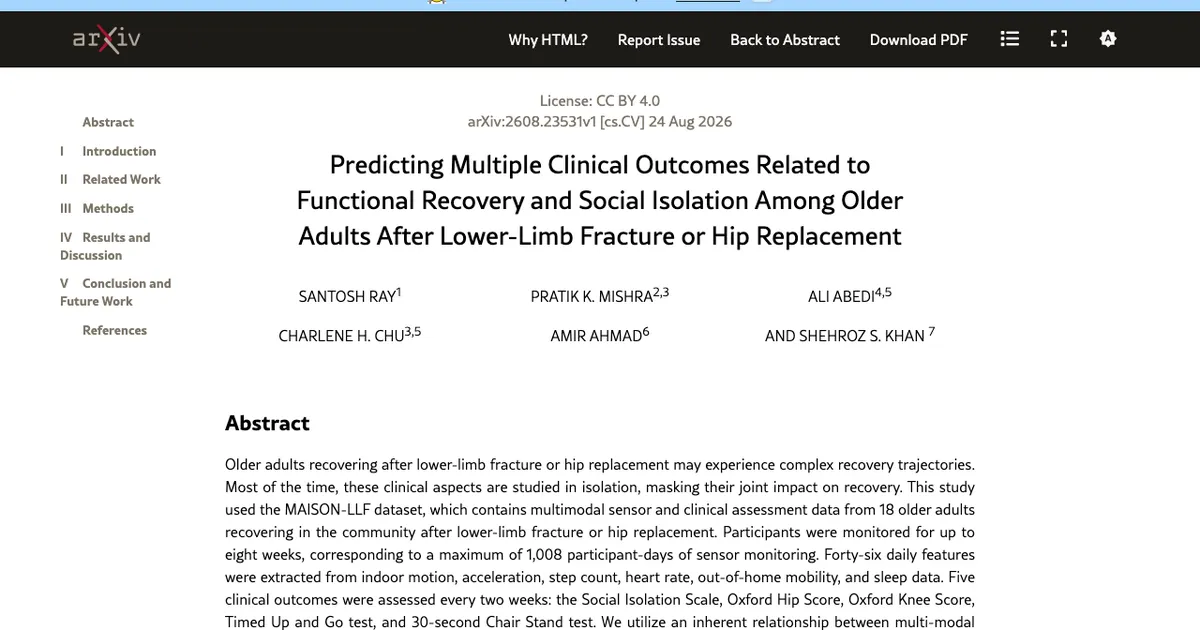
💡 Beyond the Scores: Predicting Holistic Recovery in Older Adults
As ML and AI increasingly penetrate healthcare, we’re moving past siloed diagnostics. Our latest research tackles one of the most complex areas: predicting a person’s full recovery journey after major orthopedic surgeries (like hip replacements or lower-limb fractures).
A single score doesn’t tell the whole story. Is better knee function enough? What about social engagement, mobility, and sleep quality?
This study dives deep into how these complex factors intertwine in community-dwelling older adults using multimodal sensor data and clinical assessments. Our goal: to create a single model that predicts all key recovery metrics simultaneously.
🌐 How Does It Work? The Power of Multi-Output Learning
The journey starts with the MAISON-LLF dataset, monitoring 18 older adults for up to eight weeks. Researchers monitored everything—from indoor motion and step counts to heart rate and sleep patterns—collecting massive amounts of continuous data (over 46 daily features!). Crucially, they also tracked five vital clinical outcomes every two weeks: the Oxford Hip Score, TUG test performance, Social Isolation Scale, and more.
Instead of building five separate predictors, the team formulated this as a multi-output regression problem. This means training one powerful model (they used the NODE deep learning regressor) to learn the joint relationships between all inputs and outputs.
The Big Reveal: The results demonstrated that predicting these clinical scores jointly was significantly more accurate than trying to predict them in isolation. Furthermore, SHAP feature analysis confirmed that combining various multimodal sensors provided a superior view of the patient’s overall recovery trajectory.
🚀 Why This Matters for Care (GEO & Impact)
The findings aren’t just academically interesting; they have immediate implications for geriatric care and rehabilitation services, especially in community settings.
By predicting multiple outcomes—like functional decline and worsening social isolation—simultaneously, clinicians can intervene much earlier and more holistically. Instead of waiting for a score to drop below a threshold, the system flags a predicted decline in overall well-being, prompting timely interventions (e.g., scheduling social activity sessions alongside physical therapy).
This work supports the transition toward predictive digital health tools that optimize the quality of life and recovery path for older adults at home.
🔗 Read the full paper here: https://arxiv.org/abs/2608.23531
Disclaimer: This research, while promising, represents a critical step toward better care planning and requires clinical validation.
By Siddharth Chilamkur, Dorit S. Hochbaum • arXiv • Importance: 80/100
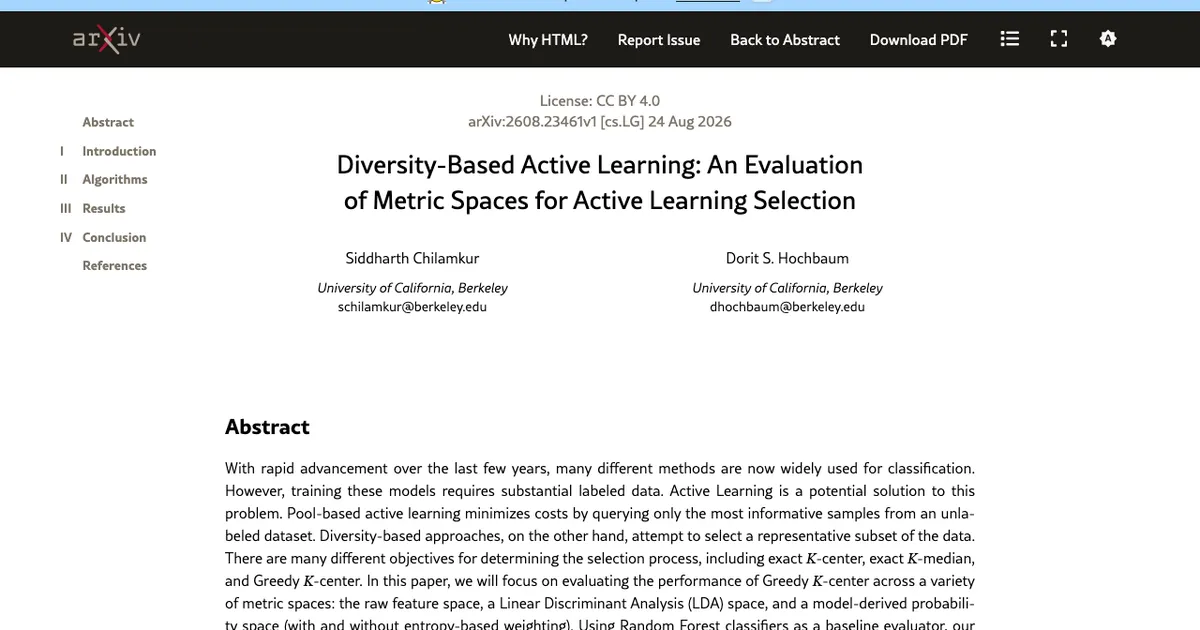
🧠 Data Science Breakthrough: Choosing the Right Samples for Optimal ML Training
Are you drowning in unlabeled data? That’s a common headache for any Machine Learning engineer. You need high-quality, representative examples to train top-performing models, but labeling every single piece of data is costly and slow. Enter Active Learning. 💡
This new paper dives into the critical question: How do we intelligently select the absolute most valuable samples from a massive pool of unknowns?
🚀 The Problem with Unlabeled Data
Traditional ML requires vast amounts of labeled data (think millions of images, thousands of text annotations). When that’s not feasible, researchers turn to Active Learning. Instead of labeling everything, they use an AI model to query only the ‘most informative’ samples—a technique that saves massive time and money.
The Diversity Challenge
Within Active Learning, there are many strategies. One popular approach is Diversity-Based Sampling, which aims to select a small subset of data that accurately represents the entire underlying dataset distribution. It’s like curating a perfect museum exhibit from millions of artifacts—you want all the key perspectives.
🔍 What Does This Paper Do? (The Core Insight)
This research tackles how different mathematical ‘spaces’ impact this selection process, using Greedy K-center as its primary selection method. The paper compares the performance of Greedy K-center when applied to three distinct representations of your data:
- Raw Feature Space: Treating features literally (the baseline).
- LDA Space: Projecting data into a dimension optimized for separation.
- Model-Derived Probability Space (The Winner!): Mapping samples based on the predictive probabilities derived from an already trained model, often weighted by entropy.
The Big Takeaway 📈
Using empirical tests on both synthetic and real-world datasets, the authors found a clear winner. For diversity-based active learning using Greedy K-center, mapping unlabeled instances into a predictive probability space and weighting by entropy consistently outperformed the raw feature space or even traditional dimension reduction techniques.
Why does this matter for practitioners? Because it provides an actionable roadmap: instead of simply looking at the data’s raw features when selecting samples, you should leverage your model’s uncertainty (entropy) to guide selection. Your model tells you where it’s confused; that confusion is where the most valuable labeled data lies.
✨ Key Concepts & Takeaways for ML Engineers
- Active Learning: Minimizing labeling costs by strategically selecting samples.
- Diversity-Based Sampling (K-center/K-median): Ensuring the selected subset is representative of the whole dataset.
- Probability/Entropy Weighting: Using the model’s predictive confidence (entropy) to identify the most ambiguous, informative samples—the ‘sweet spots.’
If you are building a high-stakes ML system and need to optimize labeling budgets, this paper offers strong evidence that basing your sampling selection on model uncertainty will yield superior results.
By Anthony Frion, Vien Minh Nguyen-Thanh, Ali Can Bekar, Pauleo R. Nimtz, Vadim Zinchenko, David S. Greenberg • arXiv • Importance: 80/100
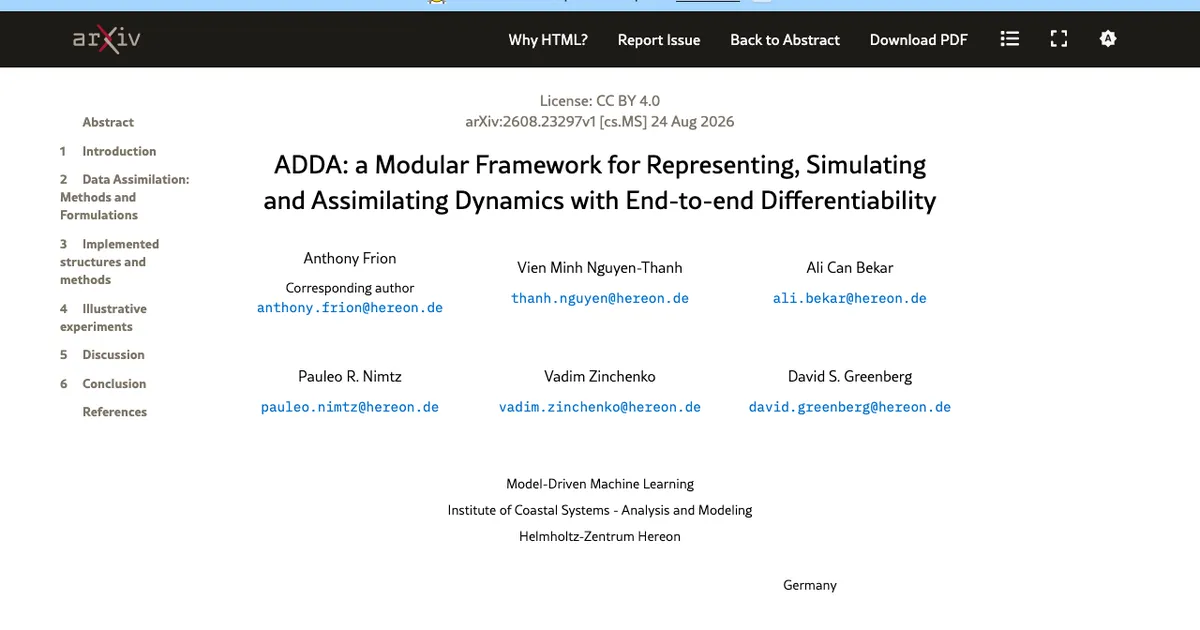
🔥 Game Changer for Earth Science: Seamlessly Assimilating Data with ADDA
If you’re in the geoscience, climate modeling, or advanced predictive analytics space, this is a must-read. The field of Data Assimilation (DA) is critical—it’s how we combine what scientific theory tells us (simulations) with real-world measurements (observations) to get better predictions and understand complex systems like Earth’s climate.
But here’s the catch: traditionally, the tools are fragmented. You have one specialized code for Variational methods, another for Ensemble Kalman Filters (EnKF), and then you have massive physical simulation models (like those simulating ocean currents or atmospheric dynamics). Integrating them seamlessly, especially while maintaining modern ML features like automatic differentiation, has been a huge pain point.
🤖 Introducing ADDA: The Unified Solution
Researchers at the mentioned institutions have unveiled ADDA (Automatic Differentiation for Data Assimilation), a groundbreaking software framework designed to solve this entire interoperability nightmare. Think of it as the universal translator and connective glue for all dynamical systems models.
What makes ADDA so powerful?
- End-to-End Differentiability: This is the biggest deal. ADDA embeds automatic differentiation (AD) deep into the core structure. This means that not only can you run a complex physical simulation and compare it to data, but the entire process—from initial state representation through the assimilation algorithm—is fully differentiable. This unlocks advanced machine learning techniques previously impossible in DA.
- Modular Flexibility: It provides powerful base classes for defining dynamic systems and observation operators. Whether you are dealing with structured grids (like typical Cartesian meshes), unstructured meshes, or complex Lagrangian variables, ADDA handles it elegantly.
- Modern ML Stack Ready: Built on PyTorch (with support for JAX-based computations), ADDA ensures that parallel processing is a first-class feature. This lets researchers scale up their models to handle massive datasets and real-time atmospheric predictions.
🌍 Why Should You Care? The Impact
ADDA isn’t just another library; it fundamentally raises the ceiling on what complex scientific modeling can achieve. It allows us to tackle previously intractable problems in areas like:
- Climate Prediction: Developing highly accurate, data-constrained forecasts.
- Oceanography: Tracking dynamic shifts using real-time buoy data and satellite imagery.
- Industrial Modeling: Improving simulations in fields requiring complex state tracking.
The framework’s commitment to making everything differentiable paves the way for next-generation hybrid ML-physics models, where AI doesn’t just supplement the physics—it becomes an integral part of the prediction loop itself.
🔗 Read the full details and explore the codebase: ADDA Paper
🚀 Developers & Researchers: The code is openly available, making this a massive boon for the scientific computing community! Check out their GitHub repository to start building your own differentiable DA pipelines.
#Geoscience #ClimateTech #MachineLearning #ScientificComputing #DataAssimilation #DeepLearning
By Matteo Berta and Tania Cerquitelli in Proceedings of the Ninth Evaluation Campaign of Natural Language Processing and Speech Tools for Italian. Final Workshop (EVALITA 2026) • ACL Anthology • Importance: 80/100
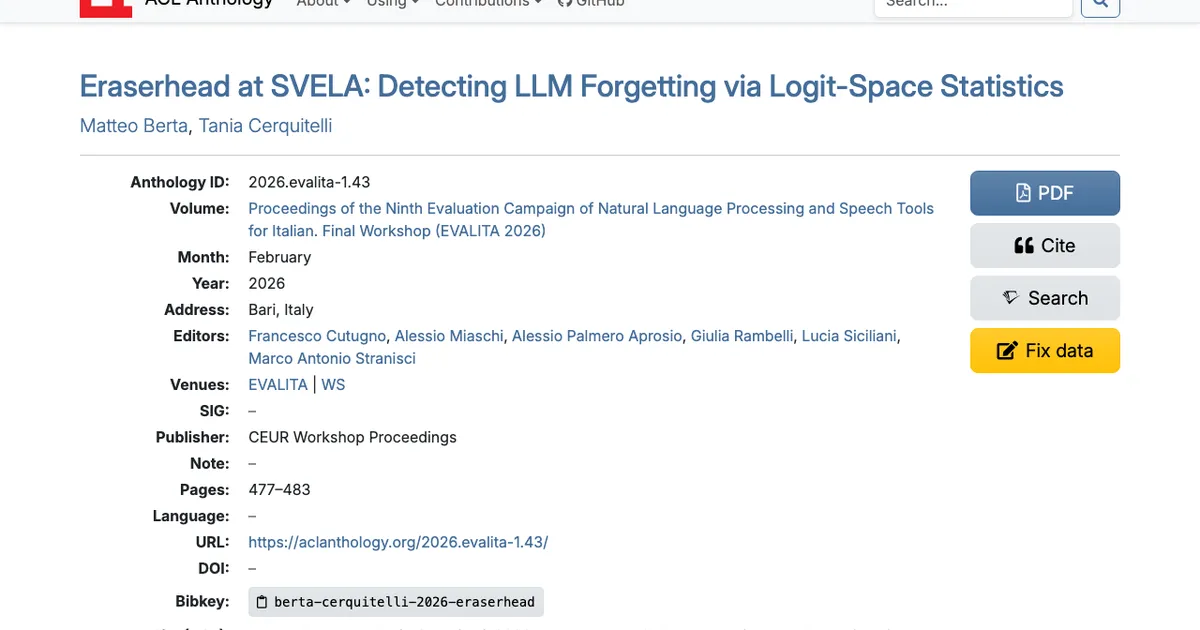
🧠 Is Your LLM Suddenly Forgetting Things? We Found the Proof! 🗑️
Ever used a powerful chatbot and noticed it suddenly ‘forgot’ context from earlier in the conversation? It’s a common annoyance, but for developers building mission-critical AI systems, this forgetting (or catastrophic forgetting) is a major roadblock. Current methods often treat LLMs like magic black boxes, making reliable monitoring almost impossible.
That changes now. Our research introduces Eraserhead at SVELA, a novel approach that doesn’t just measure performance loss—it detects the mechanism of forgetting itself. Think of it as an AI stethoscope, listening to the internal thought patterns (the logits) of a Large Language Model.
🔎 How Does Eraserhead Work? The Logits Deep Dive
Most researchers test LLMs by giving them new prompts and seeing if the answers are wrong. But what’s happening inside the model when it forgets? Our groundbreaking method delves into logit-space statistics—the raw probability distributions the model generates before selecting a word.
By analyzing these subtle shifts in logit space, we can pinpoint exactly when, where, and how an LLM’s internal representations are degrading. Instead of just saying ‘Error,’ Eraserhead tells you: ‘Warning: The certainty gradient is falling rapidly in this domain.’
Why This Matters for Developers:
- Proactive Debugging: You can build guardrails that predict forgetting before it impacts the user experience.
- System Reliability: Critical applications (medical, financial) require consistent memory. Eraserhead provides the necessary diagnostic toolset.
- Efficiency: By understanding why and how LLMs forget, we pave the way for more stable and context-aware architectures in Italian NLP (as tested at EVALITA 2026).
✨ The Takeaway: Monitoring is Key
The future of reliable LLM deployment isn’t just about training bigger models; it’s about building better monitoring systems. Eraserhead represents a significant leap toward making Large Language Models accountable, stable, and trustworthy in real-world, continuous use.
🔗 Read the full technical details on our pioneering work: https://aclanthology.org/2026.evalita-1.43/
LLM #AIResearch #NLP #MachineLearning #GenerativeAI #DeepLearning
By Adeel Zafar, Slawomir Nowaczyk, Hamid Sarmadi, Saeed Gholami Shahbandi • arXiv • Importance: 78/100
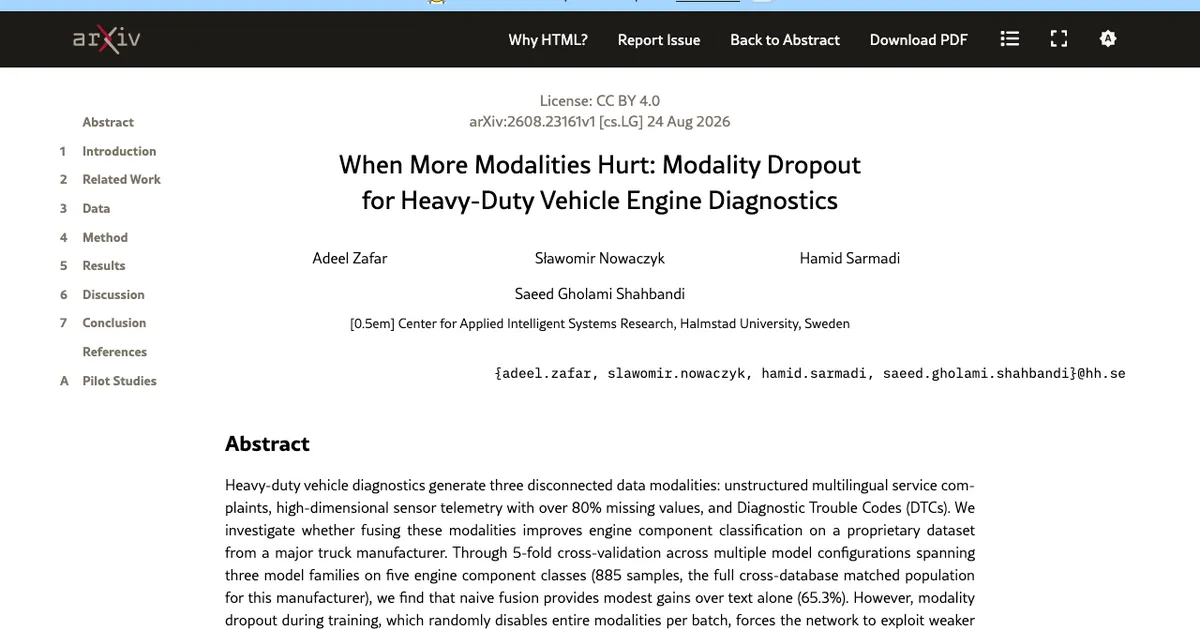
Engine Diagnostics Breakthrough: Why ‘Less is More’ Wins in AI
The Problem with Too Much Data
The modern world of heavy-duty trucks generates a data deluge. When you try to build an AI that processes everything—customer complaints, live sensor streams, and standardized fault codes—it’s easy to assume combining it all makes the model smarter. But what if the sheer volume of disconnected modalities actually confuses the system?
Our latest research tackles this common pitfall: Modality Dropout. Instead of blindly fusing every single data stream, we randomly train our AI to work even when entire data streams (like text or sensors) are temporarily disabled.
This concept—forcing a machine learning model to rely on weaker inputs—is revolutionary for industrial applications where perfect data collection is impossible.
💡 Key Findings in Truck Diagnostics
Using a proprietary, large-scale dataset from a major manufacturer, we applied this selective fusion approach to diagnose complex engine component failures. The results challenged conventional wisdom:
- Naive Fusion is Subpar: Simply combining all available data streams only gave modest improvements.
- Dropout Dominates: Modality Dropout significantly boosted accuracy by forcing the network to find predictive signals in complementary, less obvious ways (68.8% accuracy on text+DTC fusion).
- Domain Expertise Confirmed: The analysis proved that no single modality is a silver bullet. Text captures symptoms, DTCs provide structured fault codes, and sensors measure physical state. Optimal performance requires knowing which inputs to trust when.
Where Dropout Shine Brightest:
The true power of this technique emerged in specific failure scenarios. For example, diagnosing fuel system faults saw accuracy nearly triple (from 15% with text alone up to 38%) when using dropout-enhanced fusion. This demonstrates a massive leap in reliability where it counts most.
🚀 Why Modality Dropout is a Game Changer for Industry
This work marks the first application of three-way modality fusion (text, sensors, and fault codes) combined with modality dropout specifically in industrial vehicle diagnostics. For industries relying on complex machinery—trucking, manufacturing, energy—it means building more robust, reliable, and less data-dependent diagnostic AI.
If your model needs to work reliably when one sensor fails or one data type is missing, Modality Dropout is the solution.
➡️ Read the full research paper here: https://arxiv.org/abs/2608.23161
Disclaimer: This work significantly advances diagnostic capabilities for heavy-duty vehicles, improving uptime and predictive maintenance strategies.
By Matthew T. Hansen, Jason A. Dittmann • arXiv • Importance: 75/100
Breakthrough Exoplanet Search: Unveiling Long-Period Worlds from Kepler
The field of exoplanetary science is undergoing a revolution! For years, the detection methods—including those used by the famous Kepler telescope—had an inherent bias: they were optimized for finding planets with short orbital periods. This meant that entire classes of massive worlds orbiting far away from their stars remained hidden or poorly understood.
Now, researchers have solved this blind spot. In a detailed study analyzing the rich data archives from the Kepler mission, they developed a sophisticated new pipeline specifically designed to detect long-period exoplanets—those with orbital periods exceeding 342 days.
🔭 How Did They Find Them?
The team employed advanced computational methods, including classifying convolutional neural networks (CNNs), paired with deep analysis of the Kepler spacecraft’s onboard diagnostics. This wasn’t just running basic algorithms; it was building a bespoke detection system tailored for massive gaps in current astrophysical knowledge.
By applying this breakthrough pipeline to all known planetary systems within the Kepler field, and performing rigorous manual vetting on every signal, they successfully identified four remarkable new planetary candidates!
🚀 Key Discoveries:
**
These candidates represent worlds far beyond our solar system’s traditional grasp. Two of these newly found planets (Kepler 1752.02 and Kepler 199.03) are particularly exciting because the transit events they cause are consistent with systems already showing complex Transit Timing Variations (TTVs)** in their inner planet arrangements—a key indicator of gravitational interactions.
While these four candidates, on their own, might not explain all the observed TTV signals, they dramatically expand our understanding of planetary architecture. They open up exciting new avenues for follow-up observations, promising to constrain the existence and properties of planets that govern entire stellar systems.
🌌 What Does This Mean For Astronomers?
This work fundamentally shifts the paradigm of exoplanet detection. It confirms that our understanding of planetary system architecture is incomplete without dedicated tools for long-period objects. These four candidates are invaluable ‘stepping stones’ toward fully mapping the structure and evolution of diverse multi-planet systems.
Read the full academic paper here:
https://arxiv.org/abs/2608.23425
Keywords: #Exoplanets #Kepler #Astronomy #SpaceTech #PlanetaryScience #LongPeriodPlanets
By Jiayu Li • arXiv • Importance: 75/100
🚀 Is Your Quant Trading System Fundamentally Flawed? The Axioms of Stable Profit
The entire world of quantitative finance runs on a single, beautiful lie: that the patterns found yesterday will reliably predict tomorrow. This ‘faith’ is precisely what systematic trading assumes—that some latent, unobserved state drives market movements in predictable cycles. But how do we build a system based on an assumption so fragile?
Our latest research tackles this head-on by treating quantitative investing not as an art of curve-fitting, but as a structured science. We move beyond simply finding correlations and instead derive the axiomatic structure necessary for any profitable systematic trading system to exist.
🧠 What Did We Find? The Five Pillars of Market Persistence
The abstract introduces a framework that suggests almost every successful quant model is determined by just five fundamental constants. Think of these as the core parameters your system must correctly identify and account for, or else it will fail when market conditions change.
- Recurrence Bound ($\Lambda$): How often do patterns repeat? This dictates the minimum block size needed to detect cyclical behavior in the market’s latent state.
- Invariance Defect ($\epsilon_0$): Measures how perfectly a given representation captures the underlying truth. It’s your measurement error—how far you are from perfect fidelity.
- Coherence Times ($\ell_i$): How long does each component of the market’s latent state stay correlated? Short coherence times mean rapid shifts and volatile signals; long ones imply stable regimes.
- Signal Ceiling ($
ho$): The ultimate limit on predictive power. No matter how complex your model, there’s a maximum amount of predictable signal available in the data.
- Fraction Contingency ($\kappa$): What fraction of the market’s movement truly depends on the current economic regime? This tells you how much you can rely on a single environment (e.g., bull vs. bear).
🛠️ The Implication for Quants and ML Researchers
The paper suggests that once these five constants are properly identified, the architecture of an optimal quantitative investment system is almost predetermined. It moves the focus from merely collecting features to mathematically constraining the entire model structure.
This means that future alpha generation won’t just be about tweaking hyperparameters or feeding more data; it will require a deeper, physics-like understanding of the underlying market mechanisms themselves. This fundamentally changes how ML models are designed for finance—moving from ‘data-driven correlation finders’ to ‘mechanism modelers.’
🎯 Takeaway: If you build your quant system without accounting for these five critical parameters, your model is built on assumptions that may collapse at the first change of regime. Start by questioning why a pattern persists, not just that it did.
By Seokjin Hwang, Yuting, Li, Kiwan Maeng • arXiv • Importance: 75/100
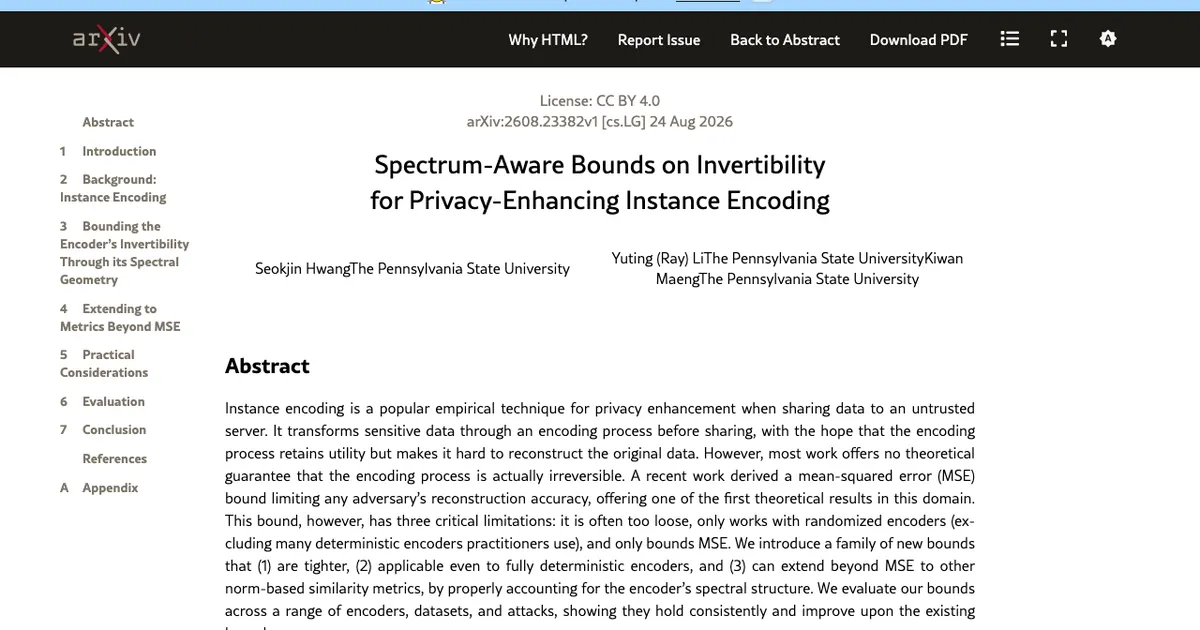
🛡️ Stop Guessing: New Theory for Truly Private Data Encoding
(Digest from the latest research on data privacy and secure machine learning)
If you’ve ever wondered how companies can share sensitive user data—like medical records or financial transactions—with an untrusted cloud server while keeping it absolutely private, this paper is your answer. Data encryption is great, but encoding? That’s where the theoretical guarantees get scary.
Most data science projects use ‘instance encoding’ (a way to transform raw data) hoping that the transformation makes the data unrecognizable and irreversible. But without a solid mathematical proof, you are just hoping for privacy. The current academic landscape is seriously lacking in rigorous theory.
🤯 The Problem with Privacy Encoding Today
Existing methods, while useful empirically, lack theoretical guarantees of true irreversibility. Previous academic bounds offered some protection (like bounding the reconstruction error), but they came with huge caveats:
- Too Loose: They were often overly optimistic, providing protection far weaker than needed.
- Limited Scope: They only worked for randomized encoders—meaning many deterministic methods practitioners actually use couldn’t be proven private by them.
- MSE Only: They could only bound the Mean Squared Error (MSE), failing to account for other real-world similarity metrics crucial in modern ML.
🚀 The Breakthrough: Spectral Bounds for Total Security
The authors introduce a novel family of bounds that fundamentally change the game by tackling the spectral structure of the encoders. Think of the spectrum like the unique ‘fingerprint’ of how data is transformed. By analyzing this deeper mathematical property, they achieve three massive leaps in security theory:
- Tighter Guarantees: Their new bounds are mathematically tighter, offering stronger proof of irrecoverability than anything before.
- Deterministic Proofs: Crucially, their framework applies to fully deterministic encoders, covering the vast majority of practical real-world ML setups.
- Metric Agnostic: They extend beyond simple MSE, supporting a wide range of norm-based similarity metrics needed for robust industrial applications.
The Bottom Line for Engineers and Researchers: This paper provides the first comprehensive theoretical framework to rigorously prove that your data encoding process is truly one-way and irreversible, regardless of whether you use randomization or deterministic methods. It moves privacy techniques from ‘best guess’ science to ‘mathematically guaranteed’ engineering.
🔗 Read the full academic paper here: https://arxiv.org/abs/2608.23382
Keywords: Data Privacy, Instance Encoding, Federated Learning, Security Bounds, Spectral Analysis, Machine Learning Theory
By David Moffat, Angus Laurenson, Victor Martinez-Vicente, Gemma Kulk, Xuerong Sun, Robert J. W. Brewin, Shubha Sathyendranath • arXiv • Importance: 75/100
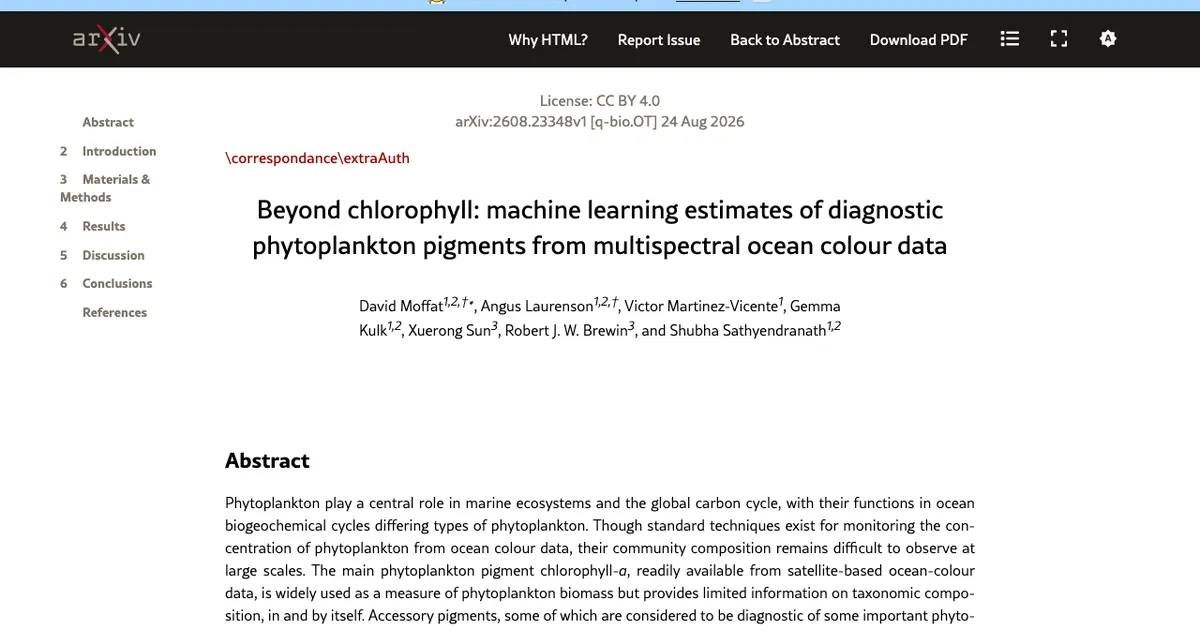
Revolutionizing Ocean Science: Unlocking Hidden Insights from Satellite Pigments! 🌊🔬
Hey science enthusiasts and geospatial data nerds! Ever wonder what the vast ocean surface is really hiding? For decades, scientists have relied heavily on satellite imagery to track plankton blooms, primarily using Chlorophyll-a. While crucial, Chl-a only tells part of the story—it’s a big measure of overall biomass but doesn’t reveal who is doing the blooming.
Now comes the breakthrough! Our latest research tackles this limitation head-on, showing that advanced Machine Learning (ML) can help us estimate crucial diagnostic phytoplankton pigments from multi-spectral satellite ocean color data. This is a massive leap in environmental monitoring!
💡 The Problem: Chlorophyll’s Blind Spot
The ocean’s microbial life, or phytoplankton, drives global biogeochemical cycles—they are key to the planet’s oxygen and carbon cycle. Different types of plankton (e.g., diatoms vs. cyanobacteria) use different pigments, which are like their unique ‘fingerprints.’ While we can easily measure Chlorophyll-a from satellites, accessory pigments (like fucoxanthin or zeaxanthin) hold the keys to understanding the full community structure—which specific groups are thriving.
However, retrieving these pigments is notoriously difficult. Standard methods struggle because signals are often mixed up with Chl-a and limited spectral data makes discrimination tough.
🧠 The Solution: Deep Learning for Ocean Chemistry
Our study introduces a sophisticated ML approach to solve this puzzle. We trained advanced models like Random Forest and TabPFN, using global satellite multispectral reflectance alongside ground-truth measurements (HPLC).
What did we find? Simply put, the ML approaches consistently crush traditional methods that relied only on Chl-a. The results prove that our multispectral data contains much richer, untapped information—enough to discriminate between plankton groups with unprecedented detail.
This means future ocean monitoring will move beyond just biomass counts and provide detailed ecological maps of what’s happening under the waves. It empowers climate researchers, conservationists, and resource managers across regions like North America, Southeast Asia, and the Mediterranean to make better decisions. 🌏🚀
🔗 Want to dive into the methodology? Check out the full paper here: https://arxiv.org/abs/2608.23348
OceanScience #ML #RemoteSensing #Phytoplankton #ClimateTech #Geospatial #DataScience
By Collin Leiber, Kai Puolamäki, Heikki Mannila • arXiv • Importance: 75/100
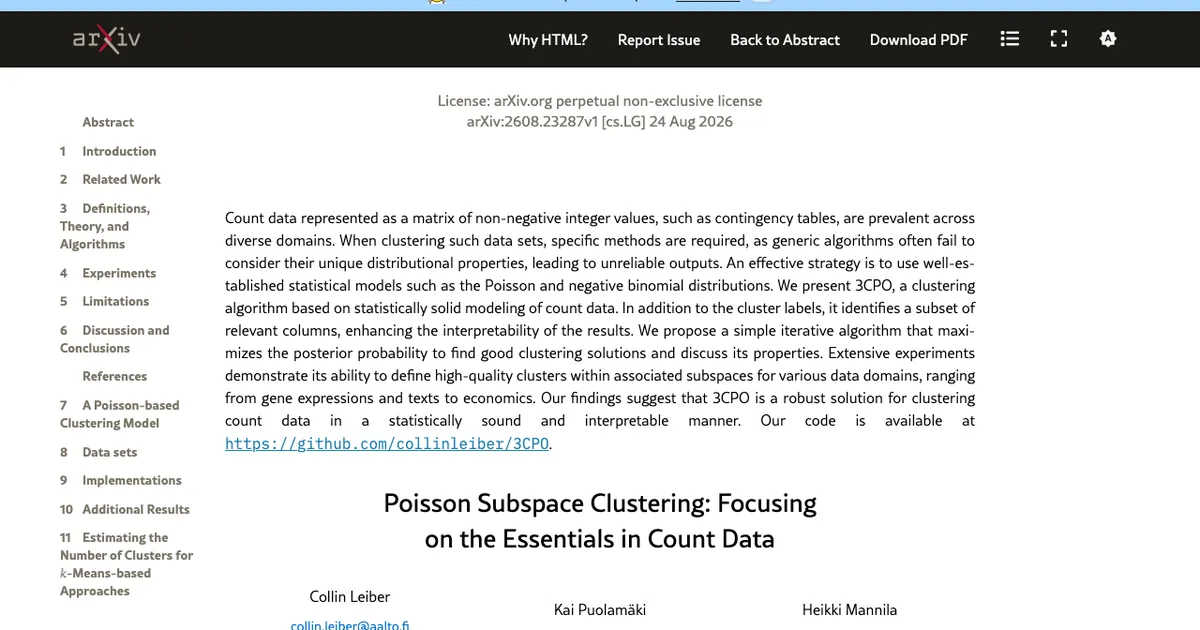
📊 Stop Guessing: The Smart Way to Cluster Count Data
Are you dealing with complex datasets—like gene expression matrices, count tables from economics, or frequency text features—that involve non-negative integer counts? If so, standard clustering algorithms are likely treating your data incorrectly, leading to noisy and unreliable results.
This paper introduces 3CPO (Poisson Subspace Clustering), a statistically robust solution designed specifically for the unique challenges of count data. Instead of generic methods, 3CPO grounds its analysis in established statistical principles like the Poisson distribution, providing insights that are both accurate and deeply interpretable.
✨ What is 3CPO and Why Should You Care?
Count data has specific distributional properties (you can’t have -2 genes expressed!). Generic machine learning techniques often ignore these nuances. 3CPO fixes this by:
- Statistical Rigor: Leveraging Poisson modeling to ensure the clustering respects the true statistical nature of the counts.
- Subspace Selection: Not only does it provide cluster labels, but it intelligently identifies the most relevant columns (features/genes) that define those clusters. This drastically improves interpretability—you don’t just get a label; you get to know why the model assigned that label.
- High Performance: Through a simple, iterative algorithm maximizing posterior probability, 3CPO delivers high-quality cluster definitions across diverse fields—from genomics and natural language processing to econometrics.
🧠 How Does it Work?
The core idea is moving beyond simple distance measures. 3CPO treats the count matrix as data governed by a Poisson process. By maximizing the likelihood under this statistical framework, it finds clusters not just based on proximity, but on a statistically sound pattern of co-occurrence and dependence within specified subspaces.
🚀 Real-World Impact & Getting Started
The versatility is impressive. The authors tested 3CPO successfully across wildly different domains:
* Genomics: Analyzing gene expression counts to find functional groups.
* Text/NLP: Clustering documents based on frequency features.
* Economics: Interpreting contingency tables and economic data patterns.
If your research involves matrix count data, this paper offers a critical upgrade over standard techniques. The authors have also provided their code for easy implementation!
🔗 Read the full methodology and see extensive experimental results here: https://arxiv.org/abs/2608.23287
Code: Available on GitHub for immediate use!
Are you struggling with count data visualization or clustering? 3CPO is designed to give you statistically sound, interpretable answers.