By Carmen Oliver Huidobro, Mikolaj Czerkawski, Kevin Monsalvez-Pozo, Cesar Aybar, Gustau Camps-Valls, Oscar J. Pellicer-Valero • arXiv • Importance: 95/100
🛰️ Earth Observation Just Got a Massive Upgrade: Introducing MajorTOM:Elliot Pretrain
If you work with satellite data—from climate science to urban planning—you know the biggest challenge is data heterogeneity. No single open dataset gives you everything: multiple sensors, varied time scales, and accompanying metadata (like text captions). Until now. 🌍✨
Researchers at https://arxiv.org/abs/2610.18624 have solved this by releasing MajorTOM:Elliot Pretrain, a groundbreaking dataset that fundamentally changes how foundation models are trained for Earth Observation (EO).
What is MajorTOM:Elliot Pretrain?
This isn’t just another dataset; it’s a massive, standardized ‘super-corpus.’ Imagine stacking the best of every available satellite source—Sentinel-2, Landsat, Sentinel-1, DEMs, WorldCover, and more—onto the same virtual map tile.
The dataset features 279,166 tiles (each 10 km in size), each containing a stacked view across multiple physical layers, all aligned on a consistent 10m grid.
Key Features That Change Everything:
* Multi-Sensor Mastery: It mashes up optical sensors (Sentinel-2/Landsat) with radar data (Sentinel-1), elevation models (Copernicus DEM), and land cover classifications (ESA WorldCover).
* Temporal Richness: It categorizes tiles into three regimes: Monotemporal (single snapshot), Monthly (annual cycle modeling), and Burst (rapid change detection over 30 days). This is crucial for tracking disasters or rapid urban development.
* Technical Excellence: The data is delivered as a massive, cloud-optimized package (6.3 TB of Cloud Optimized GeoTIFFs) indexed by TACO v3 Parquet metadata. This means you can access and filter specific time windows before downloading any pixel—a game-changer for large-scale research.
The Impact on AI Foundation Models
Why does this matter for machine learning? Training ‘foundation models’ (like large language models, but for vision/geospatial data) needs diverse and consistent inputs. MajorTOM:Elliot Pretrain provides the perfect laboratory.
The authors tested their stack by running preliminary pretraining runs on OlmoEarth-Base. The results were impressive:
✅ Completeness: Curating just a 25% subset of the core data using advanced embedding techniques matched or beat performance on most benchmarks established with the full corpus.
✅ Augmentation Success: Adding Landsat data improved performance over Sentinel-2 only training across all tests. Incorporating DEM and WorldCover targets further boosted results.
The Takeaway for Researchers: This dataset allows models to learn complex physical relationships (e.g., how high ground relates to land cover, or how radar signatures change with water body type) that were previously impossible to model systematically using separate datasets.
🔎 Who Should Care? (SEO & Geo Focus)
Climate Scientists: Analyze historical land use changes and atmospheric patterns. 🌍
Urban Planners/Civil Engineers: Track infrastructure growth, disaster recovery areas, and urbanization rates in specific global regions. 🏙️
ML Researchers (Vision/Geospatial AI): Need a reliable benchmark for building next-generation Earth Observation models.
MajorTOM:Elliot Pretrain isn’t just data; it’s the necessary fuel to unlock truly global, multi-dimensional geospatial intelligence. It sets a new standard for public EO data availability and model training complexity.
By Mattie Ji, Indradyumna Roy, Vikas Garg • arXiv • Importance: 92/100
🧬 Generating Graphs with Perfect Topology: Achieving Exact Topological Compliance
The field of graph generation is exploding. Whether you’re training models on molecular structures, social networks, or knowledge graphs, the underlying structure—the topology—is often more important than individual nodes or edges. But generating graphs that perfectly match a desired structure has been incredibly difficult.
Most existing methods use ‘soft regularization,’ meaning they aim for an approximation of the target topology. It’s like trying to hit a bullseye but settling for anything close. Researchers and practitioners need deterministic control: they need graphs whose topological fingerprints match the target perfectly (i.e., Persistence Diagrams must be identical).
🤯 The Challenge: From Approximate Matching to Exact Compliance
The authors tackle this by building upon the framework of Persistent Homology, which summarizes the topological evolution of a graph as Persistence Diagrams (PDs).
What’s New? A Dual-Approach Solution 🚀
Local Optimization: The first approach builds graphs iteratively using degree constraints. The authors prove this method is sufficient, but they expose a key limitation: focusing only on local rules can easily make the system lose diversity or hit computationally infeasible states.
Global Constraint Solver (The Breakthrough): To solve these limitations, the paper recasts the entire generation task as a global constraint satisfaction problem. This allows them to utilize powerful modern constraint programming solvers. Critically, this method is shown to be applicable to any vertex-based permutation equivariant filtration scheme and is minimal under degree filtration.
This shift from local approximations to global mathematical guarantees provides a principled, robust treatment of strict topology-compliant graph generation that was missing in the literature.
✨ Why Does This Matter for ML & AI? (SEO Focus)
For researchers developing next-generation Graph Neural Networks (GNNs), topological data analysis (TDA) models, or generative chemistry tools, this work is a game-changer.
Rigorous Control: Instead of accepting ‘close enough,’ you can demand perfect structural compliance.
Benchmark Utility: Provides verified methods to generate precise datasets for training robust GNNs in areas like drug discovery (molecular graph generation) and network science.
Scalability: By framing it as a constraint problem, they offer a scalable, mathematically sound solution applicable to diverse filtration types.
If your ML pipeline requires generating structured data (like molecular graphs or complex networks), understanding how to control its intrinsic topology is paramount. This research provides the blueprint for that exact control.
Is AI Making Education Cheating-Proof? Introducing AIRRI
The age of large language models (LLMs) and advanced image processing means that virtually any assignment—from complex diagrams to handwritten notes—can be digitized, solved, and plagiarized with alarming ease. For educators, this poses a massive crisis in educational assessment. But what if the content itself could resist AI?
This is the core challenge tackled by AIRRI (Artificial Intelligence Resilient Reading Interface), a groundbreaking framework presented by Emory Salaun et al. https://arxiv.org/abs/2610.18724.
🤖 How AIRRI Works: Making Assignments AI-Proof
AIRRI doesn’t just obscure text; it systematically introduces layers of complexity designed to thwart modern computer vision and NLP models. It approaches machine resistance from two critical angles:
1. Image-Based Obfuscation:
This involves subtle but disruptive visual changes, such as varying character opacity, manipulating line/word spacing, or applying fine noise overlays. These techniques mess with the input data structure itself.
2. Decision-Based Adversarial Attacks (The ‘Hardcore’ Approach):
These are more sophisticated attacks like RayS and SurFree, which target the specific decision pathways of OCR systems. They create subtle patterns that fool algorithms without appearing obviously wrong to the human eye.
📈 The Results: A Knockout Blow to Current OCR Systems
The evaluation results show a dramatic degradation in performance across leading industry tools. AIRRI tested its methods against three major image-to-text systems: Tesseract, EasyOCR, and GOT-OCR2 (a transformer-based model).
The impact was profound:
* Character Error Rates: For EasyOCR, AIRRI jumped the character error rate from a manageable 6.9% up to an alarming 55.9%. Tesseract saw its errors skyrocket to 100%!
* Word Recognition Failure: Word error rates similarly surged for both systems tested.
Crucially, while transformer models (like GOT-OCR2) were more resilient than older methods like EasyOCR and Tesseract, AIRRI still managed significant reductions in performance. The data suggests that AI-assisted assignment completion becomes dramatically harder.
🌍 Why This Matters for India & Global EdTech
This isn’t just a theoretical academic exercise; it has massive practical implications for educational technology globally. As more digital assessment tools—from university exams to standardized tests—rely on LLM workflows, AIRRI provides an essential guardrail.
For EdTech companies developing platforms in India and other major education hubs, this signals that basic image digitization is no longer a reliable security feature. Content creators must adopt advanced defensive strategies or risk their assessment integrity being easily compromised by generalized AI tools.
The conversation around academic authenticity just got much more technical—and potentially solvable.
Decoding the Details: Why Your ‘Refresh Frequency’ Schedule is Incomplete
If you’ve spent time training massive foundational models—the kind of GPT-style beasts that are reshaping AI—you know that every optimization parameter, from batch size to learning rate, matters. But there’s a subtle timing trap baked into advanced optimization techniques like Kronecker-preconditioning.
Our latest research shows that simply specifying a ‘refresh interval’ isn’t enough to define a complete training schedule. The timing of those refreshes relative to the overall training epoch is critical, leading to complex dependencies on the learning rate and model size.
💡 The Core Problem: Timing Matters More Than Just Frequency
The optimization process often involves recomputing expensive components like curvature eigendecompositions only periodically. Many current implementations simplify this by allowing users to define a fixed refresh frequency (e.g., every N steps). However, we found that even if the total number of refreshes is fixed, where those refreshes occur within the schedule matters significantly.
What does this mean in practice? If you move the time placement of those intermediate updates while keeping the first and last updates locked, the model’s final loss function changes. Worse still: the optimal placement shifts depending on whether your learning rate is low or high.
Our experimental results showed a dramatic phenomenon: when training on FineWeb, moving just two refresh points in a four-refresh schedule caused them to swap ranks (i.e., the placement was better at low rates, but another placement was superior at high rates). This suggests that a single benchmark comparison is highly misleading.
🔬 Technical Takeaways for ML Engineers and Researchers
Learning Rate Dependency: The optimal refresh schedule is not static. It flips its preference based on the learning rate used during training.
Full Schedule Disclosure Required: We argue that research papers reporting optimization schedules must report the full placement of refreshes and compare results across the range of learning rates they are intended to be used at.
Limits of Existing Metrics: Simple proxy scores (like a ‘spectral-width staleness score’) cannot capture these complex, rate-dependent interactions; they failed to predict the critical performance reversal we observed.
Bottom Line: If you rely on advanced preconditioned optimizers for training huge models, don’t just pick an interval. Understand where those updates fall in the lifecycle of your training process and consider the range of learning rates you might use. Scheduling these components requires a deep understanding of how they interact with the optimizer’s underlying mechanics.
By Chih-Hai Su, Tsung-Wei Ke, Yu-Lun Liu • arXiv • Importance: 90/100
🚀 Introducing Cepheid: Solving the Motion Completion Problem Across ALL Objects
As deep learning models tackle more complex real-world simulations, motion completion—predicting what happens next given only a few data points—remains a core challenge. Historically, training these generative models required extensive amounts of structured data, and crucially, they failed miserably when asked to predict motions for objects outside their training set (the ‘cross-family’ problem).
Our latest work introduces Cepheid, a novel framework designed to radically decouple the structural understanding of motion from its physical scale. This breakthrough means that once Cepheid learns how structure works, it can accurately predict motion across wildly different object families—from draped cloth and articulated animal bodies to robotic grasping tasks—without ever needing retraining or rigid human constraints.
🤯 The Core Problem We Solved (The Scaling Barrier)
The key limitations of previous methods were twofold:
Cross-Family Failure: If you train a model on, say, human poses, it will fail when asked to predict the motion of a flexible cloth or a legged animal, even if both are meshes.
The Scaling Problem: Even if the structure was fine, the amplitude (the actual size/scale) of motion varies wildly across different object types—sometimes by more than an order of magnitude! This scale is unknown at test time and collapses when data gets dense.
✨ How Cepheid Works: A Dimensionless Approach
We tackle this insurmountable barrier by adopting a novel principle: decoupling. Instead of training the model on raw, physical motion (which includes unpredictable scales), we train it to learn a dimensionless prior—a pure structural blueprint of how movement should behave.
Then, instead of predicting the final motion directly, Cepheid estimates the true underlying physical amplitude from the available observations using a lightweight correction factor learned only on source data.
The result is a unified system that works seamlessly across everything we throw at it: unseen cloth dynamics, complex legged gaits, and even point-tracked animal videos without needing skeletal structures or complex correspondence mappings.
🔬 Why This Matters for AI Research
Cepheid represents a major paradigm shift in generative modeling. It moves beyond merely learning data distributions and instead learns the fundamental physical laws and geometry connecting motion types.
Universal Applicability: Predicts physics-informed movement across arbitrary, unseen object meshes.
Robustness: Requires no pre-existing skeletons, no rigid registration of different mesh parts, and no manual cross-mesh correspondence.
Real-World Utility: Directly applicable to advanced robotics simulations, virtual garment/fluid simulation, and complex creature animation.
🧠 Decoding the Future of Robotics: Making AI Action Plans Quality-Aware
Robotics is rapidly moving out of labs and into our homes and factories. But building an AI that can actually perform complex, messy human tasks—like making a cup of tea or assembling furniture—is harder than it looks. These real-world actions are often filled with minor errors, suboptimal attempts, and inconsistent demonstrations. Traditional methods treat all training data the same, ignoring whether a demonstration was sloppy, perfect, or borderline.
Our latest research tackles this fundamental problem: How can we teach robot AI to pay attention to the quality of its own learning data?
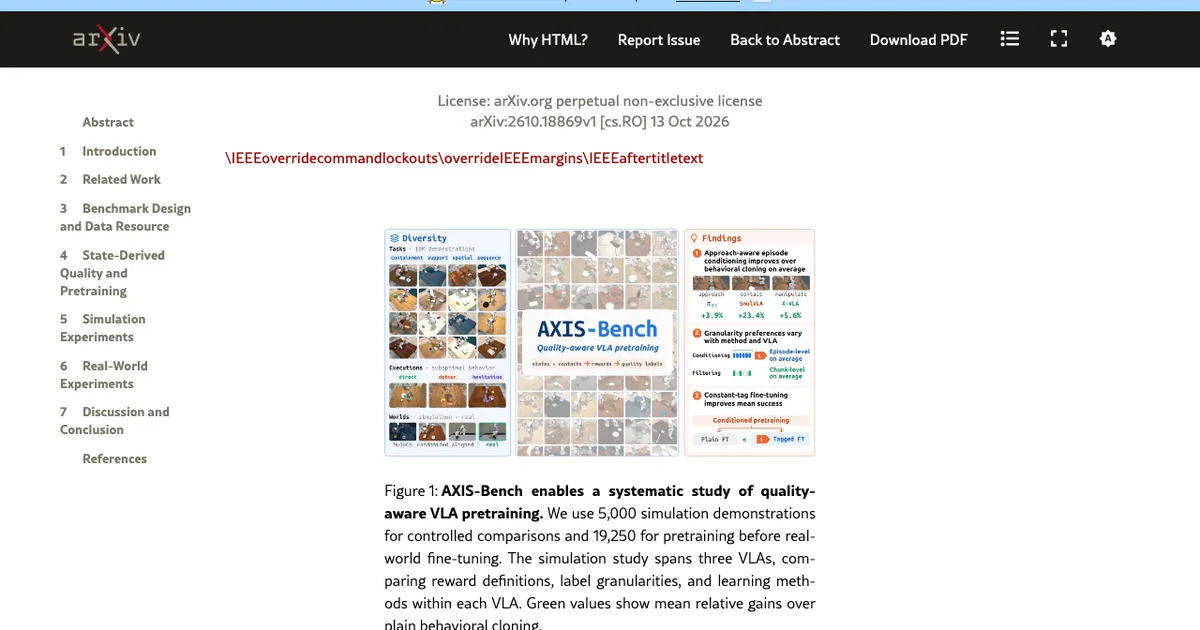
We introduce AXIS-Bench, an industry-grade benchmark designed for controlled comparison in Vision-Language-Action (VLA) models. Instead of just providing a dataset, it offers replayable trajectories with detailed object and contact states—allowing researchers and companies to precisely label where and how quality matters.
🚀 What We Found: The Secret Sauce of Superior Robotics AI
In our extensive empirical study across three diverse VLA models and 24 challenging target tasks, we found several critical insights that redefine how robot learning should happen:
Conditioning is Key: Simply training on ‘good’ data isn’t enough. We must use an approach-aware episode conditioning. This means the model needs to understand not just what happened, but how it got there (the sequence of actions and internal state). This dramatically improves mean success rates compared to basic behavioral cloning.
Granularity Matters: The ‘quality’ label should be applied at different levels for optimal performance. For instance, focusing the quality tag on the whole episode provides robust general skills, while labeling smaller action chunks helps with precise, local adjustments. (Though the best choice depends on the specific model architecture!)
The Power of Simulation: Most critically, our real-world experiment demonstrated that pretraining using simulated data substantially boosts success rates: taking a system from 9.6% to an impressive 31.7%. This validates simulation as a powerful, scalable tool for accelerating robotics deployment.
✨ Why Does This Matter for Your Business? (The SEO Angle)
For developers building next-generation physical AI in industries like manufacturing, logistics, and healthcare, these findings are transformative. They provide the blueprints to:
Reduce Failure Rates: By filtering out bad habits during pretraining, the resulting robot AI is inherently more robust and reliable.
Accelerate Deployment: The emphasis on controllable simulation benchmarks (like AXIS-Bench) means faster iteration cycles for both research labs and commercial product teams.
The work details complex improvements to VLA data processing and quality labeling that optimize resource usage, making high-performance robotics more accessible and profitable than ever.
By Dennis Grinwald, Ankur Singha, Khaled Kahouli, Karl Jansen, Shinichi Nakajima • arXiv • Importance: 90/100
🔥 Revolutionizing Quantum Simulations: Training AI on Data You Don’t Have
In the exciting world where physics meets cutting-edge AI, generating realistic quantum configurations has historically been a massive computational hurdle. Specifically, Lattice Field Theory (LFT) requires sampling equilibrium field configurations—a process that is notoriously slow and demanding. Imagine trying to simulate the fundamental forces of nature or the early universe; you need perfect, independent samples, but getting them is a bottleneck.
Enter diffusion models. These powerful generative AI tools are state-of-the-art for image synthesis, but their application in physics is transformative. Standard approaches hit a wall: they require vast amounts of ‘ground truth’ data to train, meaning we circle back to the original problem of generating samples.
The breakthrough presented by Grinwald et al. Data Free Training solves this core paradox. They show that diffusion models can be trained without external reference data—a concept called ‘data-free training.’
🔬 The Core Breakthrough: Self-Consistent Learning
The key mathematical insight lies in leveraging the target score identity. Instead of needing samples from a massive, pre-computed dataset (the original bottleneck), the models can be trained using their own generated samples. This defines a self-consistent fixed-point training scheme.
In simpler terms: The AI teaches itself by generating plausible data and then using that data to improve its ability to generate even better data. It’s a powerful feedback loop for physics simulations.
🚀 Why Is This a Game Changer?
Efficiency: By removing the reliance on massive, expensive HMC (Hamiltonian Monte Carlo) reference datasets, this approach dramatically reduces training time and computational cost.
Applicability: They benchmarked this method successfully in 2D $\phi^4$ theory across crucial phases (symmetric, critical, and broken), proving its robustness.
Impact on Physics: This opens up entirely new possibilities for simulating complex physical systems—from quantum chromodynamics to condensed matter physics—that were previously limited by computational resources.
The Result? The performance achieved with this data-free method is comparable to training using the gold-standard HMC reference data. It’s a major step toward practical, scalable quantum simulations.
By Trieu Nguyen, Frazier N. Baker, Ruoxi Gao, Daniel Adu-Ampratwum, Xia Ning • arXiv • Importance: 90/100
Decoding Drug Discovery: How AI is Learning to Optimize Molecules Through Feedback
In the high-stakes world of drug discovery, finding a molecule with perfect properties—the right combination of efficacy, low toxicity, and stability—is notoriously hard. Traditional methods often treat this as a single-step problem, but reality dictates that optimization is an iterative process: you tweak, measure, get feedback, and then adjust again.
This new research paper introduces a breakthrough framework called Multi-turn Feedback Guided (MFG) molecular optimization, fundamentally changing how we teach AI to design drugs. Instead of just guessing the best molecule in one go, MFG teaches the AI how to learn from its mistakes and improvements across multiple rounds of refinement.
🧬 The Problem with Single-Shot Optimization
The current state-of-the-art methods using Large Language Models (LLMs) for molecular design often struggle because they don’t effectively incorporate real-world feedback. They are trained to give a single, optimal output based on initial prompts. But in chemistry, the first attempt is rarely the last—it’s part of an iterative loop guided by sophisticated properties and experimental data.
✨ Introducing MFG: Learning Through Iteration
The core innovation here is treating molecular optimization as a multi-turn sequence of actions, similar to how a chemist collaborates with an AI assistant. The MFG framework uses Reinforcement Learning (RL) to train the LLM. Critically, it introduces a detailed feedback vector that captures two vital pieces of information from each turn:
Property Improvements: Did the tweak make the molecule better in terms of solubility or stability?
Source Similarity: How structurally close is the newly generated molecule to the original scaffold? (This helps ensure the changes are chemically plausible and keep the overall structure intact.)
By building a feedback-aligned reward function, MFG encourages the model not just to improve properties, but to progressively improve over successive turns.
🚀 Real-World Impact: State-of-the-Art Results
The authors applied this method to $ ext{GeLLM}^{3} ext{O}$, a powerful LLM designed for molecular optimization. By integrating the MFG structure, they showed remarkable gains:
$ ext{GeLLM}^{3} ext{O}$ (Base Model): Achieved a success rate of $70.81%$.
$ ext{GeLLM}^{3} ext{O-MFG}$ (New Model): Boosted the similarity-constrained success rate to an impressive $81.50%!$
This significant jump proves that explicitly training an LLM on multi-turn feedback leads to substantially more reliable and robust drug candidates.
🔮 What Does This Mean for Biotech?
For researchers in Boston, Cambridge, Basel, or Singapore, this is a game-changer. It moves computational chemistry closer to the workflow of actual medicinal chemists—a cyclical process involving hypothesis, synthesis, testing, and refinement. As AI becomes integrated into drug discovery pipelines globally, frameworks like MFG are essential for bridging the gap between theoretical prediction and tangible chemical reality.
By Hai Zhou, Fan Yang, Zeyi Chen, Lejun Zhang, Chenyang Fu, Jianping Li, Jiayi Zhu, Xianyang Liu, Yingxuan Yang, Lili Meng, Lu Wang, Xinyang Han, Jiankai Sun, Weirui Ye, Guanchu Wang, Wanhua Li, Ming Zhou, Boyi Li, Ming Jin, Kun Shao, Muhao Chen, Guang Chen, Lei Ma, Joey Tianyi Zhou, Costas Spanos, Xia Hu, Mac Schwager, Weinan Zhang, Qian Feng, Shangding Gu • arXiv • Importance: 90/100
✨ The Future Is Autonomous: Rethinking Robot Self-Improvement
The age of robots doing simple tasks is over. We’re entering an era where machines aren’t just executing commands—they are fundamentally improving how they learn and interact with the real world, all on their own. But how do we make a robot truly self-improving? Our latest deep dive tackles this foundational challenge with a concept called Physical Recursive Self-Improvement (Physical RSI).
⚙️ What is Physical Recursive Self-Improvement (Physical RSI)?
Think of it like training an apprentice, but the apprentice also teaches the master new techniques. Current robot research often sees capability improvements driven by humans crafting better datasets or tweaking reward functions. Physical RSI flips this script: physical experience directly guides lasting updates not only to the robot’s skills, but crucially, to its own learning procedure.
In simple terms? The more it experiences, the better and smarter it gets at how it improves with subsequent tasks.
🧠 Why Is This a Game Changer?
Making robots self-improving solves a massive scalability bottleneck. Instead of needing engineers to fine-tune every new task or fix every failure mode, the robot learns to improve its own ‘meta-skills’—the skills required for effective learning.
Our framework defines Physical RSI with granular rigor, classifying gains into five levels (L0 through L5). This structured approach helps us differentiate between simple capability improvements and true self-optimization:
Within-Task Gains: Improving performance on the same task. (Basic learning)
Across-Task Gains: Generalizing skills to a new task. (Basic generalization)
L5 - Recursive Gain: This is the core breakthrough. It means the robot autonomously improves its ability to improve, independent of any human intervention.
🚧 The Challenges We Tackled
Implementing Physical RSI isn’t easy—the real world throws curveballs: noisy sensor readings, continuous physical dynamics, expensive trial-and-error (costly trials), and the risk of irreversible damage or failure. Our work analyzes current methods in harness adaptation, model training, safety protocols, and control mechanisms to identify gaps.
Key Takeaways for AI Practitioners:
* Despite massive advances, reliable Physical RSI remains a theoretical frontier. The literature often jumps straight to capability gains without fully addressing the meta-learning loop.
* We pinpoint critical research priorities: reliable feedback systems, causal attribution (knowing why it failed), and ensuring robust safety preservation during autonomous learning.
If you are working on embodied AI, robotics, or advanced self-supervising agents, this analysis provides a crucial roadmap. We outline the path toward genuinely autonomous intelligence that can improve itself safely in complex physical environments.
By Peter Chen, Sergey Levine • arXiv • Importance: 90/100
Turbocharging Diffusion Models: Scaling Optimal Transport for Stable AI Flows
The state-of-the-art in generative AI relies heavily on diffusion models and flow matching. But as we scale these powerful systems—especially when dealing with complex, high-dimensional data like single-cell genomics or ultra-high-res images—we run into a critical bottleneck: training instability. How do we keep the training rock solid without slowing down the GPU clock?
Traditionally, models use simple random pairings of source and target samples. This introduces massive stochastic noise (variance) that degrades stability as the dataset grows. The proposed solution is to use Minibatch Optimal Transport (OT). Essentially, OT figures out the optimal way to pair source samples with corresponding target data points within a training mini-batch. This coupling drastically reduces randomness and stabilizes the learning process.
The Scaling Problem 🤯
The academic challenge is that while minibatch OT helps, scaling it up becomes computationally impossible at every single step of training. If you try to make the coupling bigger, the computational cost skyrockets. Furthermore, theoretically understanding exactly how these large-batch couplings affect the full stochastic gradient and model integration has been lacking.
Our Solution: Scalable Online Entropic OT
This research introduces a novel, scalable online entropic Optimal Transport approximation. What does this mean for practitioners? It means we can achieve the powerful stability benefits of large-batch OT couplings without running into computational dead ends.
By closing the theoretical gap (for both regularized and unregularized OT), the authors prove that their method significantly reduces full stochastic-gradient variance and integration error compared to simple random pairing—and this improvement grows as the online coupling batch size increases.
The experiments confirm this power: using single-cell gene interpolation-flow and image-flow training, increasing the online coupling directly leads to visibly better stability and higher final generation quality. This is a major win for scaling generative models in real-world scientific applications.
🛠️ Key Takeaways for ML Engineers:
* Stable Scaling: Achieve robust training stability crucial for massive datasets.
* Online Efficiency: Use computationally efficient approximations (Entropic OT) to manage coupling size.
* Performance Gain: Higher generation quality and less hyperparameter tuning required due to stable gradients.
By Kaiyuan Chen, Shuangyu Xie, Uksang Yoo, Xinyue Zhu, Cael Magner, Alvin Zhu, Daehwa Kim, Eric Heiden, Erwin Coumans, Miles Macklin, Spencer Huang, Ken Goldberg • arXiv • Importance: 90/100
🤖 Building the Digital Twin: Introducing RoboSimStudio for Realistic Robot Simulation
Robot AI is making incredible strides, but there’s a fundamental roadblock when trying to move algorithms from the clean environment of a computer screen (simulated) to the messy reality of the real world. The biggest hurdle? Physics.
The interaction between a robot gripper and an object—the precise forces of contact, how materials deform, or just enough friction to make it work—is notoriously difficult to model accurately. Traditional simulators often oversimplify these ‘messy’ physical interactions, leading to a massive gap known as the Sim2Real Gap.
That’s where RoboSimStudio (RSS) comes in. This isn’t just another simulation tool; it’s an interactive environment designed specifically to bridge that critical Sim2Real divide by putting physical knowledge back into the hands of the developer—and even coding agents!
💡 What Problem Does RoboSimStudio Solve?
Before RSS, making a robot simulation required guessing or approximating complex physics. If your robot dropped something, did it fail because the algorithm was wrong, or because the simulator didn’t accurately model the object’s stiffness? It was impossible to tell.
RSS changes that by providing an open and explicit framework built on the Newton physics system. It allows users (whether human researchers or advanced AI agents) to:
* Explicitly Choose Physics: Select specific solvers, contact models, deformation rules, and physical parameters. You can tune why something looks physically wrong.
* Iterative Refinement: The toolkit enables continuous refinement of simulations based on observed real-world physics behavior—a crucial capability for debugging complex robotic tasks like delicate assembly or grasping unknown objects.
* Multi-Modal Validation: Researchers can evaluate robot skills using visual inspection, force-feedback methods, and even let AI agents perform ‘agentic’ Real2Sim2Real testing.
✨ How Does It Work? (Under the Hood)
RSS is built on a modular system that treats physics parameters as editable choices. Instead of a black box simulation that spits out an answer, it provides transparency into how that answer was calculated.
This depth of control makes it invaluable for:
Academic Research: Deeply testing hypotheses about contact mechanics and soft robotics.
Industrial Development: Training industrial robotic arms that need to interact with complex, varied objects (e.g., in logistics or manufacturing).
Advanced AI Testing: Providing a high-fidelity ‘digital twin’ environment for autonomous agents to learn robust physical reasoning before deployment.
🚀 Why Should You Care? (The Impact)
The ability to reliably and accurately simulate complex physical interactions is the key missing piece that unlocks the next generation of truly capable, generalized robots. RSS doesn’t just make simulations run; it makes them trustworthy.
If your work involves:
* Robot Grasping: Handling objects with variable surface properties.
* Soft Manipulation: Controlling delicate tasks requiring precise force control.
* Complex Assembly: Tasks where parts might deform or interact under non-linear forces.
Then RoboSimStudio offers a revolutionary way to streamline development and dramatically reduce the costly gap between simulation and reality.
By Wenlin Zhong, Hao Wang, Kun Yuan, Fan Yang, Jinluan Yang, Dian Jin, Xu Tan, Yiquan Wu, Kun Kuang • arXiv • Importance: 90/100
🔥 Next-Gen AI Agents: SkillScaffold – Making LLMs Self-Taught and Adaptive
The era of AI agents—where Large Language Models (LLMs) don’t just answer questions, but actively plan, execute multi-step tasks, and learn from their environment—is here. But the current approach often suffers from two major headaches: inefficient learning and poor resource management.
We’ve been diving deep into Agentic Reinforcement Learning (RL), a powerful paradigm that allows LLMs to use skills distilled from past interactions. However, existing systems either blindly inject every useful skill or rely on extremely costly, sample-intensive evaluation methods. This makes real-world deployment tricky and unstable.
🚀 Introducing SkillScaffold: The Solution for Smart Agent Learning
The researchers behind SkillScaffold have introduced a breakthrough framework that acts as a smart ‘scaffolding’ layer, guiding LLM agents to learn skills selectively and efficiently. Think of it as giving the agent an internal tutor that knows exactly when and how to teach them something new, without wasting time on unnecessary lessons.
🧠 How SkillScaffold Works (The Tech Breakdown)
The core innovation lies in overcoming the expensive challenge of utility assessment. Traditional methods require running multiple simulations (rollouts) just to check if a potential skill is actually useful—a huge computational drain!
SkillScaffold revolutionizes this by implementing policy-adaptive training. Instead of expensive rollouts, it uses low-cost, outcome-aware likelihood comparisons on existing, verified trajectories. Essentially, the model learns the utility of a candidate skill by comparing how likely an outcome is with and without that skill injection.
This leads to two crucial advantages:
Selective Injection: The scaffold determines whether any skill helps at all, and if so, which specific skill is most beneficial for the current query. If nothing is needed, it wisely executes the task using its native capabilities (skill-free execution).
Internalization: By managing this guided process, SkillScaffold encourages agents to internalize those skills, making them robust enough for reliable, real-world inference even when the scaffold is removed.
⚙️ What Makes This Important? (Why You Should Care)
Efficiency & Stability: By minimizing reliance on expensive rollouts, SkillScaffold makes agent training viable for complex, long-horizon tasks like web navigation or scientific inquiry.
Robustness: The ability to abstain from using a skill when unnecessary makes the agents less prone to failure and hallucination. They only act when they have empirical evidence of improvement.
Real-World Benchmarks: The system demonstrated superior performance across demanding environments like ALFWorld, WebShop, ScienceWorld, and $\tau^2$-Bench, beating existing state-of-the-art agentic and skill-based RL models.
This framework marks a significant step toward truly autonomous AI agents capable of complex, multi-step reasoning—moving beyond simple prompting to genuine competence.
Unlocking Better LLMs: A New Way to Train with Off-Policy Data
As Large Language Models (LLMs) become central to everything from coding assistants to creative writing tools, how we train them is paramount. Standard training methods struggle when the data used for fine-tuning doesn’t perfectly match the model that will eventually deploy. This is common in real-world LLM development—think of stale datasets or asynchronous logging.
New research introduces Proximal KL, a sophisticated method designed to solve this critical mismatch in Off-Policy Reinforcement Learning with Verifiable Rewards (RLVR). Essentially, it makes training robust even when the data comes from various sources and policies. This digest breaks down what Proximal KL is, why it matters for building reliable AI, and how impressive its results are.
🚀 The Problem: Data Mismatch in LLM Training
When we fine-tune an LLM using Reinforcement Learning (RL), the data we collect (the ‘behavior policy’) is often different from the model we are trying to optimize (the ‘target policy’). This mismatch introduces significant errors, making standard RL training unstable or inaccurate. Traditional methods for handling this—like importance weighting—either become computationally prohibitive by having to multiply likelihood ratios across entire responses (sequence-level), or they introduce severe biases.
🔬 The Solution: Proximal KL and Token-Wise Precision
The authors of the paper introduce a novel framework, Proximal KL. Its core innovation lies in moving from sequence-level importance weighting to token-wise importance sampling.
Instead of weighing an entire response (which is brittle if just one token was predicted poorly), Proximal KL calculates the correction based on the Kullback–Leibler (KL) divergence between policies at each individual token. This significantly stabilizes the training process and maintains high precision.
Furthermore, it replaces the standard PPO clipping mechanism with a bounded future KL credit. This clever modification separates the stability reference policy from the sampling policy, making the optimization much more robust to changes in data or environmental dynamics (or, in our case, prompt style).
📊 Why Does This Matter? State-of-the-Art Performance
The empirical results are compelling. Proximal KL demonstrated state-of-the-art performance across multiple benchmarks:
Benchmarking: On Qwen3-1.7B and Qwen3-4B, it outperformed established methods like GRPO by up to 2.58% in micro-averaged accuracy across eight math benchmarks.
Robustness: In critical ‘periodic-refresh’ experiments (simulating continuous deployment updates), Proximal KL successfully avoided policy collapses observed in simpler techniques like PG and CISPO, achieving higher accuracy with fewer training steps.
Stability: The token-wise correction not only improves accuracy but also significantly reduces the sensitivity to baseline perturbations compared to standard PPO clipping.
This shows that Proximal KL is a highly robust and effective architecture for making LLMs safer and smarter when trained on imperfect, real-world data.
By Tianhao Fu, Austin Wang, Charles Chen, Roby Aldave-Garza, Victor Xie, Xiyue Jiao, Yucheng Chen, Martin Tin • arXiv • Importance: 90/100
Compression Breakthrough: Keeping Visual Semantics Intact in LLM Vision Models
(A Deep Dive into Varest and Efficient Multimodal AI)
As Large Language Models (LLMs) become increasingly multimodal, efficiently processing high-resolution images is the next major bottleneck. Sending billions of image tokens to an encoder or decoder can rapidly inflate computational cost and latency. The core challenge? How do we compress vast amounts of visual information—like a picture of a desk with books and a laptop—without losing the critical semantic details that make that image useful for an LLM?
The groundbreaking work published by Fu et al., Just Respect the Semantics: Image-Token Compression, introduces Varest, a novel framework designed to solve this exact problem. Varest doesn’t just apply blind compression; it intelligently understands which parts of an image can be coarsely summarized and which details must be preserved.
💡 The Problem with Generic Compression
Traditional image-token compression methods often treat all pixels/patches equally, leading to semantic loss. You might compress the empty background or a fuzzy corner just as aggressively as you compress the specific text on a sign or the intricate border of an object. This leads to poor performance because the critical semantics are lost in generalized averaging.
🖼️ How Varest Achieves Semantic Precision
Varest tackles this through two key innovations: Variable-Resolution Tokenization and In-LLM Relevance Pruning.
Semantic Fungibility Guidance (Varest): The framework first localizes objects and text regions within the image. It then assigns a variable resolution level based on semantic fungibility. This means:
High Detail Needed: Object boundaries, textual content, or complex structures must retain fine granularity.
Low Detail Tolerance: Large, homogeneous areas (like clear sky or plain walls) can be summarized with fewer tokens and larger blocks.
Post-Processing Relevance Pruning ([REL]): After the initial image encoding phase, Varest introduces learned registers that act as a filter. They analyze the early decoder output to determine which visual tokens are genuinely relevant to the model’s current understanding, discarding the noise or redundant data—all within the LLM process itself.
📈 Performance Gains That Matter
The results are impressive. Across multiple backbone architectures and thirteen rigorous benchmarks, Varest significantly outperforms existing methods. Most notably, it achieves state-of-the-art compression with minimal performance drop:
✅ Massive Reduction: It reduces the layer-averaged image-token count by over 94% (down to only 5.56% of original tokens).
✅ High Fidelity: Crucially, this reduction results in retaining between 86.10% and 92.33% of the performance achieved by using all original, full-resolution tokens.
This blend of extreme compression with high semantic fidelity is a major step toward practical, scalable multimodal AI applications—making models faster and cheaper without compromising accuracy.
Is Varest the future of vision-language modeling? The paper details how smart semantically guided compression can finally bridge the gap between theoretical model power and real-world computational feasibility. Check out the full technical details here: Read the Varest Paper on ArXiv.
By Bowen Ding, Mingda Wan, Yuhan Chen, Jiyao Yuan, Qi Zhu, Futing Wang, Heyuan Deng, Fei Mi, Lifeng Shang, Tao Lin • arXiv • Importance: 90/100
🚀 Supercharge Your AI Agents: Introducing ProAS for Advanced Multi-Turn RL
The era of LLM agents is here—and Reinforcement Learning (RL) is the engine driving their intelligence. But optimizing these complex, multi-turn systems isn’t easy. Traditional RL methods often struggle with a fundamental problem known as ‘uniform credit assignment.’ In simple terms, they treat every single action in a long sequence equally, even if early mistakes had a massive cascading effect on later outcomes.
Our latest research introduces ProAS (Progress-Aware Advantage Shaping): a groundbreaking framework designed to solve this core inefficiency. ProAS revolutionizes how LLM agents learn by giving credit—and blame—where it truly belongs in the decision chain.
🧐 The Problem with Traditional RL
Why is uniform credit assignment bad?
When an agent performs a complex task (like navigating a virtual store or booking a trip), its success depends critically on the right steps taken early on. Standard algorithms, however, assume that all actions are equally responsible for the final reward. This means they can incorrectly reinforce structurally poor actions or fail to properly penalize pivotal deviations made at the beginning of a process.
🔬 How ProAS Works: Fine-Grained Responsibility Assignment
ProAS is elegant and plug-and-play, meaning it integrates smoothly without requiring massive architectural overhauls. Instead of relying on computationally expensive ‘critic’ modules, it uses an innovative mechanism based on a dynamically evolving Agentic Reference Graph (ARG).
Its genius lies in two core components:
Masking Unreasonable Incentives (MUI): ProAS selectively prevents the agent from chasing incentives that are structurally impossible or unhelpful given the current progress state.
Asymmetric Penalty Redistribution (APR): This is key. It doesn’t just assign rewards; it intelligently rediscovers how penalties should flow backward through the task history, giving disproportionately greater weight to early errors.
By dynamically understanding the progress made throughout the conversation or task, ProAS ensures that credit assignment is nuanced and context-aware—a massive leap over standard methods.
📊 The Results: Setting New Benchmarks in AI Agentic Performance
The empirical evidence is undeniable. We tested ProAS across leading LLMs (Qwen2.5-1.5B/7B) on complex, real-world tasks:
ALFWorld: Achieving peak success rates up to 94.3%.
WebShop: Reaching impressive success rates of 70.8%.
Furthermore, ProAS didn’t just improve performance; it accelerated the entire learning process. Our methods significantly sped up training convergence by up to $2.44 imes$ while maintaining robust stability even when given imperfect reference graphs!
💡 Key Takeaway for Engineers & Researchers: If you are building sophisticated LLM agents, upgrading your RL framework from uniform credit assignment to a progress-aware approach like ProAS is mandatory. It solves a deep, architectural bottleneck in current agentic learning pipelines.
Ever notice how complex problems require planning way ahead? When it comes to robotics and AI agents making decisions over long periods, there’s a major struggle: the tension between speed (efficient inference) and foresight (long-term reasoning).
Traditional methods fall short. Value-based approaches get stuck in ‘short-sightedness’ because they only look at immediate rewards, missing out on big future payoffs. On the other hand, pure trajectory optimization is powerful but computationally crippling—it has to solve massive math problems every single time it needs a decision.
That’s where Generative Trajectory Planning (GTP) steps in.
A groundbreaking new approach proposed by Haldun Balim, Yilun Du, and Na Li https://arxiv.org/abs/2610.18677 shifts how we think about planning entirely. Instead of solving an optimization problem from scratch for every single action sequence, GTP uses a powerful generative model (specifically, a diffusion prior) to propose highly likely candidate trajectories.
💡 How Does GTP Work?
The secret sauce is treating the generative model not as the final policy itself, but as a sophisticated structured proposal distribution for planning.
Generation: It samples an initial diverse set of potential action sequences from the diffusion prior. This quickly provides a massive search space.
Refinement: It then refines these candidates using learned models—dynamics (what happens next), reward (how good it is), and value (expected future reward).
By separating generation from optimization, GTP achieves efficient, state-of-the-art performance in complex tasks like continuous control and long-horizon manipulation. The authors highlight that this framework offers a fresh perspective: generative models are best used for sampling smart starting points, dramatically improving planning efficiency.
🌟 Why is This Important?
This work pushes the boundaries of model-based reinforcement learning (MBRL) by merging advanced generative AI techniques with classical decision theory.
Efficiency: It sidesteps computationally intractable high-dimensional optimization.
Foresight: It maintains deep long-term reasoning capabilities, solving stability issues faced by previous methods.
Generalization: The results show robustness, even when strong baseline models start to fail.
If you are researching advanced robotics, decision-making architectures, or novel ways to integrate diffusion models into planning systems, this paper is a must-read!
If you’ve spent any time in the trenches of LLM development, you know that context window limits and quadratic attention costs are the biggest bottlenecks. Transformers are incredible, but feeding them massive documents is computationally expensive and memory-intensive.
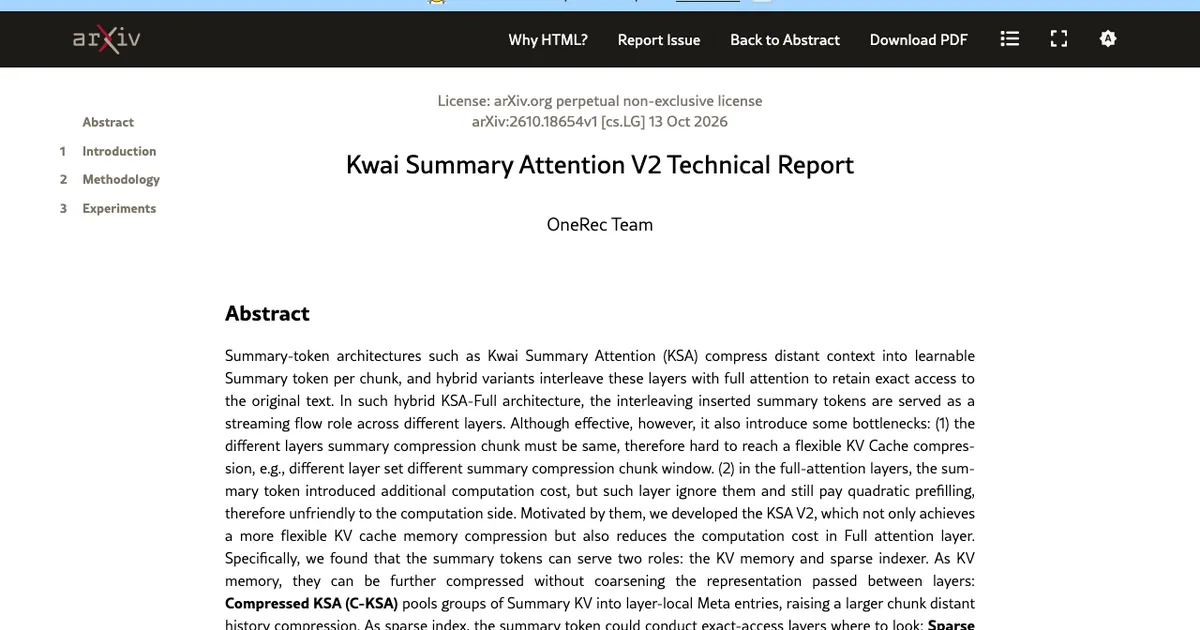
That’s why research into context compression—making large inputs manageable without losing vital information—is booming. A pioneering approach has been Summary Attention (KSA), which compresses long passages into a few ‘Summary Tokens.’ Essentially, instead of re-reading every word the model gets contextually, it reads the distilled essence.
The latest evolution, Kwai Summary Attention V2 (KSA V2), tackles the remaining limitations of these summary architectures, making context compression more flexible, efficient, and deployable in real-world, large-scale systems.
⚡ What Problem Does KSA V2 Solve?
Existing hybrid KSA architectures were powerful but faced two critical issues when scaling up:
Rigid Compression Windows: They required all layers to compress the context using the exact same window size (the ‘chunk’). This lack of flexibility was crippling for complex systems that need different levels of compression at different parts of the model stack.
Computational Overhead: When these summary tokens were interleaved with full-attention layers, they added computational costs that often went unused by those subsequent layers. The model paid for extra computation without getting the benefit, hurting efficiency.
✨ How Does KSA V2 Fix It? (The Technical Deep Dive)
The team behind KSA V2 proposes a much more sophisticated role for these summary tokens. Instead of just being another fixed-size compression chunk, they redefine their function to serve two critical roles:
Dynamic KV Memory: They achieve a highly flexible and fine-grained mechanism for compressing the Key/Value (KV) cache. This means different layers can compress context using different optimal window sizes, greatly improving architectural flexibility.
Sparse Indexing Mechanism: The summary tokens are leveraged as a sparse indexer. This allows the model to selectively access relevant parts of the context memory, rather than treating all compressed data equally.
The Core Takeaway: By redefining the summary token’s purpose from merely ‘compressed input’ to dual-purpose KV Memory + Sparse Index, KSA V2 dramatically improves both the memory efficiency and computational throughput of transformer models. It allows for state-of-the-art long context understanding with unprecedented deployment flexibility.
💡 Who Should Care? (Impact & Use Cases)
If you are building RAG systems, dealing with massive corporate documents, or deploying LLMs in resource-constrained environments, KSA V2 is a crucial development. It pushes the boundaries of what’s possible with long context window handling.
By Peiwei Chang, Li Zhang, Mark D. Plumbley, Philip J. B. Jackson, Wenwu Wang • arXiv • Importance: 85/100
🔥 Decoding Audio Memory: The AMemOps Breakthrough
As AI systems get smarter, they need more than just raw data—they need memory. For long audio streams, especially those containing recurring sounds or identities, simply recognizing a source isn’t enough. The system must track its current state, update its attributes when it changes, and crucially, know when to ignore conflicting old information.
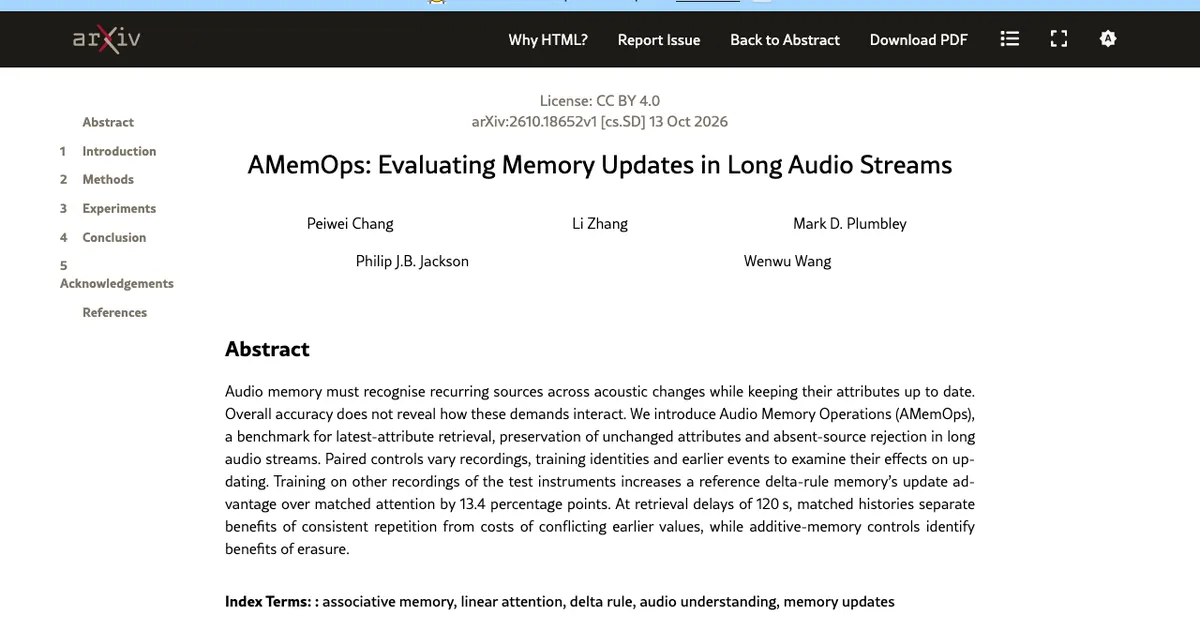
This revolutionary work introduces AMemOps (Audio Memory Operations), a new benchmark designed to rigorously test how well AI models handle these complex memory demands in long audio streams.
🧠 What is AMemOps?
The core problem addresses the interaction between three critical memory challenges:
Latest-Attribute Retrieval: Identifying the source and its state at the moment it last appeared.
Preservation of Unchanged Attributes: Maintaining consistent details about a source that hasn’t changed (e.g., an unchanging background hum).
Absent-Source Rejection: Knowing when a source has stopped and ignoring old memories of it.
Traditional metrics often overlook how these demands interact, leading to models that sound accurate but fail in real-world complexity.
🔬 Key Findings from the Research
The researchers didn’t just build a benchmark; they designed specific controls—varying recordings, training identities, and earlier events—to pinpoint exactly what aspects of memory are beneficial. The results show dramatic insights into how modern audio models manage historical context:
The Update Advantage: Training on other recordings of test instruments significantly boosted the performance of the ‘delta-rule memory’ approach (which adjusts memories based on changes) over matched attention by a substantial 13.4 percentage points.
History Separation at Delay: At long retrieval delays (120 seconds), the analysis showed that models could separate the benefits of consistent repetition from the inherent costs associated with conflicting older values, indicating sophisticated historical processing.
The Power of Erasure: The ‘additive-memory controls’ provided clarity on the benefit gained by systematically ‘erasing’ irrelevant or outdated memories—a critical component for robust long-term audio understanding.
🚀 Why Does This Matter for AI?
AMemOps moves audio modeling beyond simple detection and into true contextual intelligence. It forces models to become better historians. For applications like monitoring complex industrial environments, tracking dialogue over hours, or identifying subtle changes in environmental sounds (e.g., machinery failure), this level of memory accuracy is non-negotiable.
The paper lays out a rigorous framework for evaluating the next generation of audio processing systems, setting new standards for robust and context-aware AI.
By Leif Sieben, Yoel Zimmermann • arXiv • Importance: 85/100
Do Chemical Language Models Actually Understand Chemistry? A Deep Dive into Molecular AI
In the exciting frontier of AI-driven drug discovery and materials science, Chemical Language Models (CLMs) have promised to revolutionize how we design new molecules. The hypothesis was simple: by training large models on vast datasets of molecular structures (like treating SMILES strings as ‘words’), they would somehow absorb complex chemical rules—a kind of molecular grammar.
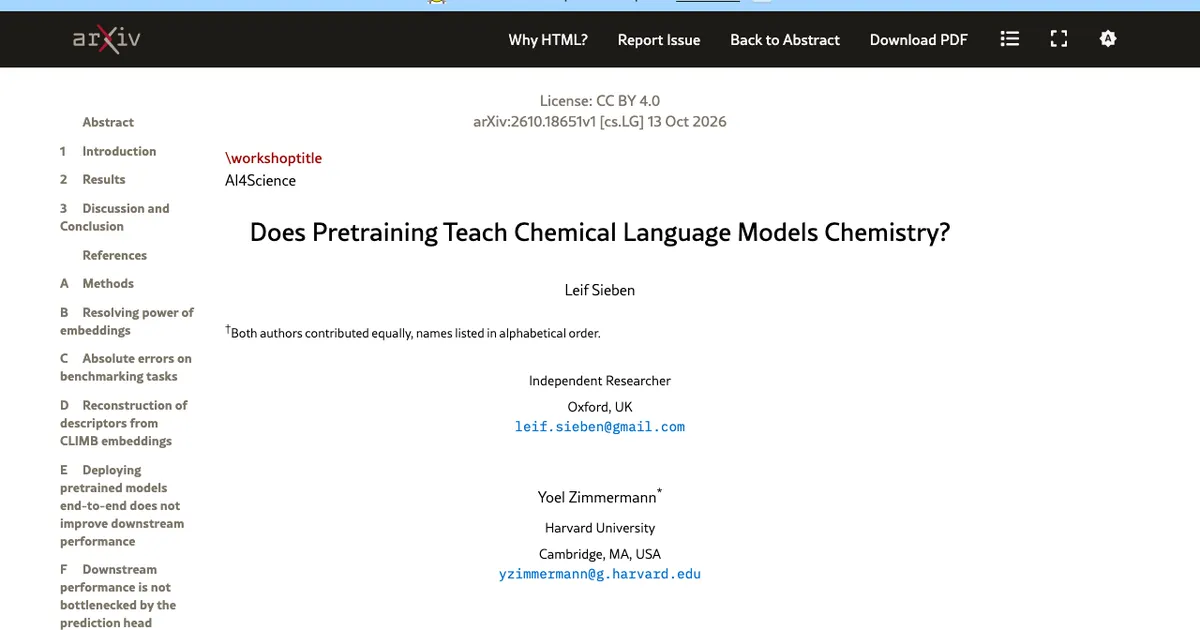
But can simply predicting sequences actually teach deep learning models fundamental physical chemistry? Our latest study Does Pretraining Teach Chemical Language Models Chemistry? throws a systematic, rigorous light on this question by testing these CLMs across 64 diverse molecular property prediction tasks.
🧪 The Core Findings: Reality Check Time
The results are surprising and point to some necessary course corrections in the field. Our research suggests that simply pretraining large language models on molecules does not guarantee magical leaps in performance. In fact, when measuring how much better these CLMs are compared to established baseline methods (like gradient boosting), we found that the gains often saturate or disappear entirely.
Furthermore, for many molecular properties, the best performance was achieved not by complex pretraining regimens, but by using supervised training on traditional, well-established physico-chemical descriptors—methods that have been cornerstones of cheminformatics for decades.
⚠️ The Biggest Takeaway (And the Warning Sign):
The abstract highlights a crucial point: while these CLMs are great at recognizing structural patterns (the ‘syntax’ of molecules), they seem to learn almost nothing beyond what classical chemical feature sets already capture. Some pretraining methods even resulted in models performing worse than a randomly initialized encoder!
This doesn’t mean the technology is useless, but it does mean that the current hype needs careful management. The deep dive suggests that CLMs are excellent at learning low-level token statistics and descriptor-like features, but they haven’t been shown to genuinely internalize complex, foundational chemical laws beyond established mathematical representations.
🔬 What Does This Mean for AI in Chemistry? (GEO & TECH Focus)
R&D Strategy: Instead of chasing the largest general CLM pretraining corpus, researchers should focus on targeted fine-tuning or integrating specialized molecular graph neural network components. The foundational chemistry knowledge might be better delivered through curated feature engineering rather than brute-force sequence prediction.
The Need for Interpretability: This research reinforces the need for increased interpretability in cheminformatics AI. We need to know why a model predicts a property, and current CLMs often act like black boxes that don’t prove deep chemical understanding.
To summarize: Molecular LLMs are powerful tools for pattern recognition, but claiming they have spontaneously learned advanced quantum chemistry requires significant evidence. Reliable performance still points toward augmenting models with proven physico-chemical features.
What do you think? Is molecular AI plateauing, or is there a new approach needed to unlock true chemical intelligence? Share your thoughts in the comments!
By Tommaso Salvatori, Matteo Forasassi, Alexis Toumi, Giovanni de Felice • arXiv • Importance: 85/100
The Future of Reasoning AI: Tiny Recursive Transformers for Hard Problems
We’ve all seen the impressive leaps in Large Language Models (LLMs). But when it comes to rigorous, structured problem-solving—like solving a complex Sudoku or finding solutions for N-Queens—these models sometimes struggle. To build truly robust AGI, we need AI that doesn’t just predict words; it needs to reason.
Our latest research dives into one of the most promising areas of structured reasoning: Message Passing Neural Networks (MPNNs). These networks are architecturally designed to encode the constraints and structure of a task directly, making them exceptionally good at algorithmic problems.
🧠 What Did We Build?
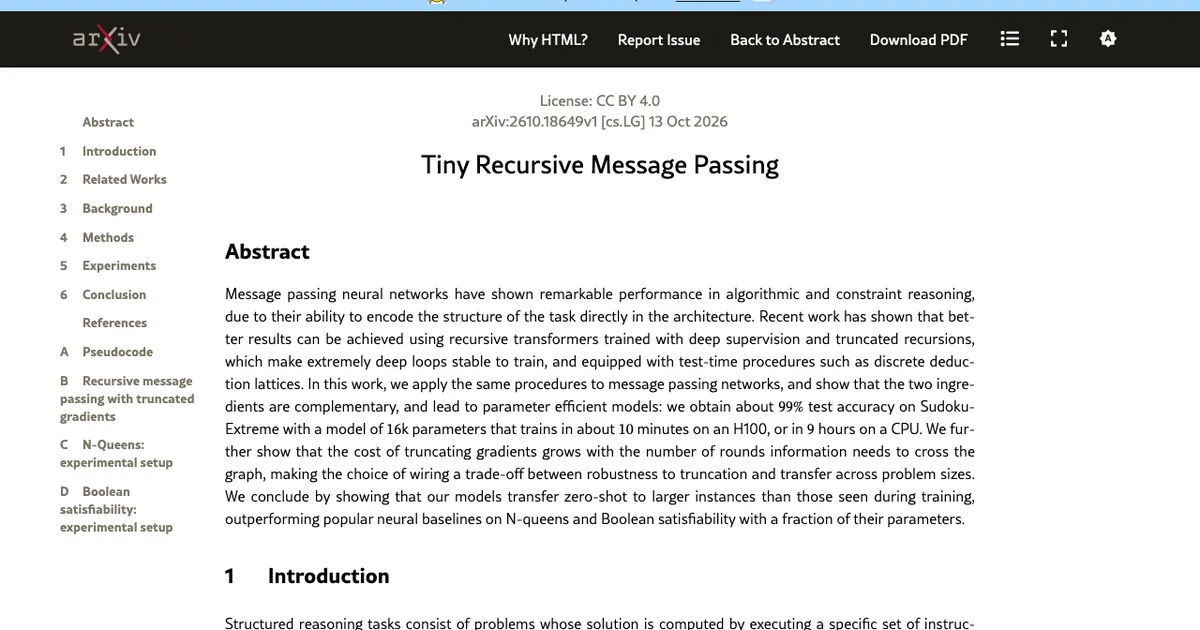
Inspired by recent breakthroughs in recursive transformers, we applied those powerful stabilizing techniques—including deep supervision and truncated recursions—to MPNNs. This proved that two key approaches to advanced AI reasoning are highly complementary, leading to models that are incredibly parameter efficient but extremely powerful.
The results are staggering:
* Sudoku-Extreme: We achieved nearly 99% test accuracy using a remarkably small model of only 16k parameters.
* Zero-Shot Transfer: Crucially, our models demonstrated superior zero-shot generalization on problems (like N-queens and Boolean satisfiability) that were larger than any instance seen during training.
💡 Key Takeaways for Researchers & Developers
This work offers two major insights into the mechanics of advanced structured AI:
The Power of Structure: MPNNs are phenomenal tools for tasks defined by rules (e.g., constraint satisfaction).
Scaling Intelligence Through Depth: By stabilizing deep recursive structures, we can boost performance dramatically while keeping models small and efficient. We even provide a useful trade-off analysis: truncating gradients provides robustness but needs careful wiring consideration.
Overall, this paper shows a path towards highly generalizable and resource-efficient AI reasoning engines—a massive step toward reliable artificial intelligence capable of solving complex, constrained tasks outside of pure language generation.
By Gaurav Kamath, Sreenath Madathil, Sebastian Schuster, Marie-Catherine de Marneffe and Siva Reddy in Transactions of the Association for Computational Linguistics, Volume 14 • ACL Anthology • Importance: 85/100
🤔 Are LLMs Really Reasoning… Or Just Guessing? Human-AI Divergence on Probabilistic Inference
The current generation of Large Language Models (LLMs) is phenomenal. They crush benchmarks in logic, math, and knowledge recall. But when it comes to subtle, open-ended reasoning—the kind that requires weighing probabilities based on limited information—they might be struggling.
Our latest work explores the fundamental difference between how humans deduce probable conclusions and how state-of-the-art LLMs approach these same tasks. We introduce PROBCOPA, a novel dataset of 210 handcrafted English inferences, meticulously annotated by 25–30 human participants to capture genuine probabilistic judgment.
Key Insights & What This Means for AI 🧠
The Core Problem: Human reasoning often involves making inferences that are likely given some premises, but not strictly logically guaranteed. LLMs, on the other hand, tend to operate in deterministic mode (A leads to B). PROBCOPA reveals this gap.
What We Found: When tested against PROBCOPA, eight top-tier reasoning LLMs consistently failed to replicate human probabilistic distributions. Their outputs were rigid and lacked the nuanced variability of genuine human judgment.
But wait, there’s more! We didn’t just show failure; we analyzed how they fail. By analyzing their internal reasoning chains, we identified a common pattern LLMs use when evaluating these subtle inferences. This gives researchers a critical blueprint for understanding the limitations of current model architectures.
🔍 Why Does This Matter to Researchers and Industry?
This work fundamentally shifts the evaluation landscape. Relying solely on deterministic (yes/no, single-answer) benchmarks is no longer enough. To build truly general intelligence, we must assess LLMs’ ability to handle non-deterministic settings—the messy, ambiguous world of real human reasoning.
If you are working in NLP, AI ethics, or building complex reasoners, this paper highlights the next frontier: evaluating degrees of belief, not just binary outcomes.
By Ali Rayat, Gia-Wei Chern • arXiv • Importance: 82/100
Deep Dive: Unlocking the Geometry of Graph Neural Networks
Have you ever considered what happens deep inside a modern AI model? Most work focuses on how information flows (the ‘what’), but this latest research tackles the much more complex question of how that flow is structured and where it physically goes. It’s about the hidden geometry of machine learning itself.
Our latest read, “Emergent Loop Geometry in Gauge-Equivariant Graph Neural Networks” [Ali Rayat et al.] (https://arxiv.org/abs/2610.18742), pushes beyond standard receptive field analysis to give us a rigorous geometrical understanding of complex graph structures used for physics and high-energy modeling.
🌐 The Problem: Beyond Simple Reach
The current generation of GNNs (Graph Neural Networks) are powerful tools, especially when applied to physical systems governed by symmetry—the concept of gauge equivariance. They generate ordered products of ‘gauge links’ via local message passing. But the authors correctly point out a critical blind spot: knowing the simple receptive field (how far information can travel) doesn’t tell you about the intricate internal geometry generated deep within the network.
💡 The Breakthrough: Loop Geometry and Depth
Using advanced statistical ensemble methods, the researchers independently of training analyzed how closed lattice walks behave. Their key finding is striking:
They found a separation between path length and spatial spread. As the network depth increases, the paths become significantly longer (generating high-order dependence), but they do so by traversing increasingly compact regions in space. In essence, deep GNNs generate long, complex loops within a relatively small physical area.
This isn’t just an abstract finding; it has profound implications for how we model physics:
Representational Richness: Network depth doesn’t just extend reach; it enriches the type of information stored within that reachable area. It allows the model to encode high-order, multi-point interactions (like correlated gauge fields).
Physical Interpretation: The authors connect this geometric insight directly to fermionic observables in physics, demonstrating how spatial locality can coexist with deep, complex dependencies on nearby physical fields.
🚀 What Does This Mean for Research? (SEO Takeaways)
This paper provides a vital geometrical perspective for building more powerful AI models for quantum physics, particle physics, and condensed matter simulation. It suggests that when designing Gauge-Equivariant Graph Neural Networks, we must consider not just the connectivity of nodes but the emergent loop structures and their scaling properties.
Key Takeaway: To build truly deep and expressive physical AI, design principles need to account for how loop geometry emerges with increasing network depth, ensuring that structural richness is preserved alongside expanded spatial reach.
This research is critical for advancing the field of ML for Physics and understanding complex lattice gauge theory simulations.
By Neel Dey, Adrian V. Dalca • arXiv • Importance: 80/100
💡 Whole-Body Medical Imaging Breakthrough: Registration Now Focuses on Anatomy, Not Just Pixels
The field of medical imaging registration—the process of aligning two or more scans taken at different times—is a cornerstone of modern diagnostics. Think of comparing a PET scan from last year to a CT scan today; this alignment is crucial for tracking disease progression. But traditional methods struggle with the complexity and variability of whole-body anatomy.
In their new work, Neel Dey and Adrian V. Dalca have unveiled ‘anatomix,’ a sophisticated approach that fundamentally changes how we define similarity between medical scans. Instead of relying on raw image intensities or just coarse segmentation masks (which often fail to capture fine details), they use complementary representations of anatomy to achieve highly accurate alignment.
🔬 The Problem with Traditional Registration
The abstract highlights a critical limitation: raw pixel intensity is a poor metric for comparison across different imaging modalities, and even auxiliary segmentation labels are too coarse. When dealing with whole-body scans—like comparing two full-torso PET/CTs—standard methods often fail to maintain fidelity or accurately align subtle structures.
✨ How ‘anatomix’ Solves the Puzzle (The Tech Deep Dive)
Their system is a hybrid, multi-stage framework built around three core innovations:
Anatomy Representation ($ ext{anatomix}$): They introduce $ ext{anatomix}$, a 3D foundation model that generates fine-grained, per-voxel semantic representations. These embeddings are robust and consistent across different volumes, meaning the system understands what an area is anatomically, not just what it looks like in one specific scan.
Dual Loss Functions: The registration solver (FireANTs) uses these powerful $ ext{anatomix}$-derived features alongside traditional segmentation-based losses. This dual-representation approach dramatically improves alignment accuracy.
Volume Preservation: Crucially, for longitudinal studies (tracking changes over time), they implemented lesion-specific component-wise volume preservation schemes. This ensures the registration process itself doesn’t artificially change the measured tumor or organ volume—a vital requirement in oncology.
🏆 Why This Matters: State-of-the-Art Results
The authors demonstrated this system’s utility by achieving first place in the prestigious Learn2Reg 2026 PSMAReg Challenge. This isn’t just an academic win; it proves the robustness and clinical potential of using anatomical representations as the primary alignment metric.
In short: Dey et al.’s work moves medical registration from simple pixel-matching to sophisticated, anatomically informed feature matching. If you are working in quantitative radiology, cancer tracking, or biomedical image analysis, this is a mandatory read.
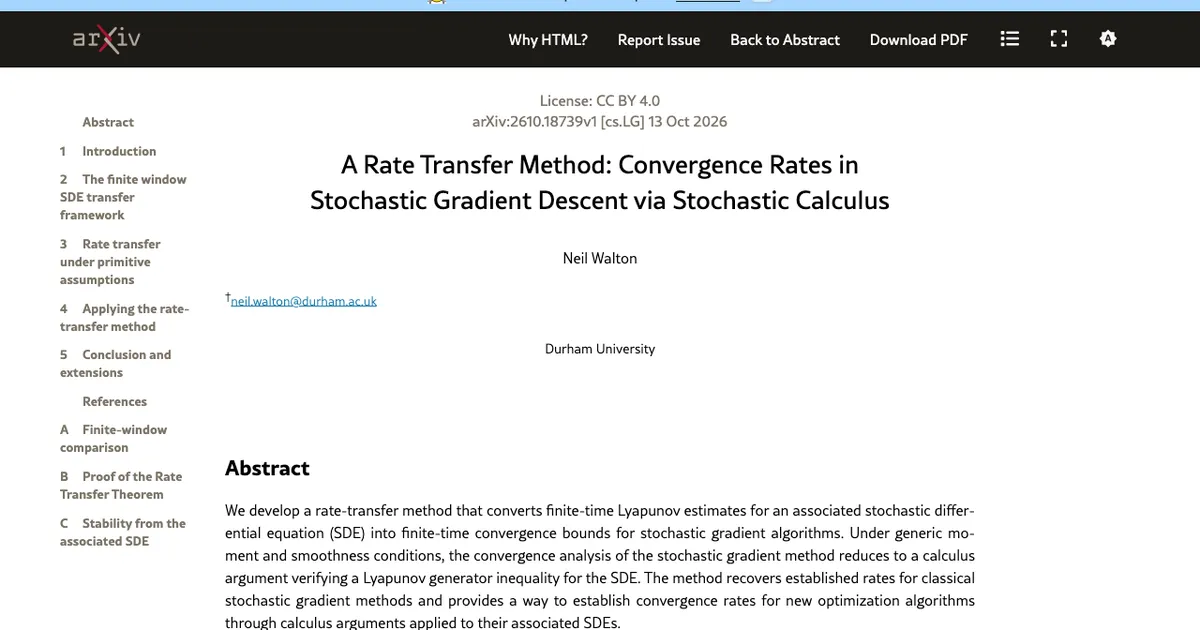
🚀 Faster AI Training: A New Calculus Approach to Understanding SGD Convergence Rates
Are you building large-scale models and wrestling with the fundamental question of convergence? Optimization is the backbone of modern Machine Learning, but knowing how fast an algorithm will actually converge in real-world data is often complex. Traditionally, analyzing Stochastic Gradient Descent (SGD) convergence requires deep mathematical dives into specific assumptions and sometimes yields vague or restrictive bounds.
We’ve got some exciting news for researchers and ML engineers who care about the theoretical underpinnings of optimization! A new work introduces a powerful ‘Rate Transfer Method’ that completely shifts how we analyze stochastic algorithms. Instead of complex iterative proofs, this method translates the convergence analysis into a more manageable framework: solving calculus problems associated with Stochastic Differential Equations (SDEs).
💡 What is the Rate Transfer Method?
In essence, this paper provides a direct mathematical link between estimating the stability of an underlying system (using Lyapunov estimates for an SDE) and determining the convergence speed of your optimization algorithm. It boils down complex SGD analysis into verifying if a simple ‘Lyapunov generator inequality’ holds for the associated SDE.
Why is this a game-changer?
Unified Framework: It doesn’t just analyze one specific algorithm; it provides a method to establish convergence rates for any new stochastic optimization algorithm by applying standardized calculus arguments.
Theoretical Depth: It rigorously recovers established, classical SGD convergence rates while simultaneously opening the door to analyzing novel algorithms previously too complex to prove.
Efficiency in Proofs: For researchers, this means transforming potentially difficult algorithmic proofs into verifiable mathematical inequalities within an SDE framework.
🌐 Who Should Read This? (The Deep Dive)
The Rate Transfer Method provides a rigorous, mathematically elegant way to achieve convergence bounds for stochastic gradient methods by converting finite-time Lyapunov estimates from associated Stochastic Differential Equations. By requiring only generic moment and smoothness conditions, the analysis significantly simplifies traditional convergence analysis into a core calculus verification step.
This is crucial reading for computational mathematicians, theoretical ML researchers, optimization experts, and anyone working on developing next-generation stochastic algorithms in industry settings across Boston, London, or Singapore who needs guaranteed performance guarantees.
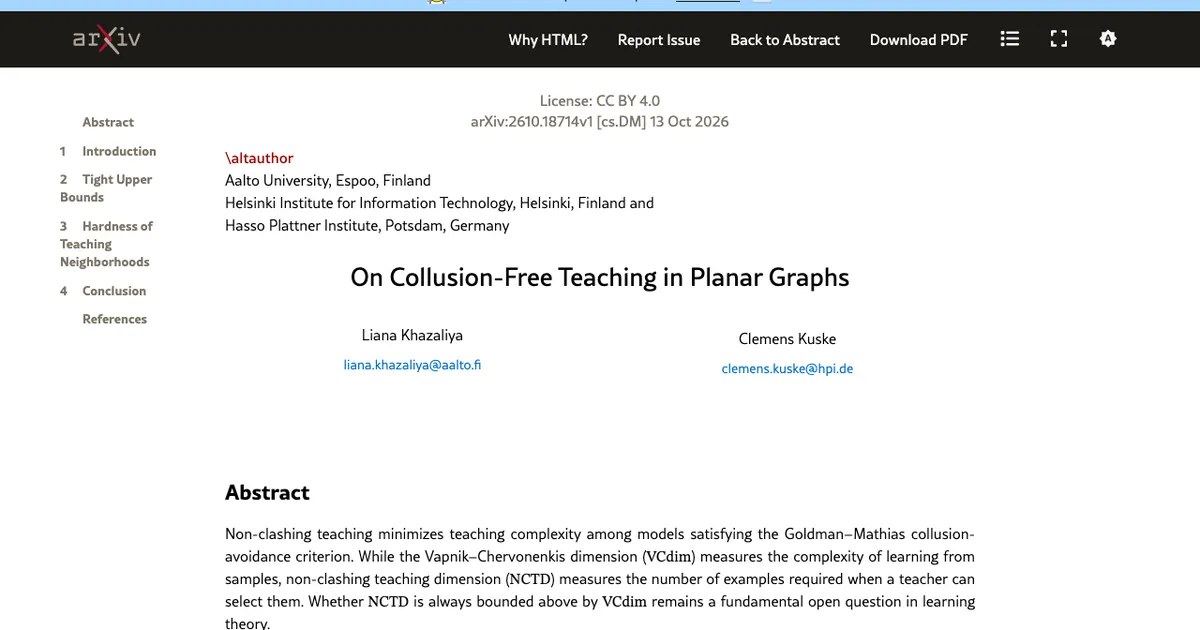
By Khazaliya Liana, Kuske Clemens • arXiv • Importance: 75/100
Unlocking the Secrets of Data Efficiency: Planar Graphs and Machine Learning Theory
Are you wondering how much data a complex AI model truly needs to learn something? This question—the core challenge of generalization in machine learning—is fundamental, yet often murky. Traditional metrics, like the Vapnik–Chervonenkis (VC) dimension, measure complexity based on random samples. But what if a ‘smart’ teacher could select the perfect examples for you?
This new research tackles exactly that, introducing the Non-Clashing Teaching Dimension (NCTD)—a much more powerful metric of learnability. The key question in learning theory is whether this specialized measure (NCTD) always remains bounded by the standard VC dimension.
🧠 What’s the Big Discovery?
This paper, On Collusion-Free Teaching in Planar Graphs, zeros in on concept classes related to closed neighborhoods within planar graphs—structures found everywhere from city layouts to circuit designs.
The core breakthrough is a mathematical proof: The authors prove that for this specific, highly structured family of problems, the Non-Clashing Teaching Dimension (NCTD) is tightly bounded by just two.
This doesn’t just provide an upper bound; it establishes that the conjectured relationship between NCTD and VCdim holds true for planar graphs, solving a major open question in theoretical computer science.
Furthermore, they tackled the positive variant (NCTD+) and found a tight upper bound of four. But the research didn’t stop at theory. They also showed a practical complexity result: deciding whether NCTD or NCTD+ is $\le 1$ for these planar graphs is NP-complete, even though we know the ultimate bounds are low!
💡 Why Does This Matter to AI Engineers?
The theoretical implications are massive. By establishing such tight, small upper bounds (2 and 4), this research deepens our understanding of sample complexity. It tells us that for problems defined by planar graphs, the amount of data needed is surprisingly limited.
Sample Efficiency: Conceptually, it suggests powerful data selection mechanisms can dramatically reduce data needs compared to traditional estimates. Lower bounds mean smaller datasets required for reliable AI deployment.
Theoretical Cornerstone: For researchers aiming to understand the fundamental limits of learnability (a huge topic in generalization theory), this paper provides a definitive answer for an important class of problem instances.
This is critical reading for those working at the intersection of Graph Theory, Computational Learning Theory, and modern ML Architectures.
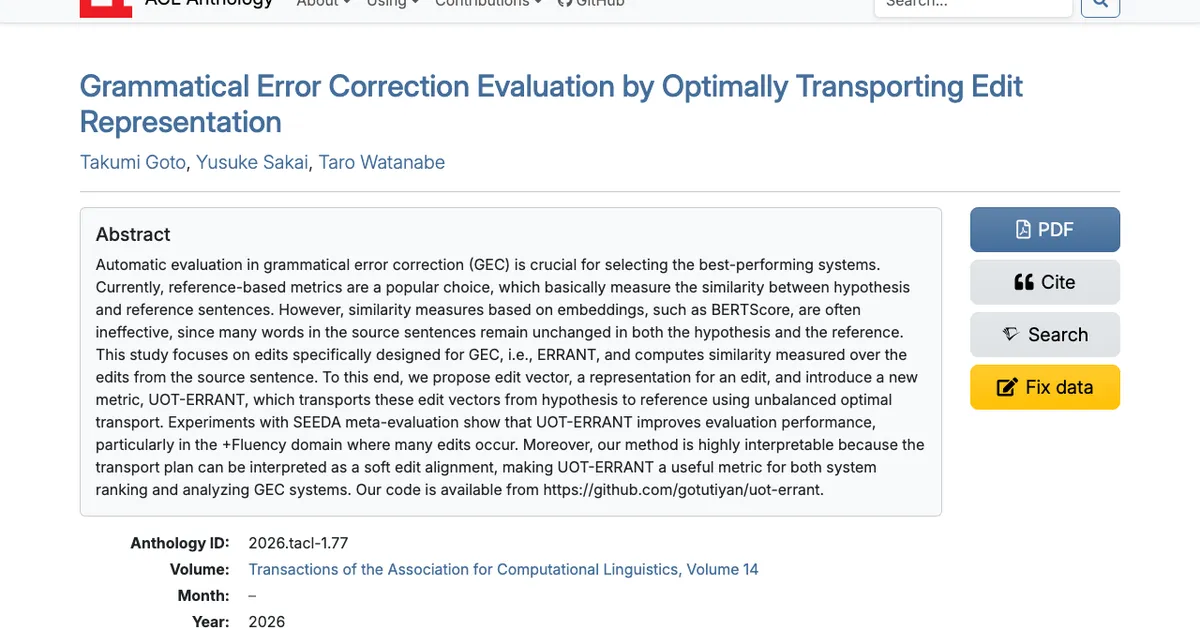
By Takumi Goto, Yusuke Sakai and Taro Watanabe in Transactions of the Association for Computational Linguistics, Volume 14 • ACL Anthology • Importance: 75/100
The field of Natural Language Processing (NLP) is constantly pushing the boundaries of what machines can do with human language. When building a state-of-the-art (SOTA) system for tasks like Grammatical Error Correction (GEC), evaluating its performance accurately is arguably just as difficult—and critical—as building the model itself.
Traditional evaluation metrics have struggled to capture the nuances of human text corrections. Common methods, such as reference-based similarity scores (like BERTScore), often fail because they treat an edited sentence and a perfect reference sentence too uniformly. As this paper demonstrates, much of the value in GEC lies not just in word embedding similarity, but specifically in the sequence of edits applied.
🛠️ The Core Problem with Existing Metrics
When evaluating GEC systems, we are really concerned with whether the proposed correction (the hypothesis) aligns semantically and grammatically with a perfect reference. Existing metrics often overlook the detailed structure of how words were changed. Since many source words remain unchanged in both the generated hypothesis and the target reference, standard embedding similarity fails to give us the granular feedback needed.
✨ Our Solution: UOT-ERRANT – Transporting Edits
The authors introduce UOT-ERRANT (Unbalanced Optimal Transport for ERRANT), a groundbreaking metric designed specifically for measuring similarity over detailed linguistic edits. Instead of comparing entire sentences, it focuses on the underlying edit vectors.
How does it work?
1. Edit Focus: The method utilizes specialized representation (ERRANT) that captures explicit edit operations.
2. Optimal Transport: It models the relationship between the hypothesis and the reference using an unbalanced optimal transport framework. This mathematical powerhouse maps or ‘transports’ the distribution of edit vectors from the generated hypothesis to the target reference in the most efficient, least-cost way possible.
3. Interpretable Scoring: The resulting score isn’t just a black box number; the ‘transport plan’ itself is highly interpretable, providing a soft alignment that visually explains how the system successfully aligned its edits with the ground truth.
🚀 Why This Matters (The Impact)
Experiments show that UOT-ERRANT significantly improves evaluation performance compared to existing metrics, especially in complex scenarios like the +Fluency domain where multiple structural edits are common.
For practitioners and researchers building next-generation NLP tools: this metric doesn’t just rank systems; it provides diagnostic power, helping us pinpoint why a system failed—whether it was a fluency issue, a grammatical mismatch, or an unaligned edit.
This shift from generalized similarity measures to explicit, edit-aware transport metrics represents a critical step forward in making machine evaluations truly reflective of human linguistic judgment.
🔗 Dive Deeper: For the full technical details and methodology, check out the paper on TACL 2026. (And remember to check out their open-source code!)
By using methods like UOT-ERRANT, we move beyond simple word matching and start measuring the intelligence of the structural changes themselves.
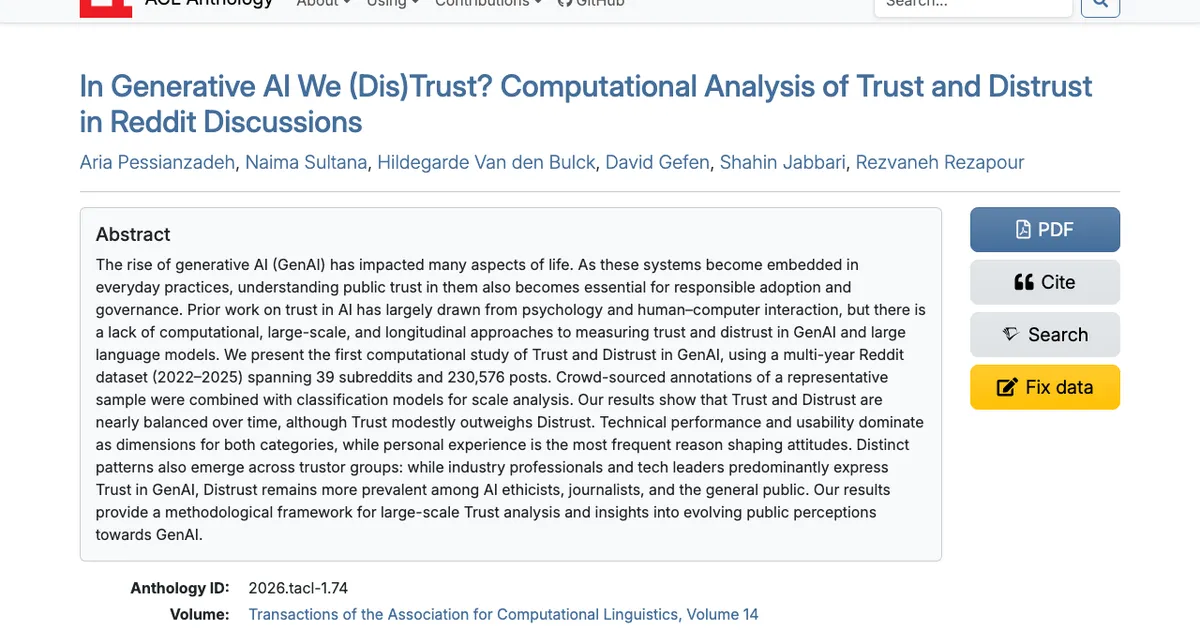
By Aria Pessianzadeh, Naima Sultana, Hildegarde Van den Bulck, David Gefen, Shahin Jabbari and Rezvaneh Rezapour in Transactions of the Association for Computational Linguistics, Volume 14 • ACL Anthology • Importance: 75/100
🤔 Are We Trusting or Distrusting Generative AI? A Deep Dive into Public Opinion
The generative AI revolution is here, reshaping everything from creative industries to knowledge work. But as these powerful tools become embedded in our daily lives, one crucial question looms large: Do we trust them?
Existing research often relies on surveys and qualitative interviews. While valuable, they miss the chaotic, authentic pulse of real-world discussion. To really understand public sentiment towards LLMs and GenAI, you need to look where people actually talk—and that’s Reddit.
🚀 What did the researchers do?
Researchers tackled a major gap: there was no large-scale, computational, longitudinal study measuring trust in GenAI.
Instead, they analyzed a massive, multi-year dataset (2022–2025) comprising over 230,000 posts across 39 diverse subreddits on Reddit. By combining crowd-sourced annotations with advanced classification models, the team successfully captured how public attitudes toward generative AI evolve in real time.
📊 Key Findings That Change the Conversation
The study revealed several fascinating patterns that have major implications for AI governance and product design:
The Balance of Sentiment: Overall, Trust and Distrust are nearly balanced over time, with a slight edge to trust. This suggests GenAI is widely adopted but faces equally strong reservations.
The Root Cause: Both positive and negative sentiment largely hinges on two factors: Technical Performance and Usability. These dimensions are what people talk about most often when forming opinions.
Personal Experience Matters Most: When it comes to why people feel a certain way, the personal experience is cited as the single most frequent reason for shaping attitudes. This emphasizes the need for excellent UX and real-world performance.
The Divide Among Experts (💡 The Biggest Insight): Perhaps the most striking finding relates to group demographics. While industry professionals and tech leaders tend to express Trust in GenAI, a significant degree of Distrust remains prevalent among AI ethicists, journalists, and the general public. This highlights a clear divergence between corporate hype and critical academic/media perspectives.
🌍 Why Does This Matter for NYC Tech & Governance?
The results offer more than just data points; they provide a robust methodological framework for measuring complex social phenomena like technological trust at scale. For organizations in major tech hubs (like New York City), understanding this deep chasm between expert-driven optimism and public skepticism is vital.
It informs:
1. Product Design: Building GenAI tools that not only work technically but also instill confidence through predictable, reliable user experience.
2. Policy & Regulation: Guiding policymakers to address specific community concerns (e.g., data privacy, ethical risks) rather than general fears.