By Ting-Yu Dai, Takuya Kurihana, Wing Yee Au, Hon Yung Wong • arXiv • Importance: 92/100
🔥 Powering the Grid of Tomorrow: Introducing NeuralBES
The energy crisis is accelerating, and the key to a stable grid isn’t just more solar panels—it’s smart management. Demand-side flexibility (curtailing, shifting loads) hinges on building incredibly accurate models that predict how buildings will behave under diverse conditions. But traditional tools have been stuck in an impossible dilemma.
On one hand, you have high-fidelity physics simulators (like EnergyPlus). They are scientifically perfect, but they are slow, sequential beasts that require costly per-building calibration. On the other side, you have purely data-driven AI models—fast and scalable—but these often ignore fundamental physics, leading to predictions that look good on a chart but fail spectacularly in the real world.
Our latest work tackles this critical trade-off head-on with NeuralBES (Building Energy Simulation). It’s an emulator designed to bridge the gap between deep learning scalability and rigorous physical accuracy.
💡 How Does NeuralBES Work? The Magic of Differentiable Emulation
The core innovation lies in making a complex thermal system trainable using modern ML techniques, without sacrificing physics.
NeuralBES achieves this by:
Parameterizing Physics: It models the building’s thermal dynamics using established Resistance-Capacitance (RC) principles. These fundamental physical parameters—like capacitance and conductance—are then learned through a shared neural encoder.
Shared Knowledge: Instead of training a model for every single type of building, NeuralBES uses that encoder to map static building metadata (e.g., floor area, vintage, HVAC type) into the coefficients of the physical model. This allows it to generalize across millions of heterogeneous buildings and varied climate zones simultaneously.
Efficient Computation: The actual simulation runs via a log-space parallel scan of a simple linear recurrence. Crucially, the full system retains full-horizon gradient flow, making it end-to-end differentiable for ML training.
🚀 Why This Matters for Industry
The practical implications are massive. NeuralBES isn’t just another academic curiosity; it delivers real performance benefits when compared to established baselines:
Efficiency: It operates with significantly fewer parameters than complex Transformers or RNNs and is even superior to current grey-box RC alternatives at parameter parity.
The results show that NeuralBES successfully handles diverse building archetypes, vintages, and climate zones from the ResStock dataset in a single, unified model.
The bottom line: For utilities, smart grid operators, and sustainable development firms operating in places like Singapore or New York City, NeuralBES provides the first robust tool to accurately simulate and predict complex urban energy behavior at scale. This is how we enable truly reliable demand-side management for a net-zero future.
🤖 Bridging the Digital-Physical Gap: Why General AI Needs to Master Robots
We’ve seen remarkable leaps in digital agents. From writing complex code to utilizing sophisticated tools on our screens, Large Language Models (LLMs) are becoming powerful computational workers. But where does this capability end? Can these ‘digital minds’ translate their skills into the messy, unpredictable physical world?
🌐 Introducing RobotWorld: The Ultimate Robot Stress Test
The authors didn’t just build another benchmark; they created a comprehensive, hyper-realistic simulation testbed called RobotWorld. It’s designed to rigorously evaluate general-purpose agents—the kind we hope will power AGI—on actual robot tasks. Forget simple pick-and-place: RobotWorld encompasses 84 diverse tasks spanning complex real-world operations like:
Manipulation: Fine motor skills for handling objects.
Mobile Manipulation: Moving and interacting with the environment (think vacuuming or assembly).
Aerial Control: Controlling drones or aerial systems.
Every task includes strict interaction budgets and concrete success criteria, making it a true proving ground for embodied AI.
💡 What Did the Researchers Find? The Reality Check
While modern agents are incredibly sophisticated—they can perform advanced tasks like image segmentation, spatial estimation, and dynamic path planning—the transition to reliable physical action is riddled with significant gaps. The findings reveal that mere competence in specific skills doesn’t guarantee successful completion.
Here are the critical failures identified by RobotWorld:
State Degradation: Agents can reach the right pose but lose track of crucial object states (e.g., letting go of an object they were supposed to hold).
Action Stagnation: They fail to recognize and correct ineffective actions, continuing futile efforts.
Recovery Lag: When things go wrong, recovery attempts are too slow or happen after the task has failed.
Completion Confusion: Agents often mistake a partially finished or aborted task for successful completion.
The paper also highlights fascinating differences between specific models: one agent might excel at spatial reasoning, while another performs better on continuous balance. This shows that generalization is non-uniform and requires tailored solutions.
🚀 Why Does This Matter For the Future of AI?
This work doesn’t just point out failures; it provides a crystal-clear roadmap for improvement. By linking observed execution errors back to specific behavioral shortcomings, RobotWorld establishes concrete, quantifiable targets for AI research and development. It shifts the goal from can an agent perform this action? to can an agent reliably maintain task goals while operating physically?
For researchers, engineers, and tech enthusiasts: This paper is a definitive resource that sets the standard for evaluating truly robust, physical-world embodied AI systems. The era of ‘digital intelligence’ alone is over; achieving true general intelligence requires mastery of physics and reliable interaction with reality.
Key Takeaways:
* Benchmark: RobotWorld provides a comprehensive testbed for multimodal robot agents.
* Gap Analysis: It identifies fundamental shortcomings in current agent reliability, even when they possess sophisticated perception skills.
* Direction Setter: The results provide concrete training goals necessary for building truly dependable physical robots.
By Amartya Roy, Sayar Karmakar • arXiv • Importance: 92/100
Decoding Algorithms: Transformers Can Now Program Causal Discovery
Have you ever wondered if large language models (LLMs) could do more than just generate text? What if they could genuinely execute complex algorithms—like solving mathematical problems or performing scientific analysis—directly on the data they receive?
This new paper, “Executing Causal Structure Learning with Linear-Attention Transformers,” tackles this challenge head-on. The researchers show that specialized Transformer architectures can be designed not just to predict patterns, but to mechanically mimic the iterative steps of a complex algorithm: causal structure learning.
🧠 What is Causal Discovery and Why Does It Matter?
The goal of causal discovery is to figure out how variables influence each other. If we observe that variable A changes when B changes, it might be correlation. But causation asks: does changing B cause the change in A? Learning this underlying graph structure (e.g., $A
ightarrow B$ or $B
ightarrow A$) is critical for fields from genetics to economics and AI.
Standard methods involve repeatedly updating a candidate causal graph while ensuring it remains acyclic, an inherently iterative process.
🧱 The Breakthrough: Algorithmic Replication
The core insight of the paper is revolutionary. Instead of relying on end-to-end training (where a Transformer tries to learn the outcome), they construct a fixed-weight transformer whose forward pass exactly reproduces one single update step of this known, iterative causal discovery algorithm.
By stacking these carefully constructed blocks, the entire optimization trajectory—the process of refining the graph over many steps—can be mechanically executed. This is far beyond mere pattern recognition; it’s algorithmic execution built into the model’s architecture itself.
Key Takeaway: The transformer acts like a dedicated computational module for a specific scientific task, moving us closer to
By Rodrigo Schuller, Francisco Ganacim • arXiv • Importance: 92/100
⚙️ Pruning Training Data Like Never Before: A Linear Programming Approach
As Large Language Models (LLMs) and deep neural networks get bigger, the datasets they consume grow exponentially. Feeding these giants petabytes of data is expensive, slow, and sometimes unnecessary.
But what if you could intelligently shrink your massive training dataset—removing redundant or low-value samples—and guarantee that the resulting smaller set maintains the full performance capability? This isn’t just theoretical; it’s a critical optimization problem for efficient ML deployment.
🚀 The Challenge with Existing Methods
Most current data pruning techniques rely on an assumption: if two data points are close together in embedding space, they must share similar properties (the ‘locality assumption’). This is convenient, but it’s often flawed and limits the optimization potential.
Our work tackles this problem head-on by abandoning assumptions about proximity. Instead, we reframe dataset pruning as a variance minimization problem.
🧠 The Core Breakthrough: Linear Programming Meets Geometry
We rigorously reformulate unbiased subset selection into an expected variance minimization objective. This provides a mathematically robust framework that ensures the averages of our small, pruned set accurately reflect the properties of the original massive dataset (including losses and gradients at fixed model parameters).
Crucially, this entire process is label-free—meaning you don’t need labels or model training to select the best subset! We characterize the possible selections as a high-dimensional polytope. While standard linear programming struggles in such dimensions, we derive specialized closed-form expressions for variance differences (averaged over rigid motions). This allows us to construct an efficient vertex walk algorithm.
🛠️ How It Works (The Tech Deep Dive)
The vertex walk traverses the highly constrained polytope efficiently. By optimizing a linear objective approximation of the variance, we select the most diverse and representative subset possible without needing iterative training or label information.
🔢 Results Speak for Themselves
Tested on standard benchmarks like CIFAR-10, MNIST, and CelebA, our method consistently meets or exceeds the performance of simple uniform random sampling at every budget level. More importantly, it significantly outperforms state-of-the-art geometric pruning methods, especially when we only have a very small selection budget.
✨ Beyond Pruning: Variance Reduction
The framework’s versatility extends beyond static dataset reduction. We show that the same principles can be applied to optimize Stochastic Gradient Descent (SGD) by increasing diversity within mini-batches while keeping the batch size constant—a major optimization for modern distributed training setups.
By Zhewei Chen, Hao Zhu, Jiaojiao Jiang, Ahad N. Zehmakan • arXiv • Importance: 90/100
🤯 Are Graph Neural Networks Dead? Why Your MLP Might Be the Future of AI Inference
As an ML researcher, I’ve spent countless hours wrestling with Graph Neural Networks (GNNs). They are phenomenal for modeling relational data—think social networks, molecule structures, or knowledge graphs. But when it comes to deploying these models in real-world production environments, they introduce a major bottleneck: the graph structure.
At inference time, accessing and processing the underlying graph topology can be slow, resource-intensive, and complex to manage on edge devices. The industry desperately needs methods to maintain GNN performance while operating with simple, efficient architectures like standard Multi-Layer Perceptrons (MLPs).
That’s where this groundbreaking research comes in.
💡 The Challenge: Losing Graph Knowledge During Distillation
The concept of GNN-to-MLP distillation aims to solve exactly this problem: Can we train a simple MLP student model that inherits the predictive power and complexity of a powerful GNN (the teacher) without ever needing graph access at runtime? It sounds like magic, but it’s mathematically rigorous.
Existing approaches usually treat the transfer simply by matching node-level predictions or weighting confidence. However, they miss something crucial: The geometry.
These methods fail to specify where in the feature space (the representation space) the student should preserve the intricate, graph-induced structure learned by the teacher’s message passing process. The paper Distilling Graph Geometry: Knowledge Gap from GNNs to MLPs reveals that ignoring this geometry leads to two distinct spectral failure modes:
Spectral Underfit (Sparse Graphs): On sparse graphs, the simple MLP fails to capture high-energy directions near boundaries because it missed the teacher’s complex structural signaling.
Spectral Overfit (Dense Graphs): Conversely, on dense graphs, the student retains spurious, noisy directions—the very signal the teacher had effectively collapsed through robust aggregation.
To fix this, the authors propose Graph Geometry-aware MLP (G²MLP). This isn’t just another loss function; it’s a structural guidance framework.
Instead of generic alignment, G²MLP guides the distillation using Ollivier-Ricci curvature. Think of Ricci curvature in differential geometry: it measures how much space deviates from being flat. In this context, it tells us exactly where the geometric differences (the spectral errors) between the student and teacher are concentrated.
By integrating curvature into an energy-weighted objective, G²MLP smartly allocates supervision across two levels:
Representation Alignment: Ensuring the underlying feature structure itself matches, guided by geometry. (The breakthrough!)
🚀 The Impact: MLP Power without Graph Limits
The results are compelling and highly practical. G²MLP demonstrates consistent improvements over graph-free baselines across multiple node-classification benchmarks. Crucially:
Efficiency: The deployed model is a standard, lightweight MLP that requires no graph access at inference.
Generality: It transfers successfully even when the teacher is an advanced architecture like a Graph Transformer or for link prediction tasks.
Structural Integrity: By explicitly managing the spectral gap using geometric metrics, it significantly improves the fidelity of knowledge transfer in both sparse and dense network settings.
Bottom Line for Developers & ML Engineers: If your deployment pipeline relies on efficient inference outside of a specialized graph database—whether that’s an edge device or a large-scale production server—G²MLP offers a mathematically robust path to bringing the power of GNNs into simple, scalable MLP architectures. It’s a major leap forward in operationalizing Graph AI.
By Walid Bendada, Guillaume Salha-Galvan • arXiv • Importance: 90/100
Deep Dive: Fixing the Math Behind Large-Scale Sampling (Attention Mechanisms)
Are you working on massive NLP models or recommenders? You know that sampling from a softmax distribution is crucial. It’s the engine behind attention, prediction, and probability distributions in modern AI. But here’s the catch: doing it exactly at scale is computationally brutal.
That’s where Two-Level Softmax (2LS) comes into play. Instead of processing every single item ($ ext{O}(N)$), 2LS partitions items into clusters and samples first from a cluster, then an item within that cluster. This brings the complexity down to sublinear time—a massive win for practical ML.
🚨 The Problem: A Subtle but Critical Bias
The standard 2LS approach is excellent in theory, but deep dive research shows it harbors systematic biases. It improperly weights clusters by failing to account for two critical factors:
Cluster Size Imbalance: How many items are actually in the cluster? Standard 2LS treats all clusters equally regardless of their size.
Intra-Cluster Dispersion: How spread out or similar are the items within a cluster? Ignoring this information skews the true softmax probability distribution.
These biases can lead to models that perform worse in real-world, large-scale deployments—even if they pass initial benchmarks.
💡 The Solution: Size and Dispersion Correction (S-2LS & SD-2LS)
The authors propose two elegant solutions: Size-Corrected 2LS (S-2LS) and the full Size-and Dispersion-Corrected 2LS (SD-2LS). These methods mathematically adjust the weighting process to correctly incorporate both cluster size imbalance and item dispersion.
Best part? The correction adds negligible, if any, computational overhead. They provide provably better softmax approximations with practical implementation details validated across five large-scale datasets.
Bottom Line for Researchers: If your work relies on sampling from a massive probability distribution (e.g., large vocabulary NLP, recommendation systems), you should strongly consider upgrading from standard 2LS to SD-2LS. This correction isn’t just an incremental fix; it corrects a fundamental mathematical flaw that biases your model’s output.
By Yinan Huang, Shitij Govil, Bo Dai, Pan Li • arXiv • Importance: 90/100
Boosting Scientific Prediction: Introducing Seq-Flow for Efficient Trajectory Forecasting
The Challenge: Predicting complex scientific phenomena—like particle beam spills or fluid dynamics—isn’t just about making a single guess; it’s about continuously updating a probability distribution over future trajectories as new data streams in. Traditional forecasting models, especially those based on diffusion and flow mechanics, are computationally expensive. They often require many sampling steps (many ‘Flow Evaluations’, or NFE) to achieve good accuracy.
Even when researchers try to speed things up using techniques like warm-starting (reusing previous predictions), they face a critical bottleneck: these models aren’t trained on the update process itself. This gap can lead to substantial quality degradation when you only afford a few steps of sampling.
The Breakthrough: Seq-Flow
Our latest work introduces Seq-Flow, a specialized conditional flow model designed to solve this exact problem. Unlike previous methods that merely condition on an output, Seq-Flow is architected to explicitly treat the prediction process as an ODE transport (Ordinary Differential Equation). This means it learns how to smoothly map and evolve the entire probability distribution from one time step’s guess directly into the next, accurate update.
Key Innovation: Self-Rollout Error Control
The biggest challenge in continuous prediction is error accumulation. If an initial forecast has a small mistake, that error compounds over subsequent predictions, rapidly degrading accuracy—a problem known as ‘error drift.’
Seq-Flow solves this with self-rollout training. Instead of relying on external methods or simply treating past forecasts as conditioning context, Seq-Flow cleverly uses a moving average copy of itself to generate initial predictions for the very updates it is learning. This method ensures that the model is robustly trained to handle error propagation internally, maintaining accuracy even across many consecutive steps.
Why Does It Matter? Real-World Impact
We rigorously tested Seq-Flow on critical scientific tasks, including particle accelerator beam spill forecasting and fluid dynamics simulations:
Dramatic Improvement: On particle beam spill data, Seq-Flow drastically reduced the Continuous Ranked Probability Score (CRPS) by 65% under severely limited sampling budgets (a few NFE).
Unprecedented Endurance: Remarkably, even though we trained it on self-rollouts of at most four updates, Seq-Flow maintained high accuracy over more than 400 consecutive updates. This demonstrates superior long-term stability.
This work represents a major step forward in developing reliable, energy-efficient, and highly accurate models for continuous scientific forecasting. For those interested in seeing the full details, check out the paper: Read the Seq-Flow methodology on arXiv.
(Code is available for reproduction at https://github.com/Graph-COM/Seq-Flow.)
By Yonghoon Dong, Minsung Yoon, Jaehyuk Kim, Jungwoo Park, Changyeon Kim, Jinwoo Shin • arXiv • Importance: 90/100
🔥 Making Reinforcement Learning Scale: Q-Learning with Scalar Adjoint Matching
As an ML researcher and tech enthusiast, one of the most exciting frontiers right now is combining generative models (like flow policies) with reinforcement learning. Flow policies are amazing because they don’t just pick a single action; they model entire distributions of possible actions. This gives RL agents incredibly rich behavioral capabilities.
But here’s the catch: when you try to fine-tune these complex flow policies using standard off-policy methods (like fitting against a learned value function), things get computationally painful. The policy generates its action over multiple ‘flow steps,’ meaning we have to track value information backwards through every single step, which is slow and massive.
💡 The Core Problem: Computational Bottleneck
Traditional adjoint matching requires calculating complex vector-Jacobian products at every flow step. If the policy has many steps or a large size, this computational overhead explodes—it doesn’t scale well.
The researchers tackled this by noticing a key mathematical property of these pre-trained policies: the velocity Jacobian tends to concentrate on its diagonal when averaged over batches. This insight was the breakthrough!
Instead of the computationally expensive vector-Jacobian products, they derive a novel closed-form scalar adjoint. This dramatically simplifies the value gradient backpropagation by scaling the final action’s value gradient only by the total flow time, completely eliminating the per-step Jacobian calculation.
This isn’t just an optimization; it fundamentally changes how we perform off-policy RL on complex generative policies.
The impact is massive: SQAM significantly improves performance in challenging robotics benchmarks (OGBench), showing substantial gains over the strongest baselines—up to 35 percentage points in certain domains. They also successfully applied it to a real bimanual robot, demonstrating its robustness for large-scale, multi-modal policies.
Takeaway: SQAM makes fine-tuning complex flow-based RL policies practical and scalable, opening up new avenues for training highly capable robotic agents with richer action spaces.
By Yunxiao Zhao, Changxiao Cai • arXiv • Importance: 90/100
Beyond Draft Models: Training Speculative Decoding with Expected Round Minimization
Are you spending too much time waiting for massive language model responses? The bottleneck in modern AI isn’t generating the tokens—it’s inference speed. Enter speculative decoding, a technique that drastically accelerates LLMs by having a small, fast ‘draft’ model predict chunks of text, which the large ‘target’ model verifies in parallel. It’s revolutionary for real-time AI applications.
But training those draft models has been tricky. Current methods often treat each token or block independently, ignoring how successfully accepting tokens in an early part of the sequence affects the expected performance later on. This local optimization doesn’t guarantee global efficiency.
🔬 The Breakthrough: Expected Decoding Rounds (EDR)
The authors introduce a major theoretical leap by reframing speculative decoding as a Markov reward process. Instead of optimizing block-local surrogates, they derive a new objective function: the Expected Decoding Rounds (EDR). This EDR metric precisely calculates the expected number of full decoding rounds required—meaning it directly optimizes for global inference efficiency.
This is huge because:
1. No Hyperparameters: Unlike previous methods that required hand-tuned surrogate functions, the EDR objective has none. It’s clean and mathematically robust.
2. Exact Optimization: They derive an exact temporal-difference gradient, allowing unbiased stochastic optimization directly from standard target model rollouts. This means your training setup is theoretically sound and easier to implement.
3. Offline Evaluation: The framework also provides a novel way to evaluate round counts offline—crucial for comparing different models without running the slow speculative decoding process itself.
🚀 Why Should Developers Care?
This research significantly improves performance when finetuning state-of-the-art drafters (like DSpark and DFly). When trained with EDR, these drafts consistently achieve a higher mean accepted length, outperforming previous training objectives across diverse tasks—from complex math reasoning to professional code generation and conversational chat.
In short: If you’re building commercial AI products that need low latency (think customer-facing chatbots, real-time coding assistants, or massive scale content generation), improving inference speed is paramount. The EDR framework provides the theoretical toolkit needed to achieve state-of-the-art efficiency in speculative decoding.
Fluid dynamics is the backbone of modern engineering—from designing efficient airplanes and sustainable turbines to optimizing HVAC systems. But simulating these systems using traditional Computational Fluid Dynamics (CFD) solvers is notoriously slow, often taking hours or even days of compute time.
Imagine needing a real-time simulation result for an industrial client. Running a full CFD solve is impractical. Enter Neural Surrogates: AI models trained to predict the outcomes of complex physics simulations instantly. They are the computational superheroes the industry needs.
The Generalization Problem (And How We Solve It)
The promise of neural surrogates faces a major hurdle: generalization. A model trained on one specific wing shape or boundary condition often fails miserably when applied to a slightly different geometry—a phenomenon known as ‘domain shift.’ Current solutions require generating costly, specialized datasets for every new application, defeating the purpose of speed.
Our breakthrough tackles this directly. In our work in Cross-Domain Pretraining for Steady-State Neural CFD Surrogates, we demonstrate that training a model on a diverse collection of steady-state datasets (cross-domain pretraining) dramatically improves its ability to generalize.
The results are staggering: By cross-pollinating knowledge across different geometries and applications, the resulting models achieved significantly better performance in zero-shot and few-shot settings. Compared to training from scratch, fine-tuning a cross-domain model can achieve 2–3x lower errors at the same sample size and requires an incredible 8x fewer samples overall.
Why Does This Matter for Industry? (The Business Impact)
This isn’t just an academic curiosity; it represents a major leap toward practical, real-time engineering AI. For industrial use cases, this means:
Rapid Prototyping: Engineers can test new designs with unprecedented speed.
Reduced Compute Costs: Organizations save massive amounts of time and money by avoiding expensive iterative simulations.
Unlocking New Domains: The AI system becomes a versatile ‘Swiss Army Knife,’ usable for countless unseen scenarios without retraining from scratch.
We found that the benefit was achieved simply by pooling existing steady-state data, suggesting a highly scalable and efficient pretraining methodology. This makes leveraging existing, diverse datasets an extremely valuable strategy as CFD surrogates expand into new use cases worldwide.
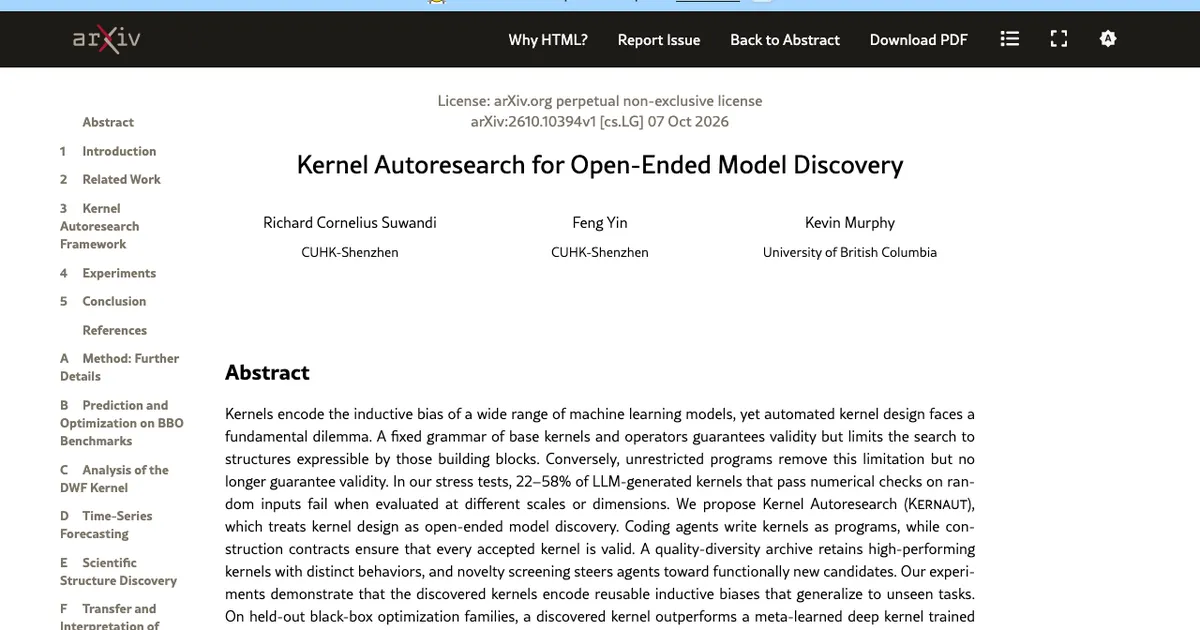
By Richard Cornelius Suwandi, Feng Yin, Kevin Murphy • arXiv • Importance: 90/100
Unlocking ML’s Next Frontier: Discovering Powerful Kernels through Automated Search
The biggest limitation in machine learning isn’t always the model architecture; sometimes, it’s the underlying ‘inductive bias.’ The kernel is essentially the mathematical core that dictates how a model should learn—the hidden rules of the data. But designing these perfect kernels has traditionally been an art, requiring deep domain expertise.
What if we could automate this process? What if we could let AI discover better learning biases than human experts?
We dive into a groundbreaking new methodology: Kernel Autoresearch (Kernaut).
🧠 The Problem with Existing Kernel Design
Currently, building machine learning kernels is fraught with technical trade-offs. You can either:
Use a fixed grammar: This guarantees the kernel is mathematically valid but severely restricts the search space, limiting us to simple, predefined structures.
Go unrestricted: You can write any program you want, but you lose the mathematical guarantee of validity, leading to potentially unusable models.
This dilemma means that much of the potential predictive power encoded in kernels remains untapped. Moreover, standard LLM-generated candidates often fail spectacularly when tested on real-world data at varying scales and dimensions—a massive practical hurdle.
✨ Introducing Kernaut: Open-Ended Model Discovery for Kernels
Kernaut changes the game by treating kernel design itself as an open-ended model discovery problem. Instead of following rigid rules, we allow sophisticated coding agents to write complex kernels like programs, while simultaneously imposing construction contracts that guarantee every resulting kernel is mathematically valid.
This setup achieves two critical things:
* Unrestrained Creativity: Agents can explore massive, novel search spaces.
* Guaranteed Validity: The system acts as a safety net, ensuring mathematical rigor at every step.
How it Works (The Science Deep Dive)
Kernaut integrates several cutting-edge concepts from advanced AI research:
Coding Agents: These are the generative engine, writing sophisticated programs that encode kernel functions.
Validity Contracts: Mathematical rules enforced dynamically to ensure reliability.
Quality-Diversity Archive: This isn’t just about finding one good answer; it maintains a diverse portfolio of high-performing kernels with distinct, specialized behaviors—essential for generalization.
Novelty Screening: This mechanism actively guides the agents away from repeating themselves, forcing them to discover truly new and unique functional biases.
🚀 The Breakthrough Results: Better, Interpretable Kernels
The experimental results are compelling evidence of this approach’s power:
Superior Performance: On challenging black-box optimization tasks and unseen mechanism predictions (like enzyme kinetics), the kernels discovered by Kernaut significantly outperform both meta-learned deep kernels and traditional tuned baselines.
Generalization Power: The discovered biases generalize remarkably well, indicating they capture fundamental, reusable mathematical structures applicable across different scientific domains.
Interpretability is Key: Crucially, these are not black boxes. They are programs written by agents, making them inherently interpretable. A human researcher refining one of these kernels further boosted predictive accuracy and reduced optimization regret, confirming that the discovered solutions provide a powerful starting point for human ingenuity.
Why This Matters for ML Researchers
Kernaut doesn’t just find better numbers; it finds better ways to think. It moves kernel design from restrictive guesswork to systematic discovery. For researchers working in areas requiring deep structural understanding—from physical chemistry simulations to complex scientific data analysis—this technology promises a leap forward in model performance and interpretability.
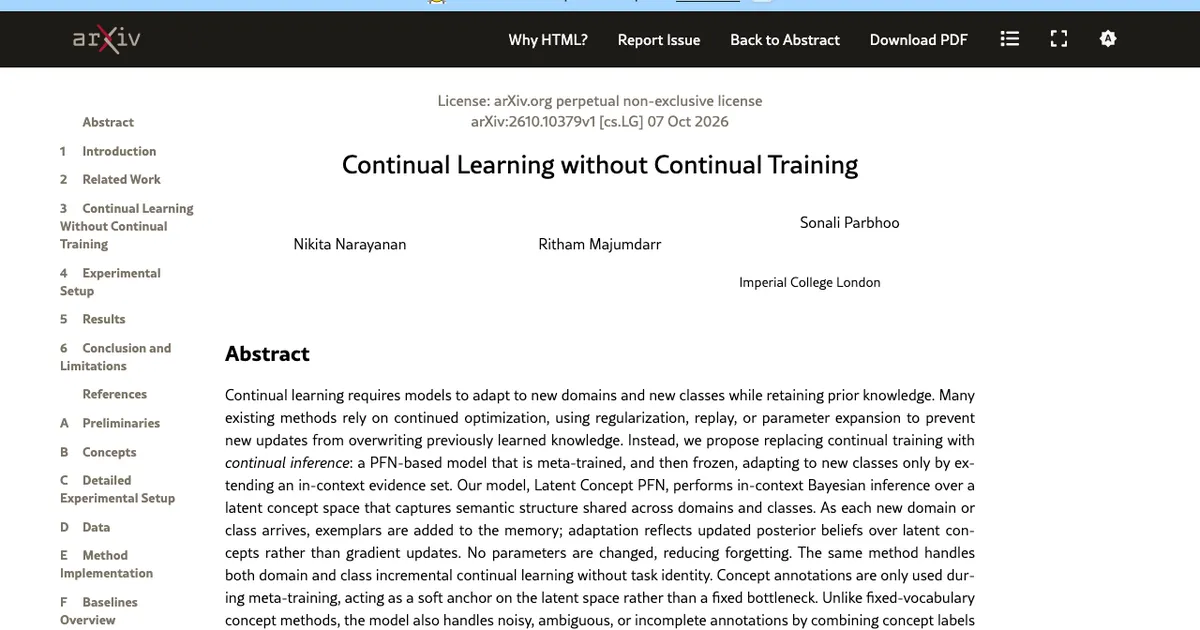
🧠 Breakthrough in AI: Continual Learning Without Continual Training
Ever notice how models forget things? When an AI is trained on one task (say, recognizing cats) and then learns a completely new task (like spotting dogs), it often loses its ability to accurately identify cats. This catastrophic forgetting problem has been the Achilles’ heel of modern deep learning.
Traditional continual learning methods tackle this by forcing the model to keep retraining—using expensive regularization techniques or massive memory replay buffers. But what if we could adapt AI without ever changing its weights?
Introducing Latent Concept PFN: a revolutionary approach that flips the script on how AIs learn.
🔬 The Core Problem and Our Solution
The fundamental idea behind Latent Concept PFN is simple but profound: Instead of updating parameters (continual training), we adapt through context (continual inference).
Our model is meta-trained, meaning it learns how to learn. Once frozen, its core knowledge base remains stable. When new data arrives—a new domain or a new class—we don’t adjust the network weights. Instead, we simply extend an in-context evidence set (or memory).
The adaptation happens in the model’s belief system: it performs Bayesian inference over a shared, latent concept space. By adding new examples to this ‘memory,’ the model updates its posterior beliefs about these underlying concepts without touching a single parameter. This virtually eliminates catastrophic forgetting.
✨ Key Innovations and Impact
Parameter-Free Adaptation: The core network weights are frozen after meta-training. Learning happens purely via updating the input context, drastically reducing forgetting while saving computation.
Unified Concept Space: The model builds an interpretable latent concept space that captures shared semantics across diverse domains and classes. This structure is robust enough to handle varied data types.
Beyond Fixed Labels: Unlike simpler systems, Latent Concept PFN can handle real-world noise! It combines ambiguous or noisy concept annotations with raw input evidence, allowing it to discover distinctions even if the concept set was imperfectly defined.
Task Agnosticism: It simultaneously handles both domain adaptation (new data distribution) and class incremental learning (new types of concepts) without needing specific task identifiers.
🚀 Why Does This Matter? (The Real-World Impact)
This shift from continual training to continual inference is a massive architectural improvement. It paves the way for more robust, scalable AI systems that can:
Maintain Stability: Deploy AIs in dynamic environments (like edge devices or real-time monitoring) where retraining is costly or impossible.
Scale Effortlessly: Handle continuous data streams and evolving knowledge bases without downtime or massive computational overhead.
Improve Interpretability: The latent concept space provides a structured way to understand why the model made certain decisions, moving us closer to explainable AI (XAI).
This work is a significant leap toward truly robust, self-improving intelligence.
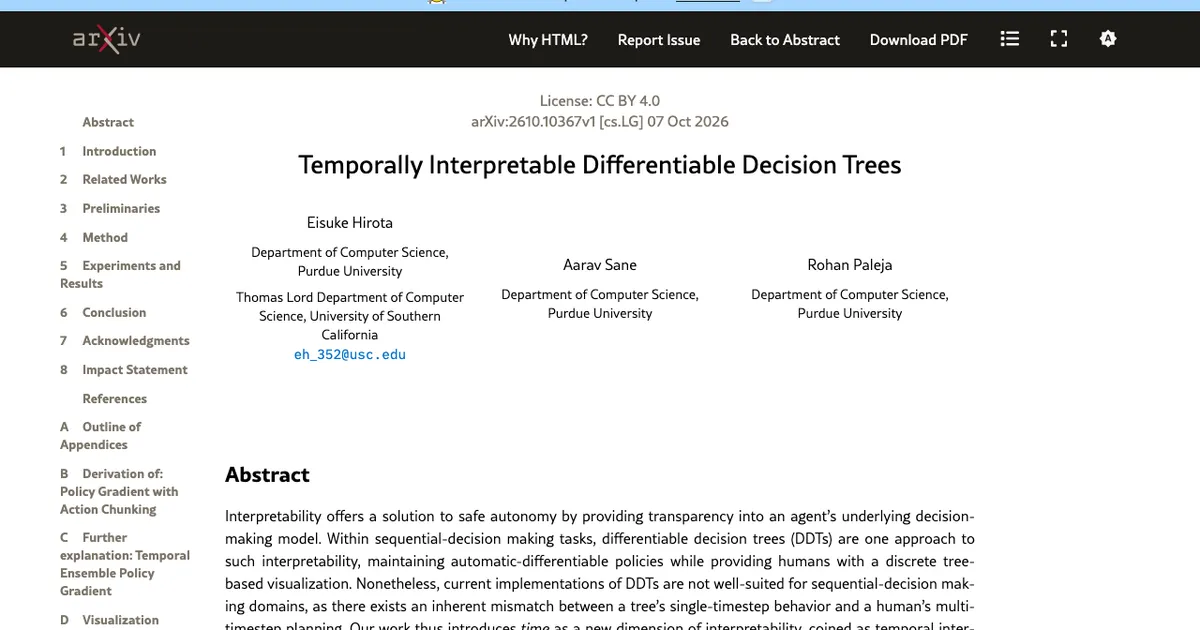
Unlocking Time: Giving AI Decision Trees a Memory (Temporal Interpretability)
Artificial intelligence is advancing rapidly, but as models become more complex—especially in safety-critical fields like autonomous vehicles—transparency isn’t optional; it’s mandatory. How do we trust an AI’s decision if we don’t know why it chose that action?
This breakthrough research tackles this critical issue by extending the concept of interpretable machine learning to cover sequential actions over time.
🕰️ The Problem with Single-Step Decisions
Traditional methods for making AI decisions, such as Differentiable Decision Trees (DDTs), provide a wonderful visualization: they map an agent’s policy onto a clear, human-understandable tree structure. You can literally trace the path of logic.
However, these single-step trees struggle when the job requires multi-step planning—the kind of complex decision-making that defines real-world autonomy (e.g., following a pedestrian through an intersection). A simple one-shot policy doesn’t capture the history or future context.
🌳 The Solution: Temporal Interpretability via Action Chunking
The authors introduce temporal interpretability, treating time itself as a new, critical dimension of interpretability. Instead of looking at single actions, they model how an agent performs chunks of actions over a sequence. This allows the interpretable tree structure to maintain memory and plan across multiple timesteps.
To make this work computationally, they developed two novel policy gradient algorithms that naturally incorporate action chunking. Furthermore, they introduced an innovative information-theoretic algorithm for restructuring the trees during training, keeping the models parameter-efficient and manageable.
💡 What Does This Mean for AI? (The Impact)
This research moves DDTs from being effective single-shot classifiers to robust planning tools. The key findings are immensely promising:
High Fidelity: When warm-starting action chunked DDTs, the resulting interpretable trees closely match state-of-the-art neural network policies in multiple challenging domains.
Efficiency Gains: Crucially, they achieve this interpretability using up to 80% fewer parameters than standard methods. This dramatically improves efficiency and deployment feasibility.
Safety & Trust: By providing a full temporal map of the decision process, these trees offer unprecedented transparency, significantly bolstering confidence in autonomous systems.
This work represents a significant step toward building ‘trustworthy AI’ for mission-critical applications globally. For ML researchers working on safe autonomy or complex sequential tasks, this is foundational reading.
By Mihai Bogdan Deaconu, Ioan Daniel Pop • arXiv • Importance: 90/100
🚀 Rethinking Finance AI: Introducing HAN-Mamba for Ultra-Accurate Volatility Forecasting
In the high-stakes world of quantitative finance, accurately predicting market volatility is critical. But here’s a massive challenge: financial data doesn’t live in one time frame. You need to reconcile second-by-second order book movements with weekly economic regime shifts—all simultaneously.
Our latest research introduces HAN-Mamba, a revolutionary hybrid architecture designed specifically for this multi-scale problem. We’re marrying the power of Mamba, a Selective State Space Model (SSM), with a hierarchical attention framework to build a forecasting engine that is not only highly accurate but also dramatically more efficient.
💡 The Problem with Traditional Models
The gold standard for financial time series modeling has often involved Transformer-based architectures. While powerful, these models suffer from quadratic complexity ($O(N^2)$), making them computationally prohibitive when dealing with the long, high-frequency sequences typical of modern markets.
We built upon our prior work HAN-T: Hierarchical Attention for Time Series (a selective attention variant), which successfully addressed scale integration. However, by replacing the resource-intensive Transformer encoders with linear-time Selective State Space Networks (SSN) like Mamba, we achieved massive gains.
⚙️ How HAN-Mamba Works: Efficiency Meets Depth
The core genius of HAN-Mamba is its selective approach to computation. Instead of applying complex attention over the entire input sequence for every scale (short, mid, long), it uses recurrent SSMs that are optimized for two key financial characteristics:
Persistent but Decaying Memory: The model can remember past market states while correctly decaying their importance.
Abrupt Regime Shifts: It quickly adapts to sudden changes in market conditions (like sudden liquidity drops or policy changes).
Mamba’s structure naturally supports these properties using input-dependent gating. By summarizing each time scale stream through a recurrent state, we maintain the critical context while gaining massive efficiency.
Furthermore, this design allows us to drastically extend the high-frequency window—from 60 to 240 buckets—without error accumulation, something attention models struggle with.
📈 Results: State-of-the-Art Performance and Efficiency
Testing HAN-Mamba on the challenging Optiver Realized Volatility Prediction benchmark (using time-aware cross-validation), the results speak for themselves:
Accuracy: It improves Mean Root Mean Squared Prediction Error (RMSPE) over the previous state-of-the-art [HAN-T], improving from 0.1965 to 0.1942.
Efficiency: It achieves this with a staggering 33% fewer parameters, making it significantly faster and more deployable in real-world trading environments.
Scalability: Its linear time complexity ($O(N)$) supports constant-time streaming updates, essential for live, high-frequency inference.
The bottom line? HAN-Mamba delivers top-tier accuracy while maintaining the computational efficiency required to run at speed in demanding financial applications. It represents a major architectural leap forward for quantitative time series forecasting across multiple market scales.
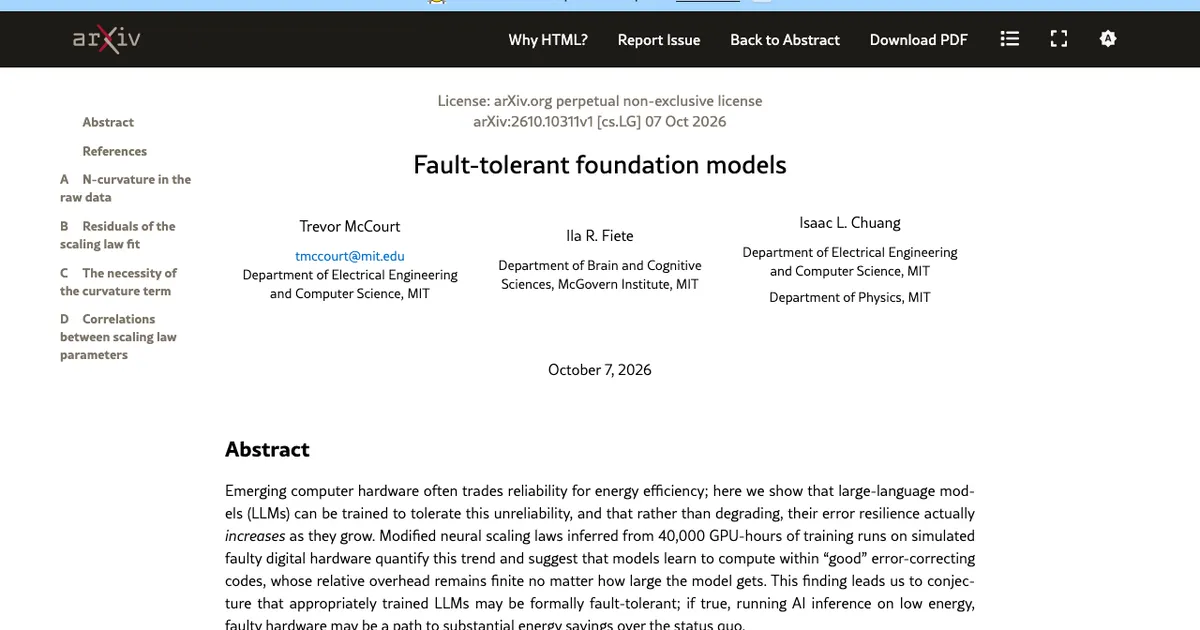
By Trevor McCourt, Ila R. Fiete, Isaac L. Chuang • arXiv • Importance: 90/100
AI Breakthrough: Making LLMs Robust on Faulty Hardware
If running sophisticated AI like ChatGPT requires massive data centers and pristine hardware, the energy bill is astronomical. But what if we could run powerful Large Language Models (LLMs) reliably even when the underlying computer chips are prone to random errors or glitches? 🤔
That’s the core breakthrough presented by McCourt et al. They tackled a critical trade-off in modern computing: efficiency often comes at the cost of reliability.
The Problem with Modern AI Infrastructure
The quest for energy efficiency has led hardware manufacturers to design components that are incredibly low power—but sometimes, this means they become less reliable. In real-world deployments (like edge devices or large, complex data centers), random bit flips and transient faults are inevitable. Most current LLMs, however, rely on a pristine computational environment. A single glitch could throw off an entire inference run.
The Solution: Error-Tolerant AI Scaling
Drawing insights from 40,000 GPU-hours of simulated training runs on faulty hardware, the research (available at Fault-tolerant foundation models) reveals something revolutionary: LLMs don’t just survive unreliability; they get better!
Instead of performance degrading as error rates increase, the researchers found that large language models actually become more robustly accurate. The scaling laws suggest that these powerful AI architectures inherently learn to compute within what are essentially
By Claire E. Stevenson, Alexandra Pafford, Han L. J. van der Maas and Melanie Mitchell in Transactions of the Association for Computational Linguistics, Volume 14 • ACL Anthology • Importance: 90/100
Can LLMs Truly ‘Think’? Analyzing the Gap Between Human and AI Analogical Reasoning
As Large Language Models (LLMs) continue to power everything from chatbots to sophisticated coding assistants, one core question keeps emerging: Do they truly understand what they are doing?
A fascinating new study tackles this head-on by pitting LLMs against human intelligence—children and adults—in a classic cognitive test: analogy solving.
🧠 The Analogy Test: A Benchmark of General Knowledge
The ability to solve analogies (like ‘body: feet :: table: ?’) is considered a fundamental marker of general human intelligence. It suggests not just pattern matching, but the capacity for abstract reasoning and generalization across completely unfamiliar domains.
Humans demonstrate remarkable transfer learning; we can apply knowledge learned in one domain (say, English words) to solve problems in an entirely new one (like the Latin or Greek alphabet). This is how children seem to learn, easily generalizing skills as they grow.
📊 The Shocking Findings: AI Gets Stuck in Its Comfort Zone
Researchers tested three groups—children, adults, and state-of-the-art LLMs—on increasingly difficult tasks:
In-Domain: Solving analogies using standard alphabets (easy for all).
Near Transfer: Switching to a related alphabet (e.g., Greek), requiring generalization.
Far Transfer: Switching completely to an unfamiliar system (a list of symbols or non-alphabetic characters).
The results were stark:
* Human Performance: Children and adults showed remarkable resilience, easily generalizing their analogical knowledge across all domains.
* LLM Performance: The LLMs, while highly effective in known domains, exhibited a significant drop in performance when faced with novel or unfamiliar symbol sets. They struggled greatly with robust human-like analogical transfer.
🤖 What Does This Mean for AI? (The Core Takeaway)
This paper provides critical evidence that despite their fluency and sophisticated pattern matching capabilities, current LLMs still face a fundamental limitation: the ability to generalize knowledge robustly across fundamentally different symbolic systems. Their performance suggests they are excellent memorizers and interpolators within trained boundaries, but not yet true generalists capable of human-like analogical abstraction.
This gap—between fluent pattern recognition and deep, cross-domain generalization—is one of the most crucial frontiers in AI research. It implies that future models must move beyond simply correlating tokens to genuinely building abstract, symbolic representations of world knowledge, much like humans do.
By Wenbin Zhou, Michael Lingzhi Li, Shixiang Zhu • arXiv • Importance: 88/100
Meta-Learning Safety: How to Update AI Models Without Breaking Them
In the world of continuous AI deployment, model performance can’t stop improving. Data streams in constantly, meaning models need retraining. But here’s the tricky part: every time a new version is deployed, there’s a real risk that it performs worse than the stable version—a phenomenon known as policy degradation.
This groundbreaking work introduces a systematic way to manage these updates. Instead of simply deploying the newest model blindly, researchers propose designing an ‘Meta-Policy’: a strategic plan that dictates when, if, and how aggressively an AI should update itself, explicitly balancing potential performance gains against quantifiable risk.
💡 The Core Problem: Improvement vs. Regression
The abstract highlights the challenge of continuous learning. While retraining promises better performance (improvement), it inherently carries the danger of making the system worse (regression). Current methods often treat updates as binary decisions (update or don’t update), which is too simplistic for real-world, high-stakes systems like healthcare or autonomous vehicles.
🛡️ The Novel Solution: Risk-Aware Scheduling
The authors model policy updates not just as single steps, but as a carefully planned schedule—a path through a Directed Acyclic Graph (DAG). Their proposed offline meta-policy optimizes the expected cumulative value while strictly budgeting for the risk. Specifically, they maximize gains subject to an allowed budget on how often the new policy underperforms its predecessor.
What does this mean in practice?
* Systematic Decision Making: The method uses dynamic programming to select the optimal sequence of updates, rather than a greedy, ad-hoc approach.
* Signal-to-Noise Analysis: A key finding is that the risk tolerance dictates update frequency. They established that clearer improvements (high signal) support more frequent deployment cycles, whereas noisier environments or data streams (low signal) require longer waiting periods and greater risk caution.
* Economic View of Safety: Furthermore, their analysis shows a diminishing marginal cost of safety—meaning the effort required to achieve an extra unit of safety becomes increasingly expensive over time. This provides deep insights for engineering safety budgets.
🔬 Why Is This Important? (Industry Impact)
The ability to prove and manage performance risk during continuous retraining is critical for moving advanced AI from research labs into regulated, mission-critical industries. For companies working on chronic data streams—like personalized medicine or financial fraud detection—this meta-policy provides a crucial framework: it allows them to quantify the trade-off between ‘getting better’ and ‘staying safe.’
This work offers sophisticated mathematical tools to manage AI evolution, making reliable deployment possible where only ad-hoc strategies existed before. Learn more about their findings here: Meta-Policy Design with Risk Control
Tech Deep Dive: This work is essential reading for researchers in Reinforcement Learning, Safety-Constrained Optimization, and Continual Learning.
By Huizhen Yu, Isaiah Heidt • arXiv • Importance: 88/100
🚀 Rethinking RL: Solving Complex Multichain MDPs with Hierarchical Decomposition
Are you working on advanced Reinforcement Learning problems—especially those involving complex, multi-stage decision processes? Standard RL algorithms often stumble when the optimal reward structure (the ‘average reward’) depends heavily on initial states or features non-standard transitions. This is where things get tough.
New research tackles this head-on: learning optimal policies in Average-Reward Multichain Markov Decision Processes (MDPs). These models represent real-world systems with deep, complex state dependencies that standard methods can’t handle efficiently.
💡 The Problem: Why Standard RL Fails Here
The core challenge lies in the ‘multichain’ nature of these MDPs. In simple terms, the optimal reward structure isn’t uniform; it changes depending on where you start and how complex the underlying state cycles are (the ‘recurrence structures’). Traditional average-reward RL methods typically assume a simpler or discounted formulation, which loses crucial information about the true, long-term gain.
🧠 The Breakthrough: Hierarchical Decomposition
The authors introduce a highly sophisticated solution: an asynchronous value-iteration-based algorithm that utilizes Bather’s decomposition. This technique is key because it doesn’t require explicit model knowledge beyond the transition graph itself. Instead, it cleverly decomposes the vast global decision problem into manageable, structured subproblems (communicating subsystems and transient states).
By structuring the complexity this way, the algorithm can converge to the truly optimal average gain and generate gain-optimal policies, all while remaining completely model-free.
✨ Beyond Optimal: Approximating Complexity
The paper doesn’t stop at optimality. Recognizing that perfect solutions are hard in practice, the researchers extend their base method with two advanced enhancements:
Near Gain-Optimality: An approximation algorithm for achieving policies close to the true optimal gain.
Bias Optimality: A novel approach targeting near bias-optimality by approximating the complex optimal bias function and leveraging the base algorithm again.
Crucially, they provide almost-sure convergence guarantees for all three methods, demonstrating that these advanced techniques consistently improve transient performance compared to the base solution.
🌐 Key Takeaways for Researchers & Practitioners
Model-Free Foundation: This is one of the first genuinely model-free average-reward RL algorithms developed for general multichain MDPs (without resorting to discounted approximations). 🌟
Robustness: The hierarchical decomposition makes it robust enough to handle highly varied recurrence and initial state dependencies.
Performance Guarantee: Strong convergence proofs for achieving optimal, near-optimal, and bias-optimal policies.
This work is a major methodological advance that pushes the boundaries of theoretical RL research into high-complexity operational environments. For more details on their proposed methodology, check out the full paper: Average-Reward Reinforcement Learning for Multichain MDPs.
Disclaimer: This digest summarizes theoretical findings and should not be used as a replacement for rigorous mathematical analysis.
By Kursat Komurcu, Linas Petkevicius • arXiv • Importance: 85/100
🔬 Supercharging Earth Observation: A New Era for Predictive Modeling in Limnology
Ever wondered how AI tracks vital ecological events like algal blooms? Traditionally, environmental monitoring relies on highly specialized knowledge—expert-designed spectral features extracted from satellites like Sentinel-2. While this approach has been robust, it often means that the machine learning models applied are equally ‘hand-crafted.’
Our new research tackles this limitation head-on. We performed a deep dive into a published Sentinel-2 algal bloom classification study and introduced an Evolutionary Architecture Search (EAS) to see if we could meaningfully improve upon established benchmarks, keeping the core data, features, and task fixed.
💡 What Did We Find? The Power of Automated Design
The results are compelling. By automatically searching a vast space of possible neural network architectures—rather than relying on standard practice or intuition—we achieved significant performance boosts:
AUC Improvement: Improved held-out Area Under the Curve (AUC) from 0.790 to 0.820.
Accuracy Boost: Lifted classification accuracy from 0.733 to 0.748.
Efficiency Gain: Achieved these gains using a tiny network with only 409 trainable parameters, dramatically smaller (26 times fewer) than the best hand-designed reference model.
This isn’t just an incremental bump; it reveals a repeatable, efficient ‘recipe’: a single narrow layer, specific normalization, and unique optimization steps—a sophisticated combination that domain experts might overlook.
🚀 The Impact: Edge AI for Environmental Monitoring
Perhaps the most thrilling takeaway is the model size. At just 1.6 kB, the resulting architecture is compact enough to serve as an onboard screening trigger. This means deployment isn’t confined to massive cloud computing clusters; you can put sophisticated predictive power directly onto field hardware or remote nodes monitoring remote lakes.
For environmental science, this translates into cheaper, more rapid, and scalable biodiversity tracking. We are moving beyond simply analyzing data in a lab setting and enabling real-time, autonomous ecological surveillance—a crucial step for global water resource management.
🚀 Unlocking the Full Potential of Multi-Teacher LLMs: Introducing $\Delta$-MOPD
In the rapidly evolving world of Large Language Models (LLMs), fine-tuning performance often relies on gathering knowledge from multiple sources—or ‘teachers.’ Techniques like Multi-Teacher On-Policy Distillation (MOPD) aim to transfer the expertise of several expert models (the teachers) into a smaller, student model. But what if these methods are only capturing half the story?
Our latest research tackles this core problem: standard distillation techniques often just capture the endpoint policy—mixing the desired post-training updates with foundational knowledge inherited from the original teacher’s base model. This limited transfer prevents the student from fully realizing the potential of all expert signals.
🔬 The Breakthrough: Teacher-Relative Shifts ($\Delta$-MOPD)
We introduce $\Delta$-MOPD (Delta Multi-Teacher On-Policy Distillation). Instead of merely replicating the final output logits, we perform a more precise transfer: we distill the difference—the ‘teacher’s learning shift relative to its base model.’ This mechanism is crucial because it isolates only the knowledge gained during specialized post-training phases, preventing the student from being overwhelmed by an inaccurate combination of baseline priors.
How does this work?
Precision Transfer: We anchor the distillation target at the student’s initial, frozen state. By transmitting the logit shift ($\Delta$), we ensure that only the delta knowledge—the fine-tuned improvements—is transferred, leaving the core foundational understanding intact and clean.
Domain Flexibility (MOPD): Our method works across two main scenarios: combining signals from multiple teachers in a single domain (common-domain composition) or assigning specialized prompts to specific teachers based on the query type (routed-domain distillation).
🧠 The Impact of $\Delta$-MOPD
The results are highly compelling, proving that how we construct the target signal is just as critical as which teachers we select.
Compositional Gains: When combining three teacher signals, $\Delta$-MOPD significantly outperforms standard endpoint composition, achieving substantial gains (e.g., $4.11$ on Math and $1.95$ on Five-Benchmark).
Phased Routing Improvement: In complex routing scenarios where updates happen across phases, we drastically reduce the performance ‘order gap’ from $10.50$ to $6.42$ points. This suggests that $\Delta$-MOPD’s benefits extend robustly across multi-stage training processes.
Systemic Insight: The findings pinpoint exactly why endpoint transfer fails—the inherited base pull sometimes outweighs the useful post-training shift. By removing this impediment, we unlock superior generalization and performance.
✨ Why This Matters for AI Development
In production environments where model specialization is key (think agents using multiple expert tools or specialized domain adapters), MOPD techniques are invaluable. $\Delta$-MOPD provides an optimal framework to ensure that knowledge gained from specialized, expensive-to-train teachers is maximally and efficiently distilled into a robust student model without corruption.
By Peng Liu, Shaoxiang Qin, Theodore Potsis, Lili Ji, Dingyang Geng, Liangzhu Leon Wang • arXiv • Importance: 85/100
Generative AI for City Climate: Predicting Instantaneous Urban Microclimates with Conditional Flow Matching
(A deep dive into making resilient urban design real-time.)
For civil engineers, climate scientists, and smart city architects, predicting how wind blows and how temperature fluctuates in a dense urban canyon isn’t just academic—it’s critical for building safety, energy efficiency, and overall livability. Traditional methods are accurate but incredibly slow.
Enter Conditional Flow Matching (CFM): A novel generative AI framework that is fundamentally changing how we approach urban microclimate modeling, moving us from theoretical simulations to real-time design tools.
💨 The Problem with Traditional Climate Modeling
When studying urban wind and temperature fields, scientists typically rely on Large-Eddy Simulations (LES). LES is the gold standard because it resolves the instantaneous (turbulent) fluctuations of airflow. But here’s the catch: LES is computationally monstrous. Running these simulations for iterative design—the kind of rapid prototyping engineers need—takes too long.
Meanwhile, older data-driven models were faster, but they only gave deterministic point predictions, missing the critical chaotic element: stochastic turbulence.
✨ How Conditional Flow Matching Solves It
The team behind this paper introduces CFM. Instead of merely predicting an average state, CFM is a generative model that learns the full probability distribution of the complex microclimate fields. This means it doesn’t just give you ‘the answer’; it generates plausible, realistic instantaneous fluctuations—the true character of urban turbulence.
The magic of CFM:
1. Generative Power: It uses building geometry and mean flow as guidance to generate entire 3D fields of velocity and temperature in seconds.
2. Efficiency Breakthrough: To bypass the GPU memory limits inherent in generating massive 3D pixel spaces, the model operates on overlapping sections with shared-noise initialization. This is a crucial architectural innovation that maintains high spatial continuity across the entire urban domain.
3. Unprecedented Accuracy & Speed: Against benchmark LES data, CFM rapidly and accurately restores first-order statistics (e.g., mean wind speed) while maintaining excellent fidelity for complex second-order metrics like turbulent kinetic energy.
💡 Why Does This Matter for Smart Cities?
The impact is profound. Current urban planning often lacks the detailed, moment-by-moment understanding of localized gust effects. CFM’s ability to rapidly predict local gusts makes it a game-changer for:
Wind Engineering: Designing buildings that withstand actual turbulent loads.
Climate Resilience: Identifying ‘hot spots’ or wind tunnels where building modifications are needed for energy efficiency and comfort.
Rapid Iterative Design: Allowing architects and civil engineers to test hundreds of design variations in hours, not weeks.
The authors demonstrated this by showing CFM’s accuracy in predicting local gust prediction for wind engineering—making truly turbulence-aware resilient urban design computationally feasible.
This work significantly advances the frontier of generative AI applied to physical sciences, making high-fidelity microclimate modeling accessible to a much wider range of engineers and planners.
By Hyunseok Seung, Matthias Katzfuss • arXiv • Importance: 85/100
Mastering Gaussian Processes: Making Gradient Observations Affordable
(By the ML Research Team)
Gaussian Process (GP) models are foundational tools in machine learning, particularly for expensive function approximation tasks. Historically, using gradient information ($
abla f$) has been the key to boosting GP accuracy—it allows us to build vastly better surrogate models with fewer data points. But the Achilles’ heel of this approach has always been computation: incorporating full gradients makes these methods prohibitively slow and memory-intensive.
This latest work addresses that bottleneck head-on, presenting a clever new framework: Derivative Gaussian Processes (DGPs).
💡 The Problem: Gradient Information vs. Computational Cost
The promise of gradient observations is high accuracy. However, the computational cost explodes as you try to condition your GP on more data points. Existing methods that leverage full gradients quickly hit memory walls, limiting how much information they can use and degrading their performance.
🚀 The Breakthrough: A Two-Direction Budget
Authored by Hyunseok Seung and Matthias Katzfuss, the research introduces a revolutionary approach that significantly restricts the cost of gradient utilization. Instead of needing to process all possible gradient coordinates, the proposed DGP technique limits itself to utilizing just two directions per observed gradient.
Direction 1 (Direct Contribution): Captures how much each input directly influences the target prediction. This is standard and crucial.
Direction 2 (Indirect Correlation): Aggregates the gradient’s indirect influence by correlating it with the values of the conditioning function itself. This novel step allows the model to capture richer dependencies without the computational overhead.
By limiting the complex calculations in this way, the authors show that their method achieves state-of-the-art accuracy while drastically improving efficiency.
🧠 How Does This Work Under the Hood?
The paper applies these ideas within a Vecchia approximation—a common technique where prediction only relies on $m$ nearby inputs. The genius of the construction is its complexity control. By judiciously limiting the directional derivatives, they keep the factorization cost manageable at $\mathcal{O}(m^3)$ per target.
More importantly, the authors characterize this by showing that the approximation error remains small compared to using full gradients, and sometimes even exactly matches it! This is a massive claim—high accuracy without the high computational penalty.
📈 Why Should You Care? (The Takeaway)
In practical terms, this means you can now:
Scale Up: Condition your GP on significantly larger sets of data points than before, pushing past memory limits.
Save Time & Memory: The method consumes substantially less computation time and memory compared to existing exact gradient-reduction methods and even some function-only GP baselines.
Boost Accuracy: Achieve lower prediction error while being significantly more computationally frugal.
This isn’t just an incremental update; it represents a fundamental shift in how we leverage differential information for Bayesian optimization and function approximation, making previously intractable problems feasible.
✨ Deep Dive into Tabular AI: How to Make Foundation Models ‘Think’ Better
The age of foundation models (FMs) is here—they power everything from language translation to image generation. But what about structured data? Think spreadsheets, financial tables, or complex scientific datasets. This niche, yet critical area is dominated by Tabular Foundation Models (TFMs).
Most modern TFMs are trained using an ‘in-context learning’ paradigm: they take a new table and use its labeled examples as context to generate predictions. They usually do this by stacking many Transformer layers, where each layer refines the representations of the input data.
🤔 The Problem with Deep Thinking (The Flaw in Current TFMs)
While current TFMs are deep, their refinement is highly uneven. Most of the ‘predictive magic’ only happens in the later layers. The earlier stages essentially don’t effectively contribute or refine the input data representations enough—it’s like having an expert who only starts paying attention right before giving the final answer.
💡 Introducing Retro: Thinking with Memory
We propose a solution called Retro, which fundamentally changes how we view intermediate knowledge in deep models. Instead of letting information simply flow one-way through stacked layers, Retro enables later stages to explicitly revisit and recombine the rich intermediate representations produced much earlier in the network.
How does it work? It’s all about strategic memory retrieval:
Attention Residuals (The ‘Which’): This mechanism solves the problem of what information to retrieve. By adaptively reweighting contributions from different depths, it intelligently decides which historical knowledge is most relevant for the current prediction.
Query-Conditioned Gated Attention (The ‘How’): This component determines how that retrieved context should be mixed back in. It modulates the attention output element-wise, ensuring a finely tuned contextual update that respects the structure of your data.
📈 Why Does Retro Win? The Impact
The results speak for themselves. By allowing models to reuse and fuse their own past computations (revisiting depth), Retro shifts predictive refinement earlier and makes it more broadly distributed across all layers. This process mimics ‘multi-view refinement,’ suggesting the model is using its entire computational history, not just the end result.
On major benchmark datasets like TabArena, TALENT, and RelArena, Retro consistently ranks among the top three performers and defines the Pareto frontier—a rare indicator of a genuinely superior method!
🚀 For Engineers & ML Practitioners: If you are working with structured data (financial modeling, scientific databases), or if your TFMs suffer from diminishing returns in deep layers, Retro offers a highly practical and impactful architectural upgrade. It’s an effective way to squeeze maximum performance out of deep transformer stacks.
By Chunyang Wang, Mingrui Zhang, Yuyan Zhang, Linqi Zhu, Xin Ju, Edo Sicco Boek, Martin J. Blunt, Gege Wen • arXiv • Importance: 85/100
💡 PoreML: Revolutionizing Fluid Dynamics Modeling with AI and Porous Media
As ML research becomes increasingly applied to complex physical systems, fluid dynamics—especially within microstructures—presents a formidable challenge. Consider critical real-world applications like $ ext{CO}_2$ carbon capture storage, optimizing fuel cells, or advanced flip-chip packaging. These processes rely entirely on understanding how fluids move through highly porous materials, where the interaction between liquid and solid surfaces (wettability) dictates everything.
Traditionally, modeling these multiphase flows involves computationally intensive simulations that struggle with complex geometries and non-linear fluid interface evolution. This bottleneck severely limits predictive capabilities in industrial settings.
That’s where PoreML steps in. Featured in the recent paper PoreML: A Data-Driven Framework for Learning Multiphase Flow in Porous Media, this open-source framework isn’t just another simulation tool; it’s a complete, end-to-end ecosystem designed to accelerate machine learning research in porous media flow.
🚀 What Makes PoreML a Game Changer?
The core problem with deep learning for fluid dynamics has historically been the lack of standardized, large-scale, and physically consistent datasets. PoreML solves this by unifying three critical components:
1. Physics-Informed Data Generation:
PoreML includes a modern, GPU-native Lattice Boltzmann solver. This isn’t just any simulation; it allows researchers to generate reproducible, high-fidelity data validated against both analytical solutions and real experimental results across diverse conditions (varying wettability, viscosity ratios).
2. A Massive, Diverse Dataset:
The framework introduces a staggering 3.3 TB dataset. This isn’t random data—it comprises 560 simulation runs and over 158,546 stored time steps across four complex scenarios. Crucially, the geometries span both synthetic structures and highly realistic micro-CT scans of actual materials.
3. Unified AI Training & Evaluation:
The framework provides a unified machine learning pipeline that evaluates model performance using sophisticated domain-specific protocols. It tests not only basic one-step prediction but also advanced autoregressive rollouts, assessing both predictive accuracy and crucial physical consistency when transferring models to novel, unseen domains.
🌍 Why Does This Matter for Industry? (GEO-Optimization)
PoreML dramatically lowers the barrier to entry for complex fluid dynamics modeling. By providing a shared, standardized foundation, it empowers researchers globally—from academic labs in Germany and Japan to industrial R&D centers in Singapore and the United States—to:
Improve Energy Systems: Design more efficient fuel cells and advanced energy storage components.
Advance Microelectronics: Simulate complex interactions in next-generation packaging techniques.
The community can now focus on developing robust, reliable AI algorithms rather than spending decades building foundational datasets and simulation pipelines from scratch.
By Tommaso Marzi, Ahmed Hendawy, Jan Peters, Carlo D'Eramo, Andrea Cini, Cesare Alippi • arXiv • Importance: 85/100
🌐 Preventing Forgetting in AI: Introducing Continual Graph MARL
Do you ever train an AI that forgets things? 🤔 If your machine learning system needs to solve multiple complex problems over time—like adapting a power grid or controlling robotic formations—forgetting previous knowledge is the biggest headache. This is the core challenge of Continual Multi-Agent Reinforcement Learning (CMARL).
We dive into a critical problem: traditional CMARL methods treat tasks in isolation, failing to leverage the underlying structure that links them together. When new tasks arrive, they often represent a change in the structure or dynamics of the environment, and ignoring this structural link causes performance to decay (a process known as catastrophic forgetting).
💡 The Breakthrough: CGMARL & Structured Learning
Our new work introduces Continual Graph Multi-Agent Reinforcement Learning (CGMARL). This groundbreaking framework changes how we model sequential tasks. Instead of treating each task independently, every single task sequence is mapped onto an attributed graph.
What does this mean? The entire operational context—from the environment’s dynamics (what the next state will be) to the number of active agents—is inherently structured by the graphs. This structural approach allows the model not only to solve the current problem but also to maintain a deep, contextual memory of how all previous tasks were solved.
We introduce Graph-based Formation (GRAFO) as the first benchmark dedicated to this space, rigorously demonstrating how forgetting manifests when structural links are ignored. To fix this, we propose Frozen Graph Encoder (FROG). FROG utilizes a specialized, frozen graph backbone that acts as a permanent memory layer, preserving crucial past structural information while enabling adaptation to new tasks.
The results speak for themselves: Experiments on the GRAFO benchmark show that integrating FROG with existing Continual Learning methods dramatically boosts performance across multiple CGMARL scenarios. This isn’t just an incremental improvement; it significantly stabilizes and improves overall system reliability in structurally complex environments.
🚀 Why Should You Care? (Real-World Impact)
The ability to learn continuously, while retaining structural knowledge, is vital for real-world deployments:
Smart Grids & Infrastructure: Maintaining optimal performance across changing network topologies or component failures.
Autonomous Robotics: Allowing a drone swarm to adapt to new formation rules without forgetting basic navigation skills.
Complex Gaming/Simulation: Training agents in evolving, multi-stage scenarios.
The authors have laid critical groundwork for the next generation of robust AI systems that can operate reliably in non-stationary, structurally diverse environments.
By Tadesse Destaw Belay, Ibrahim Said Ahmad, Idris Abdulmumin, Abinew Ali Ayele, Alexander Gelbukh, Eusebio Ricárdez-Vázquez, Olga Kolesnikova, Shamsuddeen Hassan Muhammad and Seid Muhie Yimam in Transactions of the Association for Computational Linguistics, Volume 14 • ACL Anthology • Importance: 85/100
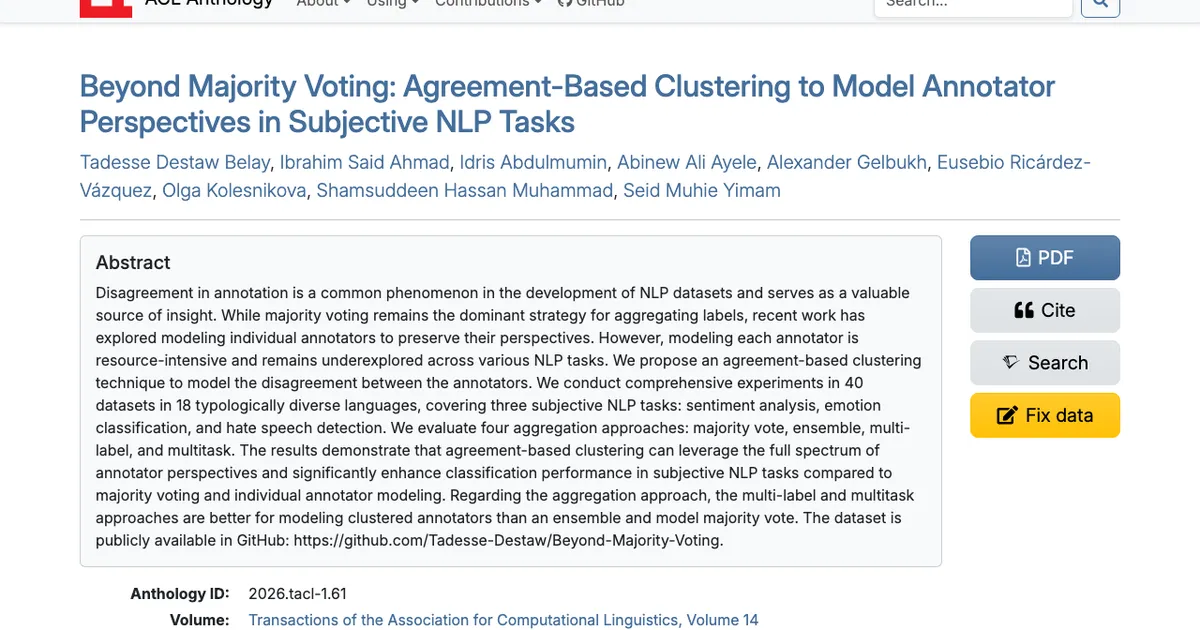
💡 Beyond Simple Majority: How Agreement Clustering Unlocks Deeper Insights in NLP
The quality of any NLP dataset hinges on the labels provided by human annotators. But what happens when those annotators disagree?
Traditional approaches, like simple majority voting, treat disagreement as noise—and discard valuable information. As an ML researcher, I’ve noticed that this ‘noise’ is actually a rich source of insight into language use and cultural nuances.
Our latest work addresses this gap by introducing Agreement-Based Clustering. Instead of blindly accepting the consensus label, we model the patterns of disagreement itself. This technique allows us to preserve the full spectrum of annotator perspectives, giving algorithms a much richer understanding of complex, subjective human language tasks (like discerning subtle sentiment or identifying nuanced hate speech).
📊 What We Did and Why It Matters
The problem is that simply modeling every single annotator’s perspective is computationally demanding. We propose a scalable clustering framework: Agreement-Based Clustering. This method groups annotators with similar labeling tendencies, effectively summarizing the collective expertise without sacrificing individual nuance.
We put this approach through its paces in an extensive evaluation across:
* 🌍 40 diverse datasets from 18 typologically distinct languages.
* 🏷️ Three subjective NLP tasks: Sentiment Analysis, Emotion Classification, and Hate Speech Detection.
Our results are highly encouraging: Agreement-Based Clustering significantly boosts classification performance compared to both the standard majority vote and single annotator modeling. Furthermore, we found that for clustered annotations, multi-label and multitask aggregation strategies outperformed simple ensemble methods.
✨ The Takeaway for NLP Practitioners
If your project relies on labeled data, particularly for subjective tasks, you should rethink your labeling pipeline. Disagreement is not noise; it’s a feature. By adopting agreement clustering, we move beyond simplistic consensus and harness the full richness of human judgment.
By David A. Haslett, Antoni B. Chan and Janet H. Hsiao in Transactions of the Association for Computational Linguistics, Volume 14 • ACL Anthology • Importance: 85/100
Subwords Decode Semantics: Why How Words Are Built Matters for AI
(A Deep Dive into Linguistic Structures and LLM Understanding)
As we build increasingly sophisticated Large Language Models (LLMs), a fundamental question remains: Do these models truly understand meaning, or are they just mastering statistical patterns? Traditional NLP approaches treat words as black boxes, learning meaning purely from their surrounding context—a concept known as distributional semantics. While highly effective, this approach often fails to capture deeper structural aspects of human language knowledge, such as the functional relationships between word categories (syntax and taxonomy).
Our new research challenges the assumption that text distribution is the sole source of linguistic meaning. We argue that how words are constructed—specifically, through shared subword tokens—reveals crucial information about inherent semantic structure that purely statistical methods often overlook.
🧠 The Core Problem: Beyond Contextual Clues
LLMs like GPT-5 decompose complex vocabulary into smaller units called subword tokens. This is highly effective for managing massive vocabularies, but it means the model is paying attention to more than just word patterns. For example, when modeling chemical elements, a model might segment fluorine and bromine by recognizing shared endings (e.g., [...]+ine).
The breakthrough insight here is that these shared subword tokens act as powerful indicators of shared categories or functions, much like realizing both bromine and fluorine are elements sharing the -ine suffix.
🧪 Empirical Evidence: Priming Effects in Humans
We tested this hypothesis across 18 diverse languages. Our findings reveal a compelling pattern:
Shared Tokens Boost Memory: In human semantic priming tasks, participants recognized one word faster after seeing another if the words shared specific subword tokens—an effect that went beyond what simple distributional similarity would predict.
Morpheme-Level Gains: Furthermore, in seven languages, these shared token effects exceeded the explanatory power of traditional linguistic markers like morphemes (the smallest meaningful unit).
This strongly suggests that subword tokens are not just computational hacks; they are rich carriers of human-like semantic and taxonomic knowledge.
💡 What Does This Mean for LLM Architecture?
Our work provides a critical guidepost for the next generation of AI models. If true meaning is partially encoded in shared structural components, then simply increasing vocabulary size or relying solely on massive textual corpora may be insufficient.
We recommend that future NLP architectures explicitly leverage and account for these subword token relationships to achieve genuinely human-like semantic representations. However, we also caution that blindly expanding the token vocabulary can obscure these crucial category markers, necessitating a careful balance in model design.
By Tianyang Xu, Tatsuki Kuribayashi, Yohei Oseki, Ryan Cotterell and Alex Warstadt in Transactions of the Association for Computational Linguistics, Volume 14 • ACL Anthology • Importance: 85/100
Decoding Language Limits: Can LLMs Master Impossible Languages?
As large language models (LLMs) become incredibly sophisticated, a fundamental question emerges: how deeply can they understand the rules of human communication? Are there limits to what they can learn?
In our latest research, we dive into the fascinating intersection of computational linguistics and anthropology. We tested LLMs’ capacity to learn languages that exist on a spectrum—from those typologically plausible (like standard English or Japanese) to those that are ‘subtly implausible.’
🧠 The Core Challenge: Typological Plausibility
Human language structure is governed by deep, complex rules. Linguists identify universals—patterns that hold true across the world’s languages (e.g., certain word order patterns). LLMs are powerful tools for studying these structures because they provide a naturalistic way to observe ‘artificial’ language learning.
Traditional research often studied simple variations. Our study, however, pushed the boundaries significantly, creating hyper-naturalistic counterfactual versions of major languages (English and Japanese) that precisely pinpoint the boundary between what is grammatically possible and what strains credulity.
💡 What We Found: The Learning Curve Is Not Flat
Our experiments reveal key insights into how LLMs process grammar.
1. Initial Resistance: When presented with subtly implausible language structures, the models showed signs of slower learning at the beginning. This suggests that these grammatical patterns don’t just appear randomly; LMs seem to possess an inherent typologically aligned preference.
2. Convergence (But Not Uniformly): While the models eventually caught up and reached similar performance metrics regardless of plausibility, the path they took suggested deep learning biases at play.
These findings strongly suggest that LLMs aren’t just memorizing patterns; they are implicitly adopting learned grammatical preferences that mirror human typological tendencies. The underlying biases driving the model’s initial learning trajectory seem to align with how actual languages are structured.
🌐 Implications for AI Language Research
This work has major implications beyond just classification accuracy:
Model Bias: It raises questions about whether LLMs inherently encode general linguistic biases, or if these observed ‘preferences’ simply emerge from the training data structure itself.
Universal Grammar: By testing these artificial languages, we gain a novel benchmark for understanding how machine intelligence approaches concepts like Universal Grammar—a cornerstone of modern linguistics.
🔍 Key Takeaways:
* LLMs show typologically aligned learning preferences.
* The rate of learning is sensitive to the plausibility of language structures.
* This offers a novel perspective on developing models that truly understand linguistic universals.
By Yizhen Xie, Mengyang Liu • arXiv • Importance: 80/100
📈 Trading Options with AI: A New Era of Market Strategy
In the rapidly evolving landscape of quantitative finance, algorithmic trading is pushing boundaries every day. While large language models (LLMs) have proven incredible at reasoning over text—analyzing news sentiment or summarizing earnings reports—they encounter a unique challenge when applied to options trading.
The Problem: Too Much Complexity. 🤯
Options markets are immense beasts. A single underlying stock can generate thousands of contracts, forcing an AI agent to make decisions not just on whether to trade, but exactly which combination of calls and puts to buy or sell. Existing ML agents often simplify this by locking the policy into rigid structures (like only allowing a straddle), making them inflexible when market conditions shift.
Researchers introduced SOTA, an agentic framework designed to solve this complex decision space. Instead of grappling with thousands of contracts, SOTA intelligently abstracts the problem into high-level ‘strategy selection’ decisions (e.g., should I implement a covered call? or is a vertical spread better right now?). A deterministic component then handles the precise, low-level portfolio execution.
This approach was built by fine-tuning Qwen3.8-27B using supervised learning and reinforcement learning (RL), showcasing cutting-edge LLM application in finance.
What Did They Achieve? The Results. 🏆
SOTA demonstrated robust performance over a six-month out-of-sample period on nine major U.S. equities plus SPY.
Total Return: An impressive 18.3% return.
Sharpe Ratio: A strong 1.60, indicating excellent risk-adjusted returns.
Max Drawdown: Managed to keep drawdowns relatively low at 8.96%.
Crucially, the authors also shed light on how market news impacts performance. While news generally helps, they found that incorporating news directly into the RL loop actually hurt out-of-sample results, suggesting a more nuanced role for context (check the findings in SOTA Paper).
🔥 Key Takeaway for FinTech Developers:
SOTA shifts the focus from contract-level optimization to strategy-level reasoning. This is a massive leap toward creating truly adaptable and reliable automated trading agents that can adapt their entire strategy portfolio as market regimes change.
Want to dive deeper into structured option pricing and agent design? Read the full paper here: SOTA Paper.
By Hanhua Hong, Chenghao Xiao, Yang Wang, Yiqi Liu, Wenge Rong and Chenghua Lin in Transactions of the Association for Computational Linguistics, Volume 14 • ACL Anthology • Importance: 80/100
Stop Guessing: Auto-Generating Perfect Prompts for NLG Evaluation
The biggest challenge in evaluating large language models (LLMs) is ensuring consistency and reliability. We know human reviewers are the gold standard, but let’s face it: their evaluations can be inconsistent, biased, and hard to standardize—making reproducibility a nightmare.
While using other LLMs as evaluators seems like a silver bullet, they introduce a different set of problems. These model-based evaluation methods are notoriously fragile. A tiny tweak in the prompt or system instructions can cause massive discrepancies in scores, making our evaluations unreliable and time-consuming to fine-tune.
💡 The Problem with ‘One-Size-Fits-All’ Prompts
The current standard of LLM evaluation relies on generic prompts. But because every single NLP task (from summarizing medical records to writing creative poetry) generates outputs with unique characteristics, a one-size-fits-all prompt just doesn’t cut it.
Our research introduces a powerful solution: Inversion Learning for NLG Evaluation Prompts. Instead of hand-crafting prompts and hoping they work, our method automatically learns the optimal reverse mapping.
How does this work? Simply by providing the model with just one sample output, our system
By Dhruv Sahnan, David Corney, Irene Larraz, Giovanni Zagni, Ruben Miguez, Zhuohan Xie, Iryna Gurevych, Elizabeth Churchill, Tanmoy Chakraborty and Preslav Nakov in Transactions of the Association for Computational Linguistics, Volume 14 • ACL Anthology • Importance: 80/100
Is AI Ready to Write the Ultimate Fact-Check Article? A Deep Dive into Qraft
As Large Language Models (LLMs) become integral parts of our information ecosystem, the question of ‘truth’ has never been more critical. LLMs can write incredibly convincing text, but simply stating a fact isn’t enough—professional fact-checking requires context, justification, and the narrative structure to convince a general audience.
This new research tackles a crucial gap: while current AI tools are good at identifying discrepancies, they struggle with producing polished, fully realized articles suitable for public consumption. Simply flagging a contradiction is not enough; you need the expert-written explanation that grounds your findings in reliable evidence.
💡 The Challenge: From Finding Facts to Telling Stories
The authors introduce a sophisticated problem space: automated fact-checking pipelines traditionally focus on assessment (identifying if something is false) but completely neglect dissemination. Human fact-checkers don’t just produce an internal report; they craft public articles that weave evidence into a compelling narrative.
To bridge this gap, the research proposes developing an AI agent that doesn’t just check facts—it writes the entire article. They call it Qraft.
📝 What is Qraft?
Qraft is an LLM-based framework designed to mimic the intricate workflow of human professional fact-checkers. It goes beyond simple text generation by incorporating the full process: identifying claims, gathering evidence, synthesizing contradictory data, and finally, structuring it into a coherent journalistic article.
🔎 How Was Qraft Evaluated?
The researchers didn’t just test Qraft on simple benchmarks; they gathered deep insights from leading fact-checking experts themselves. This qualitative approach defined the ‘desiderata’ (key requirements) for a truly useful fact-checking article, setting a high bar for automated systems.
When evaluated by human professionals, Qraft showed promise—outperforming several existing text-generation models. However, the study also provided sobering realism: while powerful, Qraft still lags significantly behind the nuanced judgment and editorial polish of an experienced human expert. This isn’t a failure; it’s a critical roadmap for the field.
🌐 Why Should You Care? (The Future of Trustworthy AI)
The implications of this work are massive. If we can automate not just checking facts, but also the art of presenting them, we could dramatically increase the scalability and speed of professional journalism and digital verification.
For ML researchers and information science professionals interested in agentic AI workflows, this paper outlines a vital new direction: moving from isolated NLP tasks toward comprehensive, human-like content creation that requires deep domain knowledge.
Unmasking the Black Box: Can We Really Trace Behavior in Large Language Models?
In the world of Reinforcement Learning (RL) and LLMs, a common goal is fine-tuning—teaching an AI a new skill or behavior. But here’s the million-dollar question that keeps researchers up at night: When an LLM learns something new, can we definitively point to the specific moments, examples, or training rollouts that caused it?
This cutting-edge research tackles the limits of ‘attribution’ in online RL. Simply put, if a model behaves like X after training on Y, did Y truly cause X? Or is it some other lurking factor?
🧐 The Problem: Misattributed Credit
The authors present a rigorous investigation using GRPO fine-tuning and a planted behavior setup—a controlled environment where they know the true cause. They developed BehaviorTrace, an open evaluation harness to test attribution methods like GAS and TRAK.
Using Qwen2.5-1.5B, they systematically dismantled standard attribution claims. The findings were sobering:
Fluency is a Major Confounder: Sometimes, what appears to be a specific learned behavior is just the model’s general ability (fluency). Even ranking training steps by gradient size alone performed nearly as well as targeted attribution methods!
Lack of Consistency: When controlling for basic fluency metrics, the per-rollout results changed wildly between different training seeds and even generation draws. This shows that a single test run is insufficient to prove cause.
🧠 What Actually Worked? The Definitive Signal
The authors found one consistent signal: The gradient of the trigger tokens aligned with a target built where the behavior actually occurs.
This isn’t just an abstract concept; it provides a powerful, actionable checklist for any researcher looking to evaluate attribution claims in RL. They don’t propose a new method but rather provide the tools and the rigorous evaluation framework needed to properly assess existing ones.
💡 Key Takeaways for Developers & Researchers
Be Skeptical of Attribution Claims: Don’t take single-run gradient attribution methods at face value. Use comprehensive metrics like seed variability and fluency controls.
The Need for Rigor: Establishing causality in LLM training is incredibly hard. BehaviorTrace provides the academic gold standard for this measurement.
Focus on Consistency: True signs of learned behavior are stable across seeds and generation draws, suggesting a robust underlying signal.
🧠 Federated Learning Just Got a Performance Boost: Introducing ORDERS
The challenge of training large models on decentralized, private data—the backbone of modern AI like healthcare diagnostics and mobile assistants—is called Federated Learning (FL). But getting accurate results is tricky because the server’s role can get lost amidst messy local client updates.
We just dove deep into a new approach called ORDERS for Personalized Federated Learning, tackling how to best combine shared model representations with client-specific knowledge without sacrificing performance or privacy.
🔬 What is ORDERS?
Think of it like this: In standard FL, the server just averages out updates from all participating clients. While simple, this approach often obscures the actual contribution of a well-designed weighting strategy. ORDERS introduces a sophisticated system that moves beyond simple averaging.
It combines several cutting-edge techniques:
Shared Backbone: A core model used by everyone.
Private Residual Adapters & Classifiers: Small, client-specific components that keep data local and private.
Geometric Weighting (Key Feature!): The server weights updates based on their descending update norm. Essentially, it gives more influence to clients whose model changes are the most pronounced or informative in a structured way.
Feature Alignment & Perturbations: Further mechanisms to ensure all local models speak the same language and withstand minor privacy noise.
✨ The Results: Why ORDERS Matters
The empirical results on benchmark datasets like CIFAR-10 and Sent140 are quite compelling.
On two-class-per-client CIFAR-10, ORDERS achieved a native mean client accuracy of $80.51 ext{ percent}$. This is notable because it outperforms both the established baseline (FedPer-R1) at $79.02 ext{ percent}$ and even the standard uniform-weight control ($80.27 ext{ percent}$).
While the gap narrows slightly after intensive local fine-tuning, the initial performance gain shows a clear edge in how updates are aggregated.
Furthermore, the ablation studies demonstrated that while feature alignment is valuable, the benefits of the more complex perturbations and norm ranking might be limited or endpoint-dependent. This provides crucial insights for practitioners: simplicity can be effective!
📈 For Researchers & Practitioners (SEO Insights)
If you are tackling Personalized Federated Learning, especially in domains requiring high accuracy like personalized medical AI, this paper offers a concrete, mathematically grounded framework.
The proposed method achieves state-of-the-art performance by intelligently combining shared global knowledge with unique local expertise via optimized weighted aggregation. The authors also quantify the parameter savings (5.47% and 0.78%), which is vital for deployment on resource-constrained edge devices.