← Back to Archive

Digest for 2026-08-05

🐦 Share on X 💼 Share on LinkedIn 📘 Share on Facebook

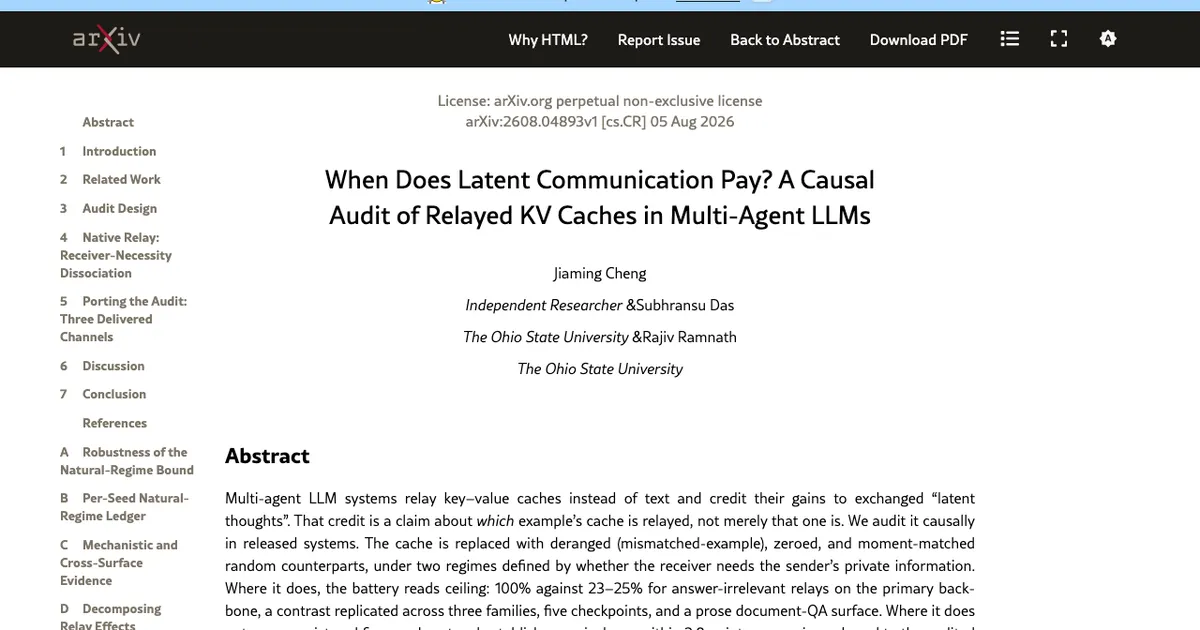
When Does Latent Communication Pay? A Causal Audit of Relayed KV Caches in Multi-Agent LLMs
By Jiaming Cheng, Subhransu Das, Rajiv RamnatharXivImportance: 92/100
Hero Image for 2608.04893

Is Your LLM Really Sharing Thoughts? Causal Audit of ‘Latent Communication’ in Multi-Agent Systems

(Digest from: Jiaming Cheng et al. - arXiv:2608.04893)


The rise of sophisticated multi-agent AI is massive, promising systems where AIs not only respond but actively collaborate by ‘thinking’ together. One key mechanism fueling this is the relaying of Key–Value (KV) caches—the distilled computational memory of an LLM’s past inputs. Researchers have theorized that when agents exchange these cached memories, they are exchanging something far more valuable than just numbers; they are supposedly sharing ‘latent thoughts,’ specific context or intent.

But wait. Is this ‘thought-sharing’ real, or is it a sophisticated computational illusion? 🤔

The authors tackle this with a rigorous, causal audit, probing the foundational claims of multi-agent LLM systems. They don’t just measure performance gains; they scientifically replace the relayed cache memories with corrupted versions (like zeroed data or caches from unrelated inputs) to see if the system’s gain collapses.

🧠 The Core Finding: It Gets Complicated (and Specific)

In challenging scenarios where the receiving agent needs the sender’s private context, the gains are dramatic. They reported battery readings of 100% on the primary backbone compared to just 23–25% when using irrelevant or corrupted caches. This suggests that context-rich relays are powerful.

However, the paper meticulously investigates cases where the received information is not critical. Here, they establish that the observed gains are statistically equivalent to nothing—a crucial find suggesting the touted ‘latent thought’ transfer might just be a measurement artifact if not contextually necessary.

Key takeaways from this causal audit:

  • Specificity Matters: A large cache effect does not necessitate a pairing or specific thought-sharing mechanism. The mere act of relaying cached data must be rigorously tested for its true informational content.
  • The Cost of Error is High: Zeroing the relay entirely costs significant points (14.7 points), whereas using a mismatched, corrupted cache only results in a minimal drop (0.4 points). This highlights how sensitive LLMs are to accurate context transfer.
  • Audit Tools Are Essential: The researchers emphasize that simply observing high benchmark delta scores is insufficient proof of ‘latent thought’ transmission. A robust, causal audit—like the mismatched-cache test they developed—is required to establish true informational transfer.

💡 What Does This Mean for AI Development?

This work provides essential scrutiny for the multi-agent LLM field. Developers can no longer simply claim a ‘latent thought’ mechanism; they must provide concrete evidence of causality. It forces the community to define precisely what information is transferred and why that specific piece of context makes the difference.

If you’re building complex, reasoning LLM workflows—especially those involving multiple autonomous agents (like using LangGraph or AutoGen)—read this paper. Understanding the genuine information flow between your agents is crucial for optimizing performance and ensuring reliability!

🔗 Read the full audit here: https://arxiv.org/abs/2608.04893
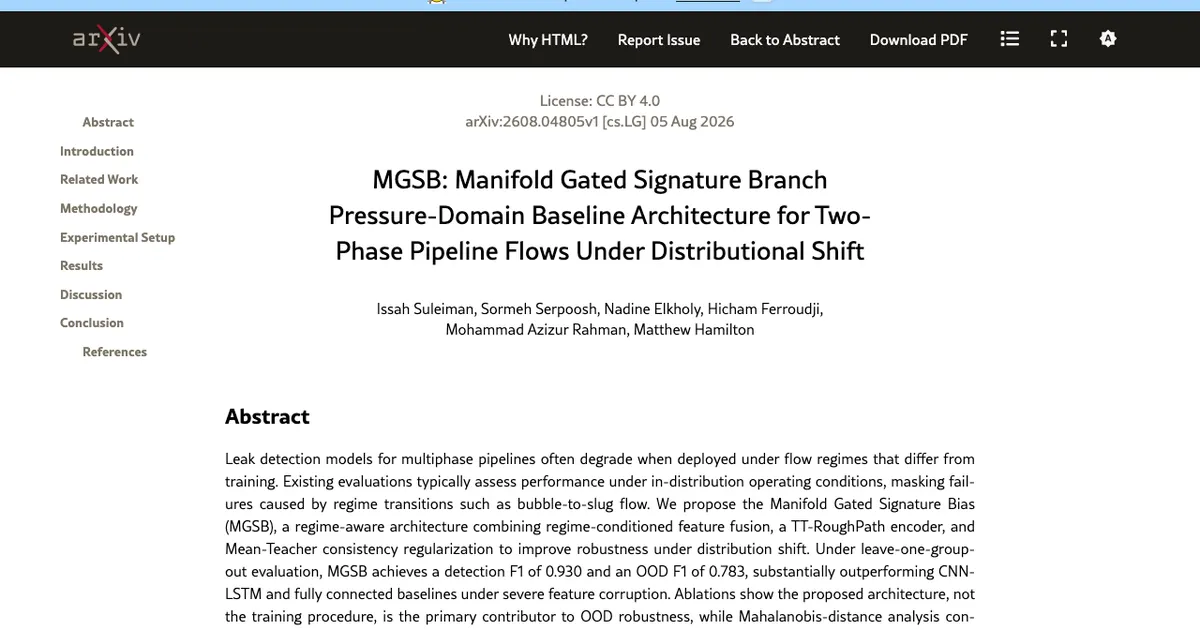
MGSB: Manifold Gated Signature Branch Pressure-Domain Baseline Architecture for Two-Phase Pipeline Flows Under Distributional Shift

By Issah Suleiman, Sormeh Serpoosh, Nadine Elkholy, Hicham Ferroudji, Mohammad Azizur Rahman, Matthew HamiltonarXivImportance: 92/100
Hero Image for 2608.04805

🌊 Pipelines of the Future: Revolutionizing Leak Detection with Regime-Aware AI

Are industrial pipelines prone to leaks? Yes. But simply detecting a leak isn’t enough—modern infrastructure needs systems that work flawlessly even when faced with drastically changing operational conditions, or ‘distribution shifts.’ If your model was trained only on ideal data, it will fail spectacularly the moment real-world physics kick in.

This groundbreaking new research introduces MGSB (Manifold Gated Signature Bias): an advanced AI architecture designed specifically to bring rock-solid reliability to complex multiphase flow leak detection. It’s a major leap beyond simply improving metrics; it’s about ensuring functionality when the system doesn’t behave like its training data.

🤯 The Problem with Current Leak Detectors

The reality of industrial fluid dynamics is messy. A pipeline doesn’t just flow smoothly (single phase). It might transition between bubble-to-slug flow or various complex mixing regimes (multiphase flow). Existing leak detection models often assume the operational data will resemble the training data—a false assumption that leads to disastrous performance drops when real regime transitions occur.

🧠 How MGSB Solves the Problem

MGSB is not just another layer of a neural network. It’s an explicitly regime-aware system. Its architecture combines several cutting-edge ML techniques:

  • Regime-Conditioned Feature Fusion: The model dynamically recognizes which flow state (or ‘regime’) the pipeline is in, adjusting its feature analysis accordingly.
  • TT-RoughPath Encoder: This specialized encoder handles the inherent complexity and non-linear nature of real-world fluid measurements with exceptional precision.
  • Mean-Teacher Regularization: By forcing consistency between predictions, MGSB dramatically improves robustness when facing data far outside its comfort zone (Out-of-Distribution or OOD).

By combining these elements, MGSB achieves unprecedented stability, proving it can maintain high detection accuracy even under severe feature corruption and challenging operational regimes.

📈 Performance Highlights & Impact

The results are compelling. In rigorous leave-one-group-out (LOO) evaluations—which simulate the model being tested on entirely unseen flow types—MGSB achieved an F1 score of 0.930. More critically, its OOD performance stabilized at 0.783, far surpassing traditional baselines like CNN-LSTM.

This isn’t incremental improvement; it is a paradigm shift toward sensor-agnostic and highly robust leak detection, making complex industrial monitoring feasible in diverse, unpredictable environments. This has massive implications for sectors like energy, water treatment, and chemical processing.

🔗 Want to dive into the technical details? Check out the full paper here: MGSB Paper Link

Keywords: #AI #MLResearch #IndustrialIoT #MultiphaseFlow #LeakDetection #DigitalTwin

OctoLong: Mid-Training On Cross-Repository Code Contexts Enhances Long-Context Modeling

By Indraneil Paul, Falko Helm, Goran Glavaš, Iryna GurevycharXivImportance: 90/100

Code LLMs Are Getting a Mega Upgrade: Introducing OctoLong

Are you building next-generation AI agents? Do your models struggle when the context spans thousands of lines across multiple files? If so, this breakthrough paper is for you. We’re diving into OctoLong, a groundbreaking approach to solving one of the biggest bottlenecks in large language model (LLM) development: maintaining state and coherence over massive, structured codebases.

🚀 The Challenge with Long-Context AI

We all know LLMs are powerful, and increasing context length has been the gold standard. But current methods relying on simple text concatenation often hit a wall when dealing with real-world software development. Existing long-context data tends to be clean books or academic papers—not messy, interconnected code. Code, by its very nature, is recursive and highly dependent; knowing one file requires understanding dozens of others.

💡 What Exactly Is OctoLong?

OctoLong isn’t just another dataset; it’s a sophisticated context engineering pipeline. The researchers instrumented powerful developer tools—including AST parsers, language server backends, and package managers—to do something incredibly hard: recursively retrieve deep code dependencies. This process allows them to curate dependency-rich code contexts containing millions of tokens that mimic the complexity of real enterprise repositories.

In simple terms: They went beyond just pasting files together. They taught the model how software structures are connected, creating a super-context tailored for professional coding tasks.

📊 The Impact: Why This Matters to Devs and AI Engineers

The authors trained a suite of models (OctoLong-Instruct) using this novel data stream. Their results are dramatic:

  • 🔥 Long-Range Retrieval: OctoLong significantly boosts the model’s ability to find relevant information deep within complex, multi-file codebases.
  • 🧠 State Tracking: It dramatically improves long-term state tracking—crucial for agents that need to maintain context over hours of interaction or task execution.
  • 🛠️ Repository Understanding: The resulting models show a profound understanding of entire software repositories, moving beyond isolated file completion. This is the difference between completing a function and restructuring a microservice.

Experimental evaluations against 18 leading open-weight LMs showed that replacing just 12% of traditional context data with OctoLong material yielded substantial gains across agentic tasks and general code understanding.

🌎 Optimized for Developers (SEO/GEO Focus)

Whether you’re building complex AI tools in the Silicon Valley ecosystem, optimizing backend microservices in London, or developing enterprise SaaS solutions anywhere globally, your LLM needs this level of contextual intelligence. This research pushes the frontier of AI software development and MLOps.

Want to dive deeper into the technical details? Check out the full paper: [https://arxiv.org/abs/2608.05141]


This post is tailored for ML Engineers, AI Researchers, and Backend Developers interested in advanced LLM architecture.

Stable Density Ridges: Consistency and Convergence of Subspace Constrained Mean Shift

By Wanli QiaoarXivImportance: 90/100
Hero Image for 2608.05112

🚀 Deep Dive: Beyond Density Ridges – Why Your Data Analysis Needs a Stable Theory

Ever faced a data analysis project where your initial results felt almost right, but something key was missing? In the high-dimensional world of modern data science—from medical imaging to genomics—extracting meaningful patterns is tough. The traditional method, Subspace Constrained Mean Shift (SCMS), aims to pinpoint these ‘density ridges’: low-dimensional structures that capture the true flow and shape of your complex data.

But here’s the catch: the existing theory might be wrong.

Our latest research challenges a decades-old assumption in nonparametric statistics. The foundational idea was that SCMS always converges to a simple, static ‘classical density ridge.’ Our deep dive reveals this is generally false. Why? Because it ignores the crucial dynamics—specifically, how the relevant feature space rotates as your algorithm progresses.

💡 Meet the Stable Ridge: A New Paradigm in Data Topology.

We introduce the ‘stable ridge,’ a novel theoretical construct rooted in dynamical systems theory and Jacobian matrices. Unlike the static assumption, the stable ridge accounts for the continuous flow and rotation inherent to high-dimensional data manifolds. This isn’t just an adjustment; it’s a fundamental shift in how we model density structures.

Our work doesn’t stop at definition. We provide rigorous mathematical proofs that:**

  1. True Convergence Target: The stable ridge is the actual, theoretical destination of the SCMS algorithm.
  2. Robust Framework: We establish a generalized SCMS framework with constant step size, proving its uniform R-linear convergence and topological surjectivity onto this stable target.
  3. Efficiency Boost: Critically, we resolve major computational bottlenecks. The original SCMS suffered from polynomial-time complexity due to an implicit coupling of step size and bandwidth. Our novel approach delivers a statistically consistent, significantly more efficient solution.

🧠 What does this mean for ML practitioners?

If you rely on density ridge estimation, this research is mandatory reading. It provides: * Increased Reliability: A theoretically sound method that handles complex data dynamics accurately. * Scalability: An algorithm with improved computational complexity makes it viable for massive real-world datasets. * Deeper Understanding: A clearer, mathematically rigorous picture of the geometry underlying high-dimensional data structures.

Read the full technical paper to explore the mathematical foundations and practical implications: [https://arxiv.org/abs/2608.05112]

#DataScience #MLResearch #Topology #DimensionalityReduction #Statistics


P.S. This level of theoretical improvement is critical for next-generation ML models that rely on accurate geometric interpretation of data.

Representational separation between unitary and channel quantum generative models via shared classical randomness at shallow depth

By Arunava Majumder, Marius Krumm, Hendrik Poulsen Nautrup, Hans J. BriegelarXivImportance: 90/100

⚛️ Quantum Generative AI Breakthrough: Bridging the Gap Between Theory and Hardware

Hey tech enthusiasts and ML researchers! Ever wonder how far we are from generating complex data using quantum computers? The gap between theoretical quantum power and current hardware limitations is massive. Our latest paper tackles a fundamental question in quantum machine learning (QML): Can shallow, noisy circuits actually generate the rich distributions needed for real-world AI?

In their work, ‘Representational separation between unitary and channel quantum generative models via shared classical randomness at shallow depth,’ authors Majumder et al. tackle this head-on. They provide a crucial theoretical breakthrough demonstrating that merely adding shared classical randomness to shallow quantum circuits drastically expands the model’s power.

💡 The Core Problem: Depth vs. Power

The current generation of quantum hardware (NISQ era) is characterized by limited circuit depth and local connectivity—meaning qubits can only interact with their immediate neighbors. This severely restricts the complexity of models that can be trained quickly, especially when trying to model complex data like images or language.

Purely unitary shallow circuits are constrained: they are beautiful mathematical concepts, but in practice, they often lack the capacity to generate the long-range correlations found in real-world data structures. They get trapped by their own limitations when depth is small.

✨ The Solution: Injecting Controlled Randomness

The authors show that by augmenting these limited unitary circuits with spatially separated local Pauli operations (simple, local gates) whose joint action is controlled by a single classically sampled random bit, the system gains immense representational power. This shared classical randomness acts like an ‘express lane’ for complexity.

Why does this matter? * Scalability Proof: They prove that this simple resource (shared classical randomness) establishes a strict, scalable separation between the full channel model and its purely unitary counterpart at fixed shallow depth. This moves the discussion beyond small toy models to potentially large-scale systems. * Long-Range Correlations: The resulting quantum generative model can generate complex, non-local correlations in its classical output distribution—specifically, long-range dependencies. Purely shallow, local unitary circuits struggle immensely (potentially requiring exponential depth $\Omega(N)$) to replicate these patterns. * Hardware Implementation: Crucially, they demonstrate that this required shared classical randomness can be naturally implemented using Measurement-Based Quantum Computation (MBQC), which is a natural fit for modern quantum hardware architectures.

🎯 The ML Takeaway: Rethinking Constraints

The key message for AI development is clear: When designing shallow-depth quantum generative models for near-term devices, we cannot assume that simple unitary evolution is sufficient. We must account for the practical ability to introduce controlled classical noise and measurement randomness if we want models capable of capturing real-world complexity.

This research provides a foundational benchmark, helping researchers shift focus from simply building deeper circuits to understanding which types of structured randomness are necessary to boost generative capacity while respecting hardware depth limits.

🔗 Read the full paper and explore the math: https://arxiv.org/abs/2608.05110


This breakthrough is foundational for advancing Quantum Machine Learning (QML) models deployed on limited, near-term quantum hardware.

SpecRoll: Fast-Slow Verifier-Feedback Adaptation for Speculative Reinforcement Learning Rollouts

By Nhat Minh Pham, Duy Tung Doan, Thi Duyen Ngo, Vinh Van Nguyen, Khac-Hoai Nam BuiarXivImportance: 90/100
Hero Image for 2608.04962

🚀 SpecRoll: The Turbocharger for Reinforcement Learning Rollouts

Does fine-tuning a large language model (LLM) make it smarter? Yes. But the process of actually generating responses—the ‘rollout generation’ part—is notoriously slow, bottlenecking state-of-the-art AI development.

Traditional methods like speculative decoding help speed up text generation by predicting multiple tokens ahead and verifying them quickly. However, when you combine this technique with advanced RL fine-tuning (like GRPO), things get complicated. The target model’s behavior is always shifting, meaning static prediction heads become stale, and constantly updating the predictors adds massive overhead.

Researchers tackling this challenge introduced SpecRoll – a novel speculative rollout engine designed to breathe life into expensive RL training pipelines without sacrificing accuracy or stability. This isn’t just another patch; it’s an architectural refinement for speeding up the training process itself.

🧠 How SpecRoll Works: Two Paths to Speed

SpecRoll is brilliant because it tackles the dynamism of the target policy using two distinct, complementary adaptation paths:

  1. The Fast Path (Reflex Module): This path provides rapid, localized corrections. It utilizes delayed verifier feedback to perform bounded, trajectory-local hidden-state fixes. Crucially, these adjustments happen without needing a full backpropagation step—making it incredibly fast and lightweight.
  2. The Slow Path: To handle sustained, systemic changes in the model (like concept drift), SpecRoll implements a complementary slow path. This mechanism updates the prediction head parameters only when the system detects significant performance degradation, ensuring the predictions remain accurate without incurring constant update costs.

By combining these two mechanisms with sophisticated, concurrency-aware sparse-tree verification and exact target validation, SpecRoll achieves phenomenal speedups while maintaining the integrity of the original RL objective (GRPO).

📈 The Impact: State-of-the-Art Speed Gains

The results are impressive. Across models ranging from 1.5B to 14B parameters and evaluated on complex mathematical reasoning tasks, SpecRoll delivers:

  • Generation Speedup: $1.26 ext{x}$ to $2.15 ext{x}$
  • End-to-End Speedup: $1.21 ext{x}$ to $2.04 ext{x}$

Crucially, it outperforms existing methods like FastGRPO in both generation and end-to-end time across all tested settings, providing a consistent average pairwise gain of $1.18 ext{x}$. This means RL fine-tuning cycles can run significantly faster, making advanced LLM development more accessible and efficient.

Read the full paper here: SpecRoll: Fast-Slow Verifier-Feedback Adaptation for Speculative Reinforcement Learning Rollouts

If you’re involved in ML engineering, LLM optimization, or large-scale RL research, this paper is a must-read.

Robust Control under Stationary Ambiguity

By Konrad J. Mueller, Amira Akkari, Ben Wood, Lukas GononarXivImportance: 90/100
Hero Image for 2608.04832

💡 Beyond Simulation: Keeping Your AI Robust When the World Changes

(A Deep Dive into Stationary Ambiguity in Control Systems)

As ML systems become mission-critical—whether they’re trading derivatives, managing robotics, or optimizing industrial processes—the gap between simulation and reality (Sim2Real) is perhaps the biggest hurdle. But merely closing that gap isn’t enough. What happens when the ‘reality’ keeps changing over time?

The pioneering work in deep reinforcement learning often assumes that once a system has learned to cope with initial uncertainty, it can specialize and rely solely on its local knowledge of the environment. However, this assumption fails in real-world applications like financial markets or unstable physical systems. The ‘ambiguity’ (the unknown underlying parameters) is expected to shift continually, meaning your policy must remain fundamentally robust throughout its lifetime.

🤖 The Core Problem: Decay and Specialization

Traditional simulation training addresses initial ambiguity by averaging over possible parameter values ($oldsymbol{x}$). While this gives a degree of initial robustness, the resulting policies tend to ‘forget’ how to handle uncertainty once they accumulate enough data. They specialize too quickly. For instance, an AI designed for hedging should maintain its defensive posture even if the market regime (like volatility) shifts radically months later.

✨ The Breakthrough: Stationary Ambiguity

The paper by Mueller et al. tackles this fundamental limitation by proposing a concept called Stationary Ambiguity.

In plain terms, they redesign how simulations are run. Instead of having the uncertainty simply fade away as time passes (systematic decay), the simulator is engineered to constantly inject and vary the ambiguity in the state-dependent process. This forces the trained policy not only to be robust initially but also to maintain that robustness over the entire temporal duration.

This concept formalizes the requirement that the environment’s uncertainty doesn’t just vanish, but rather evolves according to a stable filter process tied to the system’s state—keeping the model constantly ‘on alert.’

🚀 Why This Matters (The Impact)

  1. Finance and Trading: As shown in their experimental focus on derivative hedging, policies trained with stationary ambiguity maintain superior performance when confronted with real-world market shifts that require continuous robustness to latent factors like volatility regimes.
  2. Robotics & Control: Any sequential control problem where the underlying dynamics are expected to drift or shift (e.g., dealing with wear and tear, fluctuating loads) will benefit from this principled approach.
  3. Modeling Principle: Stationary ambiguity isn’t just a technique; it’s a guiding principle for designing realistic simulators. It helps researchers answer critical questions: How should we randomize parameters? Which model updates best mimic continuous real-world uncertainty?

The takeaway? If you are building sophisticated control policies for complex, open-ended systems (like finance or advanced automation), relying on traditional Sim2Real methods might leave you dangerously exposed when the operating conditions shift. Stationary ambiguity offers a mathematically rigorous way to ensure true, sustained resilience.


Read the full technical details here: https://arxiv.org/abs/2608.04832

#ReinforcementLearning #ControlTheory #AIResearch #Simulations #DeepLearning #QuantitativeFinance

Predicting Brain Morphometry with MT-GNN: Mesh Evolution in Continuous Time with Graph-Based Metric Tensor Embeddings

By Hao Ding, Daniel Semchin, Paul M. Thompson, Boris GutmanarXivImportance: 85/100
Hero Image for 2608.05132

Brain Mapping Breakthrough: Predicting Brain Shape Evolution with Graph Networks

Ever wonder how Alzheimer’s Disease or other neurodegenerative conditions might change the structure of your brain over time? Traditional methods for analyzing longitudinal brain scans often struggle to accurately predict these complex, dynamic shape changes. But a breakthrough paper introduces an elegant solution that fundamentally shifts how we model continuous anatomical evolution.

We dive into MT-GNN, a novel framework that doesn’t just guess where the surface should be; it predicts the underlying, intrinsic geometry of the brain structure itself in continuous time. Instead of relying on simple trajectory extrapolation or direct vertex deformation, MT-GNN captures the first fundamental form—the metric tensor—which is the true geometric fingerprint of the surface.

🧠 How Does MT-GNN Work? (The Deep Dive)

At its core, MT-GNN leverages Graph Neural Networks (GNNs) to process complex mesh data. Here’s the magic:

  1. Intrinsic Geometry First: The model predicts the metric tensor for every vertex. This is key because predicting the intrinsic geometry ensures that the resulting shape is mathematically valid and physically realizable as a closed surface.
  2. Time Machine Functionality: By treating time evolution as continuous, the framework can process an arbitrary number of prior scans (a multi-visit history) and predict future states with varying prediction horizons—all within one unified model. This makes it incredibly robust for clinical applications like prognosis.
  3. The As-Rigid-As-Possible Solver: A differentiable solver is used to decode the predicted metric into an actual 3D surface, ensuring geometric consistency at every step. Training on this reconstruction loss keeps the predictions physically valid.

✨ Why Is This a Game Changer? (Results)

Tested on the comprehensive ADNI dataset across 14 subcortical structures, MT-GNN set a new benchmark. The paper reported significantly lower mean vertex error compared to leading techniques like geodesic shape regression (DCM) and mesh Transformers (TransforMesh). Crucially, this superiority was maintained across all tested prediction horizons, indicating remarkable robustness.

For Researchers & Clinicians: This represents a paradigm shift in neuroimaging analysis. It offers clinicians powerful tools for richer prognostic assessments, helping identify patients at high risk before severe structural deterioration is visible. For drug development, it can improve clinical-trial enrichment by providing more accurate biomarkers of progression.

🚀 Conclusion: The Future of Structural Neuroscience

The ability to accurately model continuous brain morphometry opens doors for much deeper biological understanding—from tracking the spread of atrophy to understanding developmental variations. MT-GNN moves us closer to ‘digital twins’ of the human brain, making complex medical research more predictable and actionable.

🔗 Read the Full Paper: https://arxiv.org/abs/2608.05132 #Neuroscience #AI #DeepLearning #BrainImaging

Robust and Efficient Motion Reasoning for Privacy-Aware Classroom Incident Recognition

By Paritosh Parmar, Landy Lan, Hong Yang, Chen Yi, Chiat Pin TayarXivImportance: 85/100
Hero Image for 2608.05115

🚨 AI for Safety: How Motion Reasoning Can Keep Classrooms Safe and Private

Are computer vision systems ready to monitor our schools? The answer is complicated. While powerful, most current models struggle with the immense practical hurdles of real-world deployment—namely, balancing computational efficiency, generalization (out-of-domain robustness), and user privacy.

Our latest research addresses this critical gap head-on. We designed a novel framework that tackles classroom incident recognition from CCTV footage while prioritizing both low latency and strong privacy guarantees. The core insight? Incidents aren’t just about where people are (their pose); they are often defined by how they move—their speed, acceleration, and sudden changes in motion.

🧠 Our Solution: Motion-First Reasoning

The backbone of our method is the construction of hierarchical kinematic representations. Instead of just analyzing static poses (a single frame snapshot), we analyze the entire physical dynamics of human movement. By modeling these hierarchical relationships, we can accurately capture complex behaviors—like a sudden chase or an unusual struggle—that might be missed by simpler models.

To make this system practical for real-world use in crowded settings like schools, we introduced a revolutionary technique: motion knowledge distillation. We train a large, high-capacity model (the ‘teacher’) on comprehensive motion data and then distill the deep, multi-order reasoning skills into a significantly smaller, single-order student model.

The impact? The resulting lightweight framework achieves state-of-the-art performance in motion understanding while consuming drastically less computational power—less than one-tenth of larger baselines! This means rapid inference at the edge, crucial for live safety applications.

📚 Setting a New Standard: Benchmarking Privacy & Generalization

To validate our approach, we didn’t rely on existing datasets. We introduced a novel hybrid benchmark that combines generative CCTV-style videos with authentic real-world classroom pose data. This new dataset is crucial because it specifically addresses the generalization challenges that plague current safety AI.

Our experiments demonstrate superior performance across key metrics: enhanced out-of-domain motion reasoning and strong zero-shot synthetic-to-real generalization. We are committed to making this technology available, and we will be publicly releasing our full benchmark dataset, codebase, and supporting tools!

💡 Key Takeaways for Tech Leaders & Safety Implementers: * Efficiency Wins: Achieve high accuracy with significantly reduced computational overhead. * Privacy First: Designed specifically for constrained real-world use cases. * Robust Dynamics: Focuses on movement dynamics (kinematics), not just static poses. * Future Research: We are releasing the full dataset to accelerate safety AI research globally.

🔗 Read the paper and explore the benchmark here: https://arxiv.org/abs/2608.05115

MarsCast: Transfer Learning of AI Weather Foundation Models to Planetary Atmospheres

By M. L. Carroll, J. Li, S. D. Guzewich, G. Villanueva, J. A. Caraballo-Vega, M. J. FrostarXivImportance: 85/100

🪐 Mars Weather Forecasts? Transferring Earth’s AI Power to Other Planets

The future of deep space exploration depends on real-time environmental data. Can the incredibly complex weather prediction models we use on Earth—the ones that predict hurricane paths and daily temperature swings—actually work on Mars?

A new study, MarsCast, tackles this crucial question by adapting a cutting-edge AI model called GraphCast, originally designed for Earth’s dynamic atmosphere, to simulate Martian atmospheric dynamics. This isn’t just a theory; it’s a tangible step toward supporting future human missions.

🛰️ How Do We Predict Weather on Mars?

The authors found that while GraphCast delivered impressive ‘zero-shot’ predictions—giving surprisingly accurate initial glimpses of Martian conditions—it struggled with the full, complex cycle of life. Specifically, it failed to capture predictable features like diurnal (daily) variability and quickly reverted toward simple average (climatological) states.

This led the team to fine-tune the model using real historical data from Mars, particularly focusing on variables like solar radiation forcing and local atmospheric conditions. The results were remarkable:

  • Rapid Learning: With as few as 10 training epochs, the AI successfully started modeling Martian thermal variability.
  • Full Cycle Capture: The system quickly began accurately capturing the critical diurnal cycle.
  • Long-Term Forecasting: Predictions maintained seasonal and vertical temperature structure for up to 10 days.

These breakthroughs prove that Earth-trained deep learning models can be effectively adapted to simulate atmospheric behavior on alien worlds, opening massive new pathways for space missions.

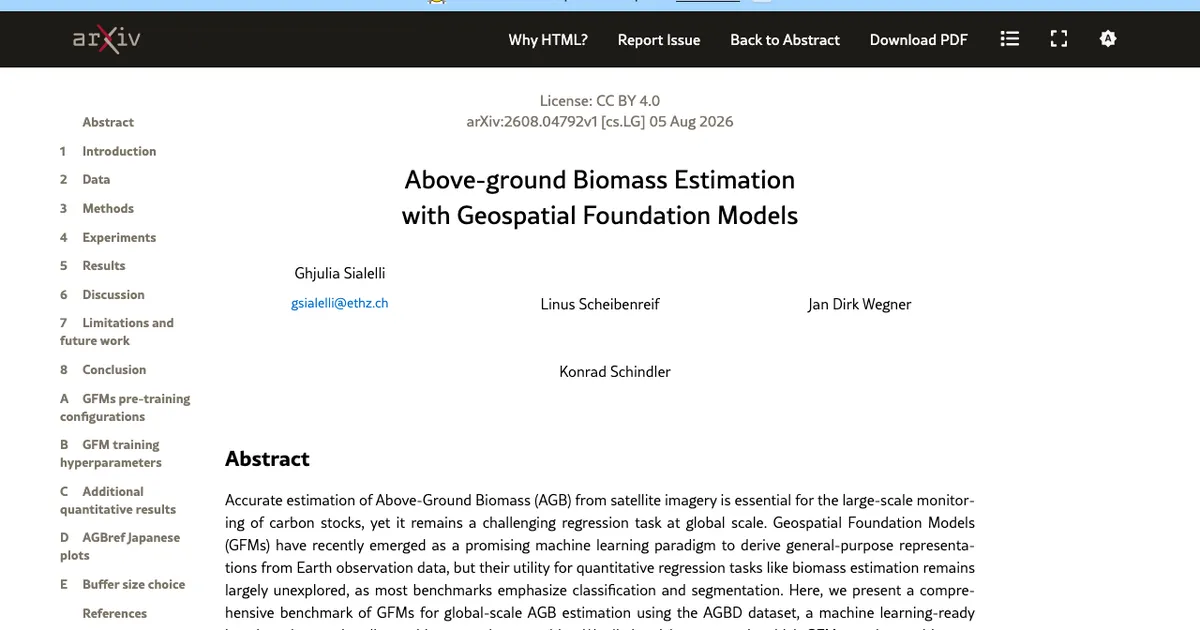
Above-ground Biomass Estimation with Geospatial Foundation Models

By Ghjulia Sialellia, Linus Scheibenreif, Jan Dirk Wegner, Konrad SchindlerarXivImportance: 85/100
Hero Image for 2608.04792

🌿 Turning Satellite Data into Carbon Credits: Why Geospatial Foundation Models Will Revolutionize Biomass Tracking

(A Digest for ClimateTech Enthusiasts & ML Engineers)

Carbon sequestration monitoring is critical to the fight against climate change. To make accurate global carbon models, we need one crucial metric: Above-Ground Biomass (AGB)—the total mass of living plants above ground. Traditionally, estimating AGB from satellite imagery has been a monumental challenge. It’s complex, highly variable, and demands massive computational power.

Enter Geospatial Foundation Models (GFMs). These are the next generation of AI models designed to digest vast amounts of Earth observation data, offering general-purpose representations that could be as powerful as Large Language Models (LLMs) are for text.

The new research by Sialellia et al., titled ‘Above-ground Biomass Estimation with Geospatial Foundation Models,’ dives deep into how effective these GFMs truly are for quantitative tasks like biomass estimation. They provide a comprehensive, real-world benchmark using the specialized AGBD dataset.

🚀 Key Findings & What It Means For Climate Tech

The authors tested multiple ways to deploy GFMs (running weights vs. pre-computed embeddings) and compared them against established supervised state-of-the-art (SOTA) models. The results deliver a clear verdict:

  • Weights Are Hard: Running GFMs as frozen encoders underperform significantly compared to specialized SOTA models.
  • Embeddings Win Big: Pre-computed embedding products, such as AlphaEarth Foundations (AEF), prove highly effective. A simple Multi-Layer Perceptron (MLP) trained on AEF embeddings can outperform the dedicated supervised model in some scenarios.
  • The Best of Both Worlds: The most robust approach is to use a SOTA model that is specifically trained using these powerful GFM embeddings, offering superior performance and critically, better generalization across space and time.

🌐 Why This Matters: From Pixels to Policy

This paper doesn’t just improve an ML benchmark; it points toward a new paradigm for how we quantify the global carbon cycle.

  1. Scalability: By leveraging standardized, general-purpose embeddings (like those from AEF), researchers can build models that are both powerful and adaptable to vastly diverse geographies and biomes—a necessity for true global monitoring.
  2. Efficiency: Pre-computed embedding products simplify deployment. Instead of needing massive GPU clusters to run complex Foundation Models on the fly, users can consume readily available, optimized inputs, speeding up research and practical application in climate initiatives.
  3. Industry Impact: For carbon credit markets, large ecological surveys, or forestry management, this means a path toward more reliable, consistently scaled, and cost-effective AGB estimation, accelerating actionable insights for policymakers and industry stakeholders.

🔗 Want to dive deeper into the methodology and results? Check out the full paper here: [https://arxiv.org/abs/2608.04792]


Disclaimer: This is a technical digest aimed at data scientists, climate researchers, and geospatial intelligence practitioners.

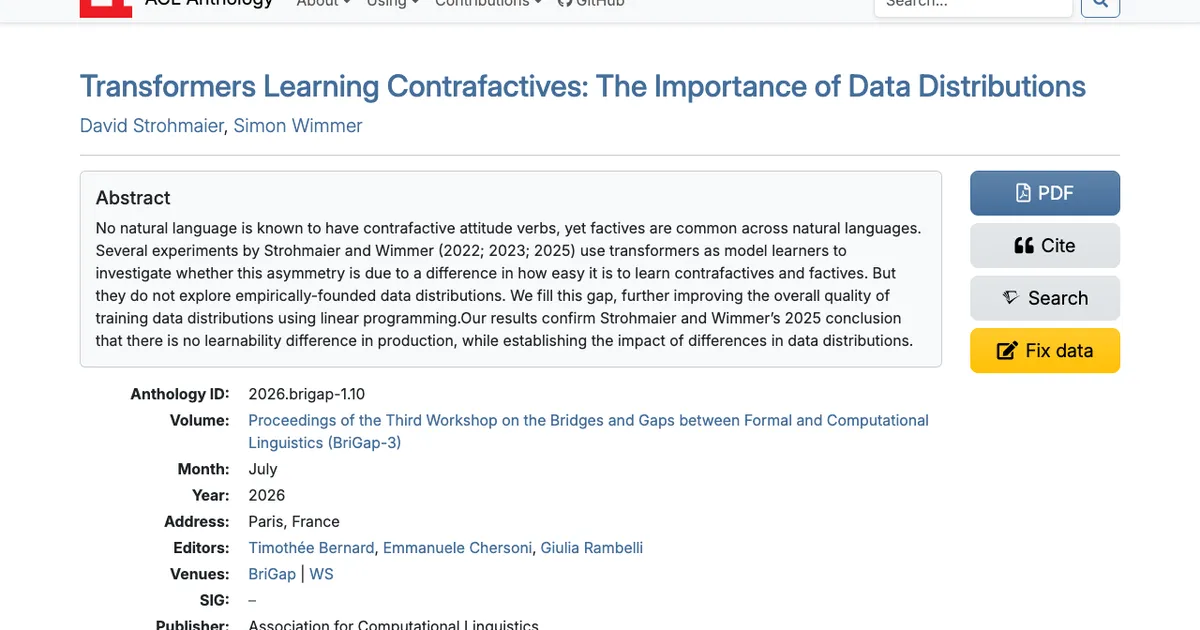
Transformers Learning Contrafactives: The Importance of Data Distributions

By David Strohmaier and Simon Wimmer in Proceedings of the Third Workshop on the Bridges and Gaps between Formal and Computational Linguistics (BriGap-3)ACL AnthologyImportance: 85/100
Hero Image for acl_2026.brigap-1.10

Are Transformers Biased? Why Your Language Models Might Be Missing Context

The ability of AI to generate fluent text has made Large Language Models (LLMs) indispensable. But how ‘real’ is the language they speak? Our latest research dives deep into the subtle yet crucial differences between factive and contrafactive language—a linguistic asymmetry that deeply affects how these models understand reality.

For years, researchers observed a pattern: while natural human languages are full of ‘factives’ (statements describing what is), they seem to lack corresponding ‘contrafactives’ (language used to describe what could have been or was imagined).

In our work, we move beyond simply training models. We tackle the fundamental problem that underlies all LLM performance: data quality and distribution. We show how strategically optimizing the dataset using techniques like linear programming can fundamentally improve model learning.

The Gap We Filled: Distribution Matters

Previous studies confirmed that current Transformer architectures don’t show an obvious ‘learnability difference’ between these two linguistic types. However, they largely assumed uniform or pre-existing data distributions.

Our breakthrough is establishing the impact of non-standard data distributions. By treating the training data itself as a flexible resource—and optimizing its balance—we significantly enhance the overall learning capacity and robustness of the models.

Key Takeaway for AI Developers & Linguists:

This isn’t just a theoretical finding. It’s a critical engineering insight: improving LLMs requires more than better algorithms; it demands superior, optimized data curation. By mastering data distributions, we can build next-generation models that capture the full spectrum of human nuance, ensuring they understand not just what is, but also what could be.

🔗 Read the full paper here: Transformers Learning Contrafactives: The Importance of Data Distributions

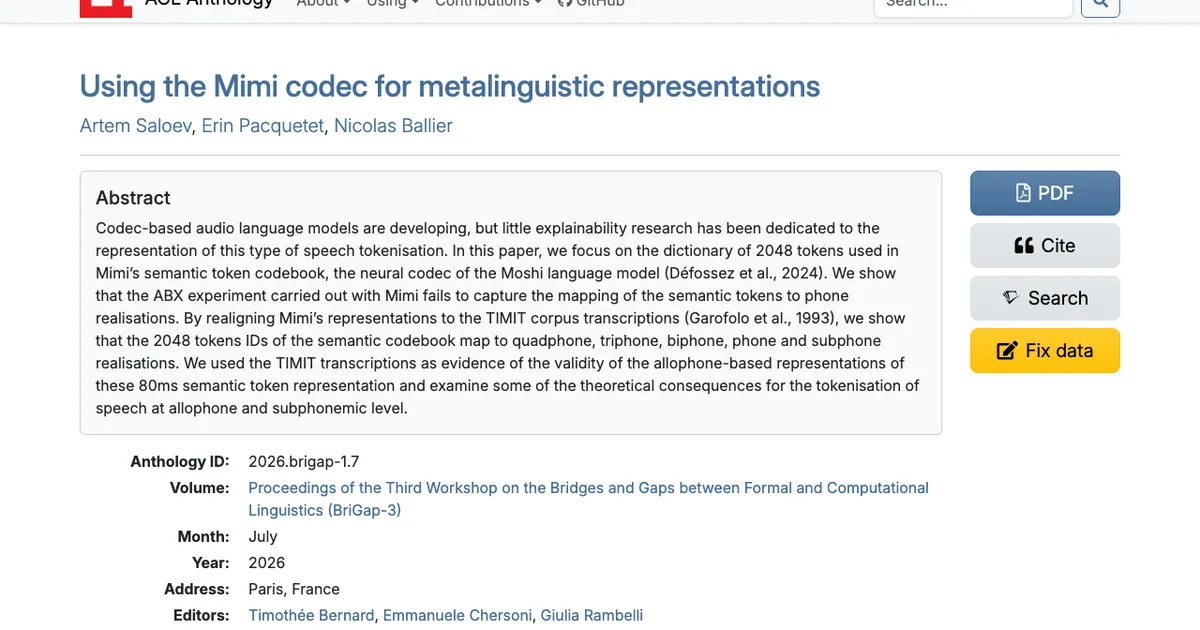
Using the Mimi codec for metalinguistic representations

By Artem Saloev, Erin Pacquetet and Nicolas Ballier in Proceedings of the Third Workshop on the Bridges and Gaps between Formal and Computational Linguistics (BriGap-3)ACL AnthologyImportance: 85/100
Hero Image for acl_2026.brigap-1.7

Decoding Speech: How Codecs are Revolutionizing Language Modeling

In the world of AI, we’re moving past simple text-based models. The next frontier is understanding human speech with unprecedented accuracy. Leading the charge? Codec-based Audio Language Models. These systems don’t just process sound; they break down complex audio into fundamental ‘tokens,’ allowing machines to truly comprehend spoken language at a granular level.

This paper dives deep into the mechanics of one such system: Mimi, the neural codec used in the Moshi language model. The authors tackle a critical gap in AI research: explainability. While these models perform incredibly well, we often don’t know how they represent speech semantically.

🧠 What Problem Did They Solve?

The core issue? Current methods for analyzing how codecs translate high-level semantic tokens into actual spoken sounds (phonemes) are insufficient. The authors found that simple experimental approaches fail to accurately map the abstract, high-level semantic IDs of Mimi’s token codebook to real-world acoustic realizations.

💡 Their Solution: Grounding Speech in Classic Linguistics

To test the boundaries and validity of these state-of-the-art models, the researchers ingeniously realigned Mimi’s internal representations against a gold standard: the TIMIT corpus transcriptions.

The results are profound: By grounding the 2048 semantic tokens using TIMIT’s comprehensive linguistic structure (quadphones, triphones, biphenes, phones, and subphones), they demonstrated that these abstract machine tokens align remarkably well with established allophone-based speech units. This provides vital evidence of both the model’s capability and opens up theoretical avenues for how machines can tokenise speech at an extremely fine, even subphonemic level.

🚀 Why Is This Important For AI?

This work moves Codec-based NLP from a black box into a field of rigorous linguistic analysis. By confirming that advanced neural codecs are capturing the nuanced details of human speech (down to allophones), it validates their potential for next-generation applications like highly accurate voice assistants, real-time multilingual translation, and deeply contextual AI agents.

Want to read the full technical breakdown? Mimi Codec Analysis at BriGap-3


This research is a crucial step toward truly understanding the deep linguistic architecture underpinning advanced speech AI.

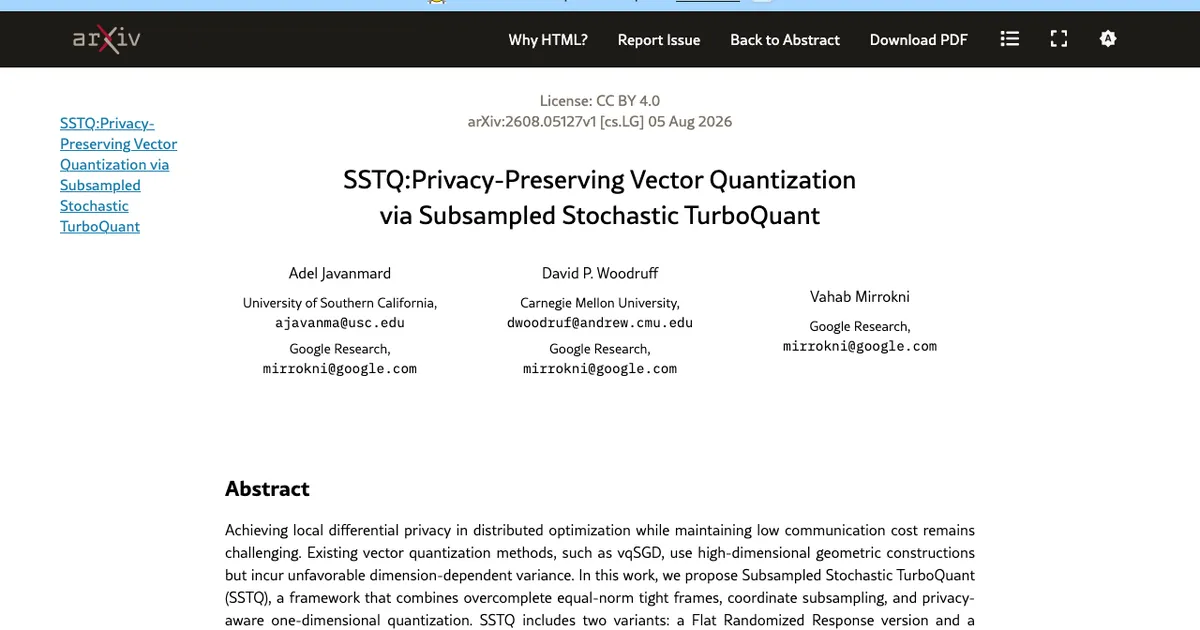
SSTQ:Privacy-Preserving Vector Quantization via Subsampled Stochastic TurboQuant

By Adel Javanmard, David P. Woodruff, Vahab MirrokniarXivImportance: 80/100
Hero Image for 2608.05127

$\text{Privacy Meets Performance: Subsampled Stochastic TurboQuant for Secure AI}$ 🎉

Are you building next-generation ML models using decentralized data? If so, you’ve hit the biggest hurdle in modern AI: balancing rock-solid privacy with state-of-the-art model performance. Standard techniques often force developers to choose between communicating too much sensitive data (high cost) or sacrificing utility (low accuracy).

That ends now.

We’re excited about a new breakthrough that tackles this complex trade-off head-on: Subsampled Stochastic TurboQuant (SSTQ). This cutting-edge technique revolutionizes how we perform Vector Quantization (VQ) in privacy-preserving federated learning settings.

🔑 The Problem SSTQ Solves

The gold standard for data security, Local Differential Privacy (LDP), requires us to process and share aggregated gradients from distributed clients without revealing individual data points. While existing methods like vqSGD achieved this, they struggled with one major issue: dimension-dependent variance. In simple terms? The required computational overhead grew unpredictably as your model got bigger, making the approach unstable for high-dimensional real-world tasks.

💡 How SSTQ Makes It Better (The Tech Deep Dive)

SSTQ is not just an incremental improvement; it’s a methodological overhaul. It masterfully integrates three powerful concepts:

  1. Overcomplete Equal-Norm Tight Frames: These mathematical constructs provide robust representations for complex data, ensuring that information is captured efficiently regardless of the dimension.
  2. Coordinate Subsampling: By intelligently subsampling dimensions, SSTQ drastically reduces the number of bits required while preserving critical signal integrity. This keeps communication costs minimal—a huge win in IoT or remote medical systems.
  3. Privacy-Aware One-Dimensional Quantization: The framework includes specialized variants (like Flat Randomized Response and Metric-Aware Laplace) that maintain LDP guarantees even during the quantization process, offering flexible options for different codebook bit-width needs.

The Results Are Game-Changing: SSTQ achieves optimal Mean Squared Error (MSE) scaling while only requiring $\lceil \log_2 N \rceil + b$ bits per client. Furthermore, it significantly improves the underlying math by reducing the codebook-dependent MSE scaling from $O(4^b)$ down to a far more favorable $O(2^b)$. This mathematical refinement ensures predictable and stable performance even as model capacity grows.

🚀 Why Should You Care? (Practical Impact)

Our empirical tests on industry standards like CIFAR-10 and Fashion-MNIST confirm the superior utility and efficiency of SSTQ against established baselines. For machine learning engineers and researchers focused on federated learning, this means:

  • Guaranteed Privacy: Adherence to rigorous Local Differential Privacy principles.
  • 🚀 Low Communication Cost: Extremely few bits are needed per client ($\ ext{O}( \log N)$ scaling).
  • High Accuracy: Maintains state-of-the-art performance, crucial for real-world deployment.

SSTQ is a major step toward deploying powerful AI models in highly regulated or bandwidth-constrained environments.

[Read the full paper on ArXiv: https://arxiv.org/abs/2608.05127]


#FederatedLearning #PrivacyPreservingAI #VectorQuantization #DeepLearning

BnBERT-iPET: Sparse Few-Shot Language Modeling for Bengali via Lottery Ticket Pruning

By Sajib Hossain, Md Kamrus Samad, Anan Ghosh, Labib Imam Chowdhury, Nabeel MohammedarXivImportance: 80/100
Hero Image for 2608.05104

🚀 Bengali NLP Just Got a Turbocharge: Meeting Resource Constraints with BnBERT-iPET

The Problem: State-of-the-art NLP models—think giants like BERT or XLM-RoBERTa—are incredibly powerful, but they come with massive drawbacks. They require colossal computational resources (expensive hardware, huge energy use) and are notoriously difficult to deploy on edge devices or in resource-constrained environments.

For low-resource languages like Bengali, this is a critical bottleneck. Accessing SOTA performance usually means immense computing power that many academic institutions or developing regions simply don’t have.

The Breakthrough: Meet BnBERT-iPET ✨

Our latest research introduces BnBERT-iPET, a novel sparse few-shot language modeling framework specifically designed for the Bengali language. The core idea is revolutionary: Why keep every single edge (parameter) from a massive BERT model if only a tiny fraction of them are truly necessary?

Inspired by techniques like Lottery Ticket Pruning, BnBERT-iPET dramatically shrinks the model—retaining only about 10% of the original parameters—while maintaining performance that is ‘neck and neck’ with much larger counterparts.

How it Works (The Magic):

  1. Sparse Modeling: Instead of relying on dense, parameter-heavy architectures, BnBERT-iPET uses sparsity, achieving up to 90% pruning. This drastically reduces the model’s memory footprint and required compute power.
  2. Few-Shot Learning: By leveraging iterative pattern exploiting training (few-shot learning), the model efficiently adapts to Bengali tasks using minimal labeled data, accelerating deployment in low-resource settings.
  3. The Result: The resulting lightweight, highly efficient language model is shown to compete robustly with leading benchmarks on challenging Bengali downstream NLP tasks, making advanced AI accessible where it was once deemed too expensive.

Why This Matters (Impact):

This isn’t just an academic tweak; this is a game-changer for digital accessibility in South Asia. By creating efficient, high-performing models tailored for Bengali and other similar resource-constrained languages, BnBERT-iPET democratizes advanced NLP capabilities.

If you are working on AI development, natural language understanding (NLU), or machine translation for Bengal, this paper provides a crucial blueprint for building truly scalable and sustainable solutions.

👉 Read the full details here: https://arxiv.org/abs/2608.05104


🚀 Key Takeaways for Developers & Researchers: * Efficiency Win: Achieve high performance with significantly fewer parameters (90% sparsity). * Language Focus: Direct application and validation on Bengali NLP tasks. * Technique: Combines Lottery Ticket Pruning with Few-Shot Learning for optimal resource efficiency.

Optimizing What Policies Learn From: Recoverability-aware Rollout Intervention Learning

By Zheyuan Zhang, Manqing Mao, Hong Wang, Zhuoer Wang, Samson Koelle, Jie Yuan, Yanjun Lin, James Feng, Nikki Lijing Kuang, Yanfang Ye, Wei NiuarXivImportance: 80/100
Hero Image for 2608.05080

🚀 Stop Wasting LLM Training Budget: Introducing RAIL for Smarter AI Learning

The era of fine-tuning massive Large Language Models (LLMs) is here. Techniques like critic-free group-based reinforcement learning are proving scalable, offering powerful ways to align models post-training. But there’s a hidden bottleneck—we often waste valuable computation by generating equally many ‘rollouts’ for every single task, even when some rollouts offer vastly more useful data than others.

Think of it like studying for an exam: you wouldn’t spend the same amount of time reviewing every chapter regardless of how well you already understand it. AI training needs this kind of intelligence.

💡 Introducing RAIL (Recoverability-Aware Intervention Learning)

A new paper tackles this exact problem head-on. RAIL is a revolutionary, training-time framework designed to make rollout generation adaptive and intelligent. Instead of relying on fixed guesses or just knowing how many rollouts to generate, RAIL learns how to select the absolute best interventions—controlling exactly where and when they should happen.

How Does RAIL Work? 🧠

RAIL models intervention selection as an online contextual-bandit problem. This means it’s not just running pre-set rules; it’s continuously learning in real-time while the core policy is evolving.

It uses a ‘shadow-to-live’ procedure, allowing its controller to refine its understanding of what makes a rollout signal maximally informative, even as the main LLM changes.

Why Should You Care? 🌍 (The Real-World Impact)

  1. Efficiency & Speed: By intelligently prioritizing high-signal rollouts, RAIL drastically improves performance under limited computational budgets—a huge win when training trillion-parameter models.
  2. Smarter Learning Signals: It moves beyond simple counting. It provides a principled way to generate less redundant and more actionable data for RLHF/post-training.
  3. Adaptivity: Unlike older methods, RAIL is built to adapt dynamically as the LLM policy changes, ensuring continuous optimization of the learning process.

🔬 The Bottom Line: The research demonstrates that RAIL consistently improves performance across multiple settings. It shows us how to make the data generation phase of advanced AI alignment significantly more targeted and effective. If you are involved in next-generation RLHF or LLM deployment, RAIL offers a critical architectural upgrade for optimizing your training pipeline.

👉 Read the full details on this breakthrough here: https://arxiv.org/abs/2608.05080

Provable Limits and Certified Deferral for Verbalized Uncertainty in Small Language Models

By Jianru ShenarXivImportance: 80/100
Hero Image for 2608.05064

When Should AI Stop Talking? Proving the Limits of Small Language Models’ Confidence

The age of powerful, multi-billion parameter LLMs is exciting, but it brings a quiet operational challenge: in cost-sensitive, offline settings, how do we know when to trust what an answerable model actually says?

As ‘Small Language Models’ (SLMs) become the standard for edge deployment—from local customer service bots to resource-constrained enterprise tools—the biggest question isn’t what they say, but whether they should even be used at all. This new research tackles that critical reliability hurdle head-on.

🛠️ The Core Problem: Confidently Wrong

The current state of AI often involves models giving high confidence scores for incorrect answers. From a deployment standpoint, this is a massive risk. If your application can’t afford an error (e.g., medical diagnosis support, industrial control), you need more than just a plausible-sounding answer—you need mathematically provable safety.

This groundbreaking paper investigates Verbalized Uncertainty and its utility in facilitating risk-controlled deferral. The authors test eleven instruction-tuned models (ranging from 0.5B to 14B parameters) across challenging datasets like ARC-Challenge and TruthfulQA, running over 25,000 local predictions.

💡 What Did They Find? The Theoretical Limits of Trust

The study didn’t just test models; it established rigorous theoretical boundaries for what model confidence can truly guarantee. Key takeaways include:

  • Calibration is Complex: Simply making a model output confident scores doesn’t mean it’s reliable. Strict mathematical rules govern how well the calibration actually preserves risk coverage and error detection.
  • Temperature Scaling Limits: A common optimization technique (temperature scaling) fails spectacularly when a model’s confidence stays high but its accuracy dips below expectations. The paper demonstrates that this common fix has predictable failure points.
  • The Power of Proof: They introduce specialized statistical procedures, like the Clopper-Pearson procedure, to convert large test sets into finite-sample risk certificates. This is a massive leap toward certified AI autonomy—it means giving you a mathematical guarantee about its safety profile, not just an average performance number.

🚀 The Impact: From Confidence Semantics to Certified Safety

The empirical results confirm that while standard calibration techniques (like Platt scaling) can dramatically reduce error metrics (down to an ECE of 0.02), achieving certified autonomy remains extremely challenging. For example, at a moderate 20% risk budget, only three model-task pairs could be certified as safe, and none were certifiable at a stringent 10% risk budget.

Translation for Developers: If your use case requires high stakes safety (low tolerance for error), you must move beyond merely observing the confidence scores. You need the mathematical framework that dictates exactly when the model is verifiably safe to proceed and, critically, when it must defer back to a human expert.

Learn more about the technical details and the full scope of these provable limits here: [https://arxiv.org/abs/2608.05064]


#AIResearch #MachineLearning #LLMs #DeepLearning #ModelSafety #EdgeAI #ResponsibleAI

WorldCycle: Self-Verifiable Reinforcement Learning for Long-Horizon Video World Models

By Bohai Gu, Yueyang Yuan, Taiyi Wu, Dazhao Du, Jian Liu, Xiaoyi Pang, Jie Zhang, Xiaocheng Lu, Haobin Zhong, Xiaotong Zhao, Alan Zhao, Song GuoarXivImportance: 80/100
Hero Image for 2608.04964

🔄 WorldCycle: Making AI Plan in the Real World

Tired of Video Game NPCs that forget what happened five minutes ago? So are we.

Building AI world models capable of planning over long periods—like self-driving cars, complex robotics, or even deep video game exploration—is notoriously hard. These models suffer from ‘compounding errors’: the slightest error in predicting a frame leads to massive divergence later on. This issue makes them unreliable for real-world tasks.

The existing solutions try to fix this post-training using Reinforcement Learning (RL), but they hit a fundamental roadblock: how do you train something to be correct across an infinite number of future steps when you don’t have ground truth for those steps? It’s like trying to test a supercomputer without ever powering it off.

💡 The Breakthrough Insight: Closed Loops are Gold

Our key breakthrough, introduced in the WorldCycle framework, sidesteps this verification problem entirely. Instead of relying on arbitrary future states, we exploit simple physics principles: reversibility.

If you take an action sequence (A) and then execute its exact inverse ($ ext{A}^{-1}$), you must return to your starting point. WorldCycle formalizes this by constructing closed action cycles and optimizing two novel rewards:

  1. Spatial Closure Reward: Forces the model’s predicted start state of $ ext{A}^{-1}$ to match the end state of A (symmetry).
  2. Temporal Consistency Reward: Ensures that states remain consistent when repeating a cycle multiple times.

By making the model learn actions as consistent operators rather than just memorized patterns, WorldCycle significantly boosts the robustness and physical groundedness of long-horizon world models.

🌍 Why Does This Matter? The ability to maintain state accuracy over extended periods is the ‘Holy Grail’ of embodied AI. WorldCycle provides a vital foundation for reliable applications: * Robotics: Planning complex, multi-step tasks that require accurate state tracking. * Autonomous Systems: Ensuring consistency during long-range missions (e.g., drone surveying). * Game AI: Creating believable characters with persistent memory and planning capacity.

We benchmark our results using CycleBench, showing up to a 44% reduction in state-returning drift and nearly 4x improvement in composite-action accuracy over baseline methods. This brings us closer to physically grounded, reliable world models that can handle the complexity of the real world WorldCycle paper.

Interested in the technical deep dive? Check out the full details here: https://arxiv.org/abs/2608.04964

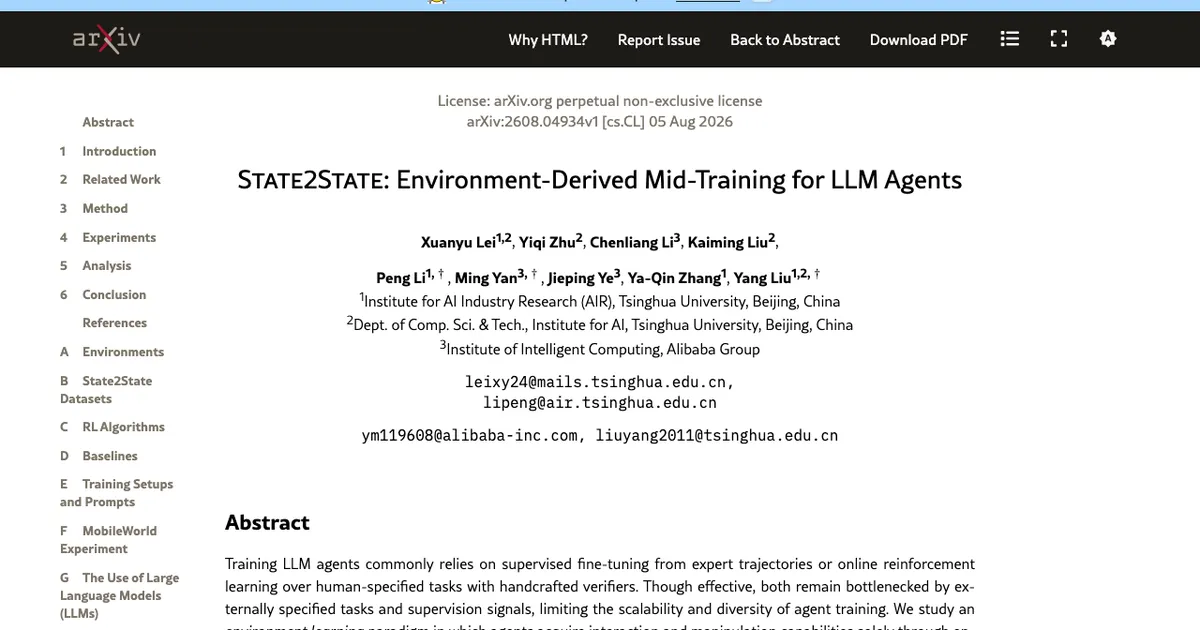
State2State: Environment-Derived Mid-Training for LLM Agents

By Xuanyu Lei, Yiqi Zhu, Chenliang Li, Kaiming Liu, Peng Li, Ming Yan, Jieping Ye, Ya-Qin Zhang, Yang LiuarXivImportance: 80/100
Hero Image for 2608.04934

State2State: How Agents Learn by Simply Existing in the World 🌎

The Problem with Training AI Agents Today

The current state of training sophisticated LLM agents is facing a major bottleneck. To make an agent good at something, we typically have two painful options: either collect tons of expert demonstrations (Supervised Fine-Tuning) or manually craft complex reward functions and tasks (Reinforcement Learning). Both methods require human intervention—defining the task, creating verifiers, or gathering perfect examples. This severely limits what we can train agents to do, making them brittle and difficult to scale.

Introducing State2State: Learning Through Exploration

Our research introduces a revolutionary paradigm shift: letting the environment define the tasks. Instead of humans telling the agent “, ” go get object X,”:{“, (we let the agent wander and interact naturally. We proposed State2State, an innovative mid-training method that harnesses every interaction the agent has with its world. Essentially, State2State converts observed pairs of environment states into specific learning objectives: ‘Given we were in State A, can we get to target State B?’

This approach is game-changing because it eliminates the need for expert supervision, manual task design, or brittle reward functions entirely. The agent learns simply by maximizing its successful completion rate across all naturally explored state transitions.

🔬 Key Breakthroughs and Why It Matters:

  • Autonomous Task Generation: State2State autonomously generates tasks simply by observing the environment’s states (e.g., ‘If I open this drawer, can I reach the spoon inside?’). This makes training vastly more scalable and diverse.
  • Verifiable Objectives: Success is measured reliably using simple rule-based state matching, ensuring objective performance tracking without complex human oversight.
  • Testing on challenging simulated worlds like ALFWorld and ScienceWorld proves that incorporating State2State as an early learning stage significantly boosts agent capability. It acts as a powerful pre-training booster, improving final performance in downstream tasks and showing promising cross-environment generalization.

🚀 Conclusion: A Leap Toward General AI

The research suggests a path toward truly generalized AI agents—systems that can learn complex skills simply by interacting with novel environments, much like how humans learn through play. This moves us away from hand-coded limitations and towards true environmental understanding.

Ready to read the full details? Check out the paper here: [https://arxiv.org/abs/2608.04934]


🔗 Dive Deeper: * https://arxiv.org/abs/2608.04934 (https://arxiv.org/abs/2608.04934)

#LLM #AIResearch #MachineLearning #Robotics #State2State #AgenticAI

(Disclaimer: This is a digest post based on academic findings and should be used for informational purposes.)

(SEO Focus: Agent training, environment learning, LLM agents, reinforcement learning)

—“:”

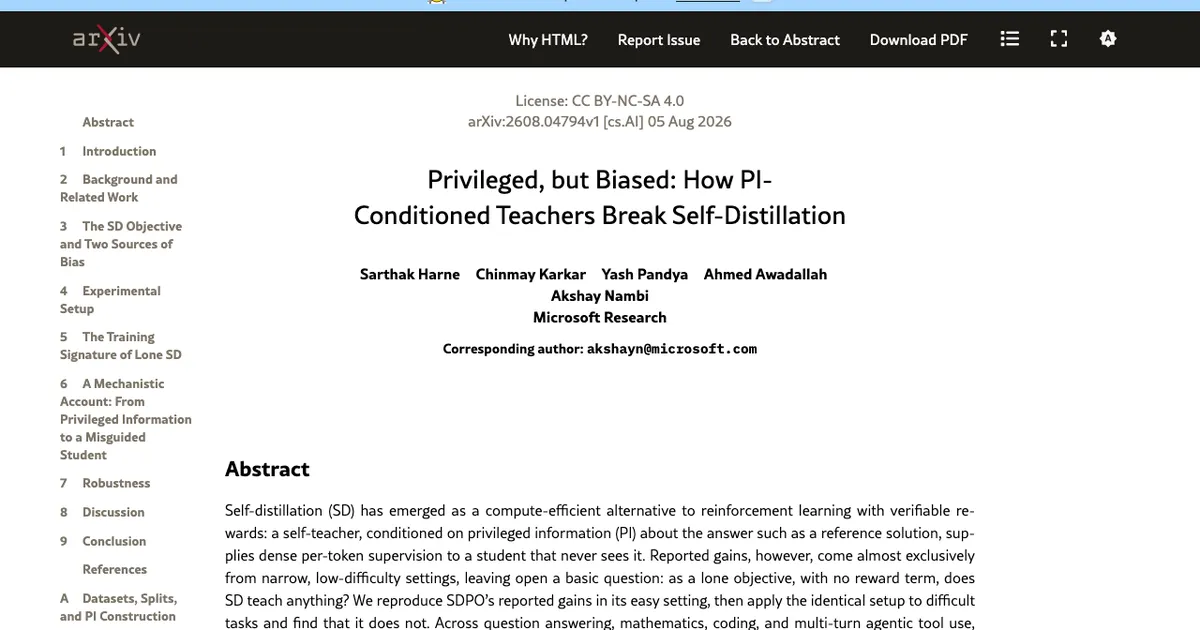
Privileged, but Biased: How PI-Conditioned Teachers Break Self-Distillation

By Sarthak Harne, Chinmay Karkar, Yash Pandya, Ahmed Awadallah, Akshay NambiarXivImportance: 80/100
Hero Image for 2608.04794

⚠️ Warning: Self-Distillation Might Be Overhyped. New Study Reveals a Fundamental Flaw in AI Training.

If you’ve been following the cutting edge of LLM training, you’ve heard whispers about Self-Distillation (SD). It sounds brilliant: using an advanced model to train a smaller one with high efficiency, skipping the complexity and cost of RL.

But what if that supposedly ‘easy win’ method is fundamentally flawed? 🧐 A groundbreaking new study published in arXiv challenges the core assumptions behind SD, suggesting that focusing solely on per-token loss can lead to models that look accurate but actually lack robust reasoning ability.

🧠 What Exactly Is Self-Distillation (SD)?

In simple terms, SD uses a ‘Teacher’ model and passes its detailed outputs (like reference solutions or token-by-token guidance) directly to a ‘Student’ model. Instead of requiring massive rewards from the environment (like in Reinforcement Learning), the student learns by minimizing the difference between its own predictions and the teacher’s perfect, step-by-step guide. It’s compute-efficient and seems like a powerful alternative for tackling complex AI tasks like QA, math, and coding.

🔬 The Study’s Big Claim: ‘Privileged Bias’

The research finds that while Self-Distillation shows promising gains on easy test settings (like the SDPO recipes), its effectiveness completely collapses when tested on genuinely difficult, real-world problems. Their key finding is that the per-token loss function itself introduces a strong bias—what they call PI Bias (Privileged Information Bias).

Think of it like this: if you train your student model using only the ‘perfect’ example provided by the teacher, it doesn’t learn how to solve problems generally. Instead, it learns to perfectly mimic that one specific path. It becomes highly sensitive and inflexible.

The consequence? The student focuses its energy on minimizing loss in ‘low-information tokens’ (like commas or stopwords) while ignoring the crucial structural changes needed for deep reasoning. When faced with ambiguity or a challenging new problem, the model simply falls back into mimicking predictable patterns rather than engaging in genuine exploratory reasoning.

🚀 Why Does This Matter For ML Developers?

This research isn’t just an academic critique; it fundamentally challenges how we think about training sophisticated AI agents. If SD merely optimizes a signal decoupled from true task success, the resource investment might be chasing a phantom improvement.

  • 🛠️ Agent Design: It suggests that relying solely on token-level matching for complex multi-turn agentic tasks (like using external tools) is insufficient. Models need mechanisms to reward generalized problem-solving and resilience during exploration, not just prediction fidelity.
  • 📈 Training Objectives: Researchers must rethink ‘per-token loss.’ The study advocates moving beyond simple unsupervised losses that treat every token equally; true success requires objective functions that measure task outcome success across varied difficult rollouts.

Takeaway: While Self-Distillation is a useful tool, practitioners should proceed with caution. It appears to be brilliant for optimizing specific structures but fails when general reasoning capacity is required. We need smarter training methods that reward the process of deep thought itself, not just mimicking an ideal guide.

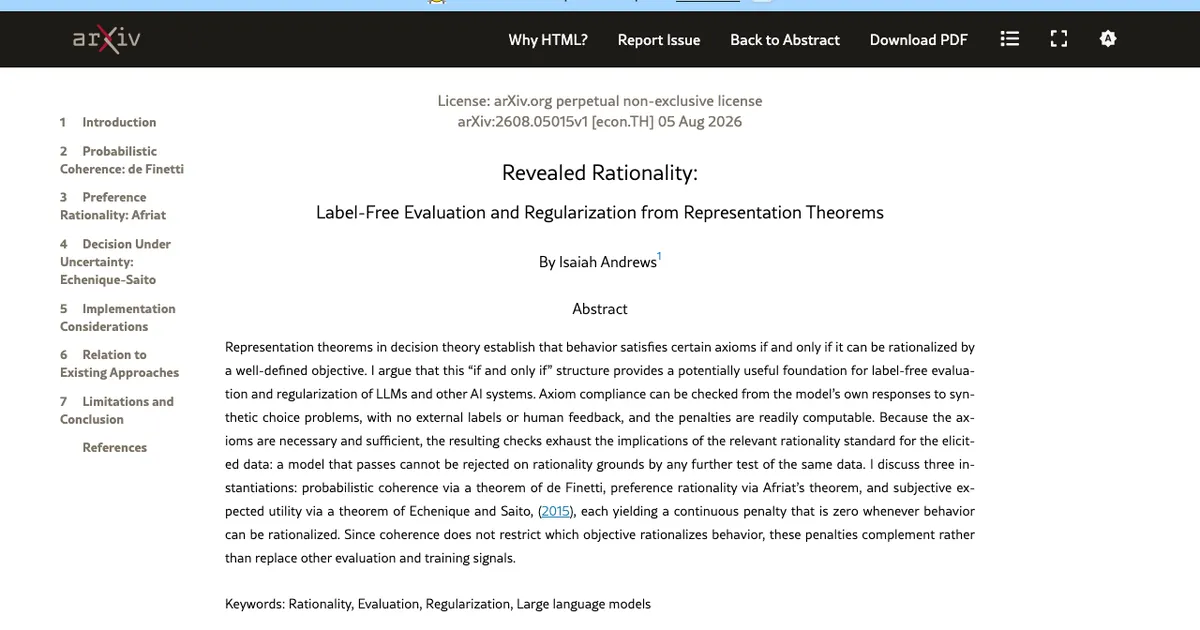
Revealed Rationality: Label-Free Evaluation and Regularization from Representation Theorems

By Isaiah AndrewsarXivImportance: 75/100
Hero Image for 2608.05015

$\text{🧠 DeepDive}$: Rethinking LLM Evaluation with Mathematical Rigor

The current state of AI evaluation often relies on proxies: human preference labels (RLHF), click-through rates, or simple benchmark scores. But what if the ultimate test of an AI model isn’t external scoring, but internal mathematical consistency?

In our latest read from the frontiers of decision theory and machine learning, Isaiah Andrews proposes a paradigm shift: using Representation Theorems to achieve ‘label-free evaluation and regularization’ for LLMs. It’s a highly theoretical concept, but its practical implications could reshape how we build reliable, truly rational AI.

💡 The Core Concept: What is ‘Rationality’ in LLMs?

The foundation of this work lies in decision theory. Representation theorems establish that if a set of observed behaviors satisfies certain strict axioms (like probabilistic coherence or preference rationality), then there must exist a single, underlying objective function (a utility function) that perfectly explains every single choice the model made.

In plain English: If an LLM’s answers are truly rational, they must be derivable from some single, stable internal goal. This work provides a mathematical blueprint to test for that stability.

🔑 How Does This Work? (The Magic of Axioms)

The key breakthrough is the ‘if and only if’ structure inherent in these theorems. Instead of needing external labels or costly human feedback (the biggest bottleneck in RLHF), you check if the model complies with fundamental axioms using its own synthetic choices.

Andrews shows three powerful instantiations: * Probabilistic Coherence: Using de Finetti’s theorem to ensure consistent probabilistic reasoning. * Preference Rationality: Leveraging Afriat’s theorem for stable choice modeling. * Subjective Expected Utility: Tapping into Echenique and Saito (2015) for formalized utility representation.

Each check yields a continuous penalty. If the model’s behavior can be perfectly rationalized by an objective function, the penalty is zero. Non-compliance results in a quantifiable cost, guiding effective regularization during training.

🚀 Why This Matters to ML Researchers & Engineers

  1. Truly Label-Free: It bypasses the limitations of human labeling and subjective feedback entirely. The evaluation signal comes purely from mathematical necessity.
  2. Complementary Signal: These penalties don’t replace RLHF or other signals; they complement them. They ensure that even if an objective is missed, the model’s underlying behavior adheres to core rules of rationality.
  3. Ultimate Consistency Check: Because the theorems are necessary and sufficient, passing these tests means the model is maximally consistent regarding its assumed rational standard—you cannot reject it on those grounds later.

Who should read this? ML researchers focused on robustness, explainability (XAI), foundational AI theory, or advanced alignment techniques.

[Read the full paper for the technical deep dive: https://arxiv.org/abs/2608.05015]


Disclaimer: This digest is based on academic work and requires a solid foundation in decision theory to fully grasp the mechanics.

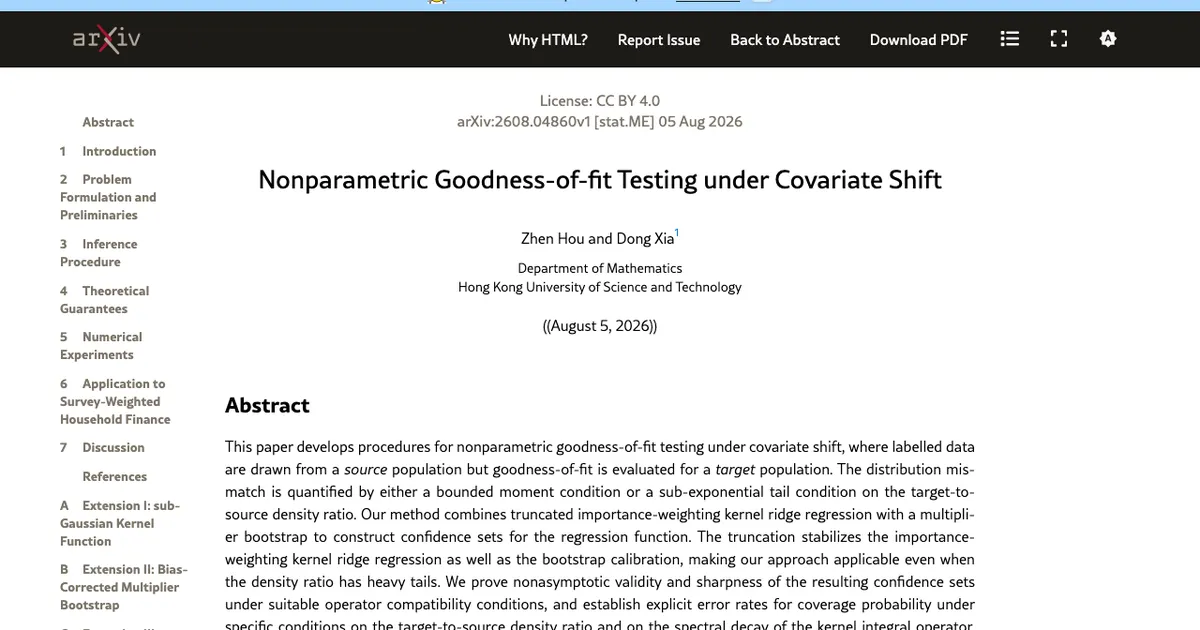
Nonparametric Goodness-of-fit Testing under Covariate Shift

By Zhen Hou, Dong XiaarXivImportance: 75/100
Hero Image for 2608.04860

Is Your Training Data Lying to You? Advanced Testing for Covariate Shift

As an ML practitioner or data scientist, you’ve heard the warnings: ‘Model drift,’ ‘Data shift,’ or ‘Covariate Shift.’ They are perhaps the biggest threats to real-world model performance. Most of your deployed models operate under this exact condition—they were trained on one dataset (the source), but they are deployed and evaluated on a slightly different, live stream of data (the target).

This new research tackles one of the most mathematically thorny problems in applied ML: rigorously testing if your model’s underlying assumptions still hold true when your operational data deviates from your training data. It’s not enough to just observe performance degradation; you need a statistically sound way to prove that distribution mismatch is happening.

The paper, “Nonparametric Goodness-of-fit Testing under Covariate Shift” (Hou & Xia), presents sophisticated methods for this exact problem. Essentially, it develops robust statistical tools to construct precise confidence sets, allowing researchers and engineers to formally quantify the extent of deviation between the training distribution and the live deployment distribution.

🛠️ What’s Under the Hood? The Technical Breakthrough

The core innovation lies in how they handle the density ratio—the mathematical measure of how much more likely a data point is under the target distribution compared to the source. Traditional methods often fail spectacularly when this ratio has heavy tails, leading to unstable estimates and unreliable p-values.

This method introduces truncated importance-weighting kernel ridge regression combined with a powerful multiplier bootstrap. The truncation step is key; it stabilizes the entire process, making the goodness-of-fit test reliable even when the density ratio possesses heavy tails—a scenario that was previously considered a major limitation in the field.

By combining these elements, the authors achieve nonasymptotic validity and sharp error rates for their confidence sets. This means the theoretical bounds are incredibly tight, giving practitioners high confidence in the results they generate.

🚀 Why Should You Care? Real-World Impact

The impact of this work extends across every ML domain: fraud detection, industrial predictive maintenance, natural language processing, and autonomous systems. If your model fails in production, it’s often because the data shifted slightly over time—not because the algorithm is inherently flawed. This paper gives you a rigorous statistical compass to detect why the failure happened.

🔑 Key Takeaways: 1. Robustness: Solves previously intractable problems related to heavy-tailed density ratios, enhancing applicability in messy real-world data streams. 2. Precision: Provides highly accurate and nonasymptotically valid confidence sets for goodness-of-fit testing. 3. ML Debugging: Offers a sophisticated toolkit for systematically debugging model failure due to distribution drift rather than modeling errors.

🔗 Want to dive deep into the mathematics? You can access the full paper here: https://arxiv.org/abs/2608.04860


Disclaimer: This research is highly theoretical and requires advanced statistical knowledge (kernel methods, nonparametric statistics) to fully implement. It represents a significant step forward in theory but should be viewed as an enhancement for the academic toolkit rather than a plug-and-play production library.

Misalignments in Common Ground as a Bridge Between Pragmatic Theory and LLM Evaluation

By Judith Sieker and Sina Zarrieß in Proceedings of the Third Workshop on the Bridges and Gaps between Formal and Computational Linguistics (BriGap-3)ACL AnthologyImportance: 75/100
Hero Image for acl_2026.brigap-1.8

The Blind Spots of LLMs: Why ‘Misunderstanding’ is the Key to Better AI

As Large Language Models (LLMs) become more integrated into our daily lives—from professional drafting to personal assistants—we often focus on one metric: how correct and fluent they are. But accuracy alone isn’t enough. Our latest work suggests that the true diagnostic test for advanced AI isn’t flawless responses; it’s how models handle moments of misalignment.

In communication theory, ‘common ground’ refers to the shared understanding between participants—the unspoken context we all agree upon. When this common ground breaks down (a misunderstanding or an incomplete assumption), it’s not a failure; it’s actually a critical diagnostic moment. This breakthrough paper argues that these moments of misalignment should be central to how we evaluate AI.

🧠 Beyond Surface Fluency: Targeting Pragmatic Competence

The gap between what an LLM says and what it understands is massive, and misalignments are the perfect way to test this. This concept moves evaluation beyond simple grammatical correctness (syntax) or factual accuracy (semantics). Instead, we target pragmatic competence—the ability to use language appropriately in a given social context.

By introducing controlled scenarios of mismatched or incomplete understanding, we can force LLMs to engage in the sophisticated ‘repair’ mechanisms that humans use naturally. Can the AI recognize when it’s wrong, and guide the conversation back to shared reality? This offers a powerful new dimension for building truly interactive and robust AI.

🔬 A Bridge Between Theory and Practice

What makes this work so powerful is its dual role:

  1. For LLM Evaluation: It provides practical, challenging benchmarks that test real-world communicative failure modes.
  2. For Linguistics: It offers controlled settings to test deep linguistic theories of common ground, accommodation, and repair—areas that are notoriously difficult to study in messy human interactions.

This dual focus establishes misalignments as a natural ‘bridge’ connecting advanced computational linguistics (LLMs) directly with foundational pragmatic theory. It changes the game for AI researchers who need more than just performance metrics; they need understanding models.

🔗 Read the full paper here: Misalignments in Common Ground: A Bridge Between Pragmatic Theory and LLM Evaluation


#AIResearch #LargeLanguageModels #Pragmatics #NLP #ComputationalLinguistics

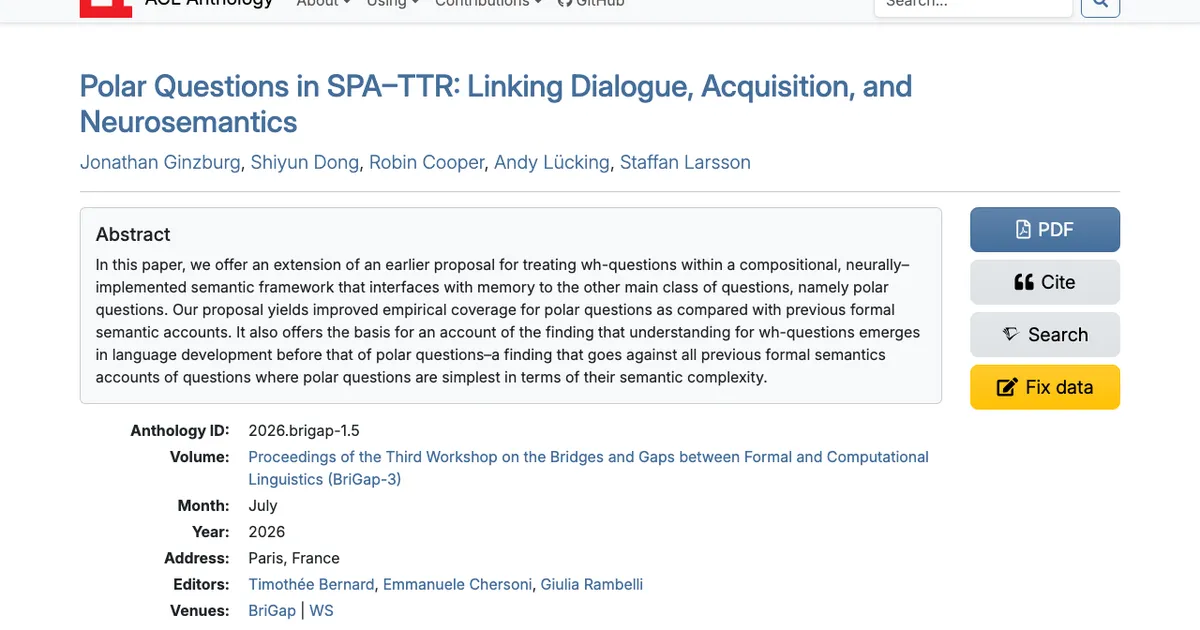
Polar Questions in SPA–TTR: Linking Dialogue, Acquisition, and Neurosemantics

By Jonathan Ginzburg, Shiyun Dong, Robin Cooper, Andy Lücking and Staffan Larsson in Proceedings of the Third Workshop on the Bridges and Gaps between Formal and Computational Linguistics (BriGap-3)ACL AnthologyImportance: 75/100
Hero Image for acl_2026.brigap-1.5

Rethinking Questions: How Polar Statements Shape Language Acquisition

Hey ML Engineers and NLP Researchers! Tired of models that understand ‘what’ questions but stumble on simple yes/no queries? You’re not alone. In the complex world of computational linguistics, understanding the nuances of interrogatives is a persistent challenge.

Our latest work tackles this head-on by expanding robust neural semantic frameworks to cover polar questions—those simple ‘yes’ or ‘no’ inquiries.

🧠 The Core Problem: Why are Questions Hard?

Traditionally, research has focused heavily on wh-questions (Who, What, Where?). While crucial, these complex queries often overshadow the equally fundamental category of polar questions. Furthermore, classical formal semantics suggested that understanding any question type was simple, and even polar questions were assumed to be semantically straightforward.

But empirical data tells a different story! Studies show that children (and thus, language development) master wh-questions before mastering polar questions. This contradicts decades of established formal linguistic theories.

💡 Our Solution: Bridging the Gap with Neural Semantics

The team proposes an advanced extension to compositional semantic frameworks—the kind that allow NLP models to build deep, context-aware meanings from multiple words. We adapt these techniques for polar questions, achieving significantly improved coverage compared to previous formal accounts.

This isn’t just a technical patch; it fundamentally shifts our understanding of language acquisition. By linking robust dialogue modeling, modern neural representations (Neurosemantics), and the structured nature of memory access, we provide an account that explains why polar questions are arguably the most complex to acquire developmentally—a major breakthrough for the field.

Want to dive into the technical details? Check out the full paper here: https://aclanthology.org/2026.brigap-1.5/

#NLP #LanguageAcquisition #ComputationalLinguistics #SemanticParsing #AIResearch


Disclaimer: This work proposes a new theoretical model and provides empirical coverage improvements for polar questions.

Proceedings of the Third Workshop on the Bridges and Gaps between Formal and Computational Linguistics (BriGap-3)

By Timothée Bernard, Emmanuele Chersoni and Giulia Rambelli in Proceedings of the Third Workshop on the Bridges and Gaps between Formal and Computational Linguistics (BriGap-3)ACL AnthologyImportance: 75/100
Hero Image for acl_2026.brigap-1.0

Bridging the Gap: Why Formal Language Meets Modern AI

The line between pure linguistic theory and bleeding-edge NLP is getting blurrier—and that’s good news for us. If you’ve ever wondered how the mathematical rules of grammar actually feed into a complex LLM like GPT or Claude, this workshop abstract offers a glimpse behind the curtain.

This isn’t just academic hand-wringing; it’s about foundational AI progress. The ‘Proceedings of the Third Workshop on the Bridges and Gaps between Formal and Computational Linguistics (BriGap-3)’ is fundamentally focused on finding the rigorous mathematical and computational structures that can guide modern Natural Language Processing.

🤯 Why Does This Matter for Tech?

Modern language models are incredibly powerful, but they often function as black boxes. They predict tokens based on massive statistical correlations, which doesn’t guarantee they understand grammar or logic in a formal sense. Researchers know this gap exists, and the mission of workshops like BriGap is to build the bridge.

They are focusing on integrating established concepts from formal linguistics (like automata theory, formal grammars, and algebraic methods) directly into computational models. This isn’t just about adding a layer; it’s proposing fundamental shifts in how we model language understanding.

Key Takeaways for ML Engineers & Researchers:

  • From Statistics to Structure: The focus is shifting from purely statistical pattern recognition (the core of current LLMs) toward models that enforce structural constraints and logical consistency. This could lead to models that are less prone to hallucination or grammatical failure.
  • Guaranteed Understanding: By employing formal methods, researchers aim for systems that don’t just sound right, but are provably grammatically or logically correct—a massive step toward true Artificial General Intelligence (AGI).
  • The Frontier of Semantics: The discussions tackle the deepest parts of meaning and structure, pushing past simple pattern matching into genuine semantic representation.

💡 What Does This Mean for the Future of NLP?

For practitioners working in tech today, understanding this gap is crucial. It tells us that while massive scaling is impressive, fundamental algorithmic advances—rooted in mathematical theory—are necessary to achieve the next level of capability.

The breakthroughs discussed at BriGap-3 are helping define the architectural blueprint for next-generation AI, where deep learning meets mathematical rigor. The push toward formal verification and structured knowledge representation is where AGI truly lives.

"Hope" at NakbaArchiveClassifier Shared Task: Transfer Learning-Based CNN Models for Infrastructure Damage Detection

By Lojien AlKhidir and HebaTalla Abdelhady in Proceedings of the 2nd International Workshop on Nakba Narratives as Language Resources @ LREC 2026ACL AnthologyImportance: 75/100
Hero Image for acl_2026.nakbanlp-1.25

🔥 Detecting War Damage with AI: A Deep Dive into Infrastructure Preservation Detection

Have you ever wondered how artificial intelligence can help assess the damage caused by conflict? Our latest research tackles a critically important and highly sensitive problem: classifying whether an image depicts damaged or intact infrastructure. This isn’t just theory; it has profound real-world applications in humanitarian aid, disaster response, and monitoring fragile regions.

In our paper presented at the Nakba-NLP 2026 Shared Task, we detailed ‘Team Hope’s system,’ which utilized state-of-the-art Convolutional Neural Networks (CNNs) to achieve reliable binary classification of social media images. The goal was simple yet challenging: distinguishing between destruction and normalcy using a dataset of Instagram-style photos.

🔬 How Did We Train the AI? (The Tech Stack)

The core of our approach relies on Transfer Learning. Instead of training an entire model from scratch, which requires massive amounts of data, we leveraged models pre-trained on ImageNet—like ResNet34, ResNet50, and EfficientNet-B0. This was a huge efficiency boost, allowing us to fine-tune these powerful architectures using the specific, limited dataset (2,001 images) related to infrastructure in highly complex contexts.

Through careful experimentation—adjusting epochs, learning rates, and even trying staged training for the ResNet34 variant—we optimized performance. Our best model achieved an 81% accuracy, demonstrating that robust performance can be reached even with moderate-depth architectures when applied to challenging, low-resource visual tasks.

📈 Key Takeaways & Why It Matters (The Impact)

The findings from this study are crucial for the field of Responsible AI and Humanitarian Tech. We didn’t just report an accuracy score; we provided a deeper comparative analysis:

  • Model Depth vs. Performance: Our results show that overly complex models aren’t always necessary. Moderate-depth CNNs can generalize effectively in low-resource settings.
  • Data Handling: The dataset was moderately imbalanced and contextually complex, highlighting the need for specialized techniques (like careful optimization) to handle real-world messy data.
  • Ethical AI: Given the political and ethical sensitivity of using such a dataset, we dedicated a substantial part of our work to discussing responsible AI practices and recognizing potential limitations. This framework is essential before deploying any tech in high-stakes geopolitical zones.

🌍 Geographical Focus & Relevance (GEO-Optimization):

The application domain—identifying war damage and infrastructure status—is inherently global. Our methods are directly applicable to conflict zones across the Middle East, South Asia, and anywhere disaster monitoring is required. This makes our work highly relevant for NGOs, governmental relief organizations, and international monitoring bodies operating in unstable regions.

🔗 Read the Full Research Paper: To dive into our comparative analysis of different CNN architectures (ResNet34 vs. EfficientNet-B0) and review the responsible AI considerations, check out the full paper here: Nakba Archive Classifier Shared Task


The future of conflict monitoring relies on accurate, context-aware AI.