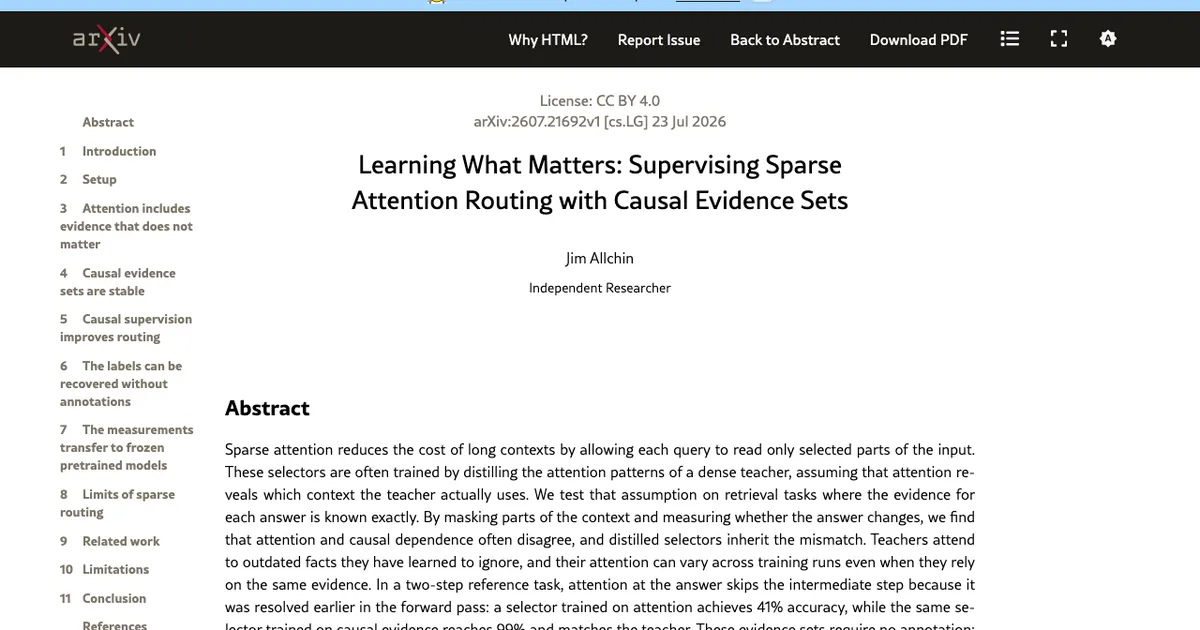
Learning What Matters: Supervising Global Context Pruning with Causal Evidence Sets
The AI Attention Myth: Why ‘Paying Attention’ Isn’t Enough for Long Context
The entire field of Large Language Models (LLMs) is built on the idea that attention tells us where the answer comes from. When a model reads a massive document, we assume that if it pays high attention to Block X, then Block X must contain crucial information.
But groundbreaking research suggests this assumption—the so-called ‘Attention Myth’—is critically flawed.
A new paper challenges the foundational understanding of how LLMs utilize long context windows, showing that what a model pays attention to often doesn’t correlate with what the model needs to answer correctly.
🧠 The Core Problem: Attention vs. Causality
Researchers tested this theory using retrieval tasks where they knew the exact source of truth (the ‘gold standard’). They found that:
- Attention is Fragile: A model’s attention map can be unreliable. On a specific set of examples, the ‘teacher’ model might focus on outdated or irrelevant facts simply because it was trained that way. This reliance is non-robust.
- Causality Matters Most: By measuring causal dependence—that is, selectively masking context blocks and observing if the answer changes—researchers found a massive performance gap. When they used this causal method to guide pruning (selecting only necessary context blocks), accuracy skyrocketed from around 36% to over 98%, demonstrating true comprehension.
🛠️ The Solution: Causal Evidence Sets
Instead of relying on the model’s internal attention weights, the proposed method uses Causal Evidence Sets. This approach systematically identifies the minimal set of context information required for accurate inference, regardless of how often or where a model originally focused its ‘attention.’
Why is this critical? 1. Robustness: The selector derived from causal evidence sets remains stable (99% accuracy) even if the training run changes, unlike attention-based selectors. 2. Deep Insights: They successfully disentangled current necessary evidence from obsolete or distracting facts within the model’s memory structure. 3. Model Performance Boost: In practical tests, they showed that replacing a standard attention router with a causal router dramatically lifted the performance of models like Gemma-2-9B (from 56% to 98%).
📈 Takeaway for Developers and Researchers
If you are building next-generation LLMs that need to handle massive, complex documents, simply optimizing attention mechanisms is insufficient. The future requires causally aware pruning—systems that prove which context blocks truly matter rather than just appearing highly connected.
This work fundamentally shifts the focus from ‘where does the model look?’ to ‘what evidence must be present for the model to succeed?’ It represents a major step toward reliable, efficient long-context retrieval systems.