Memory Attention
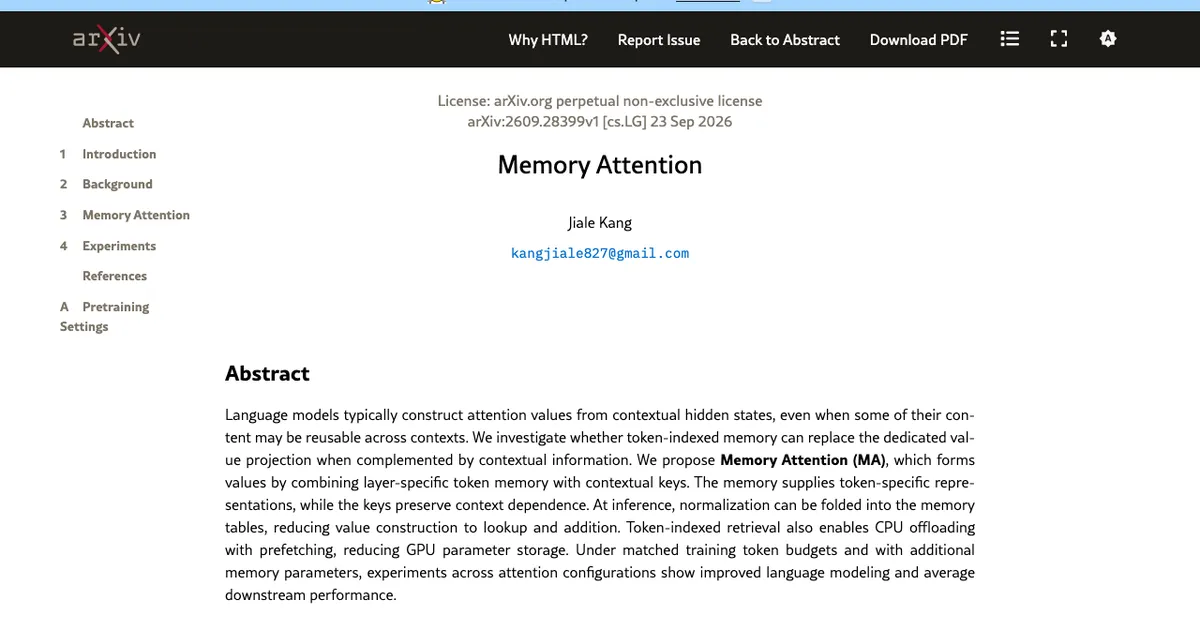
Unlocking Next-Gen AI Memory: Introducing ‘Memory Attention’
In the rapidly evolving landscape of Large Language Models (LLMs), performance hinges not just on raw parameters, but on how effectively models can retain and utilize context. Existing Transformers often treat every input token as equally immediate, leading to context limitations—a phenomenon known as the ‘short-term memory’ problem.
A revolutionary new approach called Memory Attention directly tackles this bottleneck. This work introduces a mechanism designed to give LLMs persistent, structured memory, allowing them to operate over massive sequences far beyond typical context window limits while maintaining efficiency and coherence. It’s essentially giving modern AI the ability to remember everything it needs to, whenever it needs it.
🧠 How Does Memory Attention Work?
The core innovation lies in separating the immediate processing context from long-term, summarized knowledge. Unlike simple truncation or repetitive attention patterns (like key/value caching), Memory Attention introduces dedicated memory modules that dynamically store and recall vital information points from past interactions. This structure means:
- Contextual Compression: The model learns to compress redundant historical data into high-signal ‘memory chunks.’
- Targeted Retrieval: When generating the next token, it doesn’t just look at the immediate prompt; it actively retrieves only the most relevant information from its structured memory bank.
- Enhanced Coherence: This mechanism significantly boosts the model’s ability to maintain consistency and complex thematic understanding across incredibly long conversations or documents.
🚀 Why Should Developers Care? (The Impact)
If you are building applications that require deep, multi-turn conversational history—such as advanced customer service bots, coding assistants working on entire repositories, or research analysis platforms—this research is transformative.
- Overcoming Limits: Say goodbye to the arbitrary context window limits that hamstring current LLMs.
- Efficiency Gains: By only attending to relevant memory segments rather than the entire history (which gets computationally expensive), it keeps inference efficient and fast.
- Scalability: Enables deployment of LLM applications capable of handling enterprise-level, long-tail data dependencies.
The research detailing this method can be found here: Memory Attention paper on arXiv.
🛠️ Tech Deep Dive & Implementation Notes
While the underlying principles of Memory Attention are mathematically sophisticated, the overall architecture aims for integration compatibility with existing Transformer stacks. For practitioners, think of it as adding a sophisticated Retrieval-Augmented Generation (RAG) layer that is internal to the core memory flow, making retrieval seamless and highly context-aware.
Keywords: Large Language Models, Memory Attention, Transformers, LLM Scaling, Context Window, NLP
(Disclaimer: This post summarizes academic research. Always consult the original paper for detailed implementation guidelines.)