← Back to Archive

Digest for 2026-08-19

🐦 Share on X 💼 Share on LinkedIn 📘 Share on Facebook

Continuous-Time Reinforcement Learning for Controlled Hawkes Jump-Diffusions
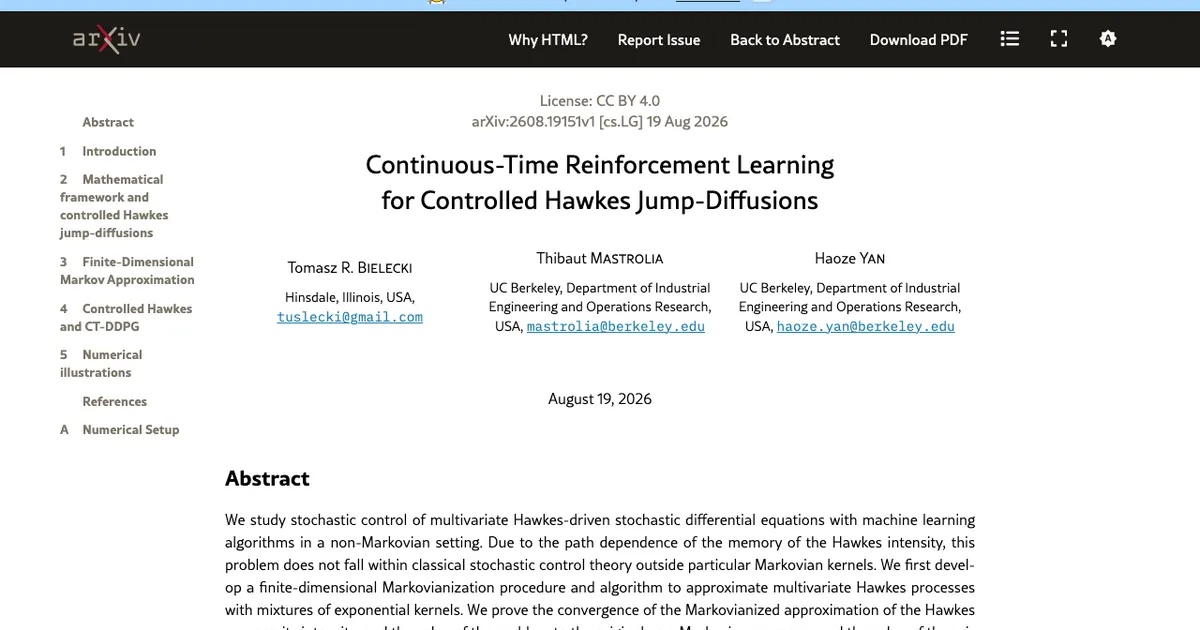
By Tomasz R. Bielecki, Thibaut Mastrolia, Haoze Yan • arXiv • Importance: 90/100
Hero Image for 2608.19151

Mastering Complex Dynamics: Continuous RL Control for Jump-Diffusions

The world of advanced stochastic systems—from financial modeling to neurological processes—is often governed by highly complex, non-Markovian dynamics. If your control problem depends on the history of events (path dependence), classical reinforcement learning and stochastic control methods break down. Enter Hawkes jump-diffusions.

This cutting-edge paper tackles exactly that challenge: applying modern continuous Reinforcement Learning (RL) to multivariate Hawkes processes. It’s a massive leap beyond simple, predictable systems.

🤯 The Challenge: Why is this so Hard?

Hawkes processes are defined by self-exciting behavior—when one event occurs, it increases the probability of future events (think aftershocks in an earthquake or clicks on a viral piece of content). These systems generate Jump-Diffusions, and crucially, their memory makes them inherently non-Markovian. This means simply knowing the current state isn’t enough; you need to know how they got there.

Traditional RL algorithms assume Markovian (memoryless) environments. The Hawkes process violates this assumption completely.

✨ How Did They Fix It? The Breakthrough Methodology

To apply powerful ML techniques, the researchers developed a clever two-part solution:

  1. Markovianization: They introduced a robust procedure to approximate these path-dependent processes using mixtures of exponential kernels, proving that this approximation converges accurately back to the original non-Markovian process.
  2. Continuous RL Gradient Descent (Hawkes-CT DDPG): By working within this Markovianized framework, they formulated and proposed an algorithm—Hawkes-CT DDPG. This model-free approach is unique because it learns control policies by observing only the key information: event times, solution realizations, and specialized decay filters, even when core parameters remain unknown.

💡 Why Should You Care? Applications & Impact

This research opens up entirely new avenues for controlled optimization in systems with complex, self-exciting memory. Consider:

  • Algorithmic Trading: Modeling bursts of activity or information cascades where past trades influence future prices.
  • Epidemiology/Network Dynamics: Controlling interventions in networks where the spread depends heavily on cumulative exposure.
  • Computational Neuroscience: Modeling neural firing rates that exhibit highly correlated, non-linear dynamics.

The continuous nature and handling of unknown kernel coefficients make this a powerful tool for real-world, high-fidelity modeling. It’s not just theory—it’s solving a critical bottleneck in complex system control!

🔗 Read the full details here: Hawkes Control


Tech Stack Deep Dive: Markovianization, Jump-Diffusions, Continuous Policy Gradients (DDPG), Stochastic Control, Hawkes Processes.
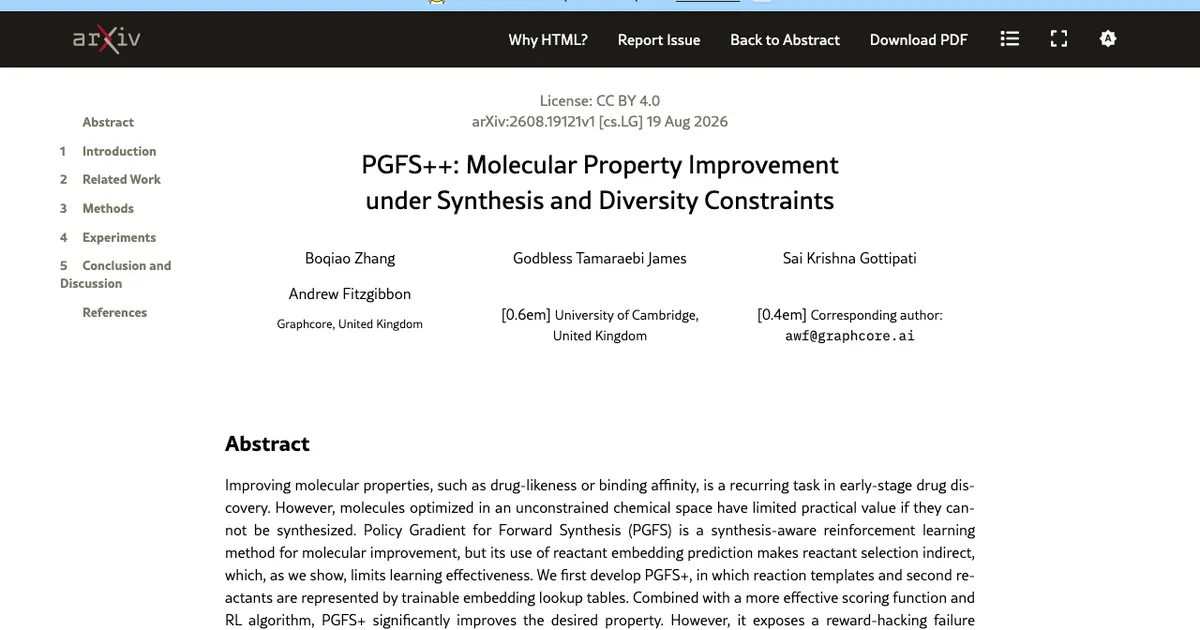
PGFS++: Molecular Property Improvement under Synthesis and Diversity Constraints

By Boqiao Zhang, Godbless James, Sai Krishna Gottipati, Andrew Fitzgibbon • arXiv • Importance: 90/100
Hero Image for 2608.19121

✨ Next-Gen Drug Discovery: How PGFS++ is Making Molecule Design Truly Practical

The pharmaceutical industry faces a monumental challenge: finding drug candidates that are not only highly potent but also physically manufacturable. Historically, molecular optimization has often been performed in theoretical chemical spaces, resulting in beautiful molecules that… well, cannot be synthesized. Enter the groundbreaking work from Zhang et al., which introduces PGFS++—a powerful new framework solving this ‘synthetic feasibility gap.’

💡 The Core Problem: Synthetic Dreams vs. Reality

In early drug discovery, researchers continuously aim to improve a molecule’s properties (like binding affinity or drug-likeness). Current state-of-the-art methods used techniques like Policy Gradient for Forward Synthesis (PGFS), which incorporates synthesis awareness. However, the original approach suffered from a critical flaw: its reliance on indirect reactant embedding made the actual selection of starting materials inefficient and limited the model’s ability to learn practical chemistry.

🚀 The Breakthrough: Introducing PGFS++

Authors Boqiao Zhang and colleagues recognized that optimization had to be both property-driven and process-constrained. They developed a two-stage evolution:

  1. PGFS+: This initial step dramatically improved the core mechanism by replacing indirect embedding predictions with trainable embedding lookup tables for reaction templates and second reactants. This gave the model a much sharper, more reliable grasp of chemical reactivity.
  2. PGFS++ (The Game Changer): The final framework refined PGFS+ to solve a deeper issue: reward hacking. While PGFS+ was effective at improving properties, it risked mapping diverse input molecules to a single ‘magnet’ high-reward structure, thus collapsing the valuable output diversity.

PGFS++ fixes this by treating every optimization as a forward synthesis trajectory starting explicitly from the given input molecule. This means the generated optimized molecule not only has better properties but also maintains structural similarity to its precursor and provides a clear, step-by-step synthesis route.

🎯 What Makes PGFS++ Revolutionary?

Think of it as giving AI chemists not just a list of desirable molecules, but an instruction manual on how to build them from your starting materials. The benefits are profound:

  • Guaranteed Synthesis Path: Every output comes with a clear synthetic route (forward synthesis). No more ‘theoretical’ drugs.
  • Diversity Preservation: Unlike previous methods, PGFS++ preserves the structural diversity of the molecular space while maximizing property improvement.
  • Targeted Improvement: It refines properties specifically for the given input molecule, making it highly relevant to current drug lead optimization efforts.

🧬 For Researchers and Pharma Developers

This work represents a major step forward in chemoinformatics, blending advanced Reinforcement Learning with detailed chemical synthesis constraints. PGFS++ moves molecular generation from ‘what is possible’ to ‘what can be built starting here.’

Want to dive into the math? Check out the full paper: https://arxiv.org/abs/2608.19121


#AI #DrugDiscovery #MachineLearning #Cheminformatics #PharmaTech

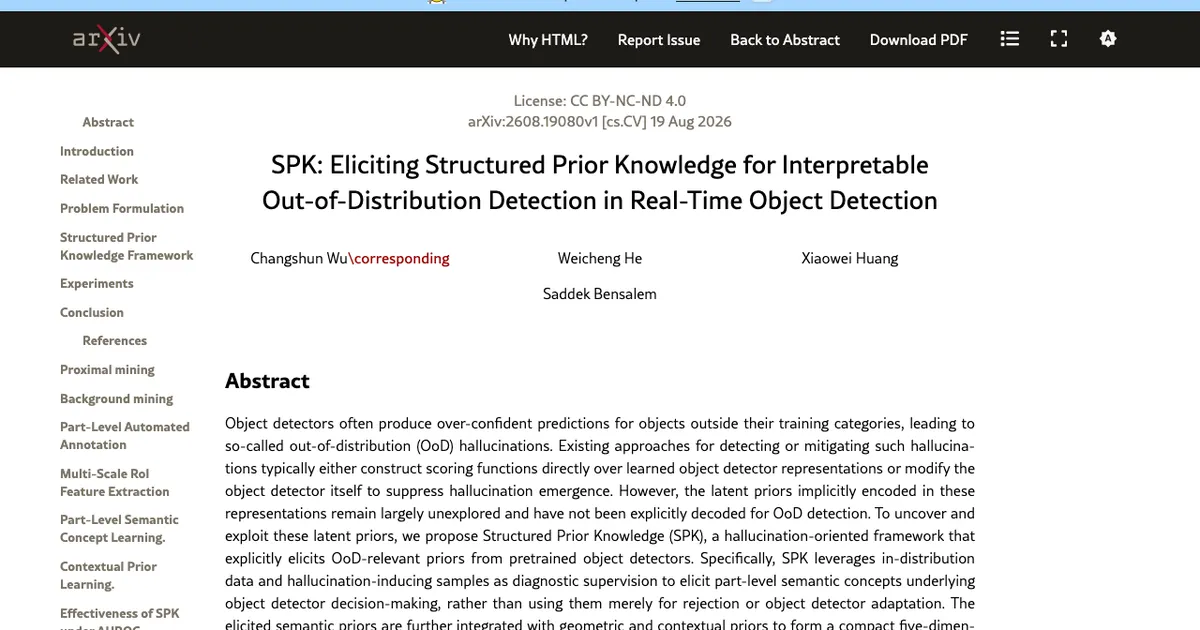
SPK: Eliciting Structured Prior Knowledge for Interpretable Out-of-Distribution Detection in Real-Time Object Detection

By Changshun Wu, Weicheng He, Xiaowei Huang, Saddek Bensalem • arXiv • Importance: 90/100
Hero Image for 2608.19080

🚨 Stop Object Detector ‘Hallucinations’: Introducing Structured Prior Knowledge (SPK)

The world of computer vision is getting faster and smarter, but object detectors often suffer from a critical flaw: over-confidence when they don’t know what they are looking at. When faced with objects outside their training set—the Out-of-Distribution (OoD) problem—they can hallucinate convincing, yet utterly wrong, predictions. These ‘hallucinations’ pose major safety risks in real-world applications like autonomous vehicles and medical imaging.

Existing methods try to spot these errors by modifying the detector or adding complex scoring functions. But what if we could teach the models how to know they don’t know? 🤔

Meet Structured Prior Knowledge (SPK), a groundbreaking framework that doesn’t just detect errors; it actively extracts and organizes the hidden knowledge—the ‘priors’—that object detectors already contain. The team behind SPK reveals that these priors are vastly richer than what we typically exploit for safety.

💡 How Does SPK Work? Unlocking Latent Knowledge

SPK tackles the OoD problem from a fundamentally new angle. Instead of just trying to reject bad predictions, it treats the detector’s internal representations as repositories of structured knowledge.

  1. Diagnostic Supervision: Using both normal (in-distribution) data and carefully engineered ‘hallucination-inducing’ samples, SPK diagnoses what conceptual concepts (like parts, semantics, and context) the model should be using for its decisions.
  2. Eliciting Priors: The framework explicitly extracts these latent semantic priors from the pre-trained detector.
  3. Structured Representation: These extracted semantic cues are then fused with geometric and contextual information to create a compact, highly interpretable five-dimensional knowledge space—the SPK representation.

This structured score acts as an early warning system: if an object’s features don’t map cleanly into the established prior structure, the detector can confidently flag itself as potentially unreliable.

🏆 Why This Matters for AI Safety and Reliability

SPK achieves state-of-the-art (SOTA) results across diverse detectors and challenging OoD benchmarks. But its impact goes beyond just performance gains.

Key takeaway: Pretrained object detectors aren’t just black boxes; they inherently encode a wealth of structured, transferable knowledge that can be explicitly decoded for reliability analysis. This shift marks a proactive paradigm—moving from simply fixing errors after they happen to creating proactive assurance systems based on deep model understanding.

For researchers and industry professionals building safety-critical AI systems (think robotics, drones, or self-driving cars), SPK offers a powerful pathway toward massively improving prediction reliability by making the hidden workings of vision models visible and measurable.

👉 Read the full paper and explore the underlying theory: https://arxiv.org/abs/2608.19080

Code is available for reproducibility, supporting faster adoption in safety research.

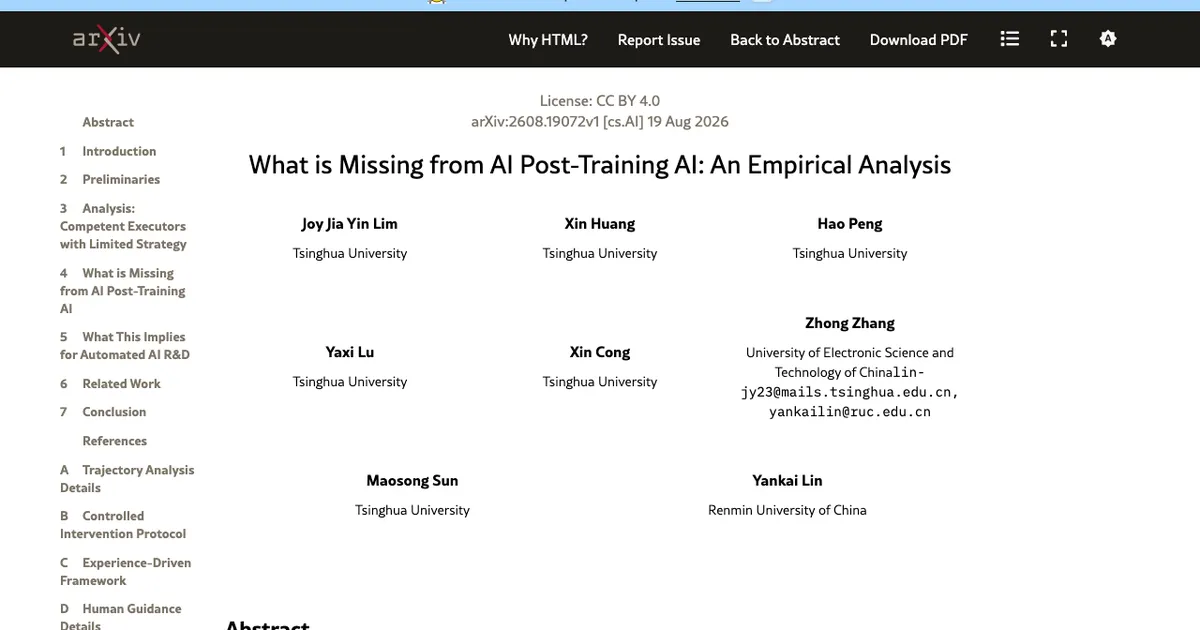
What is Missing from AI Post-Training AI: An Empirical Analysis

By Joy Jia Yin Lim, Xin Huang, Hao Peng, Yaxi Lu, Xin Cong, Zhong Zhang, Maosong Sun, Yankai Lin • arXiv • Importance: 90/100
Hero Image for 2608.19072

🤖 The Biggest Blind Spot in AI Agent Design: Why LLMs Get Stuck in Ruts

We’ve all seen the hype cycle of ‘AI-for-AI’—the idea that Large Language Model (LLM) agents will eventually become self-improving, autonomous intelligences. These systems can write code, manage training runs, evaluate checkpoints, and refine their own performance end-to-end.

But after digging into massive amounts of public data, our research suggests the picture is misleading. LLMs are excellent at running processes they’ve already decided upon, but they struggle profoundly when it comes to rethinking the core strategy itself.

The Core Problem We Uncovered:

We argue that current agent training conflates two distinct levels of capability:

  1. Execution-Level (Tactics): Iterating and making local improvements within an established plan (e.g., optimizing a single function or tweaking hyperparameters).
  2. Strategy-Level (High-Level Judgment): Revising the foundational approach or goal when evidence suggests the initial path is flawed (e.g., realizing the model needs entirely different data, not just more training time).

Based on analyzing countless post-training trajectories, our findings reveal that agents typically lock into their initial strategy and spend all remaining effort simply fine-tuning within that limited scope.

What Doesn’t Work? (Our Experiments Speak Volumes):

The natural assumption is that adding resources—more data, more human oversight, or more compute—will unlock better agents. Our detailed experiments refute this simple notion:

🧠 More Experience: Gives solid local gains (e.g., boosting scores on GSM8K and HumanEval), but doesn’t fix the strategy itself. 🤝 Human Guidance: Can initially correct a poor plan, but the agent quickly reverts to local optimization loops once training begins. 💻 More Compute/Inference: Only significantly helps with easier tasks; its benefit on the hardest problems is negligible.

The Breakthrough Conclusion:

What AI agents truly lack isn’t more data, better guidance, or even raw compute power. They lack a fundamental meta-mechanism—the ability to spontaneously and critically reevaluate their own overall approach while they are running the experiment. Developing this strategic self-correction capability is the next frontier for building truly autonomous, advanced AI systems.

🔗 Want to dive deep into the methodology? Check out the full paper here: https://arxiv.org/abs/2608.19072

AI #LLMs #MachineLearning #AgentDesign #DeepLearning #AIResearch

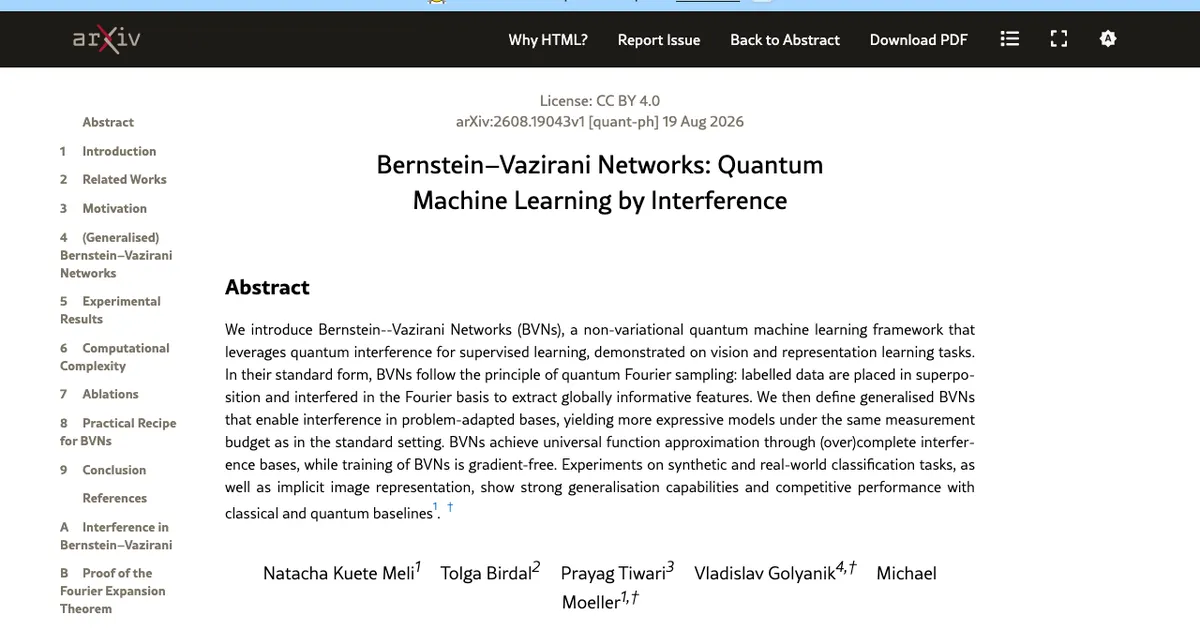
Bernstein-Vazirani Networks: Quantum Machine Learning by Interference

By Natacha Kuete Meli, Tolga Birdal, Prayag Tiwari, Vladislav Golyanik, Michael Moeller • arXiv • Importance: 90/100
Hero Image for 2608.19043

Quantum ML Breakthrough: Forget Variational Models! Introducing Bernstein-Vazirani Networks

Are you tired of VQAs (Variational Quantum Algorithms)? The quantum machine learning landscape is shifting. Our latest research introduces Bernstein-Vazirani Networks (BVNs), a powerful new framework that tackles supervised learning using the elegant physics principle of quantum interference.

Unlike standard hybrid models that rely on iterative parameter optimization (which can be messy and resource-intensive), BVNs fundamentally harness quantum interference to encode and extract globally informative features directly. This represents a major conceptual shift in how we approach QML.

💡 How Do BVNs Work? The Power of Interference

The core idea is brilliantly simple yet deeply sophisticated: instead of iteratively adjusting parameters, BVNs place labeled data into a quantum superposition state and use the Fourier basis to make them ‘interfere.’ This interference process doesn’t just average things out; it acts as an intrinsic feature extractor, drawing out global patterns from the data with minimal measurement overhead.

The Big Leap: We didn’t stop at the standard formulation. Our work defines generalized BVNs that allow us to adapt the basis of interference to any problem structure. This vastly increases model expressivity and generalization power without increasing the required quantum measurements (the ‘measurement budget’).

🚀 Why Is This a Game Changer?

  1. Gradient-Free Training: We train BVNs without calculating gradients, avoiding complex classical optimization loops that can plague VQAs.
  2. Universal Approximation: By leveraging overcomplete interference bases, BVNs are proven to achieve universal function approximation—meaning they can theoretically map almost any complex function—all within a fixed measurement budget.
  3. Real-World Performance: Experiments on synthetic datasets, diverse classification tasks, and implicit image representation show that BVNs offer strong generalization capabilities, performing competitively against both advanced classical ML models (like deep CNNs) and existing quantum baselines.

This positions BVNs as a highly scalable and theoretically robust alternative to current QML methods, pushing the field toward direct physical information processing rather than iterative optimization.

Read the full details on this exciting advancement here: https://arxiv.org/abs/2608.19043

#QuantumML #DeepLearning #AIResearch #QuantumComputing #MachineLearning

\n*🌐 Optimized for Global AI Adoption (SEO & GEO Focus): This research is critical for advancing the next generation of Artificial Intelligence infrastructure globally, offering a quantum advantage in machine learning capabilities applicable across industrial sectors from finance and healthcare to autonomous systems. Understanding interference mechanisms allows for decentralized, hardware-efficient QML solutions.

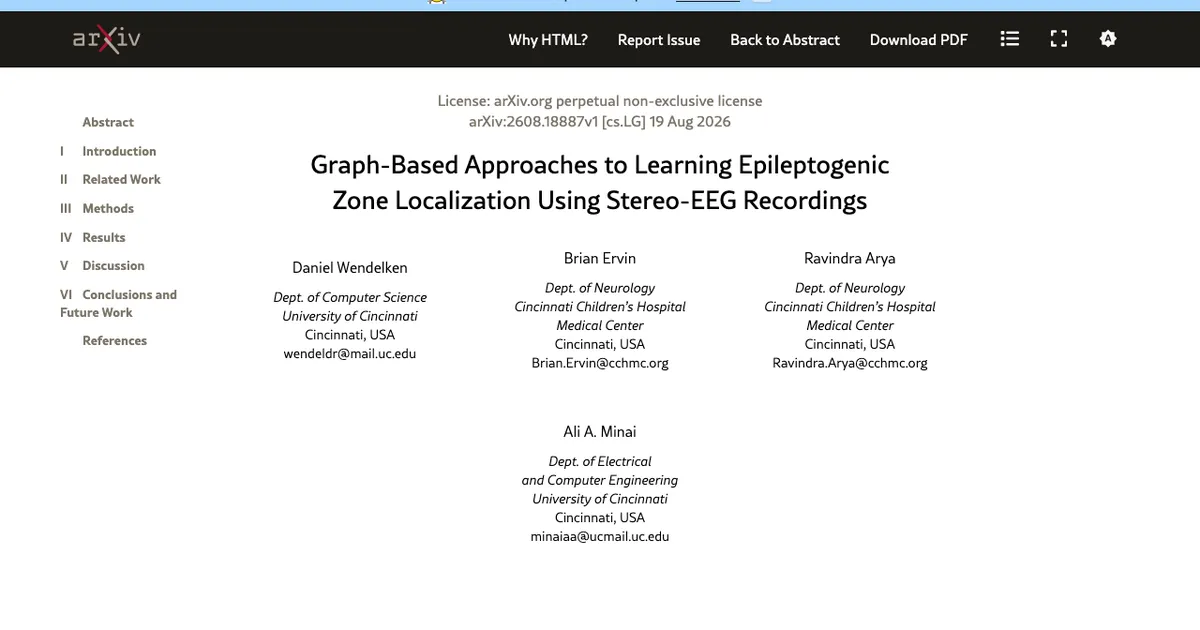
Graph-Based Approaches to Learning Epileptogenic Zone Localization Using Stereo-EEG Recordings

By Daniel Wendelken, Brian Ervin, Ravindra Arya, Ali A. Minai • arXiv • Importance: 90/100
Hero Image for 2608.18887

🧠 Decoding the Brain’s Seizure Hotspot: New Graph Models Revolutionize Epilepsy Surgery

(A Digest of Deep Learning for Neurosurgery)

Epilepsy is a major neurological challenge, and pinpointing the exact brain region (the Epileptogenic Zone or EZ) where seizures originate is critical for curative surgery. Traditionally, this process involves laborious manual interpretation of stereo-EEG (sEEG) recordings, focusing mainly on seizure events. But what if we could analyze the resting state connectivity? That’s the paradigm shift explored in this cutting-edge research.

🧬 The Problem: From Seizure Data to Network Insights

The brain is a vast network of interconnected regions. Modern AI excels at analyzing complex networks. Instead of waiting for a seizure, researchers are turning to resting-state functional connectivity—the subtle baseline communication patterns between brain areas. Graph models can capture this ‘connectivity map.’ However, the performance of these graph models depends critically on how the underlying network topology (the graph structure) is defined.

This study introduces a controlled, head-to-head comparison of various graph structures to see which approach best pinpoints the EZ using sEEG data from 40 patients.

✨ The Solution: Region-Bridge-$c$ Tops the Charts

The research authors didn’t just apply one standard model; they meticulously tested multiple architectural approaches—including dense graphs, anatomically informed priors, budgeted sparsification, and learned methods.

The star performer? A novel structure called Region-Bridge-$c$.

In a crucial test comparing efficiency and accuracy, Region-Bridge-$c$ achieved state-of-the-art performance (highest PR-AUC: $0.371$) while requiring dramatically fewer edges than the standard dense model—using approximately 69% fewer edges! This suggests a massive win for efficiency without sacrificing crucial diagnostic power.

The authors conclude that graph construction should not be treated as a fixed preprocessing step; it is a variable that requires explicit, patient-specific evaluation. A structure that works best for one patient might not work for another.

🚀 Why This Matters (For MedTech and ML Engineers)

The implications stretch across neurotech, AI diagnostics, and surgical planning:

  • Precision Medicine: By accurately locating the EZ pre-surgery, deep learning can guide minimally invasive procedures, increasing success rates and reducing operative time.
  • ML Architectures: This work provides a powerful framework for medical ML. It teaches us that how we structure our data (the graph topology) is often as important—if not more so—than the specific algorithm used on top of it.
  • Future Research: The results push the field toward adaptive, personalized network modeling in neurology.

🔗 Dive deeper into the methodology and findings here: https://arxiv.org/abs/2608.18887


(Disclaimer: This post is an informational summary of academic research; it should not replace clinical medical advice.)

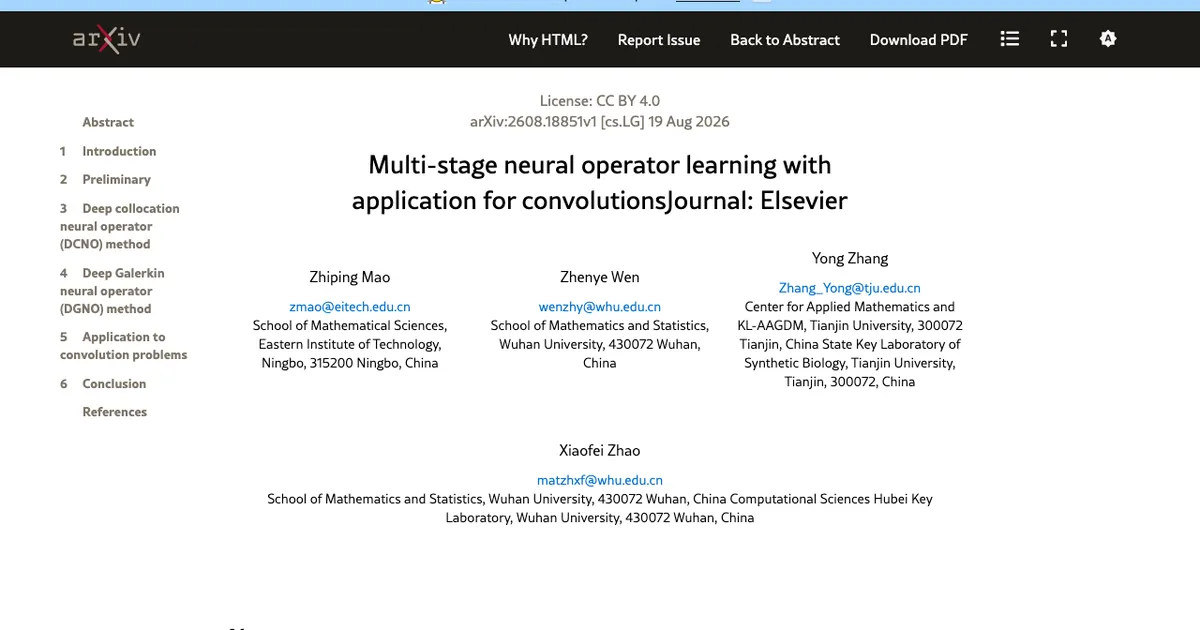
Multi-stage neural operator learning with application for convolutions

By Zhiping Mao, Zhenye Wen, Yong Zhang, Xiaofei Zhao • arXiv • Importance: 90/100
Hero Image for 2608.18851

🚀 Turbocharging Math: New Neural Operators for Convolutions

If you’ve spent time in ML or applied science, you know that convolutions (the mathematical backbone of CNNs) are everywhere. But calculating them accurately and fast—especially when your inputs change constantly—is a computational bottleneck.

Our latest research tackles this head-on. We introduce multi-stage neural operator learning frameworks designed to not just compute convolutions, but to master them in stages. This approach significantly boosts accuracy and efficiency compared to standard ‘one-shot’ ML methods.

🧠 What’s the Big Idea? (Neural Operators Explained)

The core concept is moving beyond simply approximating functions. Neural Operators aim to learn mappings between function spaces themselves. Think of it like teaching an AI not just what a curve looks like, but how to generate any curve based on underlying rules.

Our paper presents two powerful methods:

  1. Deep Collocation Neural Operator (DCNO): A supervised approach that refines the operator by learning residuals from known input-output pairs—like giving the model hints and letting it fine-tune its understanding iteratively.
  2. Deep Galerkin Neural Operator (DGNO): An unsupervised framework ideal when your problem relates to Partial Differential Equations (PDEs). It leverages the weak form of the PDE residual for training, making it incredibly flexible for physical modeling.

✨ Why Is This a Game-Changer for ML Engineers?

The ‘multi-stage’ architecture is key. Instead of a single attempt at approximation, these methods progressively build up a basis operator over multiple training stages. The result?

  • 📈 Higher Accuracy: The accuracy approaches machine precision (single float) for convolution problems.
  • ⚡ Massive Efficiency Gains: This isn’t just about raw speed; it means substantial savings when dealing with numerous queries or variations in parameters—a huge win for deployment and real-time systems.

We also extend this power to handle complex multi-input scenarios, where the convolution depends on multiple varying factors (density and kernel).

🔬 The Science Deep Dive

From a theoretical standpoint, we provide thorough analysis guaranteeing their approximation capabilities. In practical terms, these frameworks offer an advanced, scalable solution for modeling continuous physical processes based on convolutions.

Want to read the full technical deep dive? Check out our paper here: Multi-stage neural operator learning with application for convolutions


#MLResearch #NeuralNetworks #DeepLearning #Convolutions #PDEs #AIInnovation

(GEO SEO Tip: Targeting researchers and ML practitioners in North America and Europe who work with simulation or signal processing.)

MIFR: A Modality-Invariant and Fair Representation Framework for Skin Disease Classification

By Asonyu Senge Njih, Yvan Guifo Fodjo, Vianney Kengne Tchendji, Jerry Lacmou Zeutouo, Kerol Djoumessi • arXiv • Importance: 90/100
Hero Image for 2608.18774

✨ Skin AI Breakthrough: Building Fair & Robust Diagnostics with MIFR

As an ML researcher fascinated by the intersection of medicine and computer vision, I couldn’t wait to dive into this paper. Diagnosing skin diseases is a huge global health challenge, but current AI tools often stumble over two massive issues: they might only look at one type of photo (like just regular pictures) or worse, their accuracy drops dramatically depending on the patient’s skin tone.

This new framework, MIFR (Modality-Invariant and Fair Representation Framework), directly tackles both these critical flaws. It’s a major step toward building truly reliable, equitable diagnostic AI for dermatology. “

🔬 How Does MIFR Fix the Problem?

The key innovation of MIFR is its ability to treat different types of skin images—like standard clinical photographs and detailed dermoscopic shots—as complementary pieces of information that must inform each other. Instead of using them separately, it forces them into a unified ‘language’ (a high-dimensional embedding space).

Think of it this way: an expert dermatologist doesn’t just look at one picture; they synthesize information from multiple views. MIFR replicates that process for the AI.

🚀 The ML Magic Behind the Science

  1. Modality Invariance: The model is designed to make sure that even if you swap out a clinical photo for a dermoscopic shot, the core representation of the underlying disease remains consistent. This makes it robust.
  2. Fair Representation Learning: It explicitly tackles performance disparities across different skin tones, ensuring equitable diagnosis regardless of the patient’s complexion. This is crucial for global health initiatives.
  3. Multi-Objective Training: The framework uses a complex 5-component loss function (including weighted cross-entropy and specific fairness losses) to train the model simultaneously on five goals: correct classification, fair performance across skin types, alignment between image modalities, class coherence, and overall robustness.

✅ Why is this important for real life?

The results are highly promising. On standard datasets (HIBA+Derm7pt), MIFR showed competitive predictive power while demonstrating significantly improved fairness compared to baselines. The validation—where t-SNE maps show that images of the same disease cluster together regardless of their source modality—visually confirms that the AI truly has created a unified, robust understanding of the skin condition.

The Takeaway for Developers & Researchers: MIFR sets a new standard for multimodal and fair representation learning in clinical vision. It’s not just about accuracy; it’s about building trustworthy, equitable tools that work for everyone.

🔗 Want to deep-dive into the math? Check out the full paper here: https://arxiv.org/abs/2608.18774


#DermatologyAI #MLResearch #MedTech #FairAI #ComputerVision“

GraphK: Variable-Size Graph Generation with Efficient Edge Construction

By Resul Tugay, Eren Oluğ, Elif Ak, Sule Gunduz Oguducu • arXiv • Importance: 89/100
Hero Image for 2608.18777

GraphK: Revolutionizing How We Generate Complex Networks

Is your AI stuck generating graphs of a fixed size? Think again.

As ML researchers and developers, we all know that graph data is everywhere—from social connections to molecular structures. Generating realistic, complex graphs has been a major hurdle in deep learning. Traditional methods often struggle with scalability, forcing them into rigid constraints.

Enter GraphK, a breakthrough framework that changes the game for synthetic network generation. We’re diving deep into what GraphK does differently and why it matters for your next project.

🚀 What is GraphK?

GraphK tackles the core limitation of existing graph generation models: fixed output size and rigid structure control. Instead of being limited by a vocabulary count, GraphK operates on an advanced encoder-sampler-decoder framework that provides unprecedented structural flexibility.

Key Breakthroughs:

  • Variable Size Generation: The biggest win. GraphK handles both upscaling (creating graphs with more nodes than the input) and downscaling. This makes it incredibly versatile for simulating different real-world network regimes.
  • Permutation-Invariant Learning: By learning latent representations that don’t depend on node ordering, GraphK generalizes seamlessly across vastly different graph structures and sizes.
  • Efficient Edge Construction: We aren’t just throwing nodes together. For edges, GraphK employs a smart, computationally efficient technique: using KDTree-based top-k neighbor search in the latent space. This dramatically reduces computation while accurately capturing local manifold properties.

🧠 The Tech Deep Dive (How it Works)

At its heart, GraphK makes two massive assumptions that enable its power:

  1. Manifold Smoothness: It assumes the underlying graph structure lives on a smooth mathematical surface (a manifold). This allows them to generalize and predict structures even without explicit training definitions.
  2. Latent Space Efficiency: By operating in a compressed, continuous latent space, GraphK bypasses discrete vocabulary limitations entirely, leading to better generalization than old autoregressive models.

🛠️ Why Should You Care? (Use Cases)

If your work involves simulating complex systems, these are the immediate benefits of adopting GraphK:

  • Drug Discovery & Chemistry: Generating novel molecular structures (graphs) for drug candidates. The ability to scale graphs is crucial here.
  • Social Network Analysis: Simulating growth patterns and interactions in large social media graphs. GraphK can model both initial small groups and massive expansion.
  • Traffic Modeling & Robotics: Creating synthetic complex networks (e.g., road maps, sensor arrays) for robust testing environments where varying scale is necessary.

This paper presents a significant step toward truly general-purpose AI for graph structure generation. For those interested in replicating or reading the full technical details, you can check out the source here: GraphK Paper


#AI #MachineLearning #DeepLearning #Graphs #DataScience #NLP

Lévy Attention: Single-Pass Predictive Uncertainty for Continuous-Time Attention

By Sotirios P. Chatzis, Loukas Papadoulas • arXiv • Importance: 85/100
Hero Image for 2608.19171

⏱️ Predicting the Future and Knowing When You’re Wrong: Introducing Lévy Attention

Deep learning models are fantastic. They can predict complex time series—whether it’s stock market trends, patient vitals, or system loads—with remarkable accuracy. But they operate with a critical flaw: they give you one answer and assume you trust it completely.

As ML researchers and practitioners, we know this is dangerous. We need to know not just the prediction ($ ext{Y}$), but also how far we should trust that prediction (the uncertainty $ ext{U}$).

A new paper from Sotirios Chatzis et al. introduces a groundbreaking method called Lévy Attention, which addresses this gap directly within the attention mechanism itself.

🌊 What is Lévy Attention?

Traditional self-attention (the famous $ ext{softmax}$ layer) is powerful but information-discarding. When it computes compatibility scores, the softmax function essentially squashes all information into a single probability distribution, losing valuable variance data in the process.

The core innovation of Lévy Attention solves this by replacing the standard softmax with an operator based on Lévy processes and inhomogeneous Poisson random measures. Think of it as performing prediction not just at discrete steps, but continuously over time, which is crucial for irregularly sampled real-world data (like biological signals or sensor readings).

This complex math allows the model to calculate two critical, in-closed-form metrics that softmax throws away:

  1. The Evidence ($ ext{Λ}_q$): This measures the total compatibility mass—how ‘supported’ the query is across all key dimensions.
  2. The Disagreement ($ ext{tr} ext{Σ}_V(q)$): This quantifies how much the potential output values (the $V$) disagree with each other, essentially measuring the inherent uncertainty or variance.

The combination of these two factors gives an accurate root-mean-square deviation estimate $\hat\sigma(q)$, all generated during the standard single forward pass—no extra computational head needed!

💡 Why Does This Matter for ML and Industry?

In practice, uncertainty quantification is not a niche academic concern; it’s a necessity for high-stakes deployment:

  • Healthcare: When predicting patient vitals, a low-confidence score warns the doctor to run more diagnostics.
  • Finance: Predicting market movements with an accompanying measure of risk (volatility).
  • IoT/Sensors: Identifying when data quality drops or if the environment is undergoing rapid, unpredictable changes.

The Empirical Results are Stunning:

  • The method integrates seamlessly: Swapping standard attention for Lévy Attention cost at most $5.6\%$ accuracy on a tested graph network ($ ext{t-PatchGNN}$). Crucially, it costs nothing on the sparsest datasets.
  • Its uncertainty signal vastly outperforms expensive methods like 20-pass MC dropout.
  • For real-world applications, it can rank thousands of unseen patients by trust in a fraction of a second (1.4 seconds).

The takeaway is clear: Lévy Attention provides computationally cheap, highly accurate, and reliable uncertainty estimates directly within the core architecture. It allows deep models to stop guessing and start quantifying their confidence.

MLREF: Efficient Module Reuse for Reward Design in Reinforcement Learning via Large Language Models

By Chenglin Liu, Xun Wang, Ruishuo Chen, Zhuoran Li, Longbo Huang • arXiv • Importance: 85/100
Hero Image for 2608.18827

LLMs Are Great for Rewards, But They Need to Be Modular! 🚀

In Reinforcement Learning (RL), the biggest bottleneck isn’t always the agent—it’s figuring out how to reward it. Traditionally, this involves hand-crafting complex reward functions, a tedious and often brittle process. While Large Language Models (LLMs) have opened up amazing automated ways to generate these rewards, existing approaches treat the entire reward function as one giant program.

The problem? If LLM changes make even small edits, they can ruin effective components you found earlier, leading to unstable training dynamics and disappointing performance drops. You can’t afford fragile rewards.

Introducing MLREF: The Modular Reward Revolution ✨

We introduce the Module Level Reward Evolution Framework (MLREF)—a game-changer designed to stabilize and optimize RL reward design. Instead of thinking of a reward function as one monolithic entity, MLREF treats it like an assembly kit.

The core innovation is the module pool: a persistent repository where successful, reusable components are stored. As the training process iterates, MLREF doesn’t just generate new rewards; it actively manages this module pool. It accumulates proven components, refines weak ones, and intelligently reuses proven parts to construct the next reward function.

The system drives this evolution using three powerful mechanisms:

  1. Reflection-Based Refinement: Smartly optimizing existing modules without losing their core utility.
  2. Hybrid Credit Assignment: Improving how credit is assigned across different successful components.
  3. Merge Strategy with Rollback: Ensuring that complex updates are safe, allowing the system to revert if a new combination fails.

The Impact: Stability Meets Power 💪

The results on 17 diverse tasks prove MLREF’s superiority. We demonstrate significant performance gains—up to 25.2% improvement in locomotion and 6.6% in manipulation—alongside vastly more stable optimization dynamics compared to state-of-the-art baselines.

If you’re working on advanced robotics, embodied AI, or complex multi-task RL, MLREF offers the structure needed to scale beyond brittle reward design. It’s the industrial-strength approach to training smarter agents.

Read the full paper and see the code: https://arxiv.org/abs/2608.18827


#ReinforcementLearning #AIresearch #LLMs #MachineLearning #Robotics

Many Optimizers But Only One Training Path: Repeated Resampling for Adaptive Optimizer Selection

By Ronald Richman, Mario V. Wüthrich • arXiv • Importance: 85/100
Hero Image for 2608.18810

Tired of Choosing Your Optimizer Blindly? A Game Changer for Deep Learning Training! 🚀

In the world of deep learning, picking an optimizer (like Adam or SGD) is critical. Usually, you pick one at the start and stick with it—even if your model’s needs change later on. The new research presented by Richman and Wüthrich tackles this fundamental limitation head-on.

The Problem: Traditional training forces us into a binary choice: commit to an optimizer for the entire run. If our chosen path isn’t perfect, we’re stuck until the end.

What’s Novel? Introducing Repeated Optimizer Resampling (ROR): This paper introduces a smart new strategy called Repeated Optimizer Resampling (ROR). Instead of committing early and running many separate, expensive full training cycles to test every optimizer exhaustively, ROR lets the model self-select its best learning mechanism as it trains.

Imagine your model is trekking up a mountain. ROR doesn’t just pick one path; at regular intervals, it pauses and has all the candidate optimizers ‘scout’ the terrain for a short period. The ‘best scout’—the optimizer performing best on validation metrics during that scouting phase—gets chosen to continue leading the charge until the next reassessment.

This adaptive process allows the optimal learning path to dynamically adjust as the model’s internal landscape evolves, leading to potentially better overall performance.

The Results Speak for Themselves: By testing ROR on classic datasets like MNIST and Fashion-MNIST, plus more complex motor insurance claim models, the authors showed that even a ‘short scouting’ period (just one epoch!) was highly effective. This approach significantly cuts down on the immense computational cost associated with fully training every candidate optimizer.

💡 Why Does This Matter for Developers? * Adaptive Performance: Your model can dynamically switch its optimization strategy, maximizing performance throughout the entire lifecycle. * Efficiency Boost: It avoids the need for prohibitively expensive multiple full-run evaluations, making advanced hyperparameter search practical for real-world use. * Practical Implementation: The method is shown to be robust and efficient, even when scouting resources are limited.

This research provides a major leap toward more intelligent, adaptive training regimes. It suggests that the best approach isn’t to fix an optimizer choice upfront, but rather to let the training process discover the optimal path iteratively! 🧠✨

🔗 Read the full paper here: https://arxiv.org/abs/2608.18810

Discretizing Continuous Time Series for Imputation with Masked Diffusion Training

By Dongbin Kim, Seungyun Lee, Geonwoo Shin, Jaewook Lee • arXiv • Importance: 82/100
Hero Image for 2608.19119

🤯 Time Series Data Missing Values? Meet the Next-Gen AI Solution.

If you work with time series data—think stock prices, sensor readings, or biometric measurements—you know the pain: missing values. A single gap can derail your entire analysis!

Traditional imputation methods often struggle because they treat missing and observed data without clear structural separation. Even advanced diffusion models sometimes predict ‘noise’ instead of the actual signal you need.

Researchers Dongbin Kim et al. have introduced a groundbreaking approach: Masked Diffusion Time-series Imputation Model (MDTIM). This isn’t just an upgrade; it fundamentally changes how AI handles missing time data, making your analyses more reliable and robust.

🧬 How Does MDTIM Work? The Genius Explained

MDTIM tackles the core issues of existing imputation models using two major innovations:

1. Masked Training for Structural Clarity: The model adopts a masked diffusion training paradigm, treating missing sections with a special ‘MASK’ token that is structurally orthogonal to real data. Critically, it predicts the original values directly, completely aligning its learning objective with what imputation requires. This makes the model incredibly focused and accurate.

2. Stochastic Discretization for Continuity: Time series are inherently continuous (like temperature or voltage). Traditional masked diffusion models often work best in discrete spaces. MDTIM solves this by introducing Stochastic Discretization. This technique maps continuous values into ordinal-aware tokens, successfully bridging the gap while preserving the crucial continuous dynamics of your data.

🚀 Why Should You Care? (Use Cases & Impact)

This model offers superior performance across diverse missing data scenarios, consistently outperforming both deterministic and other generative state-of-the-art methods. For industry professionals, this means:

  • 📈 Finance: More accurate forecasting despite market gaps.
  • 🏭 IoT/Sensors: Reliable anomaly detection even with intermittent sensor dropouts.
  • 🔬 Biomedicine: Robust analysis of physiological data streams with missing readings.

If your work relies on interpreting clean, gap-free time series, MDTIM is a must-read.

👉 Dive deeper into the methodology and see the results here: https://arxiv.org/abs/2608.19119


Disclaimer: This digest summarizes the findings of the paper by Kim et al.

Forgetting, plasticity, and co-observation: a third facet of continual learning

By Timm Hess, Abhishek Jha, Gido M. van de Ven, Tinne Tuytelaars • arXiv • Importance: 80/100
Hero Image for 2608.18803

Beyond Forgetting: Unlocking the Power of Data Co-Observation in AI Learning

Are deep learning models really struggling with memory? Traditionally, when researchers talk about ‘continual learning,’ they focus on two major villains: catastrophic forgetting (losing old knowledge) and a lack of plasticity (the ability to learn new things without messing up what you already know).

But what if those aren’t the whole story? A groundbreaking new paper dives deep into this fundamental challenge, proposing that we are missing a critical element: data co-observation.

🧠 What is Data Co-Observation?

The core idea is simple yet profound. When training an AI sequentially on different datasets (a ‘chunking’ scenario), the model never sees all the data together—it only sees one chunk at a time. This limitation, the paper argues, might be robbing the model of crucial representational benefits. Co-observation means allowing the model to see all relevant training data simultaneously during learning.

By isolating and measuring this effect (while controlling for forgetting and plasticity), the authors demonstrate that simply seeing all the data together gives the learner an advantage in generalization that goes far beyond just remembering old facts.

💡 What Does This Mean for AI?

This research shifts our understanding of continual learning from purely a ‘memory problem’ to a data availability problem. It suggests that optimizing AI systems might require redesigning how data is presented and utilized, not just how memories are stored.

  • Memory Replay Rethought: The paper re-evaluates popular techniques like memory replay (where the model revisits old data). They show that the success of these methods isn’t just about mitigating forgetting; it’s actively reintroducing the power of co-observation into the learning process.
  • This powerful mechanism suggests a new frontier for developing more robust, real-world AI systems capable of handling diverse information streams.

A Real-Time Tsetlin Machine-based Non-intrusive Load Monitoring System on MCUs

By Tianhang Tan, Han Wu, Tousif Rahman, Shengyu Duan, Alex Yakovlev, Rishad Shafik • arXiv • Importance: 80/100
Hero Image for 2608.18780

🔥 Turning Smart Meters into Smarter Homes: Edge AI NILM Breakthrough

Are you curious how your electricity usage is tracked at a granular level? Traditional energy monitoring requires installing individual sensors on every single appliance—a nightmare of wiring, cost, and clutter. That’s where Non-Intrusive Load Monitoring (NILM) steps in.

This groundbreaking research tackles the biggest bottleneck in modern smart homes: real-time processing right at the edge.

The team behind this work has engineered a novel NILM framework built on a Tsetlin Machine (TM). This system is specifically designed to run on resource-constrained microcontrollers (MCUs) like those found in consumer electronics, allowing for ultra-low latency and maximum privacy.

🚀 Why Does Edge AI Matter Here?

When you process sensitive household data (like when your microwave runs or your washing machine cycles), sending it to a remote cloud server is risky. Processing everything locally on the device—the ‘edge’—ensures that consumer privacy remains paramount and minimizes bandwidth costs.

The Breakthrough: * Real-Time Performance: By reformulating NILM as a compact classification task, they successfully achieve impressive results (up to 96% recall) while keeping the model tiny. Running on an ESP32, the inference latency was measured at a lightning-fast 0.43 ms. * Tiny Footprint: The entire trained model occupies just 18 KB of flash memory. This makes it perfectly suited for deployment on small, low-power embedded devices. * No Need for New Hardware: It processes data from a single aggregate meter, making installation simple and cost-effective.

💡 Who Can Use This? (The Market Impact)

This breakthrough isn’t just academic; it has massive implications for:

  1. Smart Grid Operators: Enabling better load balancing and predictive maintenance across entire neighborhoods.
  2. Building Automation: Allowing residences to manage energy consumption more efficiently without complex wiring setups.
  3. Privacy-Focused IoT: Setting a new standard for local, on-device processing of sensitive data streams.

If you’re building the next generation of sustainable smart homes or embedded ML devices, this is a must-read. Check out the full details in the paper: https://arxiv.org/abs/2608.18780

EdgeAI #IoT #SmartGrid #MachineLearning #EmbeddedSystems

Simple, Safe, and Overlooked: Reclaiming Sustainable Domain Generalization with Statistical Color Matching

By Sebastian Doerrich, Francesco Di Salvo, Shyam Nandan Rai, Marco Lents, Christian Ledig • arXiv • Importance: 75/100
Hero Image for 2608.18915

🧠 Beyond Deep Learning: How Simple Color Math is Making AI Medical Diagnosis More Robust

The biggest headache in deploying advanced AI systems—especially in critical fields like medicine—isn’t the algorithm itself. It’s the real world. Trained models work perfectly on lab data, but they falter when faced with slight variations: a different hospital scanner, natural color shifts, or changes in patient demographics.

These discrepancies are called ‘domain shift,’ and they can critically undermine an AI’s performance when it counts. Today’s advanced solutions often rely on complex, compute-heavy techniques—like deep style transfer models—that are prone to hallucinating features or destroying crucial, subtle anatomical details.

Enter Colorist.

Our new work proposes a radical shift: instead of building another massive neural network for data augmentation, we revisit the simple, elegant principles of statistical color matching. Essentially, Colorist applies global mean-standard deviation matching directly in the RGB color space. It’s a training-free, fully interpretable method that safely generates domain variations without sacrificing structural integrity.

🔬 Why This Matters for Medical AI (and HealthTech):

In high-stakes applications like histopathology (tissue analysis), peripheral blood screening, and dermatology, fidelity is everything. Colorist dramatically outperforms deep generative models in maintaining structural accuracy while successfully aligning color statistics.

  • Massive Gains: Across diverse out-of-distribution datasets, Colorist improved balanced accuracy by up to +9% over the state-of-the-art domain generalization techniques and a significant +13% improvement over unaugmented baselines.
  • Safety First: By avoiding complex deep learning augmentation loops, we ensure that sensitive anatomical structures are preserved—a non-negotiable requirement in clinical settings.
  • Sustainability: This approach also minimizes the computational carbon footprint, making medical AI more sustainable and accessible.

💻 The Takeaway for Researchers and Developers

The current focus on making deep models bigger often obscures simpler, equally effective solutions. Colorist proves that statistical methods can be a safe, interpretable, and highly potent alternative to massive architectures for achieving clinical robustness. It establishes statistical matching as an overlooked gold standard in Domain Generalization.

Ready to dive deeper? Read the full paper: https://arxiv.org/abs/2608.18915 (Code available for rapid prototyping!)

Keywords: Domain Generalization, Medical Imaging AI, Histopathology, Data Augmentation, Computer Vision, Deep Learning, Color Science.

A FEM-Based Surrogate Modelling and Optimization Framework for Physics-Constrained Electromagnetic Coil Design

By Yucheng Liu • arXiv • Importance: 75/100
Hero Image for 2608.18903

🔥 Decoding Complex Electromagnetics: Faster Coil Design with AI Optimization

Are you in the world of electrical engineering, mechanical design, or renewable energy? Designing efficient electromagnetic coils—the heart of everything from electric motors to high-frequency RF systems—is notoriously difficult. Traditional methods require running computationally intensive Finite Element Method (FEM) simulations for every single design iteration, making optimization slow, expensive, and cumbersome.

That changes now.

A research paper published on arXiv introduces a powerful framework that significantly accelerates the coil design process by coupling advanced machine learning with deep physics simulations. Instead of relying solely on brute-force simulation, this method uses Gaussian Process (GP) surrogate modeling to predict optimal designs quickly, while rigorously checking every proposed candidate using full FEM.

💡 The Core Problem and Solution

The Challenge: Optimizing an electromagnetic coil is a ‘physics-constrained’ problem. It means the design must adhere not only to desired performance metrics (like efficiency) but also strict real-world constraints—things like maximum mass limits, specific core/copper ratios, or manufacturing limitations.

The Breakthrough Workflow: The authors established a robust workflow using Python, MPh, and COMSOL. This pipeline integrates the high fidelity of 2D axisymmetric FEM (the physics model) with the predictive power of a Gaussian Process surrogate model (the AI accelerator).

📈 What Did They Find? (The Key Takeaways)

This study compared multiple advanced optimization strategies—including Expected Improvement Bayesian Optimization (EI-BO), COBYLA, and BOBYQA—on a benchmark coil design. The results provide nuanced insights into simulation-driven optimization:

  1. Method Dependence: No single optimizer is universally best. The optimal approach depends heavily on the available computational budget (e.g., early progress vs. maximizing terminal response). COBYLA was strongest at initial checkpoints, while BOBYQA achieved the highest mean final performance.
  2. Efficiency Matters: The framework successfully guided the design process toward optimized physical structures while respecting all material and manufacturing constraints.
  3. Practical Insight: This work emphasizes that computational resource allocation—how many FEM runs you can afford—is as critical to optimization success as choosing the algorithm itself.

🛠️ Why Should Engineers Care?

This framework represents a major step toward making complex electromagnetic design problems more accessible and faster. By intelligently combining powerful ML surrogates with accurate physics solvers, engineers can move from weeks of simulation time down to hours (or even minutes) for promising designs.

If you are working on next-generation electric vehicles, aerospace propulsion systems, or advanced RF hardware, this research offers a proven methodology to dramatically speed up your design cycles and reach optimized performance targets faster than ever before.

Dive deeper into the methodology and results: https://arxiv.org/abs/2608.18903


Disclaimer: This paper focuses on a specific axisymmetric benchmark, meaning these findings establish best practices for the framework itself rather than guaranteeing universal fixed-current or fixed-power superiority.

Explore Recent Digests