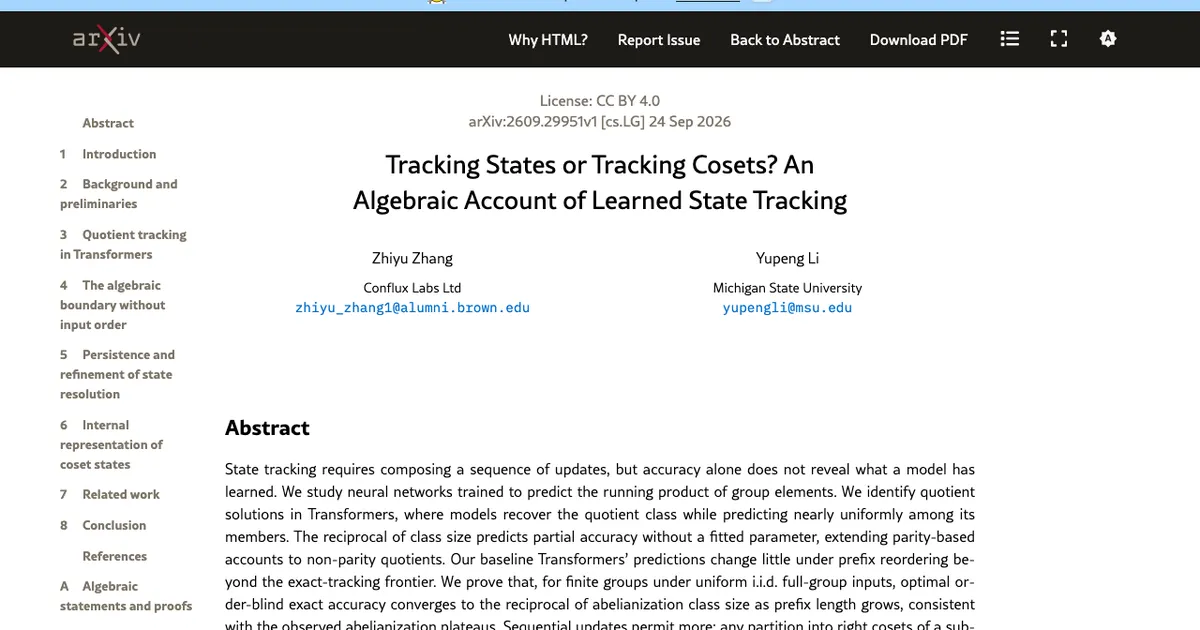
Tracking States or Tracking Cosets? An Algebraic Account of Learned State Tracking
🤖 Tracking States: A Deep Dive into the Algebra of Memory
Are Large Language Models (LLMs) truly remembering things, or are they just mastering a new form of mathematical bookkeeping? This paper dives deep into the foundational mechanisms of state tracking—a crucial, yet often opaque, component of complex AI behavior.
If your models struggle with multi-turn conversations, maintaining consistent character traits, or managing complex simulated environments, you’ve encountered the challenge of ‘state management.’ LLMs are notoriously good at generating fluent text, but when tasks require rigorous, persistent memory (like remembering an item added 10 turns ago), they sometimes stumble. They hallucinate history.
The Core Insight: States vs. Cosets
Zhang and Li’s work Tracking States or Tracking Cosets? An Algebraic Account of Learned State Tracking introduces a mathematically rigorous framework to analyze how LLMs model sequential information. They challenge the intuitive idea that all complex state tracking simply involves tracking a single ‘state vector.’ Instead, they propose that what modern AI models might actually be learning is something much richer: cosets.
- What are Cosets? (Simplified): Think of a coset as tracking not just where you are in the system (the state), but also how that location relates to all possible past transformations. It’s an algebraic abstraction that captures relational structure and context dependency far better than a simple point estimate.
- Why does this matter? Understanding whether LLMs are learning states or cosets dictates how we design future memory architectures. If they are only learning states, it means their ‘memory’ is fragile and prone to drift. If they are learning cosets, it suggests a deeper, more robust understanding of the underlying system dynamics.
🧠 Key Takeaways for AI Engineers & Researchers
- The Limits of Simple State Representation: Traditional recurrent models often oversimplify memory. This paper provides the mathematical backing to understand why that simplification fails in complex tasks.
- Designing Robust Memory: For systems requiring perfect consistency (e.g., robotics, financial modeling), we need to move beyond simple state vectors and incorporate more mathematically rigorous context representation, potentially by modeling coset relationships.
- The Next Frontier of LLMs: This work shifts the focus from what states are being tracked to how those states are algebraically related and transformed over time. It suggests that advanced memory modules should be designed using principles of group theory and abstract algebra.
🚀 Who Should Care?
ML Researchers, NLP Engineers, Architectural Designers working on long-context models, Retrieval Augmented Generation (RAG) systems, and agents that require multi-step reasoning.
Understanding the difference between tracking a state point and tracking the coset structure is crucial for building the next generation of reliable, consistent, and deeply context-aware AI assistants!