By Joseph Rigal, Emmanuel Virot, Caroline Pascal • arXiv • Importance: 92/100
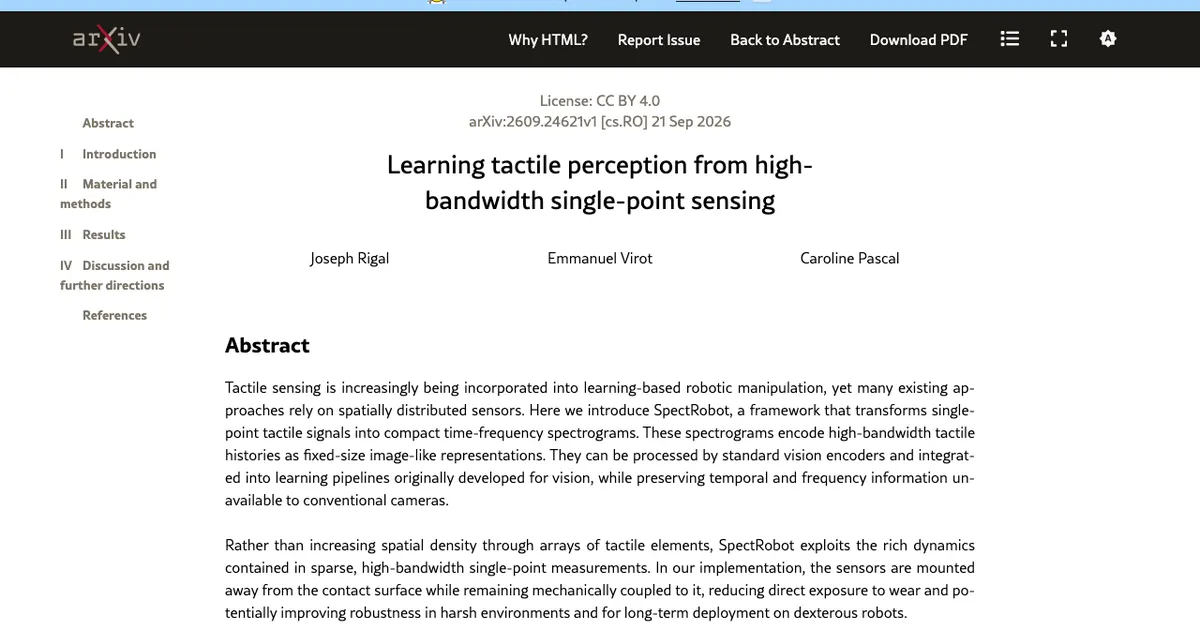
Seeing the World with Single Points: A Breakthrough in Tactile Robotics
The next frontier for robots isn’t just seeing—it’s feeling. Traditional robotic vision excels at mapping visible surfaces, but when a robot needs to interact with an object—to grasp it, polish it, or manipulate delicate components—vision alone is insufficient. This is where high-bandwidth tactile sensing comes in.
For years, the standard approach was increasing sensor density (think of large arrays of small tactometers). However, researchers are finding a more elegant solution: maximizing data quality from minimal hardware.
Our latest dive into robotic perception looks at SpectRobot, a groundbreaking framework that unlocks the power of single-point sensing. Instead of needing vast arrays, SpectRobot transforms high-frequency, single-point tactile signals (like vibration and force) into rich time-frequency spectrograms—essentially turning complex dynamic histories into compact, image-like data.
🧠 How It Changes Everything: From Point to Picture
The core innovation is representation. By generating these fixed-size spectrographs, the raw dynamics of single contact points can be processed by standard vision encoders and integrated directly into existing learning pipelines originally designed for camera images. This bridges a huge gap, allowing researchers to treat incredibly rich tactile data as if it were visual data.
Key advantages include:
Efficiency & Robustness: Instead of bulky, delicate sensor arrays (which wear out easily), SpectRobot mounts sensors away from the contact point while remaining mechanically coupled. This drastically improves durability and suitability for long-term deployment on dexterous robots in harsh industrial environments.
Bandwidth Power: The framework utilizes high-bandwidth measurements (up to 100 kHz!), capturing subtle vibrations that conventional cameras completely miss.
Generalization: The representation is agnostic to the specific sensor type—whether it measures acceleration, force, or strain. This means the learning policy built today can be easily transferred across different hardware platforms.
🤖 Real-World Impact and Applications
The experimental results are compelling, showing that a robot can successfully complete a complex manipulation task using only single-point vibration signals, especially when the target object is visually occluded. This proves the immense power of contact dynamics.
Why does this matter for robotics?
Blind Manipulation: Allows robots to perform precise tasks in environments where line-of-sight is lost (e.g., deep inside machinery, or picking up obscured components).
Embodied Learning: By integrating high-bandwidth touch into standard vision pipelines, we accelerate the development of unified AI models for embodied agents.
Accessibility: The framework makes sophisticated, research-grade tactile sensing accessible using off-the-shelf hardware.
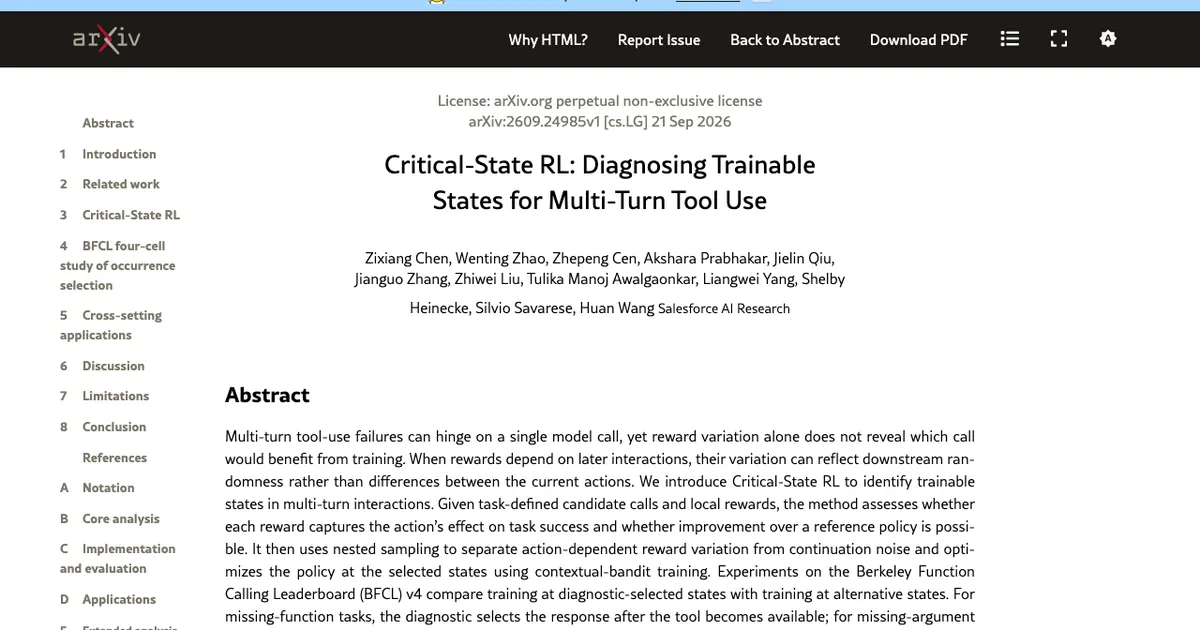
Unlocking AI’s Potential: Targeting Failure Points in Multi-Turn Interactions
Ever notice when an advanced chatbot struggles with a multi-step task? It might seem like a random failure, but for researchers and engineers, that failure point is a massive clue. Our latest work introduces Critical-State RL, a revolutionary approach designed to precisely diagnose which intermediate steps or ‘states’ in a complex interaction are actually hindering model performance and deserve focused training.
🧠 The Problem: Why Standard Training Fails on Complex Tasks
The core challenge of building sophisticated multi-turn AI agents (like those using external tools) is that overall task failure is often determined by the last incorrect step. Traditional reinforcement learning (RL) methods look at the final reward, treating all steps equally. This leads to a critical problem: the observed variation in the final reward might actually be due to random noise later in the interaction, not because of poor choices made much earlier.
Simply put: Looking only at the end result masks the root cause of failure.
🛠️ Introducing Critical-State RL
Critical-State RL solves this ambiguity. Instead of training blindly on every step, it asks a surgical question: “Did the action taken at State X actually determine whether the task succeeded or failed?”
The method mathematically separates true, actionable differences (action-dependent reward variation) from mere continuation noise (downstream randomness). By pinpointing these critical states, researchers can apply focused optimization, maximizing training efficiency.
How it works:
1. Diagnosis: The system identifies candidate steps where model improvement is plausible.
2. Separation: It employs nested sampling techniques to filter out noise and isolate the true impact of specific actions.
3. Optimization: Focused training using a contextual-bandit approach significantly boosts performance precisely at those identified bottlenecks.
🚀 State-of-the-Art Results on Function Calling
We benchmarked Critical-State RL on complex benchmarks, including the Berkeley Function Calling Leaderboard (BFCL) v4. The results speak for themselves:
Missing Functions: By training only the response generated after a necessary tool becomes available, we achieved an impressive improvement of about 14 percentage points over baseline models.
Missing Arguments: Similarly, diagnosing and improving responses made before required arguments are supplied led to robust performance gains.
Training at these diagnostically selected states drastically outperforms training at any alternative steps, which leaves performance flat or even worse. This confirms that targeted intervention is vastly superior to broad optimization.
🌍 Impact and Future Applications
Critical-State RL isn’t just for function calling; the core recipe is highly adaptable. We extend its application across various model tasks, including:
* Avoiding unnecessary tool calls (repeat-call avoidance).
* Advanced memory management in dialogue systems.
This research paves the way for building truly reliable and robust multi-step AI agents that can maintain coherence and solve complex problems with human-level precision. It moves RL from generalized training toward surgical, diagnostics-driven improvement.
By Jurij Schönfeld, Tom Beucler, Julien Savre, Steven Sherwood, Veronika Eyring • arXiv • Importance: 90/100
Unlocking Earth’s Climate Secrets: How AI is Giving Climate Models ‘Memory’
The climate science community has long relied on complex, manually tuned physics equations to simulate how the Earth system works. These equations are powerful, but they often treat processes like convection as if everything happened in a vacuum—meaning the current state only depends on what’s happening right now. In reality, however, natural processes have intrinsic memory and persistence (think of oceanic heat storage or seasonal rainfall patterns).
This groundbreaking research tackles that fundamental limitation head-on. The team introduces a novel framework to give Earth system models a robust ‘memory,’ allowing them to better simulate complex subgrid physics.
🧠 The Problem: Short-Term Climate Views
The core challenge lies in parameterization—the process of using coarse, low-resolution model data (like a map block spanning 100km) to represent processes that happen at much finer scales (like individual storm clouds). Current standard methods are ‘diagnostic,’ meaning they only use instantaneous information. For crucial phenomena like tropical precipitation, this lack of memory leads to unrealistic simulations—the diurnal cycle might be wrong.
🚀 The Solution: Symbolic Memory Integration
The authors propose a two-step system. First, they compress the necessary historical context into a low-dimensional latent space using an autoencoder. This hidden vector now carries crucial past information that was previously ignored.
Critically, they then upgrade this AI component. Instead of leaving it as a black box (the autoencoder), they replace it with symbolic equations. This means the model learns not just what the memory is, but how that memory evolves over time, integrating it physically and mathematically.
This framework results in prognostic variables—additional state variables that track hidden, long-term dependencies alongside the standard atmospheric state. They are integrated directly into the climate model’s equations.
🔬 Real-World Results (The Proof)
The approach was rigorously tested on two challenging systems: an online benchmark using the Lorenz-96 model and an offline test focused on simulating surface precipitation from high-resolution atmospheric runs.
Improved Statistics: The memory-informed parameterizations significantly improved various climate statistics. The most striking finding was capturing a realistic diurnal cycle in tropical land precipitation, a detail crucial for accurate regional forecasting.
Efficiency Insight: Intriguingly, they showed that much of the value added by the complex autoencoder step could be replicated by simply using a forced multivariate linear ordinary differential equation (ODE), suggesting potential paths toward even more computationally efficient implementations.
💡 Why Does This Matter for Climate Modeling?
The ability to accurately parameterize processes with memory is a game-changer. It moves climate modeling closer to true geophysical reality, enhancing the reliability of projections used for everything from sea-level rise warnings to regional agricultural planning.
By Jiancheng TU, WenqiFan • arXiv • Importance: 90/100
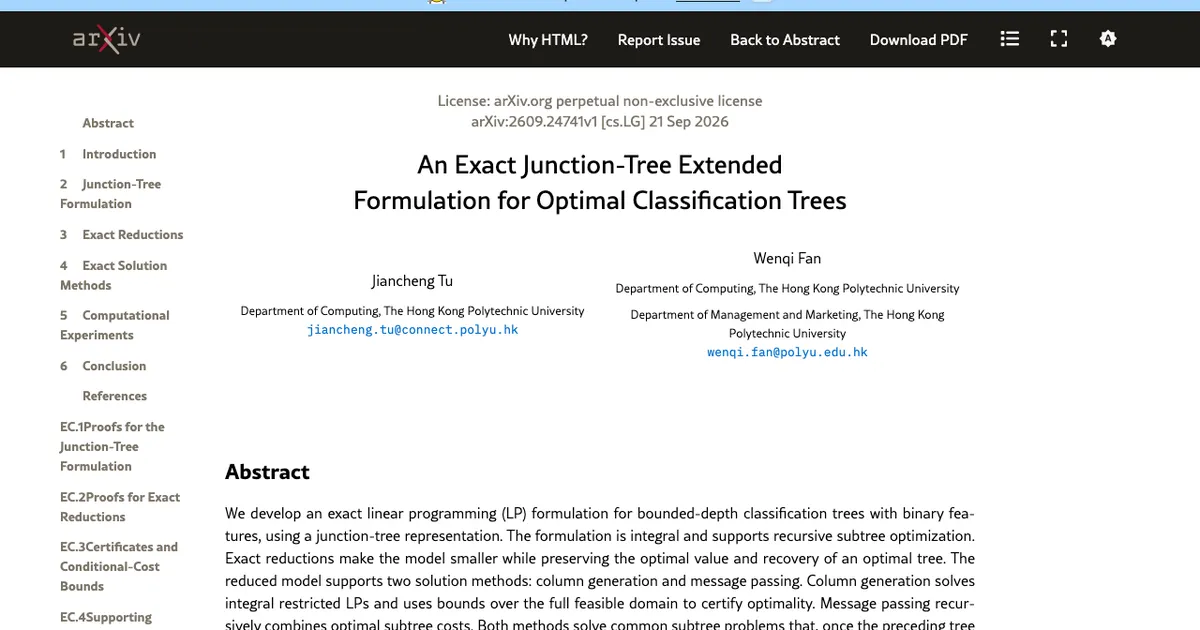
🌳 Deep Dive: Revolutionizing Optimal Classification Trees with Junction-Tree Formulations
The holy grail of machine learning model optimization—finding the absolute best classification tree—has long been computationally prohibitive. Traditional methods struggle because finding a truly optimal structure requires solving massive, complex Mixed Integer Programs (MIPs).
That is, when building a decision tree for high-stakes data analysis, you often need to know if there’s a mathematically perfect split point and depth combination that minimizes error across your entire dataset. Getting close is good; getting the provably best structure is better.
Our latest research tackles this complexity head-on by introducing an Exact Junction-Tree Extended Formulation. This isn’t just another tweak; it fundamentally rethinks how we represent the optimization problem, making finding true optimal classification trees both smaller and drastically faster.
🛠️ How It Works: The Mathematical Breakthrough
Our approach leverages advanced graph theory (specifically, junction-trees) and specialized linear programming techniques to develop an exact formulation. Here’s what makes it so powerful:
Exact Reductions: We introduce integral reductions that maintain the mathematical integrity of the model. Critically, these reductions shrink the size of the overall optimization problem without sacrificing any information about the optimal solution—it’s a perfect compromise between accuracy and tractability.
Parallelizable Optimization: The reduced structure supports two powerful methods: Column Generation and Message Passing. By separating the common subtree problems, we allow different parts of the tree to be evaluated independently and in parallel. This drastically reduces the bottleneck associated with sequential optimization.
🚀 Why Does This Matter for ML Engineering?
In practical terms, this research delivers two major wins:
Certified Optimality: The resulting LP formulation can certify instances where prior mixed-integer models could not prove optimality within the same timeframe. For critical tasks (like medical diagnosis or financial risk scoring), knowing that your model is optimal is non-negotiable.
Speed and Efficiency: Computational experiments show an order-of-magnitude reduction in geometric-mean runtime compared to existing state-of-the-art exact methods. This means deploying truly optimized decision trees for large datasets moves from a theoretical possibility to a practical, scalable solution.
This work provides a robust, certified method for optimizing bounded-depth classification trees with binary features by solving the underlying mathematical challenges using advanced graph theory and specialized linear programming techniques An Exact Junction-Tree Extended Formulation.
By Fabian Spaeh, Jingxing Fang, Shandian Zhe, Bin Shen • arXiv • Importance: 90/100
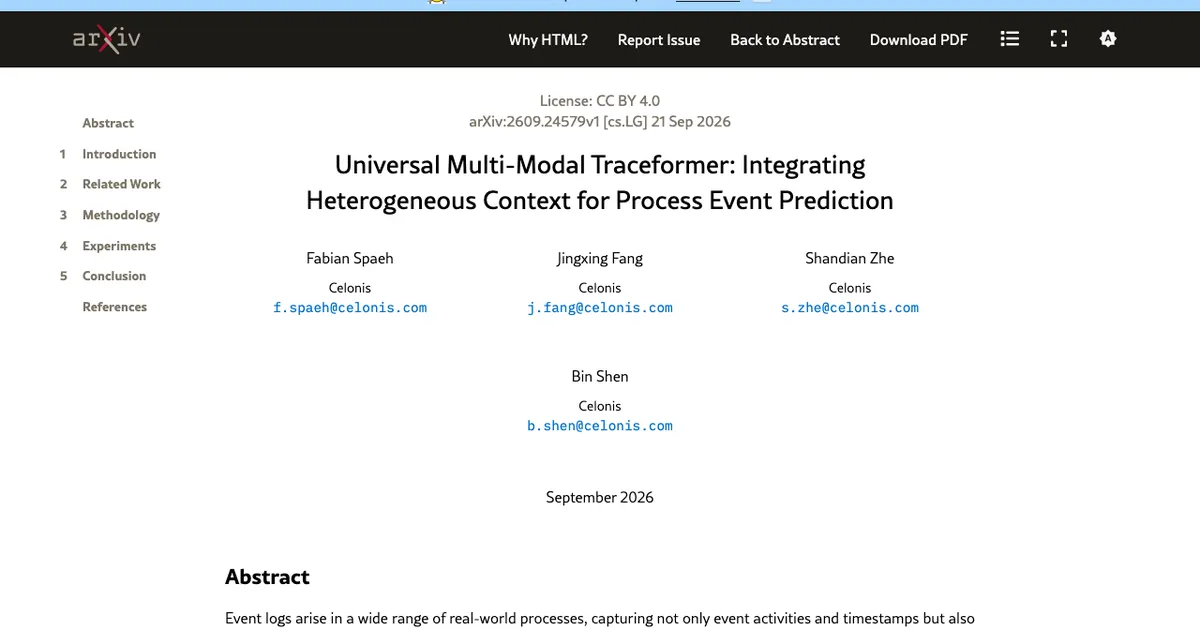
🔥 Decoding Process Logs: Introducing the Universal Multi-Modal Traceformer
As AI systems become deeply embedded in complex real-world processes—think manufacturing lines, financial trading platforms, or hospital diagnostics—understanding what happens and when it happens is critical. But process logs are messy. They don’t just contain a sequence of actions; they’re flooded with diverse context: sensor readings (numerical), device types (categorical), error messages (textual), and rich metadata.
Traditional models treat these complex log sequences poorly, often focusing only on the activity names and timestamps. This limitation means they miss the crucial ‘why’ behind the process failure or success.
That’s where the Universal Multi-Modal Traceformer (UMT) comes in. Developed by Fabian Spaeh et al., UMT is a groundbreaking new architecture designed to unify diverse types of context into next-event prediction, setting a new standard for process understanding.
🧠 How Does UMT Work?
At its core, UMT builds upon the power of Transformers but significantly upgrades how it handles mixed data types. It’s engineered for ‘universal’ applicability across various industry logs.
Unified Feature Encoding: Instead of treating each context type separately, UMT uses a universal feature encoder to map all heterogeneous features (text, numbers, categories) into one shared, coherent representation space.
Per-Event Contextualization: It introduces a sophisticated Perceiver module that dynamically weighs and integrates contextual information at the granular ‘event’ level. This ensures every piece of attached metadata informs the prediction.
Advanced Temporal Modeling: Predicting when an event happens is often harder than predicting what it is. To handle the highly variable, heavy-tailed nature of inter-arrival times (the time gap between events), UMT models this by representing the intervals across multiple temporal scales, making its predictions robust and accurate.
🚀 Why Is This a Big Deal? (Impact)
This isn’t just an incremental update; it’s a foundational shift in how we model real-world event sequences. By explicitly modeling the interaction between activities AND context, UMT can:
Improve Predictive Accuracy: It doesn’t just predict the next action; it predicts the optimal combination of action + required contextual state.
Handle Real-World Messiness: Its universal approach means it can be applied to diverse industrial logs—from IT operations to healthcare systems—without requiring massive domain-specific overhauls.
Joint Prediction Success: The model’s ability to jointly predict both the next event activity and its timing significantly boosts real-world operational utility.
If your work involves analyzing complex machinery, diagnosing system failures from logs, or managing supply chains with rich metadata, UMT offers a powerful new toolkit.
By Shi Fu, Youming Qiao, Dacheng Tao, Zongqi Wan, Qixin Zhang • arXiv • Importance: 90/100
The Next Frontier in Optimization: Getting Closer to Perfect Subset Selection
The field of Machine Learning and Data Science constantly grapples with the problem of subset selection. Whether you’re pruning unnecessary neurons from a large neural network, selecting the most informative features for a classification model, or condensing hours of video into an impactful summary, the core task is optimizing a function over a limited set of choices.
For years, researchers have been guided by concepts like submodularity—a property that models diminishing returns (i.e., the benefit gained from adding a feature decreases as more features are added).
But what happens when real-world tasks introduce complexities? Specifically, when we deal with $\gamma$-weak submodularity and restrictive constraints defined by matroids, standard optimization algorithms often fall short.
The Breakthrough: Introducing Poisson Exchange for Better Guarantees
Researchers have long faced a bottleneck: existing approximation algorithms for maximizing $\gamma$-weakly submodular functions subject to general matroid constraints only offered the conservative $(1+1/\gamma)^{-2}$ approximation ratio. This was seen as a significant limitation.
The team behind this new work (Shi Fu et al.) introduced $\text{MGPE}$—a novel algorithm rooted in controlled maximum-gain local exchanges via a non-homogeneous Poisson clock. Their breakthrough lies in fundamentally improving the performance guarantee.
They prove that $\text{MGPE}$ achieves an approximation ratio approaching $
ho_ ext{\gamma} = 1 - (\gamma / (2-\gamma))^{ \gamma^2 / (2(1-\gamma)) }$.
Why is this a big deal?
Superior Performance: For every value of $\gamma$, the new factor $
ho_ ext{\gamma}$ strictly outperforms the old $(1+1/\gamma)^{-2}$. Critically, as $\gamma$ approaches 1 (the standard submodular case), this ratio asymptotically approaches the optimal $1-1/e$ approximation guarantee.
Flexibility and Recovery: The algorithm is surprisingly robust. When the matroid constraint simplifies to a simple cardinality limit or when the objective satisfies the stronger $\alpha$-weak DR-submodularity, $ ext{MGPE}$ automatically recovers the best known tight bounds of $1-e^{-\gamma}$ and $1-e^{-\alpha}$, respectively.
Theoretical Advance: By tying the optimization to a non-homogeneous Poisson process, the paper offers a deep methodological advance in how we approach complex structural constraints in combinatorial optimization.
💡 In Practice: What Does This Mean for AI Engineers?
This work isn’t just theoretical; it has direct implications for optimizing resource allocation and model efficiency:
Feature Engineering: Better subset selection means models can identify the absolute best features, leading to more efficient and less overfitted data pipelines.
Model Compression (Pruning): By accurately selecting only the necessary components of a large neural network, researchers can significantly shrink model size while maintaining high performance—crucial for edge devices or low-resource environments.
Scientific Computing: Any domain involving combinatorial optimization under complex constraints will benefit from these tighter approximation guarantees.
This research provides a powerful new toolkit that brings the theoretical limits of subset selection closer to perfect efficiency, opening up highly optimized possibilities across machine learning and beyond.
By Matthias Neuwirth-Trapp, Maarten Bieshaar, Danda Paudel, Konrad Schindler, Luc Van Gool, Christos Sakaridis • arXiv • Importance: 90/100
🚗💨 Edge AI Breakthrough: Context-Aware Object Detection with MECAIL
Intelligent Transportation Systems (ITS) are constantly evolving. Whether it’s predicting vehicle movements in a bustling city or monitoring unusual activity at a temporary construction site, object detection models need to adapt—and they need to do it continually.
The core challenge? Running powerful AI on resource-constrained devices (like edge cameras or roadside units) is tough. Most existing solutions require massive data transfers from centralized servers for updates, which is often bandwidth-intensive and impractical in real-world deployment.
That’s where MECAIL comes in. This groundbreaking approach solves the problem of deploying high-performance object detection to edge devices without overwhelming local networks or limited compute power.
🛰️ What Problem Does MECAIL Solve?
Traditional Incremental Learning (IL) is effective, but if you have dozens of specialized environments—a parking lot, a gas station, a ferry terminal, a temporary worksite—how do you update the model for each one without sending gigabytes of data? The bottleneck is often the network itself.
The authors introduced an incredibly strict constraint: keeping each adaptive module under 14.6 KB. This restriction ensures the updates fit reliably within the initial TCP window and minimizes fragmentation across various communication protocols (Wi-Fi, 2G-5G) used in Vehicle-to-Everything (V2X) systems.
✨ How Does MECAIL Work?
MECAIL stands for Mixture-of-Experts for Communication-Aware Incremental Learning. It fundamentally changes how we adapt models:
Specialized Experts: Instead of modifying a massive, monolithic base model, MECAIL deploys a small ‘expert network’ tailored for specific spatiotemporal contexts (e.g., detecting construction equipment vs. identifying objects at a marina).
Communication Efficiency First: The design is driven by the 14.6 KB limit, making it genuinely communication-aware. This ensures practical deployment feasibility in harsh edge environments.
Modular Adaptation: Each expert module acts as an efficient patch, allowing the core base model to maintain high performance while gaining highly localized knowledge for temporary or focused situations.
The results on benchmarks like D-RICO and ODinW-13 are outstanding: MECAIL achieves performance that closely matches computationally expensive models, but with dramatically improved bandwidth efficiency.
This means comprehensive coverage—whether it’s a long-term city deployment or a short-lived temporary construction project—is finally achievable in an energy-efficient, scalable manner.
By Xinying Cai, Junkai Lu, Yuhan Zhu, Xiaoyun Yu, Xiangfei Qiu, Jilin Hu • arXiv • Importance: 90/100
🚀 Forecasting the Future: Introducing MUSE for Time Series Prediction
As businesses become increasingly data-driven, forecasting accurate trends in multivariate time series—whether predicting stock movements, energy consumption, or sensor readings—is no longer optional; it’s critical. The natural next frontier involves leveraging the immense power of Large Vision Models (LVMs) that have revolutionized image processing, adapting them for complex temporal data.
However, migrating state-of-the-art vision techniques to sequential time series presents deep challenges: how do you model both independent variables and their intricate dependencies across time, especially when the visual backbone was trained purely on natural images?
We’re excited to dive into MUSE (Multivariate Understanding through Selective Encoding): a novel, dependency-aware adaptation framework that tackles these hurdles head-on. Published in arXiv,
MUSE achieves state-of-the-art performance by carefully adapting the powerful masked autoencoder (MAE) structure without requiring costly retraining.
🧠 How MUSE Works: Bridging Vision and Time
The core breakthrough of MUSE is its modular design, which treats the complex problem of time series forecasting in three specialized steps:
1. Variable Context Refinement (VCR): This module is responsible for maintaining the fidelity of individual variables while simultaneously modeling how they interact. It aggregates shared temporal information within each variable and models the crucial cross-variable contextual dependencies—a perfect balance between independence and synergy.
2. Temporal-Periodic Refinement (TPR): Time series are inherently rhythmic. TPR addresses this by performing lightweight refinements at multiple encoder depths. Crucially, it explicitly captures two types of dependency: across-period temporal dependencies (how current periods relate to past/future ones) and within-period periodic dependencies (the underlying cyclical nature).
3. Fusion: The outputs from VCR and TPR are independently generated yet cohesively combined using a learnable prediction-level gate, ensuring a robust and highly accurate final forecast.
🏆 Why MUSE Matters for Data Scientists
Existing LVM approaches often struggle with the unique temporal semantics of time data. By proposing a fully frozen MAE backbone—meaning we preserve the powerful, pre-trained knowledge without catastrophic forgetting—MUSE provides an elegant and effective solution. Its ability to model dependencies both across variables and across different time scales makes it exceptionally robust for real-world applications.
MUSE demonstrated state-of-the-art results across ten diverse, challenging real-world datasets. This solidifies its potential as a powerful toolset for advanced predictive analytics in fields like finance, environmental science, and resource management.
This post is optimized for data scientists, ML engineers, and quantitative analysts looking to integrate advanced vision techniques into time series forecasting.
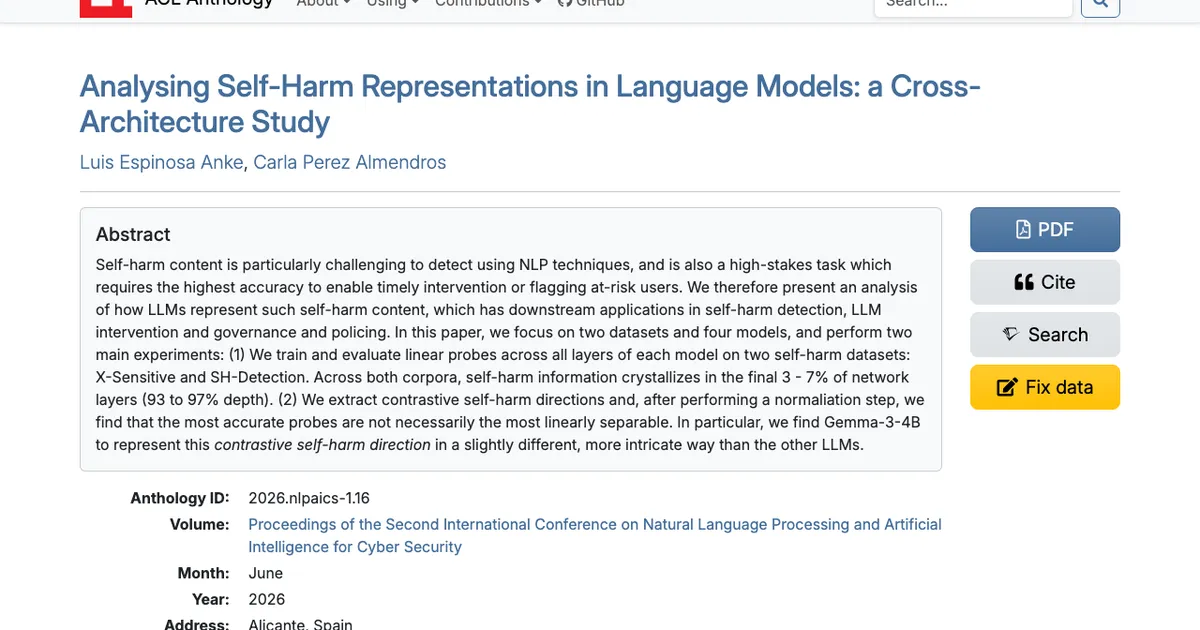
By Luis Espinosa Anke and Carla Perez Almendros in Proceedings of the Second International Conference on Natural Language Processing and Artificial Intelligence for Cyber Security • ACL Anthology • Importance: 90/100
Deconstructing Crisis Signals: How LLMs Encode Self-Harm Content
As AI models become deeply integrated into mental health support and content moderation, understanding how they internally represent highly sensitive topics—like self-harm—is not just academic; it’s critical for public safety. This research dives deep into the “brain” of Large Language Models (LLMs) to see exactly where and how dangerous signals are coded.
The Challenge: High Stakes NLP
The detection of self-harm content is one of the most challenging, high-stakes tasks in Natural Language Processing. Mistakes have profound real-world consequences, demanding exceptionally high accuracy for timely intervention. Simply flagging text isn’t enough; we need to understand why and where a model makes those determinations.
What Did the Researchers Find? (The Technical Dig)
The team in this study didn’t just test models on top of their outputs; they performed an unprecedented cross-architecture analysis, probing the internal representations across multiple layers within four different LLMs using two specialized datasets.
Here are the key takeaways that challenge how we thought about LLM understanding:
Location, Location, Crisis: Self-harm information isn’t evenly distributed. It consistently ‘crystallizes’ in a very specific, deep segment of the network layers—between 93% and 97% depth. This pinpoints exactly where the model seems to store or focus on these high-stakes concepts.
Beyond Simple Separability: The study found that the most accurate detection methods (the ‘probes’) aren’t always the easiest to measure linearly. In other words, sophisticated meaning isn’t always straightforwardly separated from surrounding noise.
Architecture Matters: Gemma Leads? Most remarkably, when examining the complex directions of self-harm content (called contrastive directions), they found that Gemma-3-4B represented this sensitive direction in a noticeably different and more intricate way compared to other state-of-the-art LLMs.
This suggests that model architecture plays a critical role not just in performance, but in the very mechanism of understanding difficult concepts. This is vital knowledge for governance and developing reliable intervention tools.
🌐 Implications for AI Safety & Governance
This research has massive implications for:
AI Intervention: Building safer LLM conversational agents that can recognize subtle warning signs.
Content Moderation: Developing more robust detection pipelines that look deeper than just surface-level keywords.
Model Auditing: Providing a blueprint for how external researchers and safety teams can audit the internal knowledge storage of proprietary models.
By Vojtěch Outrata, Barbora Štěpánková, Michael Adam Polák and Martin Kopp in Proceedings of the Second International Conference on Natural Language Processing and Artificial Intelligence for Cyber Security • ACL Anthology • Importance: 90/100
🧠 Command Obfuscation Detection: Catching Attackers in the Wild
As cyber threats become more sophisticated, attackers are constantly finding ways to bypass security tools. One common tactic involves command-line obfuscation: altering syntax and adding junk characters to make malicious commands look benign or unreadable.
But how do you build a defense that works against every variation? That’s the core problem addressed in this groundbreaking research.
💡 The Challenge: Obfuscated Code at Scale
Traditional security tools often struggle with command-line logs because they rely on recognizing specific patterns (signatures). Sophisticated adversaries know this and use obfuscation techniques to hide their tracks. Furthermore, real-world telemetry data is massive—we’re talking about billions of commands flowing in every second! When you combine high volume, constantly changing threats, and extreme class imbalance (where genuine attack examples are incredibly rare compared to normal logs), the problem becomes immensely challenging.
🚀 The Solution: Transformer-Powered Edge Detection
This paper introduces a scalable detection method designed specifically for this nasty challenge. Instead of relying on brittle rules or massive, slow models, the researchers optimized a custom small transformer-based model. This architecture is key because it achieves high accuracy—outperforming previous methods even in controlled, unbalanced settings—while maintaining low-latency inference required for real-world, high-volume data streams.
Key Takeaways for Security Professionals:
Scalability & Efficiency: The method is built to handle massive, continuous command logs without bogging down the system. Low latency is non-negotiable in incident response.
Robustness: By leveraging transformers trained on realistic telemetry, it can detect novel obfuscation patterns that simple signature matching would miss.
Real-World Validation: The model was tested against multiple days of diverse, high-volume command log data from real environments, proving its effectiveness far beyond a controlled lab setting.
🛡️ Why This Matters for SOC Teams (SOC/Cybersecurity)
The goal isn’t just detection; it’s reducing the crippling analyst workload. By providing highly accurate, efficiently-processed warnings about obfuscated commands, this model allows Security Operations Centers (SOCs) to focus their finite resources on genuine threats, dramatically improving mean time to detect (MTTD).
By Lei Yang, Mengyin Liu, Jia Wang, Hangyu Guo, Liang Zhao, Zheng Ge, Kang An, Binxing Jiao, Qi Han, Daxin Jiang, Siqi Shen, Xiangyu Zhang • arXiv • Importance: 88/100
Level Up Your LLM Data: Introducing onPanda for Efficient Annotation
The quality of data is the bedrock of advanced AI. For Large Language Models (LLMs) and embodied agents to move from impressive demos to reliable, real-world tools, they need vast amounts of high-quality, meticulously annotated alignment data. But annotation is notoriously slow, expensive, and requires massive human effort.
That’s where onPanda comes in. This innovative system fundamentally rethinks how we gather supervision for next-generation AI models, promising to slash the time and cost associated with manual data curation.
💡 How onPanda Works: Precision Annotation at the Token Level
Instead of having annotators write long drafts from scratch or spending hours performing tedious post-hoc edits (the typical approach), onPanda introduces an interactive, token-level correction loop.
Imagine you’re reading a model output that starts to veer off track. On Pando, you don’t just delete and rewrite the whole thing. You pinpoint the exact first incorrect token. Then, you choose a substitute from the model’s own candidate tokens or type in the exact correction needed via free-form editing.
Crucially, onPanda then truncates everything after that point and allows the generation to continue seamlessly from your corrected prefix. This precise ‘locate-correct-continue’ mechanism lets annotators steer model outputs with surgical precision and remarkable speed.
🚀 Why This Matters for AI Development
This isn’t just a neat trick; it solves multiple critical problems in LLM development:
Speed and Efficiency: Controlled studies show that onPanda reduces median annotation time by an astonishing 52% compared to manual post-editing. This dramatic efficiency boost means researchers can scale their data collection efforts dramatically.
Data Integrity (On-Policy Focus): Because the majority of the final response is generated by the model itself—you are correcting, not rewriting—the resulting training data largely preserves the original model’s sampling distribution. This makes the dataset ideal for constructing highly effective on-policy Supervised Fine-Tuning (SFT) and preference datasets.
Fine-Grained Supervision: The recorded token-level corrections provide granular supervision with precise positional information, naturally generating perfectly paired positive/negative samples that are invaluable for advanced fine-tuning techniques.
Agentic Capabilities: onPanda goes beyond text. It connects to external tools and harnesses, allowing for interactive trajectory annotation in realistic, complex agent environments—a huge leap toward grounding AI in the real world.
📚 Dive Deeper with Panda-CVL
To help the community adopt this method, the authors have released Panda-CVL, a foundational dataset annotated using onPanda, alongside a new benchmark specifically for token-level correction. This solidifies its place as an essential tool in the LLM and Agentic AI research toolkit.
Conclusion: For anyone working with LLMs, RLHF data generation, or embodied agents, onPanda represents a paradigm shift from tedious manual annotation to efficient, high-fidelity, and scalable supervision. It’s a must-know breakthrough for advancing responsible and robust AI.
🚀 When Models Get Smarter: Introducing Self-Evolving AI Forecasts
The field of time-series forecasting is ripe for a major upgrade. Traditional models treat data as static; they predict based on what was. But in the real world—think dynamic markets, evolving climate patterns, or unpredictable resource consumption—the underlying system itself changes over time. This calls for an AI agent that doesn’t just predict, but one that actively learns from its own mistakes and successes after the fact.
This is the core breakthrough presented in TimEvolve: a novel approach that turns every realized outcome into structured learning signals for the forecasting policy itself.
🧠 The Problem: Static Prediction vs. Dynamic Reality
Most time-series agents rely on iterative refinement (like reviewing past forecasts or retrieving similar historical data). While useful, they treat feedback only as a refinement signal. They don’t systematically update the core decision-making logic—the joint orchestration policy—that determines which expert model to trust and how to combine their outputs when faced with future uncertainty.
The paper When Tomorrow Becomes Today: Self-Evolving Policies for Agentic Time-Series Forecasting highlights that the richest, most valuable supervision comes from the delayed feedback mechanism inherent in deployment. When a forecast is made today (Predict), and the true value arrives next week (Reveal), that gap allows for a comprehensive evaluation of all potential choices made earlier.
✨ The Solution: TimEvolve’s Adaptive Learning Loop
TimEvolve tackles this by implementing a specialized ‘predict, reveal, and update’ protocol. Instead of just adjusting the forecast based on past data points, it systematically converts the realized outcome (the ground truth) into persistent updates for three critical components:
Expert Trust Weights: How much faith should the system place in each contributing numerical model?
Agent Path Selection: Which sequence of reasoning steps or models should be prioritized?
Intervention Strength: How heavily should external rules or interventions influence the final prediction?
In simpler terms, TimEvolve doesn’t just say, ‘I was wrong.’ It says, ‘Based on this failure/success, I will systematically rewire my internal decision-making process to perform better next time.’
The system is designed as a frozen-backbone agent, meaning its core architecture remains stable while its high-level, policy layer continuously evolves and adapts based on real-world deployment data.
📈 Why This Matters for AI Deployment (The Impact)
Testing TimEvolve across eight challenging Time-MMD domains revealed superior performance. It achieved the best average MSE and MAE ranks among fifteen state-of-the-art methods, significantly outperforming existing agentic forecasting techniques.
This work is foundational because it shifts the paradigm from forecasting to adaptive decision optimization. As AI agents become more critical in high-stakes domains—from financial trading and supply chain management to predictive healthcare—the ability to systematically learn from delayed, large-scale outcomes is paramount. TimEvolve shows how to build systems that don’t just predict the future, but actively learn how to navigate its uncertainties.
By Sebastian George Sincari, Bogdan Alexandru Gheorghe, Antonio Barbalau • arXiv • Importance: 88/100
The Geometry of Memory: How Muon Changes Continual Learning
If you’ve been deep in the world of machine learning optimization, you’ve heard about catastrophic forgetting—the dreaded problem where a model, trained on Task A, forgets everything it learned for Task B when it moves on. This is arguably one of the biggest hurdles in deploying real-world AI systems.
Traditional solutions often use clever regularization techniques within the loss function (like ELLA or O-LoRA) to penalize updates that overlap too much with past knowledge. The core idea: don’t change things you already know!
But what if the problem isn’t the size of the update, but its direction? This paper introduces a paradigm shift by coupling Low-Rank Adapters (LoRA) with an optimizer called Muon.
💡 The Muon Advantage: Spreading the Update Energy
The researchers ask a fundamental question: Do we need complex, task-specific loss functions to control weight updates? Or can a simple, generic mechanism provided by the optimizer do the job?
LoRA is already popular for efficiency—it significantly shrinks the number of parameters needed while maintaining performance. By incorporating Muon, which orthogonalizes each update, the method (IncLoRA+Muon) fundamentally changes the geometry of how weights are updated.
The key finding, and frankly, surprising takeaway, is that Muon drastically alters where the model allocates its change energy. While standard optimizers like AdamW confine updates to a small number of effective directions (e.g., 1.4 to 1.8 singular directions), Muon spreads this update over many more—up to 7.0.
This massive difference in distribution is what gives the boost in performance, outperforming dedicated methods on key benchmarks like Standard CL and TRACE Learn about IncLoRA+Muon.
Key Takeaways for ML Engineers:
Optimizer Matters More Than You Think: The paper suggests that the dedicated mechanisms usually implemented in Continual Learning methods might be mitigating a geometric issue stemming from the optimization process itself. A simpler, orthogonal update constraint can provide comparable—or even superior—performance.
Simplicity Wins (Maybe): For some tasks, adding multiple constraints doesn’t help; it actually degrades performance. This suggests that optimizing the core mechanism is key, not stacking ad-hoc fixes.
The Power of Geometry: The advantage isn’t just a bigger update signal; it’s how that signal is spread across weight space. Muon changes the underlying geometry, allowing greater capacity for new knowledge without conflicting with old memories.
This work opens up intriguing avenues for developing next-generation, highly efficient continual learning models by shifting focus from complex loss function engineering to deeper understanding of optimization geometry and update mechanisms.
The Challenge: Predicting energy load isn’t just about analyzing time series; it’s inherently spatial. When forecasting electricity consumption across a region, you must consider the complex, interconnected relationships between substations, feeders, and geographical zones. Traditional Machine Learning (ML) approaches treat these signals in isolation, completely missing the crucial ‘graph structure’ that governs energy flow.
Adding to this complexity, the current state-of-the-art for Graph Neural Networks (GNNs) forecasting is notoriously fragmented. Researchers spend enormous amounts of time manually stitching together data loaders, graph builders, model wrappers, and interpretability tools—often using incompatible libraries. It’s a workflow nightmare.
✨ The Solution: GraphToolbox
We’re excited to dive into GraphToolbox, an open-source Python framework designed to finally unify the entire GNN forecasting workflow. If you work in energy systems, smart grids, or any domain involving complex relational data, this tool changes everything.
Built on PyTorch Geometric, GraphToolbox provides a single, configuration-driven pipeline that manages everything from graph construction to advanced interpretation. Here’s what makes it indispensable:
Comprehensive Connectivity: It includes adapters for training 51 of the 65 available PyTorch Geometric convolutions, offering an unprecedented breadth of model selection.
Full Lifecycle Management: The framework handles data-driven graph creation, complex recurrent cell integration (via PyTorch Geometric Temporal), and advanced forecasting techniques like online expert aggregation.
Interpretability Built-In: More than just a prediction, GraphToolbox offers tools for interpretability and significance testing on cached forecasts, helping researchers understand why the model made certain decisions.
⚡️ Performance Deep Dive: What Does It Mean in Practice?
The paper evaluates GraphToolbox across two challenging case studies. The results are highly compelling:
French Regional Load: In a full forecasting sweep of 48 convolutions, the resulting error rate was low (1.14%–1.60%). By applying online aggregation, this figure dropped significantly to 0.98%. Crucially, even when comparing these advanced graph models against classical methods (like additive or boosting baselines), the framework allows for systematic architectural evaluation, clearly defining where GNNs add value and where simpler models suffice.
Systematic Evaluation: The ability to use a single experimental interface to compare direct graph predictions vs. component-wise improvements showcases GraphToolbox’s power: it enables rigorous, apples-to-apples comparison—the gold standard for ML research.
🚀 Why This Matters for the Industry (SEO Focus)
For engineers and data scientists in France, the EU, or any smart grid location, optimizing energy forecasting is critical for grid stability and managing renewable intermittency. Previously, this deep research was slowed by tool incompatibility. GraphToolbox accelerates the cycle from hypothesis to verifiable model improvement, accelerating global clean energy transitions.
Key Takeaway: If your project requires rigorous, reproducible analysis of spatiotemporal data on interconnected networks (like power grids), ditch the ad-hoc scripts. Adopt a standardized pipeline with GraphToolbox!
By Hyukjun Yang, Jongchan Park, Narim Jeong, Donghwan Lee • arXiv • Importance: 88/100
Rethinking Offline RL: Introducing Lifted Bellman Linear Programming
The challenge of Offline Reinforcement Learning (RL)—training agents using only pre-collected data without any live interaction with the environment—remains a major hurdle in AI. Standard methods often rely on minimizing regression losses against bootstrapped value targets, which can be unstable, especially when dealing with multi-step targets and off-policy corrections.
Researchers have tackled this problem by imposing Bellman optimality using standard critics. However, these approaches often struggle with the instability introduced by target networks (like Exponential Moving Averages or EMA) and complex off-policy corrections.
We introduce a fundamentally different approach: Lifted Bellman Linear Programming (LBLP). Instead of regression targets, LBLP formulates Bellman optimality constraints as linear inequalities directly on the critic’s $(Q, V)$ space. This is a game-changer because every single constraint only involves state-action pairs that actually exist in your dataset.
🧠 How Does LBLP Revolutionize Offline RL?
Data Fidelity: By constraining the problem using in-sample Bellman optimality, we ensure our critic is perfectly grounded in the available data, eliminating reliance on potentially misleading bootstrapped targets.
Stability & Simplicity: LBLP inherently avoids the complex mechanism of target networks and EMA updates. Its minimization objective is clean and stable. This dramatically simplifies training and reduces memory footprint.
Generalization: The constraints hold true for any rollout policy and horizon, meaning the core logic doesn’t break down as you change how far into the future you plan.
🚀 ALBUM: Making LBLP Practical
The paper details an approximation called Approximate Lifted Bellman Unconstrained Minimization (ALBUM). This method implements LBLP using neural networks by relaxing the strict linear constraints into hinge penalties. Crucially, this allows us to achieve the stability of LBLP while fitting it to modern deep learning architectures.
The results on the OGBench benchmark are highly promising: ALBUM achieves average performance matching state-of-the-art methods like FQL, all while using significantly fewer parameters and demanding less peak GPU memory. This makes high-performance offline RL accessible even on resource-constrained hardware.
💡 Key Takeaways for Practitioners
The shift from regression-based target learning to constraint-based optimization marks a significant maturation of the field. If you are building safety-critical or data-heavy AI systems (e.g., robotics, autonomous vehicles), adopting an approach that minimizes divergence from observed data is critical.
By Anne-Christin Hauschild, Amirreza Aleyasin, Nils H. Beyer, Lisa Fricke, Jonas Hügel, Maryam Moradpour, Anh-Tien Nguyen, Youngjun Park, Sophia Rheinländer, Tim Beissbarth, Elisabeth Hessmann, Martin Middeke, Matthias Lauth, Maximilian Reichert, Ulrich Sax • arXiv • Importance: 85/100
🧠 Revolutionizing Cancer Care: How Federated AI is Reshaping Pancreatic Diagnosis
The challenges of medical data privacy and interoperability are some of the biggest bottlenecks in developing cutting-edge diagnostic tools. Traditionally, achieving high accuracy requires centralizing massive datasets—a process hampered by strict regulations like GDPR.
But what if we could build powerful AI models using sensitive patient data across multiple hospitals without ever moving the data? Enter Federated Learning (FL).
Our latest research demonstrates a robust framework for applying FL to optimize pancreatic cancer treatment strategies. This isn’t just theoretical; it outlines a practical, implementable pipeline ready for real-world deployment across participating clinical sites.
🔬 The Problem and the Solution
Pancreatic cancer diagnosis requires highly specialized data—ranging from genomic markers to advanced pathology reports. Centralizing this sensitive information is legally complex (think GDPR) and ethically challenging. Our approach tackles this head-on by using FL: instead of pooling data, we send a ‘learning engine’ (our local Docker container) to each hospital’s secure server. The models learn locally at the site, and only the aggregated insights (the updates/weights) are shared back—keeping raw patient data entirely private.
✨ Key Breakthroughs in This Study
Solving the Data Silo Challenge: We successfully implemented a sophisticated FL pipeline that integrates diverse datasets from multiple sites, even when those datasets contain partially overlapping features. This is crucial because real-world hospital data rarely fits perfectly into clean buckets.
Operationalizing AI Ethics: We’ve not only designed the algorithm but also addressed the major non-technical hurdles: securing operational concepts for IT infrastructure, navigating ethics approvals for novel AI architectures, and establishing workflows across multiple institutions. This grounded approach brings FL closer to clinical reality.
Leveraging Core Data: Our framework proposes utilizing the German oncology core data set (oBDS), a system already mandatory for cancer registry reporting. By anchoring our work in an existing, compliant infrastructure, we significantly streamline future scaling and adoption.
By Qing Yao, Lijian Gao, Qirong Mao • arXiv • Importance: 85/100
Decoding the Training Trap in Generative Speech: Introducing Corrective Forcing
As AI models tackle more complex tasks like real-time speech enhancement, we’ve seen remarkable advancements with Diffusion and Flow models. These generative paradigms have shown incredible promise for recovering high-fidelity audio from noisy signals.
However, under the hood lies a critical flaw that many researchers—and engineers building these systems—are currently overlooking: the Training-Inference Mismatch.
🤯 The Problem Explained: Why Doesn’t It Work in Practice?
The current methodology trains these sophisticated generative models using clean, idealized analytical paths. But when you actually use them (the inference phase), they must generate audio step-by-step, relying on self-generated rollout states along a discretized trajectory. This recursive process means small prediction errors accumulate drastically—like rounding errors compounded over hundreds of steps—leading to degraded perceptual quality and poor reconstruction fidelity.
This abstract introduces Corrective Forcing (CoF), a revolutionary post-training approach designed to bridge this gap and make these powerful models truly robust in real-world applications.
✨ How Corrective Forcing (CoF) Fixes the Flaw
The core idea of CoF is simple yet profound: instead of only training on idealized paths, we force the models during post-training to learn directly from these challenging self-generated rollouts. Essentially, it teaches the model how to correct its own predictions dynamically.
Self-Correction Learning: CoF regularizes the process by having the model correct clean speech predictions on actual rollout states toward the ground truth, adjusting for dynamic sampling schedules. This exposure ensures robust performance regardless of the number of steps used.
Local Fidelity Enhancement: It further stabilizes the system by using locally corrected counterfactual transitions as references for factual transitions, ensuring high local fidelity at every step.
Unified Architecture: Crucially, CoF achieves this using a shared clean-speech prediction parameterization, allowing it to apply the same effective post-training objective seamlessly across both Diffusion and Flow formulations.
🚀 Real-World Impact: What Does This Mean for Audio AI?
The results presented in Corrective Forcing: Unified Post-Training for Diffusions and Flows in Generative Speech Enhancement are highly encouraging. Demonstrations using popular datasets like SB-VE show measurable improvements in both perceptual quality (how good it sounds to a human) and reconstruction fidelity (how accurately the signal is recovered). This significantly boosts the reliability of generative speech enhancement systems, making them ready for deployment in demanding fields like telecommunications and medical monitoring.
Are you building next-generation voice technology? Understanding this ‘training trap’ is key to achieving production-level audio AI.
By Lea L. Mairhöfer, Silke Szymczak, Björn-Hergen Laabs, Tuwe Löfström-Cavallin • arXiv • Importance: 85/100
Beyond the Black Box: How Artificial Trees Unlock Stable, Interpretable ML
The core tension in machine learning remains: do you want incredible predictive power (often requiring complex ‘black box’ models like Random Forests), or do you need crystal-clear interpretability? Usually, achieving both means sacrificing performance. But what if we could build a model that keeps the interpretability of a simple tree while giving it the stability and rigor needed for real-world decision-making?
The current landscape forces us into uncomfortable choices:
Random Forests (RFs): Powerful, but completely opaque. Understanding why a prediction was made is nearly impossible. They are black boxes.
Single Decision Trees: Highly interpretable—you can draw the decision path and understand it step-by-step. However, they are notoriously unstable; small changes in data can cause massive shifts in the resulting structure (high variance).
This instability makes them unreliable for critical applications where consistency is key.
✨ The Solution: ARTs + Conformal Prediction
The authors introduce a sophisticated pairing of techniques to solve this dilemma:
Artificial Representative Trees (ARTs): These are designed as interpretable surrogates for the powerful but opaque Random Forests. They provide a structural bridge, making RF-like performance more visible and understandable.
Leaf-wise Mondrian Conformal Predictive Systems (CPS): This advanced system wraps the ART structure, allowing it to do much more than just give a single prediction point. It provides:
Calibrated probabilities of hitting specific thresholds.
The Synergy: By combining ARTs and CPS, the researchers create a single model that is interpretable, structurally stable, and provides rigorous uncertainty quantification. This is the Holy Grail for many industries.
🔬 What Did They Find? (Key Takeaways)
The study rigorously tested their proposed system against standard decision trees, multi-model approaches, and separate regression/probability models across numerous datasets. The results were compelling:
Stability & Reproducibility: ARTs with CPS yielded compact, structurally stable trees with substantially more reproducible split-variable selection than traditional single decision trees.
Calibration & Confidence: Across benchmark datasets and even a cross-sectional NHANES example dataset, the combined approach showed strong reliability. Furthermore, they achieved lower and less variable Brier scores than complex multi-model setups.
The Balance Act: While standard decision trees might edge out slightly on pure predictive performance or narrowest intervals, the ART/CPS method demonstrated a superior balance of reproducibility, stability, and transparency.
💡 Why Should You Care? (SEO Focus)
In high-stakes domains—like medicine, finance, or regulatory compliance—knowing that an outcome will happen is less useful than knowing how likely it is and why the model arrived at that conclusion. The ART+CPS framework makes advanced machine learning results accessible, reliable, and trustworthy.
Bottom Line: If you are building models where stability, interpretability, and accurate uncertainty estimates are non-negotiable, this approach offers a significant leap forward over traditional single trees or opaque black boxes.
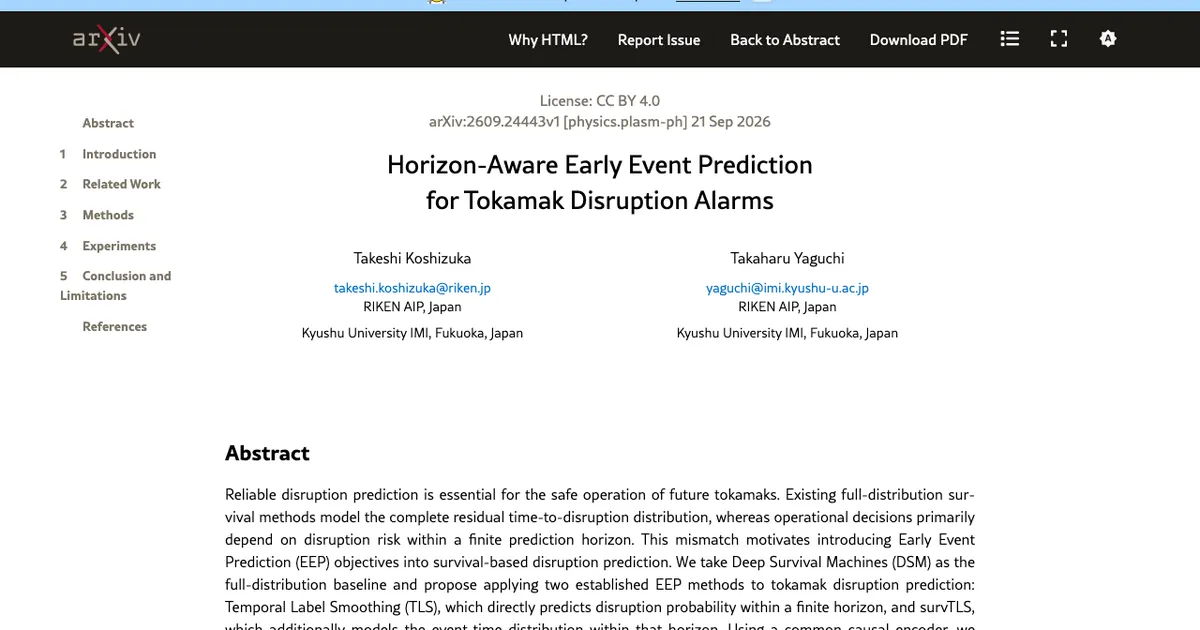
By Takeshi Koshizuka, Takaharu Yaguchi • arXiv • Importance: 85/100
🚀 Predicting Plasma Meltdowns: A New Era for Fusion Energy Safety
Are we one step closer to clean fusion power? The answer depends critically on managing the volatile physics inside massive tokamaks. When a tokamak undergoes a disruption—a sudden loss of confinement and plasma energy—it’s dangerous, damaging, and must be predicted reliably.
Our latest research dives into how to predict these critical events much earlier and more accurately. Traditional models often try to forecast the entire time-to-disruption distribution, which is overkill for operational safety systems. The real question isn’t ‘when will it happen?’ but ‘what is the risk by this specific minute?’
🕰️ The Problem with Time: Why Horizon Matters
Existing disruption prediction methods (like Deep Survival Machines) try to model the entire residual survival time distribution. While mathematically comprehensive, operational control systems only care about the probability of failure within a practical, finite ‘prediction horizon.’ This mismatch has been a critical bottleneck in deployment.
In this paper Horizon-Aware Early Event Prediction for Tokamak Disruption Alarms, we tackle this gap by introducing Early Event Prediction (EEP) objectives into the prediction framework. This means training models not just on overall survival, but specifically on the probability of an event occurring within a predefined time window.
✨ Our Approach: Focusing on Near-Term Risk
We leveraged Deep Survival Machines (DSM) as our baseline and applied two advanced EEP techniques:
Temporal Label Smoothing (TLS): This method directly trains the model to estimate disruption probability within a fixed, finite window of time—perfect for real-time alarms.
survTLS: A more complex approach that attempts to model both the overall event-time distribution AND the detailed event-time probability within that specific window.
By comparing these techniques across data from major fusion devices (DIII-D, Alcator C-Mod, and EAST), we demonstrated which prediction strategy best translates into reliable, deployable warning signals.
💡 Key Findings for Fusion Safety
Our rigorous evaluation revealed some critical insights:
The Horizon Focus Wins: Temporal Label Smoothing (TLS) achieved the best mean alarm performance on DIII-D and EAST. This suggests that directly predicting the overall risk within a limited window is more effective than attempting to model complex, detailed event distributions inside that window.
Device Specifics Matter: The optimal prediction horizon and encoder architecture are not universal. Disruption characteristics vary significantly across different tokamaks (e.g., DIII-D vs. Alcator C-Mod), necessitating device-specific tuning for maximum safety impact.
Practicality First: While complex modeling is appealing, operational simplicity often dictates success. The results guide engineers toward the most practically robust prediction method suitable for real-world fusion reactors.
🌍 Impact on Fusion Energy and Geo-optimization
Safer tokamaks are prerequisites for commercially viable fusion power plants (e.g., ITER, DEMO). By providing more reliable, early warning systems for disruptions, this research significantly accelerates the path toward safe commercial fusion energy production globally. The models we validate can inform operational procedures in next-generation reactors and contribute to global efforts in plasma physics research.
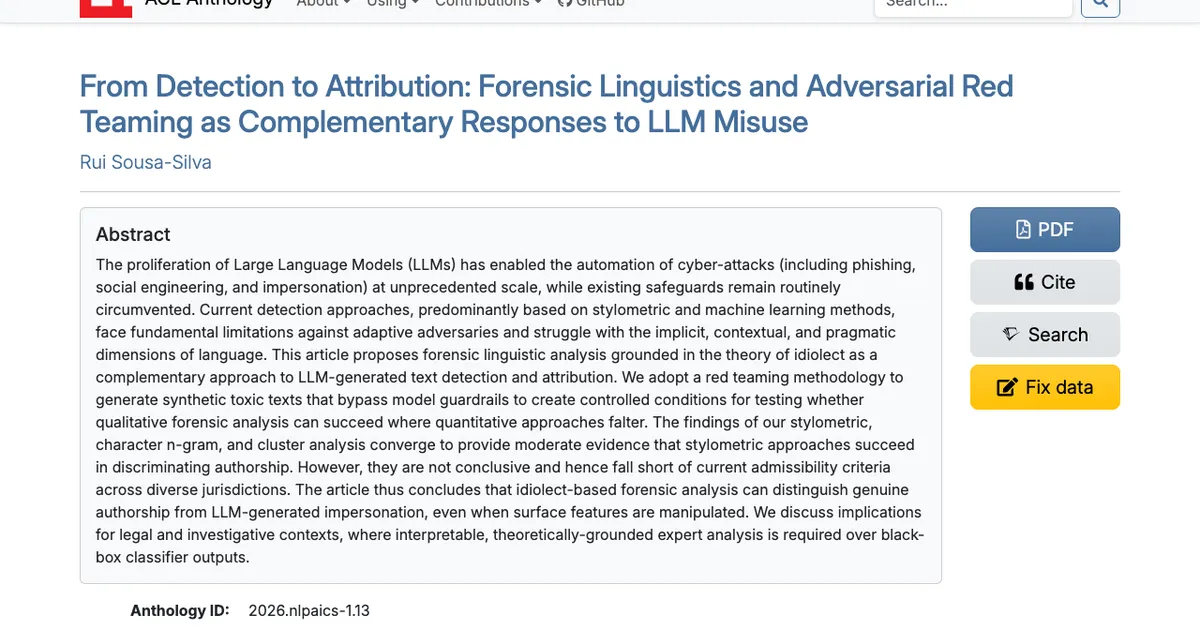
By Rui Sousa-Silva in Proceedings of the Second International Conference on Natural Language Processing and Artificial Intelligence for Cyber Security • ACL Anthology • Importance: 85/100
🚨 LLM Misuse: How to Prove Who Wrote It When the AI is a Master Impersonator
The rapid advancement of Large Language Models (LLMs) has fundamentally changed the threat landscape. While these tools power incredible innovation, they also empower cybercriminals to automate attacks—think hyper-realistic phishing campaigns, sophisticated social engineering, and mass impersonation—at an unprecedented scale.
Existing detection methods are struggling. Most current safeguards rely on quantitative analyses (like spotting generic ‘AI patterns’ or analyzing character frequency), but these fail spectacularly when faced with adaptive adversaries who know exactly what they are looking for.
🔬 The Blind Spot of Current Detection
The core problem, as highlighted in the latest research from NLP AI for Cyber Security Forensic Linguistics and Adversarial Red Teaming, is that current models are often ‘black boxes.’ They give a score of probability, but they don’t tell investigators why the text is fake or who the real author is.
This paper introduces a critical pivot: moving beyond mere detection to attribution. Instead of asking, ‘Is this text AI-generated?’ it asks, ‘Does this text sound like this specific person?’
🔑 Introducing Forensic Linguistics and Idiolect
Researchers propose adopting forensic linguistics, specifically focusing on the theory of idiolect. An idiolect is an individual’s unique linguistic fingerprint—the subtle combination of vocabulary choices, grammatical tendencies, rhythm, and typical phrasing that makes their writing unmistakably theirs.
By applying a controlled red teaming methodology (generating synthetic toxic texts designed to bypass model guardrails), the authors test if this deep, qualitative human analysis can succeed where purely mathematical/stylometric approaches fall short.
The Takeaway: While quantitative methods show some promise in identifying authorship patterns, the study concludes that traditional stylometrics are not yet sufficient for legal admissibility. However, they argue persuasively that a theoretically-grounded, expert forensic analysis based on idiolect provides a powerful means to distinguish genuine human intent from sophisticated LLM impersonation, even when surface features have been heavily manipulated.
💡 What This Means for Security Professionals and Legal Teams
For the cybersecurity industry, this research points toward a necessary shift: detection tools must eventually incorporate expert-level linguistic analysis. For legal teams and forensic investigators, it reinforces that technical classification scores alone are insufficient; they require interpretable, human-expert judgment anchored in deep linguistic theory.
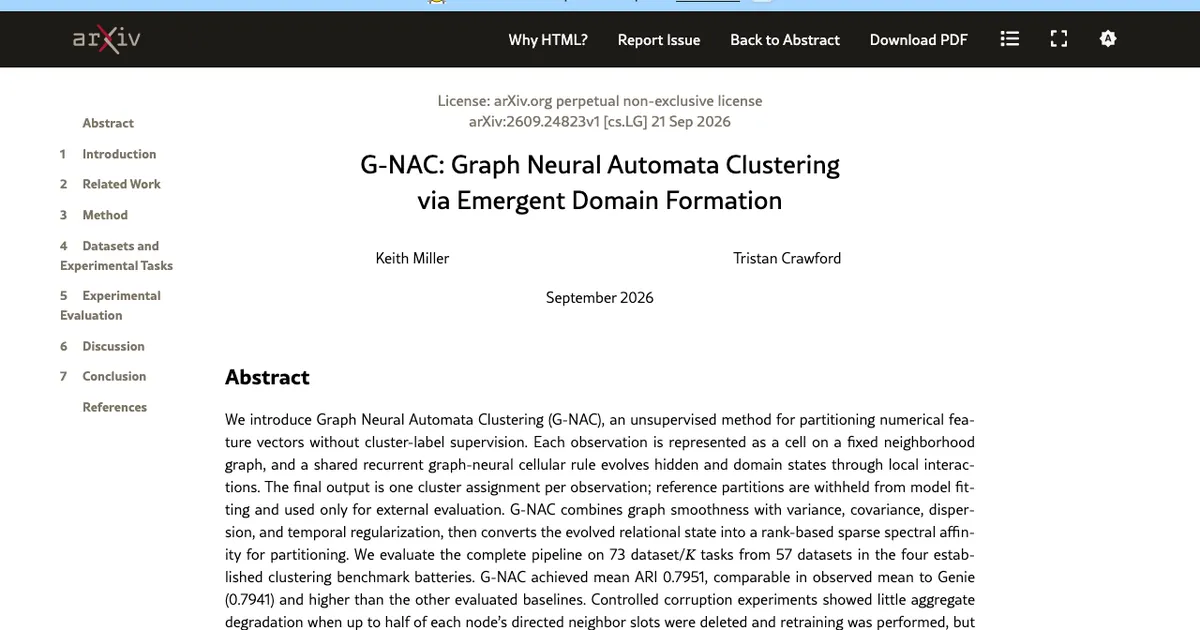
By Keith Miller, Tristan Crawford • arXiv • Importance: 80/100
🤖 Unlocking Hidden Structure: Introducing G-NAC for Advanced Graph Clustering
The world of data is increasingly represented by complex relationships—think social networks, molecular interactions, or citation graphs. Traditional clustering methods often struggle to capture the dynamic, local dependencies inherent in these graph structures. Enter G-NAC (Graph Neural Automata Clustering), a powerful new unsupervised technique designed to breathe life into your relationship data.
✨ How G-NAC Works: From Nodes to Latent Domains
G-NAC treats every observation as an interconnected cell on a fixed neighborhood graph. Instead of static analysis, it introduces a shared recurrent graph-neural cellular rule. This rule allows the system to evolve ‘latent domain states’ through continuous local interactions. Essentially, the model learns how local patterns propagate across the entire network over time, pinpointing inherent groupings that might be invisible using standard techniques.
This dynamic process is then converted into a rank-based spectral affinity score, which reliably partitions the complex graph data into meaningful clusters.
🏆 Why G-NAC Matters (The Results Speak for Themselves)
Testing across 57 diverse benchmark datasets and 73 varied clustering tasks, G-NAC achieved an impressive mean adjusted Rand Index (ARI) of 0.7951. This performance places it on par with state-of-the-art methods like Genie, while significantly outperforming most evaluated baselines.
What’s truly exciting are the practical implications:
* Scalability: The training time and GPU memory scale linearly, making it viable for large graphs (up to 100,000 nodes).
* Transfer Learning: Crucially, G-NAC demonstrates robust knowledge transfer. Transition rules learned on small source graphs can successfully generalize to completely independent, massive target samples.
These findings solidify a powerful new paradigm: modeling clustering as a recurrent graph cellular automaton. This doesn’t just improve scores; it suggests a more fundamentally rigorous way of analyzing complex data systems.
🚀 For Researchers and Engineers in Korea & Asia:
If your work involves advanced time-series analysis, network science, or drug discovery using molecular graphs, G-NAC offers a significant architectural upgrade. Its focus on local interaction dynamics is highly relevant for solving geospatial clustering (e.g., market segmentation in Seoul) or complex biological graph partitioning.
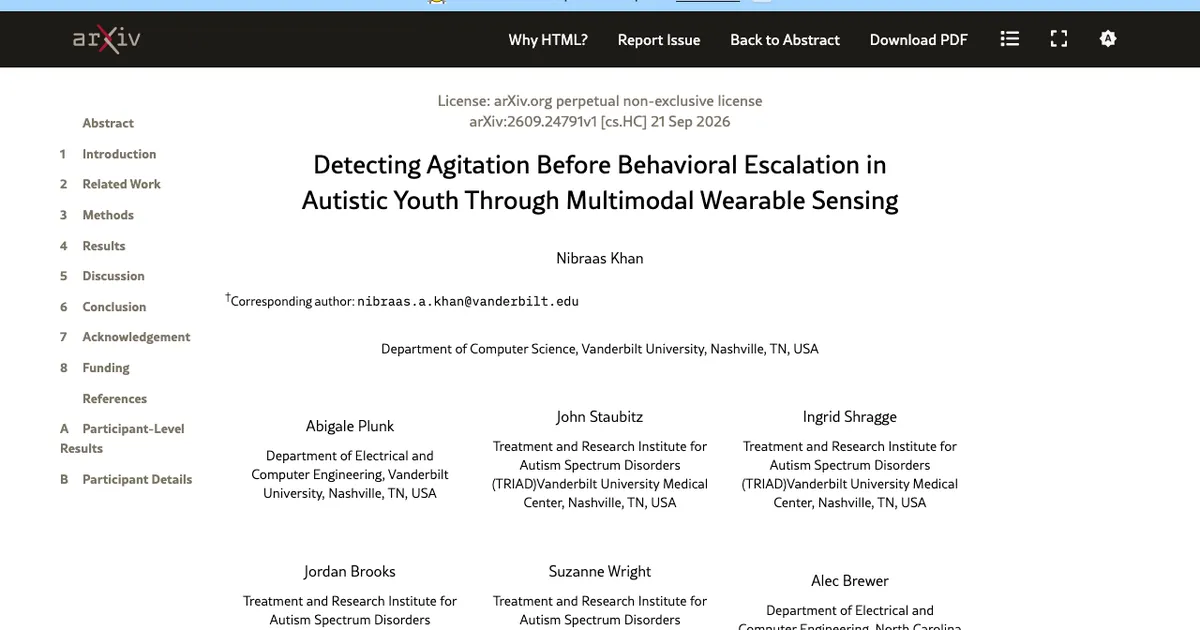
By Nibraas Khan, Abigale Plunk, John Staubitz, Ingrid Shragge, Jordan Brooks, Suzanne Wright, Alec Brewer, James Dieffenderfer, Alper Bozkurt, Amy Weitlauf, Nilanjan Sarkar • arXiv • Importance: 80/100
Predicting the Storm: Detecting Agitation in Autistic Youth with Wearable AI
The challenge of challenging behaviors—such as aggression or self-injury—in autistic youth is massive, affecting up to two-thirds (68%) of this population. But here’s the critical insight: these destructive episodes are rarely sudden. They are almost always preceded by a rising state of distress called agitation.
Detecting agitation before it escalates requires spotting subtle signs—shifts in movement, changes in voice tone, or autonomic arousal signals that might be invisible to the naked eye. Traditional methods struggle because these signs are highly personalized and often occur without explicit warning.
This groundbreaking study tackles this problem head-on using a multimodal approach powered by advanced foundation models. The researchers collected comprehensive data from 15 autistic youth across 30 clinician-led sessions, capturing not just what they did, but how their bodies moved (using Inertial Measurement Units), the physiological changes in their wrists, and their vocalizations (via lapel mics).
🧠 How the AI Works: Multimodal Fusion
The core innovation lies in adapting advanced, pre-trained foundation models to each data stream—movement, physiology, and audio. Instead of treating them separately, they project these diverse signals into a shared mathematical space (128 dimensions) before being fused together by a single group model. This holistic approach allows the AI to learn complex correlations between seemingly unrelated signs.
The Results? Highly Promising.
When tested on clinician-annotated onset periods, the system achieved an Area Under the ROC Curve (AUC) of 0.724. Crucially, the performance remained robust even when predicting agitation further out—declining only modestly to 0.608 at a 30-second pre-onset window. This demonstrated that personalized agitation detection is feasible and reliable.
Why this matters for real life:
1. Early Intervention: Predicting distress before escalation gives caregivers, educators, and medical professionals precious minutes—a window crucial for de-escalation strategies (e.g., sensory breaks, redirection) while the crisis is still mild.
2. Personalization: The model excels at capturing individualized agitation patterns, suggesting that a single, adaptable model can be effective even if each child’s presentation is unique.
3. Multimodal Power: The findings emphasize the importance of combining multiple data types; the study found that audio contributed the most signal, while wearable movement monitoring was essential for comprehensive coverage.
This research offers tangible proof-of-concept for developing non-invasive, continuous monitoring tools. It moves us closer to personalized care plans powered by advanced AI and wearable technology, potentially transforming daily support structures for autistic youth.
By Jule Budnick, Andrew Keane, Serhiy Yanchuk • arXiv • Importance: 80/100
Predicting the Unseen: Next-Generation Reservoir Computing Tackles Climate and Chaos
The ability to predict unknown components in complex systems—whether they are governed by simple mathematical chaos or massive global datasets like climate records—is one of the grand challenges of modern scientific computing. How do we build models that don’t just fit observed data, but truly infer the underlying, hidden dynamics?
Our latest work introduces and validates Next-Generation Reservoir Computing (NGRC), a powerful, data-driven method designed for this precise task: inferring unseen dynamical components of complex systems.
🧠 What is Reservoir Computing? The Power to Model Chaos
Reservoir Computing (RC) is an artificial neural network technique that excels at processing time-series data and modeling dynamic systems. It’s a
By Trinh T. L. Vuong, Simon Graham, Quoc Dang Vu, Phat T. H. Ho, Jeewoo Lim, Mostafa Jahanifar, Nasir Rajpoot, Jin T. Kwak • arXiv • Importance: 80/100
✨ AI in Pathology: Analyzing Mitotic Figures with MiTHras
As deep learning models revolutionize healthcare, one critical bottleneck remains: how do we build AI systems that can generalize across different patient cohorts and hospital equipment? When analyzing complex biological structures like mitotic figures (MIFs) – which are vital for grading tumors—standard general-purpose models often fall short.
Our latest work introduces MiTHras, a novel, task-specific framework designed to tackle this challenge head-on. It’s not just another encoder; it’s an entire pretraining ecosystem optimized specifically for the intricacies of mitotic figure analysis.
💡 The Problem with General Models (And How MiTHras Solves It)
Mitotic figures are crucial biomarkers used by pathologists to grade and predict tumor aggressiveness. However, existing deep learning models trained on general medical images often struggle when deployed in real-world settings because they are highly sensitive to variations in tissue type, stain variations, or how the image was acquired (a common issue called ‘domain shift’).
MiTHras solves this by implementing a sophisticated pretraining strategy. It uniquely combines three powerful techniques:
Contrastive Learning: By comparing masked image segments and corresponding tokens, MiTHras learns robust representations that distinguish true biological signals from noise.
Pseudo-label Guidance: This guides the learning process using initial predictions, boosting performance even in semi-supervised settings.
Masked Reconstruction: It forces the model to predict missing parts of the image (like filling in gaps), improving overall contextual understanding.
🔬 What Makes MiTHras Powerful?
We trained MiTHras on an massive, meticulously curated corpus: TCGA-MF-Pseudo, comprising 1.8 million cell-centered images sourced from 14 diverse TCGA cohorts across 11 different organ sites. This sheer scale and diversity make the resulting model highly transferable.
Our comprehensive evaluation validates its superiority across multiple tasks:
* Classification: Achieved the highest mean F1 scores on three distinct mitotic figure classification benchmarks.
* Subtyping & Grading: Demonstrated superior performance in both subtype classification and survival prediction compared to existing methods.
* Generalization Power: Crucially, MiTHras outperformed general-purpose foundation encoders even when tested under linear probing (a stringent test of representation quality), showing that its specialized training yields truly robust features.
For researchers and clinicians: This work establishes a new gold standard for automated mitotic activity assessment, providing highly transferable representations that drastically improve reliability in clinical settings.
By Tianshuo Zhang, Xianglei Xing, Aowen Yang, Jia Gao, Wenzhe Zhai, ShanShan Liu • arXiv • Importance: 80/100
Better Sea Ice Predictions: Introducing ECHO for Accurate Forecast Correction
Ever wonder how scientists predict the state of the planet’s massive ice sheets? Forecasting sea ice concentration (SIC) is mission-critical, helping us understand climate change impacts and global cryosphere dynamics. But here’s the challenge: models are run days in advance when observations are sparse, leading to errors that accumulate.
New research from Zhang et al. tackles this core issue by proposing a novel framework called ECHO (Evidence-guided Correction with Heterogeneous prOpagation).
🔬 The Problem: Error Accumulation at Ice Edges
Traditional sea ice forecasting models assume fixed error propagation—meaning the way an error evolves doesn’t depend on the local conditions. However, reality is far more complex. As this paper reveals, errors tend to build up most severely near sharply defined features, like the edges of dense ice fields (high-gradient zones). Meanwhile, in the homogenous interiors, less extrapolation is needed.
This suggests that the error propagation distance shouldn’t be fixed; it must adapt based on the local state of the sea ice.
💡 The Solution: ECHO (Adaptive Correction)
The authors introduce a sophisticated two-pronged system:
ECHO-Scale: This module revolutionizes how we handle geometry. It dynamically adjusts the propagation distance, ensuring that the correction process preserves the fine details and overall shape of the ice structure—a major leap in robustness.
ECHO-Delta: This module focuses on learning a constrained residual (the difference between prediction and observation) specifically around the fixed initial propagation area. By constraining this error space, it significantly boosts local accuracy.
Together, they create an end-to-end system that adapts its predictions not just based on available data points, but based on where those points are relative to the ice structures themselves.
🚀 Why This Matters for Climate Science & AI
This isn’t just a niche climate model improvement; it sets a new standard for spatio-temporal forecasting in complex physical systems. The findings demonstrate that these adaptive, localized approaches significantly outperform traditional fixed-propagation methods across diverse settings (sparsity levels, noise types, and geometries).
For Climate Researchers: Better SIC forecasts mean more accurate inputs for modeling sea level rise, ocean circulation, and carbon sequestration—all vital pieces of the climate puzzle.
For AI/ML Engineers: ECHO provides a powerful blueprint for handling complex spatio-temporal predictions in domains where boundary conditions and local features are critical (e.g., hydrological forecasting, geophysical image restoration).
The detailed methodology and implementation code are available for review by the scientific community: Tackling Sea Ice Forecasting with ECHO. Don’t miss out on this deep dive into adaptive physical modeling!
By Julia Gastinger, Thilo Dieing, Christian Meilicke, Heiner Stuckenschmidt • arXiv • Importance: 80/100
🎵 Beyond the Setlist: Predicting Music Festival Lineups with Temporal Knowledge Graphs
Hey Tech Community! Ever wonder how Coachella or Glastonbury decide who plays next year? It’s not just random vibes—it’s a complex web of relationships that ML models are perfectly positioned to decode.
We’re diving into an exciting resource and research paper tackling one of the most
By Yuhan Zhu, Jilin Hu, Xinying Cai, Yingshan Li, Li Ma, Xiangfei Qiu Linsen Li, Kai Zhang, Yao Fu, Weihao Jiang, Bin Yang • arXiv • Importance: 80/100
Unlocking Cleaner Grids: Meet WPBench, the New Standard for Wind Power Forecasting
As the world pivots toward decarbonization, integrating massive amounts of variable renewable energy (VRE), especially wind power, is the biggest challenge facing modern electrical grids. Accurate forecasting isn’t just a helpful metric—it’s absolutely critical for maintaining grid stability, optimizing dispatch, and keeping electricity markets running smoothly.
But building reliable forecasts has been hindered by outdated tools. Researchers often test models against limited datasets or use metrics that don’t reflect real-world grid needs. This lack of systematic benchmarking slows down progress and makes it hard to know which model genuinely works best in complex scenarios.
That’s where the WPBench project steps in. Published by Yuhan Zhu et al., WPBench isn’t just another dataset; it’s a comprehensive, fair, and extensible platform designed to fundamentally change how we test wind power forecasting models.
💨 What Makes WPBench Revolutionary?
Before diving into the details, let’s break down what makes this benchmark so impactful for both researchers and industry professionals in the clean energy space.
📈 Breadth & Diversity: WPBench pulls together a massive collection of 26 public datasets. These aren’t just simple time series—they cover every critical permutation: single turbines, complex multi-turbine arrays, univariate forecasts, and advanced multivariate scenarios, all categorized by realistic turbine scale and variable composition.
🛠️ Model Depth: The benchmark is robust enough to test a wide array of methods. It supports everything from classic traditional statistical models to cutting-edge deep temporal learning architectures, and even fully integrated Foundation Models—ensuring comprehensive model evaluation.
📐 Beyond Errors (The Game Changer): Most benchmarks only measure point-wise errors (how far off the single prediction was). WPBench goes deeper. It assesses forecast-curve fidelity (how well the entire predicted curve matches reality) and measures computational efficiency, which is crucial for real-time grid operations.
🌐 Structure-Aware Diagnostics: Perhaps most groundbreaking are its diagnostics. WPBench doesn’t just give an error number; it provides deep insights into why a model failed—is it due to poor handling of temporal dependencies, variable interactions (variable dependency), or physical spatial relationships across multiple turbines (spatial dependency)?
💡 Why Does This Matter for the Energy Sector in Germany and Beyond?
For energy developers, grid operators, and utilities looking to scale up renewable infrastructure (especially significant markets like Germany, Texas, etc.), WPBench means better planning and fewer surprises.
Reliable Deployment: By providing a standardized testing ground, WPBench accelerates the deployment of truly reliable forecasting models into actual operational power grids.
Systematic Comparison: It allows companies to objectively compare different algorithms—AI vs. physics-informed models—under identical conditions, leading to better investment decisions.
Accelerating Research: For academia, it removes the ‘data silo’ problem, offering a single, unified platform for reproducible and rigorous research in wind energy ML.
Bottom Line: WPBench is not just an improvement; it’s establishing the necessary scientific infrastructure to handle the complexity of next-generation smart grids. If you work in power systems engineering, advanced time series modeling, or renewable integration, this resource should be your primary reference point.
By Ozkan Kilic, Raja Soundaramourty and Ramu Chenchaiah in Proceedings of the Second International Conference on Natural Language Processing and Artificial Intelligence for Cyber Security • ACL Anthology • Importance: 80/100
🔥 Supercharging Edge AI for Cyber Defense: The Educator Effect in Small LLMs
In high-security environments, relying on cloud-hosted AIs is often a non-starter due to strict data sovereignty rules. But how do we bring powerful NLP and ML capabilities directly onto premises? Our latest research explores the vital intersection of compact language models (LLMs) and cybersecurity—making sophisticated AI useful where it’s needed most.
🛡️ The Challenge: Edge Security & Data Sovereignty
The global push toward AI-assisted security faces a major hurdle: data location. Many high-security sectors cannot send sensitive operational data to public cloud APIs, forcing the use of small, efficient, and on-premise models.
We took three leading small open-source architectures—Gemma 2 2B, Phi-3.5 3.8B, and Llama 3.1 8B—and fine-tuned them for cybersecurity Q&A using a robust dataset of 147,600 synthetic pairs. The goal was to optimize performance for critical, real-world security tasks.
✨ Key Findings: The ‘Educator Effect’
Our most surprising discovery is what we call the ‘Educator Effect.’
Normally, models strive for format compliance (giving a clean A/B/C answer). However, when trained on data structured like pedagogy—that is, explanation-rich QA pairs—the model doesn’t just give an answer; it internalizes how to explain the concept. This explanatory behavior dramatically improves understanding and performance in security contexts.
The Results Speak Volumes:
🔬 Gemma 2 (2B): Saw a massive gain of +9.3 percentage points, showcasing exceptional efficiency improvements.
📉 Llama 3.1 (8B): Paradoxically, performance dropped significantly (-24.0 pp), highlighting the nuances of scaling in this specific domain.
This suggests that complexity doesn’t always mean better security performance; pedagogical structure might be the key!
🧩 Deconstructing Optimal Training Strategies
We also conducted controlled ablations to understand the optimal data strategy:
Curriculum vs. Randomness: Contrary to common practice, our ablation study showed that randomized ordering of samples outperformed a structured curriculum in achieving maximum performance gains.
Capacity Myth: While ‘severity’ (the complexity of security concepts) seemed correlated with model capacity, we caution that this relationship is highly confounded by architecture and the specific learning rates used—it’s not a simple linear relationship.
💡 Takeaway: For high-stakes, edge cybersecurity deployments, focusing on data quality and structure (like educational Q&A) often provides a greater performance lift than simply increasing model size or adopting complex training schedules. Optimize the data, optimize the defense!
📱 Transforming Medicine: How Your Smartphone is Becoming a Diagnostic Tool
As tech advances at breakneck speed, the healthcare industry is undergoing a massive revolution. Gone are the days when sophisticated diagnosis required expensive clinic visits and specialized equipment. Enter the mobile device—your smartphone or even a laptop—which is rapidly emerging as a core component of accessible medical care.
We dive into the cutting-edge research that proves that simple images captured by non-medical cameras can be enough to detect serious health conditions early on. This isn’t sci-fi; it’s actionable AI being deployed right now.
🌍 Democratizing Healthcare for the Global South
The biggest takeaway from this field is accessibility. For underserved populations in remote and resource-constrained settings, mobile imaging represents a game-changer. It offers low-cost pathways to crucial diagnosis and monitoring that were previously unimaginable. Think instant screenings for:
👁️ Eye and ENT Diseases: Diagnosing issues without specialized optometrists.
🍎 Malnutrition & Skin Conditions: Early detection through simple photos.
💖 Heart Health: Monitoring heart rate variability just by capturing images of the skin.
🏃 Injury Assessment: Initial triage using mobile cameras.
This capability doesn’t just save costs; it saves lives by bringing expert-level diagnostic support to nearly anywhere with an internet connection.
🔍 What Does the Research Say? (The Deep Dive)
The comprehensive survey detailed in Mobile Imaging Solutions for Medical Diagnosis: Trends and Applications provides a robust, comparative analysis of existing solutions across various medical domains. The authors don’t just list successes; they critically analyze the strengths, limitations, desirable features, and gaps in current research.
Key Insights from the Study:
* Holistic View: It offers an unparalleled overview of how different AI models are applied to different body parts and pathologies.
* Identifying Gaps: Crucially, it highlights where existing approaches fall short—pointing researchers and developers toward the next wave of innovation (e.g., standardization, robust performance in diverse settings).
* Challenges Outlined: It tackles common technical hurdles, such as data variability, real-world deployment challenges, and ensuring diagnostic accuracy across different demographics.
💡 The Future is Mobile Medicine
The consensus emerging from the literature is exciting but cautious. While mobile imaging holds incredible potential for low-cost diagnosis, future development must focus on:
Standardization: Developing universal protocols for image capture and AI interpretation.
Robustness: Ensuring accuracy regardless of local infrastructure or device quality.
Integration: Seamlessly integrating these tools into existing healthcare workflows.
This research solidifies the premise that mobile devices are not just consumption gadgets, but powerful instruments capable of supporting foundational clinical diagnostic processes. This is genuinely revolutionary tech for global health equity!
By Hyunjoong Cho, Jinhyeok Jang • arXiv • Importance: 75/100
🔋 Smart Model Merging: Energy-Proportional Allocation for Multi-Task LLMs
Does combining multiple specialized AI models mean giving them all equal treatment? Maybe not. In the world of large language models (LLMs) and vision transformers, model merging is a crucial technique that lets us distill the knowledge from dozens of fine-tuned checkpoints into one efficient multi-task workhorse—all without expensive retraining.
But current state-of-the-art methods often treat every task equally, assigning uniform ‘rank capacity’ regardless of how complex or isolated a specific task is. This is inefficient resource management at the level of model architecture! It’s like giving every single friend an identical budget for their trip, even if one friend needs a huge budget for a deep safari and another only needs funds for a weekend cafe.
🤯 The Problem with Uniform Allocation
The process of combining models (or ‘merging’) relies on exploiting the low-rank structure—the core set of necessary dimensions—of task-specific updates. Standard spectral merging methods are powerful, but they make one key assumption: that all tasks require an equal amount of representation capacity.
The latest research by Cho and Jang introduces a smarter way to allocate resources.
✨ Introducing SERA: Task-Adaptive Merging
Their proposed method, Spectral Energy-proportional Rank Allocation (SERA), is a game-changer in model efficiency. Instead of assigning uniform ranks, SERA intelligently allocates spectral capacity based on the actual energy structure of each task vector.
How does it work?
1. Analyzes Complexity: It quantifies how ‘energetic’ or complex a specific task is (using singular values).
2. Allocates Smartly: Tasks with highly complex or unique spectral signatures get a richer, deeper allocation of ranks. Tasks that are compact and well-represented in fewer dimensions receive a minimal, optimized capacity.
3. Improves Performance: By prioritizing resources where they matter most, SERA significantly boosts multi-task merging performance compared to standard methods.
The best part? It maintains the exact same total rank budget as existing techniques, proving that this is purely an optimization of resource allocation, not a resource increase!
🚀 Why This Matters for AI Developers
Efficiency Boost: Better utilization of model parameters means smaller, faster, and more capable single models (a huge win for deployment).
Improved Robustness: By giving complex tasks the resources they need, SERA prevents them from being bottlenecked by over-constrained merging spaces.
Future Merging Paradigm: This marks a shift from ‘equal resource distribution’ to ‘need-based resource allocation’ in multi-task AI systems, crucial for building highly specialized and efficient AI agents.