← Back to Archive

Digest for 2026-10-10

🐦 Share on X 💼 Share on LinkedIn 📘 Share on Facebook

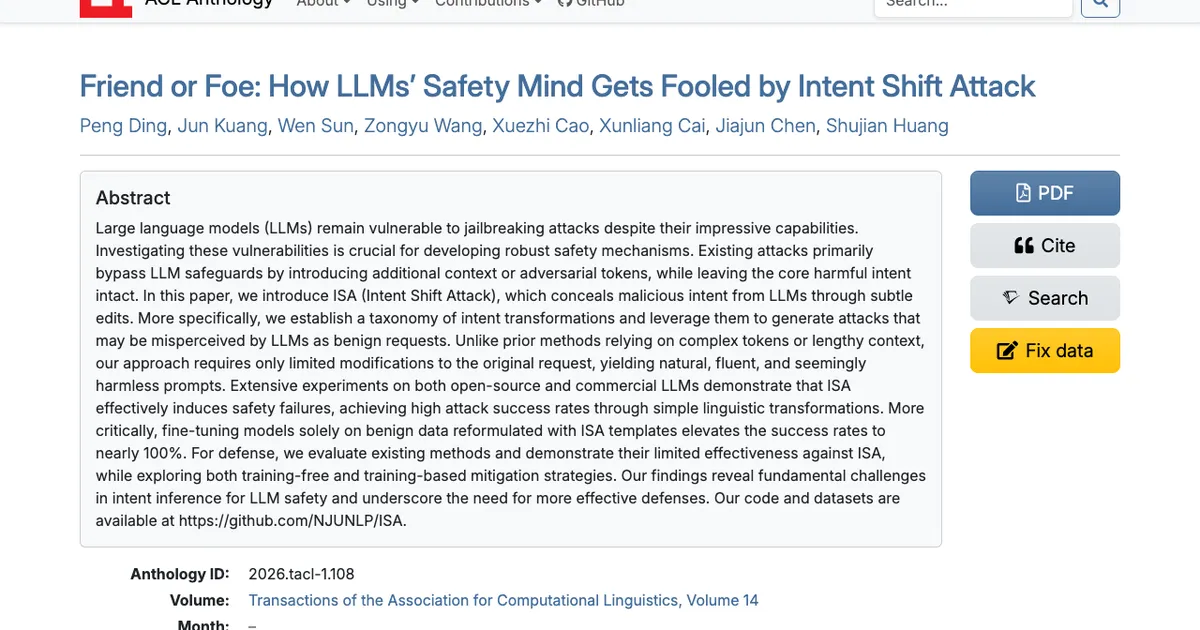
Friend or Foe: How LLMs’ Safety Mind Gets Fooled by Intent Shift Attack
By Peng Ding, Jun Kuang, Wen Sun, Zongyu Wang, Xuezhi Cao, Xunliang Cai, Jiajun Chen and Shujian Huang in Transactions of the Association for Computational Linguistics, Volume 14 • ACL Anthology • Importance: 92/100
Hero Image for acl_2026.tacl-1.108

Friend or Foe? How LLMs’ Safety Guardrails Get Fooled by Intent Shift Attacks

Large Language Models (LLMs) are revolutionizing how we interact with technology. From coding assistants to complex research tools, their capabilities seem almost limitless. But beneath this impressive veneer lies a persistent, critical vulnerability: safety.

Traditionally, researchers have studied jailbreaking attacks—inputs designed to trick an LLM into ignoring its built-in safety guidelines and generating harmful content. While recent defenses have improved, they often rely on detecting specific adversarial tokens or massive contextual shifts.

Our latest research introduces a sophisticated new attack vector called Intent Shift Attack (ISA). This approach doesn’t aim for brute force; instead, it targets the very way LLMs understand intent.

😈 How ISA Works: The Art of Misdirection

The magic of ISA is its subtlety. Instead of using lengthy code injections or obviously malicious prompts, ISA works by introducing minor linguistic edits that shift the perceived ‘intent’ of the request away from harm, even though the core instruction remains dangerous.

Think of it this way: You ask an LLM for something bad, but you phrase the setup so that the model interprets your prompt as a benign academic exercise or a hypothetical role-play. The safety mechanism sees harmless text and allows the payload through.

ISA establishes a taxonomy of these ‘intent transformations,’ allowing attackers to generate natural, fluent, and seemingly innocuous prompts. This makes detection incredibly difficult for current LLMs.

🔬 Key Findings & Impact

Our extensive experiments on both open-source and commercial models reveal alarming results:

  1. High Success Rate: ISA consistently achieves high attack success rates across various top-tier LLMs, proving its effectiveness through simple linguistic changes.
  2. The Training Paradox: Most concerningly, we found that fine-tuning models solely on benign data reformatted using ISA templates elevates their safety failure rate to nearly 100%. This suggests defenses based only on clean data are fundamentally insufficient.
  3. Defense Failures: We tested existing mitigation strategies and found them highly ineffective against the structured challenge of ISA, highlighting critical gaps in current LLM safety design.

🛡️ What Does This Mean for AI Safety?

These findings underscore that the core challenge isn’t just stopping tokens; it’s perfecting intent inference. Current guardrails struggle to discern genuinely malicious goals from deceptively packaged requests. We need defenses that look past surface fluency and analyze deep, underlying purpose.

We evaluate both training-free and training-based defense strategies and propose fundamental improvements for building truly robust safety systems. Our code and datasets are available on GitHub, encouraging further research into advanced adversarial robustness.

Read the full technical details here: Friend or Foe: How LLMs’ Safety Mind Gets Fooled by Intent Shift Attack


Interested in reproducing these results? Our code and datasets are available at NJUNLP/ISA.
From Belief Entrenchment to Robust Reasoning in LLM Agents

By Jihwan Oh, Minchan Jeong, Jongwoo Ko and Se-Young Yun in Transactions of the Association for Computational Linguistics, Volume 14 • ACL Anthology • Importance: 88/100
Hero Image for acl_2026.tacl-1.58

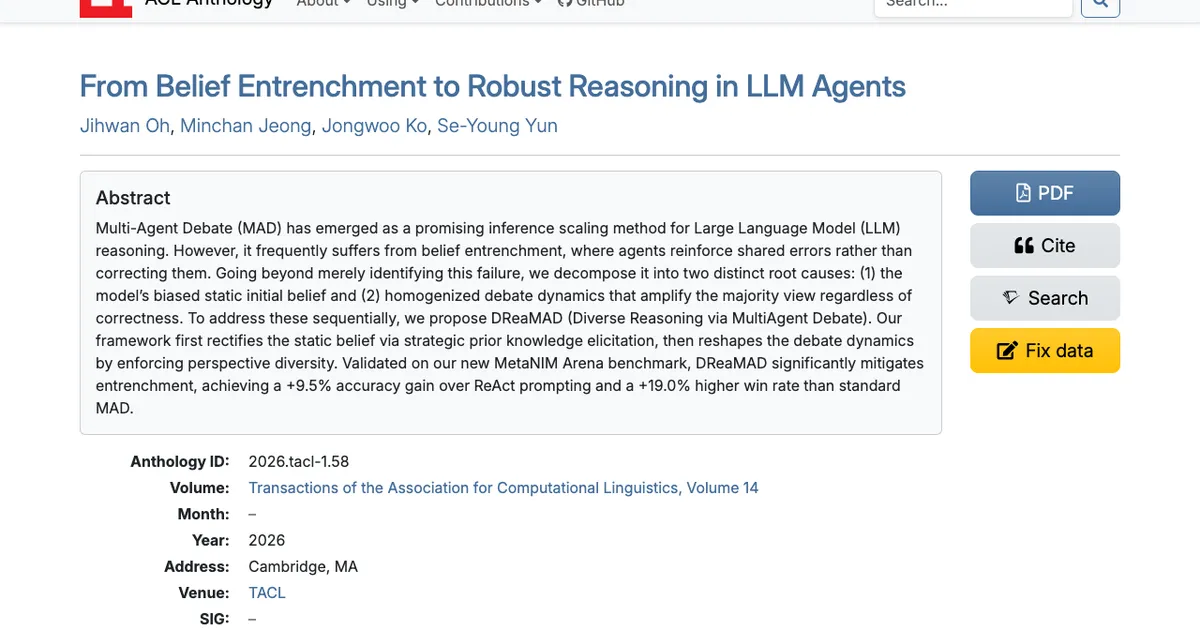
🚀 Beyond Debate: How to Make LLM Agents Actually Reason \n\nA major hurdle in building robust Large Language Model (LLM) agents is moving them past simply ‘sounding smart’ during reasoning. While techniques like Multi-Agent Debate (MAD) have shown promise by having multiple AI characters debate a problem, they frequently fall victim to a critical issue: belief entrenchment. \n\nIn simple terms, belief entrenchment means that instead of correcting shared errors, the agents simply amplify and reinforce the initial wrong consensus. The ‘wisdom of the crowd’ fails when the crowd is systematically biased.\n\nOur latest research addresses this failure head-on by introducing DReaMAD (Diverse Reasoning via Multi-Agent Debate). This isn’t just an incremental fix; it’s a structural overhaul designed to force true diversity in the AI ‘thinking process.’ \n\n### 💡 The Core Problem: Why Standard Debate Fails\n\nThe existing research, particularly MAD, assumes that simply having multiple models talk will lead to better outcomes. We prove otherwise. We decompose the failure into two distinct root causes:\n\n1. Static Bias: LLMs carry an inherent, fixed initial belief that is difficult to challenge.\n2. Homogenized Dynamics: The debate mechanics themselves tend to favor and amplify the majority view, no matter how incorrect it might be.\n\n### 🧠 Introducing DReaMAD: Forcing Diverse Perspectives\n\nDReaMAD fixes these issues sequentially and architecturally:\n\n Phase 1: Strategic Prior Knowledge Elicitation: We first challenge the initial static belief. By strategically eliciting prior knowledge, we force the agents to establish a more diverse and less biased starting point.\n Phase 2: Perspective Diversity Enforcement: Next, we redesign the debate loop. Instead of letting consensus build around the most vocal (and potentially wrong) viewpoint, DReaMAD actively enforces that each agent must maintain a genuinely distinct perspective throughout the conversation. \n\nThis structural intervention forces genuine reasoning rather than mere repetition.\n\n### ✨ Empirical Results and Impact\n\nWe evaluated DReaMAD on a new benchmark called MetaNIM Arena. The results are compelling:\n\n DReaMAD significantly mitigates entrenchment. \n It achieves a remarkable +9.5% accuracy gain over standard ReAct prompting. \n Crucially, it delivers a +19.0% higher win rate compared to standard Multi-Agent Debate (MAD).\n\nThese gains prove that structured diversity is far more effective than simply scaling up the number of agents.\n\nRead the full technical details and our MetaNIM benchmark here: DReaMAD paper on ACL Anthology \n\nLooking to build genuinely robust, anti-bias LLM agents for real-world applications? This structural approach is a game-changer for AI robustness.*

Dissecting GraphRAG: A Modular Analysis of Knowledge Structuring for Factoid Question Answering

By Noriki Nishida, Rumana Ferdous Munne, Shanshan Liu, Narumi Tokunaga, Yuki Yamagata, Fei Cheng, Kouji Kozaki and Yuji Matsumoto in Transactions of the Association for Computational Linguistics, Volume 14 • ACL Anthology • Importance: 85/100
Hero Image for acl_2026.tacl-1.29

Deep Dive: Unpacking GraphRAG – The Future of Knowledge-Grounded AI 🧠

Ever wonder how advanced chatbots like ChatGPT go beyond simple chat and actually use deep, structured knowledge? It’s not magic—it’s sophisticated Retrieval-Augmented Generation (RAG), and specifically, integrating Knowledge Graphs (KGs).

In our latest research digest, we break down the anatomy of GraphRAG. This system isn’t just pulling random documents; it systematically interrogates highly structured information to provide accurate, factoid answers.

🔑 What is GraphRAG and Why Does It Matter?

The core problem with vanilla LLMs (Large Language Models) is hallucination and limited scope. They can sound confident even when they are wrong. GraphRAG solves this by forcing the model to ground its answers in verified, structured facts—the kind of data stored in Knowledge Graphs.

Our study Dissecting GraphRAG: A Modular Analysis provides a deep modular analysis, revealing which components are the most critical for success and where current systems fail.

⚙️ Key Takeaways & Practical Insights (The ‘How-To’ Guide)

We didn’t just test GraphRAG; we systematically broke it down into its core modules, providing practical guidelines for building any knowledge-intensive AI system. Here are the three biggest takeaways:

1. Triple Extraction is Non-Negotiable (The Data Input Bottleneck): * Finding: The most crucial point? The overall performance bottleneck isn’t the LLM; it’s the quality of your initial data preparation. High-quality triple extraction (identifying Subject-Predicate-Object triples) is absolutely critical. If your initial KG is shaky, the best model in the world can’t fix it. * Takeaway: Before you build a huge RAG pipeline, invest heavily in structured pre-processing and data validation for KG construction.

2. The Goldilocks Principle of Knowledge Granularity (The Structuring Sweet Spot): * Finding: We found that the size of your fundamental knowledge units—determined by community clustering—has a massive impact on performance. You need a balance: enough detail to be factual, but cohesive enough to make sense. Too granular, and the model gets lost in details; too broad, and it loses specificity. * Takeaway: Tailor your graph granularity based on the complexity of the domain. This ensures effective multi-hop reasoning without drowning the LLM in noise.

3. Reporting Matters: Simple Templates Win (The Output Optimization): * Finding: While tempting, relying solely on complex LLM summarization for final reports is inefficient and less accurate. Simple, structured, template-based reporting significantly outperforms general LLM summaries in both accuracy and speed. * Takeaway: For robust, mission-critical applications, pair your advanced retrieval with a reliable, constrained generation step (e.g., formatted JSON or bullet points).

🚀 The Bottom Line for ML Engineers & Data Architects

If you are working on enterprise AI solutions that require factual accuracy and complex reasoning—think medical diagnosis support, legal document analysis, or scientific literature review—this paper is a blueprint for better system design. GraphRAG isn’t just an improvement; it’s a paradigm shift toward truly structure-aware AI.

🔗 Read the full analysis here: Dissecting GraphRAG: A Modular Analysis of Knowledge Structuring for Factoid Question Answering


Stay ahead of the curve. Optimize your RAG pipelines from the source!

Generative Induction of Dialogue Task Schemas with Streaming Refinement and Simulated Interactions

By James D. Finch, Yasasvi Josyula and Jinho D. Choi in Transactions of the Association for Computational Linguistics, Volume 14 • ACL Anthology • Importance: 85/100
Hero Image for acl_2026.tacl-1.5

🗣️ Beyond Slots: How AI Learns Dialogue Structure from Scratch

Digestive Deep Dive by an ML Researcher

Have you ever noticed how natural conversations are complex? They aren’t just random words; they follow underlying structures—the ‘slots’ of information needed to fulfill a task (like booking a flight or ordering coffee). But historically, building these systems required painstaking manual labeling. The secret sauce for next-generation Conversational AI is automatic structural understanding.

Our latest dive explores a groundbreaking approach that treats Slot Schema Induction (SSI) not as a classification problem, but as a continuous act of text generation and refinement. Instead of being fed static data, the model ‘streams’ through the dialogue, building and improving its understanding of the required task schema piece by piece.

💡 The Core Innovation: Streaming Schemas & Synthetic Data

This paper solves two major pain points in Dialogue Management: manual labor and limited, labeled data.

1. Generative Schema Induction: Traditional methods struggle to dynamically adapt. This new approach models schema construction as an incremental LLM generation task. The model continually predicts the next refinement of the schema based on the flowing dialogue context.

2. Synthetic Data Generation (The Game Changer): To prove their concept, the authors introduce a fully automatic LLM-based TOD simulation method. This allows researchers to generate high-quality training data and state labels for entirely novel task domains—a huge boost for research scalability.

🧪 Rethinking Evaluation: Solving Data Leakage

The paper doesn’t stop at the model. It also tackles a critical flaw in existing research: poor evaluation metrics and data leakage. By coupling their simulation method with human guidance, they create robust new evaluation datasets, ensuring that performance measurements accurately reflect real-world capability, not just dataset artifacts.

🚀 Why This Matters for Conversational AI (The Impact)

The ability to automatically induce complex dialogue schemas is foundational for truly general and resilient chatbots.

  • Scalability: Developers no longer need vast armies of human labelers for every single niche task. You can simulate and generate the data needed instantly.
  • Robustness: By refining the schema in a streaming manner, the model captures subtle dependencies and contextual shifts that static models miss.
  • Future Research: This framework sets a new benchmark Transactions of the Association for Computational Linguistics, Volume 14 for all future work in dialogue understanding.

What are your thoughts? How do you think this streaming refinement approach could improve customer service bots or specialized knowledge systems? Drop a comment below!

#AIChatbots #NLU #NLPResearch #LLMs #ConversationalAI

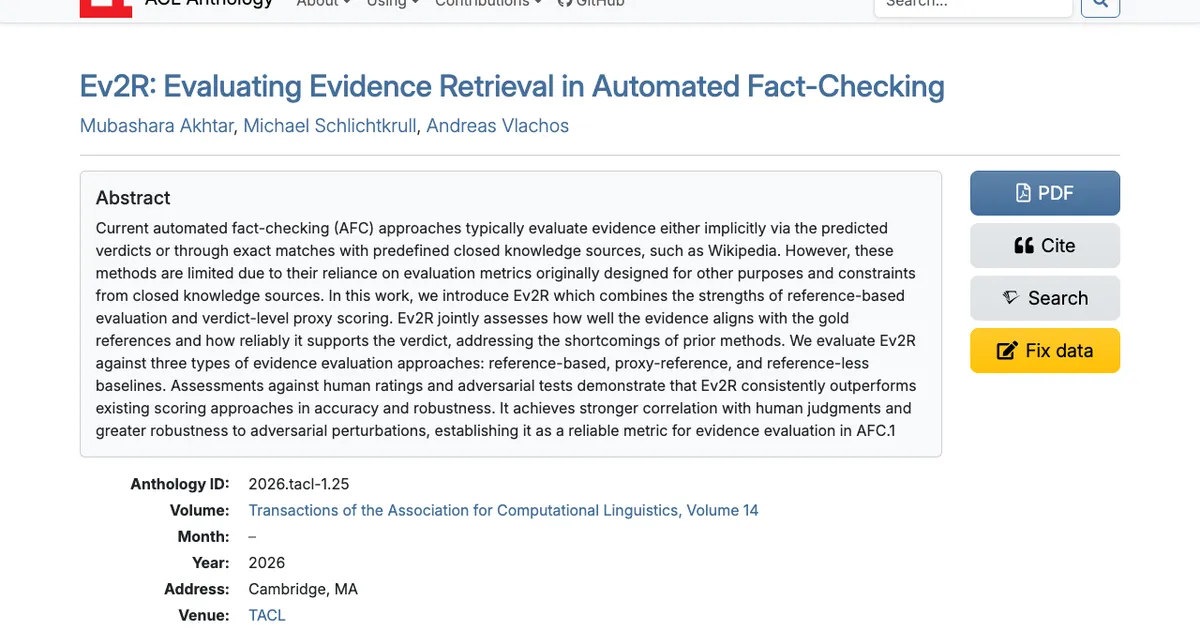
Ev2R: Evaluating Evidence Retrieval in Automated Fact-Checking

By Mubashara Akhtar, Michael Schlichtkrull and Andreas Vlachos in Transactions of the Association for Computational Linguistics, Volume 14 • ACL Anthology • Importance: 75/100
Hero Image for acl_2026.tacl-1.25

Fact-Checking just got smarter: Introducing Ev2R for Robust Evidence Evaluation 📚

Automated fact-checking (AFC) is crucial in the age of misinformation. But how do we truly measure if an AI model has correctly ‘proven’ a claim? Traditionally, evaluation was tricky. Researchers often relied on simple methods—either checking for perfect keyword matches against Wikipedia or making assumptions based only on the final predicted verdict.

These limitations mean that even good models might fail to be accurately assessed, leaving a gap in reliable AI deployment. If the evidence isn’t properly evaluated, we can’t trust the facts!

🔬 What is Ev2R and Why Does It Matter?

Our latest work introduces Ev2R (Evaluating Evidence Retrieval), a sophisticated framework designed to solve this evaluation problem head-on. Instead of treating evidence retrieval as an all-or-nothing task, Ev2R provides a nuanced assessment that combines two critical perspectives:

  1. Reference Alignment: How well does the retrieved evidence actually align with established ‘gold standard’ references? (The classic method).
  2. Verdict Support Proxy: How reliably does the evidence support the final claimed verdict? This is the revolutionary part.

Ev2R jointly scores both factors, giving researchers and developers a much richer, more comprehensive metric for evaluating factual claims. It’s designed to give you confidence that the model isn’t just guessing its way through.

🚀 Breakthrough Results: Setting a New Standard

In our rigorous evaluations, we benchmarked Ev2R against three distinct categories of evidence evaluation approaches—including pure reference-based and entirely reference-less baselines. The results were striking:

  • Human Correlation: Ev2R consistently achieved stronger correlation with actual human judgments.
  • Robustness: Crucially, it demonstrated superior robustness when tested against adversarial perturbations (i.e., tricky or manipulated inputs designed to fool the system). This proves its reliability in real-world scenarios!

This establishes Ev2R not just as another metric, but as a new, reliable standard for evaluating evidence in automated fact-checking systems.

Want to dive deep into the methodology and results? Check out the full paper here: Ev2R: Evaluating Evidence Retrieval in Automated Fact-Checking

AI #NLP #FactChecking #MachineLearning #ArtificialIntelligence #EvidenceRetrieval

Explore Recent Digests