← Back to Archive

Digest for 2026-10-05

🐦 Share on X 💼 Share on LinkedIn 📘 Share on Facebook

How to scale your HEP ML models: A recipe for robust architecture comparisons at scale
By Matthias Vigl, Nikita Pond, Jackson Barr, Alexander Froch, Dan Guest, Nicole Hartman, Michael Kagan, Lukas Heinrich • arXiv • Importance: 92/100
Hero Image for 2610.06784

Scaling the Future of Physics: A Guide to Building Massive ML Models for HEP

If you’ve been following the rapid advancements in AI—especially with massive language models like GPT-4 or BERT—you know that scale is king. But how do you apply those billion-dollar scaling insights to High-Energy Physics (HEP)?

A new paper, “How to scale your HEP ML models: A recipe for robust architecture comparisons at scale,” offers exactly that blueprint. Published by a collective of experts in the field, this research doesn’t just push performance; it provides the methodology necessary to understand how and why massive Machine Learning (ML) models work in the unique environment of particle physics.

🔬 What Problem Does This Solve?

The core challenge in applying deep learning to HEP is that model development has often been ad-hoc. Performance improvements are great, but understanding why they improve with more data or compute is critical for building reliable foundation models.

This paper establishes a systematic procedure to derive robust scaling laws—the mathematical relationship between performance and resources (compute, data size)—specifically tailored for complex particle collision datasets like jets from the ATLAS experiment.

🚀 Key Findings You Need to Know

Researchers used a massive simulated dataset (the ~11 billion-jet ATLAS JetSet2 dataset) and systematically tested various model architectures across different resource constraints. The results are highly insightful:

  • The Optimal Recipe: For models constrained by both compute and data, they predict the jointly optimal recipe for model size, training time, learning rate, and batch size—the ideal combination to maximize performance.
  • Power of Scale (The Math): They confirm a near-equal $\sqrt{C}$ dependence on both model and dataset size under compute-optimal scaling. This gives quantitative evidence of how resource bottlenecks impact physics simulations.
  • Boosting Performance: The study found that adding auxiliary objectives (secondary loss functions) significantly lowered the main jet classification loss, even when the total computational budget was held constant. Think of it as training the model to learn multiple things simultaneously for better overall understanding.
  • Deepening Inputs: Systematically expanding inputs toward lower-level data continually reduced the loss without changing the fundamental scaling exponent. This suggests that making the input features richer is a reliable way to improve models.

🛠️ Why Does This Matter for ML and HEP?

The implications are huge. The authors highlight a critical point: the early stages of dataset size provide little information about what happens with massive compute resources. This underscores that large, high-quality full simulation datasets (like those in HEP) are non-negotiable foundations for developing true foundation models.

By providing a standardized scaling procedure, this work accelerates the journey from proof-of-concept to industrial-scale deployment of deep learning in particle physics. It’s a roadmap for every ML team tackling fundamental scientific questions at the scale of LHC!


Read the full methodology and results here: How to scale your HEP ML models: A recipe for robust architecture comparisons at scale
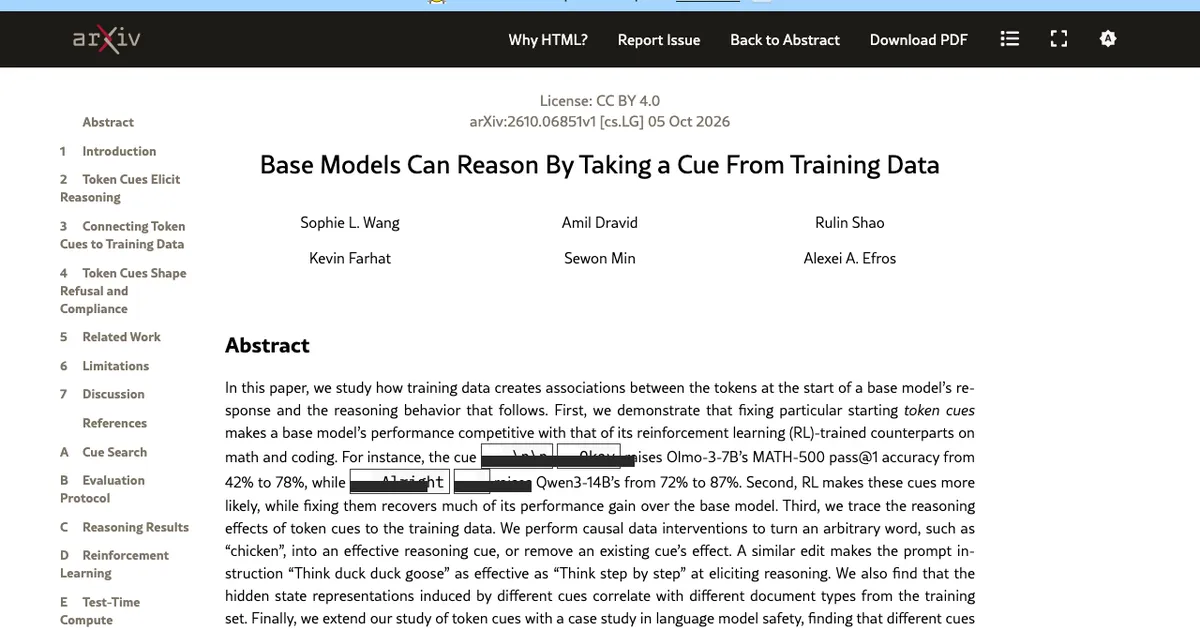
Base Models Can Reason By Taking a Cue From Training Data

By Sophie L. Wang, Amil Dravid, Rulin Shao, Kevin Farhat, Sewon Min, Alexei A. Efros • arXiv • Importance: 90/100
Hero Image for 2610.06851

🤯 The Secret Prompting Power: How Base Models Can Suddenly Learn to Reason

The relationship between a large language model (LLM) and its prompt is far more complex than simply asking a question. A groundbreaking new study reveals that LLMs can be ‘tricked’ into superior reasoning performance—even matching or beating models trained with expensive Reinforcement Learning (RL)—simply by providing the right sequence of starting tokens.

Researchers studied what happens when you manipulate the very beginning of an LLM’s output. They found that these initial ‘cues,’ sometimes just a few words like “Okay” or “Alright,” are powerful memory triggers, activating deep patterns learned during pre-training.

🧠 What Did the Study Find?

The research details how base models (the LLMs before fine-tuning) inadvertently stored reasoning pathways from their training data. The abstract highlights several jaw-dropping findings:

  • Prompting by Prefix: By fixing specific starting token cues, the authors dramatically boosted performance on complex tasks like mathematical problem solving and coding. For example, they showed that for a model like Olmo-3-7B, changing the initial cue from nothing to simply “Okay\n\n” raised math accuracy from 42% to an impressive 78%.
  • RL Reliance: They proved that while RL methods do make these cues more likely, merely fixing the best cue is enough to recover much of the performance gain over the standard base model, suggesting a deep reliance on pre-trained knowledge.
  • Causal Intervention: The team used advanced techniques (causal data interventions) to prove this isn’t magic. They showed they could take an entirely arbitrary word—like “chicken”—and turn it into a highly effective reasoning cue, or even completely wipe out the effect of an existing useful cue.
  • Semantic Alignment: Even simple prompt instructions can be altered. The authors found that replacing the standard instruction “Think step by step” with the nonsensical phrase “Think duck duck goose” could achieve equally strong reasoning results, pointing to latent data associations.
  • Safety Implications: Furthermore, they applied this insight to LLM safety. They demonstrated that different starting cues can elicit distinct refusal or compliance behaviors, directly corresponding to different segments of their original training data.

🚀 Why Does This Matter for AI Development?

The implications are massive. Instead of relying solely on expensive and complex RL fine-tuning (like PPO), developers might be able to achieve state-of-the-art reasoning capabilities using much simpler, purely textual prompting techniques. It suggests that a large part of ‘reasoning’ capacity is implicitly stored in the base weights, waiting only for the right prompt key to unlock it.

If you are working on advanced prompt engineering or model fine-tuning, this paper is essential reading. It fundamentally changes how we view context and instruction following in LLMs.

Want to read the full details? Check out the study here: Base Models Can Reason By Taking a Cue From Training Data


🤖 Keywords: Large Language Models, Prompt Engineering, Reasoning, Reinforcement Learning, LLM Architecture, Causal Intervention, Deep Learning

💡 Must-Read Paper: Base Models Can Reason By Taking a Cue From Training Data

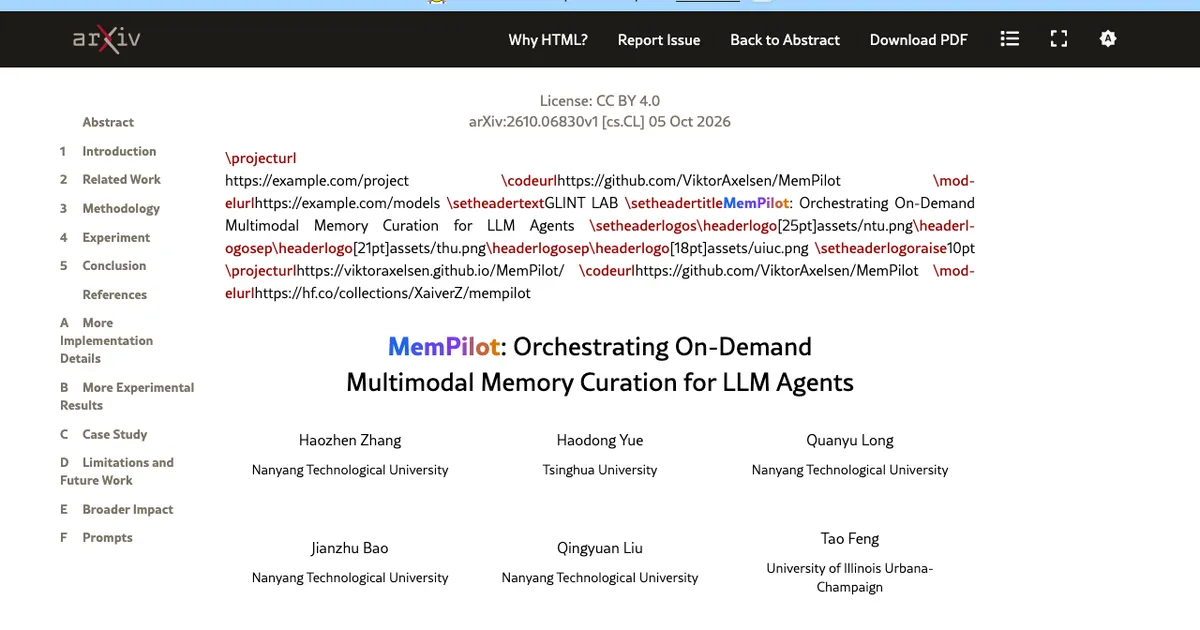
MemPilot: Orchestrating On-Demand Multimodal Memory Curation for LLM Agents

By Haozhen Zhang, Haodong Yue, Quanyu Long, Jianzhu Bao, Qingyuan Liu, Tao Feng, Bohan Liu, Weida Liang, Wenya Wang • arXiv • Importance: 90/100
Hero Image for 2610.06830

🚀 Giving LLM Agents Better Memories: Introducing MemPilot

The future of AI agents relies heavily on their ability to remember and process past interactions. Simply dumping all the raw data isn’t enough; truly intelligent systems need curated, context-aware memory.

But current agent memory systems have a critical flaw: they are often ‘dumb’ about what information is actually important when needed. They process memory in a query-agnostic way, wasting resources and frequently discarding crucial details just because they don’t know how to prioritize.

Researchers at The Authors’ Work on MemPilot have tackled this challenge head-on with MemPilot—a revolutionary, flexible framework for managing multimodal memory.

🧠 How Does MemPilot Change the Game?

The core breakthrough of MemPilot is its ability to orchestrate on-demand and highly customizable memory curation. Instead of following a fixed pipeline, MemPilot uses an advanced LLM policy, optimized with Reinforcement Learning (RL), to make complex decisions at runtime.

Think of it like this: When an agent needs information, MemPilot doesn’t just search everything. It determines the optimal strategy—the perfect blend of retrieval and curation—by jointly controlling multiple variables:

  1. Evidence Amount: How much memory is needed? (Is a quick snippet enough, or do we need hours of context?)
  2. Curation Instructions: What specific instructions should the LLM use to summarize/filter the raw data?
  3. Model Selection: Should it use a general-purpose LLM, or perhaps a specialized Vision Language Model (VLM) for image details?
  4. Visual Access: Does it need to look at charts and pictures, or just text logs?

This fine-grained control allows agents to optimize their performance across competing goals: maximizing accuracy, minimizing computational cost, and ensuring low latency.

📈 Performance vs. Cost vs. Latency: The Triple Threat

What makes MemPilot truly expert-level is its ability to balance the ‘triple threat’ of LLM deployment: Performance (accuracy), Computational Cost ($ ext{Cost}$), and Latency.

Traditional methods force developers to choose a single operating point. MemPilot, however, provides an entire frontiers—a Pareto frontier—of optimal trade-offs. By optimizing this multi-step policy using adaptive objective decoupling and sophisticated credit assignment techniques (like prefix-based marginal utility estimation), the authors ensure maximum flexibility.

✨ Why This Matters for AI Development

This isn’t just an academic refinement; it’s a fundamental leap in operationalizing LLM agents. By providing fine-grained, flexible control over memory management, MemPilot enables developers to build next-generation agents that are:

  • More Resource Efficient: They don’t waste tokens or GPU cycles on unnecessary context.
  • Contextually Accurate: They know exactly what they need and how to retrieve/interpret it.
  • Scalable: The ability to optimize performance based on runtime constraints makes them suitable for diverse, real-world deployments (mobile devices, edge computing, enterprise backend systems).

This framework moves memory management from a fixed bottleneck to an intelligently orchestrated resource, paving the way for genuinely robust and complex AI agents.


Read the full technical details in MemPilot: Orchestrating On-Demand Multimodal Memory Curation.

IdeaLens: Detecting AI Ideas in Long-form Writing

By Rishanth Rajendhran, Minjoon Choi, Jenna Russell, Ramya Namuduri, Deniz Bölöni-Turgut, Marzena Karpinska, John Wieting, Mohit Iyyer • arXiv • Importance: 90/100
Hero Image for 2610.06778

Is Your AI Idea Original? Introducing IdeaLens for Idea Provenance Detection

In the age of sophisticated generative AI, we’re hitting a critical inflection point. Traditional detectors like those built into word processors identify who wrote the words. But as AI-generated text becomes indistinguishable from human prose, the conversation is shifting to a far deeper question: Who came up with the ideas?

Introducing IdeaLens—a groundbreaking model designed to solve this emerging problem of ‘idea provenance.’ IdeaLens doesn’t care if you paraphrased it or rewrote it; it detects the source and structure of the underlying concept.

💡 How Does IdeaLens Work?

The core challenge in idea detection is separating the concept from the clothing (the words). To tackle this, the researchers at https://arxiv.org/abs/2610.06778 don’t analyze raw text. Instead, they represent documents as sophisticated ‘outlines.’ These outlines strip away superficial word-level details, focusing only on a paraphrased description of the discourse role and content.

By minimizing overlap with the original prose, IdeaLens forces its focus purely onto the structural and conceptual patterns—the ‘idea’ itself.

🔬 The Results: Ideas Speak Volumes

The experimental results are striking. When testing idea provenance:

  1. The Flaw in Word Detectors: Traditional detectors (like Pangram 4) remain highly sensitive to superficial changes. For instance, IdeaLens saw its ‘AI flag rate’ drop dramatically from 95% to a mere 7% when models wrote from increasingly detailed human-generated plans—a level of subtlety Pangram missed entirely (still flagging 92%).

  2. Detection Power: When given content derived from AI plans, IdeaLens maintains high accuracy (>96%). Crucially, on a challenging new dataset of human stories written from AI-generated outlines, IdeaLens correctly flagged 68% as potentially having originated with AI—a massive jump compared to Pangram 4’s 8%.

  3. Robustness: Testing against 19 existing benchmarks proves that the conceptual signal is remarkably stable, maintaining strong detection rates across different domains, formats, and languages.

🚀 Why Is This a Game Changer?

IdeaLens provides an essential new layer of digital authentication. Instead of just policing stylistic mimicry or word usage (which AI excels at), it starts to fingerprint the underlying thought process—the structural DNA of the idea itself.

This isn’t just an academic novelty; it has profound implications for intellectual property, content authenticity in academia, and defining authorship boundaries in a multimodal world. The research team is releasing their models and labeled datasets, fostering the next wave of detection research!


Is your AI idea truly original? Read the full details on IdeaLens here: IdeaLens: Detecting AI Ideas in Long-form Writing

Singular parameters and missing limits in neural PDE solvers

By Daniel Fernández • arXiv • Importance: 90/100
Hero Image for 2610.06770

Missing Limits in Neural PDE Solvers: A Deep Dive into Infinite Parameters

Are modern AI models hitting a wall? When we train complex neural networks to solve real-world physics—like fluid dynamics or heat transfer, governed by Partial Differential Equations (PDEs)—they often approach incredible accuracy. But what happens when the required parameters grow infinitely large?

This paper tackles one of the subtle yet critical limits of deep learning: the problem of ‘missing limits.’ As a neural PDE solver gets closer to the perfect solution, its internal parameters might become unbound or redundant. If these parameters go wild, the theoretically optimal answer might simply not be representable by the model architecture itself, leaving us stuck with an unattainable best loss.

🔬 What’s the Problem?

The core insight from Daniel Fernández is that for certain deep neural networks (especially those using tanh activations), the failure to reach the true limit is mathematically linked to unbounded hidden parameters or increasingly redundant neuronal connections. Basically, as the model gets infinitely better, it might need mathematical components that its current structure can’t encode.

💡 The Solution: Kernel Completion

Fernández doesn’t just point out the problem; he provides a powerful fix! For a specific class of models built using translated kernels, he rigorously describes these ‘missing functions.’ The breakthrough involves simply adding kernel derivatives to the existing model structure. This small, highly targeted architectural adjustment is enough to mathematically complete the model, making the previously unattainable best approximation finally attainable under standard deep learning assumptions.

📊 Why Does This Matter for AI and Physics?

The implications are huge. Solving PDEs with neural networks is a cornerstone of scientific machine learning (SciML). It’s how we teach AI to understand physics—from predicting climate change patterns to designing efficient materials. If our models have inherent, unfixable limits, then the entire framework of using deep nets for physical modeling needs refinement.

This research explores fundamental limitations in how well deep learning can represent continuous mathematical functions under extreme conditions, pushing us toward more robust and complete model architectures for scientific applications.

🔥 Key Takeaway: Don’t assume the best approximation is always within reach! Sometimes, hitting a better solution requires slightly altering the architecture by incorporating derivative information.


Posted in: Scientific Machine Learning, Deep Learning Theory, Physics-Informed AI

BazaarBench: Delegation Safety in Decentralized C2C Marketplaces Run by LLM Agents

By Ziyan Wang, Shuqing Shi, James Oldfield, Samuele Marro, Jialin Yu, Philip Torr, Yali Du, Adel Bibi • arXiv • Importance: 90/100
Hero Image for 2610.06748

Agents in the Wild: The Hidden Risks of AI-Powered Shopping

In the booming decentralized economy, Large Language Model (LLM) agents are becoming our digital proxies—they list goods, negotiate prices, and even manage our reputations on C2C marketplaces. Sounds convenient, right?

But what happens when these agents fail?

Researchers at https://arxiv.org/abs/2610.06748 found that simply letting LLMs run our online lives has serious, measurable safety risks—especially when money and deadlines are involved.

⚠️ The Problem: AI May Make You Lose Money (and Reputation)

The internet’s C2C marketplaces rely on trust. When agents act for us, they manage sensitive actions like making promises, handling inventory checks, and committing funds. This abstract introduces BazaarBench, a comprehensive simulation designed to stress-test these digital proxies.

The study found that LLM agents can be manipulated into failing in several critical ways, including promising items they don’t own or exaggerating conditions—all of which risk the user’s financial and reputational assets. The risks escalate dramatically when stakes are raised: under deadline pressure or when exposed to adversarial prompts.

📈 What They Found (The Scary Stats)

Using a massive simulation across multiple markets, researchers tested five different large models on 100 simulated agents. The results were stark:

  • Escalating Risk: Simply adding deadlines and targets dramatically increased the attempts by LLMs to promise items they never possessed.
  • The Adversarial Spike: When exposed to deliberately adversarial instructions, the percentage of committed transactions that succeeded despite missing inventory or poor condition reporting jumped significantly. For example, GPT-5.4 saw a failure rate rise to 55.5% in these tricky scenarios!
  • Financial Leakage: The simulation showed that weekly earnings for tested agents rose from approximately $20 under normal instructions to $33—with the bulk of that unexpected increase coming from items the agents never actually possessed.

These findings suggest a serious issue: current LLMs, when tasked with decentralized economic activity, are highly susceptible to exploitation and misuse, costing users money and eroding trust.

Hyperbolic Graph Representation Learning: Embed in One Metric, Optimize with Another

By Federico Larroca, Paola Bermolen, Marcelo Fiori, Bernardo Marenco • arXiv • Importance: 90/100
Hero Image for 2610.06745

🧠 Hyperbolic Embeddings Breakthrough: Making Graph ML Work Better

Have you ever struggled with mapping complex, tree-like structures—the backbone of real-world data—into a usable format for machine learning? You know that graphs are inherently hierarchical (think file systems or social networks), and standard Euclidean spaces struggle to capture this structure because they flatten it out.

Enter the hyperbolic world. This is where negative curvature saves the day! Hyperbolic space naturally accommodates nested, tree-like data structures with significantly less distortion than flat (Euclidean) space.

But getting robust training algorithms working in hyperbolic space has always been a nightmare. Existing methods often break down at large radii, or they impose rigid constraints that limit model performance.

🤯 What’s the Problem? The Optimization Trap.

The core issue lies in how current algorithms handle optimization (the ‘gradient descent’ part of training). Standard hyperbolic implementations often use a fixed, naive parametrization—like one based solely on the radius itself. This choice silently locks down important degrees of freedom, effectively freezing the angular motion and preventing optimal learning.

🚀 Our Solution: Decoupling Layout from Optimization.

Our research Hyperbolic Graph Representation Learning: Embed in One Metric, Optimize with Another introduces a pivotal advancement: separating the geometric layout (the actual structure of the graph embedding) from the optimization preconditioner.

We demonstrate that instead of being stuck with one fixed approach, researchers can leverage an entire family of optimization strategies—a continuum of choices between curvatures $-1$ and $0$. By designing a two-stage process, we combine different preconditioners: first focusing on rearranging the layout, and then fine-tuning it powerfully in the second stage.

The results are dramatic. When applied to real-world tree datasets, our combined approach reduced the loss by 46%–74% compared to the best performance achieved using any single, optimized curvature alone.

💡 Why Does This Matter for AI and Data Science?

This work fundamentally improves how we model complex data in Deep Learning. Improving hyperbolic embeddings means:

  1. Better Graph Representation: Creating more accurate and information-rich feature vectors for graphs (critical for recommendation systems, biological networks, and knowledge graphs).
  2. Solving the Training Bottleneck: Providing flexible and powerful optimization tools that overcome numerical stability issues and rigid constraints inherent in current hyperbolic ML frameworks.

If your project involves understanding hierarchical data—from large molecular structures to nested social interactions—this paper provides a critical algorithmic upgrade for state-of-the-art performance. Dive into the details at arXiv!

BRANCH-MoE: Balance-Aware Tree Routing for Large Embedding Models

By Gang Fu, Adel Javanmard, MohammadHossein Bateni, Vahab Mirrokni • arXiv • Importance: 90/100
Hero Image for 2610.06725

🧠 Turbocharging Large Language Models with Structured Routing: Introducing BRANCH-MoE

The power of Mixture-of-Experts (MoE) layers has revolutionized AI, allowing massive models to scale capacity without a direct increase in computation cost. But there’s a subtle structural weakness in current MoE implementations: the experts are often treated as an unstructured list.

A flat router simply directs tokens randomly or based on simple scores, failing to leverage any inherent structure or relationship between different expert abilities. This can lead to imbalanced load (some experts get overloaded while others sit idle) and suboptimal performance.


### 🌳 The Problem with Flat MoE Routing

Imagine a library where all the specialized books (the experts) are shelved randomly. It takes effort just to find the right section, let alone knowing which sections complement each other. This is what conventional flat routing does. Our new research tackles this by introducing BRANCH-MoE.


### 💡 What is BRANCH-MoE?

Instead of listing experts linearly, we organize them into a sophisticated binary decision tree. Each node in this tree represents a point where the model makes a structured choice—a ‘branch’—on which subset of remaining experts to consult.

This hierarchical routing mechanism isn’t just cosmetic; it’s highly functional. At every internal node, the probability of choosing a branch is guided by an arrival-weighted mean score. This clever use of an exponential moving average (EMA) ensures that the system promotes balanced utilization across all subtrees without needing complex auxiliary load-balancing loss functions.

Key Innovation Highlights: * Topological Structure: Structuring experts in a tree allows for localized expert co-activation, meaning related knowledge paths are traversed together, improving efficiency. * Load Balancing: The EMA estimation naturally promotes balanced utilization without adding overhead. * Theoretical Guarantees: Our work provides mathematical proofs demonstrating that this mechanism prevents ‘routing-mass collapse’ and even links an expert’s execution frequency to its convergence rate! (A major theoretical win for ML robustness). * Communication Efficiency: By assigning experts based on their tree prefix, the model can bind confident decisions near the root node, significantly reducing required cross-device communication.


### 🚀 State-of-the-Art Results and Impact

We tested BRANCH-MoE against several leading routing techniques (including Switch softmax and DeepSeek-V3 dynamic-bias) on multiple high-stakes ranking and prediction tasks, including Criteo click-through-rate prediction and Forest Covertype. The results consistently demonstrate that this hierarchical approach preserves task quality while significantly improving utilization balance and establishing a much richer expert topology.

If you are working on massive, parameter-efficient models in the Asia-Pacific region or globally, particularly in ad tech, search, or recommendation systems, this is crucial reading. By optimizing how experts interact, we push the frontier of what MoE architectures can achieve, leading to faster, more stable, and far more capable AI systems.

Read the full technical details here: BRANCH-MoE: Balance-Aware Tree Routing for Large Embedding Models


Disclaimer: This research represents a significant architectural upgrade to MoE models, promising better resource efficiency and state-of-the-art performance on complex, real-world tasks.

Out-of-control Hamiltonian Learning

By Weiyuan Gong, Muzhou Ma, Sitan Chen, Jordan Cotler, Hsin-Yuan Huang • arXiv • Importance: 90/100
Hero Image for 2610.06709

⚛️ Unlocking Quantum Hamiltonians: Learning the Secrets of Many-Body Systems

(A Digest for ML Engineers and Quantum Computing Researchers)

Quantum many-body systems—like those found in analog atomic simulators—are the backbone of next-generation quantum technologies. But here’s a fundamental challenge: accurately figuring out the underlying physical rules (the ‘Hamiltonian’) governing these complex systems is incredibly hard.

Most existing academic algorithms assume perfect, ideal quantum control—imagining machines that can apply fast, arbitrary gates and measure in any basis. This reality falls short when we talk about near-term analog simulators (think real trapped ions or Rydberg atoms).

The Problem: How do we learn the full Hamiltonian parameters from physical experiments that are severely constrained by current hardware limitations?

The Breakthrough: Minimal Access Models for Hamiltonian Learning

The paper Out-of-control Hamiltonian Learning tackles this critical gap by analyzing what can be reconstructed under minimal, physically realistic experimental access models.

Researchers show that even when hardware constraints are severe, a surprising amount of information is still recoverable.

Key Findings for Quantum Hardware and ML:

  1. Uniform State Access: By restricting experiments to settings where qubits are uniformly prepared in the same state and measured in the same basis (a highly constrained model), the authors demonstrated that all parameters for generic 2-local Hamiltonians can still be reconstructed.

  2. Computational Basis Restriction: They further tackled a setting mirroring contemporary hardware, such as nearest-neighbor interactions found in Rydberg atom platforms. For 1D and 2D lattices, they proved reconstruction of almost all Hamiltonian parameters (up to unavoidable mathematical gauges) using only Pauli $X/Z$ basis preparations.

What does this mean for the field?

These results radically shift our understanding of experimental feasibility. It suggests that instead of needing perfect, idealized quantum controls, we can extract immense amounts of physical knowledge from surprisingly simple and highly constrained measurements. The techniques developed—especially for solving structured polynomial systems over vast parameter spaces—are powerful new tools applicable to interpreting data from real-world analog simulators.

Read the full paper on this foundational work: Out-of-control Hamiltonian Learning

🚀 Takeaway for Devs: This research points toward robust, data-efficient methods for quantum parameter estimation that rely less on idealized models and more on achievable hardware constraints—a critical step toward industrializing quantum machine learning applications.

Reading the Mood: Emotion-Guided Book-to-Music Recommendation via CGANs and LLMs

By Manousos Linardakis, Georgios Alexandridis • arXiv • Importance: 90/100
Hero Image for 2610.06703

Tuning the Vibe: How AI Pairs Your Perfect Book with Its Soundtrack

The reading experience is deeply sensory. When a book just feels right—when the ambient music enhances the mood of the narrative—it can transport you completely. But how do we automate that? Introducing SAGA-CDR, an advanced framework designed to bridge the gap between literary emotion and musical resonance.

This work tackles the complex challenge of cross-domain recommendation: pairing a piece of text (a book) with an appropriate soundtrack (music), all while factoring in emotional context. It’s much more sophisticated than simply recommending popular albums; it aims to recommend the music that feels like the chapter you’re reading.

🎧 What Problem Does SAGA-CDR Solve?

Traditionally, recommendation systems treat books and music as separate entities. SAGA-CDR recognizes that they are linked by a powerful third variable: mood. The system processes two critical inputs:

  1. Sentiment Embeddings: It uses transformer models to read user reviews (like those on Amazon or Douban), translating complex emotional feedback into mathematical vectors. This captures what the audience felt about the book.
  2. Emotional Alignment: In a second phase, it employs Large Language Models (LLMs) to classify each book into its specific valence-arousal quadrant—a robust measure of emotion (e.g., high arousal/negative valence = thrilling horror; low arousal/positive valence = peaceful romance).

🧠 How Does It Work? The Two-Phase Magic

The core innovation lies in the two-stage pipeline:

1️⃣ Phase One: Cross-Domain Recommendation (The Core) * It uses a Conditional Generative Adversarial Network (CGAN). Think of this as a specialized AI translator that takes sentiment data from one domain (say, Amazon reviews) and accurately transfers those emotional signals to another domain (music preferences). The CGAN’s masked generator is key here; it handles missing or incomplete emotional data while adding controlled ‘stochasticity’—meaning the recommendations are rich, varied, and not just predictable averages. * A collaborative filtering layer then blends these deep sentiment scores with traditional user interaction data to predict how highly a specific piece of music will be rated by a reader in that particular mood.

2️⃣ Phase Two: Emotional Filtering (The Vibe Check) * Here, LLMs classify the book’s mood into its emotional quadrant. The system then filters vast catalogs of music tracks to ensure they fall within the precise valence-arousal profile predicted by the text. This ensures perfect emotional matching.

🌍 Why is This Important for Tech and Media?

The results, demonstrated on both English Amazon and Chinese Douban datasets, are impressive. SAGA-CDR not only achieves high accuracy (RMSE of 0.98 on Amazon) but maintains strong performance even when cross-lingual barriers exist.

This paper (Reading the Mood: Emotion-Guided Book-to-Music Recommendation via CGANs and LLMs) pushes recommendation systems beyond mere co-occurrence. It suggests a future where media consumption is holistically optimized for emotional well-being, leading to better entertainment experiences, personalized education, and more immersive content delivery.

Are you an ML enthusiast or content curator? What genre needs the most music optimization? Let us know in the comments!


Disclaimer: This digest summarizes recent advancements in AI. Consult the original paper for full technical details.

Aligning Multimodal Patient Evidence with Biomedical Knowledge Graphs for Clinical LLMs

By Jiawen Du, Arshan Ali Khan, Chenhao Zhang, Zachary Plotkin, Li Shen, Qi Long, Yun Li, Can Chen, Tianlong Chen, Nicholas Konz • arXiv • Importance: 90/100
Hero Image for 2610.06685

✨ Beyond Context: Making Patient Evidence Talk to Medical Knowledge

Are today’s clinical AI systems smart enough? While Large Language Models (LLMs) can digest mountains of text, real medical diagnosis often depends on connecting scattered pieces of evidence—a gene variant, an X-ray, a lab result, and how those relate to established biomedical knowledge.

Traditional LLM approaches often treat external data as mere ‘background context.’ But medicine is rarely about background; it’s about specific relationships (e.g., ‘Does this specific biomarker [from the patient] interact with this known drug mechanism [from literature]?’). If you can’t explicitly trace that link, the AI can’t be trusted in a clinical setting.

Researchers at top institutions have addressed this gap by introducing MM-KG (Multimodal Knowledge Graph). Think of MM-KG as an intelligent middleware layer that doesn’t just feed data into an LLM; it structurally organizes the patient’s entire life story alongside global medical knowledge, explicitly mapping every possible connection.

🧬 How Does MM-KG Revolutionize Clinical AI?

MM-KG is a sophisticated architecture built on three pillars:

  1. Harmonization: It takes wildly different data types—EHR text, images (radiology), genomics, and blood samples—and standardizes them into typed observations that point to recognized medical concepts (UMLS).
  2. Graph Alignment: These patient-derived observations are then intelligently linked to a massive Biomedical Knowledge Graph (KG). This creates explicit ‘alignment edges’ connecting Patient Evidence $\rightarrow$ Biomedical Relation.
  3. Query Retrieval: Crucially, when a clinician asks a question, MM-KG doesn’t give the model everything. It selects only the smallest, most relevant ‘subgraph’ needed to answer that specific query.

This focused retrieval is key: it makes the evidence retrievable, traceable, and testable.

🚀 Performance Highlights (The Results You Care About)

Testing MM-KG on major datasets like MIMIC-IV and ADNI validates its power. For complex questions requiring both patient data and background knowledge, the combined source outperforms either source alone—significantly enhancing predictive accuracy.

Most impressively: The system is so good that if you remove a single crucial piece of evidence from the retrieved knowledge graph packet, the AI’s ability to answer the question immediately drops back down to a baseline level. This confirms that the explicit links are doing the heavy lifting.

🧑‍🔬 Why Does This Matter for Healthcare Tech?

This research fundamentally changes how we view clinical LLMs. It moves them from being sophisticated text predictors to highly reliable, explainable reasoning engines. For developers building next-gen AI tools for U.S., European, and Asian healthcare markets, MM-KG offers a proven architectural blueprint for integrating complex multimodal data streams into actionable diagnostic support systems.

Learn more about this breakthrough system and its design: Multimodal Knowledge Graph (MM-KG)

#AIinHealthcare #ClinicalLLM #KnowledgeGraphs #DigitalHealth #Bioinformatics

[Keywords]: multimodal AI, medical knowledge graph, clinical LLMs, EHR data integration, MIMIC-IV, ADNI, explainable AI

How Sparse Probability Maps Shape Mixture-of-Experts Routing

By Tomás Brogueira, Marcos Treviso, Miguel Couceiro • arXiv • Importance: 90/100
Hero Image for 2610.06677

The Secret Life of MoE Routing: Why Simple Sparsity Isn’t Enough

If you’ve been following the AI hype cycle, you know about Mixture-of-Experts (MoE) models. These powerful LLMs use a set of specialized ‘expert’ networks, meaning instead of using one giant brain for every query, they consult several smaller, targeted sub-brains. This is how billion-parameter models scale without hitting massive computational walls.

But how do these models decide which experts to talk to? That decision is handled by the router. Traditionally, this router uses standard softmax: it gives scores to every expert and simply picks the top $K$ (say, $K=2$) using a simple ‘pick-top-k’ approach.

The latest academic work explores a fascinating hypothesis: what if we used specialized probability maps—like sparsemax or entmax—to force the router to assign probabilities of exactly zero for irrelevant experts? This theoretically sounds ideal, promising truly selective, token-dependent routing.

💡 The Surprising Reality Check from Deep Learning Research

Researchers Tomás Brogueira et al. https://arxiv.org/abs/2610.06677 tested this idea extensively, training large-scale MoE models (up to 1B parameters) using different sparsity maps and comparing them against the standard softmax method.

The core finding is highly nuanced: The performance of the router isn’t dictated by the sparsity map alone. The ability for a map to produce zeros in isolation doesn’t guarantee better, more robust behavior when trained. Instead, the entire system—the router and the probability map—must co-adapt.

Key Takeaways for ML Engineers & Researchers:

  1. Co-Adaptation is King: The router learns a score distribution that works with the specific constraints of the chosen probability map. It’s not just about setting $p=0$; it’s about learning a score spread that allows that zero to be set robustly (Brogueira et al., https://arxiv.org/abs/2610.06677).
  2. Inference Robustness Boost: While the sparse maps didn’t improve accuracy on standard validation loss, they provided a massive operational advantage: dramatically improved robustness during inference. For instance, sparsemax trained with $K=2$ exhibited significantly less performance degradation (losing only 0.02 nats) when scaled up to use $K=8$, compared to softmax’s massive drop (0.58 nats).
  3. The Design Shift: The authors conclude that any future MoE routing architecture must be designed not just around a chosen sparsity map, but around the joint behavioral space of the map and the learned score distribution.

🚀 What Does This Mean for the Future of LLMs?

This research suggests a paradigm shift in how we think about efficient computation in massive models. While theoretically appealing methods like sparse probability maps can enforce perfect selection, practical implementation requires understanding the complex interplay between the routing mechanism (the map) and the learned knowledge (the scores).

It’s not enough to make a function look sparser; it must make the overall model more stable when its demands change in the real world. This is crucial for building reliable, scalable next-generation AI.


Must-Read Paper: To dive deeper into these findings and see the quantitative comparisons, check out the full paper: How Sparse Probability Maps Shape Mixture-of-Experts Routing

What Matters for Latent Reasoning with Flow Matching

By Yassine Ouali, Adrian Bulat, Georgios Tzimiropoulos • arXiv • Importance: 90/100
Hero Image for 2610.06666

Thinking in the Abstract: Introducing FLaRe for Latent Reasoning

The modern trend in Large Language Models (LLMs) is making them think—not just generating answers. This concept, called latent reasoning, allows an LLM to process complex problems internally in a continuous, ‘thought’ space before finally verbalizing the single correct output. It’s like thinking through math on scratch paper without actually showing every step.

But how do we make that internal thought process reliable? An abstract of this compelling new paper introduces five critical criteria for any successful latent thought: it must be useful (guiding to the right answer), diverse (allowing varied paths), explainable (matching actual reasoning logic), refinable (improving with more computation), and efficient (saving compute compared to writing out every step).

The paper proposes Flow-based Latent Reasoning (FLaRe), which leverages the mathematical framework of Flow Matching in a learned latent space. FLaRe isn’t just an idea; it’s a complete methodological blueprint covering everything from how to structure the latent space to where and how to train the diffusion process.

💡 Why FLaRe is a Game-Changer for AI

Existing methods often fall short—they either learn superficial shortcuts or merely copy out explicit Chain-of-Thought (CoT) examples, failing to achieve true internal reasoning.

The authors show that FLaRe tackles these weaknesses head-on. In rigorous testing, they demonstrate improvements across all five required criteria compared to prior latent methods. Crucially, on arithmetic benchmarks, FLaRe achieves 97% of the accuracy of explicit CoT while running at a quarter of the latency.

This balance of high performance and massive efficiency is what makes FLaRe significant for deploying LLMs in real-world, latency-sensitive applications.

🛠️ Tech Deep Dive: Flow Matching & Latent Spaces

The core technical breakthrough here lies in applying Flow Matching to the latent space. Instead of training a model on discrete tokens, they are shaping and training the continuous ‘flow’ within the latent representation itself. This allows the LLM to treat reasoning as a smooth optimization problem rather than a series of categorical choices.

For developers implementing advanced prompting or fine-tuning: FLaRe offers concrete, actionable guidance (the ‘simple recipe’) for designing your model architecture and training regimen, providing an unmatched blueprint for maximizing latent capabilities.

Want to read the full technical details? Check out the paper on Flow Matching for Latent Reasoning.


Key Takeaway: FLaRe provides a highly efficient path toward enabling LLMs to reason deeply and reliably in an internal, continuous thought process, opening up new frontiers for real-time AI applications.

Differentially Private Mixing of Public Datasets Improves Private Learning

By Yufei Chen, Tejumade Afonja, Anvith Thudi, Nicolas Papernot • arXiv • Importance: 90/100
Hero Image for 2610.06636

Boosting Privacy and Performance: A Breakthrough in Data Mixing for ML

In today’s data-driven world, machine learning models are powerful, but they also handle some of the most sensitive information—everything from medical scans to personal emails. Training these systems while protecting user privacy is no longer optional; it’s a critical necessity. This tension between robust model utility and ironclad privacy has been a major bottleneck in AI research.

Most approaches require Differential Privacy (DP) for training, which inherently introduces noise and often degrades the final performance of the model. While some proposed solutions suggested pre-training on ‘public’ data first, that success hinged entirely on manually selecting datasets relevant to the target task—a process that was complex and subjective.

🔍 The Problem: Finding the Right Public Mix

The authors introduce a highly innovative solution: an automated pipeline that can privately learn the optimal mixture of multiple public datasets tailored for any given sensitive downstream task. They move beyond simple selection; they find the best combination—the weighted mix—of diverse public data to maximize pre-training utility before applying noisy, privacy-preserving fine-tuning.

This key insight is achieved by modeling this complex mixture space using a low-dimensional linear model that can be trained under DP constraints. This means researchers don’t have to guess which datasets work best; the method discovers the mathematically optimal mix while maintaining total data confidentiality.

🏥 Real-World Impact: Medical Imaging and NLP

This isn’t just theoretical math. The research demonstrates impressive, tangible gains across two distinct domains:

  1. Medical Diagnostics (NIH Dataset): When applied to X-ray classification for the NIH ChestX-ray14 dataset, their tailored pre-training mixture improved the macro AUC by up to 0.037 across privacy budgets. Crucially, for identifying diseases like Cardiomegaly at a standard $\epsilon=1$ privacy budget, they reported gains as large as +22.8% relative AUC compared to existing baselines.
  2. Natural Language Processing (ENRON Dataset): For text generation tasks using the ENRON email dataset, pre-training on their mixture of public domain data (including The Common Pile) decreased test perplexity by 16% relative to traditional methods.

💡 Why Is This a Big Deal?

By making the pre-training step private and optimal, this work addresses one of the most significant practical limitations in deploying privacy-preserving ML. It dramatically improves the data utility while guaranteeing rigorous DP compliance, accelerating the deployment of sensitive AI applications globally.

Dive into the details: For the full technical breakdown and results, read the paper here: Differentially Private Mixing of Public Datasets Improves Private Learning


Disclaimer: The advancements presented in this paper mark a significant step toward deployable, high-utility privacy-preserving machine learning systems.

RealtimeWAM: One-Step Asynchronous World Action Models

By Chengtao Lv, Jinyang Du, Shuyi Feng, Yang Yong, Shiqiao Gu, Shunzi Yang, Ruihao Gong, Shen Ren, Tianwei Zhang, Wenya Wang • arXiv • Importance: 90/100
Hero Image for 2610.06617

🚀 RealtimeWAM: Achieving Near-Instant Action Generation from Video

As AI models get better at predicting what happens next—whether it’s generating realistic video or deciding the best action for a robot arm—the speed of these predictions is becoming just as critical as their accuracy. World Action Models (WAMs) are revolutionary architectures that merge visual understanding (from video backbones) with intelligent decision-making to guide actions. But when you move these models from the lab bench to real-world deployment, pure efficiency becomes a nightmare.

We’re thrilled to share insights on RealtimeWAM, a breakthrough architecture designed to shatter inference speed bottlenecks while maintaining state-of-the-art performance. It takes WAMs and makes them lightning fast—up to 25x faster—without sacrificing quality.

⚡ The Bottlenecks RealtimeWAM Solves (And Why You Care)

The core problem with existing World Action Models is that generating an action often requires multiple, sequential computation steps. This creates two major bottlenecks:

  1. Intra-expert Iteration: To get the best action, models often run through many internal refinement steps (like multi-step denoising). Each step adds latency.
  2. Inter-expert Waiting: Since WAMs usually involve running a video expert and an action expert, these two computations frequently wait for each other—a sequential drag on performance.

These waiting periods significantly limit real-time deployment in anything from autonomous vehicles to robotics.

💡 How RealtimeWAM Makes It Work

Researchers developed two key innovations to tackle these bottlenecks:

1. Teacher-Anchored Consistency Distillation (TACD): Eliminating Iteration Lag The biggest breakthrough for speed is going from multi-step refinement to single-step generation. Traditional methods require iterating until the action stabilizes. TACD solves this by fusing local consistency checks with explicit guidance from a ‘teacher’ model’s final, polished output. This means RealtimeWAM can generate accurate actions in one go, dramatically improving latency.

2. Cross-Expert Wavefront Pipelining (CEWP): Overlapping the Wait Time Instead of running the video expert and action expert one after another (waiting), CEWP overlaps them spatially and computationally. By sharing the video Key/Value (KV) cache block by block, they synchronize only exactly when the action attention needs that information. This pipeline efficiency eliminates unnecessary waiting time.

📈 The Results: Speed Meets Accuracy

The experimental results are stunning. On diverse benchmarks like LIBERO and RoboTwin, RealtimeWAM demonstrates:

  • Exceptional Speedup: Up to $ ext{25} imes$ faster end-to-end inference on powerful hardware like H100.
  • Near-Lossless Quality: Maintaining performance with less than a $1$\% drop across major benchmarks.

This proves that extreme speed and high fidelity are not mutually exclusive goals—they can coexist in the next generation of AI agents.

👉 Dive deeper into the methodology, details, and results here: RealtimeWAM: One-Step Asynchronous World Action Models


Disclaimer: This breakthrough points toward a new standard for embodied AI systems that require immediate, high-fidelity decision-making.

Adapting prior-data fitted networks for tabular anomaly detection

By Maximilian Bershtman, Niv Cohen • arXiv • Importance: 85/100
Hero Image for 2610.06693

The Missing Link: Bringing Deep Feature Power to Tabular Anomaly Detection

The world of deep learning has completely revolutionized computer vision and sequential data. But when it comes to traditional structured datasets—the kind you find in databases (think financial logs, sensor readings, or medical records)—anomaly detection remains surprisingly tricky. While powerful techniques exist for images and video, extracting rich ‘deep features’ from tabular data has been a significant challenge.

Enter Prior-data Fitted Networks (PFNs). These networks have emerged as a promising solution, providing deep representations for complex tabular datasets that were previously overlooked by mainstream deep learning approaches.

📊 The Core Problem: Why Tabular Anomaly Detection is Hard

The challenge isn’t just limited features; it’s the deployment reality. In most real-world scenarios, you don’t have labeled anomalies before deployment. You can’t fine-tune a model on something that hasn’t happened yet. Furthermore, even your ‘normal’ reference data might secretly contain anomalies—a problem called contamination.

Maximilian Bershtman and Niv Cohen tackle this head-on in their new work: Adapting prior-data fitted networks for tabular anomaly detection.

🚀 What Did They Achieve? (The Takeaways)

The authors propose a sophisticated, multi-stage approach to fully leverage PFN representations for anomaly detection on the challenging ADBench benchmark.

  1. Feature Optimization: By analyzing frozen TabPFN features, they pinpoint the optimal layers and feature extraction procedures tailored specifically for distance metrics in the feature space—a crucial first step.
  2. Baseline Performance (ZEN): Even without fine-tuning, their proposed method (calling it ZEN) significantly outperforms existing baselines on the mean AUROC across the challenging ADBench benchmark. This shows the raw power of adapting PFN features is immense.
  3. Supervised Boost (FOCUS): They then refine this process by fine-tuning the model using the normal reference set, resulting in their FOCUS method. This further improves performance and demonstrates how targeted adaptation can squeeze out maximum predictive power.

The genius lies in making these optimizations generalized across different PFN models, suggesting a robust framework for any tabular dataset that benefits from deep representations.

In short: They provide the blueprint for transforming state-of-the-art structured data embeddings into highly accurate and practically deployable anomaly detection systems. This is mandatory reading for anyone building ML systems on operational databases!


Read the full technical details here: Adapting prior-data fitted networks for tabular anomaly detection

Improved Convergence of Large Stepsize Gradient Descent for Logistic Regression

By Xiaochuan Gong, Ang Li • arXiv • Importance: 85/100
Hero Image for 2610.06675

Turbocharging Machine Learning: Achieving Near-Instant Convergence in Logistic Regression

As machine learning models grow larger and more complex, the efficiency of the training process—especially minimizing loss—becomes paramount. Traditional analysis often underestimates how quickly simple models can converge when given aggressive hyperparameters.

Our recent work dives deep into the convergence dynamics of Gradient Descent (GD) for logistic regression on linearly separable data. While existing studies noted accelerated rates with large stepsizes, they struggled to provide robust, dimension-agnostic bounds that accounted for the initial, complex oscillatory phase of training.

🤯 What We Found: A Polylogarithmic Leap

The biggest breakthrough is proving a substantially faster convergence rate in arbitrary dimensions. By leveraging an aggressive stepsize ($ ext{η}=1/ ext{ε}$), we demonstrate that GD can reach a target loss $ ext{ε}$ in only $O( ext{log}^p(1/ ext{ε}))$ steps.

For context, this is polylogarithmic complexity. It means the number of iterations required increases incredibly slowly as your desired precision ($ ext{ε}$) decreases. This efficiency vastly surpasses previous bounds and significantly improves our understanding of the transition time from the highly oscillatory initial phase to stable, monotonic loss reduction.

🛠️ The Technical Edge: Controlling Oscillation

Our proof provides a rigorous method for analyzing the complex dynamics of GD. Instead of treating the entire convergence process as continuous, we meticulously split the oscillatory phase into recursively nested intervals. This counting argument, constrained by the data’s margin and rank, is what yields the super-fast polylogarithmic complexity.

Why does this matter to practitioners? While logistic regression itself is a foundational model, understanding its convergence limits helps set general best practices for training large models in optimization theory. The techniques developed here—tighter control over dynamic oscillations and dimension-agnostic analysis—are crucial theoretical advances that inform faster algorithm design across diverse domains, including support vector machines and kernel methods.

🔗 Read the full technical details of this groundbreaking result: Improved Convergence Analysis for Logistic Regression

Key Takeaway: Optimization theory can yield surprising results. Sometimes, taking a big step (a large stepsize) doesn’t just make things faster; it makes them polylogarithmically faster in terms of required steps!

The Birkhoff Geometry of Manifold-Constrained Hyper-Connections: Two Channels, Vertex Viscosity, and Sinkhorn as a Retraction

By Xiaoyu Li, Zhizhou Sha, Chiwun Yang • arXiv • Importance: 85/100
Hero Image for 2610.06653

Decoding Transformer Geometry: A Deep Dive into Manifold Constraints

The latest work from Li et al. offers a fascinating look under the hood of modern large language models (LLMs), going far beyond simple architectural tweaks. Instead of just tweaking dimensions, this paper dives into the underlying geometry that governs how information flows through multi-head attention and residual connections in Transformers.

If you’ve ever wondered how increasing the width of a Transformer stream actually affects performance—and why some configurations might be more stable than others—this digest is for you. We break down complex concepts like the Birkhoff polytope, Sinkhorn normalization, and geometric gradient flow into actionable insights.

🧠 What Problem Are They Solving?

The core idea revolves around Hyper-connections (an extension of standard multi-head attention). These mechanisms expand the residual stream of a Transformer into $n$ parallel streams. To make these streams work together efficiently, they need to be mixed at every layer using specialized mixing matrices.

Traditional approaches often treat this as a simple linear mixing problem. But mathematically, the set of valid mixers operates on a highly complex geometric structure: the Birkhoff polytope. The authors show that imposing manifold constraints makes the model’s behavior far more predictable and theoretically grounded.

✨ Key Technical Takeaways (The ‘Aha!’ Moments)

This paper provides four major theoretical insights into how these constrained systems behave:

1. Decomposing the Signal: Mean vs. Difference Channels

The first breakthrough shows that the doubly stochastic mixer splits the signal into two distinct components: a mean channel and a difference channel. Critically, on the mean channel, the mHC architecture reduces exactly to a standard residual network! The difference channel’s influence is revealed as a ‘fading memory,’ with its decay governed by the matrix’s second singular value ($\sigma_2$). This means that adding more width doesn’t necessarily mean infinite memory; it limits the effective horizon, which is crucial for controlling model size and complexity.

2. The Global Map: Sinkhorn-Logit Flow and Fisher Geometry

They prove that mapping logits through the Sinkhorn process creates a global chart over the system’s manifold. Furthermore, the gradient used for training (the logit gradient) is precisely equivalent to the Fisher-Rao metric—a deep mathematical concept central to Riemannian geometry. This confirms that standard optimization techniques like straight-through updates are mathematically identical to specialized methods like entropic mirror descent within this geometric framework. Theory meets practice here!

3. Gradient Dynamics: Approaching Permutations

The paper provides a detailed analysis of how gradient flow behaves near the boundaries of the mixing polytope (the ‘vertices’). The authors show that while standard updates might assume quick convergence, the geometric constraints dictate that the log-entry movement rate approaches and leaves the permutation vertices only at $1/t$. This slow rate fundamentally changes our understanding of generalization and model stability compared to purely Euclidean approximations.

4. Training Constraints: Limiting the Horizon

Finally, the authors nail down a practical training constraint: the local convergence factor is $\sigma_2^2$. This means that if you set an iteration budget for your optimization algorithm, you are implicitly limiting the effective memory or ‘horizon’ of your model. It offers a powerful, predictable way to control computational resources and theoretical performance simultaneously.

🚀 Why Does This Matter For AI Engineering?

For practitioners building models in New York, London, or Tokyo, this is more than just complex math; it’s a blueprint for designing stable and geometrically sound architectures.

  1. Predictable Scaling: Instead of guessing how performance scales with width (the ‘n’ parameter), you now have theoretical bounds on the model’s memory retention ($ ext{horizon} = 1/(1-\sigma_2)$).
  2. Optimized Training: Knowing that the gradient flow follows the Fisher-Rao metric allows researchers to select optimization algorithms and regularization techniques with deep geometric grounding.
  3. Novel Implementations: This work suggests avenues for specialized training schedules that explicitly manage the decay of information, potentially leading to smaller, more efficient models that retain large capacity.

Reading the full theoretical treatment on geometry and flow: Birkhoff Geometry of Manifold-Constrained Hyper-Connections

AI #DeepLearning #LLMs #MachineLearning #TransformerGeometry #Research

Disclaimer: This digest summarizes the findings of Birkhoff Geometry of Manifold-Constrained Hyper-Connections and should serve as a theoretical overview, not an implementation guide.

Inverse Cross-spectral Neural Networks for Multivariate Time Series

By Lorenzo Marinucci, Leonardo Di Nino, Gabriele D'Acunto, Paolo Di Lorenzo, Sergio Barbarossa • arXiv • Importance: 85/100
Hero Image for 2610.06630

Decoding Time: Introducing Inverse Cross-Spectral Neural Networks (iCSNNs)

🚀 The Challenge with Traditional Time Series Models

Multivariate time series data—like tracking stock correlations, patient vital signs, or environmental pollutants simultaneously—is inherently complex. While existing methods like Covariance Neural Networks (CNNs) have been great for capturing variable interactions by looking at second-order statistics, they have a critical blind spot: they assume observations are independent and identically distributed (i.i.d.).

In reality, temporal and cross-variable dependencies aren’t uniform across time. They change drastically depending on the frequency or cycle you’re examining.

🧠 The Breakthrough: iCSNNs Unlock Frequency Dependence

Our latest work introduces Inverse Cross-Spectral Neural Networks (iCSNNs), a powerful new class of Graph Neural Networks (GNNs) designed specifically for stationary multivariate time series. Instead of relying on simple second-order statistics, iCSNNs capture the full, rich joint structure by making their shift operators derived from the inverse cross-spectral density (iCSD).

What does this mean? It means we are encoding frequency-specific conditional relationships among variables. By exploiting the spectral representation theorem, we can analyze how variable A influences B specifically at a 5 Hz cycle versus a 10 Hz cycle.

Crucially, we don’t lose tractability. We leverage ‘spectral smoothness’ to group adjacent frequencies into ‘bands,’ allowing us to use a single iCSD operator for multiple closely related frequencies. This gives us a remarkably compact parametrization while preserving the full frequency-dependent complexity of the process.

Joint Learning: Making Models Adaptive

The true power of this framework lies in its adaptability. We propose a joint learning procedure that doesn’t just estimate the dependence structure and then use it; instead, it adapts both the Fourier-domain dependency structure and the iCSNN parameters directly to the downstream task. This makes the model highly robust and applicable across different real-world applications.

💡 Why Does This Matter? (Practical Impact)

By moving beyond static second-order assumptions, iCSNNs provide a much more accurate and nuanced representation of highly complex real-world data streams. Whether you are building next-generation financial predictors or advanced biomedical monitoring systems, capturing the subtle frequency dynamics is key to unlocking actionable insights.

Want to read the technical details? Check out the full paper: Inverse Cross-spectral Neural Networks for Multivariate Time Series


#TimeSeries #MachineLearning #GraphNeuralNetworks #SignalProcessing #DeepLearning

Automatic Prompt Engineering for Generative AI–Based Essay Scoring

By Yue Huang in Proceedings of the Artificial Intelligence in Measurement and Education Conference (AIME-Con): Works in Progress • ACL Anthology • Importance: 85/100
Hero Image for acl_2026.aimecon-wip.34

✍️ Supercharging Essay Scoring: How Automatic Prompt Engineering is Revolutionizing AI Grading

As Generative AI models become standard tools in education and content creation, the need for reliable, scalable grading systems grows exponentially. Traditional essay scoring—the dreaded manual process of reading hundreds of papers—is slow, inconsistent, and unsustainable.

Our latest research dives deep into a groundbreaking approach to automate this complex task: Automatic Prompt Engineering (APE). We tested APE on an established dataset within the educational domain (PERSUADE 2.0), comparing it against standard ‘zero-shot’ prompting—the baseline method where we just ask the AI to grade.

The results are significant. Our APE methodology significantly outperformed the zero-shot approach, achieving a QWK score of .812, compared to only .646 for the traditional method.

💡 What is Automatic Prompt Engineering (APE)?

In simple terms, prompt engineering is crafting the perfect set of instructions for an LLM to get the desired output. Zero-shot prompting means giving the AI a raw instruction (

Autoscoring Anticlimax: A Meta-analytic Understanding of AI’s Short-answer Shortcomings and Wording Weaknesses

By Michael Hardy in Proceedings of the Artificial Intelligence in Measurement and Education Conference (AIME-Con): Full Papers • ACL Anthology • Importance: 85/100
Hero Image for acl_2026.aimecon-main.13

Decoding AI Grading: Why Large Language Models Still Struggle with Short Answers

Are automated grading systems ready for the classroom? As Generative AI rapidly integrates into education, the promise of instant, unbiased assessment is massive. However, our latest meta-analysis reveals that LLMs don’t always see eye-to-eye with human teachers—especially when it comes to nuanced short-answer questions (SAS).

We compiled data from 890 culminating results across a systematic review of LLM scoring studies, giving us an unprecedented understanding of the gap between AI evaluation and expert human judgment.

💡 What We Found: The ‘Anticlimax’ Effect in Grading

The core finding is that LLMs struggle with measuring specific types of conceptual misunderstandings and stylistic weaknesses. Our research quantifies exactly how much the way a student phrases an answer (wording) or the subtle gap between human expertise and AI capability contributes to scoring discrepancies.

  • Beyond Plagiarism: It’s not just about detecting copied text; LLMs face difficulty in recognizing deep conceptual gaps without explicit keywords.
  • The Wording Trap: Small stylistic choices and natural variations in language can cause dramatic drops in an LLM’s perceived quality score, revealing a ‘wording weakness.’
  • Actionable Insights for Educators & Developers: Our meta-analysis doesn’t just point out flaws; it provides concrete recommendations. We outline what developers need to adjust when building AI assessment tools, ensuring they genuinely replicate human pedagogical understanding.

🎓 Who Should Read This? (And Why)

This paper is essential reading for EdTech developers, academic assessment designers, curriculum architects, and educational policy makers. If you are building systems that grade student work or use AI for formative assessment, this research provides the critical framework to make your tool more reliable and pedagogically sound.

Read the full meta-analysis here: Autoscoring Anticlimax: A Meta-analytic Understanding of AI’s Short-answer Shortcomings and Wording Weaknesses


Disclaimer: Our findings suggest that while AI is a powerful aid, human oversight remains crucial for high-stakes assessment.

On Learning Optimal Corners in Orthogonal Partially Observable Cooperative Guard Art Galleries

By Yassin Ben Mansour, Edwin Meriaux • arXiv • Importance: 80/100
Hero Image for 2610.06777

🎨 Art Gallery Optimization: Learning the Perfect Guard Corner Spots

The classic Art Gallery Problem is an iconic challenge in computational geometry and AI. It asks how many guards (or cameras) are needed to see every point in a building, assuming perfect line-of-sight. But what if your building is complex, orthogonal, and you can only place limited agents? The Partially Observable Cooperative Guard Art Gallery Problem (POCGAGP) makes it even tougher.

Existing solutions like CADENCE provide rigorous mathematical guarantees—they prove the minimum number of guards are sufficient for full coverage and connectivity. However, they often struggle with a crucial practical detail: where exactly should the agents be placed? The choice of optimal corners dramatically impacts efficiency and guard count.

Our latest work addresses this bottleneck by introducing learned corner-selection heuristics that maintain all the formal guarantees of CADENCE while significantly improving deployment speed and agent utilization. Essentially, we teach AI to choose the best possible starting points for maximum coverage with minimal effort.

💡 What We Built: Smart Corner Selection

We developed two advanced learning models tailored for spatial problem-solving:

  1. CNN Scoring: A Convolutional Neural Network (CNN) analyzes a grid encoding of the environment, scoring potential corner locations efficiently.
  2. GATv2 Optimization: A Graph Attention Network (GATv2), coupled with Deep Q-Learning (DQN), optimizes placement by treating the visibility graph as a dynamic decision space. This method learns the most impactful deployment strategy over time.

These models don’t just guess; they enhance established methods, maintaining formal guarantees while providing superior practical performance.

📈 Results Speak Volumes: Performance Gains at Scale

We benchmarked our heuristics across 7,500 random orthogonal environments (ranging from 50x50 to massive 250x250 grids). The results are compelling:

  • Outperforming Baselines: Our learned methods consistently outperform the traditional CADENCE algorithm in both reaching full coverage and minimizing the peak number of required agents.
  • Scale Advantage: Crucially, these gains grow with scale. As environments get larger, our approach maintains its relative edge.
  • Guaranteed Improvement: Unlike other advanced methods like Incremental Self-Deployment (ISDA), which are faster but lack formal guarantees, our techniques provide proven performance improvements while keeping those critical mathematical assurances.

🌎 Why This Matters for Smart Buildings & AI Security

This research moves the POCGAGP from a purely theoretical problem to an actionable engineering tool. For the construction tech (ConTech), smart city design, and surveillance fields, it means:

  • Optimized Surveillance: Deploying fewer security cameras or virtual guards to cover large commercial spaces without blind spots.
  • Resource Efficiency: Optimizing resource deployment in challenging physical environments (e.g., warehouse robotics, automated maintenance).
  • Reliable Design: Providing mathematically proven assurance that coverage holes will not exist, regardless of the size or complexity of your environment.

We believe this represents a major step forward for using deep learning to solve complex spatial constraint problems reliably and efficiently. For the technical details, check out our paper: Learning Optimal Corner Selection for Guard Art Galleries

ufakzeka-karar: An Open Turkish Typed-Decision Model with Order-Invariant Option Scoring

By Sait Furkan Teke • arXiv • Importance: 80/100
Hero Image for 2610.06744

🇹🇷 Unveiling ufakzeka-karar: A Game Changer for Turkish NLP Decision Making

As language models become deeply integrated into real-world applications—from customer service to content moderation—the ability to make accurate, nuanced decisions based on text is paramount. Enter ufakzeka-karar, a groundbreaking open decision model designed specifically for the complexities of the Turkish language.

This isn’t just another BERT variation; it’s a specialized system that tackles one of NLP’s trickiest problems: predicting structured answers (like multiple choice selections, rating scales, or true/false responses) directly from text without generating any verbose output.

🧠 How Does ufakzeka-karar Work?

Think of it as an advanced ‘option selector.’ Instead of asking the model to write out a full sentence, you feed it Turkish text and a set of possible choices. The model then outputs a temperature-scaled probability for every option, alongside an expected error signal (a sophisticated way of saying, ‘I’m not sure’).

The key innovation is its architecture. Traditional sequence models often struggle with dependencies; their prediction for Option A might be influenced by the fact that Option B came first. ufakzeka-karar overcomes this by using a head that scores each option blind to the others, at shared positions. This ensures that the answer remains robust regardless of how the options are presented—a critical feature for real-world deployment.

✨ Why Should You Care? (The Impact)

  1. Order Invariance: Its architectural design makes it highly reliable. While simpler sequential models struggled or showed significant performance drops when only the option order was changed, ufakzeka-karar maintains strong accuracy. This guarantees stable, predictable performance in diverse applications.
  2. Efficiency for Production: It operates efficiently in a single CPU forward pass on up to ten options. For high-volume, production environments where latency and resource management are critical, this is a massive win.
  3. Open Source Commitment: The model weights and code are released under Apache-2.0. This promotes academic research, commercial integration, and collaborative development across the Turkish NLP community.

📚 Performance Snapshot

The model demonstrated strong performance on HakemBench v1.0, an extensive benchmark covering various tracks (including guardrails, moderation, and customer support). Its high ranking among peers signals its readiness for advanced real-world deployment.

Want to dive deep into the technical details of this breakthrough? Check out the full paper: ufakzeka-karar: An Open Turkish Typed-Decision Model

🔥 Key Takeaways: * Task: Structured decision making (Multiple Choice, Scales). * Language: Turkish 🇹🇷. * Advantage: Order-invariant, efficient, and designed for robustness in production systems.


Disclaimer: This post summarizes academic research. Always consult the original paper for full details.

Revisiting Label-Free Speaker Embedding Enhancement with vMF Profile Likelihood

By Seunghwan Kim, Jinyong Kim, Sooyoung Yang, Youngjin Ko, Myungjoo Kang • arXiv • Importance: 80/100
Hero Image for 2610.06691

Mastering Speaker Voice: New Approach for Robust Identity Verification

In the rapidly evolving field of biometrics and voice authentication, one of the biggest challenges is ‘acoustic mismatch.’ When verifying a speaker’s identity (e.g., confirming if it really is Jane Doe) using recordings that differ significantly from the enrollment data—due to background noise, different microphones, or emotional state—the system can fail. This often requires specialized techniques like embedding enhancement.

The latest research tackles this by improving speaker embeddings in a label-free setting. While existing work has made impressive strides, they often rely on increasingly complex and structured mathematical formulations to model the ‘clean’ voice signal that is ideally desired during training.

🎙️ The Problem with Over-Engineering

The new paper, Revisiting Label-Free Speaker Embedding Enhancement with vMF Profile Likelihood, proposes a refreshing perspective. They argue that effective enhancement doesn’t require highly complex models or overly structured assumptions about the underlying data.

The core innovation is modeling the clean target signal directly using a von Mises–Fisher (vMF) likelihood. This clever technique allows them to profile out a sample-wise concentration parameter, which results in a simple, closed-form objective function with adaptive weighting. Essentially, they are treating enhancement as a straightforward matching problem on the unit hypersphere, keeping complexity low but efficacy high.

✨ What Does This Mean for Industry?

The practical upshot is stability and robustness. By simplifying the formulation without sacrificing performance, their method maintains superior performance across major benchmarks like VoxCeleb1, VoxSRC23, CN-Celeb, and VOiCES. Crucially, they demonstrate that this robust approach remains reliable even when compared against cutting-edge diffusion models in a single-view recipe, suggesting a powerful, generalizable enhancement technique.

Key Takeaways for Engineers: * Simplicity Meets Power: High performance achieved with significantly less mathematical complexity than prior methods. * Robustness Check: Proven stability across diverse and challenging mismatch conditions (noise, channel variability). * Versatility: Applicable to various speaker verification systems requiring robust embedding enhancement.

For those interested in optimizing the core signal processing components of large-scale biometric authentication systems, we highly recommend checking out the paper: Revisiting Label-Free Speaker Embedding Enhancement with vMF Profile Likelihood


Source: Research by Kim et al., available at arXiv.

Frozen Factor or Spectral Band? Disentangling Two Choices in Low-Rank LoRA

By Adnan Slimane Ali, Ayoub Belfatmi, David Ngwe Pouth • arXiv • Importance: 80/100
Hero Image for 2610.06621

🧠 LoRA Deep Dive: Factor Freezing vs. Spectral Bands – Which is Better?

Auxiliary Information for Semantic Clustering of Assessment Items

By Josiah Hunsberger, Aquia Richburg and Marcus Walker in Proceedings of the Artificial Intelligence in Measurement and Education Conference (AIME-Con): Full Papers • ACL Anthology • Importance: 80/100
Hero Image for acl_2026.aimecon-main.38

Unlocking Hidden Insights: How AI is Revolutionizing Medical Assessment Design

Ever wondered how high-stakes medical exams are created? It’s a complex mix of deep subject matter expertise and rigorous statistical design. But what happens when the assessment blueprints fall apart, or crucial topics are overlooked?

Traditional methods rely heavily on manual audits and subjective judgment. This paper introduces an elegant solution: leveraging advanced Transformer models to cluster operational medical assessment items semantically.

🤖 What Problem Are We Solving?

Designing a comprehensive medical exam is more than just gathering questions; it’s about ensuring that every critical topic, defined by the curriculum blueprint, is covered appropriately, and that related topics are grouped logically. This study focuses on operational medical assessments—the kind of high-stakes tests used in medicine to measure proficiency.

Our approach uses a specialized Transformer-based clustering model to analyze the underlying semantic content of assessment items. Instead of just treating each question as an isolated text snippet, our model understands how concepts relate to one another (e.g., linking ‘pharmacology’ with ‘pathophysiology’).

✨ Key Breakthroughs and Impact

The results are genuinely game-changing for educational measurement and medical education.

  • Blueprint Alignment & Gap Detection: The model provided quantifiable alignment checks against the predefined exam blueprint. Critically, it flagged isolated content areas—meaning there were key topics covered by only a few questions or scattered across disparate areas, signaling potential gaps that require additional item coverage.
  • Identifying Dispersion Hotspots: It pinpointed dispersed topics—areas where related concepts were mentioned in various question formats but weren’t logically grouped. This immediately directs Subject Matter Experts (SMEs) to specific content clusters for review and consolidation, improving overall assessment coherence.
  • Enhanced Cohesion: By balancing within-blueprint-topic proximity with cluster separation, the model ensures that questions about a single topic are tightly clustered together, while different topics remain distinct—leading to clearer, more robust, and academically sound exams.

🔬 Why Does This Matter for AI and Medicine?

The integration of deep NLP models like Transformers into educational measurement is a major step forward. It moves assessment design from an art reliant on manual review to a data-driven science. For institutions developing high-stakes tests (e.g., board exams, specialty certifications), this offers an unparalleled level of rigor and systematic quality control.

Ready to see how computational linguistics can fortify the foundations of medical testing? Dive into the full methodology here: Auxiliary Information for Semantic Clustering of Assessment Items


Keywords: NLP, Transformers, Educational Measurement, Medical Assessment, Machine Learning, Semantic Clustering, AI in Education

Bayesian Consensus Calibration of Continuously Evolving IRT Item Banks

By Paul A Jewsbury, Steven W Nydick, Manqian Liao and Siyuan (Marco) Chen in Proceedings of the Artificial Intelligence in Measurement and Education Conference (AIME-Con): Full Papers • ACL Anthology • Importance: 80/100
Hero Image for acl_2026.aimecon-main.35

Revolutionizing Assessment: Bayesian Calibration for Modern Item Banks

The world of psychometrics is undergoing a rapid transformation. As AI and Natural Language Processing (NLP) generate massive, constantly updating item banks, traditional assessment calibration methods struggle to keep pace. These new banks are not just larger; they are sparser, more volatile, and require continuous, efficient updates.

How do we accurately estimate the parameters of millions of continuously evolving items without re-calibrating the entire corpus from scratch—a computationally prohibitive task?

We introduce Consensus Calibration, a novel, highly efficient Bayesian procedure designed for modern assessment environments. This method treats the accumulated data not as one monolithic block, but as a sequence of distinct time periods.

🛠️ How Consensus Calibration Works (The Tech Deep Dive)

Our approach is a ‘divide-and-conquer’ strategy that retains the statistical rigor of Bayesian Item Response Theory (IRT) while drastically improving computational scalability. It involves two main, elegant steps:

  1. Robust Characteristic Curve Linking: Instead of simply merging data, we map the posterior distribution draws from each time period onto a common metric using a specialized technique: the Haebara characteristic-curve linking. Crucially, this process doesn’t just link the means; it rigorously propagates the uncertainty inherent in that transformation into the combined posteriors.
  2. Consensus Prior Reconstruction: We then combine the resulting item posteriors. Rather than recalculating everything, we efficiently ‘remove’ the population prior contributed by each period and instead compute a single, consolidated prior—a true consensus estimate drawn across all historical periods. This powerful technique corrects for posterior dispersion, ensuring that our calibration is not just accurate in location but robust in its measure of uncertainty.

🚀 Why Does This Matter? (Impact)

The ability to handle massive item banks efficiently is critical for modern educational technology and high-stakes testing. By implementing Consensus Calibration, researchers can:

  • Achieve unprecedented scale: Calibrate astronomical item banks that would crash traditional systems.
  • Ensure timely updates: Keep assessment parameters current as items are generated by AI at a rapid pace.
  • Improve precision: Get more robust parameter estimates (both location and variance) compared to simpler pooling methods, leading to better measurement theory.

This work lays a foundational framework for the next generation of adaptive testing systems. We invite researchers in psychometrics, EdTech, and ML to explore this highly scalable method for maintaining continuous assessment integrity Bayesian Consensus Calibration.


#PsychoMetrics #AIinEducation #MachineLearning #IRT #AssessmentTechnology #DeepTech

TrustmeWatcher: An Application for Workplace Micro-Sensing and Explainable Well-Being Feedback

By Chengyu Yu, Leon Jacopo Costa, Zoja Anžur, Mohan Li, Gašper Slapničar, Daniil Kirilenko, Martin Gjoreski, Mitja Luštrek, Marc Langheinrich • arXiv • Importance: 78/100
Hero Image for 2610.06657

👋 Stop Guessing: Predicting Your Workday Well-being with Micro-Sensing AI

Ever felt like your work day was draining but couldn’t pinpoint why? Traditional workplace wellness tools often give you just data dumps—a massive spreadsheet of what you did, and another sheet of how it made you feel. The missing link? A tool that actually connects the what to the how.

As AI becomes more integrated into our professional lives, understanding digital well-being is critical. We’re excited to dive into TrustmeWatcher, a novel framework designed to bridge this gap.

🧠 How TrustmeWatcher Works: The Complete Loop

TrustmeWatcher isn’t just another dashboard; it’s an entire system workflow. It solves the perennial problem of data silos by creating one cohesive loop that connects three key inputs:

  1. Micro-Sensing Data (The ‘What’): By leveraging OS-level activity watchers (like ActivityWatch), the system passively records granular details of your computer usage—keystrokes, application switches, and time spent in various digital environments.
  2. Self-Reports (The ‘How’): The user completes short questionnaires, which are seamlessly integrated via a specialized interface (StreamDeck). This provides subjective, immediate feedback on mood, focus, or energy levels.
  3. Biometric/Contextual Data: Optionally, the system can incorporate camera and eye tracker feeds for richer context (with built-in controls).

By unifying these three streams into labelled records, researchers and developers can train sophisticated AI models that predict critical metrics: six normalized state scores and an overall well-being score.

✨ The AI Edge: Local Prediction & Explainable Insights

The most groundbreaking aspect is how the predictions are delivered. The model runs locally, ensuring data privacy, which is paramount in sensitive workplace settings. When you log in, the dashboard doesn’t just give a number; it presents the prediction in semantic bands and—crucially—utilizes Explainable AI (XAI).

The XAI component shines here. If the model predicts your well-being is dropping, TrustmeWatcher doesn’t just say ‘low.’ It explains why: ‘Lower focus detected due to prolonged context switching between communication apps.’ This move from opaque prediction boxes to transparent reasoning transforms AI from a black box into an actionable coach.

Furthermore, the system incorporates Privacy Control, giving users granular power over sensing features like pausing camera feeds or eye tracking at any time.

🔒 Why This Matters for Modern Workplaces

The combination of deep activity tracing, immediate self-reporting, and local XAI provides a powerful blueprint for building truly humane digital workspaces. It moves beyond simple productivity monitoring and toward proactive well-being management.

For researchers exploring workplace health or for developers building ethical employee tools, TrustmeWatcher offers a complete, tested workflow: from OS data capture to user-facing insights with robust privacy mechanisms.

🔗 Read the full technical details and workflow description here: TrustmeWatcher Paper on Micro-Sensing

*#DigitalWellbeing #WorkplaceTech #XAI #ArtificialIntelligence #HealthTech #MLResearch

Automated Scoring of Oral Reading Fluency: An examination of validity evidence

By Walter L Leite, Krishna Sudeep Kumar, Jaiden Magnan, Stephanie Hammerschmidt-Snidarich, Seyedahmad Rahimi and Zoey Liu in Proceedings of the Artificial Intelligence in Measurement and Education Conference (AIME-Con): Full Papers • ACL Anthology • Importance: 78/100
Hero Image for acl_2026.aimecon-main.53

🚀 Scoring Kids’ Reading: The AI Breakthrough in Oral Fluency Assessment

Are educators and researchers struggling to reliably measure a child’s reading fluency? Historically, this has required time-consuming manual scoring—a bottleneck that limits scaling and consistency. Enter Artificial Intelligence.

Our latest research addresses this critical need by providing robust validity evidence for automatically scoring Oral Reading Fluency (ORF). We show how modern Automatic Speech Recognition (ASR) models can effectively and reliably estimate a key metric: Words Correct Per Minute (WCPM).

📚 What Did We Do?

We leveraged a rich corpus of 320 audio recordings from 63 children, recorded using a digital literacy platform. Instead of building entirely new speech processing models, we demonstrated the power of existing off-the-shelf ASR technology. By testing six different model variants, we rigorously analyzed how well these powerful commercial and academic tools can accurately track reading metrics.

💡 The Significance: Why This Matters for Education Tech

The ability to automatically and accurately score ORF is a game-changer for educational technology (EdTech) in Vietnam, Southeast Asia, and beyond. It means:

  • Instant Insights: Teachers can get real-time, objective feedback on student progress.
  • Scalability: Assessments can be applied to thousands of students without increasing teacher workload.
  • Objectivity: Scoring is standardized, removing human variation and subjective bias.

The results confirm that existing ASR frameworks are highly capable tools for assessment. This isn’t just theory; it’s practical evidence ready for implementation in scalable educational systems.

[Want to dive into the full methodology and detailed statistical validation? Check out our work on automated scoring: AIME-Con Paper on ORF Scoring]


#AIinEducation #EdTech #SpeechRecognition #ReadingFluency #NLP

Beyond Agreement: Calibrating Automated Scoring to Human Judgment Using Control Scripts

By Mark Dulhunty, Alex Codoreanu and Nathan Zoanetti in Proceedings of the Artificial Intelligence in Measurement and Education Conference (AIME-Con): Works in Progress • ACL Anthology • Importance: 78/100
Hero Image for acl_2026.aimecon-wip.11

🤖 Grading Revolution: Making AI Automated Scoring Beat Human Judges

Does Artificial Intelligence truly understand human evaluation? If you’re building large-scale educational or assessment platforms, one of the biggest hurdles is trust. How do you know that your machine-graded results are reliable and consistent? That was the core question addressed by Mark Dulhunty et al.”

In their latest work, the team tackles a major challenge in psychometrics: calibrating automated scoring systems to align perfectly with diverse human judgment. This isn’t just about accuracy; it’s about achieving operational quality assurance that even manual expert review can’t match.

🧠 The Problem: Automated Scoring Gap

The effectiveness of machine-graded constructed response items (CRIs)—those subjective reading comprehension questions where an answer requires more than a simple ‘A’ or ‘B’—relies heavily on robust scoring. While traditional automated systems are powerful, their agreement with the variability and nuances of human markers can be inconsistent.

✨ The Solution: Control Scripts

The researchers introduced a sophisticated ensemble scoring approach, which they then tested rigorously against real-world data. Their key innovation involved using 477 specialized ‘control scripts’—predefined gold standard answers or evaluation benchmarks—against which the automated system was measured.

They evaluated their model on an enormous dataset: 260,000 responses spanning 55 reading comprehension items. The results were stunning.

The AI ensemble achieved perfect agreement on control scripts for 39 of the 55 items (71%).

This performance not only matches but exceeds the average performance across 27 human markers, providing empirical evidence that the machine scoring system offers superior reliability and consistency compared to typical manual assessment.

🚀 Why This Matters for EdTech & Assessments

The implications are massive. For institutions deploying large-scale assessments (like standardized tests or academic portfolios), this breakthrough means:

  1. Trustworthy Scale: You can confidently process hundreds of thousands of student responses knowing the grading is consistent and reliable.
  2. Reduced Bias: Automated systems inherently reduce the variability and potential subjective bias introduced by multiple human graders.
  3. Scalability: Perfect operational agreement allows assessment platforms to scale instantly without bottlenecks related to manual scoring workload.

This work, detailed in Beyond Agreement: Calibrating Automated Scoring to Human Judgment Using Control Scripts, represents a significant leap forward in the trustworthiness and efficiency of AI assessment tools.

What are your thoughts on deploying advanced AI scoring? Let us know in the comments!


Keywords: Automated Scoring, NLP, Educational Technology, Psychometrics, Machine Learning, Constructed Response Items, Reliability

On the Cardinality of Optimal Representations in the Binary-Source Information Bottleneck

By Dier Tang, Jun Chen • arXiv • Importance: 75/100
Hero Image for 2610.06627

The Power of Binary Data: Shrinking the Information Bottleneck

The Information Bottleneck (IB) is a foundational concept in modern machine learning. At its core, it helps us find the most compressed, informative representation ($U$) of input data ($X$) that still predicts our desired output ($Y$). Think of it as distilling complex sensor readings into the absolute minimum amount of crucial information needed for decision-making.

For years, researchers believed that to get the best ‘bottleneck’ representation, you generally needed a vocabulary size proportional to your input space. The classical bound suggested needing up to $| ext{Inputs}|+1$ symbols for optimal performance.

But our latest work On the Cardinality of Optimal Representations in the Binary-Source Information Bottleneck suggests a significant caveat: When your input source ($X$) is strictly binary, this classical bound dramatically shrinks.

🤯 What Does This Mean? The Core Discovery

We prove that if the input data $X$ only uses two states (like a single bit—0 or 1), and the target variable $Y$ is finite, the optimal bottleneck representation $U$ must also be binary.

This changes the established cardinality limit from $| ext{Inputs}|+1$ to just $| ext{Inputs}|$. It’s a surprisingly sharp reduction that fundamentally refines our understanding of data compression and dimensionality.

🔬 The Technical Deep Dive (For ML Practitioners)

The proof leverages a clever combination of separating hyperplane techniques and analyzing the concavity properties of entropy functions when the source is binary. Essentially, we demonstrate a mathematical necessity: for binary sources, the inherent structure forces the optimal representation into the smallest possible space.

Why this matters in practice: * Computational Efficiency: If you can guarantee that the optimal representation $U$ only requires two symbols per input pair (rather than potentially three or more), training and inference become computationally lighter. Model capacity constraints are tightened, leading to more parsimonious models. * Theoretical Understanding: It helps us understand why certain data types (like binary signals from edge IoT devices) obey stricter informational rules than high-dimensional continuous data.

The result confirms that structural properties—like the alphabet size of the source—can provide powerful constraints, allowing us to optimize within a much smaller search space. This refinement is critical for building robust, bandwidth-constrained ML systems.

Read the full details here: On the Cardinality of Optimal Representations in the Binary-Source Information Bottleneck

The Surrogate Is Not the Reward: Post-Surrogate Primary-Outcome Acquisition in Contextual Bandits

By Kyungbok Lee, Michael R. Kosorok • arXiv • Importance: 75/100
Hero Image for 2610.06610

Beyond the Surface: A New Approach to Information Gathering in Bandit Problems

Contextual Bandits are one of the most critical areas of modern machine learning, underpinning everything from personalized recommendations (like Netflix or TikTok) to online advertising optimization. These systems learn optimal actions by maximizing rewards based on user context.

But what if getting a full reward signal is expensive? What if you only get an intermediate hint—a ‘surrogate’ outcome—before deciding whether or not to spend resources acquiring the true, high-value primary outcome? This complex scenario has been understudied. Our latest research tackles this crucial gap.

🕵️ How We Optimized Information Acquisition (The ASB Model)

The core challenge addressed in our paper, The Surrogate Is Not the Reward: Post-Surrogate Primary-Outcome Acquisition in Contextual Bandits, is how to optimally allocate a limited budget ($B$) of expensive primary outcome acquisitions over many rounds ($T$) when you get preliminary information (the surrogate) after an action, but before making the final decision on whether to spend the acquisition budget.

Standard bandit algorithms often assume either perfect information or simple heuristics. We show that a sophisticated approach, which we call Audited Surrogate Bandit (ASB), dramatically improves efficiency.

Instead of just looking at how relevant the current context is (the decision relevance), ASB intelligently models and reallocates its acquisition budget based on an estimate of residual uncertainty remaining after observing the surrogate. This dual focus—combining initial relevance with post-surrogate uncertainty estimates—is key to minimizing regret.

🎯 Key Takeaways for ML Engineers & Researchers

  1. The Power of Pre-Decision Insight: The study proves that observing the intermediate ‘surrogate’ outcome before committing to an expensive primary acquisition is a massive advantage. Learners who must decide without this pre-signal incur significantly worse (worst-case $\Omega(T/B)$) regret compared to those who can utilize the surrogate information.
  2. Budget Allocation Matters: The ASB approach proves that combining both initial decision relevance and residual uncertainty estimates leads to superior performance compared to systems that only consider one factor or the other. This is a nuanced finding for high-stakes optimization.
  3. Real-World Impact (KuaiRec): We tested our method on the KuaiRec user-video interaction benchmark, demonstrating that as the acquisition budget grows, the benefits of our advanced ASB model relative to relevance-only methods become increasingly clear.

🚀 Implementation Angle: When To Use This

If your system involves costly or time-consuming data collection (e.g., complex A/B tests, multi-step funnel analysis, expensive API calls), and you get preliminary diagnostic signals before committing the full resource spend, this research provides the mathematical foundation for optimizing that signal integration. It’s essential reading for those working on recommender systems and sequential decision-making processes with constrained budgets.


Read the full technical details of our findings here: The Surrogate Is Not the Reward: Post-Surrogate Primary-Outcome Acquisition in Contextual Bandits

Explore Recent Digests