← Back to Archive

Digest for 2026-10-01

🐦 Share on X 💼 Share on LinkedIn 📘 Share on Facebook

SIEVE: Selective attention-value Suppression for Vision-Language Models Unlearning
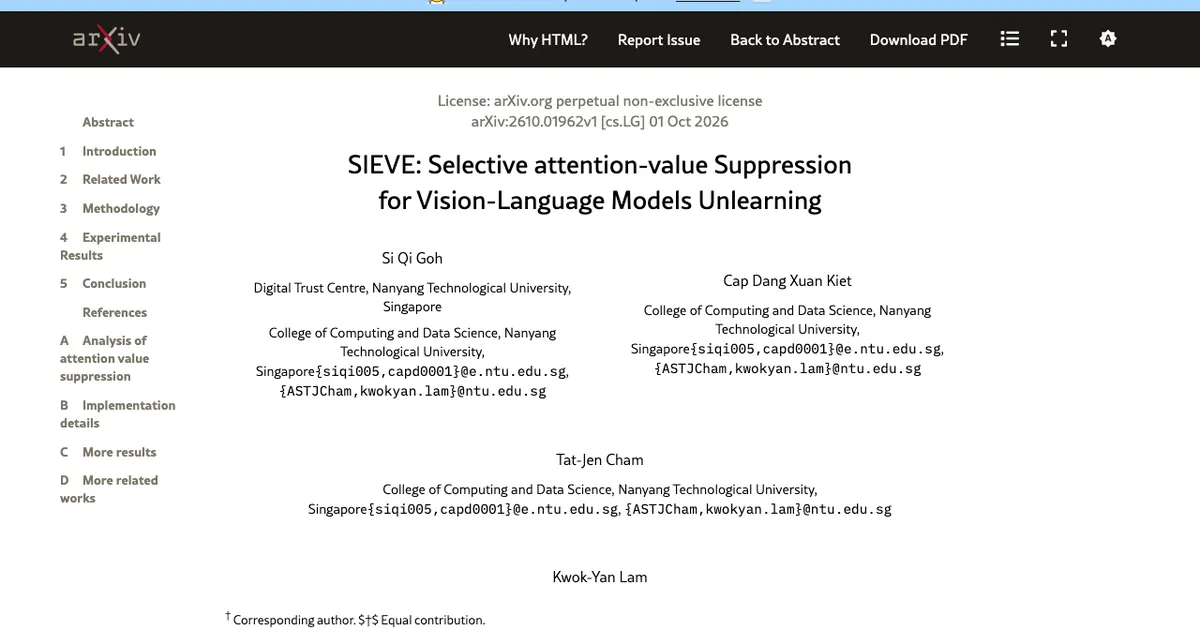
By Si Qi Goh, Cap Dang Xuan Kiet, Tat-Jen Cham, Kwok-Yan Lam • arXiv • Importance: 95/100
Hero Image for 2610.01962

🔥 AI Governance Deep Dive: Selective Memory Erasure for Vision-Language Models

Have you ever wondered how to ‘forget’ a specific piece of personal information from an advanced AI—say, deleting your old address without making the model forget that you are still you? This is the critical frontier of responsible AI deployment.

Vision-Language Models (VLMs) are incredibly powerful at linking visual identities with textual bios. But this power comes with a serious ethical challenge: how do we selectively unlearn sensitive, personally identifiable information (PII) without accidentally corrupting all other retained knowledge about that individual?

Introducing SIEVE: A revolutionary framework designed to solve selective VLM unlearning.

🛡️ What is SIEVE and Why Does It Matter?

Traditional model forgetting approaches are often blunt instruments, deleting everything in the process. SIEVE tackles this head-on by intervening precisely at the attention values within the model’s inner workings. Think of attention values as the neural network’s ‘focus dial.’ SIEVE allows researchers to pinpoint and suppress specific connections (forgetting the PII) while simultaneously ensuring that the core, permitted knowledge remains intact.

The framework achieves this through a sophisticated, dual-action mechanism:

  1. Targeted Forgetting: It forces the attention values associated with sensitive examples toward zero suppression.
  2. Knowledge Preservation: Crucially, it utilizes a frozen reference model to match and anchor the representations of retained knowledge, ensuring that core identity utility is maintained.

This selective approach ensures we meet strict data governance requirements while keeping powerful models useful—a major win for real-world deployment in regulated industries like healthcare or finance.

🔬 Technical Deep Dive (How It Works)

The genius of SIEVE lies in its ability to regularize the model’s attention-value representations. Instead of just looking at input/output pairs, it addresses the internal mechanism that dictates how the model processes information. By suppressing unwanted signal values while stabilizing desired ones, SIEVE provides a novel and robust method for selective multimodal unlearning.

This means it works across various combinations of text and images (multi-modality) and is highly effective even when sensitive data and retained data share complex visual inputs and representations.

🚀 Key Takeaways & Impact

  • State-of-the-Art Unlearning: SIEVE achieves leading performance in VLM selective unlearning. Read the full paper here.
  • Precision over Brute Force: It proves that attention values are a highly effective intervention point for granular, selective memory control.
  • Utility Preservation: The reference-based matching mechanism is key to minimizing ‘utility degradation’—a common failure mode in AI unlearning.

SIEVE represents a significant step toward building trustworthy and compliant AI systems. It transforms the theoretical concept of ‘AI Right to Be Forgotten’ into a practical, quantifiable architectural solution. This research is foundational for the next generation of responsible AGI development.
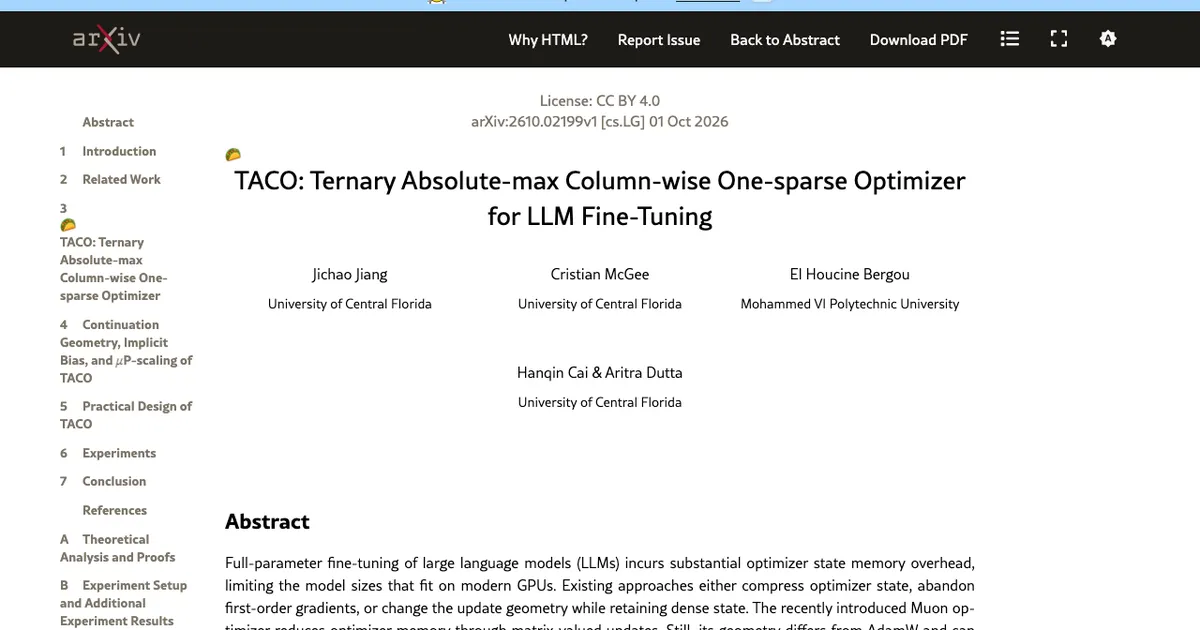
TACO: Ternary Absolute-max Column-wise One-sparse Optimizer for LLM Fine-Tuning

By Jichao Jiang, Cristian McGee, El Houcine Bergou, Hanqin Cai, Aritra Dutta • arXiv • Importance: 92/100
Hero Image for 2610.02199

🚀 Memory Breakthrough: TACO Makes Full LLM Fine-Tuning Feasible on Single GPUs

The operational cost of running Massive Language Models (LLMs) has always been tied to a vicious cycle: bigger models require more memory, and the training process—especially storing optimizer states—is the biggest culprit. While quantization and Parameter-Efficient Fine-Tuning (PEFT) methods like LoRA have dramatically expanded our capabilities, they still impose limits.

But what if we could afford full fine-tuning of enormous models on today’s hardware?

That is exactly what the authors behind TACO: Ternary Absolute-max Column-wise One-sparse Optimizer have accomplished. This paper introduces a revolutionary optimizer that drastically slashes the memory overhead associated with LLM training, making truly massive model updates accessible even on single high-end GPUs.

🧠 The Problem: Why is Full Fine-Tuning So Memory Hungry?

When you fine-tune an LLM using standard methods like AdamW, not only do you need memory for the gradients and activations, but you also must store complex optimizer states. For multi-billion parameter models, this state overhead quickly ballooned into tens or even hundreds of gigabytes, making full training impossible on a single GPU.

Existing attempts often compromised: either they used approximation techniques (like Muon), which might deviate from standard optimizers like AdamW and hurt performance, or they limited the parameters trained.

✨ The TACO Solution: Near-Zero Memory Overhead without Sacrificing Quality

TACO solves this by rethinking how optimizer state is stored. It builds upon advanced optimization theory (the operator-norm steepest descent view) but arrives at a remarkably simple, computationally efficient mechanism.

How it works: TACO leverages a ternary structure—it only needs to track the sign and magnitude of the largest entry in each column of the weight matrices. By selecting this single, dominant component per column, it retains first-order gradient information while making the persistent optimizer state

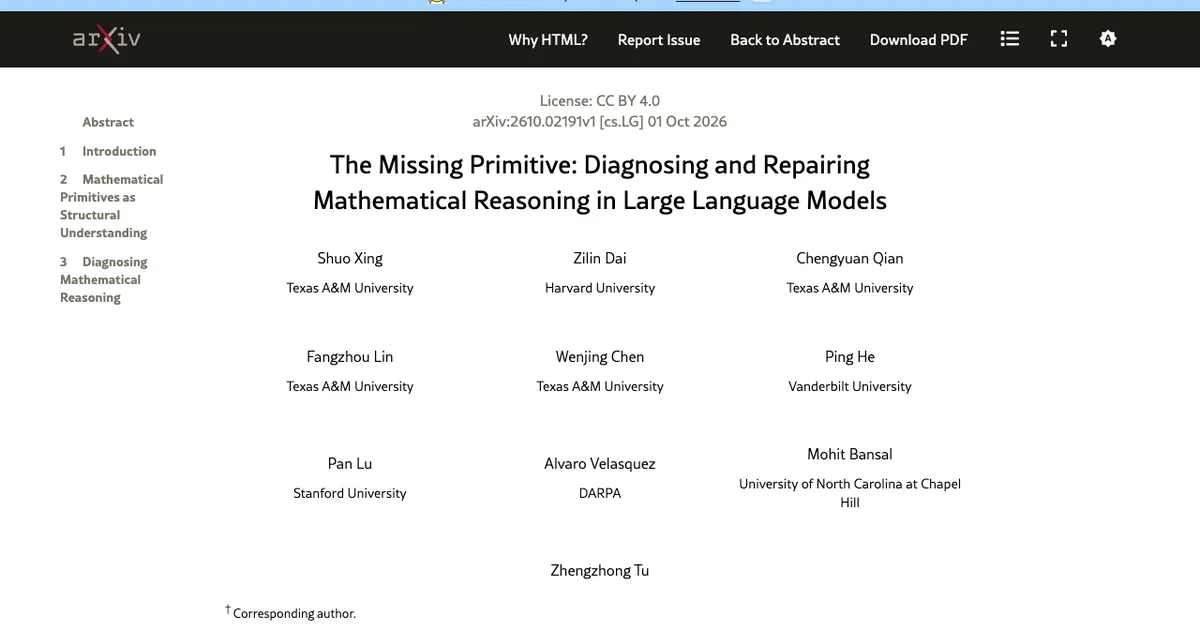
The Missing Primitive: Diagnosing and Repairing Mathematical Reasoning in Large Language Models

By Shuo Xing, Zilin Dai, Chengyuan Qian, Fangzhou Lin, Wenjing Chen, Ping He, Pan Lu, Alvaro Velasquez, Mohit Bansal, Zhengzhong Tu • arXiv • Importance: 92/100
Hero Image for 2610.02191

🧠 Unlocking the Hidden Math Genius of LLMs: A New Era of AI Reasoning

Large Language Models (LLMs) have become household names, capable of impressive feats—from writing code to drafting complex essays. But when it comes to deep mathematical reasoning, are they truly understanding the underlying concepts, or are they just mimicking patterns? This foundational question has plagued ML researchers for years.

New research published in https://arxiv.org/abs/2610.02191 offers a powerful answer, providing both a systematic diagnosis of LLM shortcomings and a concrete path toward fixing them.

🔍 The Problem: Math Accuracy vs. True Understanding

The current state-of-the-art shows that while models can achieve high solution accuracy on many math benchmarks, this success often hides deep structural deficiencies. Researchers propose the concept of a ‘Mathematical Primitive,’ suggesting that true understanding isn’t monolithic but comprises distinct abilities—like knowing how to discover a formula, generate steps, process information (digestion), and execute calculations.

The team introduces $ ext{hlei}$, a novel benchmark designed to probe these four specific dimensions of mathematical reasoning: Discovery, Generation, Digestion, and Execution. This shift moves the goalposts from simply getting the right answer to understanding how the model arrives at that answer.

💡 Key Insights & Breakthroughs

The paper reveals several crucial insights about how LLMs ‘think’ mathematically:

  1. The Bottleneck is Discovery: Systematic analysis shows that even models with high overall accuracy often struggle because of a bottleneck in the initial Discovery phase—the ability to identify the correct mathematical framework or formula needed to solve the problem.
  2. Latent Capacity: The primitives reveal that LLMs have significant ‘latent’ reasoning capacity that simply needs targeted access and guidance, suggesting that better diagnostic tools are key to unlocking potential.
  3. Targeted Repair Works: Critically, the authors found that these discovery-limited failures are particularly easy to repair with specialized training. This is a huge step toward making AI reliable for high-stakes applications like engineering or medicine.

🛠️ The Solution: Primitive-Privileged Self-Distillation

The core contribution of this paper is the introduction of $ ext{abs}$, a groundbreaking post-training framework. $ ext{abs}$ operates by selectively transferring knowledge. Instead of general retraining, it focuses on guiding the student model using these identified ‘primitive-guided’ reasoning paths.

This selective distillation approach consistently demonstrates significant improvements in mathematical rigor and robustness across various model sizes and challenging benchmarks, proving that decomposing complex reasoning is a viable pathway to highly reliable AI.

🚀 Why Does This Matter for Developers & Researchers?

  • For ML Engineers: If you are building mission-critical AI systems, this work provides a roadmap beyond simple fine-tuning. It tells you what skills your model lacks (e.g., discovery) and how to train them specifically.
  • For Data Scientists: This shifts the paradigm of evaluation. Relying solely on final scores is insufficient; we need multi-dimensional diagnostic tools like $ ext{hlei}$ to ensure true competence.
  • The Future: By diagnosing and repairing these fundamental mathematical primitives, this research accelerates the path toward creating truly reliable and trustworthy AI capable of complex, real-world reasoning.

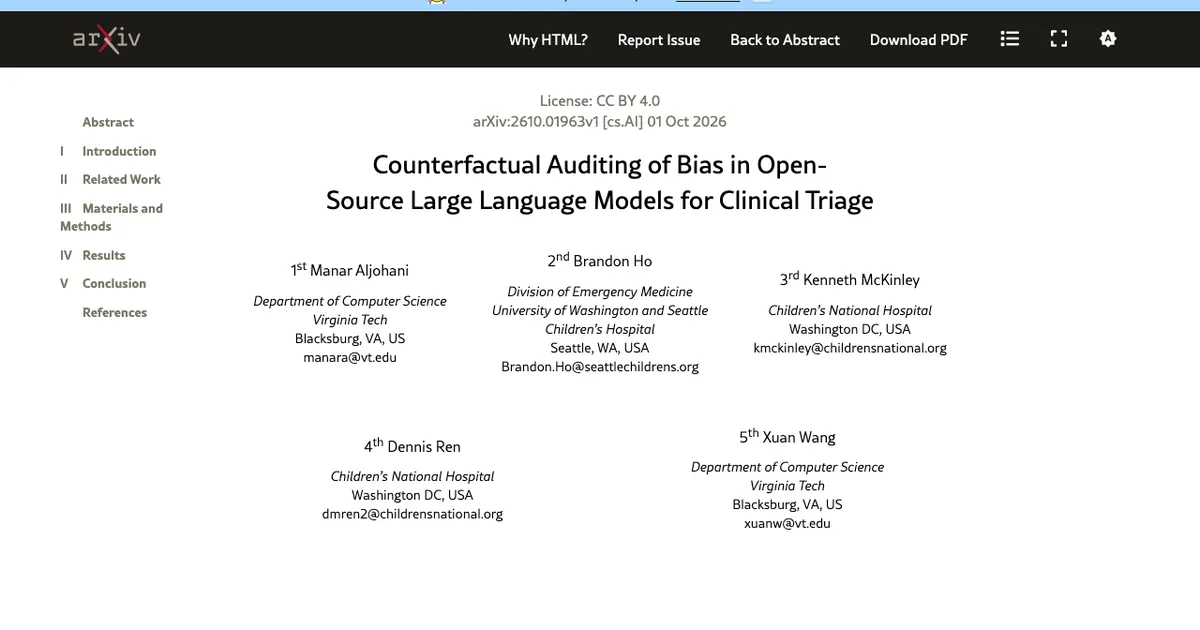
Generative modeling of intrinsically disordered protein regions by reinforcing sparse autoencoder features

By Jason X. Liu, Sebastian Ibarraran, Frank Hu, Soojung Yang, Xinyu A. Feng, Abigail Park, Anagha Aneesh, Lacramioara Bintu, Alexander R. Dunn, Grant M. Rotskoff • arXiv • Importance: 92/100
Hero Image for 2610.02189

Decoding the Chaos: Designing Functional Proteins with IDiom and RL-SAE

(ML Researcher Insights & Tech Digest)

The blueprint of life is built on proteins. But not all proteins are neatly folded little machines. Many crucial biological functions rely on ‘Intrinsically Disordered Protein Regions’ (IDRs)—flexible, amorphous stretches that act like molecular Swiss Army knives.

These IDRs are central to fundamental cellular processes, including signal transduction and gene regulation. However, designing them is notoriously difficult. Traditional structure-based methods fail because there’s no fixed shape! Even the latest massive protein language models (PLMs) often struggle, as they are trained primarily on perfectly folded domains, biasing their knowledge away from these flexible regions.

That’s where cutting-edge computational biology steps in.

🧬 Meet IDiom: An AI for Flexible Proteins

Researchers have introduced IDiom, an autoregressive protein language model specifically trained on a massive dataset (IDiom-DB, derived from the AlphaFold Database) containing millions of predicted IDRs. Think of it as GPT for disordered proteins.

IDiom’s breakthrough power lies in its ability to generate diverse and realistic sequences that capture the true complexity of natural IDRs—including their motif patterns and unique compositional rules.

But generation isn’t enough. If you want a protein with specific functions (e.g., ‘this part must bind DNA,’ or ‘it needs to localize near the nucleus’), you need control. Enter Reinforcement Learning with Sparse Autoencoder Features (RL-SAE).

🛠️ The Control Mechanism: Making Proteins Goal-Oriented

RL-SAE is a post-training optimization that allows researchers to guide IDiom’s output using predefined functional features. Instead of simply generating a protein, you can ask the system to generate one that specifically activates key biological pathways.

In testing across eight diverse design tasks, the results were stunning: RL-SAE generated sequences that activated 90% of targeted features—significantly outperforming previous methods (like activation steering) by generating functional proteins with unprecedented precision.

This combination enables interpretable and composable IDR design. You can now build a protein sequence where distinct, known biological functions are explicitly encoded and combined into a single strand.

🔬 Why This Matters for Biotech & Drug Discovery

This isn’t just an academic parlor trick; it changes how we approach synthetic biology.

  1. Precision Engineering: Instead of trial-and-error screening, you can computationally design protein regions that perform multiple functions simultaneously (e.g., binding a specific receptor AND modulating gene expression).
  2. Overcoming Limitations: It sidesteps the structural constraint problem, opening up IDRs—a vast and largely unexplored biological space—for drug development.
  3. General Utility: The framework of RL-SAE is highly valuable and can be adapted to other protein design challenges requiring feature-specific control.

The authors’ work IDiom: Generative modeling… provides a powerful, robust toolkit for the next generation of bio-engineered materials and therapeutics.

🔥 Future Impact: By giving us explicit control over IDR function, IDiom opens the door to designing designer proteins that solve some of biology’s most complex signaling puzzles.

Decoding Looped Transformers Better for (Almost) Free

By Weihao Liu, Huangjie Zheng, Tianrong Chen, Rohit Dilip, Richard He Bai, Yizhu Jiao, Yuyang Wang, Ruixiang Zhang • arXiv • Importance: 92/100
Hero Image for 2610.02185

Decoding Looped Transformers Better for (Almost) Free: Making LLMs Faster and Stronger

Are you tired of massive language models that eat up your GPUs? The efficiency problem in NLP remains critical. Researchers are finding ingenious ways to compress the model size while maintaining state-of-the-art performance, and a new method called LoopCD tackles this head-on.

This breakthrough addresses a subtle but significant flaw in how Looped Transformers decode. These specialized models gain efficiency by running shared blocks repeatedly (like an iterative refinement process). Each repetition gives us slightly different, yet related, predictions for the next token. However, standard decoding methods often ignore the rich information contained in those initial, computationally cheaper loops.

🧠 What Problem Does LoopCD Solve?

The core insight is this: those early, less-computed states aren’t just warm-up; they are valuable signals. By contrastively pairing the final prediction (the ‘strong’ signal) with an earlier intermediate state (the ‘weak’ signal), researchers can create highly effective guidance.

LoopCD introduces a training-free contrastive framework that formalizes this process. It essentially tells the model: ‘Don’t just trust the last output; compare it to where you were five steps ago, and use that comparison to make your next decision.’

🚀 The Technical Breakthroughs (And Why You Should Care)

The impact of LoopCD is substantial, hitting two critical targets for modern LLM deployment: performance boost and massive efficiency gains.

  1. Unprecedented Performance: When tested on challenging benchmarks like AIME 2024 (a math reasoning test) and HumanEval (coding), LoopCD significantly outperforms baselines. For instance, it raises Ouro-2.6B-Thinking’s AIME pass@1 from 61.88% to an impressive 73.33%.
  2. Efficiency Goldmine: Crucially, these performance gains allow the model architect to halve the number of recurrent loops needed. This dramatic reduction in computation cuts forward FLOPs by up to 48.2%, meaning you get a stronger, smarter model running on half the compute!

Whether implemented in logit space (LoopCD-Logits) for easy use or hidden-state space (LoopCD-Hidden) for minimal overhead, LoopCD offers robust, tangible improvements.

🌎 Real-World Impact & SEO Takeaways

The implications stretch across multiple industries: * Edge Computing/Mobile: Running powerful LLMs on limited hardware becomes much more feasible. Faster inference = lower latency. * Enterprise AI Solutions (US/Europe): Deploying specialized, accurate models without needing massive GPU clusters saves costs and accelerates product development. * Academic Research: Provides a scalable framework for optimizing complex recurrent architectures.

Read the full technical details on this groundbreaking method in LoopCD: Decoding Looped Transformers.


Tags: #LLMOptimization #GenerativeAI #Transformers #NLP #MachineLearning #DeepLearning

Sample complexity bounds for categorical Markov random fields via Discrete Diffusions

By Shivam Kumar, Nabarun Deb • arXiv • Importance: 92/100
Hero Image for 2610.02128

$\text{Deep Dive: Sampling Complex Data with Discrete Diffusions}$ ✨

Have you ever needed to sample data from a highly structured distribution—one that mimics complex real-world systems like language models, protein folding, or physical lattices? Traditional sampling methods can struggle when the dependencies between adjacent data points are local and strong.

Enter Discrete Diffusion Models. These techniques have emerged as incredibly flexible tools for generating high-quality samples from complicated distributions. But achieving reliable, theoretically sound performance in a discrete setting is challenging—especially when considering the error introduced by training deep neural networks to estimate probability scores.

What did the research team (Shivam Kumar and Nabarun Deb) tackle? 🤔

This paper tackles the crucial problem of providing end-to-end sample complexity bounds for discrete diffusions. In simple terms, they are not just showing that a method works well empirically; they are giving us mathematically rigorous guarantees on how many samples we need and how accurate our final results will be.

🔬 The Core Technical Breakthrough: Pinning Decomposition

The main technical insight is powerful: a new pinning decomposition of the discrete score. In continuous diffusions, mathematics can sometimes simplify things, but for discrete data (like categorical variables), the scoring function is much tougher to handle. This decomposition shows that, unlike other settings, the dependence on time and the dependence on the target variable separate multiplicatively. This structure allows for a massive simplification in training efficiency.

🧠 A Smarter Way to Train: Weight-Sharing Learning

Building on this separation, the authors propose a novel weight-sharing neural score learner. Instead of training an enormous, complex model that tries to capture every single detail independently (like fully connected networks), they design a network that shares weights across different noise levels.

Why is this revolutionary? It dramatically improves stability and sample efficiency, especially when generating long sequences.

💡 Real-World Impact: Adaptive Sampling Guarantees

The breakthrough extends beyond just building a better model. The research provides sampling guarantees that explicitly depend on key parameters like the vocabulary size and the interaction order of the Markov Random Field (MRF). Crucially, their approach allows for inference-time adaptation: they train a single score network but can choose the required discretization level (and thus, trade off computational cost versus accuracy) right when they are using it. This adaptability is invaluable in practical deployment scenarios.

Bottom Line: By combining structural decomposition with efficient weight-sharing learning, this work delivers theoretical guarantees and superior empirical performance for generating complex discrete data—a critical step forward for fields ranging from genomics to next-generation LLMs.https://arxiv.org/abs/2610.02128

Is your project dependent on sampling high-dimensional, locally correlated data? This paper offers the theoretical bedrock you need to scale discrete diffusion models.

Relative Transitions, Not Absolute Destinations: A Transfer-and-Ground Framework for Target-Trajectory-Free Human Mobility Generation

By Yidi Wang, Yunhe Zhang, Bangchao Deng, Dingqi Yang, Pengyang Wang • arXiv • Importance: 92/100
Hero Image for 2610.02033

🚀 Say Goodbye to City-Specific Mobility Models: Introducing Nomad

Ever used an app that predicts where you’ll go next based on data from another city? Good news, because a new breakthrough is making it possible—and it changes everything for urban planning and location services.

Traditional models for predicting human movement (or ‘trajectories’) are severely limited. They typically require training data from the exact city they will be deployed in. This assumption creates a massive bottleneck, especially for developing economies or rapidly expanding regions where clean trajectory data is scarce. Furthermore, these old models treat destinations as absolute points—tying reusable human behavior patterns to the rigid geometry and unique POI identifiers of a specific source city.

This is exactly what the research in Nomad: Target-Trajectory-Free Human Mobility Generation addresses. They’ve completely reframed the problem from predicting absolute destinations to predicting context-conditioned relative transitions. This is a paradigm shift.

💡 What Problem Does Nomad Solve?

The core limitation? Mobility models assume that movement behavior in City A must be defined by POIs and distances found only in City A.

Nomad’s revolutionary approach breaks this dependency into two parts:

  1. The Behavior Layer (Learning): It learns how people move—the underlying, reusable patterns of transitions (semantic displacement, geographic change, time elapsed) from rich source cities.
  2. The Grounding Layer (Generation): Using only public map data (POIs and categories) in the target city, it figures out where those learned movements can be realized, without needing any example target trajectories.

Think of it as teaching a child to walk using ballet techniques: first learning the fundamental motions (the transitions), and then applying those learned motions onto an unfamiliar stage or floor plan.

🔬 How Does Nomad Work Under the Hood?

At its heart, Nomad uses a specialized flow-matching model. This model learns a transition prior—a statistical rule governing the likelihood of moving from one type of POI context to another (e.g., from ‘restaurant’ to ‘park’).

During inference in a new city, it employs a behavior graph and an exploration-return walk method. Essentially, it models movement not as predicting a single destination, but by exploring possible, high-probability paths on the target POI map until it finds a coherent route.

✨ Why Is This a Game Changer?

  • Transferability: It enables truly generalizable mobility prediction across different geographical areas with diverse urban structures. No more reliance on perfectly matched source/target data!
  • High Fidelity: Testing showed that Nomad significantly outperforms existing adaptation baselines, improving distributional fidelity by about 15% and utility in downstream tasks by 3%.
  • Utility: This makes it vastly more powerful for critical applications like emergency service dispatch optimization, resource allocation, and simulating large-scale crowd movement.

If you’re building the next generation of smart city infrastructure or working on global location intelligence, this paper is a must-read. It defines a new standard for tackling complex human behavior modeling in data-poor environments.

BranchIP: Learning Adaptive Equivariant Computation for Interatomic Potentials

By Laura Zichi, Gil Harari, Chuin Wei Tan, Marc L. Descoteaux, Albert Zhu, Menghang Wang, Yoel Zimmermann, H. T. Kung, Boris Kozinsky • arXiv • Importance: 92/100
Hero Image for 2610.02013

🚀 Beyond Deep Learning: Making Atomic Simulations Faster with BranchIP

The field of materials science has been fundamentally changed by Machine Learning Interatomic Potentials (MLIPs). These models allow researchers to simulate atomic systems—like catalysts or solid electrolytes—with unprecedented accuracy and speed, moving us toward designing next-generation energy solutions. But there’s a massive computational bottleneck: even the best MLIPs are incredibly complex, and scaling them up for long simulations drains both compute power and memory.

This is where Branch Interatomic Potential (BranchIP) steps in. This breakthrough framework solves the core problem of deep MLIPs by introducing an adaptive, branch-based approach to computation.

💡 What Is BranchIP?

The biggest bottleneck in current MLIPs often lies in computationally intensive tensor product computations. Traditionally, these models have to allocate resources equally everywhere, regardless of whether a specific atomic interaction is chemically simple or highly complex.

BranchIP fundamentally changes this game by learning where and how much computation depth is actually needed. It’s not just one massive model; it’s an adaptive resource allocator trained specifically for the physics of chemical interactions.

🛠️ How Does It Work?

Think of BranchIP as a smart circuit designer for molecular physics. Instead of treating all potential interactions with maximum computational depth (which wastes time on simple bonds), it intelligently adapts the computation graph.

The authors developed this using a novel distillation loss, allowing the model to learn which physical inputs demand deeper processing and where simpler calculations suffice. This adaptive mechanism is key to its efficiency.

📊 The Impact: Speed, Memory, and Interpretability

The results are genuinely remarkable across two diverse systems—a heterogeneous catalysis setup and a proton-conducting solid acid electrolyte.

  • 🚀 Massive Acceleration: BranchIP accelerates existing MLIPs by up to 2.4×.
  • 💾 Reduced Memory Footprint: It slashes memory usage by up to 2.6×.
  • 🔬 Unprecedented Interpretability: Beyond just speed, the framework offers interpretability. By analyzing its computation depth, researchers can now pinpoint exactly which atomic interactions are chemically complex or unusual, linking computational cost directly back to chemical reality and dynamic processes. This is a game-changer for mechanistic understanding.

The Bottom Line: BranchIP doesn’t just make MLIPs faster; it makes them smarter and more physically insightful. By efficiently managing computational resources based on the underlying physics, it opens up entirely new simulation regimes for materials discovery in everything from clean energy to advanced battery technologies.

Interested in learning more? Read the full paper: BranchIP

Cost-augmented Schrödinger bridges on graphs are exactly solvable: a Feynman-Kac tilt replaces learned control

By Akshay Balsubramani • arXiv • Importance: 90/100
Hero Image for 2610.02195

✨ Beyond the Black Box: Solving Complex Pathfinding with Schrödinger Bridges

The field of generative AI and optimal control is rapidly moving past simple pattern recognition. Today’s frontier involves solving inherently complex problems—like figuring out the most efficient path to fold a protein, or optimizing traffic flow across massive real-world graphs. The challenge often lies in introducing ‘cost’: how do you optimize for efficiency and minimize energy expenditure along the way?

Traditional methods often rely on learning complicated control policies via large models, which are computationally intensive and introduce potential approximation errors.

Enter the new paradigm: Exact Analytical Solutions.

The paper by Akshay Balsubramani introduces a breakthrough method for solving Cost-Augmented Schrödinger Bridges (CASBs) on graphs. At its core, this research shows that incorporating state costs (like energy barriers or congestion penalties) doesn’t require complex machine learning modifications; it can be exactly and analytically incorporated into the solution framework.

💡 What is a Cost-Augmented Schrödinger Bridge?

Think of a Schrödinger bridge as finding an optimal path of ‘mass’ between two known probability distributions (say, starting with uniform traffic and ending at maximum congestion). When you add a cost layer—for instance, penalizing paths that pass through highly congested intersections or high-energy states—you get the Cost-Augmented version.

The key insight is this: The complex penalty term associated with state costs actually simplifies into a mathematical transformation called a Feynman-Kac tilt. This means the difficult problem of finding a cost-optimal path can be reduced to solving a much simpler, standard bridge problem against a ‘tilted’ reference process.

🔬 Why Does This Matter for ML and Optimization?

The implications are huge, offering highly scalable improvements in several areas:

  • Computational Efficiency: Instead of relying on iterative learning (like gradient descent) or large-scale sampling rollouts, the exact bridge is computed by simply alternating two endpoint rescalings. Crucially, this process requires only sparse matrix exponentiations and does not require time discretization or learned parameters.
  • Scalability: The method’s memory requirement grows only linearly with the size of the network, making it viable for massive graphs—like city-scale road networks with millions of intersections.
  • Accuracy & Robustness: For specific cost types (like quadratic congestion), the divergence from the exact solution can be bounded by a simple gradient descent error, offering strong theoretical guarantees on accuracy.

🧬 Real-World Impact: Protein Folding and Robotics

The abstract highlights two incredibly impactful use cases:

  1. Biology: On protein-folding models, incorporating a free-energy cost directly lowers the expected barrier of the folding paths—meaning the model can predict more biologically plausible and stable structures.
  2. Autonomous Systems: Applied to learned road networks, the exact bridge method matches target distributions within sampling error. This suggests powerful applications for autonomous vehicle routing, traffic prediction, and resource allocation where costs are critical (e.g., time, fuel, safety).

This work, detailed in Cost-augmented Schrödinger bridges on graphs are exactly solvable: a Feynman-Kac tilt replaces learned control, marks an elegant shift from approximation theory to exact mathematical solvability for highly complex optimal control problems, paving the way for new benchmarks in scientific machine learning.

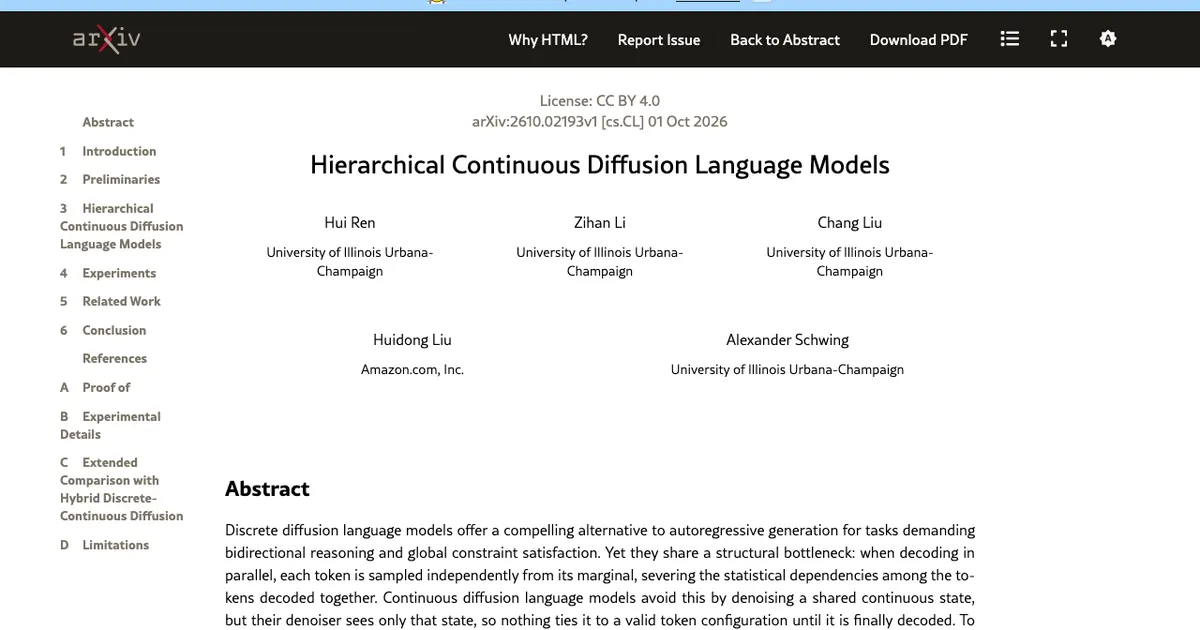
Hierarchical Continuous Diffusion Language Models

By Hui Ren, Zihan Li, Chang Liu, Huidong Liu, Alexander Schwing • arXiv • Importance: 90/100
Hero Image for 2610.02193

🧠 Next-Gen Language Models: Bridging the Gap Between Continuous and Discrete Text

The limitations of current large language models (LLMs) are becoming clearer. While autoregressive models excel at sequential text generation, they struggle with tasks requiring deep, bidirectional reasoning—like solving Sudoku or complex mathematical planning. Meanwhile, discrete diffusion models help, but they hit a new roadblock: sampling tokens independently ruins the statistical relationships between the generated tokens.

Enter Hierarchical Continuous Diffusion Language Models (HC-DLM).

A breakthrough paper from [Hui Ren et al.] introduces HC-DLM, tackling this core limitation by combining the best of both worlds. Think of it as giving LLMs a deep, continuous understanding while maintaining perfect discrete token structure.

🚀 How Does HC-DLM Work?

The core innovation is moving from separate pipelines to a single, unified denoising process. Instead of treating the text generation and context modeling as two separate steps, HC-DLM uses a shared, evolving continuous latent state.

  1. Latent Trajectory: The model learns to denoise this continuous state, which acts as the primary source of generative information at every step.
  2. Bidirectional Feedback: Crucially, when tokens are read out from this state (e.g., ‘the’, ‘cat’), those discrete tokens immediately feed back into updating the latent state for the next token, acting as a scaffold.
  3. The Result: This creates a deeply coupled system where the continuous space guides the global context, and the sampled discrete tokens maintain local coherence—all within one principled framework.

🔍 Why Is This a Big Deal? (Performance & Impact)

The authors demonstrate that HC-DLM significantly outperforms existing baselines across multiple difficult tasks:

  • Structured Reasoning (Sudoku/Countdown): It shows improved puzzle accuracy, proving its ability to handle global constraints—a major leap over traditional LLMs.
  • Language Modeling (LM1B): The model achieves superior generative perplexity, indicating a much deeper and more coherent understanding of language structure than previous methods.

By deriving its objective from the variational bound on token likelihood, HC-DLM is not just an incremental update; it proposes a fundamentally more robust architecture for complex reasoning tasks.


🌐 Key Takeaways & Implications

  • For Researchers: If your work involves moving beyond simple next-token prediction (e.g., structural reasoning, formal math), HC-DLM provides a powerful new architectural blueprint. The coupling mechanism is the breakthrough.
  • For Industry/Developers: We are getting closer to AGI capability in LLMs. Models that can reliably solve Sudoku and mathematical puzzles represent a massive step toward reliable agents for critical applications like scientific discovery or detailed process automation.

We highly recommend checking out the full details on arXiv and exploring their project page: HC-DLM Project Page.

ML #LanguageModels #Diffusion #AIResearch #DeepLearning #GenerativeAI

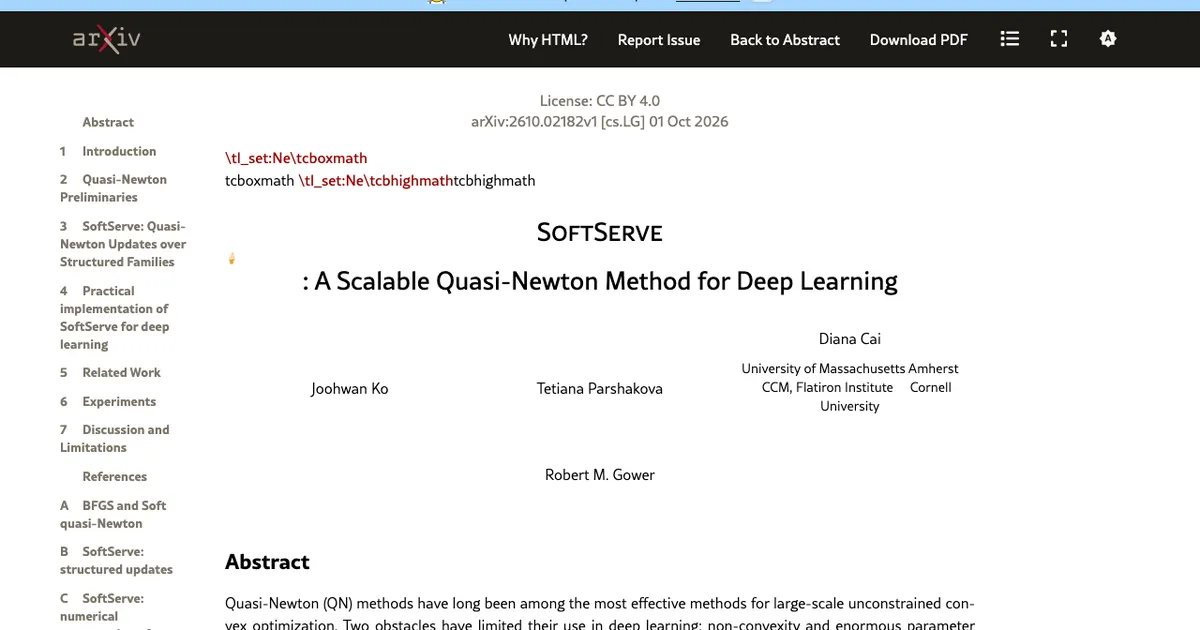
SoftServe: A Scalable Quasi-Newton Method for Deep Learning

By Joohwan Ko, Tetiana Parshakova, Diana Cai, Robert M. Gower • arXiv • Importance: 90/100
Hero Image for 2610.02182

Revolutionizing Optimization: Introducing SoftServe for Massive Deep Learning Models

For years, the backbone of deep learning—optimization—has struggled with a fundamental dilemma. Quasi-Newton (QN) methods are theoretically robust and essential for large-scale optimization, yet they traditionally falter when faced with two major roadblocks in modern AI: non-convex objectives and billions of parameters.

We’ve hit a performance ceiling using established optimizers like Adam or Muon, especially on complex, ill-conditioned tasks such as Physics-Informed Neural Networks (PINNs) or advanced recurrent models. Why? Because these methods often struggle to accurately capture the true curvature landscape of massive, non-convex loss functions.

Enter SoftServe.

SoftServe is a novel family of Quasi-Newton methods engineered from the ground up to handle the unique challenges of modern deep learning architectures. It’s not just an incremental improvement; it fundamentally shifts how we approach optimization on scale.

💡 How SoftServe Changes the Game

Unlike traditional QN approaches, SoftServe achieves stability and scalability by:

  1. Bypassing Line Searches: It eliminates slow, computationally expensive line searches and ad hoc curvature corrections, making training faster and more reliable.
  2. Handling Non-Convexity Gracefully: It derives positive definite curvature estimates from advanced variational objectives, maintaining mathematical stability even when the underlying objective exhibits negative curvature—a common occurrence in deep models.
  3. Massive Scale Efficiency: SoftServe provides specialized diagonal and Kronecker-factored variants that preserve essential properties (like positive definiteness) while scaling efficiently to networks with millions or billions of parameters.
  4. GPU Optimization: Crucially, it replaces costly, bottlenecking matrix decompositions with the stable coupled Newton-Schulz iteration. This means maximum performance gains directly on GPU hardware.

🌐 Real-World Impact: Where SoftServe Shines

SoftServe is particularly powerful in niche, yet critical, domains where standard optimizers fail:

  • Physics-Informed Models (PINNs): When modeling complex physical laws, the loss landscape is notoriously difficult. SoftServe shows superior performance on tasks like the 136M-parameter physics-informed diffusion model.
  • Recurrent Networks and Autoencoders: For time series or generative tasks where dependencies create ill-conditioned matrices, SoftServe delivers better convergence and lower losses than leading baselines (including Adam).

If your project involves optimizing massive models on highly complex, non-convex loss landscapes, SoftServe represents a critical upgrade to the foundational tools of AI research.

🔗 For the technical details, check out the paper: SoftServe: A Scalable Quasi-Newton Method for Deep Learning


Disclaimer: This post summarizes key findings and is intended for researchers working with large-scale optimization techniques in deep learning.

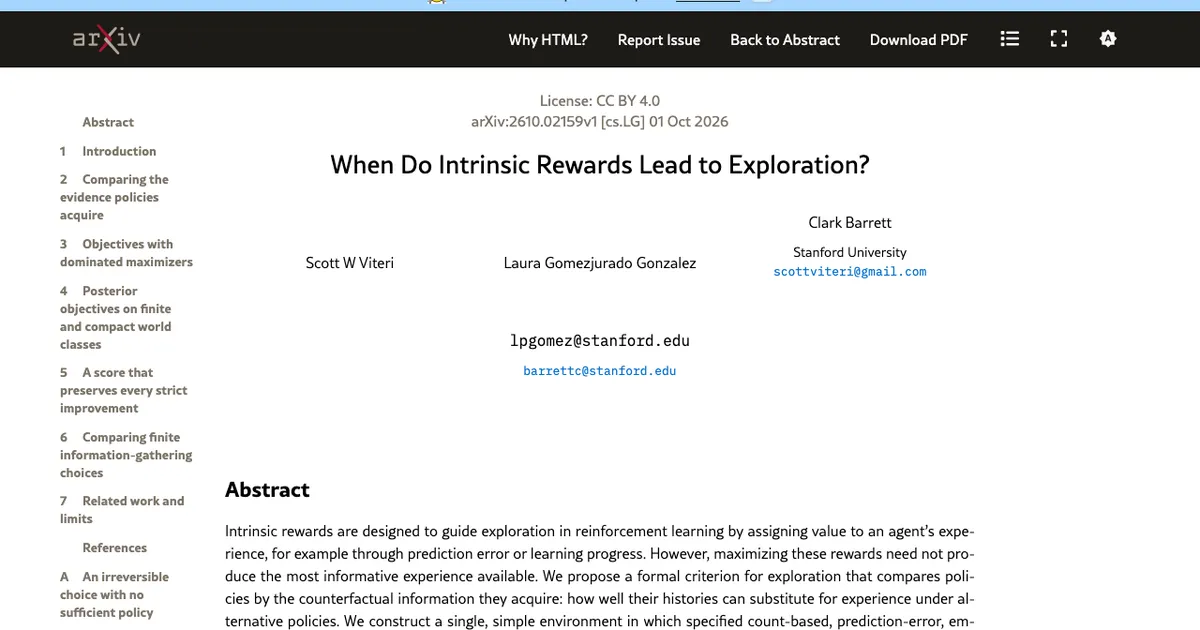
When Do Intrinsic Rewards Lead to Exploration?

By Scott W. Viteri, Laura Gomezjurado Gonzalez, Clark Barrett • arXiv • Importance: 90/100
Hero Image for 2610.02159

Is Your RL Agent Exploring the Right Things? A New View on Intrinsic Rewards

(A Deep Dive into Optimal Exploration)

In Reinforcement Learning (RL), getting an agent to explore is half the battle. You don’t just want it to wander aimlessly; you want it to gather information in a way that truly maximizes its understanding of the environment. This challenge is encapsulated by intrinsic rewards—signals designed to motivate exploration beyond simple external goals.

But here’s the catch: most intrinsic reward mechanisms assume that maximizing reward equals maximizing information. Our latest research challenges this fundamental assumption, introducing a rigorous new framework for defining ‘optimal’ exploration.

💡 The Problem with Current Exploration Signals

Traditional methods often use signals like prediction error (the agent being surprised) or count-based exploration (visiting rare states). While effective, the paper When Do Intrinsic Rewards Lead to Exploration? demonstrates that maximizing these established metrics doesn’t guarantee acquiring the most informative experience.

Think of it this way: an agent might get high reward for visiting a rare, but unhelpful, state, while ignoring key transitional paths that would unlock deep knowledge about the system’s dynamics. The current mechanisms can guide agents to Pareto-suboptimal local maxima instead of truly globally optimal knowledge acquisition.

🧠 Our Solution: Counterfactual Information Theory

The authors introduce a mathematically rigorous measure based on Counterfactual Information. Instead of just looking at what happened (the agent’s history) and rewarding it, they compare how well that history could substitute for the experience gained under alternative policies. In essence, they measure the information an agent gains by asking: ‘If I had done something else, how much better would my understanding have been?’

This shift moves exploration from a purely reward-driven process to an information-theoretic one—a massive leap in complexity and theoretical grounding.

Key Takeaways for ML Practitioners:

  • Failure Analysis: The research constructs a single, simple environment where multiple popular intrinsic rewards (like count-based or empowerment) are shown to lead to suboptimal exploration according to the new counterfactual criterion. This provides concrete failure cases.
  • Optimal Objective Construction: Crucially, they don’t just point out flaws; they construct a novel objective function that explicitly assigns higher value when the agent’s current actions demonstrably improve its knowledge according to their counterfactual measure.

🌐 Why This Matters for AI Research (The Takeaway)

For anyone building state-of-the-art RL agents, this paper is a must-read. It forces practitioners to critically evaluate the foundational assumptions underpinning exploration policies. Moving toward counterfactual information methods could lead to vastly more sample-efficient and intelligent autonomous systems—from robotics to complex game AI.

Read the full analysis here: When Do Intrinsic Rewards Lead to Exploration?


Disclaimer: This article is a conceptual digest and not intended as direct implementation code.

From Knowledge Access to Source Learning: Developing Source-Specific Competence

By Lucheng Fu, Kejing Xia, Yiyang Wang, Yiqiao Jin, Jinjin He, Xiyuan Yang, Haoxin Liu, Ye Yu, Haibo Jin, Yijia Xiao, Wenke Lee, B. Aditya Prakash, Haohan Wang • arXiv • Importance: 90/100
Hero Image for 2610.02150

Beyond Retrieval: Teaching LLMs How to Truly ‘Learn’ from Documents

Are Large Language Models (LLMs) just advanced flashcards? If they only retrieve information, their ability is fundamentally limited. When an LLM needs to solve complex tasks relying on external knowledge, it typically treats every document as a fresh input—it just looks up facts and passes them along.

But what if the model could actually learn something specific about a source over time? What if every time it encounters a textbook chapter or an internal company manual, it didn’t just search for keywords, but progressively built a deeper, usable understanding of that source itself?

This is the core breakthrough explored in the paper SourceLearn: Developing Source-Specific Competence.

🧠 The Problem with Current RAG Systems

Most modern LLM applications rely on Retrieval-Augmented Generation (RAG). Think of RAG as a brilliant librarian who can pull out any fact you ask for, instantaneously. However, even the best librarians sometimes fail to notice recurring structural patterns or subtle contradictions within their books.

The current generation of agents treats external sources purely as data repositories. They excel at retrieval, but they lack a mechanism for progressive understanding—they don’t build ‘competence’ regarding the source itself. The repeated exposure to a single manual or knowledge base is wasted opportunity.

✨ Introducing SourceLearn: Source-Specific Competence

SourceLearn tackles this limitation head-on. It proposes shifting the paradigm from mere Knowledge Access (retrieval) to Source Learning.

It doesn’t just recall data; it builds and refines a persistent ‘source model.’ This model is an active, reusable representation of the source material’s structure, interpretive rules, and applied knowledge.

How does it do this?

  1. Self-Directed Source Learning: The system acts like a curious student. It identifies exactly what parts of the authoritative source remain ambiguous or misunderstood and proactively revisits them for refinement.
  2. Task-Guided Source Learning: This mechanism is like real-world application. By processing specific downstream tasks, it highlights representational ‘gaps’—showing where the source knowledge needs to be organized differently or where recurring patterns are missed during task execution.

By combining these two learning signals, SourceLearn ensures that every interaction contributes meaningfully to a persistent improvement of the understanding of the source, not just an answer derived from it.

🚀 Performance and Impact

The results speak volumes. Tested across five diverse benchmarks and three different LLM backends, SourceLearn achieved state-of-the-art performance in 13 out of 15 settings. Critically, the gains over established techniques like Hybrid RAG were substantial, demonstrating a major step up from static retrieval systems.

In short: This is moving beyond searching for answers to truly teaching the model how to master its source material.


What does this mean for enterprise AI? It means your LLM agents won’t just read your manuals; they will internalize them. This ability to develop deep, progressive competence from proprietary data is the next frontier of reliable and advanced AI deployment.

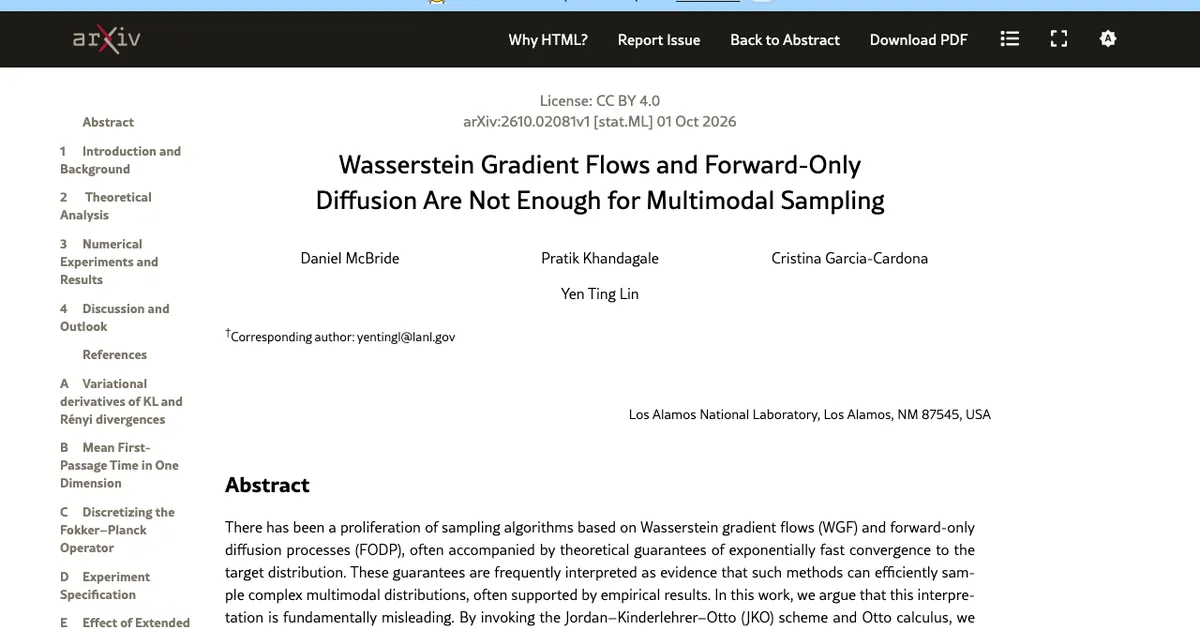
Wasserstein Gradient Flows and Forward-Only Diffusion Are Not Enough for Multimodal Sampling

By Daniel McBride, Pratik Khandagale, Cristina Garcia-Cardona, Yen Ting Lin • arXiv • Importance: 90/100
Hero Image for 2610.02081

🚨 Myth Busting in Generative AI: Why Diffusion Models Struggle with Multimodal Data

By [Your Name/Tech Blog Name], ML Research Digestist

The field of generative modeling has been revolutionized by diffusion processes. Methods relying on Wasserstein Gradient Flows (WGF) and Forward-Only Diffusion Processes (FODP) promise beautiful, theoretically guaranteed ways to sample complex data—especially for multimodal distributions like those found in images or text.

For a while, the consensus was that these theoretical guarantees meant efficient sampling of every mode. But according to cutting-edge research from Daniel McBride et al., this interpretation is fundamentally flawed.

📉 The Core Problem: Structural Limitations in Sampling Theory

The team dives deep into nonequilibrium statistical physics, invoking tools like the Jordan-Kinderlehrer-Otto (JKO) scheme and Otto calculus. Their central finding is stark: standard WGF dynamics and overdamped forward diffusion share the same inherent structural limitations.

They show that well-separated modes (multimodality) don’t just pose a slight challenge—they induce exponentially long mixing times. Think of it like trying to get a probability distribution to move between two isolated, separated islands: no matter how fast your local transport mechanism is on one island, crossing the wide ocean takes an exponentially long time.

The Takeaway: Purely local, gradient-driven transport mechanisms (which WGF/FODP use) are inherently limited when needing to connect probability mass across deeply distinct modes. This isn’t a failure of implementation; it’s a fundamental limitation of the approach itself.

💡 What Does This Mean for Practitioners?

The paper challenges the industry assumption that merely improving the annealing schedule (like using log-linear transitions) or focusing on theory is enough to solve multimodal sampling. While these techniques are useful, they do not eliminate the exponential scaling of the total transport time.

Key Impact: To efficiently sample complex data with multiple distinct modes, future models must move beyond local gradient flow mechanisms and incorporate nonlocal transport strategies. This is a massive call for architectural innovation in generative modeling.


📚 Read the full paper to understand the mathematical foundation of this limitation: Understanding Multimodal Sampling Limitations

GenerativeAI #DiffusionModels #MachineLearning #MLResearch #Multimodality #StatisticalPhysics

Sequential Capacity of Quantum Processes with Finite Memory

By Yibin Wang • arXiv • Importance: 90/100
Hero Image for 2610.02068

Unlocking Quantum Complexity: How Long Can a Quantum Device Remember?

A quantum device with limited memory might seem simple—it just runs its fixed program over and over. But if you want to know how complex that system truly is, or how much computational power it can emulate, the challenge lies in quantifying its sequential capacity.

In our latest work, we tackle this fundamental question by defining a metric: the maximum number of independent testing stages an adaptive quantum process can undergo while still being distinguishable from other potential processes. Essentially, we are measuring its ‘memory’ or ability to sustain complexity over time, even when running tests repeatedly with limited internal resources.

🔬 The Key Discovery: Logarithmic Growth!

The core finding is mathematically striking. For fixed system and memory sizes, the sequential response capacity of quantum processes grows significantly faster than expected—it grows on the order of $K ext{ log } K$, where $K$ is the length of each run. This represents a substantial enhancement over classical counterparts.

To demonstrate this, we constructed a simple yet powerful example: using time-dependent phase rotations on just a single visible qubit (requiring no extra internal memory). Crucially, these tests yield perfect response probabilities (exactly zero or one), making the detection process exceptionally clean.

💡 Quantum vs. Classical: The Gap is Real

Our research provides a clear comparative advantage. When subjected to the same rigorous testing framework, classical stochastic processes that measure in a fixed basis at every step exhibit only linear capacity ($O(K)$). This highlights that the observed logarithmic growth ($ ext{log } K$) is genuinely quantum in nature.

Furthermore, we explored how known sources of noise (specifically independent Pauli noise) affect this super-polynomial enhancement. We prove matching capacity bounds under ideal controls and weak residual phase noise after correction, identifying the inverse residual phase-flip probability as the critical coherence timescale that limits this extra logarithmic growth.

🚀 What Does This Mean for Quantum Computing?

This research contributes a deep theoretical understanding of quantum resource limitations. It provides tight bounds on how long and how complex a fixed-memory quantum process can be, establishing fundamental limits on its sequential processing capacity. Understanding these intrinsic boundaries is vital for designing practical, error-corrected, and scalable quantum architectures that operate in noisy environments.


Read the full details of our findings on Sequential Capacity of Quantum Processes with Finite Memory.

QuantumComputing #TheoryOfComputation #InformationTheory #QuantumPhysics #MLResearch

Distributionally Robust Schrödinger Bridge

By Jinhwan Sul, Panagiotis Theodoropoulos, Vincent Pacelli, Jaemoo Choi, Evangelos Theodorou • arXiv • Importance: 90/100
Hero Image for 2610.02043

Mastering Uncertainty: Introducing the Distributionally Robust Schrödinger Bridge

🚀 Hey ML Engineers & Researchers! If you’ve worked with generative models or stochastic optimal control, you know that real-world data is messy. Your carefully trained model performs great on test data—until the input shifts. This failure point, known as distributional shift, is one of the biggest headaches in deploying ML systems.

The Schrödinger Bridge (SB) framework excels at learning reliable transport paths between two distributions (say, an image source and a target style). But what happens when the initial distribution you encounter isn’t exactly what your training data assumed? The standard SB fails. 💥

That’s why we need a stronger approach: The Distributionally Robust Schrödinger Bridge (DRSB).

What Problem Does DRSB Solve?

Simply put, the original SB assumes the starting distribution is fixed. DRSB doesn’t make that assumption. It proactively accounts for uncertainty in the initial state by training a single controller optimized not just for the expected case, but for the worst-case scenario within an ‘ambiguity set’ around the nominal input.

This means the resulting dynamic path is maximally robust against unexpected variations in the starting data—a huge leap toward reliable deployment.

The Technical Breakthrough (How it Works)

The core idea is elegantly integrating three advanced fields: stochastic optimal control, distributionally robust optimization, and variational calculus.

The DRSB objective minimizes a worst-case value derived from the trade-off between the path’s control energy and keeping the final state close to the desired target distribution (via a KL penalty).

To make this computationally tractable, the authors derive an exact variational formulation of the objective. They then propose an alternating algorithm that intelligently updates the adversarial initial distribution (finding the worst case) while simultaneously training the controller.

For practitioners, the biggest takeaway is the improved robustness. The method uses sophisticated gradient approximations like Wasserstein and Sinkhorn variants—tools typically used for complex optimal transport calculations—to guide the adversarial update process.

📊 Real-World Impact & Results

The experimental results validate this improved resilience:

  1. Image/Domain Translation: On two-dimensional transport tasks and image-to-image translation, DRSB showed marked improvement in robustness to input perturbations compared to standard SB. (Note the trade-off: improving robustness might slightly reduce nominal performance.)
  2. Robust Transport (Gaussian Mixtures): When handling complex inputs like Gaussian mixture transports, Sinkhorn DRSB significantly achieved lower mean sliced Wasserstein distance than previous methods that used fixed-level noise augmentation on unseen noise levels.

🔑 The Bottom Line: If your application relies on high reliability when the input data might drift—think autonomous driving simulations or generative modeling for real-world data—DRSB offers a mathematically grounded and empirically superior method for stable distribution learning.

🔗 Read the full details and methodology here: Distributionally Robust Schrödinger Bridge (ArXiv)

#MachineLearning #GenerativeAI #OptimalControl #Robotics #DeepLearning #Robustness

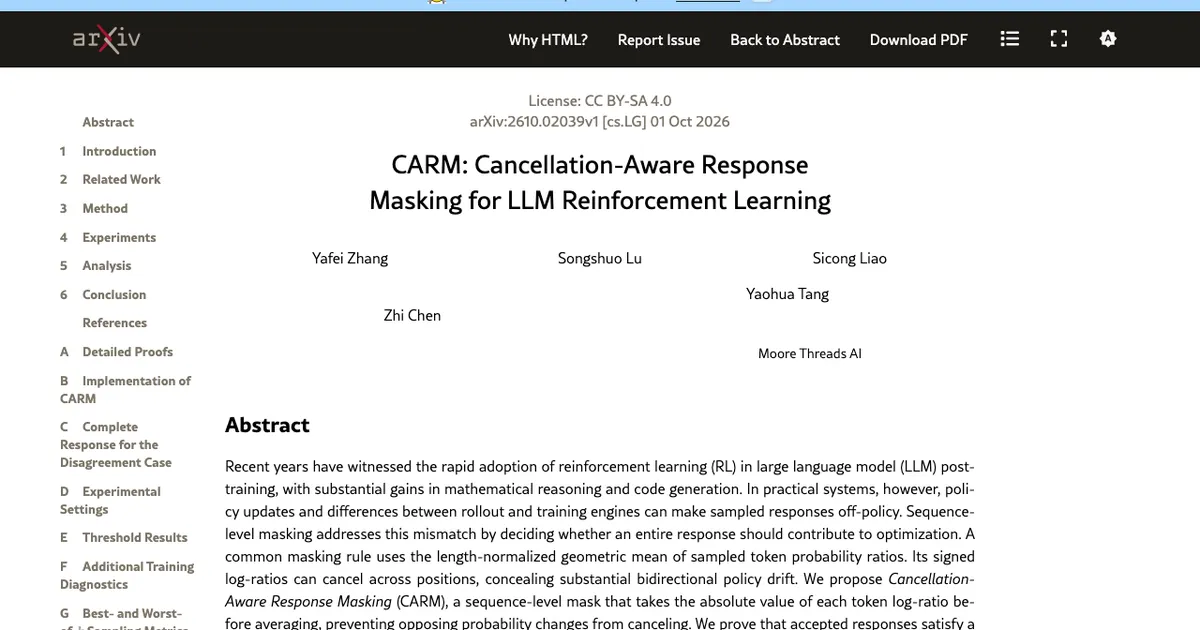
CARM: Cancellation-Aware Response Masking for LLM Reinforcement Learning

By Yafei Zhang, Songshuo Lu, Sicong Liao, Zhi Chen, Yaohua Tang • arXiv • Importance: 90/100
Hero Image for 2610.02039

🚀 Stop Policy Drift: A Game-Changing Masking Technique for LLM RL

In the rapidly evolving world of Large Language Models (LLMs), Reinforcement Learning (RL) has been a powerhouse, unlocking incredible capabilities in complex tasks like mathematical reasoning and code generation. But there’s a sneaky problem lurking beneath the surface of state-of-the-art models: policy drift.

When you fine-tune an LLM using RL, especially when your training data (rollout) doesn’t perfectly match what your final model generates (training engine), simple token-level masks fail. Your sampled responses become off-policy, leading to unreliable optimization and performance degradation.

💡 What is CARM and Why Should You Care?

Our research introduces CARM: Cancellation-Aware Response Masking. Simply put, traditional RL masking techniques average log-ratios of token probabilities. If one token’s probability drops significantly but another compensates with an equally large increase—the effect cancels out when you take the signed average. This cancellation hides massive shifts in the underlying policy that are critical for successful learning.

The CARM approach solves this by taking the absolute value of each log-ratio before averaging. By focusing on the magnitude of deviation rather than just the sign, we ensure that even opposing probability changes register their true impact, making our RL optimization much more robust and accurate.

🔬 The Impact: Real-World Performance Gains

This isn’t just a theoretical fix; we show massive real-world improvements.

  • Mathematics: CARM significantly boosts performance on AIME-level mathematical reasoning benchmarks, improving mean@16 by up to 3.13 percentage points. This is critical for high-stakes academic tasks.
  • Coding: For code generation, CARM increases average pass@1 across diverse coding benchmarks by 2.88 points. Our results demonstrate that our method provides a theoretically grounded and highly effective way to handle off-policy control in demanding LLM applications https://arxiv.org/abs/2610.02039.

🧠 Deep Dive: The Theory Behind CARM

We provide a formal, theoretically grounded proof that accepted responses using CARM satisfy strict joint bounds. This means our method isn’t just an empirical fix; it is mathematically proven to stabilize and improve response-level off-policy control in LLMs.

Takeaway for Practitioners: If you are building high-performance RL agents—especially those tackling complex multi-step tasks like solving math problems or generating flawless code—you need robust, cancellation-aware techniques. CARM offers a proven upgrade to the standard masking procedure that mitigates unseen policy drift, pushing the boundaries of what LLMs can achieve in specialized domains.

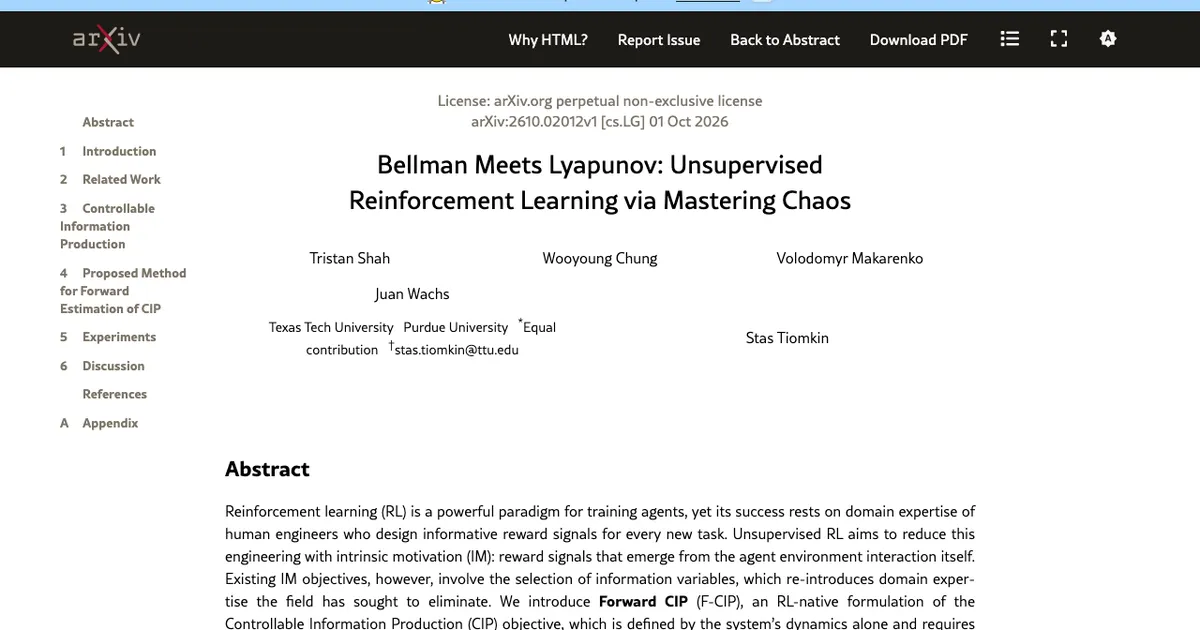
Bellman Meets Lyapunov: Unsupervised Reinforcement Learning via Mastering Chaos

By Tristan Shah, Wooyoung Chung, Volodomyr Makarenko, Juan Wachs, Stas Tiomkin • arXiv • Importance: 90/100
Hero Image for 2610.02012

Unlocking Robot Intelligence: How ‘Mastering Chaos’ in RL is Revolutionizing Automation

Making robots behave like trained humans has always been a massive challenge. Traditionally, every time an engineer wants a robot to perform a new trick—say, walking on uneven terrain or balancing a cup—they have to hand-design complex reward functions. This process is not only tedious and expensive but often limits the robot’s true potential.

Enter Unsupervised Reinforcement Learning (RL): the holy grail that promises agents can learn from pure interaction with their environment, without a human telling them exactly what

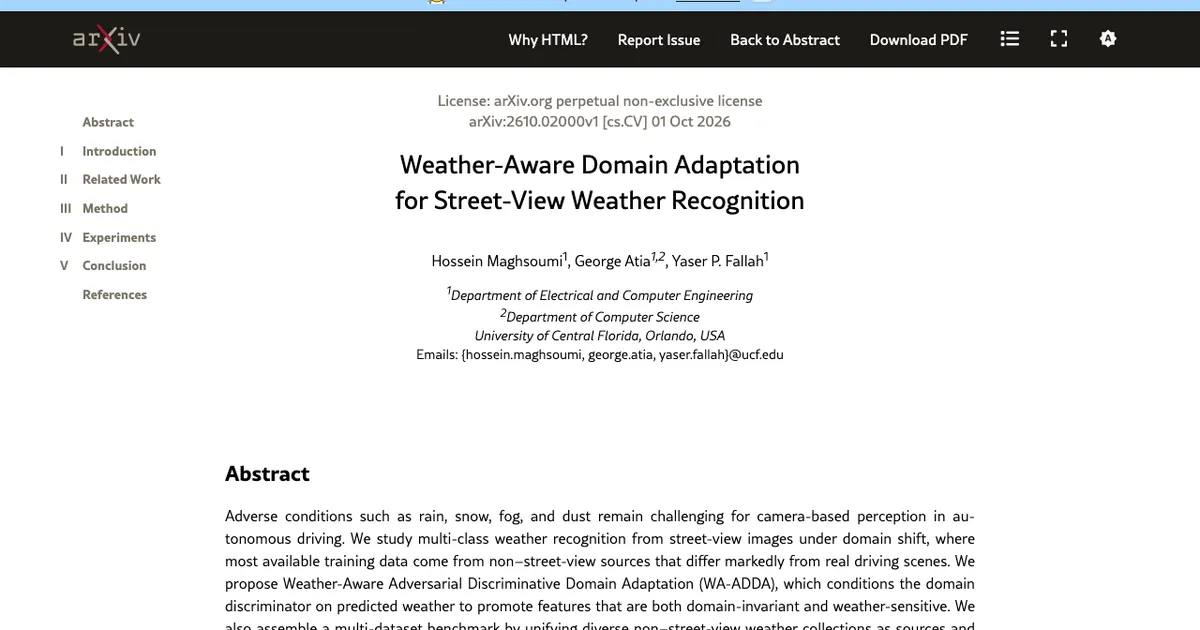
Weather-Aware Domain Adaptation for Street-View Weather Recognition

By Hossein Maghsoumi, George Atia, Yaser P. Fallah • arXiv • Importance: 90/100
Hero Image for 2610.02000

Mastering the Elements: Robust Weather Recognition for Autonomous Driving 🚗💨

If you’ve ever taken a foggy or rainy picture, you know how quickly conditions can change. For self-driving cars, these adverse weather conditions—rain, snow, fog, and dust—aren’t just inconveniences; they are critical safety challenges. Standard camera perception models often fail spectacularly when the environment shifts from clean streets to inclement weather.

This new research addresses this core problem head-on by proposing a sophisticated approach called Weather-Aware Adversarial Discriminative Domain Adaptation (WA-ADDA). This groundbreaking technique tackles the significant gap between training data (which often comes from various, non-street-view sources) and real-world street-view driving scenes.

🧠 What’s the Problem? The Domain Gap.

The best AI models are only as good as their data. When researchers train perception systems on diverse datasets that aren’t taken directly from city streets (the domain gap), these models struggle to generalize when deployed in a real-world vehicle. Weather exacerbates this: even if the model is trained well, how does it perform when confronted with a combination of fog and poor lighting?

💡 The Breakthrough: How WA-ADDA Works.

The authors introduced an ingenious mechanism: they adapt domain adaptation by making the system ‘aware’ of the weather. Instead of just trying to make features look like they came from the same source (which is standard domain adaptation), WA-ADDA conditions the domain discriminator on a predicted weather state.

In simpler terms, it forces the model to learn features that are robust enough to handle different domains while simultaneously retaining critical information about what the current weather actually is.

This dual constraint ensures: 1. Domain Invariance: The core ability of recognizing a street scene remains stable regardless of whether the data came from a clean studio dataset or actual muddy backroads. 2. Weather Sensitivity: Crucially, it maintains high accuracy specifically for weather recognition (Is it snowing? Is it foggy?) even under difficult domain shifts.

🌐 Beyond Theory: A Standardized Benchmark

Complementing the method, the researchers built a massive, standardized multi-dataset benchmark. By unifying various non-street-view collections as sources and using real street-view images as targets, they provide an essential tool for the entire autonomous driving community to measure true domain generalization capabilities.

🏆 Key Takeaways & Impact

The experimental results are highly encouraging: WA-ADDA significantly boosts weather recognition performance across multiple backbone networks (ResNet-50, EfficientNet). Most importantly, it doesn’t just perform well in bad weather; it preserves strong accuracy even when recognizing clear conditions—highlighting its overall robustness.

This paper is a significant step towards reliable, on-board perception systems needed for Level 4 and Level 5 autonomy, making the dream of self-driving cars work rain or shine.


Read the full technical details here: Weather-Aware Domain Adaptation

Keywords: Autonomous Driving, Weather Recognition, Domain Adaptation, Deep Learning, Computer Vision, AI Safety.

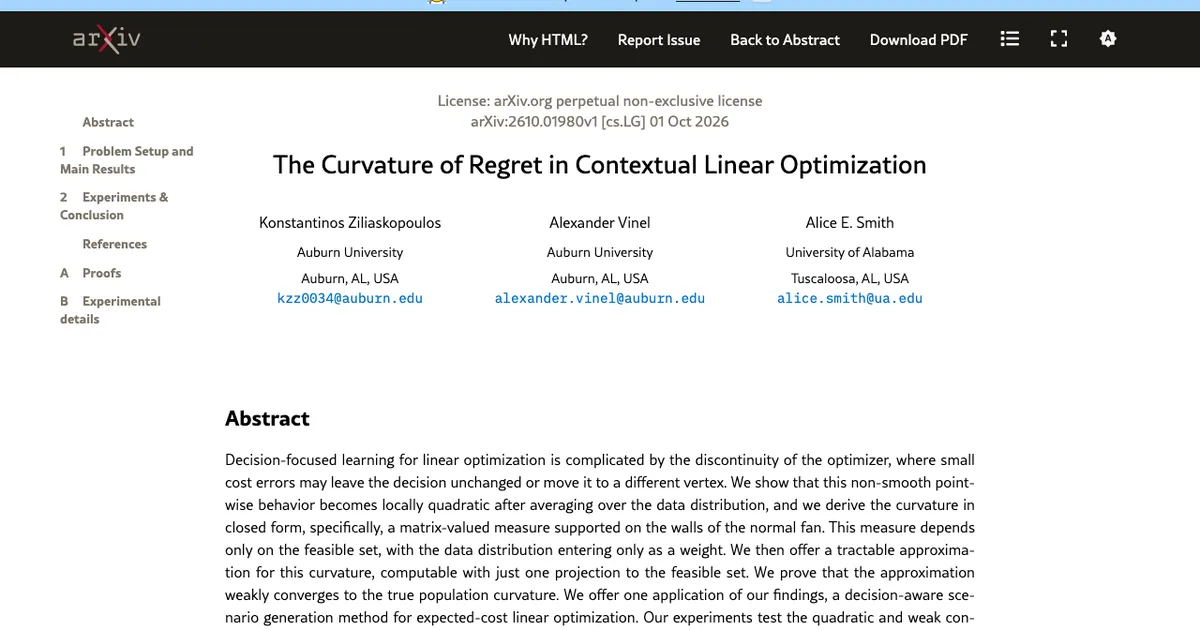
The Curvature of Regret in Contextual Linear Optimization

By Konstantinos Ziliaskopoulos, Alexander Vinel, Alice E. Smith • arXiv • Importance: 90/100
Hero Image for 2610.01980

Deep Dive: Decoding Regret Curvature in Linear Optimization

(For Machine Learning Engineers and Applied Math Researchers)

The world of decision-making under uncertainty often boils down to linear optimization. But traditional methods struggle when the underlying cost function is noisy or discrete—a common occurrence in real-world scenarios like algorithmic trading or resource allocation.

Our latest work dives into this thorny problem, analyzing how ‘regret’ accumulates not just through expected values, but through the inherent geometry of the feasible solution space. We present a novel framework for quantifying this geometric complexity using Curvature Measures derived from statistical optimization theory.

📉 The Problem: Non-Smooth Decisions

Standard linear optimization assumes continuous changes in cost lead to proportional changes in decisions. However, when faced with real data noise (or ‘small cost errors’), the optimizer behaves non-smoothly. A tiny change in cost might either keep the optimal decision exactly where it was, or suddenly jump to a completely different vertex—this discontinuity complicates learning.

💡 Our Breakthrough: Smoothing the Discontinuity

We show that this seemingly erratic, pointwise non-smooth behavior regularizes when we average over data distribution. Crucially, this local averaging smooths out the chaos, making the underlying regret landscape locally quadratic.

What’s truly groundbreaking is how we quantify this smoothness: We derive the curvature in closed form. This curvature isn’t just an abstract number; it’s a rich matrix-valued measure supported precisely on the walls of the normal fan—a geometrical feature entirely dependent only on the structure of the feasible set, minimizing data dependency.

🚀 Practical Impact: From Theory to Application

The derived curvature measure allows us to calculate a tractable approximation using just one simple projection onto the feasible set. This approximation provably converges to the true population curvature.

We demonstrated its power in a practical application: generating decision-aware scenarios for expected-cost linear optimization. In experiments focused on battery arbitrage, our method achieved an impressive 30.8% regret improvement over standard uniform allocation strategies.

This work offers a powerful, mathematically rigorous toolset for designing better learning algorithms that can handle the geometric quirks of decision spaces, paving the way for more robust AI in constrained physical systems.

🔗 For the full mathematical details and experimental results, check out our paper on Curvature of Regret in Contextual Linear Optimization.


Keywords: Linear Programming, Machine Learning, Decision Theory, Convex Optimization, Curvature, Regression Analysis, Algorithmic Trading

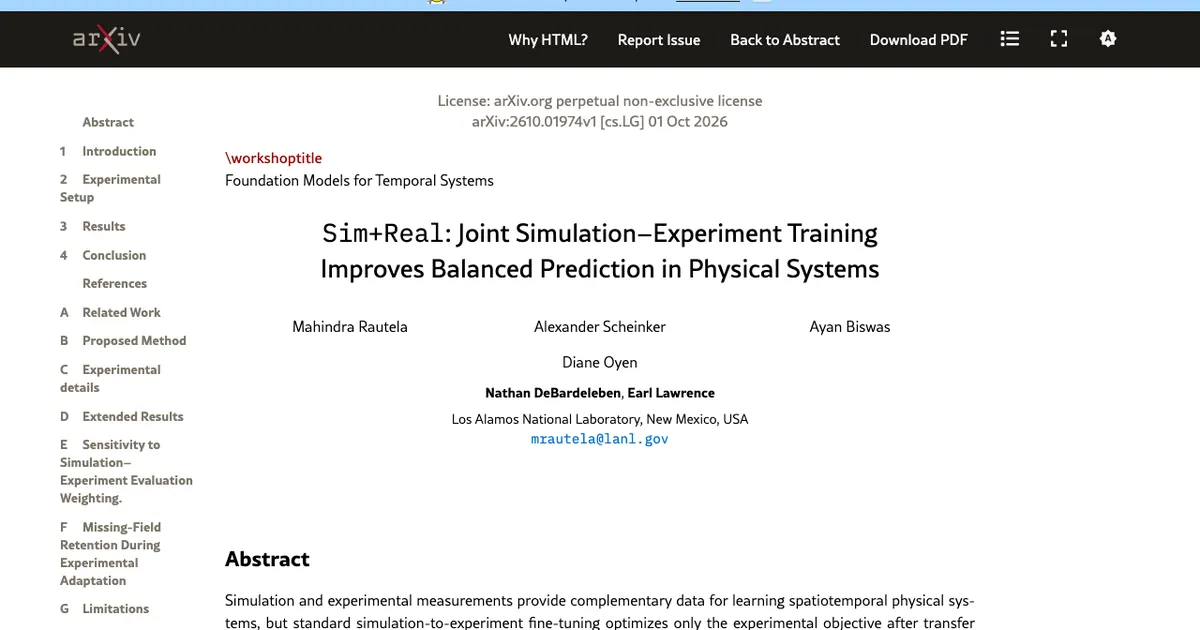
Sim+Real: Joint Simulation - Experiment Training Improves Balanced Prediction in Physical Systems

By Mahindra Rautela, Alexander Scheinker, Ayan Biswas, Diane Oyen, Nathan DeBardeleben, Earl Lawrence • arXiv • Importance: 90/100
Hero Image for 2610.01974

Sim+Real: Why Joint Training Is the Future of AI in Physics

The world’s most advanced AI models struggle when they need to bridge the gap between theory and reality. You train a model on perfect, clean simulated data, but then you test it using messy, noisy measurements from the real world. This discrepancy—the ‘Sim-to-Real Gap’—is perhaps the biggest hurdle for deploying sophisticated ML models in physical engineering, fluid dynamics, and robotics.

Leading researchers have shown that simply fine-tuning a simulation model on real data (Sim$ ightarrow$Exp) often makes the AI forget how to perform well in the theoretical world. It specializes too much on the messy reality, sacrificing its robust understanding of physics it gained from the simulations.

Our latest work presents Joint Simulation–Experiment Training (Sim+Real): a fundamental shift towards multi-objective learning that treats simulation and physical observation equally. Instead of treating them as sequential steps, we train models to optimize for both theoretical consistency and real-world accuracy simultaneously.

🤯 What We Did & Why It Matters

The abstract details the problem: current methods are too specialized. We formulated this prediction challenge as a multi-objective optimization incorporating domain-specific risks from both simulation and experiments.

We rigorously tested our method across four complex fluid systems using the RealPDEBench benchmark (a testament to modern physical system modeling) and multiple model capacities.

The results were clear: Joint Training consistently outperformed both Simulation Only and Sim$ ightarrow$Exp methods. Not only did it achieve the best balanced performance across various evaluation weights, but critically, it substantially improved the model’s ability to retain its foundational knowledge of physics (simulation retention) compared to traditional fine-tuning approaches.

In simple terms: Our method builds an AI that is equally competent and robust whether it’s running on a supercomputer simulation or measuring real fluid flow in a lab—it keeps its ‘physical intuition.’

🚀 The Tech Deep Dive (For ML Enthusiasts)

This isn’t just about mixing data. By treating the problem as a multi-objective learning task, we are guiding the model to find optimal weights that minimize losses related to both physical laws and observed discrepancies. This principled approach prevents ‘catastrophic forgetting,’ which is the bane of applied machine learning when transferring knowledge across domains.

This work provides essential tools for building truly reliable AI systems capable of operating in physically constrained environments, making it pivotal for fields like sustainable energy modeling and advanced manufacturing.

An Evaluation of Agreement and Uncertainty in LLM-Based Automated Essay Scoring

By Yiting Yao, Yanyun Yang and Huan (Hailey) Kuang in Proceedings of the Artificial Intelligence in Measurement and Education Conference (AIME-Con): Full Papers • ACL Anthology • Importance: 90/100
Hero Image for acl_2026.aimecon-main.31

📝 LLMs and Essay Scoring: The Truth About AI ‘Agreement’

A massive field of research assumes that because Large Language Models (LLMs) are highly consistent—always giving a similar score to the same essay—they must be reliable. But new work challenges this deeply held belief.

If you’ve ever used AI tools for educational assessment, or wondered how ChatGPT might grade your college paper, this is essential reading. We dive into recent findings that evaluate the performance of LLMs when doing automated essay scoring (AES).

🤖 What Did the Research Find?

This study investigated two key areas: score agreement (how close AI scores are to human judgment) and uncertainty estimation (whether the AI knows how much it doesn’t know). The punchline? LLMs might be giving us a false sense of security.

  • Overconfidence Trap: The researchers found that LLMs tend to be overconfident. They assign scores with high certainty, even when their judgment is weak. This overconfidence can be dangerous in critical applications like education.
  • The Consistency Myth: While LLMs are very consistent (giving the same score multiple times), this consistency doesn’t necessarily mean they are accurate or that simple techniques—like majority voting across multiple runs—will improve results. The deterministic scores often held up surprisingly well compared to mere averaging.

💡 Why Does This Matter for Education Tech?

This isn’t just an academic footnote; it has real-world implications for EdTech and assessment design.

  1. Rethinking Automated Scoring: If LLMs are overconfident, relying solely on their reported score might be misleading. Educational platforms need to incorporate mechanisms that explicitly model uncertainty, rather than just outputting a point total.
  2. Beyond Black-Box Grading: The field needs new methods for evaluating calibration—a measure of whether the predicted confidence actually matches the real accuracy. Simply getting high scores isn’t enough; the model must be honest about its own limitations.
  3. The Future of Assessment: For AI to become a trustworthy evaluator, it can’t just mimic human-like output (good fluency). It needs mechanisms that reflect genuine uncertainty and reliability when evaluating subjective tasks like writing quality.

➡️ Read the full paper for deeper insights into these evaluation metrics: Evaluation of Agreement and Uncertainty in LLM-Based Automated Essay Scoring

The Takeaway: Consistency $\neq$ Confidence $\neq$ Accuracy.

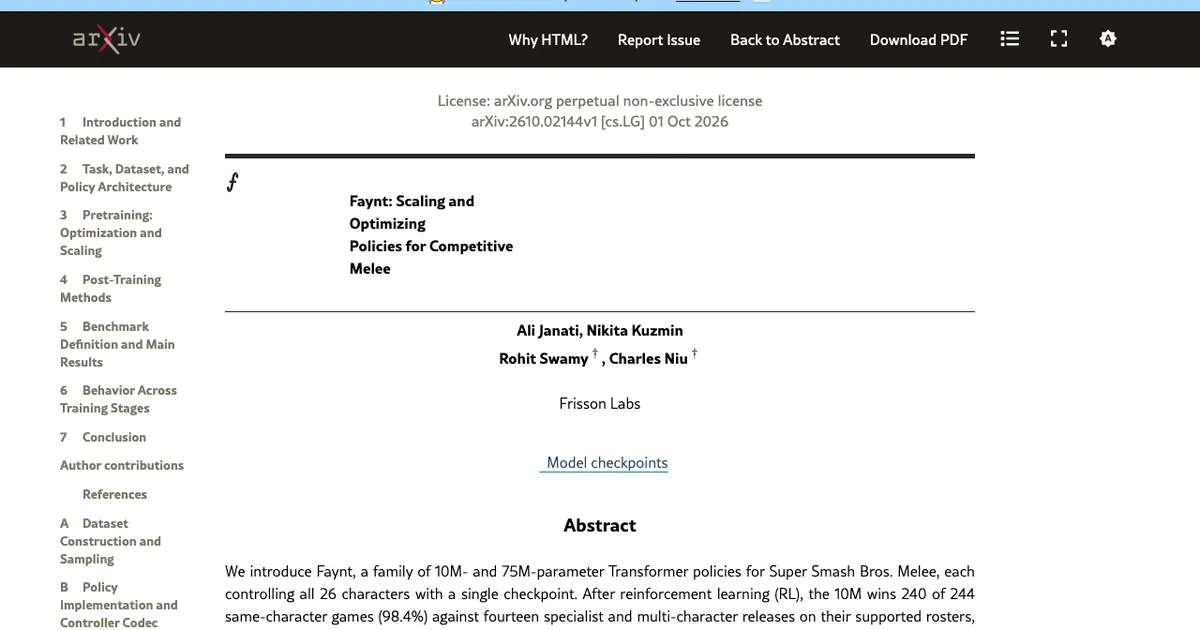
Faynt: Scaling and Optimizing Policies for Competitive Melee

By Ali Janati, Nikita Kuzmin, Rohit Swamy, Charles Niu • arXiv • Importance: 85/100
Hero Image for 2610.02144

🎮 Beyond Human Skill: How AI Conquered Super Smash Bros. Melee

The landscape of competitive gaming just got a massive upgrade—and it’s powered by cutting-edge Machine Learning. Researchers have released ‘Faynt,’ an advanced policy that has dominated the high-stakes world of Super Smash Bros. Melee, setting new standards for AI performance in fighting games.

🚀 What is Faynt?

The team behind Faynt developed a family of Transformer policies (10M and 75M parameters) designed to control all 26 characters in the complex ecosystem of Super Smash Bros. Melee, all from a single checkpoint. This isn’t just another impressive AI; it showcases sophisticated scaling techniques applied directly to an intricate human domain.

🔥 The Results: Setting New Records

The initial benchmarks are staggering. Against fourteen specialized and multi-character AI releases (that still retain action delays), the smaller 10M model achieved a remarkable 98.4% win rate in head-to-head matches of same-character games, beating every single opponent on their supported roster.

In an even more rigorous test against a zero-delay private Slippi-AI model, the 10M checkpoint won all 68 games across two conditioning settings. This demonstrates peak performance consistency.

✨ The Technical Deep Dive (And Why It Matters)

The core innovation of Faynt isn’t just its winning streak; it’s the optimization and scaling methodology. The researchers leveraged pretraining on 840,000 human replays, followed by complex post-training techniques including distillation and RL restricted to mirror matches.

Key takeaways for ML enthusiasts include: * Efficiency Magic: A small 10M parameter model was highly effective, achieving competitive results with optimized inference times (5.2 ms per decision on an NVIDIA T4). This demonstrates superior knowledge transfer and pruning ability. * Curriculum Learning: The post-training used rank- and outcome-based curricula combined with distillation, proving that targeted fine-tuning significantly boosts performance beyond raw scaling. * Generalization: By training on a massive corpus of diverse human data, the policies can generalize effectively across all 26 characters—a major architectural feat for complex character-specific games.

🔑 Open Source and Future Impact

The team has been generous in open-sourcing everything: the model weights, the benchmark suites, and a full platform for automated model tournaments. This commitment accelerates the research process, allowing the wider ML community to build upon these results.

🔗 Want to read the full technical paper? Check it out here: Faynt: Scaling Policies for Super Smash Bros. Melee


(Keywords: Reinforcement Learning, Transformers, Game AI, Deep Learning, Machine Learning, Super Smash Bros., Policy Optimization)

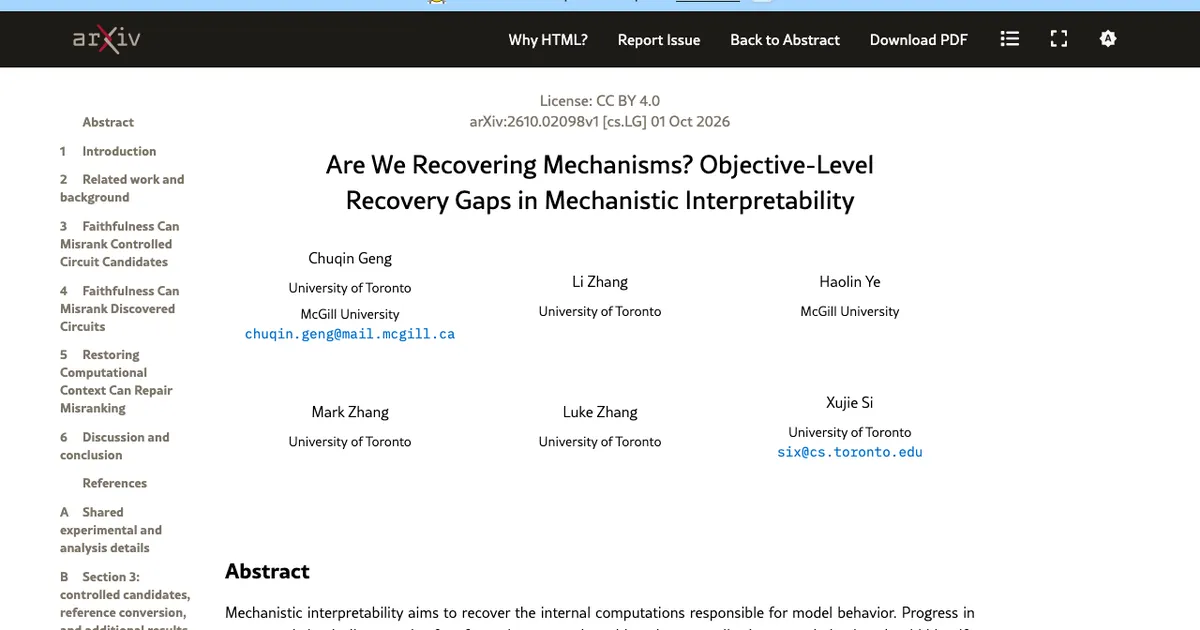
Are We Recovering Mechanisms? Objective-Level Recovery Gaps in Mechanistic Interpretability

By Chuqin Geng, Li Zhang, Haolin Ye, Mark Zhang, Luke Zhang, Xujie Si • arXiv • Importance: 85/100
Hero Image for 2610.02098

🧠 The Blind Spot in AI: Why Discovering Circuits Isn’t Enough

Mechanistic Interpretability (MI) is the frontier of understanding how Large Language Models (LLMs) actually work. We spend countless hours building tools and algorithms to ‘reverse-engineer’ a model’s internal computations—the circuits that process language. The assumption has long been: if we build a better circuit discovery tool, it will find the best explanation for the model’s behavior.

But groundbreaking research just proved this assumption is fundamentally flawed. According to the latest study Are We Recovering Mechanisms?, simply improving our discovery process doesn’t guarantee we find the true mechanism. There’s a critical ‘objective-level recovery gap’ that could mislead researchers into thinking they are succeeding when, in reality, they are just optimizing for an incorrect metric.

🚨 The Problem: Objectives Lie to Us

Think of it this way: Imagine you’re trying to find the single perfect explanation for how a complex machine works. Current MI methods often rely on ‘validation faithfulness’—they check if your recovered circuit looks structurally similar or passes certain tests designed to mimic the model’s internal logic. However, this structural similarity (the objective) can be achieved by an equally sized circuit that reproduces the model’s behavior poorly.

The authors demonstrate that optimizing for these structural objectives creates a massive failure mode: they rank candidate circuits incorrectly (‘misrank’) even when the underlying mechanisms are sound. This gap shows why better discovery alone is insufficient; the objective function itself must be critically re-evaluated.

💡 What’s the Solution? Behavior First, Structure Second

The key insight from this paper is that focusing solely on structure or internal ‘faithfulness’ leads us astray. The true measure of a mechanism’s importance must be its behavior—its agreement with how the original, intact model behaves on unseen prompts (held-out data).

The researchers tested various advanced discovery algorithms and found they all fail in ways predicted by the authors. Crucially, when they manipulated inputs (context distortion), they were able to repair a significant percentage of these misrankings by simply restoring signals that had been excluded—all without altering the identified circuits or their original scores.

This work strongly suggests that any future progress in MI must shift its focus from maximizing objective-based ‘faithfulness’ metrics toward rigorous, behavioral validation against real-world model outputs.


🔬 Key Takeaways for ML Researchers: * The Pitfall: Do not trust discovery algorithms solely based on optimizing an objective metric (e.g., structural similarity or internal faithfulness score). * The Fix: Always validate candidate circuits against the model’s actual behavior on held-out data. * The Goal: Mechanistic Interpretability must prioritize robust, empirical behavioral validation over mere structural optimization to avoid misleading results.

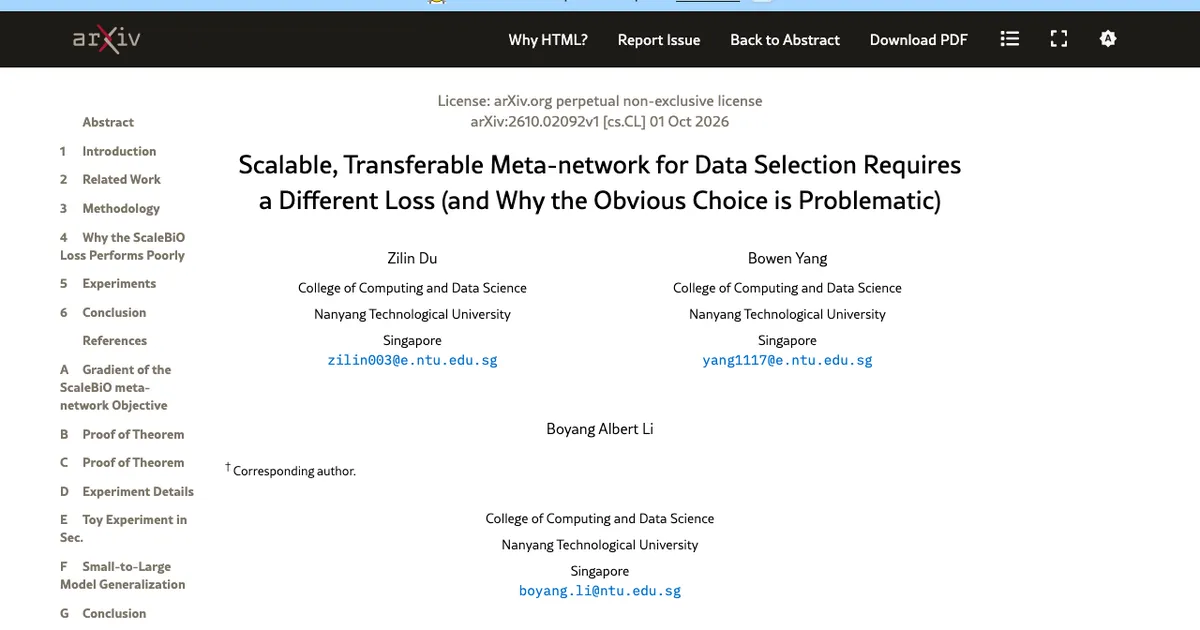
Scalable, Transferable Meta-network for Data Selection Requires a Different Loss (and Why the Obvious Choice is Problematic)

By Zilin Du, Bowen Yang, Boyang Albert Li • arXiv • Importance: 85/100
Hero Image for 2610.02092

🧠 Mastering the Data Diet: A New Way to Select Optimal Training Examples for LLMs

In the age of Large Language Models (LLMs), the adage ‘garbage in, garbage out’ holds a particularly sharp edge. While model size and training compute get the hype, many experts are realizing that the quality and selection of data—the ‘data diet’—is often the most critical bottleneck for achieving breakthrough performance. Training on massive, messy, heterogeneous corpora is necessary, but blindly feeding all the data can dilute a model’s potential.

This new research tackles this fundamental challenge head-on. The paper, Transferable Example Scoring and Selection (TESS), introduces a scalable framework to solve data selection: determining which examples in an enormous dataset are genuinely valuable for fine-tuning or safety alignment.

⚙️ The Problem with Current Data Selection Methods

Existing meta-learning techniques approach data selection by assigning weights or scores to individual samples based on how well they contribute to a validation objective. While principled, these methods often face two major roadblocks:

  1. Poor Transferability: They struggle to adapt when the model size changes, the corpus type shifts, or when moving from training subsets to the full corpus.
  2. Optimization Instability: Integrating complex per-sample scoring mechanisms into existing meta-training objectives can lead to unstable optimization and a tendency for the model to rely only on ‘easy’ features (weight suppression).

Simply put: the methods didn’t scale reliably or generalize well enough across different real-world LLM tasks.

✨ The TESS Solution: Pointwise Value Matching

The authors propose Transferable Example Scoring and Selection (TESS). Instead of wrestling with per-sample weights, which are notoriously difficult to train robustly, they anchor their framework on a novel approach: the Pointwise Value Matching objective (PVM).

This shift allows for a selection network that is both scalable and stable. By focusing on matching the underlying value contribution of examples rather than trying to weight them directly, TESS achieves robust data selection across vastly different scenarios.

🚀 Why This Matters For LLM Deployment (SEO Focus: Enterprise AI)

For companies building production-grade LLMs—especially in regulated industries like finance or healthcare—data quality isn’t a luxury; it’s an operational requirement. TESS provides a scientifically grounded, robust method for optimizing the expensive data curation process.

The results are powerful:

  • Robust Transfer: The framework demonstrates strong generalization across datasets, whether you’re analyzing small, high-quality subsets or the entire raw corpus.
  • Scalability: It maintains performance when scaling up to larger models and handling enormous, diverse data streams.
  • Real-World Impact: Experiments on critical areas like LLM safety and targeted instruction tuning validate its practical utility in making advanced AI systems safer and more effective upon deployment across different geographic regions or use cases.

TESS moves the needle from simply ‘training big’ to ‘training smart.’ If you are building, deploying, or fine-tuning enterprise AI solutions in London, New York, Singapore, or Sydney, understanding robust data selection is paramount.

Kolmogorov-Arnold Networks for Free-Boundary Partial Differential Equations

By Tan Phuong Dong Le • arXiv • Importance: 85/100
Hero Image for 2610.02084

🚀 Beyond PINNs: Using Kolmogorov-Arnold Networks for Complex Physics Simulations

As computational science pushes the boundaries of what’s possible, solving complex physical systems—like material failure or phase transitions—remains a monumental challenge. Traditional methods often struggle with ‘free-boundary problems,’ where the boundary itself is not known beforehand (think melting ice or deforming structures).

Researchers have been pioneering physics-informed machine learning approaches, notably Physics-Informed Neural Networks (PINNs). However, when dealing with highly non-linear constraints and moving interfaces, PINNs can become numerically unstable or require extensive manual tuning. Enter the next evolution: Kolmogorov-Arnold Networks (KANs).

💡 What’s the Breakthrough? Solving Free Boundaries with KANs

This paper introduces a powerful new framework that leverages KANs to tackle notoriously difficult free-boundary partial differential equations (PDEs). Instead of just approximating solutions, this approach is designed specifically to handle critical physical constraints:

  • Obstacle Constraints: Modeling scenarios where an object cannot penetrate another surface.
  • Complementarity Conditions: Required when dealing with non-linear contact points.
  • Moving Interfaces: Addressing time-dependent problems like the famous Stefan problem (modeling phase changes).

By encoding all these constraints into a single residual-based loss function, the KAN solver provides a robust and unified approach that outperforms traditional PINN methods in several key areas.

📐 Performance Deep Dive: Why KANs Shine

Testing against established baselines (including standard PINNs), the researchers demonstrated that KANs achieve remarkably low errors—both in $L^2$ and $L^\infty$ norms. Crucially, they maintained accuracy right at the most challenging points: the contact regions and moving interfaces.

The findings strongly suggest that KAN representations offer a significantly effective and stable alternative for solving complex free-boundary PDEs. This makes them invaluable tools for engineers and scientists working in fields like solid mechanics, fluid dynamics, and thermodynamics.

Learn more about this innovative solver here!


Is this relevant to you? 💡 If your work involves simulating physical phenomena with complex geometry or unconstrained boundaries, KANs might be the breakthrough tool you’ve been waiting for.

AI Emulation of Stochastic Sudden Stratospheric Warming with Interpretable Latent Structure

By C. Daniel Boscu, Daniel Hernandez, Fabio Alvarez Ventura, Justin Finkel, Ashesh Chattopadhyay, Pedram Hassanzadeh, Dorian S. Abbot • arXiv • Importance: 80/100
Hero Image for 2610.02069

Decoding Extreme Weather: How AI Models Uncover the Secrets of Stratospheric Warming

The atmosphere is a complex, chaotic system. Predicting rare and extreme weather events—like Sudden Stratospheric Warmings (SSW)—is one of science’s biggest challenges. These transitions are crucial because they can dramatically shift global climate patterns, yet standard data-driven models often struggle with the inherent ‘rare event’ problem due to massive class imbalance.

Our latest work tackles this head-on. We developed a sophisticated probabilistic deep learning emulator designed specifically for stochastic dynamical systems undergoing rare regime changes.

🌪️ Modeling the Polar Vortex Transition

To test our methodology, we focused on the iconic Holton–Mass model, which simulates stratospheric variability and exhibits two distinct metastable states: the strong polar vortex and the weak polar vortex. The transition between these regimes (representing SSW events) is triggered by rare stochastic forcing—the hallmark of complex geophysical systems.

Using a ResNet-inspired Conditional Variational Autoencoder (CVAE), we built an emulator that accurately replicates not just short-term dynamics, but also key statistical properties: the steady-state distribution, regime persistence times, and critically, the transition expected lead time of the physical model. This is crucial for building advanced warning systems.

✨ The Breakthrough: Interpretable Latent Structure

Fidelity is only half the story. Where our work shines is in interpretability. We didn’t just build an accurate black box; we interrogated its internal workings.

The latent space—the compressed, high-dimensional representation of the system’s state learned by the AI—revealed a profound physical structure. Through Principal Component Analysis (PCA), we observed a clear, unsupervised separation into four physically distinct clusters: strong/weak vortex regimes and stable/transition-prone configurations. This internal organization mirrors the known physics of the stratosphere.

This emergent regime separation is highly non-trivial for deep generative models applied to high-dimensional stochastic systems. It demonstrates that carefully designing probabilistic emulators can effectively uncover physically meaningful manifolds governing extreme-event dynamics.

🚀 Implications and Future Directions

The ability to accurately emulate the complex statistics of rare events, while simultaneously revealing the underlying physical structure in a machine-readable format, represents a significant leap forward. This methodology has profound potential for operational atmospheric science, potentially paving the way for improved advanced warning systems for major climate shifts.

Want to dive deeper into the technical details? You can read the full paper: AI Emulation of SSW dynamics


Disclaimer: This blog post summarizes research findings and should complement, not replace, established operational forecasting tools.

Counterfactual Auditing of Bias in Open-Source Large Language Models for Clinical Triage

By Manar Aljohani, Brandon Ho, Kenneth McKinley, Dennis Ren, Xuan Wang • arXiv • Importance: 80/100
Hero Image for 2610.01963

Bias Audit: Can Open-Source LLMs Trust You in the Emergency Room?

In high-stakes environments like Emergency Department (ED) triage, every decision counts. The initial assignment of acuity—knowing if a patient needs immediate care versus waiting—is fundamentally critical. But what happens when bias creeps into the system? Do predictive models disproportionately underestimate care for certain groups based on their zip code or socioeconomic status, even when their physical symptoms are identical?

Open-source Large Language Models (LLMs) are heralded as potential privacy-preserving solutions for clinical decision support. However, before these powerful tools can transition from the lab to a real-world hospital setting, we must address one critical question: How fair are they?

A Cognitive Lab Study of Student AI Chatbot Use in Online Coursework

By Jinah Choi, Sonya Powers, Farzan Karimi-Malekabadi and Michelle Barrett in Proceedings of the Artificial Intelligence in Measurement and Education Conference (AIME-Con): Works in Progress • ACL Anthology • Importance: 75/100
Hero Image for acl_2026.aimecon-wip.1

🤖 Is AI Chatbot Use Making Students Lazy? What the Data Says

The integration of generative AI into education is reshaping classrooms globally. But how do students actually use tools like ChatGPT and other AI assistants when tackling homework or coursework? Are they just using them as answer machines, or are these bots truly boosting cognitive skills?

We dove deep into this question with a recent cognitive lab study focusing on secondary students (Grades 7-12). Instead of relying solely on quiz scores, we analyzed rich user data—including detailed chat logs, direct observations from facilitators, and post-session student reflections. Our goal was to test whether AI chatbots could act as true learning companions that help students keep progressing without simply giving them the final answer.

Key Findings for Educators & Developers 🧠

Our findings provide crucial insights beyond mere usage counts. We pinpointed several critical areas where AI tools must improve to genuinely support learning:

  • Typing Fluency and Interaction Quality: The way students interact (their prompt engineering skills) significantly affects the quality of their output, suggesting that sophisticated human input is required.
  • Boundary Handling: How well the chatbot manages the boundaries of answers—providing enough context without giving away the whole solution. This hints at a need for smarter scaffolding.
  • Safety & Privacy Responses: We emphasized the absolute necessity of robust safety and privacy response patterns when deploying AI in educational settings.
  • Student-Facing Feedback Mechanisms: For AI to be effective, it needs feedback designed specifically for the student, guiding them back toward critical thought rather than just solving the problem.

This research isn’t just an academic exercise; it provides tangible evidence for how we can better design and validate educational AI tools. It tells developers: don’t build a chatbot to do the work; build one to guide the thinking process.

👉 Want to read the full methodology and implications? Check out the complete paper here: A Cognitive Lab Study of Student AI Chatbot Use


Are you an EdTech developer or teacher considering integrating generative AI? What are your biggest concerns about academic integrity and actual learning outcomes? Share your thoughts below!

Assessing Large Language Model Performance in Post-Certification-Examination Comment Categorization

By Huaping Sun, Kristin O’Brien, Colleen Burke Kave, David Shin, Qiao Lin and Jeffrey Marc Lyness in Proceedings of the Artificial Intelligence in Measurement and Education Conference (AIME-Con): Works in Progress • ACL Anthology • Importance: 75/100
Hero Image for acl_2026.aimecon-wip.8

LLMs in Grading: Is AI Ready to Replace Human Examiners?

As Large Language Models (LLMs) become ubiquitous, their application extends beyond chatbots and writing assistance—it’s moving into highly sensitive fields like academic evaluation. But when should we trust an LLM’s judgment, especially in critical areas like medical grading or certification?

We dove deep into a real-world dataset: 1,406 Neurocritical Care examination comments. Our goal was to assess how well an LLM could perform the task of classifying these complex comments into specific sentiment and thematic categories—a process usually handled by human subject matter experts.

What We Found (The Bottom Line)

The performance analysis revealed a mixed but insightful picture:

  • Agreement Gap: While human raters showed strong internal agreement on the coding, the agreement between the LLM and these expert human coders was only moderate. This suggests that while the model grasps some patterns, it struggles with nuanced interpretations.
  • Thematic Complexity Hurts: Surprisingly, adding strict thematic definitions (i.e., trying to force all comments into predefined boxes) actually reduced the LLM’s performance, highlighting the difficulty of rigidly constraining complex natural language.
  • Human Touch Matters: The study strongly suggests that incorporating high-quality human-coded examples significantly boosts the model’s accuracy. This confirms that fine-tuning with expert data is crucial for specialized domains.

💡 Takeaways for AI Implementers & Educators

The results don’t signal the end of human judgment, but they point toward a powerful co-pilot role for LLMs.

  1. Preliminary Triage: LLMs are excellent tools for preliminary coding and triaging massive volumes of unstructured text (like hundreds of medical notes). They can handle the sheer scale that would overwhelm human resources.
  2. The Oversight Loop: Crucially, human review remains necessary. The findings emphasize that AI should function as a support system that flags potential issues or suggests categories for expert confirmation, not as an autonomous final grader.

Verdict: LLMs are powerful assistants in the realm of educational measurement and content categorization, making workflows faster and more scalable. However, they currently lack the robust reliability needed to operate independently in high-stakes certification environments.

Want to read the full technical breakdown? Check out the study: Assessing LLM Performance in Comment Categorization.


#AIinEducation #LLMs #NLP #MachineLearning #EdTech #HealthcareAI

Explore Recent Digests