LLMs Can Design Near-Optimal OR Algorithms
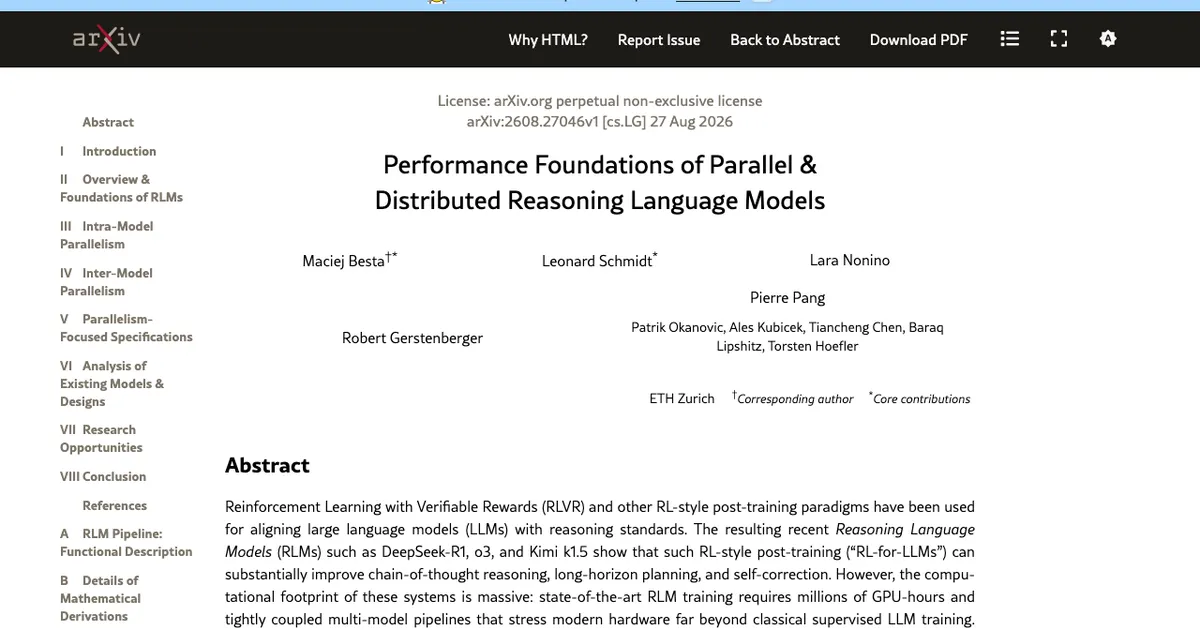
The era of Large Language Models (LLMs) is accelerating faster than our compute resources can handle. While recent advancements like DeepSeek-R1 and o3 demonstrate remarkable reasoning capabilities—especially in complex planning and self-correction—the methods used to train them are breaking current computing paradigms.
This groundbreaking paper tackles the hidden bottleneck: The massive, distributed computational cost of developing advanced Reasoning Language Models (RLMs).
The performance leap from standard LLMs to Reasoning LMs (RLMs) comes primarily through specialized post-training techniques like Reinforcement Learning with Verifiable Rewards (RLVR). These methods teach the model not just what to say, but how to reason and self-correct—a significant jump in capability.
However, this power comes at an astronomical cost. Training state-of-the-art RLM pipelines requires millions of GPU-hours and highly complex, multi-model setups that stress modern hardware far beyond what was required for classic supervised training.
The authors systematize the entire RL-for-LLMs paradigm. They don’t just focus on algorithms (like PPO or GRPO); they focus on making these pipelines computable, scalable, and cost-effective.
Their contribution is a deep dive into parallel computing for LLMs:
For tech companies, AI startups, and deep learning teams focusing on advanced NLP, this is a foundational shift. The bottleneck isn’t just math; it’s systems architecture. If you plan to build commercial-grade reasoning models that need reliability and scalability, you must master these distributed computing techniques.
This paper transforms RLM development from being merely an algorithmic challenge into a critical distributed systems engineering problem. It sets the standards for building trillion-parameter future LLMs.
🔗 Dive Deeper: To understand how to build scalable, high-performance reasoning models, check out the full work here: https://arxiv.org/abs/2608.27046
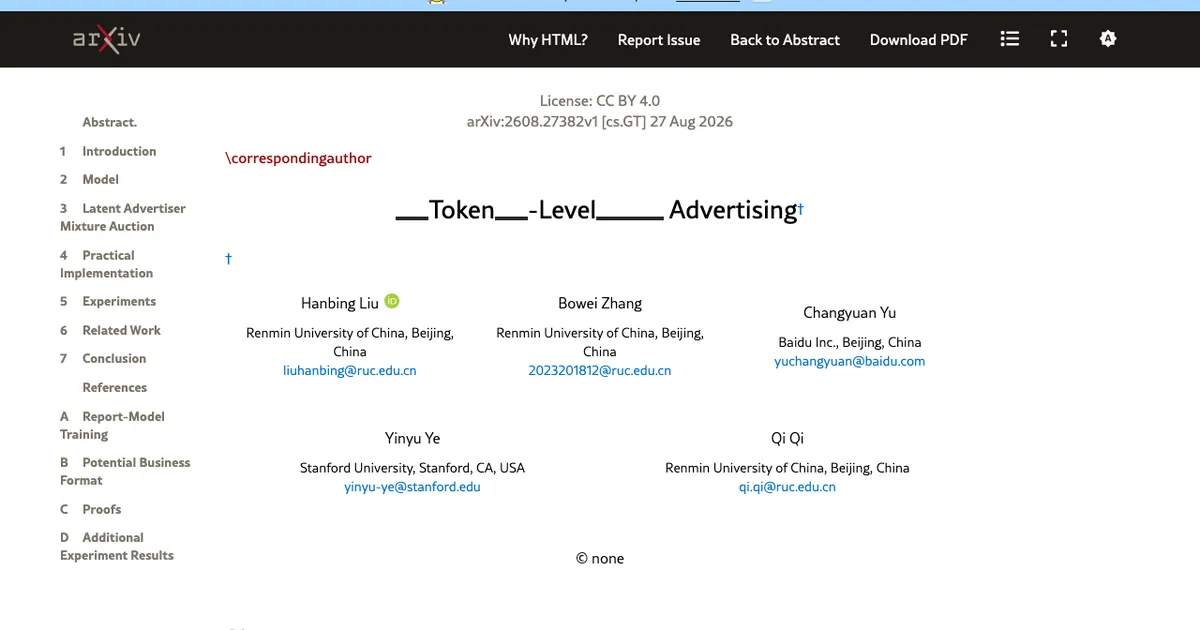
The era of fixed ad slots and predictable ad placement is over. With Generative AI transforming how we consume information, traditional advertising models are struggling to keep up. How does a model like ChatGPT decide what’s relevant right now, token by token? Our latest research tackles this fundamental challenge head-on.
We introduce LAMA (Latent Advertiser Mixture Auction): a groundbreaking mechanism that embeds advertiser influence directly into the core generation process itself. Think of it less as ‘putting an ad next to your text,’ and more like making the text generate the optimal advertisement while respecting commercial objectives.
In traditional advertising, relevance is determined post-generation (a slot filler). LAMA changes the game by integrating advertiser goals—their ‘influence’—at the microscopic level of every generated token.
Instead of a simple banner ad, advertisers submit what we call local continuation values. These values don’t just report an expected outcome; they induce specific, measurable next-token policies tailored to their product or service. The platform then cleverly decodes these multiple advertiser signals through a latent mixture, effectively managing a complex auction that happens within the AI model’s probabilities.
The Key Takeaway: LAMA ensures that the ad is not merely appended; it is optimally woven into the natural flow and context of the generated content, maximizing both commercial value (platform revenue) and user experience (response quality).
The impact of this work is massive. We rigorously prove that LAMA satisfies crucial economic constraints like Markov DSIC and IR, while achieving near-optimal KL-regularized welfare—meaning it works mathematically soundly.
Crucially, we developed a learning-based implementation that allows platforms to reconstruct these complex ad reports online using only learned local advantages. This makes the concept immediately deployable in real-world commercial search scenarios.
Our proof-of-concept experiments on actual commercial-search query splits show compelling initial evidence: LAMA significantly boosts platform welfare and revenue without degrading the quality or relevance of the core AI response.
If you’re involved in building LLMs, designing digital ad platforms, or thinking about the next generation of web interfaces, this is a must-read. We are moving toward truly ‘generation-native advertising.’
🔗 Dive deep into the methodology and proofs here: https://arxiv.org/abs/2608.27382

The process of figuring out a molecule’s structure from its spectroscopic fingerprint has long been critical to chemistry. But when you combine multiple types of spectra (like combining NMR, IR, and Mass Spec data) – creating a ‘multimodal’ view – the sheer variety and uneven nature of these signals quickly overwhelm standard AI models. This difficulty is known as multimodal imbalance.
Enter MM-Spectrum: A groundbreaking framework designed to tackle this challenge head-on. Developed by Yu et al., MM-Spectrum isn’t just adding more data; it’s smarter about how it combines heterogeneous information using a cutting-edge Sparse Mixture-of-Experts (MoE) architecture.
The current challenge in computational chemistry is that while molecular structures can be accurately determined, relying on simple concatenation of multiple spectra fails spectacularly when the inputs are highly varied or when certain data types are missing. Different spectral signals (e.g., one spectrum having rich data while another is noisy) introduce ‘multimodal imbalance’ and degradation.
MM-Spectrum introduces sophisticated mechanisms to handle this mess:
For computational chemists, drug discovery platforms, and materials science, this leap is massive. MM-Spectrum promises: * Higher Accuracy: Better molecular structures inferred from complex spectra, minimizing guesswork. * Robustness to Missing Data: The system doesn’t collapse if one type of spectrum is missing or corrupted—a common issue in real-world lab settings. * Enhanced Workflow Automation: Streamlining the process of structural elucidation and accelerating drug candidate screening.
If you are working on advanced analytical chemistry, bio-sensing, or materials analysis using deep learning, this paper is a must-read. Check out the details here: https://arxiv.org/abs/2608.27286
Keywords: Molecular Structure Elucidation, Spectroscopy, Mixture-of-Experts (MoE), Multimodal AI, Computational Chemistry, Deep Learning, Analytical Chemistry
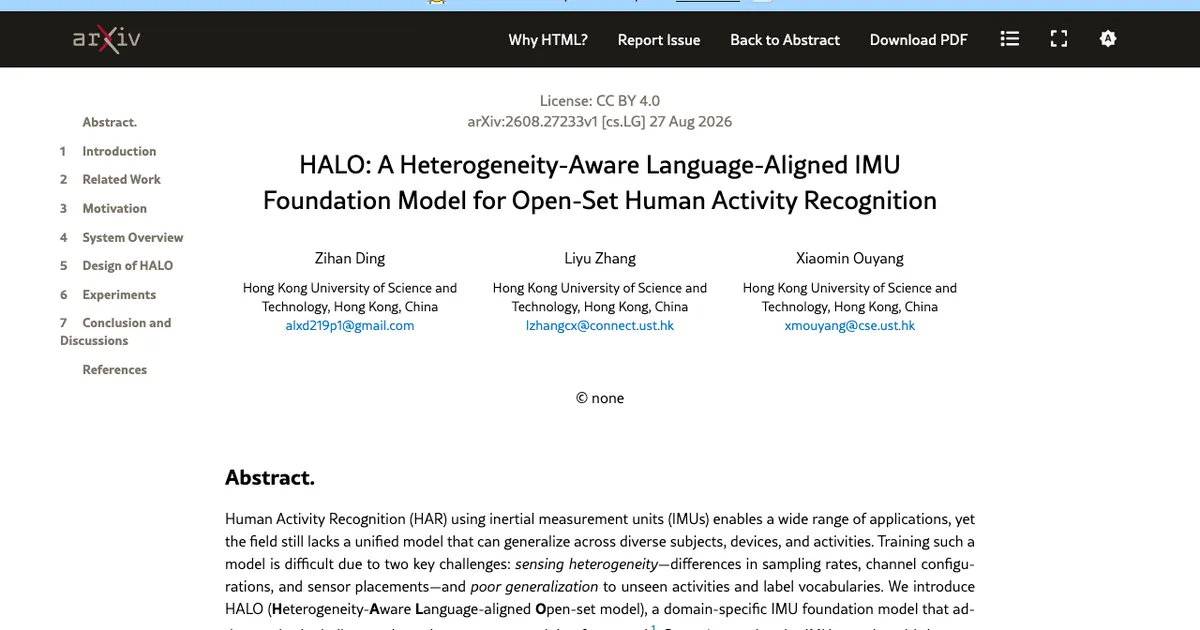
The world relies on movement data. From healthcare monitoring to industrial safety systems, knowing what a person is doing using just their phone or wearable device (an Inertial Measurement Unit, or IMU) is critical. But current systems are brittle—they break when the sensors change, the user changes, or the activity hasn’t been seen before.
That ends now. Researchers have unveiled HALO (Heterogeneity-Aware Language-aligned Open-set model): a foundational breakthrough designed to solve the nightmare of real-world, messy movement data. This isn’t just another classifier; it’s an entire paradigm shift for Human Activity Recognition (HAR).
The HAR field faces two major headaches:
HALO tackles these deep issues by adopting a revolutionary, two-stage approach that makes it robust and versatile—all while keeping its size small.
1. Stage 1: Training the Muscle (Heterogeneity Awareness) HALO uses advanced self-supervised learning to preprocess the IMU data, forcing the model to understand the meaning of the signals rather than just patterns linked to specific devices. Techniques like adaptive pooling and channel-independent feature extraction ensure that the core physical signal is preserved regardless of how the sensor was attached or sampled.
2. Stage 2: Connecting Movement to Language (Language Alignment) This is where HALO shines. By aligning the IMU encoder with natural language embeddings using synonym-aware contrastive learning, the model gains a semantic understanding. Instead of simply comparing raw feature vectors, it can relate a detected movement (‘running’) to its conceptual meaning in text, making zero-shot recognition possible.
The Result? Open-Set Recognition: Because the model is trained conceptually (via language) and not just statistically (on specific datasets), it achieves open-set recognition via simple cosine similarity retrieval. No per-dataset retraining or thousands of new classifiers are needed for every unique activity—a massive leap in deployment efficiency.
The results speak for themselves. HALO outperforms existing state-of-the-art models across multiple benchmarks. Most impressively:
For developers building AI solutions around human motion—be it in smart cities, physical therapy, or industrial logistics—HALO represents a game-changer. It moves the state of HAR from specialized academic benchmarks to robust, real-world utility.
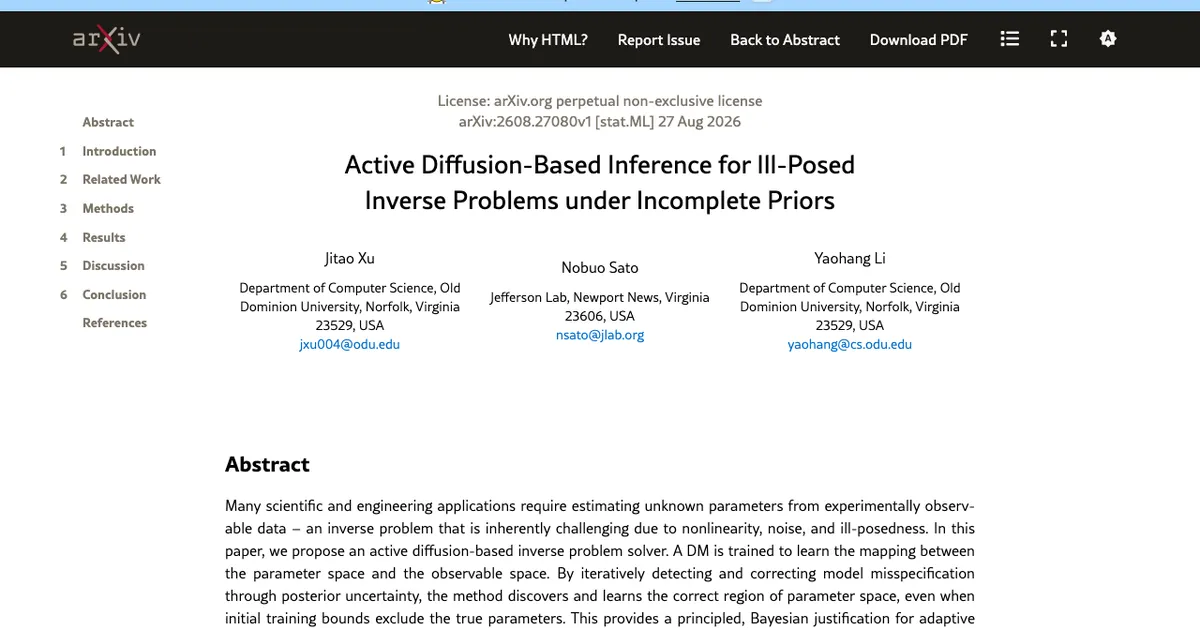
Are you working on an inverse problem? You need to figure out hidden parameters from noisy, limited data. Well, this latest research paper introduces a groundbreaking approach that solves one of the toughest challenges in scientific machine learning—the uncertainty surrounding incomplete prior knowledge.
Traditional inverse problems are notoriously ‘ill-posed’ (meaning small changes in input data can lead to massive errors or infinite solutions). In real-world settings, we often lack perfect priors. This new method, which leverages Active Diffusion modeling, doesn’t just give you an answer; it helps you find the right domain of answers—even if your initial assumptions were wrong.
Think of it like this: Your AI model makes an educated guess (the initial prior). When the method encounters uncertainty in its prediction, that’s a warning sign. Instead of just failing or giving you a misleading result, the Active Diffusion solver uses posterior uncertainty to detect exactly where its own understanding is flawed. It then adaptively expands its search space and corrects its model misspecification until it lands on the true parameter region.
This capability provides a principled, Bayesian safeguard for adaptive domain augmentation. It means your scientific inference is more robust and trustworthy, especially when dealing with complex, real-world physics data like Quantum Chromodynamics (QCD).
The authors demonstrate this solver’s power on a highly complex toy problem involving infinite solutions. Crucially, they apply it to the parameterization of quantum correlation functions for nucleon structure in an advanced QCD analysis. This isn’t just academic filler—it tackles fundamental questions about matter and energy at their core.
The Takeaway: If your ML application requires deep scientific justification (e.g., medical imaging, physics simulation, material science), you need techniques that can navigate massive uncertainty spaces and tell you when they don’t know enough yet. This active diffusion approach is a major step toward reliable, robust AI in scientific domains.
👉 Read the full paper here: https://arxiv.org/abs/2608.27080
#MachineLearning #PhysicsAI #InverseProblems #DiffusionModels #QuantumComputing #DeepLearning
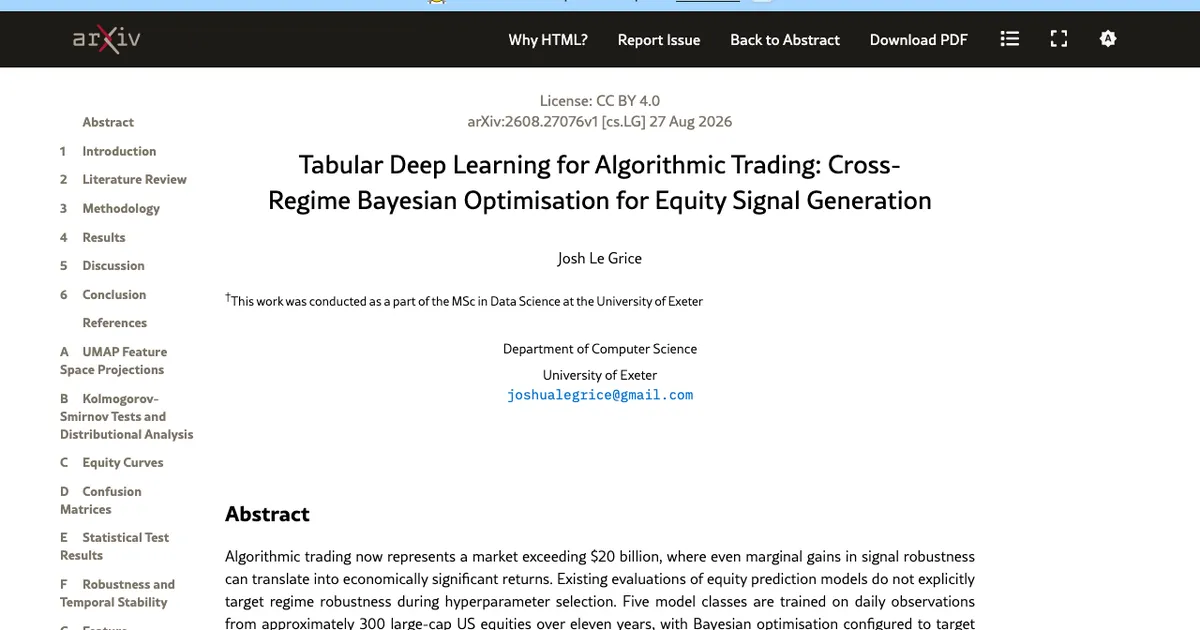
The algorithmic trading space is massive—we’re talking about markets over $20 billion where even tiny improvements in signal reliability can mean millions. But here’s the catch that most academic studies ignore: real-world financial markets aren’t static. They shift between distinct ‘regimes’—bull markets, bear cycles, volatile periods. Training a model to perform well only when things are going up is financially useless.
This cutting-edge research tackles that core problem head-on. Using daily data from 300 large-cap US equities over eleven years, the researchers didn’t just optimize for peak performance; they optimized for consistency across multiple, historically distinct market regimes using advanced Bayesian Optimization. The result? A deeply robust strategy.
What sets this paper apart is its focus on regime robustness. Instead of just maximizing a single metric (like Sharpe Ratio) on clean data, the method fine-tunes model hyperparameters to ensure peak performance and stability whether the market is trending up, sideways, or crashing.
By training five different deep learning models—including TabNet and others—and subjecting them to this rigorous multi-regime optimization, they demonstrated that consistent signal precision remained above random chance across all test quarters. This proves genuine out-of-sample generalization.
While pure deep learning models (like TabNet) didn’t outperform traditional powerhouse methods like Gradient Boosted Trees (XGBoost), the authors found something even better: a Hybrid ensemble. By combining the strengths of XGBoost and TabNet using rank aggregation, they engineered an alpha-generating portfolio with staggering results:
These metrics indicate that the strategy successfully carved out excess return independent of whether the S&P 500 was rising or falling.
The authors conclude by outlining an interactive application that makes these complex results explorable in real-time—a clear path toward practical deployment in modern quantitative finance ecosystems.
👉 Dive deeper into the methodology and full findings here: https://arxiv.org/abs/2608.27076
#AlgorithmicTrading #QuantitativeFinance #DeepLearning #MachineLearning #FinTech
Are you living with conditions that make speaking difficult? Do privacy concerns make voice recognition impossible? Traditional methods of assistive communication are hitting a roadblock. But what if you could speak silently, using only natural hand movements?
A groundbreaking new study presents exactly that: a soft, active Electromyography (EMG) interface designed for word-level Silent Speech Recognition (SSR). This isn’t sci-fi; it’s highly stable, wearable tech ready to change lives.
The main challenge in SSR is signal quality and wearability. Existing systems often require uncomfortable, constant facial attachment or rely on noisy signals that struggle with movement and real-world variability.
The research team designed a novel approach: a soft, fingertip electrode system. This device is worn on the hand and can be strategically placed near the lips only when needed.
Key Engineering Breakthroughs: * Flexibility & Stability: The interface uses advanced materials like liquid metal (LM) interconnects, transparent flexible printed circuit (FPC) electrodes, and elastomer encapsulation. This combination ensures the electrode remains mechanically stable even through complex finger movements—a massive leap in real-world reliability. * Active Sensing: By requiring deliberate placement near the lips, it provides a highly focused, stable signal source for EMG capture. * Deep Learning Power: The captured stable signals are processed by a deep neural network. This system achieved an impressive mean accuracy of 97.2% on a 30-word vocabulary across three subjects!
The authors didn’t stop at just speech recognition. They validated the practical utility by controlling a drone! This proves the system is robust enough to function in noisy, privacy-sensitive environments where traditional voice commands fail.
Why this matters: * Privacy: Speech capture happens locally and on demand. * Comfort: No constant facial attachment required. * Versatility: Applicable not just for speech but for any hand/gesture-based control (robotics, medical assistance).
This technology sets a new standard for secure and intuitive Human-Machine Interfaces (HMIs). If you’re interested in the mechanics or the full findings, check out the paper: https://arxiv.org/abs/2608.27048
Read the Full Research: https://arxiv.org/abs/2608.27048
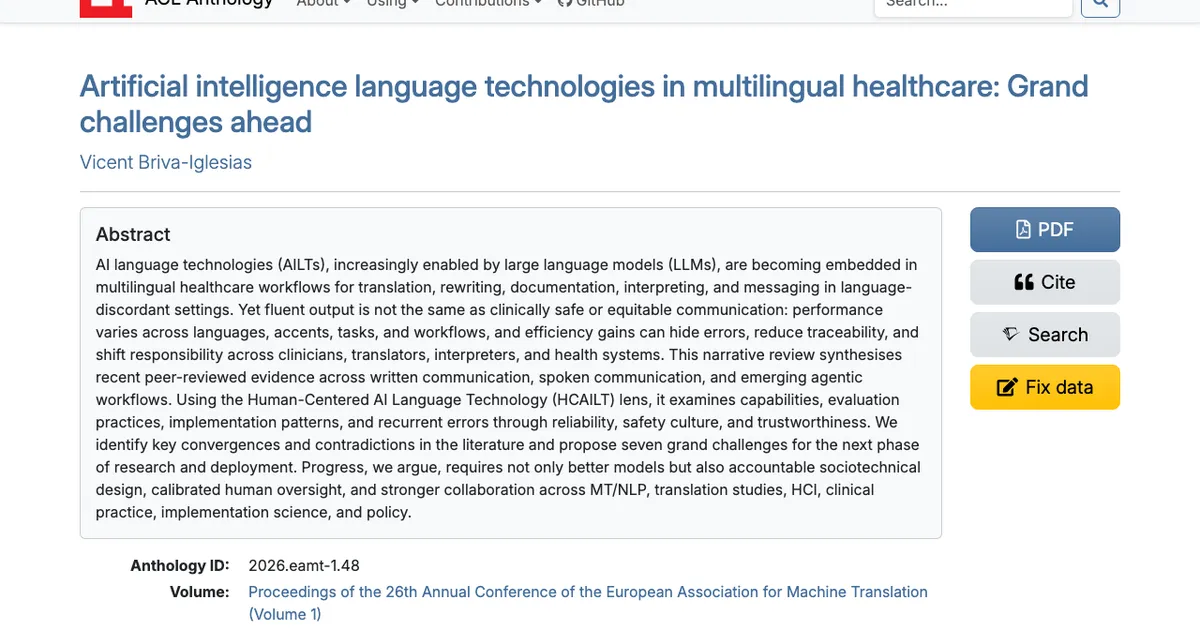
The integration of Large Language Models (LLMs) is rapidly reshaping global healthcare. From translating patient histories to drafting discharge summaries, Artificial Intelligence Language Technologies (AILTs) are making medical communication seamless across language barriers. But here’s the reality check: fluent isn’t the same as safe.
This cutting-edge review dives into the critical challenges at the intersection of AI, healthcare, and multilingualism. While LLMs promise revolutionary efficiency gains—handling everything from written documentation to real-time interpreting—they introduce profound safety, equity, and accountability issues that we can’t ignore.
The paper synthesizes recent evidence using a Human-Centered AI Language Technology (HCAILT) framework. It doesn’t just ask ‘Can the AI do this?’ but rather, ‘How should it be used, and who is responsible when it fails?‘
We explore how performance can wildly fluctuate based on language, dialect, specific medical task, or even the workflow setup. Efficiency gains, while desirable, risk masking underlying errors, distributing responsibility across clinicians, interpreters, and complex health systems, making accountability hazy.
The authors move beyond simply listing bugs. They identify seven major ‘Grand Challenges’ that the field must solve for AI to achieve true clinical reliability. Achieving safe deployment requires a radical shift: it’s not just about building better LLMs; it demands accountable sociotechnical design, human oversight, and deep cross-disciplinary collaboration.
Key takeaways for tech leaders and healthcare policymakers: * Safety First: Reliability and safety culture must be prioritized over speed and sheer automation. The AI output must enhance, not obscure, critical thinking. * Equity Gap: Performance variations across languages and accents highlight serious equity issues that need technological focus. * Systemic Change: Progress requires merging expertise from Machine Translation (MT), NLP, Human-Computer Interaction (HCI), Clinical Practice, and even Policy Studies.
This research provides a vital roadmap for the next generation of multilingual healthcare tech. For developers working on Natural Language Processing (NLP) solutions or Health Informatics professionals deploying LLMs, this paper mandates adopting a Human-in-the-Loop strategy designed explicitly for error traceability and accountability.
Don’t wait for an adverse event to dictate change. Start building safer, more accountable systems today.
Read the full review: Artificial intelligence language technologies in multilingual healthcare
Source: Vicent Briva-Iglesias, Proceedings of the 26th Annual Conference of the European Association for Machine Translation (Volume 1)
(Image Suggestion: A side-by-side comparison graphic showing a stack of RTX 5090 GPUs next to a sleek graph illustrating performance vs. cost.)
If you thought training massive Large Language Models required billions in compute power and institutional budgets, think again.
The LLM landscape has long been gated by prohibitively expensive infrastructure. Previously, reaching competitive open-source model performance meant significant capital expenditure—we’re talking millions of dollars just to match mid-sized models like Llama 3 or SmolLM. This barrier relegated state-of-the-art research to well-funded corporate labs.
But the breakthrough is here:
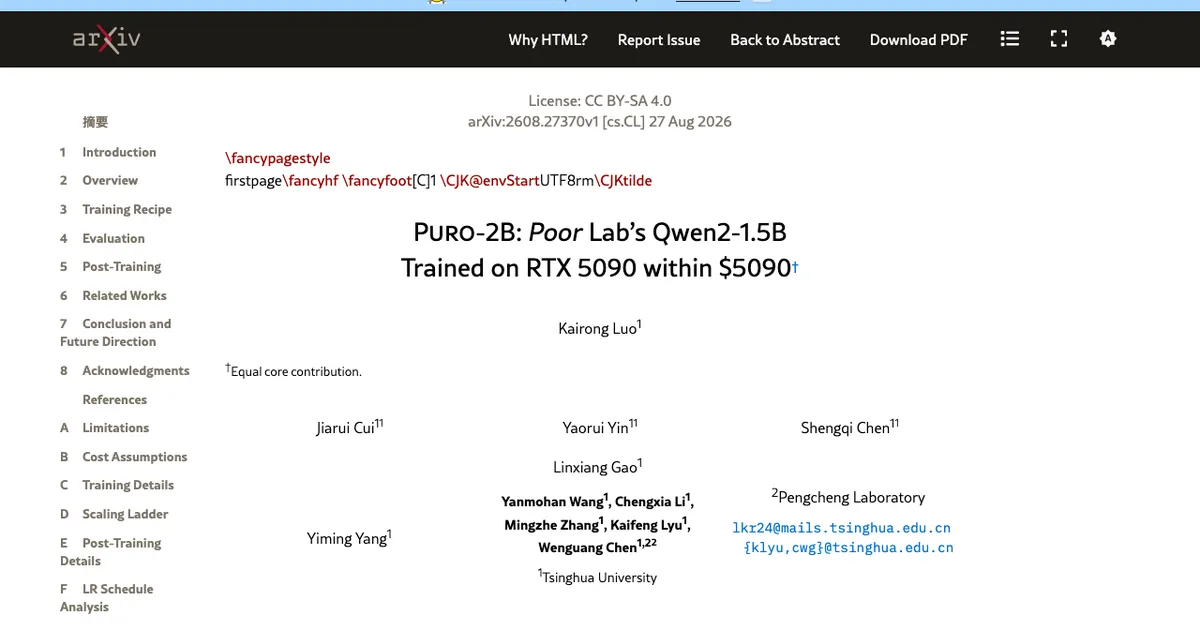
Our research introduces Puro-2B, an entirely novel, open pretraining recipe that shatters those cost barriers. It proves that building a high-performing LLM can be achieved using consumer-grade hardware (specifically, the RTX 5090) for dramatically less than professional-grade supercomputing clusters.
The abstract painted a sobering picture of model training costs: * Training Llama-3.2-3B easily exceeds $1.5 million. * Reproducing other strong open models required budgets exceeding $700,000.
For the academic community and independent developers, this was a crippling financial hurdle to pioneering research.
Puro-2B isn’t just another model; it’s an entirely accessible methodology. By combining several revolutionary techniques, we drastically optimized the training lifecycle.
Our cost efficiency comes from a powerful combination of:**
Using this recipe, we trained a collection of Puro-2B models on up to 1.4 trillion tokens. Our best model achieved performance approaching that of the industry benchmark Qwen2.5-1.5B at a total compute cost of less than $6,900.
But the most impactful finding wasn’t just one good number—it was building a systematic framework:
This research is a massive leap toward democratizing advanced AI. It means:
This isn’t just an incremental improvement; it’s a fundamental shift in the economics of modern deep learning.
🔗 Read the full paper on how to achieve state-of-the-art LLMs affordably: https://arxiv.org/abs/2608.27370
Puro-2B is ready for adoption: Dive into the released collection and code here: https://huggingface.co/collections/thu-pacman/puro-2b
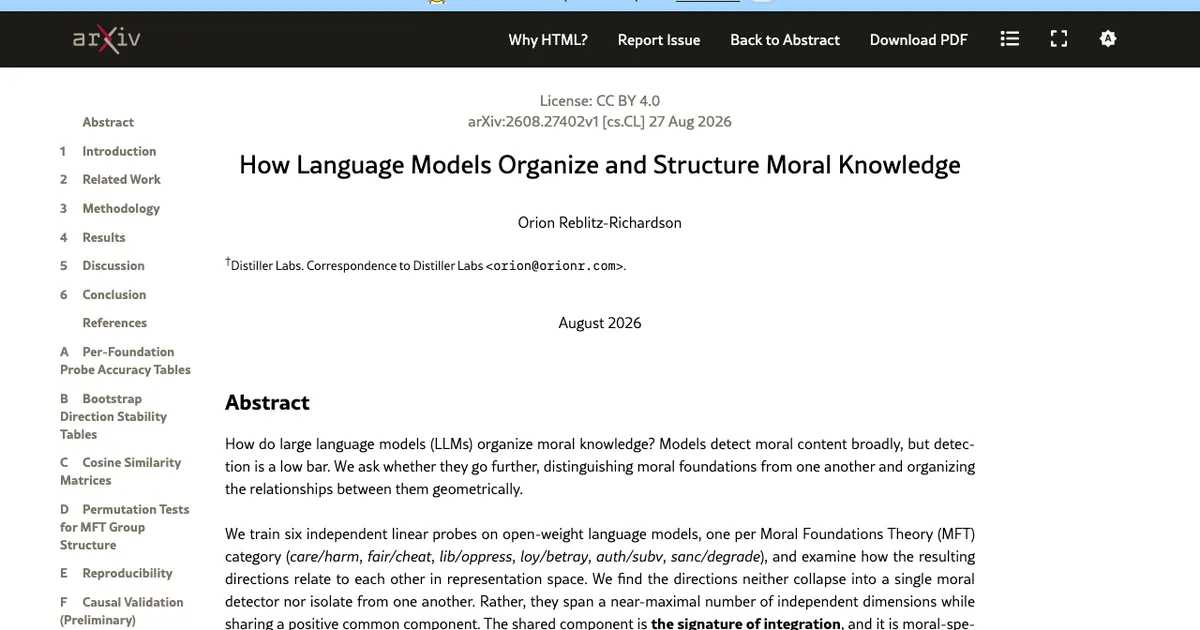
The ethical behavior of large language models (LLMs) is one of the most critical, and least understood, aspects of modern AI. We often ask, ‘Does this model understand morality?’ But does it just detect keywords, or does it grasp the complex relationships between different moral concepts?
Our latest research tackles this head-on, going beyond simple detection to map the structural organization of moral knowledge within open-weight LLMs.
When we think about ‘morality,’ it’s not one monolithic concept. Theories like Moral Foundations Theory (MFT) suggest distinct pillars—care/harm, fair/cheat, loyalty/betrayal, etc.—that combine to form nuanced judgments (like feeling slighted by a betrayal that violates fairness).
Previous work often treated morality as a binary on/off switch. We went deeper, treating the LLM’s internal knowledge space like a complex geometry. By training specialized linear probes—one for each distinct moral foundation—on open-weight models, we were able to map how these concepts coexist within the model’s massive embedding space.
Our findings paint a surprisingly integrated picture:
This research has major implications for alignment and safety. If LLMs structurally integrate moral concepts, it suggests a complex internal mechanism rather than simple pattern matching. Understanding this geometry is crucial for developing better interpretability tools that can probe exactly how the model makes ethical decisions.
The study can be read here: https://arxiv.org/abs/2608.27402
(Disclaimer: This analysis of moral foundations reflects current linguistic capabilities and is not a definitive statement on conscious understanding.)
Read the full paper abstract and details here: https://arxiv.org/abs/2608.27402
#AIethics #LLMs #AILearning #MachineLearning #AIResearch #Safety
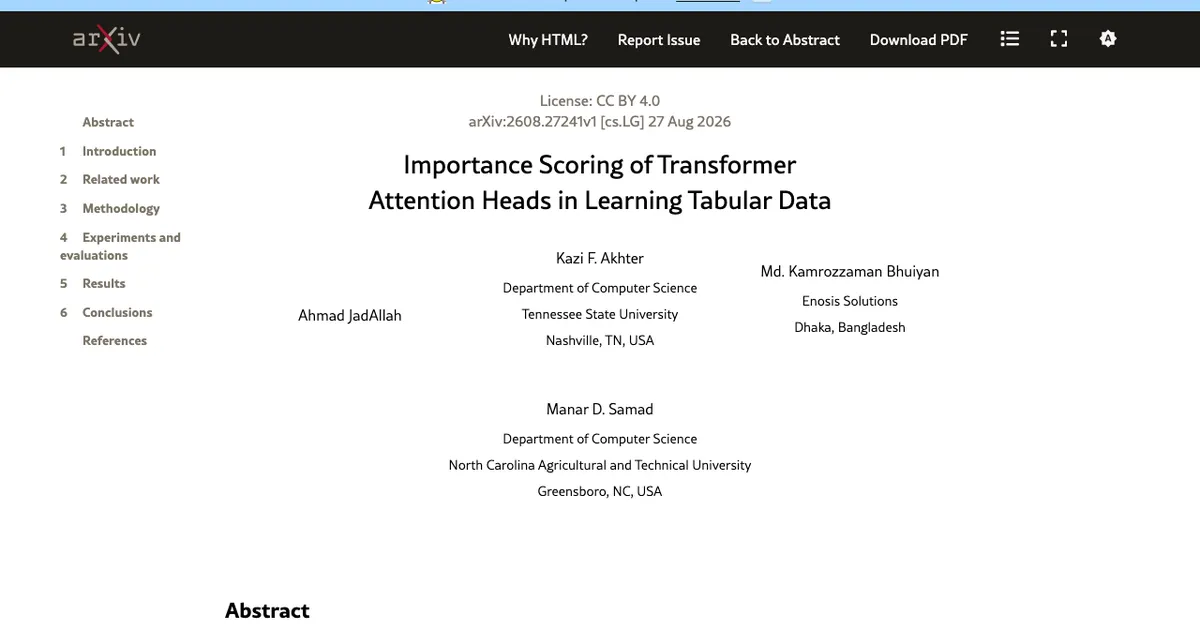
If you’ve been deep in the world of NLP or Computer Vision using transformers, you know their power. But what happens when your data isn’t text or pixels? We’re talking about structured, tabular data—the bread and butter of most business analytics, finance, and scientific research.
The gap has always been glaring. While researchers are making amazing strides with Vision Transformers (ViTs) and massive LLMs, applying this power to traditional tables requires a smarter approach than just ‘plunking’ transformers on the dataset. You need deep architectural insights.
🚀 What We Tackled in Our Latest Research
Our new paper introduces a novel method: an importance-scoring metric designed specifically to interpret how Multi-Head Attention (MHA) mechanisms function when learning from tabular data. Simply put, we’re not just running the model; we’re figuring out which parts of the transformer are actually doing the heavy lifting.
The research demonstrates that these attention heads aren’t built on a one-size-fits-all principle, especially when dealing with diverse schemas. We tested our approach across 40 varied tabular datasets and found strong, repeatable results:
💡 Why Does This Matter? (The Tech Impact)
This isn’t just academic curiosity; it changes how we design robust ML systems. By pinpointing redundant or unnecessary attention heads, we can:
If your work relies on advanced ML in finance (credit scoring), healthcare (patient records), or analytics (operational reports), this paper is a must-read. We’ve made our source code publicly available to accelerate adoption!
🔗 Read the full paper and dive into the methods: https://arxiv.org/abs/2608.27241

Are you relying on common geodesics to guarantee optimal decoding in your structured SVM? Think again. A recent, rigorous study is exposing a deep theoretical gap between necessary conditions and actual performance guarantees in advanced machine learning models.
This paper dives into the foundational geometry of Structured Support Vector Machines (SVMs), tackling a problem that has long underpinned confidence measures: Fisher Consistency—the idea that the optimal prediction can be reliably found across different statistical approximations.
The theory states that for an SVM to be ‘Fisher consistent,’ the underlying loss function must be a metric where all output triples share a common geodesic point. Sounds solid, right? Well, authors Jintao Fei and Jiangying Luo demonstrate that this condition is not sufficient for canonical coordinate-wise argmax decoding—the method most ML practitioners assume works perfectly.
Their findings are highly technical but fundamentally important: they provide minimal counterexamples showing where the elegant mathematical guarantees fail in practice. They pinpoint specific geometric structures, like certain star metrics and $K_{m,n}$ graphs, that satisfy the common geodesic condition yet fail to guarantee argmax consistency.
Perhaps the most definitive contribution is their complete classification of positively weighted tree metrics. They prove a fundamental structural limit: argmax consistency holds for a metric if and only if that metric forms a simple path. Any branching structure introduces potential failure points.
Crucially, they demonstrate that while boundary distributions are vulnerable to this failure on branching trees, every tree retains the argmax property under full-support distributions. This provides critical guidelines for model design.
For those building deep models or tackling advanced structured prediction tasks: The paper exposes a concrete ‘decoder gap.’ Simply satisfying geometric criteria like common geodesics does not guarantee that an embedding will validate the prescribed argmax link across all surrogate-risk minimizers.
This is not just theoretical math—it impacts how we build confidence and make decisions in real-world ML systems. These findings mandate a deeper understanding of the interplay between metric space geometry and practical model decoding.
➡️ Dive into the full technical details here: https://arxiv.org/abs/2608.27203
#MachineLearning #DeepLearning #StructuredSVM #OptimizationTheory #MLResearch #GeodesicGeometry
(This digest was written for tech leaders and ML researchers interested in the mathematical foundations of model reliability.)
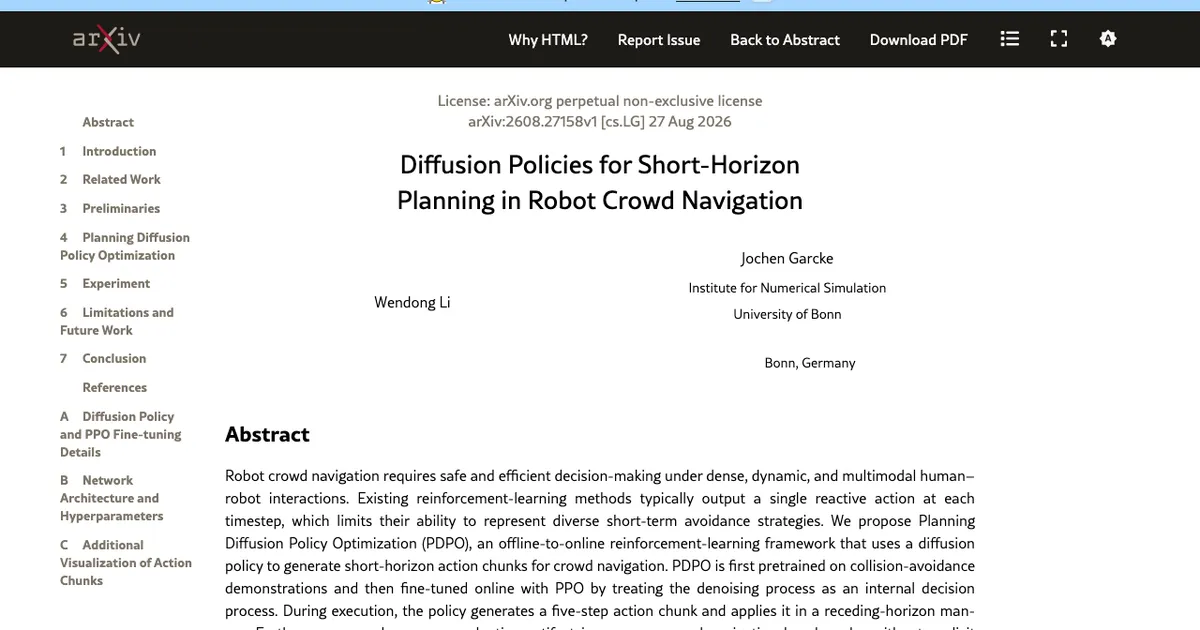
Dealing with a bustling city street or a packed airport terminal is hard enough for humans. For robots, navigating dense human crowds demands more than just quick reflexes—it requires genuine planning. Our latest work introduces Planning Diffusion Policy Optimization (PDPO), a breakthrough method that moves robot navigation from single-step reactions to sophisticated short-term decision-making.
The current state of reinforcement learning (RL) for robots often boils down to reactive policies. At every moment, the policy decides only one action: move this way. When faced with a complex bottleneck or an unpredictable crowd member, these single-action models struggle because they can’t pre-plan a sequence of maneuvers (e.g., ‘wait 0.5s, then veer left for two seconds’). This limitation severely restricts robots’ ability to operate safely and efficiently in real-world, densely populated environments.
PDPO redefines how robots plan movement. Instead of outputting a single action per timestep, it utilizes Diffusion Policies—a powerful generative model usually used for image creation—to predict an entire chunk of actions (specifically, five steps ahead). This sequence-planning ability fundamentally changes the game.
Here’s how PDPO works: 1. Offline Pretraining: The system is initially trained on expert demonstrations focused purely on collision avoidance, teaching it fundamental safe movement patterns. 2. Online Refinement: It then uses advanced techniques (PPO) to fine-tune these plans in a live setting, treating the process of ‘denoising’ the action chunk as an internal decision-making process itself. 3. Receding Horizon Execution: During operation, PDPO generates that five-step sequence and executes it, constantly re-planning based on new sensory inputs, ensuring dynamic safety throughout the crowded space.
We also found a critical flaw in common benchmark tests: some learned agents would simply bypass dense crowds by ignoring spatial boundaries. To make our framework robust for real deployment, we introduced a key setting where boundary violations are treated as collisions. This refinement forces the robot to navigate realistically within its allowed operational space.
This research paves the way for truly autonomous and reliable mobile robots in urban settings, healthcare facilities, and logistics hubs. By enabling sophisticated short-horizon planning, PDPO allows deployment of robots that can safely operate where simple reactive algorithms fail—in the most complex human environments.
Read the full academic details here: https://arxiv.org/abs/2608.27158
#Robotics #AIPlanning #DiffusionModels #CrowdNavigation #DeepLearning
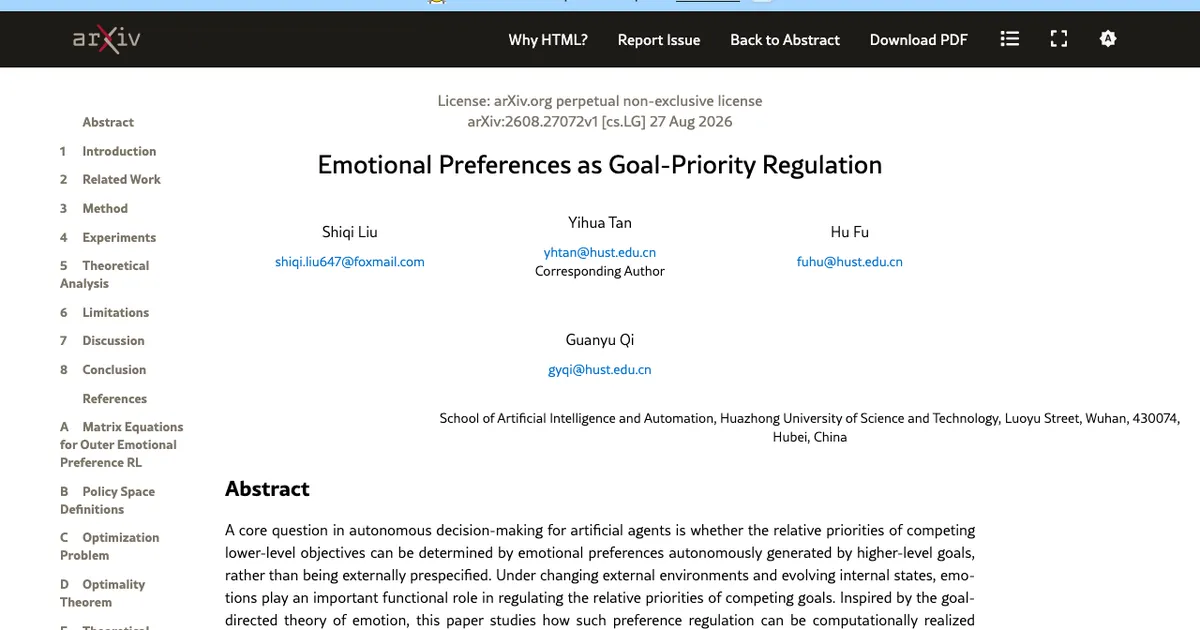
If you’ve ever wondered how complex AI—like advanced self-driving cars or sophisticated robotic agents—decide which task is more important when faced with competing demands (e.g., safety vs. efficiency)? Most traditional models treat these priorities as hard-coded rules. This paper flips that script, suggesting a much more dynamic, human-like approach: priorities are not given; they are emergent.
Inspired by the goal-directed theory of emotion, the researchers propose viewing emotional preferences not just as feelings, but as a computational mechanism that regulates relative goal priorities in real time. This means the overarching high-level goal autonomously dictates which sub-goals should be emphasized or downplayed, depending on the current state and environment.
To make this work computationally, the authors designed a novel architecture:
Through advanced Reinforcement Learning (RL), this outer generator trains the agent to exhibit what they call ‘emergent emotional preferences.’ The result? An AI that doesn’t just execute tasks, but thoughtfully navigates complex trade-offs based on its perceived goals and environment.
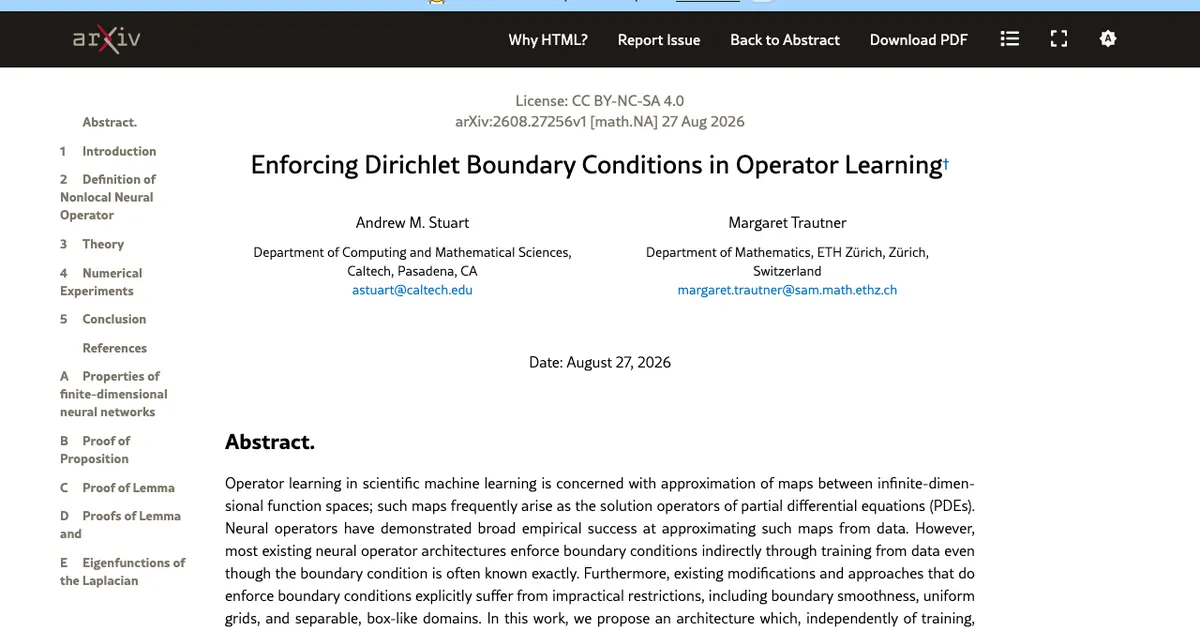
Are you working with high-dimensional data that governs physics—think fluid dynamics, heat transfer, or wave propagation? If so, you know the struggle: your neural network must not just be accurate; it must respect the laws of physics, especially at the edges.
Most powerful modern AI architectures, like Neural Operators (NOs), are amazing at learning complex mappings between function spaces. They’ve shown incredible empirical success in solving Partial Differential Equations (PDEs) and approximating solution operators.
But here’s the catch: traditional NOs often treat boundary conditions (BCs) as mere data points. Even when we try to enforce them explicitly, the resulting methods are painfully restrictive—they demand perfect grid alignment, smooth boundaries, or simple box domains. This limitation severely cuts down where and how NOs can be applied.
The breakthrough? We made boundary adherence a core mathematical property of the network itself.
Our work introduces a revolutionary architecture that guarantees homogeneous Dirichlet boundary conditions ($ ext{u}=0$ on $ ext{Boundary}$), independent of the training process. This means the physics holds true whether or not your dataset has perfectly captured the edges.
🔬 What makes this groundbreaking?
🚀 The Impact (And Why You Should Care)
The inability to robustly enforce BCs has been one of the biggest bottlenecks in moving AI from academic toys to industrial solvers for physics simulations. By providing a physically constrained architecture, we significantly expand the operational envelope for NOs.
We validate our method on challenging 2D PDEs—from Darcy flow (a classic fluid dynamics problem) on a square domain to the Helmholtz equation on a circular geometry—showing that it performs robustly and comparably well to state-of-the-art methods, all while guaranteeing physical compliance.
If your research involves scientific machine learning for complex geometries or non-uniform meshes, this architectural breakthrough is a game-changer. Learn more about the theory and implementation here: Enforcing Dirichlet Boundary Conditions in Operator Learning
Keywords: Scientific Machine Learning, Neural Operators, PDEs, Partial Differential Equations, Deep Learning, Physics-Informed AI, Homogeneous Dirichlet BCs, Function Spaces
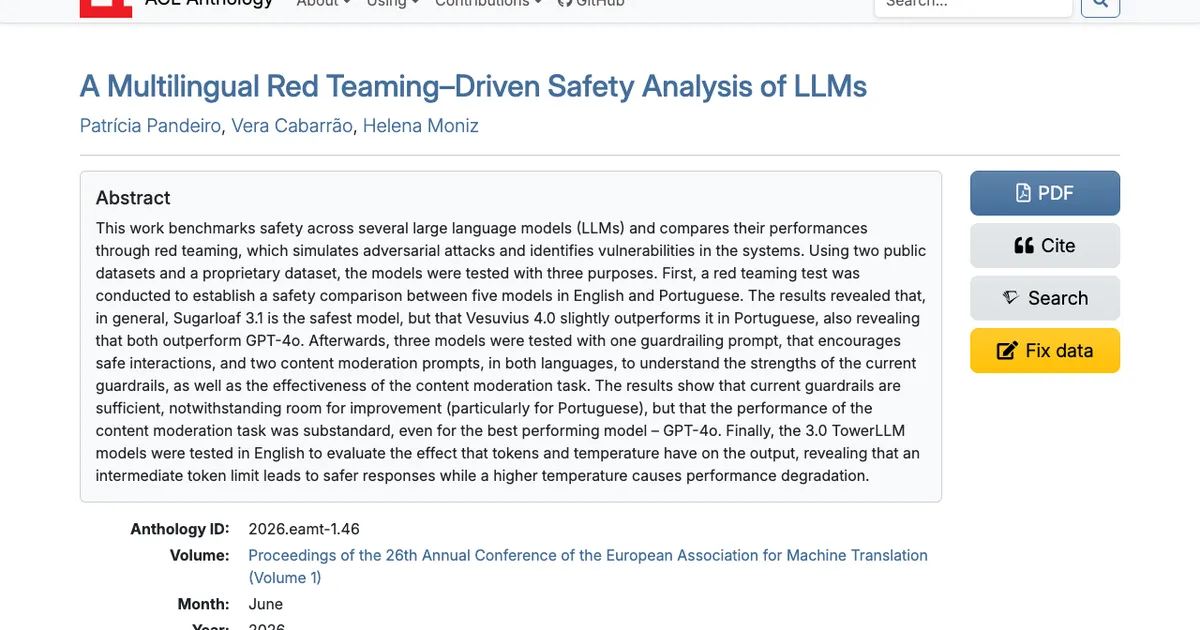
As Large Language Models (LLMs) become integral to our daily lives—from drafting emails to analyzing complex data—understanding their safety limits is mission-critical. New research from Patrícia Pandeiro, Vera Cabarrão, and Helena Moniz dives deep into this vulnerability landscape by deploying advanced red teaming techniques.
In this comprehensive analysis, the team systematically benchmarked several top LLMs across English and Portuguese, simulating adversarial attacks to expose their weaknesses.
This isn’t just a single stress test; it’s a multi-layered deep dive into AI robustness. The study covered three key areas:
The paper also investigated operational mechanics by testing the ‘3.0 TowerLLM’ models in English. They discovered that finding the sweet spot for safety is complicated: an intermediate token limit promotes safer outputs, while raising the temperature (making the model more creative/random) actually degrades its performance and safety.
👉 Want to read the full methodology and detailed results? Check out the paper here: https://aclanthology.org/2026.eamt-1.46/
#AIethics #LLMSafety #MachineLearning #NLP #GenerativeAI #PortugueseTech #DeepLearning #MLResearch

*Are Large Language Models (LLMs) truly smart? Or are they just… guessing?
This deep dive into ‘Block Drafting’ reveals a fundamental limitation in how modern models propose answers, suggesting that current techniques might be overlooking crucial details about context and local dependencies. If you work with advanced NLP, AI architecture, or model evaluation, this post is for you.
Many state-of-the-art LLMs don’t generate text one token at a time. Instead, they employ block drafting (or lookahead), proposing several potential tokens simultaneously in one forward pass. While fast and efficient, this method inherently mixes two types of errors when it makes a prediction:
The core insight from the research is that these two issues can be cleanly separated using a concept called an information floor. This ‘floor’ represents the theoretical minimum rejection rate—the best-case performance possible under specific conditions. The model gap, then, is defined as any rejection above this theoretical floor.
This paper meticulously analyzes models across four domains and four target benchmarks (including frontier APIs like OpenAI’s GPT series). Here’s what the authors found:
1. The Ceiling is Low: Using the Qwen3-4B model, the all-parallel information floor was calculated to be $\approx 28.6\%$. This means that even when models are at their absolute best proposal quality (the theoretical limit), they can only expect about $71\%$ per-slot acceptance in the final slot.
2. Local Context is King: Crucially, the research demonstrated that realizing just one token dramatically reduced this floor by $86$–$100\%$. This suggests that sequential, local conditioning is vastly more powerful and accurate than attempting to predict entire blocks of tokens in parallel.
3. Massive Model Gap Exists: The most striking finding: current high-performance drafters (like DFlash and DSpark) perform significantly above their theoretical information floor. For instance, the final-slot model gap accounted for $43$–$64\%$ of DFlash rejection and $85$–$92\%$ of DSpark’s oracle-conditioned rejection.
The core value proposition here is definitive: the paper successfully separates the contribution of short-range conditioning (sequential generation) from the raw quality of multi-token proposals. Current best practices might be heavily overestimating their true capability by conflating these two sources of strength.
What this means for development: Future LLM architectures should focus less on maximizing parallel proposal sizes and more on optimizing localized, step-by-step conditional generation while better modeling the minimal required context (the information floor).
🔗 Read the full paper here: https://arxiv.org/abs/2608.27339
Topics Covered: #LLMs #NLP #AIResearch #MachineLearning #ModelEfficiency #GenerativeAI
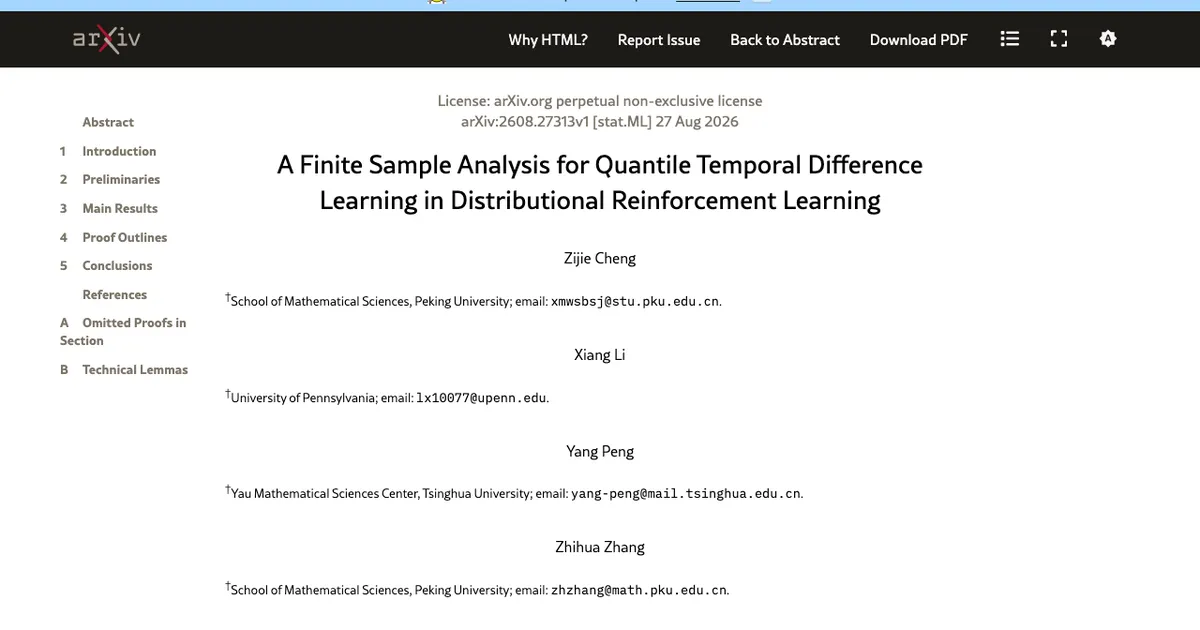
If you’ve spent time diving into the world of Reinforcement Learning (RL), especially distributional methods like QR-DQN, you know that achieving stable, sample-efficient training is the holy grail. Why? Because real-world agents don’t get infinite data streams; they need to learn fast and accurately from limited interactions.
Our latest analysis tackles this core problem head-on. We provide a global finite-sample guarantee for Quantile Temporal Difference (QTD) learning, providing theoretical rigor that few papers have achieved in this complex domain. This isn’t just another incremental update; it sheds light on exactly how the algorithm stabilizes.
Simply put, we’ve rigorously separated the noise source (local stochastic fluctuation) from the fundamental sample complexity required for convergence globally. Our proof accomplishes this by analyzing two distinct mechanisms:
The Bottom Line: Superior Sample Complexity. For specific step sizes $\alpha_t = c(t+1)^{-a}$ where $a \in (1/2, 1)$, we show that the final residual error is of order $\widetilde O\bigl(T^{-a/2}/\sqrt{1-γ}\bigr)$ and critically shows no polynomial dependence on the number of quantiles. This result sharply distinguishes between the manageable local stochastic noise and the unavoidable global sample complexity.
If your research involves building sample-efficient agents or designing robust optimization algorithms based on Bellman equations, this paper is mandatory reading.
🔗 Read the full technical details here: https://arxiv.org/abs/2608.27313
(Keywords: Reinforcement Learning, Distributional RL, QTD, Sample Complexity, Machine Learning Theory)
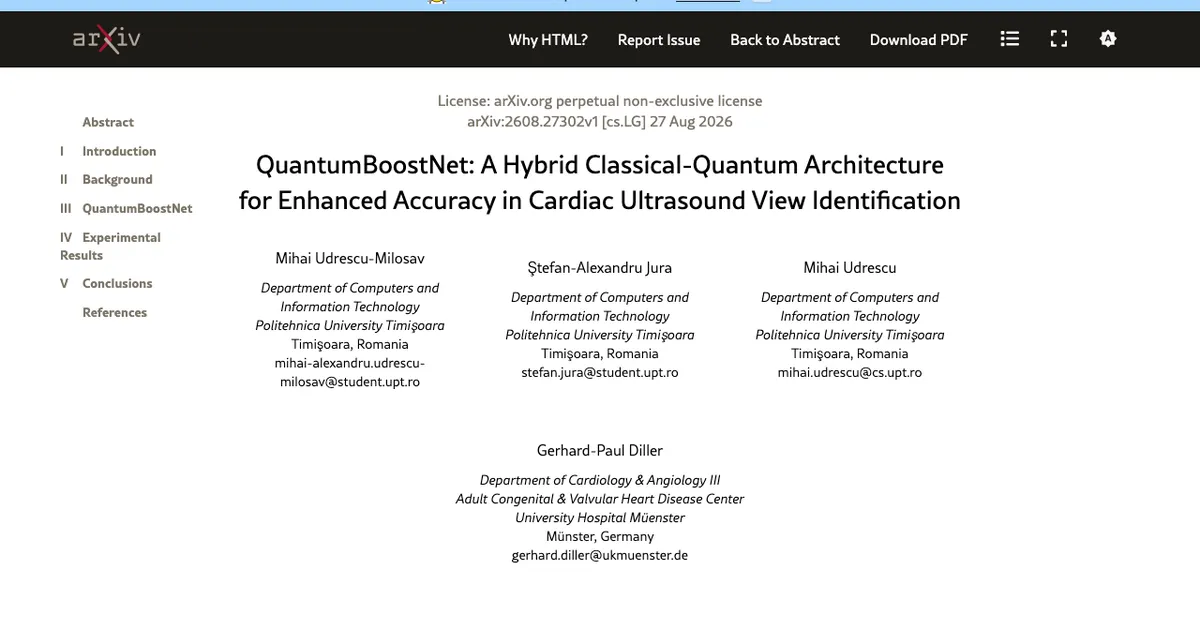
The world of medical diagnostics is undergoing a revolution. Reading an echocardiogram (ultrasound heart scan) isn’t just about seeing images—it’s about precisely identifying the correct view, angle, and plane to ensure accurate measurements and prevent critical diagnostic errors. For cardiologists, this initial viewing step is absolutely vital.
But here’s the catch: standard computer vision models, while powerful, often stumble when faced with the real-world challenges of medical data—think high noise, unique artifacts, and specialized views. They perform well in pristine benchmarks, but fail in messy clinical reality.
Introducing QuantumBoostNet: The Next Generation of Cardiac AI.
We just dove into a fascinating new model that mixes the best of classical deep learning with cutting-edge quantum computation to tackle this problem head-on. QuantumBoostNet isn’t your standard CNN; it’s a powerful hybrid architecture designed specifically for noisy, high-stakes medical imaging.
Imagine training an AI that can learn from both classical mathematical patterns and the inherently complex relationships modeled by quantum mechanics. That’s QuantumBoostNet’s genius!
The architecture uses a strong classical backbone for feature extraction, but then bifurcates into two specialized heads: one remaining classical, and one revolutionary quantum head. This quantum head is implemented using a parameterized 10-qubit circuit.
The training process itself is sophisticated. It doesn’t just use one path; it dynamically adapts its learning strategy (governed by a mixing parameter) to monitor the loss dynamics across both heads, optimizing the transition between classical and quantum insights.
The Bottom Line: By integrating quantum computational principles into a classical deep learning framework, QuantumBoostNet offers a promising blueprint for enhancing diagnostic accuracy in specialized medical fields like cardiology. It strongly supports the shift towards hybrid classical-quantum models for next-level AI healthcare solutions.
🔗 Read the full details of this groundbreaking work here: QuantumBoostNet Paper
Disclaimer: This is an academic report and research findings should always be validated by clinical experts.
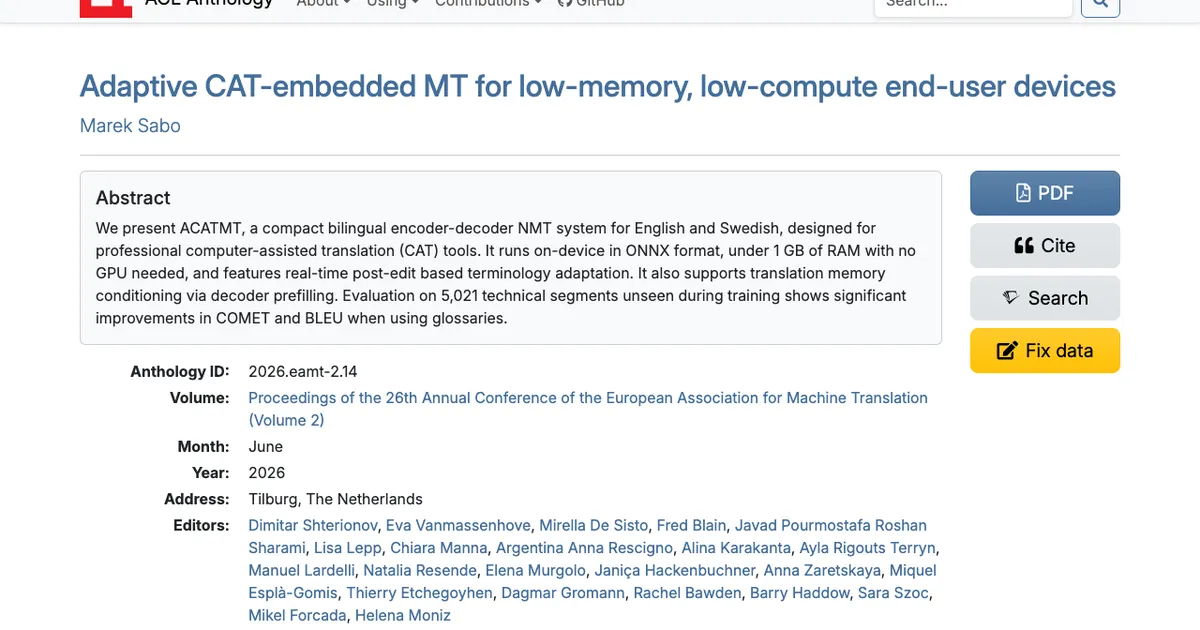
Are large language models (LLMs) and complex machine translation systems destined for the cloud? Think again. In this deep dive, we explore a brilliant solution that brings high-quality professional translation directly to your end-user device—the kind of compact, efficient AI needed for global accessibility.
Our focus is on ACATMT, an advanced Neural Machine Translation (NMT) system built specifically for Computer-Assisted Translation (CAT) tools. The core breakthrough? It delivers professional-grade performance while maintaining ultra-low computational requirements.
The biggest bottleneck in AI translation right now is deployment and resources. Cloud-based solutions are convenient, but they require constant connectivity, high bandwidth, and often consume significant energy. ACATMT solves this by being designed to run entirely on-device.
The research confirms the system’s robustness. When evaluated on a challenging set of technical segments, ACATMT demonstrated significant improvements in standard metrics like COMET and BLEU when specialized glossaries were utilized. This proves that it doesn’t just translate; it translates accurately within specific, regulated professional domains (like medical or engineering texts).
ACATMT represents a significant step towards truly decentralized and portable high-quality NLP. It demonstrates that complex NMT capabilities—the kind previously limited to massive data centers—can be successfully scaled down into robust, low-power edge applications. This push toward efficient, resource-constrained AI is defining the next generation of global connectivity tools.
Want to read more about this compact architecture? Check out the full paper here: https://aclanthology.org/2026.eamt-2.14/

The rapid evolution of Large Language Models (LLMs) has brought us incredibly powerful machine translation capabilities. But here’s the rub: as models become near-perfect on standard test sets, we face a ‘saturation problem.’ The existing benchmarks are getting too easy! How do researchers prove if Model A is genuinely better than Model B when both score nearly identically?
Entering the scene is a clever new approach called Adversarial Translation Optimization (ATO). Instead of just feeding models more data, these researchers are making the inputs tougher to handle. They’ve created a way to artificially increase the difficulty of text translation without relying on expensive human curation or complex LLM prompting.
Think of it like this: Instead of just correcting typos, the system is strategically finding tokens to replace (augment) in a source language that specifically degrade the translation quality. They are using sophisticated gradient-based optimization combined with a ‘differentiable difficulty estimator’—a mathematical function that tells them how hard a piece of text is to translate.
This allows ATO to systematically search for the most challenging modifications, transforming the problem into an advanced Beam Search tree traversal. The result? A significantly tougher test!
A groundbreaking evaluation showed that applying ATO to existing benchmarks drastically lowers the average translation quality score ($ ext{xCOMET}$), dropping it from $0.93$ down to $0.82$. Meanwhile, other methods (like paraphrasing) only saw a drop to $0.86-0.88$. This validates that their augmented texts are genuinely harder and not just random noise.
Crucially, human evaluation confirmed that despite the added difficulty, the modified source texts still sound remarkably natural—a huge win for dataset integrity! The researchers are also releasing two fully generated datasets of 200 English texts each and their code, making this methodology highly reproducible for the entire ML community.
This isn’t just an academic tweak; it’s a crucial methodological step forward for Natural Language Processing (NLP). By creating more rigorous benchmarks, researchers can finally distinguish between models that are good and those that are truly state-of-the-art. For companies developing translation software or deep learning solutions in the EU market, keeping an eye on these harder metrics is essential for planning future model upgrades.
🔗 Dive into the full methodology and datasets here: 26th Annual Conference of the European Association for Machine Translation (Volume 1)
Are you excited about more robust AI evaluation? Share your thoughts below!
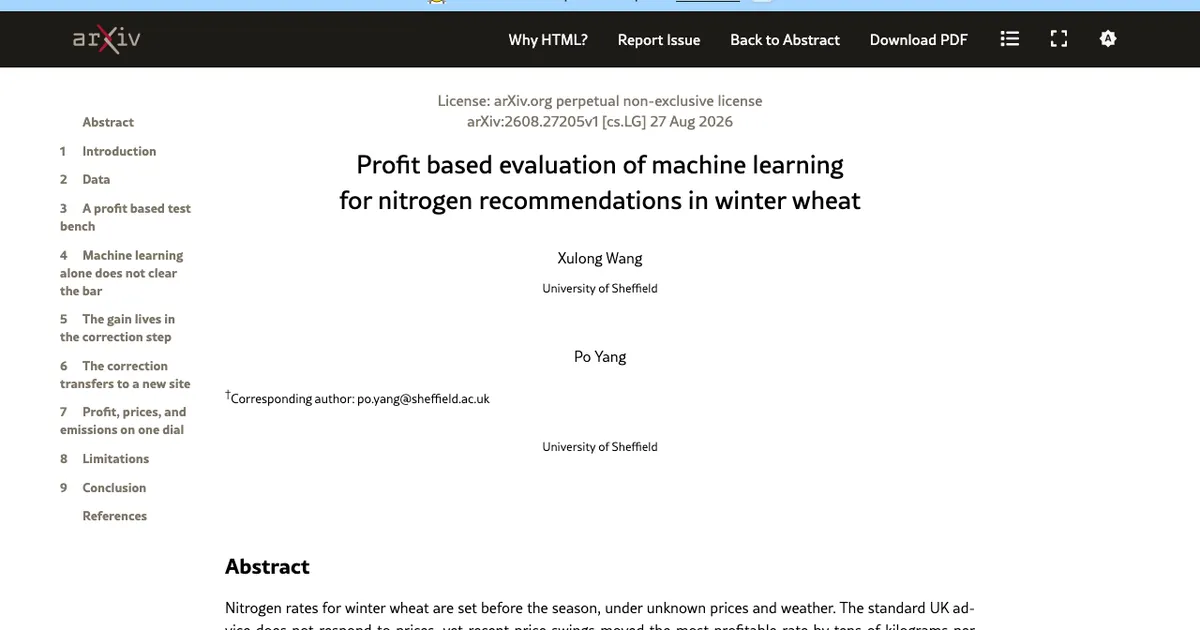
For years, Machine Learning (ML) has been touted as the silver bullet for agricultural sustainability. When it comes to complex decisions like nitrogen fertilization for winter wheat, experts usually recommend a fixed amount based on ‘best practice.’ But what if the most profitable decision depends heavily on volatile commodity prices and unpredictable weather?
Our latest research dives deep into this problem, shifting the focus from mere predictive accuracy to economic profit. Using a robust test bench built on 892 real-world UK farm yield response curves—data spanning two long-term farming experiments—we tested how ML models actually perform when facing market reality. The findings are surprisingly counterintuitive.
The Punchline? ML Models Fail the Profit Test.
The study reveals that most sophisticated machine learning algorithms fail to identify the truly optimal nitrogen rate under varying prices, even beating standard ‘best practice’ advice at normal prices. Standard models usually lose when tested on profit, not just prediction accuracy.
So, where does the real gain come from? The Correction Step.
The breakthrough isn’t a better model; it’s a simple, calculated refinement applied after the model makes its recommendation. By implementing this damped correction step, we significantly cut predicted profit losses—in one site alone, slashing them by 43% without needing any retraining or extra features!
This correction also opens up new avenues: pricing emission reductions (like carbon credits) at a cost comparable to existing carbon schemes.
The Takeaway for AgTech: ML isn’t meant to replace established agricultural advice; it needs to function as an intelligent, profit-scoring correction applied to it. The future of precision agriculture lies in marrying robust ML with economic modeling and domain-specific rules.
Read the full paper and dive into the methodology: https://arxiv.org/abs/2608.27205
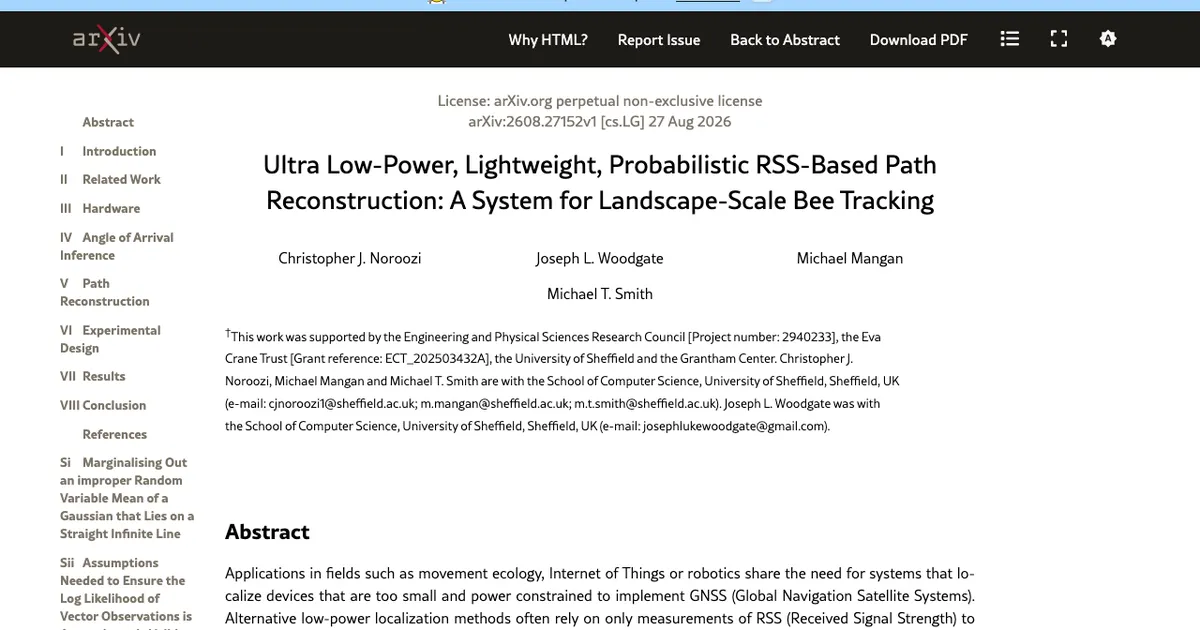
The challenge of tracking objects in the wild—be it a delicate insect or a corner robot—has always been limited by one factor: power. Traditional GPS (GNSS) systems are too energy-intensive for ultra-lightweight devices, making robust localization impossible in real-world, large-scale environments.
This groundbreaking new research tackles this head-on. The authors present an innovative method that uses nothing more than Received Signal Strength (RSS) measurements to reconstruct complex movement paths over vast landscapes, all while maintaining incredibly low power consumption.
The system is designed for minimalist deployment. Instead of requiring intensive measurements or large hardware packages, it utilizes simple rotating high-gain transmitters spaced hundreds of meters apart. By carefully modeling the incoming RSS signals and applying sophisticated probabilistic techniques (like Gaussian Processes and doubly stochastic variational inference), the receiver can infer its Angle of Arrival (AoA) using only a minimal number of readings.
The results are genuinely impressive: they achieve robust tracking—with an accuracy of roughly 15 meters—of receivers weighing just 38mg, all while consuming less than 180uW. To improve accuracy slightly to around 10m, they simply increase the RSS measurements and boost power marginally to under 600uW.
The most compelling part? They demonstrated this technology by applying it directly to track Bombus terrestris (Bumblebee) nest return flights. This provides immediate, powerful applications for movement ecology, behavioral science, and conservation efforts.
This research represents a significant leap forward for the Internet of Things (IoT), bio-inspired robotics, and any field requiring continuous monitoring of tiny, distant assets.
👉 Want to see the math behind the magic? Read the full abstract here: https://arxiv.org/abs/2608.27152
Keywords for this field: Low-power localization, RSS tracking, Gaussian Processes, Movement ecology, Tiny IoT.
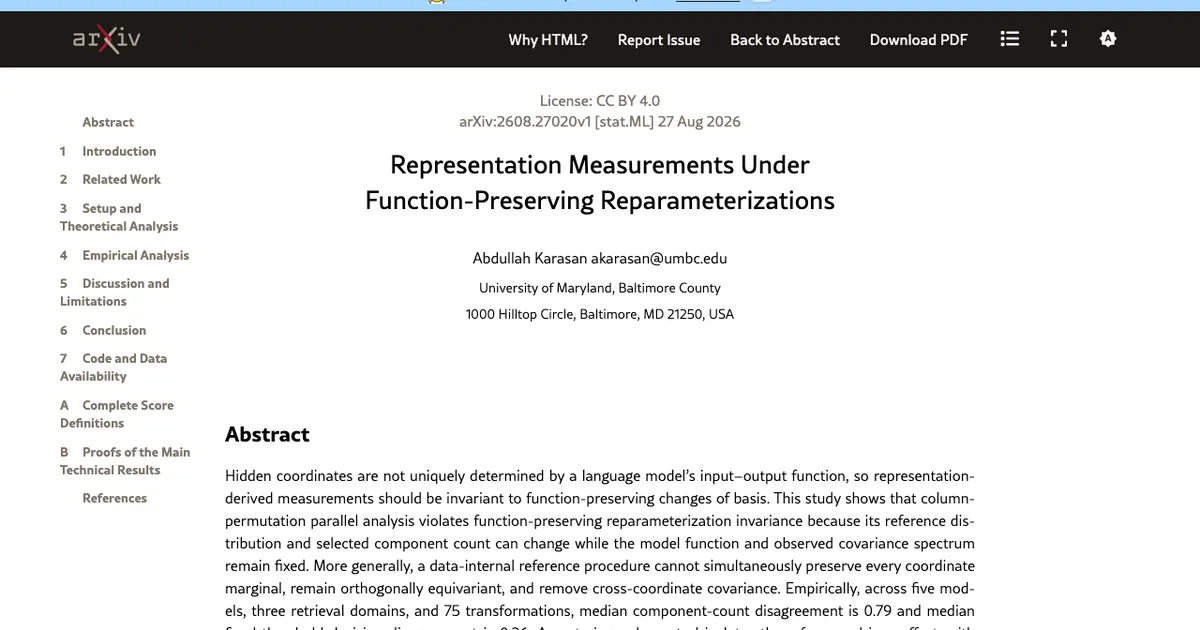
As Large Language Models (LLMs) become cornerstones of modern AI, researchers frequently study their internal workings—the ‘representations’ or hidden coordinates. We assume these representations capture some unique, meaningful understanding of the data. But what happens when we change how we measure them?
Our latest research challenges this fundamental assumption. If a model’s function (input $ ightarrow$ output) remains constant, should its internal representation measurements remain stable, no matter how we mathematically rotate or re-parameterize our basis? Our study reveals that many popular techniques used to analyze these representations—including Column-Permutation Parallel Analysis and certain data-internal procedures—are fundamentally unstable.
The core finding is deceptively simple but deeply impactful: the choice of basis (the coordinates we use to measure internal features) can dramatically change what these analytical methods tell us, even when the underlying model function hasn’t changed at all. This means that many published component counts or feature rankings derived from standard techniques might be reflecting an arbitrary mathematical artifact rather than a true property of the LLM’s learned knowledge.
We rigorously tested this instability across five different models, three retrieval domains, and 75 distinct transformations. The results show significant disagreement: many standard component counts changed even when only a centering mechanism was applied to the data—meaning the observed spectrum stayed exactly the same!
Crucially, we introduced orthogonally invariant comparator scores. These novel measures remained numerically stable and maintained similar high performance in discrimination tasks, providing a more robust way to analyze internal LLM representations.
In short: We provide strong evidence that standard parallel analysis-derived component counts might be misleading, leading researchers to potentially misinterpreting the stability or dimensionality of model knowledge.
Want to read the full technical details? Check out the paper here
🚀 Takeaway for ML Engineers & Researchers: Moving forward, when analyzing LLM internal representations (like using PCA or PAR), you must adopt basis-invariant measurement techniques to ensure your insights are physically meaningful and not just mathematical artifacts of your chosen coordinates. Building robust AI needs reliable measurements!
Published by: [Your Blog/Company Name]
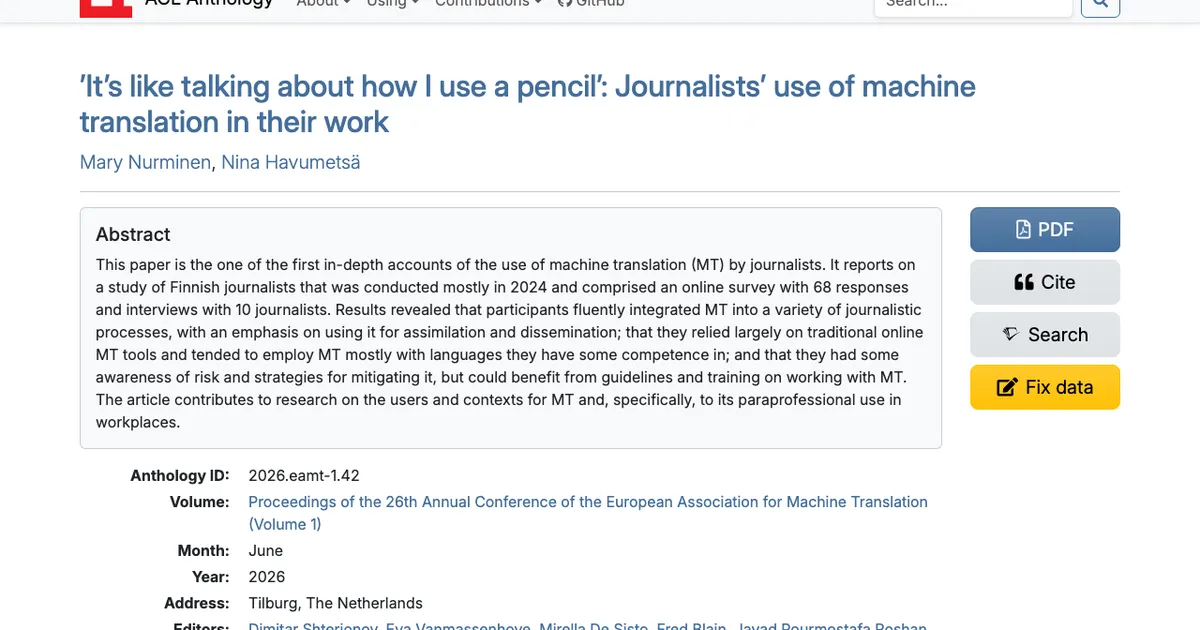
The age of instant translation is here, but how does it actually play out in high-stakes professional environments? Forget the sci-fi notion of perfect universal interpreters—real journalistic workflows are far messier (and more human). Our latest deep dive investigates how professional journalists integrate machine translation (MT) tools into their daily grind, offering critical insights for both AI developers and news organizations.
🚨 Key Takeaway:* Journalists aren’t just pasting text and hitting ‘translate.’ They are fluent, skilled integrators of MT, using it strategically for everything from synthesizing new information to quickly disseminating stories across language lines. But this advanced usage comes with a manual learning curve—they need better guidelines.
The authors found that Finnish journalists were highly adept at integrating MT into their processes. The use was not merely surface-level but deeply embedded in key journalistic tasks, specifically focusing on assimilation (absorbing foreign content) and dissemination (getting local stories out globally).
Here’s a breakdown of what this means for the future of global journalism:
This research provides a crucial map of the user experience (UX) landscape for Machine Translation. For tech companies building next-generation AI, it signals that ‘plug-and-play’ translation won’t cut it. Solutions must be designed with professional workflows and human expertise in mind.
For newsrooms, it’s a call to action: Invest in formal training! Don’t just give journalists access to the tools; teach them how to work with them ethically, efficiently, and effectively. Better guidelines mean better global reporting.
🌍 Read the full study and join the conversation on professional AI integration at the EAMT conference proceedings.
#JournalismTech #MachineTranslation #AIinMedia #GlobalNews #DeepLearning