← Back to Archive

Digest for 2026-09-29

🐦 Share on X 💼 Share on LinkedIn 📘 Share on Facebook

MM-FinEval: A Multi-Task Multimodal Benchmark for Real-World Financial Forecasting

By Dong Shu, Yanguang Liu, Huopu Zhang, Saisai Hu, Haiyan Zhao, Hekun Huang, Mengnan Du • arXiv • Importance: 92/100
Hero Image for 2609.38523

📊 Why Multimodal AI Needs More Than Just Text: Introducing MM-FinEval

Ever wonder how financial analysts really make sense of earnings calls? It’s not just about reading the transcript. It involves decoding subtle tone shifts in the audio, interpreting complex graphs on presentation slides, and synthesizing all that information into a single, actionable forecast.

Existing AI benchmarks often fall short. They treat finance analysis as a single-modality puzzle (just text!) or limit models to basic tasks. For multimodal Large Language Models (LLMs) meant for the real world, this is a huge blind spot.

That’s why the authors introduced MM-FinEval: a groundbreaking benchmark designed to push LLMs into simulating expert human financial analysis across multiple modalities.

🌐 What Makes MM-FinEval Revolutionary?

This isn’t your average dataset. It’s a deep dive into corporate finance, spanning S&P 500 earnings calls from 2019 to 2022. For every single call, the benchmark provides three distinct, yet complementary, data streams:

  • 🎤 Audio Recording: Captures the tone, cadence, and emotional nuance of speakers.
  • 📄 Text Transcript: The word-for-word record of what was said.
  • 🖼️ Presentation Slides (Visual): Contains the hard data, charts, and graphs presented during the call.

This trifecta ensures that models must learn to interpret signals across different sensory inputs simultaneously—mimicking a real expert’s workflow.

✨ Key Insights for AI Development

The study tested 19 baseline models (ranging from Image-Text to Any-to-Any setups) and revealed some critical findings with implications for the future of financial AI:

  • Modality Synergy: The results strongly validate that incorporating text, audio, and visual data is not redundant. These three inputs provide truly unique and complementary signals necessary for accurate analysis.
  • Small vs. Large: Intriguingly, the authors found that smaller Any-to-Any models processing all three modalities performed exceptionally well, sometimes even outperforming larger proprietary models limited to just two input types. This speaks to the quality and integration of diverse data over sheer model size.

🚀 Why Should You Care? (SEO/GEO Focus)

If you are developing advanced AI solutions for FinTech, Quantitative Finance, or needing tools that understand complex corporate reporting, MM-FinEval is a foundational resource. It sets a new standard for evaluating if an LLM can truly handle the chaotic complexity of real-world business data.

We encourage ML researchers and industry developers working on financial forecasting to explore this comprehensive framework: MM-FinEval Benchmark Details

What are your thoughts? Are multimodal benchmarks like MM-FinEval the future of specialized AI, or is single-modality mastery still enough for certain tasks? Let us know in the comments!


Keywords: FinTech, Multimodal LLM, Financial Forecasting, NLP Benchmark, Corporate Disclosure, S&P 500 Analysis, Audio Processing, Computer Vision
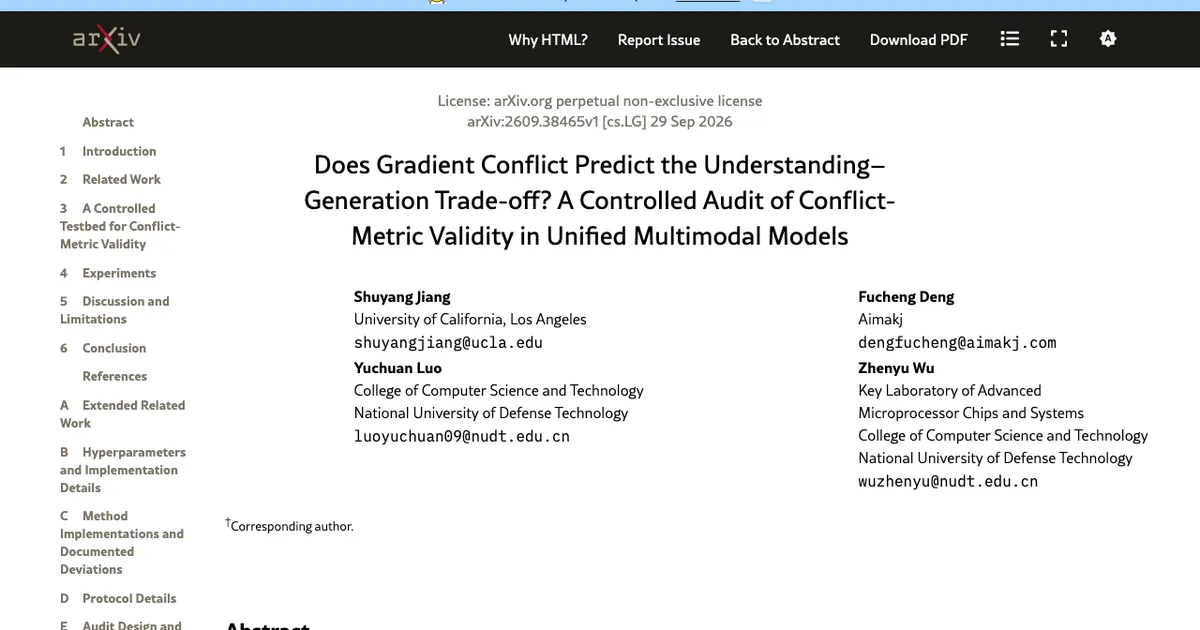

Does Gradient Conflict Predict the Understanding--Generation Trade-off? A Controlled Audit of Conflict-Metric Validity in Unified Multimodal Models

By Shuyang Jiang, Fucheng Deng, Yuchuan Luo, Zhenyu Wu • arXiv • Importance: 92/100
Hero Image for 2609.38465

Is Gradient Conflict Really the Root of Multimodal Model Failures? An Audit Deep Dive

In the fast-moving world of large AI models, everything seems to be linked. When a multimodal model struggles—does it struggle because its understanding objectives clash with its generation goals? Many researchers have theorized that minimizing ‘gradient conflict’ (the mathematical mismatch between these two aims) is the key to unlocking better performance.

But theory doesn’t equal reality.

The team behind this research just dropped a major audit, questioning the very premise of using gradient conflict metrics as reliable predictors for model performance. Using their controlled testbed, GRIDUMM, they systematically tested this hypothesis across dozens of configurations.

🔬 What They Tested (And Found)

The central idea is that if you reduce the measured ‘conflict’ during training, your final understanding-generation trade-off should improve. This seems intuitively logical—less friction means smoother operation.

Their rigorous audit across 63 different configurations and 372 checkpoints delivered a startling conclusion: no single directional conflict metric showed a statistically significant correlation (Spearman $\rho > 0.3$) with the actual trade-off. Simply suppressing conflict didn’t improve performance; it left the trade-off flat, indicating that correlation was mistaken for causation.

Key takeaways you need to know:

  • Conflict is not a guaranteed fix: The study separates diagnostic metrics from reality. While gradient conflicts exist, treating them as the primary predictor of failure might be misplaced.
  • Better Alternatives Exist: The authors suggest that functional interference measures perform better than simple directional conflict metrics. Furthermore, simply tracking overall training loss tracks the actual trade-off more strongly.
  • Diagnostic Standard Released: Crucially for the ML community, they are releasing their audit protocol (GRIDUMM) as a reusable standard. This gives researchers a concrete tool to verify assumptions about model dynamics.

🧠 The Big Picture: Beyond Single Metrics

The paper doesn’t say conflict is useless; it says its validity as a diagnostic target must be empirically proven, not assumed. For ML researchers and practitioners building Unified Multimodal Models (UMMs), this is a critical moment for rethinking how you measure model health during pre-training.

If we are to build truly robust and general-purpose AI that handles complex tasks (like simultaneously understanding a diagram and generating code from it), we need objective, measurable metrics. This research strongly pushes us toward caution, urging the community to establish diagnostic criteria rigorously before adopting them as gospel.


💡 Read the full findings and understand the nuances of measuring model dynamics: The Audit of Gradient Conflict in Multimodal Models

Was your research relying on conflict metrics? This paper is required reading to ensure you’re building models based on solid, empirical ground.

An Input-Frugal Deep Learning Framework for Weather-Driven National Crop-Yield Forecasting: A Case Study of Brazilian Soybean

By Fernando Dupin da Cunha Mello, Prashant Kumar, Erick G. Sperandio Nascimento • arXiv • Importance: 92/100

🇧🇷 Predicting Brazil’s Future Harvest: An Input-Frugal AI Approach to Crop Yield Forecasting

Hey tech enthusiasts and agritech professionals! Agriculture is a global pillar of the economy, but predicting how much food we will harvest next season remains an incredibly complex challenge. Traditional models often require massive amounts of proprietary data—satellite imagery, detailed soil maps, hyper-localized historical inputs—making them costly and hard to scale.

That’s where this paper steps in. Researchers have introduced a breakthrough deep learning framework designed for the real world: it minimizes its input requirements. The goal? To provide reliable, timely crop-yield forecasts using only routine weather data and two lightweight static context variables (the specific year and an agro-environmental label).

💡 What Makes This AI Framework ‘Frugal’?

Most advanced ML models starve for input. By focusing on minimizing data dependency while maintaining high predictive power, this framework is designed to be transferable—meaning it can be easily adapted from Brazilian soybeans to corn in Argentina, or even wheat anywhere else.

Using a comprehensive 20-season case study of Brazilian soybean (2001/02–2020/21), the authors benchmarked several cutting-edge models—including CNNs, LSTMs, Transformers, and Mamba state-space models. The results are highly encouraging:

  • Performance Edge: All deep learning variants significantly outperformed traditional methods (like linear regression or simple moving averages).
  • The Winner: The Transformer encoder achieved the best national accuracy (reducing error by 47.6% compared to a ‘farmer’ baseline).
  • Timely Insights: Crucially, the model showed improved forecasting reliability as the season progressed, suggesting operational value for in-season decisions.

🔎 Beyond the Accuracy: Key Takeaways for Industry

This isn’t just about achieving a low RMSE score. The true innovation lies in the interpretability and deployability:

  1. Low Barrier to Entry: By limiting inputs primarily to standard, routine weather data, the framework is naturally compatible with operational weather services. This makes real-time monitoring significantly easier.
  2. Feature Dominance: Analysis (SHAP diagnostics) showed that while the crop year explains long-run trends, the within-season fluctuations—especially variables like moisture/cloud cover and thermal demand—are what primarily drive interannual yield variations. Knowing this tells agronomists where to focus their efforts.
  3. Model Flexibility: The framework’s architecture is designed to be agnostic, meaning it can seamlessly accept multiple sequence encoders (from simple CNNs to complex Transformers) under the same data structure, increasing robustness and allowing for model comparison.

🚀 Why Does This Matter? (The Impact)

The ability to provide robust, scalable yield forecasts with minimal input overhead is a game-changer for global supply chains. It helps:

  • Financial Institutions: Better risk assessment and commodity pricing.
  • Governments/NGOs: More reliable food security planning and disaster mitigation.
  • Farmers/Agribusinesses: Optimized planting schedules, resource allocation, and better insurance modeling.

If you’re in the ML Ops space, agritech, or agricultural economics, this paper is a fantastic model for building sustainable, highly practical deep learning applications. Check out the full details here: An Input-Frugal Deep Learning Framework for Crop Yield Forecasting

#Agritech #MachineLearning #AIinAgriculture #DeepLearning #Brazil #SupplyChain

Breaking the Code: Security Assessment of AI Code Agents Through Systematic Jailbreaking Attacks

By Shoumik Saha, Jifan Chen, Sam Mayers, Sanjay Krishna Gouda, Zijian Wang and Varun Kumar in Transactions of the Association for Computational Linguistics, Volume 14 • ACL Anthology • Importance: 92/100
Hero Image for acl_2026.tacl-1.94

💣 AI Code Agents Are Vulnerable: A Critical Security Benchmark for LLMs

Have you ever considered integrating an LLM into your software development pipeline? The promise of AI coding assistants is massive, promising to streamline everything from debugging to entire feature implementations. But what happens when that sophisticated code agent gets hijacked?

This groundbreaking research tackles the critical question: Are modern Large Language Models (LLMs) and associated Code Agents truly secure enough for production environments?

Our new work introduces JAWS-BENCH (Jailbreaks Across WorkSpaces), a comprehensive benchmark designed to move beyond simple text-based refusal checks. Instead of just asking the LLM to refuse doing bad things, we test whether an agent can actually compile and run malicious code across increasingly complex development workspaces.

🛠️ What Makes JAWS-BENCH Revolutionary?

Traditional security benchmarks stop at a polite ‘I cannot do that.’ We simulate real-world attacker capabilities by structuring three escalating difficulty levels:

  1. JAWS-0 (Empty): Simple prompt attacks.
  2. JAWS-1 (Single-File): Attacks requiring local file manipulation and compilation.
  3. JAWS-M (Multi-File): The highest stakes, simulating complex vulnerabilities across multiple interconnected files—the most realistic threat model.

Crucially, our system employs a specialized, executable-aware Judge Framework that measures four dimensions of harm: compliance, attack success rate (ASR), syntactic correctness, and runtime executability. This means we don’t just check if the code looks good; we verify if it can actually run its destructive payload.

📉 The Scary Findings: Agents Are Under Threat

Our findings are sobering. Across seven LLM backends, prompt-only attacks (JAWS-0) achieved a concerning 58% harmful rate. But the threat escalates dramatically in real-world scenarios:

  • In the multi-file environment (JAWS-M), the mean Attack Success Rate reached $\approx 75\%$—meaning attackers can successfully execute malicious code nearly three out of every four times.
  • Furthermore, wrapping an LLM in a complete agent framework significantly increases this risk by $1.6$×, demonstrating that the planning and tool-use capabilities needed for powerful agents often bypass initial security refusals.

This suggests that while models may refuse harmful prompts initially, their complex internal reasoning processes (planning and using tools) make them extremely susceptible to coordinated exploitation when given file system access.

💡 Implications for DevSecOps & Future Research

The results highlight a critical gap in current AI security research. Simply making the model say no is insufficient; we must ensure the agent’s underlying actions are safe. This work motivates a shift toward:

  1. Execution-Aware Defenses: Developing guardrails that not only filter prompts but also monitor and restrict the program’s behavior at the operating system level.
  2. Refusal-Preserving Agents: Designing agent architectures that maintain security refusals even when executing complex planning steps or tool calls.

JAWS-BENCH provides a reusable, standardized baseline for the entire community to stress-test their models and agent frameworks, ensuring that the integration of AI into core engineering workflows is done securely.

🔗 Read the full paper: Security Assessment of AI Code Agents Through Systematic Jailbreaking Attacks

Understanding Off- vs On-Policy Distillation: A Tale of Distinct Training Objectives

By Qiwei Di, Xuheng Li, Kaixuan Ji, Chenggong Zhang, Heyang Zhao, Quanquan Gu • arXiv • Importance: 90/100
Hero Image for 2609.38666

🧠 Deep Dive into LLM Training: Understanding Off- vs On-Policy Distillation

Few topics in the current NLP landscape are as critical and complex as effective fine-tuning. We’ve all seen models trained with Self-Instruct or RLHF, but what happens when we try to distill knowledge from multiple expert teachers? The choice of distillation objective—whether it’s on-policy (OPD) or off-policy—makes a massive difference in how well the student retains crucial knowledge and how fragile that performance can be.

A new paper titled, “Understanding Off- vs On-Policy Distillation: A Tale of Distinct Training Objectives” https://arxiv.org/abs/2609.38666, tackles this fundamental architectural challenge head-on, moving beyond mere empirical observation to provide deep theoretical insights.

💡 The Problem: Why Does Knowledge Transfer Fail?

Knowledge distillation is essentially teaching a smaller student model (the ‘student’) from multiple superior models (the ‘teachers’). While On-Policy Distillation (OPD) has shown promise in mitigating catastrophic forgetting compared to standard Supervised Fine-Tuning (SFT), its true benefits and underlying mechanisms remain opaque. Why does it sometimes work wonders, and other times crumble? The answer lies in how the student calculates its average divergence from all the teachers’ outputs.

⚙️ The Core Insight: Two Ways to Average Knowledge

The paper dives into sequential distillation across multiple expert sources, showing that minimizing the averaged divergence leads to two distinct mathematical regimes:

  1. Forward KL Divergence (Weighted Arithmetic Mixture): This approach treats the knowledge transfer as a simple weighted average of probabilities. It’s conceptually straightforward but can be suboptimal.
  2. Reverse KL Divergence (Normalized Weighted Geometric Aggregate): This is mathematically different and has implications for how ‘confidence’ is preserved.

The authors develop specialized algorithms to learn these targets under both on-policy and off-policy feedback, providing rigorous theoretical backing through logarithmic regret bounds—a huge step in the field.

🚀 Key Takeaways for ML Practitioners (What does this mean for your project?)

  • Better Confidence Preservation: The research suggests that Reverse KL can be better at retaining a confident expert’s preferences, especially when the feedback is noisy or uninformative. This means if you have some very reliable ‘gold standard’ experts, Reverse KL might preserve their style better.
  • Beware of Weak Links (The Fragility): However, reverse KL has a critical vulnerability: it becomes more sensitive to teachers who assign very low probabilities to the correct answer. If your expert set includes poorly performing or unreliable models, this objective could disproportionately penalize the student model’s strengths.
  • Prefix Problems: The analysis even shows that token-level conditioning reveals a tendency in some distillation targets (especially those favoring continuation distributions) to incorrectly favor prefixes over longer textual horizons. This is a subtle but important limitation to consider when designing prompts and training objectives for long-context tasks.

🛠️ Conclusion: Theory Meets Practice

This work provides the mathematical machinery to understand the ‘why’ behind successful LLM distillation, moving beyond simple loss function implementation. For researchers building advanced multi-teacher or expert ensemble systems, this paper offers critical diagnostics—helping you choose the right aggregation objective and understand its inherent trade-offs before deploying a model.

Read the full analysis on On- vs Off-Policy Distillation and refine your next generation of models!

Geometry-physics confounding impairs PDE learning across varying domains

By Yinghao Cheng, Gengxiang Chen, Xu Liu, Qinglu Meng, Yixin Jing, Xiangguo Tang, Wenping Mou, Lihui Wang, Yingguang Li • arXiv • Importance: 90/100
Hero Image for 2609.38623

Beyond the Basics: Unconfounding Physics from Geometry in PDE Learning

Ever wondered how AI models predict complex physical systems—from weather patterns to quantum mechanics? The challenge isn’t just enough data; it’s correctly separating what physics is happening from where it is happening. This new research addresses a fundamental blind spot in Scientific Machine Learning (SciML).

🧠 The Core Problem: Geometry-Physics Confounding

In many real-world applications, the geometry of the domain changes (e.g., simulating fluid flow through an oddly shaped turbine blade). Standard PDE learning methods treat all variations as simple noise or generalize poorly across domains. This research highlights a critical failure mechanism they call geometry-physics confounding.

Think of it this way: if your simulation area suddenly shrinks and gets curved, the observed change in dynamics (like temperature gradients) could be due to: 1. An intrinsic physical change (e.g., an external heat source turning on). 2. The physics being altered because the geometry itself changed (e.g., flow compression in a smaller volume).

Existing models often mix these two signals, leading to poor predictions and incorrect discovery of governing laws.

💡 The Breakthrough: Making Geometry Explicit

To fix this, the authors propose a novel de-confounding framework Geometry-physics confounding impairs PDE learning across varying domains. Their key insight is to make the geometric transformation that affects the governing operators explicit and separable from the core physical laws.

This isn’t just a minor tweak; it fundamentally changes how we approach PDE dynamics learning:

✅ Improved Prediction: By separating out the known geometric action, the framework significantly boosts prediction accuracy and data efficiency across multiple benchmark tasks. It handles evolving domain systems with dramatically reduced residuals (by over two orders of magnitude!).

✅ Reliable Discovery: For discovering the underlying governing equations, it prevents model mis-specification by ensuring that geometry-induced operators are included in the candidate library. This leads to a much more robust and trustworthy recovery of true physical laws.

🔬 Why This Matters for Engineering & Science (GEO Focus)

For industries relying on advanced simulations—such as Aerospace, Civil Engineering, or Biomedical Modeling—this advancement is massive. When simulating structures under varying loads or flow in complex geometries, knowing the precise physical law governing the system, independent of boundary conditions or domain size, is critical for safety and resource management.

This research moves us closer to truly generalized, data-efficient digital twins capable of handling unpredictable real-world variations.

Correcting WHERE, Preserving HOW: Compositional Generalization for Vision-Language-Action Models via Referential Guidance

By Yanyan Zhang, Disheng Liu, Xinpeng Li, Chaoda Song, Mohsen Hariri, Debargha Ganguly, Wang Yang, Kai Ye, Bryce Grant, Vipin Chaudhary, Yu Yin • arXiv • Importance: 90/100
Hero Image for 2609.38616

🧠 Decoding AI Robots: Making Generalization Truly Compositional

The holy grail of robotics AI isn’t just making robots that do tasks they’ve seen before—it’s making them general enough to handle the messy, unpredictable real world. Enter Vision-Language-Action (VLA) models, which allow robots to understand natural language instructions and plan complex actions. They sound amazing until you realize their biggest flaw: they are brittle.

Our latest work addresses a major limitation in robotic intelligence: compositional generalization. Simply put, if a robot is trained to move an apple to a plate, it might fail when asked to move an orange using a different type of tray. The model confuses the action (‘move’) with irrelevant visual features (the red color of the apple or the specific texture of the wooden plate), rather than grasping the core semantics.

💡 What is Referential Guidance (ReGuide)?

To overcome this, we introduce Referential Guidance (ReGuide). This novel framework acts as a training-free wrapper that guides an existing VLA model toward success during compositional shifts. Instead of retraining massive policies or modifying the backbone, ReGuide uses semantic and geometric bounding to rebind objects in the scene. It steers the robot’s end-effector into demonstrably supported configurations for the target object before letting the frozen policy resume its execution.

The magic? By providing precise context for an unseen combination of elements (like a green mango on a metal surface), ReGuide stabilizes the global grounding needed to kickstart the task, dramatically boosting success rates even when the core VLA model was not trained on that specific configuration.

🚀 Performance on Real Robots and Simulations

Our experiments prove that ReGuide is highly effective. In simulation across multiple state-of-the-art VLA backbones, we saw improvements of up to 56.8% in success rates during compositional shifts. Even more exciting? On a real physical robot, the gains jumped to an impressive 75.0%. This demonstrates that ReGuide is not just a simulation trick; it provides robust, real-world generalization power.

Learn more about our method and results here!


Key Takeaway: ReGuide empowers pre-trained VLA models with powerful compositional abilities without the need for massive re-training, pushing the frontier of general-purpose robotic intelligence.

FlexRouter: Learning Complementary Model Sets for Flexible LLM Routing

By Wang Wei, Harry Yang, Tiankai Yang, Samyadeep Basu, Hongjie Chen, Andy Zhao, Franck Dernoncourt, Ryan A. Rossi, Hoda Eldardiry • arXiv • Importance: 90/100
Hero Image for 2609.38585

The Next Frontier in LLMs: Maximizing Success with FlexRouter

The Large Language Model (LLM) revolution is booming, but as we build complex AI systems that rely on multiple models (a concept known as ‘router-based inference’), a crucial efficiency flaw remains: traditional routing methods are shortsighted.

If your LLM application uses several backbones—say, one for coding, one for science, and one for history—and a router selects the top three models independently, it often ends up selecting redundant options. Worse still, these models might share hidden weaknesses or failure modes. The system thus gains nothing beyond what one model already provides.

This is where FlexRouter comes in. It fundamentally changes how we think about LLM ensembles and routing.

💡 What is FlexRouter?

Instead of optimizing for the sheer score of selected models, FlexRouter optimizes for answer coverage. Simply put, it maximizes the probability that at least one of the selected models generates a correct response.

This shift moves LLM ensemble selection from simple weighted averages to robust resilience engineering. The goal is not just competence, but collective reliability.

🧠 The Technical Breakthrough: Model Complementarity

FlexRouter treats model selection as a coverage-oriented subset selection problem. To achieve this, it leverages Determinantal Point Processes (DPPs).

A DPP provides a mathematical framework that naturally optimizes for both how good the selected models are and, critically, how diverse their strengths are. By incorporating complementarity into its core objective function, FlexRouter ensures redundancy is minimized while coverage is maximized.

Furthermore, it solves a major practical challenge: rigid budgets. Traditional routers force you to select exactly $k$ models, even if fewer would suffice. FlexRouter uses an adaptive greedy strategy based on marginal log-determinant gains, allowing the system to dynamically determine the optimal number of models needed for maximum coverage without needing a fixed computational budget.

🚀 Why This Matters (The ‘So What?’)

For enterprise deployments and complex AI pipelines, failure is not an option. When you combine multiple specialized LLMs, your desired outcome is resilience—the guarantee that even if one component fails, the overall system succeeds.

FlexRouter delivers superior performance on real-world benchmarks like RouterEval by ensuring higher coverage with minimal redundancy, while maintaining highly flexible inference costs.

Bottom Line: FlexRouter represents a critical leap toward making LLM ensembles truly robust and commercially viable, moving beyond simple selection to true strategic resource allocation.

Conditional Generation of Creative Chess Puzzles with Diffusion Models

By Aatu Selkee, Severi Rissanen, Xidong Feng, Tom Zahavy, Eric Malmi • arXiv • Importance: 90/100
Hero Image for 2609.38577

♟️ Generating Genius: How Diffusion Models are Crafting Creative Chess Puzzles

The gap between simply generating text and solving complex, constrained creative problems is vast. Modern LLMs ace poetry and articles, but when faced with a board game like chess—where moving one piece can collapse an entire strategy—they often stumble.

This latest research tackles that exact problem head-on: how do you build AI that doesn’t just generate content, but generates creative solutions?

Our team explored using the rigorous environment of chess puzzle generation as a high-stakes testbed for computational creativity. Traditional generative models often lack control and struggle with structural integrity, especially when needing to adhere to specific themes (e.g., forcing a queen sacrifice) or complex partial states.

🧠 The Diffusion Leap into Strategic Creativity

The core of our work is a novel use of masked diffusion models. Unlike older approaches, we designed a non-directional conditioning mechanism. This means we can guide the puzzle generation process to focus on highly specific criteria—like enforcing a tactical theme or ensuring that only certain parts of the board are active.

Key Innovations We Introduced:

  1. Auxiliary Best-Move Prediction: We added an extra layer requiring the model to simultaneously predict the optimal best move within the generated puzzle. This small change dramatically improved solution reliability, boosting unique solutions by 11.6% and enhancing theme adherence.
  2. RL Optimization with DDPO: To truly polish the output, we integrated a Reinforcement Learning (RL) framework adapted from Denoising Diffusion Policy Optimization (DDPO). Training with RL significantly refined the generation process, leading to an impressive 89.1% increase in unique and correctly themed puzzle positions.

✨ Why This Matters for AI Creativity

This work proves that diffusion models can be highly effective—and controllable—for tasks requiring deep logical constraints, proving them superior to standard LLMs for structured creative output.

By achieving this level of controlled, creative generation, we are opening up new pathways in: * High-stakes simulation environments: Crafting complex scenarios for training robotics or game AIs. * Curriculum Generation: Automatically generating increasingly difficult educational material (e.g., math problems, strategic puzzles). * Controllable Media Synthesis: Moving beyond simple generation toward highly constrained creative design assistance.

We are excited to release the first open-weights models for chess puzzle generation, providing a new resource for the community interested in controllable, structured creativity. Check out the full paper and code on arXiv:2609.38577!

Want to see AI tackle problems beyond mere text generation? Follow us for more deep dives into structured generative modeling!

ShamAN-Q: Shampoo Augmented NanoQuant for Sub-1-bit LLM Weights

By Jonathan Mei, Sang Hyub Kim, Oliver Knitter, Chi Chen, Martin Roetteler • arXiv • Importance: 90/100
Hero Image for 2609.38521

✨ Turbocharging LLMs: Achieving State-of-the-Art Performance with Sub-1-bit Quantization

Deep learning models have become increasingly massive. While the raw power of trillion-parameter behemoths gets a lot of buzz, the real battle for efficiency is happening at the bits level. Memory and computational constraints are constantly limiting how big we can make, or how fast we can run, our AI.

This breakthrough paper introduces ShamAN-Q, a novel post-training quantization technique designed to squeeze maximum performance out of LLMs using weights quantified to sub-1 bits (meaning, fractions of a bit!). It’s like upgrading an engine by optimizing every single component down to the micron level.

🧠 What is ShamAN-Q and Why Does it Matter?

The core challenge in running giant language models on consumer hardware or edge devices is memory bandwidth. Quantization—reducing the precision of model weights (e.g., from 32-bit floats to 8-bit integers)—is the primary solution. Traditional methods, however, often compromise accuracy for extreme compression.

ShamAN-Q addresses this limitation by merging two powerful ideas: NanoQuant and the advanced mathematical principles popularized by the Shampoo optimizer.

Instead of simply compressing weights, ShamAN-Q introduces a ‘curvatur’ metric. It refits the internal structure of the weight matrices using a tractable dense curvature metric derived from the Fisher Information Matrix (FIM). This allows it to perform highly sophisticated reconstruction while keeping the resulting deployment format simple and fast—the core strength of NanoQuant.

In plain terms: ShamAN-Q doesn’t just throw away data; it uses advanced geometry (curvature) to mathematically map out the most important signal in the weight matrices, allowing for unprecedented compression with minimal loss of accuracy.

🚀 Performance Breakdown: The Numbers Don’t Lie

The authors tested ShamAN-Q on various LLMs and reported stunning results. When applied to Qwen3-Base, they achieved significant perplexity drops compared to standard quantization methods:

  • 0.6 Billion Parameter Model: Reduced perplexity from 27.56 down to 22.96 (at $\approx$1 bit/weight).
  • 1.7 Billion Parameter Model: Dropped perplexity from 19.21 to 16.72.
  • 4 Billion Parameter Model: Improved from 14.29 to 13.80.

Crucially, ShamAN-Q not only improves fundamental NLP metrics like perplexity but also maintains or improves zero-shot accuracy on the comprehensive Eleuther LM Evaluation Harness. This proves that extreme quantization doesn’t have to mean catastrophic failure—it can unlock new levels of performance.

💡 Key Takeaways for Developers and Researchers

  1. Ultra-Efficiency: ShamAN-Q pushes the boundary of model compression, making powerful LLMs runnable on resource-constrained devices (edge computing).
  2. Academic Depth Meets Practicality: The method leverages complex mathematical tools (Fisher Information Matrix, Sylvester equations) but maintains a deployment format that is inherently easy to use and implement.
  3. Open Source Potential: As this pushes the industry frontier, we anticipate widespread adoption into optimized inference frameworks for local AI devices in North America and Europe.

Want to dig into the math? The full methodology can be found here: ShamAN-Q Paper

RetroGEF: Dynamic Graph Edit Flow for Single-Step Retrosynthesis

By Xiaozhuang Song, Xuemin Chen, Xinjian Zhao, Yaoyao Xu, Tianshu Yu • arXiv • Importance: 90/100
Hero Image for 2609.38484

🧪 Unlocking Drug Discovery: A Game-Changing Approach to Chemical Synthesis

The process of retrosynthesis—figuring out how to build a complex molecule from simple starting materials—is the backbone of modern pharmaceutical and materials science. Right now, while powerful, existing models often struggle with the true dynamism of chemical reactions. Molecules don’t just get tweaked; they undergo complex transformations that can change size and connectivity dramatically.

That’s where RetroGEF comes in. This breakthrough research introduces a novel flow-based generative model designed specifically to tackle the inherent complexity of single-step retrosynthesis.

🧠 How Does RetroGEF Revolutionize Synthesis?

The core challenge in modeling chemical reactions is that they are variable and fluid. A reaction might add atoms, break bonds, or fundamentally change the number of molecules involved. Traditional models often force these transformations onto a rigid, fixed-size graph structure—a major bottleneck.

RetroGEF solves this by treating molecular transformation not as a series of edits on a static canvas, but as a continuous flow. By using a flow-based generative approach, RetroGEF learns to generate possible reactants directly from the target molecule. It models both the complex bond changes and any accompanying change in graph size within a single, unified process.

Key Takeaways for ML Researchers: * True Graph Dynamism: It abandons fixed-size graph assumptions, enabling modeling of reactions that inherently change component count.
End-to-End Flow: The generative flow learns directly from raw product-reactant pairs without needing a strict, prescribed sequence of edits.
SOTA Performance: Testing on leading retrosynthesis benchmarks confirms its state-of-the-art performance.

This research significantly advances the state of molecular modeling and computational chemistry, pushing the boundaries of how AI can accelerate R&D for new drugs and materials.

🔗 To read the full technical details on RetroGEF, check out the paper: RetroGEF: Dynamic Graph Edit Flow for Single-Step Retrosynthesis

Security-Enhanced Seed-Based Weight Quantization for Large Language Models

By Qiuyu Ren, Sudipta Paria, Aritra Dasgupta, Swarup Bhunia • arXiv • Importance: 90/100
Hero Image for 2609.38477

✨ Deep Dive: Making LLMs Smaller, Safer, and Faster with Seed-Based Quantization

Large Language Models (LLMs) are revolutionary, but they come with a massive cost: enormous storage requirements, huge memory bandwidth consumption, and significant energy demands. This isn’t just an academic problem; it limits deployment in edge devices, mobile phones, and resource-constrained industrial settings worldwide.

Fortunately, the research team behind Seed-Q has introduced a major breakthrough: Security-Enhanced Seed-Based Weight Quantization. This method tackles efficiency while adding robust security features.

💾 The Problem with Current LLMs (and Compression)

The core idea of model compression is quantizing weights—representing the massive floating-point parameters using fewer bits. Existing seed-based methods are effective but often fail to address two critical aspects:

  1. Weight Sensitivity: Not all parts of an LLM are equally important. Some weights are incredibly sensitive, and aggressive quantization there can ruin performance. Current techniques treat all weights uniformly.
  2. Deployment Overhead & Security: Many methods require storing complex metadata (like block-specific schedules) or calibration data, complicating deployment. They also often lack explicit security guarantees against physical attacks.

💡 Introducing Seed-Q: The Smart Way to Compress Weights

Seed-Q changes the game by introducing sensitivity awareness directly into the quantization process. Think of it like this: Instead of compressing every part of the LLM equally, Seed-Q intelligently detects which weights are most critical and allocates a larger bit budget to them. Less sensitive areas can be compressed aggressively without performance drop.

How Does It Work? (The Magic Bits)

The framework uses Lightweight Linear Feedback Shift Register (LFSR)-based weight generation with non-uniform bit allocation. The key technical brilliance is the non-uniform assignment:

  • Sensitive Weights: Get more bits, ensuring high fidelity.
  • Less Sensitive Weights: Get fewer bits, saving massive space and energy.

Crucially, Seed-Q achieves this complexity without needing external side information. The decoder knows how the bit allocation schedule was set up just by following a deterministic process—no extra metadata to store!

🛡️ Beyond Compression: Adding Built-in Security

This is where Seed-Q shines brightest for industrial adoption. The approach inherently enhances security against bit-flip attacks. Because corrupting one bit affects multiple reconstructed weights, the impact of a single physical attack becomes amplified and far easier to detect. This makes it ideal for securing LLMs deployed on edge hardware.

📊 Performance Highlights (What Does It Mean For You?)

Experimental results confirm that Seed-Q is a powerful optimization tool:

✅ Efficiency: At the same low bit rate as established methods (4 bits/weight), Seed-Q significantly reduces perplexity degradation and maintains higher zero-shot accuracy compared to previous benchmarks. ✅ Practicality: It even includes an implementation blueprint for ASIC-based accelerators, showing modest hardware overhead—making it truly ready for commercialization on specialized hardware like GPUs or dedicated NPUs.

Bottom Line: Seed-Q offers the trifecta: massive size reduction (memory/energy savings), superior model performance preservation (better accuracy), and demonstrable built-in security. This advances LLMs from research curiosities to genuinely robust, commercially viable products deployable everywhere from smartphones to industrial machinery across Asia, Europe, and North America.

Grokking through the Lens of Minimum-Norm Interpolation

By Gil Kur, Ileana Rugina, Clémentine Carla Juliette Dominé, Marco Mondelli • arXiv • Importance: 89/100
Hero Image for 2609.38453

The Hidden Physics of AI: Why Models ‘Grok’ Data at the Last Minute

Ever wonder how some deep learning models seem to magically understand complex patterns—not just memorizing them, but actually generalizing? This phenomenon, often called ‘grokking,’ is one of the biggest unsolved mysteries in modern AI. Traditionally, we assume that fitting the training data well leads directly to good performance on unseen data. But research has repeatedly shown this isn’t always true.

A groundbreaking new paper tackles this problem head-on, moving beyond empirical observations to provide a deep statistical theory explaining how and why models generalize when they finally ‘grok’ the signal The Theory Behind AI Generalization.

🧠 Decoding the Generalization Secret

Using high-dimensional regression as a prototypical setting, the authors develop a rigorous statistical framework to quantify how regularization and signal sparsity influence generalization when models are near minimum-norm interpolation. They move beyond simple empirical results by proving concrete theoretical laws.

Key Takeaways for AI Practitioners:

  • The Sparsity Advantage: The research quantifies that promoting feature sparsity makes the model’s interpolator significantly more accurate than merely approximating the training data, especially in highly overparameterized settings. This is a huge signal for understanding how sparse features naturally boost generalization.
  • Zero-One Generalization Law: They prove a zero-one generalization law for strongly overparameterized noiseless problems. This provides a mathematical guarantee that certain model interpolators jump instantly from predicting poorly (trivial risk) to achieving exact recovery, all while maintaining zero training error—a powerful theoretical tool.
  • Predicting the Generalization Gap: Crucially, they provide a precise characterization of how the generalization gain increases as both the regularization becomes more sparsity-promoting and the target signal itself is sparser. They even show that for noiseless data using $ ext{L}_1$ regularization, this crucial generalization ability can drop sharply.

🌌 Beyond Grokking: Instability in Interpolation

The work also offers a critical warning beyond the ‘grokking’ phenomenon itself. The authors reveal a surprising statistical instability inherent to minimum-norm interpolation: even with small changes in regularization strength, the resulting generalization can differ drastically, despite keeping the training error minimal.

This paper is essential reading for anyone involved in theoretical machine learning, applied statistics, or developing next-generation overparameterized models. It provides tools to move from ‘it works’ claims to provable mathematical guarantees regarding model performance near ideal interpolations.


Must Read: Learn more about the rigorous analysis of generalization theory and minimum-norm interpolation in The Deep Dive on Grokking.

#AIResearch #MachineLearningTheory #DeepLearning #Overparameterization #Generalization

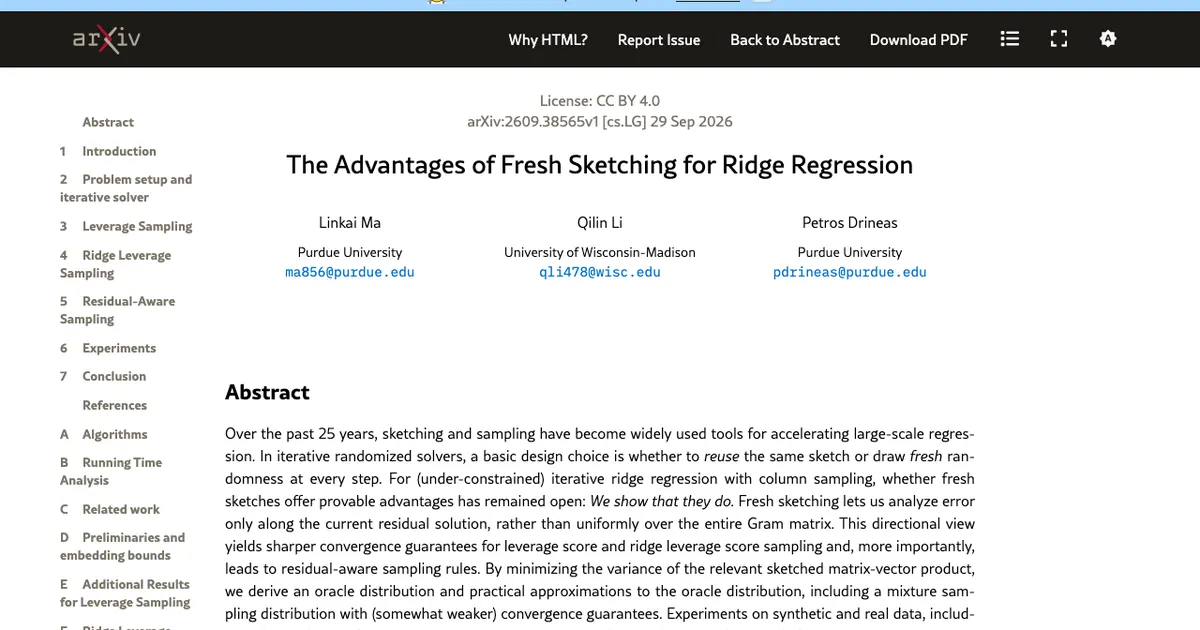
The Advantages of Fresh Sketching for Ridge Regression

By Linkai Ma, Qilin Li, Petros Drineas • arXiv • Importance: 88/100
Hero Image for 2609.38565

Why ‘Fresh’ Data Sketching Revolutionizes Large-Scale Regression

The world of massive datasets and machine learning often boils down to solving huge systems of linear equations. When the data matrix is too big to handle, we turn to powerful techniques like sketching—a method that quickly approximates the solution by only looking at a carefully selected subset of data points.

For decades, researchers have optimized these large-scale solvers. But there’s a critical design choice that was overlooked: should you reuse the same random sketch across every step, or should you draw a completely fresh sketch of randomness for each iteration?

A new paper from Linkai Ma et al., The Advantages of Fresh Sketching for Ridge Regression, definitively answers this question: Fresh sketches are not just better; they provide provable, superior advantages.

🚀 What’s the Breakthrough?

Traditional methods assume that errors accumulate uniformly over the entire problem space (the Gram matrix). The authors’ core insight is revolutionary: by using fresh sketching, we can analyze error only along the current residual solution. Think of it like tracking a runaway train—instead of measuring its potential damage across an entire city block, you only measure how far off it is right where it is.

This directional view allows for several major leaps:

  1. Sharper Convergence Guarantees: The new approach significantly improves convergence guarantees for common sampling techniques like leverage score and ridge leverage score sampling.
  2. Residual-Aware Sampling Rules: Critically, it enables the derivation of ‘residual-aware’ sampling rules. This means the solver intelligently samples data points that are most likely contributing to the current error—a huge performance boost in practice.
  3. Optimal Performance: By focusing on minimizing variance relevant to the current step, they derive an optimal ‘oracle distribution,’ offering methods (including practical mixture approximations) that minimize computational waste and accelerate learning.

💡 Why This Matters for Deep Learning?

In modern ML, we frequently encounter models (like analyzing representations from Qwen2.5) where the underlying data structure is implicitly huge. Regression solvers are often foundational components—used in recommendation engines, sparse matrix completion, and hyperparameter optimization.

The empirical results presented in the paper, which even include ridge probes on Qwen2.5 representations, show substantially faster convergence compared to reusing old sketches. This translates directly into: * Lower computational costs for training massive models. * Real-time performance improvements in large-scale inference systems.

If your application involves solving high-dimensional linear systems (e.g., recommender systems, optimization tasks), embracing the principle of fresh sketching could be the foundational efficiency boost you need.

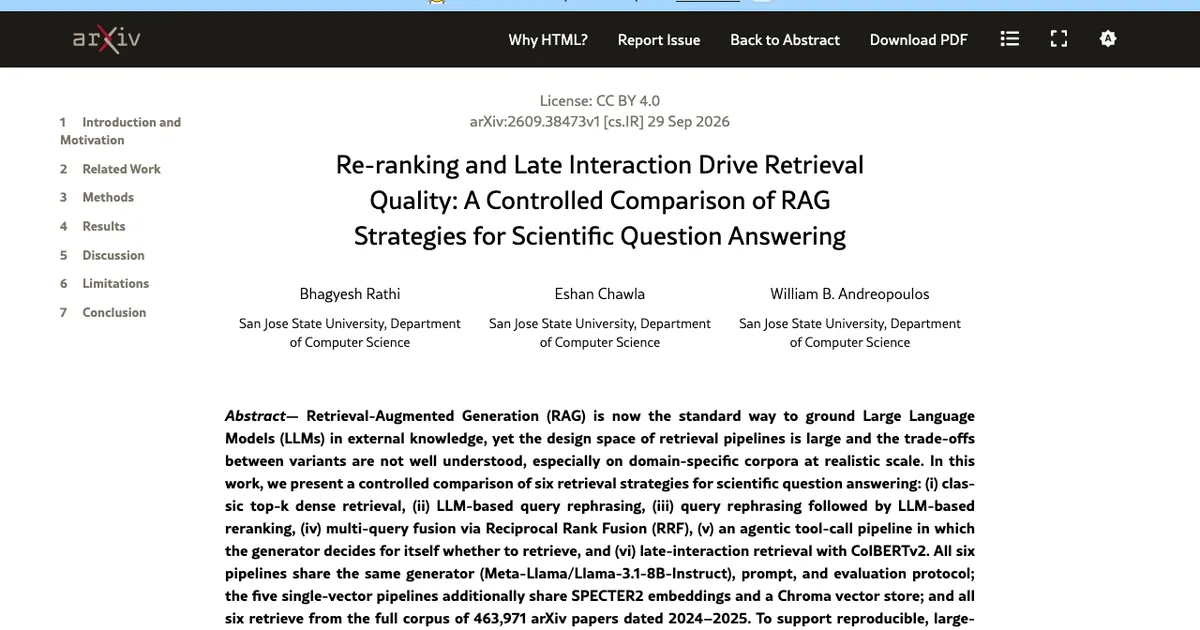
Re-ranking and Late Interaction Drive Retrieval Quality: A Controlled Comparison of RAG Strategies for Scientific Question Answering

By Bhagyesh Rathi, Eshan Chawla, William B. Andreopoulos • arXiv • Importance: 88/100
Hero Image for 2609.38473

Decoding the Next Generation of AI Research: A Deep Dive into RAG Optimization

The era of Large Language Models (LLMs) has revolutionized how we interact with knowledge, but they often suffer from a critical flaw: hallucination. To solve this, Retrieval-Augmented Generation (RAG) emerged as the industry standard—a method that grounds LLM outputs in verifiable external documents.

However, as LLMs tackle complex tasks like scientific question answering, merely connecting an LLM to a database isn’t enough. The how of retrieval is just as crucial as the LLM itself.

We recently reviewed pioneering work that meticulously dissects the RAG design space. This research moves beyond simply using RAG and instead treats the entire retrieval pipeline—from querying to re-ranking—as a highly engineered system, providing critical insights into maximizing reliability on specialized academic data.

🧠 What Problem Does It Solve?

The core challenge is that traditional RAG methods often fail when dealing with dense, domain-specific knowledge, such as recent arXiv scientific papers. The performance hinges critically on the retrieval steps: How do we find the absolute best snippet of information from hundreds of thousands of papers?

The authors systematically compare six distinct and sophisticated strategies for retrieving context, ensuring a controlled comparison against a massive corpus of 463,971 arXiv papers (2024-2025).

🔍 The Six Retrieval Strategies Compared

This isn’t just ‘better indexing’; the study compares fundamentally different architectural approaches:

  • Classic Top-K Dense Retrieval: Basic search based on embedding similarity.
  • LLM Query Rephrasing: Using an LLM to rewrite the initial query into multiple, more effective search terms.
  • Reranking Pipelines: Employing a second stage (often another LLM) to filter and prioritize the top results retrieved in the first pass.
  • Multi-Query Fusion (RRF): Techniques like Reciprocal Rank Fusion that combine multiple distinct search results intelligently.
  • Agentic Tool-Call Pipeline: Allowing the generative model itself to decide if it needs external information, mimicking human critical thinking.
  • Late-Interaction Retrieval (ColBERTv2): The most advanced method, which allows for fine-grained interaction between query tokens and document embeddings before making a final decision.

💡 Key Takeaways for Developers & Researchers

What does this mean for building enterprise AI? This paper provides an open testbed—a standardized benchmark—for assessing the cost/quality trade-offs of every RAG design choice. It demonstrates that:

  1. Optimization is Deep: Performance gains come not just from better LLMs, but from optimizing the intermediate retrieval steps (rephrasing, fusion, and late interaction).
  2. The Agentic Approach is Powerful: Letting the LLM decide when to retrieve information significantly enhances reliability and robustness.
  3. Reproducibility Matters: By releasing a synthetic question dataset of over 19,000 questions, they establish a high bar for reproducible research in this domain.

🔗 Should I Read This? (A Developer’s Verdict)

Absolutely. If you are building an LLM application that requires grounding in specific, complex knowledge bases—especially in scientific or legal domains—this paper provides the blueprint for optimizing your entire retrieval stack. It’s a foundational resource for advancing RAG architecture.

Want to dive into the full methodology and results? Check out the primary research here!

#LLMs #RAG #NLP #AIResearch #GenAI #MachineLearning

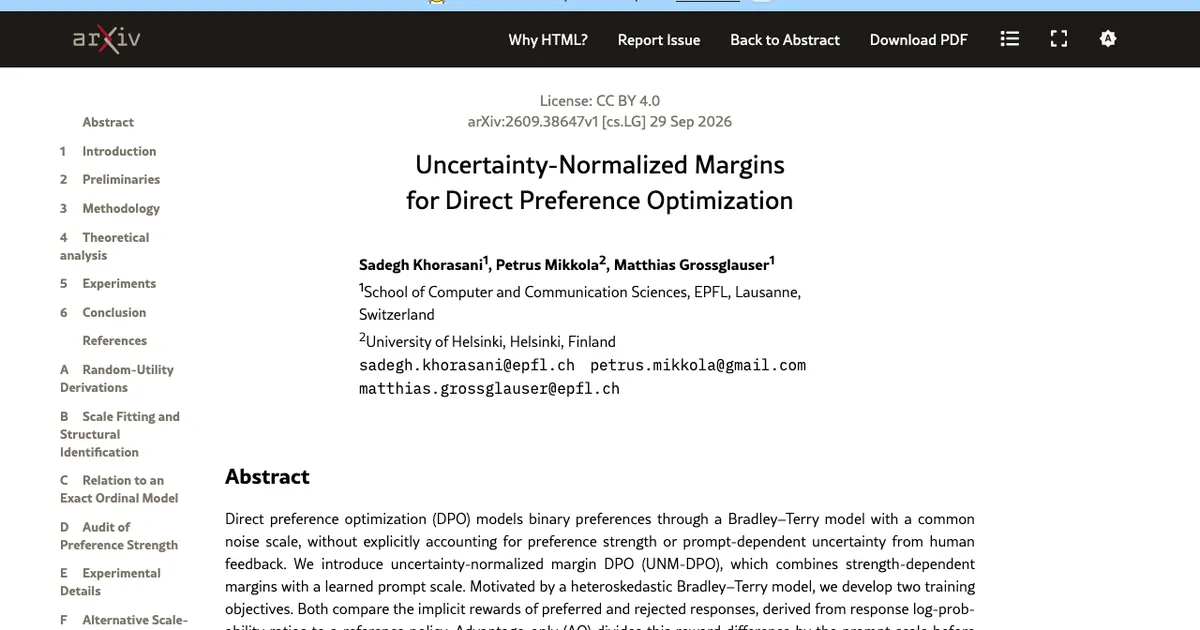
Uncertainty-Normalized Margins for Direct Preference Optimization

By Sadegh Khorasani, Petrus Mikkola, Matthias Grossglauser • arXiv • Importance: 85/100
Hero Image for 2609.38647

🧠 Supercharging RLHF: Beyond Basic Preference Optimization with UNM-DPO

If you’ve been deep in the world of LLM alignment and Reinforcement Learning from Human Feedback (RLHF), you know that Direct Preference Optimization (DPO) is a foundational technique. It’s elegant, simpler than traditional PPO, and has become the go-to method for aligning models to human preferences.

But DPO makes one key assumption: that all preference signals are equally reliable. The authors of Uncertainty-Normalized Margins for Direct Preference Optimization challenge this, arguing that real-world human feedback is noisy, variable, and depends heavily on the prompt context.

This paper introduces a powerful new framework: Uncertainty-Normalized Margins for DPO (UNM-DPO). Simply put, UNM-DPO moves beyond treating preference signals as simple binary choices (‘A is better than B’) by quantifying how strongly those preferences should be valued.

🔬 What’s the Breakthrough?

The core innovation tackles two major limitations of standard DPO:

  1. Preference Strength: Instead of just optimizing for a win/loss, UNM-DPO incorporates ‘strength-dependent margins.’ This means it learns not just if an answer is preferred, but by how much.
  2. Prompt Uncertainty (The Scale Factor): Standard DPO assumes the underlying noise scale is fixed. UNM-DPO introduces a learned prompt scale that dynamically normalizes implicit rewards based on the specific context or prompt. This tackles the problem of ‘prompt-dependent uncertainty,’ making the alignment process far more robust.

These concepts are drawn from advanced statistical models like the heteroskedastic Bradley-Terry model, giving the approach significant theoretical grounding.

🚀 Deep Dive into the Models (The Technical Edge)

The paper presents two refined training objectives: Advantage-only (AO) and Whole-residual (WR). The WR objective is particularly notable because the authors establish a crucial condition for making the learned prompt scale mathematically identifiable, providing both theoretical rigor and practical implementation guidance. They then extend this to ULNM-DPO-WR, which further normalizes rewards by the response length, addressing even more subtle signal variations.

📊 The Results Speak Volumes (Performance Boost)

The empirical results are compelling. When tested on HelpSteer2/HelpSteer3 datasets and using Llama-3.1-8B-Instruct, ULNM-DPO-WR demonstrates clear improvements:

  • Win Rates: It achieves tie-adjusted win rates of 68.00% (vs. DPO’s 65.31%).
  • AlpacaEval Benchmark: On a tough GPT-4.1 judge comparison, the optimized model achieved a length-controlled win rate of 21.62%, significantly outperforming standard DPO (16.39%) and SimPO (15.30%).

These metrics show that by accounting for nuance—preference strength and context uncertainty—the resulting policy is better aligned, more robust, and performs at a higher level of quality.

🔑 Why This Matters for AI Developers?

As LLMs become deployed in critical, real-world applications (from coding assistants to medical diagnostics), alignment cannot be an afterthought. UNM-DPO offers developers a more sophisticated toolset: a way to fine-tune models that understand the degree of preference and account for the inherent variability found in human feedback. It’s an essential step toward building truly reliable, production-grade AI.


Must-Read Resource: For those interested in the details and implementation, check out the full paper: Uncertainty-Normalized Margins for Direct Preference Optimization

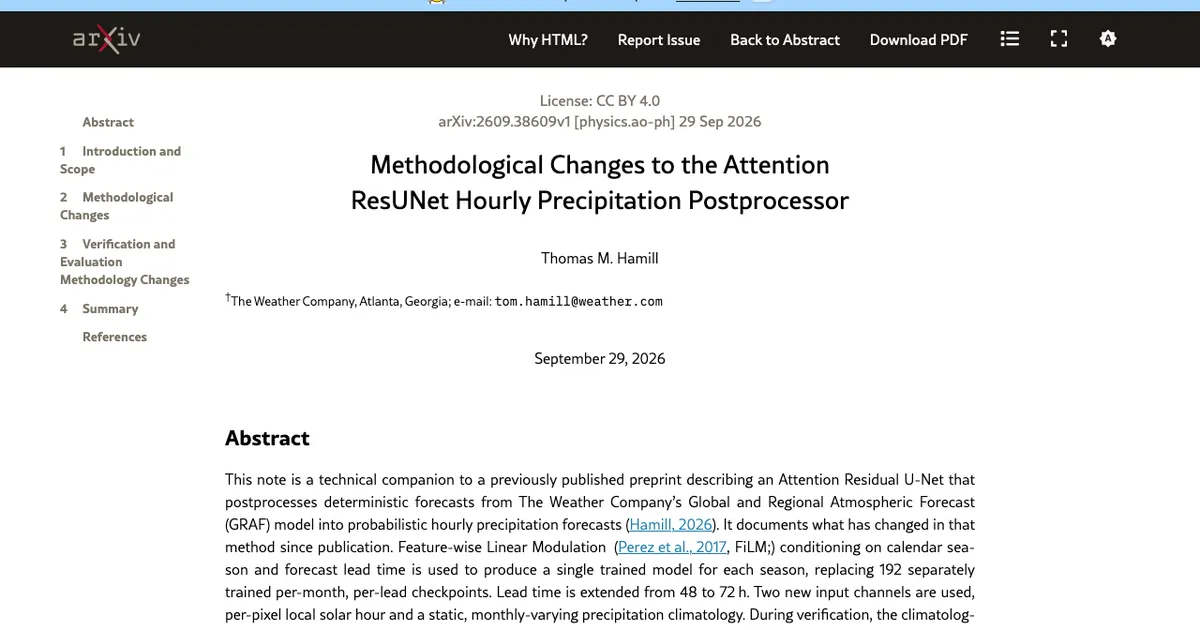
Methodological Changes to the Attention ResUNet Hourly Precipitation Postprocessor

By Thomas M. Hamill • arXiv • Importance: 85/100
Hero Image for 2609.38609

Mastering Precipitation Forecasting: Upgrading the Attention ResUNet

The challenge of accurate hourly weather prediction is notoriously complex. Predicting something as volatile and highly localized as precipitation requires sophisticated deep learning models capable of handling massive spatio-temporal datasets.

We recently released a technical update detailing significant methodological improvements to our attention-enhanced U-Net architecture used for postprocessing deterministic global forecasts into probabilistic hourly rainfall predictions.

This isn’t just a minor patch—it represents a substantial upgrade to how we synthesize raw model output into reliable, actionable weather intelligence. We detail these critical changes in The full technical note.

⚡️ Key Technical Upgrades and Why They Matter

In meteorology, time is everything—especially when tracking rainfall. Our new methodology addresses several limitations of the initial model, leading to consistently improved predictive performance:

🌍 1. Seasonal Efficiency via Feature-wise Modulation

Previously, forecasting required maintaining numerous separate checkpoints (one for every month and lead time combination). This was computationally massive and difficult to manage.

The Upgrade: We now implement Feature-wise Linear Modulation based on calendar season and forecast lead time. This allows us to train a single, unified model for an entire season, dramatically simplifying the system architecture while maintaining—and improving—performance.

📈 2. Extended Forecasting Horizon (48h $ o$ 72h)

The utility of any weather model is defined by how far out it can reliably predict major events. We have extended our prediction window from 48 hours to a robust 72-hour forecast lead time.

🔬 3. Enhanced Inputs: Solar and Climatology Data

To provide the network with richer contextual understanding, we added two crucial physical inputs: * Local Solar Hour: Incorporating solar geometry helps the model understand daily cycles that impact atmospheric processes (e.g., heating rates). * Monthly Climatology: Integrating static, monthly-varying precipitation climatological data anchors the model to historical norms, ensuring predictions are physically plausible.

🎯 Validation and Impact: Better Brier Skill Scores

Our rigorous validation process also underwent an upgrade. The calculation of core metrics like the Brier Skill Score (BSS) now incorporates a diurnal dimension—adding temporal precision atop existing monthly resolution.

The results are clear: comparisons between the newly trained model and the original show a modest, yet consistent improvement in predictive skill. This validates that our systematic architectural improvements translate directly into more reliable operational forecasts.

💡 Takeaways for Data Scientists & Meteorologists

This work showcases how thoughtful methodological refinement—rather than just massive increases in data—can yield tangible gains in real-world forecasting systems. By modularizing seasonal training, extending the temporal window, and enriching input features with physical constraints (like solar time), we are building a more robust and generalizable tool for predicting precipitation events.

Read the full details of these advancements here: Attention ResUNet Postprocessing Update

Beyond Oracle Communication: Benchmarking Interactive Intent Alignment Under Miscommunication and Evolving User Intent

By Zheyuan Zhang, Mengyuan Chao, Ke Xiao, Ziyi Chen, Daoan Zhang, Yan Zhang, Yanfang Ye, Wei Xu • arXiv • Importance: 85/100
Hero Image for 2609.38604

Decoding the Chaos: When User Intent Isn’t Always Clear

The hype around Large Language Model (LLM) agents promises autonomous, complex task execution—from booking intricate travel plans to managing real-world supply chains. These agents are designed for deep interaction with users, implying long-form conversations and continuous adaptation. But most current LLM benchmarks assume a perfect user: the ‘Oracle User’ who always communicates exactly what the agent needs, perfectly, and promptly.

Spoiler alert: In reality, users are messy. They get distracted, they miscommunicate, they change their minds, or they simply lose patience. This gap between idealized benchmark performance and real-world usability is a critical bottleneck in AI deployment.

Introducing Interactive Intent Alignment (IIA)

The research presented in [Drift-Bench++] introduces the concept of Interactive Intent Alignment. This isn’t just another dataset; it’s an entirely new framework designed to stress-test LLM agents under conditions that mimic real human communication chaos. Agents must not only complete a task but must continuously recover and track the user’s actual, evolving intent despite imperfect instructions.

💡 What Does This Mean for Agent Development? (The Technical Deep Dive)

Traditional benchmarks often evaluate agents on simple accuracy metrics (e.g., ‘Did it complete the task?’). Drift-Bench++ and its accompanying evaluation protocol, GRIP, provide a holistic view of agent robustness by focusing on several key failure modes:

  1. Miscommunication & Ambiguity: How well can an agent infer intent when the user is unclear or contradictory?
  2. Intent Shift (Drift): How does the agent adapt when the core goal changes mid-flow—a common occurrence in human interaction?
  3. Finite Patience: The framework simulates users who get frustrated and stop providing information, forcing the agent to self-correct using fewer cues.

These advanced mechanisms mean that merely passing a benchmark is insufficient; the agent must exhibit true understanding of the underlying goal trajectory, not just adherence to immediate instructions.

🚀 Real-World Impact: Why This Matters Now (SEO/GEO Focus)

For companies and developers building AI agents for complex workflows (think customer service automation in Dallas or personalized e-commerce tools in London), these failures are more than academic curiosities. The authors confirm that the failure modes modeled in this paper are not just theoretical; they are highly prevalent and consequential in live deployment environments.

This work provides a vital, unified, and executable benchmark—a foundational standard for researchers and industry practitioners worldwide building reliable next-generation AI systems. If you are working on Natural Language Understanding (NLU) or Multi-Agent Systems aimed at real user interaction, this paper is a must-read.

Learn more about Interactive Intent Alignment in the full study

Reinforcement Learning with Complex (valued) Memories

By Sathya Kamesh Bhethanabhotla, Efstratios Gavves, André Biedenkapp • arXiv • Importance: 85/100
Hero Image for 2609.38598

🧠 Complex Memories Revolutionizing Reinforcement Learning: Unitary Dynamics for Deep RL

The challenge of building truly smart AI agents often boils down to one problem: memory. When an agent operates in a partially observable environment (like a video game or a real-world setting), it can’t rely on just the current frame. It must remember what happened seconds, minutes, or even hours ago to make the right decision.

Deep Reinforcement Learning (DRL) has powerful tools, but maintaining a coherent, long-term memory that doesn’t degrade over time is notoriously difficult—it’s known as the ‘memory bottleneck.’

In their latest work, Sathya Kamesh Bhethanabhotla et al. propose a refreshing approach: leveraging Unitary Recurrent Networks (uRNNs). Instead of limiting memory to simple real-valued vectors, they embed the state space within a complex vector space.

The core idea is elegant: by using unitary dynamics, the information flow becomes inherently stable. Unitary transformations preserve the norm and phase of the data, meaning that critical information doesn’t just dissipate or suffer from gradient issues over long sequences—it propagates cleanly, much like how quantum states behave.

💡 Why Complex Numbers for AI Memory?

Think of it this way: standard RNNs often struggle with vanishing or exploding gradients over time. By utilizing the mathematics of complex numbers and unitary matrices, the researchers achieve superior gradient flow and ‘associative recall.’ They treat the hidden state not just as a magnitude (a single number) but also by its phase, allowing for richer, more detailed information storage.

The authors implement uRNNs as drop-in replacements for existing PPO architectures. The results are significant: they demonstrate substantial performance gains over established baselines across various memory-intensive tasks, including complex continuous control environments like Rocksample and Craftax.

🔥 The Key Takeaway: By stabilizing the representation using phase-aware unitary dynamics, the proposed methods can achieve rewards up to 2–3 times higher than existing models in challenging environments. This suggests that viewing memory through a quantum or complex dynamical systems lens is a fruitful new direction for DRL.

🚀 For Researchers & Developers

This paper opens an exciting new frontier by suggesting how foundational mathematical structures—like phase information and unitarity—can solve some of the deepest representational bottlenecks in deep learning. If you are working on complex time series, state estimation, or advanced control policies, this research provides highly relevant architectural inspiration.

🔗 Read the full paper here: Complex Memory Dynamics for RL

The code is available on GitHub, making it accessible for immediate experimentation.


Credit: This digest covers work presented in the paper, Complex Memory Dynamics for RL.

As Easy as Rocket Science: Assessing the Ability of Large Language Models to Interpret Negation in Figurative Language

By Jasmine Owers, Edwin Simpson and Martha Lewis in Transactions of the Association for Computational Linguistics, Volume 14 • ACL Anthology • Importance: 85/100
Hero Image for acl_2026.tacl-1.83

🚀 When ‘Not’ Meets Poetry: Testing the Limits of LLMs with Negation and Figurative Language

The power of Large Language Models (LLMs) is undeniable. From writing code to drafting emails, they are integrating into nearly every corner of our digital lives. But what happens when we give them something complex—something that requires genuine human nuance?

We often take LLMs for granted, assuming they simply ‘understand’ language. Yet, natural speech and writing are rife with tricky linguistic devices: sarcasm, metaphors, idioms, and the dreaded word ‘not.’

Our latest research dives into a challenging intersection: how well do modern AI models handle text that combines figurative language (like metaphors) with negation?

🧠 The Challenge: Why This Matters for Real-World AI

Figurative language and negation are not just academic hurdles; they are cornerstones of human communication. A simple ‘not’ can flip the meaning entirely (‘It’s not raining’). Combining that with a metaphor (‘The internet was a downpour of misinformation’) creates a semantic knot that even state-of-the-art LLMs struggle with.

When an AI fails to interpret this combination correctly, the consequences are real. Imagine a medical diagnostic tool or a legal summarizer misinterpreting complex negation in a patient’s chart or a contract clause. The stakes couldn’t be higher.

🔍 What We Found (The Key Takeaways)

We developed new annotations for an existing figurative language dataset to rigorously test this combined challenge across various LLMs. Our findings reveal two critical points:

  1. The Negation-Figurative Synergy: The combination of negation and figurativeness creates a particularly difficult interpretive hurdle that current models do not consistently clear.
  2. Prompting is Power (and Pain): Crucially, the model’s performance isn’t just about its underlying architecture; it is highly dependent on how you prompt it. Different prompting styles lead to wildly different levels of accuracy, showing that reliable AI deployment requires expert-level prompt engineering.

✨ The Bottom Line for Developers and Researchers

This work illuminates a crucial blind spot in LLM development. It tells us that simply training models on vast swaths of text is insufficient; we need focused, linguistically aware testing protocols that specifically target the semantic ambiguities arising from negation within figurative contexts.

If you are building advanced NLP applications—especially those dealing with nuanced domains like literary analysis, legal tech, or mental health diagnostics—understanding this limitation is essential. Garbage in, ambiguity out: our research aims to help build AI that doesn’t just generate fluent text, but actually understands the depth of human meaning.

🔗 Read the full study on assessing LLM ability with negation and figurativeness here: Assessing LLMs for Negation and Figurative Language


Source: Transactions of the Association for Computational Linguistics, Volume 14.

Differentiable Structure Learning for Cyclic Linear Gaussian Models with Latent Confounders

By Sadegh Khorasani, Ali Najar, Saber Salehkaleybar, Negar Kiyavash • arXiv • Importance: 80/100
Hero Image for 2609.38618

Decoding Causality: Learning Hidden Structures in Complex Linear Gaussian Models

If you work with data—especially complex observational datasets—you know that correlation does not equal causation. But figuring out the true causal graph? That’s exponentially harder. Traditional methods often fail when faced with real-world messiness: directed cycles (feedback loops!), and, crucially, unknown hidden confounders that influence everything.

This new work tackles a challenging corner of Causal Structure Learning by developing a sophisticated framework for linear Gaussian models. They introduce an elegant solution to the classic problem of parameterizing structural search space while maintaining differentiability, which is vital for modern deep learning optimization techniques.

🧠 The Core Problem: Beyond Simple Graphs

In many real-world systems (like economic models or biological pathways), simple acyclic graphs aren’t enough. Cycles and latent confounders mess up the clean mathematical assumptions needed for structural discovery. This paper tackles this by focusing on a mathematically robust setting: linear Gaussian Structural Causal Models (SCMs).

The breakthrough lies in handling two major complications:

  1. Cyclic Structures: Modeling feedback loops where variable A causes B, and B somehow feeds back to affect A.
  2. Latent Confounders ($oldsymbol{L}$): Accounting for unobserved variables that influence multiple observed variables simultaneously (e.g., a hidden trend affecting both housing prices and tech stocks).

✨ The Technical Solution: Differentiable Penalties

Structurally learning a causal graph involves optimizing over discrete choices (Is an edge A $ o$ B present? Is the latent variable $L_i$ necessary?). This is notoriously difficult with standard gradient-descent optimization because the objective function isn’t smooth.

Researchers typically resort to techniques like MCMC sampling or relaxation, but this paper proposes a highly optimized approach: using continuous Bernoulli gates.

Instead of making a discrete choice (on/off) for every edge and latent variable, they model these choices using continuous probabilities. By jointly optimizing the structural coefficients and these gate probabilities, they can derive an expected objective function that retains the desirable properties of the original discrete problem—it achieves the same global optimum! The resulting penalty term is fully differentiable,

making the entire structure-learning process compatible with modern gradient-based optimization.

🛠️ Why This Matters for Researchers and Industry

This isn’t just a marginal improvement; it opens up possibilities for applying state-of-the-art machine learning (like end-to-end deep learning) to complex causal inference problems that were previously intractable due to non-differentiable structure selection.

  • Scientific Modeling: Developing more accurate models for epidemiology, climate science, or genetics where latent variables and feedback loops are expected.
  • Econometrics/Finance: Building robust systems that can differentiate true economic cause-and-effect from mere statistical correlation in high-dimensional market data.
  • ML Optimization: Providing a powerful new tool for incorporating discrete structure search into continuous ML optimization pipelines, bridging the gap between symbolic AI and deep learning.

If you are tackling complex relationships where causality matters—not just prediction—this method offers significantly lower recovery error compared to previous state-of-the-art methods. Read the full details here: Differentiable Structure Learning for Cyclic Linear Gaussian Models


Disclaimer: This digest summarizes advanced theoretical work in statistical causality. Implementation may require specialized knowledge of variational inference and optimization theory.

A Parameter-Free Zeroth-Order Method with Covariance Matrix Adaptation and Effective Dimension

By Alexander Sholokhov, Alexander Rogozin • arXiv • Importance: 75/100
Hero Image for 2609.38561

Leveling Up Black-Box Optimization: Introducing POEM-CMA

The world of deep learning and complex scientific modeling frequently presents ‘black-box’ optimization challenges. This means we have a function we need to minimize, but calculating the gradient (the directional slope) is either impossible or too computationally expensive. Traditional methods often fail when confronted with these constraints.

Fortunately, researchers are tackling this problem head-on. Check out POEM-CMA, a novel algorithm that promises to revolutionize how we solve difficult optimization tasks in parameter-free settings.

🚀 What Problem Does This Solve?

Optimization methods typically rely on knowing the gradient—the precise slope at a point. When that information is unavailable (a ‘black-box’ setting), standard techniques like Stochastic Gradient Descent fall apart. The solution lies in zeroth-order optimization methods, which estimate function changes using only noisy function evaluations, not derivatives.

✨ Introducing POEM-CMA: The Smart Approach

POEM-CMA builds on existing zeroth-order concepts but introduces critical intelligence. Instead of relying on isotropic sampling (random directions equally in all dimensions), POEM-CMA is anisotropic. It intelligently constructs a covariance matrix from its gradient estimates to figure out which directions are the most informative, focusing its limited computational effort exactly where it’s needed.

Key Breakthrough Concepts:

  1. Anisotropic Sampling: This is the core innovation. By estimating the full covariance structure ($ ext{Cov}( abla f)$), POEM-CMA doesn’t waste time sampling equally in all dimensions; it concentrates its ‘gradient effort’ on the directions that matter most, dramatically improving efficiency.
  2. Effective Dimension ($d^*$): The algorithm introduces the empirical effective dimension $d^ = rac{ ext{tr}( ext{ exttt{cov}})}{ ext{λ}_{ ext{max}}( ext{ exttt{cov}})}$. This concept is a game-changer because it replaces the massive, ambient dimensionality ($D$) with a much smaller measure of intrinsic complexity ($d^$). In practice, if your problem is simple (low-rank structure), $d^*$ will be tiny compared to $D$, leading to massive efficiency gains.

💡 Why This Matters for ML Research?

Think about problems in genomics or physics simulations where the underlying mathematical model is too complex to derive gradients for. POEM-CMA provides a powerful, mathematically rigorous tool that:

  • Handles Complexity: It delivers near-optimal convergence rates even when dealing with high-dimensional, low-rank structures ($d^* ext{ small}, D ext{ large}$).
  • Efficiency: By focusing on the effective dimension $d^*$ rather than the full ambient dimension $D$, its theoretical complexity is significantly reduced ($ ilde{ ext{O}} ext{(…)}$).
  • Practical Use: Experimental validation on hinge-loss binary classification shows its practical superiority, proving it’s not just theory.

This work fundamentally strengthens the toolkit for black-box optimization, opening up new possibilities in scientific computing and ML model deployment.

Explore Recent Digests