← Back to Archive

Digest for 2026-10-12

🐦 Share on X 💼 Share on LinkedIn 📘 Share on Facebook

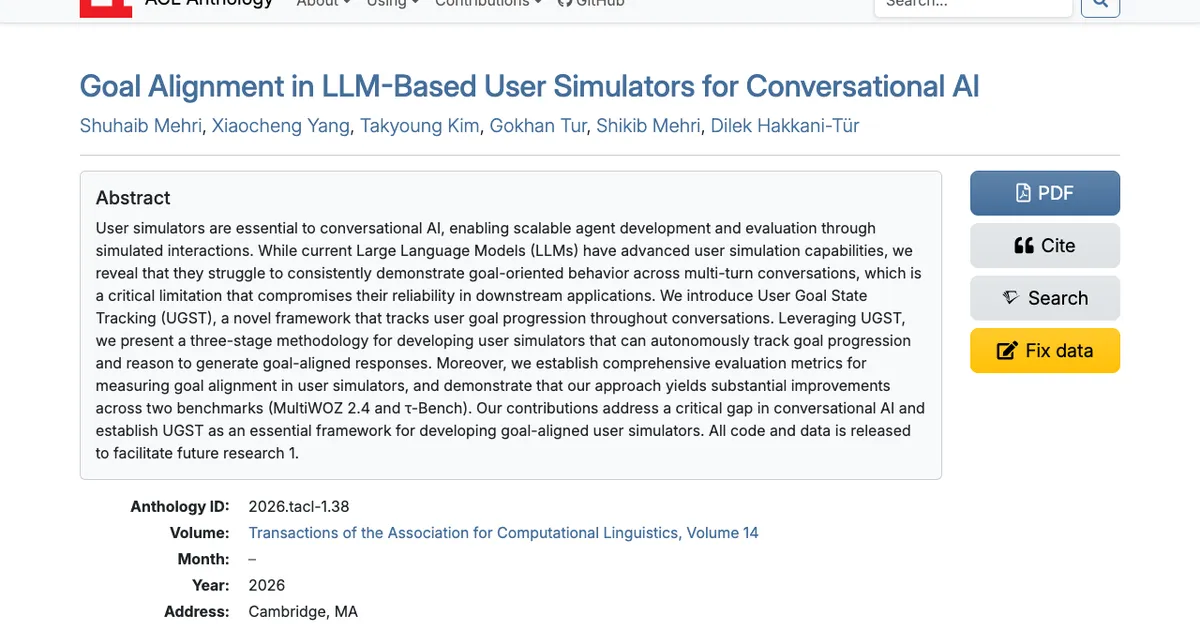
Goal Alignment in LLM-Based User Simulators for Conversational AI
By Shuhaib Mehri, Xiaocheng Yang, Takyoung Kim, Gokhan Tur, Shikib Mehri and Dilek Hakkani-Tür in Transactions of the Association for Computational Linguistics, Volume 14 • ACL Anthology • Importance: 90/100
Hero Image for acl_2026.tacl-1.38

Does Your AI Conversation Really Understand the Goal?

If you’ve spent time in conversational AI development—building agents that talk to users—you know the biggest headache: consistency. You can prompt an LLM to act like a user, and it will sound convincing for one turn. But when the conversation gets complex, or requires the ‘user’ to remember its original objective while handling various detours, the agent starts rambling. It loses track of the goal.

This is the critical flaw in many current AI systems: they are proficient at sounding human, but not necessarily at thinking like a user with a purpose.

🚀 The Breakthrough: Introducing User Goal State Tracking (UGST)

We’ve tackled this core problem by introducing User Goal State Tracking (UGST). At its heart, UGST is a novel framework designed to rigorously track and maintain the progression of a user’s goal across multi-turn dialogue. Instead of simply generating contextually plausible text, our approach forces the simulated ‘user’ to always be aware of where they are in relation to their overall objective.

By implementing UGST, we developed a three-stage methodology for building high-fidelity user simulators. These new simulators don’t just chat; they autonomously reason about goal completion and generate responses that are strictly aligned with the simulated user’s original intent.

👉 Why Does This Matter?

Goal alignment is non-negotiable for real-world applications. Whether you’re building a complex booking agent, a medical triage bot, or customer service AI, your system needs to handle goal deviation and completion reliably. Our work provides the necessary scaffolding—both the theoretical framework and the measurable metrics—to build truly reliable conversational agents.

🔬 Key Takeaways & Impact

  • The Problem Solved: Inconsistent goal-oriented behavior in LLM user simulators.
  • The Solution: User Goal State Tracking (UGST), a specialized framework for maintaining dialogue objectives.
  • Impact: Significantly improved performance on complex, multi-domain benchmarks like MultiWOZ 2.4 and τ-Bench 📄 Details at ACL Anthology.

Our research not only fills a critical gap in conversational AI but also provides the necessary tools (code and data) for the community to advance reliable, goal-aligned agent development.


Want to dive into the technical details? Read the full paper on Goal Alignment in LLM-Based User Simulators.
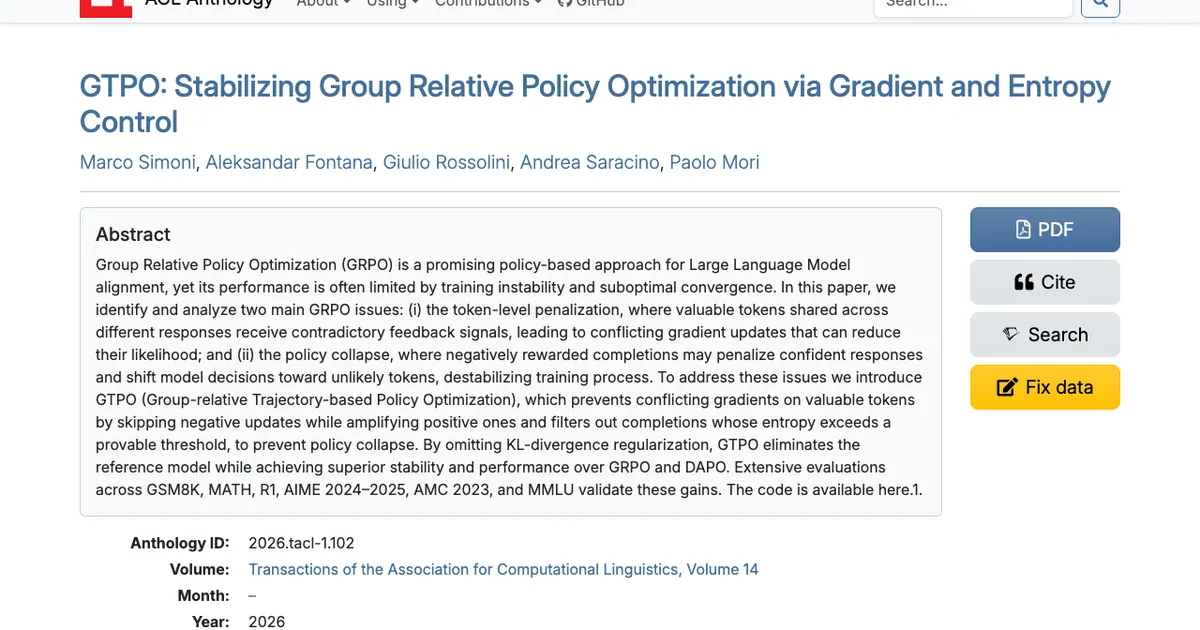

GTPO: Stabilizing Group Relative Policy Optimization via Gradient and Entropy Control

By Marco Simoni, Aleksandar Fontana, Giulio Rossolini, Andrea Saracino and Paolo Mori in Transactions of the Association for Computational Linguistics, Volume 14 • ACL Anthology • Importance: 90/100
Hero Image for acl_2026.tacl-1.102

Unlocking Reliable LLM Alignment: Introducing GTPO

In the rapidly evolving field of Large Language Models (LLMs), alignment is key. While powerful policy optimization techniques like Group Relative Policy Optimization (GRPO) show immense promise for aligning models to human values and complex reasoning tasks, they often struggle with inherent training instability. This instability can undermine the model’s performance on critical benchmarks.

Our latest research introduces GTPO (Group-relative Trajectory-based Policy Optimization)—a robust architectural improvement designed specifically to tackle these deep-seated issues in LLM alignment. As researchers are pushing the boundaries of model capability, training stability is no longer optional; it’s foundational.

💡 The Problem with Standard Alignment Techniques

The core issue we address lies within GRPO itself. We found two major pitfalls that hamstring performance:

  1. Token-Level Penalization: When a model generates valuable tokens (like common words or crucial intermediate steps) that appear in multiple successful and unsuccessful responses, standard methods can give these tokens contradictory feedback signals. This conflicting gradient update mistakenly reduces the token’s likelihood—penalizing useful components simply because they weren’t part of every perfect response.
  2. Policy Collapse: Overly negative rewards can destabilize training by penalizing even confident, high-probability completions. This forces the model to shift its decision space towards increasingly unlikely tokens, leading to erratic and unstable behavior.

🛠️ How GTPO Solves the Instability Crisis

GTPO is engineered with two primary mechanisms to restore stability and boost performance:

  • Conflict Prevention: We modify the gradient update process to skip negative updates for valuable tokens while amplifying positive ones. This prevents conflicting signals from undermining common, necessary language components.
  • Entropy Filtering: To prevent policy collapse, GTPO filters out completions whose entropy exceeds a provable threshold. By restricting the model’s output space, we maintain coherence and prevent drift toward nonsensical, low-probability tokens.

Crucially, by omitting complex KL-divergence regularization, GTPO not only achieves superior stability over GRPO and DAPO but also drastically simplifies the training process without sacrificing performance.

🚀 Performance Validation

We put GTPO through its paces on some of the toughest academic benchmarks, including GSM8K, MATH, R1, AIME 2024–2025, AMC 2023, and MMLU. The extensive evaluations validate that GTPO consistently delivers superior stability and performance gains across complex reasoning tasks.

Whether you are working on advanced LLM fine-tuning, Reinforcement Learning from Human Feedback (RLHF), or foundational model alignment research, understanding these advancements is critical for maximizing your model’s potential.

Hearing to Translate: The Effectiveness of Speech Modality Integration into LLMs

By Sara Papi, Javier Garcia Gilabert, Zachary Hopton, Vilém Zouhar, Carlos Escolano, Gerard I. Gállego, Jorge Iranzo-Sánchez, Ahrii Kim, Dominik Macháček, Patricia Schmidtova and Maike Züfle in Transactions of the Association for Computational Linguistics, Volume 14 • ACL Anthology • Importance: 90/100
Hero Image for acl_2026.tacl-1.89

Hearing to Translate: Do LLMs Need Speech Input? A Deep Dive into Modern Speech Translation

As Large Language Models (LLMs) have conquered the text domain, the natural next frontier is speech. We’ve all seen remarkable advancements in voice assistants and translation apps that feel genuinely ‘smart.’ But when we talk about advanced Speech-to-Text or real-time multilingual translation, a core question remains: Does integrating speech directly into an LLM architecture actually improve performance over established, reliable pipelines?

We just reviewed the paper “Hearing to Translate” in the Transactions of the Association for Computational Linguistics (TACL), and it provides one of the most rigorous benchmarks we’ve seen yet. It’s essential reading for anyone building next-gen ASR or translation systems.

🎤 The Problem: Cascades vs. Native SpeechLLMs

The current landscape is split into two main approaches:

  1. The Cascade System: The old guard (but reliable). This involves separate components: first, a powerful Speech Foundation Model (SFM) handles the transcription (Speech-to-Text), and then a traditional LLM takes that text output for translation or generation. Think of it as Text Step 1 $ ightarrow$ Translation Step 2.
  2. The Native SpeechLLM: The cutting edge. These models are designed to process audio and language information simultaneously, aiming to skip the explicit transcription step entirely and go straight from sound wave to target text (Audio $ ightarrow$ Target Language).

The debate is simple: Is bypassing the traditional ST phase worth the architectural risk? Our latest review reveals a nuanced truth.

🔬 What ‘Hearing to Translate’ Found (The Key Takeaways)

This study didn’t just test a few models; they built a comprehensive, rigorous test suite. They evaluated 6 state-of-the-art SpeechLLMs against 16 strong direct and cascade systems. The testing was brutal, spanning 16 diverse benchmarks, 13 language pairs, and tackling 9 challenging conditions—including noisy environments, disfluent speech, and long-form discourse.

The findings are critical:

✅ Cascades Remain the Gold Standard (For Now): Overall reliability still points to well-engineered cascaded systems. When performance matters most across diverse real-world conditions, the established pipeline is hardest to beat.

📈 The Promise of SpeechLLMs: However, the paper confirms that many modern SpeechLLMs can match or even outperform cascades in specific settings. This signals massive progress and validates the approach for niche use cases.

📉 SFMs Still Need an LLM Partner: Importantly, the authors highlight that merely integrating a raw Speech Foundation Model (SFM) alongside an LLM is often insufficient; the coupling of the two, either within one architecture or in a robust pipeline, is absolutely essential for high-quality speech translation.

🚀 TL;DR: What Does This Mean for Developers?

  • Don’t discard traditional pipelines yet. They are still the most robust option for general deployment. The risk/reward balance favors reliability. (Read the full analysis at TACL Paper). Focus on Fusion: True innovation lies in how tightly an LLM is coupled with, or trained using, robust speech encoders—the synergy is what matters.

Ultimately, ‘Hearing to Translate’ moves us closer to fully integrated, multimodal AI that understands context not just from words, but from the nuances of spoken language itself. The future is truly hearing.

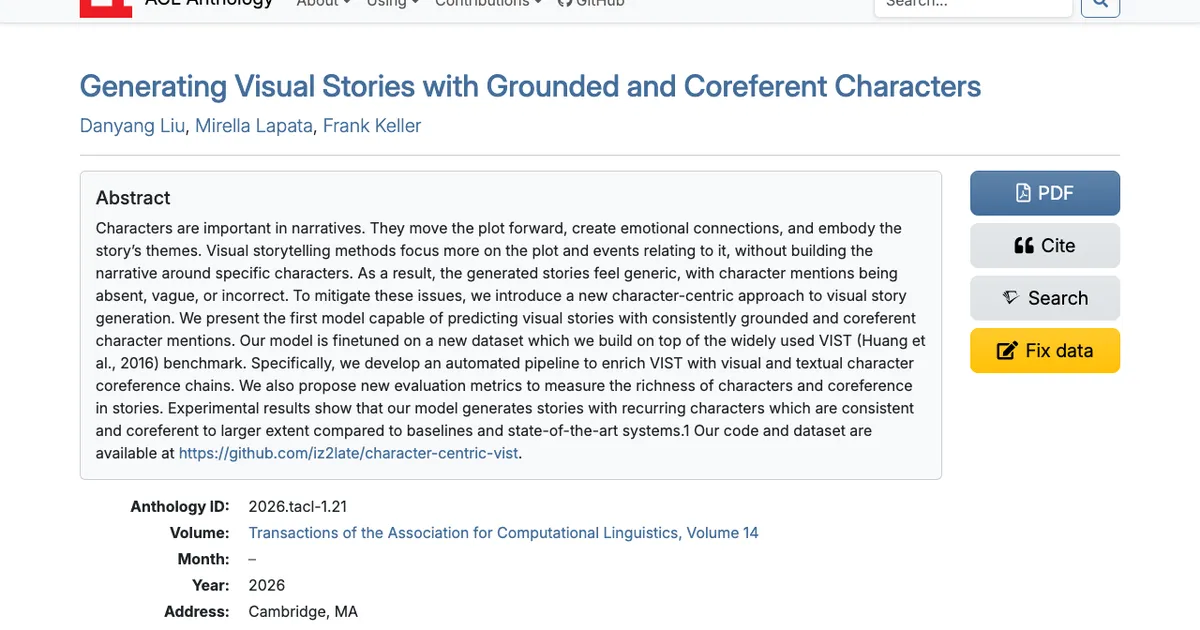
Generating Visual Stories with Grounded and Coreferent Characters

By Danyang Liu, Mirella Lapata and Frank Keller in Transactions of the Association for Computational Linguistics, Volume 14 • ACL Anthology • Importance: 85/100
Hero Image for acl_2026.tacl-1.21

🎭 Bring Characters Back: Generating Cohesive Visual Stories with Character Focus

Ever scrolled through cool AI-generated image stories only to feel… empty? The plot might be amazing, but the characters feel generic or inconsistent. That’s a persistent gap in modern visual storytelling AI.

At its core, AI generating narrative visuals often focuses solely on what happens (the events), neglecting who is doing it (the people). This leads to beautiful but shallow outputs where character mentions are vague, incorrect, or simply missing.

Our latest work addresses this fundamental limitation by pioneering a character-centric approach to visual story generation. We’ve developed and introduced the first model capable of generating complex visual stories while ensuring characters are not only consistently present but also perfectly grounded (visually accurate) and coreferent (maintaining consistent identity throughout the narrative).

🔬 What Does ‘Character-Centric’ Mean?

The goal is to move beyond simply describing events. We aim for narratives where character identities persist. Think of a main character introduced in Scene 1, who then reappears correctly and consistently in Scene 5, even across different visual styles and descriptions.

To achieve this groundbreaking level of narrative coherence, we didn’t just build a model—we built an entire infrastructure:

  • 📚 New Dataset: We enriched the foundational VIST benchmark with an automated pipeline to meticulously add visual and textual character coreference chains. This massive enhancement allows us to train models on rich identity tracking.
  • 🧠 Novel Model Architecture: Our model is fine-tuned specifically to predict visual stories that maintain these complex, recurring character dependencies.
  • 📈 Better Evaluation: We proposed new metrics crucial for measuring the true ‘richness’ and consistency of characters in generated narratives.

🚀 Impact & Results: State-of-the-Art Coherence

Experimental results demonstrate a significant leap forward. Our character-centric approach generates stories with recurring main characters that are demonstrably more consistent and coreferent than existing state-of-the-art systems and baselines.

This research pushes the boundaries of creative AI, moving it from simply depicting scenes to constructing believable, deeply human narratives centered on memorable protagonists. It’s a critical step toward making cinematic, storybook quality content accessible via AI.

Want to dive deep into the mechanics? Read the full paper, Generating Visual Stories with Grounded and Coreferent Characters.

Our code and enhanced dataset are available on GitHub for reproducibility!


(This research was presented at the Association for Computational Linguistics.)

Explore Recent Digests