By Chaoqian Ouyang, Ling Yue, Libin Zheng, Huanghui Guo, Shengxiang Xu, YiShu Wang, Ran Li, Jian Yin, Shaowu Pan, Shimin Di • arXiv • Importance: 92/100
Is Your LLM Agent Blowing the Budget? Forecasting Token Costs in Real-Time
When you build an AI agent—say, one that needs to fix a bug in GitHub or book a flight—you expect it to be efficient. But here’s the brutal truth: the cost of running these complex agents is notoriously unpredictable.
As the LLM processes intermediate results, tool outputs, and its own growing context, the sheer number of tokens explodes over time. Predicting how much this entire process will cost before it runs is nearly impossible because the agent’s path isn’t fixed (it keeps making choices based on new evidence).
This uncertainty poses a huge bottleneck for deploying large-scale LLM applications, especially in enterprise settings where billing needs to be precise and costs must be managed.
🤖 What TokenCast Does: Predicting the Unpredictable Cost Curve
Researchers at https://arxiv.org/abs/2609.35760 have released TokenCast, a novel framework designed to solve this exact problem: forecasting the total token consumption of an LLM agent’s execution in real-time.
Traditional cost models fail because they treat each step in isolation and cannot account for cumulative context growth—the fact that old inputs are reread by every subsequent query. TokenCast tackles this by learning a ‘composable cost representation.’ This allows it to accurately capture the compounding extra input cost incurred when the agent’s history continually inflates the prompt.
Key Breakthrough Points:
* Real-Time Adaptation: As the agent runs, new evidence (like tool output) is immediately factored into the forecast, requiring no additional LLM calls. This keeps prediction latency extremely low (only 32.8 ms on SWE-bench Verified).
* High Accuracy: On rigorous testing across multiple task suites and agents, TokenCast significantly outperformed state-of-the-art comparators, showing an average absolute error reduction of 14.5%.
* Efficiency Gain: In critical offline scenarios like budget control replay, using TokenCast resulted in a remarkable 21.3% token saving compared to standard fixed-budget policies.
✨ Why This Matters for AI Development (The ‘Why Care’ Factor)
The ability to predict execution costs is no longer just an academic nicety; it’s a requirement for production-grade LLM agents.
Budgeting & Monetization: Companies need reliable cost tracking to move from proof-of-concept to scalable, billable products.
Resource Management: It allows developers to preemptively allocate budget and halt failed or overly expensive runs before they hit massive costs.
Optimization Loop: By knowing the expected token count, downstream systems can be optimized—maybe by summarizing context earlier or changing prompts to reduce redundancy.
If you are deploying LLM agents, understanding their true cost profile is mission-critical. TokenCast offers a concrete, measurable solution that moves agentic AI from experimental sandbox to reliable enterprise toolset.
As Machine Learning models become the backbone of engineering and physics simulations, tackling complex Partial Differential Equations (PDEs) remains a major challenge. Traditionally, solving PDEs requires domain-specific mesh generation and massive computational resources—a process that is slow and computationally expensive.
But what if we could bypass traditional solvers entirely?
Our latest work introduces the Neural Harmonic Measure Operator (NHMO), a groundbreaking neural network designed specifically to solve elliptic PDE problems on arbitrarily complex, variable-shape domains. NHMO fundamentally shifts how we approach physical simulations by modeling the inherent geometric properties of a domain directly.
🔑 What Problem Does NHMO Solve?
The harmonic measure is a fundamental concept in potential theory—it’s a boundary probability distribution that captures essential information about a domain’s geometry, regardless of what data you apply to its boundaries. Using this measure for solving PDEs traditionally involves complex numerical quadrature and requires tedious retraining when the problem parameters change.
NHMO tackles two massive limitations: generalization and efficiency.
Geometry-First Solver: NHMO parameterizes this critical measure using a transformer-based kernel, supervised by Walk-on-Spheres exit samples. This means that one trained model can handle diverse boundary values on any shape—no retraining required.
Poisson Extension: We extend the concept to the Poisson equation (which includes source terms) via a classical decomposition and an auxiliary network. Crucially, we avoid singular volume quadratures that historically complicated direct evaluation.
✨ Key Innovations & Why This Matters
Generalization Power: The core strength of NHMO is its ability to perform inference for new boundary values or source terms without any retraining. It truly models the physical geometry, not just specific training examples.
State-of-the-Art Performance: We show that NHMO significantly outperforms four prior baselines on the challenging MCB-B 3D variable-shape Poisson benchmark and remains highly competitive against major neural operator approaches in controlled 2D tests.
The Transformer Advantage: By framing the measure as a transformer-based kernel, we leverage the power of sequence modeling for physical data representation, offering high fidelity and architectural flexibility.
💡 Who Should Care?
This research is essential for researchers and engineers in:
Computational Physics & Fluid Dynamics (CFD)
Medical Imaging (e.g., Electrophysiology mapping)
Materials Science Simulation
AI-driven scientific discovery
If your work relies on accurate, generalizable solutions to PDEs over varied geometries, NHMO offers a powerful new paradigm.
By Emiliano Penaloza, Dane Malenfant, Dheeraj Vattikonda, Roger Creus Castanyer, Siddarth Venkatraman, Abhay Puri, Jonathan Light, Matthew James Sargent, Augustine N. Mavor-Parker, Massimo Caccia, Lucas Caccia, Glen Berseth, Esmeralda S. Whitammer, Alessandro Sordoni, Minseon Kim, Marc-Alexandre Côté, Laurent Charlin, Guillaume Lajoie • arXiv • Importance: 92/100
Turbocharging Agentic LLMs: The KV-Stream Solution for Infinite Memory
Have you ever trained a massive AI agent and hit the infamous memory wall? You build it out to handle long conversations, but eventually, the context trace gets so long that your GPU just chokes. This is the fundamental bottleneck in scaling truly ‘agentic’ LLMs—those systems designed to operate over extended timelines and complex tasks.
Traditional solutions relied on context compaction: aggressively summarizing or filtering past information to save precious GPU memory. While effective, these methods often hurt training efficiency by requiring costly pre-filling of the entire context multiple times. It was a performance trade-off nobody wanted.
💡 The Breakthrough: Introducing KV-Streams 🚀
Our latest work tackles this throughput bottleneck head-on with KV-streams, a revolutionary, plug-and-play method for managing massive LLM contexts. At its core, KV-streams fundamentally changes how context compaction happens.
Instead of flushing and refilling the Key-Value (KV) cache repeatedly—the slow way—KV-streams stream the cached information forward. This means the model can efficiently compress and maintain long-term state without incurring massive compute overheads, resulting in a huge jump in training speed.
🚀 Why This Matters for AI Development
Massive Speed Gains: We demonstrate that KV-streams enable several compaction strategies while achieving an impressive 2.6x to 5x wall-clock speedup in training time. For large-scale, resource-intensive models, this translates directly into faster research cycles and lower cloud computing costs.
True Scalability: By efficiently managing context memory, KV-streams allows agents to maintain continuous coherence over vastly longer timelines than previously possible, pushing the boundaries of multi-turn dialogue and complex task execution.
Hidden State Advantage: Beyond just speed, we found something exciting. When implemented correctly, the streamed KV cache isn’t just a memory saver; it acts as a powerful recurrent state. In controlled settings, we show that this preserved information can emerge purely through Reinforcement Learning (RL), giving agents an implicit ‘memory hook’ for long-term planning and consistency.
🔧 Implementation Details (The Tech Deep Dive)
KV-streams are designed to be highly compatible. They are a lightweight addition, making them agnostic to any existing context compaction strategy. This plug-and-play nature dramatically lowers the barrier to adoption for research teams and production engineers.
If you’re working on building the next generation of multi-step AI agents or need to scale your LLM training infrastructure, this paper presents an exceptionally efficient, high-impact improvement that can be adopted immediately.
By Prithwish Dan, Chenyang Ma, Wei Zhan • arXiv • Importance: 92/100
Unlocking General AI Manipulation: Introducing X-Reset for Cross-Embodiment Learning
Does training a general robot policy feel like pulling teeth? If you’ve struggled with Reinforcement Learning (RL) for dexterous manipulation, you know the pain point: getting a single policy to reliably pick up and reorient diverse objects from scratch is an exploration nightmare.
Traditionally, solving these complex tasks required one of three things: piles of robot demonstrations, heavily tailored rewards for every single object/task combination, or limiting the robot’s behavior space. But what if you could solve this massive exploration problem using something simpler—and more robust?
Researchers have released an exciting new framework called X-Reset, which promises to radically redefine how we train generalist robotic policies.
💡 What is X-Reset and Why Does It Matter?
In essence, X-Reset tackles the inherent difficulty of deep RL exploration by replacing high-fidelity demonstration imitation with a novel technique: cross-embodiment resets drawn from human hand-object interactions. Instead of trying to perfectly copy or even just track messy human motions, X-Reset uses those human demonstrations as a distribution of reset states.
The system cleverly maps the observed human hand-object poses (even noisy ones) into viable robot configurations, filtering out any states that are physically unstable in simulation. These filtered states then serve as high-quality, diverse starting points for the RL agent.
The key shift: The policy now learns to perform tasks based purely on the object state and the goal, treating the reset distribution merely as a mechanism to inject broad, feasible starting knowledge into the system—without being limited by specific task rewards or perfect imitation.
🦾 Breakthrough Capabilities:
The authors demonstrate X-Reset’s power across incredible complexity:
Generalist Policy: It trains policies on 20 diverse objects and maintains generality based only on the object state and goal.
Cross-Embodiment Scaling: The policy generalizes remarkably well, trained over three distinct hardware setups—a 22-DoF hand on two different arms, plus a parallel-jaw gripper. This is huge for real-world applicability!
Scalability & Robustness: It scales linearly with the number of objects and shows robustness even when receiving imperfect human pose estimates.
Sim-to-Real Transfer: Most critically, it successfully transfers learned behaviors from simulation to the physical world (zero-shot sim-to-real), a monumental step toward real robot autonomy.
🌐 The Tech Deep Dive (For Fellow ML Engineers)
The core innovation is moving beyond direct imitation learning. By sampling stable states from human demonstrations, X-Reset effectively gives the agent a massive, pre-curated ‘bootstrapping’ space that dramatically constrains and guides the initial exploration phase, making generalist policy acquisition tractable.
Bottom Line: X-Reset provides a powerful blueprint for moving robotic AI from narrow, task-specific applications to true generalist manipulators capable of interacting robustly with the complex world.
Read more about State Space Modeling and RL exploration techniques!
By Swagatam Mukhopadhyay, Vishal Vivek Saley, Vraj Parikh, Mausam • arXiv • Importance: 92/100
👀 The ‘Read-Blindness’ Mystery: Why Do Transformers Accidentally Build Such Big Feature Activations?
Hey AI enthusiasts and ML researchers! Ever wonder what makes large language models (LLMs) tick, especially when they generate surprising or deeply ingrained patterns? Our latest deep dive into Transformer mechanics tackles one of the most critical and persistent puzzles in NLP: Massive Activation Features (MAs).
These MAs are highly energetic, residual-stream features. Think of them as latent information pockets within the model that just refuse to fade away, even when the model has ample mechanisms—like attention and feed-forward layers—to suppress them. They persist across many layers, suggesting a fundamental quirk in how Transformers process information.
🧠 The Core Insight: Read-Write Asymmetry
The core finding from our analysis is surprisingly simple but mechanically profound: Transformers are ‘read-blind’ when it comes to these massive features.
Using an operator-level mechanistic analysis of attention and feed-forward (FFN) blocks, we demonstrated a clear read-write asymmetry. When the model is reading input data (processing context), its core components systematically ignore or fail to correct for MA coordinates. However, this reading blindness doesn’t extend to the writing phase (generating output). This one-way failure creates an information vacuum: it allows these massive features to accumulate without corrective feedback.
💡 What does ‘Read-Blindness’ mean?
It means that even though attention and FFN layers are designed for sophisticated processing, they fail to fully integrate or resolve the highly energetic signals present in the input context when dealing with MAs. This failure of internal correction is what allows the features to build up.
🛠️ Deep Dive into the Mechanism (Attention & FFN)
We meticulously analyzed both the attention mechanism and the feed-forward network (FFN), finding that both components contribute equally to this read-blindness and, consequently, the persistence of MAs.
But we dug deeper. We tested prior hypotheses suggesting that only the FFN’s amplification power was responsible for MAs. Contrary to expectations, our checkpoint analysis revealed something much earlier: read-blindness emerges before the expected FFN amplification stage. This suggests read-blindness is an upstream architectural vulnerability, not merely a result of potent signal boosting.
Furthermore, by examining the gradient landscape, we connected this behavior to surprising asymmetries in how the model minimizes loss, implying that the model actively maintains this persistent pattern Read-Blindness.
🚀 Takeaway for AI Developers and Researchers
This research moves beyond merely identifying an anomaly; it provides a mechanistic understanding of why MAs exist. By showing that read-blindness is the primary driver, we highlight a fundamental asymmetry in how LLMs process contextual information versus generating text.
The next steps are critical: understanding this vulnerability could allow us to design better training objectives or architectural modifications—perhaps by forcing attention/FFN blocks to be more contextually sensitive when processing inputs.
Is the model failing to properly ‘read’ its own history? This paper suggests so, and it’s a massive breakthrough for understanding LLM reliability and emergent behavior!
By Nazim Bendib, Nicolas Perrin-Gilbert, Olivier Sigaud • arXiv • Importance: 92/100
🧠 Unlocking Diverse Behaviors: Searching Policies in the Latent Space of Foundation Models
Large Language Models (LLMs) have revolutionized how we interact with AI, but what about the actions our models take? Enter Behavioral Foundation Models (BFMs)—the next frontier for embodied intelligence. Think of them as massive behavioral ‘brain cores’ that, like LLMs, exhibit remarkable versatility and can perform tasks they weren’t specifically trained for.
The Problem: Finding optimal, diverse behaviors in complex environments (like making a robot walk over uneven terrain or picking up an unknown object) is incredibly hard. Traditional Reinforcement Learning (RL) searches directly through massive policy parameter spaces, which are high-dimensional and computationally expensive. This often leads to ‘local optima,’ where agents find a solution but fail to discover the full range of possible, robust behaviors.
The Breakthrough: BFM-QD Framework
This paper introduces a groundbreaking framework called BFM-QD. It smartly shifts the search process. Instead of searching in the colossal policy parameter space (the raw weights), it performs its crucial Quality-Diversity (QD) search within the compact latent behavioral space generated by the BFM.
Why does this matter? The latent space is essentially a low-dimensional ‘semantic map’ of all possible behaviors that the BFM has learned, making the search much more efficient and tractable. By operating here, the system can efficiently discover not just one optimal action, but an entire diverse repertoire of high-quality behaviors.
✨ Key Improvements & Impact:
Search Efficiency: Searching in a compact latent space dramatically reduces complexity compared to searching the full parameter set.
Superior Performance: The BFM-QD framework significantly outperforms traditional, state-of-the-art methods across continuous control benchmarks, especially where tasks are sparse (few rewards) or deceptive. In these challenging scenarios, existing parameter-space search methods often fail spectacularly!
Practical Gains: It provides a closed-form, gradient-free policy improvement operator that approximates powerful policy gradients—all without needing complex critic training or backpropagation. This simplicity is huge for real-world deployment.
In plain terms: BFMs are positioning themselves as universal ‘backbones’ for finding specialized skills. BFM-QD shows that we don’t just use these models for zero-shot tasks; we can leverage their inherent structure to systematically discover and catalog a full spectrum of robust behaviors, setting a new standard for embodied AI research.
Unmasking LLM Limitations: Why General Performance Scores Are Misleading
As Large Language Models (LLMs) become fixtures in everything from content creation to complex reasoning, we often rely on a single, aggregated score to judge their overall capability. But what happens when those scores mask critical weaknesses?
Introducing QC-Stark: the groundbreaking benchmark that doesn’t just grade LLMs—it dissects them. This research introduces an unprecedented multi-task evaluation framework designed specifically for quantum computing (QC) tasks, revealing deep ‘capability dissociations’ in modern LLMs.
🔬 The Problem with General Benchmarking
The current state of LLM testing often suffers from a lack of granularity. A model might score highly overall, suggesting mastery across domains. However, as shown by the creators of QC-Stark, this global ranking can be profoundly misleading. When we test models on complex, specialized tasks—like quantum circuit debugging or error correction—the correlation between an LLM’s general performance and its specific task skills often vanishes.
🚀 What is QC-Stark?
QC-Stark is an incredibly rigorous benchmark covering 11 distinct quantum computing tasks. These include:
* Circuit Construction: Building the necessary quantum circuits from scratch.
* Debugging: Fixing faulty quantum code and logic errors.
* Compilation: Translating abstract QC concepts into executable form.
* Error Correction: Implementing sophisticated error mitigation strategies.
* Simulation: Executing and interpreting quantum simulations.
Crucially, the benchmark evaluates models across 2,750 detailed evaluations (10 models $ imes$ 11 tasks $ imes$ 5 difficulty levels $ imes$ 5 seeds). Every task is auto-verifiable via execution, ensuring objective, machine-grade grading—no manual review required.
💡 Key Takeaways for AI Researchers and Developers
The central finding is sobering: the general performance of an LLM does not guarantee competency in specialized, technical domains like quantum computing. For four out of eleven tasks, we found that the correlation between overall rankings and per-task rankings was statistically insignificant.
This means you cannot trust a single score. To truly understand model capability, you must look at the granular breakdown across specific, critical skills.
Whether you are building next-generation quantum software tools or comparing models for specialized enterprise applications in advanced computing (especially relevant in hubs like Silicon Valley and Bangalore), QC-Stark provides the necessary diagnostic power.
The full methodology, code, and data sets are openly available on Huggingface, allowing the community to build upon this vital resource. For the academic details, check out the paper: QC-Stark Benchmark Paper.
By Longxiao Fan, Tao Zhang, Han Yan, Jiajun Li, Mingcong Song, Guoping Long, Hongjie Si, Weiwei Sun • arXiv • Importance: 92/100
From Prompt Engineering to Persistence: How SAGE Masters NPU Kernel Synthesis
Are LLMs ready to write high-performance code for specialized hardware? Most of the time, not really. While large language models (LLMs) have shown incredible prowess in general coding tasks, getting them to synthesize highly optimized kernels—the bedrock of modern AI acceleration—for domain-specific architectures (DSAs) like NPUs is a whole other ball game.
Traditional approaches either require expert tuning for every tiny kernel or struggle with the unique memory models and execution requirements of specialized chips. Even promising ‘memory-learning’ agents fall short, struggling to differentiate between valuable experiences that should be saved long-term and those that are merely used once.
The authors introduce SAGE (Self-Improving Agent), a groundbreaking framework designed specifically for NPU kernel synthesis. SAGE doesn’t just use general LLM knowledge; it fundamentally changes how the agent learns from its interactions with the hardware.
🧠 The Core Problem: Hardware Specificity and Memory Decay
The challenge in accelerator computing is that performance relies on tightly optimized kernels (like highly tuned CUDA code for GPUs). When moving this concept to NPUs, several bottlenecks emerge:
The Transfer Gap: LLMs trained on general code struggle because NPU execution models differ significantly from standard GPU/CPU architectures.
Inefficient Learning: Existing memory-based methods treat all experiences equally, failing to prioritize truly valuable insights that cross multiple tasks or operators.
Knowledge Overload: Agents waste effort retrieving every piece of information instead of consolidating high-value rules into a compact, reusable ‘knowledge base.’
✨ SAGE’s Solution: Adoption Awareness and Consolidation
SAGE tackles these challenges with two major innovations:
Adoption-Traced Utility (ATU): Instead of assigning equal reward to every experience, ATU combines explicit records of an experience’s use (‘adoption’) with its measured kernel performance. This allows the system to assign a much more accurate, ‘adoption-aware’ credit score.
Utility-Gated Consolidation (UGC): UGC is the agent’s mechanism for active learning and memory management. It selectively chooses high-utility, repeatedly beneficial rules (especially those generalizing across different mathematical operators) and abstracts them into a small, bounded resident context. This ensures that hard-won hardware knowledge is retained and reusable, drastically reducing retrieval overhead.
🚀 State-of-the-Art Results in Action
Testing SAGE on NPUKernelBench demonstrates its massive potential. On one of the most demanding benchmarks, it achieved a remarkable 95.5% execution rate compared to 84.1% for the best controlled baseline. Furthermore, when tackling sparse flash attention using GLM-5.3, SAGE delivered a staggering 43.99x speedup over current reference implementations!
These results prove that by incorporating adoption awareness and strategic knowledge consolidation, AI agents can truly accumulate and reuse hardware-specific expertise, making them viable tools for industrial-grade NPU development.
Stop Video Diffusion Artifacts: Introducing Projected Distribution Matching Distillation (PDMD)
Video generation has gotten insanely good. We’ve moved past the ‘uncanny valley’ for single images and are now tackling full videos, complete with realistic motion, temporal consistency, and synchronized audio.
But there’s a major technical bottleneck: Computational Cost. Running modern video diffusion models (like those powering high-quality AI films) requires tens—sometimes hundreds—of denoising steps. This makes them slow and resource-intensive.
This is where the academic work presented by Wang et al. on Projected Distribution Matching Distillation (PDMD) comes in. It introduces a highly practical and powerful optimization technique designed to boost performance while radically cutting runtime.
🚀 The Problem with Video Diffusion:
The goal of techniques like Distribution Matching Distillation (DMD) is brilliant: reduce the number of computationally expensive steps (NFE). Instead of running 50 denoising steps, you might only need 4 or 5.
However, DMD isn’t perfect. During training, it suffers from ‘critic errors.’ These errors are subtle but fatal—they accumulate progressively, leading to oversaturation, unnatural textures, and noticeable artifacts in the final video frames.
✨ The PDMD Solution: Cleaning Up the Signal
The core breakthrough of PDMD is its ability to filter out these compounding critic errors without sacrificing signal quality.
Think of it like noise cancellation for generative AI training. While DMD gets you close, PDMD mathematically projects away the junk (the error) and keeps only the pure, actionable information needed for perfect video synthesis. This is achieved by specifically identifying and projecting out the components of the update parallel to the student-critic endpoint residual.
The best part? It’s incredibly lightweight. The authors report that PDMD requires only a one-line code change to existing DMD implementations—no new losses, no extra networks, and no massive training overhaul. This makes it instantly deployable for researchers and industry labs alike.
📈 State-of-the-Art Results
The empirical results are highly compelling:
Video Quality: PDMD successfully stabilizes training where DMD fails, improving sample quality, especially in complex motion and detailing the elimination of unnatural textures.
Benchmarking: At a challenging 4 NFE setting using Wan2.1, PDMD achieves a VBench total score of 83.73, outperforming matched DMD by over a full point. This translates to visibly superior, more realistic videos.
Audio & Video Sync: On MiniMax-H3 joint video-audio generation, PDMD sets records, achieving the highest visual score and demonstrating best performance across all six critical audio metrics—proving stability across multiple modalities.
🛠️ Takeaways for Developers and Researchers
For anyone working on high-fidelity generative media (e.g., deepfake tools, film special effects, video game asset generation), this paper offers a crucial improvement: reliable efficiency. PDMD provides a robust method to make state-of-the-art video diffusion models faster, more stable, and visibly higher quality.
By Chi Zhang, Haoyang Shi, Yueyi Liu, Ruichuan An, Junkang Zhou, Chang Li, Xiuyuan Lu, Yichi Zhang, Bo Wang, Yuhang Wu, Sen Cui, Miao Liu • arXiv • Importance: 90/100
🚀 One-Shot Visual Generation Just Got Exponentially Better: Meet MGFlow
Visual generation—creating photorealistic images from mere prompts—is the holy grail of AI. While multi-step diffusion models like FLUX.2 have shown incredible power, they are slow and complex. The bottleneck? Reaching high fidelity requires multiple passes.
What if we could achieve state-of-the-art quality in a single step? Enter MGFlow. This groundbreaking research introduces a unified framework for one-step visual generation that dramatically improves efficiency without sacrificing realism.
🔬 The Core Problem: Efficiency vs. Fidelity
The major challenge in current generative models is the trade-off between speed and quality. Diffusion models are powerful because they model complex data distributions over many steps, but this makes them computationally heavy. Researchers needed a way to distill that multi-step knowledge into a single, robust generation pass.
✨ The Breakthrough: Unified Distributional Training
MGFlow isn’t just another loss function; it’s a deep theoretical overhaul of how we train generative models. The paper introduces a unified framework for Distributional Training, connecting global objectives (what the final image should look like) to specific, pointwise feature updates using sophisticated math concepts like Wasserstein gradient flow.
By building upon this robust theory, MGFlow can model complex feature distributions—using Gaussian Mixtures (GMMs)—with adjustable granularity. This means it sits perfectly between simple global statistics and extremely detailed sample representations.
What Makes It a Game-Changer?
Mode Collapse Fix: Unlike previous methods that struggled with diverse outputs (mode collapse), MGFlow intelligently couples mass-constrained sample assignment with component updates, ensuring the model captures the full diversity of the data space.
Compatibility King: The framework naturally supports both Optimal Transport (for general distribution matching) and Score-Based Matching, making it versatile for various generative tasks.
One-Step Mastery: On ImageNet $256 imes256$, MGFlow significantly outperforms the established FD-Loss baseline, setting new state-of-the-art records for metrics like $ ext{FDr}^6$.
Text-to-Image Power-Up: Perhaps most impressive, we can use MGFlow to post-train massive models like FLUX.2 [Klein] 4B into a fast, one-step generator that beats the original four-step model on industry benchmarks (GenEval and PickScore).
💡 Key Takeaways For Developers & Researchers
MGFlow fundamentally changes the economics of generative AI. It promises to make high-quality, multi-modal image generation accessible at a fraction of the current computational cost.
By Fred Xu, Thomas Markovich, Florence Regol, Yizhou Sun • arXiv • Importance: 90/100
Rethinking Uncertainty in Graph Neural Networks: Introducing Doubly-Spectral Stochastic Expansion
The graph revolution is booming. From drug discovery to social network analysis, Graph Neural Networks (GNNs) are transforming how we model relationships. But just because a model can predict a result doesn’t mean it’s reliable when facing the real world.
Graph data is messy. Models often struggle with three things: 1) Uncertainty Quantification (Are we sure of this prediction?), 2) Out-of-Distribution (OOD) Detection (Is this input fundamentally different from what I was trained on?), and 3) Distribution Shift/Robustness (How does it perform when the data changes slightly?).
💡 The Core Innovation: Modeling Uncertainty as Signal✨
Instead of treating uncertainty with simple variance estimates, the paper reframes uncertain node embeddings as complex random graph signals. This is where the ‘doubly-spectral’ magic happens:
Structural Variation (Graph Fourier Filters): By applying Graph Fourier filters, they capture how structural changes within the graph influence the signal. This accounts for where the data point lives in the network topology.
Stochastic Variation (Orthogonal-Polynomial Chaos): They incorporate a scalar orthogonal-polynomial chaos coordinate to model latent randomness or noise inherent in the features themselves.
The resulting DSS expansion unifies these two dimensions, creating a single, rich representation from which all necessary insights can be extracted.
🔬 From One Representation to Three Insights
The elegance of this method is that the same unified representation yields multiple critical tasks:
Task-Matched Readouts: The mean coefficient provides class evidence for an energy-based OOD score, allowing us to know if the input looks strange.
Structured Logit Variation: Higher-order coefficients quantify the inherent uncertainty in the prediction structure itself.
Prediction & Calibration: Quadrature averaging over the chaos coordinate defines a single predictive distribution, giving both an accurate point estimate and a measurable calibration degree.
The authors provide two flexible deployment options—Standalone DSS-GNN or as a Hybrid Residual Branch (DSS-Hybrid)—ensuring maximum applicability:
Standalone Mode: Shows top performance in Brier scores across various node classification benchmarks, proving its robust uncertainty estimation without needing extra tweaks.
DSS-Hybrid: Excels dramatically when paired with existing deterministic models. It achieves the best AUROC on most OOD settings and maintains strong accuracy even under severe concept shift (a major challenge in deployment).
The evaluation across multiple benchmarks confirms that both modes complement each other, providing clear guidance for researchers deploying these systems into real-world, unpredictable environments.
🌐 Conclusion: A Leap Towards Reliable Graph AI
By integrating structural, stochastic, and predictive signals into one unified framework, DSS-GNN elevates the state of graph machine learning. It moves beyond merely predicting outcomes; it predicts confidence and reliability, making GNNs safer and more dependable for high-stakes applications.
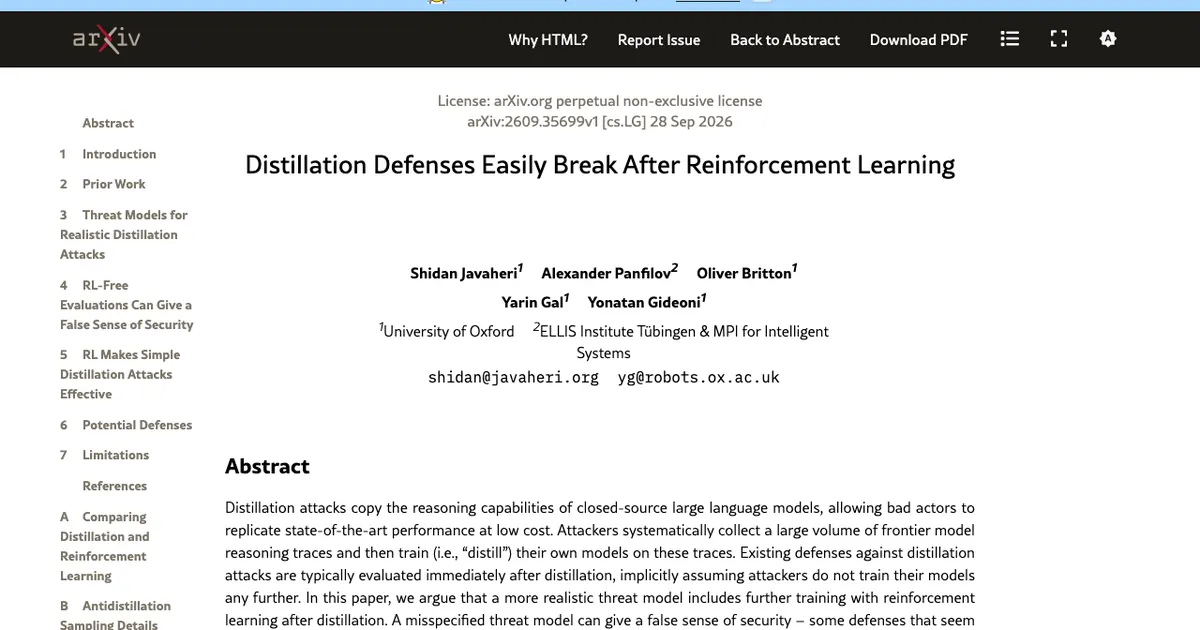
By Shidan Javaheri, Alexander Panfilov, Oliver Britton, Yarin Gal, Yonatan Gideoni • arXiv • Importance: 90/100
Distillation Defenses: Why RL Makes Them Break
Are LLMs truly safe? 🤔 The world of AI security is constantly evolving, and today’s breakthrough paper exposes a critical flaw in how we think about model defenses.
We often protect large language models (LLMs) using techniques like ‘distillation defenses’—methods designed to prevent bad actors from copying the core reasoning power of proprietary models. These defenses assume that once an attacker copies the knowledge, they stop there.
However, this paper argues that real-world adversaries don’t stop at a simple copy-paste job. They take it a step further: Reinforcement Learning (RL).
🤯 The Threat Model Shift: From Snapshot to Iteration
The researchers demonstrated that many existing defenses only check for robustness immediately after the initial ‘distillation.’ By introducing RL—which allows an attacker to iteratively fine-tune their stolen model on additional data—the entire defense framework collapses.
Here’s the core takeaway: A seemingly robust defense today might be rendered useless simply by allowing enough information leakages that enable subsequent training (i.e., RL). The barrier for a successful attack is significantly lowered.
🛡️ What Does This Mean for AI Developers?
The paper’s findings are sobering. They show that even simple attacks, using easily accessible API data from current closed-source LLMs, can steal sophisticated reasoning capabilities, achieving performance equivalent to highly complex attacks that require access to the model’s full internal traces.
This research points toward a critical industry shift: we must move past defenses that only guard against initial copying. Instead, our security strategies need to account for multi-stage adversarial refinement.
If your LLM defense strategy leaks sufficient information to reconstruct approximate reasoning traces, it is likely ineffective—a harsh warning for anyone building protective layers around frontier models.
🚀 Key Concepts:Distillation Attacks, Reinforcement Learning (RL), Frontier LLMs Security. The work presented in This critical paper on model defenses forces us to rethink the fundamental assumptions of AI safety and security.
Disclaimer: We are tracking the advancements in AI security, but the need for comprehensive, multi-layered defense systems remains paramount.
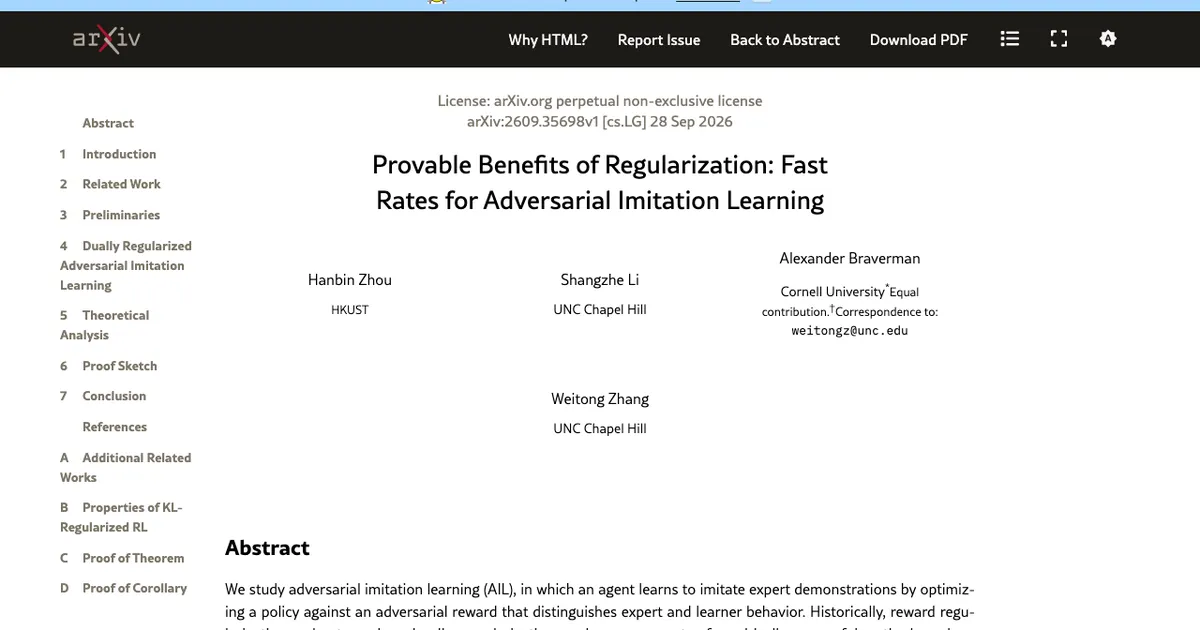
By Hanbin Zhou, Shangzhe Li, Alexander Braverman, Weitong Zhang • arXiv • Importance: 90/100
🛡️ Decoding the Stats: Why Regularization is the Secret Weapon in AI Learning
(A Deep Dive into Adversarial Imitation Learning)
As ML models get more complex and deployment moves from theory to real-world robots, understanding why they fail is often as critical as knowing how they succeed. This new research digs into a core problem of modern reinforcement learning (RL): Adversarial Imitation Learning (AIL).
In simple terms, AIL teaches an AI agent to behave like an expert—whether that’s driving perfectly or playing at grandmaster level—by having the system learn from demonstrations. The challenge is making sure this imitation process generalizes reliably and quickly.
📚 The Problem with Empirical Magic (and the Power of Proof)
The current state-of-the-art methods, like GAIL and LS-IQ, have shown incredible empirical success. They rely heavily on two techniques: reward regularization and entropy-based policy regularization. For practitioners, these are just ‘magic ingredients’ that make the models work. But for researchers (and safety engineers!), knowing why they work is everything.
The authors introduce a rigorous mathematical analysis to finally provide statistical guarantees for these
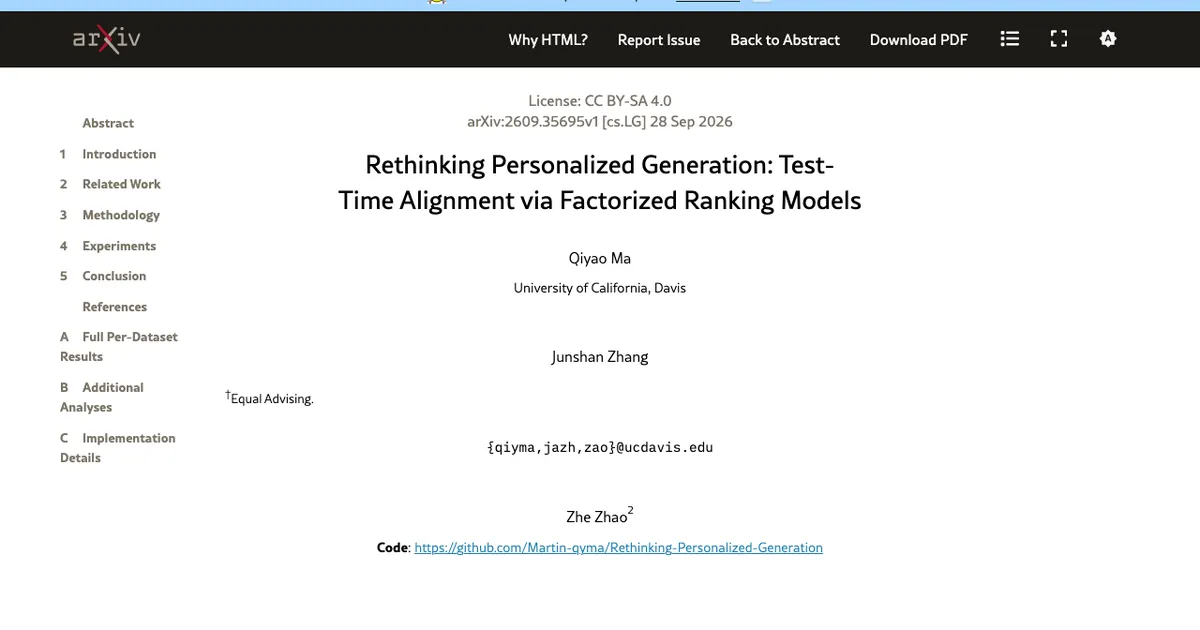
🧠 Unlock Hyper-Personalization: Why Your LLM Needs a Dedicated Ranking Model
Are you tired of generic AI responses? You train a massive Large Language Model (LLM), give it a prompt, and get something… okay. What if the real performance boost didn’t come from making the base model bigger, but from better selection?
A groundbreaking new paper challenges the assumption that LLMs must be aligned for an average user. Instead, they propose a radical shift: focusing on test-time personalization.
The Problem with Generic Alignment
The current paradigm dictates that we train an LLM to satisfy the largest possible group of users—a monolithic alignment goal. As the authors argue, this forces the model into mediocrity because it must find a statistical average preference.
Furthermore, if you try to solve personalization using massive ‘generalist’ reward models (like billion-parameter scorekeepers), you hit two major walls: poor calibration for niche tastes and astronomical computational cost when scoring thousands of candidates. It’s too expensive!
💡 The Game Changer: Factorized Ranking
The researchers introduce a specialized, highly efficient solution: the personalized ranking model.
Instead of trying to improve every single parameter of the giant base LLM, they propose using a compact, million-parameter Multi-Layer Perceptron (MLP) that acts as a dedicated scorekeeper. This model is designed to analyze massive candidate pools efficiently and precisely guide the generation process.
How does it work?
Efficiency: By keeping the ranking model small ($ ext{<}0.4\%$ of parameters), they drastically reduce computational overhead compared to billion-parameter alternatives.
Integration: It reuses the internal embeddings of the base LLM, making integration seamless and cheap.
Performance: It takes fine-grained personalized data during training to create a powerful preference map that accurately scores candidate responses for specific user tastes, rather than general ones.
🚀 Why This Matters for AI Developers
This work demonstrates that by separating the core generation capability from the specialized scoring mechanism, we can achieve massive performance gains in personalized contexts. The results are undeniable: their ranking model outperforms billion-parameter generalist reward models on every tested dataset, while being orders of magnitude faster and smaller.
If you are building hyper-personalized AI agents or recommendation systems built on LLMs, this approach offers a much more cost-effective path to true user delight. It’s not just about having the biggest model; it’s about optimizing the final, crucial step: selection.
Keywords: Large Language Models, Personalized AI, Recommendation Systems, Reinforcement Learning from Human Feedback (RLHF), Ranking Models, Efficiency
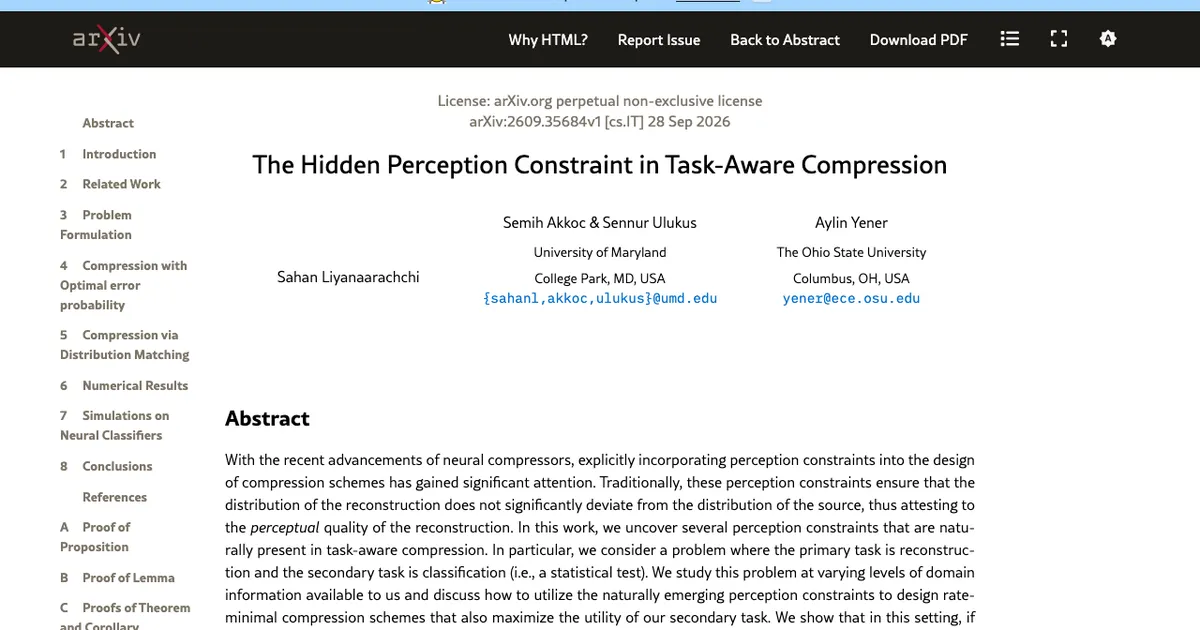
By Sahan Liyanaarachchi, Semih Akkoc, Sennur Ulukus, Aylin Yener • arXiv • Importance: 90/100
Decoding the Details: How Compression Can Boost AI Accuracy
Have you ever wondered what happens to an image or video when it gets compressed? Usually, we think of lower quality. But for deep learning models and specialized tasks, compression isn’t just about file size—it’s about preserving essential information while discarding the noise.
Our latest research dives into a crucial concept: the hidden perception constraint in task-aware compression. Instead of treating compression as a simple lossy process (like a JPEG), we view it through the lens of maximizing utility for a specific downstream task, like classification. This fundamentally changes the game.
💾 The Problem with Traditional Compression
The goal of most AI compressors is straightforward: make the data smaller while keeping its distribution close to the original source’s distribution. While this maintains general perceptual quality, it doesn’t guarantee that the most important features for a specific task (say, distinguishing between cats and dogs) are perfectly preserved.
✨ Our Breakthrough: Using Hidden Constraints
We found that when we combine primary reconstruction tasks with secondary tasks—like classification—new, natural constraints emerge. These aren’t explicit loss terms; they are statistical relationships dictated by the task itself.
Specifically, we analyze scenarios where a classifier’s decision boundary might not align perfectly (a ‘mismatch’) with our source data distribution. Our work demonstrates that if this misalignment occurs, aligning the reconstructed target distribution to match the optimal domain for classification significantly boosts accuracy.
In simpler terms: We showed that even when compressing highly complex data, we don’t need to just make it look right; we need to ensure the resulting latent representation makes the downstream AI task easier and more accurate.
🛠️ Implications for Real-World ML
The implications are massive across several industries:
Edge Computing & IoT: Devices with limited bandwidth (think remote sensors in rural areas or cars on highways) need to send highly compressed, yet information-rich, data. Our methods provide a path to minimize rates while maximizing decision utility.
Medical Imaging: Compressing large medical scans (MRI/CT) for transmission requires maintaining features critical for diagnosis. This research ensures the latent space is optimally structured for clinical accuracy.
Speech & Video Communication: Enhancing video conferencing quality or transmitting audio data under poor network conditions by focusing on task-critical features.
We propose a new framework that quantifies and leverages these innate perception constraints to design rate-minimal compression schemes tailored precisely to the utility function of the secondary task.
🔥 Supercharging Optimization: Learning to Precondition Interior-Point Methods
The world of Machine Learning and scientific computing often hits a major bottleneck when tackling constrained problems. Standard optimization techniques, like Interior-Point Methods (IPMs), are robust but notoriously expensive. They require computationally heavy steps—specifically, costly second-order Hessian evaluations and massive linear system solves.
Enter pdLIP: A revolutionary approach that blends advanced optimization theory with modern deep learning to make solving complex constrained problems faster, easier, and more GPU-friendly than ever before.
💡 The Problem: Why Standard IPMs Struggle
Intelligent algorithms are powerful, but their resource demands limit their scalability. Traditional Interior-Point Methods (IPMs) use Newton’s method for search directions. While accurate, this requires:
Second-Order Information: Computing the full Hessian matrix (a massive amount of work).
Large Linear Solves: Solving huge systems of equations, which consumes significant time and memory.
Sensitivity Near Boundaries: Standard IPMs suffer near constraints because the logarithmic barrier function is extremely sensitive to small perturbations, complicating reliable warm starts.
✨ The Solution: pdLIP - Learned Preconditioning for Optimization
pdLIP tackles these pain points head-on by introducing a learned preconditioning layer into a state-of-the-art primal-dual projected search IPM (pdProj).
How does it work?
Instead of performing the full, expensive Newton system solve at every iteration, pdLIP uses a shared coordinate-wise recurrent network to predict an effective diagonal preconditioner. This learned factor scales the right-hand side of the reduced Newton system for the primal step. The genius part is that the remaining required directions are recovered using analytical methods.
Key Architectural Breakthroughs:
* No Hessian Needed: By using a data-driven preconditioner, pdLIP completely bypasses costly Hessian evaluations and full linear solves.
* First-Order Friendly: It operates primarily with first-order information and simple coordinate-wise operations, making it perfectly suited for massively parallel GPU acceleration.
* Robust Warm Starts: The model incorporates primal and dual shifts that counteract the inherent sensitivity of the logarithmic barrier near constraints. This makes warm starting (restarting an optimization run) exceptionally reliable.
🚀 Performance & Impact: A Massive Speed Boost
In empirical tests on four classes of high-dimensional convex and non-convex problems, pdLIP demonstrates dramatic performance gains:
Warm Start Dominance: When warm starting from a previous solution (a common ML task), pdLIP reduced the required refinement iterations by an incredible 63–67% compared to starting fresh.
Scalability Proof: The improvements hold up when scaled to challenging problems, such as box-constrained QPs with 1000 variables.
This means that solving complex tasks—from optimizing investment portfolios (Portfolio Optimization) and training Support Vector Machines (SVMs) to advanced non-linear control problems—can now be done faster and more reliably than before.
🔬 Under the Hood: The Technical Edge
Training is self-supervised, using a loss function based on a penalty-barrier merit function and residuals of perturbed optimality conditions. This approach means pdLIP doesn’t need specialized target solutions or precomputed ground truth data, making it highly generalizable.
Whether you are tackling constrained resource allocation, optimizing physical systems, or running large-scale machine learning models, pdLIP offers a critical step toward making high-performance optimization both practical and scalable.
By Basile Morel, Samuel Ruiperez-Campillo, Andreas P. Streich, Julia E. Vogt, Thomas Hofmann • arXiv • Importance: 90/100
ECG Signal Cleaning Breakthrough: Using Mamba for Superior Long-Range Time Series Denoising
Are you an ML researcher or a medical tech expert? You know that ECG recordings are crucial, but they come with a massive headache: non-stationary noise. This corruption can ruin diagnostic accuracy, especially when monitoring patients over long periods (like during ambulatory studies).
Traditional deep learning denoisers struggle here. CNNs have limited view windows (receptive field), Transformers cost an absolute fortune (scaling quadratically with length), and diffusion models are often too slow for real-time use.
💡 Introducing DR-net-Mamba: The State-of-the-Art Solution
Our latest research, ‘DR-net-Mamba,’ introduces a clever hybrid architecture that merges the best of local feature extraction with powerful, long-range temporal modeling. We strategically insert Selective State-Space Blocks (Mamba) into existing convolutional bottlenecks.
Why is this a game-changer for ECGs?
Efficiency + Depth: By using Mamba, we achieve long-range context awareness at linear complexity—solving the biggest scalability issue of Transformers.
Superior Fidelity: Extensive testing on real and synthetic datasets shows our model achieving the highest SNR and lowest RMSE for noise reduction.
Context Matters: Crucially, per-class analysis reveals that Mamba significantly boosts diagnoses like ST/T changes, which rely heavily on capturing broad, context-sensitive waveforms over time.
🧠 The Technical Edge: Why State-Space Models?
When dealing with time series data (like ECGs), the model needs to understand patterns that span minutes, not just milliseconds. Mamba excels at this. Unlike fixed-window models, its selective state mechanism allows it to dynamically focus on the most important temporal dependencies across vast stretches of data.
This research demonstrates that combining local spatial detail (the Conv base) with global sequence understanding (Mamba) is key to building robust, clinically reliable medical AI tools.
P.S. While denoising improves basic metrics (like BCE), the most significant benefit comes when diagnosing complex morphology changes—where Mamba truly shines.
🔗 Read the Full Paper: If you are working on biomedical signal processing or advanced sequential modeling, we invite you to check out our full findings on arXiv:2609.35634.
By Caio F. Deberaldini Netto, Moshe Eliasof, Luana Ruiz • arXiv • Importance: 90/100
Unlocking the Continuum: Graph Transformers through Attention Graphons
(A Deep Dive into Scalable Graph AI)
As models tackle increasingly complex structures like social networks and molecular graphs, Graph Transformers have become indispensable. But when these learned representations scale up to enormous graphs—think billions of nodes—a core question emerges: Does the underlying pattern of pairwise interactions stabilize? Is there a stable ‘limit object’ governing their behavior?
This groundbreaking work introduces Attention Graphons, offering a powerful theoretical lens from dense graph limit theory. They tackle whether the attention-induced interactions, traditionally seen as giant $N imes N$ matrices, actually converge to a robust, stable structure as the number of nodes ($N$) approaches infinity.
💡 What is an Attention Graphon?
In simple terms, we view the raw attention matrix (the learned pairwise interaction map) not just as a finite snapshot, but as a sample drawn from a continuous underlying function—the attention graphon. By analyzing this limit object under the cut-distance metric, the researchers provide fundamental insights into the scalability and structural integrity of Graph Transformers.
🔍 The Core Contribution: Theory Meets Practice
The paper makes several significant contributions:
Theoretical Stability Analysis: They derive rigorous variance bounds (worst-case and regularity-aware) for the convergence, ensuring that we can mathematically quantify how stable an attention pattern is as the graph grows.
Operational Toolkit: To make this theory usable, they propose a practical pipeline: ‘canonicalize-then-block-average.’ This method allows developers to estimate the true dataset-level graphon structure from real-world data.
Diagnostic Testing: Crucially, they offer a variance-based diagnostic tool. If your attention matrix’s variation decreases with $N$ according to their bounds, it suggests your learned interactions admit a stable continuum description—a huge win for industrial deployment.
🚀 Why Does This Matter for AI Engineers?
For anyone working on large-scale graph neural networks (GNNs), this work is transformative:
Scalability Guarantee: It provides a formal mechanism to test if your model’s learned interactions remain consistent and structured even when faced with massive, never-before-seen datasets.
Feature Extraction at Scale: Instead of relying solely on the $N imes N$ matrix (which is infeasible for large $N$), practitioners can now extract a stable, lower-dimensional graphon representation that captures the essence of the graph’s connectivity pattern.
Improved Generalization: By understanding the underlying limit object, we can design more robust and theory-informed Graph Transformer architectures that generalize better beyond limited training graphs.
🌍 Practical Impact & Next Steps
Experiments across various benchmarks confirmed that attention frequently stabilizes to dataset-specific graphon structures. Furthermore, the authors demonstrated that these estimated graphons successfully transfer their structure even when applied to larger graph sizes with predictably diminishing error. This confirms the practical utility of the approach.
Whether you are tackling massive knowledge graphs or complex molecular simulations, understanding the underlying continuous limits is key to moving from academic prototypes to enterprise-grade AI systems.
By Shashank Raj, Kalyanmoy Deb • arXiv • Importance: 90/100
Turbocharge Model Training: Introducing EvE, the Hyperparameter Search Game Changer
If you’ve ever spent weeks optimizing hyperparameters or searching for the perfect model architecture, you know the pain point: standard optimization routines like Adam are great at completing a run, but terrible at cheaply ruling out bad ideas early. You spend massive computational budgets just to find out that one tiny tweak makes no difference.
That’s exactly what the authors of EvE: An Alternate Optimizer to Adam addressed. They introduce EvE (Evolutionary Explorer), a groundbreaking optimizer designed not for final training completion, but specifically for the resource-intensive process of searching—whether it’s tuning hyperparameters or exploring new model structures.
🧠 How EvE Changes the Game: Search vs. Training
The core insight is this: Model search needs cheap early failure. Standard optimizers (like Adam) are designed to squeeze every last bit of performance out of a fixed setup. EvE flips this script. It’s built using a steady-state, population-of-four differential evolution (DE) approach, giving it the exploratory power to jump between candidate settings quickly.
What makes EvE unique is its targeted gradient awareness. Instead of running full Adam steps every time, EvE uses DE for exploration. It only calls upon the powerful, resource-heavy gradient descent (like Adam) as a ‘rescue mission’—a small burst of optimization run only if the broad evolutionary search suggests room for improvement.
This design keeps the per-iteration cost low, allowing it to vastly increase the number of evaluations within the same computational budget as Adam.
🚀 Performance Deep Dive: Why EvE Wins the Search Battle
The empirical results are compelling, demonstrating that EvE is a specialized tool for a specialized job. Here’s the breakdown:
Search Speed: In successive halving tests (like tuning parameters on UCI Adult), EvE completed hyperparameter and architecture searches 3.1–3.5 times faster than Adam.
Scalability: Across diverse benchmarks, it won or tied Adam on a significant majority of tests, proving its robustness even up to one million variables.
Real-World Impact: While EvE is not meant to replace Adam for the final, polished stage (Adam still holds an edge in pure accuracy on tasks like GSM8K), its speed advantage shines when resources are limited. In fine-tuning complex models or running preliminary searches, it’s significantly faster.
🎯 The Bottom Line: A Gradient-Aware Proxy
EvE isn’t trying to be a total replacement for Adam; it’s designed to be the ultimate first step. It acts as a fast, gradient-aware proxy for the search regime. Think of it this way: if training is like running a marathon, EvE is the high-speed car that gets you quickly through the obstacle course of options before settling in for the race.
Are you optimizing hyperparameters or exploring architectures? Give EvE a try! It offers an invaluable return on your compute budget, drastically reducing the time required to find excellent configurations, even if it means accepting a slightly modest reduction in final-stage maximum accuracy.
By Radosław Nowak, Anna Bielawska, Bogusz Stefańczyk, Maciej Sanocki, Paweł Wawrzyński • arXiv • Importance: 90/100
🔮 From Nodes to Hyperballs: How GeoGAE is Revolutionizing Graph Embeddings
As machine learning models become increasingly complex, the need to represent entire structured objects—like social networks or biological pathways—in a mathematically usable format has never been higher. While standard methods have successfully embedded simple units (words, images), encoding an entire graph remains a notoriously difficult problem.
We’re diving into GeoGAE, a novel framework that tackles this grand challenge by rethinking how graphs are represented in vector space. If you work with complex network data, this is a must-read.
🌌 The Problem: Why Standard Graph Embeddings Fail
Traditional graph embedding methods face a scalability headache. They usually either force the output node order to match the input (a fragile one-to-one mapping) or they neglect crucial structural information. Both approaches limit the model’s ability to capture the global architecture of a large, complex network.
✨ The Breakthrough: Hyperball Cloud Representations
GeoGAE introduces a brilliant architectural shift: representing an entire graph not as individual nodes, but as a ‘cloud of hyperballs.’
A hyperball cloud is essentially a geometric container that captures the overall spread and structure of the data. By using this representation, the model can define a specific, stable node ordering—solving the core scalability problem.
🚀 How GeoGAE Works: The Autoencoder Approach
GeoGAE leverages the power of Transformers for both encoding and decoding:
Encoding (The Translator): A Transformer encoder takes the entire hyperball cloud representation and compresses it into a compact, fixed-size ‘graph-level embedding.’ This single vector holds the DNA of the whole network.
Decoding (The Reconstructor): The Transformer decoder takes that graph-level embedding and reconstructs the full graph structure, proving that the global information was successfully preserved.
This autoencoding process allows GeoGAE to simultaneously capture:
* Global Structure: The overall shape and connectivity of the network.
* Local Patterns: The specific relationships between neighboring nodes.
The results are highly promising across diverse graph datasets, demonstrating superior performance in reconstructing complex graphs from their learned embeddings. It’s a massive step toward general-purpose graph representation learning.
🧠 Key Takeaways for Researchers & Engineers:
* Concept Focus: Hyperball Clouds provide a unique, scalable solution for graph ordering.
* Architecture: Uses Transformer encoders/decoders to manage graph-level latent space.
* Impact: Enables the robust embedding of entire network structures, opening doors for better graph AI in fields like bioinformatics and social science.
By Yeachan Kim, Mingyu Lee and SangKeun Lee in Transactions of the Association for Computational Linguistics, Volume 14 • ACL Anthology • Importance: 90/100
💡 Memory-Efficient Fine-Tuning for LLMs: A Deep Dive Survey
Large Language Models (LLMs) have revolutionized AI, but deploying them isn’t free—it requires massive computational resources. When we fine-tune these giants to make them useful for specific tasks or specialized domains, the memory demands are staggering, often creating a deployment bottleneck, especially on resource-constrained hardware.
This comprehensive new survey tackles that exact problem. If you work with deploying state-of-the-art LLMs (like GPT-3, Llama, Mistral, etc.), this read is absolutely essential reading.
🧠 What is Memory-Efficient Fine-Tuning (MEFT)?
In simple terms, MEFT methods allow developers and researchers to adapt massive pre-trained models for specialized tasks without needing to update every single parameter. Instead of re-training the whole model—which demands terabytes of memory—they surgically adjust only a small fraction of parameters. This dramatically reduces computational overhead (GPU RAM) while maintaining high performance.
The Challenge: While techniques like LoRA and QLoRA have brought huge improvements, the field is rapidly evolving, and previous surveys haven’t provided a unified, systematic view. Developers need a comprehensive roadmap!
Systematic Classification: The authors categorize existing methods not just by task, but by their underlying optimization environments (the model architecture itself, or the surrounding system infrastructure). They also classify model-based techniques based on their specific targets.
Comprehensive Scope: Unlike previous narrow reviews, this paper provides a holistic view of both hardware/system optimizations and novel parameter adjustment techniques.
Practical Guide & Evaluation: It doesn’t just list methods; it discusses proper evaluation strategies and provides empirical analyses, helping practitioners know how to measure the efficiency and effectiveness of their chosen MEFT approach.
🚀 Who Needs This Paper?
ML Engineers/MLOps: If you are deploying LLMs in production environments with limited GPU memory (e.g., edge devices or smaller cloud instances).
Research Scientists: Anyone building novel parameter-efficient fine-tuning methods and needs to benchmark against the state of the art.
AI Developers: Professionals needing a reliable, high-level architectural roadmap for customizing LLMs affordably.
This survey is set to become the go-to resource for anyone serious about scaling LLM deployment responsibly and efficiently.
By Huaiyuan Qin, Muli Yang, Gabriel James Goenawan, Shiqi Huang, Min Kass Chong, Wahyu Wiratama, Peng Hu, Chen Gong, Wu Liu, Xi Peng, Chun Jian Ho, Hongyuan Zhu • arXiv • Importance: 85/100
Copy the Same, Distill the Difference: Making Efficient Vision Transformers Work
Are you building next-generation AI models? You’ve heard the whispers about making large foundation models faster—and those whispers usually point to Linear Vision Transformers (ViTs). They ditch the expensive Softmax attention for linear-complexity alternatives, promising a massive boost in speed and efficiency.
But here’s the catch: these powerful linear variants often suffer from poor performance when trained from scratch. Essentially, they lose the vast knowledge benefit that came with training on established Softmax architectures like ViT Base or ViT Large.
Our latest research investigates how we can bridge this massive performance gap. The core question was: Can we simply reuse the pre-trained weights from a standard Softmax ViT to initialize a linear one?
The short answer? It’s much more nuanced than that.
🔑 Key Finding: Weights Are Not Always Interchangeable
We found that different components of the ViT cannot be transferred equally:
Attention (The Operator): Softmax attention and linear attention are fundamentally different operators. Simply copying the attention weights does little, and sometimes even makes performance worse! Instead, we treat the behavior of the attention—the token routing logic—and recover it through a smart process called distillation. This means training the new architecture to mimic the output patterns of the original model.
MLPs (The Memory): In contrast, the MLP layers are ‘operator-agnostic.’ They carry general, learned representations that don’t depend on whether attention is Softmax or linear. These weights can be simply copied directly from the pre-trained model.
✨ The Winning Strategy: Combine Copying and Distillation
The optimal initialization strategy for Linear ViTs is a powerful combination:
Copy the universal, learned MLP weights +Distill the functional behavior of the Softmax attention into the linear attention operator.
By combining these two techniques, we not only close the performance gap between Softmax and linear ViTs but often find that the resulting models surpass the original Softmax counterparts. This amazing result holds true across different model sizes, architectural variants, and diverse datasets.
💡 Takeaways for ML Engineers & Researchers
This work provides a crucial framework for understanding how pre-trained knowledge can be effectively reused when fundamentally changing a model’s core mechanics (like replacing Softmax attention). If you’re tackling efficiency improvements or architecturally modifying foundation models, remember this principle: Copy what stays the same and distill what differs.
Disclaimer: This research deepens the understanding of transferring pre-trained knowledge across different attention operators, guiding future work on efficient and powerful foundation models.
By Shama Gupta, Hoang H Nguyen, Chelsea Huang, Lindsay Devon Brin, Fanny Riols • arXiv • Importance: 85/100
Multilingual Voice Agents: Why Code-Switching Accuracy is Critical for Business Success
The rise of multilingual voice agents and AI assistants has revolutionized how businesses operate globally. But there’s a massive, often overlooked hurdle: code-switching (CS).
Code-switching—the natural, seamless alternation between languages within a single conversation (think mixing English and Spanish mid-sentence)—is routine in many enterprise settings across India, Latin America, Southeast Asia, and beyond. Yet, current Automatic Speech Recognition (ASR) systems are not designed to handle this fluid reality.
🎙️ The Problem: Beyond Simple Transcripts
Most existing research focuses on the technical challenge of transcribing code-switching. However, as ML researchers and industry leaders, we know that poor transcription isn’t just about a high Word Error Rate (WER). In an enterprise setting, minor errors can cascade into massive operational failures.
A voice agent failing to accurately understand ‘Transfer the documento’ versus transcribing it incorrectly could lead to incorrect routing, failed transactions, or lost client trust.
Our new benchmark, CoSE-E (Code-switching Evaluation for Enterprise), changes the focus. We don’t just measure transcription accuracy; we evaluate how code-switching errors impact critical downstream tasks—the true cost to your business.
💡 What is CoSE-E?
We introduce a synthetic, multidimensional evaluation framework specifically tailored for enterprise-grade voice agents and operational domains. Our work systematically tests frontier ASR models across five major language pairs (including those prevalent in diverse markets like the US, India, and Brazil).
CoSE-E provides three critical outputs:
Systematic Benchmarking: Compare top ASR systems head-to-head on code-switched speech.
Diagnostic Error Analysis: Pinpoint which type of code-switching error (e.g., language boundary crossing, mixed grammar) is most damaging for specific language pairs and models.
Operational Impact Scoring: Help organizations predict the real-world failure rate when integrating multilingual voice AI into critical workflows.
This moves ASR evaluation from an academic metric to an actionable business intelligence tool.
By Sakshi Arya, Cheng Soon Ong • arXiv • Importance: 85/100
Decoding Optimal Decisions: New Insights in Single-Index Bandit Learning
As AI systems become more complex and context-aware, making the right decision under uncertainty—especially when gathering data is costly—is paramount. Traditional machine learning models often struggle with highly structured, resource-constrained decision problems like contextual bandits.
Our latest research tackles a specific class of challenging bandit problem: two-arm contexts governed by a shared, unknown ‘single index’ and a monotone link function. The key insight here is that the optimal choice depends only on the relationship between the arms’ indices, not on estimating complex reward functions or the common underlying structure.
🚀 Introducing Natural Boundary Learning (NBL)
We introduce Natural Boundary Learning (NBL), a groundbreaking greedy procedure designed to find this theoretically optimal decision boundary. Unlike previous methods that require estimating multiple unknown parameters, NBL operates directly on a statistical contrast—a sequential Stein contrast—to learn the optimal boundary geometry immediately.
This approach offers significant robustness and efficiency gains:
* Direct Boundary Learning: It bypasses the need to model complicated reward functions or the shared link structure (monotone link).
* Stability Characterization: We don’t just propose an algorithm; we mathematically characterize its local behavior using a ‘decision stability coefficient.’ This coefficient is highly valuable because it balances three crucial factors: how far apart the arms are, the geometry of the underlying link, and the distribution of our context data.
💡 The Technical Breakthrough: Geometry and Regret
Our theoretical analysis shows that when this predicted local decision stability holds (i.e., we operate within a stable regime), NBL is guaranteed to contract toward the true optimal boundary. Crucially, it achieves an impressive expected regret bound of $O(\log n)$. This level of performance demonstrates that NBL effectively navigates complex statistical landscapes and converges rapidly to the best decision strategy.
🌍 Why This Matters for AI (Deployment Insights)
The implications of NBL extend across personalized recommender systems, adaptive resource allocation in manufacturing, and targeted marketing campaigns. By leveraging geometric insights, we provide a framework that is both theoretically robust and practically deployable in settings where data efficiency and accurate boundary estimation are critical.
For engineers working on advanced bandit formulations or decision-making under structural constraints, read the full technical paper to dive into the underlying mathematics of decision geometry.
This work is presented by Sakshi Arya and Cheng Soon Ong.
By Liangbing Zhao, Le Zhuo, Mohamed Elhoseiny • arXiv • Importance: 85/100
Turbocharging Image Editing: How On-Policy Self-Distillation Solves Multi-Turn AI Collapse
The era of generative AI has brought powerful image editors into our hands. You can type ‘add a cat’ and the model does it. But what happens when your edits get complicated? What if you want to first add a cat, then move it to a spaceship, and finally change its color? This is where current models struggle. They often degrade rapidly—a phenomenon we call ‘multi-turn collapse.’
Our new work tackles this core limitation head-on: MT-OPSD (Multi-Turn On-Policy Self-Distillation).
🚀 The Problem with Iterative Editing
Most modern image editing models are trained to look at a clean original photo and produce one perfect edit based on an instruction. They never see the chaotic, imperfect output of another model trying to fix it.
In practical use, however, you rarely operate in single turns. You apply Edit 1 $
ightarrow$ Image A; then Edit 2 is applied to Image A $
ightarrow$ Image B. Each step builds on an accumulated error from the previous turn. The models are simply not robust enough for real-world iteration.
As researchers Zhao et al. show in their paper, this failure is rooted in a train-test mismatch: the model is trained on perfect inputs but must run using its own flawed outputs as conditioning information Multi-Turn Image Editing Breakthrough.
💡 What MT-OPSD Does (The Solution)
MT-OPSD proposes a powerful self-distillation framework. Instead of forcing the model to condition only on clean source images, it trains the model by having it learn from its own generated, imperfect intermediate steps, guided by what a perfect ‘teacher’ model would look like.
In plain English: It teaches the AI how to reliably edit an image even when the input is already messy. This robust training fundamentally stabilizes the iterative process, leading to dramatically better long-horizon consistency.
✨ Why This Matters for Creators and Developers (Impact)
This isn’t just a technical fix; it unlocks practical commercial applications for generative AI imaging in several key ways:
Complex Storyboarding: Developing AI tools that can execute multi-step visual storytelling (e.g., character evolution, scene changes).
High-Fidelity Design Iteration: Allowing designers to refine concepts over many rounds of feedback without losing coherence.
Robust Creative Pipelines: Ensuring that complex pipelines built on generative models are stable and dependable, moving AI from proof-of-concept to enterprise grade.
To prove its worth, the authors also introduce a massive new benchmark: LME-Bench, which consists of 100 challenging ten-turn editing sessions. Our experiments confirm that MT-OPSD significantly boosts long-horizon success while maintaining impressive single-turn quality.
By Kexin Li, Wenjun Qiu, Joshua Abraham, Aditi Maheshwari, David Lie • arXiv • Importance: 85/100
👻 The Ghost in the Machine: Exploiting Dead Neurons for AI Attacks
Hey AI enthusiasts and security experts! Today we’re diving into a really dark corner of machine learning research. This paper unveils sophisticated new attack methods that demonstrate how strategically manipulating training data—without ever touching the model’s core weights directly—can cripple an otherwise robust deep learning system.
📉 The Problem: Dying Neurons and Gradient Gradients
The foundational component of many modern neural networks, like the Rectified Linear Unit (ReLU), is great for performance, but it has a critical flaw: dying neurons. A neuron ‘dies’ when its input pre-activation consistently falls below zero. When this happens, ReLU outputs zero and stops passing gradients. For attackers, this isn’t just an academic curiosity; it’s a reliable point of failure they can exploit to degrade model performance.
🛠️ The Breakthrough: Data Ordering and Poisoning Attacks
The researchers presented by Kexin Li et al. show that the way you feed data into a network is as important as what data you use. They introduce two primary attack vectors:
Dynamic Data-Ordering Attack (DOA): This method greedily selects training examples in an optimized sequence. By carefully ordering the data, the attackers force ReLU units to enter that ‘dead’ state, effectively starving them of useful gradients during training.
Gradient Inversion Poisoning: Going a step further, they develop poisoning attacks using gradient inversion. This allows them to synthesize highly targeted, class-conditioned poisoned samples that amplify the negative effects observed through data ordering, severely compromising accuracy.
These techniques can be applied even without modifying the victim’s training labels or adding random noise—just by controlling the input sequence.
💡 Real-World Impact (and Threat Level)
The results are startling. On a fully connected ReLU network trained on MNIST, simply ordering 100 out of 60,000 examples for just five epochs was enough to drop test accuracy from a pristine 96% down to 95%. And when they added poisoned samples? The accuracy plummeted further, reaching 86-88%—all achieved without altering the original model architecture or weights.
This proves that training robustness is deeply linked not just to data quality, but also to the sequential presentation of that data. This raises serious security questions for industries relying on ML, from autonomous vehicles in São Paulo to financial risk modeling in London.
🚀 Key Takeaways for Security & Researchers
The immediate focus must shift towards developing defense mechanisms that are robust against data ordering and poisoning attacks. We need training methodologies that stabilize gradients regardless of input sequence or minor data corruptions.
Interested in reading the full details on this breakthrough research? Check out the paper: Let the Neurons Die
By Artin Sermaxhaj, Nastaran Alipour, Donat Sinani, Johannes Hog, Neeratyoy Mallik, Jenia Jitsev, Danny Stoll • arXiv • Importance: 80/100
💡 Stop Guessing: The New Benchmarks for ML Scaling Laws
The age of large foundation models has made ‘scaling’ the most talked-about topic in AI. We build bigger, train on more data, and often assume that simply going up the size curve guarantees better results—but how do we know if our scaling analysis is accurate?
Most of the time, research into machine learning progress focuses on building better models. The process of evaluating how to get those scaling laws itself has been overlooked. It’s a critical blind spot in today’s AI research landscape.
That’s why the authors introduced ScAn-Bench (Scaling Analysis Benchmarks). This groundbreaking resource is not another model; it’s an evaluation framework designed to scrutinize the methodology used to determine scaling laws across different modalities—from text (LLMs) to vision-language pipelines (VLMs).
🚀 What Does ScAn-Bench Do?
ScAn-Bench tackles two huge, complex questions:
Data Acquisition Reliability: How consistently can we measure performance when gathering data across different sources and formats?
Extrapolation Methodology: When empirical evidence runs out (i.e., we hit the limits of our available compute), how reliably can we project future performance using scaling laws?
The creators tested these methods rigorously using over 4500 and 8000 checkpoints, establishing the first systematic evaluation of data acquisition and extrapolation for both text and multimodal setups.
✨ Why Should AI Engineers Care?
For researchers, model architects, and serious ML engineers working with massive models (like GPT-x or Claude-y), this is essential reading. Before you spend months building a multi-billion parameter model based on assumptions about scaling performance, use ScAn-Bench to validate your methodology.
By providing systematic evaluations, this paper helps set the standards for future AI research, ensuring that progress in foundation models is built upon rigorous, reliable science rather than optimistic guesswork.
By Chang-Wei Shi, Xu Wang, Wu-Jun Li • arXiv • Importance: 80/100
🔥 Leveling Up LLM Training: Introducing MeqMuon for Optimal Pretraining
The era of massive Large Language Models (LLMs) is here, but it comes with a steep price tag—exponentially increasing training costs and computational overhead. As models get bigger, optimizing the foundational pretraining process becomes critical to achieving state-of-the-art performance without exhausting your budget.
That’s where MeqMuon steps in.
A recent development, Muon, has already shown great promise for high accuracy and training efficiency during LLM pretraining. But even Muon had limitations: balancing the massive update matrices was challenging, especially when different parts of the matrix exhibited varied imbalance patterns.
🛠️ The Breakthrough: Matrix-Equilibrating Optimization
Our new optimizer, MeqMuon (Matrix-Equilibrating Muon), tackles this head-on. It’s an advanced optimization technique designed specifically to manage complex update matrices in LLMs.
How does it work?
MeqMuon is revolutionary because it doesn’t just apply a single normalization strategy. Instead, it automatically tailors its balancing mechanism to handle any pattern of imbalance present in the update matrix—balancing both row and column magnitudes simultaneously. This eliminates the need for manual tuning or complex architectural modifications based on dataset specifics.
Two Key Improvements That Matter:
Universal Balancing: By achieving comprehensive balance across both rows and columns, MeqMuon stabilizes convergence dramatically better than previous methods like standard AdamW or Muon.
Memory Efficiency: Crucially, it ditches the need to store AdamW’s bulky second-moment estimates. This isn’t just a minor tweak; reducing optimizer state memory drastically makes training massive models feasible on more resource-constrained hardware—a huge win for researchers and industry alike!
🚀 Why MeqMuon Matters (SEO & Impact)
The primary goal of MeqMuon is boosting convergence performance. In practice, this means:
Faster Training: Achieving peak performance with fewer training steps.
Greater Stability: The model converges reliably even with highly noisy or complex data updates.
Cost Reduction: Reduced memory usage and faster convergence translate directly into lower cloud compute costs for pretraining state-of-the-art models like GPT-X or Llama-Z.
If your research involves large-scale NLP, foundation model training, or optimizing transformer architectures, MeqMuon is a significant advancement to watch. Dive deeper into the math and results here: MeqMuon: Matrix-Equilibrating Muon for LLM Pretraining
This research represents an essential optimization layer for the next generation of trillion-parameter AI.
By Antoni Oliver and Sergi Alvarez-Vidal in Proceedings of the 1st International Workshop on Teaching AI-Based Translation and Technologies (TAITT 2026) • ACL Anthology • Importance: 75/100
Beyond the Classroom: How UOC is Training the Next Generation of AI Translators
The rapid advancement of Large Language Models (LLMs) and Neural Machine Translation (NMT) has opened up massive professional opportunities, but it also presents a challenge: how do we effectively educate future linguists and technologists to handle these powerful tools?
Most educational resources assume specialized access. But what if the tools could be designed not just for research labs, but for accessible learning environments?
Introducing MTUOC! 🚀
MTUOC is an open-source pedagogical toolkit developed by Universitat Oberta de Catalunya (UOC). It’s a modular suite of tools designed to demystify the complex workflows involved in training, fine-tuning, and integrating NMT systems and LLMs. Rather than just teaching theory, MTUOC provides hands-on, accessible technical experiences.
🛠️ What is MTUOC?
The core genius of MTUOC lies in its design philosophy: making cutting-edge AI translation technologies usable for formal education and diverse professional training settings.
It’s a comprehensive platform used across multiple levels of study, from Bachelor’s to Master’s degrees, covering everything needed to build expertise in Translation Technologies. This isn’t just theory—it’s practical integration into real curricula.
Enhanced Autonomy: Providing students with high-level, accessible interfaces drastically improves their technical understanding and self-reliance (technical autonomy). Students don’t need to be deep ML experts just to use state-of-the-art tools.
Professional Readiness: The tools equip learners with the practical skills necessary for today’s industry demands, accelerating professional readiness in the field of AI translation.
Community Building: The project has generated significant buzz, already powering a successful open course and proving its utility in asynchronous learning environments.
💡 Who Needs MTUOC?
This technology is crucial for:
Academia: Institutions looking to integrate cutting-edge AI research into language or computer science curricula without requiring specialized ML faculty overhead.
Industry Trainers: Companies offering professional upskilling in machine translation and LLMs.
Students/Researchers: Anyone looking for a structured, practical way to master NMT and LLM technologies through guided projects.
If you’re involved in language technology education or NLP research, check out the full details presented at TAITT 2026. The future of translation education is hands-on, open, and scalable!