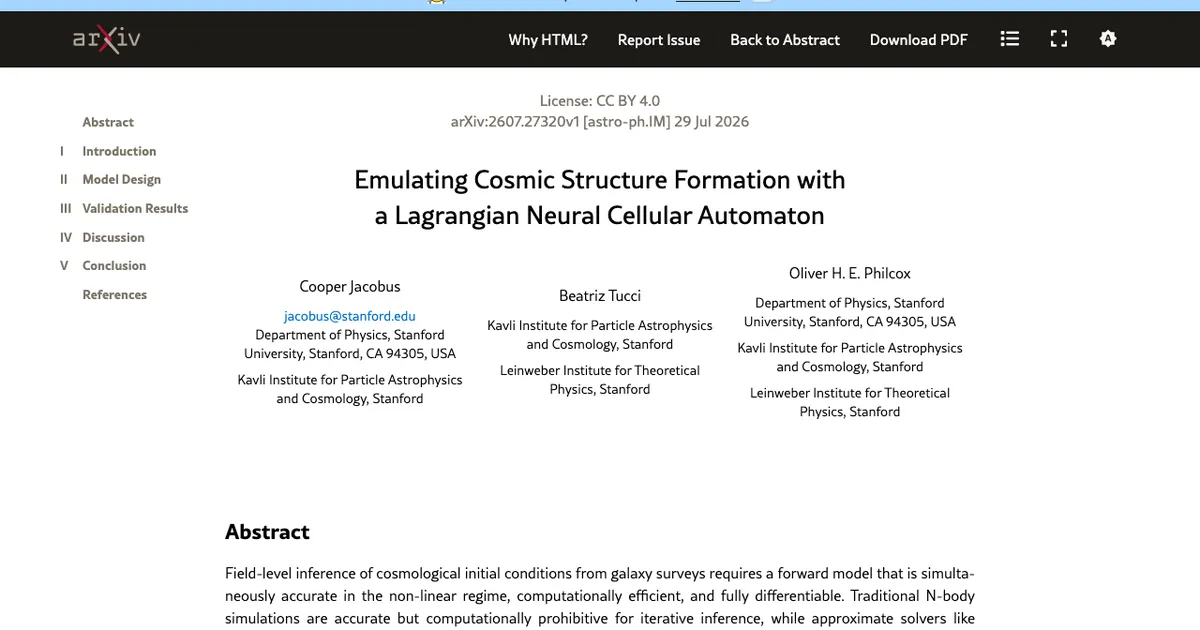
Emulating Cosmic Structure Formation with a Lagrangian Neural Cellular Automaton
🌌 Mapping the Cosmos: Training AI to Predict the Universe’s Structure
As an ML researcher who spends time thinking about everything from small language models to simulating galaxies, I find this one paper genuinely breathtaking. It tackles one of the biggest grand challenges in modern science: understanding how matter clumped together to form every star and galaxy we see—a process called cosmic structure formation.
The problem is that simulating the universe accurately requires computationally impossible amounts of computing power. Traditional N-body simulations are accurate but grind to a halt when you need them many times for complex data analysis, like reconstructing initial conditions from observed galaxies.
💡 The Breakthrough: Lagrangian Neural Cellular Automaton (LNCA)
The authors introduce the Lagrangian Neural Cellular Automaton (LNCA). This isn’t just another fancy CNN; it represents a fundamental shift in how we model physical processes with AI.
What makes LNCA revolutionary?
- Moving vs. Fixed: Most deep learning models operate on fixed grids (Eulerian). The LNCA, by contrast, operates in the Lagrangian frame. Instead of mapping a static density map, it ‘advects’ its computational graph to follow the actual flow of mass—just like reality!
- The Magic of Residuals: Rather than training a massive model from scratch to predict everything, LNCA only learns the small residual displacement corrections needed on top of an already excellent approximation (the Zeldovich approximation). This dramatically reduces complexity while maintaining high accuracy.
- Full History Tracking: Critically, it’s built as an equivariant cellular automaton, meaning it doesn’t just predict a final state; it generates the complete trajectory or dynamic history. This is crucial for accurate astrophysical modeling.
✨ Why Is This Important? The Next Frontier of Cosmology
The model’s ability to be a differentiable forward model means scientists can use gradient descent (a core ML tool) to reconstruct the initial conditions of the universe simply by observing lightcone data from galaxy surveys. We are moving from passively observing the cosmos to actively inferring its deep past.
The performance metrics are stunning: LNCA achieves percent-level precision in key cosmic spectra (power and cross spectra) deep into the non-linear regime ($k ot ext{ extless} 0.5 ext{ } h ext{Mpc}^{-1}$), all while requiring $ ext{tens of thousands}$ of times fewer learned parameters than comparable methods.
Takeaway for AI & Science: This paper demonstrates how specialized ML architectures (like CA and equivariant networks) can transition from academic novelties into powerful, scalable tools for solving the hardest problems in physics. It’s a prime example of scientific ML—where deep learning acts not just as a tool, but as an intrinsic part of the physical process being modeled.
🔗 Dive Deeper: Read the full paper here: https://arxiv.org/abs/2607.27320
This research is pioneering a new class of physical simulation models that bridge deep learning with computational astrophysics, opening up entirely new avenues for observational cosmology.