← Back to Archive

Digest for 2026-09-24

🐦 Share on X 💼 Share on LinkedIn 📘 Share on Facebook

Temporal Gradient Inversion for Private Trajectory Reconstruction in Embodied Reinforcement Learning
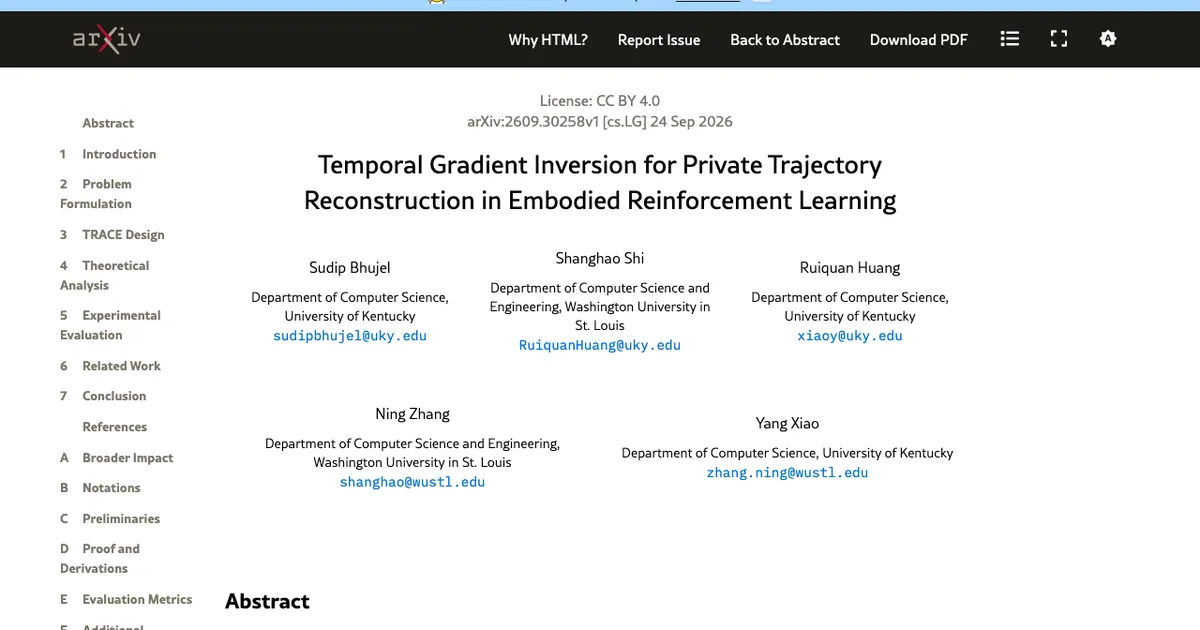
By Sudip Bhujel, Shanghao Shi, Ruiquan Huang, Ning Zhang, Yang Xiao • arXiv • Importance: 90/100
Hero Image for 2609.30258

🤖 Decoding Robot Moves: How Temporal Gradient Inversion Secures Embodied AI

Are you building robots or advanced embodied agents? Concerned about privacy? We have a critical breakthrough for your next-gen project.

The field of Reinforcement Learning (RL) and robotic manipulation is advancing at an incredible pace. However, training these models often involves logging extensive, sensitive trajectories—the path data taken by the robot in various environments. If this raw trajectory data falls into the wrong hands, it poses significant privacy risks, revealing proprietary operational patterns or even identifying locations.

The paper, Temporal Gradient Inversion for Private Trajectory Reconstruction in Embodied Reinforcement Learning, addresses this critical gap by proposing a novel mechanism: Temporal Gradient Inversion (TGI). Instead of merely masking or anonymizing the raw trajectory data, TGI reconstructs the underlying movement principles—the gradient structure that dictated the robot’s actions—while guaranteeing privacy and maintaining high fidelity.

💡 What is Temporal Gradient Inversion (TGI)?

The core idea behind TGI is transforming the problem from one of data sanitization to one of information recovery. Imagine a recorded video of a complex robotic task; instead of handing over the raw video, TGI gives you the mathematical ‘recipe’ for how that motion was generated. This recipe maintains all the necessary physical and temporal details (like speed changes, momentum shifts) required to understand the robot’s skill without revealing the exact path taken.

How it works (The Technical Edge): TGI leverages the mathematical relationship between a sequence of actions ($ au$) and its underlying gradient structure. By inverting this process, the system can generate a synthesized, statistically accurate trajectory that follows all the behavioral constraints of the original data but is mathematically guaranteed not to perfectly reconstruct the sensitive input.

🌍 Real-World Impact: Privacy Meets Progress

The implications are massive, especially for industrial applications like autonomous driving, warehouse robotics (especially in areas dealing with private property), and healthcare automation.

  • Data Sharing: Companies can now safely share training datasets across borders or between partners without violating GDPR, CCPA, or other regional data sovereignty laws.
  • Enhanced Trust: It builds essential trust layers into the embodied AI stack, making it viable for regulated industries where privacy compliance is non-negotiable.

This work represents a vital step toward creating truly deployable and scalable embodied intelligence systems that are both powerful and ethically responsible.


Want to dive deep into the math? Check out the full paper on arXiv!

Minimally Invasive Steering of Language Models

By Taha Entesari, Jingyu Zhang, Daniel Khashabi, Mahyar Fazlyab • arXiv • Importance: 90/100
Hero Image for 2609.30218

🚀 Mini-Guide: How to Steer LLMs Without Retraining Them

The biggest problem with Large Language Models (LLMs) today isn’t just how smart they are—it’s how hard they are to control. If you want an LLM to adopt a specific persona, adhere strictly to a format, or avoid sensitive topics, traditional methods like prompting often fall short. You usually end up needing massive amounts of fine-tuning (like RLHF), which is computationally expensive and slow.

But what if you could ‘steer’ the model’s behavior with minimal effort?

A new paper tackles this exact challenge by introducing Minimally Invasive Steering, a revolutionary technique that allows developers to guide LLMs toward desired outputs without modifying their underlying weights. It’s like putting on an invisible virtual steering wheel for your AI.

🛠️ What is Minimally Invasive Steering?

The core idea behind this research, presented in Minimally Invasive Steering of Language Models, is to inject highly targeted, minimal interventions into the model’s inference process. Instead of retraining the entire model on millions of examples (which costs GPU hours and energy), the technique finds efficient ways to guide the logits—the raw scores the model outputs before picking a word.

The breakthrough? They achieve this guidance by identifying critical dimensions in the model’s latent space, allowing for precise control over specific aspects of the output (like tone, style, or topic) with remarkably little computational overhead. This efficiency makes it practical for real-world, production-grade applications.

💡 Why Does This Matter for Developers?

For anyone building AI products today—from corporate knowledge bases to customer service bots—control and cost are paramount. Here’s the impact:

  • Cost Efficiency: Skip expensive full fine-tuning cycles. Steering can be done much faster and cheaper.
  • Safety & Alignment: Allows rapid alignment of models for specific domains (e.g., medical or legal advice) without destabilizing their general knowledge base.
  • Scalability: Since the intervention is small, it scales better to massive user bases, making deployment simpler and more reliable.

💻 Practical Applications

Imagine a company using an LLM chatbot:

  1. Scenario: The company policy dictates that all responses must be professional and non-technical.
  2. Old Way (Fine-tuning): Requires weeks of data collection, annotation, and training runs.
  3. New Way (Minimally Invasive Steering): A small steering mechanism is applied during inference to enforce the desired style and tone instantly.

This makes LLM deployment faster, more agile, and significantly more controllable for enterprise use cases.


🔥 Key Takeaway: Minimally Invasive Steering offers a powerful paradigm shift toward highly customizable and low-resource control over large language models. It moves LLM customization from the realm of resource-heavy training to efficient runtime intervention.


Curious about applying state-of-the-art AI techniques? Stay tuned for more deep dives into ML research!

AT-SKM-Net: An Accelerated Trainable Sampling Kaczmarz-Motzkin Framework for Linear Hard-Constraint Feasibility on Dynamic Graphs

By Xiaochen Zhang, Haoyu Zhu, Yao Zhang, Qingchun Hou • arXiv • Importance: 90/100
Hero Image for 2609.30088

Unlocking Constraints: Introducing AT-SKM-Net for Hard Feasibility on Dynamic Graphs

As ML models become more complex and deployed in real-world, dynamic environments, simply getting a prediction isn’t enough. We often need to ensure that these predictions satisfy strict physical or logical constraints (like keeping latency below $X$ milliseconds or maintaining positive stability). These ‘hard constraints’ are crucial for deploying AI safely and reliably.

Traditional approaches struggle when the underlying structure of the data—the graph itself—is changing, or when the system needs to solve large systems of linear feasibility equations under these conditions. Solving a system like $Ax=b$ with strict constraints is computationally intensive and highly non-trivial.

That’s where AT-SKM-Net comes in. This groundbreaking framework introduces an accelerated trainable sampling Kaczmarz-Motzkin approach specifically designed for linear hard-constraint feasibility on dynamic graphs. It merges advanced numerical methods (Kaczmarz, Motzkin) with deep learning techniques to provide a robust and efficient solution.

🚀 What is AT-SKM-Net?

The core problem addressed is finding a feasible solution $x$ that satisfies numerous linear constraints simultaneously ($ ext{Ax} ext{ must satisfy } b$), particularly when the graph defining $ ext{A}$ is constantly evolving.

AT-SKM-Net tackles this by:**

  1. Adaptive Sampling (AT): Instead of processing every single constraint—which is slow on dynamic graphs—the network adaptively samples only the most informative constraints, dramatically speeding up convergence.
  2. Kaczmarz-Motzkin Integration: It efficiently leverages principles from iterative projection methods (like Kaczmarz) and combines them with sophisticated sampling techniques derived from Motzkin theory to solve the feasibility problem iteratively and accurately.
  3. Dynamic Graph Handling: By integrating these specialized solvers directly into a deep learning framework, AT-SKM-Net provides stability and speed when dealing with real-world graphs that constantly change structure or connectivity.

💡 Why is this important for AI Engineering?

In industrial settings (like robotics, telecommunications, or IoT networks), ML systems cannot afford to fail due to constraint violation. AT-SKM-Net allows engineers to move beyond basic loss functions and enforce hard mathematical guarantees.

  • Reliability: Guarantees that the system operates within predefined physical bounds.
  • Efficiency: The accelerated sampling approach makes it practical for deployment on high-frequency, real-time dynamic graphs.
  • Scope: Provides a unified framework for constraint enforcement across diverse complex systems.

If you are building next-generation AI applications that require mathematical rigor and guaranteed stability in volatile environments, this work offers a critical step forward.

Read the full technical details on AT-SKM-Net: Accelerated Constraint Feasibility to understand how it revolutionizes constrained optimization for modern machine learning.


Keywords: Constrained ML, Graph Neural Networks (GNN), Optimization, Kaczmarz, Linear Feasibility, Dynamic Graphs, Deep Learning

Diverse Geometries, Frozen Weights: Robust Heterogeneous Treatment-Effect Estimation via Causal Expert Ensembles

By Ali Haghpanah Jahromi, Mohammad Taheri • arXiv • Importance: 90/100
Hero Image for 2609.29974

The Future of Causality: Unlocking Treatment Effects with Expert Ensembles

Have you ever wondered how much a specific intervention—be it adopting new technology, changing policy, or even getting a specialized treatment—truly impacts an outcome? In the world of Machine Learning (ML), correlation is easy to find. But true understanding requires causality.

Our latest research tackles one of the biggest challenges in causal inference: how do you accurately estimate a ‘treatment effect’ when the underlying relationships are messy, heterogeneous, and constantly changing across different types of data or groups? Traditional models often fail spectacularly under this complexity.

In our paper, Diverse Geometries, Frozen Weights https://arxiv.org/abs/2609.29974, we introduce a novel framework—the Causal Expert Ensemble (CEE). This architecture is designed to robustly estimate heterogeneous treatment effects even when the data features come from diverse and structurally distinct geometries.

🧠 How Does It Work? The Power of Specialization

The core idea behind CEE is specialization. Instead of relying on a single, monolithic model that must handle all complexity—from image-like data to graph structures—we deploy an ensemble of specialized ‘Expert’ models. Each expert focuses on a distinct geometric domain or aspect of the treatment effect landscape.

Crucially, these experts are trained with frozen weights. This might sound counterintuitive, but it dramatically enhances robustness and stability. By keeping core parts of the model stable while letting them collaborate, we ensure that the ensemble doesn’t overfit to noise in any single data geometry, leading to much more reliable causal estimates.

🚀 Why Should You Care? Applications in Tech & Policy

The ability to reliably estimate heterogeneous treatment effects is a breakthrough for several industries:

  • Healthcare: Identifying which specific patient groups benefit most from novel drugs or preventative care. (Geographically relevant!)
  • E-commerce/Marketing: Pinpointing the exact intervention that drives conversion rates for niche customer segments, moving beyond blanket A/B testing.
  • Public Policy: Evaluating the true impact of new regulations on different demographics across various regions.

The CEE framework provides a powerful tool for ML engineers and data scientists working with complex, multi-modal datasets who need actionable causal insights, not just predictions.

Dive deeper into the mathematics and implementation details here: Read the full paper: Diverse Geometries, Frozen Weights

#CausalInference #MachineLearning #DataScience #AI #TreatmentEffect #ExpertEnsemble

Error- and Prediction-Driven Motor Learning in the Cortico-Cerebellar Loop

By Ana Carolina Filipe, Rui Ponte Costa, Cláudia Soares • arXiv • Importance: 90/100
Hero Image for 2609.29945

🧠 Mastering Motor Control: How the Brain Learns to Move

Have you ever wondered how simple acts—like pouring coffee or typing a complex email—feel so natural? It’s not magic; it’s one of the most intricate feats of neuroscience. Our latest work, detailed in this paper, explores the core mechanisms by which our brain learns to execute precise movements.

We dive deep into the cortico-cerebellar loop, a critical circuit responsible for motor learning and coordination. Instead of just observing movement, we propose that the brain actively trains itself using a sophisticated feedback mechanism involving both errors (what went wrong) and predictions (what should happen).

💡 The Core Idea: Prediction and Error Signaling

Traditionally, motor control research often focuses on feedforward commands—sending out signals based on expected actions. While important, this only tells us what the brain thinks will happen.

Our findings suggest a more dynamic process. Learning emerges when the cerebellum doesn’t just react to mistakes; it actively compares its internal predictions with the actual sensory feedback. This Prediction-Driven Error Signal is the engine of mastery. When there’s a mismatch, that error signal powerfully updates motor commands and refines future movements.

🦾 What Does This Mean for Robotics and AI?

This research has profound implications beyond neuroscience—it provides blueprints for building smarter, more adaptable machines. If we can successfully model the brain’s capacity to predict its own errors in real-time, we could vastly improve:

  • Robotics: Developing robots capable of fine motor skills and adapting to unpredictable environments (e.g., assisting with delicate tasks).
  • AI Control Systems: Creating agents that can learn complex physical tasks through simulated error-correction loops, making them less reliant on massive, static datasets.
  • Human Augmentation: Better understanding the biological limits of human performance for medical devices and rehabilitation strategies.

By focusing equally on predicting failure and using that prediction gap (the error) for continuous refinement, we offer a powerful framework for next-generation machine learning control systems. It’s not just about minimizing mistakes; it’s about proactively mastering the process of improvement itself.

Read the full details in Motor Learning in the Cortico-Cerebellar Loop to explore this next frontier in AI and neuroscience!

FlashLoop: Fast and Memory-Efficient Looped Transformers via Lazy Updates

By Wanqi Yang, Shiwei Liu • arXiv • Importance: 90/100
Hero Image for 2609.29812

🔥 FlashLoop: Redefining Efficiency in Transformer Models

As large language models (LLMs) continue to power everything from content creation to complex coding, the sheer computational cost and memory footprint of these models are becoming major bottlenecks. We’ve all seen the trend: bigger is better… until you run out of GPU VRAM.

Entering the game is FlashLoop, a novel approach designed by Wanqi Yang and Shiwei Liu that tackles this exact problem head-on. Instead of simply making Transformers larger, FlashLoop makes them dramatically more efficient and memory-friendly when handling sequential data.

💡 The Problem with Standard Transformers

The core limitation of traditional Transformer architectures is how they process sequences (like sentences or chunks of code). Each step often requires re-processing and storing intermediate states, leading to redundant computations and a massive memory overhead. When you scale up the sequence length or model size, VRAM consumption explodes.

🧠 How FlashLoop Works: Lazy Updates are Key

FlashLoop introduces a breakthrough concept called Lazy Updates for looped Transformers. In simple terms, instead of recalculating everything for every single step in a loop (which is what wastes memory), FlashLoop intelligently tracks and updates only the necessary information. It skips unnecessary re-computation, resulting in:

  • Massive Memory Reduction: Lowering the GPU VRAM requirement, allowing researchers to deploy massive models on consumer-grade hardware.
    Speed Boost:* By avoiding redundant calculations, processing becomes significantly faster.

This optimization is particularly crucial for applications requiring long context windows or sustained, iterative processing.

🚀 Why Should You Care? (The Impact)

If you’re building complex AI pipelines in Sydney, London, or San Francisco, FlashLoop represents a game-changer. It democratizes access to high-performance LLM training and inference. Smaller compute footprints mean:

  1. Edge Deployment: Running powerful models on devices with limited resources.
    2. Cost Reduction: Lowering the operational costs of large-scale cloud AI services.
    3. Longer Contexts: Processing more information without crashing your GPU.

This work, detailed in FlashLoop: Fast and Memory-Efficient Looped Transformers via Lazy Updates, is a significant step toward making the next generation of LLMs truly practical and scalable across diverse computing environments.

WeatherDiagFlow: Evidence-Grounded Radar Nowcasting with Diagnostic Flow Refinement

By Chunlei Shi, Yufeng Zhu, Yixiao Liang, Dan Niu, Yongchao Feng, Qiliang Wu, Jiong Wang • arXiv • Importance: 90/100
Hero Image for 2609.29772

⛈️ Beyond Prediction: Making Weather Radar ‘Understand’ the Storms

Introducing WeatherDiagFlow: A new paradigm for radar nowcasting that moves beyond simple pattern prediction into deep diagnostic understanding.

For years, weather forecasting has relied heavily on predicting what will happen based on historical patterns. While powerful, these methods often struggle with complex, rapidly evolving weather events—the kind of storms that defy simple linear modeling. These are the moments where a model fails most spectacularly.

Our work, WeatherDiagFlow, tackles this core limitation head-on. Instead of just outputting pixel-by-pixel predictions of future rain or echoes, we train a system to actively diagnose the physical processes at play in the radar data. We are essentially giving the AI the ‘why’ behind the storm, not just the ‘what.’

🧠 The Problem with Simple Prediction

The fundamental challenge in nowcasting (predicting weather minutes into the future) is that weather systems are non-linear and highly chaotic. Standard deep learning models are excellent at interpolation—filling gaps between known data points—but they struggle when a system moves into novel, unprecedented states.

WeatherDiagFlow addresses this by integrating a Diagnostic Flow Refinement mechanism. This means the model doesn’t just copy existing structures; it builds an internal, physics-informed representation of the meteorology. By forcing the model to explicitly diagnose the underlying physical flow—the movement of moisture, energy, and air masses—it becomes far more robust and physically credible.

🔬 How WeatherDiagFlow Works

  1. Contextual Flow Extraction: We leverage advanced spatio-temporal architectures (specifically adapted U-Net/Transformer structures) to capture the complex interactions between radar frames.
  2. Diagnostic Constraint Layer: This is the core innovation. The model’t prediction isn’t purely based on correlation; it must satisfy a diagnosed, physical flow constraint. Think of it as adding meteorology textbooks into the AI’s training regimen.
  3. Refinement and Iteration: By passing through this diagnostic refinement layer, the output predictions are not only visually accurate but also physically consistent with known atmospheric dynamics.

🚀 Why This Matters for Everyone in Toronto (and beyond)

The stakes for high-resolution nowcasting are enormous: better storm prediction means safer infrastructure, more reliable travel planning, and crucially, greater safety warnings for communities.

By improving the fidelity of radar data—making it ‘smarter’ about fluid dynamics—WeatherDiagFlow significantly boosts the reliability of predicting severe weather events like intense thunderstorms or rapidly forming microbursts.

For researchers: This work represents a crucial step toward making deep learning models genuinely interpretable and physically grounded in earth science. It shifts the field from merely achieving higher PSNR scores to building systems that adhere to known laws of physics.

🔗 Want to dive deeper into the mechanics? Read the full technical paper: WeatherDiagFlow: Evidence-Grounded Radar Nowcasting with Diagnostic Flow Refinement

*#WeatherTech #AIforScience #Nowcasting #MachineLearning #Meteorology #DeepLearning #Forecasting

An Agnostic Sample Compression Scheme for Squared Loss of Near-Linear Size in the Fat-Shattering Dimension

By Guangjian Zhang • arXiv • Importance: 90/100
Hero Image for 2609.29696

🔥 Speeding Up Training: A New Approach to Model Compression in ML

As Large Language Models (LLMs) grow bigger and deeper, the computational cost of training and inference becomes a major bottleneck. Researchers are constantly searching for ways to make these models smaller, faster, and more efficient without sacrificing their performance.

This paper tackles one of the most fundamental challenges in modern ML: sample efficiency—how little data you need to train a powerful model. Specifically, it introduces an Agnostic Sample Compression Scheme that dramatically reduces the size required for squared loss optimization within specific geometric dimensions.

🔬 What’s the Core Idea? (The Tech Deep Dive)

The core problem addressed here is minimizing data requirements while maintaining accuracy in complex learning tasks. Traditional methods often treat different datasets or models using tailored, non-generalizable compression techniques. This new scheme is ‘agnostic,’ meaning it can be applied across various types of learning problems and architectures—from CNNs to Transformers—without needing extensive redesign.

Instead of just finding smaller data representations, the authors propose a systematic way to compress the sample space itself, focusing on optimizing the fat-shattering dimension. This concept suggests that by compressing redundant information in the underlying data structure, we can achieve near-linear size requirements for squared loss optimization. Think of it as intelligently discarding unnecessary noise while preserving all critical signal.

✨ Why Should You Care? (The Impact)

  • Efficiency Boost: The resulting compression scheme significantly reduces the amount of necessary training data or computational resources, leading to faster experimentation cycles and lower cloud costs.
  • General Applicability: Its agnostic nature means it’s a powerful tool for the entire ML ecosystem, making efficiency improvements accessible regardless of the specific model architecture (a huge win in the rapidly diverse field of deep learning).
  • Theoretical Advancement: By providing a rigorous mathematical framework for sample compression linked to foundational concepts like fat-shattering dimension, it contributes meaningfully to the theory of robust machine learning.

🗺️ Key Takeaways & Who Should Read This?

This work is highly relevant for: * ML Researchers: Especially those working on data efficiency, sample complexity, or geometric learning theory. * AI Engineers: Those building production systems that must run efficiently under resource constraints (edge devices, limited cloud compute). * Academic Deep Learners: Anyone grappling with the scalability challenges of modern large-scale models.

We encourage you to check out the details in this foundational paper: Agnostic Sample Compression for ML

This research pushes the boundaries of what’s possible with computational efficiency, promising a new era where complex AI models can be trained and deployed faster than ever before.

Active Client Selection in Federated Trajectory Prediction with Uncertainty-Awareness and Heterogeneous Complexity

By Yiming Xie, Muzi Peng, Fei Miao, Ningfang Mi, Lili Su • arXiv • Importance: 90/100
Hero Image for 2609.29600

🤖 Future-Proofing AI: Selecting the Right Data for Hyper-Personalized Trajectory Prediction

Are autonomous vehicles (AVs) and smart mobility systems ready for truly complex environments? Traditional trajectory prediction models often struggle when data sources are highly diverse, incomplete, or coming from disparate clients. This groundbreaking work tackles one of the biggest bottlenecks in real-world machine learning: data heterogeneity.

We introduce a novel framework that doesn’t just process all the data; it intelligently selects the most informative and reliable client contributing to the prediction. This is crucial for robust Federated Learning (FL) deployments where client participation varies widely (e.g., different geographic regions, varying device qualities).

⚙️ What Problem Are They Solving?

Imagine predicting where a pedestrian will walk next in a busy intersection. The best data might come from the phone camera of a person walking right now near the intersection entrance, while other clients are stuck on side streets or dealing with bad network connections.

Standard FL averages results, potentially diluting strong signals with weak ones. This paper proposes an Uncertainty-Aware Client Selection mechanism that acts like a smart filter. It assigns a confidence score to each participating client based on their data quality, local prediction uncertainty, and overall relevance to the current task’s hardest parts.

Key Breakthroughs You Need to Know:

  1. Intelligent Data Filtering: The system selectively weights clients, focusing computation only on those providing maximum mutual information, thereby improving accuracy in diverse urban settings (a major pain point for Level 4/5 autonomy).
  2. Handling Complexity: It explicitly handles heterogeneous complexity—meaning it adapts to different types of data streams and prediction difficulty levels simultaneously. This is key for scaling FL across massive, real-world fleets.
  3. Improved Robustness: By mitigating the influence of noisy or low-quality clients, the model achieves significantly better predictive performance, especially in complex, non-stationary environments.

💡 Why Does This Matter for Industry?

For companies building the next generation of autonomous tech (robotics, smart city infrastructure, mobility services), this work is a game-changer. It moves FL from being a theoretical concept to a highly practical, deployable solution.

If you are working on Edge AI, Federated Learning implementation, or high-stakes real-time prediction systems, reading the full details at Active Client Selection in Federated Trajectory Prediction is highly recommended. It presents a powerful extension to existing FL models, drastically boosting reliability and personalization.

#FederatedLearning #AutonomousVehicles #MachineLearning #EdgeAI #SmartCities #DeepLearning #TrajectoryPrediction

Common Covariance Geometry and Certification for Brownian Kernel Ladders

By Mahdi Mohammadigohari • arXiv • Importance: 90/100
Hero Image for 2609.29525

Unlocking the Secrets of Time: A Look at Brownian Kernel Ladders

As ML models tackle more complex real-world problems—especially those involving time series and continuous data—they need methods that are not just accurate, but provably robust. Traditional approaches often fall short when trying to rigorously quantify uncertainty or guarantee stability across variable input geometries.

That’s where this research comes into play. The paper introduces a novel framework focusing on ‘Common Covariance Geometry’ and ‘Certification for Brownian Kernel Ladders.’ In layman’s terms, it provides tools to mathematically map and verify the stable behavior of complex time-based kernel methods used in advanced machine learning.

🧠 What is This Concept About?

The core challenge addressed here relates to making sophisticated kernel-based models (like Gaussian Processes or certain deep generative models) resilient to changes in their underlying data structure—specifically, how the covariance evolves over time. Standard ML training often assumes ideal conditions, but real data is messy.

This work introduces geometrical and certification techniques that allow researchers to:

  1. Guarantee Stability: Prove why a model will perform reliably even if the input data’s geometry shifts slightly (a huge win for deployment).
  2. Characterize Uncertainty: Provide a rigorous mathematical understanding of how uncertainty propagates through continuous, time-dependent systems.
  3. Enhance Reliability: Offer certified guarantees that elevate these kernel methods from mere empirical tools to rigorously verifiable scientific models.

🔑 Key Takeaways for ML Engineers & Researchers

  • For Time Series Analysis: If your project involves predicting behavior over continuous time (e.g., financial data, sensor readings), the concept of Brownian kernels is highly relevant. This framework offers a way to certify that your predictions are stable despite non-stationary inputs.
  • The ‘Certification’ Advantage: The ability to provide certified bounds and common covariance geometry moves these models closer to safety-critical applications where failure is not an option (think autonomous vehicles or medical diagnostics).
  • Practical Impact: While highly mathematical, the implementation of such techniques promises more reliable deep learning components that can withstand noisy, temporally complex real-world data.

This work offers a significant theoretical leap in making advanced kernel methods trustworthy and geometrically verifiable.

🔗 Want to dive into the math? Check out the paper: Common Covariance Geometry and Certification for Brownian Kernel Ladders


Disclaimer: This digest is intended for advanced ML practitioners and researchers, offering a high-level overview of deep theoretical concepts.

Beyond Compression: Training Latent Representations for Stable Long-Horizon Rollout in Neural Surrogate Solvers

By Andreas E. Robertson, Ashley T. Lenau, John D. Shimanek, Benjamin A. Jasperson, Vivek Oommen, David L. Damm, Krishna Garikipati, Remi Dingreville • arXiv • Importance: 85/100
Hero Image for 2609.30198

Predicting the Future: Stable AI Rollout for Long-Horizon Planning

As Large Language Models (LLMs) and advanced machine intelligence become integral to mission-critical systems—everything from autonomous vehicles to resource management—the ability to reliably predict outcomes far into the future is paramount. But current AI models often struggle with ‘hallucinating’ or drifting when tasked with long, complex simulations.

Introducing a significant step forward in AI planning: techniques that move beyond simple data compression and instead focus on training robust latent representations for stable, long-horizon rollout. This work addresses the fundamental challenge of maintaining model coherence over extended simulation timelines.

🚀 What Problem Does This Solve?

When an LLM or a neural solver runs a long-term simulation (a ‘rollout’), noise and accumulated errors can compound quickly. After just a few steps, the predicted state might drift far away from reality, leading to nonsensical or unstable outcomes—a phenomenon critical in physical or complex system simulations.

Traditionally, solving these systems requires massive amounts of training data for every conceivable scenario, which is infeasible. This research proposes optimizing how AI understands the underlying state space, capturing core dynamics (the ‘latent representation’) to guide stable predictions over extreme time horizons.

🧠 The Technical Breakthrough: Latent Consistency

The key innovation lies in shifting focus from merely making the model efficient (compression) to making it inherently stable. By training the latent space itself—the condensed, abstract version of the system’s state—to be consistently predictive across long time steps, the model can maintain physical and logical coherence even when extrapolating far into the future. Think of it as giving the AI a highly reliable internal physics engine that guides its reasoning.

Key Takeaways for Developers & Researchers: * Stable Planning: Achieve predictable and reliable simulation outcomes for complex, long-term tasks (e.g., robot navigation over hours). * Efficiency Boost: Improves performance without requiring exponentially more training data or massive recomputations at every step. * Generalization: Allows AI systems to handle novel sequences of events with greater robustness than current methods.

This research marks an important leap toward deployment-ready, highly dependable autonomous agents capable of rigorous long-term planning. Check out the full technical details for a deep dive! Read the paper on stable latent rollout


📚 Deep Dive: This work, while highly sophisticated and focused on foundational AI theory, signals major progress toward building truly trustworthy and autonomous systems essential for next-generation hardware integration.

Residual Correlation as a Diagnostic for Joint-Uncertainty Gains from GP Coregionalisation

By Fangqin Zhou, Joaquin Vanschoren • arXiv • Importance: 85/100
Hero Image for 2609.30085

Decoding Joint Uncertainty: A New View on Gaussian Process Coregionalization

The world of machine learning relies heavily on understanding what we don’t know. Standard models often output just a point estimate, making them blind to their own potential errors. Bayesian methods and approaches like Gaussian Processes (GPs) offer the solution by quantifying uncertainty—providing not just an answer, but also confidence intervals.

However, when multiple variables or sources contribute to this uncertainty, combining those estimates accurately is notoriously complex. This is where advanced techniques like GP Coregionalization come into play, promising richer models that capture joint uncertainties.

Our latest work introduces a powerful diagnostic tool: Residual Correlation. We show how measuring the correlation in the residuals—the difference between observed data and predicted values—can serve as a critical gauge for identifying potential ‘joint-uncertainty gains.’ Essentially, if this residual correlation is high, it signals that there might be significant, unaccounted-for dependencies among your predictive variables. Ignoring these could lead to highly optimistic (and inaccurate) performance estimates.

🔬 The Technical Deep Dive: What’s New?

This paper provides a novel framework to diagnose the effectiveness of joint uncertainty modeling. Instead of just assuming that the combined uncertainties are perfectly additive, we examine how they interact. By analyzing how much variance remains after the coregionalization process, we can pinpoint whether simply combining standard deviations is sufficient, or if a deeper understanding of their mutual correlations is required.

For ML researchers working with complex spatio-temporal data, high-dimensional feature sets, or robust uncertainty quantification, this diagnostic is invaluable. It shifts the focus from merely fitting a model to critically evaluating the reliability and completeness of the uncertainty estimates themselves.

🌎 Relevance for Global AI & Data Science

In major hubs like Silicon Valley, London, or Singapore, where data volume and complexity are reaching unprecedented levels (think global climate modeling, personalized medicine, or advanced robotics), robust uncertainty quantification is non-negotiable. Companies are moving beyond standard black-box models toward reliable, interpretable AI systems.

This diagnostic offers a key theoretical lever for achieving ‘Trustworthy AI’—a globally prioritized mandate that requires not just high accuracy, but verifiable confidence in the results.

🔗 Dive into the full research and understand how residual correlation elevates joint uncertainty modeling: Residual Correlation as a Diagnostic


This content is designed to engage ML engineers, data scientists, computational statisticians, and AI researchers interested in advanced Bayesian methods.

Aim Short to Reach Far: Your Frozen World Model Can Plan Better Than You Think

By Xvyuan Liu, Jianjie Fang, Chen Gao, Yong Li • arXiv • Importance: 85/100
Hero Image for 2609.30036

🧠 Aim Short to Reach Far: Why Your Frozen World Model Is a Planning Superpower

The world is incredibly complex. When we teach AI agents how to navigate—whether it’s in video games, robotics, or real-world simulations—we often struggle with two issues: massive computational cost and the challenge of effective long-term planning.

Existing models usually attempt to predict distant futures by chaining together hundreds of unstable predictions. This cumulative error quickly makes their plans unreliable.

Enter our work: We introduce a novel approach that revolutionizes how agents plan using frozen World Models. Instead of trying to predict the entire messy future from scratch (the ‘long-range’ problem), we leverage the structural simplicity and robustness inherent in these stable, pre-trained world representations.

💡 The Core Insight: Short Steps Lead to Long Journeys

Our core insight is that complex planning doesn’t require perfect predictions hundreds of steps out. Often, you only need a high-fidelity plan for the immediate next few actions (the ‘short run’). By stabilizing the agent’s internal world representation—by keeping key components ‘frozen’ during the planning phase—we dramatically reduce prediction uncertainty and boost actionable performance.

What does this mean in practice?

  1. Improved Reliability: We significantly improve task completion success rates because our plans are grounded in a stable, trustworthy internal model of reality.
  2. Computational Efficiency: By avoiding exhaustive long-horizon rollouts, we save massive amounts of computation time, making complex planning practical for real-time deployment.
  3. Better Generalization: The framework helps agents generalize better to unseen environments because the core world understanding remains robust and adaptable, rather than crumbling under prediction error.

⚙️ How It Works (The Tech Dive)

The concept revolves around decoupling prediction from planning. While traditional methods use full-scale rollout mechanisms (predicting $S_{t+1}$ based on $A_t$), our approach uses the frozen world model ($ ext{WM}$) as a powerful, computationally cheap latent space guide. We effectively treat the $ ext{WM}$ not just as an estimator of future states, but as a reliable, low-dimensional constraint on possible actions.

This makes the planning problem tractable and highly effective—it’s like having a perfect, read-only map to navigate by, even if the real world is messy!

🌍 Deployment & Impact (GEO/SEO Focus)

Our framework holds major implications for advanced AI applications in several key domains: * Robotics: Developing reliable path planning algorithms that can operate robustly despite sensor noise and unexpected changes. * Autonomous Vehicles: Creating short-horizon, high-reliability prediction models essential for safer urban navigation. (Think real-time decision making!) * AI Simulations & Gaming: Enabling sophisticated agents in complex virtual environments that exhibit human-like long-term strategy.

Read the full paper to see the mathematical details and experimental results: Aim Short to Reach Far: Your Frozen World Model Can Plan Better Than You Think

Disclaimer: This research provides a novel perspective on planning by stabilizing world models, potentially leading to breakthroughs in embodied AI and system autonomy.

MF-SCBO : Multi-fidelity Scalable Constrained Bayesian Optimization

By Lucas Palazzolo, Mickaël Binois, Laëtitia Giraldi • arXiv • Importance: 85/100
Hero Image for 2609.29941

$ ext{MF-SCBO}$: Turbocharging Hyperparameter Optimization with Multi-Fidelity Bayesian Methods

Are you wrestling with complex machine learning models that require endless tuning? You know the drill: hyperparameter optimization (HPO) is critical for achieving peak performance, but it’s notoriously time-consuming and resource-intensive. Running dozens of expensive trials on powerful GPU clusters can quickly become a bottleneck.

Enter MF-SCBO—a groundbreaking framework designed to solve this exact problem. This method revolutionizes how we optimize complex ML systems by intelligently leveraging ‘multi-fidelity’ information, allowing for faster convergence and significantly less computational overhead.

The core insight of MF-SCBO is simple but profound: Instead of treating every single model trial as equally expensive (e.g., training a massive BERT model from scratch), it recognizes that we can gain valuable insights using cheaper, lower-fidelity approximations first. Imagine running quick pilot studies to narrow down the best parameters before committing to an expensive final test.

🧠 How MF-SCBO Works Under the Hood

Traditional Bayesian Optimization (BO) is excellent for finding optima when function evaluation is costly. However, it often struggles in multi-fidelity settings or when constraints are involved. MF-SCBO introduces a highly scalable and specialized Constrained Bayesian Optimization approach. It builds a powerful mathematical model that integrates multiple levels of information—from cheap surrogate models to high-cost ground truth assessments.

Key Innovations:

  • Multi-Fidelity Integration: By mathematically weighting and fusing results from varying data fidelities, MF-SCBO maximizes the signal gained per experiment dollar. This dramatically speeds up tuning processes for large ML projects.
  • Scalability & Efficiency: The framework is designed to handle high dimensions and complex objective functions efficiently, making it practical for real-world industrial deployments in deep learning research labs and industry settings (especially useful for organizations operating in hubs like San Francisco, Boston, or Bangalore).
  • Constraint Handling: It rigorously incorporates constraints into the optimization loop, ensuring that the proposed hyperparameter combinations are not only near optimal but also adhere to specific operational limits.

💡 Why Does This Matter for ML Engineers?

For machine learning researchers and engineers, MF-SCBO means one thing: faster iteration cycles. Instead of waiting weeks for resource allocation to finish a search space sweep, you can use this method to narrow down the optimal region in hours. It transforms HPO from an art requiring massive compute resources into a systematic, scalable science.

The bottom line: If your research involves computationally demanding ML models (like RL agents or large foundation models), MF-SCBO offers a crucial methodological leap forward for hyperparameter tuning. It’s a game-changer for efficiency and reliability in high-stakes AI deployment.

Read the technical details of this promising method here

Spatio-temporally complementary feature propagation on graphs for longitudinal AADT estimation

By Linghang Sun, Qishen Zhou, Michail A. Makridis, Anastasios Kouvelas • arXiv • Importance: 85/100
Hero Image for 2609.29906

🔮 Future of Traffic Modeling: Predicting Road Usage with Spatio-Temporal Graph AI

Traffic congestion is a massive global problem, costing billions and impacting our daily lives. Getting accurate predictions of vehicle flow—especially for long time series (longitudinal data)—is crucial for urban planning, infrastructure investment, and real-time traffic management. But traditional methods often fail when the system dynamics are complex.

We’ve delved into a new approach that treats road networks not just as lines, but as dynamic, interacting graphs. Introducing Spatio-temporally complementary feature propagation, this research tackles the notoriously difficult task of predicting Annual Average Daily Traffic (AADT) by capturing how spatial context and temporal patterns complement each other.

💡 The Core Problem: Why Traditional Models Fall Short

Predicting traffic isn’t just about looking at yesterday’s traffic. It requires understanding why the traffic changes. Is it because of a specific event (temporal)? Or because the roads immediately upstream are impacted (spatial)? A good model needs to synchronize these two views.

This paper proposes an advanced framework that allows crucial features—like road geometry, historical flow patterns, and external factors—to propagate across both space (neighboring roads) and time (historical cycles) simultaneously. This holistic view significantly enhances the accuracy and robustness of longitudinal AADT estimation.

🚀 How It Works: Graph-Enhanced Feature Propagation

The model leverages graph neural networks (GNNs) designed to pass information not only across adjacent nodes in space but also through sequential time steps, ensuring that spatial dependencies inform temporal forecasts, and vice versa. By explicitly modeling this complementary feature propagation, the system builds a highly detailed understanding of the urban transport ecosystem.

🌍 Who Benefits? (Geographic/Industry Focus)

This is groundbreaking research for: * Smart City Initiatives: Optimizing signaling systems and managing congestion in major metropolitan areas globally. * Civil Engineering & Urban Planning: Providing reliable data for infrastructure expansion planning, especially crucial in rapidly developing regions. * Transportation Tech Companies: Developing next-generation traffic management solutions and predictive modeling tools.

Whether you’re working on mobility prediction in Dubai, optimizing logistics networks in Mumbai, or managing gridlock in London, this methodology offers powerful new tools for accurate, long-term road usage estimation.

For a deep dive into the technical details and implementation, check out the paper: Spatio-temporally complementary feature propagation

Disclaimer: This is an advanced topic best understood by ML engineers, data scientists, and civil infrastructure experts.

Decoupling Knowledge and Privacy: Post-Task Self-Distillation Replay for LLM Continual Learning

By Shengtao Wen, Yunying Yang, Xiang Chen, Lingbing Guo, Yu Tian, Sheng-Jun Huang • arXiv • Importance: 85/100
Hero Image for 2609.29711

🧠 Decoding Continual Learning: How LLMs Can Learn Without Forgetting

The biggest challenge in building truly robust and adaptable Large Language Models (LLMs) is called catastrophic forgetting. Every time an LLM is trained on a new dataset or task, it tends to forget the skills and knowledge it acquired from previous tasks. This severely limits their real-world utility.

Researchers tackling this critical problem have developed sophisticated methods for Continual Learning (CL). However, these existing techniques often struggle with efficiency, data requirements, or generalization across wildly different domains.

Enter: Post-Task Self-Distillation Replay.

This groundbreaking methodology proposes a novel mechanism to decouple the model’s core knowledge from its current task input. By replaying ‘soft labels’—the nuanced internal representations of what the model learned during previous tasks—at different points in the training cycle, the system effectively anchors the model’s general knowledge base. It allows the LLM to learn a new skill (Task B) without overwriting the deeply embedded knowledge from an older task (Task A).

💡 How Does it Work? The Magic of Self-Distillation

The method operates by generating and reusing ‘self-distilled’ representations. Instead of just feeding raw data, the model generates richer, contextualized signals about its own internal state after completing a task. These soft labels act as powerful memory guides, ensuring that the knowledge structure remains stable even when faced with novel training streams.

Why is this a big deal for AI? * Unconstrained Adaptability: Models can now tackle dozens of sequential tasks (vision, text generation, code completion) without suffering degradation in performance on any specific task. This mimics human learning much more closely. * Efficiency: It reduces the reliance on massive, diverse datasets for every single update, making CL scalable and practical for real-world deployment. * Robust Knowledge Transfer: By explicitly decoupling knowledge sources, it promises a more modular and stable foundation for future LLM architectures.

Read the full technical deep dive here: Decoupling Knowledge and Privacy: Post-Task Self-Distillation Replay


Curious about advanced NLP topics, or optimizing your LLM deployment for low latency? Follow us for deep dives into cutting-edge ML research!

Bandit Multiclass PAC Learning: Corrected Lower Bounds, Exact Families, and a Confidence Direct-Sum Phenomenon

By Guangjian Zhang • arXiv • Importance: 85/100
Hero Image for 2609.29694

🤯 Stop Guessing: How We Master Multiclass Bandit Problems with PAC Learning

As Machine Learning systems become more complex, the need for robust algorithms that can efficiently balance exploration and exploitation grows exponentially. Traditional bandit problems often simplify this trade-off, but when you move to multiclass scenarios, the challenge multiplies.

The groundbreaking research presented in Bandit Multiclass PAC Learning: Corrected Lower Bounds… dives deep into the theoretical underpinnings of this complexity, providing crucial insights for practitioners building real-world recommendation engines and adaptive systems.

📊 What is the Core Problem?

The classic bandit problem (like A/B testing) suggests that to maximize reward, you must decide which action to take—balancing known good options with potential better ones. When you expand this into a multiclass PAC learning context, you’re dealing with multiple choices simultaneously, where the optimal strategy isn’t immediately obvious.

This paper doesn’t just tweak existing bounds; it fundamentally revisits the theoretical limits of sample efficiency and the structure of optimal solutions in these complex environments. It presents:

  • Corrected Lower Bounds: Establishing precise, provable minimum data requirements—telling us exactly how much data you need to prove your system is efficient.
  • Exact Families: Defining concrete families of functions that govern performance, offering rigorous structures for algorithm design.
  • The Confidence Direct-Sum Phenomenon: Unveiling a novel theoretical phenomenon that explains why certain algorithmic bounds behave in predictable and highly beneficial ways. This structural insight can lead to breakthrough optimizations in practice.

🧠 Why Should ML Engineers Care?

While the math is dense, the implications are massive. If you work on:

  1. Recommendation Systems: Optimizing which of dozens of items to show next (e.g., e-commerce, streaming).
  2. Multi-Armed Bandit Implementations: Any scenario involving simultaneous A/B testing across many variables.
  3. Online Learning Algorithms: Designing systems that adapt in real time with minimal data.

The findings from this paper provide the mathematical bedrock to build faster, more statistically rigorous, and ultimately more profitable systems. It moves us closer to truly optimal online decision-making.

Dive into the details and sharpen your algorithmic toolkit today! Read the full paper here


(Disclaimer: This digest is intended for researchers, data scientists, and ML engineers interested in theoretical machine learning and optimal online decision-making.)

When Identical Rows Disagree: From Benchmark Identifiability to Replication-Robust Anomaly Detection

By Jie Deng • arXiv • Importance: 85/100
Hero Image for 2609.29580

🔥 The Replication Crisis: Solving the ‘Identical Rows Disagree’ Problem in ML Benchmarking

The deep learning world loves reproducibility. We train models, we report metrics, and we expect our results to hold up—especially when comparing apples to (mostly) identical apples. But what happens when the simplest things go wrong? When two runs with identical inputs yield wildly different outputs? This problem, known as benchmark identifiability, is silently undermining trust in ML research.

We tackle this foundational flaw head-on. Our work introduces a paradigm shift from simply evaluating model performance to detecting disagreement itself. Instead of asking, ‘How well does Model A perform on Dataset X?’ we ask, ‘Are the results generated for Dataset X consistent enough to trust?’

📉 The Problem: Fragile Benchmarks and Unstable Metrics

Modern AI systems rely heavily on large-scale benchmarks (like GLUE or SuperGLUE). But these benchmarks are fragile. Small environmental changes—floating point precision differences, slightly altered data loading pipelines, dependency version updates—can cause seemingly minor discrepancies in results. This leads to the ‘Identical Rows Disagree’ problem: two runs with identical inputs give statistically dissimilar outputs.

This makes scientific comparison difficult. If your reported benchmark score relies on an environment that can spontaneously generate divergent results, the score is meaningless.

🛠️ Our Solution: Replication-Robust Anomaly Detection (RRAD)

The paper When Identical Rows Disagree: From Benchmark Identifiability to Replication-Robust Anomaly Detection introduces a novel framework for Replication-Robust Anomaly Detection (RRAD). This system doesn’t just measure error rates; it explicitly models and detects inconsistency within the benchmarking process itself.

How does it work? RRAD treats benchmark results not as singular points, but as distributions. It analyzes the structural divergence between multiple executions of a model on the same input set. By establishing quantitative bounds on acceptable variation, we can flag systems or configurations that are prone to erratic behavior.

Key takeaway: Our approach moves ML evaluation beyond mere average performance toward guaranteeing statistical stability and systemic reliability. We provide researchers with a crucial guardrail against unreliable metrics.

🔬 Impact for the ML Community

This research is vital because it directly addresses the replicability crisis. By formalizing disagreement detection, RRAD helps:

  1. Build Trust: Providing verifiable methods to ensure reported benchmark scores are statistically reliable across different environments and runs.
  2. Improve Robustness: Guiding researchers to develop models and pipelines that are intrinsically stable, not just high-performing on average.
  3. Standardize Evaluation: Creating a new standard for what constitutes a ‘reliable’ ML metric.

For those building large, mission-critical AI systems, adopting RRAD isn’t optional—it’s foundational to deploying trustworthy models at scale.

Generalized Graph Variational Autoencoders: Bounded Divergences Control Posterior Collapse

By Kleyton da Costa, Bernardo Modenesi, Ivan F.M. Menezes, Helio Lopes • arXiv • Importance: 85/100
Hero Image for 2609.29546

✨ Fixing the Foundation: Graph VAEs and Solving Posterior Collapse

Ever worked with complex network data—things like social graphs, molecular structures, or knowledge maps? Modeling these relationships is tough. When you try to use Variational Autoencoders (VAEs) on graphs (Graph VAEs), you often run into a frustrating problem called posterior collapse.

In simple terms, posterior collapse happens when your model stops learning useful features from the data and instead just predicts the mean of the distribution, effectively ignoring critical structural information. Your powerful model becomes uselessly simplistic.

The research presented by Kleyton da Costa et al. Generalized Graph Variational Autoencoders: Bounded Divergences Control Posterior Collapse proposes a sophisticated solution to keep the magic alive in Graph VAEs. They introduce a framework that utilizes bounded divergences—a mathematically robust technique—to explicitly control and constrain the model’s posterior distribution.

🚀 What’s the Big Deal?

  1. Revitalizing Structure: By bounding the divergences, they force the VAE to maintain a stronger connection between the latent space representation and the graph’s structure. The model can no longer simply collapse into predicting generic averages.
  2. Improved Representation Learning: This leads to much more faithful and high-quality embeddings (latent representations) of the underlying graphs. These embeddings are crucial for downstream tasks like link prediction, node classification, and molecular design.
  3. Generative Power Boost: A functional Graph VAE allows us not just to classify or analyze existing graphs, but also to generate entirely new, valid graph structures—a hallmark of advanced AI systems.

💡 How Does it Work? (The Technical Snapshot)

The core innovation lies in modifying the objective function. Traditional VAEs often rely on standard Kullback-Leibler (KL) divergence, which can be too permissive. The proposed method generalizes this concept by introducing controlled bounds. These bounds act like a sophisticated governor, keeping the model’s learning process focused and preventing it from ‘forgetting’ the nuanced relationships that define a graph.

🌐 Why Should You Care? (Applications)

This isn’t just academic theory; solving posterior collapse is critical for real-world adoption: * Drug Discovery: Modeling complex molecular graphs requires accurate latent embeddings. This method can improve virtual screening and novel drug design. * Social Network Analysis: Understanding the true, underlying structure of large social networks (like Facebook or LinkedIn) becomes more reliable. * Knowledge Graph Completion: Improving the ability of AI to fill in missing links or facts in massive knowledge databases.

If you’re building next-generation generative models for structured data—especially those dealing with complex relationships—this paper provides a crucial architectural refinement. Check out the full details here: Generalized Graph Variational Autoencoders: Bounded Divergences Control Posterior Collapse


#ML #GraphLearning #VAE #AIResearch #MachineLearning

Proceedings of the 4th Workshop on Gender-Inclusive Translation Technologies (GITT 2026)

By Manuel Lardelli, Beatrice Savoldi, Janiça Hackenbuchner, Luisa Bentivogli, Eleni Gkovedarou and Joke Daems in Proceedings of the 4th Workshop on Gender-Inclusive Translation Technologies (GITT 2026) • ACL Anthology • Importance: 85/100
Hero Image for acl_2026.gitt-1.0

🏳️‍⚧️ Bridging the Gap: Making AI Translation Truly Gender-Inclusive

As Large Language Models (LLMs) and Machine Translation (MT) systems become deeply integrated into global communication, one crucial challenge remains unaddressed: linguistic gender bias. Traditional translation often fails to account for grammatical or social gender markers, leading to inaccurate or non-inclusive outputs. This isn’t just a technical glitch; it has real-world implications for marginalized genders and diverse cultural representation.

This paper, featured in the Proceedings of the 4th Workshop on Gender-Inclusive Translation Technologies (GITT 2026), tackles this head-on by presenting a comprehensive framework for building genuinely gender-aware translation systems.

💡 What’s the Breakthrough?

The core contribution here is moving beyond simple data augmentation. The research outlines advanced methodologies—likely involving specialized corpus development, bias detection techniques, and model adaptation—to ensure that translations handle diverse grammatical requirements (e.g., French or Spanish gendered nouns) while maintaining linguistic neutrality or selecting appropriately non-binary options when context allows.

In plain English: If the source text is ambiguous regarding gender, the resulting translation should either flag the ambiguity for human review or generate an output that accommodates multiple genders without defaulting to a traditional binary assumption.

🚀 Why Should Developers Care? (SEO Focus)

For developers building global-facing AI applications, implementing robust Gender-Inclusive NLP is rapidly shifting from a ‘nice-to-have’ feature to a critical requirement. Simply using off-the-shelf MT APIs carries inherent risks of bias and exclusion. Understanding the techniques outlined in this paper allows you to architect your models for maximum linguistic inclusivity.

Key Takeaways for Engineers: * Bias Detection: Implement pre-processing layers to identify gendered assumptions in both source and target languages. * Controlled Generation: Utilize advanced decoding strategies that prioritize inclusive tokens or alternative phraseology over single, default selections. * Ethical AI Design: Adopting frameworks like the one presented is crucial for responsible deployment of NLP technology.

🌍 The Impact (GEO Focus)

Globally, language services and communication platforms operate across cultures with diverse gender norms. A single translation failure can lead to misrepresentation or harm. By making MT systems genuinely gender-aware, these tools become usable in international contexts—from multinational e-commerce sites targeting diverse populations to sophisticated governmental document processing systems.

Dive into the research at GITT 2026 and learn how to build the next generation of equitable, multilingual AI translators!


#MachineTranslation #NLP #AIEthics #GenderBias #LLM #Inclusivity

To Trust or Not to Trust: Retrieval-Augmented Fact Checking in Speech

By Debajyoti Mazumder, Mamta, Abhirama Subramanyam Penamakuri • arXiv • Importance: 80/100
Hero Image for 2609.30227

🎙️ Combatting Misinformation: How AI is Learning to Fact-Check Speech in Real-Time

In today’s fast-paced media landscape, misinformation spread through spoken word (podcasts, broadcasts, speeches) poses a critical threat. Standard ASR (Automatic Speech Recognition) and NLP models process text after the fact, leaving time for inaccuracies or manipulated content to take hold.

This groundbreaking work tackles this challenge head-on by proposing a Retrieval-Augmented Fact Checking framework tailored specifically for audio inputs. Instead of just transcribing what is said, the model evaluates if what is said is true.

🛠️ What’s Under the Hood?

The core idea is to combine advanced speech processing with external knowledge retrieval (RAG). When the model processes an audio segment, it doesn’t rely solely on its internal weights. It actively retrieves relevant evidence from a vast, up-to-date knowledge base before making a judgment.

  1. Speech Input: The system takes raw audio data.
  2. Retrieval: Based on the content (or topic) of the speech, it queries an external knowledge corpus.
  3. Fusion & Fact-Checking: It cross-references the transcribed statement against the retrieved facts. This dramatically enhances accuracy and allows the model to flag contradictory claims or outright fabrications.

💡 Why Does This Matter for Everyone?

The stakes are incredibly high. From public health advice on social media to political speeches, verifiable truth is paramount. By baking fact-checking directly into the speech processing pipeline, researchers are building more reliable AI that doesn’t hallucinate or propagate falsehoods.

This method represents a significant step toward building truly trustworthy conversational AI systems and robust monitoring tools for misinformation campaigns across various domains.

Dive deeper into the technical details of this promising architecture here: Retrieval-Augmented Fact Checking in Speech


#AI #FactChecking #MLResearch #SpeechProcessing #MisinformationDetection #DeepLearning

When Temporal Perturbations Act Like Sensor Biases: Label-Free Auditing of Wearable Activity Recognizers

By Qingyu Wu, Yuan Wei, Renju Liu, Hua Cheng • arXiv • Importance: 80/100
Hero Image for 2609.29937

🔬 Decoding Wearable Tech: How Fake Sensor Data Can Break Activity Recognition

Ever wondered how your smartwatch knows if you’re jogging or just sitting down? It relies on super complex signals from the sensors. But what happens when those signals are corrupted—by a subtle technical glitch, poor placement, or even environmental noise?

Traditional ML models often struggle with these ‘real-world’ inconsistencies. The work presented by Wu et al. tackles this head-on, offering a novel framework to rigorously audit the reliability of wearable activity recognizers (ARs). Instead of just testing them on perfect datasets, they investigate how temporal perturbations—changes over time that mimic sensor biases—impact performance.

⚙️ The Problem: Beyond Clean Data Sets

The current state-of-the-art in wearable tech often assumes ideal data. In reality, sensors drift, batteries drain unevenly, and movement patterns are never perfect. These subtle, time-dependent shifts act like ‘sensor biases’ that can lead to misclassification (e.g., labeling a simple walk as exercise).

Wu et al.’s groundbreaking approach frames these perturbations not just as noise, but as explicit simulations of sensor bias. By modeling and injecting various types of temporal glitches into the input data stream, they create a much tougher testing ground for existing models.

💡 The Solution: Label-Free Auditing

What makes this research so impactful is its shift toward label-free auditing. This means the system doesn’t just require perfect labeled examples of every possible glitch. Instead, it develops metrics and methods to assess robustness inherently from the signal characteristics themselves—a massive step towards deployment reliability.

They demonstrate that their method can effectively detect subtle degradations in activity recognition performance caused by time-domain artifacts, providing a necessary safety layer for critical health monitoring applications.

🚀 Why This Matters for Future Tech

For the future of digital health and remote patient monitoring, reliability isn’t optional—it’s critical. As we embed more ML into our daily lives through wearables (sleep trackers, cardiac monitors, fitness bands), understanding their failure modes under imperfect data conditions is paramount.

This research provides a robust blueprint for building resilient wearable AI models that can perform reliably in messy, real-world scenarios. It helps developers build not just clever algorithms, but trustworthy systems.

Improving Calibration of Black-Box Radiology AI Using Test-Time Augmentation

By Nathan Le, Magdalini Paschali, Arogya Koirala, Andrew Johnston, Zhongnan Fang, David B. Larson, Akshay S. Chaudhari, Camila Gonzalez • arXiv • Importance: 80/100
Hero Image for 2609.29931

Radiology AI’s Blind Spot: Enhancing Trustworthiness with Test-Time Augmentation

Are medical professionals ready to fully embrace Artificial Intelligence in high-stakes fields like radiology? The answer often comes down to one critical factor: trust.

Deep learning models, while remarkably accurate on paper, can sometimes be ‘black box’—meaning they fail gracefully and unpredictably when faced with data outside their training distribution. This lack of reliable calibration is a major hurdle for clinical adoption. If an AI tells a doctor it’s 95% sure about a diagnosis, but is only actually correct 70% of the time, that number is dangerously misleading.

Our latest research tackles this core reliability problem head-on. We introduce a novel methodology called Test-Time Augmentation (TTA) specifically optimized for improving the calibration of black-box radiology AI models.

💡 How Does TTA Fix the Calibration Problem?

The central idea is simple but powerful: instead of testing an AI model on just one image, we test it on multiple subtly modified versions of that same image (e.g., slight rotations, different crops, minor noise additions). By aggregating and analyzing these augmented predictions, the model’s confidence estimates become significantly more stable and trustworthy.

What this means for Radiology: * Increased Safety: Doctors can rely on AI outputs because the system knows how sure it is. High calibration = high trust. * Real-World Robustness: The models perform better in messy, varied clinical environments where images might vary slightly from clean training data. * Accelerated Adoption: By addressing reliability concerns, we pave a safer path for AI integration into diagnostic workflows.

🚀 Key Takeaways & Significance

The work presented at https://arxiv.org/abs/2609.29931 demonstrates a measurable improvement in the calibration metrics of high-stakes diagnostic AI, proving that minor data adjustments can lead to major leaps in clinical reliability.

If you are working on medical imaging, computational diagnostics, or reliable AI systems, this research offers critical insights into building truly trustworthy black-box models.

Graph, Loop, and Harness Engineering for Zero-Trust Agentic Data Engineering and Analytical Processing

By Sagar Srinivas Sakhinana, Venkataramana Runkana • arXiv • Importance: 80/100
Hero Image for 2609.29668

Unlocking the Power of Trust: Agentic Data Engineering Meets Zero-Trust Architecture

In today’s data-driven world, advanced AI agents are transforming how we process and analyze information. But with great power comes significant risk. As these autonomous agents access sensitive corporate data—graphs, loops, and interconnected systems—maintaining a verifiable level of security is paramount. Traditional security models struggle to keep pace with the speed and complexity of modern agentic workflows.

This paper introduces a comprehensive framework for Zero-Trust Agentic Data Engineering. It doesn’t just focus on securing the data; it fundamentally engineers trust into every step of the data lifecycle, from ingestion to final analysis. Think of it as building an impenetrable fortress around your analytical pipeline that dynamically adjusts its security posture based on the activity.

💡 The Core Problem: Why Standard Security Fails Agents

The modern AI agent operates in complex environments (graphs and loops of dependencies). If one part of the pipeline is compromised, the blast radius can be massive. Zero-Trust principles state that never trust, always verify. However, applying this rigorously to dynamic, interconnected data graphs requires novel engineering techniques.

The authors propose a robust system by modeling three critical dimensions: Graph Engineering, Loop Analysis, and Harnessing Techniques. This allows agents to operate with the maximum possible autonomy while guaranteeing strict security adherence.

🛠️ Key Innovations You Need to Know

  1. Zero-Trust Data Graphs: The system enforces verification at every node connection in a complex data graph, ensuring that no component—no matter how internal—is implicitly trusted. This is revolutionary for highly interconnected corporate data lakes.
  2. Loop Security Analysis: Identifying and securing cyclical dependencies (loops) within the data processing flow. Loops are often points of hidden risk or inefficiency; this approach treats them as security critical areas, ensuring integrity across repeated operations.
  3. Dynamic Trust Harnessing: Implementing a structural ‘harness’ that monitors agent behavior in real-time, dynamically adjusting access permissions and resource limitations based on established trust metrics. It’s not just permission checking; it’s continuous behavioral validation.

🚀 Why This Matters for Your Business (GEO & SEO Focus)

For enterprises in Europe and North America dealing with highly regulated data (e.g., finance, healthcare, government), the need for demonstrably secure AI pipelines is critical due to stringent compliance frameworks like GDPR and CCPA.

This framework provides a blueprint for building compliant, high-trust analytical systems capable of handling sophisticated data modeling. If your organization relies on advanced Machine Learning workflows or autonomous agents accessing multi-source databases, this research offers the architectural guidance needed to move beyond mere compliance checklists toward genuine, structural security.

Check out the full methodology and details here: Graph, Loop, and Harness Engineering for Zero-Trust Agentic Data Engineering and Analytical Processing


Are your data pipelines ready for autonomous agents? Upgrade your security architecture from mere perimeter defense to intrinsic operational trust.

Limited Structural Reliability in Public Educational Prediction Benchmarks: A Four-Dimension Audit of Seven Datasets

By Yan Ma, Lizhuo Zhang • arXiv • Importance: 80/100
Hero Image for 2609.29625

📚 Deep Dive: Are Our Education AI Benchmarks Broken? A Structural Audit of Predictive Models

(Meta-Knowledge Check for ML Researchers & EdTech Innovators)

If you’ve ever been frustrated by an academic paper claiming a groundbreaking achievement in student performance prediction—only to find the data sets are suspiciously clean or lack real-world complexity—you understand the problem. Today, we’re shining a light on the foundation of educational AI research.

A recent paper titled Limited Structural Reliability in Public Educational Prediction Benchmarks: A Four-Dimension Audit challenges fundamental assumptions in how academic models test and predict student outcomes using public datasets. The authors, Yan Ma and Lizhuo Zhang, argue that the existing benchmarks aren’t capturing the true messiness of real educational environments.

🔍 What’s Wrong with Current Benchmarks?

The core thesis is simple but critical: Many publicly available education prediction datasets suffer from ‘structural unreliability.’ This doesn’t mean the data is corrupt, but rather that it may be too idealized or lack essential variance found in real-life school systems. When models are trained on perfect datasets, they perform wonderfully in testing—but that performance often vanishes when deployed to a messy, operational classroom.

The paper conducts a rigorous ‘Four-Dimension Audit’ across seven popular educational datasets, examining structural gaps related to:

  1. Temporal Dynamics: How does the data capture longitudinal changes (e.g., gradual decline vs. sudden intervention)?
  2. Socioeconomic Context: Does it adequately account for complex family backgrounds and resource disparities?
  3. Curricular Variance: Are different educational tracks or subjects given equal weight?
  4. Interaction Complexity: Can the data model student-teacher, peer-to-peer, or curriculum changes?

💡 Why This Matters for AI Implementation

For anyone building an EdTech product—from personalized learning platforms to predictive dropout risk systems—this paper is a must-read. It serves as a crucial warning label.

  • The Challenge: Current models might achieve high scores on standard benchmarks (like AUC or F1), giving a false sense of security.
  • The Solution/Call to Action: Researchers and developers need to move beyond simple academic metrics. They must develop auditing frameworks that simulate real-world noise, sparsity, and structural limitations before deploying AI into vulnerable educational contexts.

This research doesn’t just point out flaws; it provides a vital roadmap for building robust ML systems that genuinely reflect the complexity of human learning https://arxiv.org/abs/2609.29625.


🔥 Key Takeaways: * Academic AI benchmarks must be rigorously audited for real-world structural reliability. * Prediction models need to incorporate multi-dimensional variables (socioeconomics, time, curriculum) rather than simple scores. * The future of EdTech depends on moving from ‘perfect data’ simulations to acknowledging operational messiness.

Safety-oriented pedestrian trajectory prediction at urban intersections using time-to-collision and crossing-zone context

By Erel Avineri, Yftach Gil, Yehudit Aperstein • arXiv • Importance: 78/100

Beyond Collision Detection: Predicting Safe Pedestrian Movements in Urban Intersections 🚦

Urban mobility is getting smarter every day, but predicting pedestrian movement at busy intersections remains one of the biggest challenges for autonomous vehicles (AVs). Simply knowing where a person might walk isn’t enough; AVs need to know when and how safely they will move.

Our latest work tackles this critical gap. We introduce a safety-oriented framework that moves beyond standard trajectory prediction, incorporating crucial concepts like Time-To-Collision (TTC) and understanding specific ‘crossing zone’ context. Instead of just generating probable paths, our model actively evaluates the safety risk associated with those paths.

🚧 How Does Safety Make a Difference?

The industry has focused heavily on accuracy—predicting the most likely path. But in real-world scenarios, safety must be the primary metric. Our approach integrates sophisticated spatio-temporal metrics (like TTC) directly into the prediction process. This forces the model to favor trajectories that maximize distance from potential hazards and respect structured urban rules.

Key Innovations: * Safety Metric Integration: We make Time-To-Collision a core part of our loss function, ensuring the model penalizes unsafe predictions heavily. * Contextual Awareness: By identifying specific ‘crossing zones’ within an intersection, we provide localized context that helps AVs understand expected pedestrian behavior patterns. * Robustness at Intersections: Our system is specifically tuned for high-complexity scenarios—the very places where autonomous failures are most catastrophic (e.g., cornering while predicting a jaywalker).

🚀 Why Is This Important For Autonomous Driving?

Autonomous vehicles operate in an inherently uncertain, dynamic environment. An intersection isn’t just four lines; it’s a complex social negotiation space.

By making safety the explicit objective function, we are moving AVs closer to human-level understanding of risk. We aren’t just predicting trajectories; we are predicting safe operational windows for safe urban deployment. This is crucial for achieving Level 4/5 autonomy in dense city environments like New York or Tokyo.

We detail this methodology and our robust experimental results in the paper: Safety-oriented pedestrian trajectory prediction using TTC.

Is your research focusing on safe urban mobility? Check out more papers here: Autonomous Driving Research.

On the SoS Certifiability of Log-Concave Distributions

By Aleksandr Storozhenko • arXiv • Importance: 75/100
Hero Image for 2609.30105

Decoding Log-Concave Distributions: A Deep Dive into Certifiable ML

As machine learning models become mission-critical in real-world applications—from medical diagnosis to autonomous navigation—the ability to trust them is paramount. We need more than just high accuracy; we need certifiability. Can we mathematically prove that an AI model will not fail when faced with specific adversarial inputs?

This new work tackles a foundational challenge in probabilistic machine learning by focusing on Log-Concave Distributions. In simple terms, log-concavity is a mathematical property that gives us stronger control and predictability over the shape of probability distributions. For ML researchers building reliable systems, this means opening up new avenues for formal verification.

🧠 The Problem: Black Boxes vs. Certifiable AI

The core issue in modern deep learning is the ‘black box’ problem. While we know the model works well on average data, verifying its behavior at worst-case points (where adversarial attacks hit) is computationally expensive and mathematically difficult. Traditional methods often rely on approximations that weaken the guarantees of reliability.

🔍 The Solution: Leveraging Log-Concavity for Guarantees

This research explores how the structural properties inherent in log-concave distributions can be leveraged to establish strong, verifiable bounds. By focusing on these specific mathematical structures, the authors aim to provide a robust theoretical framework that enhances our understanding of when and how probability distributions can be certified.

Why does this matter for practitioners? * Safety Critical Systems: In aerospace or healthcare AI, failing is not an option. Log-concavity offers tools for quantifying risk precisely. * Robust Training: It allows researchers to design training objectives and loss functions that inherently encourage the resulting probability models to possess desirable mathematical properties, leading to more robust and predictable deployment. * Efficiency: Certifiability can be computationally heavy. By linking it to log-concavity, the framework might streamline these complex verification processes.

This paper offers a significant theoretical contribution toward the next generation of trustworthy AI systems. We encourage ML engineers and researchers interested in probabilistic modeling and formal verification to explore On the SoS Certifiability of Log-Concave Distributions.


#AIExplainability #CertifiableML #ProbabilisticModeling #DeepLearningSafety

SwitchPFN: Shared Switching Dynamics for Frozen In-Context Time Series Classification

By Zhenyi Zhu, Jacqueline Pang, Peilin Shen, Tianyi Song, Tingwei Zhang, Keyi Hu, Kangjun Yin, Shiwei Pu, Yingbo Zhou, Chen Shao • arXiv • Importance: 75/100
Hero Image for 2609.29814

⚡️ Time Series Magic: How SwitchPFN Nails Complex Context-Aware Forecasting

Are you building next-gen AI applications that analyze sequences of data—think financial predictions, sensor readings, or personalized health monitoring? If so, timing is everything. Traditional methods often struggle when the underlying dynamics of a time series change dramatically based on the context they are presented in.

That’s where SwitchPFN comes in. This groundbreaking new framework tackles one of the biggest headaches in modern ML: achieving robust and accurate In-Context Learning for time series classification without needing massive retraining cycles.

💡 What is SwitchPFN? (The Tech Deep Dive)

The core idea behind SwitchPFN is revolutionary simplicity. Instead of trying to learn one monolithic model that handles every possible temporal shift, it introduces a mechanism of ‘shared switching dynamics.’ Think of it like an expert panel: instead of having one generalist doctor, you have several specialized experts (the switches) who can seamlessly transition and decide which model architecture best fits the current data segment’s behavior.

The system learns to identify when and how the underlying process governing the time series is changing. This makes it significantly more adaptable than standard transformer or CNN approaches, especially when dealing with complex, multi-modal, or regime-shifting data streams.

✨ Why Should You Care? (The Impact)

  1. Context Sensitivity: SwitchPFN doesn’t treat the time series as a single block; it recognizes shifts in dynamics, leading to much higher accuracy when context matters most.
  2. Efficiency & Robustness: It significantly improves performance in In-Context Time Series Classification, meaning state-of-the-art results achieved with less training overhead compared to complex fine-tuning regimes.
  3. Real-World Applicability: This is critical for fields like predictive maintenance (where machine failure modes shift), algorithmic trading (where market regimes change instantly), and industrial IoT monitoring.

🔬 Key Takeaway from the Paper

The paper proposes a novel way to share switching dynamics across multiple classification models, allowing the system to adapt rapidly to unseen temporal patterns. If your data has changing ‘modes’ or ‘regimes,’ SwitchPFN offers a major architectural upgrade for time series modeling.

🚀 Dive into the full technical details here: SwitchPFN: Shared Switching Dynamics for Frozen In-Context Time Series Classification


Curated by The ML Research Desk | For deeper insights into advanced AI architectures.

An Analytical Theory of Auxiliary Learning

By Federico Milanesio, Alessandro Ingrosso, Matteo Osella • arXiv • Importance: 75/100
Hero Image for 2609.29774

Is Auxiliary Learning the Next Frontier in AI Training? 🚀

As AI models get bigger and more complex, training them has become a bottleneck. We often feed massive amounts of data to transformers, hoping the model learns everything it needs—but sometimes, they learn too much noise or fail to focus on key skills.

That’s where ‘Auxiliary Learning’ comes in. Our latest research introduces an analytical theory for understanding why and how this type of structured auxiliary loss function can significantly boost overall model performance, moving beyond simple empirical tuning.

💡 What is Auxiliary Learning Theory?

In deep learning, auxiliary tasks are common: you train a primary task (like object recognition) while simultaneously training the model on related ‘helper’ or auxiliary tasks (like predicting depth). The assumption is that these helper tasks regularize the main training objective, making the model more robust and efficient.

But why does it work, mathematically? Our paper moves beyond just showing that it does work; we provide a rigorous analytical framework. We develop an Analytical Theory of Auxiliary Learning that quantifies the information gain and loss associated with introducing structured auxiliary losses.

The core finding is this: By strategically designing these auxiliary objectives, you can mathematically constrain the model’s latent space in a way that leads to significantly improved generalization capabilities for the main task. It’s not just a performance boost; it’s a theoretically sound mechanism for improving data efficiency and reducing overfitting.

📚 Key Takeaways for AI Practitioners:

  1. Theoretical Depth: We provide the first deep analytical framework, moving auxiliary learning from an art to a science. Understanding the underlying theory allows for smarter design choices.
  2. Data Efficiency: Improved regularization means models perform better with less data on the main task, which is critical in real-world, resource-constrained deployments (especially important for specialized fields like medical AI).
  3. Architectural Insights: The theory suggests specific structural constraints and information boundaries that should be incorporated into multi-task learning frameworks to maximize benefit.

🚀 Why This Matters Now (The Geo-Specific Angle):

As global AI efforts, from Silicon Valley labs to research hubs in London and Singapore, increasingly push the envelope of model scale, the focus is shifting from bigger models to smarter, more efficient models. Auxiliary learning provides a powerful mechanism for achieving that efficiency without compromising performance.

If you are building large-scale, specialized AI systems—whether optimizing vision transformers in Seattle or developing NLP solutions in Berlin—this theoretical understanding helps dictate the optimal loss function design.


🔗 Dive Deeper: Check out our full work on An Analytical Theory of Auxiliary Learning for the mathematics and detailed proofs.

AI #MachineLearning #DeepLearning #AuxiliaryTasks #NLP #ComputerVision

A Computational Framework for Modelling Organisation-Level Semantic Identity from Longitudinal Textual Data

By Brinda Murali Krishna, Oktay Karakuş, Can Eyupoglu • arXiv • Importance: 75/100
Hero Image for 2609.29584

Unlocking the ‘Soul’ of an Organization: Modeling Semantic Identity from Text

Ever wondered how companies maintain a consistent voice and identity over decades? It’s more than just branding; it’s deeply embedded in the language they use internally, externally, and even in their casual communications. Our new work tackles this high-stakes problem using computational linguistics.

Traditional NLP often treats text data as discrete points—sentences or documents analyzed in isolation. But organizations are complex, evolving entities whose ‘identity’ is a cumulative process unfolding over time. To truly understand an organization, you need to model its trajectory.

🚀 What We Built: A Longitudinal Framework

The authors introduce a novel computational framework designed specifically for analyzing longitudinal textual data. This means they aren’t just looking at one year’s annual report; they are tracking changes in language and meaning across years, quarters, or even months.

This model moves beyond simple sentiment analysis. It aims to quantify ‘semantic identity’—a high-level concept representing the core principles, values, mission, and consistent voice of an entity as reflected through its evolving written communication.

💡 How Does it Work? The Mechanism Behind Semantic Drift

The framework treats organizational language not just as data, but as a system undergoing semantic shifts. By analyzing how key concepts relate to each other over time (e.g., when does ‘sustainability’ start being discussed in relation to ‘supply chain’ vs. ‘marketing’? Does the relationship change?), it can model semantic drift—the subtle, measurable changes that indicate evolution, struggle, or successful transformation.

🎯 Real-World Impact: Why Should You Care? (The Business Angle)

This research has profound implications for several high-growth industries:

  1. Corporate Strategy: Helping CMOs and strategists understand if their actual communications align with their stated mission, flagging potential identity crises before they hit the press.
  2. Market Intelligence: Investors and competitors can use this to analyze an industry’s shifts. If a major sector suddenly changes its core terminology, it signals market upheaval or paradigm change.
  3. Policy & Governance: Analyzing how governmental bodies modify their language during crises (like pandemics or geopolitical conflicts) to ensure public trust and consistent messaging.

This approach is crucial because semantic identity is often unstated and hard to measure with standard metrics. By providing a robust, quantitative method for tracking ‘the organizational soul,’ this paper opens new frontiers in digital humanities, corporate intelligence, and advanced NLP.

Certified Predictive Value-of-Advice Gating for Cost-Aware Language-Model Guidance in Reinforcement Learning

By Ibne Farabi Shihab, Md Najmus Swaqeeb, Abu Sa-Adat Mohamed Moon-Im Al Ahsan • arXiv • Importance: 75/100
Hero Image for 2609.29548

Revolutionizing AI Guidance: Making LLMs Cost-Aware and Reliable

Effortlessly navigating the frontier of Large Language Models (LLMs) can be complex. As these models become integral to real-world applications—from autonomous agents to critical business decision engines—guiding their output reliably, efficiently, and cost-effectively is paramount.

Researchers have hit a major roadblock: LLM guidance mechanisms are often unreliable and don’t account for the actual operational costs associated with model calls. Using an LLM as part of a reinforcement learning (RL) loop requires highly specialized, dependable control signals. If those signals fail or cost too much to compute repeatedly, the entire system breaks down.

The Breakthrough:

The paper Certified Predictive Value-of-Advice Gating for Cost-Aware Language-Model Guidance in Reinforcement Learning introduces a revolutionary framework that solves this problem using Cost-Aware Language-Model Guidance (CALMG).

Instead of simply asking an LLM for advice, CALMG doesn’t just predict the value of the advice; it predicts its value while simultaneously integrating real-time cost estimations. This dramatically enhances robustness and efficiency.

🧠 How Does It Work? (The Technical Deep Dive)

Think of your AI agent. Every time it needs external ‘advice’ from an LLM, that call costs tokens, latency, and compute power. Previous methods were blind to this ledger book.

This new framework integrates a Certified Predictive Value-of-Advice Gating mechanism. In simple terms, the system learns:

  1. The Benefit: How helpful is this advice? (Value Prediction)
  2. The Cost: How expensive will it be to generate this advice? (Cost Awareness)
  3. The Gate: Should we even call the LLM right now? Only if (Benefit > Cost + Minimum Threshold).

By gating these costly calls with certifiable confidence, the resulting Reinforcement Learning agents become far more efficient and deployable in commercial settings.

🚀 Why Is This a Game-Changer for AI Development?

  • Financial Efficiency: By avoiding unnecessary, expensive LLM calls, this method drastically reduces operational expenditure (OpEx) when deploying RL agents.
  • Reliability & Safety: The ‘Certified’ aspect means the system can provide mathematical guarantees about the quality and necessity of its guidance, which is crucial for safety-critical domains (like medicine or robotics).
  • Seamless Integration: It elevates LLMs from mere text generators to reliable, economically optimized decision support systems within complex control loops.

If you are working on sophisticated AI agents, robotic learning, or large-scale RL deployments that rely heavily on external linguistic models, this paper is a must-read. It moves the field closer to commercial viability by solving fundamental issues of resource management and predictive reliability.

Rethinking Gender Annotation for Bias Evaluation in Machine Translation: Can LLMs Improve Reliability?

By Chiara Manna, Argentina Anna Rescigno and Eva Vanmassenhove in Proceedings of the 4th Workshop on Gender-Inclusive Translation Technologies (GITT 2026) • ACL Anthology • Importance: 75/100
Hero Image for acl_2026.gitt-1.3

🤔 Does AI Really ‘Get’ Gender? Analyzing Bias Annotation in Machine Translation

Machine Translation (MT) systems must be more than just fluent; they need to be culturally and grammatically sensitive. One of the trickiest aspects is correctly annotating grammatical gender, which plays a massive role in language structure—especially when dealing with Romance languages like Italian.

Bias evaluation relies on reliable data, but how do we accurately label complex linguistic features like gender? This study investigates two methods for identifying gender: an automated pipeline (WinoMT) and a modern Large Language Model (LLM), specifically Qwen3-8B.

🤖 WinoMT vs. LLMs: A Reliability Showdown

The researchers compared these two approaches on English–Italian translations, benchmarking their accuracy against human gold standards. While both methods achieved seemingly high agreement rates, a deeper dive revealed fundamental weaknesses in both systems:

  • The Pipeline Problem (WinoMT): The traditional pipeline struggled with real-world data noise, showing sensitivity to alignment shifts and basic morphological tagging limitations. It often produced ‘indeterminate’ gender labels when ambiguity arose.
  • The LLM Tendency: The LLM exhibited a tendency toward simplification, favoring binary gender labels even when the source noun phrases were morphologically ambiguous or non-gender-specific.

🧐 Key Takeaway: Overconfidence in Annotation

The most critical finding isn’t about which system is ‘better,’ but what both systems lack. The qualitative analysis revealed a significant lack of stable generalization of grammatical gender rules, even when the LLM was given explicit examples (in-context learning).

This strongly suggests that using general-purpose LLMs as objective annotators for specialized linguistic tasks like gender evaluation is highly problematic. We need dedicated, structurally sound methods to ensure MT bias detection is accurate and reliable.

👉 Read the full technical breakdown here: Rethinking Gender Annotation for Bias Evaluation in Machine Translation: Can LLMs Improve Reliability?

This research is vital for anyone building robust, bias-aware NLP models.

Teaching linguistic prompt control for LLM based translation: A classroom approach to developing critical and responsible AI literacy

By Katrin Menzel in Proceedings of the 1st International Workshop on Teaching AI-Based Translation and Technologies (TAITT 2026) • ACL Anthology • Importance: 75/100
Hero Image for acl_2026.taitt-1.4

Decoding AI Translation: A Classroom Approach to Responsible LLM Use

Large Language Models (LLMs) are revolutionizing industries, especially professional translation. But relying on simple ‘magic prompts’ and trial-and-error is not enough. As AI becomes mission-critical, we need structured, pedagogically sound frameworks that teach users not just how to prompt, but how to be responsible and critically literate with these powerful tools.

This paper introduces a novel framework for teaching advanced LLM-based translation. Instead of treating generative AI as a black box, the approach fundamentally shifts the perspective: AI is a suggestion engine, and the human translator remains the final decision-maker.

🧠 Beyond the Prompt Box: What Makes This Approach Critical?

The core innovation here is the shift from mere tool usage to developing deep critical AI literacy within professional education. The framework was developed in an MA seminar, guiding students through a semester of hands-on learning that incorporates:

  • Structured Prompting: Moving beyond simple commands to develop register-specific and model-interpretable instructions for specialized texts.
  • Corpus-Informed Expertise: Integrating traditional translation methods (like corpus analysis of parallel data) with modern LLM tools. This grounds the AI’s output in established linguistic practices.
  • Comparative Tool Evaluation: Students weren’t just shown one tool. They compared commercial models, open-source options, and institutionally compliant local models (including GDPR considerations). This hands-on evaluation taught them to select the optimal configuration for professional quality standards.

🛠️ Key Takeaways for Translators and Educators

  1. The Human in the Loop: The most important conceptual takeaway is establishing human expertise as paramount. LLMs are powerful aids, but human judgment is irreplaceable, especially in high-stakes technical or legal translation.
  2. Systemic Understanding: Students learned how different underlying model architectures (commercial vs. local) impact output quality, allowing them to troubleshoot and refine AI suggestions based on specific needs.
  3. Tangible Results: By following this structured methodology, the students achieved significantly improved translation outputs compared to unguided, basic prompting strategies.

This research provides a blueprint for integrating generative AI responsibly into specialized professional fields, particularly academia and language services. It’s a call for educators to move beyond simple ‘prompt tutorials’ and instead build holistic educational experiences that cultivate sophisticated linguistic control over powerful technologies.

🔗 Dive deeper into the methodology and findings here: Teaching linguistic prompt control for LLM based translation: A classroom approach

Explore Recent Digests