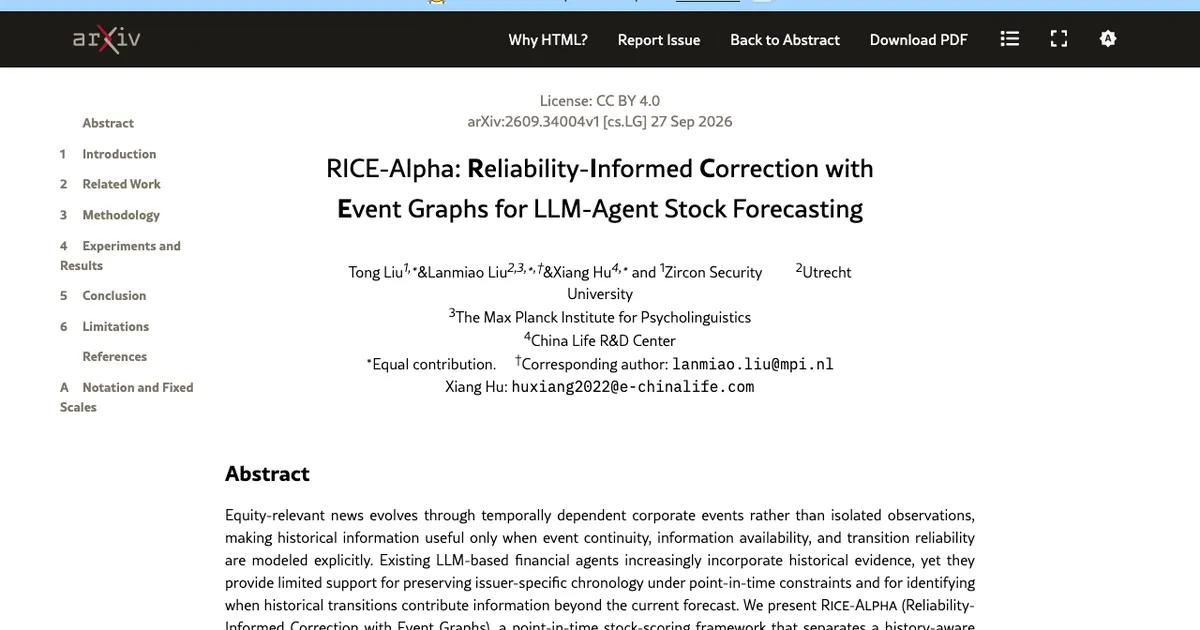
RICE-Alpha: Reliability-Informed Correction with Event Graphs for LLM-Agent Stock Forecasting
🚀 Predicting the Market with Event Graphs: RICE-Alpha Explained
Are you building advanced financial AI? Stock forecasting used to rely on simple historical averages. But modern market movements—especially those driven by corporate news and unpredictable events—require an understanding of when information is valid, how it connects chronologically, and what transitions are most reliable.
That’s exactly what the groundbreaking research behind RICE-Alpha tackles. This paper introduces a radical shift in how Large Language Models (LLMs) consume financial history for stock prediction.
🧠 What is RICE-Alpha?
The core idea is simple yet profound: A company’s historical news flow isn’t just a pile of data. It’s an interconnected graph of events. The performance of an LLM agent depends on how well it models the continuity and reliability of these events.
RICE-Alpha (Reliability-Informed Correction with Event Graphs) treats stock prediction as a two-part system:
- Base Alpha: A comprehensive view incorporating various multi-view historical signals. This is the agent’s primary forecast.
- Residual Correction ($ ext{RICE Delta}$): This crucial second component captures the incremental information gained specifically from tracking the reliability and temporal continuity of corporate events (e.g., an event that was highly likely to happen but didn’t, or a transition whose historical path has proven unreliable).
By focusing on this residual signal—the reliable parts of the history that aren’t already captured by standard models—RICE-Alpha significantly boosts accuracy.
⚙️ How Does It Work? (The Tech Deep Dive)
The model uses sophisticated graph mechanisms to manage time and context:
- Multi-Tier Memory Layer: Instead of treating all history equally, this layer grounds the LLM’s interpretation in temporally eligible, issuer-specific history. This prevents noise from unrelated or chronologically impossible events.
- Typed Event Agent & Event Graphs: The model doesn’t just process text; it models event states. It builds successor relationships between these event states within a specific company (issuer-level) and only pools those reliable relationships across multiple companies after local validation. This keeps the narrative grounded.
- Reliability Calibration: This is key. Transitions are calibrated using their empirical reliability—how often they occur in reality. The final graph signal is then residualized, subtracting it from the Base Alpha view. This isolates and quantifies pure, novel information derived from event continuity.
📈 The Results: A Major Leap in Financial AI
Testing on critical financial indexes like the Nasdaq-100 and Hang Seng Index using data spanning 2024–2026 reveals striking results. RICE-Alpha surpasses existing state-of-the-art LLM agents and benchmark momentum strategies across multiple rigorous metrics.
Most dramatically, its Information Coefficient Improvement Ratio (ICIR) more than doubles that of the strongest baseline. Furthermore, net Sharpe ratios reached impressive levels (1.656 in the U.S. and 1.725 in Hong Kong), demonstrating superior risk-adjusted performance for predictive portfolio construction.
What this means for quant finance: Simply having access to massive amounts of news data isn’t enough. The breakthrough is proving that how we structure, constrain, and quantify the temporal reliability of events—treating history as a differential signal—is what unlocks superior market predictability.
➡️ Read the full paper: RICE-Alpha: Reliability-Informed Correction with Event Graphs
Disclaimer: This article is for informational purposes and does not constitute financial advice.