← Back to Archive

Digest for 2026-07-20

🐦 Share on X 💼 Share on LinkedIn 📘 Share on Facebook

Attacking Graph Foundation Models Through Their Shared Representation
By Pankaj Kumar, Subhankar Mishra • arXiv • Importance: 90/100
Hero Image for 2607.18567

🛡️ Breaking the Code: Attacking Graph Foundation Models’ Shared Brain

By [Your Blog Name], ML Security Insights

The modern AI landscape is increasingly powered by ‘Foundation Models’—massive, generalized systems designed to tackle diverse problems. While powerful, these models are not immune to attack. Our latest research dives deep into the architecture of Graph Foundation Models (GFMs), exposing a critical, unstudied vulnerability: their shared representation layer.

Think of a GFM as having a centralized ‘shared brain’—a core space where all incoming information (edges, features, text) is mapped before any task-specific reasoning happens. This crucial mapping layer, which separates GFMs from older Graph Neural Networks (GNNs), is precisely the Achilles’ heel we targeted.

🔬 What Did We Discover? The Alignment Layer Flaw

We subjected six diverse public GFM architectures to rigorous adversarial testing. Our findings reveal that this shared ‘alignment layer’ acts as a powerful, unified point of failure.

  1. Representation-Space Attack: A highly focused perturbation on the internal representation space was enough to cause catastrophic failures across multiple models, sometimes requiring significantly less attack budget than a traditional GNN would need.
  2. Input-Space Attack: We also developed a realizable attack—one that actually edits observable graph inputs (edges or features). This direct manipulation removed at least half of the correct predictions on three of the six tested models at peak performance.

🤯 The Key Takeaway: Representation vs. Input Fragility

The most critical finding is understanding where the fragility resides. Our work shows that simply having high clean accuracy (performing well on standard test data) does not guarantee robustness when faced with a targeted attack. Furthermore, how robust a model is depends heavily on whether an attacker can directly access and manipulate the raw inputs versus if they must tamper with the model’s hidden representations.

This research provides structural measures (like local Lipschitz sensitivity) for defensive mitigation, giving developers concrete metrics to improve model resilience by addressing flaws in how the decoder reads the representation.

👉 Read the full paper and see the technical details here: https://arxiv.org/abs/2607.18567

Security is not an afterthought; it must be baked into the foundation itself.
Hybrid Latent-Structural Fusion (HLSF) for Cyber Anomaly Detection

By Dorianis M. Perez, Maksim E. Eren, Bryan E. Kaiser • arXiv • Importance: 88/100
Hero Image for 2607.18479

🚨 Supercharge Your Cyber Defenses: New Hybrid Model for Anomaly Detection

As digital threats become more sophisticated and high-stakes enterprise networks face relentless attacks, simple perimeter defenses are no longer enough. Detecting malicious anomalies—the subtle blips in normal behavior—is the holy grail of cybersecurity. New research introduces a powerful framework called Hybrid Latent-Structural Fusion (HLSF) designed to revolutionize how we spot intrusions.

🧠 The Problem: Too Many Layers, Too Few Signals

The difficulty lies in modeling complex user and network behaviors. Traditional methods often struggle because they treat data features or structural components independently, missing the crucial correlation between different types of ‘abnormal’ signals.

Existing advanced techniques like CP-APR (a specialized tensor decomposition method) are great at capturing the underlying structure of multi-dimensional data, while Normalizing Flows excel at mapping and understanding high-density distributions in latent space. However, using them separately limits the total detection power.

✨ Introducing HLSF: The Fusion Advantage

Our research presents HLSF—a weighted anomaly fusion framework. Instead of choosing between two powerful techniques, HLSF intelligently combines their strengths. It takes the structural ‘anomaly scores’ from CP-APR and fuses them with the density ‘scores’ derived from Normalizing Flows. The result is a much more holistic and robust understanding of what constitutes an attack.

🔬 Proven in a High-Security Environment

This isn’t just theory. We rigorously tested HLSF on real-world data: compromised user credentials collected from the large, sensitive enterprise network of Los Alamos National Laboratory (LANL) during a red-teaming exercise. The results were clear: HLSF significantly outperformed using either CP-APR or Normalizing Flows alone.

Key Takeaway for Security Teams: By merging structural analysis with density modeling, HLSF offers a significant performance boost in detecting subtle, multi-faceted anomalies that bypass single-method detection systems.

Want to read the full technical details? Check out the paper here


For CTOs & ML Engineers: If your organization relies on advanced unsupervised learning for behavioral analytics, HLSF represents a critical improvement in model robustness and detection capability. Stay ahead of the next wave of cyber threats!

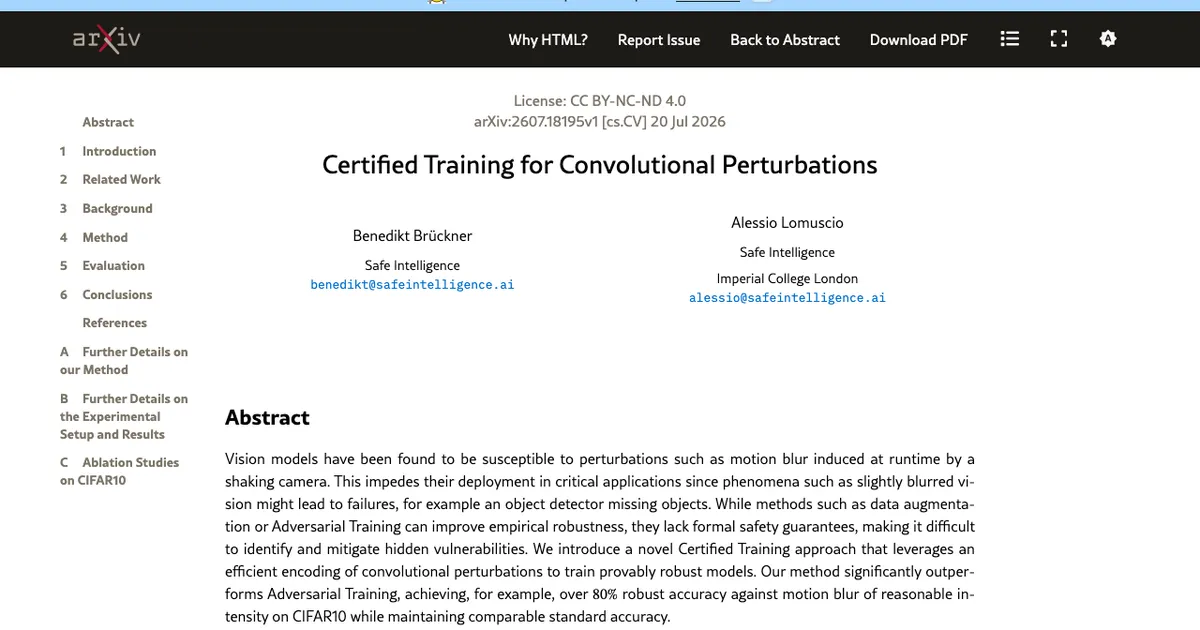
Certified Training for Convolutional Perturbations

By Benedikt Brückner, Alessio Lomuscio • arXiv • Importance: 88/100
Hero Image for 2607.18195

🛡️ Making AI Vision Models Ironclad: Certified Defense Against Blur and Perturbations

The Problem: Computer vision models—the backbone of self-driving cars, medical diagnosis, and industrial inspection—are secretly fragile. We’ve all seen the headlines about edge cases, but there’s a deeper issue: real-world imperfections like minor camera shake or slight motion blur can cause these critical AI systems to fail entirely. Current training methods (like simple data augmentation or standard Adversarial Training) might make the models look robust in testing, but they offer zero formal safety guarantees when things go wrong in the field.

The Breakthrough: Researchers Benedikt Brückner and Alessio Lomuscio introduce a novel approach: Certified Training for Convolutional Perturbations. This isn’t just another training trick; it’s a mathematical framework designed to guarantee that even if minor, real-world blur or perturbations hit the model at runtime, its performance remains within provable bounds.

How It Works (The ML Magic): Instead of simply feeding the network blurry pictures and hoping for the best, this method ingeniously encodes the structure of convolutional perturbations. By training on these certified representations, the resulting vision models are not just empirically robust—they are provably robust. This means we can guarantee their reliability against specified types of noise.

Why This Matters: Think of safety-critical applications. An object detection system powered by this method won’t suddenly lose sight of a bicycle because the camera wobbled slightly. By achieving over 80% robust accuracy on datasets like CIFAR10 while maintaining high standard performance, this approach significantly outperforms existing Adversarial Training techniques.

🔬 TL;DR: If you are building safety-critical AI for autonomous systems, understanding and quantifying uncertainty due to real-world noise is crucial. This research provides a necessary leap from ‘best effort’ robustness to guaranteed robustness, making AI usable in the most demanding environments.

🔗 Read the paper here: https://arxiv.org/abs/2607.18195


Keywords for Search Engines: Certified Robustness, Vision Models, Convolutional Perturbations, Adversarial Training, Motion Blur, AI Safety, Computer Vision

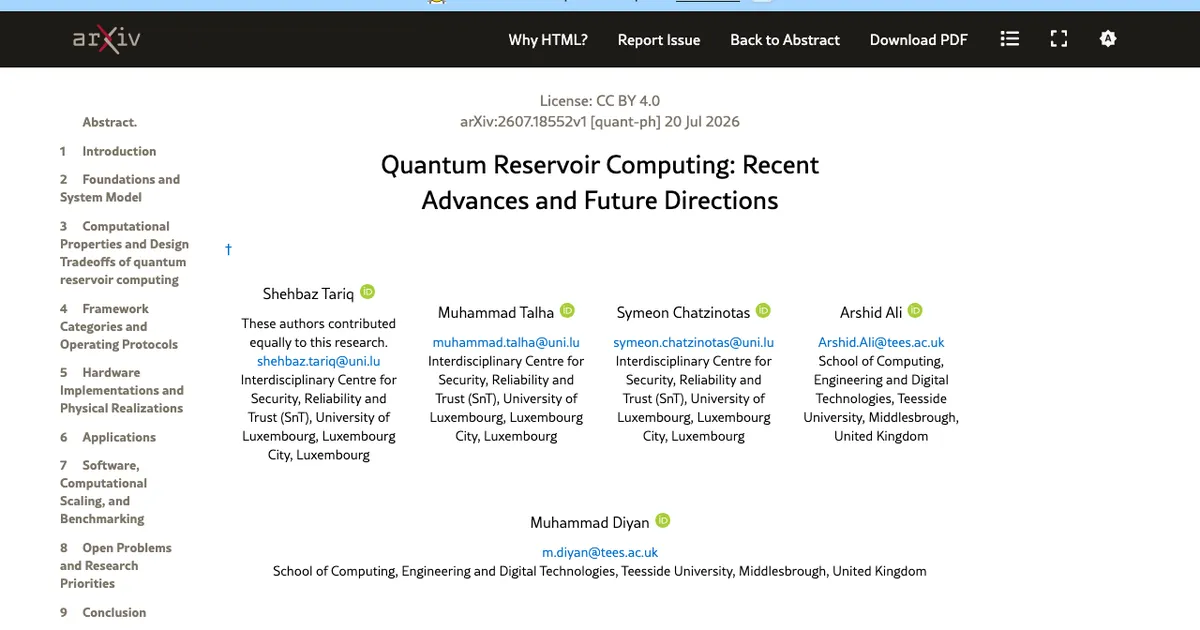
Quantum Reservoir Computing: Recent Advances and Future Directions

By Shehbaz Tariq, Muhammad Talha, Arshid Ali, Muhammad Diyan, Symeon Chatzinotas • arXiv • Importance: 85/100
Hero Image for 2607.18552

🚀 Quantum Reservoir Computing: The Next Frontier in AI

Are quantum computers going to revolutionize AI? Not necessarily by optimizing every layer—and that’s the surprising key takeaway from this deep dive into Quantum Reservoir Computing (QRC).

Quantum Reservoir Computing (QRC) is a fascinating hybrid approach. Instead of forcing an entire massive quantum circuit to train simultaneously, it leverages the complex, exponentially rich dynamics of a fixed quantum system as a high-dimensional feature extractor. Then, only the final classical readout needs training.

🧠 How Does QRC Work? The Secret Sauce:

Think of the quantum system (the ‘reservoir’) like a massive, pre-wired neural network layer that performs incredibly complex transformations on time series data. When you feed sequential input into this fixed quantum state, it naturally maps that subtle signal into an exponentially large feature space. This separation—fixed quantum evolution + classical readout training—is crucial because it bypasses two major headaches of variational quantum algorithms: the difficulty of updating vast parameters and the notorious ‘barren plateaus’ problem.

💡 But Wait, It’s Not Just About Size:

The authors correctly point out that having a massive Hilbert space (a large state space) doesn’t automatically guarantee superior performance. The actual power depends on an intricate combination of factors: how you encode the input, the specific quantum evolution mechanism, the observable measurements, and the classical readout design.

Furthermore, real-world hardware introduces limitations—finite sampling, noise, and measurement backaction. This means that theory often diverges sharply from practice.

🔬 What’s New in this Survey? (And Why It Matters):

This comprehensive survey systematically organizes the entire field of QRC. It connects theoretical foundations to practical implementation across diverse quantum platforms: * Spin Systems: Utilizing electron spins for computation. * Photonic Systems: Using light properties. * Superconducting Circuits: Employing superconducting qubits. * Bosonic/Neutral Atom Platforms: Leveraging other emerging hardware technologies.

The paper doesn’t just showcase amazing circuits; it establishes a rigorous common system model. Critically, it moves beyond hype by setting demanding standards: It specifies the resource accounting and benchmark criteria needed to genuinely claim ‘quantum advantage,’ forcing researchers to distinguish between theoretical simulation capability and noisy hardware reality.

🔑 The Takeaway for ML Engineers:

While current results don’t yet establish a broad, definitive quantum advantage over well-matched classical reservoirs, this paper provides the essential blueprint. It helps us understand what resources are needed and how we must rigorously benchmark QRC claims across disparate physical hardware (simulations vs. actual devices). This survey is mandatory reading for anyone building advanced AI systems that might eventually interact with real quantum hardware.

🔗 Dive into the Details: Quantum Reservoir Computing: Recent Advances and Future Directions https://arxiv.org/abs/2607.18552

QuantumComputing #MachineLearning #AIResearch #ReservoirComputing #DeepLearning

Adversarial Robustness of Phishing Email Detection: A Comparative Study of TF-IDF + Logistic Regression and Fine-Tuned DistilBERT

By Tanveer Ahmed, Seyedali Pourmoafil • arXiv • Importance: 85/100

Is Your Phishing Detector Actually Safe? We Stress-Tested Top ML Models.

Phishing emails are not going anywhere. They’re persistent, sophisticated, and constantly evolve to bypass our digital defenses. While many machine learning models claim near-perfect accuracy on ‘clean’ data, we found a critical vulnerability: these detectors crash when faced with deliberately altered, adversarial attacks.

In our latest research, we performed a deep dive into how well different approaches detect sophisticated phishing emails under stress. Our findings are sobering and point to an urgent need for change in the cybersecurity evaluation landscape.

The models we compared—a classic TF-IDF + Logistic Regression baseline and a state-of-the-art fine-tuned DistilBERT transformer—both boasted impressive performance on standard, ‘in-distribution’ test sets (over 98% accuracy!). But when confronted with adversarial samples—emails subtly tweaked to trick the system—both models saw massive drops in performance.

The results were startling: both systems plummeted from near-perfect detection rates to around the mid-60s. The drop was huge, signaling that high clean-data accuracy is a poor predictor of real-world robustness.

🔬 Key Takeaways for Security Engineers:

  1. Adversarial Testing is Non-Negotiable: Our work strongly recommends adopting adversarial testing as a standard requirement for any phishing detection system. Relying only on clean data metrics creates a false sense of security.
  2. Similar Vulnerabilities, Different Failures: While both BERT and TF-IDF struggled similarly under attack (losing over 34 percentage points), detailed analysis using LIME/SHAP showed they relied on different features for their predictions. Critically, while they made many shared errors, each model also exhibited unique failure patterns, suggesting complementary—rather than identical—weaknesses.
  3. The Gap is Small: Both models agreed on over 54% of the adversarial samples, indicating that while they are not perfect fallbacks for each other, their points of failure overlap significantly.

What does this mean for cybersecurity? It means that today’s highly accurate phishing detectors might be severely under-prepared for determined attackers. This research mandates a fundamental shift in how we validate and deploy ML tools against evolving cyber threats.

🔗 Read the full comparative study on adversarial robustness: https://arxiv.org/abs/2607.18429

#Cybersecurity #MLSecurity #PhishingDetection #NLP #AdversarialAI #DeepLearning

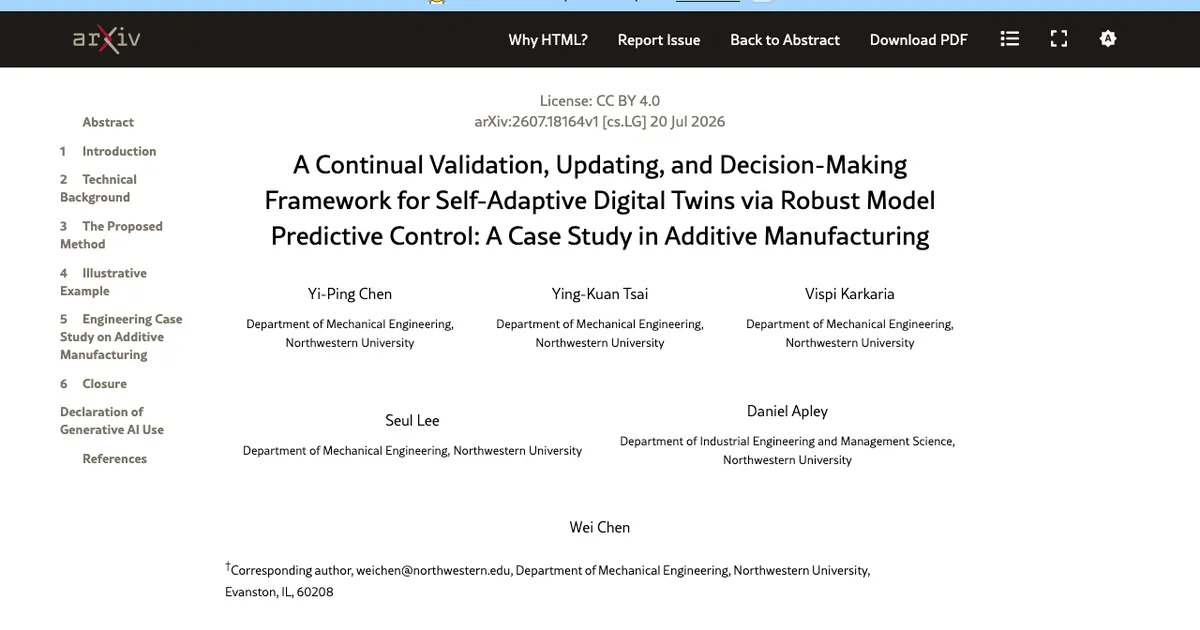
A Continual Validation, Updating, and Decision-Making Framework for Self-Adaptive Digital Twins via Robust Model Predictive Control: A Case Study in Additive Manufacturing

By Yi-Ping Chen, Ying-Kuan Tsai, Vispi Karkaria, Seul Lee, Daniel Apley, Wei Chen • arXiv • Importance: 85/100
Hero Image for 2607.18164

Mastering the Future of Digital Twins: Self-Healing AI for Complex Systems

Ever wonder how smart factories and complex machinery stay accurate over years of use? Traditional AI models are great at initial predictions, but they suffer from a critical flaw: they degrade as the real world changes. This problem is known in ML circles as concept drift.

A Digital Twin (DT) — a virtual replica of a physical asset—is supposed to be constantly perfect. But when operating conditions change (be it temperature shifts or wear and tear), the model powering the twin loses fidelity. Making DTs that can automatically fix themselves is the holy grail of Industry 4.0.

This groundbreaking research solves that problem with an elegant, self-adaptive framework. We introduce a system designed to keep Digital Twins running at peak performance by ensuring they are always learning and statistically certified before any update goes live.

🔬 How Does This AI Keep Itself Fixed? (The Technical Deep Dive)

This paper proposes an advanced adaptive DT architecture that brings together statistical rigor, cutting-edge continual learning, and robust control theory. Instead of just guessing when a model is bad, the system actively monitors its own confidence using specialized metrics:

  1. Drift Detection: It employs a novel Fisher score-based multivariate detector. This acts like an early warning system, pinpointing when the real world has shifted away from the training data.
  2. Efficient Learning (LoRA): When drift is detected, the system doesn’t retrain everything. It uses Low-Rank Adaptation (LoRA), which fine-tunes only a tiny fraction of the model’s parameters (often less than 1%). This makes adaptation fast, energy efficient, and avoids catastrophic forgetting.
  3. Statistical Validation: Crucially, before accepting any changes, the framework runs an online statistical test (Mann-Whitney U test). This step acts as a gatekeeper, mathematically certifying that the newly adapted model is statistically better than the old one.

The combination of these elements creates a truly robust feedback loop: Detect $ ightarrow$ Learn Efficiently $ ightarrow$ Validate Rigorously.

🏭 Real-World Impact: Additive Manufacturing & Beyond

The authors successfully tested this framework on highly complex, stochastic systems, including directed energy deposition (DED) additive manufacturing. These are processes where subtle changes in parameters drastically affect the final part’s quality.

By applying this self-adaptive approach, the system not only maintained high predictive accuracy but also kept a proper estimate of its uncertainty quantification even after encountering abrupt or gradual operational shifts. This level of reliability is absolutely critical for deploying DTs in mission-critical industrial environments—from aerospace manufacturing to smart infrastructure.

🚀 Key Takeaways for Industry and Researchers

  • Trustworthiness by Design: The framework establishes a new standard for trusting AI systems in continuous operational cycles. It moves Digital Twins from experimental tools to dependable, industrial assets.
  • Efficiency: Using LoRA makes the adaptation process lightweight and highly practical for deployment on resource-constrained edge devices.
  • Scientific Rigor: By combining signal processing (Fisher scores) with classical statistics (Mann-Whitney U), the paper offers a mathematically sound pathway to combating model degradation.

🔗 Read the Full Paper: For those interested in the mathematical details, the methodology, and the full case study on additive manufacturing, you can access the paper here: https://arxiv.org/abs/2607.18164

DigitalTwins #MLOps #AIforIndustry #AdditiveManufacturing #DeepLearning

AIDA Agents: A Multi-Agent Translation Platform with Context-Aware Quality Control

By Emanuele Di Rosa and Piotr Peszynski in Proceedings of the 26th Annual Conference of the European Association for Machine Translation (Volume 2) • ACL Anthology • Importance: 85/100
Hero Image for acl_2026.eamt-2.4

$ ext{AIDA Agents}$: The Next Generation of Context-Aware Machine Translation

The headache of imperfect machine translations is well-known. Even the best LLMs struggle when dealing with complex contexts, specialized terminology, and diverse style guides. Enter AIDA Agents, a groundbreaking multi-agent platform designed to completely overhaul how high-stakes content is translated.

Think of AIDA not just as a single large language model, but as an entire highly efficient translation team. Instead of relying on one monolithic AI pass, it orchestrates specialized ‘agents’—each tackling a specific aspect of the translation process: drafting, quality review, human-like post-editing simulation, and re-rating. This multi-stage approach ensures that context is maintained at every step.

🚀 How AIDA Agents Works Under the Hood (The Tech Stack)

AIDA’s power lies in its intelligent orchestration and modularity. Here’s a deep dive into what makes it revolutionary:

  • Multi-Agent Framework: It uses several specialized LLM agents working together. This process emulates the rigorous workflow of professional human translation teams, dramatically boosting quality.
  • Context Injection (RAG): The platform incorporates Retrieval-Augmented Generation (RAG), allowing it to inject crucial context—such as corporate style guides, internal terminology glossaries, and existing translation memories—at every single stage. This is critical for consistency in large, multi-document projects.
  • Zero Fine-Tuning: Crucially, AIDA achieves top-tier performance without the need for expensive and time-consuming model fine-tuning on proprietary datasets. It uses orchestration intelligently to boost capability.
  • Integration Ready: With native XLIFF support, AIDA is built for industrial deployment, making it immediately usable by professional localization teams globally.

🏆 Performance Speaks Louder Than Buzzwords

In rigorous testing, AIDA Agents set a new benchmark. On the demanding WMT24++ challenge (covering 11 languages), AIDA outperformed all competitor systems across an impressive 10 out of 11 language pairs. For real-world enterprise use cases, it achieved astonishing results: 70–98% of translated segments were deemed publication-ready without any human post-editing.

This isn’t just incremental improvement; this is a major leap toward truly automated, high-quality, contextually accurate cross-lingual content generation.

🔑 Key Takeaways for Industry Professionals

If your business relies on translating large volumes of complex or specialized content (legal documents, technical manuals, marketing campaigns), AIDA Agents represents the industrial solution you’ve been waiting for. It promises not just accuracy, but reliability at scale.

👉 Want to read the full academic deep dive? You can review the paper here: https://aclanthology.org/2026.eamt-2.4/

MachineTranslation #LLM #AIResearch #NLP #Localization #AIDAAgents

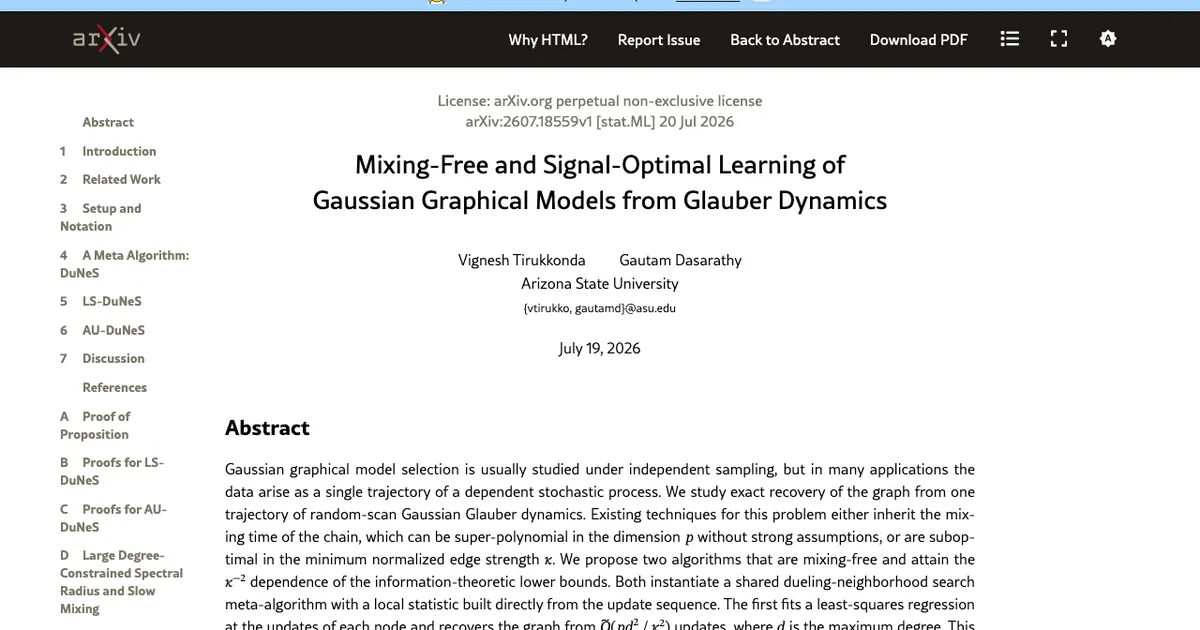
Mixing-Free and Signal-Optimal Learning of Gaussian Graphical Models from Glauber Dynamics

By Vignesh Tirukkonda, Gautam Dasarathy • arXiv • Importance: 80/100
Hero Image for 2607.18559

Gaussian Graphs from Single Trajectories: New Breakthrough in Statistical Inference

If your data isn’t sampled independently—if it comes as a single continuous stream or trajectory—traditional machine learning models struggle. Many real-world processes, from complex biological systems to financial market fluctuations, are inherently dependent.

Gaussian Graphical Model (GGM) selection is crucial for understanding which variables influence each other (i.e., building the network structure). But when data arrives as a single sample path (a ‘trajectory’) from a random process like Glauber dynamics, the standard statistical assumption of independent sampling breaks down, making graph recovery incredibly difficult.

Our new research tackles this formidable challenge head-on. We introduce two groundbreaking algorithms that can accurately recover the underlying dependency structure—the Gaussian graph—directly from one observed trajectory, even without assuming stationarity or relying on complex mixing time analysis!

🧠 The Technical Challenge: Dependent Data

The core problem is analyzing signals embedded in a dependent, non-stationary sequence. Standard methods often fail because they assume the process has mixed fully (i.e., reached equilibrium) or require assumptions about the data’s stability over time. This dramatically limits their real-world applicability.

✨ Our Solutions: Mixing-Free & Signal-Optimal

We propose two novel, highly robust algorithms that overcome these limitations:

  1. The Local Regression Approach: By fitting a least-squares regression locally at each node’s update, the first algorithm achieves excellent point-wise recovery while maintaining computational tractability.
  2. The Update Pattern Counting Method: This second method leverages counting specific update patterns in the sequence. It is particularly appealing because its complexity does not depend on any strict conditioning number, making it extremely robust across different data distributions.

Crucially, both approaches are ‘mixing-free,’ meaning they do not require the process to approach stationarity or rely on spectral gap assumptions. Furthermore, we match the best known information-theoretic lower bounds in terms of dependence on the edge strength $\kappa$.

🚀 Why This Matters for ML and Data Science?

This work moves GGM inference from idealized controlled environments into the messy reality of real-world data streams. For researchers working with complex time series, spatial dependencies, or dynamic systems (think physics simulations or neural network state transitions), this provides a powerful toolkit to map out dependency relationships that were previously inaccessible.

Read the full technical details and methodology: https://arxiv.org/abs/2607.18559

Tags: #MachineLearning #Statistics #TimeSeries #GaussianGraphicalModels #DataScience #StatisticalInference

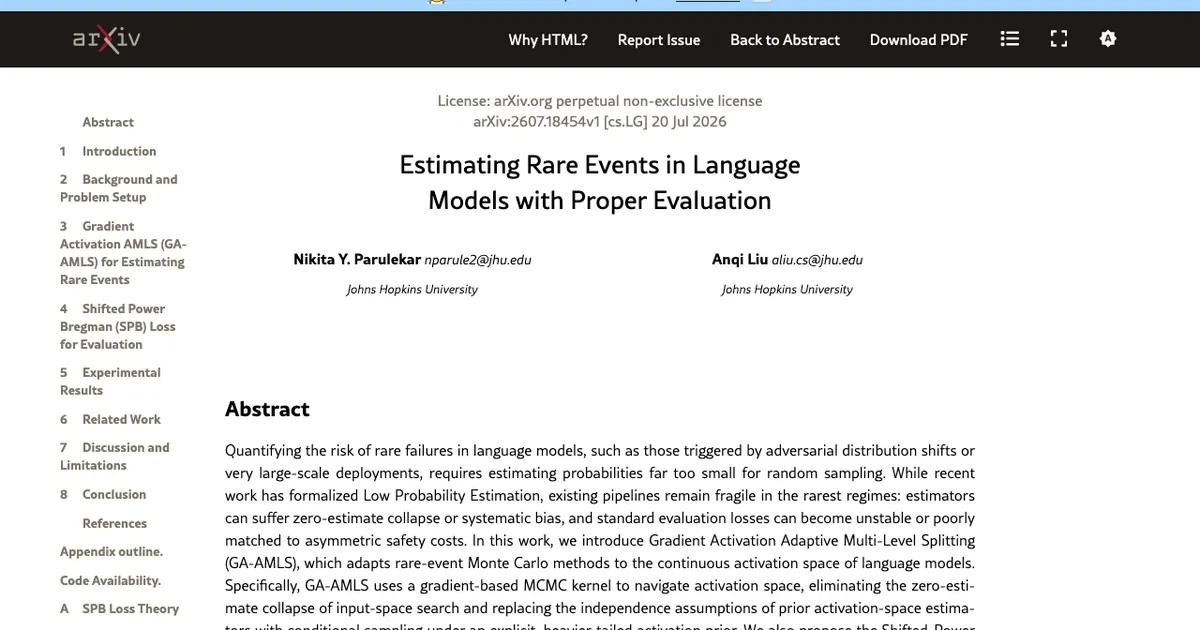
Estimating Rare Events in Language Models with Proper Evaluation

By Nikita Y. Parulekar, Anqi Liu • arXiv • Importance: 80/100
Hero Image for 2607.18454

🚨 LLM Safety Warning: Are You Measuring the Unmeasurable Risks? 📊

As Large Language Models (LLMs) become mission-critical—powering everything from financial trading to medical diagnostics—the stakes for failure are sky-high. But how do you test for failures that might happen only once in a million uses?

Most standard LLM evaluation techniques fail when trying to quantify these ‘rare events.’ If the probability of a failure (like an adversarial attack or catastrophic hallucination) is extremely low, traditional methods struggle, often giving dangerously optimistic zero-estimates.

That’s why we developed Gradient Activation Adaptive Multi-Level Splitting (GA-AMLS): a breakthrough method for assessing extreme LLM safety risks.

🔬 The Problem with Standard Testing

When evaluating AI, we often assume that if something hasn’t broken during our test period, it never will. This assumption breaks down in the ‘rare event’ regime. Traditional testing methods can suffer from:

  • Zero-Estimate Collapse: They simply say the failure probability is zero, even if a rare failure mode exists.
  • Fragile Biases: The results are highly unstable and don’t account for the asymmetric cost of different errors (e.g., underestimating risk vs. overestimating caution).

💡 Our Solution: Diving into Activation Space

The key insight from our research is that instead of searching through the high-dimensional, messy space of all possible inputs (the discrete text), we should analyze the continuous mathematical space where the model operates—its activation space.

GA-AMLS leverages this by using a gradient-based MCMC kernel. This allows us to navigate the underlying structure of the LLM’s decision-making process continuously, bypassing the brittleness and limitations of input-space searches.

Furthermore, we introduce the Shifted-Power Bregman (SPB) Loss, a specialized scoring rule that doesn’t collapse when probabilities are zero. It allows deployers to fine-tune how much they penalize underestimation versus overestimation—a crucial feature for real-world safety budgets.

🚀 What Does This Mean for AI Deployment?

The findings on small transformers prove that the choice of evaluation metric is paramount. If you are operating in a high-stakes, asymmetric cost environment (where a failure is extremely expensive), you must use an estimator designed for those specific conditions.

The Takeaway: Don’t just measure average performance. For critical systems, robust LLM safety requires deep methods that can accurately quantify and estimate truly rare failure modes in the model’s internal math space.

🔗 Read the full details of our work here: https://arxiv.org/abs/2607.18454

(Keywords: LLM Safety, Rare Event Estimation, Activation Space, MCMC, Transformers, ML Reliability)

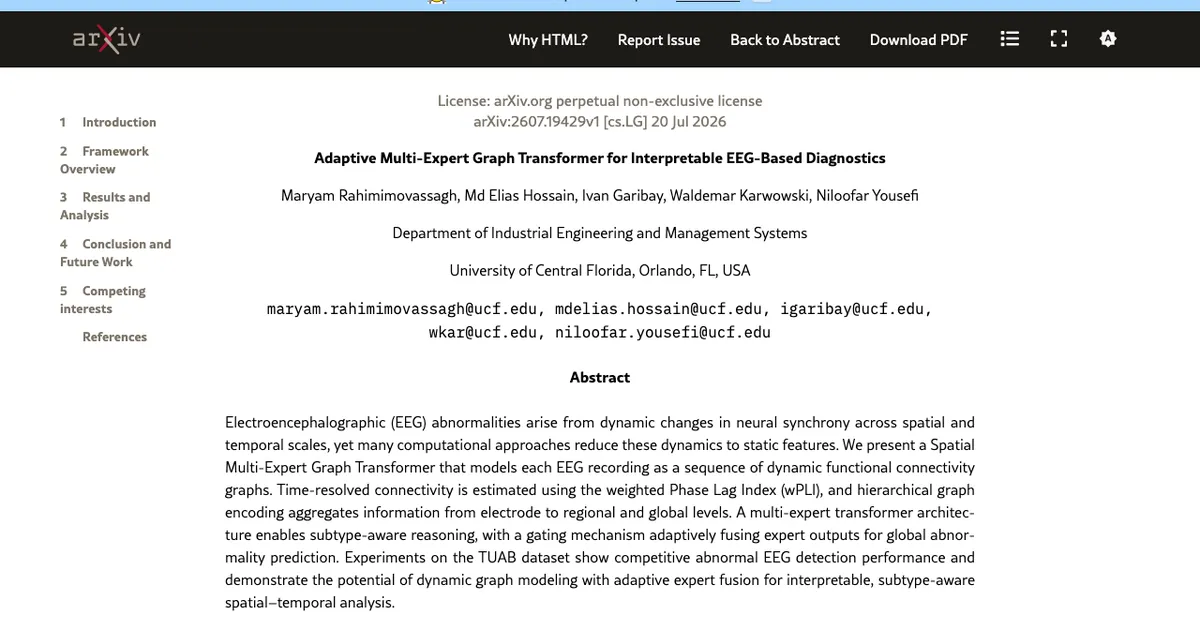
Adaptive Multi-Expert Graph Transformer for Interpretable EEG-Based Diagnostics

By Maryam Rahimimovassagh, Md Elias Hossain, Ivan Garibay, Niloofar Yousefi • arXiv • Importance: 80/100
Hero Image for 2607.19429

🧠 Decoding the Brain’s Language: New Graph Transformer for Interpretable EEG Diagnostics

As an AI researcher and tech enthusiast, I spend a lot of time digging into how we can make machine learning models not just accurate, but understandable. When it comes to medical diagnostics—especially reading brain activity from EEG scans—the biggest challenge isn’t just detecting ‘abnormal’; it’s figuring out why the pattern is wrong.

Traditional methods often treat complex biological signals like static snapshots. But the human brain is dynamic, evolving its synchrony moment by moment. The new research presented in this paper tackles that core limitation head-on.

💡 The Problem with Static AI Models

The brain communicates through intricate networks of electrical activity (neural synchrony). When things go wrong—due to seizures, sleep disorders, or other pathologies—these communication patterns change dramatically across space and time. Early ML models typically reduced a complex EEG recording into simple, static features, losing the crucial temporal depth and spatial relationship between electrodes.

🏗️ What’s New: The Adaptive Multi-Expert Graph Transformer

The authors introduced a sophisticated solution: an Adaptive Multi-Expert Graph Transformer. This architecture fundamentally changes how we model brain data by treating every EEG recording not as a single file, but as a continuous stream of dynamically changing functional connectivity graphs.

Here’s the tech breakdown:

  • Dynamic Graphs: Using metrics like weighted Phase Lag Index (wPLI), they capture real-time changes in how different brain regions are talking to each other. This is critical for capturing transient events.
  • Hierarchical Encoding: The model learns information at multiple levels—from specific individual electrodes, up to entire functional regions, and finally to a global system perspective. This provides comprehensive context.
  • Multi-Expert Fusion (The Magic): Instead of relying on one single prediction path, the Transformer employs multiple experts. Each expert is potentially tuned to detect a different type or subtype of abnormality. A sophisticated gating mechanism then adaptively weighs and fuses these expert outputs. This isn’t just an ensemble; it enables true subtype-aware reasoning, meaning the model can differentiate between subtle but distinct types of underlying brain dysfunction.

🔬 Why is this a Big Deal?

  1. Interpretability: By modeling connectivity changes dynamically and using expert fusion, the system provides higher interpretability, telling clinicians which specific pattern or region contributed most to the diagnostic suspicion—a huge leap for clinical adoption.
  2. Superior Dynamics Capture: It moves beyond static feature extraction, giving a much richer, time-resolved view of neural function.
  3. Subtype Precision: The ability to perform subtype-aware diagnosis is invaluable in neurology, where conditions often manifest with heterogeneous patterns.

This paper shows the immense potential of combining graph modeling (natural for network data) with advanced Transformers (powerful sequence processing) to solve complex, dynamic biological problems. For researchers and clinicians looking for next-generation diagnostics, this work warrants close attention.

🔗 Read the full technical paper on ArXiv: https://arxiv.org/abs/2607.19429

#MachineLearning #Neuroscience #EEG #DeepLearning #GraphTransformers

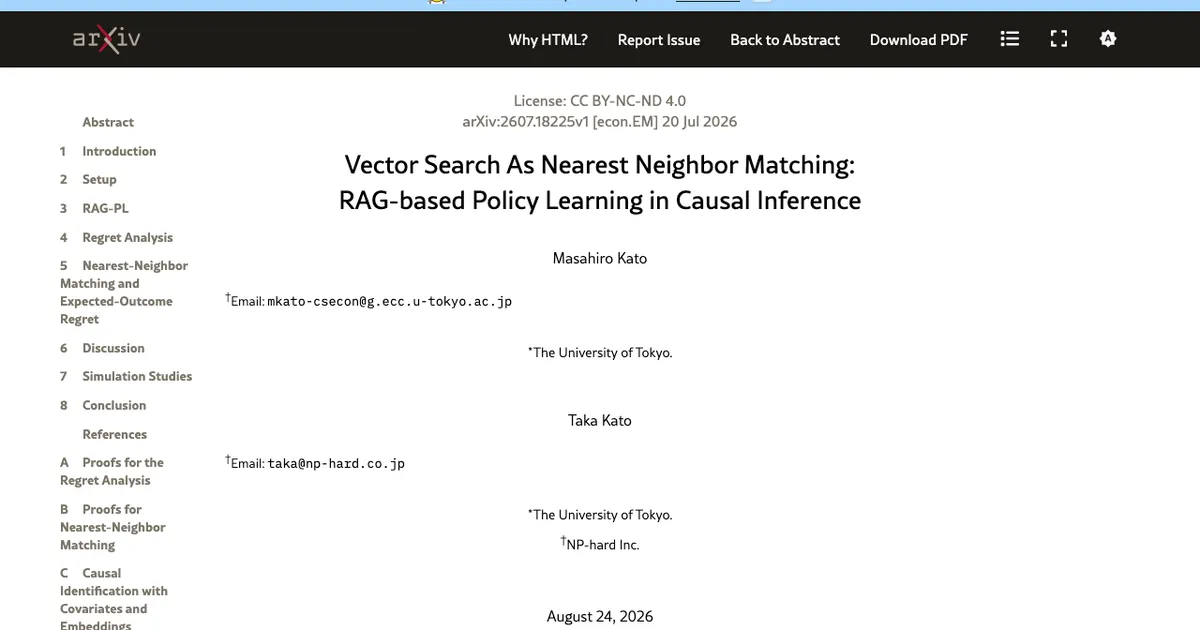
Vector Search As Nearest Neighbor Matching: RAG-based Policy Learning in Causal Inference

By Masahiro Kato, Taka Kato • arXiv • Importance: 80/100
Hero Image for 2607.18225

🚀 Bridging the Gap: Using Vector Search to Learn Optimal Policies in Causal Inference

Have you ever wondered how AI can make complex decisions that aren’t just based on predicting the next word, but on figuring out the best action to take in a real-world scenario? Standard Large Language Models (LLMs) are phenomenal at pattern recognition, but decision-making under uncertainty—the kind requiring causal understanding—is where they often stumble.

New research from Kato et al. tackles this critical challenge by proposing an innovative framework: connecting Vector Search (the backbone of RAG) directly to the rigorous world of Causal Inference.

🤔 The Core Problem: Why Standard LLMs Aren’t Enough

The goal of causal inference is not just prediction; it’s determining why something happens and figuring out what would happen if we intervened (e.g., ‘If we launch Feature X, what will the user adoption rate be?’). Traditional RAG systems use vector search to retrieve relevant documents, providing context. However, they don’t inherently provide a structured method for action selection that minimizes regret or maximizes expected outcomes.

🛠️ The Solution: Action-Specific Nearest Neighbors

This paper proposes a powerful two-step policy learning approach. Think of it like this:

  1. Candidate Generation (Vector Search): Instead of retrieving general context, the system uses specialized vector search to find neighboring evidence that is highly relevant to specific potential actions. It narrows down the possible decision space.
  2. Refinement & Selection (LLM/Causal Model): The generative model then estimates conditional expected outcomes for these narrowed candidates or contrasts between them. Finally, a plug-in rule selects the optimal action based on maximizing the predicted outcome.

This formulation essentially treats action selection as finding the nearest neighbor to the desired outcome in an embedding space—a critical connection that grounds the black box of LLMs in measurable causal theory (potential outcomes).

💡 Why This Matters for AI Development (SEO & GEO Focus)

  • For Companies Building Enterprise AI (Enterprise Focus): If your business requires highly reliable, actionable decision-making—whether optimizing supply chains, personalized medical treatments, or financial risk assessment—this framework provides a structured way to move beyond mere correlation and establish causal links. It’s the next evolution of Responsible AI.
  • For ML Engineers in Silicon Valley (Technical Focus): This research decomposes the complexity, bounding prediction errors using established techniques for nearest-neighbor estimators and transformers. Understanding how this reduces ‘regret’ is key to building production-grade RAG systems that truly make decisions.

🌐 Key Takeaways:

  • The proposed method links Vector Search $ ightarrow$ Nearest Neighbor Matching $ ightarrow$ Causal Policy Learning.
  • It offers a quantifiable way (bounding regret) to improve the reliability of LLM-based decision agents.
  • It expands RAG from a context retrieval tool into an active, decision-making framework.

👉 Read the full technical details and mathematical proofs here: https://arxiv.org/abs/2607.18225

#CausalAI #LLMs #VectorSearch #RAG #MachineLearning #DeepLearning #ArtificialIntelligence

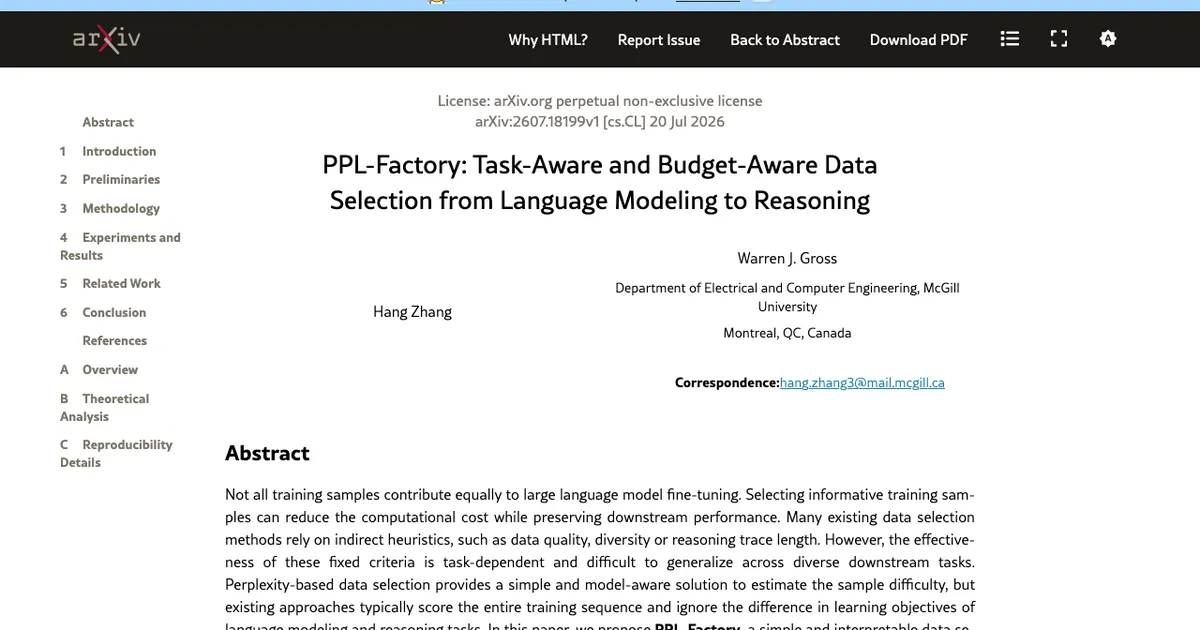
PPL-Factory: Task-Aware and Budget-Aware Data Selection from Language Modeling to Reasoning

By Hang Zhang, Warren J. Gross • arXiv • Importance: 80/100
Hero Image for 2607.18199

🔥 Stop Wasting Training Data: Introducing PPL-Factory for Hyper-Efficient LLM Tuning

In the race to build bigger, smarter Large Language Models (LLMs), the biggest bottleneck isn’t always computational power—it’s knowing which data to focus on. Simply feeding an LLM massive datasets is inefficient; many samples are redundant or simply not helpful for a specific task.

This groundbreaking paper introduces PPL-Factory, a revolutionary framework that solves the ‘data selection dilemma.’ PPL-Factory doesn’t just select random, high-quality data; it intelligently chooses training samples based on their estimated difficulty and relevance to your specific downstream task—whether that’s simple language completion or complex multi-step reasoning (like solving math problems).

🚀 What Problem Does PPL-Factory Solve?

Existing methods for data curation often rely on fixed, generalized rules (e.g., ‘diversity’ or ‘data quality score’). These heuristics fail because what works for one task (say, summarization) might be terrible for another (like mathematical reasoning).

  • The Old Way: Use a generic metric across the entire dataset, wasting compute on easy samples and missing crucial hard examples.
  • PPL-Factory’s Breakthrough: It combines two critical elements: Task-Awareness and Budget-Awareness. It uses a simplified, model-aware perplexity score to estimate how challenging (and thus informative) a sample is for the specific goal, ensuring every single token counts.

🤯 The Game-Changing Results (The Punchline)

This isn’t just incremental improvement; these results are massive:

  • Efficiency Masterclass: On the highly challenging GSM8K dataset (a common benchmark for middle school math), PPL-Factory outperforms state-of-the-art methods while utilizing only 1% of the total training data!
  • Performance Boost: Even when using a generous 10% of the data, PPL-Factory showed remarkable gains: exceeding full-data fine-tuning accuracy by a whopping 0.9 on GSM8K and an incredible 4.8 points on MATH!

These findings prove that smart, targeted data selection is an effective and highly scalable approach to making LLM fine-tuning vastly more efficient.

✨ Key Takeaways for ML Engineers & Researchers

  1. Resource Conservation: Reduce GPU time and data storage costs significantly without sacrificing performance.
  2. Enhanced Reasoning: Provides a powerful mechanism for forcing the model to learn from its ‘sweet spot’—the hard-but-solvable examples.
  3. General Applicability: The task-aware scoring system makes it versatile across diverse LLM applications, far surpassing general heuristics.

Ready to supercharge your fine-tuning pipeline? Check out the full details here: PPL-Factory Paper Link

#LLMs #MachineLearning #DataScience #AIResearch #NLP

MotifRole-Diff: Risk-Optimal Role-Aware Corruption for Masked Molecular Graph Diffusion

By Tasfia Nuzhat Ornee, Elias Hossain, Ivan Garibay, Niloofar Yousef • arXiv • Importance: 75/100
Hero Image for 2607.21634

Molecular AI Breakthrough: Training LLMs for Chemistry by Knowing What Matters

The Problem with ‘One-Size-Fits-All’ Masking in Chemistry

When you train advanced AI models (like diffusion models) to generate complex molecules, the process is often treated like generating text. You mask random parts of a molecular graph and teach the model to fill them in.

But here’s the critical flaw: treating every part of a molecule—every ‘token’ representing a chemical bond or atom—as equally important is fundamentally wrong. Structurally, some parts are easy for the model to reconstruct; others are tricky or critically determine the molecule’s function.

The standard approach uses a uniform mask schedule, which wastes effort on the easy parts while leaving the truly challenging and critical parts insufficiently trained.

👉 Introducing MotifRole-Diff: The Smarter Way to Train Molecular AI.

Attractor Geometry Determines the Identifiability Limits of System Discovery

By Matteo Gallo, Fabio Anselmi, Paolo Lazzari • arXiv • Importance: 75/100
Hero Image for 2607.18490

The Ultimate Limit to Science: How Attractor Geometry Dictates System Discovery

Are we hitting a mathematical wall in scientific discovery? Most of us assume that if you feed an enough algorithm and enough data into a model, you can eventually figure out the underlying physics. But this groundbreaking research suggests the limitation isn’t our code—it’s the system itself.

Researchers have unveiled a fundamental constraint: the geometric shape of a system’s ‘attractor’ determines whether its governing equations can even be discovered from data.

In simple terms, when we try to deduce the physics (like differential equations) that govern real-world dynamics, the attractor—the path where the system tends to settle over time—is the ultimate bottleneck.

🔬 What Does This Mean for Scientific Machine Learning? (The Core Idea)

This paper fundamentally shifts the focus of scientific discovery from ‘which algorithm is best?’ to ‘what does the physics allow us to discover?’

The key insight revolves around a single metric: $\lambda_{\min}(M)$ (the smallest eigenvalue of the invariant-measure moment matrix). This number acts as the identifiability ceiling.

The research demonstrates that this single parameter measures how fully the system’s attractor covers the function space. If $\lambda_{\min}(M)$ is near zero, it means recovery is mathematically impossible for any algorithm—whether you use sparse regression (SINDy) or evolutionary symbolic methods (PySR).

Chaos certainly spreads the data, making the system look complex and well-observed. But the study warns that this isn’t a simple upgrade! Because noise affects different algorithms differently (linearly for SINDy vs. superlinearly for PySR), deeper chaos can actually send these advanced methods in opposite directions.

Furthermore, they introduce Soft F1, a nuanced structural metric, solving performance measurement blind spots that standard success metrics miss.

🚀 Why This Matters to AI and Physics Researchers

This work provides a necessary theoretical framework for Mechanistic AI. Instead of blindly optimizing algorithms on clean data, researchers must now characterize the underlying physical system first.

  • New Benchmarks: We gain powerful, parameter-free mechanistic scores that predict when adding more complexity (e.g., increasing chaos) will not improve conditioning or discovery.
  • Robustness Check: The metrics hold up across different systems (like the Lorenz-84 and Lorenz-96), confirming they capture underlying physics, not just curve-fitting artifacts.

This paper doesn’t just optimize algorithms; it changes the question we ask at the start of any data science project: What does the attractor permit?


🔗 Read the full technical deep dive here: Attractor Geometry Determines the Identifiability Limits of System Discovery

(Published by Gallo, Anselmi, and Lazzari)

OR Else: A Differentiable Trust Region for Policy Optimization

By Chinmay Rane, Kanishka Tyagi, Michael Manry • arXiv • Importance: 75/100
Hero Image for 2607.18163

🚀 Rethinking RLHF: Introducing ‘OR Else’ for Smoother LLM Fine-Tuning

Ever wonder how powerful LLMs like Llama or GPT get so good at following complex instructions? Much of the magic involves Reinforcement Learning from Human Feedback (RLHF). But the standard optimization methods—like PPO and GRPO—rely on ‘clipped surrogate objectives.’ While these are foundational, they introduce an abrupt discontinuity that can throw a wrench into fine-tuning stability.

Enter Our Authors, Chinmay Rane, Kanishka Tyagi, and Michael Manry, tackle this problem head-on with OR Else (OR): a smooth, differentiable trust region for policy optimization.

✨ What is OR Else (OR) and Why Does It Matter?

In standard RLHF, when the model’s proposed action diverges too far from what was expected in favorable directions, the clipped objective suddenly ‘caps’ or saturates. This sudden change in the gradient is computationally messy and can lead to unstable training dynamics.

OR Else solves this by replacing the rigid clipping mechanism with an OR squared-margin loss. Instead of an abrupt cut-off, OR provides a smooth one-sided saturation rule. The core idea: it smoothly guides the model’s policy updates while still maintaining trust within a defined region—but without the nasty gradient discontinuities.

🧠 Deep Dive: PPO-OR vs. Standard Methods (A Technical Look)

Using exttt{Llama-3.2-1B-Instruct} on Anthropic’s exttt{hh-rlhf}, the authors compared OR with standard techniques like PPO-clip and GRPO. The results were compelling:

  • Under Generalized Advantage Estimation (GAE): PPO-OR showed a significantly higher mean final training reward score ($ ext{+0.305}$), suggesting superior performance and a more stable learning trajectory compared to the traditional PPO-clip method.
  • Stability Metrics: Furthermore, OR demonstrated better stability characteristics—specifically showing a smaller observed spread of scores and reducing unwanted ‘overshoot.’

OR fundamentally changes how optimization behavior works in RLHF by making the policy updates far smoother and more reliable.

💡 Key Takeaways for AI Developers & Researchers

  1. Smoothness is Power: The biggest win of OR Else is its differentiable smoothness. This improves the reliability and robustness of fine-tuning LLMs.
  2. RLHF Evolution: OR offers a potential alternative to the canonical PPO clipping objective, opening new avenues for stable and high-performance model alignment.
  3. For Implementation: If you’re working on cutting-edge Llama-style models or need maximum stability in your RL phase, this is a critical optimization method to investigate.

👉 Read the full paper (OR Else): https://arxiv.org/abs/2607.18163

Disclaimer: The reported scores are based on training-time reward model measurements and do not constitute a guarantee of human preference performance.

Explore Recent Digests