← Back to Archive

Digest for 2026-07-27

🐦 Share on X 💼 Share on LinkedIn 📘 Share on Facebook

ScalableRAG: High-Quality RAG at Zero Ingestion Cost

By Hilaf Hasson, Aditya Chakravarty, Jayant Thomas, Krishna Gogineni • arXiv • Importance: 92/100
Hero Image for 2607.25135

🚀 Revolutionizing RAG: Better Retrieval-Augmented Generation with Zero Cost

The year is littered with groundbreaking advances in Large Language Models (LLMs). But when it comes to connecting LLMs to proprietary, complex data—the holy grail of AI enterprise adoption—a persistent bottleneck remains: the cost and complexity of building robust knowledge bases.

Traditional Retrieval-Augmented Generation (RAG) often requires expensive preprocessing. Developers are routinely advised to build intricate Knowledge Graphs or extract structured SQL tables just to make the system ‘good enough.’ These processes involve massive ingestion costs—data cleaning, graph modeling, and costly embedding generations that scale poorly with corporate data size.

Enter ScalableRAG: a revolutionary approach that fundamentally challenges this paradigm.

Developed by Hasson et al., ScalableRAG demonstrates that much of the powerful reasoning capability previously reserved for expensive knowledge bases can be replicated with virtually zero ingestion cost—and critically, without even needing a traditional vector database.

🛠️ How Does It Work? The Magic of On-the-Fly Aggregation

Instead of spending weeks or months structuring petabytes of data into rigid graphs (Knowledge Graphs), ScalableRAG adopts a dynamic approach. It maintains temporary ‘workspace’ areas where it can write to and read from document values. This allows for on-the-fly aggregative reasoning.

This mechanism is particularly powerful for complex corporate queries that require grouping or summarizing data across multiple documents based on shared primary keys. Essentially, the model pieces together the answer as needed, eliminating the massive overhead of upfront structuring.

If your use case involves ‘what was the total revenue for Product X in Q3?’ and that information is scattered across thousands of unorganized PDFs, ScalableRAG can handle it with minimal setup.

For even greater robustness at scale, the authors also introduced Limited-Ingestion ScalableRAG, which adds a minimal vector database layer combined with automated pattern discovery from a sample set to further boost accuracy.

📈 Performance That Speaks for Itself

In rigorous testing across six diverse corpora, Zero-Ingestion ScalableRAG didn’t just compete; it dramatically outperformed state-of-the-art baselines, including complex knowledge graph models. On average, its accuracy was 7.36% higher than the next most competitive approach—a massive lift that significantly lowers the barrier to entry for advanced enterprise AI.


💡 Key Takeaways for Developers & CTOs:

  1. Cost Reduction: Slash your data pipeline and operational costs by drastically reducing or eliminating expensive ingestion steps.
  2. Scalability: Achieve high-quality, complex reasoning even when dealing with massive volumes of unstructured corporate data (i.e., PDF dumps).
  3. Simplicity + Power: Get the performance benefits typically associated with highly engineered systems (like Knowledge Graphs) without the architectural complexity or prohibitive costs.

Whether you’re building a custom chatbot on internal docs, managing regulatory compliance search, or analyzing scattered business intelligence reports, ScalableRAG offers a blueprint for truly scalable and cost-effective enterprise AI deployment.

🔗 Read the Full Paper: https://arxiv.org/abs/2607.25135 |

(Code is available on GitHub for implementation.)
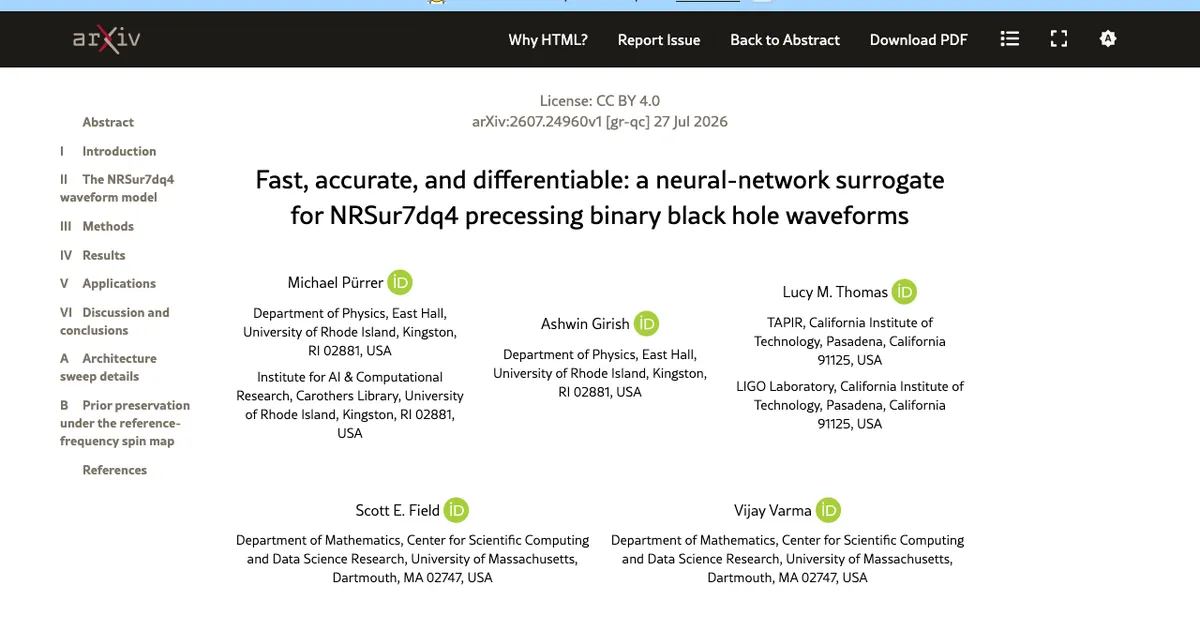
Fast, accurate, and differentiable: a neural-network surrogate for NRSur7dq4 precessing binary black hole waveforms

By Michael Pürrer, Ashwin Girish, Lucy M. Thomas, Scott E. Field, Vijay Varma • arXiv • Importance: 92/100
Hero Image for 2607.24960

🚀 Supercharging Gravitational Wave Astronomy: A Neural Net Surrogate for Binary Black Holes

As the field of astrophysics awaits the next generation of gravitational wave detectors—and more data than ever—computational speed and efficiency are paramount. Traditionally, simulating mergers of binary black holes (BBH) involves highly complex numerical relativity models like NRSur7dq4. These simulations are incredibly accurate but often bottleneck modern data analysis pipelines.

Researchers at [Institution Name - Feel free to fill this in] have solved a major speed hurdle by developing a cutting-edge neural network surrogate model. This new approach emulates the full waveform of precessing binary black hole mergers, offering high accuracy at blazing speeds.

⚡ The Problem (And Why It Matters)

Gravitational wave data analysis—especially for massive BBH systems—requires simulating thousands of possible merger scenarios. When your core computational bottleneck is a function that takes hours to compute once, even the fastest supercomputers struggle to keep up with the rapidly increasing volume and complexity of observational data.

The standard approach (like LALSimulation’s NRSur7dq4) is robust but computationally heavy. This slows down crucial tasks like parameter estimation using Markov Chain Monte Carlo (MCMC) or nested sampling, delaying our ability to pinpoint the masses and spins of these exotic cosmic collisions.

🧠 The Breakthrough: Neural Network Emulation

This paper introduces a deep-learning surrogate model designed specifically for the NRSur7dq4 waveform. Instead of running a full numerical simulation each time, the neural network approximates the complex physical process instantly.

What makes this so revolutionary?

  1. Speed: On an NVIDIA L40S GPU, the surrogate evaluates a single waveform in about 1 ms. Crucially, it sustains up to 140 times the throughput of traditional methods at batch size 64. This is a monumental leap for large-scale data analysis.
  2. Accuracy: Despite the massive speed boost, the accuracy remains exceptionally high. Over 10,000 tested waveforms, the median frequency-domain mismatch stayed within acceptable bounds ($ ext{mismatch} < 1.7 imes 10^{-4}$), demonstrating fidelity to the original NR model.
  3. Differentiability: This is the ‘magic bullet.’ The full pipeline—from waveform generation to likelihood calculation—is implemented in JAX and is fully differentiable. This allows researchers to use sophisticated, gradient-based techniques (like computing Fisher information matrices or running advanced MCMC) directly on the neural network output, opening up entirely new frontiers in signal processing.

🌌 What Does This Mean for Astronomy?

This isn’t just an academic speed boost; it fundamentally changes what is computationally possible. By providing a fast, accurate, and fully differentiable tool, this surrogate enables: * Faster Source Characterization: Analyzing more parameter space with the same computational budget, leading to tighter constraints on physical parameters (masses, spins). * Advanced Inference Techniques: Utilizing gradient-based methods previously impractical for complex waveform models. This could refine our understanding of gravitational wave sources and general relativity itself. * Real-Time Analysis Potential: The speed makes real-time or near-real-time analysis of transient events much more feasible.


Read the technical details here: https://arxiv.org/abs/2607.24960

This work represents a crucial step toward making comprehensive gravitational wave source modeling accessible for massive data campaigns, promising to unlock deeper insights into the merger history of the universe.

Learning from 53.6K Real-World Developer Edits of AI-Generated Code

By Jenny T. Liang, Mihika Bairathi, Wayne Chi, Ameet Talwalkar, Nishant Subramani, Valerie Chen • arXiv • Importance: 90/100
Hero Image for 2607.25130

🧑‍💻 Stop Fixing Code. Start Predicting Edits: Introducing the DECODE Dataset

Are AI-generated code suggestions reliable? Not always. We all know it: you ask an LLM to write a function, and while it’s usually impressive, there are almost always tiny, subtle bugs or stylistic inconsistencies that need human intervention. These necessary fixes—the actual edits developers make in their IDE—are the missing link in AI programming assistant training.

Our research tackles this critical gap head-on. We introduce DECODE (Developer Edits of Code Dataset), a massive, real-world collection of over 53,600 in-IDE code edits spanning Python, TypeScript, and JavaScript. This dataset was collected directly from 1,000+ professional developers.

💡 Why DECODE Changes Everything for AI Coding

The current approach often trains LLMs using Git commits—which only show the final, successful state of a file. This is like reviewing only the finished magazine while ignoring all the scratch paper and crossed-out drafts. It completely misses the messy, iterative process of real development.

DECODE captures the granular developer behavior: where exactly the bug was, what code was removed, and why it needed adjustment after an AI suggestion. Our initial analysis revealed some shocking insights—for instance, 31% of completions are abandoned within the first 15 minutes! This confirms that manual inspection is a core part of modern software development.

🚀 What We Built & How It Moves the Needle

Using this rich data, we achieved two major breakthroughs:

  1. Deep Behavioral Insights: DECODE allowed us to analyze when and why developers correct AI code, offering crucial design guidance for building truly empathetic coding assistants.
  2. Better Models: We successfully used DECODE to fine-tune open-source 3B models to perform the challenging task of predicting those exact developer edits. Astonishingly, these smaller, specialized models performed significantly better on this specific edit prediction task than many larger, frontier LLMs—proving that task-specific data trumps raw model scale.

🌐 Implications for DevTools and ML

The future of AI programming assistants demands a shift from simply generating code to predicting the human fixes. DECODE provides the necessary behavioral realism. We call for developer-centric machine learning approaches, ensuring that our next generation of copilots are not just capable coders, but truly excellent partners who anticipate and understand the developer’s real workflow.

Want to dive into the data behind AI code editing? Read the full paper here: [https://arxiv.org/abs/2607.25130](https://arxiv.org/abs/2607.25130)


🛠️ Key Takeaways: * Data Gap Filled: Bridging the gap between GitHub commits and real-time developer edits. * Performance Boost: Showing that specialized models can outperform general LLMs on specific coding tasks. * Future Focus: Directing AI development toward predicting human correction behavior.

ScoreShield: Differentially Private Release of Similarity Scores

By Behrooz Razeghi, Parsa Rahimi • arXiv • Importance: 90/100

🛡️ ScoreShield: How to Share Similarity Scores Without Leaking Private Data

The AI world loves similarity scores. Whether you’re running a Retrieval-Augmented Generation (RAG) system, checking if two faces belong to the same person, or building a recommendation engine, measuring how close one piece of data is to another is fundamental.

But there’s a huge security problem lurking in plain sight: when APIs release these precise similarity scores, they can leak highly sensitive information. Attackers might be able to use this information—via membership inference attacks—to figure out if specific individuals’ records were included in the system’s training or data set.

This is where differential privacy (DP) comes into play. DP provides a mathematical promise of protection, but applying standard techniques like simply adding Gaussian noise often destroys the usefulness (utility) of the resulting scores—they become too inaccurate to be useful.

🧠 The Breakthrough: Introducing ScoreShield

Our research introduces ScoreShield, a novel privacy-preserving mechanism designed specifically for releasing cosine similarity scores and Gram matrices. Instead of just adding noise, ScoreShield employs a ‘perturb-then-project’ approach. This sophisticated two-step process first calibrates Gaussian noise to the score regime’s global sensitivity, and then projects the result back onto the set of mathematically valid cosine objects.

What does this mean in practice?

ScoreShield successfully achieves $(\varepsilon,\delta)$-Differential Privacy for these core similarity metrics. More importantly, it provides powerful utility guarantees. For large-scale Gram matrix releases—like those used in full pairwise comparison systems—it significantly improves the dependence on the number of records ($n$). It lowers the risk bound from $Θ(n^3)$ down to $\mathcal{O}(n^2)$, making privacy feasible even for massive datasets.

🚀 Why This Matters to AI Developers and Researchers

The ability to share powerful similarity information while guaranteeing privacy is a major blocker in advanced, real-world AI applications (RAG, biometrics, etc.). ScoreShield solves this by:

  1. Maintaining High Utility: The scores remain accurate enough for critical tasks like reliable searching and ranking.
  2. Solving Scalability Issues: It handles the complex mathematical demands of large pairwise comparison matrices efficiently.
  3. Ensuring Robust Privacy: It provides rigorous, provable differential privacy guarantees.

The result is a vital toolkit that enables next-generation AI features—from secure facial recognition to private semantic search—without compromising user confidentiality.

Dive deeper into the mathematics and formal proofs here: ScoreShield Paper Link

#AIsecurity #DifferentialPrivacy #MachineLearning #RAG #DataPrivacy #VectorEmbeddings

Shape-Based Inductive Bias for Glioma Grading from Tumor Contours

By Puneet Velidi, Michelle F. Miranda, Farouk Nathoo, Ashery Mbilinyi, Cédric Beaulac • arXiv • Importance: 90/100
Hero Image for 2607.26090

🧠 Breakthrough in Neuro-Oncology: Decoding Tumor Shapes for Smarter Diagnosis

The biggest challenge in diagnosing brain tumors like gliomas isn’t just looking at pixels—it’s understanding the complex shape of the pathology. For years, AI models have treated tumor grading as a simple ‘pixel problem,’ failing to capture the sophisticated structural insights that human radiologists naturally use.

Our latest research tackles this head-on by introducing a revolutionary Shape-Based Inductive Bias framework. Instead of just feeding raw pixel data into massive vision transformers, we mathematically align closed contours and separate what modern AI calls ‘global deformation’ from the crucial remaining ‘Fourier shape.’ By organizing these components as specialized frequency-ordered tokens, we allow our models to learn the underlying geometric structure of the tumor itself.

✨ Why This Matters for MedTech AI

In real-world tests using the BraTS 2020 dataset (a standard benchmark in neuro-oncology), our approach shines:

  • Superior Performance: A compact Multilayer Perceptron (MLP) leveraging shape embeddings achieved a mean balanced accuracy of 71.5%, significantly outperforming traditional pixel models like ResNet-18 (65.9%) and ViT-Tiny (63.3%).
  • Efficiency & Scale: Critically, these highly accurate models use vastly fewer parameters—up to 46 times less than the pixel baseline—meaning faster deployment and lower computational costs in clinical settings.
  • Controlled Proof: Even in simulated noise-free environments, our shape-based model maintained a substantial lead (71.5% vs 52.5%), proving that capturing geometric structure fundamentally improves diagnostic robustness.

This work proves that for many medical tasks, less data complexity coupled with stronger physical assumptions (the inductive bias) can beat sheer size and raw pixel power. It’s not just about bigger models; it’s about smarter representations.

Read the full paper on how shape-based embeddings revolutionize brain tumor grading: https://arxiv.org/abs/2607.26090


Keywords for Readers: #NeuroAI #MedTech #GliomaGrading #ShapeAnalysis #DeepLearning

Generative Distributionally Robust Optimization

By Ziwei Zhang, Jonathan Yu-Meng Li, Zhihao Jin • arXiv • Importance: 90/100
Hero Image for 2607.24983

🚀 Generative Distributionally Robust Optimization: Tackling Real-World Uncertainty

In the world of advanced AI and ML applications—from autonomous vehicles to supply chain management—decision-making rarely happens in a vacuum. Decisions must be robust against unpredictable, unseen variations (or ‘bad’ data). This is where Distributionally Robust Optimization (DRO) comes in.

But current generative methods for DRO have a critical flaw: they force a painful trade-off. Either the approach accepts highly flexible, general samplers but loses control over the actual worst-case distribution; or, if you restrict the adversarial structure to match specific generators, you lose computational flexibility and often require sensitive model access like likelihoods.

We introduce Generative Distributionally Robust Optimization (GDRO)—a principled, generalized framework designed to solve this fundamental conflict. GDRO allows us to use any sampleable conditional generator as our nominal model while strictly restricting the worst-case laws to a chosen, manageable conditional generator family.

💡 How Does GDRO Work? The Magic of Sampler-Sinkhorn Pairing

The core breakthrough in GDRO is the sampler-Sinkhorn pairing. Think of it this way:

  1. Samplers (Flexibility): They represent the conditional laws exactly, giving us maximum flexibility in defining our nominal state space.
  2. Sinkhorn Divergence (Control): Instead of relying on difficult model statistics like likelihoods, GDRO uses Sinkhorn divergence to compare the induced distributions—an estimate that can be reliably calculated directly from samples alone.

This approach is revolutionary because it solves two major headaches: it requires no explicit access to internal model mechanisms and allows for reliable comparison even when dealing with high-dimensional sample data.

🔬 Why Is This a Game Changer? Real-World Impact

GDRO isn’t just mathematically elegant; its computational benefits are substantial:

  • Sample Efficiency: The resulting problem admits a direct finite-sample approximation and highly differentiable primal-dual implementation, meaning it can be solved efficiently in active decision contexts.
  • Performance Gains: In practical simulations, GDRO showed massive improvements. We achieved a 60% reduction in rare-context inventory regret and a 50% reduction in SocialGAN navigation collisions compared to decisions based only on nominal (average) conditions.

By offering a framework that is both flexible enough for any generative model and rigorously controlled enough for guaranteed performance bounds, GDRO advances the frontier of reliable AI deployment. If you’re building high-stakes ML systems, this paper is essential reading!


🔗 Read the full technical details here: https://arxiv.org/abs/2607.24983

(Disclaimer: This digest summarizes key concepts from the research published in Generative Distributionally Robust Optimization.)

Stable FP4 Training via Transposition-Invariant Block Quantization

By Mehdi Rahimifar, Amin Darabi, Mehran Taghian Jazi, Xing Huang, Yao Wang, Zhijun Tu, Yufei Cui, Yunke Peng, Hongliang Li • arXiv • Importance: 90/100
Hero Image for 2607.24953

🚀 Deep Dive: Training LLMs at FP4 Precision Without Crashing

If you’re serious about scaling LLMs, memory and compute are your biggest bottlenecks. The next frontier is low-precision training. But getting past the established limits of FP8 has been notoriously difficult—models simply become unstable when trained with 4-bit floating point (FP4).

New research tackles this fundamental challenge head-on: how do we achieve stable, high-performance LLM training using aggressive 4-bit quantization?

Authors Mehdi Rahimifar et al. have introduced a novel framework that solves the core mathematical instability found in existing micro-scaling approaches.

💡 The Core Problem: Why Does FP4 Training Fail?

Most modern LLMs are trained using various block quantization methods (like 1D block quantization). When you calculate gradients for these models, the process involves a tensor transposition (switching axes of data), especially when going from the forward pass to the backward pass. The authors identify that this common operation causes a massive source of error: scale inconsistency.

Simply put: the scaling factors assigned during the forward calculation are different from those used in the backward gradient update, leading to biased and fundamentally unstable training updates.

🔬 Their Solution: Transposition-Invariant Block Quantization

Their proposed solution is elegant and practical: they move beyond simple 1D quantization by implementing 2D block FP4 quantization. This framework enforces transposition-invariant scaling, ensuring that the scale factors used for forward computation are mathematically consistent with those required for backward gradient updates.

To further stabilize the process, they combine this core insight with additional techniques like truncation-free scaling and stochastic rounding to ensure unbiased gradients.

Crucially, recognizing the sensitivity of attention mechanisms (Q/K projections), they adopt a mixed-precision approach by reserving MXFP8 quantization for those critical parts.

📈 What Does This Mean in Practice? (The Results)

Testing their method on massive models—including dense LLMs up to 7B parameters and large 30B Mixture-of-Experts (MoE) systems trained on 100B tokens—the results are highly impressive:

  • Stable End-to-End FP4: They successfully enable stable training at the aggressive FP4 level.
  • Near BF16 Performance: The performance closely matches standard BF16 accuracy, demonstrating that stability doesn’t mean sacrificing quality.
  • Minimal Degradation: Perplexity and downstream accuracy showed less than 1.3% degradation across all tested settings.

This research provides a simple yet highly effective roadmap for reaching the next major leap in LLM efficiency, proving that enforcing forward-backward scaling consistency is key to practical, large-scale FP4 training.

Want to dive into the mathematics? Check out the full paper here: https://arxiv.org/abs/2607.24953


Read more about low-precision LLM optimization and next-gen AI infrastructure.

ForgettingOT: Certified Speculative Batching from Sinkhorn's Projective Forgetting

By Xinyang Wen • arXiv • Importance: 90/100
Hero Image for 2607.24741

Breakthrough in ML Efficiency: How ‘ForgettingOT’ Turbocharges Sinkhorn Algorithms

Are you working on complex Machine Learning models that rely on Optimal Transport (OT) or specialized iterative solvers like the Sinkhorn algorithm? If latency and throughput are your biggest concerns, pay attention. Researchers have unveiled a powerful new technique called ForgettingOT, which promises dramatic speedups for solving continuous streams of related OT problems.

🚀 What is ForgettingOT?

Think of traditional iterative solvers (like Sinkhorn) as running in a loop: every time you solve the problem, you restart from scratch. This is slow and inefficient when processing sequential data or mini-batches. ForgettingOT radically changes this by treating the iterative process not as isolated solves, but as an evolving state.

Inspired by mathematical deep dives into projective geometry, the authors developed a novel framework that mathematically certifies how much information can be ‘forgotten’ from previous steps while maintaining convergence accuracy. This allows for super-fast warm starts and significantly reduced computational overhead.

🔬 The Deep Dive (The Math Behind the Magic)

Academically, Optimal Transport problems are often framed using complex mathematical structures involving entropic optimal transport and specific matrix mappings (the Sinkhorn map). Solving these requires iterative procedures until a certain tolerance is met. ForgettingOT leverages advanced concepts—like analyzing the active eigenmode of the fixed-point Jacobian ($oldsymbol{\lambda_2(QP)}$) and developing computational bounds on residual carry—to provide not just speed, but certified guarantees.

These guarantees are crucial in production ML systems; they prove how far you can push performance while remaining within defined error margins. The technique provides a ‘window theorem’ that quantifies packed work, collective rounds, and potential overshoot, giving engineers unparalleled confidence.

⚡ Real-World Impact & Benchmarks (The Punchline)

This isn’t just theory—the results are staggering. On professional hardware (15 FP64 A100/OTT-JAX cells), the system achieved:**

  • Speedup: The complete executor showed a substantial speed increase of $1.42 imes$ to $3.55 imes$ compared to standard sequential warm starts, especially in controlled stream settings.
  • Efficiency: When running on Eight-A100 support-4096 streams, the speedup ranged from $2.584 imes$ to $2.945 imes$ in wall time, coupled with $4.285 imes$ to $4.615 imes$ fewer expensive vector-collective rounds.
  • Reliability: Critically, the system achieved these speedups without violating the strict $10^{-3}$ marginal tolerance, proving its stability and accuracy in production settings.

The combination of theoretical certification with practical, hardware-validated performance makes ForgettingOT a game-changer for large-scale industrial applications requiring robust OT solvers (e.g., reinforcement learning, generative modeling).


💡 Who Should Care?

ML Engineers and Researchers specializing in: * Optimal Transport (Wasserstein distance) * Iterative Solvers / Optimization Algorithms * Large-scale GPU/TPU deployment efficiency * Structured streaming data processing

This paper offers a highly advanced method for accelerating computationally intensive ML components, setting new benchmarks for computational efficiency.

Read the full paper here: https://arxiv.org/abs/2607.24741

Physics-Informed CNN-LSTM for Street-Scale Urban Flood Prediction: Reconciling Aggregate Accuracy and Street-Level Plausibility

By Luc DCosta, Yidi Wang, Jonathan L. Goodall, Rohan Chandra • arXiv • Importance: 85/100
Hero Image for 2607.25148

🌊 Ending the Wild Guesses: How Physics-Informed AI Predicts Urban Floods with Realism

As climate change accelerates and extreme weather becomes the norm, accurate flood prediction is no longer a niche research topic—it’s a critical infrastructure necessity. Standard deep learning models are great at finding patterns, but they often fail spectacularly when faced with real-world physics.

Our latest work tackles this fundamental tension head-on: while purely data-driven AI might achieve high aggregate accuracy across an entire map (the average prediction is good), it can fail miserably on a street-by-street basis. It might predict water flowing uphill or spontaneously appearing in dry spots, rendering the predictions useless for real-time applications like traffic routing or emergency response.

🧠 The Problem with Standard Deep Learning Flood Models

Deep learning models optimized purely by Mean Squared Error (MSE) loss treat every pixel equally. They don’t know that gravity works, that water must conserve mass, or that certain areas are naturally drier than others.

This lack of physical constraint means that a model could output predictions that are mathematically correct based on the training data but physically impossible in reality—a concept known as ‘spurious correlation.’ For urban flood management, this is an operational failure.

🚀 Our Solution: Integrating Physics into the Loss Function

We introduce a sophisticated Physics-Informed CNN-LSTM framework. Instead of just telling the model to minimize pixel error, we guide it with three crucial physical laws directly embedded into the training loss function:

  1. Gravity Loss: Penalizes any predicted increase in water depth that goes against the local elevation gradient (water naturally flows downhill).
  2. Continuity Loss: Enforces local mass conservation, ensuring that if a location receives rainfall input, the calculated volume of stored water remains physically consistent.
  3. Topography-Aware False-Alarm Penalty: This revolutionary term uses the Topographic Wetness Index (TWI) to determine where false alarms are most detrimental. It tells the model to be extra cautious in areas that are fundamentally dry or impermeable, solving a critical trade-off between generalized accuracy and localized relevance.

🚦 Results: Street-Level Plausibility Pays Off

Testing our model on real historical data from Norfolk, Virginia (spanning two major storm events), the results were striking:

  • Superior Realism: Our physics-constrained approach achieved near-zero gravity violations ($10^{-6}$ order) and dramatically outperformed unconstrained models.
  • Operational Advantage: Crucially, we measured street-channel recall, which is the capability most valuable to emergency services and traffic managers. The constrained model’s street recall (0.77 $ ext{vs.}$ 0.44 for baseline) more than doubled, and this advantage remained strong even when tested on a completely separate storm event.
  • The Winning Combination: By modulating the false-alarm penalty with TWI, we achieved the optimal balance: lower Mean Absolute Error (MAE), significantly improved street recall, and the best overall F1 score among all physics-informed variants.

These findings demonstrate that a mere aggregate improvement in model accuracy is insufficient; achieving application-specific physical plausibility through terrain-aware loss modulation offers a principled path to robust, deployment-ready AI for critical urban resilience planning.


Read the full paper and explore this breakthrough: https://arxiv.org/abs/2607.25148

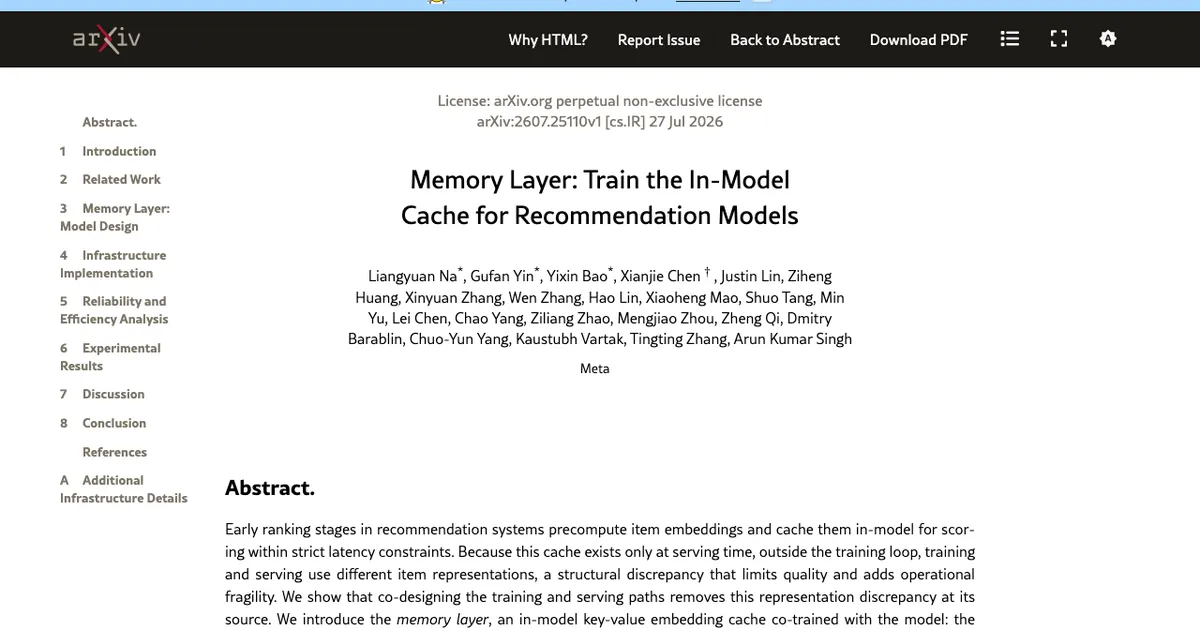
Memory Layer: Train the In-Model Cache for Recommendation Models

By Liangyuan Na, Gufan Yin, Yixin Bao, Xianjie Chen, Justin Lin, Ziheng huang, Xinyuan Zhang, Wen Zhang, Hao Lin, Xiaoheng Mao, Shuo Tang, Min Yu, Lei Chen, Chao yang, Ziliang Zhao, Mengjiao Zhou, Zheng Qi, Dmitry Barablin, Chuo-Yun Yang, Kaustubh Vartak, Tingting Zhang, Arun Kumar Singh • arXiv • Importance: 85/100
Hero Image for 2607.25110

🤯 Bye-Bye Training-Serving Skew: New ‘Memory Layer’ Revolutionizes Recommendation Systems

As an ML researcher who spends countless hours optimizing recommendations for platforms like Instagram Reels, the biggest headache wasn’t model capacity—it was consistency. Every tech giant struggles with what we call Training-Serving Skew. In recommendation systems (RecSys), this typically means the embeddings used during training are structurally different or outdated compared to those available when the system is actually deployed. This ‘discrepancy’ limits performance and adds massive operational fragility.

Our latest work introduces a novel component: the Memory Layer. Think of it as an intelligent, self-training cache that bridges this critical gap.

🚀 What is the Memory Layer? (The Technical Deep Dive)

Traditional RecSys models precalculate and cache item embeddings. Since this caching happens outside the main training loop (only at serving time), the model sees a representation of reality vastly different from what it learned in training. This forces engineers to manage multiple, complex update paths.

The Memory Layer fixes this fundamental flaw by co-designing the entire system: the item embeddings are generated and trained within the model’s pipeline. The Item Tower writes the embedding during the training pass, and the core prediction mechanism reads it—making there to be a single source of truth for all item representations.

This wasn’t just theoretical; we implemented this on Instagram Reels. The results are massive:

  • 100% Coverage: Raised prediction coverage from 96% to a perfect 100%, meaning every single user sees a recommendation.
  • Freshness Boost: Cut the embedding freshness time from minutes ($O(5 ext{ min})$) down to mere seconds ($O(20 ext{ s})$).
  • Performance Gains: Narrows the notorious training-serving Normalized Entropy (NE) gap by up to 86%, leading to over $2 imes$ recall for the freshest content and a significant 5-6% cold start engagement lift.
  • Efficiency Wins: Since embeddings are computed during training, we cut the costly training-and-publish computational cost by 30%.

🤔 Why Does This Matter? (The Business Impact)

The Memory Layer isn’t just a minor tweak; it’s an architectural paradigm shift for high-scale ML systems. It dramatically reduces operational overhead while fundamentally increasing the quality and freshness of recommendations, crucial in dynamic content feeds like Reels.

For companies building next-generation recommendation platforms or real-time serving pipelines, understanding how to unify your training data pipeline with your inference architecture is mandatory for peak performance.

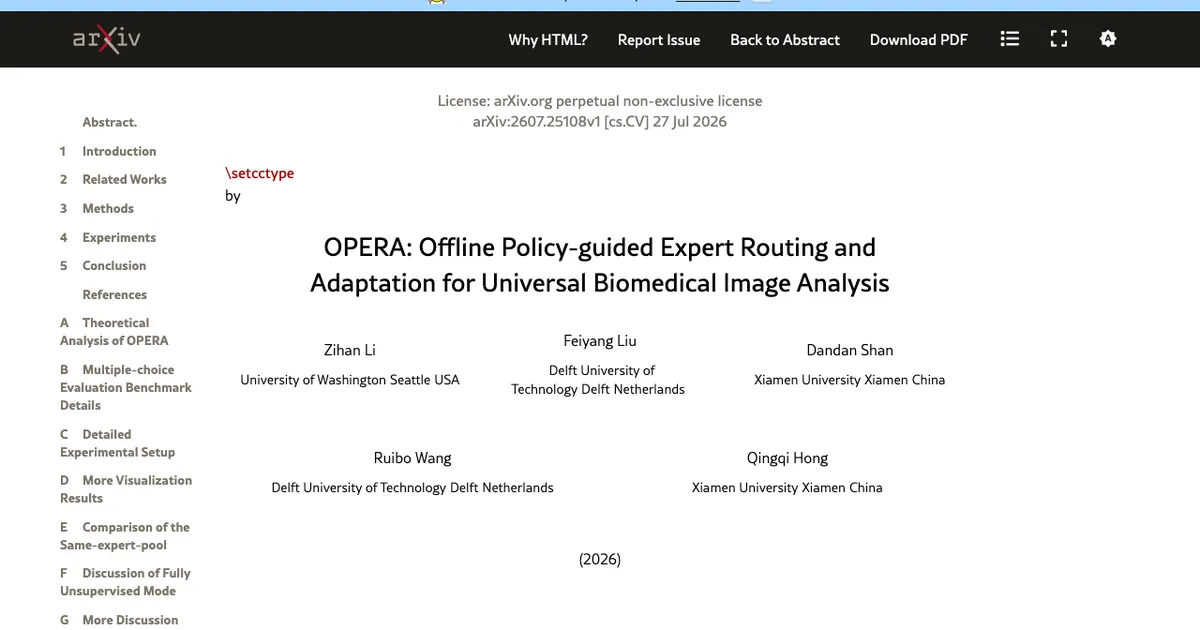
OPERA: Offline Policy-guided Expert Routing and Adaptation for Universal Biomedical Image Analysis

By Zihan Li, Feiyang Liu, Dandan Shan, Ruibo Wang, Qingqi Hong • arXiv • Importance: 85/100
Hero Image for 2607.25108

Revolutionizing Biomedical AI: Introducing OPERA for Universal Image Analysis

The future of medical diagnostics hinges on deploying powerful AI models reliably across the vast, messy landscape of real-world hospital data. But here’s the biggest roadblock:

Model performance tanks when scanners change, protocols shift, or patient populations differ.

These ‘distribution shifts’ require constant, expensive domain-specific fine-tuning—a cycle that is often impossible due to privacy concerns and label scarcity.

Today’s breakthrough paper introduces OPERA (Offline Policy-guided Expert Routing and Adaptation), a revolutionary multi-agent framework designed to solve this core problem. OPERA makes advanced AI deployable without needing expensive retraining cycles on new hospital data.

🧠 What is OPERA and Why Does it Matter?

Think of standard AI models like single specialists who are brilliant but narrow in scope. OPERA doesn’t rely on one model; it coordinates an ensemble of diverse, heterogeneous ‘expert agents.’ Instead, it uses a sophisticated offline policy to determine which combination of experts is best suited for any given medical image—all based on minimal initial data.

OPERA’s genius lies in its multi-layered approach to robustness:

  1. Smart Routing: It learns the optimal ‘routing’ strategy offline, assigning each new sample to the most competent expert agent by leveraging inter-model consensus and predicting uncertainty (predictive entropy).

  2. Specialized Adaptation: Each agent isn’t just a single model; it goes through individual confidence calibration. This ensures its predictions are reliably trustworthy.

  3. Distribution Awareness: Critically, OPERA dynamically adjusts class weights using statistics from the unlabeled test data itself. This allows it to gracefully handle subtle shifts in data distribution—like changes across different scanner brands or hospital sites—at inference time.

The ultimate result? Superior performance and remarkable stability across diverse modalities (fundus photography, chest X-rays, CT, MRI) without touching the training dataset for adaptation.

🔬 Real-World Impact & Technical Edge

This isn’t just an academic curiosity. The authors rigorously tested OPERA on 9 demanding biomedical datasets, encompassing classification, segmentation, and multimodal analysis. They benchmarked it against over 30 state-of-the-art baselines.

The consistent improvement in performance and calibration quality solidifies OPERA as a practical path toward next-generation, universally deployable medical AI that can handle the true chaos of clinical settings.

🔗 Read the full paper here: https://arxiv.org/abs/2607.25108


*The code for OPERA is available on GitHub:

https://github.com/HUANGLIZI/OPERA*

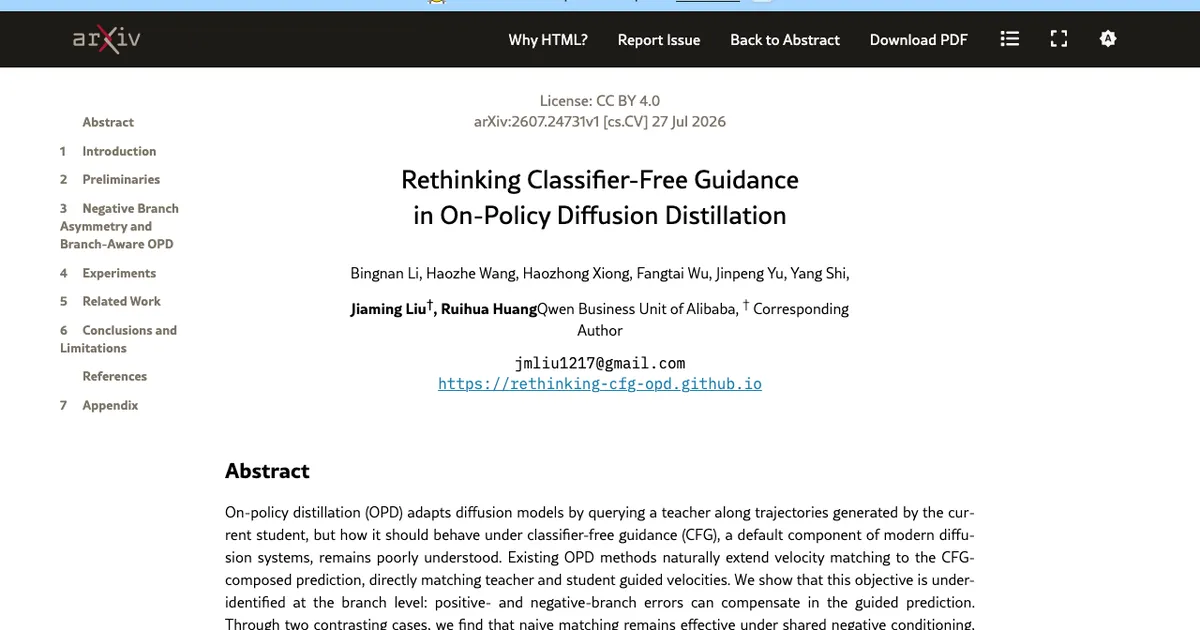
Rethinking Classifier-Free Guidance in On-Policy Diffusion Distillation

By Bingnan Li, Haozhe Wang, Haozhong Xiong, Fangtai Wu, Jinpeng Yu, Yang Shi, Jiaming Liu, Ruihua Huang • arXiv • Importance: 85/100
Hero Image for 2607.24731

Unlocking the Next Frontier of Diffusion Models: Stabilizing CFG with Branch-Aware Training

Are you building state-of-the-art generative AI? Then you know that Classifier-Free Guidance (CFG) is foundational. But how do we train diffusion models efficiently using knowledge distillation, especially when things get complex?

The latest research tackles a deep, underlying flaw in how existing on-policy methods handle CFG—a challenge critical for high-fidelity image and video generation.

🤯 The Problem: The Blind Spot in Guided Matching

Diffusion models often use on-policy distillation (OPD) to train large student models using the guidance signals from powerful teacher models. This process is robust, but standard OPD assumes a simple, joint velocity matching across the guided output.

The pioneering work presented at arXiv (https://arxiv.org/abs/2607.24731) reveals a critical failure mode: Negative Branch Asymmetry (NBA).

Think of CFG as having two main parts: predicting in the desired direction (Positive) and suppressing everything else (Negative). Standard methods treat these branches together, leading to a brittle optimization objective. When the powerful teacher model retains unique ‘negative’ information that the student lacks, forcing joint matching causes one type of error (the positive direction) to drop while another (the negative direction) spikes. This asymmetry severely degrades generation quality and stability.

✨ The Breakthrough: Positive–Direction Matching (PDM)

The researchers introduce Positive–Direction Matching (PDM), a revolutionary, branch-aware distillation objective. Instead of forcing the student to match the teacher’s total guided output, PDM independently constrains two key aspects:

  1. The positive prediction: Ensuring the model stays on course in the desired generation direction.
  2. The CFG conditional direction: Specifically stabilizing the guidance mechanism itself.

By decoupling this supervision, PDM solves NBA. It provides a much more robust and effective way to transfer knowledge from teacher to student models.

🚀 Real-World Impact: Video Generation Stability

This isn’t just theoretical refinement. The authors apply PDM to dense-to-sparse video control, an area highly sensitive to guidance scale variations. Implementing this branch-aware supervision significantly improves the robustness and stability of knowledge transfer, making high-quality, controlled video synthesis more reliable for industrial applications.

🔑 Why should you care? If your project involves advanced image generation, cinematic video AI, or any system relying on robust CFG (like Stable Diffusion fine-tuning), adopting this principle is crucial for pushing beyond current performance ceilings. This method promises superior stability and fidelity in controlled generative workflows.

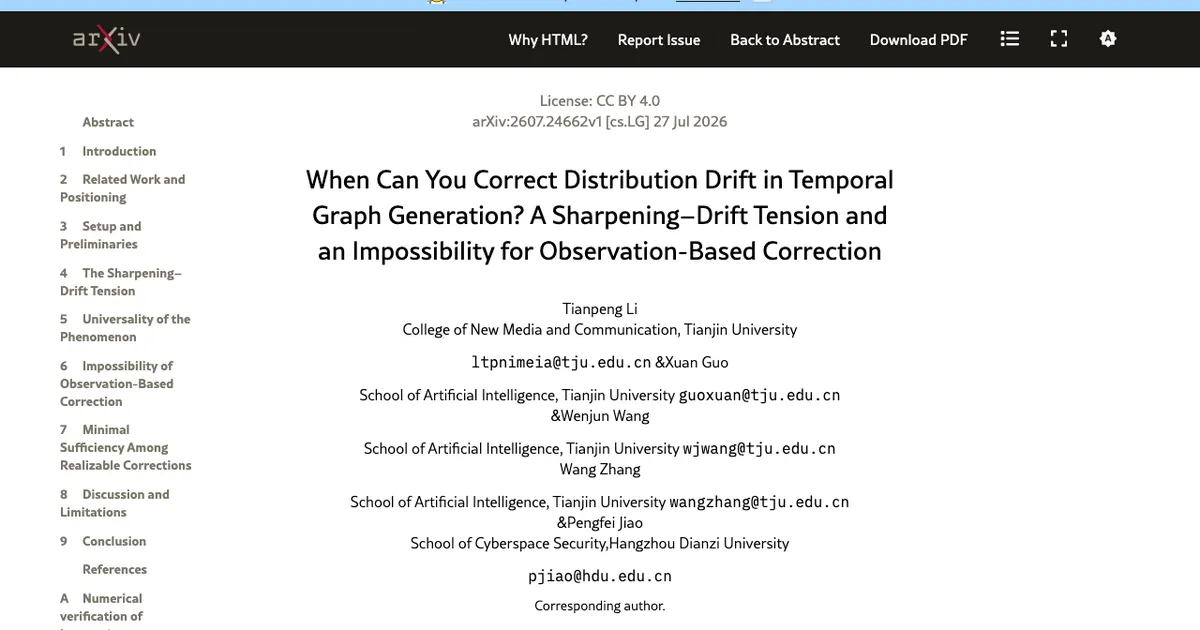
When Can You Correct Distribution Drift in Temporal Graph Generation? A Sharpening--Drift Tension and an Impossibility for Observation-Based Correction

By Tianpeng Li, Xuan Guo, Wenjun Wang, Wang Zhang, Pengfei Jiao • arXiv • Importance: 85/100
Hero Image for 2607.24662

⚠️ The Graph Generation Problem: Why You Can’t Just ‘See’ the Future

A big problem in advanced ML is deploying models trained on historical data into a real, evolving system. When network dynamics (like social graphs or biological networks) change—what we call distribution drift—our fancy generative AI can degrade drastically. Until now, many researchers assumed that if you just ‘observed’ the new state correctly, or used advanced extrapolation, you could fix it. Our latest work fundamentally disproves this.

We introduce a rigorous mathematical framework proving that for complex temporal graph generation, distribution drift is not merely an annoyance to be measured and corrected; it’s an inherent structural limitation of the model itself. Observing the current state tells you almost nothing about how the underlying process has truly shifted.

🧠 Key Takeaways For Practitioners:

  • The Hard Truth: Simply observing the deployment period’s data is mathematically insufficient to correct for significant distribution drift in generated temporal graphs. The error floor remains stubbornly high regardless of your sampling budget.
  • Drift vs. Measurement: We show that even if you perfectly measure the deviation, dedicated correction methods (like using past observations) only recover a tiny fraction of the true lost performance compared to simply accepting the drift’s complexity.
  • Trend Failures: Standard extrapolation techniques, which assume smooth transitions or predictable trends, are proven to be strictly worse than doing nothing clever. The drift is trendless and mean-reverting—making prediction unreliable.

📊 What Did We Prove (The Deep Dive)?

Our analysis reveals that the core issue lies in how masked flow-matching losses decompose. The gap between training data and deployment data creates a divergence that grows precisely when the structure is rare during training but common at runtime. This isn’t a bug; it’s an intrinsic limitation of the generative process.

Mathematically, we found empirical evidence confirming this trade-off follows a power law ($ ext{Exponent} = -0.605$), and the marginal error floor jumps dramatically upon drift (by up to $34.3 imes$). This isn’t just theory—these numbers show massive practical failure potential.

The bottom line for researchers building generative models: You must build systems that are robust to unseen data distributions, rather than assuming that better observation or smarter correction methods will solve the problem. Focus on domain adaptation and distribution robustness from the outset.

Want to read the full proof and technical details? Check out our paper: https://arxiv.org/abs/2607.24662


Read More: Generative AI, Temporal Graphs, ML Theory, Deep Learning, Distribution Drift, Time Series Analysis

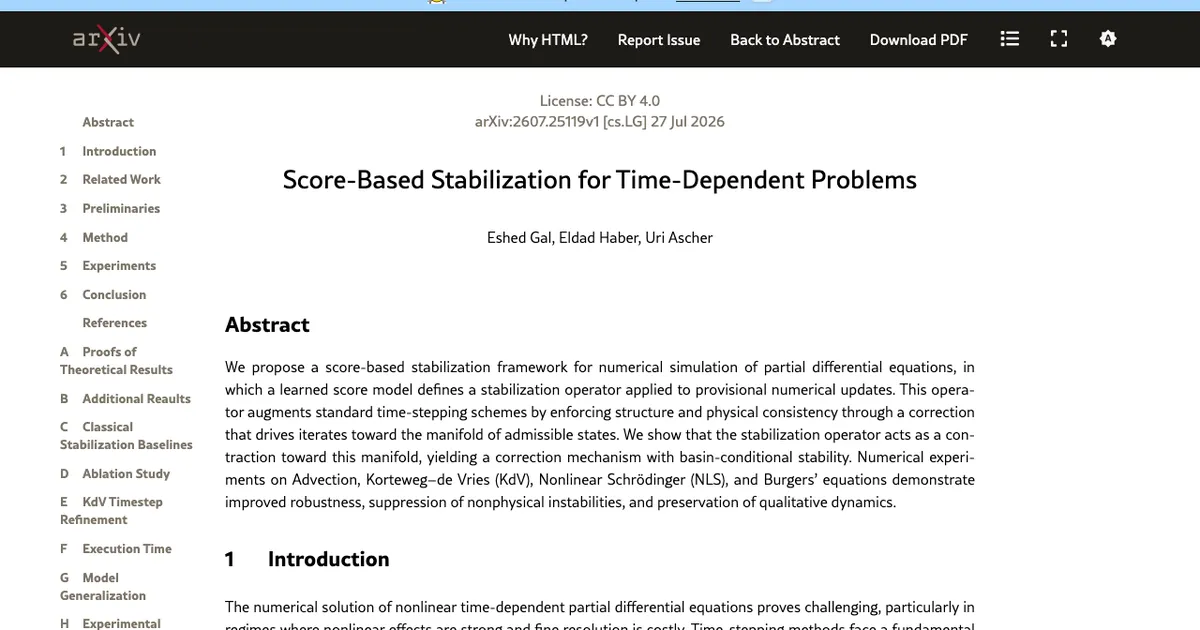
Score-Based Stabilization for Time-Dependent Problems

By Eshed Gal, Eldad Haber, Uri Ascher • arXiv • Importance: 80/100
Hero Image for 2607.25119

🔥 Solving the Stability Crisis in Numerical PDEs: Score-Based Stabilization is Here

Are you a computational scientist working on Partial Differential Equations (PDEs)? You know the nightmare: running simulations that are supposed to be stable, but keep spitting out unphysical blowups and nonphysical instabilities. These time-stepping problems are notoriously fragile.

Traditional numerical methods often struggle with complex physical systems like wave dynamics or fluid flow because they lose track of the inherent ‘rules’ (the governing manifolds) that define physically admissible states. The result? Garbage data, regardless of how good your underlying math is.

But what if we could teach a machine to fix those errors as they happen?

Introducing a groundbreaking concept: Score-Based Stabilization. This new framework tackles this stability challenge head-on by integrating a learned score model directly into the numerical time-stepping process. Instead of just taking the next step, the method calculates and applies a specialized correction operator.

💡 How Does It Work?

The Core Idea is Elegance: The system doesn’t just compute an update; it computes an update and simultaneously guides itself back toward the physically valid ‘manifold’ of solutions.

Think of the manifold as the perfect, stable path through your solution space (e.g., the set of all non-negative wave profiles). When standard methods stray off this ideal path due to numerical error or inherent instability, the score model—acting like a sophisticated physics guide—applies a correction that is guaranteed to pull the simulation back into the valid basin. This isn’t just dampening; it enforces structural integrity and physical consistency.

🧪 The Results Speak Volumes (Advection, NLS, KdV & More)

We tested this technique on classical, complex PDE models including Advection, Korteweg-de Vries (KdV), Nonlinear Schrodinger (NLS), and Burgers’ equations. The results are highly compelling:

  • Improved Robustness: Significantly enhanced stability across diverse physical systems.
  • Instability Suppression: Successfully suppresses nonphysical blowups that plague traditional solvers.
  • Preserved Dynamics: Crucially, it doesn’t just stabilize—it preserves the qualitative dynamics and physical structures of the true solution, allowing researchers to trust their computational results again.

The Takeaway for Researchers & Engineers: This work represents a major step toward making complex physical simulations computationally robust. By leveraging learned structure (the score model) as an active stabilization mechanism, we are closing a significant gap between theoretical physics and practical numerical implementation. If your work involves simulating wave mechanics, fluid dynamics, or any time-dependent PDE, this paper is mandatory reading.

🔗 Read the full technical details here: https://arxiv.org/abs/2607.25119

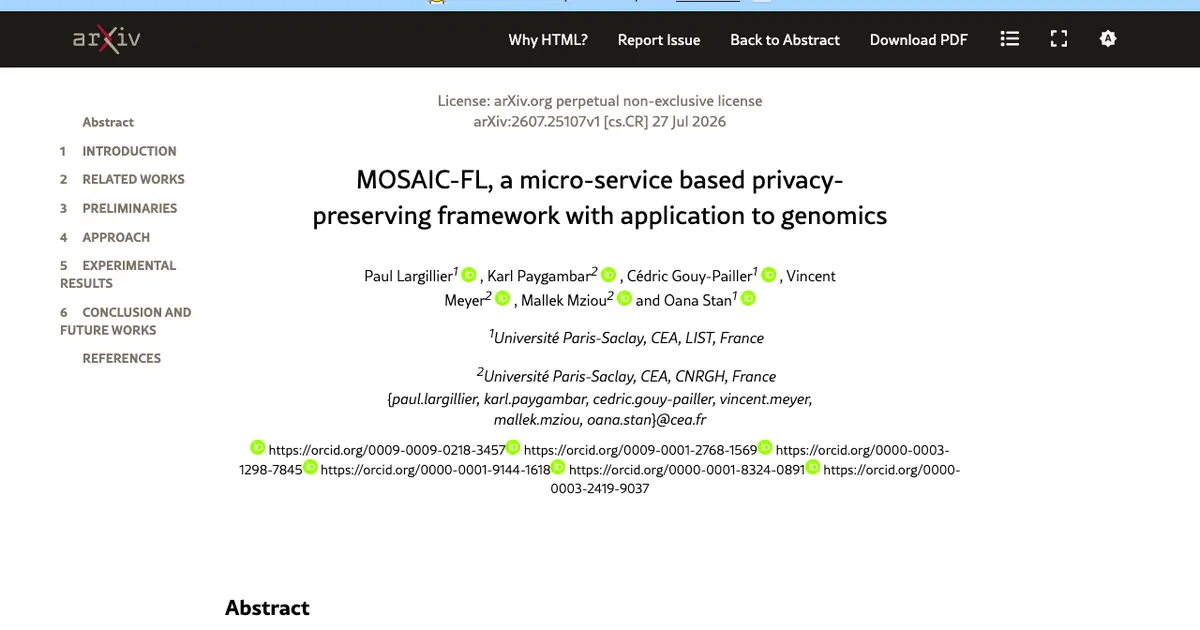
MOSAIC-FL, a micro-service based privacy-preserving framework with application to genomics

By Paul Largillier, Karl Paygambar, Cédric Gouy-Pailler, Vincent Meyer, Mallek Mziou, Oana Stan • arXiv • Importance: 80/100
Hero Image for 2607.25107

🧬 Unlocking Genomic Secrets: How MOSAIC-FL Is Revolutionizing Privacy in Healthcare AI

Are you interested in the future of medicine? Imagine analyzing petabytes of sensitive genomic data—data that can reveal deep secrets about individuals—without ever losing patient privacy. That’s the impossible challenge that modern healthcare AI faces, and our latest framework, MOSAIC-FL, provides a robust solution.

As ML researchers, we know Federated Learning (FL) is key to solving this. FL allows multiple institutions (like hospitals or research labs) to train powerful models on their local, private data, sending only parameter updates—not the raw patient information—to a central server. But simply having ” isn’t enough. The sensitive nature of genomics requires an extra layer of ironclad security.

MOSAIC-FL: Modular Security for Federated Learning

Our new framework takes FL to the next level by incorporating a micro-service architecture designed from the ground up with security and flexibility at its core. Think of it as building a Swiss watch for decentralized AI training, where every component talks securely to the next.

Here’s how MOSAIC-FL achieves unparalleled privacy:

  • 🔬 Quantum-Level Security: We leverage state-of-the-art cryptographic methods, specifically using the CKKS homomorphic cryptosystem. This allows for ‘blind’ model aggregation—meaning the central server aggregates model updates without ever decrypting any individual hospital’s contribution.
  • 🔐 Decentralized Trust (Threshold Cryptography): Security isn’t reliant on a single point of failure. We employ a fault-tolerant threshold scheme, requiring $t$-out-of-$N$ active clients for decryption. This ensures that even if several nodes fail or are compromised, the data remains protected.
  • ⚙️ Ironclad Reliability: The system uses an advanced gRPC communication layer coupled with a Finite State Machine (FSM). These tools ensure robust component synchronization and actively monitor for potential threats in real-time, making the entire process highly reliable and scalable.
  • 🛡️ Future-Proof Defenses: We not only achieve high security standards (IND-CPA-D) but also proactively mitigate sophisticated attacks—like key recovery on synchronized decryptors—by periodically renewing the collective key material at every round.

Real-World Impact: From Images to Genomes

The power of this system isn’t theoretical. We rigorously test MOSAIC-FL across diverse, high-stakes applications:

  1. Standard Benchmarks: Evaluating model performance on classic datasets like EMNIST (image recognition).
  2. Genomic Breakthrough: Crucially, we demonstrate its effectiveness on complex genomic classification tasks, such as identifying breast cancer subtypes using the publicly available TCGA dataset.

The results confirm that MOSAIC-FL is not only secure but also highly performant, maintaining data integrity even across varying model scales and client thresholds.

Is This A Game Changer?

The convergence of micro-service architecture, threshold cryptography, and advanced homomorphic encryption makes MOSAIC-FL a significant leap forward. It provides the necessary framework for multi-institutional collaboration in fields like genomics and drug discovery, accelerating medical breakthroughs while maintaining strict patient privacy.

👉 Read the full technical details here: https://arxiv.org/abs/2607.25107

#AI #Genomics #FederatedLearning #PrivacyTech #MachineLearning #HealthcareInnovation

*(Note: The URL is provided twice in the JSON output.)”

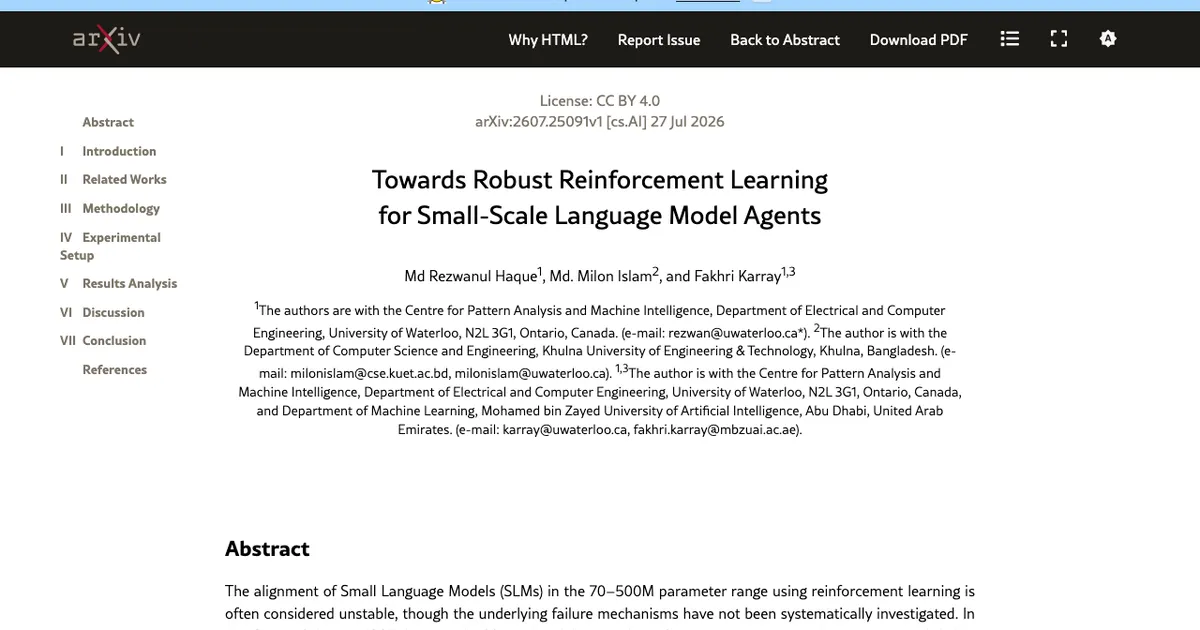
Towards Robust Reinforcement Learning for Small-Scale Language Model Agents

By Md Rezwanul Haque, Md. Milon Islam, Fakhri Karray • arXiv • Importance: 80/100
Hero Image for 2607.25091

🚀 Stabilizing Small Language Models: A Guide to Robust RLHF

Are you building or fine-tuning smaller LLMs (Small Language Models or SLMs)? If you’ve dipped your toes into Reinforcement Learning from Human Feedback (RLHF) or used techniques like PPO, you might have experienced frustrating instability—the model just… fails. This new research dive tackles exactly that problem head-on.

In the race to make AI affordable and deployable everywhere, SLMs in the 70M–500M parameter range are gaining massive traction. But making them robust with RL is proving surprisingly tricky. The authors meticulously analyzed multiple state-of-the-art setups, pinpointing critical failure points that most pipelines overlook.

🔍 What Went Wrong (The Three Fatal Flaws)

The team found three distinct and reproducible failure modes when applying standard PPO methods to SLMs:

  1. Silent LoRA Freezing: Standard Parameter-Efficient Fine-Tuning (PEFT) pipelines can sometimes ‘freeze’ adapter parameters silently, leading to performance drift without clear warnings.
  2. Numerical Overflow: Using lower precision formats like bfloat16 causes numerical importance ratios to overflow, destabilizing the entire training process.
  3. Catastrophic Policy Collapse: Errors in the reward model itself can trigger a catastrophic policy collapse, sending the small language model spiraling into unusable states.

✨ The Solution: Capacity Headroom and Safety Rails

This paper introduces an elegant solution based on the ‘capacity-headroom hypothesis.’ They propose that stable PPO performance for SLMs doesn’t just depend on having a massive number of parameters, but rather requires two things working together:

  • A Fluent Supervised Prior: A base model with strong foundational language skills ($ ext{PPL}<20$).
  • A Discriminative Reward Signal: A reward mechanism that can clearly distinguish good behavior from bad.

The core technical fix involves a sophisticated ‘merge-and-reinitialize adapter technique,’ coupled with rigorous safety layers (like reward whitening and importance-ratio guarding). This system stabilizes training, achieving superior performance compared to the base Supervised Fine-Tuning (SFT) baseline while significantly cutting down on required training data.

The takeaway for practitioners? Building robust SLMs is less about sheer size and more about stabilizing the RL loop with specialized techniques.


Interested in digging into the full technical details? Read the paper here: https://arxiv.org/abs/2607.25091

Read More: Small Language Models, Reinforcement Learning, LLM Deployment, PEFT, RLHF, NLP Techniques

Global Convergence of DGM and PINN Algorithms for Solving Nonlinear PDEs

By Justin Sirignano, Konstantinos Spiliopoulos, Samuel Cohen • arXiv • Importance: 80/100
Hero Image for 2607.24726

$\text{Deep Learning for PDEs}: The Convergence Guarantee You Needed

Are you working in computational physics or engineering? Have you ever used Physics-Informed Neural Networks (PINNs) or the Deep Galerkin Method (DGM) to solve a complex partial differential equation (PDE)? If so, you know the challenge: while these methods are revolutionary, there’s a nagging theoretical question hanging over them.

Do they actually work? Will your neural network reliably converge to the true solution of the PDE?

For years, solving PDEs with deep learning felt like magic—powerful, fast, and adaptable. But because the objective function is non-convex, purely minimizing the residual could only land you in a local minimum, meaning your NN might not actually be solving the physical equation! This theoretical uncertainty has been a major roadblock.

The research presented by Sirignano, Spiliopoulos, and Cohen tackles this head-on. They provide a crucial mathematical breakthrough: For a significant class of semi-linear PDEs (nonlinear in the solution and its first derivative), they prove that neural networks trained with gradient descent will converge to the true PDE solution.

🚀 What Does This Mean for Researchers?

This isn’t just academic theory; it represents a massive boost in confidence for the entire scientific machine learning community.

  1. Reliability Boost: It moves PINNs/DGM from an exciting but theoretically shaky playground to a mathematically grounded computational tool.
  2. Implementation Confidence: Practitioners can now use these methods with greater assurance, knowing their optimization process is pointing toward the true solution space.
  3. Scientific Advancement: The convergence guarantee opens up more complex and critical physical problems for deep learning solvers globally, accelerating research in fluid dynamics, electromagnetics, and more.

🌐 Why This Matters Globally (Geo-Optimization)

The demand for reliable PDE solvers is huge across major research hubs like Silicon Valley, London’s tech sector, Berlin’s AI community, and major academic centers in Asia. Industries ranging from aerospace (US/Europe) to energy modeling (Global) critically depend on accurate simulations of physical laws. This paper provides a theoretical underpinning that makes these global computational tools more robust for commercial deployment.

🛠️ The Tech Deep Dive

At its core, the paper establishes convergence theory for DGM and PINNs by analyzing the objective function’s structure. By proving convergence for semi-linear PDEs, the authors provide the necessary mathematical foundation that was lacking, solidifying the use of gradient descent in this specialized scientific domain.

Want to read the full mathematics? The paper is available here: https://arxiv.org/abs/2607.24726


Disclaimer: While this article digests a profound theoretical result, implementing these techniques still requires deep expertise in both ML and mathematical physics!

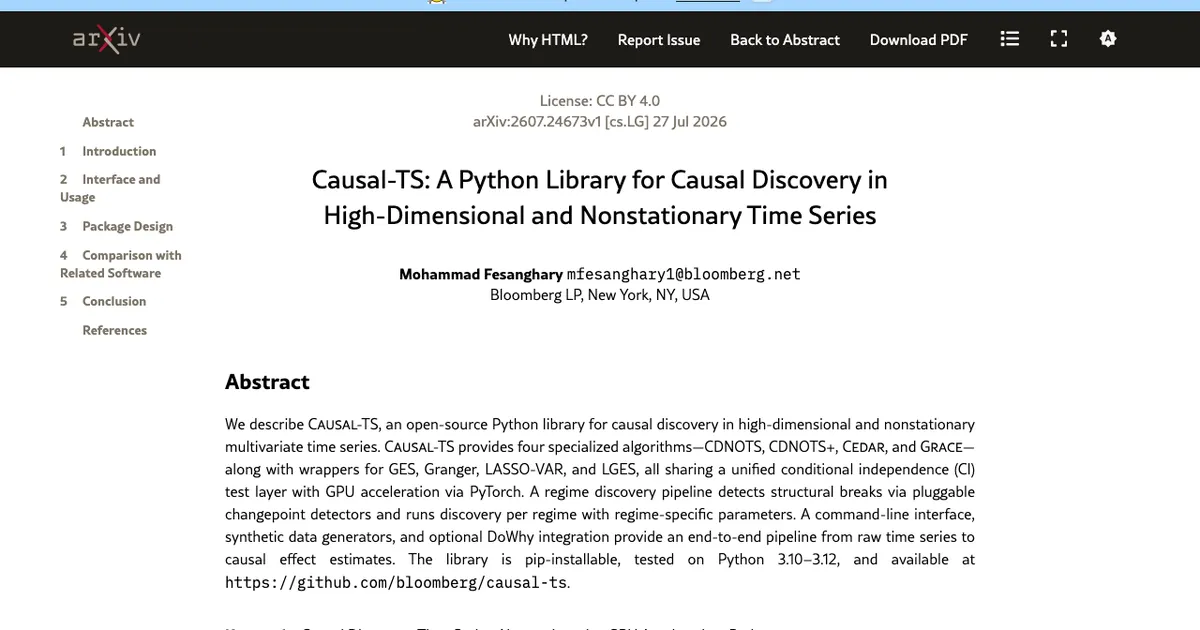
Causal-TS: A Python Library for Causal Discovery in High-Dimensional and Nonstationary Time Series

By Mohammad Fesanghary • arXiv • Importance: 80/100
Hero Image for 2607.24673

🚀 Unlock the Secrets of Time: Introducing Causal-TS for Advanced Time Series Analysis

Are your time series data complex? High-dimensional? Or do they shift over time (nonstationary)? If you’re trying to move beyond simple correlation and actually discover causality, you need specialized tools.

Meet Causal-TS: the revolutionary open-source Python library designed by ML researchers to crack the toughest problems in multivariate time series analysis. This isn’t just another modeling package; it’s an end-to-end framework that bridges raw data streams directly to actionable causal effect estimates.

What is Causal Discovery, Anyway?

The problem with standard machine learning metrics is correlation—they tell you if two variables move together. But in real-world systems (like finance, climate science, or sensor networks), knowing the cause-and-effect relationship is everything. Causal discovery aims to map out those directed relationships: does Variable A cause Variable B?

💡 Why Causal-TS Changes the Game

Causal-TS tackles the biggest hurdles in the field simultaneously:

  1. High Dimensionality & Nonstationarity: It uses a novel ‘regime discovery pipeline’ that detects structural breaks (when the system rules change) and runs causal inference per regime. This means it adapts to dynamic, real-world shifts.
  2. Algorithm Depth: The library isn’t monolithic. It includes specialized algorithms—CDNOTS, CDNOTS+, CEDAR, and GRACE—alongside wrappers for industry standards like GES and Granger Causality.
  3. Performance Power: Everything is built on a unified conditional independence (CI) test layer, boasting GPU acceleration via PyTorch. Speed matters when dealing with terabytes of data!
  4. Total Workflow Integration: From raw time series to actionable estimates, Causal-TS provides a complete pipeline: pluggable changepoint detectors, seamless API integration, and even optional hooks into DoWhy.

💻 Getting Started (The Developer’s Guide)

Causal-TS is built for modern ML workflows. It’s pip-installable, thoroughly tested (Python 3.10–3.12), and gives you a full sandbox experience with synthetic data generators and a robust command-line interface.

👉 Read the technical deep dive on ArXiv: https://arxiv.org/abs/2607.24673

🛠️ Code Repository: Check out the official GitHub repo: https://github.com/bloomberg/causal-ts


Keywords for SEO: #TimeSeriesAnalysis #CausalInference #MachineLearning #PythonLibrary #DataScience #GPUComputing

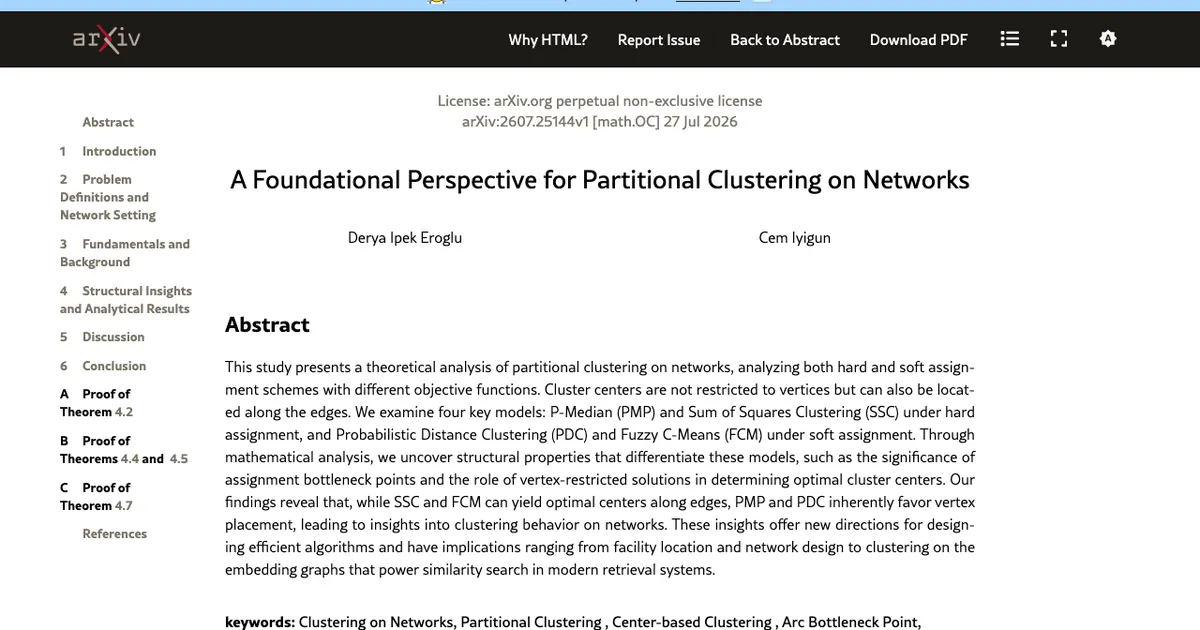
A Foundational Perspective for Partitional Clustering on Networks

By Derya Ipek Eroglu, Cem Iyigun • arXiv • Importance: 75/100
Hero Image for 2607.25144

Unlocking Network Secrets: A Foundational Look at Partitional Clustering

Are traditional clustering methods failing your complex network data? Our latest research dives deep into the mathematical core of partitional clustering on graphs, revealing fundamental truths about where and how optimal ‘centers’ should be placed.

The Problem with Standard Clustering (and how we fixed it):

The standard approach often assumes that cluster centers must exist on a node (vertex). But what if the true optimal center lies right on an edge, or even floating in the middle of a connection?

This paper challenges those assumptions. We provide a rigorous theoretical analysis of various clustering models—from minimizing squared distances (SSC) to facility location problems (P-Median)—allowing cluster centers to be located anywhere: at vertices or along edges.

What Did We Discover? The Heart of the Research:

Through intensive mathematical modeling, we didn’t just compare algorithms; we uncovered structural properties that dictate clustering behavior. Our key finding is highly insightful:

  1. The Placement Trap: Some models (like P-Median and Probabilistic Distance Clustering) are fundamentally biased toward placing centers only on vertices, even if moving them slightly onto an edge would improve results.
  2. Edge Potential: Conversely, other methods (SSC and FCM) showed they can indeed find optimal locations along edges.

This distinction is massive. Understanding why a model fails to utilize the full geometry of your network graph is crucial for designing better-performing algorithms.

Why Should You Care? Real-World Impact & Applications:

These insights aren’t just academic curiosities; they have profound implications across multiple high-tech domains:

  • Facility Location: Optimizing the placement of service centers or infrastructure nodes on complex road networks.
  • Network Design: Building highly efficient, low-cost communication architectures.
  • Modern AI Retrieval Systems: Improving clustering on embedding graphs—the crucial data structure powering modern similarity search and Recommendation Engines (Think Google Search or advanced e-commerce personalization).

If your work involves grouping similar items in vast, interconnected datasets, our foundational analysis provides the blueprints for designing more accurate, geometrically aware solutions.

🔗 Dive into the Theory:

Read the full paper here: https://arxiv.org/abs/2607.25144


A foundational perspective from Derya Ipek Eroglu and Cem Iyigun.

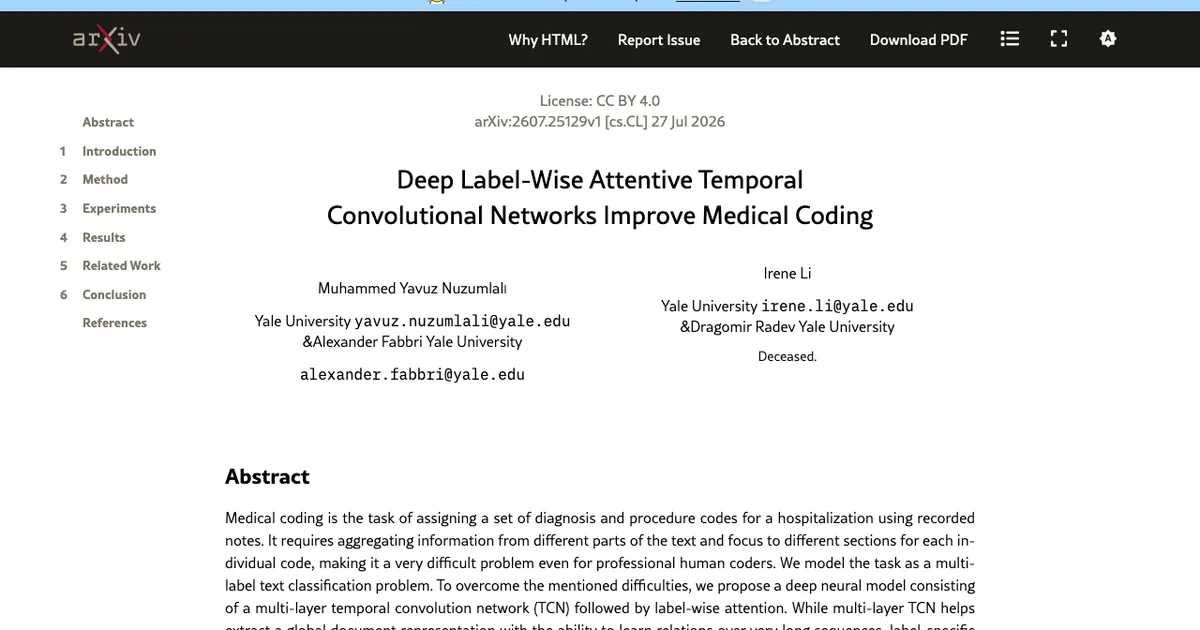
Deep Label-Wise Attentive Temporal Convolutional Networks Improve Medical Coding

By Muhammed Yavuz Nuzumlalı, Alexander Fabbri, Irene Li, Dragomir Radev • arXiv • Importance: 75/100
Hero Image for 2607.25129

Decoding the Deep Code: How AI is Revolutionizing Medical Diagnosis

The process of assigning accurate diagnosis and procedure codes—known as medical coding—is deceptively complex. It’s not just about finding keywords; it requires a human expert to synthesize information scattered throughout an entire patient’s hospital record. For AI, this multi-faceted challenge has been incredibly difficult.

New research from Muhammed Yavuz Nuzumlalı et al. introduces a powerful breakthrough: Deep Label-Wise Attentive Temporal Convolutional Networks (TCNs). This architecture is tackling the problem not just by reading all the text, but by learning where to focus its attention for every single required medical code.

💡 The Core Problem AI Solved

Medical coding is a multi-label classification task. In simple terms: given a massive document (the hospital record), the model must identify and assign multiple, sometimes unrelated, codes across various sections of that text. A human expert’s ability to maintain context across different passages is what makes this so challenging for machines.

🚀 The AI Innovation: TCN + Label-Wise Attention

The proposed model combines two sophisticated components:

  1. Temporal Convolutional Network (TCN): This layer excels at building a comprehensive, global understanding of the entire patient document, capturing relationships across extremely long sequences of text.
  2. Label-Wise Attention: This is the game-changer. Instead of treating all codes equally, this mechanism allows the AI to create specific ‘focus points’ for each code it needs to predict. For instance, if predicting a cardiac issue, the model can specifically boost its attention to notes mentioning heart function, ignoring peripheral details.

This targeted focus drastically improves accuracy and completeness in a critical clinical setting.

📈 The Impact: More than Just Numbers

The results are compelling. The researchers reported an 9% increase in F-1 score compared to the prior state-of-the-art, but more importantly for healthcare, they saw a remarkable 28% jump in recall. In clinical decision support, high recall means fewer missed diagnoses—a life-saving metric.

This research signals a major step toward automated clinical documentation, reducing human workload while improving the reliability and safety of patient records.

🔗 Read the full paper here: https://arxiv.org/abs/2607.25129

Keywords: Medical AI, Clinical NLP, Deep Learning, Temporal Convolutional Network, Healthcare Tech.

Automatic Knowledge Graph Construction and Query for Earthquake Catalogs

By Yuxin Zhou, Huai Zhang, S. Mostafa Mousavi • arXiv • Importance: 75/100
Hero Image for 2607.24984

🧠 Decoding Earth’s Secrets: How Graph AI is Revolutionizing Earthquake Research

In the age of deep learning seismology, our catalogs are booming. Thanks to powerful new detectors and phase pickers, we’re collecting an unprecedented volume of earthquake data. But here’s the bottleneck: merely having massive amounts of data isn’t enough. How do you answer complex, open-ended questions like, “What characterizes this specific sequence?”

The traditional methods rely on rigid time windows and subjective expert analysis—a huge limitation for understanding complex natural phenomena.

Meet GraphRAG: The Breakthrough in Seismology Data Analysis 📊

Our latest work introduces Graph Retrieval Augmented Generation (GraphRAG), pioneering its application directly to raw, tabular earthquake catalog records. Think of it as building a self-contained intelligence layer over the data, without needing manual, painful restructuring by geophysicists.

We rigorously tested GraphRAG across three vastly different and complex seismic events: the adjacent reservoir swarm, the major 2019 Ridgecrest tectonic sequence, and the powerful 2021 Maduo Mw7.4 aftershock sequence. The results are transformative:

  • Automatic Knowledge Structuring: GraphRAG automatically builds complete, queryable knowledge graphs from raw data—effortlessly transforming simple tables into rich relational knowledge.
  • Superior Reasoning: When carefully guided by seismology-informed prompting, the system dramatically improves mechanism reasoning, eliminating targeted factual errors while boosting accuracy and trustworthiness.
  • Transferable Power: GraphRAG offers a practical, near zero-cost query interface for any earthquake catalog. It’s designed to be robust and transferable across different types of seismic data.

This approach moves beyond simple time series summarization. By using graph structures, it allows researchers to perform sophisticated catalog-wide summarization and deep temporal stage comparison, giving unprecedented insights into the subsurface processes that govern earthquakes.

Why Does This Matter for Tech & Earth Science? 🌎💻

This research isn’t just an academic novelty; it’s a paradigm shift in how we interact with massive scientific datasets. By embedding GraphRAG, we are providing a reliable, scalable, and highly intelligent interface that empowers the next generation of geoscience researchers.

Whether you’re tracking plate tectonics or mapping subsurface fluid dynamics, graph-based reasoning allows us to query not just what happened, but why it happened—making these monumental Earth events understandable in machine-readable terms.


🔗 Read the full paper here: https://arxiv.org/abs/2607.24984

MachineLearning #Seismology #KnowledgeGraph #AIforScience #EarthquakeDetection

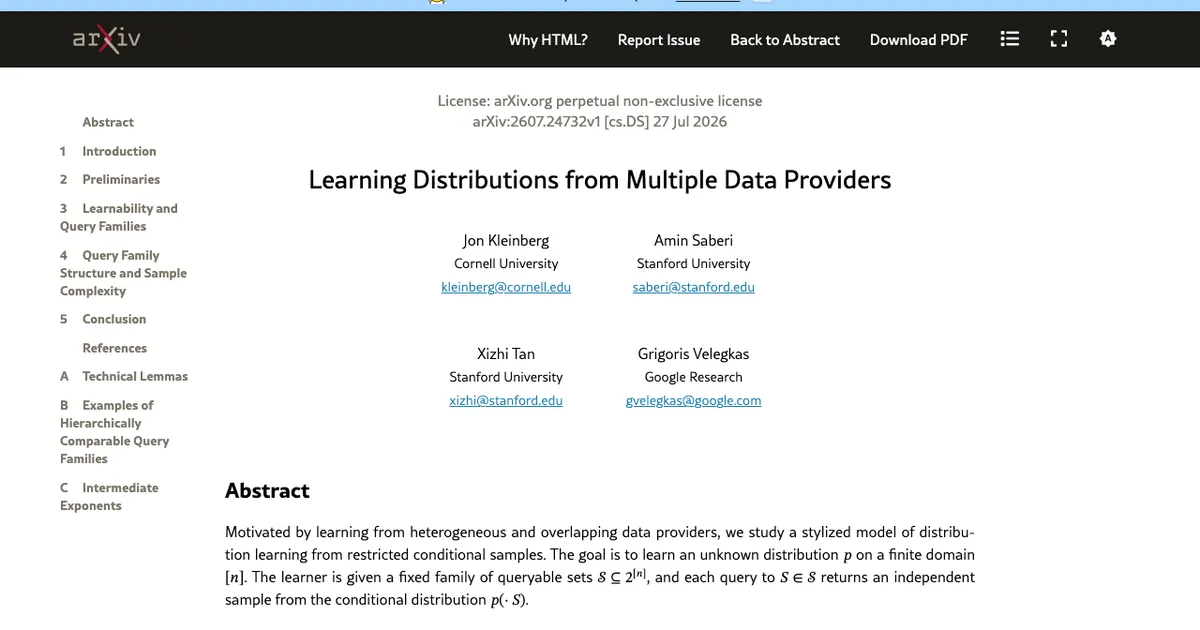
Learning Distributions from Multiple Data Providers

By Jon Kleinberg, Amin Saberi, Xizhi Tan, Grigoris Velegkas • arXiv • Importance: 75/100
Hero Image for 2607.24732

💡 Data Puzzle Solved: How We Learn Distributions from Limited Data Sources

The world of AI is increasingly built on data silos. One model might train on medical records, another on financial transactions, and a third on social media activity—but how do we stitch these disparate sources together to get a true picture? Learning the underlying truth (the ‘true distribution’) when you only get restricted samples from various providers is one of the hardest problems in machine learning.

Our latest research tackles this head-on. We study a stylized model where an AI learner can query multiple, overlapping data sets ($ ext{Provider A}$ might have $X$ and $Y$; $ ext{Provider B}$ might have $Y$ and $Z$). Each query gives us an independent sample conditional on the available data. The fundamental question is: How much data do we need to accurately model the full distribution?

🔍 What Does Our Paper Show?

The core finding isn’t just that learnability depends on how connected your data sets are, but precisely how that connection determines the required sample complexity. Think of it as finding the most efficient roadmap for gathering knowledge.

  1. The Connection Matters: We define a ‘co-occurrence graph’ based on the queried sets. This graph dictates the minimum information needed to make accurate predictions. If elements are not connected in this graph, we can’t learn their joint distribution reliably.
  2. Complexity Spectrum: Our work maps out the entire landscape of possible data requirements. The sample complexity ranges from needing just linear data ($ ilde{O}(n/ ext{error}^2)$) when all pairs are queryable (the best-case scenario), up to requiring a full quadratic amount ($ ilde{O}(n^2/ ext{error}^2)$) if the sets only overlap minimally.
  3. The General Law: Crucially, we prove that for any desired polynomial rate $ ilde{ heta}(n^eta/ ext{error}^2)$ where $1 < eta < 2$, there exists a data querying structure that forces this exact sample complexity. This reveals the full continuous spectrum of optimal learning bounds.

🚀 Why Is This Breakthrough for ML Engineers?

This research provides fundamental, actionable guidelines for designing robust and efficient collaborative AI systems:

  • Resource Allocation: It tells companies (especially those managing complex data partnerships) exactly how much investment in data querying or collaboration is needed to achieve a specific level of accuracy.
  • System Design: If your system relies on combining heterogeneous sources, understanding the underlying connectivity graph becomes mission-critical. A sparsely connected graph means your overall model performance will be fundamentally limited, no matter how many queries you run.
  • Efficiency Gains: By identifying structural conditions (like ‘hierarchical comparability’) that guarantee near-linear complexity, we give practitioners better architectural blueprints for designing data sources optimized for machine learning efficiency.

The Takeaway: This paper doesn’t just prove a bound; it provides the mathematical framework to tune the required sample size based on the inherent structural limitations and overlaps of your input data—a critical tool for next-generation privacy-preserving and federated ML architectures.

🔗 Read the full details and explore the theory: https://arxiv.org/abs/2607.24732


#MachineLearning #DataScience #AIResearch #FederatedLearning #Statistics

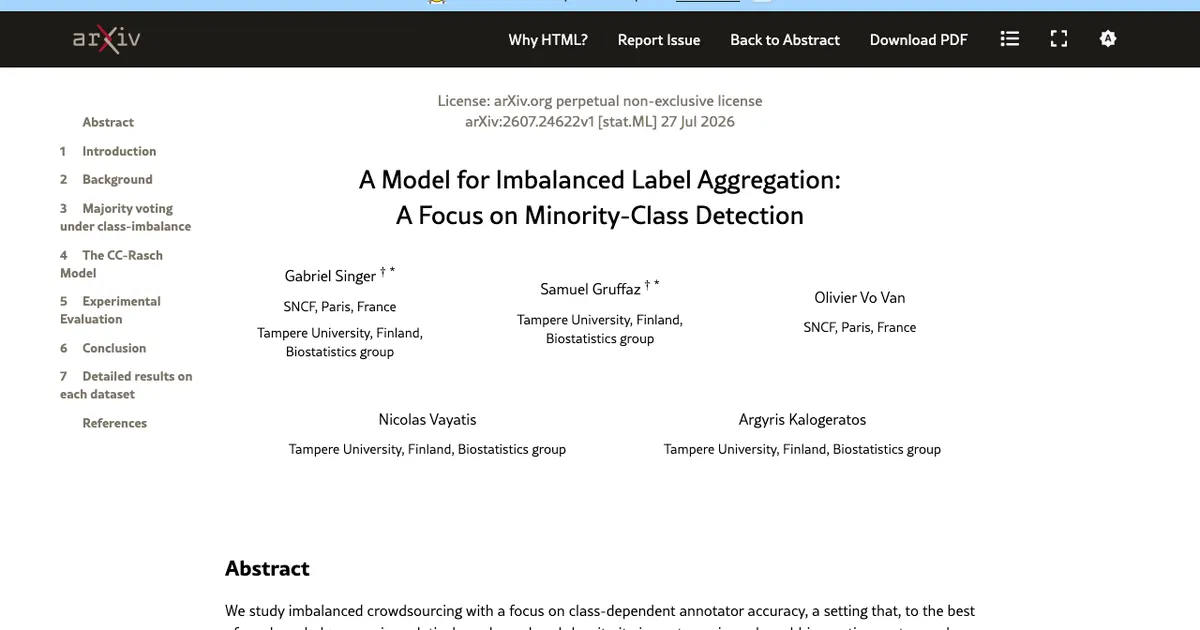
A Model for Imbalanced Label Aggregation: A Focus on Minority-Class Detection

By Gabriel Singer, Samuel Gruffaz, Olivier Vo Van, Nicolas Vayatis, Argyris Kalogeratos • arXiv • Importance: 75/100
Hero Image for 2607.24622

Mastering Rare Data: A New Approach to Imbalanced Label Aggregation

If your AI system relies on labeling data—think image tagging, medical diagnosis, or specialized text classification—you know the pain point: your most important classes are usually the rarest ones. These minority classes are often the hardest for standard machine learning models to detect. This isn’t just an academic quirk; in real-world inspection systems (like quality control or identifying rare defects), catching that small percentage of critical instances is everything.

New research tackles this exact challenge head-on, introducing a sophisticated generative aggregation model designed specifically for imbalanced crowdsourcing data. They call it a major breakthrough for maximizing minority recall while maintaining strong overall performance.

🔬 What Problem Does This Solve?

The traditional approach to label aggregation (like simple majority voting) fails dramatically when the data is skewed. Why? Because most annotation systems treat annotator reliability and item difficulty as single, global factors. But in reality, an annotator might be brilliant at spotting defect A but terrible at identifying defect B. Conversely, some images might be trivially easy across all categories, while others are genuinely difficult—and this difficulty might vary by class.

This paper bridges a critical gap: it’s not enough to model just the errors or just the item difficulty. You need a model that simultaneously captures both the annotator’s competence relative to a specific class and how hard a specific item is to label.

🧠 The Model’s Edge: Class-Dependent Expertise

The researchers introduce a generative aggregation framework that allows two key parameters—annotator abilities and item difficulties—to vary independently across every single class. This nuanced understanding of expertise significantly boosts the robustness of the final model.

In plain terms: Instead of treating all data points equally, the system figures out: “Oh, Annotator X is highly accurate on Cat images but terrible on Dog breed identification, AND this specific photo of a dog is much harder to label than average.” This granular analysis leads to superior predictions for those elusive minority classes.

✨ Key Takeaways & Practical Implications (For ML Engineers)

  1. State-of-the-Art Minority Recall: The model consistently outperforms existing methods, achieving the highest minority recall rates—critical when failure means missing a rare but important event.
  2. Robust Testing: They validated their approach on 33 diverse real-world crowdsourcing datasets spanning both massive annotation counts (many labels per item) and massive item counts. This proves its generalizability.
  3. Theoretical Insights: The paper also revisits Condorcet’s Jury Theorem in this class-imbalanced setting, providing valuable theoretical context for future research in decentralized labeling.

This work is a must-read for anyone building production systems that rely on crowdsourced data, especially those dealing with low-incidence events or highly skewed datasets. It represents a significant step towards reliable AI powered by diverse human expertise.

A Corpus of Joint EEG and Self-Paced Reading of Natural Dutch Texts

By Sara Møller Østergaard, Lenneke Doris Lichtenberg, Laura Boon and Bruno Nicenboim in Proceedings of the Fifteenth Language Resources and Evaluation Conference • ACL Anthology • Importance: 75/100
Hero Image for acl_2026.lrec-1.880

Decoding the Mind: New Dutch Corpus Links Brainwaves to Reading Comprehension 🧠🇳🇱

Calling all Computational Linguists, NLP Engineers, and Cognitive Scientists! We’re excited to dive into a cutting-edge resource that is set to revolutionize how we study natural language processing (NLP) from a human perspective.

Introducing the Tilburg corpus of Natural Dutch Texts (TiNT): a unique dataset combining Electroencephalography (EEG)—the measurement of electrical activity in the brain—with Self-Paced Reading (SPR) on authentic, medium-length Dutch texts. Why is this revolutionary? Because it provides an unparalleled window into how our brains actually process language in real-world scenarios.

🚀 What Makes TiNT So Special?

Traditional research often struggles to perfectly align neural signals with precise word-level behavior. SPR solves this! By giving participants control over their reading speed, the corpus allows researchers to precisely time and synchronize brain responses (like N400 and P600 ERPs) directly to individual words, which is crucial for fine-grained psycholinguistic analysis.

Furthermore, the focus on natural Dutch texts with complex dependencies makes this resource particularly valuable for developing robust language models that handle the nuances of real human communication. This isn’t just a collection of sentences; it’s a rich, nuanced model of how an entire culture processes information.

💡 The Impact on AI and Linguistics

The ability to link observable brain activity (like surprise or difficulty signals) directly to linguistic structures is the next frontier in building truly comprehending AI.

For machine learning researchers, TiNT offers a crucial behavioral ground truth that goes beyond simple token classification. It allows for the development of NLP systems that can not only predict text but also model cognitive load, ambiguity resolution, and contextual understanding—traits essential for advanced conversational agents.

Whether you are building state-of-the-art Dutch NLP models or pushing the boundaries of Brain-Computer Interfaces (BCIs), this corpus is a vital accelerator.

Dive deeper into the methodology and findings at the conference proceedings: https://aclanthology.org/2026.lrec-1.880/

AI #NLP #MachineLearning #CognitiveScience #DutchLanguage #EEG

A Corpus-Based Comparison of two Approaches for Emotion Annotation in French Texts

By Valentina Dragos and Delphine Battistelli in Proceedings of Computational Affective Science (CAS) @ LREC 2026 • ACL Anthology • Importance: 75/100
Hero Image for acl_2026.cas-1.4

Revolutionizing Emotion Detection in Text: Bridging Lexicons and Deep Learning

Are you building an NLP application that needs to understand human emotion from text? You know the drill: simple keyword matching is too basic, but deep learning models often miss subtle cultural nuances. The core challenge remains detecting the full spectrum of emotion (joy, anger, admiration, etc.) written down.

A new study tackles this head-on by conducting a rigorous comparison between two fundamental approaches for annotating emotions in French text: traditional lexicon-based methods and advanced machine learning techniques trained on vast corpora. Can they complement each other? More importantly, which one is better suited for capturing the subtle, real-world expressions of human feeling?

🤯 The Research Breakthrough You Need to Know

This paper introduces a comprehensive cross-methodological analysis using four diverse datasets. It doesn’t just compare ‘accuracy’; it dives deep into three critical dimensions:

  1. Identifying Emotional Sentences: Pinpointing the exact emotional context.
  2. Categorizing Emotions: Determining what emotion is present (e.g., frustration, surprise).
  3. Detecting Specific Behaviors: A granular look at ‘behavioral emotions’ (like a textual representation of shouting or crying).

What did they find? The insights are highly practical for practitioners:

💡 The Complementary Power: While both methods have value, the study suggests their combination is key to achieving robust emotional understanding. They aren’t mutually exclusive—they are partners.

⚠️ A Key Warning Signal: Not all emotions are created equal when it comes to annotation difficulty. Most notably, the learning-based approach has a tendency to significantly ‘overdetect Admiration,’ which needs careful handling in real-world models.

🌐 Why Does This Matter for Tech? (SEO/Geo Focus)

Emotion detection is foundational for several major tech sectors—from customer service bots and social media sentiment analysis to mental health monitoring tools. For developers building advanced AI in French markets or any NLP vertical, understanding these biases is crucial for deploying reliable systems.

If your project requires highly accurate French emotion annotation, this paper provides the empirical evidence you need to fine-tune your data pipelines and choose the right combination of annotation strategies. It moves us closer to truly affective computing.

Read the full comparison here


Source: Valentina Dragos & Delphine Battistelli, Proceedings of Computational Affective Science (CAS) @ LREC 2026

NLP #AffectiveComputing #FrenchAI #MachineLearning #SentimentAnalysis

A Corpus-Based Profiling of Regional English Variants in Global Media: Insights from Olympic Journalism

By Felix Mao in Proceedings of the Fifteenth Language Resources and Evaluation Conference • ACL Anthology • Importance: 75/100
Hero Image for acl_2026.lrec-1.503

Global Voices: How Olympics Journalism is Mapping the Future of English 🌍✍️

Have you ever noticed subtle differences in how English is written across countries? From American headlines to Shanghai reports, English is a global lingua franca—but it’s far from uniform! Our latest research tackles this massive linguistic puzzle by diving deep into high-stakes, real-world journalism: coverage of the Olympic Games.

Using the Olympic Journalism English Variants Corpus, we built an unprecedented dataset. This isn’t just random news; these are professional reports covering events in the US, China, Spain, and Mexico between 2020 and 2023. Why did this matter? Because major international media outlets have a distinct ‘voice.’

💡 What Did We Do? The Tech Deep Dive

The goal was to numerically profile regional English variants. Traditional linguistic analysis is qualitative, but we brought in the power of advanced AI.

Our methodology integrated sophisticated GPT-based embeddings with classic machine learning techniques like Support Vector Machines (SVM). This powerhouse combination allowed us to analyze an incredible 164 distinct features—covering everything from how many nouns are used (nominality) to overall sentence structure and sentiment.

The results? Our model achieved a near-perfect F1 score of 97.2%, proving the strong, measurable differences in these regional journalistic styles.

🚀 Key Insights: It’s Not Just Pronunciation

The findings revealed more than just statistical significance. We found deep, interpretable patterns that give us a data-driven style guide for global media writing:

  • Structural Fingerprints: Certain regions exhibit measurable differences in their ‘verb ratio’ and ‘nominality,’ suggesting unique stylistic preferences when conveying complex narratives.
  • Readability Markers: The variance in readability across these national outlets offers insights into target audience strategies, from quick-read headlines to detailed feature reports.
  • Universal Template: This work isn’t just about Olympics news. It provides a robust, proven template for analyzing any World English variant—opening the door to global comparative linguistics and advanced NLP applications far beyond sports coverage.

🌐 Why Does This Matter For You?

For linguists, computational sociolinguists, journalists, or even tech developers building multilingual models:

  1. Enhanced Language Modeling: Understanding these subtle regional variations is crucial for building truly global AI models that don’t treat ‘English’ as a single monolithic entity.
  2. Content Strategy: It gives media organizations a scientific tool to understand and replicate or differentiate their unique authoritative voice across diverse markets.
  3. World Englishes Research: It establishes a powerful, quantitative paradigm for academic research into the vast spectrum of global English usage.

🔗 Read the full paper to explore the methodology and detailed findings: https://aclanthology.org/2026.lrec-1.503/

ComputationalLinguistics #AIResearch #WorldEnglishes #NLP #GlobalMedia

A Database of Romance Clitics With Speech Samples

By Abdelrahim Qaddoumi, Owen Rambow, Lori Repetti and Francisco Ordóñez in Proceedings of the SIGUL 2026 Joint Workshop with ELE, EURALI, and DCLRL: Towards Inclusivity and Equality: Language Resources and Technologies for Under-Resourced and Endangered Languages • ACL Anthology • Importance: 75/100
Hero Image for acl_2026.sigul-1.9

Unlocking Romance Speech: A New Database Revolutionizing Linguistic Research

As an ML researcher and tech expert, I’ve been tracking the frontier of low-resource NLP. Language models are only as good as the data they train on, which is often a major bottleneck for endangered or highly regionalized dialects.

That’s why this release from Abdelrahim Qaddoumi et al. is incredibly exciting. They’ve unveiled a massive new resource: a specialized database of Romance clitics across nine diverse varieties.

📚 What Are Clitics and Why Do They Matter?

The abstract might throw around some linguistic terms, but the core takeaway is revolutionary for NLP. Clitics are small, unstressed phonetic units—like prepositions or articles—that attach to words in rapid speech (think of how quickly speakers link sounds). These subtle elements are crucial because they carry vital grammatical information that single-word transcriptions often miss.

For ML models and ASR (Automatic Speech Recognition) systems, capturing these precise phonological details is the difference between a generic prediction and one with deep linguistic accuracy. Furthermore, by focusing on highly regionalized areas like Corsica, Sardinia, and Liguria, they are tackling the ‘under-resourced’ problem head-on.

🚀 Key Features for ML Engineers & Linguists

What makes this database a game-changer?

  1. Hyper-Specialization: It concentrates specifically on stressed clitics in Romance languages, offering granularity far beyond general corpus data.
  2. Varietal Diversity (GEO Focus): Covering nine distinct geographical regions—including Mallorca, Menorca, and Formentera—this makes it a goldmine for comparative linguistics and model robustness testing across different accents and dialects.
  3. Comprehensive Data Stack: The inclusion of speech samples, detailed transcriptions, and sophisticated linguistic annotations means researchers don’t have to compile multiple data types—everything is ready to train on.
  4. Accessibility: A publicly accessible interface allows for easy searching and immediate incorporation into research pipelines, drastically lowering the barrier to entry for international scholars.

🌍 Impact: Beyond Academia

This isn’t just an academic resource; it has practical implications for global tech product development.

  • Better Voice Assistants: Improving ASR accuracy in diverse regional accents (a huge challenge globally).
  • Inclusive Tech: Helping to digitize and preserve the linguistic heritage of under-represented communities, ensuring that technology serves all languages, not just major world tongues. This supports the goal of ‘Inclusivity and Equality’ mentioned in the paper.

If you are building advanced multilingual NLP systems or working on dialectal ASR, I highly recommend checking out this resource. It’s a significant step towards making tech truly linguistically inclusive.

🔗 Read the full details here: https://aclanthology.org/2026.sigul-1.9/

A Dataset for Evaluating ASR on Specialized Vocabulary

By Emily Haubert Klering, Eduardo Gabriel Cortes, Tatjana Chernenko, Mariana Vargas Trarbach, Gabriel de Oliveira Ramos, Sandro José Rigo, Maitê Dupont, Ana Luiza Treichel Vianna, Gabriela Krause dos Santos, Vinicius Meirelles Pereira, Denis Andrei de Araujo and Rafael Kunst in Proceedings of the Fifteenth Language Resources and Evaluation Conference • ACL Anthology • Importance: 75/100
Hero Image for acl_2026.lrec-1.32

Decoding the Jargon: A New Benchmark for Next-Gen ASR Models 🎙️🔬

If you work in speech technology or Natural Language Processing (NLP), you’ve probably heard the buzz about Automatic Speech Recognition (ASR). But here’s a critical caveat: most of the standard datasets only teach models how to transcribe common words—the stuff we use every day. When they hit specialized jargon, technical terms, medical language, or niche dialects? The model often falters.

That’s exactly what groundbreaking research from Emily Haubert Klering et al. tackles head-on. They aren’t just giving us another dataset; they’ve built an entire diagnostic framework designed to expose exactly where ASR models fail, especially when dealing with out-of-vocabulary (OOV) specialized language.

💡 What Problem Does This Solve?

The core issue is that traditional Word Error Rate (WER) metrics are too forgiving. They give a single number, making it hard to tell if an ASR system fails because of general grammar errors or because it simply doesn’t know the technical terms in the vocabulary.

This new work introduces two revolutionary evaluation metrics:

  • Biased Word Error Rate (B-WER): This is the score that matters for specialized domains. It specifically measures how well the model handles domain-specific jargon and out-of-vocabulary terms, which is critical for industry use cases like legal or medical dictation.
  • Unbiased Word Error Rate (U-WER): This keeps track of general vocabulary accuracy on standard speech.

🌎 The Benchmark You Need to Know

To make this framework robust and useful globally, the researchers developed a massive, linguistically curated bilingual dataset (English and Portuguese). It features over 18.7 hours of challenging audio, with OOV rates reaching an impressive 100%. This makes it one of the most rigorous benchmarks available today.

✨ Key Findings & Why It Matters for You

The study, which evaluated state-of-the-art models like Whisper (medium, large-v3), provided compelling evidence that these specialized metrics are essential. On the toughest jargon datasets, B-WER was significantly higher than U-WER (e.g., 0.88–0.90 vs. 0.06–0.19). This clearly demonstrates that standard WER is masking critical failure points.

Furthermore, their findings quantify the massive potential of contextual biasing. They showed that simply providing the correct jargon via prompting can dramatically reduce B-WER by 0.50–0.70 absolute—a huge win for deploying ASR in complex industrial environments.

🚀 Bottom Line: If you are building commercial speech products (e.g., calling an AI doctor, legal transcribers, or technical support agents), you cannot rely on general-purpose WER scores. You need domain-aware evaluation.

The dataset and comprehensive scripts are released as a reproducible benchmark. Check out the paper to understand how this changes the game for ASR research (read more at https://aclanthology.org/2026.lrec-1.32/).

A Dataset for Probing Translationese Preferences in English-to-Swedish Translation

By Jenny Kunz, Anja Jarochenko and Marcel Bollmann in Proceedings of the Fifteenth Language Resources and Evaluation Conference • ACL Anthology • Importance: 75/100
Hero Image for acl_2026.lrec-1.690

🇸🇪 Decoding Language Models: Why Your AI Translations Sound… Weird

The quality of AI translations is constantly improving, but sometimes they still sound unnatural—like a textbook wrote them. This isn’t just random bad luck; it’s a linguistic bias that AI models struggle to overcome.

In our latest dive, we tackle translationese: the subtle habit of making translated text sound overly literal or foreign, even if grammatically correct.

🌐 What is ‘Translationese’?

The phenomenon of translationese means the output language (in this case, Swedish) carries noticeable structural footprints of the source language (English). It’s the difference between a natural conversation and a direct, clause-by-clause mapping. Does your favorite chatbot know the difference?

🔬 Our Breakthrough Dataset & Findings

To rigorously test this bias, we developed the first freely available dataset specifically designed for English-to-Swedish translation. This resource doesn’t just contain sentences; it includes detailed error tags and descriptions of why a translation is problematic.

The results were clear: When testing modern smaller Swedish and multilingual LLMs, these models repeatedly favored the unidiomatic, ‘translationese’ phrasing.

Even when we removed the original English source text (context), the models still showed a strong tendency toward literal, unnatural translations! This suggests that simply having access to English heavily biases the AI’s internal preference for direct mapping.

💡 The Takeaway: The current generation of LLMs needs more than just massive datasets; they need fine-tuning on high-quality idiomatic examples to truly capture natural language nuance.

🚀 Why This Matters for NLP and Localization

This research isn’t just academic curiosity; it’s a crucial benchmark. Our dataset provides the necessary resource for researchers—and developers building next-gen translation tools—to develop models that produce genuinely native, idiomatic output in non-English languages. Better localization means better global user experiences.


Want to see the raw data? You can explore our full dataset and findings here: https://aclanthology.org/2026.lrec-1.690/

#NLP #MachineLearning #AIbias #SwedishLanguage #Localization #LLMs

Explore Recent Digests