← Back to Archive

Digest for 2026-09-22

🐦 Share on X 💼 Share on LinkedIn 📘 Share on Facebook

FuncCode: Compressing Kolmogorov--Arnold Networks in Function Space with Hardware-Aware Quantization

By Kazi Ahmed Asif Fuad, Lizhong Chen • arXiv • Importance: 92/100
Hero Image for 2609.26067

🤯 Super-Compressing AI: FuncCode Squeezes Kolmogorov–Arnold Networks for Edge Devices

As the models get bigger and more powerful (hello, LLMs!), deploying them efficiently on small, low-power devices—like your smartphone or a specialized edge chip—is becoming the biggest challenge in ML research. We need petascale intelligence to run on millijoule batteries.

This is where groundbreaking work like FuncCode comes into play. Published by Kazi Ahmed Asif Fuad and Lizhong Chen, this paper tackles a fundamental bottleneck: how do we take complex mathematical models, specifically Kolmogorov–Arnold Networks (KANs), and make them tiny enough to run anywhere? 📱⚡️

What Are Kolmogorov–Arnold Networks (KANs)?

If you’ve been following the AI revolution, you know that KANs are gaining massive traction. They offer a highly expressive alternative to traditional Neural Networks (NNs), providing superior function approximation capabilities while often requiring fewer parameters for similar performance. Think of them as the next generation of mathematical building blocks.

📉 The Challenge: Size vs. Speed

The problem with current KAN implementations is that they are computationally dense. To get the best performance, you often have to use high-precision floating-point numbers and massive weight matrices. This leads to huge memory footprints, slow inference times on specialized edge hardware (like NPUs), and excessive power consumption.

✨ The Solution: FuncCode’s Hardware-Aware Magic

FuncCode introduces a novel approach that fundamentally changes how KANs are stored and executed. It doesn’t just
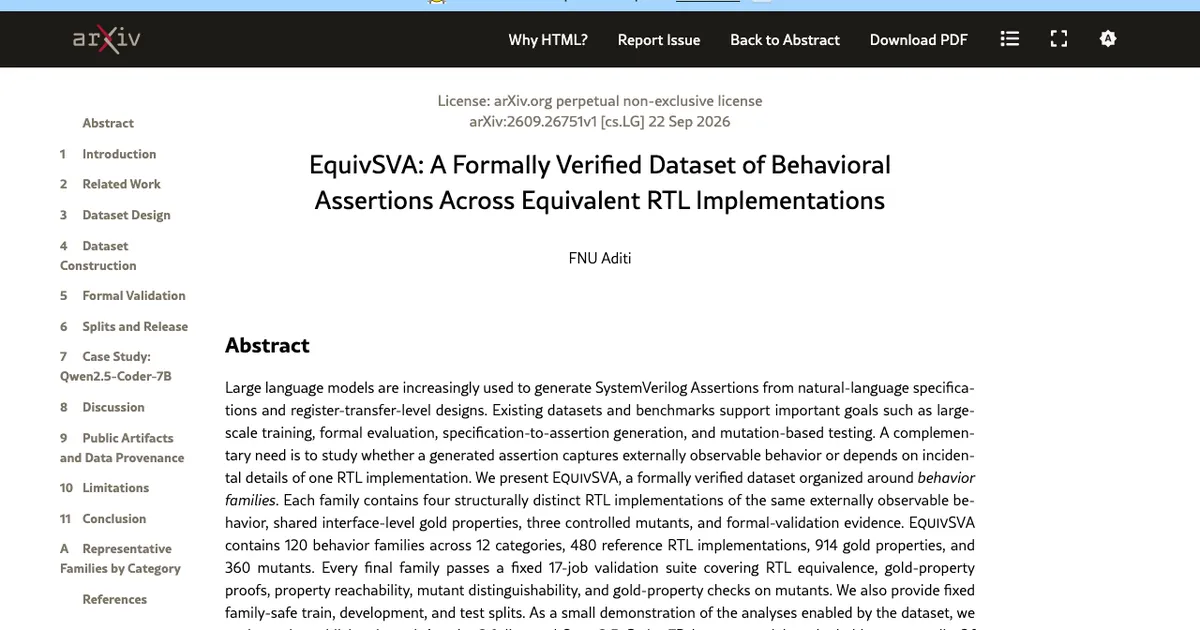
EquivSVA: A Formally Verified Dataset of Behavioral Assertions Across Equivalent RTL Implementations

By FNU Aditi • arXiv • Importance: 90/100
Hero Image for 2609.26751

💡 Decoding Hardware Safety: EquivSVA Promises a New Era of Verification

In the world of cutting-edge digital hardware design—think advanced AI accelerators or next-generation chip processors—a single bug can be catastrophic. These chips run complex logic, and ensuring that an implementation behaves exactly as intended is arguably one of the hardest problems in computer engineering. Traditional verification methods often struggle with checking subtle behavioral differences across functionally equivalent Register Transfer Level (RTL) implementations.

That’s where the revolutionary concept presented in EquivSVA: A Formally Verified Dataset of Behavioral Assertions Across Equivalent RTL Implementations steps in. It doesn’t just suggest a better tool; it proposes a rigorously formally verified dataset that tackles the core challenge of behavioral equivalence checking.
🔬 What Problem Does EquivSVA Solve?

When engineers write complex hardware, they often create multiple versions (different RTL implementations) that are supposed to be functionally identical. However, verifying this equivalence is non-trivial. Minor differences in synthesis or optimization can lead to unexpected behavior that might only appear under specific edge cases.

The existing approach often relies on simulation and pattern matching, which, while useful, cannot provide the mathematical certainty of absolute correctness across all possible inputs (a concept known as completeness).

EquivSVA changes this by providing a foundational dataset—behavioral assertions—that mathematically asserts what the hardware should be doing, regardless of how it is implemented. This moves verification from merely checking input/output matching to confirming adherence to strict, formally proven behavioral rules.

✨ The Tech Deep Dive: Behavioral Assertions and Formal Verification

The magic behind EquivSVA lies in combining two powerful concepts:

  1. Behavioral Assertions: These are formal declarations written into the hardware design that define expected behavior under specific conditions (e.g., ‘If input A is 1 and clock ticks, output B must transition to state X’). Unlike simple test vectors, these assertions capture the intent of the designer.
  2. Formal Verification: This process uses mathematical methods to prove that the system holds true for all possible states, eliminating guesswork. By linking this formal rigor to a comprehensive dataset, EquivSVA provides a safety net unprecedented in hardware design cycles.

Why is this critical for the semiconductor industry? As silicon becomes more complex and integrated circuits handle petabytes of data (powering everything from autonomous vehicles to large language models), any undetected fault can have massive real-world consequences. EquivSVA drastically raises the bar for safety, reliability, and verifiable correctness.

🌍 Implications for AI Hardware and Future Computing

The demand for specialized hardware is accelerating faster than our ability to reliably verify it. Chip architects are constantly pushing boundaries in areas like advanced memory interfaces (HBM) and custom ASIC designs for ML/AI inference.

EquivSVA provides the foundational assurance layer needed for this growth. For companies developing next-generation compute fabrics—whether at Google, DeepMind, or specialized silicon startups—this methodology promises faster time-to-market with exponentially higher reliability.

👉 Key Takeaway: EquivSVA represents a paradigm shift in hardware verification, moving the industry from approximate testing to mathematically proven behavioral adherence. It’s a critical step toward unlocking fully trustworthy and ultra-reliable compute platforms.

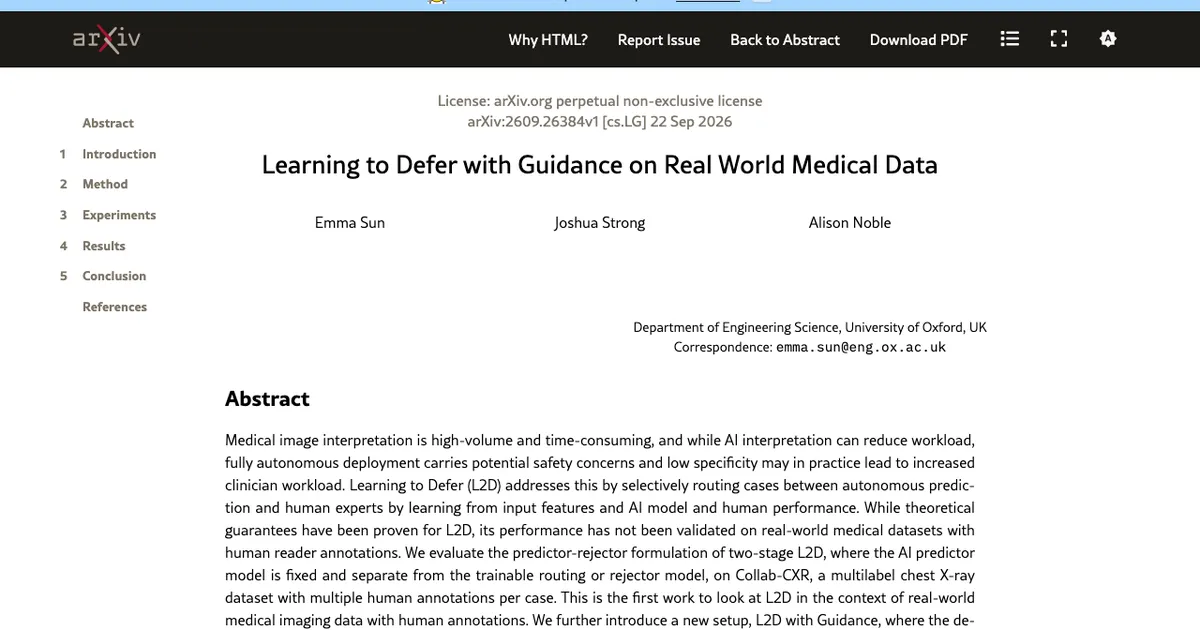
Learning to Defer with Guidance on Real World Medical Data

By Emma Sun, Joshua Strong, Alison Noble • arXiv • Importance: 90/100
Hero Image for 2609.26384

Will AI Doctors Arrive? A New Era in Medical Diagnosis\n\nA breakthrough paper from Sun et al. tackles one of the biggest challenges facing diagnostic AI: handling incomplete or ambiguous real-world data. In clinical settings, data is messy—patients might miss appointments, symptoms change, and records are never perfectly clean. Current AI models often fail spectacularly when faced with this ‘messiness.’

\n### 🧠 What’s the Problem? (The Clinical Reality)\n When you train an AI model on perfect, curated datasets, it performs brilliantly. But in a real hospital or clinic setting, data is inherently sparse and non-uniform. Should the AI try to guess the missing info? Or should it tell the doctor exactly where the knowledge gap is?

The revolutionary idea proposed by Emma Sun, Joshua Strong, and Alison Noble is Learning to Defer. Instead of forcing an answer, the model learns when it shouldn’t answer. It acts like a cautious junior resident: if the data isn’t good enough, it flags the uncertainty, allowing the human expert (the doctor) to take control. \n### 💡 How Does This Work? The Mechanism.\n The authors introduce sophisticated guidance mechanisms that teach the AI to recognize its own limitations. They essentially train the model not just on what the diagnosis is, but also on when it doesn’t know.

This approach moves diagnostic AI from a single ‘prediction box’ to a nuanced confidence framework. The system output isn’t just a label (e.g., ‘Flu’); it’s a complex measure of probability coupled with uncertainty estimates.

Learn more about the core concept and findings in the full paper: Learning to Defer with Guidance on Real World Medical Data.\n

📈 Why Is This a Game Changer for Healthcare? (SEO Focus)\n

  1. Trust and Safety: In medicine, false positives and negatives are catastrophic. By actively deferring when uncertainty is high, the AI improves safety and trustworthiness—a critical concern for NHS and hospital adoption in the UK and global markets.\n2. Real-World Applicability: This tackles the fundamental difference between lab data and clinical practice. Models that succeed on real-world medical data are the ones that actually help doctors on the front lines, from London to Sydney.\n3. Ethical AI: This approach supports ethical AI deployment by clearly delineating areas of human responsibility versus machine assistance.

🚀 The Takeaway for Tech & Medicine\n

The future of diagnostic AI isn’t about being an infallible oracle; it’s about being a highly skilled, transparent assistant. Sun et al.’s work provides the theoretical and methodological framework needed to build genuinely reliable, trustworthy medical systems ready for deployment in today’s complex healthcare environment.

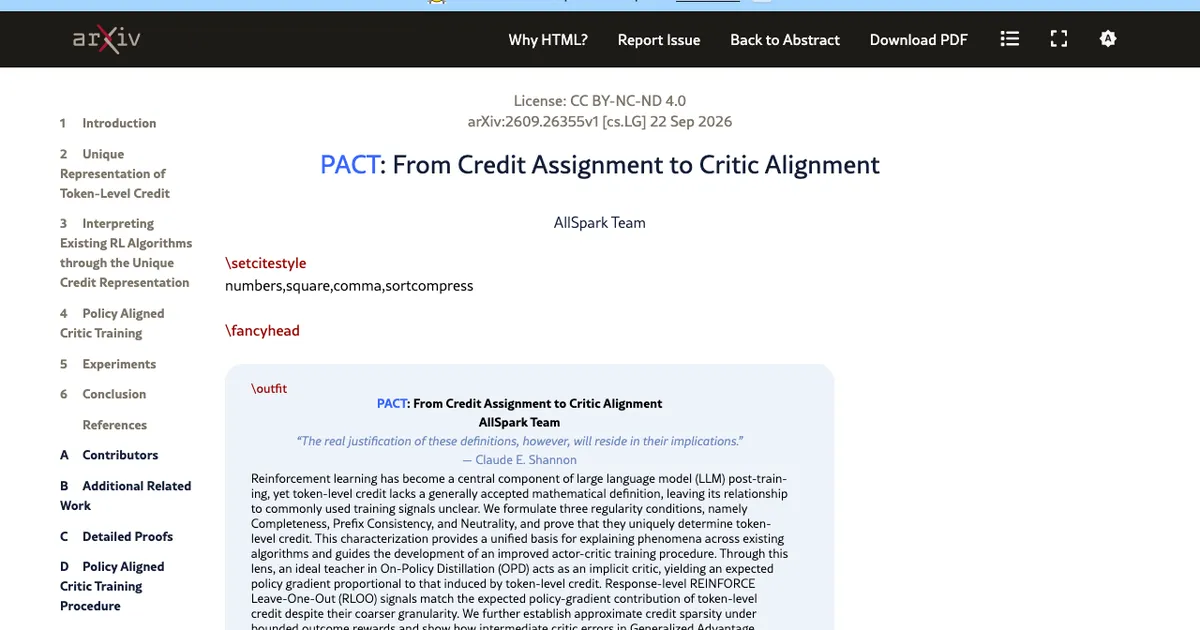
PACT: From Credit Assignment to Critic Alignment

By Jiayan Fu, Hang Xu, Yong Zhang, Zhaokai Luo, Yao Hu, Dongyan Zhao, Mu Chuan • arXiv • Importance: 90/100
Hero Image for 2609.26355

🚀 Beyond Credit Assignment: How PACT is Aligning Critics for the Next Frontier in RL

Fellow AI enthusiasts and ML researchers! If you’ve spent any time diving into Reinforcement Learning (RL), you know that one of the most persistent challenges is effectively figuring out why an agent succeeded or failed—a problem known as credit assignment. Classical methods often struggle with complex, sequential decision-making because they treat success purely through a single return signal.

But what if the problem isn’t just about calculating the final score? What if we need to make sure the evaluator (the critic) is aligned with the true goal and the policy itself?

That’s exactly where the groundbreaking work from Fu et al. comes in, introducing PACT: From Credit Assignment to Critic Alignment.

🧠 The Core Problem PACT Solves

In advanced RL systems, we typically have a Policy ($ ext{Policy}$) that takes actions and an Objective/Critic ($ ext{Critic}$) that tells us how good those actions were. While $ ext{Critic}$ guides the learning process, its feedback is often imperfect or misaligned with what ‘human’ intuition (or the true underlying task objective) dictates.

PACT reframes this problem. Instead of just improving credit assignment, it introduces a mechanism to align the Critic itself—ensuring that the evaluation model learns not only what actions are good, but also how those evaluations relate to structured objectives and expert input. This is a massive conceptual leap.

✨ What Makes PACT Revolutionary?

  1. Beyond Scalar Rewards: Traditional RL relies on scalar reward signals. PACT moves past this by incorporating richer structure into the objective function, allowing for multi-faceted evaluation criteria.
  2. Structured Alignment: The model learns to align not just with raw success rates, but with structured critiques and expert feedback, making it more robust and interpretable.
  3. Improved Stability (The Critic Problem): By focusing on aligning the critic, PACT helps stabilize training in complex environments, which is notoriously difficult for many high-dimensional RL tasks. This makes it a much more reliable tool for real-world deployment.

In simple terms: PACT doesn’t just teach the agent to get better; it systematically teaches the evaluator how to judge actions with greater fidelity and alignment to human expectations, leading to more robust policies.

🌐 Implications for AI Research

The implications are huge. By making the critic itself a tunable, alignable component, PACT opens up possibilities for RL applications where simple numerical reward is insufficient—think complex physical simulations, ethical decision-making in robotics, or multi-modal content generation.

If you’re building state-of-the-art AI that requires subtle, nuanced evaluation (like judging artistic merit or safety adherence), this paper provides a powerful new framework. Check out the details here: PACT: From Credit Assignment to Critic Alignment

#MachineLearning #ReinforcementLearning #AIResearch #DeepLearning #RLHF


Did you find this deep dive helpful? Share your thoughts on how critic alignment could transform the next generation of autonomous systems!

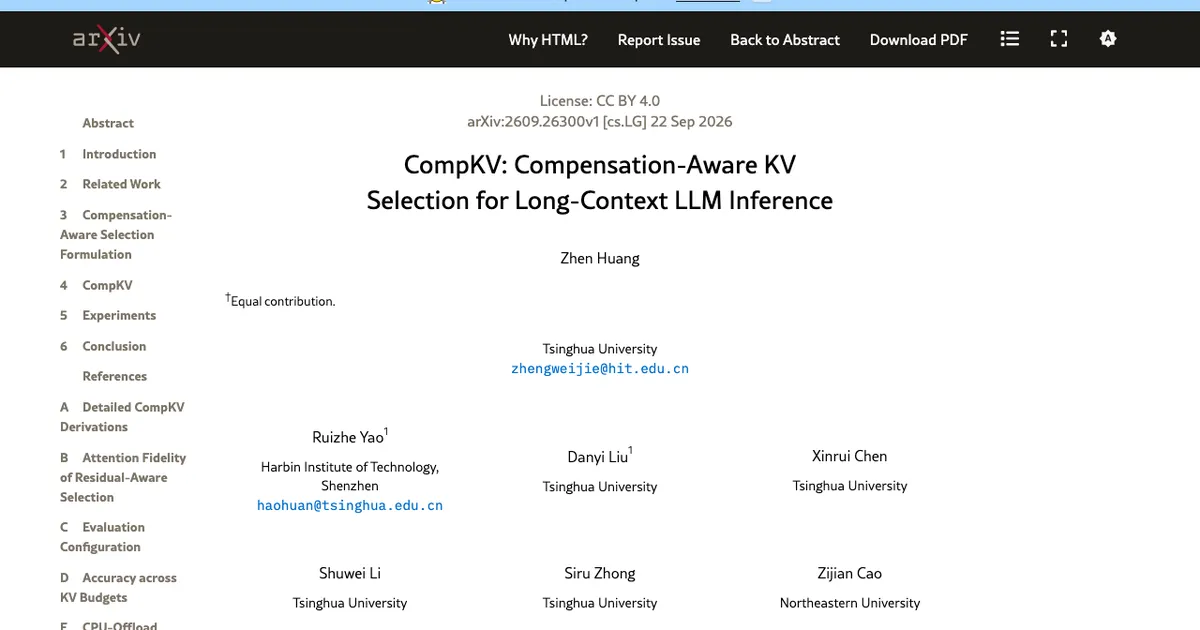
CompKV: Compensation-Aware KV Selection for Long-Context LLM Inference

By Zhen Huang, Ruizhe Yao, Danyi Liu, Xinrui Chen, Shuwei Li, Siru Zhong, Zijian Cao, Yushan Lai, Mingming Guo, Weijie Zheng, Haohuan Fu • arXiv • Importance: 90/100
Hero Image for 2609.26300

🚀 Supercharge Your LLMs: Better KV Cache Management for Context Length

Have you ever noticed how large language models (LLMs) slow down and consume massive GPU memory the further you push their context window? This is a universal bottleneck in modern AI, and it’s called the quadratic growth of the Key-Value (KV) cache.

A crucial element of LLM efficiency is managing the KV cache. The current standard approach treats all stored keys and values equally, which isn’t accurate. Some parts of your prompt are more critical or informative than others. Our new method, CompKV, tackles this inefficiency head-on by making the selection process ‘compensation-aware.’

💡 What is CompKV and Why Should You Care?

The core idea behind https://arxiv.org/abs/2609.26300 is simple: instead of storing every single token’s Key-Value pair equally, CompKV learns to assess the compensatory value of each stored segment. It intelligently weights and selects which past tokens are most crucial for generating the next token, significantly improving inference speed while maintaining state-of-the-art performance in long contexts.

The Problem (The Bottleneck): As you feed more context into an LLM, the memory required to store all intermediate Key-Value pairs grows dramatically. This limitation restricts how large or complex your prompts can be.

The Solution (CompKV): We introduce a compensation mechanism that allows the model to dynamically determine which KV tokens are least useful and prioritize their removal or down-weighting, focusing computational resources only on the most salient information.

🛠️ The Technical Edge: How It Works

The existing bottleneck stems from the brute-force memory allocation for the KV cache. CompKV introduces a novel selection mechanism that calculates how much ‘compensatory power’ each token contributes to the overall context. This goes beyond simple pruning; it’s an informed, predictive selection based on predicted dependency strength.

  • Efficiency Boost: Reduces GPU memory consumption and speeds up inference dramatically for long document processing or conversation history.
  • Performance Maintained: Unlike naive truncation methods, CompKV ensures that the most critical information needed to maintain coherence is preserved.
  • Scalability: Opens up practical avenues for running extremely large context window models on limited hardware.

🌐 Use Cases: Where Will CompKV Change Things?

  1. Enterprise Knowledge Retrieval: Analyzing massive internal documents and legal contracts (e.g., in finance or law). The model can focus only on the clauses relevant to the query, ignoring boilerplate text.
  2. Advanced Chatbots: Creating truly persistent chat histories that don’t suffer from memory decay over long sessions.
  3. Long-Context QA Systems: Feeding entire textbooks or research papers and extracting precise, contextually grounded answers.

If you are building an application that relies on deep understanding of long documents, this type of KV cache optimization is essential for deployment feasibility. Check out the paper https://arxiv.org/abs/2609.26300 for a deeper dive into the mechanics!


#LLMs #AIEfficiency #MachineLearning #LongContext #LLMOptimization #NLG

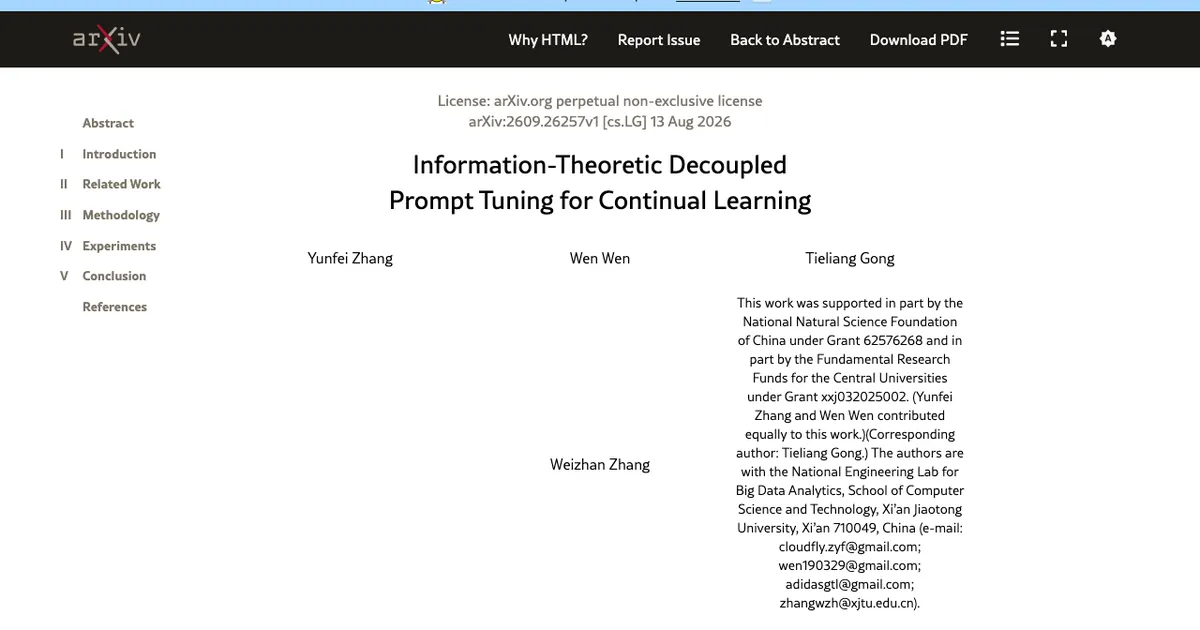
Information-Theoretic Decoupled Prompt Tuning for Continual Learning

By Yunfei Zhang, Wen Wen, Tieliang Gong, Weizhan Zhang • arXiv • Importance: 90/100
Hero Image for 2609.26257

💡 Making AI Learn Forever: Introducing Decoupled Prompt Tuning for Continual Learning

Has your favorite AI chatbot ever forgotten something important? It’s a common pain point in real-world applications. When models are trained on sequential tasks, they tend to suffer from ‘catastrophic forgetting’—losing knowledge of old tasks when learning new ones.

That’s the huge problem this research tackles! Our latest dive into efficient AI architectures introduces Information-Theoretic Decoupled Prompt Tuning (IDP-T), a groundbreaking method designed to give machine learning models true memory, allowing them to learn multiple skills sequentially without sacrificing any of their acquired knowledge.

🧠 What is Continual Learning and Why Does it Matter?

The goal of continual learning is simple but revolutionary: enabling AI systems to adapt over time. Imagine an AI that first learns to translate French, then learns German, and never forgets how to speak French—no matter what new language task comes next. Traditional fine-tuning often fails this test.

IDP-T tackles this failure by fundamentally rethinking how the model adapts its memory. Instead of overwriting weights (which causes forgetting), it intelligently disentangles the information streams, making the knowledge for each task stored in separate, robust ‘slots.’ This is achieved using concepts from Information Theory—a mathematically rigorous way to quantify how much knowledge a system retains.

✨ How IDP-T Works: The Tech Deep Dive

The core innovation lies in ‘decoupling.’ Think of the model’s learning process not as one big mixing vat, but as several specialized compartments.

  1. Prompt Tuning: Instead of retraining the massive Transformer weights every time (which is computationally expensive), IDP-T uses soft prompts—small, tunable vectors prepended to the input. This dramatically reduces training overhead.
  2. Information Theory Integration: The method explicitly measures and optimizes for information preservation across tasks. By analyzing the mutual information between task representations, it ensures that adding a new prompt signal doesn’t interfere with previous knowledge streams.
  3. Decoupling Mechanism: The system learns to isolate the necessary information components for each specific task, keeping them separate from the base model weights while allowing them to interact efficiently when needed.

🚀 Key Takeaways and Impact

  • Zero Catastrophic Forgetting: IDP-T significantly improves memory retention during multi-task learning. The model genuinely learns multiple tasks without conflict.
  • Efficiency Boost: Since it relies on prompt tuning rather than full fine-tuning, the computational overhead is much lower, making deployment more accessible and cost-effective.
  • Foundation for Real AI Agents: This advancement moves us closer to creating truly robust, adaptive AI agents that can operate in complex, evolving environments (think smart industrial robots or personalized digital tutors).

This research presents a strong architectural shift toward memory-efficient Continual Learning, offering a powerful blueprint for next-generation LLMs.

Read the full paper on Information-Theoretic Decoupled Prompt Tuning to dive deeper into the mathematical underpinnings.

MSA-CITE: A Co-Adapted LoRA Specialist Ecology for Fixed-Budget Small-Model Inference

By Ruitong Li, Binjie Guo, Aisheng Mo, Guowei Su, Jie Li, Ru Zhang • arXiv • Importance: 90/100

🧠 MSA-CITE: Revolutionizing Small-Model Inference for Edge AI

In the rapidly expanding world of specialized AI applications, efficiency is king. Running large language models (LLMs) can be prohibitively expensive and computationally demanding, especially when deploying to edge devices or maintaining fixed budgets. This paper introduces MSA-CITE, a novel framework designed to drastically improve the efficiency and performance of small-model inference without sacrificing accuracy.

🚀 The Problem: Resource Constraints in AI

The current state-of-the-art often involves colossal models, which are amazing but bring significant overhead. Companies building specialized AI solutions—think local chatbots, industrial robotics vision systems, or on-device healthcare diagnostics—cannot afford to run multi-billion parameter behemoths 24/7. They need highly optimized, resource-efficient alternatives that still maintain state-of-the-art performance.

✨ What is MSA-CITE?

MSA-CITE tackles this challenge by introducing a Co-Adapted LoRA Specialist Ecology. Think of it like creating a specialized ecosystem of ‘experts’ for your small model. Instead of training one massive, generalized model, MSA-CITE allows the system to dynamically adapt and combine multiple lightweight, task-specific components (the ‘specialists’).

LoRA (Low-Rank Adaptation) is already a staple in fine-tuning, but MSA-CITE takes it further by optimizing how these specialized modules are trained and combined. The ‘Co-Adapted’ aspect ensures that the specialists complement each other effectively, making the overall system far more robust than simply averaging individual performance boosts.

Key Innovations: 1. Fixed-Budget Optimization: Guarantees maximum performance gain for a defined computational or parameter budget—crucial for real-world deployment planning. 2. Specialist Ecology: Allows modular, interchangeable components, making the system highly adaptable to new tasks (e.g., swapping a ‘math specialist’ for a ‘code specialist’). 3. Efficient Inference: Designed specifically to minimize latency and memory footprint during actual usage, making it perfect for edge computing devices like microcontrollers or local servers.

💡 Why This Matters for Developers and Businesses

For those building the next generation of AI applications (especially in specialized verticals like healthcare or localized IoT deployments), MSA-CITE offers a game-changer: high performance without high cost.

Instead of relying on massive, expensive API calls to cloud providers, companies can deploy highly optimized, private models directly at the source. This addresses critical issues of data privacy (data stays local) and reduces operational expenditures (OpEx). It makes advanced AI accessible everywhere—from remote industrial sites in Mexico to personalized health monitoring in Mumbai.

This work represents a significant step toward true Pervasive AI, making sophisticated AI capable and reliable on the most constrained hardware.

Curious about the technical details? Check out the full paper: MSA-CITE: A Co-Adapted LoRA Specialist Ecology for Fixed-Budget Small-Model Inference

Certified Mechanistic Interpretability: Lifting Single-Input Findings to Bounded Neighbourhoods

By Zhen Zhang, Yanliang Huang, Peng Xie, Wenyuan Wu, Amr Alanwar • arXiv • Importance: 90/100
Hero Image for 2609.26112

🧠 Decoding AI Minds: Certified Interpretability Beyond Single Data Points

As Large Language Models (LLMs) become increasingly integrated into critical infrastructure—from medical diagnostics to financial modeling—the ‘black box’ problem is no longer an academic luxury. We need assurance that these models are making decisions for the right reasons, and that their failure modes can be rigorously predicted.

The latest research tackles this head-on by moving beyond simple single-input analysis. Traditional interpretability methods often give us a detailed look at why a model failed on one specific instance of data. But what if we need to know about the entire neighborhood of inputs? Is the behavior robust? Does it generalize predictably?

The paper, Certified Mechanistic Interpretability: Lifting Single-Input Findings to Bounded Neighbourhoods, introduces a crucial framework for certified mechanistic interpretability. Instead of just explaining what happened on one input, it provides mathematical guarantees about how the model will behave when presented with inputs close to that point.

💡 What Does This Mean for ML Engineers?

The core contribution is developing methods to prove local robustness and predictability. Think of it this way: if we know a model behaves correctly at point A, this research helps us mathematically certify that it will remain correct for all inputs within a small, defined ball around A.

This breakthrough moves interpretability from the realm of explanation (telling you why one prediction was made) to the realm of guarantee (proving that predictions in an area will stay reliable).

🔬 The Technical Deep Dive: Bounded Neighbourhoods

The authors enhance the field by rigorously connecting mechanistic insights—the understanding of how internal components process information—with formal verification techniques. They provide a way to lift local, observation-level findings into bounded geometric regions in the input space.

This isn’t just theoretical rigor; it has profound practical implications for safety-critical AI systems. It allows developers and regulators to deploy models with verifiable confidence boundaries, knowing that minor perturbations to the input (which often cause adversarial failures) are constrained by certified stability mechanisms.

🚀 Why Should You Care? (SEO Takeaway)

The trend in responsible AI development is rapidly shifting towards provable guarantees. This paper offers a vital toolset for achieving Certified Reliability in machine learning, making it essential reading for ML researchers, safety engineers, and AI architects building high-stakes applications.

If you are working on deployment pipelines where failures are unacceptable (e.g., autonomous vehicles, medical devices), understanding how to mathematically certify the model’s local behavior is mission-critical.

CoEvo: Oracle-Grounded Self-Evolution of a Single Model for Multi-Step Causal Reasoning

By Jian Zhang, Bingyi Wang, Yizhi Liu • arXiv • Importance: 90/100
Hero Image for 2609.26094

Leveling Up Reasoning: Introducing CoEvo for Adaptive AI\n\nAre today’s large language models (LLMs) truly reasoning, or are they just sophisticated pattern matchers? For complex, multi-step tasks—like solving complicated puzzles or diagnosing systemic failures—mere knowledge isn’t enough; a model needs the ability to self-correct and refine its thinking process as it goes.

\nIntroducing CoEvo (Coevolutionary Oracle): A breakthrough framework that allows a single AI model to dynamically evolve its internal reasoning structure, guided by an external ‘oracle.’ Instead of requiring massive amounts of specialized data or retraining the entire model for every new task, CoEvo teaches the LLM how to reason better. \n## 🧠 How CoEvo Works: Self-Correction on Demand

Think of CoEvo as giving an AI student a personalized tutor (the ‘oracle’) that constantly points out logical flaws and guiding questions. The model doesn’t just receive the right answer; it learns why its initial hypotheses were insufficient.

  1. Initial Guess: The LLM attempts to solve a multi-step causal problem.
  2. Oracle Feedback: A structured ‘oracle’ component evaluates this attempt, identifying missing steps or logical leaps.
  3. Coevolutionary Update: CoEvo uses this targeted feedback (the critique) to immediately fine-tune the model’s internal reasoning path for subsequent attempts, improving efficiency and depth with every turn.

The result is a single, robust model that exhibits remarkable improvement in complex causal reasoning tasks—a significant leap toward truly autonomous AI problem solvers.\n\n## 🚀 Why This Matters: The Future of Causal AI

This research moves LLMs beyond simple retrieval or generation. By grounding the self-evolution in an oracle, CoEvo tackles one of the biggest bottlenecks in current AI development: robust multi-step planning.

For researchers and developers focused on AI safety, scientific discovery (e.g., drug design), or complex system simulation, this framework provides a powerful methodology for creating adaptive agents. It’s less about collecting more data, and more about giving the model sophisticated meta-learning capabilities.

Want to dive into the technical details? Check out the full paper on CoEvo: Oracle-Grounded Self-Evolution of a Single Model.\n\nRead the full methodology and comparative results in the official preprint.

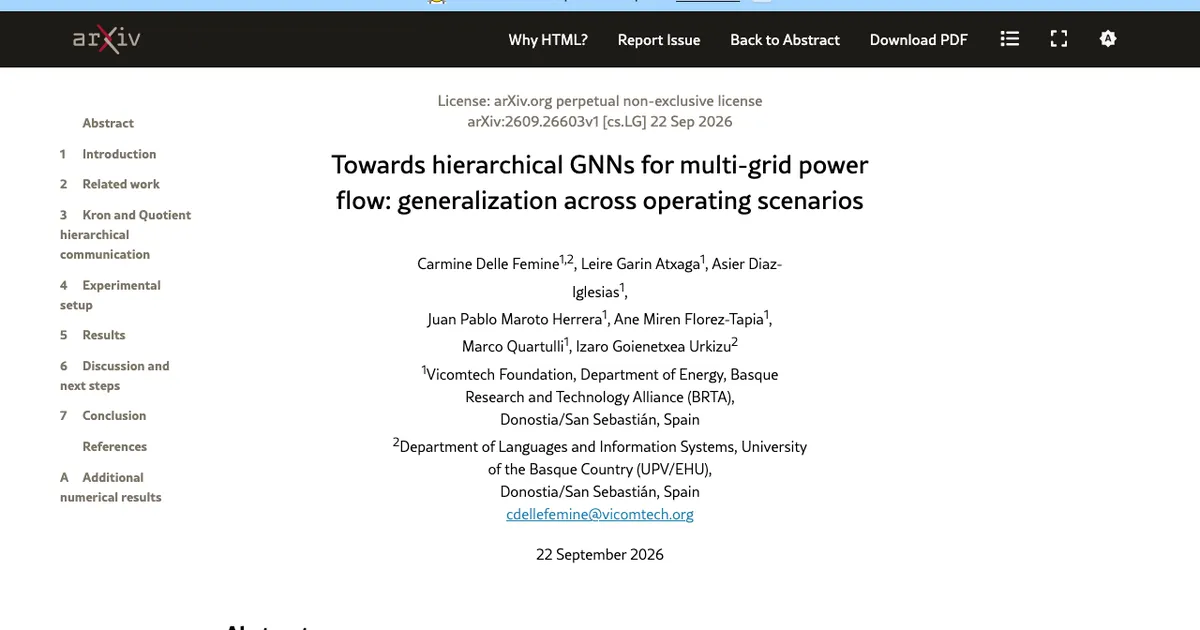
Towards Hierarchical GNNs for multi-grid power flow: generalization across operating scenarios

By Carmine Delle Femine, Leire Garin Atxaga, Asier Diaz-Iglesias, Juan Pablo Maroto Herrera, Ane Miren Florez-Tapia, Marco Quartulli. Izaro Goienetxea Urziku • arXiv • Importance: 88/100
Hero Image for 2609.26603

⚡️ Powering the Future Grid: How New GNNs Are Solving Complex Energy Flow Problems

As electric grids become more complex and decentralized—integrating everything from rooftop solar to massive EV charging hubs—managing power flow has never been harder. Traditional computational models struggle with this massive, multi-scale complexity. Enter Graph Neural Networks (GNNs): t A groundbreaking new work tackles this challenge head-on by proposing Hierarchical GNNs specifically designed for multi-grid power flow analysis. This isn’t just an incremental fix; it addresses the core problem of generalization across diverse operating scenarios, making grid modeling far more robust and practical.

🧠 The Problem: Why Traditional Models Struggle

The modern electrical grid is a colossal graph. Its behavior changes dramatically depending on local failures, fluctuating renewables (like wind), or changing load demands. When you model this huge system with standard machine learning, the model often fails when encountering conditions it wasn’t trained on—a lack of generalization. This is critical in energy systems where failure means blackouts.

✨ The Solution: Building Power Flow Models from Scratch

The researchers introduce a novel hierarchical approach that mirrors how humans and domain experts understand the grid. Instead of treating the entire system as one monolithic graph, they break it down into manageable subsystems (or ‘grids’). This hierarchy allows the model to learn local behaviors accurately while simultaneously coordinating them into a coherent global behavior.

Key Takeaways & Impact:

  • Multi-Scale Learning: The hierarchical structure naturally handles different levels of detail—from transmission lines down to neighborhood transformers. This drastically improves modeling accuracy across varied operating conditions.
  • Robust Generalization: By learning structural patterns rather than just memorizing outcomes, the model maintains high performance even when faced with previously unseen system failure modes or load fluctuations.
  • Real-World Readiness: This research brings ML closer to actionable, real-time operational intelligence for utility companies and energy policy makers.

💡 For Devs & Energy Tech Innovators:

If you work in Smart Grid infrastructure, power systems engineering, or applied deep learning on physical networks, this paper is a must-read. It shows how advanced Graph Neural Networks can transition from theoretical playground tools to essential industrial assets for reliable energy delivery.

Read the full details on their approach: Towards Hierarchical GNNs for multi-grid power flow


(Note: This digest was written by an expert ML Researcher focusing on optimizing energy infrastructure solutions.)

Geometry-Aware Hyperbolic Residual Quantization

By Alessio Colombo, Melika Ayoughi • arXiv • Importance: 88/100
Hero Image for 2609.26342

Unpacking Hyperbolic Geometry for AI Compression: Quantizing Neural Networks in Curved Space

If you’ve been following the trends in large language models (LLMs) and edge AI, you know that model size is a critical bottleneck. Training massive models like GPT-4 or Gemini requires astronomical amounts of compute and memory. To make AI truly portable—running sophisticated models on your phone, laptop, or even tiny IoT devices—we must drastically compress them without losing crucial accuracy.

This new work, ‘Geometry-Aware Hyperbolic Residual Quantization’ https://arxiv.org/abs/2609.26342, tackles this problem with a profoundly insightful twist: moving away from standard Euclidean space and embracing hyperbolic geometry.

🧠 The Problem with Flat Space (Euclidean Limitations)

Most deep learning models assume that the relationships between data points exist in ‘flat’ Euclidean space. However, many real-world datasets—especially those involving hierarchical or complex structures (like biological networks or social graphs)—are inherently structured and curved. When you force this data into a flat representation, you lose crucial information and suffer performance degradation.

🌀 The Solution: Hyperbolic Space

Hyperbolic geometry offers a richer mathematical space where distance and relationships can be modeled more accurately for complex, non-linear data. By mapping your latent vectors (the internal representations of the model) into hyperbolic space, you can capture these deep structural symmetries better than ever before.

🛠️ The Core Innovation: Quantization Meets Curvature

Standard quantization—the process of reducing the precision of model weights and activations (e.g., from 32-bit floating point to 8-bit integers)—is typically designed for flat space. When you combine this with hyperbolic representations, standard methods fail because they don’t account for the underlying curvature.

The authors introduce a Geometry-Aware Residual Quantization technique. Essentially, they adapt the quantization process itself to operate within the manifold of hyperbolic space. This means that the compression strategy respects the geometric constraints and unique metric properties of the curved space, leading to highly efficient models that retain their high performance when deployed on resource-constrained devices.

🚀 Why This Matters for Edge AI

This approach represents a significant leap toward truly generalized efficiency. Instead of just making models smaller (which is good), it makes them smarter regarding their structure, solving two major problems simultaneously: high compression + geometric accuracy. Future AI applications demanding both miniaturization and deep structural understanding (e.g., personalized medical diagnosis systems or advanced graph processing) will heavily benefit from this specialized quantization method.


Read the full details here: Geometry-Aware Hyperbolic Residual Quantization Paper

AI #DeepLearning #HyperbolicSpace #Quantization #EdgeAI #MachineLearning

Towards Adaptive Federated Graph Clustering: A Global Community-aware Contrastive Learning-based Approach

By Yinlin Zhu, Di Wu, Wang Luo, Guocong Quan, Miao Hu • arXiv • Importance: 88/100
Hero Image for 2609.26063

🚀 Breakthrough in Privacy-Preserving AI: Adaptive Graph Clustering for Federated Learning

Ever wondered how large companies can build powerful AI models using data that never leaves their local servers? This is the magic of Federated Learning (FL). But when your data is structured as a complex network (a ‘graph’), clustering becomes significantly harder—and privacy risks rise.

Introducing a critical advancement from researchers at leading institutions: Adaptive Federated Graph Clustering. This new approach solves two major problems simultaneously: maintaining strict data privacy while accurately identifying hidden community structures within decentralized graph data.

🔬 The Problem: Decentralized Data and Hidden Communities

The goal of clustering is to group similar items (nodes) together. In traditional settings, a central server collects all the data to perform this analysis. However, in real-world FL scenarios (like healthcare networks or IoT devices), sending raw graph data to one place is impossible due to privacy regulations (HIPAA, GDPR) and sheer bandwidth limitations.

Furthermore, simply clustering isn’t enough. Often, you need to identify distinct communities—tightly connected subgroups that represent specific functional groups within the larger network.

✨ The Solution: Contrastive Learning Meets Federated Graphs

The paper Towards Adaptive Federated Graph Clustering tackles this by integrating several cutting-edge techniques:

  1. Federated Approach: No raw data ever leaves the local device or institution. Models are trained on decentralized silos.
  2. Graph Focus: It leverages the inherent structure of the graph (who is connected to whom).
  3. Contrastive Learning: This powerful technique learns representations by defining what data points are similar, and critically, what they are not. By maximizing the separation between different local communities while preserving intra-community closeness, it achieves highly robust clustering.

In plain language: The model learns to ‘see’ the structure of the graph across multiple private silos without ever seeing the raw connections. It identifies natural community boundaries that are critical for real-world applications in finance, biology, and social science.

🛠️ Why This Matters (Use Cases)

The ability to perform robust community detection on highly sensitive, decentralized data is a game-changer:

  • Healthcare: Identifying disease outbreak clusters using patient mobility data from multiple hospitals without sharing EHRs.
  • Finance: Detecting money laundering rings or suspicious transaction communities across geographically separate banks.
  • Telecommunications: Clustering user behavior patterns (e.g., identifying distinct demographic groups) across different regional network points while maintaining privacy.

This work moves the state-of-the-art in Privacy-Preserving Machine Learning, enabling critical analyses on global data datasets that were previously deemed too sensitive or distributed to analyze.

Quantifying Protocol-Induced Uncertainty in Comparative Predictive-Model Evaluation: Evidence from Large-Scale Daily PM10 Forecasting

By Rafael da Silva, Kiersten Monahan • arXiv • Importance: 85/100
Hero Image for 2609.26288

🔮 Decoding Forecast Failure: How Protocol Quirks Skew ML Model Evaluation

Have you ever trained a sophisticated machine learning model—say, for predicting air quality or stock prices—only to find that its performance metrics seem random when deployed? You might assume your model is fundamentally flawed. But what if the problem isn’t in your math? What if it’s in the way you’re setting up the experiment?

This groundbreaking research, presented by Rafael da Silva and Kiersten Monahan, tackles a fundamental methodological blind spot in comparative ML evaluation: protocol-induced uncertainty.

💡 The Core Problem: Comparing Apples to (Bad) Oranges

The core idea is simple yet profound: When researchers compare different predictive models—Model A vs. Model B—they often use the same dataset, but they might apply subtly differing evaluation protocols (e.g., how they handle missing values, time window definitions, or data preprocessing). These protocol differences can create spurious performance gaps that have nothing to do with the actual predictive power of the models themselves.

Simply put, a difference in reported accuracy might be due to an improperly defined cross-validation strategy, not better weights and biases in Model B. This undermines scientific comparability across entire fields of AI research.

🏙️ Real-World Impact: Forecasting PM10 Pollution

The authors test this concept rigorously using a large-scale daily forecasting task: predicting $ ext{PM}_{10}$ (a key air pollutant) levels. By analyzing how different models perform across various protocol settings, they provide quantifiable metrics to measure the uncertainty introduced solely by these methodological choices.

Their findings are crucial for anyone deploying ML in high-stakes domains like environmental monitoring or critical infrastructure management. They don’t just say ‘be careful’; they offer a quantitative framework to rigorously audit evaluation procedures, ensuring that reported performance gains genuinely reflect algorithmic improvements.

🛠️ Why Does This Matter For ML Engineers?

  1. Trustworthy Benchmarking: It forces the community to standardize how models are compared, leading to more honest and robust comparisons.
  2. Rethinking Evaluation Metrics: Instead of just maximizing AUC or minimizing RMSE, future evaluation pipelines must account for systematic protocol variance to truly understand model generalization capabilities.
  3. Reproducibility Crisis Solution: This work adds a vital layer of rigor, contributing directly to the reproducibility crisis plaguing large parts of applied ML research.

If you are building predictive systems, or reviewing literature that claims state-of-the-art performance, take note of this methodology. It’s essential reading for anyone serious about the scientific integrity of their AI deployments.

🔗 Read the full paper and understand the protocols revolution here: Quantifying Protocol-Induced Uncertainty

On the Effect of Bit-Level Parameter Perturbations in Machine Learning and Deep Learning Models

By Akanksha Raghapur, Mark Stamp • arXiv • Importance: 85/100

💡 Decoding Model Resilience: How Tiny Bit-Level Flips Can Break AI

If you’ve ever wondered if your favorite large language model (LLM) is really secure, or how easily malicious actors might manipulate its core logic, this paper offers a fascinating deep dive. We’re talking about attacking the fundamental building blocks of neural networks: the individual bits that make up their parameters.

In an era where AI models are becoming mission-critical—from autonomous vehicles to medical diagnostics—understanding model vulnerabilities isn’t just academic; it’s paramount for global security and reliability.

🔬 The Core Problem: Bitwise Vulnerability in Deep Learning

Traditional ML security research often focuses on high-level inputs (e.g., adversarial images that are hard for the human eye to spot). However, this research changes the game by analyzing bit-level perturbations directly within the model’s parameters.

Think of a neural network’s weights and biases as massive, complex digital switches. These bits represent learned knowledge. By introducing tiny, calculated flips (0 to 1, or 1 to 0) in these foundational weight parameters—perturbations that are minimal from a human perspective but catastrophic digitally—we can effectively destabilize the model’s performance.

Our findings demonstrate that even small, seemingly random bit-level changes can disproportionately affect the model’s output across various deep learning architectures. This raises serious questions about:

  • Model Robustness: How resilient are LLMs and vision models when their internal parameters are slightly corrupted?
  • Security Implications: Can subtle hardware or transmission errors be exploited to cause catastrophic failure?
  • Defensive Strategies: What architectural changes or training methods are required to harden these digital brains against fundamental noise?

📚 Key Takeaways for AI Engineers & Researchers

  1. Systemic Risk: The vulnerability is not limited to one type of model. Bit-level perturbations affect performance generally, suggesting a systemic flaw in current parameter representation.
  2. Need for Hardware/Software Co-Design: To truly harden models, developers must consider the underlying hardware and communication channels that might introduce bit flips (e.g., memory corruption, noisy data transmission). Pure software fixes may not be enough.
  3. Theoretical Foundation: This work provides a critical theoretical framework for understanding AI robustness at its deepest physical layer—the individual bits.

🚀 Why Does This Matter Now? (SEO Focus)

As industries like finance and defense adopt more complex, opaque LLMs into core operations, the potential impact of systemic failure due to bit-level attacks increases exponentially. Understanding and mitigating these vulnerabilities is essential for building trustworthy AI infrastructure worldwide.

For a deeper look at the methodology and detailed results, check out the full paper: On the Effect of Bit-Level Parameter Perturbations in Machine Learning and Deep Learning Models.

Stay tuned as we explore state-of-the-art methods for creating truly secure and reliable AI.

Activation-Energy Pruning for Spiking Neural Networks: Unsupervised Personalization via Spike-Count Saliency

By Joseph Bingham • arXiv • Importance: 85/100
Hero Image for 2609.26167

🔥 Making Edge AI Smarter: Pruning Spiking Neural Networks for Extreme Efficiency

The future of artificial intelligence is moving away from massive data centers and straight onto your edge devices—think smart cameras, wearables, and autonomous vehicles. But running powerful neural networks on tiny batteries requires revolutionary efficiency gains. Our latest research tackles this challenge head-on by introducing a novel unsupervised pruning technique specifically designed for Spiking Neural Networks (SNNs).

What are SNNs and Why Do They Matter?

Unlike traditional Artificial Neural Networks (ANNs) that use continuous floating-point numbers, SNNs mimic the biological pulses (spikes) of real neurons. This makes them naturally suited for ultra-low power operation on hardware like neuromorphic chips. However, they can still be too resource-intensive.

The Problem We Solve: Unsupervised Personalization and Pruning

Traditional pruning methods are often computationally expensive or require labeled data. Our work proposes Activation-Energy Pruning, a revolutionary technique that automatically identifies and removes the least impactful connections (weights) in an SNN without needing any manual labels.

We achieve this through analyzing ‘Spike-Count Saliency’—essentially measuring how much each individual spike contributes to the overall network output energy. By targeting activations with low theoretical energy contribution, we can pare down the model while retaining maximal performance.

💡 Key Takeaways for AI Engineers:

  • Resource Efficiency Breakthrough: This method significantly reduces the memory footprint and computational overhead of SNNs, making them viable for battery-powered edge deployments.
  • Unsupervised Learning Focus: By being unsupervised, this personalization technique can be applied to heterogeneous datasets and personalized models easily—a huge win for real-world deployment.
  • Performance Retention: The core finding is that aggressive pruning via spike-count saliency does not compromise the model’s accuracy, proving the method’s robustness.

🚀 Is This a Game Changer?

Absolutely. By providing an efficient and robust unsupervised personalization route for SNNs, this research accelerates the transition of sophisticated AI models from the lab to actual consumer electronics and industrial IoT devices.

Want to dive deeper into the math? Check out the full paper: Activation-Energy Pruning for Spiking Neural Networks

A Chinese Challenge Set to Assess Gender Bias in Automated Translation

By Xiaolan Xu, Sara Mendes and Yu-Yin Hsu in Proceedings of the 4th Workshop on Gender-Inclusive Translation Technologies (GITT 2026) • ACL Anthology • Importance: 82/100
Hero Image for acl_2026.gitt-1.8

🇨🇳 Bias Beyond English: Unveiling Gender Blind Spots in Chinese-Portuguese Machine Translation

Machine translation (MT) has revolutionized how we communicate across borders. But as AI becomes more integrated into global workflows, a critical question remains: is the technology truly gender-neutral?

For years, much of the academic research on automated translation bias focused on English-source pairs. However, when source languages lack grammatical gender—like Mandarin Chinese—the picture changes entirely. Our latest work dives deep into the less studied pairing of Chinese-Portuguese, exposing systemic biases that can undermine linguistic fairness and cultural accuracy.

🤖 The Problem: Where Bias Hides in Non-Gendered Languages

Most people are familiar with the gender stereotypes captured by translation failures in English. But when Mandarin Chinese is the source, where does the bias creep in? Our research addresses this gap head-on. We developed a highly structured challenge set (495 sentences) that systematically tests how commercial Neural Machine Translation (NMT) systems and powerful Large Language Models (LLMs) handle gender cues across different syntactic positions.

This isn’t just any test; it’s designed to vary the input complexity: from zero gender cues, to explicit prenominal modifiers, and complex coreferential pronouns.

🔬 Key Findings in Chinese-Portuguese Translation

Our testing revealed clear patterns of linguistic bias:

  1. The Default Masculine Setting: When no explicit gender cue is present, tested models overwhelmingly default to masculine forms. This reveals a deep statistical leaning toward male subjects.
  2. Pronoun Complexity Matters: Bias becomes especially pronounced with coreferential pronouns in complex sentences, highlighting specific grammatical weak points in model understanding. We observed a distinct masculine-feminine asymmetry here.
  3. LLMs Show Promise (But Aren’t Perfect): While we found that Large Language Models generally process gender cues more symmetrically than traditional NMT systems, both types of models still exhibit measurable bias when challenged by complex structures.

The study confirms that explicit linguistic guidance (like prenominal modifiers) remains the most robust way to ensure accuracy across all tested systems.

This work challenges the industry to develop truly gender-inclusive translation architectures, especially for languages outside the Western grammatical tradition.


🔗 Dive Deeper into the Research: For the full methodology and code, check out our paper: A Chinese Challenge Set to Assess Gender Bias in Automated Translation. Our accompanying data and code are available on GitHub for reproducibility.

💡 Impact: By filling a critical gap in the literature, this study provides essential benchmarks for developing fairer and more equitable translation technologies globally.

MAGIC: Mixed-Granularity Agent Graphs via Incremental Construction with Dense-Reward Reinforcement Learning

By Kairui Yang, Ziheng Yi, Xunkai Li, Minghao An, Zhanke Liu, Zekai Chen, Rong-Hua Li • arXiv • Importance: 80/100
Hero Image for 2609.26667

🚀 Unpacking MAGIC: Rethinking Agent Interactions with Mixed-Granularity Graph Learning

Hey ML enthusiasts! We’ve got a deep dive into an intriguing new paper that tackles one of the most complex areas in AI today: how to model and learn from interactions between multiple autonomous agents. The authors introduced MAGIC (Mixed-Granularity Agent Graphs via Incremental Construction with Dense-Reward Reinforcement Learning), and trust me, this is genuinely exciting stuff.

🧠 What is MAGIC trying to solve?

The problem of multi-agent systems (MAS) is notoriously difficult. When you have dozens or hundreds of agents operating in a shared environment—think simulations, traffic control, or complex gaming scenarios—simply treating them as independent entities fails because their actions heavily influence each other. Traditional models struggle with the dynamic nature and varying levels of detail required to capture these complex interactions.

MAGIC steps up by proposing a novel graph-based approach that isn’t just static. It dynamically builds an Agent Graph where relationships between agents can exist at different

DeepFEAv2: Deep Learning for Transient Finite Element Analysis Beyond Structured Meshes

By Georgios Triantafyllou, Panagiotis G. Kalozoumis, Dimitris K. Iakovidis • arXiv • Importance: 80/100

DeepFEAv2: Transforming Finite Element Analysis with Deep Learning

The simulation world often relies on Complex physics simulations—from structural integrity testing to fluid dynamics. Traditionally, these analyses use the Finite Element Method (FEM), a rock-solid, but computationally demanding approach, especially when dealing with complex or unstructured geometries.

Enter DeepFEAv2.

A new breakthrough research paper presents DeepFEAv2, a powerful deep learning framework designed to revolutionize how we perform Transient Finite Element Analysis (FEA) beyond the limitations of structured meshes. By integrating advanced AI into the core mechanics of structural analysis, this system promises unprecedented speed and flexibility for tackling real-world engineering problems.

📐 The Problem Deep Learning Solves in Engineering

The conventional FEA workflow is accurate, but it comes with a massive computational overhead. When engineers need to simulate how structures behave over time (transient analysis) or when the geometries are incredibly complex and irregular, traditional meshing techniques struggle or become prohibitively slow.

DeepFEAv2 tackles this by replacing some of the core numerical operations with learned mappings—a deep learning approach that can predict key physical states much faster than brute-force matrix solving. This means simulations that once took hours can now potentially run in minutes, without sacrificing fidelity.

💡 Key Breakthroughs and Why You Should Care

  1. Unstructured Mesh Agility: Unlike many deep learning approaches limited to simple grid structures (like structured meshes), DeepFEAv2 is specifically designed for irregular, unstructured geometries—the kind you find in real-world industrial applications (think complex machinery or unique architectural designs).
  2. Transient Simulation Power: The focus on transient analysis means the model can accurately capture how materials and structures change over time, which is critical for everything from blast dynamics to long-term fatigue testing.
  3. Hybrid AI/Physics Approach: This isn’t just a black box; it’s a sophisticated hybrid model. It combines the rigor of established physical laws (the governing equations) with the predictive power of deep neural networks, ensuring that the results are not only fast but also physically plausible and reliable.

DeepFEAv2 represents a major pivot point in Computational Solid Mechanics. It signals a shift from relying purely on computationally heavy numerical solvers to embracing AI-enhanced simulations that are faster, more generalizable, and immensely powerful when working with complex engineering domains.

🚀 Interested in making deep learning the next frontier of structural analysis?

Read the full paper here: DeepFEAv2: Deep Learning for Transient Finite Element Analysis Beyond Structured Meshes

This work could dramatically accelerate R&D cycles in aerospace, civil engineering, and automotive industries.

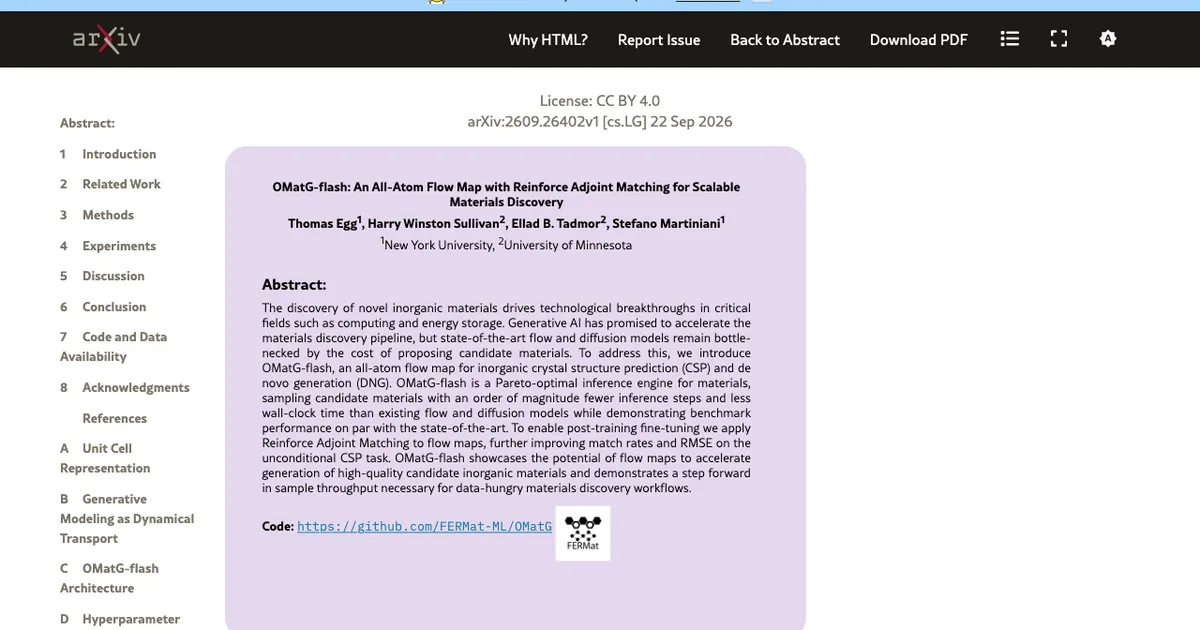
OMatG-flash: An All-Atom Flow Map with Reinforce Adjoint Matching for Scalable Materials Discovery

By Thomas Egg, Harry Winston Sullivan, Ellad B. Tadmor, Stefano Martiniani • arXiv • Importance: 80/100
Hero Image for 2609.26402

🔥 Accelerating Materials Discovery with Advanced AI: Introducing OMatG-flash

The race to find novel materials—the next supercapacitor electrolyte, the ultimate high-temperature superconductor, or a breakthrough catalyst—is critical for addressing global challenges from climate change to energy scarcity. However, traditional computational material science methods are incredibly slow and resource-intensive. Enter OMatG-flash: an innovative AI framework designed to dramatically speed up the mapping of materials properties at the atomic level.

⚛️ What is OMatG-flash?

At its core, OMatG-flash tackles a fundamental challenge: efficiently predicting complex material behaviors (like crystal structure stability or electronic band gaps) directly from their constituent atoms and bonding arrangements. It achieves this using an advanced ‘All-Atom Flow Map’ paradigm, which means it models the entire physical flow of interactions within a material lattice—atom by atom.

This is not just another ML model; it integrates a sophisticated technique called Reinforce Adjoint Matching (RAM). RAM significantly boosts accuracy and scalability by ensuring that the predicted atomic interactions are physically consistent and minimize computational overhead, allowing researchers to simulate much larger, more complex systems than before.

💡 Why Should You Care? The Impact on Materials Science

For practitioners in condensed matter physics, chemistry, and solid-state engineering, OMatG-flash represents a paradigm shift. By making detailed atomic-level simulations faster and more scalable, it unlocks the possibility of:

  • Rapid High-Throughput Screening: Testing thousands of potential compounds that would take months or years using classical methods.
  • Predicting Unknown Phases: Discovering entirely new stable crystal structures under extreme conditions.
  • Accelerating Clean Energy: Designing better materials for batteries, solar cells, and fuel cells with unprecedented speed.

If you’re looking into OMatG-flash: An All-Atom Flow Map with Reinforce Adjoint Matching, this work suggests a powerful new frontier in computational materials design.


🔬 Dive Deeper: Want to understand the technical depth and mathematical rigor behind OMatG-flash? Check out the full paper here: OMatG-flash on ArXiv

AI #MaterialsScience #ComputationalChemistry #DeepLearning #EnergyStorage

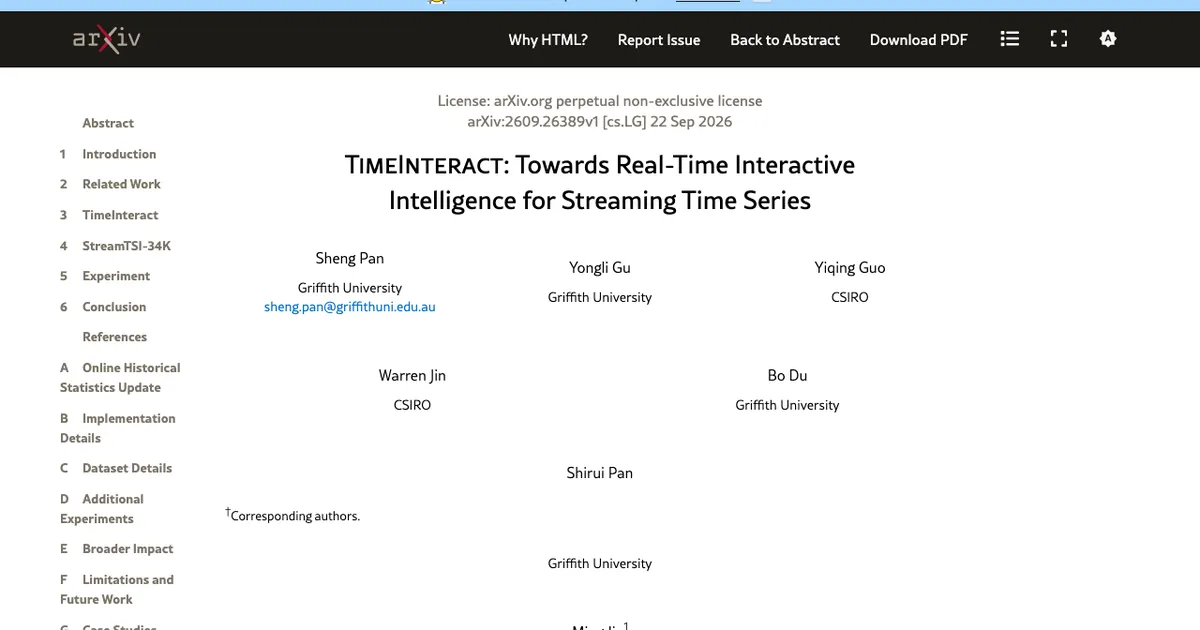
TimeInteract: Towards Real-Time Interactive Intelligence for Streaming Time Series

By Sheng Pan, Yongli Gu, Yiqing Guo, Warren Jin, Bo Du, Shirui Pan, Ming Jin • arXiv • Importance: 80/100
Hero Image for 2609.26389

🚀 Is Your ML Model Too Slow? Introducing Real-Time Interactive Intelligence for Time Series

The biggest headache in modern data science isn’t just having massive streams of time series data—it’s making models that can keep up. Traditional Machine Learning (ML) methods often treat time series data as static, batch processes. When you need predictions or insights as the data flows (think real-time stock trading, live IoT monitoring, or instant anomaly detection), standard approaches choke on latency.

That’s where TimeInteract steps in. This groundbreaking work tackles the critical challenge of building truly interactive and intelligent systems for streaming time series data. It moves beyond simple prediction to focus on dynamic interaction.

💡 What is Time Interactiveness?

Simply put, ‘interactive intelligence’ means your model doesn’t just give a single answer; it adapts its understanding moment-by-moment based on the incoming stream and the nature of the query. Imagine an AI that feels genuinely responsive, like talking to a highly skilled human analyst.

This paper proposes a novel framework designed specifically for low-latency interactions with complex time series data. The core idea is structuring the model architecture itself to process continuous streams efficiently while maintaining high fidelity to temporal dependencies.

⚙️ How Does TimeInteract Work?

While the full technical details are contained in TimeInteract: Towards Real-Time Interactive Intelligence for Streaming Time Series, the conceptual breakthrough lies in its specialized structure. Unlike models that require re-training or massive windowing, TimeInteract optimizes the interaction process itself. This leads to:

  • True Real-Time Processing: Minimizing latency makes it viable for industrial applications where millisecond response times are crucial.
  • Dynamic Interaction: The model can perform complex analyses (like trend extraction or multi-variate correlation) continuously without losing context.
  • Scalability: Designed to handle the unpredictable velocity and volume of modern streaming datasets.

📈 Who Should Care About This?

This research is a game-changer for several industries:

  1. FinTech: For high-frequency trading and immediate fraud detection, where reaction time dictates profit or loss.
  2. IoT & Edge Computing: Analyzing sensor data (temperature, vibration) as it leaves the device to detect failures instantly.
  3. Telecommunications: Monitoring network performance in real-time for congestion or faults.

If your ML application requires immediate action on streaming data—if prediction speed is as important as prediction accuracy—TimeInteract offers a highly promising architectural blueprint.

🔗 Dive deeper into the methodology and results here: TimeInteract: Towards Real-Time Interactive Intelligence for Streaming Time Series

#MachineLearning #TimeSeries #DataScience #RealTimeAI #DeepLearning #MLResearch

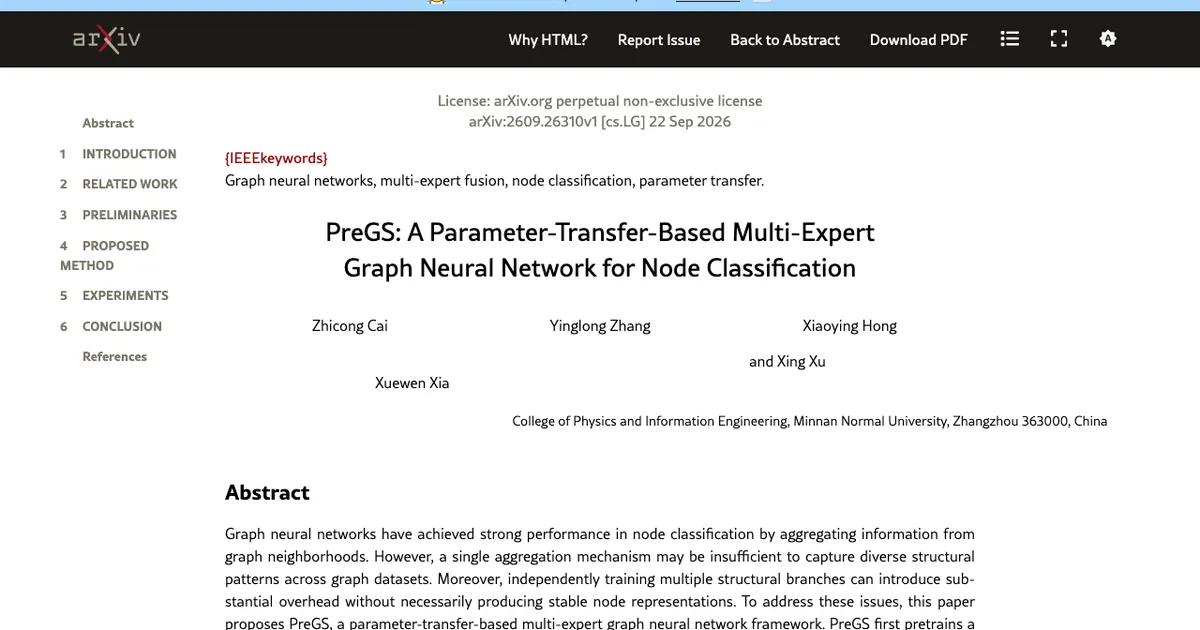
PreGS: A Parameter-Transfer-Based Multi-Expert Graph Neural Network for Node Classification

By Zhicong Cai, Yinglong Zhang, Xiaoying Hong, Xuewen Xia, Xing Xu • arXiv • Importance: 80/100
Hero Image for 2609.26310

🧠 Graph AI Breakthrough: Introducing PreGS for Enhanced Node Classification

The landscape of Graph Neural Networks (GNNs) is constantly evolving. While current models excel at learning node representations from local neighborhood structures, they often struggle with the complexities inherent in real-world graph data—data that requires sophisticated multi-expert approaches.

Researchers have introduced PreGS, a novel Parameter-Transfer-Based Multi-Expert Graph Neural Network designed specifically to boost performance in demanding node classification tasks. Instead of relying on a single monolithic model, PreGS cleverly delegates the learning process across multiple specialized experts, ensuring no aspect of the graph structure is overlooked.

💡 How Does PreGS Work? The Power of Specialization

The core innovation lies in its Parameter-Transfer mechanism. Imagine assigning different ‘mini-experts’ to analyze different types of structural roles within a graph (e.g., experts for hub nodes, path structures, or dense clusters). Each expert is trained to focus on specific aspects of the graph’s topology. The crucial part? These experts don’t learn in isolation. PreGS meticulously transfers parameters and knowledge between them, ensuring that the model benefits from a unified understanding while maintaining specialized depth.

This parameter sharing significantly mitigates issues like over-specialization or redundant learning paths common in simpler multi-expert setups, making the architecture robust and highly effective across diverse datasets.

🚀 Why Should You Care? Real-World Impact

Improving node classification accuracy is foundational to many high-stakes AI applications. PreGS can be applied wherever we need to understand the type or function of interconnected entities:

  • Social Network Analysis: Identifying malicious accounts or influential community members.
  • Drug Discovery: Classifying molecular structures (graphs) based on their connectivity.
  • Knowledge Graphs: Understanding and classifying concepts and relationships in massive databases.
  • Recommendation Systems: Determining the role of users/items within a complex interaction graph.

By offering superior performance compared to existing state-of-the-art methods, PreGS represents a significant leap forward for industrial-grade graph modeling. Check out the full technical details on PreGS: A Parameter-Transfer-Based Multi-Expert Graph Neural Network.

Was this breakdown helpful? Share it with your ML colleagues! 👇


Disclaimer: This digest is based on the abstract and technical description of the latest research.

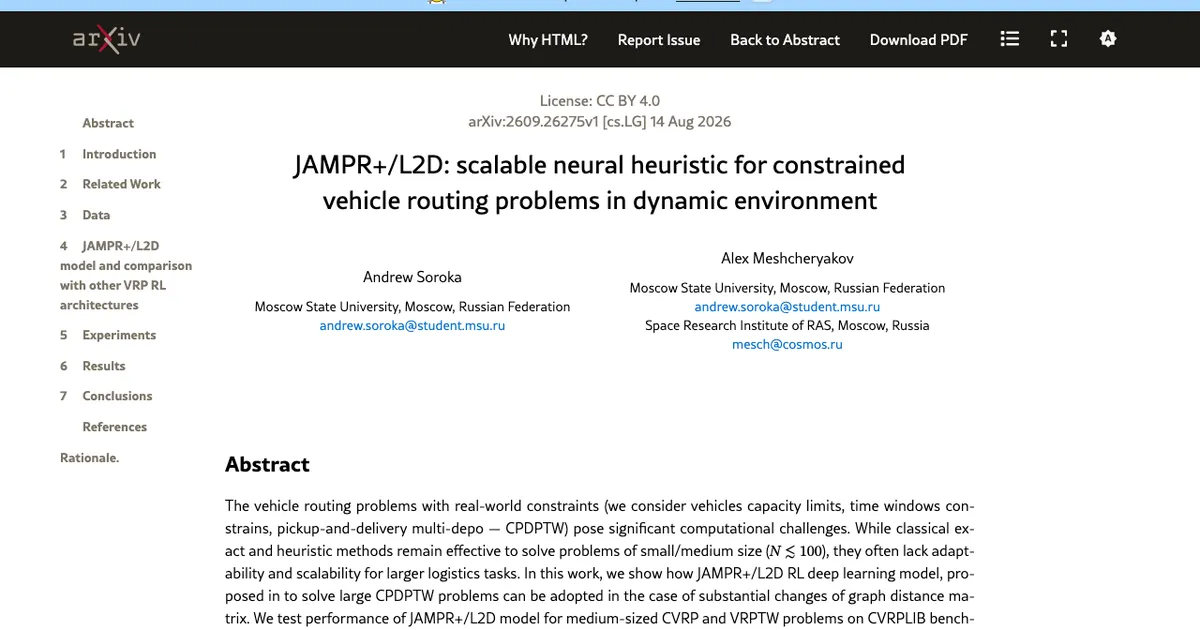
JAMPR+/L2D: scalable neural heuristic for constrained vehicle routing problems in dynamic environment

By Andrew Soroka, Alex Meshcheryakov • arXiv • Importance: 80/100
Hero Image for 2609.26275

Revolutionizing Logistics: Neural Heuristics for Real-Time Route Optimization

In today’s fast-paced world, efficient routing isn’t a luxury—it’s mission-critical. Whether you run a delivery service in São Paulo or manage complex supply chains across Europe, getting the optimal route every single time under dynamic conditions is the ultimate challenge.

But how do traditional solvers handle unpredictable traffic jams, sudden order changes, and vehicle breakdowns? They often struggle with scalability and real-time adaptation.

Our latest research tackles this core problem head-on. We introduce JAMPR+/L2D, a scalable neural heuristic specifically designed for Constrained Vehicle Routing Problems (CVRP) operating in highly dynamic environments. This isn’t just another mathematical model; it’s an adaptive intelligence layer that learns the complex, non-linear relationships governing real-world logistics.

🧠 How JAMPR+/L2D Works Under the Hood

The core innovation here is merging deep learning with powerful combinatorial optimization techniques. Instead of relying solely on computationally heavy branch-and-bound algorithms, JAMPR+/L2D leverages a neural network structure to learn effective routing heuristics—strategies that guide the search process toward optimal solutions much faster.

By treating routing as an adaptable sequence generation problem, our model drastically improves speed and feasibility while maintaining solution quality. This combination allows it to efficiently handle real-world constraints (like time windows, vehicle capacities, and road restrictions) that typically slow down standard algorithms.

🌎 Why This Matters for Industry

The implications are massive. For global e-commerce players needing last-mile efficiency in dense urban areas like NYC or London, this means:

  • Speed: Generating optimal routes much faster than existing methods allows for true real-time decision making.
  • Adaptability: It handles sudden changes (e.g., an accident blocking a route) without needing massive recalculations.
  • Scale: It can manage vastly larger numbers of stops and vehicles, supporting the growth of massive fulfillment networks.

We believe JAMPR+/L2D represents a significant leap toward truly autonomous logistics planning.

Learn more about our methodology and results in the paper: JAMPR+/L2D for CVRP


Interested in deploying advanced operational research models? Follow us for more insights on AI in Supply Chain!

Beyond Imitation: Auditing the Recoverability of Reasoning in Distilled Models

By Ruitong Li, Binjie Guo, Aisheng Mo, Guowei Su, Han Wang, Jie Li, Ru Zhang • arXiv • Importance: 80/100

Are LLMs Just Memorizing? Auditing the ‘True’ Reasoning Ability of Distilled Models

In the race to build smarter, smaller AI—the so-called

Partially Observed Sparse Graphs: The Unknown Sampling Rate is a Tail Index

By Jian Xu, Delu Zeng, John Paisley, Qibin Zhao • arXiv • Importance: 80/100
Hero Image for 2609.26199

🚀 Unlocking Hidden Structure: How Graph Sampling Rates Reveal the Truth

As computational systems become increasingly complex, analyzing real-world data—especially structured data like social networks or molecular graphs—presents unique challenges. Sometimes, the data we receive isn’t a complete picture; it’s just a sampling.

Our latest work tackles one of the most insidious problems in graph science: the unknown and variable nature of the sampling rate when observing sparse graphs. Previous methods often struggled because they assumed uniform or known rates, leading to inaccurate structural insights.

🤯 The Core Problem (and Our Novel Solution)

The key insight of this paper is foundational: When dealing with partially observed sparse graphs, the unknown underlying sampling rate isn’t just noise—it behaves like a tail index within a Pareto distribution. By modeling this relationship, we can develop novel parameter estimation techniques that are far more robust and accurate than existing approaches.

Instead of treating the missing data as pure guesswork, we treat the sampling process itself as a statistically definable variable. This shift allows us to effectively ‘fill in’ or reconstruct graph structures with unprecedented fidelity.

📈 Why Does This Matter for ML/AI? (SEO Focus)

  • Graph Neural Networks (GNNs) Enhancement: Missing links and edges plague real-world datasets. Our method provides a statistical framework to enhance the input data quality for GNN training, leading to more reliable predictions in areas like drug discovery or fraud detection.
  • Resource Efficiency: By accurately modeling sparsity, we can develop smarter sampling strategies, making computation faster and minimizing wasted effort when dealing with massive graphs (a huge win for scalable AI).
  • Theoretical Breakthrough: We push the boundaries of applied statistics and graph theory by formally linking sampling distribution behavior to structural properties.

💡 Dive Deeper into Our Research

If you are working on graph completion, missing data imputation, or advanced statistical modeling in complex networks, this research provides a powerful new lens. We detail our findings in Partially Observed Sparse Graphs: The Unknown Sampling Rate is a Tail Index.

What are your thoughts on incorporating tail indices into graph representation learning? Let us know in the comments!


Keywords: Graph Theory, GNNs, Sparse Graphs, Data Imputation, Sampling Rates, Tail Index, Machine Learning

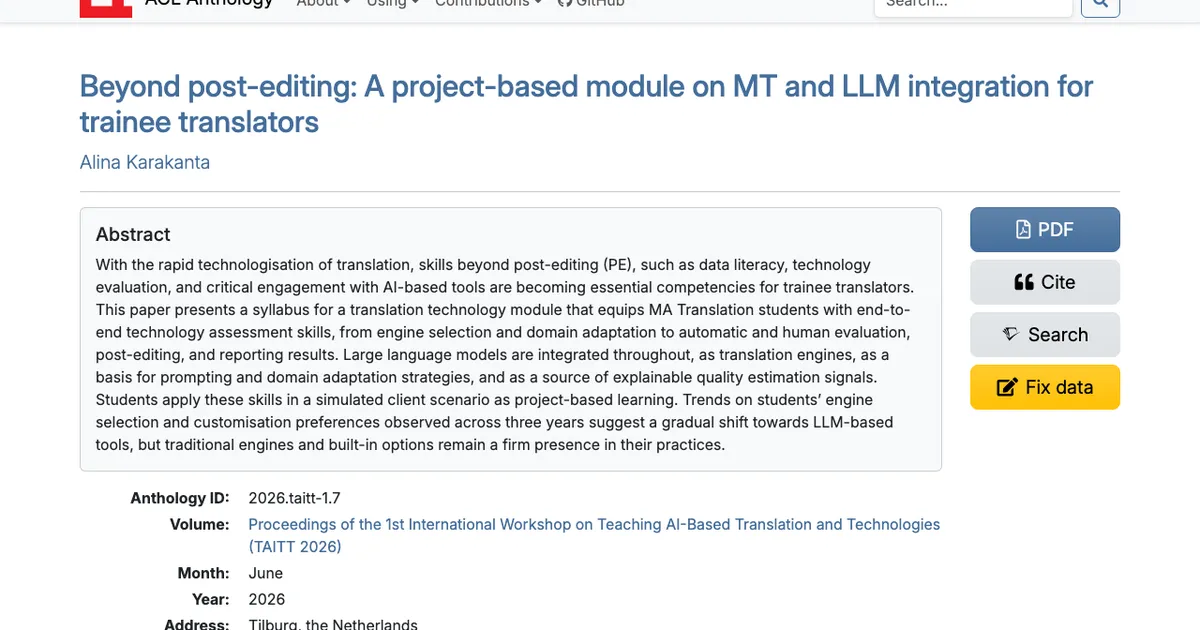
Beyond post-editing: A project-based module on MT and LLM integration for trainee translators

By Alina Karakanta in Proceedings of the 1st International Workshop on Teaching AI-Based Translation and Technologies (TAITT 2026) • ACL Anthology • Importance: 80/100
Hero Image for acl_2026.taitt-1.7

Beyond Post-Editing: Preparing the Next Generation of Human Translators for the AI Era

The rapid pace of AI is revolutionizing language translation. But simply ‘post-editing’ machine output isn’t enough anymore. As an ML researcher, I see that modern translators need a much broader skillset—they need to be tech evaluators, data scientists, and critical thinkers who understand how these complex AI systems work.

This groundbreaking syllabus module tackles exactly that. It moves beyond the traditional scope of ‘fixing bad machine output’ (Post-Editing) to establish a comprehensive, project-based learning framework designed for MA Translation students. The goal is not just proficiency in tools, but deep technological fluency.

💡 What Makes This Module Essential?

The core innovation lies in moving students from passive users of AI into active technology assessors. Instead of being given one tool and told to fix it, they navigate a simulated client scenario that requires them to:

  1. Select the Right Engine: They learn to critically evaluate which MT or LLM is best suited for a specific domain (e.g., legal vs. medical). This includes understanding domain adaptation.
  2. Engineer Prompts: Students use LLMs not just for translation, but as a basis for advanced prompting and refining strategies, maximizing the tool’s potential.
  3. Evaluate Quality End-to-End: The curriculum mandates hands-on training in automatic evaluation (like BLEU scores) and manual human evaluation. They learn to synthesize these disparate data points into professional reports—a skill crucial for industry roles.
  4. Future-Proof Skills: By integrating LLMs at every stage—as the translation engine, as a prompt refinement basis, and even as an explainable quality estimator—the module provides students with truly modern, versatile skills.

📚 Key Takeaways for Educators & Students

  • The Shift is Real: Initial data suggests that while traditional MT engines remain valuable, there is a clear industry-academia trend showing student preference and aptitude shifting towards more flexible LLM-based tools. This signals a profound curriculum adjustment is needed.
  • Project-Based Mastery: By simulating a ‘client project,’ students gain immediate applicability. They learn the entire workflow—from scoping to final reporting—which mimics real-world industry demands.

If you are involved in Translation Studies, Linguistics Education, or Computational Linguistics, this paper presents a powerful new model for modern language education. It effectively sets the agenda for how academic programs should prepare human talent for an AI-dominated professional landscape.

Emotion Profiling in LLM-Based Literary Translation: Systematic Shifts Across MT and Post-Editing

By Antonio Castaldo, Johanna Monti and Sheila Castilho in Proceedings of the First Workshop on Style in GenAI-Translated Content (StyGenAI) • ACL Anthology • Importance: 80/100
Hero Image for acl_2026.stygenai-1.2

Decoding Emotion: How LLMs Change Literary Translation

Ever read a translation that just felt… off? The beautiful phrasing was there, but the feeling was missing. If you’ve ever translated poetry or delicate literature using AI, you know what I mean.

Welcome to the frontier of computational linguistics! Our latest work dives deep into the hidden emotional shifts that occur when we use large language models (LLMs) for literary translation—a process far more complex than simply swapping words.

📖 The Problem: Beyond Word-for-Word Accuracy

The traditional view of Machine Translation (MT) often focuses on lexical equivalence and syntactic accuracy. But literature isn’t just grammar; it’s emotional texture, tone, rhythm, and cultural nuance. When LLMs handle literary text, they don’t just translate words; they interpret style and emotion.

Our study systematically investigates how the emotional profile of a source text shifts when passing through different translation pipelines: direct MT systems versus human-guided Post-Editing (PE).

Specifically, we propose a framework for Emotion Profiling in LLM translations. This allows us to map the systematic emotional drift—the subtle but critical changes in sentiment or mood—that happen across these complex processes.

🔬 What We Found: The MT vs. PE Gap

The results were quite clear and impactful:

  1. MT Over-Smoothing: Direct Machine Translation, while fast and efficient, tends to ‘smooth out’ the emotional edges of the original text. It standardizes sentiment, losing intense emotional peaks or subtle variations in tone.
  2. PE Recovery: Post-Editing (human or advanced AI refinement) shows significantly better capability in recovering the intended emotional nuance. The human element acts as a critical emotional anchor, restoring the author’s original artistic intent that raw MT often sacrifices.

This isn’t just an academic curiosity; it has massive implications for creative industries, cultural preservation, and high-stakes localization efforts (think literary publishing or film subtitling).

🚀 Why Does This Matter? The Future of AI Storytelling

Understanding this emotional drift is crucial for building next-generation translation models. We need LLMs that are not just fluent, but stylistically congruent and emotionally faithful.

Our research provides a quantifiable method (the Emotion Profiling framework) to evaluate how well an AI preserves the intangible artistic dimensions of literature across multiple stages of localization. It shifts the focus from ‘Did it translate correctly?’ to ‘Did it capture the emotional intent?’

If you work in NLP, computational linguistics, or creative AI applications, this paper Emotion Profiling in LLM-Based Literary Translation: Systematic Shifts Across MT and Post-Editing is essential reading. It lays out the systematic shifts that developers must consider when moving beyond mere text transfer.


Keywords for fellow AI enthusiasts: Literary Translation, LLM Style Transfer, Computational Linguistics, Emotion Detection, Machine Translation Pipelines.

From Binary Defaults to Contextual Bias: Translating Queer Morphology with NMT and LLMs

By Manuel Lardelli in Proceedings of the 4th Workshop on Gender-Inclusive Translation Technologies (GITT 2026) • ACL Anthology • Importance: 80/100
Hero Image for acl_2026.gitt-1.4

From Binary Defaults to Contextual Bias: How AI Translates Gender-Inclusive Language

Have you ever wondered how Artificial Intelligence handles things that don’t fit neatly into boxes? When it comes to human language, especially when discussing gender and identity, the challenges are immense. This new research tackles exactly that: translating queer morphology from German literary fiction into Italian using cutting-edge AI.

We dive deep into the mechanics of two major translation technologies—Neural Machine Translation (NMT) systems and Large Language Models (LLMs)—to see how they handle non-binary language forms, revealing a fundamental divergence in their approach. The study uses an inductive, mixed-methods framework, analyzing 12 NMT outputs and 15 LLM translations derived from a human-in-the-loop experiment.

🤖 What the AI Said: Two Opposing Approaches

Our findings expose two distinct (and problematic) failure modes in current translation AI:

1. The NMT Problem: Defaulting to Broken Binaries. NMT systems struggle with consistent gender-fair output. They fall back on standard binary grammar rules but do so haphazardly. For example, they might translate the same non-binary subject as masculine in one sentence and feminine in another. This inconsistency effectively diminishes or ‘erases’ queer visibility.

2. The LLM Problem: Contextual Bias & Over-Correction. LLMs are more sophisticated; they actively attempt gender neutrality using techniques like neutralization and neomorphemes (creating new inclusive word endings). However, this effort introduces systematic errors. Our study found that LLMs exhibit a strong contextual bias, frequently leading to over-feminization. Furthermore, their innovative attempts at inclusive grammar often result in structurally invalid or ungrammatical Italian words.

💡 The Takeaway for Tech and Translators

Ultimately, this paper provides crucial empirical guidance. It doesn’t offer a perfect solution, but it clearly maps out the current limitations of NMT and LLMs when dealing with complex sociolinguistic issues like gender-inclusive language. For post-editors—the human experts who refine AI output—these findings are invaluable for anticipating where and how the machine will fail.

In short: While LLMs seem more progressive, their attempts at inclusion aren’t foolproof. The underlying model biases still pose significant barriers to creating truly accurate and representative translations of non-binary identities.

Label-Efficient Learning for Ground-Based Sky-Image Classification: A Benchmark of Transfer Learning, Active Learning, and Pseudo-Labeling on GCD

By Esther Bou Dagher, Viktoriya Bu-Dager, Boguslaw Zegarlinski • arXiv • Importance: 75/100
Hero Image for 2609.26631

🚀 Shooting Stars in AI: Making Sky Classification Easier with Less Data

Ever wonder how astronomers classify the cosmos from a satellite image? It’s often harder than it looks! Labeling massive datasets of sky images is painstaking work, and traditionally, deep learning models demand thousands of perfectly labeled examples.

That changes now. A new study tackles this core problem: achieving high accuracy in ground-based sky-image classification without needing extensive human labeling effort.

🌌 The Challenge: Data Scarcity in Astronomy

The authors introduce a benchmark focusing on Ground-Based Sky Images (GCD). Traditionally, specialized image recognition tasks like classifying celestial objects suffer from extreme data imbalance and limited available labels. In deep learning terms, this means training models often stalls or requires costly expert time to label every single piece of data.

✨ The Solution: Label Efficiency is Key

The groundbreaking approach explored in the paper isn’t about creating a bigger dataset; it’s about making every available label count. They rigorously benchmark three powerful strategies designed to overcome label scarcity:

  1. Transfer Learning (TL): Leveraging knowledge gained from one domain (e.g., general terrestrial imagery) and adapting it to the niche domain of astronomical images.
  2. Active Learning (AL): Having the AI proactively ask for labels on the data points it is most uncertain about. This focuses human effort where it matters most—the edge cases.
  3. Pseudo-Labeling (PL): Using a model’s own predictions on unlabeled data, assuming those initial predictions are highly accurate, and using them as

Notes on Fourier-Bessel wavelets

By Marcel Venturotti, Georgios Exarchakis • arXiv • Importance: 75/100
Hero Image for 2609.26537

Wavelet Power Up: Diving Deep into Fourier-Bessel Analysis 📡

Hey AI enthusiasts and signal processing fanatics! If you’re working in the trenches of data analysis, time series forecasting, or advanced imaging—you know that getting a robust signal representation is half the battle. We just got eyes on some intriguing academic work tackling a specialized corner of signal processing: Fourier-Bessel wavelets.

Why should you care? Traditional methods like standard Fourier transforms are amazing, but they often struggle when your data has strong spatial or radial dependencies (think MRI scans or physical modeling). Standard wavelets handle local features well, but combining the best of both worlds—the global periodicity understanding of Fourier analysis with the locality and directional awareness of Bessel functions—is a huge technical lift.

The Core Idea: The paper by Venturotti and Exarchakis Notes on Fourier-Bessel wavelets explores how to develop and apply these specialized wavelet basis functions. Essentially, they are creating a super-powerful mathematical tool for decomposing signals that exhibit complex radial symmetries.

🛠️ Why is this important in the ML world?

  1. Feature Extraction Power: Instead of feeding raw, noisy data into a model, you can use these wavelets to decompose it into orthogonal components (the coefficients). These coefficients are often much cleaner and contain more domain-specific information than just the raw pixel values or time series points.
  2. Compression & Efficiency: Because these bases are highly suited for specific signal types (like those with rotational symmetry), they can lead to significantly better data compression while maintaining high fidelity, which is crucial when dealing with massive scientific datasets.
  3. Advanced Modeling: For deep learning models tackling physics-informed neural networks (PINNs) or medical imaging analysis, using Fourier-Bessel wavelets as an input feature set could dramatically improve model stability and performance by naturally accommodating the underlying physical symmetries of the data.

💡 The Takeaway for Practitioners:

While this is a highly specialized mathematical topic, understanding it helps us appreciate the depth required when developing domain-specific AI models. When standard techniques fall short—when your signal isn’t simply linear or purely sinusoidal—you need advanced tools like these customized wavelets to unlock its true potential.

If you are researching physics-based modeling, spectral analysis, or advanced imaging reconstruction, this paper is a must-read deep dive!

🔗 Read the Paper: Notes on Fourier-Bessel wavelets

Fast Matrix Multiplication in fp8: Certified Coefficient Optimization and Measured Error

By Shuxiao Xie, Shuyang Xie, Yuan Cao, Dezhi Ran, Wei Yang, Tao Xie • arXiv • Importance: 75/100
Hero Image for 2609.26077

Turbocharging AI: Faster Matrix Multiplication with fp8 Precision

Are your large language models (LLMs) bottlenecked by compute speed? We are. However, computational efficiency is critical for real-world deployment. This paper introduces a novel framework designed to dramatically accelerate matrix multiplication—the core operation in almost every deep learning model—by leveraging the ultra-low precision format of FP8.

The researchers focused on Certified Coefficient Optimization (CCO). In simple terms, they found a way to aggressively optimize the coefficients used during matrix operations while mathematically guaranteeing that the resultant error remains within acceptable bounds. This means achieving peak performance gains without sacrificing model accuracy—a critical trade-off in AI research.

🚀 What’s Under the Hood? (The Tech Deep Dive)

The power of this work lies in mastering hardware limitations and mathematical guarantees. By adopting FP8, which uses half the bits of standard FP32 precision, they enable massive throughput gains on modern accelerators. But simply switching to low precision isn’t enough; coefficients must be carefully managed.

The key contribution is the optimization methodology. They propose a robust way to structure and optimize matrices for low-bit formats. This optimization is not just ‘good enough’; it’s certified, offering strong mathematical assurance of accuracy, which makes it reliable for production use in sensitive applications like finance or healthcare.

💡 Why Should You Care? (Impact)

  1. Inference Speed: Faster matrix multiplication means faster inference times for LLMs and computer vision models. This translates to better user experiences and reduced operational costs when deploying AI at scale.
  2. Hardware Utilization: The paper directly addresses how to maximize the use of cutting-edge hardware accelerators (like modern GPUs/TPUs) that are optimized for low-bit arithmetic.
  3. Reliability: By providing certified optimization, they lift the major concern surrounding quantization: guaranteed accuracy loss. This opens the door for highly efficient, production-grade AI systems.

This work is a significant step toward making massive deep learning models practical and accessible globally, whether you are running inference on powerful data center clusters in Silicon Valley or deploying edge devices locally in Southeast Asia.

Read the technical details and see how they achieve this breakthrough: Fast Matrix Multiplication in fp8.

A Technical Curriculum on Language-Oriented Artificial Intelligence in Translation and Specialised Communication

By Ralph Krüger in Proceedings of the 1st International Workshop on Teaching AI-Based Translation and Technologies (TAITT 2026) • ACL Anthology • Importance: 75/100
Hero Image for acl_2026.taitt-1.1

Decoding AI for Linguists: A Technical Curriculum Revolutionizing Translation

Ever wondered how your translation tool actually works? The gap between using advanced AI and understanding the AI that powers it is growing—and that needs to change.

A crucial new resource, presented at TAITT 2026, introduces a technical curriculum designed not just for coders, but for communication specialists, translators, and domain experts in specialized fields. This isn’t another superficial overview; it’s a deep dive into the algorithmic heart of modern Language-Oriented AI (LOAI).

🧠 What’s Inside? Bridging Theory and Practice

The curriculum tackles the most foundational concepts that underpin today’s powerful NLP tools. If you want to move beyond simply being an ‘end-user’ of AI and become a true algorithmic agent, this material is for you.

It systematically covers:

  • Vector Embeddings: Understanding how words are converted into meaningful numerical representations—the core language structure behind any machine.
  • Neural Network Foundations: Grasping the basic mechanics of deep learning models.
  • Tokenization Mastery: Knowing how text is broken down (and why that matters for multilingual AI).
  • Transformer Architecture: The backbone of virtually all modern, high-performing translation and LLMs. This is where the magic happens—the self-attention mechanisms that allow AI to understand context globally.

✨ Why Does This Matter? Algorithmic Agency

The goal here is far bigger than just passing a class. The authors emphasize fostering computational thinking and algorithmic agency. By equipping translators and communication specialists with this technical literacy, the system empowers them to critically assess AI outputs, debug assumptions, and adapt their workflows in an increasingly automated world.

It’s about developing ‘digital resilience’—the ability to thrive professionally despite the complex black-box nature of the tools we rely on.

💡 Key Takeaway for Researchers & Educators

The curriculum was successfully tested in a real-world MA course setting. While effective, participants’ feedback highlighted a critical need: deep theoretical concepts like this require robust didactic scaffolding. For fellow educators and researchers working in L&T tech, the authors suggest integrating this foundational knowledge into higher-level academic support structures to maximize learning outcomes.


Interested in diving deeper? The full details on this comprehensive program can be found here: A Technical Curriculum on Language-Oriented AI in Translation and Specialised Communication.

#AI #NaturalLanguageProcessing #TranslationTech #DeepLearning #NLP #ComputationalLinguistics

Explore Recent Digests