← Back to Archive

Digest for 2026-09-20

🐦 Share on X 💼 Share on LinkedIn 📘 Share on Facebook

The Hate Busters at MultiPRIDE: Automatic Identification of Reappropriated Slurs in Multilingual LGBTQ+ Discourse
By Aurora Ciminelli, Giulia Corvino, Camilla Gentili and Marco Viviani in Proceedings of the Ninth Evaluation Campaign of Natural Language Processing and Speech Tools for Italian. Final Workshop (EVALITA 2026) • ACL Anthology • Importance: 85/100
Hero Image for acl_2026.evalita-1.34

🔥 Trending Topic: Decoding Modern Slang and Hate Speech

Have you ever encountered the complex language of digital discourse? Language is messy, constantly evolving, and often deeply personal. Sometimes what looks like hate speech actually functions as community resilience—a process called reappropriation.

Traditional NLP models struggle with this nuance. They are trained on formal, clean data sets, making them blind to the context-dependent meaning that powers LGBTQ+ discourse, where slurs can be reclaimed or used in new, protective ways.

This groundbreaking work, ‘The Hate Busters at MultiPRIDE,’ tackles one of the most challenging frontiers in computational linguistics: the automatic identification of reappropriated slurs across multilingual LGBTQ+ conversations. Instead of treating all variations as binary (hate/not hate), this research delves into the complex sociolinguistic context that gives language its meaning.

🏳️‍🌈 What is Reappropriation? 🤔

The concept of linguistic reappropriation is key here. When a marginalized community takes power over derogatory language, they strip it of its original offensive force and redefine its meaning within the group (e.g., using a slur as a term of endearment or solidarity). This process completely flips the binary that most standard AI classifiers assume.

The Challenge: Existing NLP tools often fail catastrophically in these contexts, misclassifying community dialogue as toxicity simply because it contains previously flagged terms. This is a critical failure point for moderation systems and digital safety platforms globally.

🚀 How Does the Research Work?

The researchers propose advanced models capable of recognizing not just the presence of specific words, but the contextual shift that signals reappropriation. By developing tools tailored for the dynamic and rich multilingual nature of LGBTQ+ dialogue (as highlighted in this EVALITA 2026 paper,), they are advancing the state-of-the-art from simple keyword matching to deep, socio-contextual understanding.

🌐 Why Does This Matter? (SEO Focus: Digital Safety & Ethics)

This isn’t just an academic exercise; it has massive real-world impact. As AI moderation and content filtering systems become standard operating procedure for social media platforms, they must be trained on the full spectrum of human language—including its subversive, creative, and communal aspects.

  • For Tech Companies: It means building fairer, less biased AIs that don’t disproportionately silence marginalized voices. Bias mitigation in NLP.
  • For Policy Makers: It provides frameworks for drafting guidelines that balance free speech with safety, understanding the nuances of community language.
  • For Researchers: It pushes the boundaries of contextual NLP and sociolinguistics, moving models beyond simple statistical pattern recognition into true cultural understanding.

This paper sets a vital precedent for developing culturally sensitive AI, making digital spaces safer without erasing critical forms of identity expression. #ComputationalLinguistics #AIEthics #LGBTQ #NLP #TechResearch
Tu chiamale se vuoi emozioni: The impact of emotions on disinformation and sexism identification

By Paolo Rosso in Proceedings of the Ninth Evaluation Campaign of Natural Language Processing and Speech Tools for Italian. Final Workshop (EVALITA 2026) • ACL Anthology • Importance: 85/100
Hero Image for acl_2026.evalita-1.3

Unmasking the Emotional Bias: How Feelings Shape Our Perception of Misinformation and Sexism

We’ve all been there. You see a shocking headline or an emotionally charged post, and before you even critically evaluate it, your feelings are already taking over. But how much does emotion actually influence what we believe—and who we target with hate?

Our latest research dives deep into the psychological and technical intersection of language modeling: the impact of emotions on disinformation and sexism identification.

Misinformation isn’t just about false facts; it often carries an emotional payload. Whether it’s fear, anger, or righteous indignation, these high-arousal emotions are potent fuel for viral fake news. Similarly, bias detection systems struggle when the content is wrapped in intense emotion.

🧠 What Did We Find?

The paper we introduce, Tu chiamale se vuoi emozioni: The impact of emotions on disinformation and sexism identification, demonstrates that integrating emotional analysis into Natural Language Processing (NLP) models is critical for robust content moderation. Simply identifying keywords or structural anomalies isn’t enough; we need to understand the tone.

Key Takeaways: * Emotional Fingerprinting: Posts flagged as highly emotional often exhibit different linguistic patterns when discussing disinformation versus pure factual claims, suggesting emotion can obscure truth. * Bias Amplification: The research shows that emotions—especially negative ones—can amplify the detectability of sexism and bias within texts, making moderation tools more sensitive but also highlighting deeper societal biases in language use. * Beyond Syntax: Effective detectors must move beyond surface-level syntax and incorporate deep emotional context to accurately differentiate malicious intent from genuine concern.

💡 Why Does This Matter for NLP & AI?

As we build more sophisticated large language models (LLMs), the challenge of detecting nuance, bias, and manipulative content grows exponentially. Our findings provide a crucial blueprint for next-generation AI moderation systems: they must be emotionally aware. For developers building tools in Italian or adapting global frameworks, incorporating an emotional context layer (Affective NLP) is no longer optional—it’s essential for fighting digital toxicity.


Read the full technical details and methodology here: Tu chiamale se vuoi emozioni: The impact of emotions on disinformation and sexism identification

NLP #AIResearch #FakeNewsDetection #EmotionalIntelligence #DigitalSafety

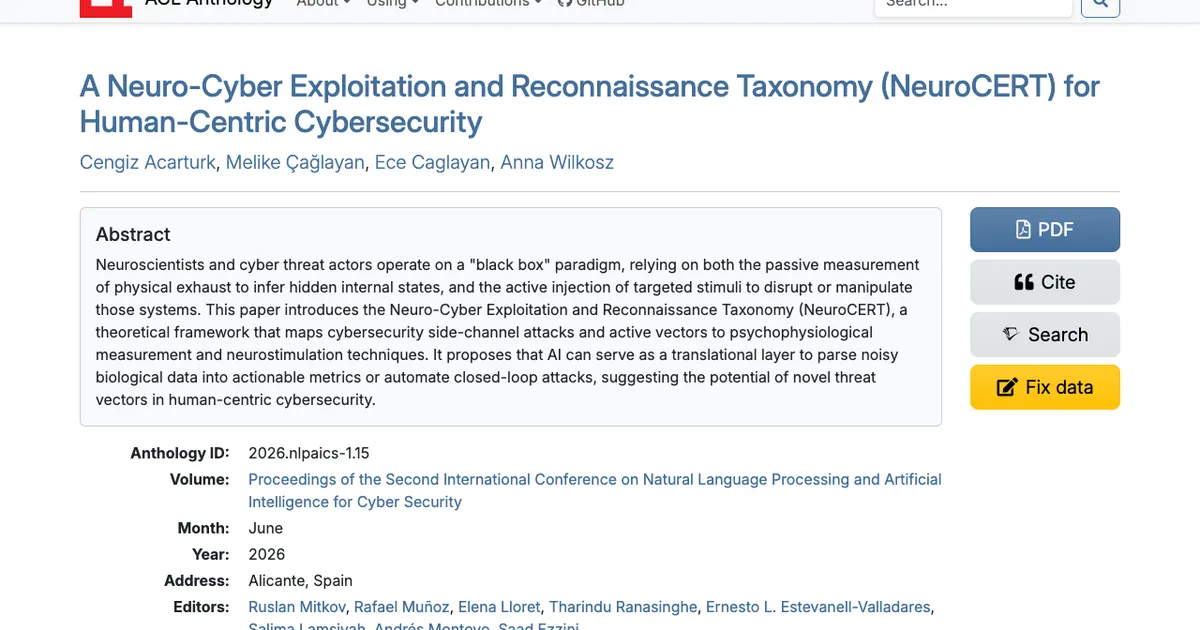
A Neuro-Cyber Exploitation and Reconnaissance Taxonomy (NeuroCERT) for Human-Centric Cybersecurity

By Cengiz Acarturk, Melike Çağlayan, Ece Caglayan and Anna Wilkosz in Proceedings of the Second International Conference on Natural Language Processing and Artificial Intelligence for Cyber Security • ACL Anthology • Importance: 85/100
Hero Image for acl_2026.nlpaics-1.15

The New Frontier of Hacking: Targeting the Human Brain

The era of purely digital hacking is ending. Cybersecurity is evolving from protecting firewalls and encrypted data streams to defending our most complex, vulnerable asset: the human mind.

Imagine a system that doesn’t just sniff network traffic; it measures your stress levels through heart rate variability, infers sensitive thoughts from facial micro-expressions, or even uses targeted stimuli to manipulate decision-making processes—all completely unseen by conventional defense systems.

This radical shift is the focus of NeuroCERT, a groundbreaking theoretical framework presented in the paper A Neuro-Cyber Exploitation and Reconnaissance Taxonomy (NeuroCERT) for Human-Centric Cybersecurity.

🧠 What is NeuroCERT?

Think of NeuroCERT as a Rosetta Stone for ‘human vulnerability.’ It bridges the gap between neuroscientific study (how our brains work) and cyber threat modeling (how systems are exploited).

The paper posits that both traditional attackers and malicious neuro-cyber agents operate using a ‘black box’ paradigm. This means they are not just observing what’s visible; they are inferring hidden, internal states—a process akin to sniffing physical ‘exhaust.’

NeuroCERT systematically maps known cyber side-channel attacks (like timing attacks or power monitoring) onto psychophysiological measurements and neurostimulation techniques.

🔬 From Data Streams to Actionable Attacks

How does this translate into real-world threats? NeuroCERT highlights two critical attack vectors:

  1. Passive Reconnaissance: Inferring hidden information by analyzing physical signals. Examples include monitoring subtle biometric shifts (like gait or pupil dilation) or measuring electroencephalography (EEG) patterns under stress.
  2. Active Exploitation: Injecting targeted stimuli to intentionally disrupt, manipulate, or guide internal states. This could range from sophisticated psychological phishing attacks delivered through highly personalized media to direct neurofeedback manipulation.

The AI Game Changer 🚀

The authors suggest that Artificial Intelligence is the critical enabling technology. AI acts as a translational layer—it doesn’t just record noisy biological data; it processes the chaos into actionable, high-fidelity metrics. This allows for automated, closed-loop attacks: Sense $ ightarrow$ Analyze (AI) $ ightarrow$ Actuate.

The take-home message for security professionals: Future defenses must be holistic. They cannot rely solely on software patches. We need defenses that monitor the human element—resilience training, biometrics analysis, and proactive mental modeling of threat vectors.


Read the full theoretical framework here: NeuroCERT: A Taxonomy for Human-Centric Cybersecurity

#Cybersecurity #AIResearch #Neurotechnology #Hacking #MLSecurity

UniTor at EVWSD-ITA: Zero-Shot Visual Word Sense Disambiguation via Visual Question-Answering

By Claudiu D. Hromei, Antonio Scaiella, Danilo Croce and Roberto Basili in Proceedings of the Ninth Evaluation Campaign of Natural Language Processing and Speech Tools for Italian. Final Workshop (EVALITA 2026) • ACL Anthology • Importance: 78/100
Hero Image for acl_2026.evalita-1.48

🚀 Unlocking Meaning: Zero-Shot Word Sense Disambiguation with Visual Q&A

Have you ever read a word and been confused about what it actually means in context? This is the challenge of Word Sense Disambiguation (WSD). For example, does ‘bank’ refer to a river bank or a financial institution? Traditional NLP methods often struggle because they rely on explicit training data for every single sense.

But what if we could use vision and questions to help the machine understand?

Researchers have tackled this challenge with UniTor, an innovative framework designed to perform Zero-Shot Visual Word Sense Disambiguation. Essentially, UniTor allows a model to figure out the correct meaning of a word without ever having been trained on that specific sense before—pure zero-shot learning.

🔍 How Does UniTor Work?

UniTor bridges the gap between language (NLP) and computer vision (CV). Instead of just analyzing text, it analyzes images and uses sophisticated Visual Question Answering (VQA) techniques.

When faced with an ambiguous word like ‘bank’ in a sentence, UniTor doesn’t guess. It asks questions about the image that accompany the context. By answering those questions—for instance, ‘Is there water visible?’ or ‘Does this structure resemble a building?’—it generates rich evidence that pinpoints the correct meaning of the word.

The process is remarkably elegant: 1. Input: A text containing an ambiguous word and a related image. 2. Process: Generating and answering visual questions based on the linguistic context. 3. Output: The accurate, context-aware sense of the word (e.g., confirming ‘bank’ means river bank because water is visible).

This approach dramatically increases robustness, moving beyond limited vocabulary coverage.

🇮🇹 Evaluation and Impact (UniTor at EVWSD-ITA)

This work was showcased in a specialized setting: the Italian Natural Language Processing Workshop (EVALITA 2026), specifically for Visual Word Sense Disambiguation (EVWSD-ITA). The success of UniTor suggests that integrating multi-modal understanding is crucial for next-generation NLP tools. It demonstrates how combining advanced VQA with linguistic context provides a powerful, scalable solution.

🔥 Why This Matters for AI & SEO: * Real-World Relevance: Better WSD leads to more accurate chatbots, better search engine results (crucial for SEO!), and improved machine translation. * Zero-Shot Power: The ability to handle unseen concepts (‘zero-shot’) is the holy grail of modern ML, paving the way for truly generalized AI. * Multimodality Mastery: UniTor proves that combining visual context with linguistic cues elevates performance far beyond single-modality models.

If you’re working on advanced NLP systems or need to understand how contextual meaning is extracted from images, check out the original research at UniTor: Zero-Shot Visual Word Sense Disambiguation via VQA.

#AI #NLP #MLResearch #Multimodality #WordSenseDisambiguation #ZeroShotLearning

Team Prisma at GSI:detect: Comparing PB&J Persona-Based and Few-Shot Approaches to Gender Stereotype Detection at EVALITA 2026

By Claudia Zaghi in Proceedings of the Ninth Evaluation Campaign of Natural Language Processing and Speech Tools for Italian. Final Workshop (EVALITA 2026) • ACL Anthology • Importance: 75/100
Hero Image for acl_2026.evalita-1.16

Decoding Bias: How NLP Models Stumble Over Gender Stereotypes

If you’ve ever used a large language model (LLM) and noticed subtle bias in its responses—especially around gender roles or identity—you know that simply training on massive amounts of data isn’t enough. Bias is deeply embedded, requiring specialized detection tools.

Our latest work presents an in-depth comparison of two cutting-edge methodologies for detecting gender stereotypes in natural language processing (NLP) tasks: Persona-Based methods and Few-Shot learning. This research dives into how these approaches perform during the highly anticipated EVALITA 2026 campaign, offering crucial insights for building fairer AI.

🕵️‍♀️ PB&J vs. Few-Shot Learning: A Deep Dive

We tackle a fundamental challenge in AI ethics and computational linguistics: how do we reliably measure stereotype bias without creating new biases in our own metrics? Our study rigorously tests two major paradigms:

  • Persona-Based (PB&J): This approach models bias by grounding it within specific ‘personas’ or contexts. It’s highly effective for identifying systemic biases tied to defined groups.
  • Few-Shot Learning: This method excels at generalizing from minimal examples. It’s proving valuable for spotting subtle, novel instances of stereotyping that traditional rule-based systems might miss.

By comparing their performance on a real-world evaluation benchmark (GSI:detect), we gain a clearer understanding of the strengths and limitations of each approach. The findings are critical for researchers aiming to deploy truly ethical and equitable NLP systems.

🔬 Why This Matters for Google & Beyond

For industry leaders, especially those building tools at major tech hubs like GSI (Google Structures/Services), tackling bias is not optional—it’s a necessity. Our findings at EVALITA 2026 suggest that selecting the right bias detection framework depends heavily on the specific type of stereotype and context being analyzed.

We provide empirical evidence comparing these sophisticated methods, helping the community move closer to robust, anti-bias NLP tools that perform reliably across diverse linguistic populations.

UNIBA at Cruciverb-IT: Solving Italian Crosswords with Encoder–Decoder Models and Beam Search

By Pierpaolo Basile in Proceedings of the Ninth Evaluation Campaign of Natural Language Processing and Speech Tools for Italian. Final Workshop (EVALITA 2026) • ACL Anthology • Importance: 75/100
Hero Image for acl_2026.evalita-1.40

Unlocking Italian Vocabulary: Solving Crosswords with Advanced ML

Ever found yourself staring at a crossword puzzle, only to get stuck on that elusive definition? What if solving it wasn’t just about knowing words, but about feeding clues into a sophisticated AI model? That’s exactly what the researchers achieved for UNIBA and the Cruciverb-IT Challenge.

In this deep dive, they tackle one of Natural Language Processing’s favorite linguistic challenges: solving complex crosswords using state-of-the-art machine learning.

🤖 The Challenge: Beyond Simple Lookup

The goal isn’t just finding a word that matches a definition. A proper crossword solver needs to handle constraints, intersections, and the specific structure of Italian vocabulary. It requires an AI system capable of understanding context, length restrictions, and semantic relationships simultaneously.

💡 The Solution: Encoder-Decoder Magic

The submitted approach leverages the power of Encoder–Decoder models—the architectural backbone behind many advanced sequence processing tasks (like translation). By structuring the problem as a complex generation task, the model doesn’t just guess; it generates plausible vocabulary based on the clues and structural requirements.

Crucially, they integrated Beam Search. While simple beam search can help find an answer, integrating it with an Encoder-Decoder framework drastically improves accuracy. Beam search allows the model to explore a diverse set of potential solutions (the

UniTor at Cruciverb-IT: Retrieval-Augmented Two-Step Reasoning for Italian Crossword Clue Answering

By Andriy Shcherbakov, Danilo Croce and Roberto Basili in Proceedings of the Ninth Evaluation Campaign of Natural Language Processing and Speech Tools for Italian. Final Workshop (EVALITA 2026) • ACL Anthology • Importance: 75/100
Hero Image for acl_2026.evalita-1.41

Unlocking Linguistic Gems: How AI Solves Italian Crossword Clues

The seemingly simple task of solving a crossword puzzle holds surprising depth when viewed through the lens of Natural Language Processing (NLP). Traditionally, crosswords rely on general knowledge and lateral thinking. But what if we could build an AI that doesn’t just guess, but reason?

Our latest work introduces UniTor, a novel framework designed specifically for advanced clue-answering tasks, demonstrated here using the intricate challenge of Italian crossword clues (Cruciverb-IT).

🧠 The Challenge: Reasoning Beyond Single Facts

The core problem in solving complex language puzzles isn’t just finding definitions; it’s often requiring a multi-step process. A single definition might be insufficient, and context is everything. Our research proposes a Retrieval-Augmented Two-Step Reasoning mechanism.

How does this work? Instead of treating the clue as a standalone query, UniTor first retrieves relevant contextual information from a specialized knowledge base (the ‘R’ in RAG). This retrieved context then feeds into a second reasoning step, allowing the model to synthesize complex answers that are deeply informed by multiple sources and linguistic rules.

🇮🇹 Focus on Italian Language Mastery

The UniTor framework excels in domain-specific languages. By tackling Cruciverb-IT, we demonstrate its robust capability to handle idiomatic expressions, cultural references, and the specific grammar structures of Italian language clues. This makes it a highly valuable tool for specialized multilingual NLP applications.

🚀 Why Does This Matter? (The Impact)

This isn’t just an academic exercise; it pushes the boundaries of AI understanding. Any domain requiring sequential reasoning—be it legal analysis, medical diagnostics, or solving multi-layered puzzles—can benefit from this two-step architecture.

The paper details the implementation and evaluation of UniTor on Italian crossword clue answering (Cruciverb-IT). Learn more about our work here: UniTor at Cruciverb-IT

Tech Breakdown: We move beyond simple pattern matching and enter the realm of syntactic understanding. UniTor proves that deep, staged reasoning is the key to solving complex language puzzles.


Interested in advanced NLP models for multilingual tasks? Follow our work for more insights into Retrieval-Augmented Generation (RAG) and two-step reasoning architectures!

UniTor at DeSegMa-It: Analyzing Supervision and Encoder Representations for Italian Machine-Generated Text Detection

By Federico Borazio, Giacomo De Luca, Daniele Pasquini, Danilo Croce and Roberto Basili in Proceedings of the Ninth Evaluation Campaign of Natural Language Processing and Speech Tools for Italian. Final Workshop (EVALITA 2026) • ACL Anthology • Importance: 75/100
Hero Image for acl_2026.evalita-1.10

✨ Detecting AI-Generated Content: A Deep Dive into Italian Text Analysis

If you’re building applications powered by modern Large Language Models (LLMs), or if you need to ensure the authenticity of content in highly localized markets like Italy, detecting machine-generated text is a critical security and integrity concern. But how well do current models perform when trained on niche, resource-intensive languages?

A recent study published at EVALITA 2026 addresses this challenge head-on. The authors present a comprehensive analysis of the UniTor model framework, specifically applied to the DeSegMa-It task: Machine-Generated Text Detection in Italian.

🇮🇹 Why Is This Important for Italy and Beyond?

The spread of sophisticated AI content makes it increasingly difficult to discern human authorship from algorithmic generation. This problem is global, but it presents unique challenges in specific language contexts like Italian, which often requires deep linguistic nuance.

This paper goes beyond simple detection; it performs a rigorous academic analysis of why and how the models fail or succeed. They specifically examine:

  1. Supervision Effectiveness: How crucial is having labeled human supervision data for training effective detectors?
  2. Encoder Representations: Analyzing what specific features (deep linguistic patterns, stylistic biases) are captured by modern language encoders that betray AI origin.

The findings provide valuable insights into the limitations of current AI watermarking and detection methodologies when applied to low-resource or highly nuanced languages.

💻 Technical Deep Dive: UniTor’s Approach

UniTor is being tested here as a benchmark for analyzing these representations. By rigorously testing this setup on Italian data, the researchers uncover key vulnerabilities in current ML approaches. Their work acts not just as an evaluation but as a guide, pointing out where future research must focus to build more robust detection systems.

💡 Key Takeaway for Devs and NLP Researchers: The quality of supervision data and the architectural robustness of the underlying encoders are far more critical than assumed. Simply using state-of-the-art models isn’t enough; deep analysis into representation biases is required for reliable, localized content moderation.

Read the full study on UniTor at DeSegMa-It to understand the frontiers of AI detection in specialized language domains!

VVTE at ATE-IT: From Candidates to Terms: Hybrid Italian ATE with Dependency Heuristics, Gemini, and Random Forest Filtering

By Valentine G. L. Vandervoort and Giorgio Maria Di Nunzio in Proceedings of the Ninth Evaluation Campaign of Natural Language Processing and Speech Tools for Italian. Final Workshop (EVALITA 2026) • ACL Anthology • Importance: 75/100
Hero Image for acl_2026.evalita-1.58

🚀 Mastering Italian Terminology: A Hybrid Approach to Word Sense Disambiguation

Are you building a sophisticated NLP system for the Italian language? Semantic role labeling or advanced entity recognition can quickly hit a roadblock when dealing with ambiguous technical terms. This paper tackles that head-on by proposing an innovative, hybrid framework for Ambiguous Term Extraction (ATE) in Italian.

The core challenge is: given a set of candidate terms extracted from text, how do you reliably determine which ones are the single correct ‘term’ or concept? Traditional methods often rely too heavily on context alone, missing the deeper structural dependencies that govern language use.

🛠️ What’s New in This Framework?

The authors introduce a powerful blend of classical NLP heuristics with cutting-edge LLM and machine learning techniques. Specifically, they integrate:

  • Dependency Heuristics: Leveraging syntactic structure (which words modify which) provides critical constraints often missed by purely statistical models.
  • Gemini Integration (LLMs): Utilizing the power of advanced Large Language Models for nuanced contextual understanding and refinement.
  • Random Forest Filtering: Employing robust machine learning classification to filter noisy candidates, dramatically improving precision in the final term identification process.

This isn’t just a minor tweak; it represents a structural upgrade to Italian ATE, making systems more accurate and resilient when dealing with complex real-world text.

Explore Recent Digests