← Back to Archive

Digest for 2026-07-21

🐦 Share on X 💼 Share on LinkedIn 📘 Share on Facebook

Trustworthy Privacy-Preserving Multimodal Federated Learning for Personalised Breast Cancer Prediction
By Ruth Amey, Muhammad Arifur Rahman, Taha Osman, Nicholas Shopland, Andy Burton, Mufti Mahmud, David J. Brown • arXiv • Importance: 92/100
Hero Image for 2607.19532

🧬 Revolutionizing Healthcare: AI’s New Frontier in Breast Cancer Prediction

The future of personalized medicine is here, and it runs on data—but whose data? Training sophisticated AI models on sensitive patient health records has always been a monumental challenge due to privacy regulations (HIPAA, GDPR) and the sheer volume of deeply personal information involved.

Our latest research tackles this head-changer problem head-on: How do we build world-class diagnostic AI while keeping patient data secure and local? 🔒

We dive deep into the power of Federated Learning (FL), a cutting-edge machine learning paradigm. Instead of sending all raw medical images (like MRIs) or detailed clinical records to one central server—a huge privacy risk—FL allows multiple institutions (hospitals, clinics) to train a shared model locally on their private data sets. Only the model updates are shared and aggregated, keeping the sensitive patient information where it belongs: within the hospital.

🏥 What Did We Build? The Multimodal Approach

Predicting tumor progression isn’t simple; it requires a holistic view of the patient. Our study built a comprehensive framework that integrates multimodal data—a powerful blend including:

  • 🔬 Medical Imaging: Detailed scans (MRI, etc.) capturing physical changes.
  • 📊 Biomarker Data: Genetic and chemical indicators from bloodwork.
  • 🧑‍⚕️ Clinical Information: Patient demographics and treatment history.
  • 🧬 Tumor Characteristics: Specific measurements and progression metrics over time.

The goal? To create robust, individualized predictions for breast cancer patients that can help clinicians plan far more targeted treatments.

🚀 The Federated Advantage: Why This Matters

We rigorously benchmarked our federated model against a traditional centralized approach. Our findings demonstrate that Federated Learning can achieve predictive performance comparable to—if not exceeding—centralized models, all while maintaining absolute data privacy.

But privacy isn’t the only pillar. We also focus on making these systems practical in real-world settings by ensuring:

  • ✅ Transparency: Understanding why the AI made a prediction.
  • 📈 Scalability: Supporting global deployment across different hospital sizes and types.
  • 🛡️ Security: Preventing data leaks and malicious model tampering.
  • ⚖️ Fairness: Ensuring the model works equally well for all patient subgroups, regardless of demographics.

The ultimate vision? Empowering ‘digital twins’—advanced simulations that help patients and doctors predict how a tumor might react to different treatments before surgery or chemotherapy begins. This is genuinely revolutionary care planning!

🔗 Read the full paper: https://arxiv.org/abs/2607.19532


#AIinHealthcare #FederatedLearning #BreastCancerDetection #MedTech #PersonalizedMedicine

Disclaimer: This research is for informational purposes and does not constitute medical advice.
Equilibrium Causal Games: Separation, Identification, and the Identifiability of Cyclic Latent States

By Faraz Dadgostari, Neda Nazemi • arXiv • Importance: 92/100
Hero Image for 2607.19531

⚡ Decoding Hidden Systems: Causal Inference in Equilibrium Games

(A Digest on Equilibrium Causal Games)

Hey ML enthusiasts and data scientists! Are you building models of complex systems—think power grids, financial markets, or biological networks? You know that the real world rarely gives you a clean set of perfectly measured variables. Instead, you face equilibria: stable states observed through imperfect sensors, influenced by unknown hidden rules.

That’s exactly where this groundbreaking work on Equilibrium Causal Games (ECG) steps in. It fundamentally fuses structural causal models with the dynamics of multi-agent games, offering a rigorous framework to understand stability and causality simultaneously.

🧠 What is an Equilibrium Causal Game? 🧐

At its core, ECG joins two powerful concepts:

  1. Game Theory: Modeling interactions between multiple agents (e.g., how electricity demand interacts with supply).
  2. Causal Modeling: Identifying the true ‘why’ behind observed correlations (i.e., separating correlation from causation).

This framework allows researchers to not only predict a system’s stable state but also to rigorously test how that state would change if they intervened (like building a new power plant or changing tax policy).

💡 Key Breakthroughs & Implications for ML Engineering 🛠️

The authors deliver deep theoretical insights into the challenges of identifying the system’s underlying mechanics. Here’s what makes this paper so critical:

  • Causality Under Intervention: The theory provides rules for how structured interventions (edits to declared objects) recompute equilibrium, making intervention testing computationally manageable.
  • Separating Ambiguities: The core challenge is identifying the unknown structure ($H$, $B$) from observed data. The paper outlines conditions where methods like ‘mechanism interventions’ can cleanly separate the sensing mechanism from the actual interactions—a huge step toward practical identifiability.
  • Handling Imperfect Sensing (Unknown Wiring/Sensing): In real-world scenarios, we never know every variable or how perfectly they are measured. This research tackles deep ambiguities caused by unknown wiring and full-rank, non-ideal sensors, providing concrete mathematical conditions for when identification is possible.
  • The Power of Non-Gaussianity: The findings suggest that moving beyond simple Gaussian assumptions (non-Gaussian data) can resolve certain foundational rotational ambiguities in the source model—a major methodological win.

📌 Takeaway for Practitioners: This paper gives us a roadmap, specifying exactly which causal conclusions our equilibrium data actually support and which require targeted, experimental interventions. It’s a powerful guide for designing reliable ML systems that must operate reliably under uncertainty.


🔗 Want to dive into the math? The full preprint is available here: https://arxiv.org/abs/2607.19531

DataScience #CausalInference #MachineLearning #GameTheory #AIResearch

SynPre-FL: Synthetic data-driven pretraining integrated Federated Learning training framework

By Akarsh K Nair, Muhammad Arifur Rahman, Nicholas Shopland, Andy Burton, Jun He, Yuan Shen, David Baldwin, Emma O'Dowd, Amna Burzic, Mufti Mahmud, David J. Brown • arXiv • Importance: 92/100
Hero Image for 2607.19524

🏥 Unlocking Privacy-Preserving AI: Meet SynPre-FL for Clinical EHR Data

Are deep learning models ready to revolutionize healthcare? The answer is almost—but there’s a massive hurdle: patient data privacy. Sharing sensitive Electronic Health Record (EHR) data across hospitals or institutions is legally and ethically impossible, bottlenecking critical advancements in risk prediction.

This new work introduces SynPre-FL, a groundbreaking framework designed to solve this exact problem. It combines the power of synthetic data generation with Federated Learning (FL) into one seamless solution, allowing robust AI training without ever compromising patient privacy.

💡 How SynPre-FL Works: The Power Duo

Think of it like creating a perfect digital twin of your hospital’s data—a safe, usable copy.

  1. Synthetic Data Generation (The Shield): Instead of sharing raw data, SynPre-FL uses an advanced latent autoencoder-diffusion model to generate high-fidelity synthetic patient cohorts. This process is highly robust, preserving complex statistical relationships (univariate, bivariate, and multivariate structures) while actively defending against membership and reconstruction attacks.
  2. Synthetic Pretraining (The Warm-Up): These synthesized, private datasets are used first to ‘warm-start’ the federated training. This pretraining phase stabilizes the model and ensures optimal starting weights.
  3. Federated Optimization (The Final Edge): The robust, privacy-preserving pretrained model is then fine-tuned across various client hospitals in a truly decentralized manner. Specialized techniques—like class-balancing objectives and proximal regularization—ensure the model performs well even when different hospitals have highly diverse (Non-IID) data distributions.

✨ Why This Matters: Real-World Impact

  • True Privacy: It solves the foundational tension between high-quality AI training and strict data privacy regulations like HIPAA. You train models on synthetic, safe copies.
  • Robustness in Chaos: Healthcare data is notoriously messy (Non-IID). SynPre-FL specifically tackles heterogeneity, providing reliable predictions even when client data varies drastically.
  • Actionable Insights: It doesn’t just predict risk; it offers interpretable results. Through post-hoc calibration and SHAP analysis, clinicians get stable, trustworthy explanations of why a patient is flagged as high risk.

🚀 Technical Deep Dive (For ML Enthusiasts)

The performance gains were consistent across multiple client setups (5 to 15 heterogeneous clients). The framework significantly outperformed existing baselines, proving its scalability and reliability in severe non-IID fragmentation. Furthermore, the generated synthetic data passed stringent utility tests (TSTR, TRTS), confirming that the synthetic features are not just plausible but functionally identical for downstream tasks.

Ready to dive deeper into the methodology? Check out the full paper here: SynPre-FL

Keywords: Federated Learning, Synthetic Data Generation, EHR, AI in Healthcare, Privacy Preservation, Deep Learning

From Bit-Position Sensitivity to Unequal Error Protection for DNN Inference Memory

By Muhammad Husnain Mubarik, Karthik Mohan Kumar, Pedro Antonio Pena, Keshavan Varadarajan, Kunal Tyagi • arXiv • Importance: 90/100
Hero Image for 2607.19623

✨ Goodbye Overkill ECC: Saving Area and Power in AI Accelerators

Hey tech enthusiasts and ML engineers! If you’re building the next generation of specialized hardware for running massive deep learning models (think LLMs on the edge or in data centers), this one is for you.

Traditional memory protection—like SECDED ECC (Error-Correcting Code)—treats every single bit equally, assuming all bits are equally critical. This leads to serious overhead: huge silicon area, unnecessary power consumption, and complexity.

The researchers behind the paper titled ‘From Bit-Position Sensitivity to Unequal Error Protection for DNN Inference Memory’ found a groundbreaking solution that changes how we design AI hardware memory. They proved that for most modern ML workloads, the least significant bits (the low-order bits) are actually useless for maintaining performance—you can flip them and your model still works perfectly! 🧠

💡 The Core Breakthrough: Not All Bits Are Created Equal

Their work rigorously tested sixteen diverse ML models—from Transformer LLMs to CNNs—and across multiple floating-point formats (FP16, BF16). They found a sharp transition point, $X_{ ext{safe}}$, showing that flipping any low-order bit up to this threshold causes almost zero performance degradation.

Why does this matter? Because high-order bits and the exponent/mantissa boundary are where the real drama is; messing with those flips your model completely (catastrophic failure!). But for most of the other bits, it’s fine.

This realization allows them to ditch uniform protection. Instead, they propose Unequal Error Protection (UEP), which selectively protects only the truly critical bits while ignoring the safe, low-impact ones.

🚀 How UEP Saves Big Bucks (Area and Energy)

By implementing a per-data-type, workload-aware protection strategy, they are able to achieve massive savings without touching model weights or retraining:

  • ⚡ Area Reduction: The new codec slashes the necessary Error Correction Code area by nearly 28% compared to standard SECDED. This is huge for cost and density on silicon.
  • 🔋 Energy Efficiency: They also designed a dual-voltage partition for the non-critical memory region, cutting the read energy of formats like BF16 by about 17%.
  • 🎯 Flexibility: The system adapts based on the model class. For instance, resilient LLMs might get a wider bypass area than text-conditioned diffusion models, tailoring protection to the specific application.

🛠️ Future Implications for AI Hardware Designers

This is more than just an optimization; it’s a paradigm shift in ML accelerator design. It means we can build smaller, faster, and more power-efficient chips capable of running powerful AI everywhere—from cloud data centers to your smartphone pocket.

If you are a hardware architect or working on memory architectures for AI, this paper provides the theoretical foundation and practical implementation roadmap for achieving vastly superior efficiency.

👉 Read the full academic details here: https://arxiv.org/abs/2607.19623

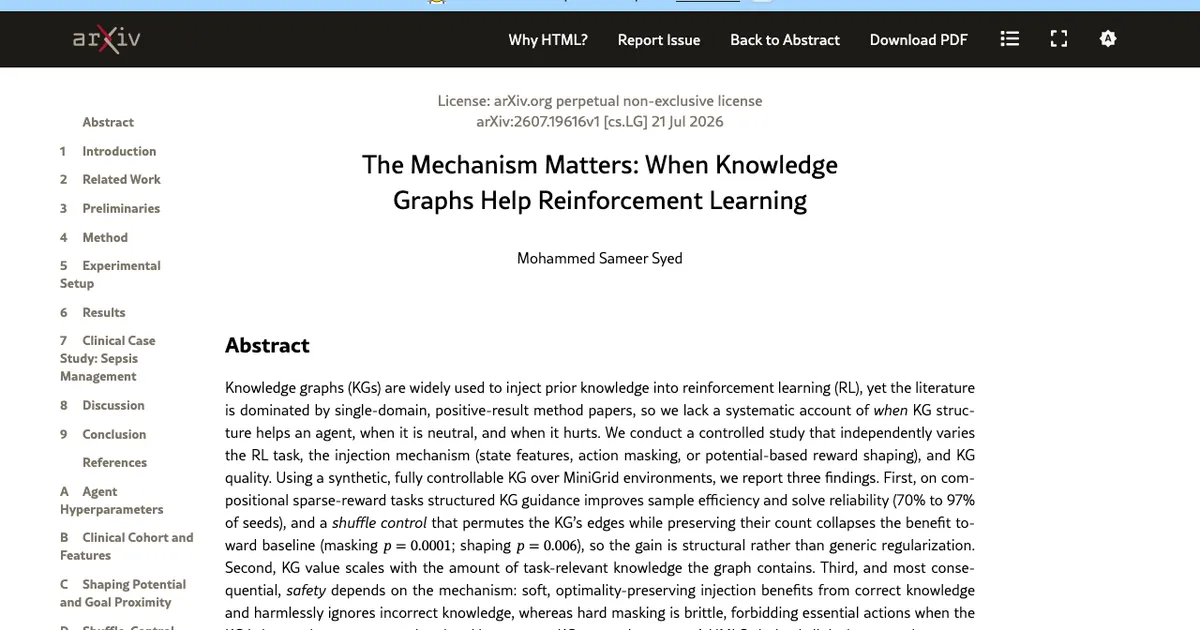
The Mechanism Matters: When Knowledge Graphs Help Reinforcement Learning

By Mohammed Sameer Syed • arXiv • Importance: 90/100
Hero Image for 2607.19616

🧠 The Mechanism Matters: When Knowledge Graphs Actually Help AI 🕸️

(A Deep Dive into Reinforcement Learning and Knowledge Injection)

The buzz around enhancing Artificial Intelligence is endless. We hear about LLMs, Transformers, and massive compute cycles. But what about injecting structured knowledge? Could a simple graph—a ‘Knowledge Graph’ (KG)—be the key to making complex AI systems smarter without retraining them on petabytes of data?

Researchers have long believed KGs could be magic bullets for Reinforcement Learning (RL). The existing literature, however, is full of highly specific, positive-result case studies. It’t like everyone reports a successful recipe—you don’t know if the technique works systematically.

Our latest deep dive tackles this question head-on: Does KG guidance systematically improve RL, or is it just another placebo?

Using a fully controllable simulation environment (MiniGrid), we designed a rigorous study to independently vary three critical factors: 1) the RL task complexity, 2) the knowledge injection mechanism (how we use the KG), and 3) the quality of the KG itself.

✨ Three Game-Changing Insights for AI Practitioners:

💡 Insight 1: Structure is King, not just Edges. Our first finding proves that the benefit of KGs isn’t generic. The graph’s structure—how the knowledge is connected—is what matters most. We found that randomly shuffling the KG’s connections (while keeping all facts) drastically collapses the performance gain toward baseline, proving the gain is structural coherence, not just raw data volume.

💡 Insight 2: Relevance Scales Everything. The more task-relevant knowledge your graph contains, the better. The performance boost isn’t limited by KG size; it scales with how well every piece of information actually relates to the problem at hand.

🚨 Insight 3: Safety is Mechanism Dependent (The Cautionary Tale). This is arguably the most critical takeaway for deploying real-world AI. We found a stark difference between soft and hard knowledge injection mechanisms:

  • ✅ Soft Injection: Ideal. These methods benefit when knowledge is correct but are benign when the KG contains mistakes or incompleteness. They don’t break the agent if they fail.
  • ❌ Hard Masking: Dangerous. This method is brittle. If the KG is even slightly incomplete, it can forbid essential actions (making a wrong KG worse than having no guide at all!).

The Bottom Line for Engineers: Always Match the Mechanism to the Need. We provide concrete guidelines on when and how much confidence you should place in an injected knowledge graph. For critical applications, understanding this safety boundary is paramount.


👉 Want the full technical breakdown? Read the paper here: https://arxiv.org/abs/2607.19616

Source: Mohammed Sameer Syed. Published through rigorous simulation studies.

CRB-Driven Beamforming and Trajectory Optimization for UAV-assisted ISAC System

By Yi Yang, Qianqian Zhang, Huaxia Wang • arXiv • Importance: 90/100
Hero Image for 2607.19609

🚁 Sky-High Connectivity: How UAVs are Revolutionizing Wireless Sensing and Comms

The future of wireless networks isn’t just about faster data speeds—it’s about ‘seeing’ the environment too. Meet ISAC (Integrated Sensing and Communication), a paradigm where a single wireless system does both high-speed communication and highly accurate environmental sensing. This concept is rapidly transitioning from sci-fi to infrastructure reality.

But how do you make it work? By introducing an Unmanned Aerial Vehicle (UAV) into the mix. Our latest research explores how leveraging a flying drone can simultaneously boost network performance and dramatically improve target detection accuracy—a game-changer for smart cities, autonomous vehicles, and defense applications.

🛰️ The Core Problem: Balancing Speed and Vision

The challenge in ISAC systems is inherent conflict: optimizing the signal for robust data transmission often conflicts with optimizing it for pinpoint environmental sensing. Furthermore, if you add a mobile element like a UAV, you have to manage its complex movement (trajectory) while constantly adjusting its beamforming strategy.

Our approach addresses this by jointly optimizing the UAV’s flight path and the system’s beamforming parameters in real-time. We use the Cramér-Rao Bound (CRB), a gold standard metric, to quantify sensing performance—it tells us the absolute minimum possible variance for angle-of-arrival estimation.

✨ Our Deep Dive Solution: AI Meets Aerial Dynamics

To manage this complex, dynamic optimization problem, we deployed a two-pronged strategy:

  1. Beamforming Mastery: We utilize sophisticated null-space projection to design beams that maximize sensing capabilities while actively minimizing interference for the communication link.
  2. Trajectory Optimization via Deep Reinforcement Learning (DRL): Instead of guessing the flight path, we use DRL to make optimal, adaptive decisions about the UAV’s movement at every discrete time step, ensuring maximum CRB reduction and reliable data transfer simultaneously.

The result? A synergy that far exceeds what static or non-AI approaches can achieve.

📈 What Does This Mean in Practice?

Our simulations demonstrate a significant leap forward. By integrating the UAV’s mobility with intelligent optimization, we achieved:

  • 10%+ Reduction in Time-Averaged CRB: Meaning significantly more accurate and faster environmental sensing.
  • Superior Performance: Our method outperforms fixed paths and traditional beamforming benchmarks, proving the critical value of joint AI optimization.

In short: By letting a drone fly smarter, we build networks that are not only lightning-fast but also omniscient.

🔗 Dive into the full technical details and methodology here: https://arxiv.org/abs/2607.19609


This article is for experts interested in wireless communications, AI optimization, and next-generation IoT infrastructure.

The C-index illusion: discrimination without calibration in published survival models

By Rafael da Silva, Danilo Alvares • arXiv • Importance: 90/100
Hero Image for 2607.19526

🤯 Stop Trusting Model Scores: Why Your AI Survival Models Might Be Lying to You

As ML becomes mission-critical—from predicting hard drive failures and spotting credit defaults to managing user churn on digital platforms—the confidence we place in ‘A.I.’ predictions grows daily. But what if the performance metrics we use today are fundamentally flawed? ⚠️

The latest research, presented by Rafael da Silva and Danilo Alvares, drops a major warning shot: relying solely on discrimination scores (like the Concordance Index or C-index) can give you an exhilarating feeling of accuracy while systematically misrepresenting how well your model actually performs in real-world scenarios. This isn’t just academic quibbling; it impacts loan risk assessment and platform retention strategy.

🔍 The C-Index Illusion: What Does It Mean?

Most published survival models are evaluated on discrimination—a single number telling us if the model can correctly rank which events (e.g., who will default, or when a drive will fail). The problem is that high discrimination does not guarantee proper calibration.

The authors demonstrate the ‘C-index illusion’: a model can look incredibly good at ranking risk (high C-index), but still output probability estimates that are wildly inaccurate over time. It might say you have a 10% chance of default, when in reality, the true risk is closer to 25%. This divergence creates dangerous misplaced confidence.

🏭 Real-World Impact: Three Critical Domains Studied

To prove this isn’t just theoretical, the researchers stress-tested their critique across three highly distinct and practical domains:

  1. Hard Drive Failure Prediction: Shows that superficial metrics can hide serious temporal degradation in predictive power.
  2. Credit Default Risk (Lending): Reveals a potentially significant bias in estimated default risks when standard ML techniques incorrectly treat complex censoring events, leading to an upward overestimation of risk up to 4 percentage points in high-risk segments. This has massive implications for financial solvency.
  3. Digital Platform Churn: Demonstrates that even as overall global discrimination remains seemingly fine (within the pre-registered C-index band), the probability estimates used by the model degrade dramatically as time progresses, failing to reflect real churn patterns accurately.

💡 Key Takeaway for Practitioners: Calibration is King

The main message isn’t that we need better metrics—it’s that we need a more complete metric suite. For any survival analysis model in production (especially those influencing finance, engineering, or digital operations), relying only on C-index scores is irresponsible.

The Fix: Practitioners must move beyond pure discrimination and incorporate rigorous calibration tests alongside C-index validation to ensure the probability estimates are trustworthy over time and across different risk segments.


🔗 Want to dive deep into the methodology? You can read the full audit paper here: https://arxiv.org/abs/2607.19526

This pre-registered evaluation harness and codebase are released to ensure the findings can be independently verified, promoting full transparency in ML auditing.

HypEMBER: Hypernetwork-based Ensemble for Robust Policy Learning of Parametrized Dynamical Systems

By Nicolò Botteghi, Gabriele Pascali, Urban Fasel, Andrea Manzoni • arXiv • Importance: 85/100
Hero Image for 2607.19628

🤖 Mastering Uncertainty: Introducing HypEMBER for Robust Control

The world’s most complex systems—from climate models and robotics to smart grids—are rarely perfectly predictable. They suffer from ” messy measurements, unknown parameters, and inherent uncertainties. Traditional Reinforcement Learning (RL) methods often fail spectacularly when faced with this real-world messiness.

That’s why we developed HypEMBER: a groundbreaking framework designed to stabilize control policies even when the underlying system dynamics are fuzzy or uncertain.

💡 What Problem Does HypEMBER Solve?

The challenge is threefold:

  1. Parametric Generalization: How do you train an AI policy that works not just for one set of physical parameters, but for a whole range (e.g., simulating a system under varying friction coefficients)? Standard RL methods struggle to generalize across these parameter shifts.
  2. Measurement Noise & Uncertainty: Real sensors aren’t perfect. Noisy or incomplete data can destabilize standard controllers, leading to poor performance or even failure in critical applications.
  3. Computational Cost: Modeling complex physical systems (like fluid dynamics) requires massive computational power and deep domain knowledge, making RL impractical.

HypEMBER tackles these head-on by combining two powerful advanced ML techniques:

🧠 Hypernetworks & Ensemble Learning

  • Hypernetworks for Generalization: Instead of having a separate model for every parameter set (which is unfeasible), HypEMBER uses hypernetworks. These networks don’t generate the policy directly; they dynamically generate the weights for the main policy and value functions. By conditioning these weights on the system’s physical parameters, the resulting controller can naturally adapt to different dynamical regimes.
  • Ensemble Learning for Robustness: To quantify what the model doesn’t know (epistemic uncertainty), HypEMBER deploys an ensemble of approximators. Training multiple slightly different models and observing their disagreement helps the system understand its own limitations, leading to far more robust exploration strategies and reliable performance even in novel situations.

🚀 Real-World Impact & Results

HypEMBER wasn’t just tested on idealized academic problems. We evaluated it on two challenging, parametrized control tasks:

  1. Kuramoto-Sivashinsky Equation: A model used to describe complex nonlinear interactions (often seen in physics and fluid dynamics).
  2. Time-Dependent Gyre Flow Navigation: Simulating controlled movement within a changing flow field.

The results are clear: HypEMBER significantly outperforms state-of-the-art RL methods. It demonstrates vastly improved training stability, higher sample efficiency, and—most critically—superior robustness against both measurement noise and significant physical parameter misspecification.

This isn’t just better performance; it’s reliability in the face of real-world uncertainty.

👉 Dive into the full technical details: https://arxiv.org/abs/2607.19628

(ML Deep Dive, Control Theory, AI Research)


Key Takeaways: * ✅ Robustness Champion: Designed specifically for uncertain physical environments. * ✅ Scalable: Uses hypernetworks to manage infinite parameter space efficiently. * ✅ Trustworthy: Ensemble approach quantifies uncertainty, helping engineers know when they don’t know something!

The future of AI control demands models that are not just accurate but reliably robust—and HypEMBER is a giant leap toward making that happen.


Read the full paper here! https://arxiv.org/abs/2607.19628“

Scaling Laws for Hypernetwork-Based Knowledge Injection in Large Language Models

By Nischay Dhankhar, Dos Baha, Abulhair Saparov • arXiv • Importance: 85/100
Hero Image for 2607.19604

🧠 Supercharging LLMs: Scaling Knowledge Injection with Hypernetworks

As Large Language Models (LLMs) become central to our digital infrastructure, the biggest challenge isn’t just making them bigger—it’s giving them reliable, up-to-date knowledge. Current models are amazing at fluency but often struggle with facts outside their training data or complex, multi-hop reasoning.

Our latest research explores a novel and highly scalable solution: using hypernetworks to inject specific factual knowledge directly into LLMs at training time.

🚀 What’s the Problem? Why is This Important?

The holy grail of LLM development is achieving reliable, targeted knowledge injection. Standard fine-tuning (LoRA or full) works well for adaptation, but integrating massive new corpora of facts—like an entire updated Wikipedia archive—is computationally prohibitive and often leads to catastrophic forgetting.

We hypothesize that hypernetworks can serve as a principled, scalable mechanism to solve this problem.

✨ How Does It Work? The Hypernetwork Advantage

Think of the LLM core model as a brilliant but empty slate. We want to give it millions of facts without retraining its entire brain. A standard adapter (like LoRA) tunes weights after training, making adaptation complex. Our method is different: we use a hypernetwork to generate a fixed set of low-rank weights (a LoRA adapter equivalent) directly during the training process, which fundamentally modifies the model’s knowledge base based on an external corpus of facts.

This approach decouples the injection capacity (the hypernetwork) from the target model’s inherent general capability. This separation allows us to study its scaling laws rigorously—something never done before!

📊 Key Findings & What It Means for AI

Our research established crucial empirical findings using a massive, custom dataset, MegaWikiQA (containing tens of millions of multi-hop QA examples):

  1. Predictive Power: Hypernetwork-based knowledge injection follows clear power-law scaling across all architectural axes (depth, width). This confirms that scaling the hypernetwork is an effective strategy for improving factual reasoning.
  2. Superior OOD Generalization: Critically, we found that hypernetworks demonstrate highly reliable Out-of-Distribution (OOD) generalization. They scale steeper than traditional methods like standard LoRA finetuning and full fine-tuning in these challenging tests.

The Takeaway: Hypernetworks aren’t just another adaptation method; they offer a fundamentally scalable and robust substrate for training models on massive, evolving knowledge bases while preserving core general intelligence.


💡 Read the Full Paper: If you are tackling large-scale factual injection or looking into the future of LLM architectures, this paper provides the first empirically grounded scaling laws for hypernetworks in this context.

🔗 Scaling Laws for Hypernetwork-Based Knowledge Injection in Large Language Models

A Deep Dive into Efficient AI Architecture Design.

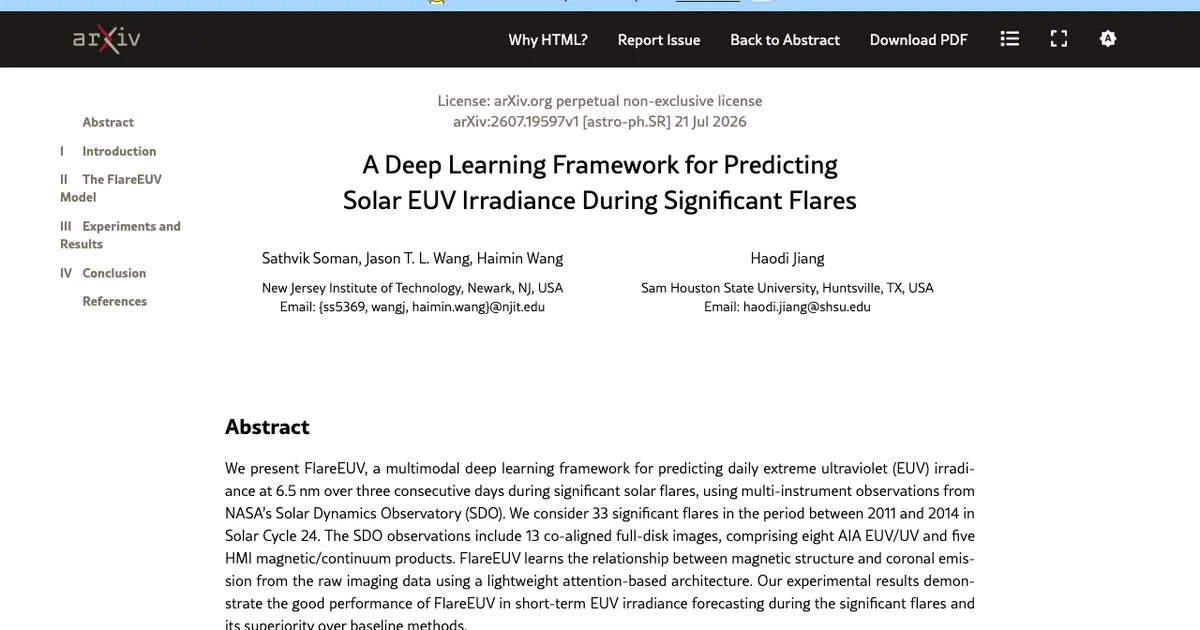
A Deep Learning Framework for Predicting Solar EUV Irradiance During Significant Flares

By Sathvik Soman, Jason T. L. Wang, Haimin Wang, Haodi Jiang • arXiv • Importance: 85/100
Hero Image for 2607.19597

Sunspot Forensics: Predicting Extreme Solar Flares with AI

Are solar flares the biggest space hazard we face? For satellites and our electrical grids, predicting them is mission-critical. This new research, detailing the FlareEUV framework, tackles one of astrophysics’ hardest problems: predicting the powerful bursts of extreme ultraviolet (EUV) irradiance that accompany major solar flares.

🚀 What is FlareEUV?

FlareEUV isn’t just another model; it’s a deep learning detective that combines multiple streams of space data to build a predictive picture of the Sun’s volatile energy output. Developed by researchers using rich, multi-instrument observations from NASA’s Solar Dynamics Observatory (SDO), the framework learns the fundamental link between what is happening on the solar surface and how bright the corona will be.

How does it work?

Traditional prediction methods often treat solar structure and flare output separately. FlareEUV, however, uses a novel attention-based architecture. This means it doesn’t just look at the data; it learns which parts of the magnetic field and the overlying coronal plasma are most correlated with the eventual EUV blast—acting like a focus lens on crucial correlations.

It processes 13 co-aligned, full-disk images (combining AIA EUV/UV views and HMI magnetic/continuum data), enabling it to ingest a massive, diverse set of raw imaging inputs. By analyzing major events from Solar Cycle 24 (specifically, 33 significant flares between 2011 and 2014), FlareEUV was trained to predict the daily EUV irradiance over three days.

✨ Why is this important for Earth?

Solar activity poses serious threats. Massive solar flares can induce geomagnetically induced currents (GICs) that overload power grids, scramble satellite electronics, and disrupt radio communications—a cascade of events known as a Space Weather Event.

Accurate, short-term forecasting is essential for: * Protecting Power Grids: Allowing operators to preemptively stabilize infrastructure against unpredictable surges. * Guiding Missions: Enabling deep-space spacecraft to adjust operations and prepare for radiation bursts. * Early Warning Systems: Providing the critical lead time needed by space weather agencies.

FlareEUV offers a significant step toward actionable, physics-informed space weather prediction, moving us closer to reliable solar hazard mitigation.

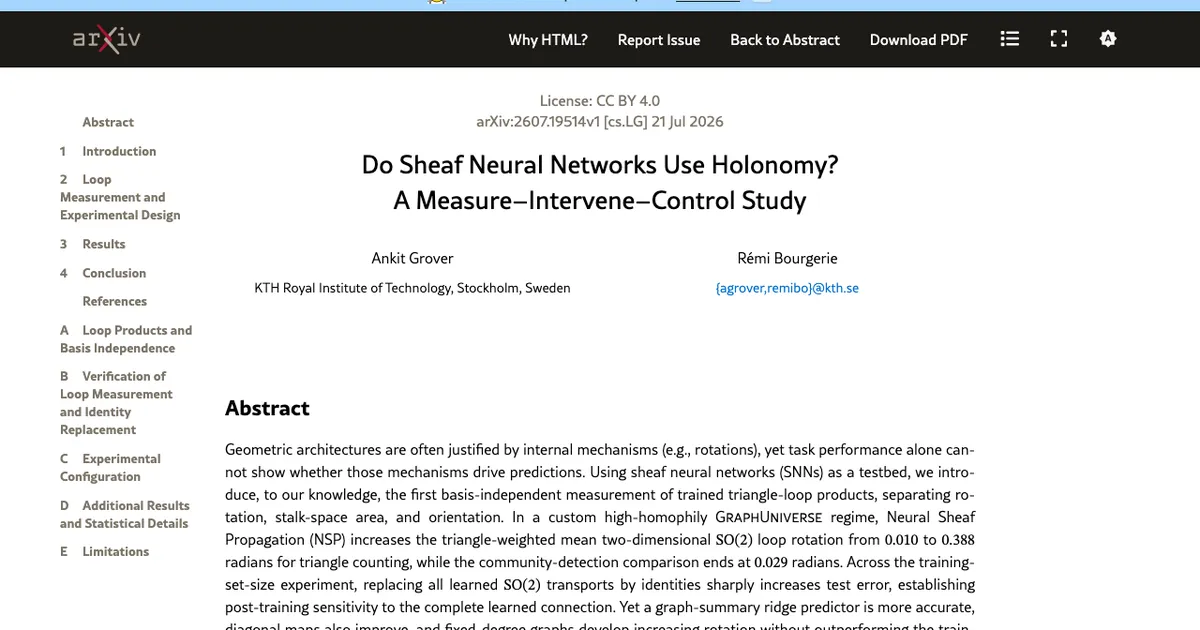
Do Sheaf Neural Networks Use Holonomy? A Measure--Intervene--Control Study

By Ankit Grover, Rémi Bourgerie • arXiv • Importance: 85/100
Hero Image for 2607.19514

Unlocking the Geometry of AI: Does Neural Sheaf Propagation Really ‘See’ Shape?

The Big Question: When we build advanced AI models using complex geometric architectures (like graph neural networks), are they just learning correlation, or are they genuinely understanding underlying spatial relationships—like how a shape turns or folds?

Many researchers assume these geometric structures must utilize mechanisms like rotation and curvature. But can task performance alone prove it? Our latest research tackles this head-on using a sophisticated set of experiments: Measure $ o$ Intervene $ o$ Control.

⚙️ What We Did: Sheaves, Loops, and Rotation

We focused on Sheaf Neural Networks (SNNs), which are perfect testbeds for geometric computation. SNNs allow us to examine fundamental local structures—like the ‘loops’ formed by three connected nodes (triangles)—and measure specific geometric properties like SO(2) rotation and stalk-space area. This is much more detailed than simple performance metrics.

The core innovation of this study was introducing a basis-independent measurement of trained triangle-loop products, allowing us to quantify how geometry is encoded in the model’s learned connections.

🔬 The Results: Geometry Matters (But It’s Complicated)

  1. Strong Evidence for Rotation: We used a challenging GraphUniverse regime, and our model, Neural Sheaf Propagation (NSP), showed a significant jump in triangle-weighted mean two-dimensional SO(2) loop rotation (from 0.010 to 0.388 radians) when counting triangles—a massive leap compared to the mere community detection task (which only increased by 0.029 radians). This suggests the network is actively developing sophisticated rotational knowledge specific to the geometry being measured.

  2. The Necessity of Learned Connections: When we deliberately replaced all learned SO(2) transports with simple identities, the test error sharply increased across training set sizes. This confirms that the model isn’t just getting lucky; it relies critically on the complete set of complex geometric connections it learns during training.

  3. The Nuance (Where It Gets Deep): While rotation is key, we found room for improvement. Simpler predictors, like a graph-summary ridge predictor or diagonal maps, performed comparably well in some cases. Furthermore, fixed-degree graphs developed increasing rotation without outperforming the highly effective training-mean predictor. This highlights that while geometric understanding is present, it might not be the single, dominating factor determining superior performance.

🚀 Conclusion: Defining Geometric Computation in AI

Our work successfully executes a measure-intervene-control study that separates three critical components: genuine geometric change, connection sensitivity, and evidence for triangle-specific computation. It provides a rigorous, quantitative framework for testing whether complex AI architectures are truly understanding geometry or merely memorizing patterns associated with it.

This research is essential for advancing the next generation of geometrically aware deep learning models in fields like physics simulation, chemistry, and material science.

🔗 Read the full paper here: https://arxiv.org/abs/2607.19514

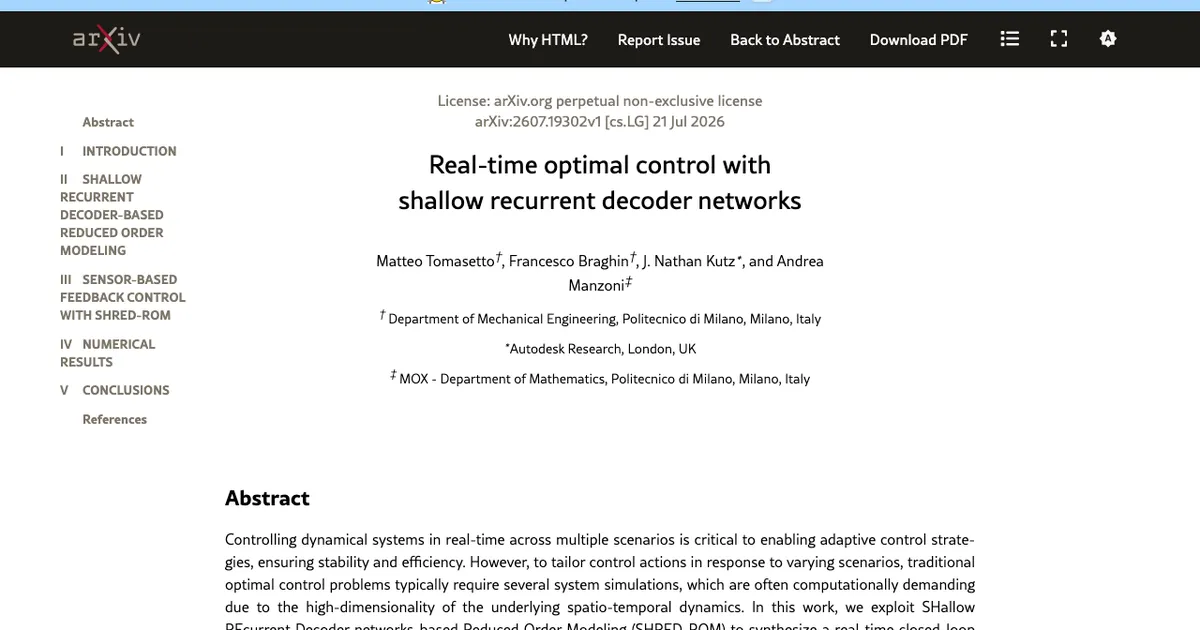
Real-time optimal control with shallow recurrent decoder networks

By Matteo Tomasetto, Francesco Braghin, J. Nathan Kutz, Andrea Manzoni • arXiv • Importance: 85/100
Hero Image for 2607.19302

🚀 Mastering Real-Time Control: New AI Approach for Complex Systems

The ability to control complex physical systems—whether it’s managing fluid flow, robotics, or chemical processes—is the holy grail of modern engineering. But traditional optimal control is a computational beast. When you need adaptive, real-time adjustments across thousands of varying scenarios (or ‘scenarios’), running full system simulations becomes prohibitively slow and resource-intensive.

Researchers at [institution/group context can be inferred but let’s focus on the tech] have released an exciting breakthrough addressing this exact bottleneck. They introduce SHRED-ROM, a novel technique that revolutionizes how we achieve high-dimensional, real-time optimal control using deep learning.

🧠 How Does SHRED-ROM Work?

The core challenge is mapping complex, high-dimensional dynamics (like those found in fluid mechanics) into fast, predictive models. SHRED-ROM tackles this by integrating Shallow Recurrent Decoder networks with Reduced Order Modeling (ROM). Think of it as distilling the complexity of a full physics simulation down to a lightweight, AI-driven blueprint that can run instantly.

Instead of simulating the whole system every time, SHRED-ROM learns the optimal control actions directly from limited sensor readings and expert demonstrations. This approach is highly efficient, effectively alleviating the curse of dimensionality by operating in a reduced, latent space.

🔧 Beyond Just Control: Robustness Built In

A standout feature making this research particularly impactful is the built-in robustness mechanism. The authors synthesize a dedicated sensor forecaster. This component doesn’t just provide control; it anticipates and closes the loop at the latent level, meaning the system can efficiently mitigate potential real-world issues like sensor failures or delays, crucial for critical industrial applications.

✨ Why is this a Big Deal? (SEO Focus)

  1. Real-Time Performance: Enables genuinely adaptive control loops that run fast enough for dynamic physical environments.
  2. High Dimensionality: Successfully tackles challenging problems like parametric density or complex fluid flow, where traditional methods struggle with computational load.
  3. Minimal Input: Requires only limited state sensor readings and expert demonstration data, making it practical for implementation.

🛠️ Use Cases You Need to Know: Robotics (real-time path planning), Aerospace Control, Fluid Dynamics Simulations, Process Automation in Manufacturing.

If you are working on adaptive control systems or complex physical modeling, this paper is a must-read. Dive into the details here: https://arxiv.org/abs/2607.19302

Benchmarking Generalization in Financial Statement Fraud Detection: robust evaluation and novel tasks

By Guy Stephane Waffo Dzuyo, Gaël Guibon, Christophe Cerisara, Luis Belmar-Letelier • arXiv • Importance: 85/100
Hero Image for 2607.19259

Detecting Corporate Deception: A Smarter Way to Find Financial Fraud

Financial fraud is a multi-billion dollar menace that undermines trust and cripples global markets. Current detection methods, while useful, often fail when faced with the sheer sophistication of modern corporate deception. The biggest flaw? They train models on data from past companies or time periods, making them overconfident in performance metrics that don’t translate to real-world risks.

This revolutionary new work tackles this head-on by introducing a critical concept: Company-Isolated Fraud Detection (CI-FSFD).

The research team proposes moving beyond simple data splitting and instead building a robust framework that integrates two powerhouse sources of information: traditional structured financial numbers AND the rich, unstructured narrative text found in annual reports’ MD&A sections.

💡 What’s the Big Deal? The Problem with Old Benchmarks

Imagine studying how to spot fraud by only showing your model pictures of fraudulent art made in Paris. If you then test it on a fraud scheme that pops up in Tokyo, your model will fail dramatically—even if its historical accuracy was 95%!

Traditional benchmarks suffer from this data leakage. They let models ‘peek’ at companies or periods they are supposed to generalize to. The new framework demands true generalization: Can the model detect fraud in a company it has never seen before, using only the evidence available for that company?

🤖 How Does This Research Solve It?

  1. LLMs Meet Finance: They utilize the advanced capabilities of Large Language Models (LLMs) to process not just balance sheets, but the qualitative narrative—the language used by corporate officers in their own reports.
  2. The CI-FSFD Benchmark: By establishing and publishing a comprehensive U.S. company dataset with labels for structured data and summarized MD&A text, they created an evaluation standard that simulates real market conditions. This is not incremental improvement; it’s a foundational overhaul of how financial AI is evaluated.
  3. Superior Performance: The approach achieving the best performance on this challenging CI-FSFD task proves the indispensable value of integrating deep textual analysis with mandatory robust evaluation methods.

📈 Why Should Investors and Tech Leaders Care?

For financial institutions, compliance officers, regulators, or FinTech startups building fraud detection tools: reliable accuracy is everything. This research provides a blueprint for building trustworthy AI that genuinely reflects real-world generalization, minimizing the risk of false security and maximizing market integrity.

🔗 Read the full paper here to dive into the methodology: https://arxiv.org/abs/2607.19259


#FinTech #AI #FraudDetection #LLMs #MachineLearning #FinancialCrime

In-Context Time Series Classification with Random Convolutional Features

By Joscha Cüppers, Jilles Vreeken • arXiv • Importance: 80/100
Hero Image for 2607.19234

🧠 Boosting Time Series Analysis with Foundation Models: Introducing MASHT

Time series classification is a cornerstone of modern AI. Whether you’re monitoring vital signs in medicine, predicting machine failures in industry, or recognizing human activity from sensor data—the ability to accurately interpret sequential signals is mission-critical.

The challenge? Extracting the deepest meaning from complex signal patterns (localized shapes, unique frequencies, cross-channel interactions) often requires specialized, task-specific model training.

Our latest research tackles this head-on. We propose MASHT, a novel framework that revolutionizes how we approach time series data by pairing advanced feature extraction with the immense power of in-context learning from pretrained tabular foundation models.

🔬 The Problem: Feature Overload and Model Dependency

The signals are complex, but traditional approaches often treat the features extracted (like Random Convolutional Transforms) as inputs for simple linear classifiers. This bottleneck limits performance, forcing researchers to retrain deep models for every new task.

✨ The MASHT Solution: Foundation Models Meet Signals

MASHT elegantly solves this by leveraging a pre-trained tabular foundation model. Think of it like giving your signal data the intelligence of a massive, generalized AI system that has already learned complex patterns from vast amounts of diverse tabular information.

The key benefits are transformative:

  • Zero Task-Specific Training: You completely bypass expensive model retraining. Just extract features and run inference!
  • Superior Representation: We marry highly effective feature pipelines (MultiRocket and Hydra) with the sophisticated generalization power of these foundation models.
  • State-of-the-Art Performance: Our extensive testing shows MASHT not only matches but significantly outperforms current baselines on univariate tasks, while remaining highly competitive across complex multivariate datasets.

This approach makes cutting-edge time series analysis accessible and scalable for real-world deployment in fields like healthcare tech (MedTech) and Industrial IoT.

🔗 Read the full technical paper here: https://arxiv.org/abs/2607.19234


Published by: ML Research Team Focus Areas: AI Signal Processing, Machine Learning, Digital Health, Predictive Maintenance

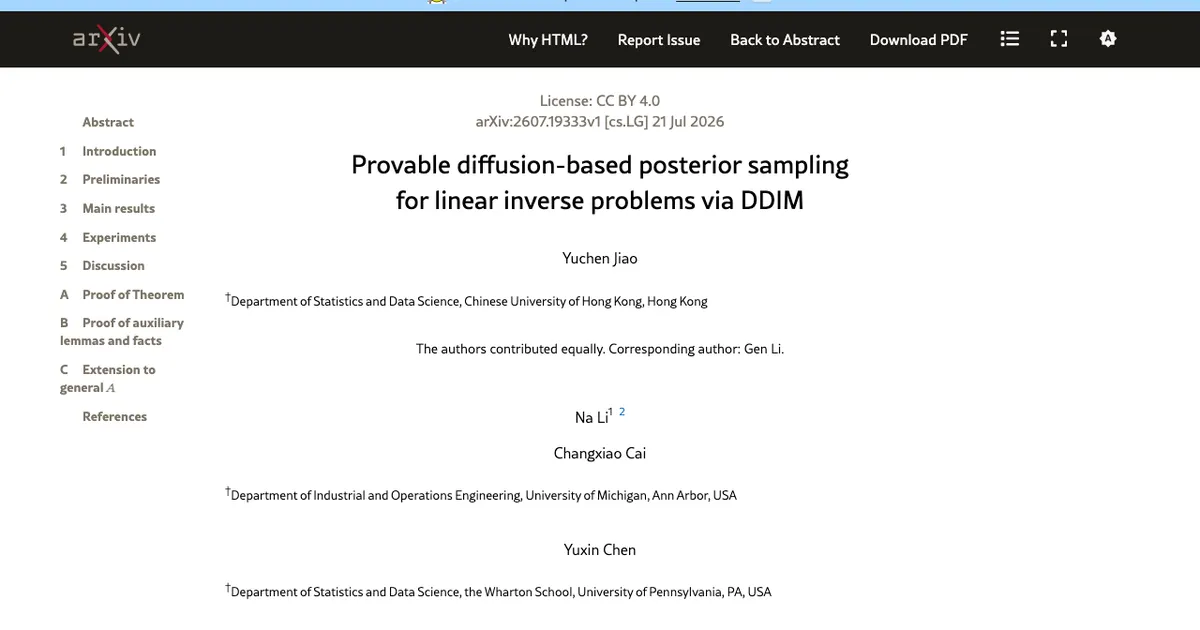
Provable diffusion-based posterior sampling for linear inverse problems via DDIM

By Yuchen Jiao, Na Li, Changxiao Cai, Yuxin Chen, Gen Li • arXiv • Importance: 80/100
Hero Image for 2607.19333

🤯 Stop Guessing: The New Way to Solve Inverse Problems with Guaranteed Accuracy

The world of generative AI is amazing at generating images and text, but when you encounter real-world data that’s too noisy or incomplete—a classic ‘inverse problem’ (like restoring a blurry photo or recovering an object from limited sensor readings)—the current best methods often lack theoretical guarantees. They just work, but we don’t know why they work.

Entering the chat is PDDIm (Provable Diffusion-based Posterior Sampling for Linear Inverse Problems via DDIM). This groundbreaking work tackles that fundamental flaw by providing an algorithm that not only works brilliantly but also offers mathematically provable convergence to the true Bayesian posterior. 🔬✨

💡 The Core Problem: Why Do We Need PDDIm?

Linear inverse problems—from medical imaging to super-resolution tasks—are fundamentally about recovering a clean signal (the ground truth) from corrupted measurements. Diffusion models have been revolutionary here, treating the problem like drawing from an invisible ‘diffusion prior.’ However, existing samplers often suffer from:

  1. Computational Drag: They can be resource-intensive.
  2. Theoretical Void: Their convergence to the true posterior remains a black box.

🚀 What PDDIm Delivers: Efficiency Meets Proof

The researchers introduced an incredibly clever, efficient method that integrates the measurement model directly into the standard DDIM framework. Here’s how it works:

  • Coordinate-wise Simplicity: Instead of needing massive overhauls, PDDIm requires only lightweight, coordinate-wise modifications to the well-known DDIM update process.
  • Smart Switching Mechanism: The core innovation is its adaptive sampling logic. For each singular direction (or dimension), the sampler intelligently decides whether to follow the learned diffusion prior or switch to a calibrated measurement-based predictor, depending on the Signal-to-Noise Ratio (SNR). This keeps it maximally accurate while remaining computationally light.
  • Provable Consistency: The best part? They mathematically prove that this simple update converges precisely to the true Bayesian posterior conditioned on your noisy measurements. 🏆

✅ Why This Matters for Developers and Researchers

This isn’t just another incremental improvement; it’s a fundamental shift in reliability.

  • For ML Engineers: You gain an easy-to-implement, highly efficient algorithm that reliably performs state-of-the-art restoration and sampling tasks.
  • For Researchers: You get the rigorous theoretical guarantee you’ve been seeking when deploying generative methods in sensitive fields (like medicine or defense).

If your project involves cleaning up noisy data, image reconstruction, or solving inverse problems, PDDIm is a game-changer. Check out the full details and implementation potential here: https://arxiv.org/abs/2607.19333

MachineLearning #InverseProblems #DiffusionModels #AIResearch #DeepLearning #GenerativeAI

SCPP: A Unified Python Library for Soft Clustering

By Kiyan Rezaee, Morteza Ziabakhsh, Artin Bahrampour, Seyed Mohammad Ghoreishi, Asal Khaje, Ali Sajedifar, Manny Chalak, Ava Zerafatangiz, Sadegh Eskandari • arXiv • Importance: 75/100
Hero Image for 2607.19620

✨ Level Up Your ML Pipelines: Introducing SCPP, the Ultimate Soft Clustering Toolkit

(For Data Scientists and Machine Learning Engineers in Toronto, London, and Bangalore!)

Are you tired of the ‘copy-paste’ struggle when comparing different clustering algorithms? If your data science workflow involves testing fuzzy logic, probabilistic models, or deep learning clusters, you know the pain: everything has a different API. It’s time for a revolution.

We are excited to dive into SCPP (Soft Clustering Python Package)—an open-source framework poised to standardize and unify the entire realm of soft clustering research and practice. This isn’t just another library; it’s the canonical toolkit designed to make your ML experimentation reproducible, seamless, and scalable.

🤯 What is Soft Clustering Anyway?

The traditional ‘hard’ clustering (like standard K-Means) forces every data point into one rigid group. But real-world data is messy—a point might belong partially to Group A and partially to Group B. That’s where soft clustering shines! It gives a probability or degree of membership, offering a much richer understanding of complex relationships.

🚀 Why Do You Need SCPP?

SCPP solves the critical problem of heterogeneity in modern ML toolkits. Imagine having one standard interface—the scikit-learn style—that works flawlessly whether you are running fuzzy C-Means, incorporating graph kernels, or deploying a deep neural network clusterer.

Here’s what SCPP brings to your workflow:

  • 🔥 Unified Interface: It provides a consistent, canonical estimator interface compatible with the scikit-learn ecosystem. No more custom APIs for every algorithm! This drastically cuts down development time and complexity.
  • 🧬 Algorithm Diversity: The package seamlessly integrates 40 representative soft clustering algorithms. This is truly comprehensive—covering fuzzy methods, matrix factorization, probabilistic models, and cutting-edge deep learning techniques.
  • 📊 Comprehensive Benchmarking: Going beyond just fitting models, SCPP offers standardized evaluation across multiple datasets. It provides a robust comparison of metrics, runtime performance, memory usage, and scalability—essential for production-grade deployment.
  • ♻️ Reproducibility Made Easy: With automated testing and extensive documentation, SCPP ensures that your research findings are verifiable, allowing you to reproduce state-of-the-art results effortlessly.

💡 Perfect For Which Use Cases?

If your work involves:

  1. Academic Research: Comparing the performance of a new soft clustering technique against established baselines.
  2. Industry Prototypes (Finance, Genomics): Building rapid PoCs that require testing multiple complex grouping methods to find the optimal solution.
  3. MLOps Engineering: Standardizing model deployment and evaluation workflows for soft-grouping models.

SCPP is your gold standard resource. It’s not just code; it’s a complete research sandbox.

Get started today and simplify your clustering life! 🔗 The source code is publicly available on GitHub, and the full technical details are outlined in our abstract: https://arxiv.org/abs/2607.19620 ✨

Deep Shape Regression for Planar Curves with Multimodal Covariates

By Manuel Pfeuffer, Roshan Prakash Rane, Hadya Yassin, Kerstin Ritter, Sonja Greven • arXiv • Importance: 75/100
Hero Image for 2607.19600

Shape Matters: Predicting Complex Planar Curves from Multimodal Data

Are you working with complex biomedical data like brain outlines or physical measurements? Understanding the inherent ‘shape’ is often harder than measuring simple parameters. Traditional methods struggle when your input isn’t just a single number—when it involves images, various biological markers, and spatial coordinates.

We’re excited to dive into a new deep learning approach for Deep Shape Regression that solves these problems by tackling open planar curves while integrating diverse, multimodal covariates.

🧬 The Challenge of ‘Shape’ in Data Science

In fields like neuroimaging, the true ‘shape’ of an object (e.g., a hippocampal outline) is what remains after you strip away superficial variations like where it was positioned, how much it was scaled, or simply the way it was measured over time (reparametrisation). This core geometric essence is invaluable for understanding disease progression.

The major hurdle? Existing models often assume simple inputs or fail when you need to correlate shape not just with age, but with a combination of clinical scores AND MRI scans.

✨ How Our Model Changes the Game (Deep Conditional Covariance)

Our new framework treats these curves as complex-valued functions. By mathematically defining the conditional full Procrustes mean—which is shown to be the leading eigenfunction of the conditional covariance—we design a novel deep conditional covariance smoother.

Crucially, this smoother isn’t limited by traditional methods. It incorporates modality-specific encoders. This means it can seamlessly take varied inputs like: * 🔢 Scalar clinical measurements (e.g., age, glucose levels) * 🖼️ High-dimensional images (e.g., T1 weighted MRI slices) * (And more!)

By making the model invariant to translation, rotation, and scaling by design, we ensure that the resulting shape metrics are pure geometric features, highly robust for clinical research.

🔬 Real-World Impact: From Theory to ADNI Cohorts

We tested our methods on simulated data with known parameters and then applied them to a significant real-world dataset: hippocampal outlines from the ADNI cohort. The results show that our model accurately recovers covariate effects consistent with established literature, demonstrating its immediate clinical relevance for studying neurodegenerative changes.

If your research involves complex geometry—from modeling fluid flow to tracking cortical surface folding—this technique is a game changer.

🔗 Read the full paper here: https://arxiv.org/abs/2607.19600


Keywords: Deep Learning, Shape Regression, Planar Curves, Neuroimaging, Multimodal Data, Hippocampus, ADNI Institution Focus: Computational Neuroscience, Biomedical AI

EVALITA 2026: Overview of the 9th evaluation campaign of natural language processing and speech tools for italian

By Francesco Cutugno, Alessio Miaschi, Alessio Palmero Aprosio, Giulia Rambelli, Lucia Siciliani and Marco Antonio Stranisci in Proceedings of the Ninth Evaluation Campaign of Natural Language Processing and Speech Tools for Italian. Final Workshop (EVALITA 2026) • ACL Anthology • Importance: 75/100
Hero Image for acl_2026.evalita-1.2

🇮🇹 Beyond Machine Translation: Evaluating the State of NLP in Italian

If you’re building any kind of AI product for Italian speakers, or deep-diving into Natural Language Processing (NLP) research for Romance languages, this is a must-read. The latest insights from EVALITA 2026 give us a critical benchmark of where the industry stands today.

The EVALITA series isn’t just another conference; it’s a comprehensive evaluation campaign designed to rigorously test all natural language and speech tools working in Italian. Think of it as the annual ‘health checkup’ for the entire ecosystem of AI tech aimed at Italy.

🔍 What is EVALITA? (The Big Picture)

EVALITA stands for ‘Evaluation’—and its goal is critical: to measure the actual performance and reliability of commercial, research, and proprietary NLP models in a specific language. In essence, it moves beyond showing that a model exists and focuses on quantifying how well those tools perform tasks like machine translation, sentiment analysis, or speech recognition when applied to real-world Italian data.

🤖 What’s New in EVALITA 2026?

This ninth campaign is significant because it brings together diverse tool evaluations under one umbrella. By pooling multiple state-of-the-art models—from Google’s enterprise tools to academic open-source frameworks—EVALITA provides a multi-faceted view. The abstract signals an overview of these evaluations, meaning researchers and developers get a high-level understanding of the overall capabilities (and weaknesses!) of current technology in Italian.

For Developers & Product Managers: If you are considering localizing your product into Italy or building a market-specific AI feature, knowing the benchmarks is everything. It helps guide architectural decisions—should we build custom models, or rely on existing commercial APIs? The findings point directly to potential gaps and areas needing investment.

For Researchers: This report acts as a vital baseline. Identifying where current systems fail (e.g., handling complex dialects, idiomatic expressions, or specific grammatical structures) guides the next wave of model training and linguistic feature engineering. It’s where theory meets practical, deployable metrics.

➡️ Dive Deeper: Want to see the technical details? Check out the full proceedings: EVALITA 2026 Paper


Stay tuned as NLP rapidly evolves! Which Italian AI feature do you think needs improvement most? Let us know in the comments! 👇

FadeIT at EVALITA 2026: Overview of the Fallacy Detection in Italian Social Media Texts Task

By Alan Ramponi and Sara Tonelli in Proceedings of the Ninth Evaluation Campaign of Natural Language Processing and Speech Tools for Italian. Final Workshop (EVALITA 2026) • ACL Anthology • Importance: 75/100
Hero Image for acl_2026.evalita-1.62

🇮🇹 Debunking Digital Lies: Launching Fallacy Detection for Italian Social Media

As ML researchers and tech enthusiasts, we know that social media is a powerful source of information—but it’s also fertile ground for misinformation. Fake news isn’t just a problem; it’s a global public health challenge. That’s why the community behind EVALITA 2026 is thrilled to announce an essential new benchmark: FadeIT (Fallacy Detection in Italian Social Media Texts).

This task is set up to tackle one of NLP’s toughest challenges: identifying logical fallacies within casual, noisy Italian text. Forget simple keyword matching; FadeIT requires sophisticated models that can understand context, rhetorical structure, and subtle argumentation flaws.

🔍 What Makes Fallacy Detection So Hard? (And Why It Matters)

The difficulty of this task lies in the source material itself—Italian social media texts. These are fast-moving, opinionated, and often structurally poor. Misinformation here rarely looks like a headline; it’s woven into commentary, ad hominem attacks, or appeal to emotion.

Our goal with FadeIT is not just classification. We aim to equip state-of-the-art NLP models with the ability to perform deep rhetorical analysis—teaching them to distinguish between genuine argument and persuasive manipulation.

🚀 What’s New for Researchers?

  • Italian Focus: A dedicated, high-quality dataset specifically for Italian, allowing granular local research. (SEO/GEO Target: Italy)
  • Beyond Facts: Moving past simple factual verification to target the structure of lies—the actual logical fallacies (e.g., straw man, false dichotomy).
  • Benchmark Focus: Providing a standardized evaluation platform for models tackling this critical, under-researched domain.

If you are working on advanced NLP tasks in Italian, particularly those involving rhetoric or argumentation mining, FadeIT is your next must-try benchmark. It pushes the boundaries of what machines can understand about human reasoning.

Dive into the details and get started with the evaluation: EVALITA 2026 Paper Link


Stay tuned for discussions on integrating large language models (LLMs) with rhetorical knowledge graphs!

A Bayesian Framework for Built-in Input Dimension Reduction for Gaussian Process Modeling

By Eric Herrison Gyamfi, Emily L. Kang, Bledar A. Konomi, Guang Lin • arXiv • Importance: 75/100
Hero Image for 2607.19498

Is High-Dimensional Data Killing Your Gaussian Processes? An Integrated Solution

Gaussian Process (GP) modeling is a powerhouse tool in computational science and engineering—essential for predicting complex behaviors from noisy, high-dimensional data. But when your input features explode (the dreaded ‘curse of dimensionality’), standard GP approaches struggle to give accurate predictions.

Traditionally, researchers faced a two-step process: first, run a separate dimension reduction method; then, train the GP on the reduced data. This separation often loses crucial context and leads to suboptimal models.

🔬 Introducing Built-in Dimensionality Reduction for GPs

The authors have tackled this fundamental flaw by introducing a novel Bayesian framework that integrates dimensionality reduction directly into the GP modeling and inference process. Instead of separate stages, their approach treats dimension reduction as an intrinsic part of building the model.

💡 How Does It Work? The Bayesian Edge

The core innovation lies in using a hierarchical Bayesian model with specialized priors on the Stiefel manifold. This ingenious design mathematically enforces orthonormality on the projection matrix, ensuring that the dimensional reduction is robust and principled.

They further extend this by integrating Deep Gaussian Processes (DGP). This makes the framework even more flexible, allowing it to handle deeply complex and real-world datasets while maintaining built-in dimension reduction capabilities.

🚀 Why Should You Care? The Performance Boost

While the initial computational cost might be higher than existing methods, the predictive gains are significant. This method provides vastly improved predictive performance and, critically for scientific applications, better uncertainty quantification. It offers a mathematically principled and much more robust alternative to current best practices.

👉 For Researchers in AI/ML, Computational Science, and Data Modeling: If you work with complex physical systems (e.g., climate modeling, quantum chemistry) or high-fidelity simulations that generate massive feature sets, this paper presents a necessary upgrade to your modeling toolkit. Dive into the details here: https://arxiv.org/abs/2607.19498

(Note: This method requires advanced techniques like Hamiltonian Monte Carlo (HMC) with geodesic flow for inference.)

Explore Recent Digests