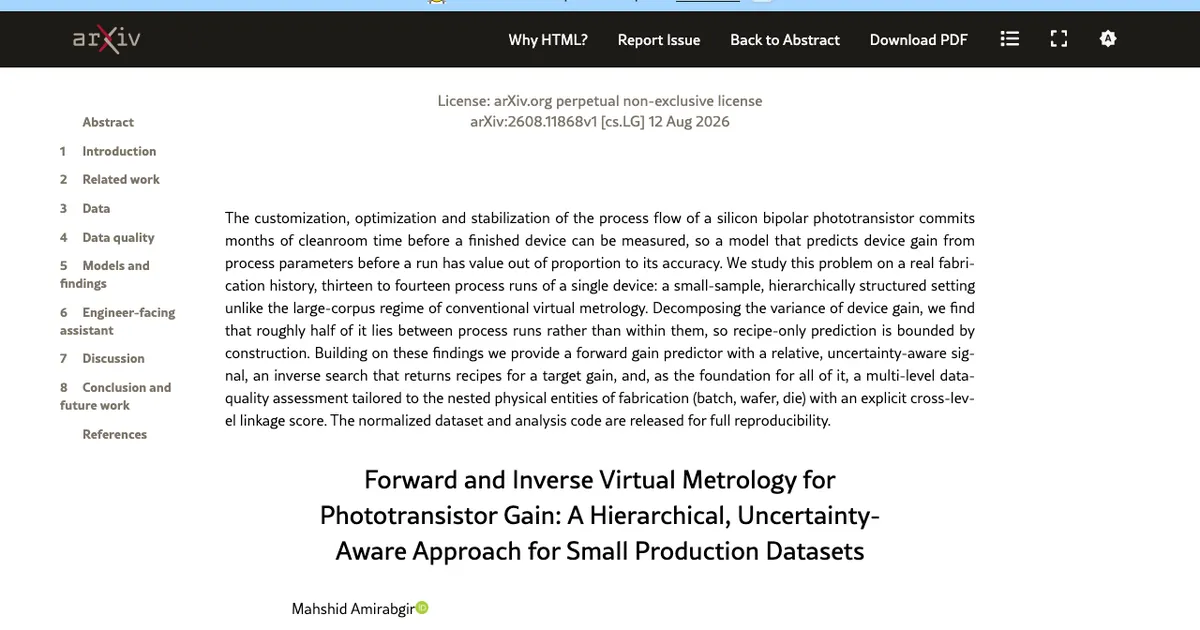
Forward and Inverse Virtual Metrology for Phototransistor Gain: A Hierarchical, Uncertainty-Aware Approach for Small Production Datasets
🚀 Beyond the Cleanroom: Predicting Silicon Phototransistor Performance from Day One
Ever wondered how tiny semiconductor chips achieve their incredible performance? Traditionally, optimizing a phototransistor requires committing weeks (or even months!) of expensive cleanroom time and physical measurements. This is slow, costly, and inefficient.
But what if you could predict its final gain before the device is ever built? 🤔
Researchers Mahshid Amirabgir et al. tackle this exact bottleneck using a cutting-edge blend of advanced machine learning (ML) and deep semiconductor physics. Their work introduces novel Virtual Metrology techniques, specifically tailored for real-world, small-sample manufacturing data.
💡 The Core Problem: Dirty Data & Complex Processes
The authors confront two major challenges: the scarcity of data (they analyze only 13–14 historical process runs) and the complex, nested structure of semiconductor fabrication. Standard ML models often fail spectacularly on this kind of ‘dirty,’ hierarchical industrial data.
Their breakthrough is realizing that much of the variation in device performance doesn’t come from minor parameter tweaks within a recipe; it comes from differences between entire process runs. Simply predicting based on existing recipes is inherently limited!
✨ What They Built: A Three-Pronged Solution
To overcome these limitations, they developed a robust framework featuring:
- Uncertainty-Aware Prediction: The model doesn’t just give a single prediction; it provides a measure of confidence (uncertainty) for its gain estimate. This is crucial for engineering reliability.
- Inverse Optimization: Not only can they predict the gain from process parameters (forward problem), but they can reverse-engineer it: given a target gain, what precise recipe adjustments are needed? (The inverse problem).
- Multi-Level Data Quality Assessment: Crucially, they built a hierarchical understanding of fabrication—linking batch $\rightarrow$ wafer $\rightarrow$ die. This linkage score ensures that the model understands which measurements belong together, making it highly reproducible and physically meaningful.
🔬 Why Does This Matter for Industry?
This isn’t just academic ML; this is industrial acceleration. By enabling reliable virtual metrology with limited data, manufacturers can:
- Save Time & Money: Cut out costly physical prototyping cycles.
- Optimize Faster: Rapidly iterate through design space to find optimal phototransistor recipes.
- Improve Reliability: Work with uncertainty quantification, giving engineers a clear risk assessment alongside their predictions.
This study provides a blueprint for tackling complex, high-stakes engineering problems where data is scarce but the need for predictive power is massive.
🔗 Read the full paper and reproducible code here: https://arxiv.org/abs/2608.11868
Key Takeaways for Engineers & Researchers: Virtual Metrology isn’t just about prediction; it’s about understanding the source of variation and building ML models that respect physical data hierarchy. #Semiconductors #MachineLearning #VirtualMetrology #DeepTech