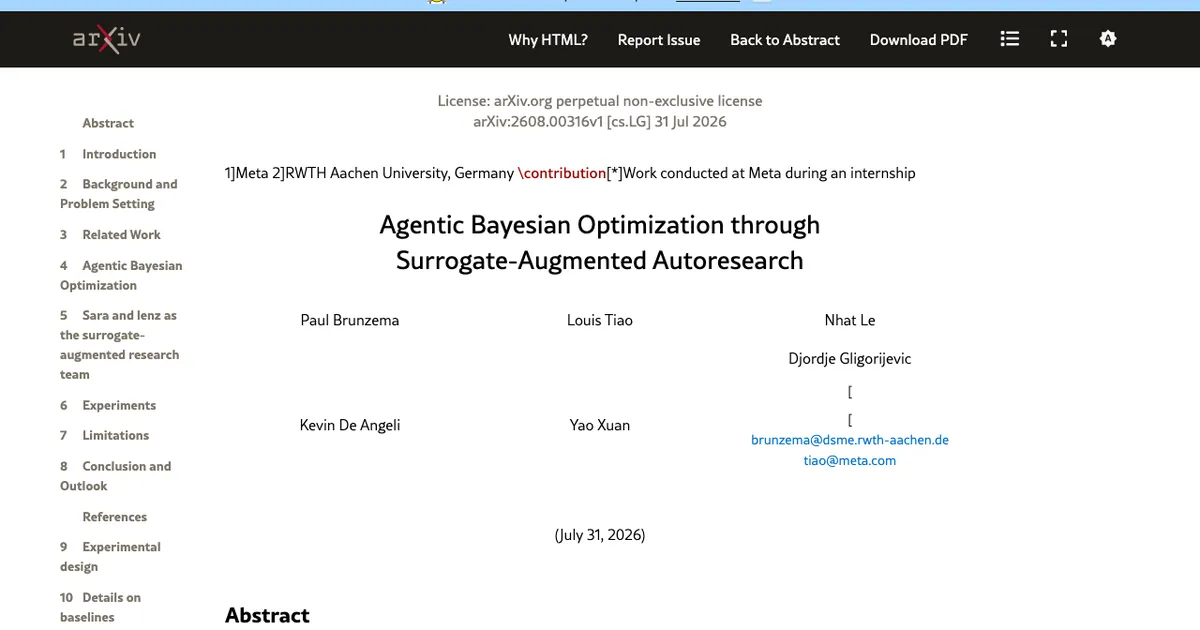
Agentic Bayesian Optimization through Surrogate-Augmented Autoresearch
✨ Meet Sara: The Future of Automated Research is Here (Agentic Bayesian Optimization)
Ever feel like you’re manually tuning a massive ML model, endlessly tweaking hyperparameters and running costly experiments? What if the optimization process could think for itself—interpreting complex goals, adjusting its strategy mid-flight, and adapting when things go wrong?
Welcome to Agentic Bayesian Optimization. This isn’t just an improvement; it’s a paradigm shift in how we automate scientific discovery and hyperparameter tuning.
🧠 The Problem with Traditional Optimization
The gold standard for efficient search is Bayesian Optimization (BO). It’s brilliant because it uses statistics to intelligently guess where the next best experiment should be run, minimizing wasted computational resources. However, traditional BO struggles when you have complex, real-world knowledge—like detailed technical documentation or ambiguous natural language requirements. You can’t just dump a whole manual into a math equation; the system needs context.
Meanwhile, using Large Language Models (LLMs) for optimization has been hit or miss. Either they are stuck in one fixed role (just suggesting parameters), or they are given too much freedom and become unreliable. They lack the systematic rigor BO provides.
🤖 The Breakthrough: Combining Intelligence with Rigor
Nhat Le et al. introduce Sara, an agentic system that bridges this gap. Instead of viewing the LLM as a simple helper, they make it the central decision-maker.
Sara operates in a powerful loop:
- The Agent (LLM): This is the strategic mind. It takes natural language priors ( “We must prioritize low latency for edge devices,” ) and configures the entire problem structure. Crucially, it can revise its own strategy mid-run—tightening bounds, switching acquisition functions, or even reframing the entire optimization goal based on new results.
- The Backend (Bayesian Optimizer): This is the rigorous engine (the ‘brain’ underneath). It provides the fundamental uncertainty-aware mathematics that keeps the process reliable and systematically explores the search space.
By coupling a flexible LLM agent with a robust BO backend, Sara achieves sophisticated optimization previously thought impossible.
🚀 Why This Matters for ML Researchers & Engineers
1. Turbocharge R&D Cycles: Instead of manual grid searches or tedious tuning, your models can enter a truly automated ‘self-optimization’ mode, dramatically speeding up the path from idea to production. 2. Handling Ambiguity: It allows researchers to integrate fuzzy, domain-specific knowledge (like documentation requirements) directly into the math of optimization, a game-changer for real-world ML deployments.3. Dynamic Adaptation: Unlike static systems, Sara can reconfigure the full problem on the fly. If business requirements change halfway through an experiment, the system adapts and optimizes toward the new goal—a capability essential in dynamic product development.
This entire framework is detailed in their paper: https://arxiv.org/abs/2608.00316
🔥 The Takeaway: Agentic BO moves optimization from simply finding good numbers, to systematically solving complex problems defined by natural language and empirical evidence.