Efficient Resource Optimization for Split Federated Learning
🔋 Edge AI Breakthrough: Mastering Resource Optimization in Federated Learning
The next frontier of artificial intelligence isn’t centralized—it’s at the edge. But training powerful models across millions of devices (like your phone or smart sensor) while keeping battery life and network costs low is a monumental challenge. Enter Federated Learning (FL), where models are trained locally and aggregated globally.
A specialized version called Split Federated Learning (SFL) takes this further: it involves strategically splitting the model itself and managing complex resource decisions across various devices. While incredibly powerful, SFL creates a super-hard optimization puzzle involving discrete choices (which part of the model goes where?) and resources (how much energy/bandwidth?).
💡 The Core Problem (The Pain Point)
The academic community struggled with optimizing SFL because these resource allocation decisions are notoriously complex—they turn into massive Mixed-Integer Problems. Existing solutions were often either guesswork (heuristics) or computationally so demanding they couldn’t scale to real-world, large-scale user populations.
🚀 The Solution: A Breakthrough Optimization Framework
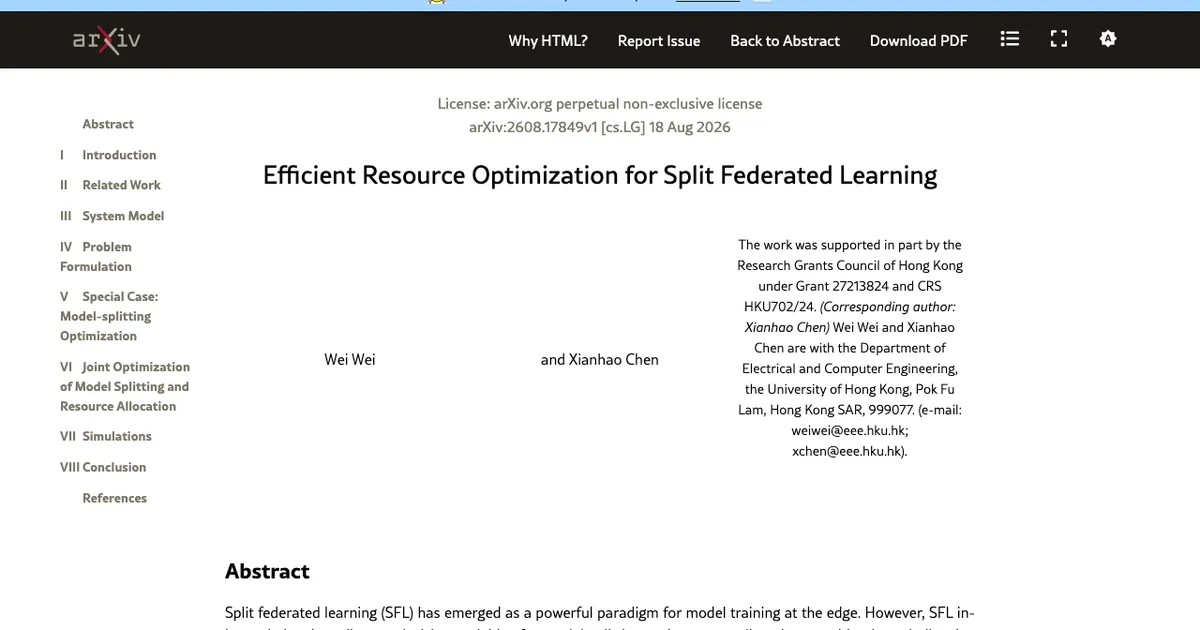
Wei Wei and Xianhao Chen introduce a novel and efficient optimization framework. This breakthrough allows system designers to jointly optimize model splitting and resource allocation simultaneously. Their goal? To minimize the total training cost, defined by minimizing a weighted blend of latency (speed) and energy costs.
What makes this significant?
- Scalability: The framework provides polynomial-time algorithms that can handle massive user bases efficiently, solving a critical limitation of prior work.
- Global Optimality: For the pure model splitting problem, they achieve global optimality. For the full joint problem, they develop an advanced approximation method with a guaranteed $(1+\epsilon)$-approximation, ensuring near-optimal resource use.
- Energy-Latency Tradeoff Mastery: The approach provides system engineers with precise tools to strike the absolute best balance between fast training (low latency) and efficient power usage (low energy).
This paper doesn’t just offer a theoretical fix; it delivers an actionable framework critical for deploying large, resource-constrained AI systems globally.
Want to dive deep into the math? You can check out the full details here: https://arxiv.org/abs/2608.17849
#AI #FederatedLearning #EdgeComputing #Optimization #DeepLearning #MLResearch