← Back to Archive

Digest for 2026-08-28

🐦 Share on X 💼 Share on LinkedIn 📘 Share on Facebook

Advancing Medical Communication: Multilingual, Multicultural, and Multimodal Processing for Translation and Simplification
By Maria Pia Di Buono in Proceedings of the 26th Annual Conference of the European Association for Machine Translation (Volume 2) • ACL Anthology • Importance: 90/100
Hero Image for acl_2026.eamt-2.21

🏥 Bridging the Gap: Making Complex Medicine Accessible to Everyone

In modern healthcare, language is often the biggest barrier. Whether it’s navigating complex diagnostic reports, understanding specialized medical jargon, or communicating across diverse cultural lines—effective communication isn’t just nice-to-have; it’s critical for patient safety and outcomes.

That’s the core mission behind the Multilingual, Multicultural, and Multimodal Medical Language Processing (4MLP) Project. This pioneering work is set to revolutionize how medical information reaches patients globally, ensuring that cutting-edge knowledge translates into genuinely usable, understandable care at the point of need.

💡 What Exactly is 4MLP?

This research tackles the monumental challenge of making global healthcare communication more inclusive and equitable. Instead of just translating words (which standard machine translation does), 4MLP focuses on deeply understanding medical concepts across three critical dimensions:

  1. Multilingual: Supporting accurate communication among dozens of languages, ensuring no patient is left behind due to linguistic barriers.
  2. Multicultural: Recognizing that medical contexts and beliefs vary by culture. The AI must be culturally aware, adapting its explanations and recommendations to resonate with local traditions and health literacy levels.
  3. Multimodal: Processing more than just text. This includes interpreting visual data (like diagrams or charts) alongside spoken language, allowing for a richer, more comprehensive understanding of the medical situation.

🧠 Why is Explainable AI Essential Here?

The project’s focus on explainable and culturally aware Artificial Intelligence is particularly noteworthy. In medicine, simply giving an answer isn’t enough; users (doctors and patients) need to know how the system arrived at that conclusion. 4MLP aims to build trust by providing transparent, auditable explanations of complex medical knowledge.

🌍 Impact & Geographic Relevance: Focus on Europe/Italy

As a project funded by the University of Naples “L’Orientale” (Italy), 4MLP is rooted in addressing European communication challenges while setting global standards. It represents a powerful collaborative effort to advance deep learning for critical public health infrastructure, starting from local academic expertise and scaling up to worldwide impact.

👉 Want to dive deeper into the technical details? The full work can be viewed here: Advancing Medical Communication: Multilingual, Multicultural, and Multimodal Processing for Translation and Simplification


This breakthrough promises a future where complex medical science is packaged into actionable, culturally appropriate, and universally understood health advice.
Beyond Simple Term Injection: Reasoning Models for Legal Translation in a Non-Dominant Language Variety

By Paolo Di Natale, Elena Chiocchetti, Marlies Alber and Egon W. Stemle in Proceedings of the 26th Annual Conference of the European Association for Machine Translation (Volume 1) • ACL Anthology • Importance: 90/100
Hero Image for acl_2026.eamt-1.23

💡 Beyond Glossaries: Why Legal AI Needs Smarter Terminology Models

The era of Large Language Models (LLMs) has dramatically reshaped machine translation. For years, integrating predefined glossaries—or ‘term injection’—was the primary method for handling specialized vocabulary. We thought that simply feeding a model a list of legal terms would solve the problem.

But new research suggests that treating terminology as mere sentence-level insertions is fundamentally limiting. The complexity increases exponentially when you move to challenging, real-world scenarios.

In our latest dive into this topic, we tackled machine translation for specialized legal texts: Italian into South Tyrolean German—a non-dominant and heavily under-resourced language variety. This deep dive goes beyond simple lookups, tackling complex issues like: Abbreviation Localisation: How do you translate localized acronyms? Homonym Disambiguation: When one word has multiple meanings, how does the legal context guide the right choice?

We specifically focused on testing advanced ‘Reasoning Models’ (RMs) against these challenges. The core findings are crucial for developers building specialized AI:

✅ Simple Terms vs. Deep Reasoning: For basic term replacement, complex reasoning models offered little edge over simpler methods. Gains only appeared in semantically rich areas like homonym resolution.

⚠️ The Reality Check (A Cautionary Tale): Critically, human evaluation showed that the performance gains observed via ‘reasoning traces’ might not translate into truly robust or factually grounded translations in practice.

🌐 Resource Scarcity Matters: Most surprisingly, we found that even state-of-the-art reasoning models struggled to find correct terminology without external terminological resources. In contrast, simple Neural Machine Translation (NMT) small models trained on specific legal corpora remained highly competitive.

The Takeaway for NLP Developers:\nBuilding reliable translation systems requires more than just large models; it needs specialized data collection strategies tailored for reasoning and frameworks designed to handle the linguistic diversity of many low-resource languages. Terminology must be viewed not as a simple plug-in, but as an integral part of the model’s contextual knowledge base.

For the deep technical details, check out the full paper: Beyond Simple Term Injection: Reasoning Models for Legal Translation in a Non-Dominant Language Variety

MachineTranslation #LegalTech #NLP #LLMs #AIResearch #LowResourceLanguages

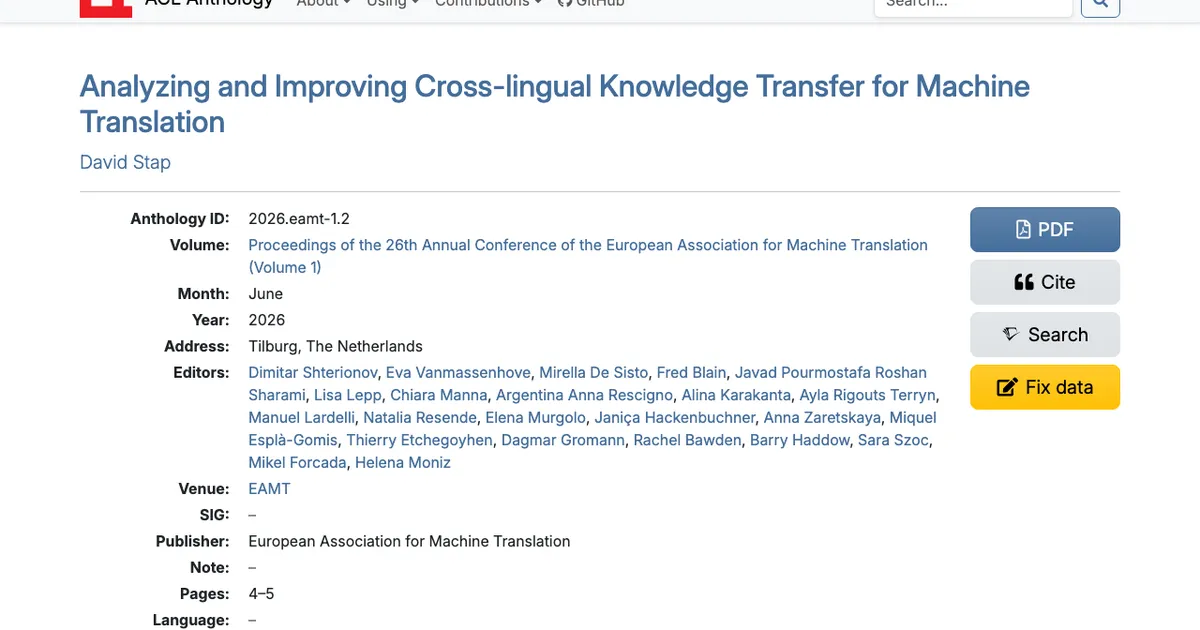
Analyzing and Improving Cross-lingual Knowledge Transfer for Machine Translation

By David Stap in Proceedings of the 26th Annual Conference of the European Association for Machine Translation (Volume 1) • ACL Anthology • Importance: 85/100
Hero Image for acl_2026.eamt-1.2

🌍 Beyond Simple Translation: How AI is Mastering Global Knowledge Transfer

If you’ve ever used Google Translate or DeepL, you know that machine translation has gotten incredibly good. But what if the AI wasn’t just translating words, but transferring deep cultural and contextual knowledge? That’s exactly what this groundbreaking research dives into.

We’re talking about improving Cross-lingual Knowledge Transfer (CLKT)—the ability of a model to use vast knowledge learned in one language (say, English) to perform robust translation or understanding in a completely different, perhaps lower-resource, language (like Swahili or Nepali).

💡 The Core Problem and the Breakthrough Solution

Most translation systems treat languages as isolated containers of words. This research argues that’s not accurate enough. True linguistic intelligence requires models to understand the underlying concepts shared across languages.

This paper introduces sophisticated methods for analyzing and improving CLKT. The goal isn’t just better word-for-word matching; it’s building systems that can infer meaning, context, idioms, and even cultural nuances—knowledge that might not have direct equivalents. By systematically analyzing where knowledge transfer fails, the authors propose architectural improvements to make these models more robust, accurate, and globally applicable.

✨ What Does This Mean for Developers & Businesses?

  1. Global Scale AI: Companies looking to expand into emerging markets (e.g., Africa, Southeast Asia) can use this research to build high-quality translation tools that work even when massive parallel datasets are scarce. This democratizes global communication.
  2. Improved User Experience: For end-users, it means translations that sound natural and convey the intended meaning, rather than literal, stilted machine output. Imagine translating a joke or a complex legal document with perfect contextual accuracy.
  3. Boosting Niche AI Applications: Whether for medical research requiring multi-lingual data synthesis or educational tools reaching underserved populations, better CLKT is foundational.

🛠️ Want to dive into the technical details? This work was presented at EAMT 2026, providing valuable insights for anyone working on NMT (Neural Machine Translation) systems, transfer learning, and low-resource NLP.

What’s your take? Have you noticed AI missing cultural context in translation? Share your thoughts below!


SEO Pro Tip: Focusing on knowledge transfer rather than just ‘translation’ is key. It frames the problem as an intelligence challenge, not a simple data-mapping task.

Audio description between MT translation and recreation: An Interview Study for the Language Pair English-German

By Merle Sauter, Ekaterina Lapshinova-Koltunski and Sylvia Jaki in Proceedings of the 26th Annual Conference of the European Association for Machine Translation (Volume 1) • ACL Anthology • Importance: 75/100
Hero Image for acl_2026.eamt-1.44

Bridging the Sensory Gap: Does Machine Translation Work for Audio Descriptions? (English-German Case Study)

(An Expert Digest from [Blog Name/Your Expertise Domain])

As generative AI and cross-lingual models become standard, we constantly aim to make digital content accessible to everyone. For the visually impaired community, this means perfect audio descriptions (AD). But what happens when you need to translate an AD—especially if it’s generated by a machine?

A recent study tackled this core question head-on, testing whether merely translating the spoken description is sufficient compared to creating a wholly new one. The findings are encouraging, suggesting a viable path forward, but also highlighting critical areas for improvement.

🎧 What’s the Challenge? Why Audio Description Matters

Audio descriptions provide vital context for viewers who are blind or visually impaired, describing visual elements (like gestures, facial expressions, and scene settings) that would otherwise go unnoticed. Traditionally, content creators must write and record new AD in every target language—a massive production hurdle.

The paper explored the shortcut: using machine translation (MT) to adapt existing English descriptions into German, rather than hiring human scriptwriters for each language pair.

🇩🇪 Methodology: Testing Translation on German Users

To evaluate this strategy, researchers conducted a comprehensive interview study in Germany. Blind and visually impaired participants were asked to compare two versions of the audio description:

  1. Machine-Translated AD: The English AD passed through an MT system into German.
  2. Original/Native German AD: A professionally produced German version (used as a baseline for comparison).

The evaluation focused on how well key descriptive elements—such as character actions, specific names, and the overall scene context—were perceived and understood by the participants.

💡 Key Findings: Feasible, But Not Perfect

Overall, the results pointed towards high acceptance of the machine-translated descriptions. This is a significant step, proving that MT translation can indeed handle the nuanced language required for accessibility in cross-lingual settings like English-German.

However, the study also revealed an important caveat: while feasible, participants generally preferred the professionally crafted original German AD. This confirms that human touch and cultural nuance still hold critical weight when dealing with deeply personal experiences of perception.

The Takeaway for ML/Production: Audio Description translation is technically achievable for large-scale deployment and significantly reduces production costs. However, future systems must integrate specialized MT models that are fine-tuned not just on syntax, but on descriptive register and emotional context to close the gap between ‘understandable’ and ‘perfectly immersive.’


🔗 Dive Deeper into the Research: You can read the full details of this interview study and its implications for global accessibility at The 26th Annual Conference of the European Association for Machine Translation (EAMT).

#Accessibility #MachineTranslation #AIAudio #MLResearch #DigitalInclusion #GermanyTech

Automatic translation in public services: A survey of the Finnish public sector

By Sıla Ilkılıç, Maarit Koponen and Mary Nurminen in Proceedings of the 26th Annual Conference of the European Association for Machine Translation (Volume 1) • ACL Anthology • Importance: 75/100
Hero Image for acl_2026.eamt-1.45

Bridging Language Barriers in Public Service: A Deep Dive into Finnish Translation Practices 🇫🇮✨

Ever wondered how public services in Finland manage communication across diverse linguistic needs? Automatic translation (AT) is everywhere, but how reliable is it when you need it most—in a high-stakes setting like government services?

Our latest research digest pulls key insights from a fascinating survey focused specifically on the use of machine translation within Finnish public sectors. While the global conversation often revolves around massive AI models in tech hubs, this study shines a spotlight on the real-world, operational impact of these tools for everyday public servants.

💡 What Did We Find?

The researchers surveyed various non-translation professionals working in the Finnish public sector in late 2025. The findings are highly practical and reveal several key trends:

  • Frequent Usage: A significant portion of respondents reported using automatic translation weekly, spanning a range of professional contexts, including those involving direct public interaction.
  • Everyday Tool: This isn’t just an academic exercise; AT has become embedded in the daily workflow for many employees. It’s a reality that needs understanding and management.
  • Confidence Spectrum: The study touched upon user confidence and satisfaction, suggesting that while these tools are useful, their integration into critical services requires careful consideration of accuracy and reliability.

🛠️ Why Does This Matter to Everyone?

This research moves beyond ‘if’ we should use machine translation and starts asking ‘how’ the existing workforce is adapting. For global companies operating in Finland, policy makers concerned with citizen experience, or even developers building localization tools, these insights are crucial.

The core message is clear: Automatic translation plays a significant operational role in Finnish public service daily life. Understanding the context, purpose, and habit of usage is more important than just knowing the technology exists.

🔗 Read the Full Survey Findings: Automatic Translation in Public Services: A Survey of the Finnish Public Sector

Stay ahead of AI trends! Follow us for more deep dives into ML research and real-world AI implementations.

Explore Recent Digests