← Back to Archive

Digest for 2026-07-28

🐦 Share on X 💼 Share on LinkedIn 📘 Share on Facebook

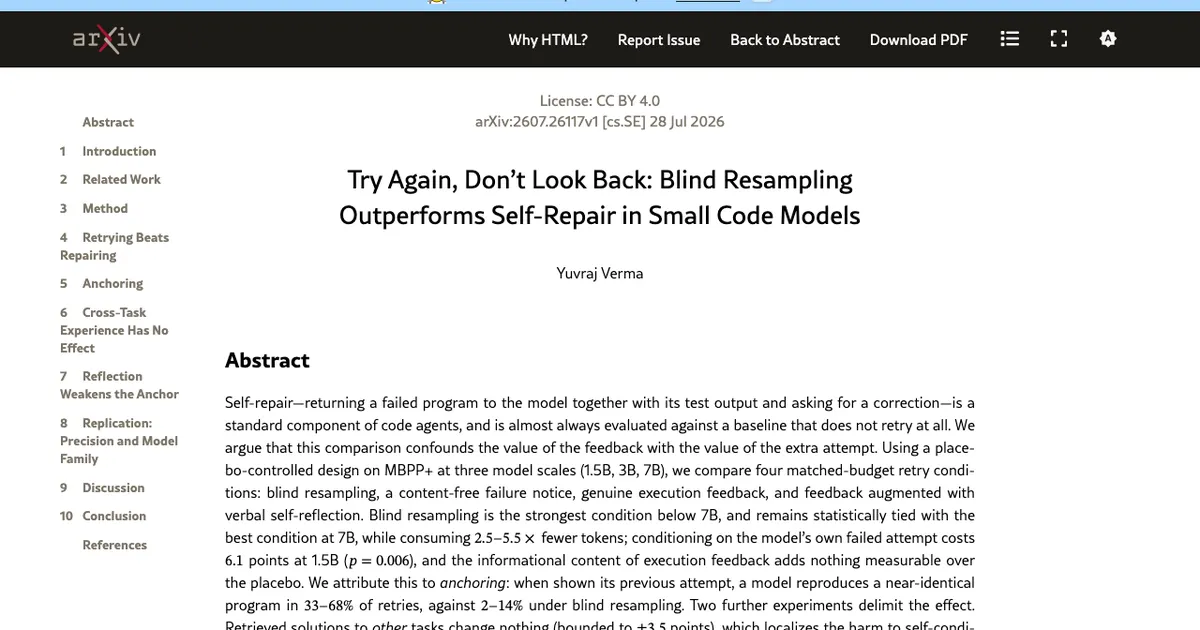
Try Again, Don't Look Back: Blind Resampling Outperforms Self-Repair in Small Code Models
By Yuvraj Verma • arXiv • Importance: 92/100
Hero Image for 2607.26117

🤯 Rethinking Code AI: Why Your Model’s ‘Self-Correction’ Might Be Its Biggest Flaw

If you’re building code agents or experimenting with LLMs for coding tasks, you know the drill: a model writes some code, it fails its tests, and then you feed that failure back to it. This is called self-repair, and it’s often presented as the gold standard for improving AI performance.

But groundbreaking research from Yuvraj Verma challenges this entire paradigm. The study, “Try Again, Don’t Look Back: Blind Resampling Outperforms Self-Repair in Small Code Models” (https://arxiv.org/abs/2607.26117), suggests that forcing a large language model to look at its own mistake—its previous failed code attempt—doesn’t actually help. In fact, it might be detrimental.

📉 The Core Finding: Anchoring and Repetition

The authors implemented a clever, placebo-controlled design comparing four retry methods:

  1. No Retry (Baseline): The standard measure.
  2. Failed Attempt Shown: Showing the model its own failed code/test output (Self-Repair).
  3. Blind Resampling: Giving the model a clean slate—just a general reminder to try again, without showing the failure details.
  4. Verbal Reflection: Augmenting the input with verbal commentary on the failure.

What they found was surprising: When you show the model its own failed attempt (Self-Repair), it tends to get stuck in a loop of near-identical, flawed code (the ‘anchoring’ effect). This repetition is worse than simply failing initially.

Meanwhile, Blind Resampling consistently outperformed the self-repair approach across multiple model sizes and was found to be computationally cheaper and equally effective at scale.

💡 Why Does Self-Reflection Fail? The Science of Anchoring

The paper attributes this failure to ‘anchoring’: when provided with its own previous work, the LLM is psychologically anchored to that initial attempt. Instead of diagnosing a fundamental flaw, it merely tweaks minor parts, failing to grasp the root cause.

Crucially, the study showed that the penalty caused by self-conditioning isn’t just an artifact of the specific task; it’s predictable and related only to the baseline quality of the model itself. The authors even replicated these findings on different models, solidifying the conclusion: the cost of committing to a bad first attempt is significant.

🚀 Takeaways for ML Engineers & Product Teams

If you are optimizing your coding agents, ditch the habit of feeding failed attempts directly back into the prompt. Instead:

  • Embrace Blind Resampling: Treat failure as general feedback, not specific material to repeat. This method is highly effective and token-efficient.
  • Minimize Context Overload: The actual content of the error message often adds nothing measurable beyond a simple ‘failure notice.’ Keep your prompts clean and focused on correction.
  • Plan for Non-Repetitive Retries: When designing failure pipelines, focus less on fixing the previous attempt, and more on encouraging a wholly new line of thought.

This research is a crucial reality check for LLM agents, suggesting that sometimes the most sophisticated feedback mechanism (showing the error) is actually counterproductive. Read the full study here: https://arxiv.org/abs/2607.26117
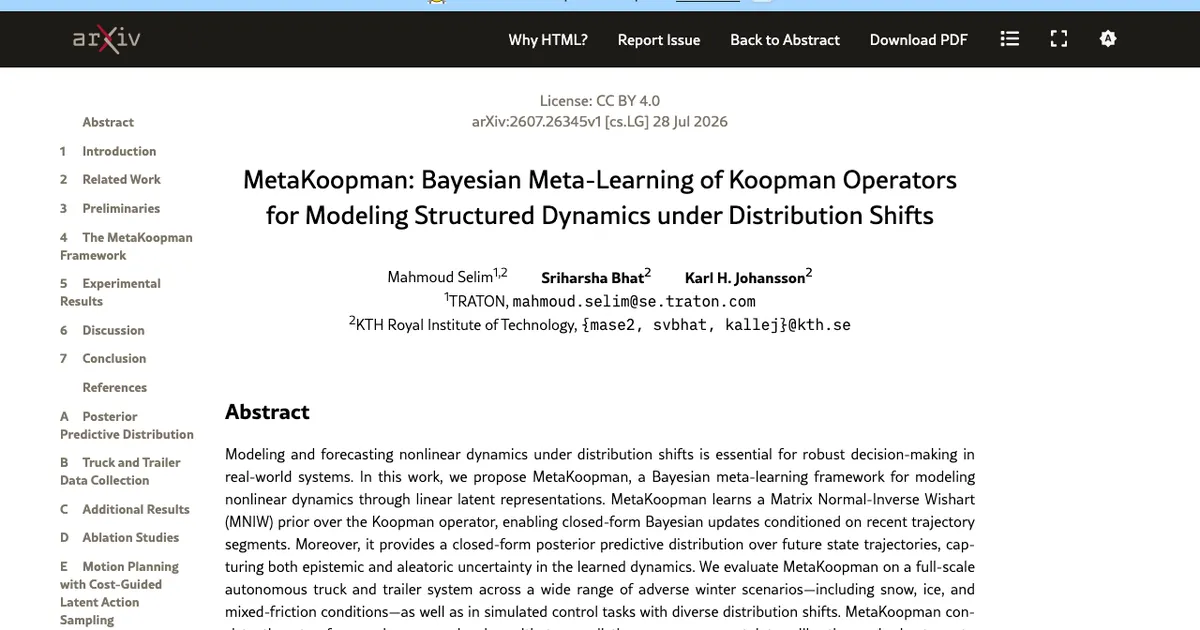
MetaKoopman: Bayesian Meta-Learning of Koopman Operators for Modeling Structured Dynamics under Distribution Shifts

By Mahmoud Selim, Sriharsha Bhat, Karl H. Johansson • arXiv • Importance: 90/100
Hero Image for 2607.26345

❄️ Beyond Training Data: How MetaKoopman Tackles the Chaos of Real-World Dynamics

As ML models move from clean datasets to chaotic real-world environments—think icy roads, unpredictable manufacturing lines, or unstable robotic movements—they often hit a wall. This is known as distribution shift, and it’s the biggest headache in deploying robust AI.

Traditional machine learning excels when the test environment mirrors the training data. But what happens when your autonomous vehicle encounters mixed friction from snow and ice? Or when an industrial robot faces novel, never-before-seen conditions?

Our latest work introduces MetaKoopman, a groundbreaking framework designed to forecast highly nonlinear, complex dynamics even when the underlying system distribution changes dramatically. It brings the mathematical rigor of Bayesian statistics into high-stakes control tasks.

🤯 What is MetaKoopman?

The core challenge in modeling systems like autonomous vehicles or fluid dynamics is that they are inherently non-linear. Simple models fail spectacularly when reality gets complicated.

MetaKoopman elegantly solves this by leveraging the Koopman operator. Essentially, it doesn’t model the messy non-linearity directly; instead, it lifts the system into a higher, linear latent space where the dynamics become tractable and predictable. Think of it as finding the simplest, underlying set of governing equations hidden within chaos.

Crucially, MetaKoopman adds two layers of intelligence:

  1. Meta-Learning: It adapts its understanding rapidly from recent small segments of data (closed-form Bayesian updates). This makes it incredibly fast and adaptive for real-time use.
  2. Bayesian Inference: Instead of giving a single point prediction (which is often dangerously wrong), MetaKoopman provides a full probability distribution over future states. This means you get quantifiable estimates of uncertainty—telling the system how sure it is about its prediction, which is vital for safety-critical systems.

🚚 Real-World Proof: Autonomous Driving Success

The theory isn’t enough; robustness matters. We rigorously tested MetaKoopman on a full-scale autonomous truck and trailer system—a notoriously challenging platform—across a spectrum of adverse winter scenarios, including snow build-up, ice patches, and mixed-friction conditions.

The results speak for themselves: MetaKoopman consistently outperformed existing state-of-the-art methods. It demonstrated superior multi-step prediction accuracy and exceptional performance in dynamically feasible motion planning during critical events like evasive maneuvers at the limits of traction.

This work isn’t just an academic improvement; it represents a significant step toward fielding truly robust, trustworthy AI agents that can operate reliably anywhere, anytime.

🔗 Dive into the technical details: Check out our paper here: https://arxiv.org/abs/2607.26345


Read more about our project: MetaKoopman Project Website

#ML #AIResearch #AutonomousVehicles #ControlTheory #BayesianLearning #DeepMind #Robotics

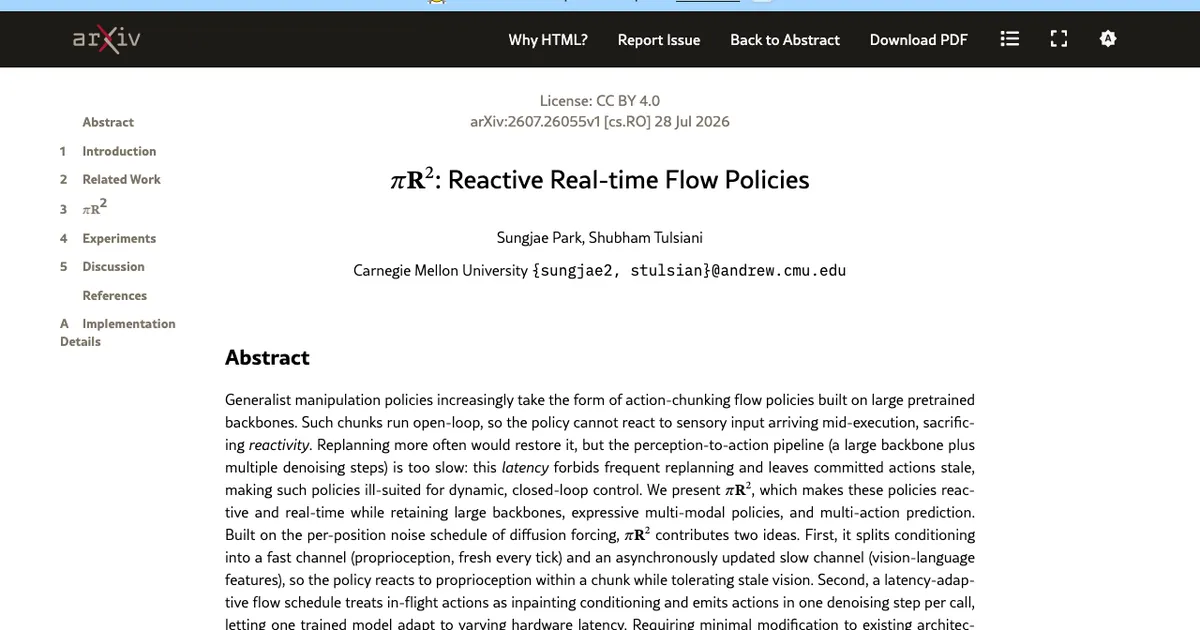
$π\mathbf{R}^2$: Reactive Real-time Flow Policies

By Sungjae Park, Shubham Tulsiani • arXiv • Importance: 90/100
Hero Image for 2607.26055

🚀 Making Robotics React: How $\pi\mathbf{R}^2$ Achieves Real-Time, Open-Loop Control

In the rapidly advancing field of AI robotics, generalist manipulation policies built on massive language models (LLMs) and vision backbones are making incredible strides. But there’s a fundamental challenge they face when interacting with the real world: reactivity.

Most current ‘chunk-based’ flow policies run open-loop—they execute a sequence of actions based on a large initial observation, but critically, they cannot adapt or react to sensory input that arrives mid-execution. This makes them fantastic for planned tasks, but fragile in the messy, dynamic environment of real life.

Furthermore, making them reactive usually means frequent ‘replanning.’ However, the process required (running a large backbone plus multiple diffusion steps) is notoriously slow, leading to crippling latency. Attempting rapid replanning results in actions that are stale, undermining the whole system’s effectiveness.

Introducing $\pi\mathbf{R}^2$: A groundbreaking new framework designed specifically to solve this reactivty vs. latency paradox.

$\pi\mathbf{R}^2$ allows large-scale models to behave as if they were real-time and truly closed-loop, all while maintaining the power of massive pre-trained backbones. It’s not just about speed; it’s about believable, rapid adaptation.

🔬 The Breakthrough Ideas Behind $\pi\mathbf{R}^2$

The authors introduce two elegant, high-impact architectural concepts that fundamentally restructure how planning and execution communicate:

1. Dual-Channel Conditioning (Proprioception Focus): Instead of waiting for slow, rich vision/language inputs to update the policy, $\pi\mathbf{R}^2$ splits conditioning into a fast channel (proprioception—the robot’s joint angles and immediate state) and a slow channel (vision-language features). This brilliant separation means the policy reacts instantly to small changes in joint angle within an action chunk, even if the overall visual understanding of the scene is slightly stale.

2. Latency-Adaptive Flow Scheduling: The second major innovation treats ongoing actions like advanced image inpainting conditioning. By emitting actions in a single denoising step per call, $\pi\mathbf{R}^2$ effectively decouples its performance from the underlying hardware latency, letting one model perform reliably across various computing environments.

📈 Real-World Impact and Performance Gains

These two mechanisms not only restore reactivity but do it at speed. On a physical xArm6+XHand platform, $\pi\mathbf{R}^2$ was tested on GR00T-N1.7 and demonstrated closed-loop replanning up to 4x faster than its base policy (achieving ~25Hz, or an observation update every 40ms).

This speed boost translates directly into task success: * 📈 Simulation: Improved success rate by up to $23\%$. * 🌍 Real World: Improved success rate by up to $30\%$ over the strongest existing baselines.

$\pi\mathbf{R}^2$ is a crucial step towards truly embodied, autonomous agents that can reliably operate in unpredictable, dynamic environments. It significantly raises the bar for real-time physical intelligence in robotics!


Read the full paper here: https://arxiv.org/abs/2607.26055

Disclaimer: This framework requires minimal modification to existing policy architectures, making it highly deployable.

Collaborative System Failure Prognostics via Federated Longitudinal-Survival Modeling

By Fan Yang, Madelyn Weller, Dimuthu Fernando, Hila Livneh, Yuxin Wen • arXiv • Importance: 90/100
Hero Image for 2607.26038

Turbocharging Prognostics: How Federated Learning Tackles Real-World System Failure Prediction

If you’ve ever wondered how to predict when a critical machine—like an airplane engine or factory robot—will fail, the answer lies in advanced ‘prognostics.’ But there’s a massive hurdle: all the data needed (sensor readings, operational history) is siloed. It lives across different companies, sites, and departments due to privacy rules or proprietary concerns.

This groundbreaking research introduces Federated Longitudinal-Survival Modeling, a powerful ML framework that solves this challenge head-on. It allows multiple organizations (clients) to collaboratively train an incredibly accurate predictive model without ever sharing their raw, sensitive sensor data.

⚙️ The Problem with Centralized Prognostics

Traditional prognostics models are amazing for predicting Remaining Useful Life (RUL). They rely on analyzing longitudinal (time-series) data—like engine health over thousands of flight hours. However, when the data is distributed across multiple sites or companies (think multi-site factory monitoring), you can’t just scoop it all into one central cloud database due to GDPR, HIPAA, or competitive privacy concerns.

The core mathematical hurdle? Many classical failure models (like Cox PH) require pooling all global risk sets and records, making them incompatible with standard decentralized learning methods like Federated Learning.

💡 The Solution: Privacy-Preserving Collaboration

Our approach modifies the survival model to be client-separable. Instead of requiring a messy global optimization over all data, we structure the problem so that each participating site can contribute its unique knowledge using only local updates.

Here’s how it works: 1. Longitudinal Representation Learning: We first use advanced ML techniques to transform raw, multivariate sensor streams (temperature, vibration, pressure) into rich time-dependent representations. This captures the health state of the machine over time. 2. Federated Training: Clients train local models on their private data. The framework aggregates these partial results, collaboratively improving a shared prognostic model. 3. System Prognosis: By estimating interval-specific failure hazards and reliability curves, the model predicts RUL across heterogeneous operating conditions, vastly outperforming what any single site could achieve alone.

🚀 Why This Matters for Industry (SEO Focus)

This isn’t just theoretical ML; it’s directly applicable to critical infrastructure. Companies using this technology can: * Reduce Downtime: Predict failures proactively in assets like turbofan engines, optimizing maintenance schedules and saving millions. * Ensure Compliance: Meet strict data privacy regulations (GDPR/CCPA) while still leveraging global operational data sets. * Collaborative Benchmarking: Allows smaller players to benefit from the collective knowledge of industry leaders without giving away their core IP.

The results, tested on C-MAPSS turbofan engine subsets, show that the federated model significantly improves prognostics over isolated local training while maintaining performance comparable to perfect centralized pooling. It’s a major leap for Predictive Maintenance and Asset Health Monitoring in sectors ranging from aerospace to manufacturing.

Read the full technical details here: https://arxiv.org/abs/2607.26038

Schrödinger's Cat: Probabilistic Representation and Prediction of Potential Scene Kinematics

By Timy Phan, Jannik Wiese, Björn Ommer • arXiv • Importance: 90/100

🔮 Schrödinger’s Cat for Video: Predicting All Possible Futures of a Scene

Are you tired of video AI that predicts only one future? We were too.

Most state-of-the-art video generation models treat the future like a single, fixed path—like opening the box and seeing just one outcome. But reality is messy: if I predict how my kitchen might look in five minutes, will the cat be sleeping or running? It could be both.

This groundbreaking new research introduces GARFIELD, a probabilistic model that doesn’t just generate videos; it models the entire cloud of possible motion and appearances. GARFIELD is designed to reason about uncertainty, giving you not just an image, but the full distribution of potential future states.

💡 What is GARFIELD? (The Big Idea)

GARFIELD shifts the paradigm from single-shot generation to probabilistic scene kinematics. Instead of learning a deterministic trajectory ($ ext{Path}_{ ext{single}}$), it learns a structured latent representation that encapsulates $P( ext{Future} | ext{Present})$—the probability distribution over all possible future motions. This is crucial for high-stakes tasks like robotics and autonomous driving where ” or ” are far worse than uncertainty.

✨ Key Breakthroughs You Need to Know:

  1. Full Distribution Access: GARFIELD allows direct access to the underlying motion distribution via an efficient deterministic density decoder. This means you can quantify how unsure the model is at specific moments (e.g., “The cat’s location has high uncertainty between 3 and 5 seconds$).
  2. Uncertainty Localization: Uncertainty isn’t a global fuzziness; it can be localized to specific elements or time steps. This level of detail enables sophisticated, uncertainty-aware planning.
  3. Speed & Scalability: While matching the visual quality of massive video models, GARFIELD samples potential trajectories an incredible $97 imes$ faster. Furthermore, estimating motion densities is vastly quicker than traditional Monte Carlo methods (two orders of magnitude faster!).
  4. Goal Awareness: It incorporates optional spatio-temporally sparse constraints (like ” ) guiding the scene’s evolution toward a specific goal or constraint set.

🛠️ Why This Matters for AI and Robotics

In the real world, prediction is about managing risk. If an autonomous vehicle predicts a path, it needs to know: where might pedestrians go? It can’t just assume they follow one line. GARFIELD provides that systemic understanding of possibility.

For computer graphics, this means creating photorealistic scenes with physically plausible uncertainty. For robotics, it means enabling truly adaptive, robust motion planning by knowing the full spectrum of possible environmental interactions.

The Takeaway: Moving from predicting a future to predicting the probability distribution of futures is a monumental leap in AI reliability and sophistication. GARFIELD makes this breakthrough efficient enough for real-time application.


🔗 Dive Deeper into the Research: You can read the full paper, ‘Schrödinger’s Cat: Probabilistic Representation and Prediction of Potential Scene Kinematics,’ here: https://arxiv.org/abs/2607.25984

HiFi-UMI: Learning Deployable Manipulation Policies from High-Fidelity UMI Data Alone

By Simple AI, :, Yuteng Wei, Jinming Ma, Jiawei Wang, Weitao Zhou, Yushen Zuo, Ke Rui, Minglei Li, Jinhao Zhang, Zhikang Pan, Xiang Wang, Haoran Jia, Huan Du, Zicheng Zeng, Jun Ma, Guiyu Qin, Di Zhang, Xiaofei Li • arXiv • Importance: 90/100
Hero Image for 2607.25895

🤖 Breaking the Robot Data Bottleneck: HiFi-UMI Revolutionizes Offline Manipulation

Tired of robot policies that only work in perfect lab conditions? The biggest hurdle in making robots useful in the real world isn’t just the AI model—it’s the data. Getting high-quality, massive amounts of data through real-robot teleoperation is agonizingly expensive and slow to scale.

That’s where the research from Simple AI (et al.) steps in. They introduce HiFi-UMI, a groundbreaking system designed to radically improve the fidelity and scalability of Unscripted Manipulation Imitation (UMI) data. This isn’t just another dataset; it’s an entirely new data capture paradigm.

🛰️ How Does HiFi-UMI Work?

The core innovation is realizing that we don’t need to shrink the scalable, robot-free UMI data source; we need to dramatically increase its fidelity. HiFi-UMI achieves unprecedented data quality by integrating several advanced techniques into a portable capture system:

  • High-Fidelity SLAM: They use head-mounted offline stereo-inertial SLAM for robust tracking.
  • Relative Pose Mastery: Instead of relying on reconstructed poses, they capture native relative inter-gripper poses. This minimizes systemic error and dramatically boosts accuracy.
  • Precision Syncing: A shared microsecond GPIO trigger synchronizes all data streams (cameras, inertial data) with extreme precision.
  • Ultra-Wide View (FoV): Utilizing two wide-angle cameras per hand, the system covers an enormous $\sim200$ degrees of field of view.

Crucially, this setup achieves 3 mm workspace-local end-effector accuracy without external tracking infrastructure! 🤯

💪 Zero-Robot Post-Training: The Game Changer

The real proof lies in the results. By post-training policies solely on HiFi-UMI data (zero-robot training), the resulting algorithms deployed directly onto real physical robots and performed comparably to—and sometimes even exceeding—policies trained with precious, expensive real-robot teleoperation data.

They tested this across three major families of robot backbones (StarVLA-QwenPI, OpenPI-pi_0.5, and LingBot-VA). Key takeaways include:

  • Task Success: The strongest policy reached a remarkable 85% success rate on a precision insertion task, even though the evaluation baseline was collected in a different setup.
  • Pre-training Power: Simply pre-training on just 4,000 hours of HiFi-UMI data lowered action error on ten unseen tasks by an impressive 41%, and boosted real-robot success on StarVLA-QwenPI by $18.1$ percentage points!

This validates a critical shift in the robotics pipeline: we can achieve state-of-the-art performance by maximizing data quality at scale, rather than minimizing the expensive collection process.

🔑 Open Source for the Community

To further accelerate research, the authors are opening source HiFi-UMI-2K—a massive corpus of 2,000 hours of microsecond-synchronized, ultra-wide FoV demonstrations. This resource is a game-changer for researchers working on robotics and embodied AI.

This work represents a monumental leap forward in making complex robotic manipulation policies accessible and scalable for the general industry. Want to dive into the technical weeds? Check out the paper: https://arxiv.org/abs/2607.25895

VAD to the Bone: Ultra-Tiny Speech Activity Detection for Edge Deployment

By Stephen Bauer, Sheila Seidel, Shanza Iftikhar, Scott Veidenheimer, Gorkem Ulkar • arXiv • Importance: 90/100
Hero Image for 2607.25870

VAD to the Bone: Making Voice Recognition Invisible and Efficient

In today’s world of ‘always-on’ devices—think smart speakers, continuous monitoring systems, or edge AI gadgets—one crucial component runs constantly in the background: Voice Activity Detection (VAD). VAD is the gatekeeper. Before your device can even process speech (like transcribing a command or triggering an alarm), it must first know if you are talking and when.

But here’s the catch: These downstream processing pipelines have brutal requirements. They demand extreme efficiency—think strict memory limits, ultra-low latency, and minimal compute power. Running bloated models on tiny microcontrollers just doesn’t cut it.

🎙️ The Problem with Today’s Compact Models

Recent academic advancements in VAD have been impressive, achieving high accuracy while staying small. However, as researchers point out, many of these ‘state-of-the-art’ models rely on exotic components that are not practical for real-world embedded deployment. These might include custom learnable filterbanks or complex recurrent layers—components that standard edge hardware frameworks simply can’t support.

✨ Introducing kiloVAD: The Solution Built for the Edge

Our new work introduces kiloVAD, a revolutionary VAD model specifically engineered with one goal in mind: flawless operation on restricted, embedded hardware.

We kept things simple but powerful. kiloVAD achieves peak efficiency by adhering to industry standards: it uses standard Mel features, relies exclusively on robust CNN-only layers (perfect for modern edge accelerators), and maintains tunable context/spectral parameters. This architectural simplicity is what makes it deployment-ready.

But simplicity doesn’t mean sacrificing performance. To push the boundaries of size and accuracy, we implemented cutting-edge optimization techniques:

  • Structured Pruning: We used per-layer structured pruning combined with self-distillation to surgically remove redundant model weights while preserving capability.
  • Angle-Based Quantization (QAT): Our novel approach enhanced standard QAT methods, boosting efficiency and accuracy by an impressive 1–4% over conventional techniques.

🚀 Performance Breakthroughs You Need To Know

Evaluated under realistic, causal (real-time) conditions, kiloVAD sets a new benchmark for VAD performance. Achieving an AUC of 0.850 on the comprehensive AVA-Speech dataset with only 2.1k parameters and just a modest 200ms context window demonstrates its remarkable power density.

This isn’t just another academic metric; this is concrete proof that voice activity detection can be made incredibly small, highly accurate, and genuinely ready for deployment on the next generation of edge devices.

👉 Want to dive into the technical details and see our comparison? Check out the full paper here: https://arxiv.org/abs/2607.25870

A Clinical SKOS Ontology and Evaluation Benchmark for LLM Query Generation over ICU Knowledge Graphs

By Khurrum Ali in Proceedings of the Knowledge Graphs and Large Language Models Workshop (KG-LLM) @ LREC26 • ACL Anthology • Importance: 90/100
Hero Image for acl_2026.kallm-1.9

💡 The Privacy Paradox of Clinical AI: Why Local LLMs Struggle with Hospital Data

When a doctor says things like ‘code blue patients’ or ‘sugar disease,’ they aren’t speaking SPARQL. They are speaking human language, and for clinical AI to be useful, it needs to perfectly translate that colloquial speech into the precise, structured jargon of hospital databases.

This isn’t just an academic problem—it’s a critical hurdle for deploying reliable AI in sensitive environments like ICUs. We dove deep into this challenge, testing how well current Language Models (LLMs) can query complex ICU Knowledge Graphs while strictly adhering to strict data privacy rules.

🛡️ The Big Problem: Privacy vs. Performance

In the modern healthcare landscape, cloud-based models like Gemini are incredibly powerful. They can easily reference external ontologies (like SKOS), achieving high rates of ‘ontology deferral’—meaning they know when to stop generating text and instead pass the query structure to a formal graph database.

However, imagine working in an air-gapped hospital system mandated by privacy regulations. You cannot send patient data or complex queries offsite. This forces practitioners to use smaller, local LLMs (e.g., 4–8B parameters) on private hardware.

Our research exposed a critical flaw we call the ‘Privacy Penalty.’ While big models shine in the cloud, small, localized deployments often fail spectacularly with Semantic Bypass. Essentially, they hardcode informal terms directly into the query instead of deferring to the structured graph knowledge—making the AI unreliable and potentially non-compliant.

🔬 Our Solution: Architectural Decomposition

The key takeaway is that simply shrinking an LLM isn’t enough; you need a structural pivot. We introduced Architectural Decomposition—a specialized pipeline that completely separates two functions:

  1. Entity Extraction: The LLM’s job is restricted only to extracting structured JSON entities (e.g., identifying patient_type: 'code blue' and condition: 'sugar disease').
  2. Query Generation: This step is handled by deterministic code that uses the extracted JSON to build a guaranteed W3C compliant SPARQL query.

By confining the LLM’s scope this way, we were able to eliminate Semantic Bypass entirely (0% failure rate) and achieve an 80.4% ontology deferral rate on a local 8B model! This shows that for privacy-preserving clinical AI, decoupling components is not optional—it’s mandatory.

🚀 Key Takeaways for Healthtech & ML Engineers

  • The Challenge: Bridging colloquial medical speech to formal graph queries in air-gapped environments.
  • The Flaw: Local LLMs suffer from Semantic Bypass, violating semantic compliance.
  • The Solution: Implement Architectural Decomposition—restricting the LLM role to constrained JSON extraction and using deterministic code for final query building.

If you are working on deploying ML models in sensitive or air-gapped healthcare systems, this structural approach is essential for reliability and regulatory compliance. Dive into the full technical details here: https://aclanthology.org/2026.kallm-1.9/

^(This work was presented at the Knowledge Graphs and Large Language Models Workshop (KG-LLM) @ LREC26.)

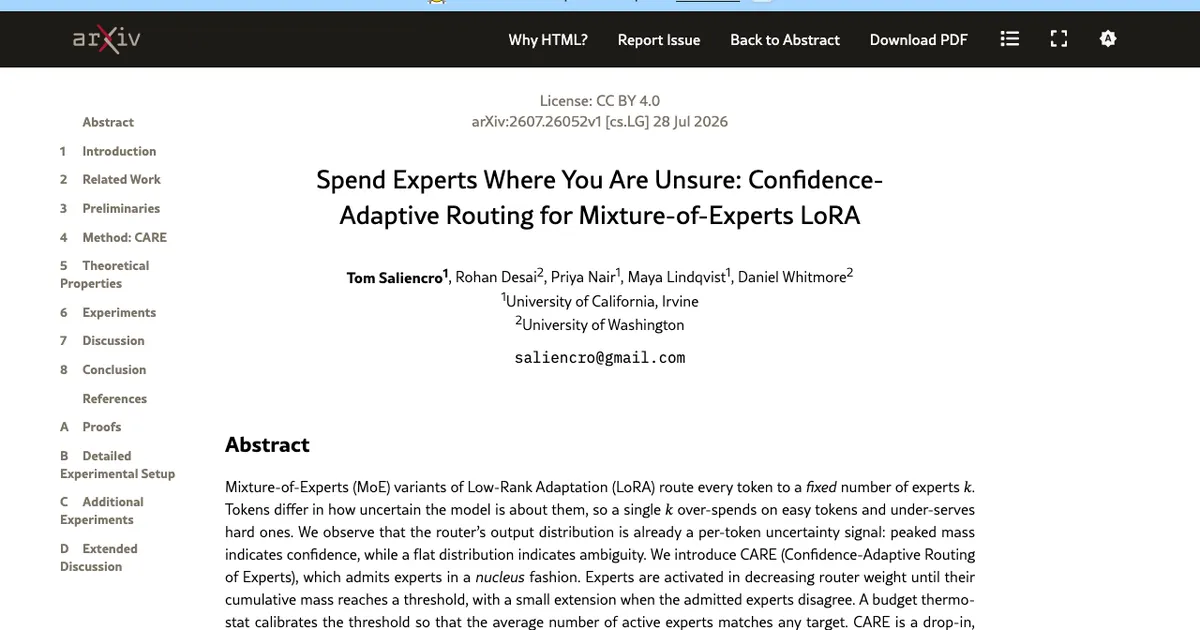
Spend Experts Where You Are Unsure: Confidence-Adaptive Routing for Mixture-of-Experts LoRA

By Tom Saliencro, Rohan Desai, Priya Nair, Maya Lindqvist, Daniel Whitmore • arXiv • Importance: 88/100
Hero Image for 2607.26052

Leveling Up LLMs: Adaptive Routing Slashes Compute While Boosting Performance

(A deep dive into CARE for Mixture-of-Experts Fine-Tuning)

The era of Massive Language Models (LLMs) is only getting started, but training and running them efficiently remains the biggest bottleneck. One key architectural component in modern LLMs is the Mixture-of-Experts (MoE) layer. Instead of calculating results for every single token using all parameters, MoE models route tokens to a small subset of specialized ‘experts.’ This makes models faster and more capable.

However, most current implementations use a simple fixed routing rule: they always select the same top $k$ experts regardless of whether the token is easy or hard. As ML researcher Tom Saliencro et al. showed in their latest work, this approach is wasteful—it over-spends compute on easy tokens and under-serves those that really need help.

💡 The Problem: Uniform Effort for Uneven Tasks

The core insight of the study (CARE) is simple yet profound: The router already knows how unsure it is. The distribution the router produces isn’t just a routing mechanism; it’s an intrinsic measure of per-token uncertainty. A sharp, peaked distribution means high confidence; a flat, ambiguous one signals the model is struggling.

✨ Introducing CARE: Confidence-Adaptive Routing of Experts

To solve this inefficiency, the authors introduce CARE (Confidence-Adaptive Routing of Experts). Instead of blindly picking the top $k$, CARE introduces a nucleus approach: it activates experts in decreasing order of their assigned weight until a predetermined mass threshold is reached. If neighboring experts disagree on the token’s best pathway, CARE smartly extends the set of activated experts to account for this internal disagreement.

  • The Secret Sauce: A clever ‘budget thermostat’ calibrates this dynamic process so that the average number of active experts matches any target compute level you want, without manual intervention.
  • Key Feature: It’s a drop-in, single-forward-pass method requiring no extra parameters, making it incredibly easy to implement and deploy on existing models like LLaMA 3.1 and Qwen2.5.

🚀 Why CARE is a Game Changer (And Where You Can Use It)

Empirically, CARE beats standard fixed top-$k$ MoE-LoRA baselines across a wide range of benchmarks (including commonsense reasoning, math, code generation, and knowledge tasks). Crucially, it maintains the performance of fixed $k=4$ baselines while activating significantly fewer experts—meaning massive compute savings in production.

This focus on resource efficiency means CARE is valuable for companies looking to run large-scale applications (think enterprise AI tools or mobile deployments) where latency and cost are paramount.

For Developers & Researchers: If you’re tackling model quantization, optimizing MoE usage, or building high-throughput inference engines, read the full paper: https://arxiv.org/abs/2607.26052

#ML #LLMs #MixtureOfExperts #Optimization #AIResearch #GenAI #DeepLearning


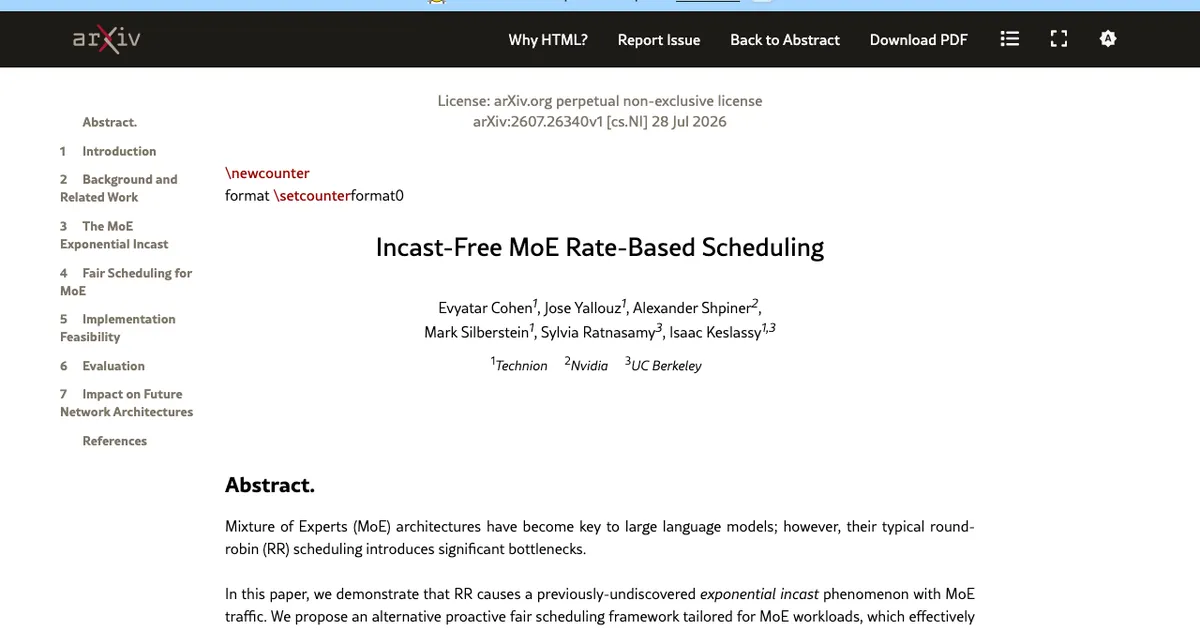
Incast-Free MoE Rate-Based Scheduling

By Evyatar Cohen, Jose Yallouz, Alexander Shpiner, Mark Silberstein, Sylvia Ratnasamy, Isaac Keslassy • arXiv • Importance: 85/100
Hero Image for 2607.26340

🚀 Say Goodbye to MoE Bottlenecks: A New Scheduling System for the Next Era of LLMs

As Mixture of Experts (MoE) models revolutionize AI—allowing us to scale model size and capability with unprecedented efficiency—the hardware infrastructure they run on is hitting a critical limit. The way we currently schedule these enormous, parallel calculations introduces a subtle but disastrous flaw: an exponential bottleneck known as ‘incast.’

The Problem: MoE architectures rely on distributing computation across hundreds or thousands of specialized chips (experts). Standard scheduling methods often use simple Round-Robin (RR) approaches. While seemingly fair, this simplistic approach fails catastrophically under the heavy traffic load of real-world ML workloads. It causes network congestion that exponentially slows down communication, leading to poor utilization and excessive completion times.

The Breakthrough: Proactive Fair Scheduling

Researchers Cohen et al. have tackled this head-on with Incast-Free MoE Rate-Based Scheduling. They propose a fundamentally new, proactive scheduling framework designed specifically for the unique, intense traffic patterns of MoE workloads. This isn’t just an optimization; it’s a necessary architectural overhaul.

What Makes It Revolutionary?

  1. Incast Elimination: The core achievement is completely eliminating incast, ensuring that the high-speed compute power promised by MoEs can actually be delivered without network slowdowns.
  2. Near-100% Link Utilization: The new framework maintains incredibly high efficiency across all interconnect links, meaning every piece of hardware time counts.
  3. Reduced Completion Time: By stabilizing communication and maximizing link use, they significantly reduce the Collective Completion Time (CCT), speeding up overall model inference and training.

How Will This Change AI Hardware?

This isn’t just theory; the authors outline concrete methods for implementing this scheduler directly within Network Interface Cards (NICs). By moving scheduling intelligence closer to the compute, they ensure that network limitations no longer dictate the scaling limits of MoE models.

For anyone building next-generation AI accelerators, running massive LLMs, or working on distributed machine learning infrastructure, understanding and adopting proactive, specialized scheduling is critical for achieving true linear scalability.

👉 Dive deeper into the technical details of this new scheduling paradigm here: https://arxiv.org/abs/2607.26340

Retrospective Orthogonal Design: Response-Surface Reconstruction from Observational Data

By Lawrence Fulton, Christopher Fulton, Arvind Sharma, Aleksandar Tomic • arXiv • Importance: 85/100
Hero Image for 2607.26219

🧠 Deep Dive: Solving Data Blind Spots with Retrospective Orthogonal Design (ROD)

Ever struggled with observational data where the results seem to change depending on how you structure your analysis? You run a regression, tweak the variables, and suddenly your coefficients shift—it’s messy, non-replicable science. This is the core problem that Retrospective Orthogonal Design (ROD) tackles.

At its heart, ROD is a groundbreaking statistical framework designed to provide robust, specification-invariant reconstruction of complex scientific relationships from limited or noisy data. Think of it as giving your data the ultimate structural integrity so you can trust what it’s actually telling you.

🔬 What Problem Does ROD Solve?

The traditional methods (like standard polynomial regression) fail in two major ways:

  1. Multicollinearity Dependence: Estimates depend heavily on which variables are included and how they relate to each other, creating unreliable coefficient estimates when variables are highly correlated.
  2. Order Dependency: Even simple metrics like sequential sums of squares (SS) can change if you calculate them in a different order. This makes statistical conclusions fragile.

ROD overcomes these limitations by reconstructing the conditional mean surface on a ‘probability-balanced lattice.’ This process not only preserves all observed data means but also intelligently completes the unobserved gaps, leading to unparalleled robustness.

🚀 How Does ROD Work? (The Magic Behind the Math)

ROD is engineered to achieve specification invariance. By designing an admissible lattice ($\mathbf{X}^{ op}\mathbf{W}\mathbf{X}=c\mathbf{I}$), it ensures that the contrast effects and sums of squares are uniquely defined and independent of the order in which variables are considered.

Key technological highlights include: * Lattice Completion: It fills in missing data points (unsupported cells) based on rigorous probabilistic rules. * Weighted Tensor-Product Contrasts: This advanced method allows for highly granular, yet stable, analysis across complex variable interactions. * Calibration and Correction: The model uses a ‘response-free projection calibration’ to accurately map the fixed reconstruction onto scientifically declared bases, correcting for typical loss incurred when analyzing finite data resolutions.

✨ Why Should You Care? (Impact)

The empirical evidence is compelling. Across thousands of simulation conditions spanning nine different underlying processes, ROD either matched or exceeded standard polynomial regression performance. Most notably, in a weighted Mincer application, it yielded the highest out-of-sample $R^2$ point estimate while providing an exhaustive allocation of sums of squares that was completely invariant to term-entry order.

The takeaway for researchers and industry: If your analysis depends critically on perfectly reliable relationships—whether optimizing clinical trials, forecasting complex market interactions, or structuring scientific theories—ROD offers a dramatically more trustworthy, stable approach than conventional modeling methods.


🔗 Dive Deeper into the Research: Learn more about this revolutionary framework and its performance metrics in the full paper: https://arxiv.org/abs/2607.26219

(Keywords: Statistical Modeling, Observational Data, ML Research, Regression Analysis, Design of Experiments, Specification Invariance)

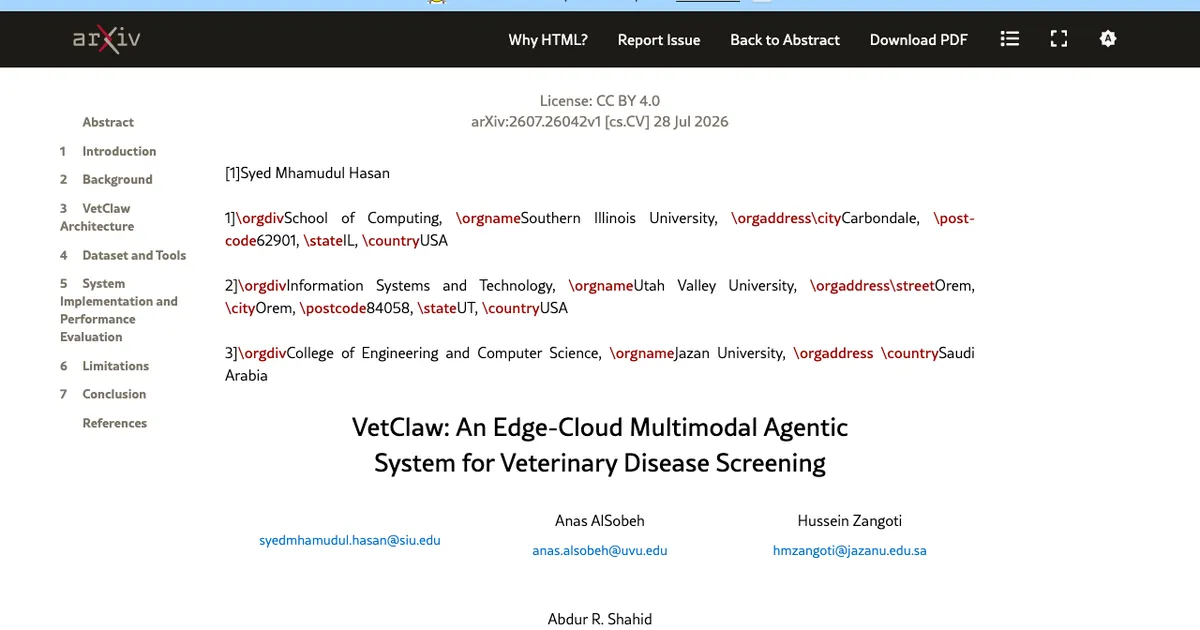
VetClaw: An Edge-Cloud Multimodal Agentic System for Veterinary Disease Screening

By Syed Mhamudul Hasan, Anas AlSobeh, Hussein Zangoti, Abdur R. Shahid • arXiv • Importance: 85/100
Hero Image for 2607.26042

🐾 Introducing VetClaw: The Future of Veterinary Diagnostics is Here

Are animal health emergencies leaving veterinarians in the dark? Traditional methods often rely on limited inputs—a single image, or a vague description. This paradigm is changing.

We are excited to digest VetClaw, a groundbreaking multimodal agentic system designed for early and comprehensive veterinary disease screening. Unlike simple AI classifiers that just look at pictures, VetClaw builds an entire diagnostic workflow on the edge, turning static predictions into coordinated care.

🚀 What is VetClaw?

The core problem in vet diagnostics isn’t lack of technology; it’s coordinating data—combining visual evidence, owner-provided symptoms, and sophisticated decision logic. VetClaw tackles this by creating a powerful Edge-Cloud Multimodal Agentic System.

Think of it as an intelligent co-pilot for vets: * 📸 Edge Sensing: It starts on your device (the ‘edge’), using a simple camera module to capture initial evidence and optionally collect symptom descriptions. This keeps the process fast and immediate. * ☁️ Cloud Intelligence: The captured data is securely sent to a server running advanced Vision-Language Models (VLMs) for zero-shot disease classification—meaning it can identify diseases it was never explicitly trained on.

🔬 The Game Changer: Agents, Not Just Algorithms

The real breakthrough isn’t just the VLM; it’s the architecture. VetClaw separates simple model prediction from complex workflow management:

  1. OpenClaw (The Orchestrator): Handles all the ‘edge-side’ coordination—scheduling, collecting user input, interacting with the veterinarian, and knowing when to send data. It makes sure everything happens in the right sequence.
  2. LangGraph (The State Manager): This is where the magic happens. LangGraph manages the entire diagnostic state. It doesn’t just run a prediction; it handles input validation, determines if more information is needed, runs multiple checks (safety protocols!), and even routes the case to specialized tools or human intervention if confidence is low.

This structured approach transforms basic classification into a safety-aware, accountable diagnostic pipeline.

✨ Why This Matters for Veterinary Medicine

VetClaw significantly elevates the standard of care by: * Maximizing Data Utility: Combining images with textual symptoms dramatically improves accuracy beyond what a picture alone can achieve. (Pure image prediction is noted as limited!) * Reliable Workflow: It’s deterministic and failure-aware. If something goes wrong, or if the model is uncertain, it escalates to alert protocols, ensuring no case falls through the cracks. * Early Intervention: Enabling faster, more accurate screening helps veterinarians intervene earlier, dramatically improving animal outcomes.

VetClaw isn’t just another AI model; it’s a robust, coordinated system designed for real-world clinical environments. The future of accessible and advanced pet care is looking multimodal and agentic!

Sharpness-Aware Minimization and Muon: Robustness under the Spectral Norm

By Wenzhi Zhong, Edward Milsom, Michael Murray • arXiv • Importance: 85/100
Hero Image for 2607.26001

Unlocking Model Stability: A New Era of Robustness with Muon and Spectral Norms

Are your deep learning models performing well in theory but failing miserably when faced with real-world data noise or adversarial attacks? This gap between perfect validation scores and messy deployment reality is the biggest headache in applied AI.

Researchers often try to fix this by introducing complex regularization techniques, like Sharpness-Aware Minimization (SAM). While SAM revolutionized generalization, it faces a core problem: how do you define ‘small’ perturbations in parameter space? Is it Euclidean distance? Frobenius norm? The choice dictates performance.

We dive deep into matrix optimization to solve this. Our latest research explores making the optimization process aware of the inherent structure of the weights—specifically, treating them as matrices with spectral properties. We combined two cutting-edge concepts: a spectral inner perturbation and the powerful Muon optimizer.

🚀 What’s the breakthrough?

Traditional SAM methods only perturb parameters generally. By adopting a matrix-aware approach, we constrain these perturbations to respect the actual structure of the hidden layer weights (a spectral norm constraint). This means our model is not just minimizing loss in a general sense; it’s finding stability that holds true when viewed through the lens of matrix geometry.

This specialized inner step was combined with an outer optimization loop using Muon, giving us unprecedented control over the parameter space.

💡 Why does this matter for ML Engineers?

  • Robustness: Our experiments across ViT-Small/16 and ResNet-50 on ImageNet-1K show that the combination consistently achieves state-of-the-art validation accuracy. This means your model will be significantly more reliable in production.
  • Stability: We are moving beyond simple loss minimization toward geometry-informed stability, yielding stronger generalizations.\
  • Practical Implementation: By combining specialized inner steps with powerful outer optimizers (like Muon), we provide a modular and highly effective framework for robust training pipelines.

If you’re building mission-critical AI—think autonomous vehicles, medical diagnostics, or financial modeling—this spectral approach to robustness is essential reading.

🔗 Read the full paper here: https://arxiv.org/abs/2607.26001

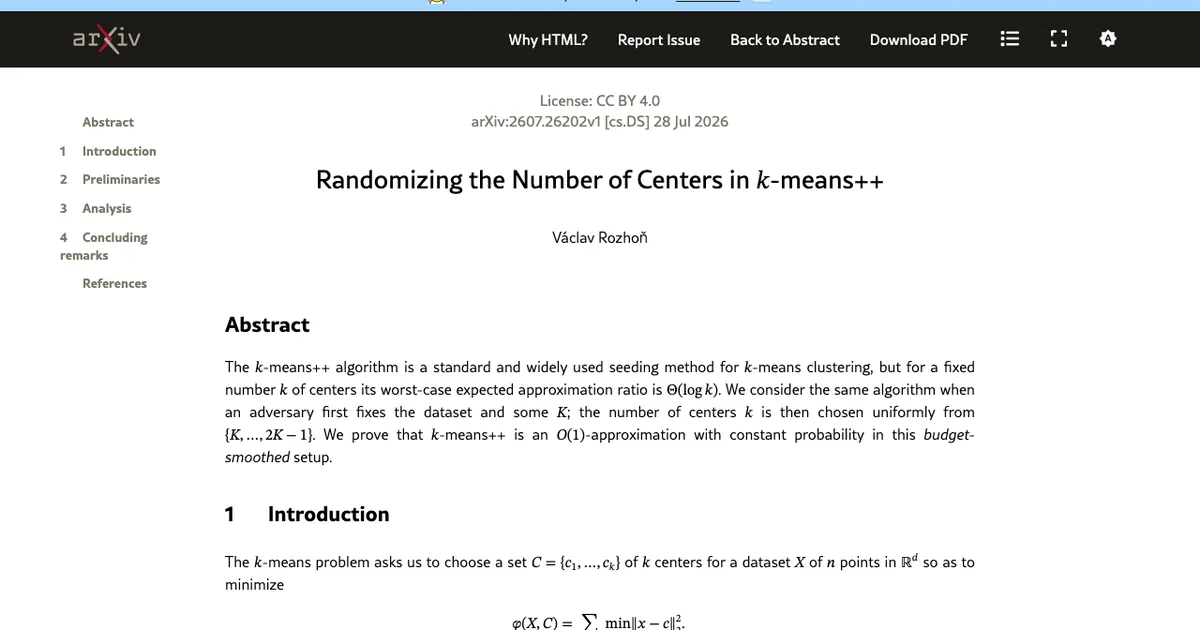
Randomizing the Number of Centers in k-means++

By Vaclav Rozhon • arXiv • Importance: 80/100
Hero Image for 2607.26202

✨ K-Means Upgrade Alert: How Randomizing Centers Makes Clustering Near-Perfect

If you’ve ever used k-means clustering for data analysis, you know its power. It’s fundamental to machine learning, helping us group similar data points and uncover hidden structures in complex datasets. But even standard tools have limitations—and the classic k-means++ seeding method has a known theoretical weakness.

The academic paper ‘Randomizing the Number of Centers in k-means++’ addresses this head-on. Essentially, the authors are proposing a major tweak to how we estimate the optimal number of cluster centers ($k$) and demonstrate that by making $k$ random over a small range (from $K$ to $2K-1$), the approximation ratio of k-means++ dramatically improves.

📉 The Problem with Standard K-Means++

In traditional analysis, when we fix the number of centers ($k$) using standard k-means++, the theoretical worst-case expected approximation ratio is $\Theta(\log k)$. This isn’t ideal—it means that the quality of our clustering can degrade logarithmically as $k$ gets larger. For practitioners, this translates to a potential gap between theoretical perfection and real-world performance.

💡 The Breakthrough: Budget Smoothing (Randomization)

The core idea presented by Vaclav Rozhon is ingenious. Instead of treating $k$ as a fixed number, the setup assumes an adversary fixes the dataset and then chooses $k$ uniformly from a range $[K, 2K-1]$. By introducing this ‘budget-smoothed’ randomness (the variable number of centers), they prove that k-means++ achieves an O(1)-approximation with constant probability.

What does O(1) mean? It means the algorithm becomes highly robust and its performance doesn’t degrade based on $k$’s scale. This is a massive theoretical win, suggesting that this randomized approach makes k-means++ nearly optimal in a statistically guaranteed sense.

🚀 Why Should You Care?

  1. Increased Robustness: Our clustering results are far less sensitive to slight misestimations of the optimal number of centers ($k$).
  2. Theoretical Guarantee: It provides a much stronger theoretical guarantee than relying on fixed $k$, making k-means++ significantly more reliable for mission-critical applications.
  3. Efficiency Boost (Potential): While the method itself is an adaptation, the improved guarantee could lead to faster convergence or higher data fidelity in real-world deployments.

If you’re working on scalable data segmentation, recommend this paper! For those who want to dig into the proof and mathematical details, check out the original research here: https://arxiv.org/abs/2607.26202

#MachineLearning #DataScience #KMeansClustering #AlgorithmTheory #AIResearch

(Disclaimer: This is a summary of theoretical research, implementation details will require careful adaptation.)

Physics-Aware End-to-End Deep Reinforcement Learning for Quadcopter Control with Actuator Dynamics

By Ya-Chia Shen, Woei-Leong Chan • arXiv • Importance: 80/100

🚀 Quadcopters Get a Deep Reinforcement Learning Upgrade: Bridging the Gap Between Code and Reality

The dream of fully autonomous aerial vehicles is closer than ever. But controlling real-world quadcopters—those marvels of engineering hovering through the sky—is notoriously difficult. Why? Because they are ‘underactuated,’ meaning just four motors (inputs) have to somehow govern six degrees of freedom in space. This isn’t a theoretical problem; it affects every drone deployment, from inspection flights to rescue missions.

New research tackles this head-on using Physics-Aware Deep Reinforcement Learning (DRL). Instead of treating the quadcopter like a simple point mass, this approach brings real-world complexity—like motor lag and aerodynamic forces—directly into the training loop, leading to significantly more stable and reliable control.

💡 What’s the Big Deal? The Physics Problem in RL

Traditional Deep Reinforcement Learning often treats the environment as perfectly predictable. But a quadcopter is anything but perfect. Motors don’t instantly respond; they have inertia (actuator dynamics), and air resistance and gyroscope effects matter greatly. If your AI ignores these physical constraints, it might look great on paper but fail spectacularly in the real world.

This groundbreaking study models these complexities with high fidelity: * Motor Lag: The simulator includes first-order actuator dynamics for each motor, mimicking how motors actually respond to commands (time constant $T_m = 0.076$ s). * Rigid Body Model: It uses a comprehensive 12-state rigid body model. * End-to-End Control: The DRL agent learns to control low-level inputs—the total thrust and the three rotational torques ($ au_x, au_y, au_z$)—directly, closing the loop against these physical details.

🤖 How Does it Work? From Theory to Autonomous Action

The researchers evaluated four leading DRL algorithms (DDPG, TD3, PPO, and SAC). By making the environment realistic, they could benchmark which algorithm was best suited for robust low-level flight control.

The Results Speak Volumes: The study found that SAC (Soft Actor-Critic) and TD3 outperformed others, demonstrating superior stability and efficiency in handling both simple hovering tasks and more complex maneuvers like navigating toward a translated goal.

This work is not just academic curiosity; it’s a crucial step for the entire drone industry. By establishing this physically accurate benchmark, it provides a reproducible blueprint for building next-generation autonomous aerial systems that can handle the messy reality of physics.

Reinforcement Learning for Code Optimization

By Pierre Chambon, Kunhao Zheng, Juliette Decugis, Benoit Sagot, Gabriel Synnaeve • arXiv • Importance: 80/100

🚀 Turbocharging Code: How We Made AI Optimize Code Realistically

The Challenge: Generating working code using Large Language Models (LLMs) is a solved problem. Now the real challenge for industry—and competitive programming—is optimization. How do you make an LLM write not just correct, but also fast code?

Traditional approaches are simple: add execution time to the reward function. But in reality, measurement noise, reward sparsity, or unstable reinforcement learning (RL) techniques quickly overwhelm the signal. The generated solutions often barely improve speed, and worse, they fail unpredictably.

🛠️ Our Solution: DMC-Optim

The authors introduce a sophisticated framework called DMC-Optim to stabilize and enhance optimization-aware RL. We tackle the messy reality of benchmarking by improving three critical stages:

  1. Better Testing (The Sandbox): We build out large, highly calibrated optimization test suites and robust sandboxing mechanisms. This provides reliable metrics far beyond simple pass/fail.
  2. Smarter Rewards: Instead of mixing correctness and speed haphazardly, we use an offline simulator to predict the most promising reward configurations, guiding the RL process efficiently.
  3. Robust Learning (The Algorithm): We adapt Reinforcement Learning algorithms (like GRPO) specifically for the challenging setting of noisy, sparse timed-execution rewards.

💡 The Impact: Serious Performance Gains

The results on industry benchmarks are staggering. When applied to powerful models like Qwen 2.5 7B and CWM 32B, DMC-Optim significantly boosts performance beyond simple correctness measures:

  • Top-50% Pass@1 Improvement: We saw a massive increase from 18.0% to 31.3% on Qwen 2.5 7B, and an even more impressive gain up to 50.4% on CWM 32B.
  • Aggressive Optimization: The gains are amplified at stricter percentiles (e.g., top-30%), showing up to a 125% relative improvement for the CWM 32B model while perfectly preserving pure correctness.
  • Robustness: Even when we degrade the timing sandbox, our robust optimization RL still achieves huge gains, demonstrating reliability across different real-world deployment conditions.

In summary, DMC-Optim doesn’t just make code work; it makes it fast, reaching complex performance levels that are competitive with human submissions and significantly accelerating the path toward production-ready AI software development.

🔗 Read the full paper here: https://arxiv.org/abs/2607.25970

AI #LLMs #ReinforcementLearning #CodeGeneration #SoftwareEngineering #DeepLearning

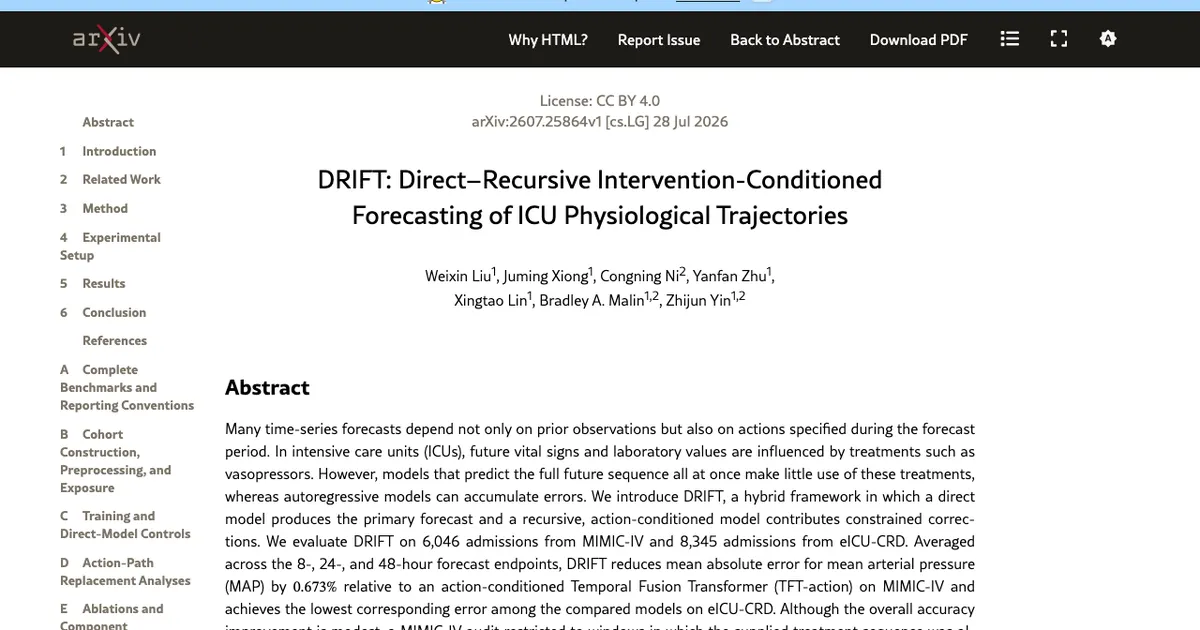
DRIFT: Direct-Recursive Intervention-Conditioned Forecasting of ICU Physiological Trajectories

By Weixin Liu, Juming Xiong, Congning Ni, Yanfan Zhu, Xingtao Lin, Bradley A. Malin, Zhijun Yin • arXiv • Importance: 80/100
Hero Image for 2607.25864

Forecasting the Critical Care Revolution: Introducing DRIFT for ICU Vital Signs

As AI models become standard tools in critical care medicine, one challenge remains: how accurately can we predict patient deterioration when that deterioration is influenced by active human intervention? In the Intensive Care Unit (ICU), every prediction—from blood pressure to lab values—is intertwined with immediate actions like adjusting vasopressors or administering drugs. Traditional forecasting models often struggle because they either ignore future treatments entirely, making them unrealistic, or they rely solely on sequential steps, accumulating errors over time.

Researchers have introduced DRIFT, a groundbreaking framework designed to solve this exact problem: Direct-Recursive Intervention-Conditioned Forecasting of ICU Physiological Trajectories.

💡 What is DRIFT and Why Should You Care?

Simply put, DRIFT models future patient health not just by looking at the historical data (what happened), but also by explicitly accounting for the planned interventions (what will happen). It fuses two powerful methodologies:

  1. The Direct Model: This component creates the primary, high-level forecast quickly and robustly.
  2. The Recursive, Action-Conditioned Model: This part acts like a constrained ‘reality check.’ After the initial forecast, it iteratively adjusts the prediction based on the specific interventions planned for each time step, ensuring the predictions remain biologically and mechanically plausible given the treatment protocol.

This hybrid approach is crucial because it prevents the common pitfalls of purely sequence-based models.

🩺 The Real-World Edge: Performance in ICUs

Testing DRIFT on massive, complex patient datasets (MIMIC-IV and eICU-CRD) confirmed its superior performance. While overall accuracy improvements might seem modest compared to existing state-of-the-art models like the action-conditioned Temporal Fusion Transformer (TFT), the deeper analysis revealed a critical advantage:

  • Targeted Accuracy: When restricted to crucial time windows—specifically moments when the prescribed treatment sequence diverged from historical norms—DRIFT significantly outperformed competitors. This means DRIFT is most reliable when predicting the outcomes of complex, novel interventions.
  • Robustness: The model maintained its lead across multiple evaluation metrics and robustness checks, confirming that its ability to handle dynamic intervention changes is consistently robust.

🔑 Key Takeaways for Clinicians & Researchers

The primary takeaway is that future ICU prediction models must be designed with an explicit understanding of the feedback loop between medical action and physiological outcome. DRIFT proves that a hybrid direct-recursive approach can provide more trustworthy, actionable predictions—especially during critical moments of treatment adjustment.

🔗 Dive Deeper: For the full technical details and rigorous comparisons, read the paper here: https://arxiv.org/abs/2607.25864

ICU #HealthTech #MachineLearning #AIinHealthcare #PredictiveAnalytics

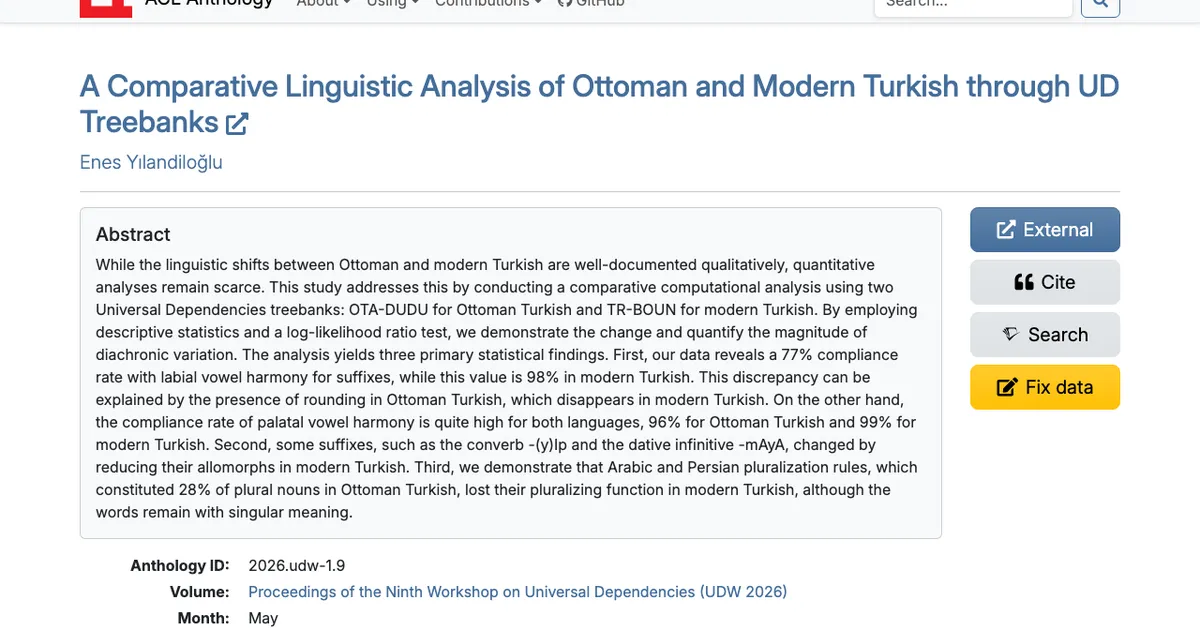
A Comparative Linguistic Analysis of Ottoman and Modern Turkish through UD Treebanks

By Enes Yılandiloğlu in Proceedings of the Ninth Workshop on Universal Dependencies (UDW 2026) • ACL Anthology • Importance: 80/100
Hero Image for acl_2026.udw-1.9

Unlocking Linguistic Secrets: How Old Ottoman Turkish Forged Modern Turkish

Are you fascinated by language history or the mechanics of natural language processing (NLP)? Then this paper is a must-read. This research dives deep into the linguistic evolution from classical Ottoman Turkish to contemporary Turkish using cutting-edge computational methods.

While linguists have long qualitatively observed how these two languages differ, few studies provide rigorous, quantitative evidence. The authors tackle this gap head-on by leveraging Universal Dependencies (UD) treebanks: OTA-DUDU for the historical Ottoman dialect and TR-BOUN for modern Turkish.

🔬 What Did They Find? The Three Pillars of Linguistic Shift

Using sophisticated statistical tests like descriptive statistics and log-likelihood ratio testing, the study quantifies the magnitude of change across key phonological and morphological areas. Here are three major takeaways that reshape our understanding of language evolution:

1. Vowel Harmony: The Subtle Sound Changes: The data reveal fascinating discrepancies in vowel harmony. While both languages show impressive compliance with palatal vowel harmony (96% vs 99%), the study highlights a notable difference in labial vowel harmony for suffixes. Ottoman Turkish showed a significantly lower compliance rate (77%) than modern Turkish’s 98%. This divergence is elegantly explained by the disappearance of rounding sounds, a structural feature present in the historical language but absent today.

2. Morphological Simplification: Shedding Complexity: The research pinpointed specific suffixes, like the converb -(y)Ip and the dative infinitive -mAyA, that underwent simplification or reduction of their allomorphs in modern Turkish. This demonstrates a clear process of grammatical streamlining over time.

3. Semantic Shift: Loss of Foreign Influence: Perhaps most striking is the finding regarding pluralization. Ottoman Turkish heavily relied on Arabic and Persian plural rules (making up 28% of plural nouns). The analysis shows that these elaborate foreign pluralizing functions have largely lost their functional role in modern Turkish, even though the words themselves persist as singular concepts.

✨ Why This Matters for Tech & NLP Developers

This paper isn’t just academic; it has profound implications for computational linguistics and machine learning. Accurate modeling of historical language variants is crucial for building robust NLP systems (like advanced translation models or dialect detectors) that must handle diachronic change (change over time). By providing quantifiable parameters, the research offers a valuable blueprint for future corpus development and model training.

*Want to dive into the details? Check out the full paper here: https://aclanthology.org/2026.udw-1.9/

#LanguageTechnology #NLPResearch #ComputationalLinguistics #TurkishLanguage #MLResearch

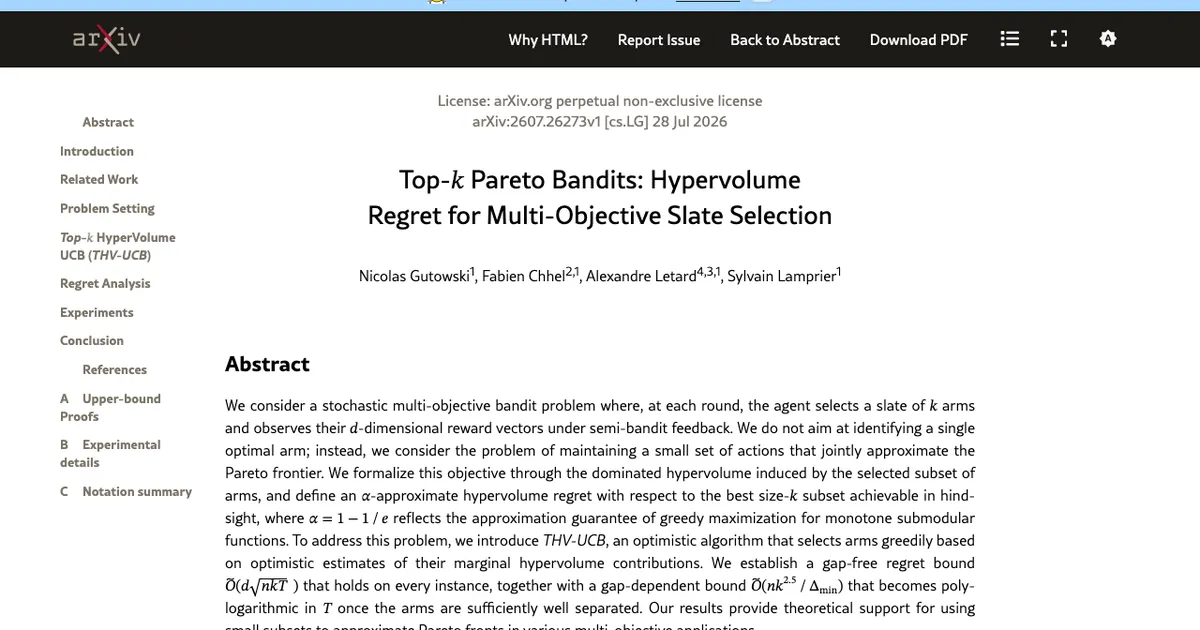
Top-$k$ Pareto Bandits: Hypervolume Regret for Multi-Objective Slate Selection

By Nicolas Gutowski, Fabien Chhel, Alexandre Letard, Sylvain Lamprier • arXiv • Importance: 78/100
Hero Image for 2607.26273

Unlocking the Pareto Frontier: How $k$-Slates Help AI Choose the Best Options

Ever notice that when you’re choosing something—whether it’s a portfolio of investments, features for an ML model, or the best set of experimental drugs—you never settle for just one single ‘best’ answer? You need a balance. This principle is at the heart of Multi-Objective Optimization and multi-objective bandit problems.

Our latest research tackles this challenge head-on: how can an AI agent intelligently select not one, but a set ($k$-slate) of actions to jointly approximate the true optimal trade-off (the Pareto frontier)?

💡 The Problem: Beyond Single Selection

The traditional bandit problem assumes you pick one action and get one reward. In real-world multi-objective scenarios, selecting $k$ arms gives you a vector of $d$-dimensional rewards. You’re not optimizing for the maximum single score; you’re maximizing the diversity and coverage of potential outcomes.

This research formalizes this goal using the concept of Hypervolume. The hypervolume induced by your chosen set quantifies how well that subset covers the optimal solution space (the Pareto frontier). We redefine regret not as missing a single best action, but as failing to select a $k$-slate that jointly achieves maximal coverage.

🚀 Introducing THV-UCB: A Breakthrough Algorithm

To solve this, we introduce THV-UCB (Top-$k$ Hypervolume Upper Confidence Bound). This optimistic algorithm is designed to make smart selections by estimating the marginal hypervolume contribution of each potential arm. It greedily selects arms that promise the greatest increase in overall coverage, making the most out of every single choice.

The theoretical results are compelling: We establish a gap-free regret bound $ ilde{O}(d oot{3/2}{n k T})$ and an advanced gap-dependent bound $ ilde{O}(nk^{2.5}/ riangle_{ ext{min}})$. These bounds provide strong theoretical guarantees, demonstrating that THV-UCB efficiently maintains an approximation of the Pareto front, even in complex, high-dimensional settings.

🌐 Why This Matters for ML and AI (GEO & Industry Relevance)

In major applications like Financial Modeling (optimizing diverse investment portfolios), drug discovery, or resource allocation planning within large enterprises, single-metric optimization is insufficient. You need robust solutions that balance multiple competing objectives (e.g., maximizing efficacy while minimizing toxicity and cost). THV-UCB provides the theoretical backbone for building next-generation AI systems capable of multi-objective decision making.

Dive deeper into the full technical details here: https://arxiv.org/abs/2607.26273

Keywords: Multi-Objective Optimization, Pareto Frontier, Bandit Problems, Reinforcement Learning, Hypervolume Maximization, Machine Learning Algorithms

Read the full paper here.

A Comparative Study of Approaches to Anonymization of Clinical Free Text in Spanish

By Florencia Luciana Brunello, Laura Alonso Alemany, Serena Villata and Milagro Teruel in Proceedings of the 8th Workshop on Clinical Natural Language Processing (Clinical NLP) @ LREC 2026 • ACL Anthology • Importance: 78/100
Hero Image for acl_2026.clinicalnlp-1.31

🇪🇸🔒 Protecting Patient Privacy: Best Approaches to Anonymizing Spanish Clinical Records

Clinical NLP is the future of healthcare research, allowing us to unlock vast amounts of patient data for critical insights. But there’s a massive hurdle: privacy. Before any hospital or researcher can use free-text medical records—the richness of which is essential—we must scrub them clean of Personally Identifiable Information (PII). This process is called anonymization.

If you work with healthcare technology in Spain or Latin America, this paper is a must-read. Why? Because the field lacks clear, empirical guidance on which anonymization technology actually works best for Spanish language clinical text.

🛠️ What Did They Test?

The authors conducted a crucial comparative study on Spanish clinical narratives. They didn’t just test one approach; they systematically compared several major paradigms:

  1. Baseline Rule-Based Systems: Simple pattern matching (e.g., finding specific date formats).
  2. General-Purpose LLMs: Using massive models like GPT via prompt engineering.
  3. Industrial NLP Toolkits (spaCy): Off-the-shelf, pre-built tools.
  4. Neural Sequence Labeling Architectures: Custom deep learning models for tagging sensitive data.

💡 Key Takeaways for Hospital IT and Data Scientists

The results provide practical, actionable advice, moving beyond theory into real-world deployment readiness. Here’s the TL;DR:

  • 🏆 The Winner: Traditional Deep Learning. The study found that recurrent neural network architectures, particularly using robust off-the-shelf toolkits like spaCy, offered the optimal balance of effectiveness, computational efficiency, and—most critically—deployment feasibility. These approaches are reliable and less resource-intensive than massive LLMs.
  • 🧠 LLM Caution: While Large Language Models are exciting, their performance was evaluated with caution. The findings suggest that specialized, task-specific training (like using custom embeddings) still yields stronger generalization capabilities compared to simply prompting a general-purpose model.
  • 📈 Data Efficiency Matters: Don’t rely solely on generalized representations! Training task-specific embeddings end-to-end significantly improves the overall strength and robustness of your anonymization pipeline.

🚀 Why Does This Matter? (Impact)

The core contribution is providing reproducible, empirical evidence specifically for Spanish NLP. Instead of forcing institutions to guess which method to use, this work offers a roadmap for building reliable, privacy-preserving clinical data pipelines in Spanish. It’s crucial for any organization aiming to leverage the wealth of Spanish medical knowledge while staying compliant with stringent privacy regulations.

🔗 Read the full study here: https://aclanthology.org/2026.clinicalnlp-1.31/


Disclaimer: This post summarizes academic findings for informational purposes and should not replace official security or medical compliance guidance.

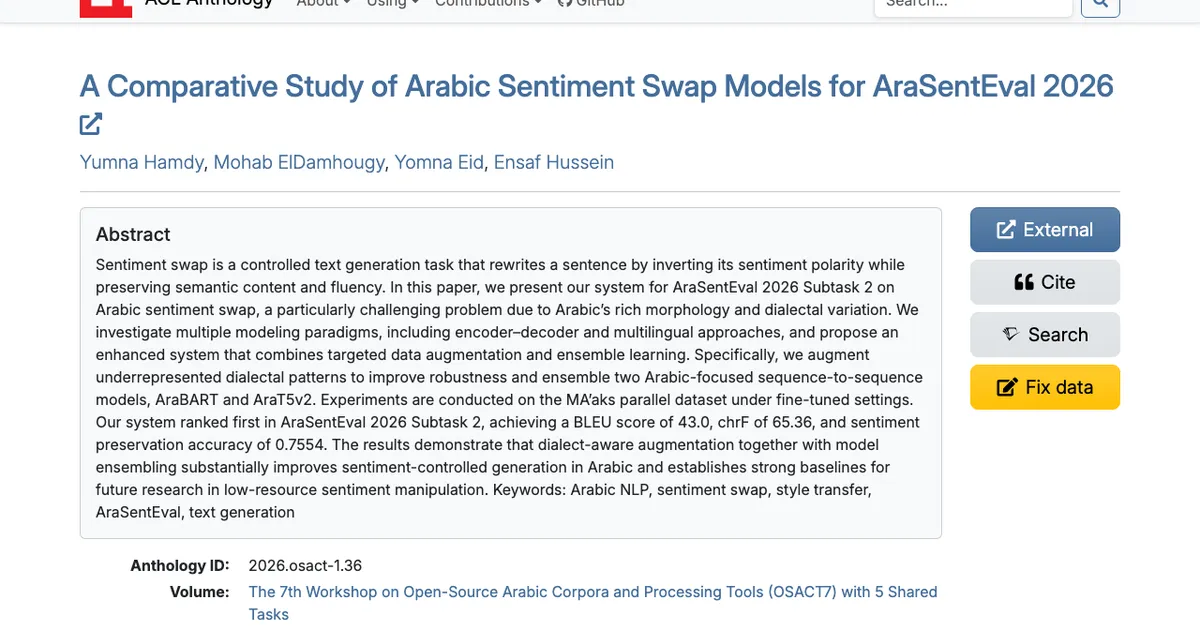
A Comparative Study of Arabic Sentiment Swap Models for AraSentEval 2026

By Yumna Hamdy, Mohab ElDamhougy, Yomna Eid and Ensaf Hussein in The 7th Workshop on Open-Source Arabic Corpora and Processing Tools (OSACT7) with 5 Shared Tasks • ACL Anthology • Importance: 75/100
Hero Image for acl_2026.osact-1.36

Arabic NLP Breakthrough: Mastering Sentiment Swaps and Dialectal Texts

Ever wonder how AI can change the tone of a piece of writing—say, turning a glowing review into a scathing one—while keeping all the original meaning intact? That’s exactly what sentiment swap is. And when you add the complexity of Arabic, which features rich morphology and diverse dialects, the task becomes incredibly challenging.

In their latest research presented at AraSentEval 2026, Yumna Hamdy et al. tackle this monumental NLP challenge head-on. They introduce an advanced system designed specifically for Arabic sentiment swap, achieving state-of-the-art results that set new benchmarks for controlled text generation in the region.

🤖 The Challenge: Why Sentiment Swap is Hard (Especially in Arabic)

The goal of sentiment swap is precision control: generate a rewritten sentence that has the opposite emotional polarity (e.g., changing ‘great’ to ‘terrible’) but retains perfect semantic meaning and natural flow.

Arabic poses unique difficulties. Its linguistic landscape includes rich morphology (complex word structures) and significant dialectal variations, which traditional, generalized models often fail to process accurately.

✨ The Solution: Smart Augmentation Meets Ensemble Power

The researchers didn’t just use off-the-shelf models; they implemented a highly sophisticated two-pronged strategy:

  1. Dialect-Aware Data Augmentation: They strategically augmented the dataset by focusing on underrepresented dialectal patterns. This infusion of diverse, real-world linguistic data significantly boosted the model’s robustness across different Arabic speaking regions.

  2. Model Ensembling: They combined (or ‘ensemble’d’) two advanced sequence-to-sequence models—AraBART and AraT5v2. By combining the strengths of multiple powerful architectures, they created an exceptionally reliable system that outperformed single-model attempts.

This combination proved critical: it drastically improved sentiment-controlled generation in Arabic while ensuring high fidelity to both semantics and style.

🏆 Results That Speak Volumes (and Score High on BLEU)

The system achieved top performance at AraSentEval 2026 Subtask 2, setting new standards with impressive metrics: * BLEU Score: 43.0 * chrF: 65.36 * Sentiment Preservation Accuracy: 75.54%

These results underscore the massive leap in capabilities for Arabic NLP and demonstrate that specialized, linguistically aware approaches are crucial for handling multilingual, morphologically rich languages.

🚀 Why This Matters to Developers and Researchers

The ability to reliably perform sentiment swap opens up exciting applications across various industries: * Content Moderation: Identifying subtle emotional shifts or propaganda. * Language Education: Tools that allow users to practice changing tones in writing. * Machine Translation Improvement: Developing better models for detecting cultural and stylistic nuances.

This research isn’t just an academic win; it establishes strong, actionable baselines for future low-resource sentiment manipulation tools.

👉 Read the full paper here: https://aclanthology.org/2026.osact-1.36/

#ArabicNLP #SentimentSwap #LowResourceAI #TextGeneration #NaturalLanguageProcessing

Explore Recent Digests