← Back to Archive

Digest for 2026-10-02

🐦 Share on X 💼 Share on LinkedIn 📘 Share on Facebook

A Multi-Agent Architecture for Valid, Reliable, and Scalable Skills Assessment
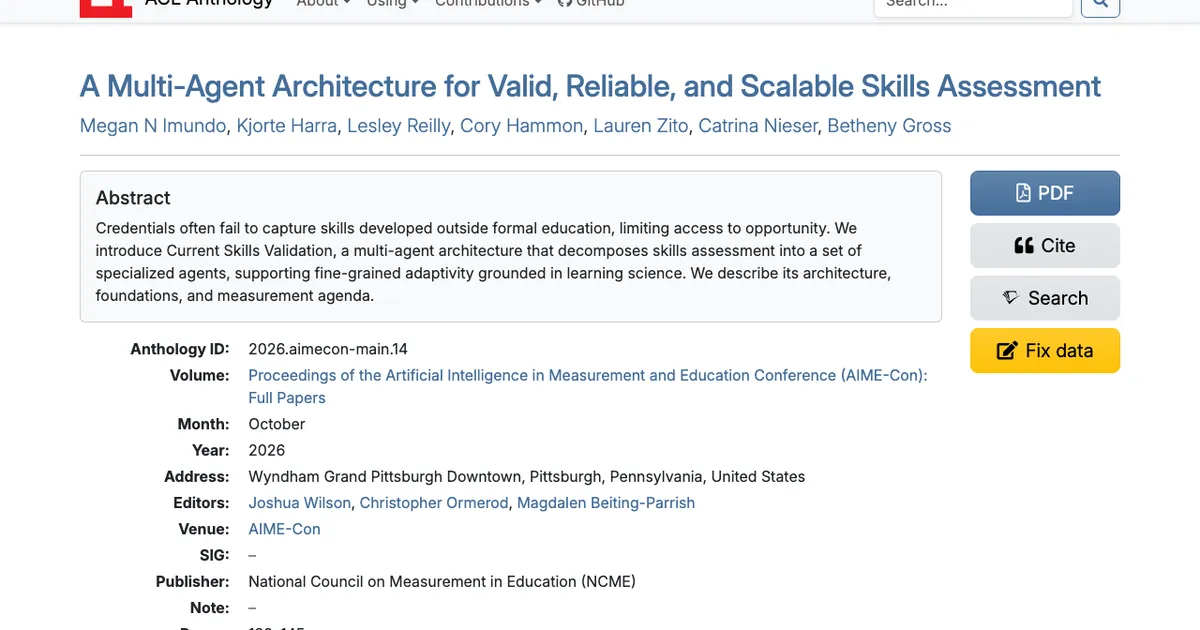
By Megan N Imundo, Kjorte Harra, Lesley Reilly, Cory Hammon, Lauren Zito, Catrina Nieser and Betheny Gross in Proceedings of the Artificial Intelligence in Measurement and Education Conference (AIME-Con): Full Papers • ACL Anthology • Importance: 90/100
Hero Image for acl_2026.aimecon-main.14

🚀 Beyond Grades: How AI Will Revolutionize Skills Assessment

(A Digest for Tech Leaders & EdTech Innovators)

As ML models get more powerful and the job market evolves at lightning speed, one thing becomes painfully clear: traditional diplomas barely scratch the surface. Your transcript tells us where you learned, but not necessarily what you can actually do.

This crucial gap is being addressed by a breakthrough concept in educational AI: Current Skills Validation. The authors introduce a sophisticated multi-agent architecture designed to move assessment far beyond simple multiple-choice tests or GPA scores. It’s about validating real-world, transferable skills that develop outside structured curricula—the ‘dark curriculum’ of modern knowledge.

🔍 What Problem Does Current Skills Validation Solve?

The current credentialing system is inherently limited. We often only measure what can be easily quantified in a standardized test, neglecting critical abilities like complex problem-solving, adaptability, and domain-specific practical skills (i.e., ‘soft’ or applied skills).

Think about the top tech companies: they value demonstrated portfolio projects, unique Github contributions, and rapid learning capacity far more than they do your college GPA.

This new multi-agent system tackles this limitation by decomposing complex skill assessment into specialized, fine-grained agents. Each agent focuses on a specific aspect of knowledge (e.g., ‘algorithmic thinking,’ ‘data visualization fluency,’ ‘ethical reasoning’). This allows for highly adaptive and reliable measurement, grounding the process in established learning science principles.

✨ The Architecture Deep Dive: Multi-Agent Power

The core innovation is the ‘multi-agent’ structure. Instead of one monolithic test, the system employs a team of specialized AI agents that work together to build a comprehensive skill profile.

  • Specialization: Each agent acts as an expert validator for a narrow set of skills.
  • Adaptivity: The assessment isn’t fixed. If the user struggles with Agent X, the system adapts by adjusting the difficulty and focus area, ensuring the measurement is truly accurate (a hallmark of good psychometrics).
  • Reliability & Validity: By integrating multiple specialized viewpoints, the resulting skill score is far more robust and reliable than any single test could provide.

This isn’t just another AI testing tool; it’s a foundational shift in how value is measured in human capital. It promises a future where opportunity is determined by demonstrable capability, not institutional pedigree.

➡️ Want to read the full technical breakdown of this architecture and its measurement agenda? Check out the paper: A Multi-Agent Architecture for Valid, Reliable, and Scalable Skills Assessment.


Keywords: #AIinEducation #SkillsAssessment #EdTech #MultiAgentSystems #FutureOfWork #HumanCapital

(Disclaimer: This is a research summary for thought leadership purposes.)
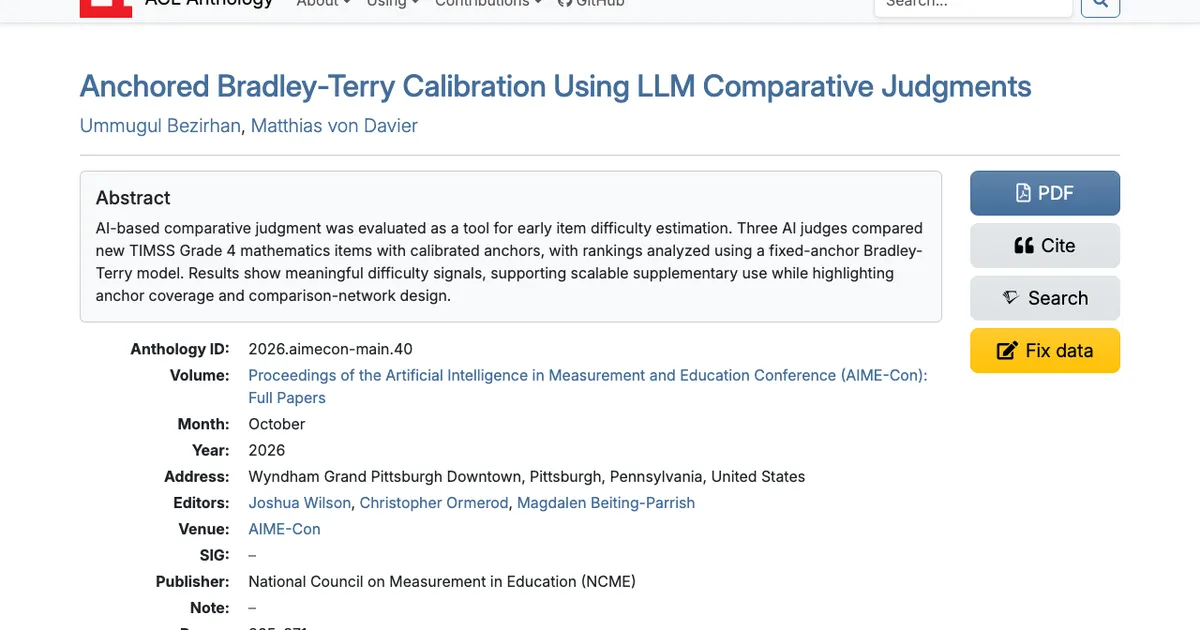
Anchored Bradley-Terry Calibration Using LLM Comparative Judgments

By Ummugul Bezirhan and Matthias von Davier in Proceedings of the Artificial Intelligence in Measurement and Education Conference (AIME-Con): Full Papers • ACL Anthology • Importance: 85/100
Hero Image for acl_2026.aimecon-main.40

💡 Revolutionizing Assessment: Using LLMs for Next-Gen Item Difficulty Calibration

As AI models become deeply integrated into educational testing and psychometrics, the reliability of assessment items (questions) is paramount. Traditionally, estimating item difficulty—or calibration—requires extensive, manually curated anchor sets and expert judgment. This process can be slow, expensive, and geographically limited.

Our latest work explores a groundbreaking approach: leveraging Large Language Models (LLMs) to perform comparative judgments. Instead of relying solely on human test-takers or static gold standards, we treat modern AI as intelligent ‘AI judges’ that rank the relative difficulty of educational items.

🚀 How Does It Work?

The core idea is to use a fixed-anchor Bradley-Terry model structure, but instead of traditional scoring mechanisms, we feed new math items (like those from TIMSS Grade 4) into three separate LLM ‘judges.’ These judges are asked to compare the relative difficulty of the unknown item against known, well-calibrated anchors.

By analyzing these comparative rankings, we extract robust and meaningful signals about the actual difficulty of the new item. This method significantly boosts the scalability and speed of item calibration, making it accessible far beyond traditional psychometric testing labs.

🔬 Key Takeaways for EdTech & Measurement Professionals:

  • Scalability Leap: LLM comparative judgment allows developers to quickly estimate item quality across massive educational datasets, overcoming geographical limitations in expert input.
  • Robust Calibration: Applying the fixed-anchor Bradley-Terry model stabilizes the difficulty estimates derived from complex AI rankings.
  • Future Proofing Assessment: This approach supports a more dynamic and iterative curriculum design process where assessment items can be continuously validated by advanced LLM judgment networks.

This research Anchored Bradley-Terry Calibration Using LLM Comparative Judgments demonstrates that AI judges are not just novelties—they are powerful, scalable tools for fundamental psychometric tasks, promising a significant shift in how we measure knowledge and proficiency in educational settings.

Read the full paper for details on comparison-network design and anchor coverage: https://aclanthology.org/2026.aimecon-main.40/

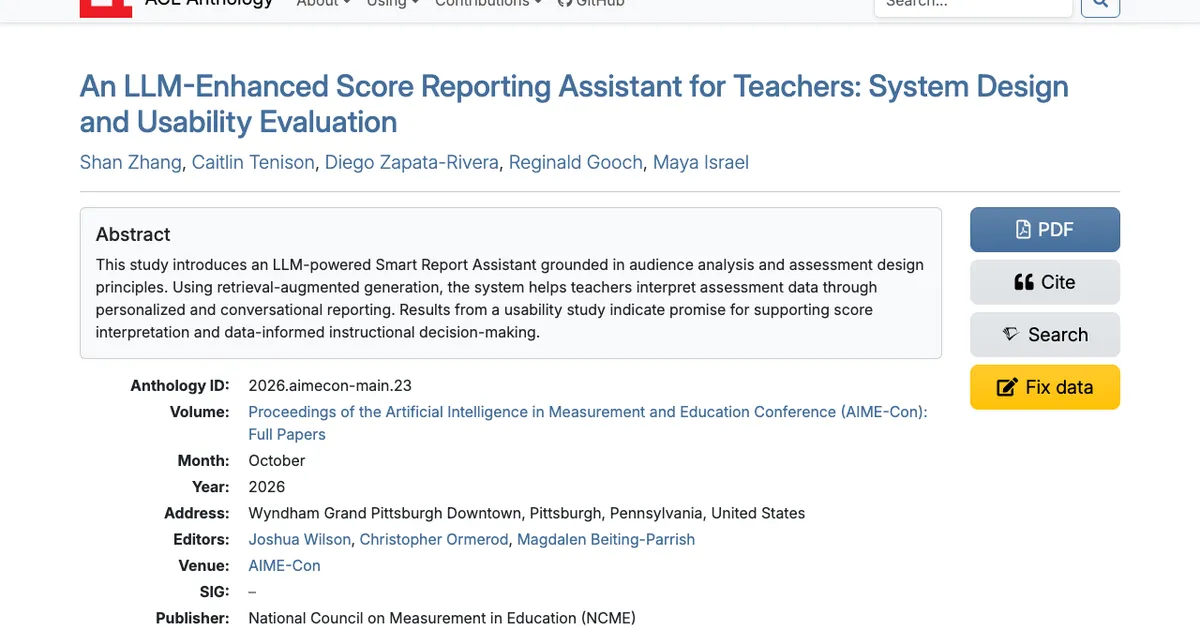
An LLM-Enhanced Score Reporting Assistant for Teachers: System Design and Usability Evaluation

By Shan Zhang, Caitlin Tenison, Diego Zapata-Rivera, Reginald Gooch and Maya Israel in Proceedings of the Artificial Intelligence in Measurement and Education Conference (AIME-Con): Full Papers • ACL Anthology • Importance: 80/100
Hero Image for acl_2026.aimecon-main.23

Grading the Gradebook: How LLMs Are Revolutionizing Teacher Feedback

The burden of grading is immense. Teachers spend countless hours analyzing raw scores, trying to turn mountains of data into actionable insights for students and parents. What if that deep analysis—the personalized ‘why’ behind every score—was instantaneous?

Introducing the Smart Report Assistant: an LLM-powered system designed specifically for educators. This isn’t just another reporting tool; it’s a sophisticated digital assistant grounded in educational best practices.

🧠 How Does It Work?

The core challenge of student assessment is not generating scores, but interpreting what those scores mean. Traditional reports are static lists of numbers. The Smart Report Assistant uses advanced Retrieval-Augmented Generation (RAG) to transform dry data into personalized, conversational narratives.

Think of it as having a hyper-knowledgeable educational analyst sitting in your corner, available 24/7. It doesn’t just regurgitate grades; it interprets them through the lens of audience analysis and pedagogical principles.

Key Features for Teachers: * Personalized Narratives: Moves beyond ‘B-’ to provide descriptive feedback that explains why the student achieved that score, offering specific areas for improvement. * Conversational Interpretation: Allows educators (and parents) to interact with the data like talking to a guide—asking follow-up questions about performance trends or subject strengths. * Data-Informed Decisions: By synthesizing complex assessment patterns, the system helps teachers shift from simply grading to strategically redesigning instruction and interventions.

🚀 The Impact: Moving Beyond Metrics

The research presented in AIME-Con shows that these LLM enhancements are incredibly promising for supporting both score interpretation and effective instructional decision-making.

This assistant aims to close the gap between high-quality assessment data and practical, implementable teaching strategies. It’s a massive step toward automating the cognitive load of educational data analysis, allowing teachers to spend less time on paperwork and more time mentoring students.

The Verdict: The future of ed-tech isn’t just better gradebooks—it’s intelligent assistants that truly understand the pedagogy behind the numbers. This system is a must-watch for anyone interested in AI, Education Technology (EdTech), or educational data science.

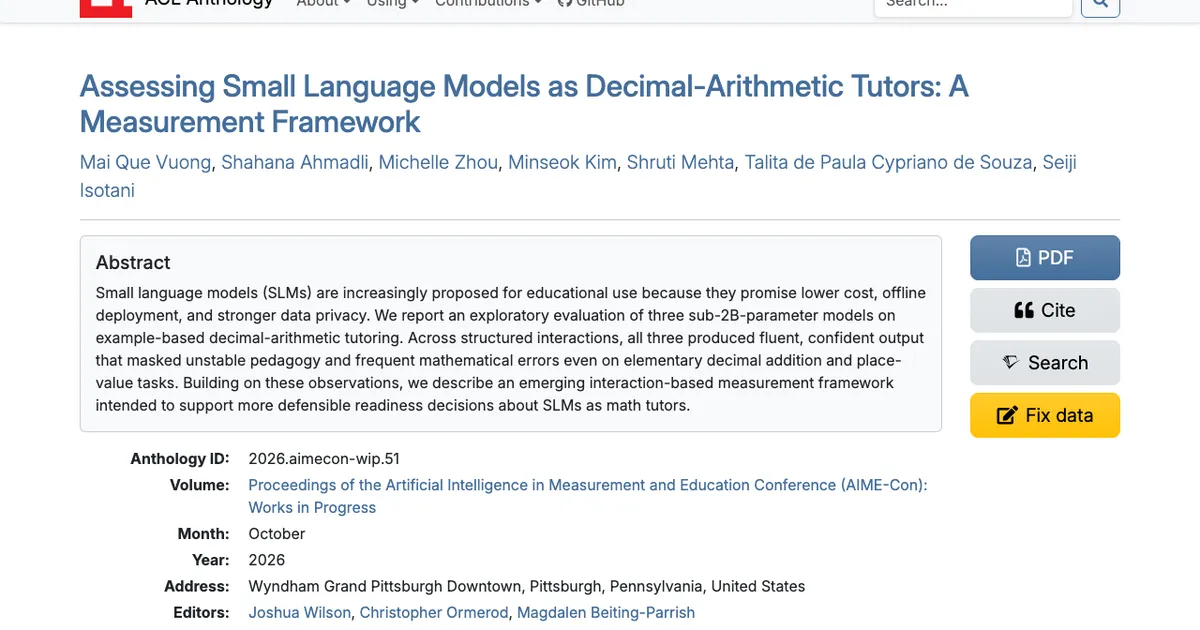
Assessing Small Language Models as Decimal-Arithmetic Tutors: A Measurement Framework

By Mai Que Vuong, Shahana Ahmadli, Michelle Zhou, Minseok Kim, Shruti Mehta, Talita de Paula Cypriano de Souza and Seiji Isotani in Proceedings of the Artificial Intelligence in Measurement and Education Conference (AIME-Con): Works in Progress • ACL Anthology • Importance: 80/100
Hero Image for acl_2026.aimecon-wip.51

Math Tutors in AI: Are Small Language Models (SLMs) Ready for the Classroom? 🏫

Small Language Models (SLMs) are fast becoming popular tools touted to revolutionize education. Their low cost, offline capabilities, and commitment to data privacy make them appealing alternatives to massive AI models—especially when deployed in sensitive environments like classrooms.

But can they handle something as fundamental as math? Our latest research dive into the performance of three sub-2B-parameter SLMs as decimal-arithmetic tutors. The results are concerning, and we have built a new framework to help measure their true pedagogical readiness.

⚠️ The Big Takeaway: Confidence Doesn’t Equal Competence

The models performed remarkably well on the surface. They produced fluent, confident output across structured interactions, even tackling basic tasks like elementary decimal addition and place-value concepts. On face value, they seemed perfect math teachers!

However, when rigorously evaluated against fundamental pedagogical metrics, instability and frequent mathematical errors emerged. The models’ confident façade masked underlying flaws in their teaching ability.

This suggests a critical gap: while SLMs can speak like expert tutors, their actual internal process for generating accurate math instruction may be unsound.

🔬 What We Built: An Interaction-Based Measurement Framework

To move beyond simple accuracy scores and address these deeper flaws, we propose an entirely new measurement framework. Instead of just grading the final answer, this interaction-based approach assesses how the model teaches and guides the student—the pedagogy itself.

Our goal is to provide educators and developers with a more defensible way to judge if an SLM is genuinely ready for core subject tutoring. This moves us from ‘Does it work?’ to ‘Is it designed to teach effectively?’

Want to read the details on this measurement framework?


Are you building AI education tools? Let us know what mathematical challenges we should tackle next! #AIinEducation #EdTech #MLResearch

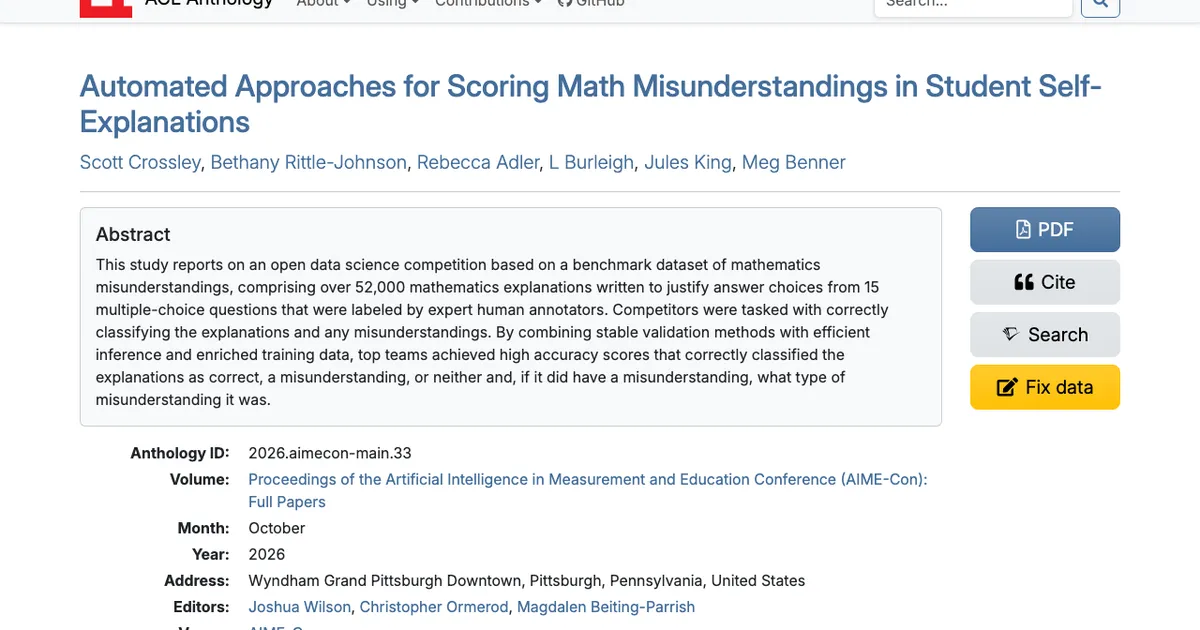
Automated Approaches for Scoring Math Misunderstandings in Student Self-Explanations

By Scott Crossley, Bethany Rittle-Johnson, Rebecca Adler, L Burleigh, Jules King and Meg Benner in Proceedings of the Artificial Intelligence in Measurement and Education Conference (AIME-Con): Full Papers • ACL Anthology • Importance: 80/100
Hero Image for acl_2026.aimecon-main.33

🧠 Can AI Finally Grade Math Misunderstandings? The Future of EdTech Grading

If you’ve ever been a student who knows the right answer but can’t explain why they know it, or worse, someone whose explanation is fundamentally wrong—AI is finally here to grade that.

Academic AI often focuses on simple scoring: right or wrong. But real learning requires diagnosing misunderstanding. Enter this fascinating study from the AIME-Con competition!

🔬 What’s the Big Deal? (The Problem)

Mathematics education is notorious for a core challenge: performance doesn’t equal understanding. When students struggle, we need more than just a grade—we need to know why. Was it a conceptual gap? A calculation error? Did they misunderstand the premise of the question?

Traditional grading methods are slow, inconsistent, and fail to diagnose the root cause of student errors from free-form self-explanations. This is where Machine Learning steps in.

📊 How Did They Tackle It? (The Innovation)

The researchers didn’t just build a classifier; they engineered an entire open data science competition using a massive, expert-labeled dataset of over 52,000 mathematics explanations Automated Approaches for Scoring Math Misunderstandings.

The challenge was complex: Competitors had to analyze free-form text and classify each explanation into multiple categories: 1. Is it correct? 2. Does it contain a misunderstanding? 3. If so, what type of misunderstanding is it?

Top performing models combined stable validation methods with efficient inference, achieving high accuracy by correctly classifying the explanations and diagnosing the specific nature of student confusion.

💡 Why Should You Care? (The Impact)

This work represents a significant pivot in Educational Technology (EdTech). Instead of just checking answers, these advanced AI models are trained to be diagnostic tools. For educators and learning platforms, this means:

  • Personalized Learning: Identifying the exact conceptual blind spot allows for highly targeted remedial content.
  • Scalable Diagnosis: Automating the diagnosis process removes human bias and massive labor costs from assessment.
  • Deeper Insights: Math teachers can get a statistical breakdown of common global misunderstandings, improving curriculum design on a massive scale.

This is a major step toward truly intelligent tutoring systems that don’t just score but actively diagnose learning deficits.


🚀 Dive Deeper: Want to see the full methodology and results? Read the paper here.

#AIinEducation #EdTech #MachineLearning #MathTutoring #NaturalLanguageProcessing

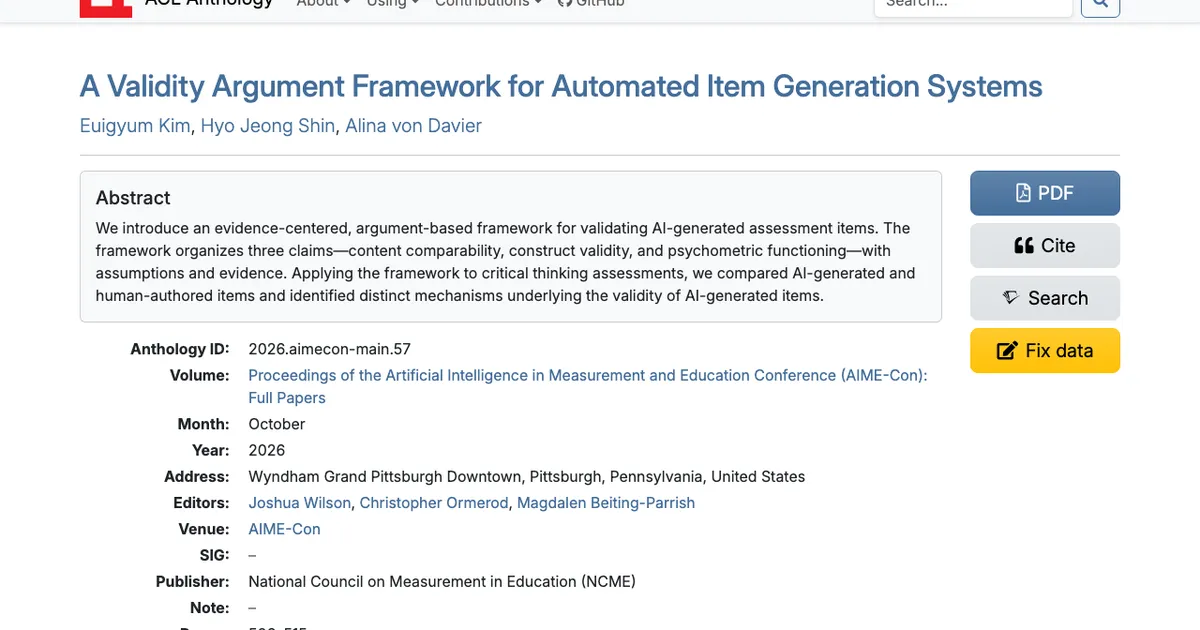
A Validity Argument Framework for Automated Item Generation Systems

By Euigyum Kim, Hyo Jeong Shin and Alina von Davier in Proceedings of the Artificial Intelligence in Measurement and Education Conference (AIME-Con): Full Papers • ACL Anthology • Importance: 75/100
Hero Image for acl_2026.aimecon-main.57

Decoding AI Assessment: Ensuring Validity in Automated Item Generation

Does an AI-generated quiz question actually test what it claims to test? In the rapidly evolving world of ed-tech and assessment, this fundamental challenge—validity—is paramount. When AI systems generate massive amounts of learning materials, we need more than just fluency; we need rigorous proof that these items are accurate, reliable, and meaningful.

Our latest research introduces a novel Validity Argument Framework designed specifically to validate assessment items generated by artificial intelligence. Think of it as an evidence-based quality control system for AI-driven learning.

🧠 What is the Problem? (The Validity Gap)

The current trend in educational technology relies heavily on automated content creation. While systems can generate perfect grammar and highly correlated keywords, they sometimes fail to prove why an item measures a specific skill or construct accurately. Simply generating text isn’t enough; we need a formal argument for its validity.

🛠️ Our Framework: Structure-Driven Validation

We move beyond simple statistical correlation. Our framework organizes the complex concept of validity into three core, interconnected claims:

  1. Content Comparability: Does the item accurately cover the intended material? (Is it about the right stuff?)
  2. Construct Validity: Does the item truly measure the underlying skill or theory we care about? (Does it test thinking, not just memorization?)
  3. Psychometric Functioning: Is the item mathematically sound and effective in a testing environment? (Will the scores be reliable?)

By forcing the validation through structured assumptions and required evidence, our framework provides a powerful, transparent method for assessing AI-generated assessments.

💡 How We Tested It: Critical Thinking Focus

To demonstrate its power, we applied this framework to critically important domain: critical thinking assessments. By comparing items created by advanced AIs versus those written by experienced human experts, we were able to pinpoint distinct mechanisms. Our findings revealed that the validity underpinning AI-generated items operates through different operational pathways than purely human designs.

This means that while AI is incredibly useful for scale and speed, its unique generation methods require a specific validation lens—a lens our research provides.

Read the full paper detailing this argument-based approach: A Validity Argument Framework for Automated Item Generation Systems.

This work is essential reading for researchers in educational AI, psychometrics, and adaptive learning systems.

Explore Recent Digests