By Burcu Arslan, Ikkyu Choi, Jesse R. Sparks, Reginald M. Gooch, Candace Walkington and Matthew L. Bernacki in Proceedings of the Artificial Intelligence in Measurement and Education Conference (AIME-Con): Coordinated Session Papers • ACL Anthology • Importance: 90/100
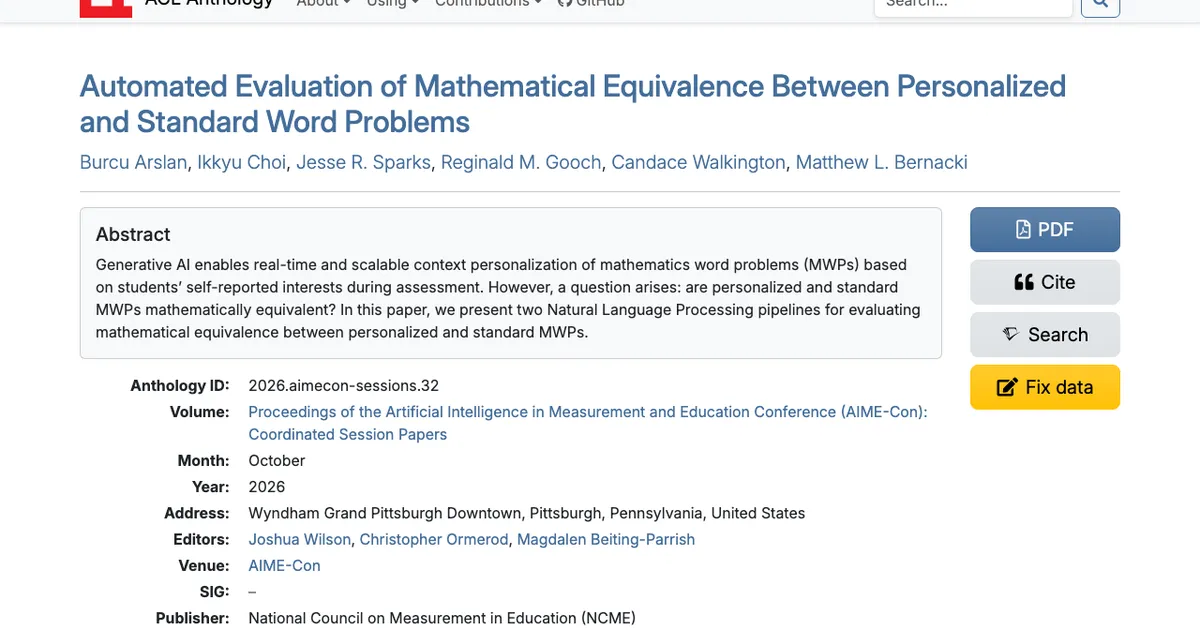
Is Personalizing Math Problems Mathematically Safe? 🤯 Understanding Equivalence in AI Assessment
As generative AI rapidly enters the educational tech space, creating assessments that feel deeply relevant to the student has become the gold standard. Imagine a math test not just about numbers, but customized around your favorite hobbies—whether you love deep-sea diving or vintage sci-fi! This is the promise of personalized learning.
But here’s the million-dollar question that AI researchers are grappling with: If we change the context to make it personal, do we also change the underlying math?
Traditional standardized assessments rely on a fixed set of problems. Personalized systems use AI to generate unique word problems (MWPs) tailored to a student’s reported interests. The core challenge is ensuring that while the narrative changes completely, the mathematical structure and solvable logic remains perfectly equivalent to the original standard problem.
💡 What This Paper Delivers: A Bridge of Trust Between AI & Academics
This research introduces sophisticated Natural Language Processing (NLP) pipelines designed specifically to measure this equivalence. The authors tackle the crucial technical gap by developing methods that can mathematically and systematically evaluate if a personalized math problem is, in fact, an accurate representation of its standardized counterpart.
Key Takeaways for EdTech Developers & Educators:
* Academic Rigor: This isn’t just about sounding plausible; it’s about proven mathematical equivalence. The paper provides the methodology to prove that personalization doesn’t introduce hidden logical traps or unintended difficulty shifts.
* Scalable AI Assessment: It offers a robust framework for building next-generation adaptive assessments at scale, giving educators confidence in the AI tools they deploy.
* The Math Behind the Magic: By focusing on NLP techniques for equivalence checking, it moves generative AI from ‘cool gimmick’ to reliable instructional tool.
This work is vital for anyone developing educational software or implementing AI testing methods. It ensures that the excitement of personalization doesn’t compromise the integrity of assessment.
By Steven James Moore and Nicholas Diana in Proceedings of the Artificial Intelligence in Measurement and Education Conference (AIME-Con): Works in Progress • ACL Anthology • Importance: 75/100
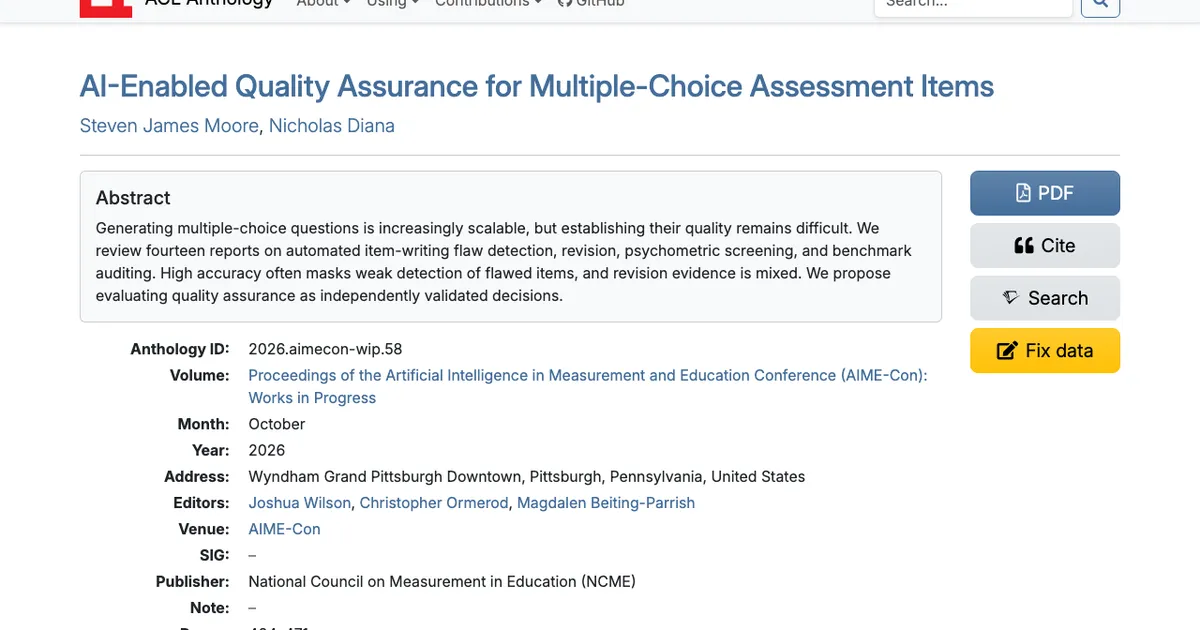
Are Your Quizzes Actually Fair? 🤯 AI-Powered Quality Assurance for Assessments
When we talk about the future of AI in education and testing, generating multiple-choice questions (MCQs) is booming. Tools can now scale question creation at an industrial level. But here’s the catch: just because a quiz is easy to generate doesn’t mean it’s good.
A foundational problem plagues automated assessment design—the quality control loop. Many tools are great at generating high accuracy scores, but this high performance often hides systemic flaws in the questions themselves (like confusing distractors or poor psychometric scaling).
In our latest work, we delve deep into how AI approaches have attempted to solve the ‘item-writing’ problem. We review a comprehensive landscape of fourteen reports dedicated to automating flaw detection, revision strategies, and benchmark auditing for educational assessments.
🛠️ The Flaw in the Current System
The current state-of-the-art suggests that while automated item generation is highly scalable, existing quality assurance mechanisms are insufficient. We found two key takeaways:
- False Confidence: High accuracy reports often give a false sense of security, masking subtle yet critical flaws within the assessment items.
- Inconsistent Solutions: Attempts to automatically fix (revise) these flawed items show mixed and often unvalidated results.
🔬 Our Proposed Shift: Independence is Key
We argue that quality assurance for educational items must shift from viewing it as an integrated, black-box process to evaluating it as a series of independently validated decisions. Instead of assuming that simply running an AI checker solves the problem, we need rigorous, verifiable methods to prove why and how an item is flawless.
This shifts the focus from ‘Can the AI write it?’ to ‘Can we definitively prove the integrity of what the AI wrote?’
👉 Read our deep dive on the challenges of automated assessment quality control in this work-in-progress paper: AI-Enabled Quality Assurance for Multiple-Choice Assessment Items.
🔥 Key Takeaways:
* Educational AI needs robust, verifiable quality checks.
* Don’t trust high accuracy scores blindly—check the underlying item integrity!
* Future research must focus on decoupling assessment generation from assessment validation.
By Langdon Holmes, Scott Andrew Crossley, Joon Suh Choi and Wesley Morris in Proceedings of the Artificial Intelligence in Measurement and Education Conference (AIME-Con): Full Papers • ACL Anthology • Importance: 75/100
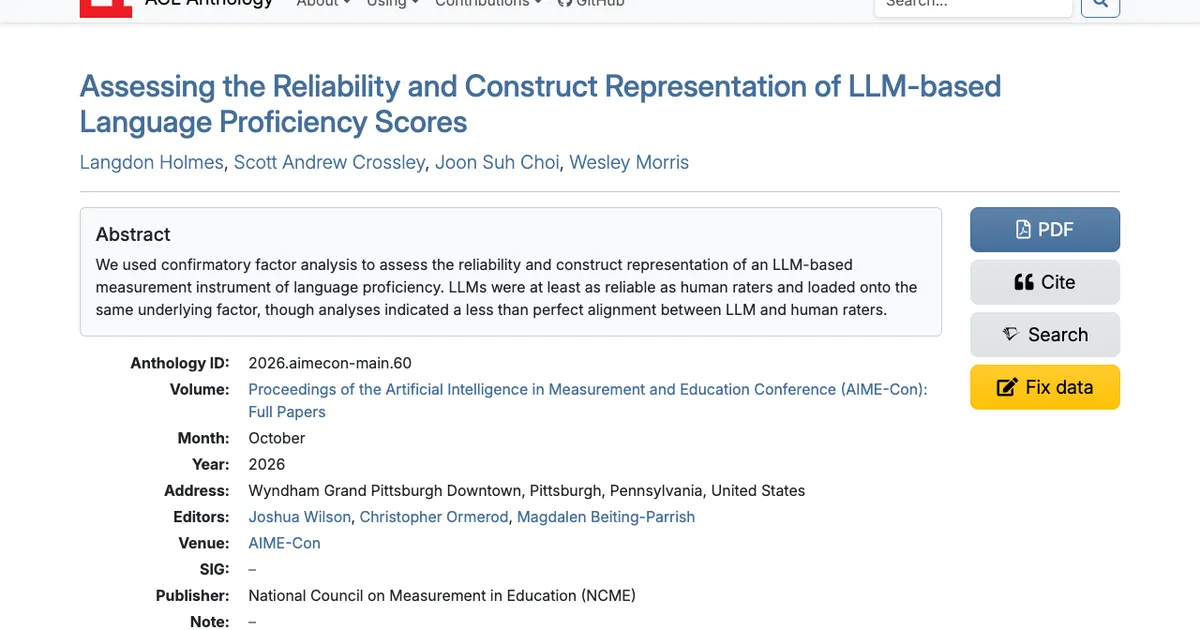
Is AI Ready to Grade Your Fluency? Assessing LLMs for Language Proficiency Scoring
Does the concept of ‘language proficiency’ have a single, objective measure? Traditionally, assessing language skills has been complex, expensive, and highly subjective—relying on human raters who are subject to fatigue, bias, or differing interpretation. But what if a sophisticated Large Language Model (LLM) could take over that task?
Researchers often tout LLMs’ incredible capability in natural language understanding (NLU), suggesting they can reliably measure things like grammar, discourse coherence, and stylistic nuances better than humans. Yet, how reliable are these AI scores? Can an algorithm truly capture the nuanced art of human communication?
We tackled this head-on by applying Confirmatory Factor Analysis (CFA) to rigorously assess both the reliability and the underlying construct representation of LLM-based language proficiency scoring. We compared the performance of LLMs against established human rater scores.
Key Findings You Need to Know:
Our analysis revealed that LLMs are at least as reliable as human raters, demonstrating a strong capacity for objective assessment. Furthermore, they loaded onto the same underlying factor—meaning the way an LLM measures ‘proficiency’ aligns conceptually with how humans define it.
However, we also found crucial insights: the alignment between LLMs and human raters was not perfect. This suggests that while AI is a powerful tool, it doesn’t fully replicate the holistic judgment of expert human evaluation. These minor discrepancies are critical for understanding the boundaries of current generative AI in specialized educational contexts.
What Does This Mean for EdTech and Linguistics?
- Efficiency Revolution: LLMs offer unprecedented scalability. Grading thousands of documents instantly removes the bottleneck of human workload, making continuous assessment possible on a massive scale (e.g., corporate training, large-scale curriculum evaluation).
- Objective Baselines: The findings establish a statistically rigorous benchmark for using AI in educational measurement. It tells developers and educators precisely where LLMs excel and where they still need human oversight.
- Future Research: The gap between perfect alignment and current performance points to exciting opportunities: future models must not only understand language but also incorporate the ‘human element’ of judgment and contextual subtlety.
🎓 For Educators & ML Engineers: This paper provides a vital, statistically grounded framework for anyone building AI-powered assessment tools. It moves the conversation past hype and into actionable metrics regarding measurement theory and educational technology reliability.
Read the full study on assessing LLM language proficiency scoring: Assessing LLM Reliability in Language Proficiency
AIinEducation #LanguageLearning #LargeLanguageModels #MachineLearning #EdTech #NaturalLanguageProcessing
By Yaning Cao and Nathan Dadey in Proceedings of the Artificial Intelligence in Measurement and Education Conference (AIME-Con): Full Papers • ACL Anthology • Importance: 75/100
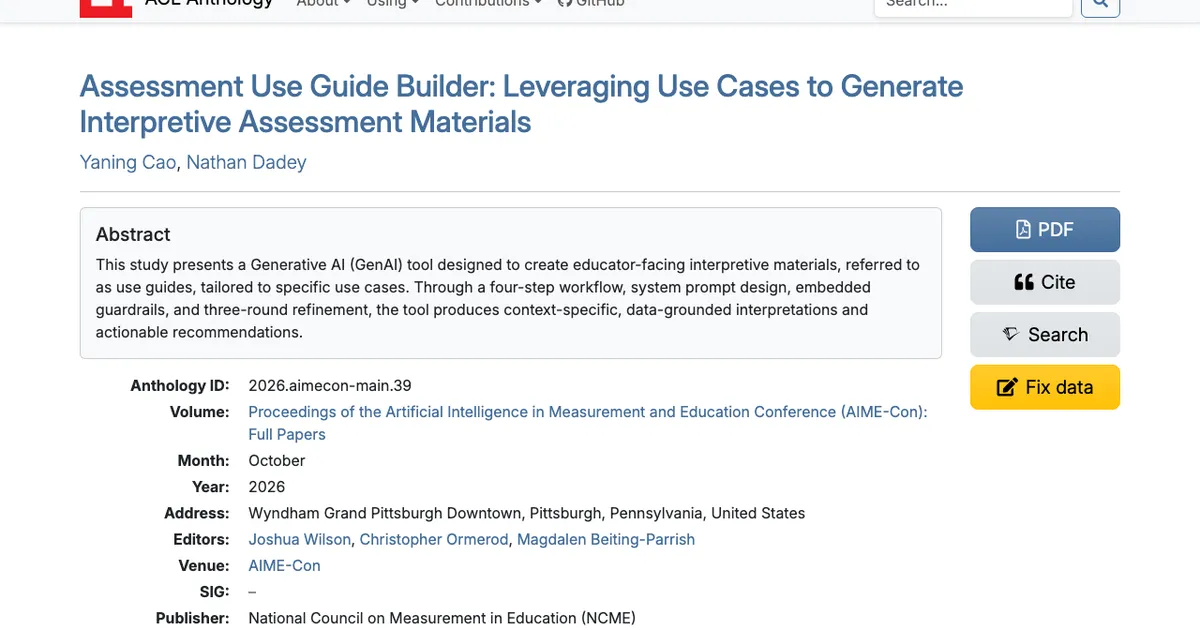
Unlocking Assessment: How Generative AI is Revolutionizing Educational Materials
If you’re in education technology (EdTech), instructional design, or assessment science, this paper should be mandatory reading. Traditional assessment material creation is incredibly time-consuming and often lacks context-specific depth. But what if a sophisticated GenAI tool could automatically generate highly detailed, data-grounded interpretive guides—or ‘Use Guides’—from basic use cases?
Introducing an exciting new research contribution that fundamentally shifts how educators interpret measurement data.
🎓 What Problem Does This Solve?
The core problem is the gap between raw assessment scores and actionable pedagogical insight. A teacher doesn’t just need a grade; they need to know why the student got that score, what specific skills were missed, and how to teach it better.
This research presents an AI-powered solution: The Assessment Use Guide Builder. Instead of just summarizing data, this tool is designed to act as a digital pedagogical expert. It takes simple use cases (e.g., ‘Students struggled with multi-step reasoning on Topic X’) and generates comprehensive, interpretive materials.
✨ How Does the AI Work? The Four-Step Genius
The abstract details a sophisticated four-step workflow that elevates standard prompt engineering far beyond basic queries. Key components include:
- System Prompt Design: Establishing deep context and persona for the AI.
- Embedded Guardrails: Ensuring the generated insights are safe, relevant, and grounded in provided data.
- Multi-Round Refinement: Iteratively improving the quality of the output through structured feedback loops (the three-round process).
- Actionable Output: The final product isn’t just text; it’s a structured guide providing specific interpretations and immediate recommendations for educators.
This rigor makes the resulting ‘Use Guide’ highly reliable and trustworthy—a massive improvement over simple AI summarization.
🚀 Why Should Educators Care? (The Impact)
- Efficiency: Saves countless hours of manual report writing and interpretation.
- Depth: Provides deeply contextualized insights, linking performance data directly to curriculum gaps.
- Actionability: Moves beyond diagnosis (‘This is bad’) to prescription (‘Do this to fix it’).
As AI becomes integrated into institutional education systems (K-12, Higher Ed), the ability to generate trustworthy and actionable assessment intelligence will be paramount. This work offers a robust blueprint for future EdTech tools.
🔗 Read the Full Paper: Assessment Use Guide Builder: Leveraging Use Cases to Generate Interpretive Assessment Materials
EdTech #AIinEducation #LearningAnalytics #GenerativeAI #InstructionalDesign
By Hotaka Maeda and Yikai Lu in Proceedings of the Artificial Intelligence in Measurement and Education Conference (AIME-Con): Works in Progress • ACL Anthology • Importance: 75/100
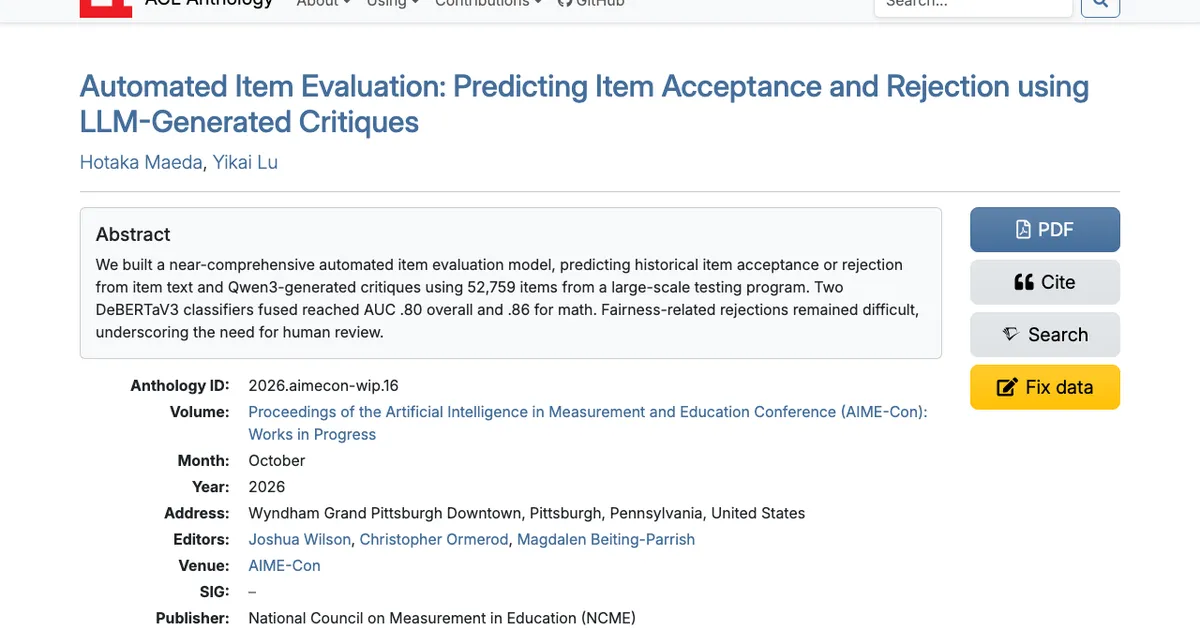
$\bigstar$ Predicting Test Item Quality: Our LLM Approach to Automated Evaluation\n\nAre academic assessments running too slowly? Manually reviewing thousands of test questions and survey items is a massive bottleneck, delaying research and educational deployment. We tackled this problem by building an automated system that predicts whether a test item will be accepted or rejected based on its text and AI-generated critiques.\n\n### 🧠 The Challenge: Scaling Quality Control\n\nIn large-scale educational programs, every single question (or ‘item’) must pass rigorous quality checks. Historically, this involves expert human reviewers—a process that is expensive, time-consuming, and difficult to scale. If an item fails, it might be rejected for clarity issues, mathematical errors, or even subtle fairness concerns.\n\nOur study introduces a near-comprehensive model trained on a massive dataset of over 52,000 items from a large-scale testing program. The goal was simple: predict the historical acceptance/rejection outcome before human effort is expended.\n\n### 💡 How We Built the Predictor\n\nWe leveraged cutting-edge Natural Language Processing (NLP) techniques, specifically adapting DeBERTaV3 classifiers, which are known for their high performance on text understanding tasks. Crucially, the model didn’t just look at the item itself; it incorporated specialized critiques generated by a powerful LLM like Qwen3. This combined approach allowed the system to understand not only what the question says, but also why an expert might reject it.\n\nThe core of our architecture involves fusing these critical signals—the raw item text and the AI-generated critique—into robust predictive features. By doing so, we achieved strong performance metrics: an overall AUC of 0.80, and impressively high AUC of 0.86 specifically for math items.\n\n### ✅ Key Takeaways & Future Directions (The Expert View)\n\nWhile our model significantly boosts efficiency by automating much of the screening process, the results also highlighted critical limitations. Specifically, fairness-related rejections proved difficult to predict accurately using text alone. This strongly underscores a foundational point: Automated tools are immensely powerful for initial screening and quality checks on clarity or syntax, but they cannot replace nuanced human judgment—especially when evaluating complex concepts like cultural bias or ethical validity.\n\nThis research moves the field towards ‘Assisted Evaluation.’ Instead of attempting to fully automate acceptance decisions, we position our model as an indispensable assistant that drastically filters out obvious flaws, freeing up expert reviewers to focus their time only on the most questionable items. This accelerates the entire lifecycle from item creation to deployment.\n\nRead the full methodology and results in this paper: Automated Item Evaluation: Predicting Item Acceptance and Rejection using LLM-Generated Critiques\n
Interested in scaling educational AI tools? Follow us for more deep dives into NLP, Machine Learning, and EdTech!