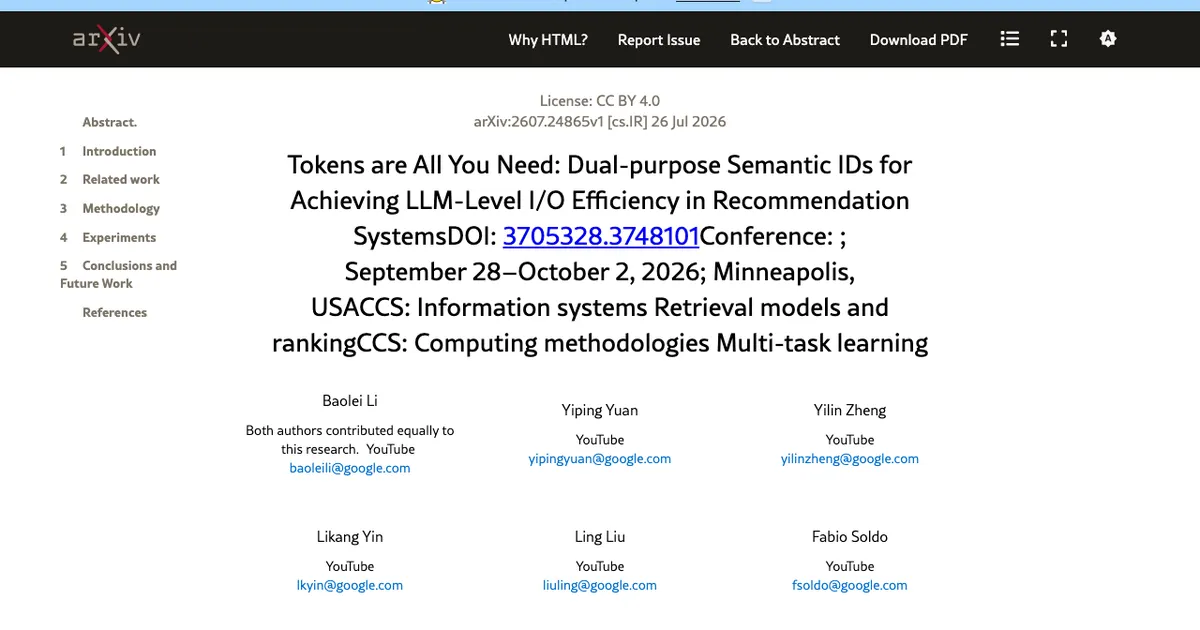
Tokens are All You Need: Dual-purpose Semantic IDs for Achieving LLM-Level I/O Efficiency in recommendation systems
🔥 Breakthrough in Recommendations: Making LLMs Run Leaner!
Large-scale recommendation systems are brilliant, but they hit a major roadblock the moment they get truly massive. These bottlenecks—often called the ‘Memory Wall’—are fundamentally due to having enormous embedding tables. Think gigabytes of dense vectors that just sit there, waiting to be accessed.
That’s where revolutionary research from Baolei Li et al. comes in with their concept: Dual-purpose Semantic IDs.
💾 The Problem: Dense Vectors and the Memory Wall
Traditional recommenders rely on storing vast amounts of high-dimensional, dense embeddings (vectors) for every user and item interaction. While efficient for deep learning models, storing and retrieving these massive vector stores is computationally expensive and slows down real-world production systems.
💡 The Solution: Discrete Tokens are Enough
Inspired by advanced data compression techniques used in computer vision, the authors propose a radical shift: replacing bulky vector storage with compact, discrete IDs—or ‘tokens.’
Their approach is ” and they tackle this problem from two angles simultaneously:
- Collaborative Identity: They use a standard learnable embedding table to model how users interact with items.
- Content Reconstruction (The Magic Part): Instead of storing the full vector, they use a lightweight Semantic Decoder. This decoder can reconstruct an accurate, high-dimensional embedding on demand, using the compact Semantic ID token.
Essentially, this method is performing ” ” on storage and complexity while maintaining (or even improving) model performance. It drastically reduces system overhead and data footprints.
✨ Why This Matters for AI Production
This isn’t just theoretical; the authors successfully deployed this framework in a major video sharing platform’s production-scale ranking and retrieval systems. They prove that highly efficient, content-rich recommendations can be achieved when you realize that discrete tokens are all you need.
This technique promises to unlock the next generation of recommendation engines—making them faster, smaller, more sustainable, and capable of scaling to unprecedented levels of complexity.
🔗 Want to dive into the technical details? Check out the paper: https://arxiv.org/abs/2607.24865
SEO Deep Dive: * Target Audience: ML Engineers, Data Scientists, Infrastructure Architects, Product Managers in Tech. * Key Selling Point: Dramatically reduced memory footprint and faster inference for large-scale recommenders. * Readability Focus: Using bolding, emojis, and clear headings to break down complex concepts into digestible points.
(Keywords: recommendation systems, LLMs, embedding tables, quantization, semantic IDs, ML efficiency, high-dimensional data)
#AI #MachineLearning #LLMEfficiency #RecommenderSystems #TechInnovation #DataScience“