🧠 Decoding Neural Network Robustness: New Limits on Lipschitz Constants
Hey ML enthusiasts and researchers! Have you ever wondered how sensitive an AI model is to tiny changes in input? This isn’t just academic curiosity—it’s crucial for deploying reliable, safe real-world AI systems.
The sensitivity of a Neural Network (NN) is mathematically captured by its Lipschitz constant. Simply put, it measures the maximum stretching factor: how much the output can change compared to the input change. For critical applications like autonomous vehicles or medical diagnosis, we need models that are highly robust and predictable.
Our latest research dives deep into quantifying this robustness for a specific yet important architecture: two-layer Input Convex Neural Networks (ICNNs).
📊 What Did We Prove? The Computational Wall
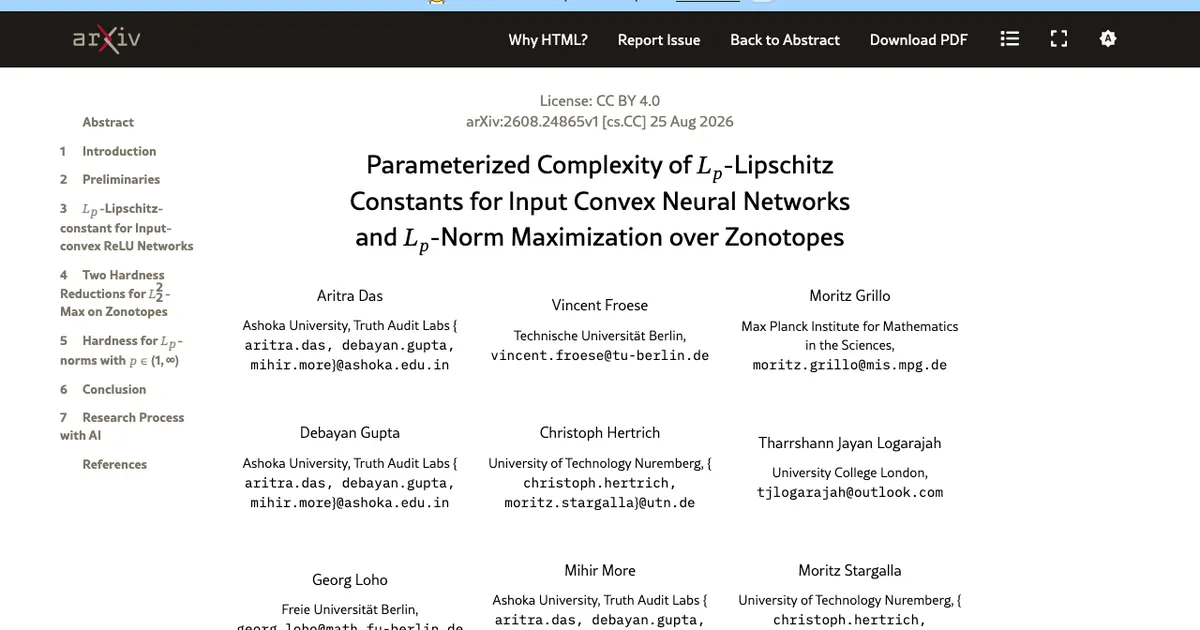
While measuring Lipschitz constants is vital, calculating them has been computationally thorny. Our paper tackles the problem of maximizing certain $L_p$-norms over geometric shapes called zonotopes—a representation crucial for ICNN analysis.
We delivered a major complexity result: For any fixed rational exponent $p
eq 1$, maximizing the $L_p$-norm over a zonotope is W[1]-hard with respect to the dimension $d$. The implications are profound. This doesn’t just mean it’s hard; it suggests that finding exact solutions requires algorithms whose complexity scales poorly, effectively confirming that efficient, polynomial-time general solvers are unlikely.
Crucially, by leveraging duality theory, this hardness result automatically dictates the computational difficulty of determining the $L_p$-Lipschitz constant for two-layer ReLU ICNNs.
💡 In Plain English: If you want to know the exact sensitivity ($ ext{Lip}$) of a complex ICNN model using an $L_p$ norm (like $L_3$, $L_{1.5}$, etc.), don’t expect a quick, simple calculation for high dimensions. The problem is fundamentally hard.
🚀 Why Does This Matter For AI? (The Industry Takeaway)
The computational results force us to rethink how we certify robustness. Instead of aiming for an exact, closed-form solution that scales with input dimension $d$, future work must focus on:
- Approximation Methods: Developing highly efficient approximation algorithms that provide tight bounds without solving the full optimization problem.
- Specialized Hardware/Theory: Identifying restricted classes of inputs or norms where polynomial solutions do exist (e.g., $L_1$ and $L_ ext{inf}$ remain tractable).
- Certification Tooling: Building new theoretical tools that can certify model robustness quickly enough for industrial-scale deployment, moving beyond simple mathematical proofs into practical software.
This paper resolves a long-standing open problem posted at COLT‘25, providing deep foundational insights into the limits of computational feasibility in modern machine learning safety and certification. For those interested in complex optimization, complexity theory, or rigorous NN analysis, this is essential reading!
🔗 Read the Full Paper Here: https://arxiv.org/abs/2608.24865
(Keywords: Machine Learning, AI Safety, Complexity Theory, Lipschitz Constants, Deep Learning, ICNN)