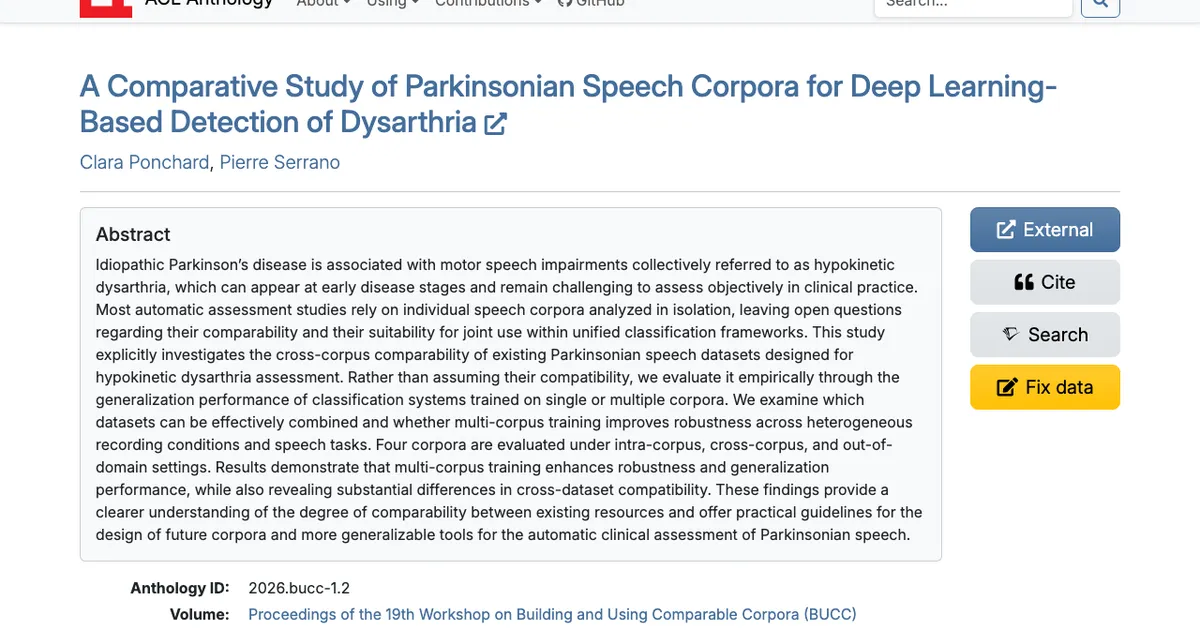
A Comparative Study of Parkinsonian Speech Corpora for Deep Learning-Based Detection of Dysarthria
🎤 Can AI Really Diagnose Parkinson’s From Speech? Understanding the Data Challenge
If you or a loved one are dealing with Parkinson’s disease, you know that speech changes can be a major concern. What makes this complex? Early signs of motor speech impairment (hypokinetic dysarthria) can be tricky to measure objectively in a busy clinic.
Deep Learning models are exciting tools for automated assessment, but they rely entirely on the data we feed them. This cutting-edge study dives deep into the foundational problem: Can we treat multiple Parkinson’s speech datasets as one unified source?
📊 The Data Compatibility Puzzle
Most research treating dysarthria uses individual, siloed datasets. As a tech and ML expert, this immediately raises a red flag: if the data sources are incompatible or non-comparable, your model’s performance will be limited.
Researchers Clara Ponchard and Pierre Serrano tackle this head-on by conducting an empirical study on the cross-corpus comparability of existing Parkinsonian speech datasets. Instead of just assuming compatibility, they test it under three rigorous conditions:
- Intra-Corpus: How well does a model perform within one dataset?
- Cross-Corpus: Can the knowledge learned from Dataset A successfully predict outcomes using Dataset B?
- Out-of-Domain (OOD): Can the system generalize to completely unseen, real-world conditions?
✨ Key Takeaways for AI Healthcare Development
The findings are crucial for anyone building diagnostic tools in this space:
- Multi-Corpus Training Wins: The study proves that training models on combined datasets significantly enhances robustness and generalization performance. Combining multiple data sources makes the resulting AI much stronger.
- Dataset Heterogeneity Matters: It reveals substantial, critical differences in how comparable existing resources actually are. Developers can’t just throw any dataset into a mix; careful vetting is required.
- Practical Guidelines for Future Data: This work offers clear, actionable guidelines for building future speech corpora—helping the entire field move towards standardized, more generalizable tools for automatic clinical assessment.
This research doesn’t propose a new algorithm; instead, it fixes the critical infrastructure layer: the data itself. By making corpus comparability measurable, they are laying essential groundwork for reliable, scalable AI healthcare solutions.