← Back to Archive

Digest for 2026-08-09

🐦 Share on X 💼 Share on LinkedIn 📘 Share on Facebook

A Corpus of Persuasion Techniques in Slavic Languages
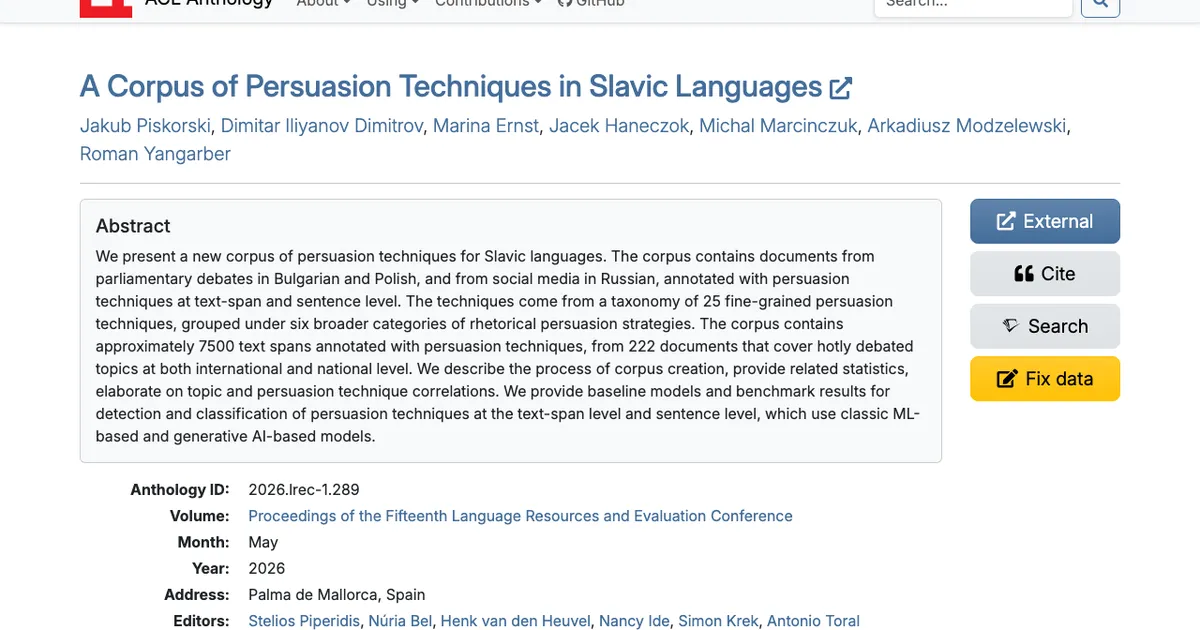
By Jakub Piskorski, Dimitar Iliyanov Dimitrov, Marina Ernst, Jacek Haneczok, Michal Marcinczuk, Arkadiusz Modzelewski and Roman Yangarber in Proceedings of the Fifteenth Language Resources and Evaluation Conference • ACL Anthology • Importance: 80/100
Hero Image for acl_2026.lrec-1.289

Decoding Persuasion: New Corpus for Slavic Languages\n

📢 Attention AI Enthusiasts and Computational Linguists! Deepening our understanding of rhetoric in machine learning is crucial, especially when dealing with politically charged or culturally nuanced texts. We’re excited about a new resource that tackles this challenge head-on.\n\nThe paper, A Corpus of Persuasion Techniques in Slavic Languages, introduces a meticulously annotated dataset designed specifically to train AI models to identify rhetorical strategies—the subtle art of persuasion—across multiple Slavic languages (Bulgarian, Polish, and Russian).\n\n### 🧠 What is this Corpus? (More Than Just Text)\n\nThis isn’t just another pile of words. This specialized corpus is built from high-stakes textual sources: official parliamentary debates and volatile social media discussions. Its goal is to capture how persuasion works in the real world, covering hotly debated topics at both national and international levels.\n\nResearchers annotated approximately 7,500 text spans using a sophisticated taxonomy of 25 fine-grained persuasion techniques, grouped under six major rhetorical categories. This granular detail allows models to distinguish between subtle manipulative language and genuine argumentation.\n\n### ✨ Why Does This Matter for NLP/ML? (The Impact)\n Identifying persuasive intent is one of the hardest problems in Natural Language Processing (NLP) because it requires understanding context, tone, cultural idioms, and rhetorical structure—it’s not just about syntax. Traditional sentiment analysis often misses this depth.\n\nThe authors provide strong baseline models and benchmarks for both text-span and sentence-level detection, comparing classic ML approaches with cutting-edge Generative AI models. This gives the research community a powerful tool to test the limits of modern NLP in these complex linguistic domains.\n
🌐 Key Takeaways & Who Should Care? (SEO Focus)\n Domain: Rhetoric, Political Science, Computational Linguistics. Perfect for those building ethical AI or advanced language understanding tools. \n Coverage: Three major Slavic languages (Bulgarian, Polish, Russian). Critical for global NLP research and machine translation improvements in Eastern Europe.\n Tooling: Provides a ready-to-use benchmark dataset, accelerating research into argumentative structure detection. \n\n🔗 Read the full paper here:* https://aclanthology.org/2026.lrec-1.289/\n

NLP #ComputationalLinguistics #SlavicLanguages #MachineLearning #AIethics #Rhetoric

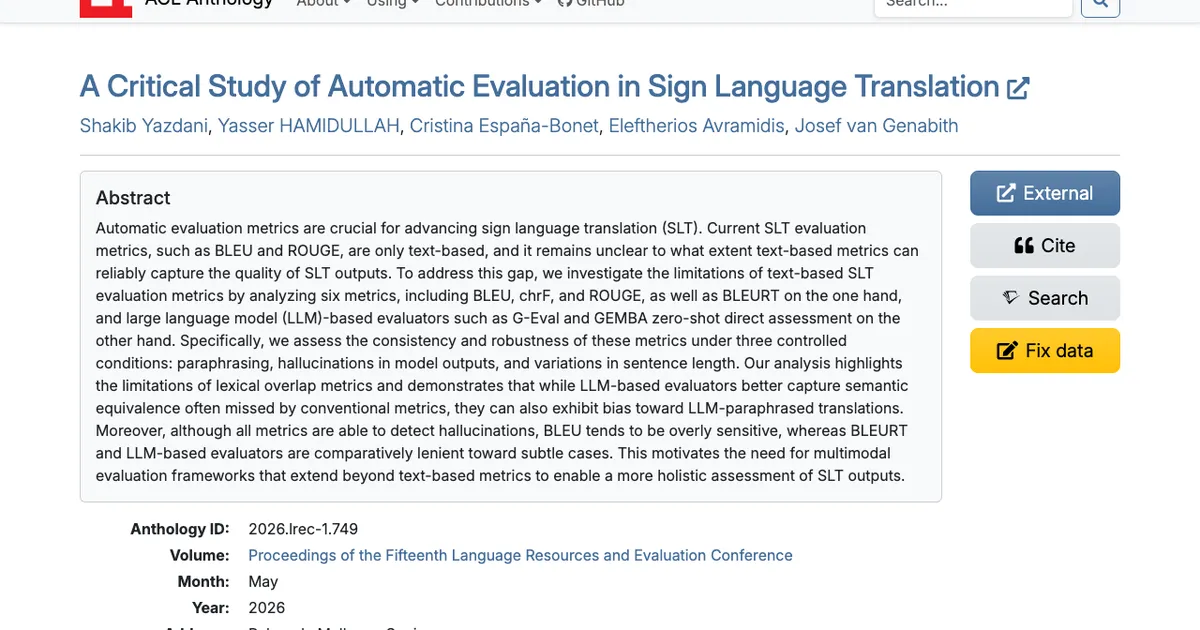
A Critical Study of Automatic Evaluation in Sign Language Translation

By Shakib Yazdani, Yasser HAMIDULLAH, Cristina España-Bonet, Eleftherios Avramidis and Josef van Genabith in Proceedings of the Fifteenth Language Resources and Evaluation Conference • ACL Anthology • Importance: 80/100
Hero Image for acl_2026.lrec-1.749

🤖 Stop Grading Signs with Text Scores! The Future of SLT Evaluation is Multimodal

(A Critical Look at Automatic Metrics for Sign Language Translation)

As AI rapidly progresses, evaluating complex systems like Sign Language Translation (SLT) is crucial. Yet, most current tools—including the standard metrics you hear about (like BLEU and ROUGE)—treat signs as if they were just text. This is a fundamental flaw that researchers must address.

In our new study, we dove deep into how these evaluation metrics actually perform when judging AI-generated sign language interpretations. Our findings reveal major limitations:

🚨 The Big Problem: Text Metrics Can’t See the Whole Picture

The abstract was clear: Sign Language is not just English written out. It’s a complex, visual language that requires context and grammar invisible to simple lexical overlap metrics.

We rigorously tested six different evaluation types—from traditional text matchers (BLEU, chrF) to advanced Large Language Model (LLM)-based evaluators (G-Eval, GEMBA)—across challenging scenarios like paraphrasing, model hallucinations, and varying sentence lengths.

🔬 Key Findings You Need to Know:

  1. Lexical Limits: Traditional metrics fail because they only count shared words, ignoring semantic meaning or proper signing grammar.
  2. LLMs Improve, But Don’t Fix Everything: While using LLMs drastically improves the capture of semantic equivalence (the real meaning), these advanced tools are not perfect. They can sometimes show a bias toward translations that sound like they were generated by other AI models.
  3. Hallucination Detection Challenges: While most metrics detect when an AI makes up content (‘hallucinations’), they do it differently. BLEU is often overly sensitive, while newer LLM-based methods are comparatively more lenient on subtle errors.

The Takeaway? No single metric can score SLT accurately. We urgently need multimodal evaluation frameworks—tools that combine visual understanding (the signs) with language intelligence (the meaning)—to achieve a truly holistic assessment of SLT outputs.


🔗 Want to read the full deep dive into our findings? Check out the proceedings at https://aclanthology.org/2026.lrec-1.749/

#AIResearch #SignLanguage #NaturalLanguageProcessing #MLEvaluation #DeepLearning

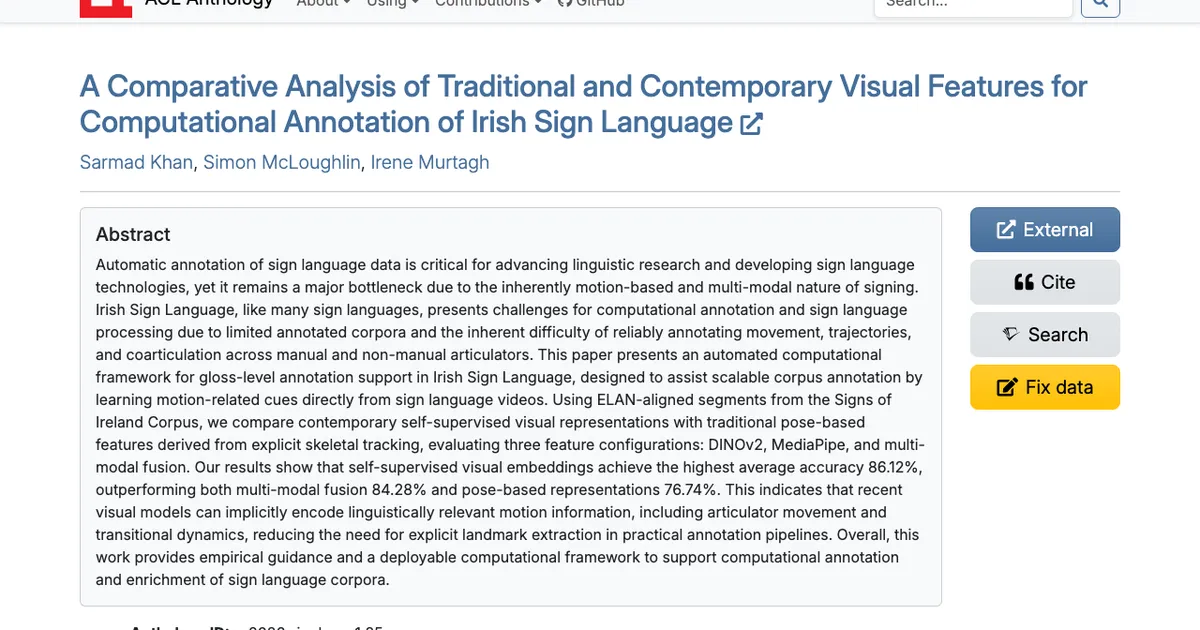
A Comparative Analysis of Traditional and Contemporary Visual Features for Computational Annotation of Irish Sign Language

By Sarmad Khan, Simon McLoughlin and Irene Murtagh in Proceedings of the LREC 2026 12th Workshop on the Representation and Processing of Sign Languages: Language in Motion • ACL Anthology • Importance: 75/100
Hero Image for acl_2026.signlang-1.25

Is AI the Key to Decoding Irish Sign Language? We Compared Modern Visual Tech vs. Traditional Robotics.

Have you ever wondered how computers ‘see’ language—especially a rich, nuanced form like sign language? It’s incredibly complex! Signing isn’t just hand gestures; it involves facial expressions, body movement, and continuous motion that makes traditional recognition systems struggle.

As an ML researcher who works with multimodal data, I know the bottleneck: properly annotating massive sign language datasets. You need granular, reliable labels for every tiny movement (coarticulation) across both hands and face—a nightmare task even for human experts, let alone AI.

That’s where this breakthrough research comes in. This paper tackles computational annotation for Irish Sign Language by comparing cutting-edge deep learning features against classic computer vision methods. The core question was: are fancy pre-trained visual models (like DINOv2) better at understanding signing than explicit skeleton tracking (like MediaPipe)?

🧠 What We Tested: * Traditional Approach: Pose-based features derived from explicit skeletal tracking (e.g., joint coordinates). * Modern AI Approach: Self-supervised visual representations learned from massive datasets (e.g., DINOv2 embeddings) which implicitly capture context and motion. * Hybrid Approach: Fusion of the above two.

🚀 The Game Changer Result: The study found that self-supervised visual embeddings achieved significantly higher accuracy (86.12%), beating out both pose-based systems and multi-modal fusion methods.

What does this mean for researchers and developers working with sign languages? It means we might be able to move away from the incredibly complex requirement of explicitly labeling every single joint coordinate in a video, which massively simplifies practical corpus annotation pipelines! The visual model seems to implicitly ‘learn’ linguistically relevant motion cues like articulator movement and transitional dynamics.

💡 Why This Matters for Sign Language Technology: 1. Scalability: It provides a deployable framework to enrich existing sign language corpora (like the Signs of Ireland Corpus). More annotated data = better AI models. 2. Accessibility: Better computational annotation leads directly to more robust and accurate Sign Language Interpreting/Recognition tools, improving accessibility for the Deaf community. 3. Efficiency: By showing that advanced visual models can capture motion implicitly, this research drastically reduces the technical burden on annotators and researchers building these essential datasets.

This is fantastic empirical guidance supporting the next generation of sign language processing. Check out the full details here: A Language in Motion Link

#IrishSignLanguage #SignLanguageAI #ComputerVision #DeepLearning #AccessibilityTech #NLP #MLResearch

Explore Recent Digests