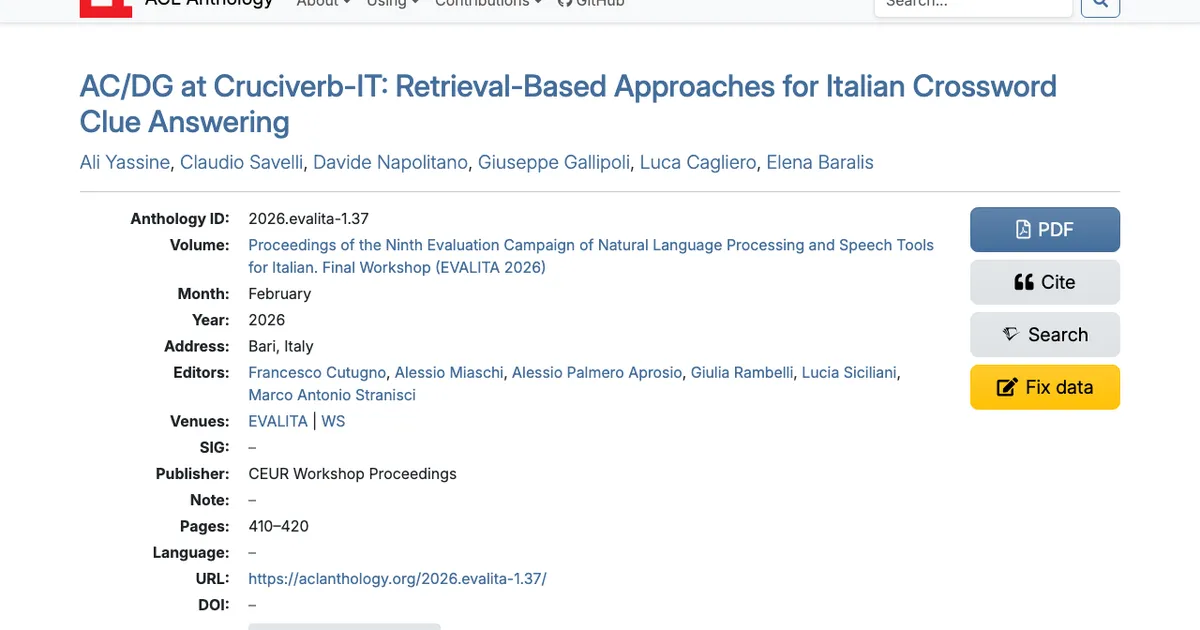
AC/DG at Cruciverb-IT: Retrieval-Based Approaches for Italian Crossword Clue Answering
Decoding Crosswords: How AI is Solving the Italian Language Puzzle 🧩🇮🇹
Are you a puzzle master? We’ve all been there—staring at cryptic clues, knowing the answer must fit an unusual sequence of letters. But what if solving crosswords wasn’t just human intuition? What if an advanced AI could systematically tackle complex linguistic challenges like Italian crossword clue answering?
That’s exactly what researchers tackled in this fascinating study presented at EVALITA 2026. This work explores specialized retrieval-based methods to bridge the gap between natural language understanding and highly constrained structured knowledge, using Italian crosswords as the ultimate test case.
💡 What Problem Did They Solve?
The challenge of crossword clue answering is deceptively hard. It’s not enough just to understand the meaning of a clue; you must also figure out the correct length, fit the available letters, and adhere to complex linguistic patterns all at once. The study focuses on applying state-of-the-art retrieval techniques specifically tailored for the nuances and structures inherent in the Italian language.
🔍 Key Tech Deep Dive: Retrieval Systems
At its heart, the research leverages advanced Retrieval-Based Approaches. Instead of relying purely on generating a single answer from general knowledge (like a standard LLM prompt), these models retrieve candidate solutions from a curated knowledge base that is highly relevant to specific domains. This structured approach dramatically improves accuracy when the answer space is finite and constrained—perfect for crosswords.
For Italian, this means developing specialized mechanisms that understand idiomatic expressions, regional variations, and precise syntactic structures unique to Italian vocabulary.
🚀 Why Does This Matter? (The Bigger Picture)
This paper isn’t just about filling in squares; it’s a foundational piece for multilingual NLP systems. The techniques developed here—combining deep contextual understanding with precision retrieval—are crucial for: * Niche Language Tasks: Improving performance on low-resource or highly structured language domains (like historical texts, specialized vocabulary quizzes). * Cross-Lingual AI: Developing robust tools that can handle complex rulesets and constraints across different languages. * AI Game Theory: Creating sophisticated solvers for complex puzzle formats beyond traditional Q&A interfaces.
If you are working on advanced NLP systems, multilingual modeling, or structured knowledge extraction, these retrieval strategies offer valuable insights into moving AI beyond general conversation toward pinpoint accuracy in constrained environments.
Read the full research paper here: https://aclanthology.org/2026.evalita-1.37/